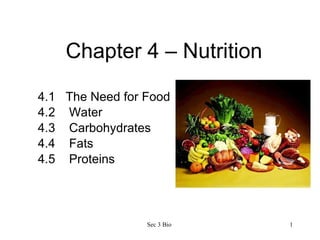
Chapter 4 – Nutrition 4.1  The Need for Food 4.2  Water 4.3  Carbohydrates 4.4  Fats 4.5  Proteins Sec 3 Bio
Learning Objectives Candidates should be able to: State the roles of water in living organisms List the chemical elements which make up carbohydrates, fat, proteins. Describe tests for starch (iodine solution), reducing sugars (Benedict ’ s solution), protein (biuret test), fats (ethanol emulsion). State that large molecules are synthesized from smaller basic units Glycogen from glucose Polypeptides and proteins from amino acids Lipids such as fats from glycerol and fatty acids
4.1 The need for food Provide energy  for the vital activities of the body. Synthesis new protoplasm  for  cell growth ,  repair  of worn-out parts of the body and cell division. Stay healthy.
Nutrients Definition: Nutrients are  chemical substances  in food that provide  energy  and  materials needed  by the body.  They are substances needed by the body for good health.
How Many Types of Nutrients Are There? Carbohydrates,  Fats,  Proteins,  Vitamins,  Minerals,  W ater.   Fibre
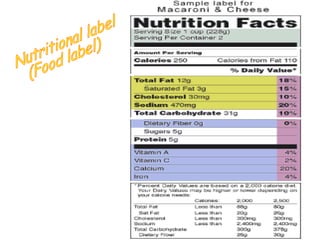
Nutritional label  (Food label)
Nutrients Ingredients
4.2 Water 60% to 70% of the body weight is  water . Medium  or substance in which chemical reactions occur in an organism. Regulation  of body temperature Water is needed for  transportation  of  -digested   food , -Excretory products, -Hormones Water is also the key component of : -Protoplasm -lubricants found in joints -digestive juices -blood -tissue fluid
4.2 Water In animals: Required for certain reactions such as hydrolysis (breakdown of substances in the presence of water) Help control body temperature through sweating In plants: Needed for photosynthesis Helps keep the plant upright through turgor pressure Needed to transport mineral salts from roots to leaves Needed to transport food substances from leaves to all parts of the body
4.3 Carbohydrates Carbohydrates are  organic compounds  made up of the elements  carbon ,  hydrogen  and  oxygen .  The general formula is:  C n H 2m O m Ratio of hydrogen and oxygen is  2: 1 E.g. glucose: C 6 H 12 O 6 E.g. sucrose: C 12 H 22 O 11
Types of Carbohydrates Monosaccharides  (Simple Sugars) -E.g. Glucose, Fructose, Galactose Disaccharides  (Double Sugars) -E.g. Maltose (malt sugar), Lactose (milk sugar), Sucrose (cane sugar) Glucose + fructose    sucrose Glucose + glucose    maltose Glucose + galactose    lactose Polysaccharides ( Complex Sugars) -E.g. Starch, Cellulose, Glycogen
Fructose Glucose Galactose
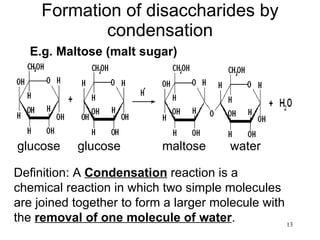
Formation of disaccharides by condensation E.g. Maltose (malt sugar) Definition: A  Condensation  reaction is a chemical reaction in which two simple molecules are joined together to form a larger molecule with the  removal of one molecule of water . glucose  glucose  maltose  water
Digestion of disaccharides by  hydrolysis maltose  glucose  glucose maltase Definition:  Hydrolysis  is a chemical reaction in which  a water molecule is needed  to break up a complex molecule into small molecules.
Polysaccharides Polysaccharides( Complex Sugars): consist of many monosaccharides (simple sugars) Eg. Starch, Cellulose, Glycogen By which process is polysaccharides formed?
Test for reducing sugars (Benedict’s Test)
Results Blue to  orange-red   precipitate Blue to  yellow or orange  precipitate. Blue to  green  precipitate. Large amount  of reducing sugar is present. Moderate amount  of  reducing sugar is present. Traces  of  reducing sugar is present. Conclusion
This equipment  is used to find out nutrients found in food products .
Applications of Food Test In food, dairy and agricultural industries.  Used by food biotechnologists, nutritionists
Functions of carbohydrates A  substrate for respiration , to provide energy for cell activities; Form s upporting  structures e.g cell wall Converted into other organic compounds such as amino acids and fats Formation of  nucleic acids  e.g. DNA Synthesis  lubricant s e.g. mucus Synthesis  nectar  in some flowers
Where can we find carbohydrates?   Carbohydrates are found in: -Starch: Bread, Rice, Pasta, Potatoes -Sugars: Soft drinks, sweet fruits, sweets
4.4 Fats They are organic compounds made up of the elements  carbon ,  hydrogen  and  oxygen .  Fats contain much less oxygen in proportion to hydrogen. E.g. tristearin C  57  H 110  O 6 A fat molecule GLYCEROL FATTY ACIDS
What make up fats? Carbon (C)  Hydrogen (H)  Oxygen (O) 3 fatty acids    glycerol
Fats It can be broken down into  fatty acids and glycerol  by  hydrolysis. +     +  Fat molecule  3 water molecules  glycerol  three fatty acid molecules
Differences between saturated fats and unsaturated fats Saturated fats Found mostly in animals Solid at room temperature Eg. Butter Fatty acid chains are straight Unsaturated fats Found mostly in vegetables Liquid at room temperature Eg. Olive oil Fatty acid chains are bent in some places -A fatty substance called  cholesterol  is usually found together with polysaturated fats. Too much polysaturated fats and cholesterol in the diet may cause coronary heart disease.
Test for Fats (Ethanol Emulsion Test)
Functions of fats Source  and  store of energy Insulating material  preventing excess heat loss. A  solvent  for fat-soluble vitamins and other vital substances such as hormones. An essential part of the  protoplasm , especially in cell membrane. To reduce water loss from skin surface.
Where can we find fats? Fats are found in: Butter, nuts, certain parts of meat. Types of fats: Saturated Found in animals fats Usually found with cholesterol Unsaturated Found in vegetable fats
4.5 Proteins The chemical elements in proteins are  carbon ,  hydrogen ,  oxygen  and  nitrogen .  Often  sulphur  and  phosphorus  are present too.
Amino acids  are the building blocks of proteins. T here are  2  types of amino acids,  essential   and  non-essential . There are  9  essential amino acids that must be supplied by the food you eat. Proteins
Proteins An amino acid is made up of a  amino group   (-NH2),  and  acidic group   (-COOH)  and a side chain  (-R)
Proteins Two amino acids link up in a  condensation  reaction. The bond formed is called a  peptide bond .
Proteins Many amino acids linked up by peptide bond to form a  peptone  or  polypeptide . Polypeptides may link up to form long chains of amino acids.  Protein molecule  is formed when the chains fold together.
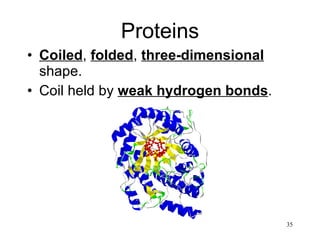
Proteins Coiled ,  folded ,  three-dimensional  shape. Coil held by  weak hydrogen bonds .
Test for Proteins  (Biuret Test)
Proteins are needed for:  growth  and  repair  of tissues synthesis  of  enzymes, antibodies  and  hormones supply of  energy Functions of proteins
Where can we find proteins? Proteins are found in: Fish, meat, eggs, milk and milk products, beans
What is a Balanced Diet? A balanced diet should contain the  right  amount of: carbohydrates,  fats, proteins, vitamins,  minerals,  water  and  roughage   to meet the daily requirements of the body.
Protein deficiency Leads to  Kwashiorkor Symptoms: Swollen stomachs, skin crack and become scaly.
Carbohydrates NUTRIENTS may be Functions of water   In animals, water:  • is a medium for chemical reactions to occur;  • transports digested food products, excretory products, and hormones from one part of the body to another;  • is an essential part of protoplasm, lubricants, digestive juices and blood;  • is essential for hydrolysis; and  • helps to control body temperature. Monosaccharides (single sugars), e.g. glucose, fructose and galactose In plants, water:  • is essential for photosynthesis;  • is needed to keep plant cells turgid;  • transports mineral salts from the roots to the leaves; and  • transports food substances from the leaves to other parts of the plants. Water Fats Organic compounds made up of carbon, hydrogen and oxygen but they contain much less oxygen in proportion to hydrogen. Organic compounds made up of carbon, hydrogen and oxygen in a ratio of 1 : 2 : 1. Organic compounds made up of carbon, hydrogen, oxygen and nitrogen. Sulphur may also be present. Inorganic nutrient. Water does not contain carbon. Proteins Disaccharides (double sugars), e.g. maltose, lactose and sucrose Polysaccharides (complex carbohydrates) made up of many monosaccharides e.g. Starch Glycogen Cellulose •  forms the cell walls in plants; and  • cannot be digested by mammals, but is used as fibre in their diet. Identification   Test for reducing sugars: A reducing sugar gives a brick-red precipitate when boiled with Benedict’s solution. Sucrose is a non-reducing sugar. •  serves as the main form of storage for carbohydrates in green plants; and  • gives a blue-black colour with iodine (test for starch). •  serves as the main form of storage for carbohydrates in animals and fungi. Basic units   Fats are hydrolysed to form fatty acids and glycerol. Identification   Test for fats: A cloudy white emulsion is formed in the ethanol emulsion test. Basic units   Proteins consist of amino acids linked together by peptide bonds.  Identification   Test for proteins: Proteins give a violet colouration with Biuret reagent. amino acids polypeptides proteins

Chapter 4 nutrition 2011

  • 1.
    Chapter 4 –Nutrition 4.1 The Need for Food 4.2 Water 4.3 Carbohydrates 4.4 Fats 4.5 Proteins Sec 3 Bio
  • 2.
    Learning Objectives Candidatesshould be able to: State the roles of water in living organisms List the chemical elements which make up carbohydrates, fat, proteins. Describe tests for starch (iodine solution), reducing sugars (Benedict ’ s solution), protein (biuret test), fats (ethanol emulsion). State that large molecules are synthesized from smaller basic units Glycogen from glucose Polypeptides and proteins from amino acids Lipids such as fats from glycerol and fatty acids
  • 3.
    4.1 The needfor food Provide energy for the vital activities of the body. Synthesis new protoplasm for cell growth , repair of worn-out parts of the body and cell division. Stay healthy.
  • 4.
    Nutrients Definition: Nutrientsare chemical substances in food that provide energy and materials needed by the body. They are substances needed by the body for good health.
  • 5.
    How Many Typesof Nutrients Are There? Carbohydrates, Fats, Proteins, Vitamins, Minerals, W ater. Fibre
  • 6.
    Nutritional label (Food label)
  • 7.
  • 8.
    4.2 Water 60%to 70% of the body weight is water . Medium or substance in which chemical reactions occur in an organism. Regulation of body temperature Water is needed for transportation of -digested food , -Excretory products, -Hormones Water is also the key component of : -Protoplasm -lubricants found in joints -digestive juices -blood -tissue fluid
  • 9.
    4.2 Water Inanimals: Required for certain reactions such as hydrolysis (breakdown of substances in the presence of water) Help control body temperature through sweating In plants: Needed for photosynthesis Helps keep the plant upright through turgor pressure Needed to transport mineral salts from roots to leaves Needed to transport food substances from leaves to all parts of the body
  • 10.
    4.3 Carbohydrates Carbohydratesare organic compounds made up of the elements carbon , hydrogen and oxygen . The general formula is: C n H 2m O m Ratio of hydrogen and oxygen is 2: 1 E.g. glucose: C 6 H 12 O 6 E.g. sucrose: C 12 H 22 O 11
  • 11.
    Types of CarbohydratesMonosaccharides (Simple Sugars) -E.g. Glucose, Fructose, Galactose Disaccharides (Double Sugars) -E.g. Maltose (malt sugar), Lactose (milk sugar), Sucrose (cane sugar) Glucose + fructose  sucrose Glucose + glucose  maltose Glucose + galactose  lactose Polysaccharides ( Complex Sugars) -E.g. Starch, Cellulose, Glycogen
  • 12.
  • 13.
    Formation of disaccharidesby condensation E.g. Maltose (malt sugar) Definition: A Condensation reaction is a chemical reaction in which two simple molecules are joined together to form a larger molecule with the removal of one molecule of water . glucose glucose maltose water
  • 14.
    Digestion of disaccharidesby hydrolysis maltose glucose glucose maltase Definition: Hydrolysis is a chemical reaction in which a water molecule is needed to break up a complex molecule into small molecules.
  • 15.
    Polysaccharides Polysaccharides( ComplexSugars): consist of many monosaccharides (simple sugars) Eg. Starch, Cellulose, Glycogen By which process is polysaccharides formed?
  • 16.
    Test for reducingsugars (Benedict’s Test)
  • 17.
    Results Blue to orange-red precipitate Blue to yellow or orange precipitate. Blue to green precipitate. Large amount of reducing sugar is present. Moderate amount of reducing sugar is present. Traces of reducing sugar is present. Conclusion
  • 18.
    This equipment is used to find out nutrients found in food products .
  • 19.
    Applications of FoodTest In food, dairy and agricultural industries. Used by food biotechnologists, nutritionists
  • 20.
    Functions of carbohydratesA substrate for respiration , to provide energy for cell activities; Form s upporting structures e.g cell wall Converted into other organic compounds such as amino acids and fats Formation of nucleic acids e.g. DNA Synthesis lubricant s e.g. mucus Synthesis nectar in some flowers
  • 21.
    Where can wefind carbohydrates? Carbohydrates are found in: -Starch: Bread, Rice, Pasta, Potatoes -Sugars: Soft drinks, sweet fruits, sweets
  • 22.
    4.4 Fats Theyare organic compounds made up of the elements carbon , hydrogen and oxygen . Fats contain much less oxygen in proportion to hydrogen. E.g. tristearin C 57 H 110 O 6 A fat molecule GLYCEROL FATTY ACIDS
  • 23.
    What make upfats? Carbon (C) Hydrogen (H) Oxygen (O) 3 fatty acids glycerol
  • 24.
    Fats It canbe broken down into fatty acids and glycerol by hydrolysis. +  + Fat molecule 3 water molecules glycerol three fatty acid molecules
  • 25.
    Differences between saturatedfats and unsaturated fats Saturated fats Found mostly in animals Solid at room temperature Eg. Butter Fatty acid chains are straight Unsaturated fats Found mostly in vegetables Liquid at room temperature Eg. Olive oil Fatty acid chains are bent in some places -A fatty substance called cholesterol is usually found together with polysaturated fats. Too much polysaturated fats and cholesterol in the diet may cause coronary heart disease.
  • 26.
    Test for Fats(Ethanol Emulsion Test)
  • 27.
    Functions of fatsSource and store of energy Insulating material preventing excess heat loss. A solvent for fat-soluble vitamins and other vital substances such as hormones. An essential part of the protoplasm , especially in cell membrane. To reduce water loss from skin surface.
  • 28.
    Where can wefind fats? Fats are found in: Butter, nuts, certain parts of meat. Types of fats: Saturated Found in animals fats Usually found with cholesterol Unsaturated Found in vegetable fats
  • 29.
    4.5 Proteins Thechemical elements in proteins are carbon , hydrogen , oxygen and nitrogen . Often sulphur and phosphorus are present too.
  • 30.
    Amino acids are the building blocks of proteins. T here are 2 types of amino acids, essential and non-essential . There are 9 essential amino acids that must be supplied by the food you eat. Proteins
  • 31.
    Proteins An aminoacid is made up of a amino group (-NH2), and acidic group (-COOH) and a side chain (-R)
  • 33.
    Proteins Two aminoacids link up in a condensation reaction. The bond formed is called a peptide bond .
  • 34.
    Proteins Many aminoacids linked up by peptide bond to form a peptone or polypeptide . Polypeptides may link up to form long chains of amino acids. Protein molecule is formed when the chains fold together.
  • 35.
    Proteins Coiled , folded , three-dimensional shape. Coil held by weak hydrogen bonds .
  • 36.
    Test for Proteins (Biuret Test)
  • 37.
    Proteins are neededfor: growth and repair of tissues synthesis of enzymes, antibodies and hormones supply of energy Functions of proteins
  • 38.
    Where can wefind proteins? Proteins are found in: Fish, meat, eggs, milk and milk products, beans
  • 39.
    What is aBalanced Diet? A balanced diet should contain the right amount of: carbohydrates, fats, proteins, vitamins, minerals, water and roughage to meet the daily requirements of the body.
  • 40.
    Protein deficiency Leadsto Kwashiorkor Symptoms: Swollen stomachs, skin crack and become scaly.
  • 41.
    Carbohydrates NUTRIENTS maybe Functions of water In animals, water: • is a medium for chemical reactions to occur; • transports digested food products, excretory products, and hormones from one part of the body to another; • is an essential part of protoplasm, lubricants, digestive juices and blood; • is essential for hydrolysis; and • helps to control body temperature. Monosaccharides (single sugars), e.g. glucose, fructose and galactose In plants, water: • is essential for photosynthesis; • is needed to keep plant cells turgid; • transports mineral salts from the roots to the leaves; and • transports food substances from the leaves to other parts of the plants. Water Fats Organic compounds made up of carbon, hydrogen and oxygen but they contain much less oxygen in proportion to hydrogen. Organic compounds made up of carbon, hydrogen and oxygen in a ratio of 1 : 2 : 1. Organic compounds made up of carbon, hydrogen, oxygen and nitrogen. Sulphur may also be present. Inorganic nutrient. Water does not contain carbon. Proteins Disaccharides (double sugars), e.g. maltose, lactose and sucrose Polysaccharides (complex carbohydrates) made up of many monosaccharides e.g. Starch Glycogen Cellulose • forms the cell walls in plants; and • cannot be digested by mammals, but is used as fibre in their diet. Identification Test for reducing sugars: A reducing sugar gives a brick-red precipitate when boiled with Benedict’s solution. Sucrose is a non-reducing sugar. • serves as the main form of storage for carbohydrates in green plants; and • gives a blue-black colour with iodine (test for starch). • serves as the main form of storage for carbohydrates in animals and fungi. Basic units Fats are hydrolysed to form fatty acids and glycerol. Identification Test for fats: A cloudy white emulsion is formed in the ethanol emulsion test. Basic units Proteins consist of amino acids linked together by peptide bonds. Identification Test for proteins: Proteins give a violet colouration with Biuret reagent. amino acids polypeptides proteins

Editor's Notes

  • #42 Concept Map page 69