D.1 – HUMAN NUTRITION
D.2 – DIGESTION
D.3 – THE LIVER
D.4 – THE HEART
OPTION D
D.1 - HUMAN NUTRITION
1. ESSENTIAL VS. NON
ESSENTIAL
DIET
• THE TOTAL FOOD INTAKE BY AN
ORGANISM.
• Nutrition – the supply of
nutrients.
NUTRIENTS
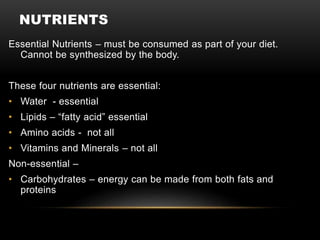
Essential Nutrients – must be consumed as part of your diet.
Cannot be synthesized by the body.
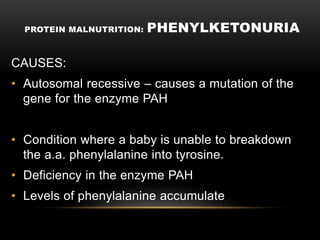
These four nutrients are essential:
• Water - essential
• Lipids – “fatty acid” essential
• Amino acids - not all
• Vitamins and Minerals – not all
Non-essential –
• Carbohydrates – energy can be made from both fats and
proteins
AMINO ACIDS
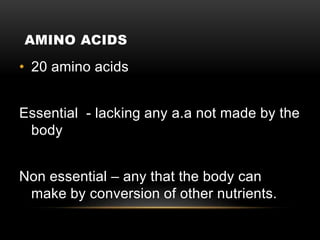
• 20 amino acids
Essential - lacking any a.a not made by the
body
Non essential – any that the body can
make by conversion of other nutrients.
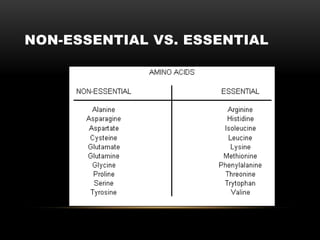
NON-ESSENTIAL VS. ESSENTIAL
FATS
• Storage of energy
• Insulation of body against temperature changes
• Fat around some organs provides shock
absorbers
• Cell membrane - phospholipid
VITAMIN AND MINERALS
• Can be distinguished by their chemical nature
Minerals –
• Chemical elements; usually ionic
Vitamins –
• All organic
Cannot be made by the body - essential
2. ENERGY
IN
HUMAN
DIETS
COMPARISON OF ENERGY
IN NUTRIENTS.
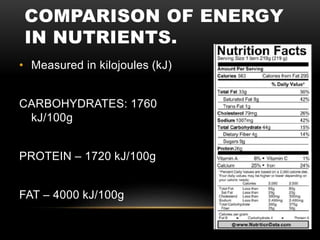
• Measured in kilojoules (kJ)
CARBOHYDRATES: 1760
kJ/100g
PROTEIN – 1720 kJ/100g
FAT – 4000 kJ/100g
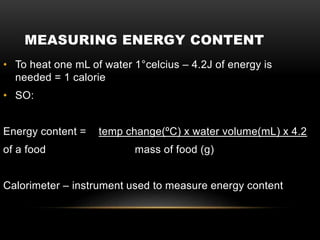
MEASURING ENERGY CONTENT
• To heat one mL of water 1°celcius – 4.2J of energy is
needed = 1 calorie
• SO:
Energy content = temp change(ÂşC) x water volume(mL) x 4.2
of a food mass of food (g)
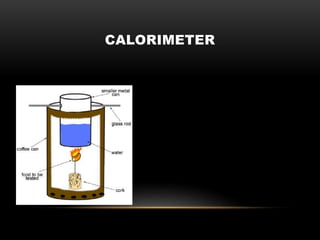
Calorimeter – instrument used to measure energy content
CALORIMETER
3. READING NUTRITIONAL DATABASES
• VITAMIN AND MINERAL
• NUTRIENT DATABASE
• NUTRITONAL CONTENT IN FOODS
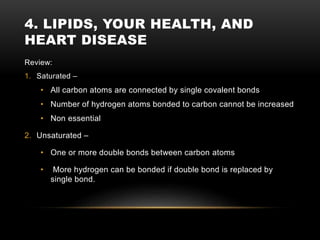
4. LIPIDS, YOUR HEALTH, AND
HEART DISEASE
Review:
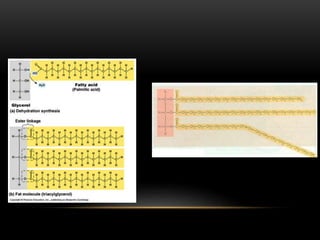
1. Saturated –
• All carbon atoms are connected by single covalent bonds
• Number of hydrogen atoms bonded to carbon cannot be increased
• Non essential
2. Unsaturated –
• One or more double bonds between carbon atoms
• More hydrogen can be bonded if double bond is replaced by
single bond.
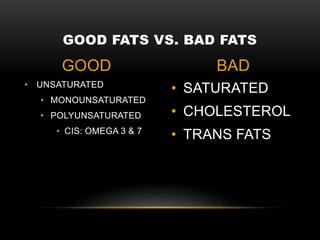
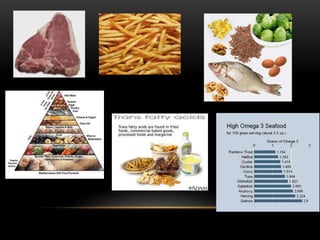
• SATURATED
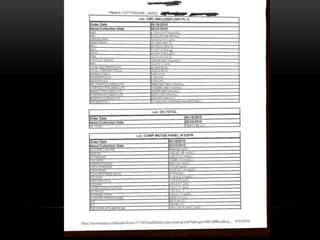
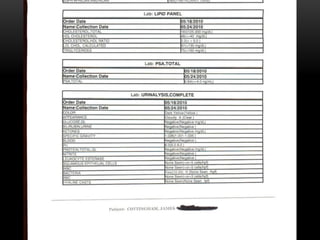
• CHOLESTEROL
• TRANS FATS
• UNSATURATED
• MONOUNSATURATED
• POLYUNSATURATED
• CIS: OMEGA 3 & 7
GOOD FATS VS. BAD FATS
GOOD BAD
FATTY ACIDS AND HEALTH - CHOLESTEROL
HDL vs. LDL – produced in the liver
CHOLESTEROL travels in the blood attached to a protein
• Low Density Lipoprotein – transports cholesterol and triglycerides from
the liver around the body…tends to deposit on artery walls.
• “Bad cholesterol” “Lousy”
• High Density Lipoproteins - transports excess cholesterol and
triglycerides from body to the liver.
• “Good cholesterol” “Happy”
Other source of FAT:
• Triglycerides - another type of fat produced by excess calories,
alcohol, and sugar (very LDL)
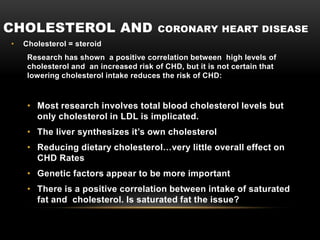
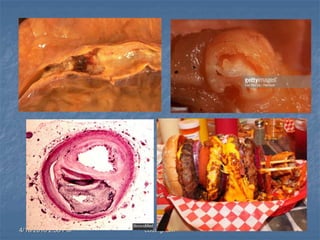
CHOLESTEROL AND CORONARY HEART DISEASE
• Cholesterol = steroid
Research has shown a positive correlation between high levels of
cholesterol and an increased risk of CHD, but it is not certain that
lowering cholesterol intake reduces the risk of CHD:
• Most research involves total blood cholesterol levels but
only cholesterol in LDL is implicated.
• The liver synthesizes it’s own cholesterol
• Reducing dietary cholesterol…very little overall effect on
CHD Rates
• Genetic factors appear to be more important
• There is a positive correlation between intake of saturated
fat and cholesterol. Is saturated fat the issue?
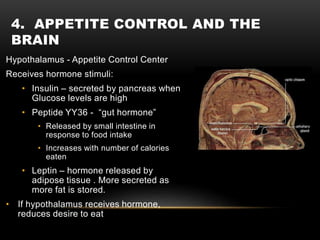
4. APPETITE CONTROL AND THE
BRAIN
Hypothalamus - Appetite Control Center
Receives hormone stimuli:
• Insulin – secreted by pancreas when
Glucose levels are high
• Peptide YY36 - “gut hormone”
• Released by small intestine in
response to food intake
• Increases with number of calories
eaten
• Leptin – hormone released by
adipose tissue . More secreted as
more fat is stored.
• If hypothalamus receives hormone,
reduces desire to eat
5. NUTRIENT DEFICIENCY DISEASES/DISORDERS
Malnutrition – a deficiency, imbalance,
or excess or specific nutrients in the
diet.
Starvation – severe lack of intake of
both essential and non-essential
nutrients.
• Results in breakdown of body tissue
VITAMIN AND MINERALS
• Can be distinguished by their chemical nature
Minerals –
• Chemical elements; usually ionic
Vitamins –
• All organic
Cannot be made by the body - essential
VITAMIN C
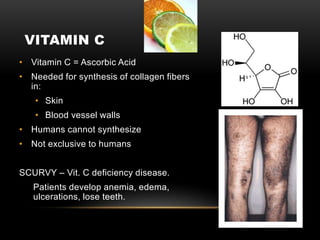
• Vitamin C = Ascorbic Acid
• Needed for synthesis of collagen fibers
in:
• Skin
• Blood vessel walls
• Humans cannot synthesize
• Not exclusive to humans
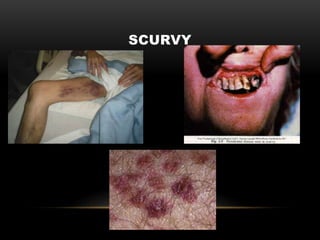
SCURVY – Vit. C deficiency disease.
Patients develop anemia, edema,
ulcerations, lose teeth.
SCURVY
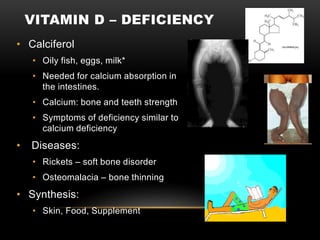
VITAMIN D – DEFICIENCY
• Calciferol
• Oily fish, eggs, milk*
• Needed for calcium absorption in
the intestines.
• Calcium: bone and teeth strength
• Symptoms of deficiency similar to
calcium deficiency
• Diseases:
• Rickets – soft bone disorder
• Osteomalacia – bone thinning
• Synthesis:
• Skin, Food, Supplement
PROTEIN MALNUTRITION: PHENYLKETONURIA
CAUSES:
• Autosomal recessive – causes a mutation of the
gene for the enzyme PAH
• Condition where a baby is unable to breakdown
the a.a. phenylalanine into tyrosine.
• Deficiency in the enzyme PAH
• Levels of phenylalanine accumulate
PHENYLKETONURIA
• Most infants are tested soon after birth.
Symptoms:
Early: seizures, small head size
Long term – severe mental retardation
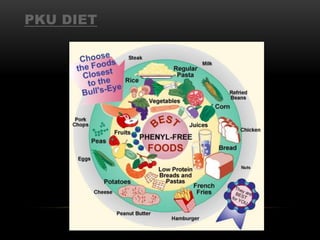
Treatment: diet low in phenylalanine
PKU DIET
6. CONSEQUENCES OF OBESITY
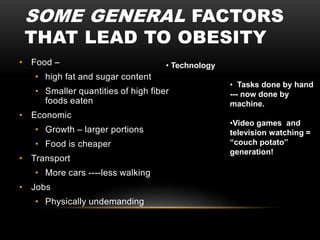
SOME GENERAL FACTORS
THAT LEAD TO OBESITY
• Food –
• high fat and sugar content
• Smaller quantities of high fiber
foods eaten
• Economic
• Growth – larger portions
• Food is cheaper
• Transport
• More cars ----less walking
• Jobs
• Physically undemanding
• Technology
• Tasks done by hand
--- now done by
machine.
•Video games and
television watching =
“couch potato”
generation!
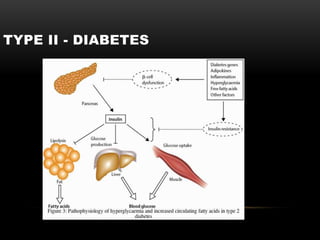
TYPE II - DIABETES
TYPE II - DIABETES
• Diabetes Mellitus
• Adult Onset Diabetes
• Medical Cause:
• Auto immune destruction of insulin-
secreting cells in pancreas (TYPE 1)
• Decreased responsiveness of body cells
to insulin. (TYPE II)
TYPE II - DIABETES
Risk Factors:
• Obesity due to overeating
• Diets rich in fat/low in fibre
• Inactivity
• Genetics
• Ethnic background
TYPE II - DIABETES
Symptoms:
• Elevated blood/urine glucose
• Frequent Urination
• Dehyradtion/Increased thirst
• Extreme hunger
• Weight Loss
• Fatigue
• Slow healing and more frequent infection
COMPLICATIONS – TYPE II
DIABETES
If not carefully managed:
• Atherosclerosis/circulation issues
• Hypertension
• CHD
ANOREXIA NERVOSA
• Unusual obsession with food, weight, body shape, and
excessive exercise
• Affects more women than men
Psychological disorder:
• Emotional issues
• Perfectionism
• Control
• Self worth
PHYSICAL CONSEQUENCES
• Circulatory
• Anemia - bruising
• Low blood cell count & electrolyte balance
• Heart failure
• Respiratory – lung tissue
• Skeletal – bone loss; osteoporosis
• Muscle – loss of muscle mass, weaker
• Hair Loss
• Women – interruption of ovulation
• Men – low testosterone
PSYCHOLOGICAL CONSEQUENCES
• Depression
• Obsessive Compulsive
Disorder
• Drug Abuse
• Personality Changes
D.2 - DIGESTION
STOMACH
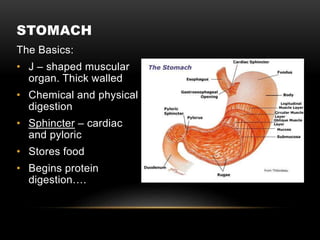
The Basics:
• J – shaped muscular
organ. Thick walled
• Chemical and physical
digestion
• Sphincter – cardiac
and pyloric
• Stores food
• Begins protein
digestion….
STOMACH
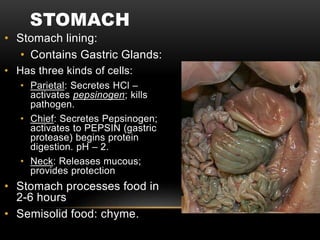
• Stomach lining:
• Contains Gastric Glands:
• Has three kinds of cells:
• Parietal: Secretes HCl –
activates pepsinogen; kills
pathogen.
• Chief: Secretes Pepsinogen;
activates to PEPSIN (gastric
protease) begins protein
digestion. pH – 2.
• Neck: Releases mucous;
provides protection
• Stomach processes food in
2-6 hours
• Semisolid food: chyme.
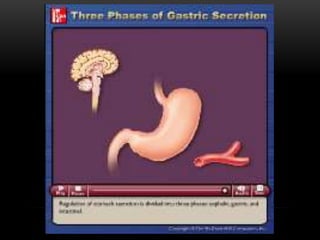
CONTROL OF GASTRIC JUICE SECRETION
• Controlled by nerves and hormones:
• Sight and smell of food sends nerve impulses to Parietal
cells – secretes acid (REFLEX)
• Na and Cl ions secreted. Water moves into stomach by
osmosis. Forms Gastric Juice.
• Chemoreceptors detect amino acids – move stomach
wall.
• Impulses are sent to brain. Brain sends impulses to
endocrine glands via VAGUS NERVE to secrete Gastrin.
• Gastrin stimulates further secretion of acid and
pepsinogen.
• Secretin and Somatostatin - inhibit gastrin secretion
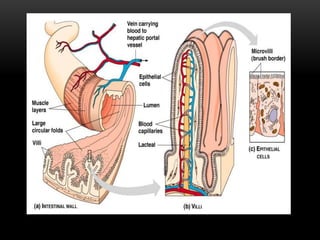
SMALL INTESTINE
SMALL INTESTINE
SMALL INTESTINE
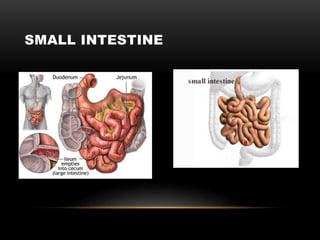
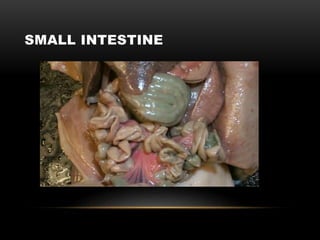
• Small diameter….7 meters long/ 23 ft (appx)
• Some physical; mostly chemical digestion.
• Receives secretions from the liver and
pancreas.
• 3 sections: duodenum (digestion), jejunum
(digestion and absorption) and ileum (for
absorption)
• Absorption of nutrients begins in the lining of
the small intestine.
SMALL INTESTINE - ENZYMES
• Bicarbonate – from pancreas to neutralize acid (not an enzyme)
• Protein –
• Trypsin - (pancreas) continues protein digestion. (pH 8)
• Endopeptidase - (small intestine) completes protein digestion
to amino acids (pH – 7.5)
• Fat –
• Bile – (liver) not an enzyme. Breaks down large fat molecules
• Lipase – (pancreas) digests fats. (pH – 8)
• Carbohydrates
• Amylase (pancreas) continues starch digestion (maltose) (pH
7)
• Maltase - (small intestine) = (maltose into glucose). (pH 7)
• Sucrase – glucose and fructose (pH – 7)
• Lactase – glucose and galactose (pH – 7)
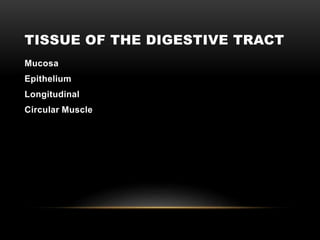
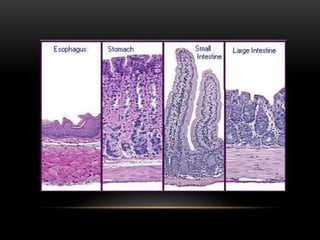
TISSUE OF THE DIGESTIVE TRACT
Mucosa
Epithelium
Longitudinal
Circular Muscle
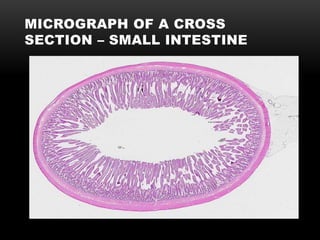
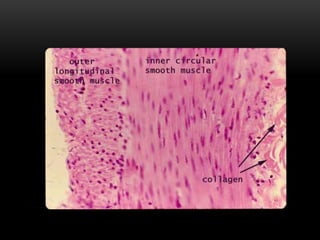
MICROGRAPH OF A CROSS
SECTION – SMALL INTESTINE
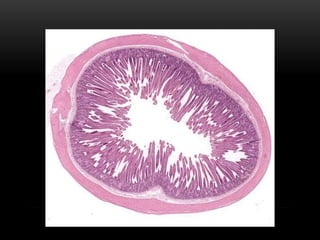
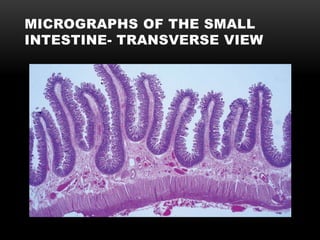
MICROGRAPHS OF THE SMALL
INTESTINE- TRANSVERSE VIEW
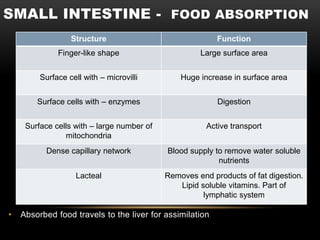
SMALL INTESTINE - FOOD ABSORPTION
• Absorbed food travels to the liver for assimilation.
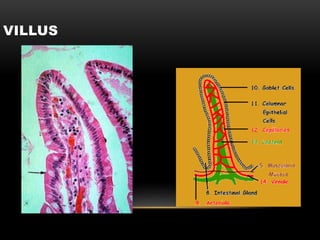
Structure Function
Finger-like shape Large surface area
Surface cell with – microvilli Huge increase in surface area
Surface cells with – enzymes Digestion
Surface cells with – large number of
mitochondria
Active transport
Dense capillary network Blood supply to remove water soluble
nutrients
Lacteal Removes end products of fat digestion.
Lipid soluble vitamins. Part of
lymphatic system
VILLUS
METHODS OF ABSORPTION
• Simple Diffusion – hydrophobic nutrients – fatty acids
• Facilitated Diffusion – hydrophilic nutrients (fructose)
• Active Transport – mineral ions….Na, Ca, Fe
• Endocytosis – Triglycerides, cholesterols
ASSIMILATION
• Taking molecules to cells to become part of the body:
• Carbohydrates: produce ATP, DNA, RNA, Cell membrane
• Fat: Adipose tissue, phospholipids, mitochondrial membranes,
hormones
• Amino acids: cells=proteins. Excessive amino acids are deaminated
by the liver to form urea
DISEASES OF THE DIGESTIVE SYSTEM
D.3 - THE LIVER
FUNCTIONS
• Composed of hepatocytes (Liver cells):
1. Detox: removes toxins from blood. Converts them to
less toxic/non-toxic.
2. Conversion of Cholesterol to Bile Salts: part of BILE.
Bile helps to emulsify fats in small intestine.
3. Production of Plasma proteins: rER of liver cells
produce 90% of plasma proteins (Albumin &
Fibrinogen). Processed by Golgi in liver cells
4. Nutrient storage and regulation:
• GLUCOSE STORAGE
• Iron, Vitamin A, Vitamin D
FUNCTIONS
5. Breakdown of Erythrocytes (RBC)
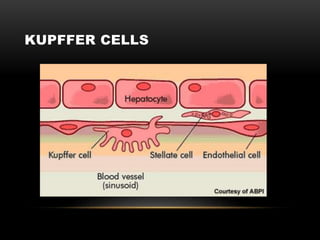
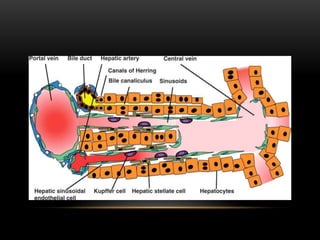
• Kupffer Cells – walls of sinusoids.
• Specialized macrophages that absorb and
breakdown RBC by phagocytosis.
• Recycle the components:
• Hemoglobin split
• Globins hydrolyzed
• Iron separates from heme – taken to
bone marrow
• Remainder of the heme forms
BILIRUBIN – used to form bile.
KUPFFER CELLS
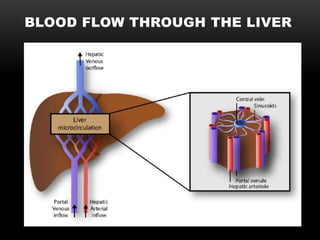
BLOOD FLOW THROUGH THE LIVER
BLOOD FLOW (HEPATOCYTE)
• Blood is supplied by these vessels:
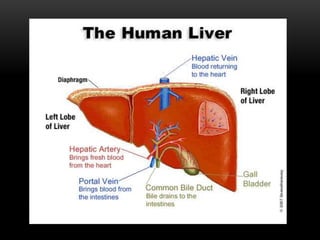
• HEPATIC PORTAL VEIN – blood from stomach, sm. Int. &
spleen directly to liver. Not a true vein. Bring nutrients to
liver.
• HEPATIC VEIN – blood -- no Oxygen to heart from liver
• HEPATIC ARTERY – blood supplies Oxygen from heart
• HPV separates into SINUSOIDS
• Capillary- like (wider), thin celled, many pores: allows blood
flowing through it to come in close contact to liver cells.
• HA branches to form capillaries that join sinusoids: provides
Oxygen to liver cells.
7. DISEASES OF THE DIGESTIVE
SYSTEM
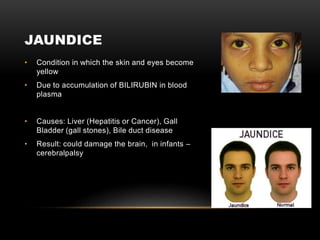
JAUNDICE
• Condition in which the skin and eyes become
yellow
• Due to accumulation of BILIRUBIN in blood
plasma
• Causes: Liver (Hepatitis or Cancer), Gall
Bladder (gall stones), Bile duct disease
• Result: could damage the brain, in infants –
cerebralpalsy
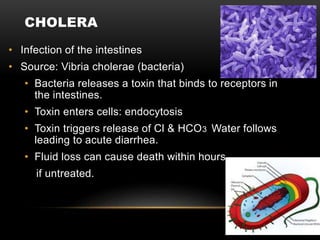
CHOLERA
• Infection of the intestines
• Source: Vibria cholerae (bacteria)
• Bacteria releases a toxin that binds to receptors in
the intestines.
• Toxin enters cells: endocytosis
• Toxin triggers release of Cl & HCO3 Water follows
leading to acute diarrhea.
• Fluid loss can cause death within hours
if untreated.
STOMACH ACID SECRETION AND
ULCERS
Stomach Acid
• secreted by parietal cells
• Disrupts ability of cells to be held
together in tissue
• Leads to denaturing of proteins
(except pepsin)
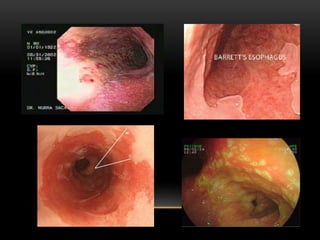
ACID REFLUX
• occurs when cardiac sphincter malfunctions
• Acid enters the esophagus
• Heartburn!
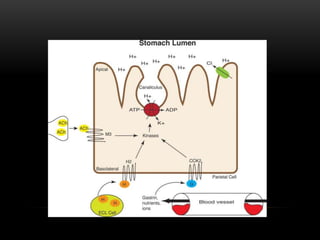
• Production of acid in stomach –
• proton pump (H+,K+ - ATPase Pump)
• Uses ATP to exchange 2H+ for 2K+
• Reduce Acid –
• Use of proton pump inhibitor (PPI)
• Bind to a single pump – irreversibly
• Provides temporary relief
• NEXIUM, PREVACID
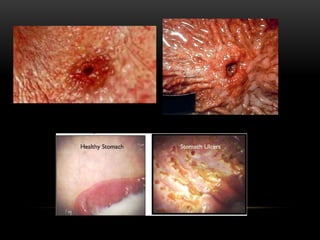
ULCERS
• Open sore
• Partial digestion of stomach lining by pepsin/HCL
• Causes:
• Stress
• Excessive acid production
• Infection with Heliobacter pylori bacteria (80%)
• Lack of treatment can lead to stomach cancer
D.4 – THE HEART
4/10/2016 2:58 PM cottingham
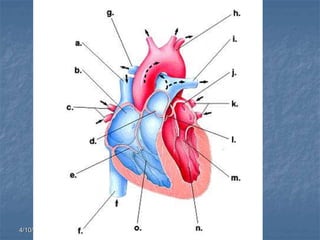
THE HEART
4/10/2016 2:58 PM cottingham
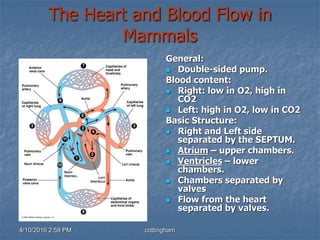
The Heart and Blood Flow in
Mammals
General:
 Double-sided pump.
Blood content:
 Right: low in O2, high in
CO2
 Left: high in O2, low in CO2
Basic Structure:
 Right and Left side
separated by the SEPTUM.
 Atrium – upper chambers.
 Ventricles – lower
chambers.
 Chambers separated by
valves
 Flow from the heart
separated by valves.
4/10/2016 2:58 PM cottingham
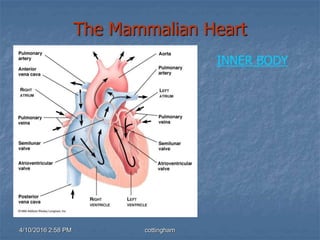
The Mammalian Heart
INNER BODY
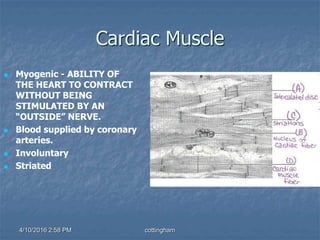
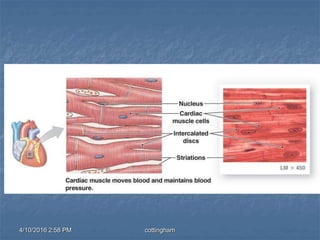
Cardiac Muscle
 Myogenic - ABILITY OF
THE HEART TO CONTRACT
WITHOUT BEING
STIMULATED BY AN
“OUTSIDE” NERVE.
 Blood supplied by coronary
arteries.
 Involuntary
 Striated
4/10/2016 2:58 PM cottingham
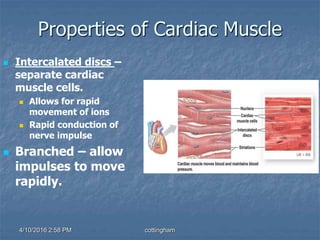
Properties of Cardiac Muscle
 Intercalated discs –
separate cardiac
muscle cells.
 Allows for rapid
movement of ions
 Rapid conduction of
nerve impulse
 Branched – allow
impulses to move
rapidly.
4/10/2016 2:58 PM cottingham
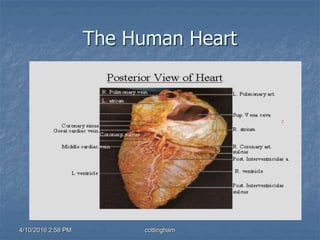
The Human Heart
4/10/2016 2:58 PM cottingham
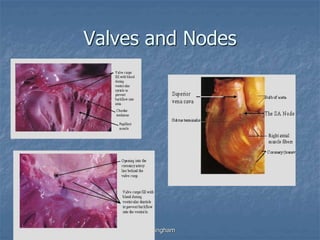
Valves and Nodes
4/10/2016 2:58 PM cottingham
Valves
VALVES
 Atrioventricular – allows blood
to flow between atria and
ventricle
 Semilunar – allows blood to
flow from ventricles
Cardiac Angiography
4/10/2016 2:58 PM cottingham
CARDIAC CYCLE – Control of
the Heartbeat!!!
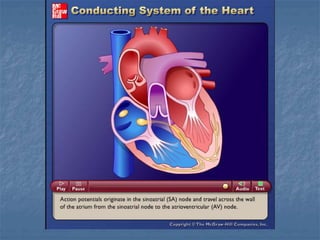
Nodes
 Sino Atrial – (SAN) –
 Wall of right atrium
 Pacemaker
 Initiates contractions
 Atrioventricular (AVN) –
 Wall of lower RA.
 Receives impulse from SAN
 Connecting Fibers –
 Bundle of His connected to Purkinje Tissue
 pass through septum to base of heart to all
parts of the ventricles
4/10/2016 2:58 PM cottingham
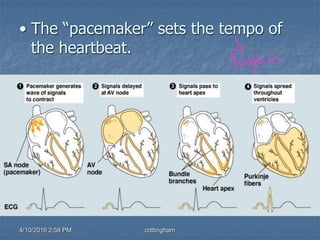
• The “pacemaker” sets the tempo of
the heartbeat.
4/10/2016 2:58 PM cottingham
Cardiac Cycle
4/10/2016 2:58 PM cottingham
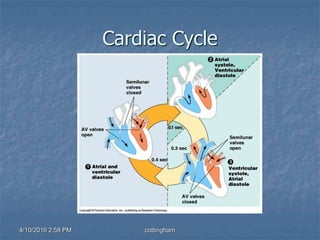
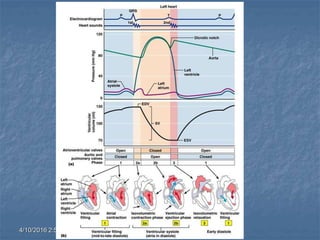
Cardiac Cycle
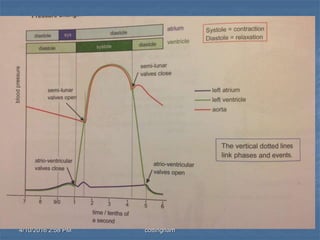
1. Walls of atria contract (Systole = 0-1)
 SAN fires – ventricles about 70% full
 Pushes blood from atria to ventricle
 AV open; Semilunar closed
 Ventricles fill; volume rises
2. Walls of ventricles contract(Systole = 1-4.2)
 More powerful;
 Initial rise in blood pressure in ventricles: AV valves close;
 Further rise in BP: SL valves open
 Blood PUMPED into aorta and pulmonary artery
 Volume decrease
Events of the Cardiac Cycle
3. Ventricles stop contracting (diastole = 4.2-9)
 Pressure falls
 Semilunar valves close – prevents backflow
 Blood pressure in Vena cava push blood
into atria
 Ventricular pressure falls below atrial
pressure: AV valves open
4/10/2016 2:58 PM cottingham
CONTROL OF HEARTRATE
1. Myogenic
1. Pacemaker – region of the heart (wall of R.A.)
responsible for initiating contraction.
2. Nerves from the brainstem carry messages
to pacemaker - speed up heartbeat
3. Adrenaline – carried to heart in blood ---
tells pacemaker to speed up heartbeat.
Cardiology
4/10/2016 2:58 PM cottingham
Basic Techniques in
Cardiology
4/10/2016 2:58 PM cottingham
Measuring Heart Rate
 Typically uses:
 Radial artery in wrist
 Carotid artery in neck
 DO NOT USE THUMB!
 It has its own pulse.
 Variables affecting:
 Demand for oxygen
 Demand for glucose
 Removal of CO2
 Exercise
 Body Position
 Temperature
4/10/2016 2:58 PM cottingham
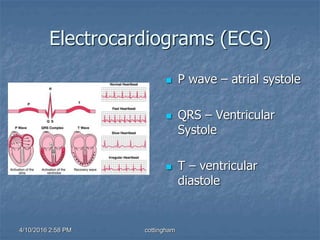
Electrocardiograms (ECG)
 P wave – atrial systole
 QRS – Ventricular
Systole
 T – ventricular
diastole
4/10/2016 2:58 PM cottingham
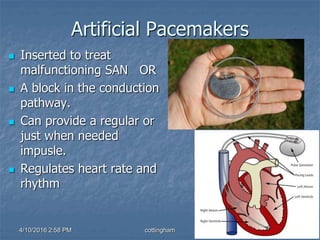
Artificial Pacemakers
 Inserted to treat
malfunctioning SAN OR
 A block in the conduction
pathway.
 Can provide a regular or
just when needed
impusle.
 Regulates heart rate and
rhythm
4/10/2016 2:58 PM cottingham
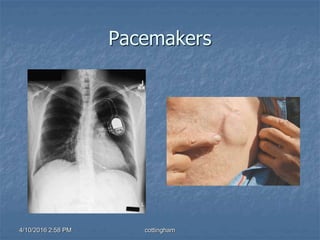
Pacemakers
4/10/2016 2:58 PM cottingham
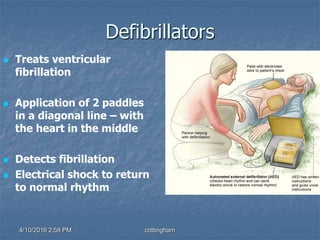
Defibrillators
 Treats ventricular
fibrillation
 Application of 2 paddles
in a diagonal line – with
the heart in the middle
 Detects fibrillation
 Electrical shock to return
to normal rhythm
4/10/2016 2:58 PM cottingham
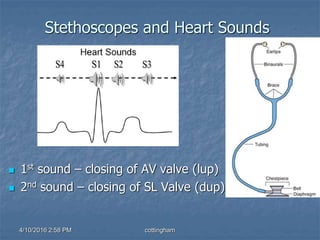
Stethoscopes and Heart Sounds
 1st sound – closing of AV valve (lup)
 2nd sound – closing of SL Valve (dup)
4/10/2016 2:58 PM cottingham
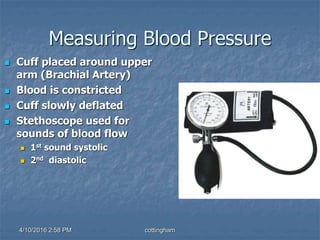
Measuring Blood Pressure
 Cuff placed around upper
arm (Brachial Artery)
 Blood is constricted
 Cuff slowly deflated
 Stethoscope used for
sounds of blood flow
 1st sound systolic
 2nd diastolic
4/10/2016 2:58 PM cottingham
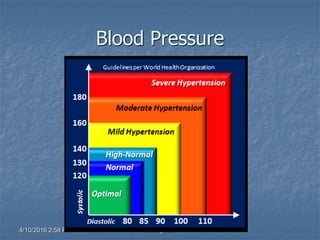
Blood Pressure
4/10/2016 2:58 PM cottingham
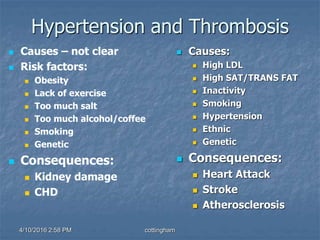
Hypertension and Thrombosis
 Causes – not clear
 Risk factors:
 Obesity
 Lack of exercise
 Too much salt
 Too much alcohol/coffee
 Smoking
 Genetic
 Consequences:
 Kidney damage
 CHD
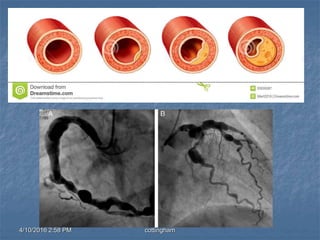
 Causes:
 High LDL
 High SAT/TRANS FAT
 Inactivity
 Smoking
 Hypertension
 Ethnic
 Genetic
 Consequences:
 Heart Attack
 Stroke
 Atherosclerosis
4/10/2016 2:58 PM cottingham

Option D

  • 1.
    D.1 – HUMANNUTRITION D.2 – DIGESTION D.3 – THE LIVER D.4 – THE HEART OPTION D
  • 2.
    D.1 - HUMANNUTRITION
  • 3.
    1. ESSENTIAL VS.NON ESSENTIAL
  • 4.
    DIET • THE TOTALFOOD INTAKE BY AN ORGANISM. • Nutrition – the supply of nutrients.
  • 5.
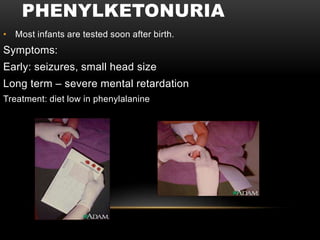
    NUTRIENTS Essential Nutrients –must be consumed as part of your diet. Cannot be synthesized by the body. These four nutrients are essential: • Water - essential • Lipids – “fatty acid” essential • Amino acids - not all • Vitamins and Minerals – not all Non-essential – • Carbohydrates – energy can be made from both fats and proteins
  • 6.
    AMINO ACIDS • 20amino acids Essential - lacking any a.a not made by the body Non essential – any that the body can make by conversion of other nutrients.
  • 7.
  • 8.
    FATS • Storage ofenergy • Insulation of body against temperature changes • Fat around some organs provides shock absorbers • Cell membrane - phospholipid
  • 9.
    VITAMIN AND MINERALS •Can be distinguished by their chemical nature Minerals – • Chemical elements; usually ionic Vitamins – • All organic Cannot be made by the body - essential
  • 10.
  • 11.
    COMPARISON OF ENERGY INNUTRIENTS. • Measured in kilojoules (kJ) CARBOHYDRATES: 1760 kJ/100g PROTEIN – 1720 kJ/100g FAT – 4000 kJ/100g
  • 12.
    MEASURING ENERGY CONTENT •To heat one mL of water 1°celcius – 4.2J of energy is needed = 1 calorie • SO: Energy content = temp change(ºC) x water volume(mL) x 4.2 of a food mass of food (g) Calorimeter – instrument used to measure energy content
  • 13.
  • 14.
    3. READING NUTRITIONALDATABASES • VITAMIN AND MINERAL • NUTRIENT DATABASE • NUTRITONAL CONTENT IN FOODS
  • 15.
    4. LIPIDS, YOURHEALTH, AND HEART DISEASE Review: 1. Saturated – • All carbon atoms are connected by single covalent bonds • Number of hydrogen atoms bonded to carbon cannot be increased • Non essential 2. Unsaturated – • One or more double bonds between carbon atoms • More hydrogen can be bonded if double bond is replaced by single bond.
  • 17.
    • SATURATED • CHOLESTEROL •TRANS FATS • UNSATURATED • MONOUNSATURATED • POLYUNSATURATED • CIS: OMEGA 3 & 7 GOOD FATS VS. BAD FATS GOOD BAD
  • 19.
    FATTY ACIDS ANDHEALTH - CHOLESTEROL HDL vs. LDL – produced in the liver CHOLESTEROL travels in the blood attached to a protein • Low Density Lipoprotein – transports cholesterol and triglycerides from the liver around the body…tends to deposit on artery walls. • “Bad cholesterol” “Lousy” • High Density Lipoproteins - transports excess cholesterol and triglycerides from body to the liver. • “Good cholesterol” “Happy” Other source of FAT: • Triglycerides - another type of fat produced by excess calories, alcohol, and sugar (very LDL)
  • 22.
    CHOLESTEROL AND CORONARYHEART DISEASE • Cholesterol = steroid Research has shown a positive correlation between high levels of cholesterol and an increased risk of CHD, but it is not certain that lowering cholesterol intake reduces the risk of CHD: • Most research involves total blood cholesterol levels but only cholesterol in LDL is implicated. • The liver synthesizes it’s own cholesterol • Reducing dietary cholesterol…very little overall effect on CHD Rates • Genetic factors appear to be more important • There is a positive correlation between intake of saturated fat and cholesterol. Is saturated fat the issue?
  • 23.
    4. APPETITE CONTROLAND THE BRAIN Hypothalamus - Appetite Control Center Receives hormone stimuli: • Insulin – secreted by pancreas when Glucose levels are high • Peptide YY36 - “gut hormone” • Released by small intestine in response to food intake • Increases with number of calories eaten • Leptin – hormone released by adipose tissue . More secreted as more fat is stored. • If hypothalamus receives hormone, reduces desire to eat
  • 24.
    5. NUTRIENT DEFICIENCYDISEASES/DISORDERS Malnutrition – a deficiency, imbalance, or excess or specific nutrients in the diet. Starvation – severe lack of intake of both essential and non-essential nutrients. • Results in breakdown of body tissue
  • 25.
    VITAMIN AND MINERALS •Can be distinguished by their chemical nature Minerals – • Chemical elements; usually ionic Vitamins – • All organic Cannot be made by the body - essential
  • 26.
    VITAMIN C • VitaminC = Ascorbic Acid • Needed for synthesis of collagen fibers in: • Skin • Blood vessel walls • Humans cannot synthesize • Not exclusive to humans SCURVY – Vit. C deficiency disease. Patients develop anemia, edema, ulcerations, lose teeth.
  • 27.
  • 28.
    VITAMIN D –DEFICIENCY • Calciferol • Oily fish, eggs, milk* • Needed for calcium absorption in the intestines. • Calcium: bone and teeth strength • Symptoms of deficiency similar to calcium deficiency • Diseases: • Rickets – soft bone disorder • Osteomalacia – bone thinning • Synthesis: • Skin, Food, Supplement
  • 29.
    PROTEIN MALNUTRITION: PHENYLKETONURIA CAUSES: •Autosomal recessive – causes a mutation of the gene for the enzyme PAH • Condition where a baby is unable to breakdown the a.a. phenylalanine into tyrosine. • Deficiency in the enzyme PAH • Levels of phenylalanine accumulate
  • 30.
    PHENYLKETONURIA • Most infantsare tested soon after birth. Symptoms: Early: seizures, small head size Long term – severe mental retardation Treatment: diet low in phenylalanine
  • 31.
  • 32.
  • 33.
    SOME GENERAL FACTORS THATLEAD TO OBESITY • Food – • high fat and sugar content • Smaller quantities of high fiber foods eaten • Economic • Growth – larger portions • Food is cheaper • Transport • More cars ----less walking • Jobs • Physically undemanding • Technology • Tasks done by hand --- now done by machine. •Video games and television watching = “couch potato” generation!
  • 34.
    TYPE II -DIABETES
  • 35.
    TYPE II -DIABETES • Diabetes Mellitus • Adult Onset Diabetes • Medical Cause: • Auto immune destruction of insulin- secreting cells in pancreas (TYPE 1) • Decreased responsiveness of body cells to insulin. (TYPE II)
  • 36.
    TYPE II -DIABETES Risk Factors: • Obesity due to overeating • Diets rich in fat/low in fibre • Inactivity • Genetics • Ethnic background
  • 37.
    TYPE II -DIABETES Symptoms: • Elevated blood/urine glucose • Frequent Urination • Dehyradtion/Increased thirst • Extreme hunger • Weight Loss • Fatigue • Slow healing and more frequent infection
  • 38.
    COMPLICATIONS – TYPEII DIABETES If not carefully managed: • Atherosclerosis/circulation issues • Hypertension • CHD
  • 39.
  • 40.
    • Unusual obsessionwith food, weight, body shape, and excessive exercise • Affects more women than men Psychological disorder: • Emotional issues • Perfectionism • Control • Self worth
  • 41.
    PHYSICAL CONSEQUENCES • Circulatory •Anemia - bruising • Low blood cell count & electrolyte balance • Heart failure • Respiratory – lung tissue • Skeletal – bone loss; osteoporosis • Muscle – loss of muscle mass, weaker • Hair Loss • Women – interruption of ovulation • Men – low testosterone
  • 42.
    PSYCHOLOGICAL CONSEQUENCES • Depression •Obsessive Compulsive Disorder • Drug Abuse • Personality Changes
  • 43.
  • 44.
    STOMACH The Basics: • J– shaped muscular organ. Thick walled • Chemical and physical digestion • Sphincter – cardiac and pyloric • Stores food • Begins protein digestion….
  • 46.
    STOMACH • Stomach lining: •Contains Gastric Glands: • Has three kinds of cells: • Parietal: Secretes HCl – activates pepsinogen; kills pathogen. • Chief: Secretes Pepsinogen; activates to PEPSIN (gastric protease) begins protein digestion. pH – 2. • Neck: Releases mucous; provides protection • Stomach processes food in 2-6 hours • Semisolid food: chyme.
  • 47.
    CONTROL OF GASTRICJUICE SECRETION • Controlled by nerves and hormones: • Sight and smell of food sends nerve impulses to Parietal cells – secretes acid (REFLEX) • Na and Cl ions secreted. Water moves into stomach by osmosis. Forms Gastric Juice. • Chemoreceptors detect amino acids – move stomach wall. • Impulses are sent to brain. Brain sends impulses to endocrine glands via VAGUS NERVE to secrete Gastrin. • Gastrin stimulates further secretion of acid and pepsinogen. • Secretin and Somatostatin - inhibit gastrin secretion
  • 48.
  • 49.
  • 50.
    SMALL INTESTINE • Smalldiameter….7 meters long/ 23 ft (appx) • Some physical; mostly chemical digestion. • Receives secretions from the liver and pancreas. • 3 sections: duodenum (digestion), jejunum (digestion and absorption) and ileum (for absorption) • Absorption of nutrients begins in the lining of the small intestine.
  • 51.
    SMALL INTESTINE -ENZYMES • Bicarbonate – from pancreas to neutralize acid (not an enzyme) • Protein – • Trypsin - (pancreas) continues protein digestion. (pH 8) • Endopeptidase - (small intestine) completes protein digestion to amino acids (pH – 7.5) • Fat – • Bile – (liver) not an enzyme. Breaks down large fat molecules • Lipase – (pancreas) digests fats. (pH – 8) • Carbohydrates • Amylase (pancreas) continues starch digestion (maltose) (pH 7) • Maltase - (small intestine) = (maltose into glucose). (pH 7) • Sucrase – glucose and fructose (pH – 7) • Lactase – glucose and galactose (pH – 7)
  • 53.
    TISSUE OF THEDIGESTIVE TRACT Mucosa Epithelium Longitudinal Circular Muscle
  • 54.
    MICROGRAPH OF ACROSS SECTION – SMALL INTESTINE
  • 56.
    MICROGRAPHS OF THESMALL INTESTINE- TRANSVERSE VIEW
  • 59.
    SMALL INTESTINE -FOOD ABSORPTION • Absorbed food travels to the liver for assimilation. Structure Function Finger-like shape Large surface area Surface cell with – microvilli Huge increase in surface area Surface cells with – enzymes Digestion Surface cells with – large number of mitochondria Active transport Dense capillary network Blood supply to remove water soluble nutrients Lacteal Removes end products of fat digestion. Lipid soluble vitamins. Part of lymphatic system
  • 60.
  • 61.
    METHODS OF ABSORPTION •Simple Diffusion – hydrophobic nutrients – fatty acids • Facilitated Diffusion – hydrophilic nutrients (fructose) • Active Transport – mineral ions….Na, Ca, Fe • Endocytosis – Triglycerides, cholesterols
  • 62.
    ASSIMILATION • Taking moleculesto cells to become part of the body: • Carbohydrates: produce ATP, DNA, RNA, Cell membrane • Fat: Adipose tissue, phospholipids, mitochondrial membranes, hormones • Amino acids: cells=proteins. Excessive amino acids are deaminated by the liver to form urea
  • 63.
    DISEASES OF THEDIGESTIVE SYSTEM D.3 - THE LIVER
  • 65.
    FUNCTIONS • Composed ofhepatocytes (Liver cells): 1. Detox: removes toxins from blood. Converts them to less toxic/non-toxic. 2. Conversion of Cholesterol to Bile Salts: part of BILE. Bile helps to emulsify fats in small intestine. 3. Production of Plasma proteins: rER of liver cells produce 90% of plasma proteins (Albumin & Fibrinogen). Processed by Golgi in liver cells 4. Nutrient storage and regulation: • GLUCOSE STORAGE • Iron, Vitamin A, Vitamin D
  • 66.
    FUNCTIONS 5. Breakdown ofErythrocytes (RBC) • Kupffer Cells – walls of sinusoids. • Specialized macrophages that absorb and breakdown RBC by phagocytosis. • Recycle the components: • Hemoglobin split • Globins hydrolyzed • Iron separates from heme – taken to bone marrow • Remainder of the heme forms BILIRUBIN – used to form bile.
  • 67.
  • 68.
  • 69.
    BLOOD FLOW (HEPATOCYTE) •Blood is supplied by these vessels: • HEPATIC PORTAL VEIN – blood from stomach, sm. Int. & spleen directly to liver. Not a true vein. Bring nutrients to liver. • HEPATIC VEIN – blood -- no Oxygen to heart from liver • HEPATIC ARTERY – blood supplies Oxygen from heart • HPV separates into SINUSOIDS • Capillary- like (wider), thin celled, many pores: allows blood flowing through it to come in close contact to liver cells. • HA branches to form capillaries that join sinusoids: provides Oxygen to liver cells.
  • 72.
    7. DISEASES OFTHE DIGESTIVE SYSTEM
  • 73.
    JAUNDICE • Condition inwhich the skin and eyes become yellow • Due to accumulation of BILIRUBIN in blood plasma • Causes: Liver (Hepatitis or Cancer), Gall Bladder (gall stones), Bile duct disease • Result: could damage the brain, in infants – cerebralpalsy
  • 74.
    CHOLERA • Infection ofthe intestines • Source: Vibria cholerae (bacteria) • Bacteria releases a toxin that binds to receptors in the intestines. • Toxin enters cells: endocytosis • Toxin triggers release of Cl & HCO3 Water follows leading to acute diarrhea. • Fluid loss can cause death within hours if untreated.
  • 75.
    STOMACH ACID SECRETIONAND ULCERS Stomach Acid • secreted by parietal cells • Disrupts ability of cells to be held together in tissue • Leads to denaturing of proteins (except pepsin)
  • 76.
    ACID REFLUX • occurswhen cardiac sphincter malfunctions • Acid enters the esophagus • Heartburn! • Production of acid in stomach – • proton pump (H+,K+ - ATPase Pump) • Uses ATP to exchange 2H+ for 2K+ • Reduce Acid – • Use of proton pump inhibitor (PPI) • Bind to a single pump – irreversibly • Provides temporary relief • NEXIUM, PREVACID
  • 79.
    ULCERS • Open sore •Partial digestion of stomach lining by pepsin/HCL • Causes: • Stress • Excessive acid production • Infection with Heliobacter pylori bacteria (80%) • Lack of treatment can lead to stomach cancer
  • 81.
  • 82.
    4/10/2016 2:58 PMcottingham THE HEART
  • 83.
    4/10/2016 2:58 PMcottingham The Heart and Blood Flow in Mammals General:  Double-sided pump. Blood content:  Right: low in O2, high in CO2  Left: high in O2, low in CO2 Basic Structure:  Right and Left side separated by the SEPTUM.  Atrium – upper chambers.  Ventricles – lower chambers.  Chambers separated by valves  Flow from the heart separated by valves.
  • 84.
  • 85.
    4/10/2016 2:58 PMcottingham The Mammalian Heart INNER BODY
  • 86.
    Cardiac Muscle  Myogenic- ABILITY OF THE HEART TO CONTRACT WITHOUT BEING STIMULATED BY AN “OUTSIDE” NERVE.  Blood supplied by coronary arteries.  Involuntary  Striated 4/10/2016 2:58 PM cottingham
  • 87.
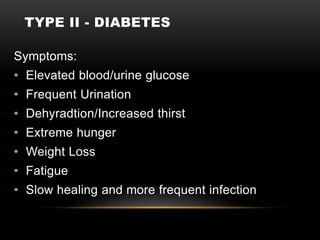
    Properties of CardiacMuscle  Intercalated discs – separate cardiac muscle cells.  Allows for rapid movement of ions  Rapid conduction of nerve impulse  Branched – allow impulses to move rapidly. 4/10/2016 2:58 PM cottingham
  • 88.
  • 89.
    4/10/2016 2:58 PMcottingham The Human Heart
  • 90.
    4/10/2016 2:58 PMcottingham Valves and Nodes
  • 91.
    4/10/2016 2:58 PMcottingham Valves VALVES  Atrioventricular – allows blood to flow between atria and ventricle  Semilunar – allows blood to flow from ventricles Cardiac Angiography
  • 92.
    4/10/2016 2:58 PMcottingham CARDIAC CYCLE – Control of the Heartbeat!!!
  • 94.
    Nodes  Sino Atrial– (SAN) –  Wall of right atrium  Pacemaker  Initiates contractions  Atrioventricular (AVN) –  Wall of lower RA.  Receives impulse from SAN  Connecting Fibers –  Bundle of His connected to Purkinje Tissue  pass through septum to base of heart to all parts of the ventricles 4/10/2016 2:58 PM cottingham
  • 95.
    4/10/2016 2:58 PMcottingham • The “pacemaker” sets the tempo of the heartbeat.
  • 96.
    4/10/2016 2:58 PMcottingham Cardiac Cycle
  • 97.
  • 98.
    4/10/2016 2:58 PMcottingham Cardiac Cycle 1. Walls of atria contract (Systole = 0-1)  SAN fires – ventricles about 70% full  Pushes blood from atria to ventricle  AV open; Semilunar closed  Ventricles fill; volume rises 2. Walls of ventricles contract(Systole = 1-4.2)  More powerful;  Initial rise in blood pressure in ventricles: AV valves close;  Further rise in BP: SL valves open  Blood PUMPED into aorta and pulmonary artery  Volume decrease
  • 99.
    Events of theCardiac Cycle 3. Ventricles stop contracting (diastole = 4.2-9)  Pressure falls  Semilunar valves close – prevents backflow  Blood pressure in Vena cava push blood into atria  Ventricular pressure falls below atrial pressure: AV valves open 4/10/2016 2:58 PM cottingham
  • 100.
  • 101.
    4/10/2016 2:58 PMcottingham CONTROL OF HEARTRATE 1. Myogenic 1. Pacemaker – region of the heart (wall of R.A.) responsible for initiating contraction. 2. Nerves from the brainstem carry messages to pacemaker - speed up heartbeat 3. Adrenaline – carried to heart in blood --- tells pacemaker to speed up heartbeat.
  • 102.
  • 103.
  • 104.
    Measuring Heart Rate Typically uses:  Radial artery in wrist  Carotid artery in neck  DO NOT USE THUMB!  It has its own pulse.  Variables affecting:  Demand for oxygen  Demand for glucose  Removal of CO2  Exercise  Body Position  Temperature 4/10/2016 2:58 PM cottingham
  • 105.
    Electrocardiograms (ECG)  Pwave – atrial systole  QRS – Ventricular Systole  T – ventricular diastole 4/10/2016 2:58 PM cottingham
  • 106.
    Artificial Pacemakers  Insertedto treat malfunctioning SAN OR  A block in the conduction pathway.  Can provide a regular or just when needed impusle.  Regulates heart rate and rhythm 4/10/2016 2:58 PM cottingham
  • 107.
  • 108.
    Defibrillators  Treats ventricular fibrillation Application of 2 paddles in a diagonal line – with the heart in the middle  Detects fibrillation  Electrical shock to return to normal rhythm 4/10/2016 2:58 PM cottingham
  • 109.
    Stethoscopes and HeartSounds  1st sound – closing of AV valve (lup)  2nd sound – closing of SL Valve (dup) 4/10/2016 2:58 PM cottingham
  • 110.
    Measuring Blood Pressure Cuff placed around upper arm (Brachial Artery)  Blood is constricted  Cuff slowly deflated  Stethoscope used for sounds of blood flow  1st sound systolic  2nd diastolic 4/10/2016 2:58 PM cottingham
  • 111.
  • 112.
    Hypertension and Thrombosis Causes – not clear  Risk factors:  Obesity  Lack of exercise  Too much salt  Too much alcohol/coffee  Smoking  Genetic  Consequences:  Kidney damage  CHD  Causes:  High LDL  High SAT/TRANS FAT  Inactivity  Smoking  Hypertension  Ethnic  Genetic  Consequences:  Heart Attack  Stroke  Atherosclerosis 4/10/2016 2:58 PM cottingham
  • 113.
  • 114.