Our Impact on the
Ecosystem
Chapter 22
Content
• Effects of Man on the Ecosystem

• Conservation (Environmental
  Biotechnology)
Ecosystem
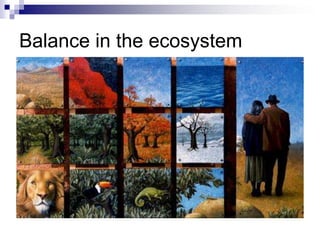
Balance in the ecosystem
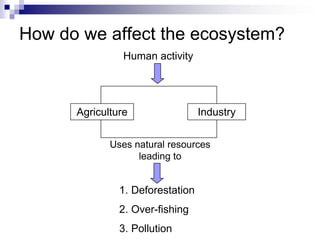
How do we affect the ecosystem?
   Natural resources are resources supplied by
    nature that are used by humans
   Air, water, soil, wildlife and forests are
    renewable resources (i.e. they can be replaced
    in the ecosystem by natural cycles as long as
    humans do not overuse them)
   On the other hand, fossil fuels take millions of
    years to form naturally
   They cannot be replaced once they are
    used, hence they are called non-renewable
    natural resources
How do we affect the ecosystem?
                Human activity


      Agriculture                 Industry


             Uses natural resources
                   leading to


               1. Deforestation
               2. Over-fishing
               3. Pollution
1) Deforestation
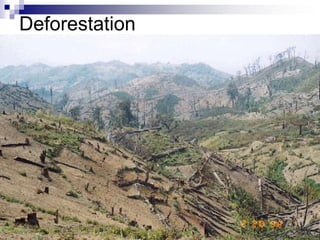
Deforestation
 Definition:
 The removal of forests by cutting and burning
 to provide land for agricultural
 purposes, residential or industrial building
 sites, roads, etc., or by harvesting the trees for
 building materials or fuel.
Deforestation
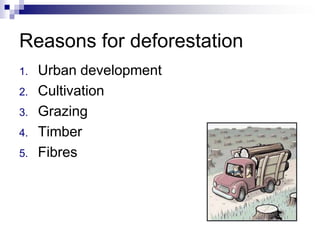
Reasons for deforestation
1.   Urban development
2.   Cultivation
3.   Grazing
4.   Timber
5.   Fibres
Damaging effects of deforestation
i)     Soil erosion

ii)    Flooding

iii)   Desertification

iv)    Climate changes
i) Soil erosion
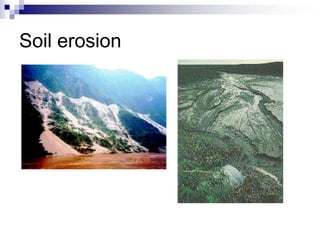
Soil erosion
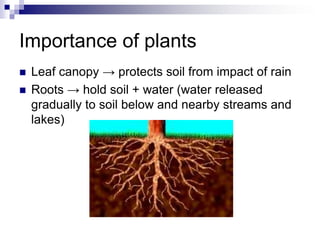
Importance of plants
   Leaf canopy → protects soil from impact of rain
   Roots → hold soil + water (water released
    gradually to soil below and nearby streams and
    lakes)
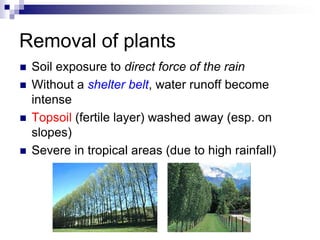
Removal of plants
   Soil exposure to direct force of the rain
   Without a shelter belt, water runoff become
    intense
   Topsoil (fertile layer) washed away (esp. on
    slopes)
   Severe in tropical areas (due to high rainfall)
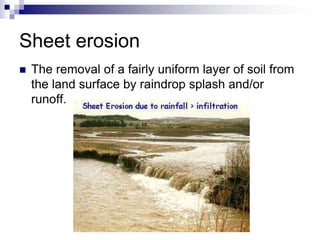
Sheet erosion
   The removal of a fairly uniform layer of soil from
    the land surface by raindrop splash and/or
    runoff.
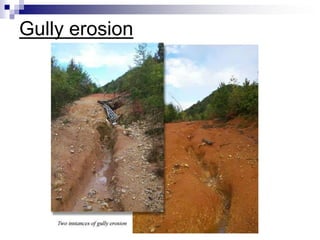
Gully erosion
   Removal of layers of soil due to heavy
    rainfall, thus creating small channels which
    eventually widen and deepen as more soil
    is removed, forming gullies
Gully erosion
ii) Flooding
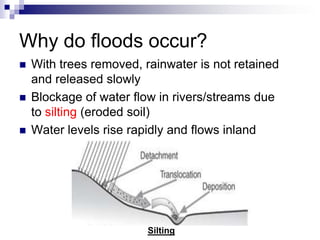
Why do floods occur?
   With trees removed, rainwater is not retained
    and released slowly
   Blockage of water flow in rivers/streams due
    to silting (eroded soil)
   Water levels rise rapidly and flows inland


                         Silting
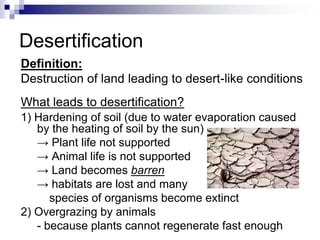
iii) Desertification
Desertification
Definition:
Destruction of land leading to desert-like conditions
What leads to desertification?
1) Hardening of soil (due to water evaporation caused
   by the heating of soil by the sun)
   → Plant life not supported
   → Animal life is not supported
   → Land becomes barren
   → habitats are lost and many
      species of organisms become extinct
2) Overgrazing by animals
   - because plants cannot regenerate fast enough
Result of desertification
 Loss of habitats
 Extinction of species of organisms
 Loss of potential medicinal resources
  which may be useful in treating diseases
 Upsetting O2 and CO2 balances
iv) Climate changes
How does deforestation result in
climatic changes?
→ with forests, rainwater is retained and absorbed by
  roots of trees
→ water lost during transpiration
→ relative humidity of air around forests high
→ water vapour condenses + precipitates as rain
→ However when trees are cleared the area becomes
  dry & warm
→ annual rainfall decreases
What have we learnt so far?
   Deforestation
    - definition
    - reasons for deforestation
    - damaging effects of deforestation
      (i) soil erosion
      (ii) flooding
     (iii) desertification
     (iv) climatic changes
2) Over-fishing
How do uncontrolled fishing
practices harm the ecosystem?
i) Humans catch fish for food. As the human
    populations increases, so does the demand
    for fish. Some species of fish have been
    caught in such large numbers that their
    populations have decreased drastically
    (over-fished)
ii) Indiscriminate fishing (i.e. do not distinguish
    between the targeted catch and immature
    organisms or unwanted species e.g. gigantic
    drift nets trap almost everything in their path.
    Marine life e.g. sharks, turtles, dolphins are
    unintentionally caught. Though dumped back
    into the sea, they often die
How do uncontrolled fishing
practices harm the ecosystem?
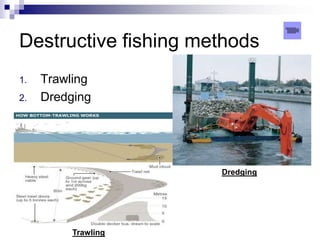
iii) Some methods of fishing destroy the seabed and marine
    habitat
    - shrimp/prawn trawlers drag large fishing nets along
      the bottom of the sea. Many unwanted species are
      trapped in the process
    - scallop dredges scrape the seabed, destroying coral
      reefs and organisms that live on the seabed
    - In cyanide fishing, cyanide (a poison) is squirted in
      the water around coral reefs. The cyanide stuns reef
      fish and makes them unable to swim properly.
      Fishermen then capture the fish for sale as pets.
      Explosives (e.g. dynamite) are also used to stun and
      catch reef fish. Both cyanide and explosives kill corals
      and many other reef organisms
Destructive fishing methods
1.   Trawling
2.   Dredging


                      Dredging


          Trawling

Chapter 22 Our Impact on the Ecosystem Lesson 1 - Deforestation_Overfishing

  • 1.
    Our Impact onthe Ecosystem Chapter 22 Content • Effects of Man on the Ecosystem • Conservation (Environmental Biotechnology)
  • 2.
  • 3.
    Balance in theecosystem
  • 4.
    How do weaffect the ecosystem?  Natural resources are resources supplied by nature that are used by humans  Air, water, soil, wildlife and forests are renewable resources (i.e. they can be replaced in the ecosystem by natural cycles as long as humans do not overuse them)  On the other hand, fossil fuels take millions of years to form naturally  They cannot be replaced once they are used, hence they are called non-renewable natural resources
  • 5.
    How do weaffect the ecosystem? Human activity Agriculture Industry Uses natural resources leading to 1. Deforestation 2. Over-fishing 3. Pollution
  • 6.
  • 7.
    Deforestation Definition: Theremoval of forests by cutting and burning to provide land for agricultural purposes, residential or industrial building sites, roads, etc., or by harvesting the trees for building materials or fuel.
  • 8.
  • 9.
    Reasons for deforestation 1. Urban development 2. Cultivation 3. Grazing 4. Timber 5. Fibres
  • 10.
    Damaging effects ofdeforestation i) Soil erosion ii) Flooding iii) Desertification iv) Climate changes
  • 11.
  • 12.
  • 13.
    Importance of plants  Leaf canopy → protects soil from impact of rain  Roots → hold soil + water (water released gradually to soil below and nearby streams and lakes)
  • 14.
    Removal of plants  Soil exposure to direct force of the rain  Without a shelter belt, water runoff become intense  Topsoil (fertile layer) washed away (esp. on slopes)  Severe in tropical areas (due to high rainfall)
  • 15.
    Sheet erosion  The removal of a fairly uniform layer of soil from the land surface by raindrop splash and/or runoff.
  • 16.
    Gully erosion  Removal of layers of soil due to heavy rainfall, thus creating small channels which eventually widen and deepen as more soil is removed, forming gullies
  • 17.
  • 18.
  • 19.
    Why do floodsoccur?  With trees removed, rainwater is not retained and released slowly  Blockage of water flow in rivers/streams due to silting (eroded soil)  Water levels rise rapidly and flows inland Silting
  • 20.
  • 21.
    Desertification Definition: Destruction of landleading to desert-like conditions What leads to desertification? 1) Hardening of soil (due to water evaporation caused by the heating of soil by the sun) → Plant life not supported → Animal life is not supported → Land becomes barren → habitats are lost and many species of organisms become extinct 2) Overgrazing by animals - because plants cannot regenerate fast enough
  • 22.
    Result of desertification Loss of habitats  Extinction of species of organisms  Loss of potential medicinal resources which may be useful in treating diseases  Upsetting O2 and CO2 balances
  • 23.
  • 24.
    How does deforestationresult in climatic changes? → with forests, rainwater is retained and absorbed by roots of trees → water lost during transpiration → relative humidity of air around forests high → water vapour condenses + precipitates as rain → However when trees are cleared the area becomes dry & warm → annual rainfall decreases
  • 25.
    What have welearnt so far?  Deforestation - definition - reasons for deforestation - damaging effects of deforestation (i) soil erosion (ii) flooding (iii) desertification (iv) climatic changes
  • 26.
  • 27.
    How do uncontrolledfishing practices harm the ecosystem? i) Humans catch fish for food. As the human populations increases, so does the demand for fish. Some species of fish have been caught in such large numbers that their populations have decreased drastically (over-fished) ii) Indiscriminate fishing (i.e. do not distinguish between the targeted catch and immature organisms or unwanted species e.g. gigantic drift nets trap almost everything in their path. Marine life e.g. sharks, turtles, dolphins are unintentionally caught. Though dumped back into the sea, they often die
  • 28.
    How do uncontrolledfishing practices harm the ecosystem? iii) Some methods of fishing destroy the seabed and marine habitat - shrimp/prawn trawlers drag large fishing nets along the bottom of the sea. Many unwanted species are trapped in the process - scallop dredges scrape the seabed, destroying coral reefs and organisms that live on the seabed - In cyanide fishing, cyanide (a poison) is squirted in the water around coral reefs. The cyanide stuns reef fish and makes them unable to swim properly. Fishermen then capture the fish for sale as pets. Explosives (e.g. dynamite) are also used to stun and catch reef fish. Both cyanide and explosives kill corals and many other reef organisms
  • 29.
    Destructive fishing methods 1. Trawling 2. Dredging Dredging Trawling