JeopardyJeopardy
$100
Classification
Systems
Dichotomous
Keys
Vocabulary
A Little of
This & That
More of This
And
That
$200
$300
$400
$500 $500
$400
$300
$200
$100
$500
$400
$300
$200
$100
$500
$400
$300
$200
$100
$500
$400
$300
$200
$100
Final JeopardyFinal Jeopardy
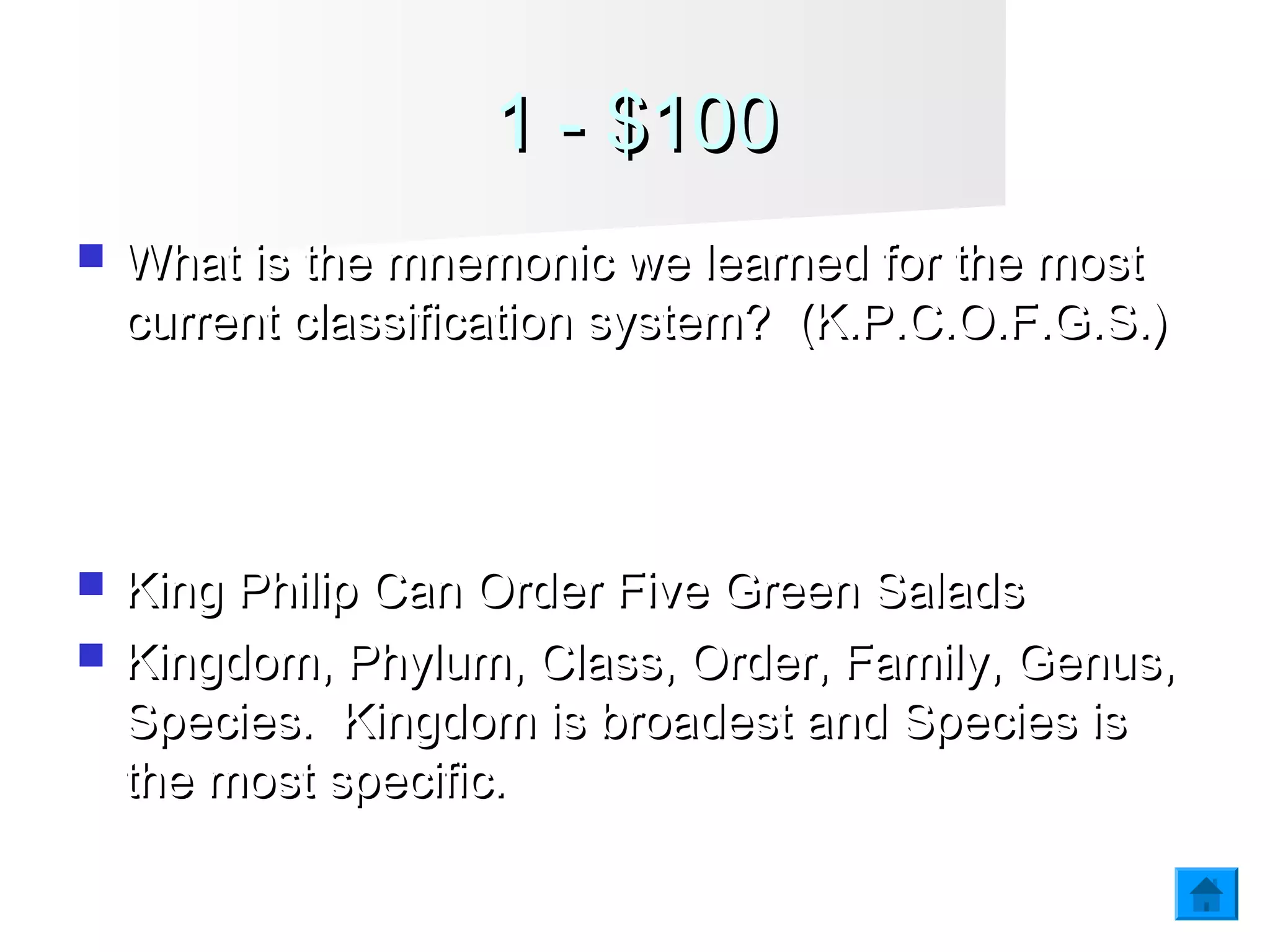
1 - $1001 - $100
 What is the mnemonic we learned for the mostWhat is the mnemonic we learned for the most
current classification system? (K.P.C.O.F.G.S.)current classification system? (K.P.C.O.F.G.S.)
 King Philip Can Order Five Green SaladsKing Philip Can Order Five Green Salads
 Kingdom, Phylum, Class, Order, Family, Genus,Kingdom, Phylum, Class, Order, Family, Genus,
Species. Kingdom is broadest and Species isSpecies. Kingdom is broadest and Species is
the most specific.the most specific.
1 - $2001 - $200
 We use an organisms ______________ andWe use an organisms ______________ and
______________ to help classify them.______________ to help classify them.
 We use an organisms CHARACTERISTICS andWe use an organisms CHARACTERISTICS and
STRUCTURE to help classify them.STRUCTURE to help classify them.
 Things like: backbones, feathers, hair, etc.Things like: backbones, feathers, hair, etc.
 Age is NOT considered when classifyingAge is NOT considered when classifying
organisms.organisms.
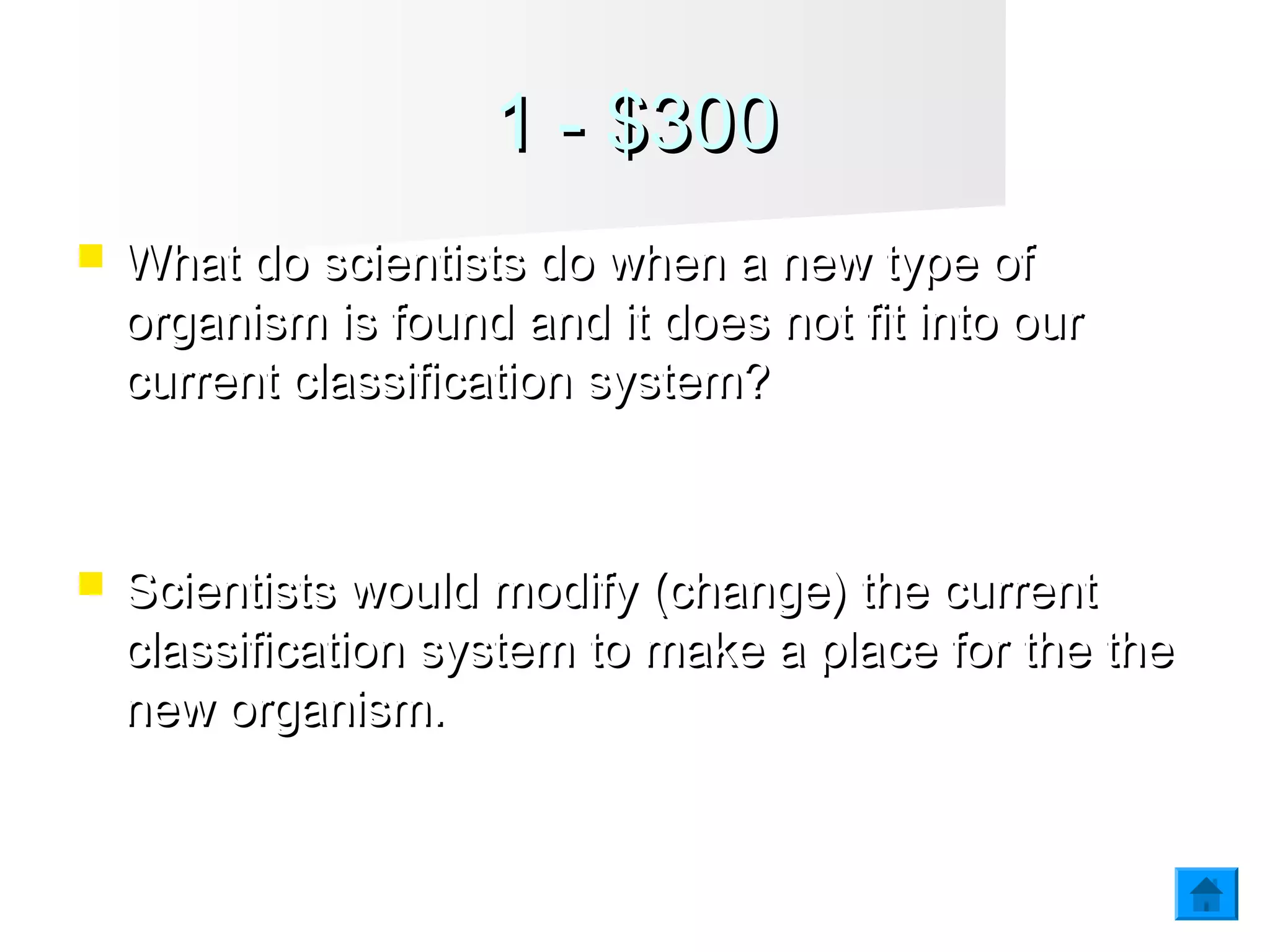
1 - $3001 - $300
 What do scientists do when a new type ofWhat do scientists do when a new type of
organism is found and it does not fit into ourorganism is found and it does not fit into our
current classification system?current classification system?
 Scientists would modify (change) the currentScientists would modify (change) the current
classification system to make a place for the theclassification system to make a place for the the
new organism.new organism.
1 - $4001 - $400
 Why isn’t a mushroom part of the plantWhy isn’t a mushroom part of the plant
kingdom?kingdom?
 The cannot produce their own food.The cannot produce their own food.
 They can grow in the dark.They can grow in the dark.
 They get their nutrients by absorbing nutrientsThey get their nutrients by absorbing nutrients
from other organisms.from other organisms.
1 - $5001 - $500
 In which kingdom would a multi-cellularIn which kingdom would a multi-cellular
organism that has cell walls and can produce itsorganism that has cell walls and can produce its
own food be placed?own food be placed?
 Plantae, because plants are multi-cellular andPlantae, because plants are multi-cellular and
produce their own food through photosynthesis.produce their own food through photosynthesis.
2 - $1002 - $100
 What is a dichotomous key?What is a dichotomous key?
 A tool used by scientists to help them identify theA tool used by scientists to help them identify the
scientific names of organisms.scientific names of organisms.
2 - $2002 - $200
 How many choices do you have in each step ofHow many choices do you have in each step of
a Dichotomous Key?a Dichotomous Key?
 TWOTWO
 The word dichotomous means- splitting into twoThe word dichotomous means- splitting into two
parts.parts.
2 - $3002 - $300
 What step do you ALWAYS start with whenWhat step do you ALWAYS start with when
reading a Dichotomous Key?reading a Dichotomous Key?
 You ALWAYS start with step one and then moveYou ALWAYS start with step one and then move
on from there.on from there.
2 - $4002 - $400
 It’s a SNERF.It’s a SNERF.
 It doesn’t stand or walk on its legs & it has spots.It doesn’t stand or walk on its legs & it has spots.
CREATURE IDENTIFICATION KEY
1. Does it stand or walk on its legs? 7. Does it have POINTED EARS?
If YES, go to question #6. If YES, the alien is a BELZARK.
If NO, go to question #2. If NO, go to question #8.
2. Does it have spots on its skin? 8. Does it walk on 6 LEGS?
If YES, the alien is a SNERF. If YES, the alien is a RUDARG.
If NO, go to question #3. If NO, go to question #9.
3. Does it have stripes on its skin? 9. Does it have WINGS?
If YES, the alien is a GORZAK. If YES, the alien is a SCHMELK.
If NO, go to question #4. If NO, go to question #10.
4. Does it have 4 Legs? 10. Does it have THREE EYES?
If YES, the alien is a MOG. If YES, the alien is a SNOOF.
If NO, go to question #5. If NO, go to question #11.
5. Does it have a FORKED TONGUE? 11. Does it have FINGERS AND TOES? If
YES, the alien is a BEM. If YES, the alien is a POG.
If NO, go to question #6. If NO, go to question #12.
6. Does it have HAIR on its back and head? 12. Does it have sharp POINTED
TEETH? If YES, the alien is a WABBLER. If YES, the alien is a BIZZLE.
If NO, go to question #7. If NO, the alien is a YAZBAT.
Use the dichotomous
key to identify this
creature:
2 - $5002 - $500
 It’s a SNOOF.It’s a SNOOF.
CREATURE IDENTIFICATION KEY
1. Does it stand or walk on its legs? 7. Does it have POINTED EARS?
If YES, go to question #6. If YES, the alien is a BELZARK.
If NO, go to question #2. If NO, go to question #8.
2. Does it have spots on its skin? 8. Does it walk on 6 LEGS?
If YES, the alien is a SNERF. If YES, the alien is a RUDARG.
If NO, go to question #3. If NO, go to question #9.
3. Does it have stripes on its skin? 9. Does it have WINGS?
If YES, the alien is a GORZAK. If YES, the alien is a SCHMELK.
If NO, go to question #4. If NO, go to question #10.
4. Does it have 4 Legs? 10. Does it have THREE EYES?
If YES, the alien is a MOG. If YES, the alien is a SNOOF.
If NO, go to question #5. If NO, go to question #11.
5. Does it have a FORKED TONGUE? 11. Does it have FINGERS AND TOES? If
YES, the alien is a BEM. If YES, the alien is a POG.
If NO, go to question #6. If NO, go to question #12.
6. Does it have HAIR on its back and head? 12. Does it have sharp POINTED
TEETH? If YES, the alien is a WABBLER. If YES, the alien is a BIZZLE.
If NO, go to question #7. If NO, the alien is a YAZBAT.
Use the Dichotomous
Key to identify this
creature:
3 - $1003 - $100
 An organism that is unicellular and does notAn organism that is unicellular and does not
have a nucleus would be placed in whathave a nucleus would be placed in what
kingdom?kingdom?
 Eubacteria, Protista, Fungi, or Plantae?Eubacteria, Protista, Fungi, or Plantae?
 Eubacteria! Eubacteria are unicellular and haveEubacteria! Eubacteria are unicellular and have
no nucleus.no nucleus.
3 - $2003 - $200
 What is Binomial Nomenclature?What is Binomial Nomenclature?
 Scientific naming system created by LinnaeusScientific naming system created by Linnaeus
that uses the genus and species to namethat uses the genus and species to name
organisms.organisms.
3 - $3003 - $300
 What is a single celled organism that has aWhat is a single celled organism that has a
nucleus and moves with flagella, cilia, ornucleus and moves with flagella, cilia, or
pseudopods?pseudopods?
 ProtistaProtista
3 - $4003 - $400
 Explain the difference between living, non-living,Explain the difference between living, non-living,
and once living.and once living.
 Living- has all of the characteristics of life.Living- has all of the characteristics of life.
 Once Living- had all of the characteristics of lifeOnce Living- had all of the characteristics of life
at one time.at one time.
 Non-living- never had all of the characteristics ofNon-living- never had all of the characteristics of
life. It could have some, but not ALL.life. It could have some, but not ALL.
3 - $5003 - $500
 A scientist studies two different groups of fishA scientist studies two different groups of fish
and concludes that one of the groups shouldand concludes that one of the groups should
actually be classified as its own species. Sheactually be classified as its own species. She
made an _________________ about the twomade an _________________ about the two
different groups.different groups.
 ObservationObservation
 Scientists usScientists us OBSERVABLE EVIDENCEOBSERVABLE EVIDENCE toto
change an organism’s classification.change an organism’s classification.
4 - $1004 - $100
 If an organism has the same scientific name asIf an organism has the same scientific name as
another organism they belong to theanother organism they belong to the
same______________.same______________.
 SpeciesSpecies
 If they have the same scientific name, theyIf they have the same scientific name, they
belong to the same species.belong to the same species.
4 - $2004 - $200
 If I were to name the 7 levels of classificationIf I were to name the 7 levels of classification
from SPECIFIC to GENERAL, what group wouldfrom SPECIFIC to GENERAL, what group would
I start with first?I start with first?
 SpeciesSpecies
 Specific to General:Specific to General: species, genus, family,species, genus, family,
order, class, phylum, kingdomorder, class, phylum, kingdom
 General to Specific:General to Specific: kingdom, phylum, class,kingdom, phylum, class,
order, family, genus, speciesorder, family, genus, species
4 - $3004 - $300
 The scientific name of an organism comes fromThe scientific name of an organism comes from
its ________________ and its_______________its ________________ and its_______________
 Scientific names come from an organisms genusScientific names come from an organisms genus
and species.and species.
 They are italicized and the genus is capitalizedThey are italicized and the genus is capitalized
and the species is not.and the species is not.
4 - $4004 - $400
 A mountain lion has the scientific name of:A mountain lion has the scientific name of:
Felis concolor
What genus does it belong to?What genus does it belong to?
 It belongs to the genus: FelisIt belongs to the genus: Felis
 It belongs to the species: concolorIt belongs to the species: concolor
4 - $5004 - $500
 Organisms in what kingdom move from place-to-Organisms in what kingdom move from place-to-
place and have specialized sense organs thatplace and have specialized sense organs that
allow them to respond to their environment?allow them to respond to their environment?
 AnimaliaAnimalia
5 - $1005 - $100
 A dog shedding its undercoat in the summer isA dog shedding its undercoat in the summer is
an example of what life process?an example of what life process?
 Hint: It is responding to its_________________.Hint: It is responding to its_________________.
 It is responding to its environment.It is responding to its environment.
 A dog shedding because of the heat is aA dog shedding because of the heat is a
response to the environment.response to the environment.
5 - $2005 - $200
 Two types of organisms whose cells do NOTTwo types of organisms whose cells do NOT
have a nucleus are?have a nucleus are?
 HINT: They used to be called the MoneraHINT: They used to be called the Monera
Kingdom.Kingdom.
 Eubacteria and ArhaebacteriaEubacteria and Arhaebacteria
 They are split into two different bacteria groupsThey are split into two different bacteria groups
because scientists OBSERVED that they have 2because scientists OBSERVED that they have 2
different cell walls.different cell walls.
5 - $3005 - $300
 In what historical order did this things happen?In what historical order did this things happen?
– 5 Kingdom classification5 Kingdom classification
– Invention of the microscopeInvention of the microscope
– DNA discoveredDNA discovered
– Aristotle classifies things as plant or animalAristotle classifies things as plant or animal
 Aristotle, Microscope, 5 Kingdoms, DNAAristotle, Microscope, 5 Kingdoms, DNA
5 - $4005 - $400
 Since we use the GENUS and SPECIES toSince we use the GENUS and SPECIES to
name animals, its name would be:name animals, its name would be:
Sylvilagus auduboniiSylvilagus audubonii
Kingdom: Animalia
Phylum: Chordata
Class: Mammalia
Order: Lagomorpha
Family: Leporidae
Genus: Sylvilagus
Species: audubonii
Use the classification for
the desert cottontail to
figure out its scientific
name.
Based on this information,
its scientific name would
be?
5 - $5005 - $500
 _______________ make their own food and_______________ make their own food and
animals do not.animals do not.
 PlantsPlants
 The plantae kingdom consists of multicellularThe plantae kingdom consists of multicellular
organisms that make their own food throughorganisms that make their own food through
photosynthesis.photosynthesis.
Final JeopardyFinal Jeopardy
 Organism 1 and organism 3 because they haveOrganism 1 and organism 3 because they have
the most in classification systems common.the most in classification systems common.
Organism
1
Organism
2
Organism
3
Kingdom Animalia Animalia Animalia
Phylum Chordata Chordata Chordata
Class Mammalia Mammalia Mammalia
Order Diprotodontia Carnivoria Diprotodontia
Family Macropodidae Ursiddae Phascolarctidae
Genus Macropus Ursus Pentalagus
Species Osphranter Maritimus furnessi
Given the
information in
this chart,
which
organisms are
most closely
related and
why?

Classification Jeopardy Review

  • 1.
    JeopardyJeopardy $100 Classification Systems Dichotomous Keys Vocabulary A Little of This& That More of This And That $200 $300 $400 $500 $500 $400 $300 $200 $100 $500 $400 $300 $200 $100 $500 $400 $300 $200 $100 $500 $400 $300 $200 $100 Final JeopardyFinal Jeopardy
  • 2.
    1 - $1001- $100  What is the mnemonic we learned for the mostWhat is the mnemonic we learned for the most current classification system? (K.P.C.O.F.G.S.)current classification system? (K.P.C.O.F.G.S.)  King Philip Can Order Five Green SaladsKing Philip Can Order Five Green Salads  Kingdom, Phylum, Class, Order, Family, Genus,Kingdom, Phylum, Class, Order, Family, Genus, Species. Kingdom is broadest and Species isSpecies. Kingdom is broadest and Species is the most specific.the most specific.
  • 3.
    1 - $2001- $200  We use an organisms ______________ andWe use an organisms ______________ and ______________ to help classify them.______________ to help classify them.  We use an organisms CHARACTERISTICS andWe use an organisms CHARACTERISTICS and STRUCTURE to help classify them.STRUCTURE to help classify them.  Things like: backbones, feathers, hair, etc.Things like: backbones, feathers, hair, etc.  Age is NOT considered when classifyingAge is NOT considered when classifying organisms.organisms.
  • 4.
    1 - $3001- $300  What do scientists do when a new type ofWhat do scientists do when a new type of organism is found and it does not fit into ourorganism is found and it does not fit into our current classification system?current classification system?  Scientists would modify (change) the currentScientists would modify (change) the current classification system to make a place for the theclassification system to make a place for the the new organism.new organism.
  • 5.
    1 - $4001- $400  Why isn’t a mushroom part of the plantWhy isn’t a mushroom part of the plant kingdom?kingdom?  The cannot produce their own food.The cannot produce their own food.  They can grow in the dark.They can grow in the dark.  They get their nutrients by absorbing nutrientsThey get their nutrients by absorbing nutrients from other organisms.from other organisms.
  • 6.
    1 - $5001- $500  In which kingdom would a multi-cellularIn which kingdom would a multi-cellular organism that has cell walls and can produce itsorganism that has cell walls and can produce its own food be placed?own food be placed?  Plantae, because plants are multi-cellular andPlantae, because plants are multi-cellular and produce their own food through photosynthesis.produce their own food through photosynthesis.
  • 7.
    2 - $1002- $100  What is a dichotomous key?What is a dichotomous key?  A tool used by scientists to help them identify theA tool used by scientists to help them identify the scientific names of organisms.scientific names of organisms.
  • 8.
    2 - $2002- $200  How many choices do you have in each step ofHow many choices do you have in each step of a Dichotomous Key?a Dichotomous Key?  TWOTWO  The word dichotomous means- splitting into twoThe word dichotomous means- splitting into two parts.parts.
  • 9.
    2 - $3002- $300  What step do you ALWAYS start with whenWhat step do you ALWAYS start with when reading a Dichotomous Key?reading a Dichotomous Key?  You ALWAYS start with step one and then moveYou ALWAYS start with step one and then move on from there.on from there.
  • 10.
    2 - $4002- $400  It’s a SNERF.It’s a SNERF.  It doesn’t stand or walk on its legs & it has spots.It doesn’t stand or walk on its legs & it has spots. CREATURE IDENTIFICATION KEY 1. Does it stand or walk on its legs? 7. Does it have POINTED EARS? If YES, go to question #6. If YES, the alien is a BELZARK. If NO, go to question #2. If NO, go to question #8. 2. Does it have spots on its skin? 8. Does it walk on 6 LEGS? If YES, the alien is a SNERF. If YES, the alien is a RUDARG. If NO, go to question #3. If NO, go to question #9. 3. Does it have stripes on its skin? 9. Does it have WINGS? If YES, the alien is a GORZAK. If YES, the alien is a SCHMELK. If NO, go to question #4. If NO, go to question #10. 4. Does it have 4 Legs? 10. Does it have THREE EYES? If YES, the alien is a MOG. If YES, the alien is a SNOOF. If NO, go to question #5. If NO, go to question #11. 5. Does it have a FORKED TONGUE? 11. Does it have FINGERS AND TOES? If YES, the alien is a BEM. If YES, the alien is a POG. If NO, go to question #6. If NO, go to question #12. 6. Does it have HAIR on its back and head? 12. Does it have sharp POINTED TEETH? If YES, the alien is a WABBLER. If YES, the alien is a BIZZLE. If NO, go to question #7. If NO, the alien is a YAZBAT. Use the dichotomous key to identify this creature:
  • 11.
    2 - $5002- $500  It’s a SNOOF.It’s a SNOOF. CREATURE IDENTIFICATION KEY 1. Does it stand or walk on its legs? 7. Does it have POINTED EARS? If YES, go to question #6. If YES, the alien is a BELZARK. If NO, go to question #2. If NO, go to question #8. 2. Does it have spots on its skin? 8. Does it walk on 6 LEGS? If YES, the alien is a SNERF. If YES, the alien is a RUDARG. If NO, go to question #3. If NO, go to question #9. 3. Does it have stripes on its skin? 9. Does it have WINGS? If YES, the alien is a GORZAK. If YES, the alien is a SCHMELK. If NO, go to question #4. If NO, go to question #10. 4. Does it have 4 Legs? 10. Does it have THREE EYES? If YES, the alien is a MOG. If YES, the alien is a SNOOF. If NO, go to question #5. If NO, go to question #11. 5. Does it have a FORKED TONGUE? 11. Does it have FINGERS AND TOES? If YES, the alien is a BEM. If YES, the alien is a POG. If NO, go to question #6. If NO, go to question #12. 6. Does it have HAIR on its back and head? 12. Does it have sharp POINTED TEETH? If YES, the alien is a WABBLER. If YES, the alien is a BIZZLE. If NO, go to question #7. If NO, the alien is a YAZBAT. Use the Dichotomous Key to identify this creature:
  • 12.
    3 - $1003- $100  An organism that is unicellular and does notAn organism that is unicellular and does not have a nucleus would be placed in whathave a nucleus would be placed in what kingdom?kingdom?  Eubacteria, Protista, Fungi, or Plantae?Eubacteria, Protista, Fungi, or Plantae?  Eubacteria! Eubacteria are unicellular and haveEubacteria! Eubacteria are unicellular and have no nucleus.no nucleus.
  • 13.
    3 - $2003- $200  What is Binomial Nomenclature?What is Binomial Nomenclature?  Scientific naming system created by LinnaeusScientific naming system created by Linnaeus that uses the genus and species to namethat uses the genus and species to name organisms.organisms.
  • 14.
    3 - $3003- $300  What is a single celled organism that has aWhat is a single celled organism that has a nucleus and moves with flagella, cilia, ornucleus and moves with flagella, cilia, or pseudopods?pseudopods?  ProtistaProtista
  • 15.
    3 - $4003- $400  Explain the difference between living, non-living,Explain the difference between living, non-living, and once living.and once living.  Living- has all of the characteristics of life.Living- has all of the characteristics of life.  Once Living- had all of the characteristics of lifeOnce Living- had all of the characteristics of life at one time.at one time.  Non-living- never had all of the characteristics ofNon-living- never had all of the characteristics of life. It could have some, but not ALL.life. It could have some, but not ALL.
  • 16.
    3 - $5003- $500  A scientist studies two different groups of fishA scientist studies two different groups of fish and concludes that one of the groups shouldand concludes that one of the groups should actually be classified as its own species. Sheactually be classified as its own species. She made an _________________ about the twomade an _________________ about the two different groups.different groups.  ObservationObservation  Scientists usScientists us OBSERVABLE EVIDENCEOBSERVABLE EVIDENCE toto change an organism’s classification.change an organism’s classification.
  • 17.
    4 - $1004- $100  If an organism has the same scientific name asIf an organism has the same scientific name as another organism they belong to theanother organism they belong to the same______________.same______________.  SpeciesSpecies  If they have the same scientific name, theyIf they have the same scientific name, they belong to the same species.belong to the same species.
  • 18.
    4 - $2004- $200  If I were to name the 7 levels of classificationIf I were to name the 7 levels of classification from SPECIFIC to GENERAL, what group wouldfrom SPECIFIC to GENERAL, what group would I start with first?I start with first?  SpeciesSpecies  Specific to General:Specific to General: species, genus, family,species, genus, family, order, class, phylum, kingdomorder, class, phylum, kingdom  General to Specific:General to Specific: kingdom, phylum, class,kingdom, phylum, class, order, family, genus, speciesorder, family, genus, species
  • 19.
    4 - $3004- $300  The scientific name of an organism comes fromThe scientific name of an organism comes from its ________________ and its_______________its ________________ and its_______________  Scientific names come from an organisms genusScientific names come from an organisms genus and species.and species.  They are italicized and the genus is capitalizedThey are italicized and the genus is capitalized and the species is not.and the species is not.
  • 20.
    4 - $4004- $400  A mountain lion has the scientific name of:A mountain lion has the scientific name of: Felis concolor What genus does it belong to?What genus does it belong to?  It belongs to the genus: FelisIt belongs to the genus: Felis  It belongs to the species: concolorIt belongs to the species: concolor
  • 21.
    4 - $5004- $500  Organisms in what kingdom move from place-to-Organisms in what kingdom move from place-to- place and have specialized sense organs thatplace and have specialized sense organs that allow them to respond to their environment?allow them to respond to their environment?  AnimaliaAnimalia
  • 22.
    5 - $1005- $100  A dog shedding its undercoat in the summer isA dog shedding its undercoat in the summer is an example of what life process?an example of what life process?  Hint: It is responding to its_________________.Hint: It is responding to its_________________.  It is responding to its environment.It is responding to its environment.  A dog shedding because of the heat is aA dog shedding because of the heat is a response to the environment.response to the environment.
  • 23.
    5 - $2005- $200  Two types of organisms whose cells do NOTTwo types of organisms whose cells do NOT have a nucleus are?have a nucleus are?  HINT: They used to be called the MoneraHINT: They used to be called the Monera Kingdom.Kingdom.  Eubacteria and ArhaebacteriaEubacteria and Arhaebacteria  They are split into two different bacteria groupsThey are split into two different bacteria groups because scientists OBSERVED that they have 2because scientists OBSERVED that they have 2 different cell walls.different cell walls.
  • 24.
    5 - $3005- $300  In what historical order did this things happen?In what historical order did this things happen? – 5 Kingdom classification5 Kingdom classification – Invention of the microscopeInvention of the microscope – DNA discoveredDNA discovered – Aristotle classifies things as plant or animalAristotle classifies things as plant or animal  Aristotle, Microscope, 5 Kingdoms, DNAAristotle, Microscope, 5 Kingdoms, DNA
  • 25.
    5 - $4005- $400  Since we use the GENUS and SPECIES toSince we use the GENUS and SPECIES to name animals, its name would be:name animals, its name would be: Sylvilagus auduboniiSylvilagus audubonii Kingdom: Animalia Phylum: Chordata Class: Mammalia Order: Lagomorpha Family: Leporidae Genus: Sylvilagus Species: audubonii Use the classification for the desert cottontail to figure out its scientific name. Based on this information, its scientific name would be?
  • 26.
    5 - $5005- $500  _______________ make their own food and_______________ make their own food and animals do not.animals do not.  PlantsPlants  The plantae kingdom consists of multicellularThe plantae kingdom consists of multicellular organisms that make their own food throughorganisms that make their own food through photosynthesis.photosynthesis.
  • 27.
    Final JeopardyFinal Jeopardy Organism 1 and organism 3 because they haveOrganism 1 and organism 3 because they have the most in classification systems common.the most in classification systems common. Organism 1 Organism 2 Organism 3 Kingdom Animalia Animalia Animalia Phylum Chordata Chordata Chordata Class Mammalia Mammalia Mammalia Order Diprotodontia Carnivoria Diprotodontia Family Macropodidae Ursiddae Phascolarctidae Genus Macropus Ursus Pentalagus Species Osphranter Maritimus furnessi Given the information in this chart, which organisms are most closely related and why?