Digestion
• Phases Include
1. Ingestion
2. Movement
3. Mechanical and Chemical Digestion
4. Absorption
5. Elimination
Digestion
• Types
– Mechanical (physical)
• Chew
• Tear
• Grind
• Mash
• Mix
– Chemical
• Enzymatic reactions to improve digestion of
– Carbohydrates
– Proteins
– Lipids
Digestive System Organization
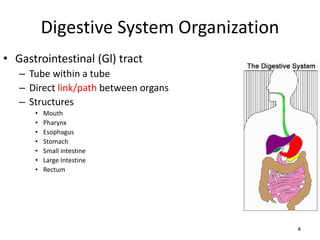
• Gastrointestinal (Gl) tract
– Tube within a tube
– Direct link/path between organs
– Structures
• Mouth
• Pharynx
• Esophagus
• Stomach
• Small intestine
• Large Intestine
• Rectum
4
Mouth
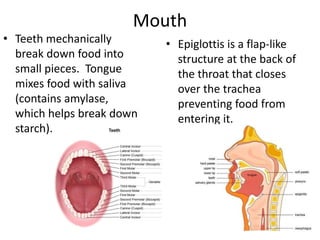
• Teeth mechanically
break down food into
small pieces. Tongue
mixes food with saliva
(contains amylase,
which helps break down
starch).
• Epiglottis is a flap-like
structure at the back of
the throat that closes
over the trachea
preventing food from
entering it.
Esophagus
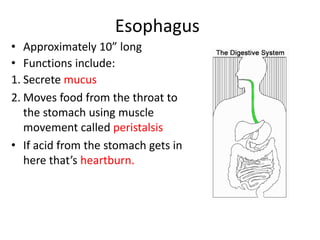
• Approximately 10” long
• Functions include:
1. Secrete mucus
2. Moves food from the throat to
the stomach using muscle
movement called peristalsis
• If acid from the stomach gets in
here that’s heartburn.
Stomach
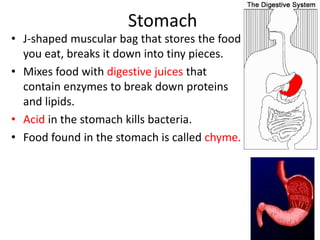
• J-shaped muscular bag that stores the food
you eat, breaks it down into tiny pieces.
• Mixes food with digestive juices that
contain enzymes to break down proteins
and lipids.
• Acid in the stomach kills bacteria.
• Food found in the stomach is called chyme.
7
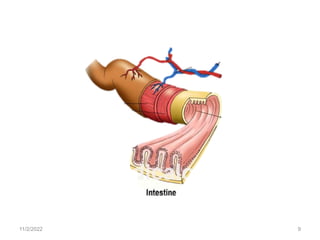
Small Intestine
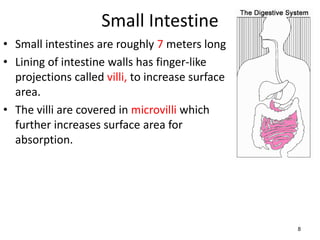
• Small intestines are roughly 7 meters long
• Lining of intestine walls has finger-like
projections called villi, to increase surface
area.
• The villi are covered in microvilli which
further increases surface area for
absorption.
8
11/2/2022 9
Small Intestine
• Nutrients from the food pass into the
bloodstream through the small
intestine walls.
• Absorbs:
– 80% ingested water
– Vitamins
– Minerals
– Carbohydrates
– Proteins
– Lipids
• Secretes digestive enzymes
10
Large Intestine
• About 5 feet long
• Accepts what small intestines don’t
absorb
• Rectum (short term storage which
holds feces before it is expelled).
Large Intestine
• Functions
– Bacterial digestion
• Ferment carbohydrates
• Protein breakdown
– Absorbs more water
– Concentrate wastes
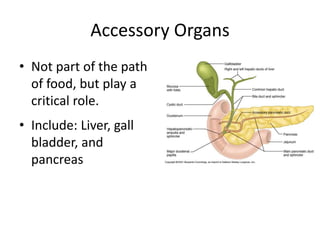
Accessory Organs
• Not part of the path
of food, but play a
critical role.
• Include: Liver, gall
bladder, and
pancreas
Liver
• Directly affects digestion by producing
bile
– Bile helps digest fat
• filters out toxins and waste including
drugs and alcohol
14
Gall Bladder
• Stores bile from the
liver, releases it into the
small intestine.
• Fatty diets can cause
gallstones
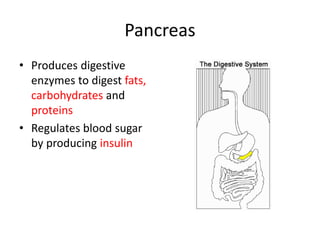
Pancreas
• Produces digestive
enzymes to digest fats,
carbohydrates and
proteins
• Regulates blood sugar
by producing insulin
11/2/2022 17
Organ Function
Mouth Chewing, Digestion of starch by salivary amylase
Esophagus
transport of food from mouth to stomach; lubricated by
mucus
Stomach
Storage of food and initial digestion of proteins + fats;
production of the hormone gastrin (response to protein)
that stimulates stomach's gastric glands to release gastric
juice (including pepsin and HCl)
Small intestine
Continued digestion of carbohydrates, proteins, lipids; most
absorption of nutrients; production of the hormone secretin
(response to HCl) that stimulates pancreas to release
bicarbonate; production of the hormone CCK (response to
fat) that stimulates gall bladder to release bile
Pancreas
Production of digestive enzymes that act in small intestine;
production of the hormones insulin and glucagon which
regulate blood sugar; production of bicarbonate that
neutralizes stomach acid in small intestine
Large intestine
Absorption of water; Production of some vitamins; storage
of undigested food
11/2/2022 18
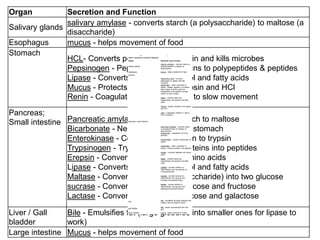
Organ Secretion and Function
Salivary glands
salivary amylase - converts starch (a polysaccharide) to maltose (a
disaccharide)
Esophagus mucus - helps movement of food
Stomach
HCL- Converts pepsinogen to pepsin and kills microbes
Pepsinogen - Pepsin, digests proteins to polypeptides & peptides
Lipase - Converts lipids into glycerol and fatty acids
Mucus - Protects stomach from pepsin and HCl
Renin - Coagulates proteins in milk to slow movement
Pancreas;
Small intestine Pancreatic amylase - Converts starch to maltose
Bicarbonate - Neutralizes HCl from stomach
Enterokinase - Converts trypsinogen to trypsin
Trypsinogen - Trypsin, converts proteins into peptides
Erepsin - Converts peptides into amino acids
Lipase - Converts lipids into glycerol and fatty acids
Maltase - Converts maltose (a disaccharide) into two glucose
sucrase - Converts sucrose into glucose and fructose
Lactase - Converts lactose into glucose and galactose
Liver / Gall
bladder
Bile - Emulsifies fat (large globules into smaller ones for lipase to
work)
Large intestine Mucus - helps movement of food
Table 2: Substances Involved in Digestion
Organ Secretion and Function
salivary glands
salivary amylase - converts starch (a
polysaccharide) to maltose (a
disaccharide)
esophagus mucus - helps movement of food
stomach
hydrochloric acid - converts
pepsinogen to pepsin and kills
microbes
pepsinogen - when converted to
pepsin, initiates digestion of proteins
(long chains of amino acids) to
polypeptides and peptides (shorter
chains of amino acids)
lipase - converts lipids (eg.
triglycerides) into glycerol and fatty
acids
mucus - protects stomach from pepsin
and HCl
renin - coagulates proteins in milk to
slow movement
pancreas; small intestine
pancreatic amylase - converts starch
(a polysaccharide) to maltose (a
disaccharide)
bicarbonate - neutralizes HCl from
stomach
enterokinase - converts trypsinogen to
trypsin
trypsinogen - when converted to
trypsin, converts proteins into peptides
erepsin - converts peptides into amino
acids
lipase - converts lipids (eg.
triglycerides) into glycerol and fatty
acids
maltase - convets maltose (a
disaccharide) into two glucose (a
monosaccharide)
sucrase - convets sucrose (a
disaccharide) into glucose and
fructose (monosaccharides)
lactase - convets lactose (a
disaccharide) into glucose and
galactose(monosaccharides)
liver
bile - emulsifies fat (large globules into
smaller ones for lipase to work)
gall bladder
bile - stores concentrated bile from
liver
large intestine mucus - helps movement of food
11/2/2022 19
Facts
• HOW LONG ARE YOUR INTESTINES? At least 25 feet
in an adult!
• Food drying up and hanging out in the large intestine
can last 18 hours to 2 days!
• In your lifetime, your digestive system may handle
about 50 tons!!
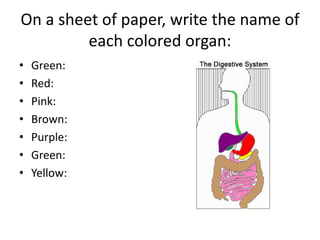
On a sheet of paper, write the name of
each colored organ:
• Green:
• Red:
• Pink:
• Brown:
• Purple:
• Green:
• Yellow:
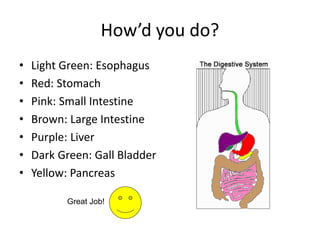
How’d you do?
• Light Green: Esophagus
• Red: Stomach
• Pink: Small Intestine
• Brown: Large Intestine
• Purple: Liver
• Dark Green: Gall Bladder
• Yellow: Pancreas
Great Job!

HUMAN DIGESTIVE SYSTEM.ppt

  • 2.
    Digestion • Phases Include 1.Ingestion 2. Movement 3. Mechanical and Chemical Digestion 4. Absorption 5. Elimination
  • 3.
    Digestion • Types – Mechanical(physical) • Chew • Tear • Grind • Mash • Mix – Chemical • Enzymatic reactions to improve digestion of – Carbohydrates – Proteins – Lipids
  • 4.
    Digestive System Organization •Gastrointestinal (Gl) tract – Tube within a tube – Direct link/path between organs – Structures • Mouth • Pharynx • Esophagus • Stomach • Small intestine • Large Intestine • Rectum 4
  • 5.
    Mouth • Teeth mechanically breakdown food into small pieces. Tongue mixes food with saliva (contains amylase, which helps break down starch). • Epiglottis is a flap-like structure at the back of the throat that closes over the trachea preventing food from entering it.
  • 6.
    Esophagus • Approximately 10”long • Functions include: 1. Secrete mucus 2. Moves food from the throat to the stomach using muscle movement called peristalsis • If acid from the stomach gets in here that’s heartburn.
  • 7.
    Stomach • J-shaped muscularbag that stores the food you eat, breaks it down into tiny pieces. • Mixes food with digestive juices that contain enzymes to break down proteins and lipids. • Acid in the stomach kills bacteria. • Food found in the stomach is called chyme. 7
  • 8.
    Small Intestine • Smallintestines are roughly 7 meters long • Lining of intestine walls has finger-like projections called villi, to increase surface area. • The villi are covered in microvilli which further increases surface area for absorption. 8
  • 9.
  • 10.
    Small Intestine • Nutrientsfrom the food pass into the bloodstream through the small intestine walls. • Absorbs: – 80% ingested water – Vitamins – Minerals – Carbohydrates – Proteins – Lipids • Secretes digestive enzymes 10
  • 11.
    Large Intestine • About5 feet long • Accepts what small intestines don’t absorb • Rectum (short term storage which holds feces before it is expelled).
  • 12.
    Large Intestine • Functions –Bacterial digestion • Ferment carbohydrates • Protein breakdown – Absorbs more water – Concentrate wastes
  • 13.
    Accessory Organs • Notpart of the path of food, but play a critical role. • Include: Liver, gall bladder, and pancreas
  • 14.
    Liver • Directly affectsdigestion by producing bile – Bile helps digest fat • filters out toxins and waste including drugs and alcohol 14
  • 15.
    Gall Bladder • Storesbile from the liver, releases it into the small intestine. • Fatty diets can cause gallstones
  • 16.
    Pancreas • Produces digestive enzymesto digest fats, carbohydrates and proteins • Regulates blood sugar by producing insulin
  • 17.
    11/2/2022 17 Organ Function MouthChewing, Digestion of starch by salivary amylase Esophagus transport of food from mouth to stomach; lubricated by mucus Stomach Storage of food and initial digestion of proteins + fats; production of the hormone gastrin (response to protein) that stimulates stomach's gastric glands to release gastric juice (including pepsin and HCl) Small intestine Continued digestion of carbohydrates, proteins, lipids; most absorption of nutrients; production of the hormone secretin (response to HCl) that stimulates pancreas to release bicarbonate; production of the hormone CCK (response to fat) that stimulates gall bladder to release bile Pancreas Production of digestive enzymes that act in small intestine; production of the hormones insulin and glucagon which regulate blood sugar; production of bicarbonate that neutralizes stomach acid in small intestine Large intestine Absorption of water; Production of some vitamins; storage of undigested food
  • 18.
    11/2/2022 18 Organ Secretionand Function Salivary glands salivary amylase - converts starch (a polysaccharide) to maltose (a disaccharide) Esophagus mucus - helps movement of food Stomach HCL- Converts pepsinogen to pepsin and kills microbes Pepsinogen - Pepsin, digests proteins to polypeptides & peptides Lipase - Converts lipids into glycerol and fatty acids Mucus - Protects stomach from pepsin and HCl Renin - Coagulates proteins in milk to slow movement Pancreas; Small intestine Pancreatic amylase - Converts starch to maltose Bicarbonate - Neutralizes HCl from stomach Enterokinase - Converts trypsinogen to trypsin Trypsinogen - Trypsin, converts proteins into peptides Erepsin - Converts peptides into amino acids Lipase - Converts lipids into glycerol and fatty acids Maltase - Converts maltose (a disaccharide) into two glucose sucrase - Converts sucrose into glucose and fructose Lactase - Converts lactose into glucose and galactose Liver / Gall bladder Bile - Emulsifies fat (large globules into smaller ones for lipase to work) Large intestine Mucus - helps movement of food Table 2: Substances Involved in Digestion Organ Secretion and Function salivary glands salivary amylase - converts starch (a polysaccharide) to maltose (a disaccharide) esophagus mucus - helps movement of food stomach hydrochloric acid - converts pepsinogen to pepsin and kills microbes pepsinogen - when converted to pepsin, initiates digestion of proteins (long chains of amino acids) to polypeptides and peptides (shorter chains of amino acids) lipase - converts lipids (eg. triglycerides) into glycerol and fatty acids mucus - protects stomach from pepsin and HCl renin - coagulates proteins in milk to slow movement pancreas; small intestine pancreatic amylase - converts starch (a polysaccharide) to maltose (a disaccharide) bicarbonate - neutralizes HCl from stomach enterokinase - converts trypsinogen to trypsin trypsinogen - when converted to trypsin, converts proteins into peptides erepsin - converts peptides into amino acids lipase - converts lipids (eg. triglycerides) into glycerol and fatty acids maltase - convets maltose (a disaccharide) into two glucose (a monosaccharide) sucrase - convets sucrose (a disaccharide) into glucose and fructose (monosaccharides) lactase - convets lactose (a disaccharide) into glucose and galactose(monosaccharides) liver bile - emulsifies fat (large globules into smaller ones for lipase to work) gall bladder bile - stores concentrated bile from liver large intestine mucus - helps movement of food
  • 19.
  • 20.
    Facts • HOW LONGARE YOUR INTESTINES? At least 25 feet in an adult! • Food drying up and hanging out in the large intestine can last 18 hours to 2 days! • In your lifetime, your digestive system may handle about 50 tons!!
  • 22.
    On a sheetof paper, write the name of each colored organ: • Green: • Red: • Pink: • Brown: • Purple: • Green: • Yellow:
  • 23.
    How’d you do? •Light Green: Esophagus • Red: Stomach • Pink: Small Intestine • Brown: Large Intestine • Purple: Liver • Dark Green: Gall Bladder • Yellow: Pancreas Great Job!