LECTURE
DR. MAHESWARI JAIKUMAR
maheswarijaikumar2103@gmail.com
DEFINITION
• " The lecture is a pedagogical
method whereby the teacher
formally delivers a carefully
planned expository address on
some particular topic or
problem". James Michael Lee
LECTURE METHOD
TECHNIQUE OF LECTURE
• Organise the class room in a way
which is conducive for teaching
learning activity.
• Prepare lesson plan on the topic
which need to be discussed
showing objectives, content,
teaching learning activity, AV aids &
time
• start the lecture with
introduction osf self, if not
introduced earlier, introduce the
topic and review the previous
topic.
• Organise the content matter,
which needs to be lectured in
the class room.
• Alter the pitch and volume of
voice periodically while lecturing.
• Develop a routine pace
depending on the respectivity
level of students such as going
fast while teaching simple topic
and slow down in teaching
difficult topics.
• Maintain eye contact and avoid
looking out of windows, at
walls and over students head
while teaching.
• Do not repeat words.
• Make use of appropriate AV
aids
• Converse freely with the
students. look in between the
prepared notes, but do not read
the contents continuously.
• Make use of simple plans and
use key points from contents
around which the whole lecture
is based
• Clarifythe previous concepts
before moving towards next
topic.
• Manage the lecture in planned
time as teaching in less time will
enable students to understand
and more time than expected
arise tension and damage the
lecture.
FUNCTIONS
• Delivers the relevant
knowledge in an organized
way.
• Provide references to the
students to gather information.
• Provides a brief introduction on
knowledge of learning before
demonstrating the skill or
introducing new area of learning.
• Clarifies concepts with
illustration.
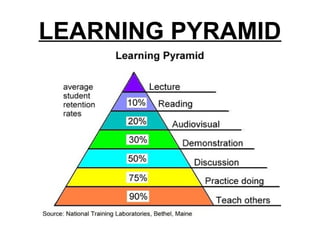
LEARNING PYRAMID
MERITS OF LECTURE METHOD
• Lecture method stimulates
students and promotes critical
thinking process.
• Lecture method meets the learning
needs of the learners as it is based
on need and interest of the
learners.
• It aparently saves resources.
• It provides the presence of
teacher with the students.
• It gives a feeling of security to
the students.
• It caters to a large group of
learners at a time.
• It provides flexibility as the teacher
is in close contact with his / her
students.
• The teacher can adjust his / her
technique in accordance with the
learner's abilities, aptitudes and
interest.
DEMERITS OF LECTURE
METHOD
• It keeps the pupil in a passive
situation.
• It does not allow for individual
pace of learning.
• Lecture method hardly offers
any possibility of checking the
learning progress.
• It does not facilitate problem
solving .
• In lecture method, less attention
is paid to problem solving,
feedback from learners, decision
making & critical thinking.
• If the lecture is not prepared
before hand it fails to attain the
objectives.
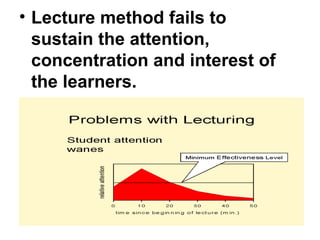
• Lecture method fails to
sustain the attention,
concentration and interest of
the learners.
GUIDELINES FOR AN
EFFECTIVE LECTURE
• A specific topic or information
should be arranged in such a
way as to leave a single, clear
impression on the minds of the
students.
• A teacher should utilize
different ways of presenting the
same information.
• The teacher should have
pauses in between the lesson
so that the students may gain
knowledge bit by bit.
• Pictoral illustrations such as
pictures, maps, charts should
be freely used as these help in
motivating the learners.
• The learners should be
encouraged to ask questions.
This will enable them to clarify
their doubts.
• Actual objects, models, diagrams,
sketches should be used.
• The lesson should divided into
sections which will have logical
sequence. This will enable the
learners to understand easily & also
train them in systematic thinking
besides assisting them to put their
own thoughts logically.
ESSENTIALS OF A
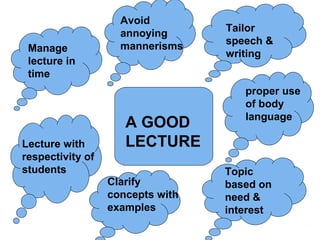
GOOD LECTURE
A GOOD
LECTURE
Avoid
annoying
mannerisms
Tailor
speech &
writing
proper use
of body
language
Topic
based on
need &
interest
Clarify
concepts with
examples
Lecture with
respectivity of
students
Manage
lecture in
time
LECTURE

Lecture Method of Teaching

  • 1.
  • 2.
    DEFINITION • " Thelecture is a pedagogical method whereby the teacher formally delivers a carefully planned expository address on some particular topic or problem". James Michael Lee
  • 3.
  • 4.
    TECHNIQUE OF LECTURE •Organise the class room in a way which is conducive for teaching learning activity. • Prepare lesson plan on the topic which need to be discussed showing objectives, content, teaching learning activity, AV aids & time
  • 5.
    • start thelecture with introduction osf self, if not introduced earlier, introduce the topic and review the previous topic. • Organise the content matter, which needs to be lectured in the class room.
  • 6.
    • Alter thepitch and volume of voice periodically while lecturing. • Develop a routine pace depending on the respectivity level of students such as going fast while teaching simple topic and slow down in teaching difficult topics.
  • 7.
    • Maintain eyecontact and avoid looking out of windows, at walls and over students head while teaching. • Do not repeat words. • Make use of appropriate AV aids
  • 8.
    • Converse freelywith the students. look in between the prepared notes, but do not read the contents continuously. • Make use of simple plans and use key points from contents around which the whole lecture is based
  • 9.
    • Clarifythe previousconcepts before moving towards next topic. • Manage the lecture in planned time as teaching in less time will enable students to understand and more time than expected arise tension and damage the lecture.
  • 10.
    FUNCTIONS • Delivers therelevant knowledge in an organized way. • Provide references to the students to gather information.
  • 11.
    • Provides abrief introduction on knowledge of learning before demonstrating the skill or introducing new area of learning. • Clarifies concepts with illustration.
  • 12.
  • 13.
    MERITS OF LECTUREMETHOD • Lecture method stimulates students and promotes critical thinking process. • Lecture method meets the learning needs of the learners as it is based on need and interest of the learners.
  • 14.
    • It aparentlysaves resources. • It provides the presence of teacher with the students. • It gives a feeling of security to the students.
  • 15.
    • It catersto a large group of learners at a time. • It provides flexibility as the teacher is in close contact with his / her students. • The teacher can adjust his / her technique in accordance with the learner's abilities, aptitudes and interest.
  • 16.
    DEMERITS OF LECTURE METHOD •It keeps the pupil in a passive situation. • It does not allow for individual pace of learning.
  • 17.
    • Lecture methodhardly offers any possibility of checking the learning progress. • It does not facilitate problem solving .
  • 18.
    • In lecturemethod, less attention is paid to problem solving, feedback from learners, decision making & critical thinking. • If the lecture is not prepared before hand it fails to attain the objectives.
  • 19.
    • Lecture methodfails to sustain the attention, concentration and interest of the learners.
  • 20.
    GUIDELINES FOR AN EFFECTIVELECTURE • A specific topic or information should be arranged in such a way as to leave a single, clear impression on the minds of the students.
  • 21.
    • A teachershould utilize different ways of presenting the same information. • The teacher should have pauses in between the lesson so that the students may gain knowledge bit by bit.
  • 22.
    • Pictoral illustrationssuch as pictures, maps, charts should be freely used as these help in motivating the learners. • The learners should be encouraged to ask questions. This will enable them to clarify their doubts.
  • 23.
    • Actual objects,models, diagrams, sketches should be used. • The lesson should divided into sections which will have logical sequence. This will enable the learners to understand easily & also train them in systematic thinking besides assisting them to put their own thoughts logically.
  • 24.
  • 25.
    A GOOD LECTURE Avoid annoying mannerisms Tailor speech & writing properuse of body language Topic based on need & interest Clarify concepts with examples Lecture with respectivity of students Manage lecture in time
  • 26.