DR.MAHESWARI JAIKUMAR
maheswarijaikumar2103@gmail.com
MICRO TEACHING
●
"Micro teaching is a scaled"Micro teaching is a scaled
down teaching encounter in adown teaching encounter in a
class size and class time".class size and class time".
● The number of students is from
5-10, and the duration of period
ranges from 5-20 minutes.
ALLEN (1996)
●
Micro teaching is a deviceMicro teaching is a device
which provides the novicewhich provides the novice
and experienced teacherand experienced teacher
alike new opportunities toalike new opportunities to
improve teaching.improve teaching.
● It is a real teaching with a
scaled down time and size of
the class.
HISTORY
● The idea of micro
teaching originated for
the first time in
STANFORD UNIVERSITY,STANFORD UNIVERSITY,
USA.USA.
● The term "MICRO
TEACHING" was coined in
1963.
ASSUMPTIONS
● Is based on Skinner's operant
conditioning.
● Teaching is a complex
process but it can be
analyzed into simple skills.
● Teacing skills can be practised
one by one up to the mastery
level under specific and
simplified situations.
● Appropriate feedback, if
systematically given proves
very significant for obtaining a
mastery level in each skill.
● When all skills have been
mastered, taken one by one,
then they can be integrated for
real class room teaching.
● Skill training can be
conveniently transferred from a
simulated teaching situation to
the actual classroom teaching
situation.
● Teaching skill is a set of
behaviours or acts of the
teacher that facilitate
student's learning.
● Teaching is observable,
definable, measurable and
demonstratable and can be
developed through training.
● Micro teaching is a teacher
training technique that plays
a significant role in
developing teaching skills in
the student teachers.
THE CONCEPT
● A single skill for practice.
● One concept of content for
teaching.
● A class of 5-10 students.
● 5-10 min of practice time.
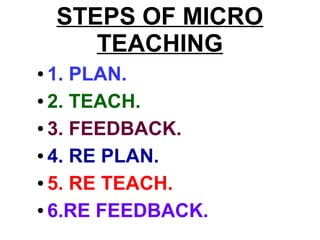
STEPS OF MICRO
TEACHING
● 1. PLAN.
● 2. TEACH.
● 3. FEEDBACK.
● 4. RE PLAN.
● 5. RE TEACH.
● 6.RE FEEDBACK.
STEPS
PLAN
● This involves selection of a
topic and related content.
● The topic is analysed into
different activities of the teacher
and the students.
● The activities are planned in
logical sequence.
TEACH
● This involves the attempts of
the teacher trainee to use the
components of the skill in
suitable situations in the
process of teaching –
learning as per the role or the
planning activities.
● If the situation is not different and
not as visualized in the planning of
the activities, the teacher should
modify his or her behaviour as per
the demand of the situation of the
class.
● The teacher should have the
courage and confidence to handle
the situations arising in the class
effectively.
FEEDBACK
● Refers to the giving
information to the teacher
trainee about his
performance.
● This helps the teacher trainee
to improve his or her
performance in the desired
direction.
RE-PLAN
● The teacher trainee replans his
lesson incorporating the points of
strngth and removing the points
not skilfully handled during
teaching in the previous attempt
either on the same tiopic or on
another topic suiting the teacher
trainee for improvement.
RE-TEACH
● This involves the teaching
the same group of student if
the topic is changed or a
different group of students if
the topic is same.
● This is done to remove
boredom or monotony in the
students.
● The teacher trainee teaches
the class with renewed
courage and confidence to
perform better than the
previous attempt.
RE-FEEDBACK
● This is the most important
component of micro teaching
for behaviour modification of
the teacher trainee in the
desired direction in each and
every skill practice.
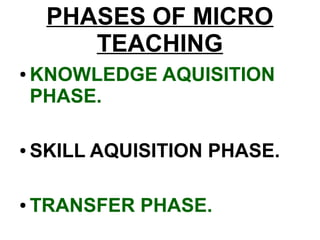
PHASES OF MICRO
TEACHING
● KNOWLEDGE AQUISITION
PHASE.
● SKILL AQUISITION PHASE.
● TRANSFER PHASE.
KNOWLEDGE AUISITION
PHASE
● The trainee teacher learns about
the skills and its components
through discussion, illustrations
and demonstration of the skill
given by the expert.
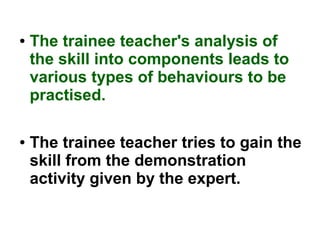
● The trainee teacher's analysis of
the skill into components leads to
various types of behaviours to be
practised.
● The trainee teacher tries to gain the
skill from the demonstration
activity given by the expert.
● He discusses and clarifies each
and every aspect of skill.
SKILL AQUISITION PHASE
● On the basis of the demonstration
presented by the expert, the
teacher trainee plans a micro –
leson plan for practicing.
● He practices the teaching skill
through the micro teaching cycle
and continues his efforts till he
attains the mastry levels.
● The feedback components of micro
teaching contributes significantly
towards the mastry level aqcusition
of the skill.
● These skills are called the "core
skills"
● These skills are called core
skills because of their extensive
use in classroom teaching.
● The core skills are as follows.
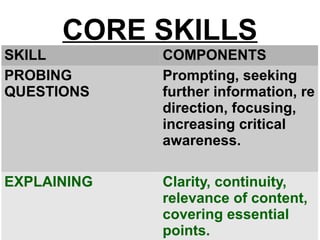
CORE SKILLS
SKILL COMPONENTS
PROBING
QUESTIONS
Prompting, seeking
further information, re
direction, focusing,
increasing critical
awareness.
EXPLAINING Clarity, continuity,
relevance of content,
covering essential
points.
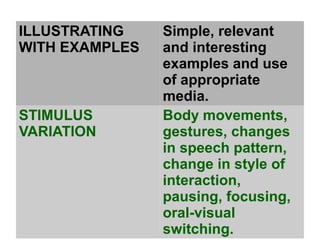
ILLUSTRATING
WITH EXAMPLES
Simple, relevant
and interesting
examples and use
of appropriate
media.
STIMULUS
VARIATION
Body movements,
gestures, changes
in speech pattern,
change in style of
interaction,
pausing, focusing,
oral-visual
switching.
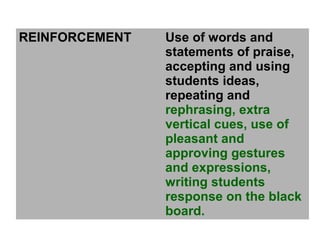
REINFORCEMENT Use of words and
statements of praise,
accepting and using
students ideas,
repeating and
rephrasing, extra
vertical cues, use of
pleasant and
approving gestures
and expressions,
writing students
response on the black
board.
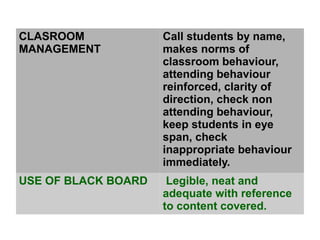
CLASROOM
MANAGEMENT
Call students by name,
makes norms of
classroom behaviour,
attending behaviour
reinforced, clarity of
direction, check non
attending behaviour,
keep students in eye
span, check
inappropriate behaviour
immediately.
USE OF BLACK BOARD Legible, neat and
adequate with reference
to content covered.
ADVANTAGES
● Visual feedback (watching a
recorded session) has been found
to provide one of the most effective
means of evaluating teaching
strengths.
● Micro teaching enables both
intrnsic (self assessment) and
extrinsic (peer assessment) review.
● Micro teaching provides
opportunity for practicing part of
lecture activity, practicing a guest
lecture, before delivering a course,
demonstration in lab for first time,
practicing a job talk, practice public
speaking skills before you address
students for the first time,
polishing your skills if you are an
experirnced person.
CHALLENGES
● Time consuminng.
● Trainee teacher may get a feeling of
saturation or get bored with
repeated teaching sessions.
● Trainee teacher may lose self
confidence if she or he is asked to
repeat the classes several time.
THANK YOU

Micro Teaching

  • 1.
  • 3.
    MICRO TEACHING ● "Micro teachingis a scaled"Micro teaching is a scaled down teaching encounter in adown teaching encounter in a class size and class time".class size and class time". ● The number of students is from 5-10, and the duration of period ranges from 5-20 minutes. ALLEN (1996)
  • 5.
    ● Micro teaching isa deviceMicro teaching is a device which provides the novicewhich provides the novice and experienced teacherand experienced teacher alike new opportunities toalike new opportunities to improve teaching.improve teaching. ● It is a real teaching with a scaled down time and size of the class.
  • 7.
    HISTORY ● The ideaof micro teaching originated for the first time in STANFORD UNIVERSITY,STANFORD UNIVERSITY, USA.USA.
  • 8.
    ● The term"MICRO TEACHING" was coined in 1963.
  • 9.
    ASSUMPTIONS ● Is basedon Skinner's operant conditioning. ● Teaching is a complex process but it can be analyzed into simple skills.
  • 10.
    ● Teacing skillscan be practised one by one up to the mastery level under specific and simplified situations. ● Appropriate feedback, if systematically given proves very significant for obtaining a mastery level in each skill.
  • 11.
    ● When allskills have been mastered, taken one by one, then they can be integrated for real class room teaching. ● Skill training can be conveniently transferred from a simulated teaching situation to the actual classroom teaching situation.
  • 12.
    ● Teaching skillis a set of behaviours or acts of the teacher that facilitate student's learning. ● Teaching is observable, definable, measurable and demonstratable and can be developed through training.
  • 13.
    ● Micro teachingis a teacher training technique that plays a significant role in developing teaching skills in the student teachers.
  • 14.
    THE CONCEPT ● Asingle skill for practice. ● One concept of content for teaching. ● A class of 5-10 students. ● 5-10 min of practice time.
  • 15.
    STEPS OF MICRO TEACHING ●1. PLAN. ● 2. TEACH. ● 3. FEEDBACK. ● 4. RE PLAN. ● 5. RE TEACH. ● 6.RE FEEDBACK.
  • 16.
  • 17.
    PLAN ● This involvesselection of a topic and related content. ● The topic is analysed into different activities of the teacher and the students.
  • 18.
    ● The activitiesare planned in logical sequence.
  • 19.
    TEACH ● This involvesthe attempts of the teacher trainee to use the components of the skill in suitable situations in the process of teaching – learning as per the role or the planning activities.
  • 20.
    ● If thesituation is not different and not as visualized in the planning of the activities, the teacher should modify his or her behaviour as per the demand of the situation of the class. ● The teacher should have the courage and confidence to handle the situations arising in the class effectively.
  • 21.
    FEEDBACK ● Refers tothe giving information to the teacher trainee about his performance.
  • 22.
    ● This helpsthe teacher trainee to improve his or her performance in the desired direction.
  • 23.
    RE-PLAN ● The teachertrainee replans his lesson incorporating the points of strngth and removing the points not skilfully handled during teaching in the previous attempt either on the same tiopic or on another topic suiting the teacher trainee for improvement.
  • 24.
    RE-TEACH ● This involvesthe teaching the same group of student if the topic is changed or a different group of students if the topic is same.
  • 25.
    ● This isdone to remove boredom or monotony in the students. ● The teacher trainee teaches the class with renewed courage and confidence to perform better than the previous attempt.
  • 26.
    RE-FEEDBACK ● This isthe most important component of micro teaching for behaviour modification of the teacher trainee in the desired direction in each and every skill practice.
  • 27.
    PHASES OF MICRO TEACHING ●KNOWLEDGE AQUISITION PHASE. ● SKILL AQUISITION PHASE. ● TRANSFER PHASE.
  • 28.
    KNOWLEDGE AUISITION PHASE ● Thetrainee teacher learns about the skills and its components through discussion, illustrations and demonstration of the skill given by the expert.
  • 29.
    ● The traineeteacher's analysis of the skill into components leads to various types of behaviours to be practised. ● The trainee teacher tries to gain the skill from the demonstration activity given by the expert.
  • 30.
    ● He discussesand clarifies each and every aspect of skill.
  • 31.
    SKILL AQUISITION PHASE ●On the basis of the demonstration presented by the expert, the teacher trainee plans a micro – leson plan for practicing. ● He practices the teaching skill through the micro teaching cycle and continues his efforts till he attains the mastry levels.
  • 32.
    ● The feedbackcomponents of micro teaching contributes significantly towards the mastry level aqcusition of the skill. ● These skills are called the "core skills"
  • 33.
    ● These skillsare called core skills because of their extensive use in classroom teaching. ● The core skills are as follows.
  • 34.
    CORE SKILLS SKILL COMPONENTS PROBING QUESTIONS Prompting,seeking further information, re direction, focusing, increasing critical awareness. EXPLAINING Clarity, continuity, relevance of content, covering essential points.
  • 35.
    ILLUSTRATING WITH EXAMPLES Simple, relevant andinteresting examples and use of appropriate media. STIMULUS VARIATION Body movements, gestures, changes in speech pattern, change in style of interaction, pausing, focusing, oral-visual switching.
  • 36.
    REINFORCEMENT Use ofwords and statements of praise, accepting and using students ideas, repeating and rephrasing, extra vertical cues, use of pleasant and approving gestures and expressions, writing students response on the black board.
  • 37.
    CLASROOM MANAGEMENT Call students byname, makes norms of classroom behaviour, attending behaviour reinforced, clarity of direction, check non attending behaviour, keep students in eye span, check inappropriate behaviour immediately. USE OF BLACK BOARD Legible, neat and adequate with reference to content covered.
  • 40.
    ADVANTAGES ● Visual feedback(watching a recorded session) has been found to provide one of the most effective means of evaluating teaching strengths. ● Micro teaching enables both intrnsic (self assessment) and extrinsic (peer assessment) review.
  • 41.
    ● Micro teachingprovides opportunity for practicing part of lecture activity, practicing a guest lecture, before delivering a course, demonstration in lab for first time, practicing a job talk, practice public speaking skills before you address students for the first time, polishing your skills if you are an experirnced person.
  • 42.
    CHALLENGES ● Time consuminng. ●Trainee teacher may get a feeling of saturation or get bored with repeated teaching sessions. ● Trainee teacher may lose self confidence if she or he is asked to repeat the classes several time.
  • 43.