FACULTY OF NURSING SCIENCES
BY- MRS SUDHARANI
INTRODUCTION:
Direct experience with reality provides an excellent
opportunity for sensory learning, field trip is a first
audio- visual aid to be introduced in audio- visual
media for effective learning.
The specific advantage of field trip is that after the
trip students just say, I have seen, instead of I have
read about or I have been told.
DEFINITIONS:
Field trip is defined as an educational procedure by
which the student studies first hand objectives and
materials in the natural environment.
-(Heidgerken)
Field trip is defined as most concrete and the real
best visual techniques which bring the pupil into
direct contact with the real life situation.
-(Bhatia)
OBJECTIVES:
 Toapply theory into practice
 Toevaluate the result of new practice
 Toenrich the classroom instruction
 Todevelop observational skills
 Toimprove social interaction among the students
 Torefresh students knowledge
 Toobtain baseline data
 Todevelop creativity skill among students
PURPOSE:
1. It helps to furnish first hand information
2. It helps to co-relate and blend school life without
side world by providing a direct touch with
community situation
3. It helps to develop keenness and observational
skills
4. Field trip provide opportunity to apply what is
taught and verify what is learned
5. Field trip provides actual source material for study
6. Field trip helps to develop aesthetic sense in
students
TYPES OF FIELD TRIPS:
1. Local school trip
2. Community trip
3. Tour or journey
4. Imaginary tour
5. Inter school visits or inter college visit
6. Individual trip
RESPONSIBILITIES OF TEACHER:
1. Check the presence of all students and see that no
student is missing
2. Adequate information should be given to the
students
3. Guide and supervise the students during the trip
4. Safety rules to be followed strictly throughout the
trip
5. Teacher should encourage unity, discipline among
the group
6. First aid box should be taken and kept in the
vehicle for the trip
RESPONSIBILITIES OF STUDENT:
1. Each student is personally responsible to know
place of visit, vehicle used for trip, time and place
of getting on and off the vehicle
2. Student should be punctual and obey the
command or instruction of the teacher
3. Student should wear suitable dress based on place
of visit
4. Questions should be framed and kept ready
5. All luggage of the student should be labeled and
should be ready on time for departure
6. Each student should take notes whenever they are
instructed to take
ADVANTAGES:
1. Observation of active participation with reality
2. Opportunity for co-operative group work and
sharing responsibilities
3. Enable the students to develop self confidence
4. Ensure close contacts with reality
5. It increases the variability
6. It is good method for individual motivation
7. It gives relief from monotonous life of classroom
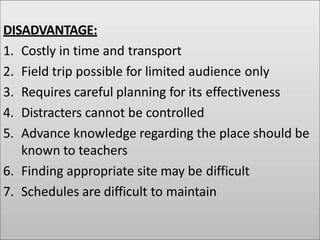
DISADVANTAGE:
1. Costly in time and transport
2. Field trip possible for limited audience only
3. Requires careful planning for its effectiveness
4. Distracters cannot be controlled
5. Advance knowledge regarding the place should be
known to teachers
6. Finding appropriate site may be difficult
7. Schedules are difficult to maintain
ANY
QUESTIONS ?
Field trip

Field trip

  • 1.
    FACULTY OF NURSINGSCIENCES BY- MRS SUDHARANI
  • 3.
    INTRODUCTION: Direct experience withreality provides an excellent opportunity for sensory learning, field trip is a first audio- visual aid to be introduced in audio- visual media for effective learning. The specific advantage of field trip is that after the trip students just say, I have seen, instead of I have read about or I have been told.
  • 4.
    DEFINITIONS: Field trip isdefined as an educational procedure by which the student studies first hand objectives and materials in the natural environment. -(Heidgerken) Field trip is defined as most concrete and the real best visual techniques which bring the pupil into direct contact with the real life situation. -(Bhatia)
  • 5.
    OBJECTIVES:  Toapply theoryinto practice  Toevaluate the result of new practice  Toenrich the classroom instruction  Todevelop observational skills  Toimprove social interaction among the students  Torefresh students knowledge  Toobtain baseline data  Todevelop creativity skill among students
  • 6.
    PURPOSE: 1. It helpsto furnish first hand information 2. It helps to co-relate and blend school life without side world by providing a direct touch with community situation 3. It helps to develop keenness and observational skills 4. Field trip provide opportunity to apply what is taught and verify what is learned 5. Field trip provides actual source material for study 6. Field trip helps to develop aesthetic sense in students
  • 7.
    TYPES OF FIELDTRIPS: 1. Local school trip 2. Community trip 3. Tour or journey 4. Imaginary tour 5. Inter school visits or inter college visit 6. Individual trip
  • 8.
    RESPONSIBILITIES OF TEACHER: 1.Check the presence of all students and see that no student is missing 2. Adequate information should be given to the students 3. Guide and supervise the students during the trip 4. Safety rules to be followed strictly throughout the trip 5. Teacher should encourage unity, discipline among the group 6. First aid box should be taken and kept in the vehicle for the trip
  • 9.
    RESPONSIBILITIES OF STUDENT: 1.Each student is personally responsible to know place of visit, vehicle used for trip, time and place of getting on and off the vehicle 2. Student should be punctual and obey the command or instruction of the teacher 3. Student should wear suitable dress based on place of visit 4. Questions should be framed and kept ready 5. All luggage of the student should be labeled and should be ready on time for departure 6. Each student should take notes whenever they are instructed to take
  • 10.
    ADVANTAGES: 1. Observation ofactive participation with reality 2. Opportunity for co-operative group work and sharing responsibilities 3. Enable the students to develop self confidence 4. Ensure close contacts with reality 5. It increases the variability 6. It is good method for individual motivation 7. It gives relief from monotonous life of classroom
  • 11.
    DISADVANTAGE: 1. Costly intime and transport 2. Field trip possible for limited audience only 3. Requires careful planning for its effectiveness 4. Distracters cannot be controlled 5. Advance knowledge regarding the place should be known to teachers 6. Finding appropriate site may be difficult 7. Schedules are difficult to maintain
  • 12.