DEMONSTRATION
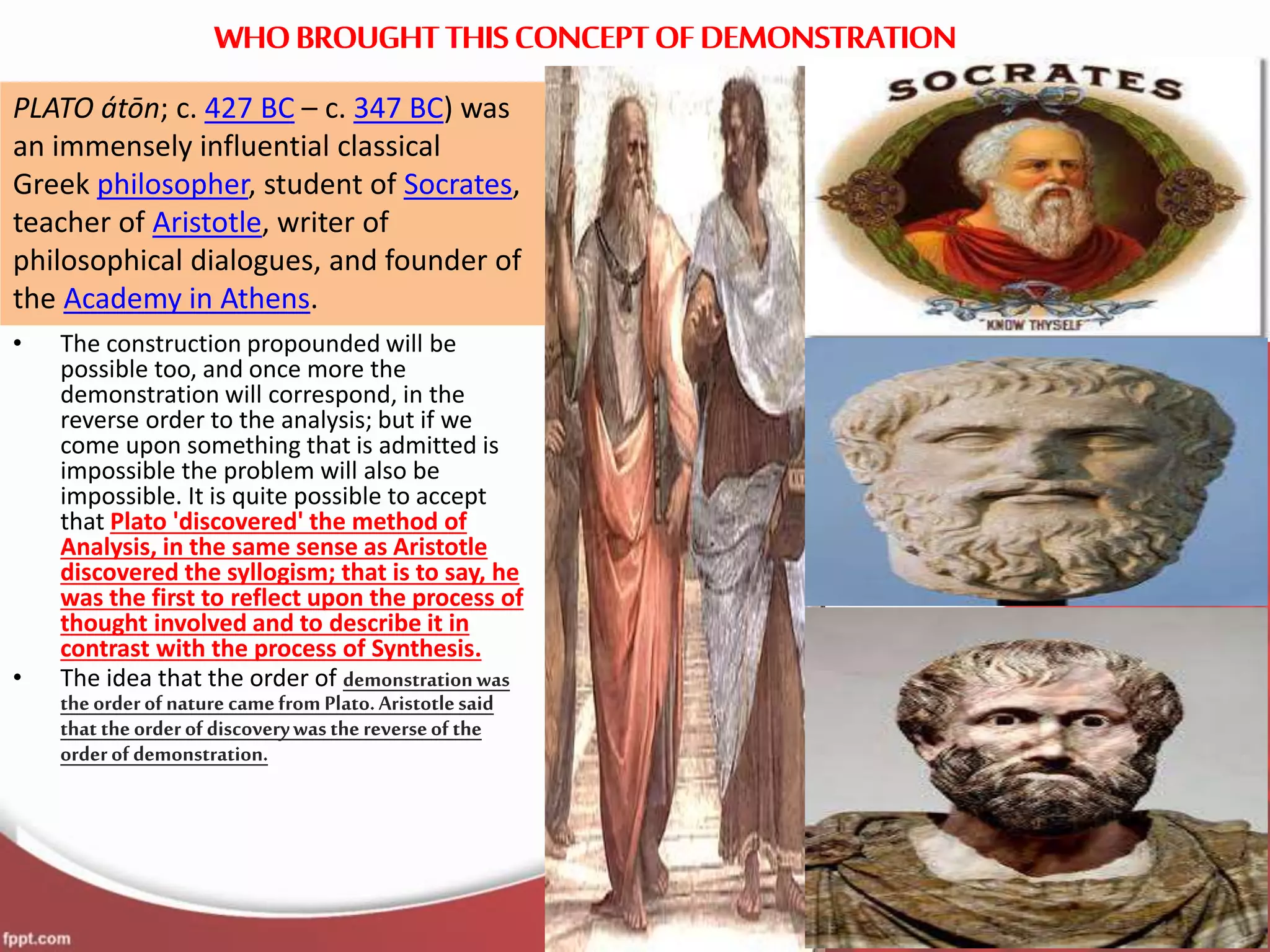
WHOBROUGHT THIS CONCEPT OF DEMONSTRATION
• The construction propounded will be
possible too, and once more the
demonstration will correspond, in the
reverse order to the analysis; but if we
come upon something that is admitted is
impossible the problem will also be
impossible. It is quite possible to accept
that Plato 'discovered' the method of
Analysis, in the same sense as Aristotle
discovered the syllogism; that is to say, he
was the first to reflect upon the process of
thought involved and to describe it in
contrast with the process of Synthesis.
• The idea that the order of demonstrationwas
theorderof nature camefrom Plato.Aristotlesaid
that theorderof discoverywasthereverseof the
orderof demonstration.
WHOBROUGHT THIS CONCEPT OF DEMONSTRATION
PLATO átōn; c. 427 BC – c. 347 BC) was
an immensely influential classical
Greek philosopher, student of Socrates,
teacher of Aristotle, writer of
philosophical dialogues, and founder of
the Academy in Athens.
Lesson plan
on
DEMONSTRATION..
SUBMITTED BY
ESTELA JOHN RANGARE
P.B.DIPOLOMA IN PEDIATRIC NURSING.
INE ,J.J HOSPITAL MUMBAI.
BATCH 2020-2021
OBJECTIVES
SPECIFIC OBJECTIVES :-
At the end of the lecture students will be able to gain knowledge and understand the concept of “DEMONSTRATION” as a method of
teaching .
GENERAL OBJECTIVES :-
At the end of the teaching students will be able to
1. Understand the concept of “DEMONSTRATION” as a method of teaching .
2. Give meaning of Demonstration.
3. Define Demonstration.
4. Enlist its purposes.
5. Classify its types.
6. Elaborate the phases of demonstration.
7. Explain the characteristic of demonstration.
8. Enlist the pre-requisite of good demonstration.
9. Explain the steps of demonstration.
10. What are the common error occur during demonstration.
11. Enlist responsibilities of Teacher &Student.
12. Diagrammatic layout relations between the teacher &student in demonstration.
13. Explain advantages &disadvantages of demonstration.
14. Elaborates the method of demonstration in Nursing.
15. Describe limitation in demonstration lecture cum presentation.
16. Discuss the suggestion for stimulant for fostering creativity in use in demonstration.
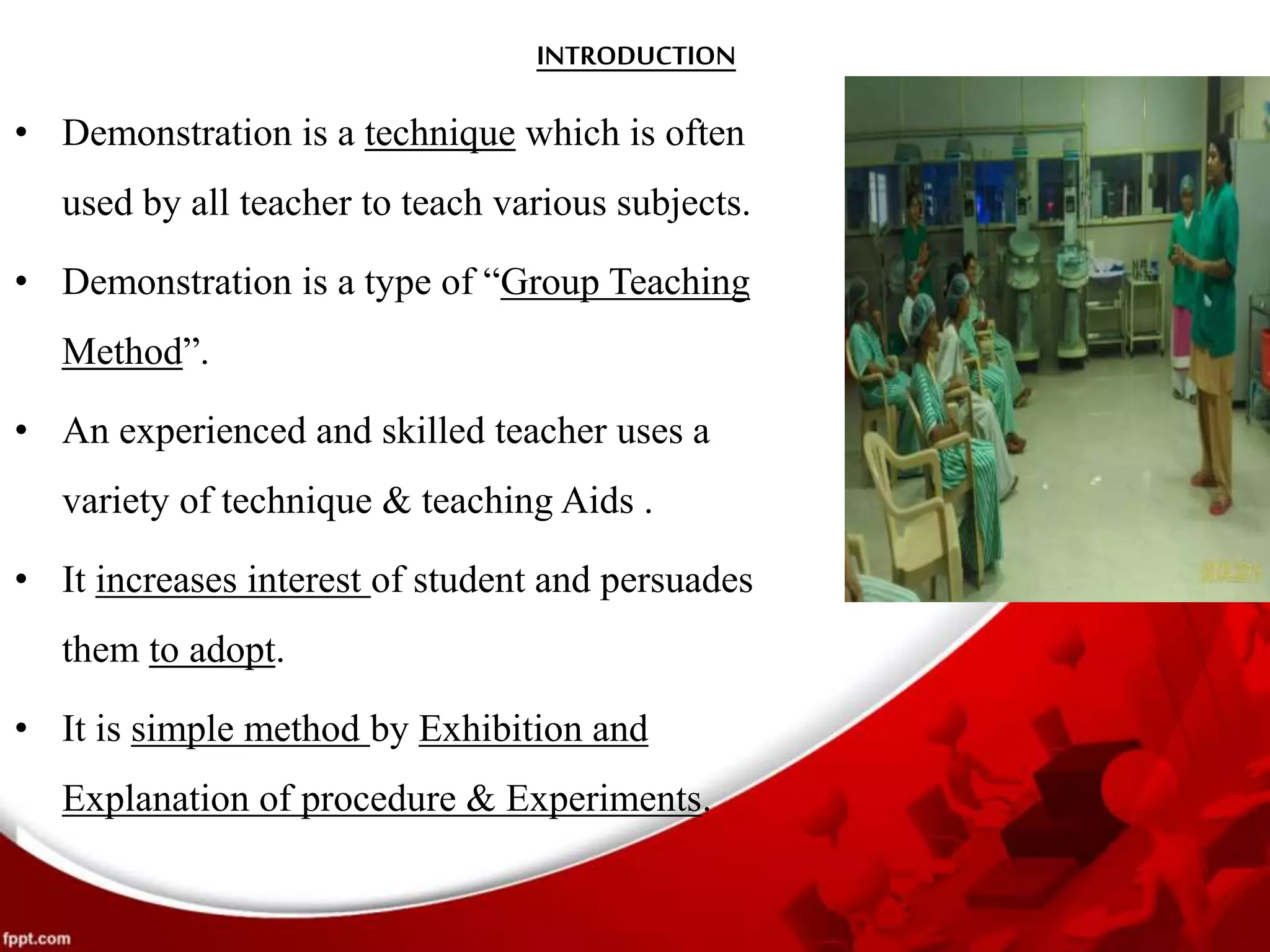
INTRODUCTION
• Demonstration is a technique which is often
used by all teacher to teach various subjects.
• Demonstration is a type of “Group Teaching
Method”.
• An experienced and skilled teacher uses a
variety of technique & teaching Aids .
• It increases interest of student and persuades
them to adopt.
• It is simple method by Exhibition and
Explanation of procedure & Experiments.
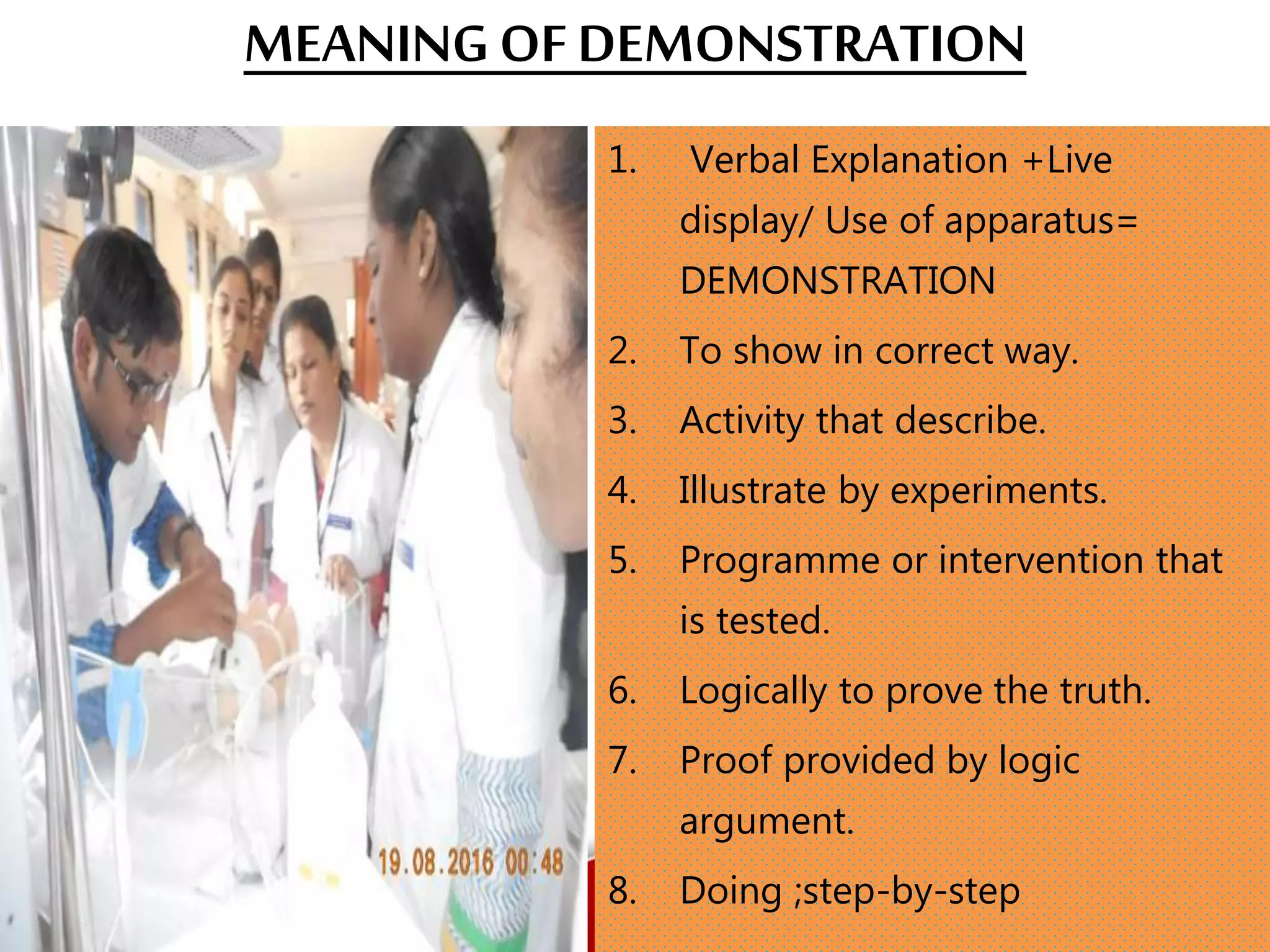
MEANINGOF DEMONSTRATION
1. Verbal Explanation +Live
display/ Use of apparatus=
DEMONSTRATION
2. To show in correct way.
3. Activity that describe.
4. Illustrate by experiments.
5. Programme or intervention that
is tested.
6. Logically to prove the truth.
7. Proof provided by logic
argument.
8. Doing ;step-by-step
DEFINITION OF DEMONSTRATION
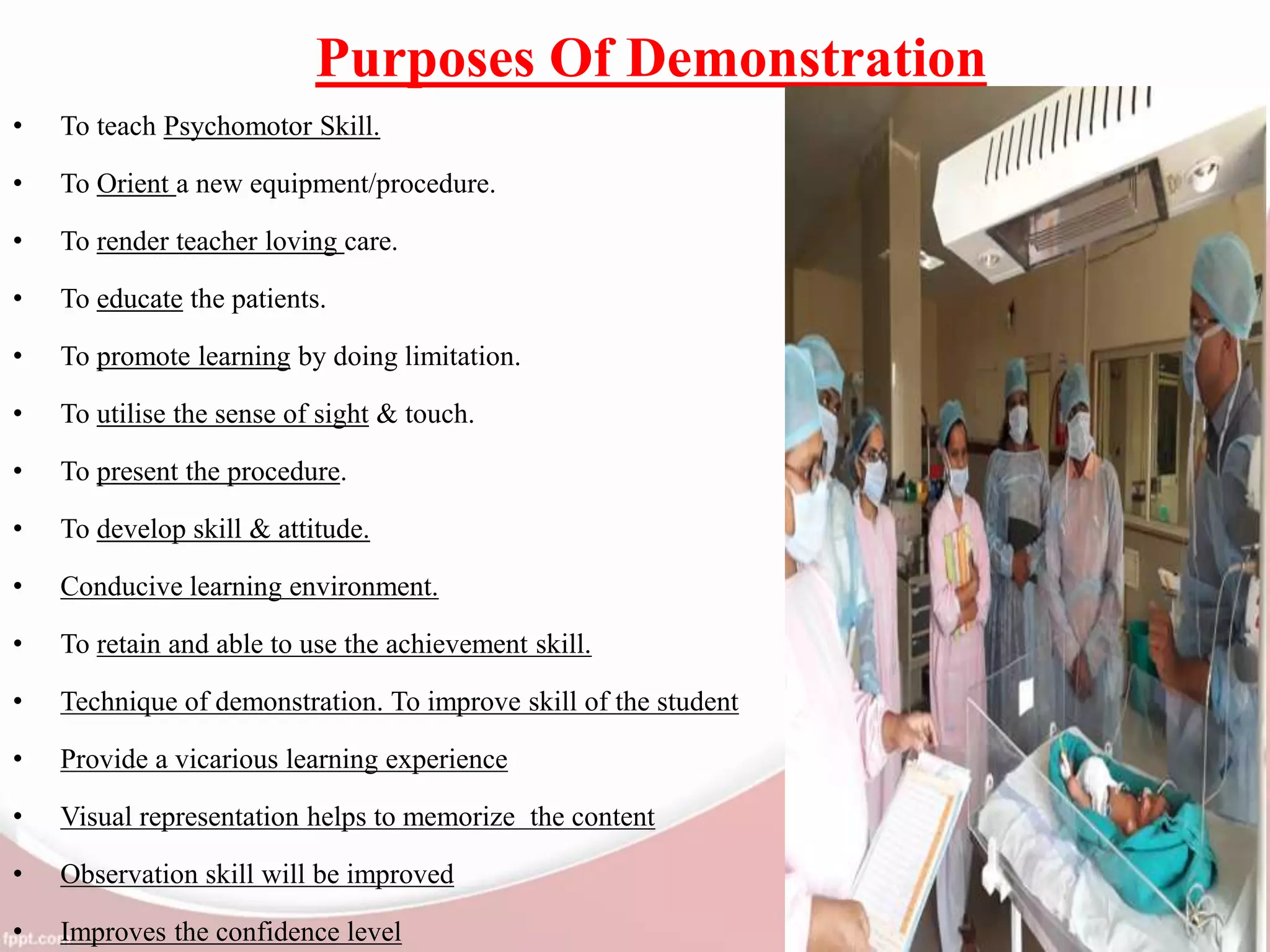
Purposes Of Demonstration
• To teach Psychomotor Skill.
• To Orient a new equipment/procedure.
• To render teacher loving care.
• To educate the patients.
• To promote learning by doing limitation.
• To utilise the sense of sight & touch.
• To present the procedure.
• To develop skill & attitude.
• Conducive learning environment.
• To retain and able to use the achievement skill.
• Technique of demonstration. To improve skill of the student
• Provide a vicarious learning experience
• Visual representation helps to memorize the content
• Observation skill will be improved
• Improves the confidence level
Special purpose in Nursing.
• Teaches new procedure either at bedside , ward
,nursing laboratory.
• Applies knowledge of underlying scientific
principal in NSG care situations.
• Teaches the uses, function & care of new
equipment.
• Teaches application on of observation
techniques.
• Teaches maintain of health & preventive health
care measures to patient & family.
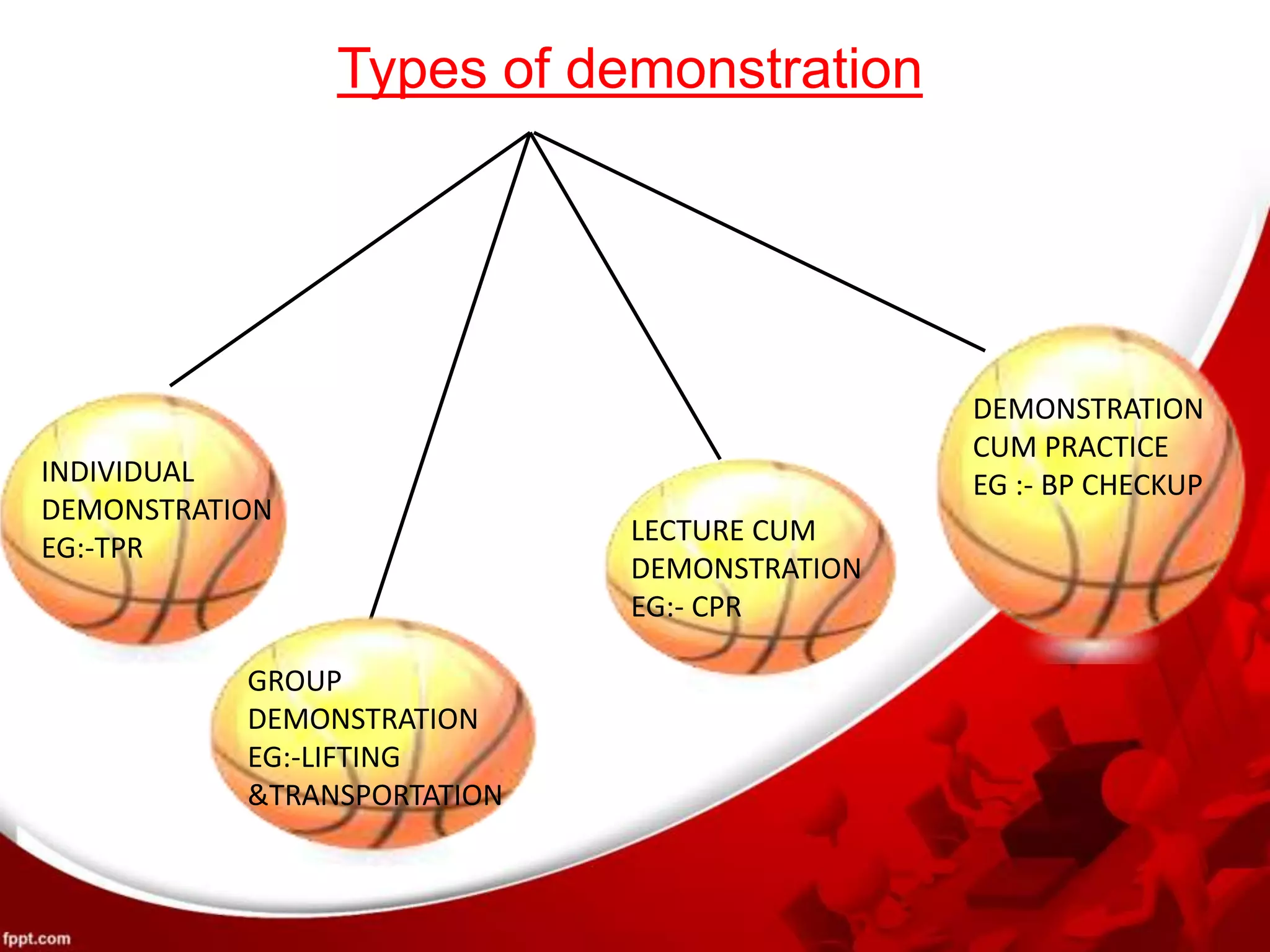
Types of demonstration
INDIVIDUAL
DEMONSTRATION
EG:-TPR
GROUP
DEMONSTRATION
EG:-LIFTING
&TRANSPORTATION
LECTURE CUM
DEMONSTRATION
EG:- CPR
DEMONSTRATION
CUM PRACTICE
EG :- BP CHECKUP
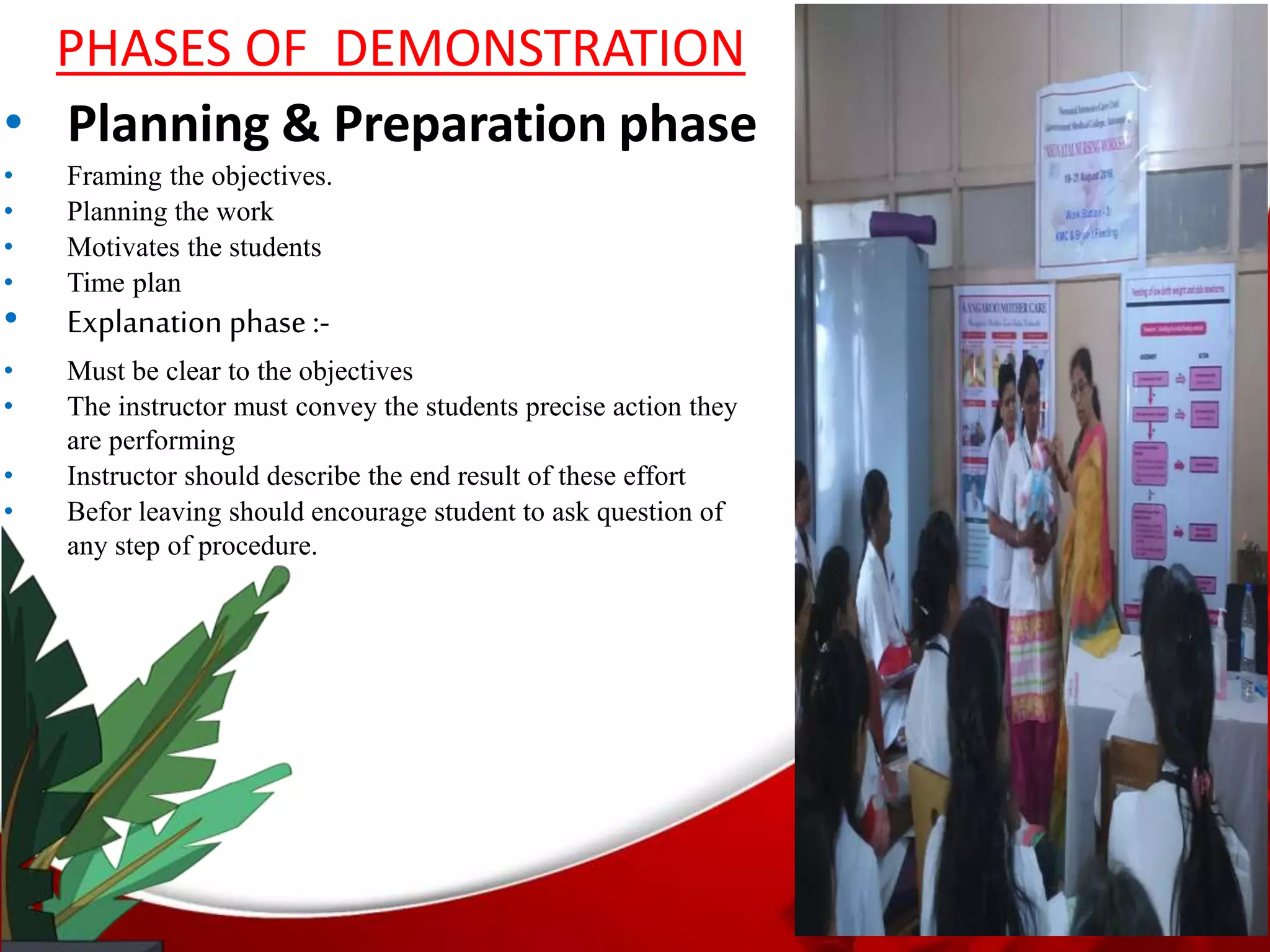
PHASES OF DEMONSTRATION
• Planning & Preparation phase
• Framing the objectives.
• Planning the work
• Motivates the students
• Time plan
• Explanation phase :-
• Must be clear to the objectives
• The instructor must convey the students precise action they
are performing
• Instructor should describe the end result of these effort
• Befor leaving should encourage student to ask question of
any step of procedure.
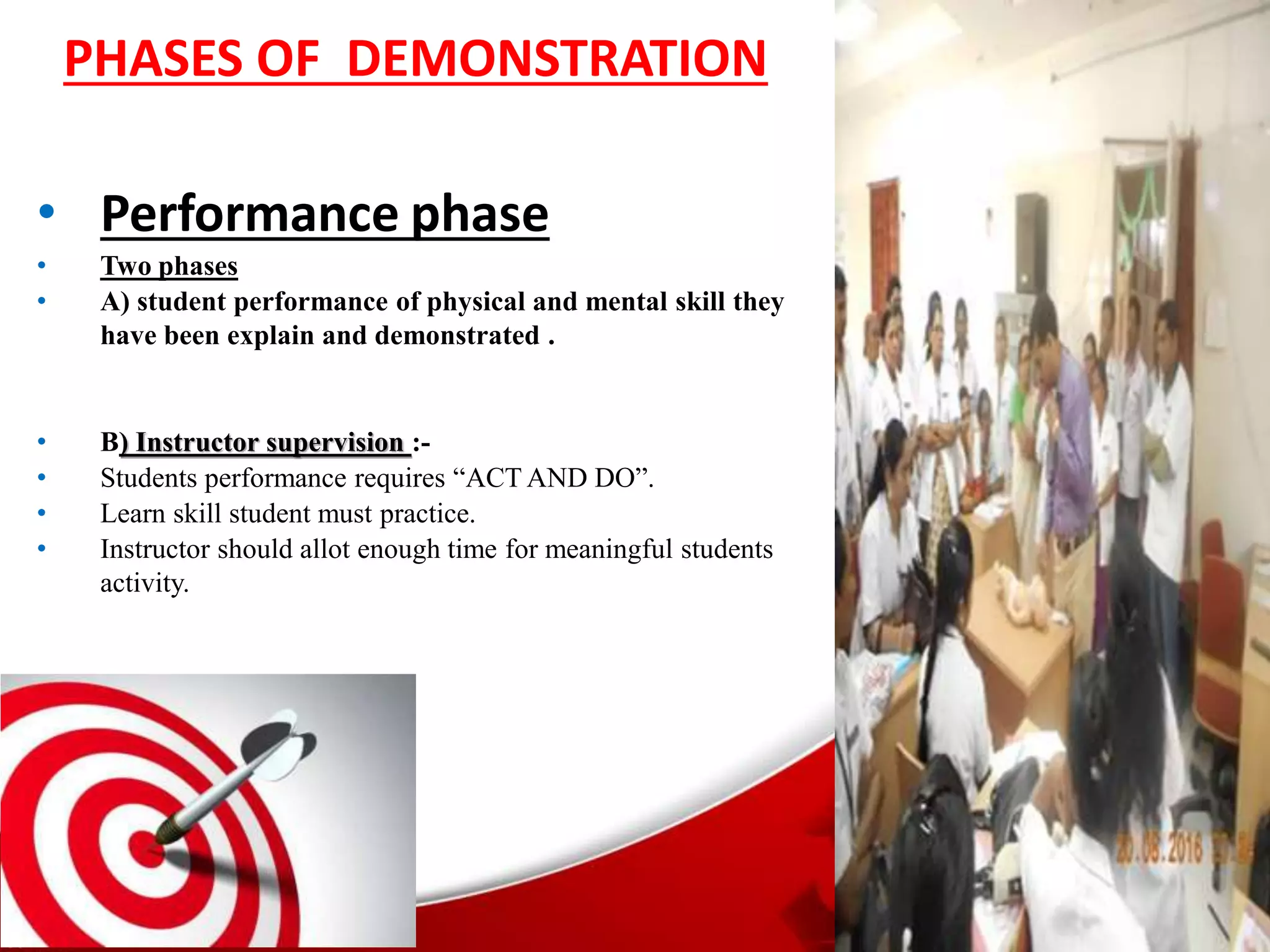
PHASES OF DEMONSTRATION
• Performance phase
• Two phases
• A) student performance of physical and mental skill they
have been explain and demonstrated .
• B) Instructor supervision :-
• Students performance requires “ACT AND DO”.
• Learn skill student must practice.
• Instructor should allot enough time for meaningful students
activity.
PHASES OF DEMONSTRATION
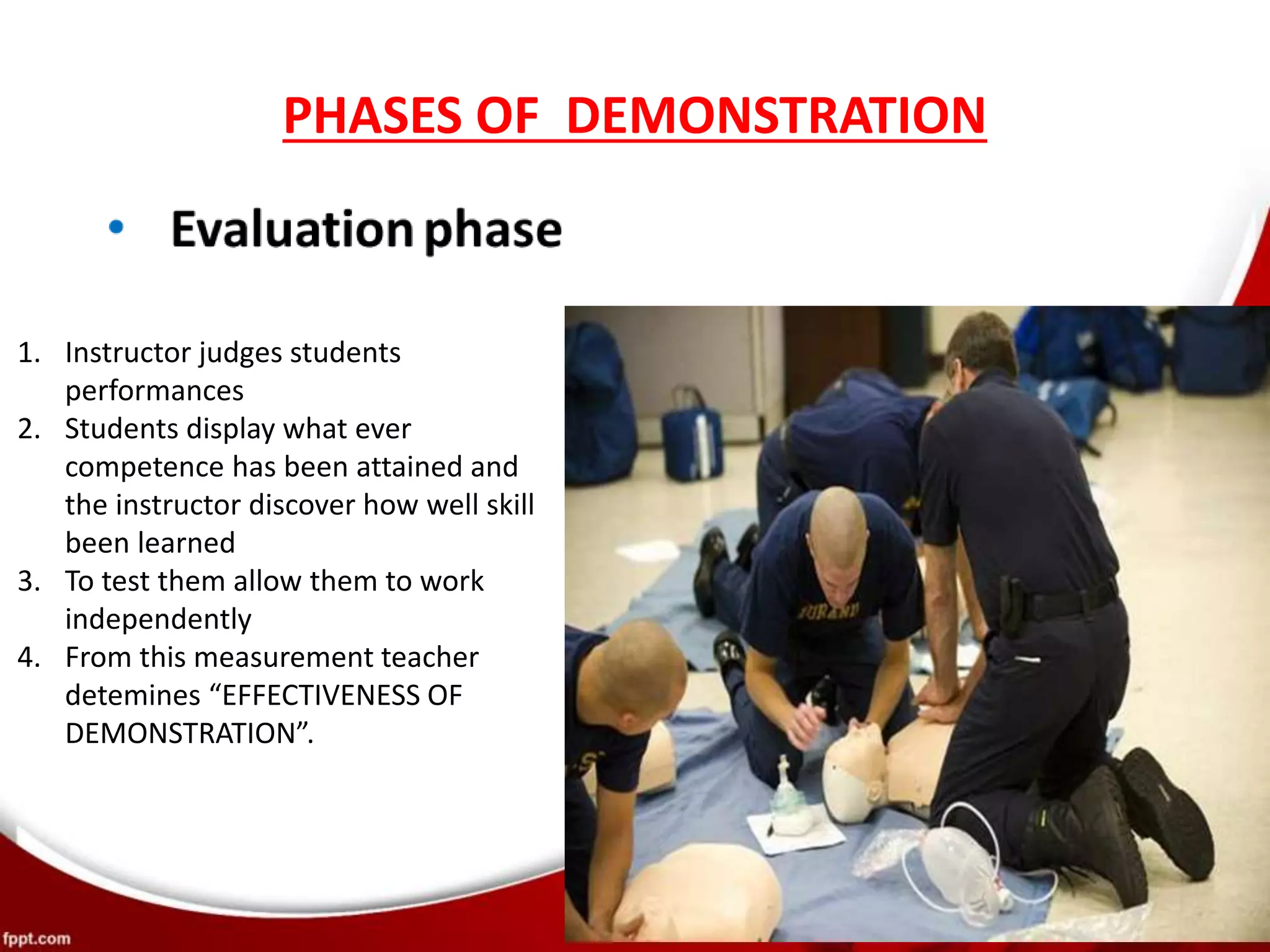
1. Instructor judges students
performances
2. Students display what ever
competence has been attained and
the instructor discover how well skill
been learned
3. To test them allow them to work
independently
4. From this measurement teacher
detemines “EFFECTIVENESS OF
DEMONSTRATION”.
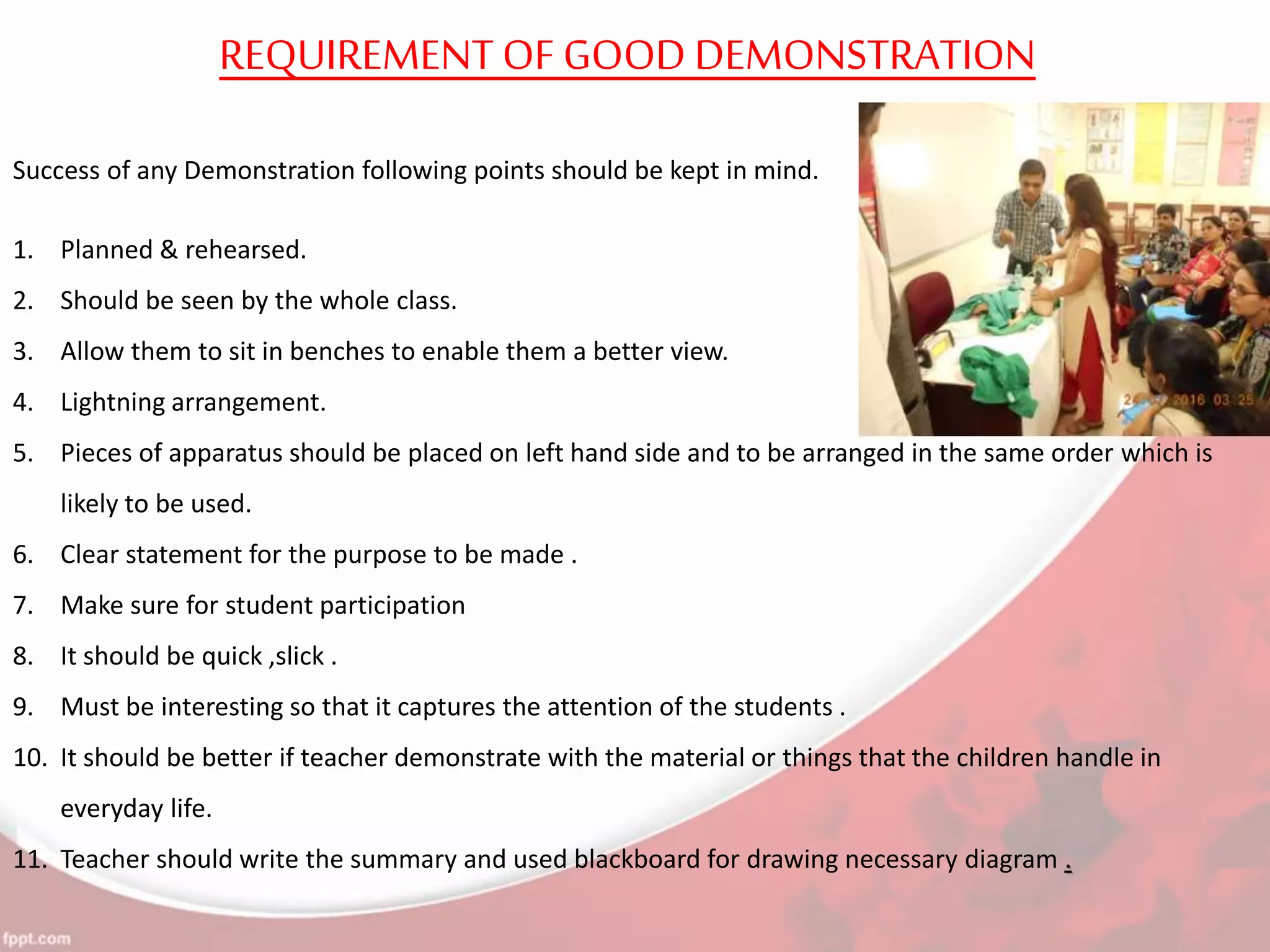
REQUIREMENT OF GOOD DEMONSTRATION
Success of any Demonstration following points should be kept in mind.
1. Planned & rehearsed.
2. Should be seen by the whole class.
3. Allow them to sit in benches to enable them a better view.
4. Lightning arrangement.
5. Pieces of apparatus should be placed on left hand side and to be arranged in the same order which is
likely to be used.
6. Clear statement for the purpose to be made .
7. Make sure for student participation
8. It should be quick ,slick .
9. Must be interesting so that it captures the attention of the students .
10. It should be better if teacher demonstrate with the material or things that the children handle in
everyday life.
11. Teacher should write the summary and used blackboard for drawing necessary diagram .
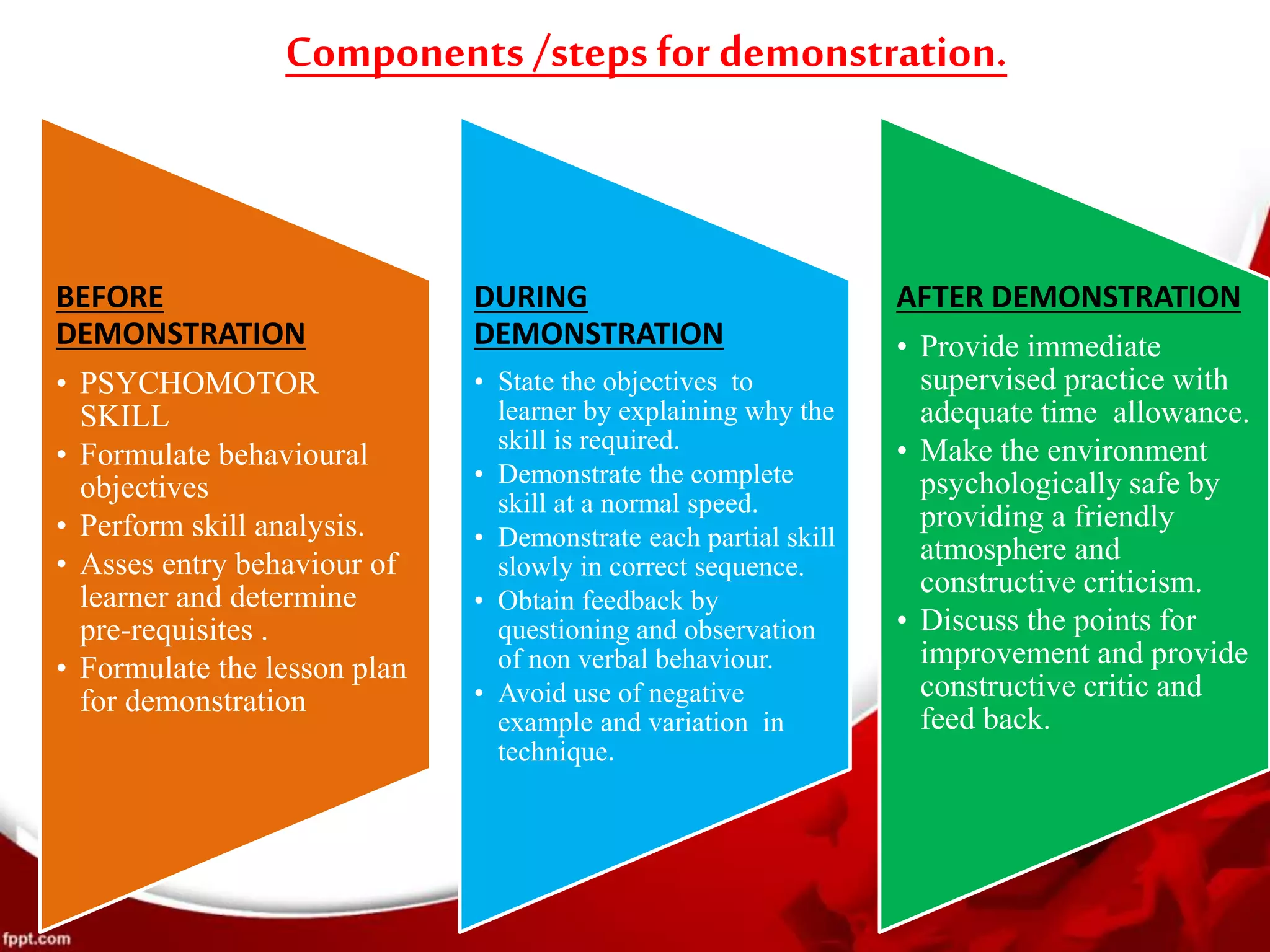
Components /steps for demonstration.
BEFORE
DEMONSTRATION
• PSYCHOMOTOR
SKILL
• Formulate behavioural
objectives
• Perform skill analysis.
• Asses entry behaviour of
learner and determine
pre-requisites .
• Formulate the lesson plan
for demonstration
DURING
DEMONSTRATION
• State the objectives to
learner by explaining why the
skill is required.
• Demonstrate the complete
skill at a normal speed.
• Demonstrate each partial skill
slowly in correct sequence.
• Obtain feedback by
questioning and observation
of non verbal behaviour.
• Avoid use of negative
example and variation in
technique.
AFTER DEMONSTRATION
• Provide immediate
supervised practice with
adequate time allowance.
• Make the environment
psychologically safe by
providing a friendly
atmosphere and
constructive criticism.
• Discuss the points for
improvement and provide
constructive critic and
feed back.
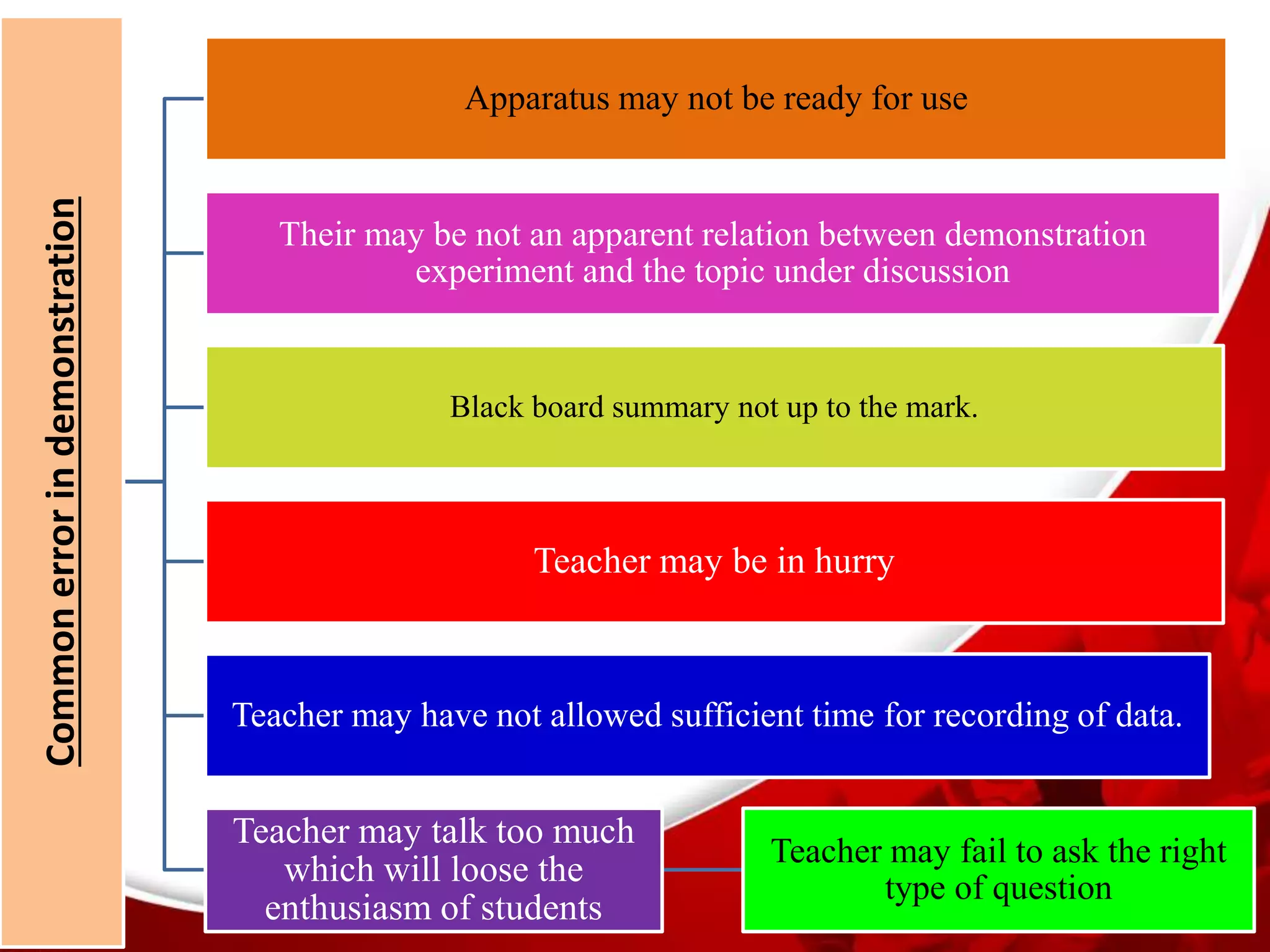
Common
error
in
demonstration
Apparatus may not be ready for use
Their may be not an apparent relation between demonstration
experiment and the topic under discussion
Black board summary not up to the mark.
Teacher may be in hurry
Teacher may have not allowed sufficient time for recording of data.
Teacher may talk too much
which will loose the
enthusiasm of students
Teacher may fail to ask the right
type of question
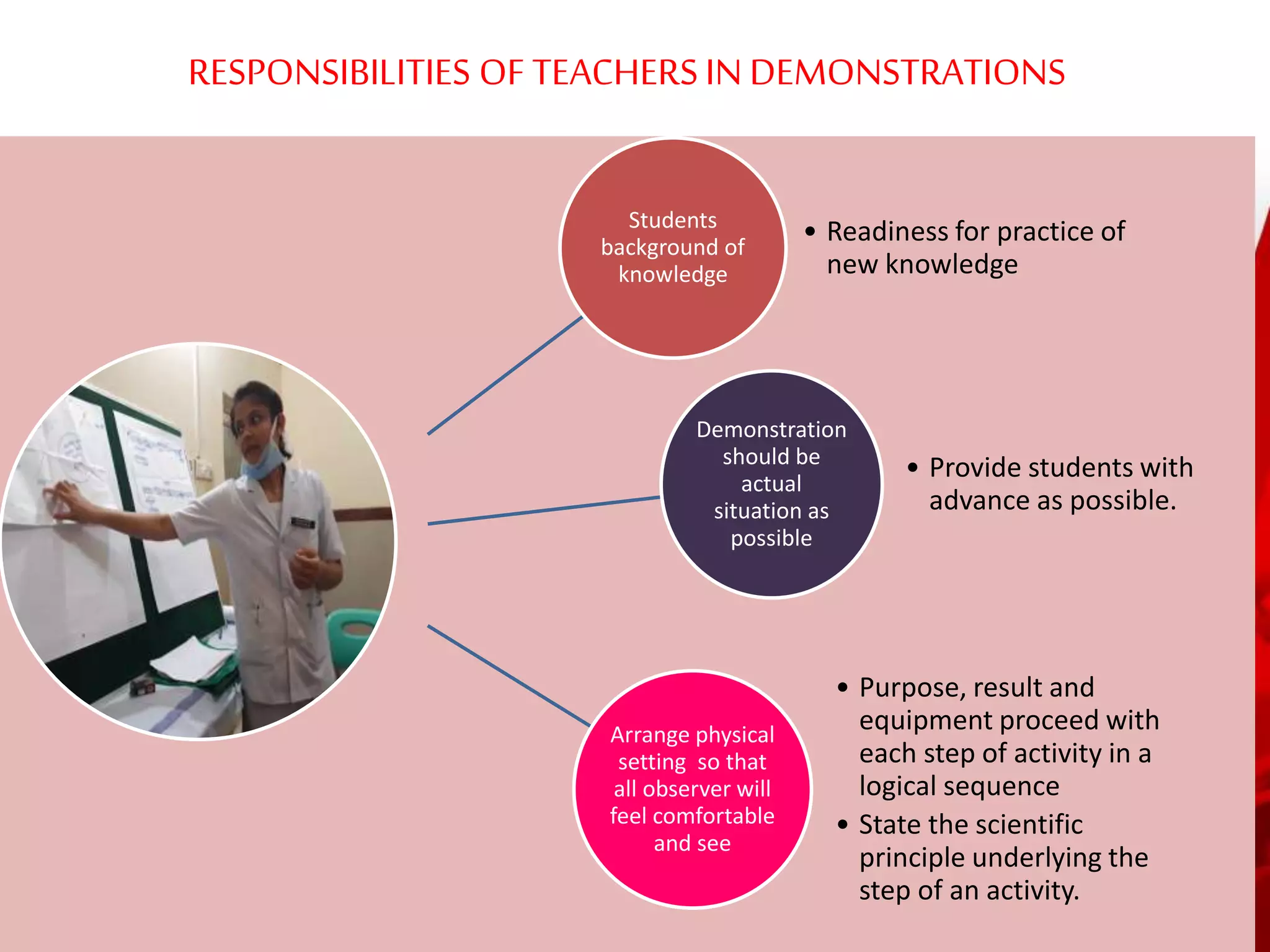
RESPONSIBILITIES OF TEACHERS IN DEMONSTRATIONS
Students
background of
knowledge
• Readiness for practice of
new knowledge
Demonstration
should be
actual
situation as
possible
• Provide students with
advance as possible.
Arrange physical
setting so that
all observer will
feel comfortable
and see
• Purpose, result and
equipment proceed with
each step of activity in a
logical sequence
• State the scientific
principle underlying the
step of an activity.
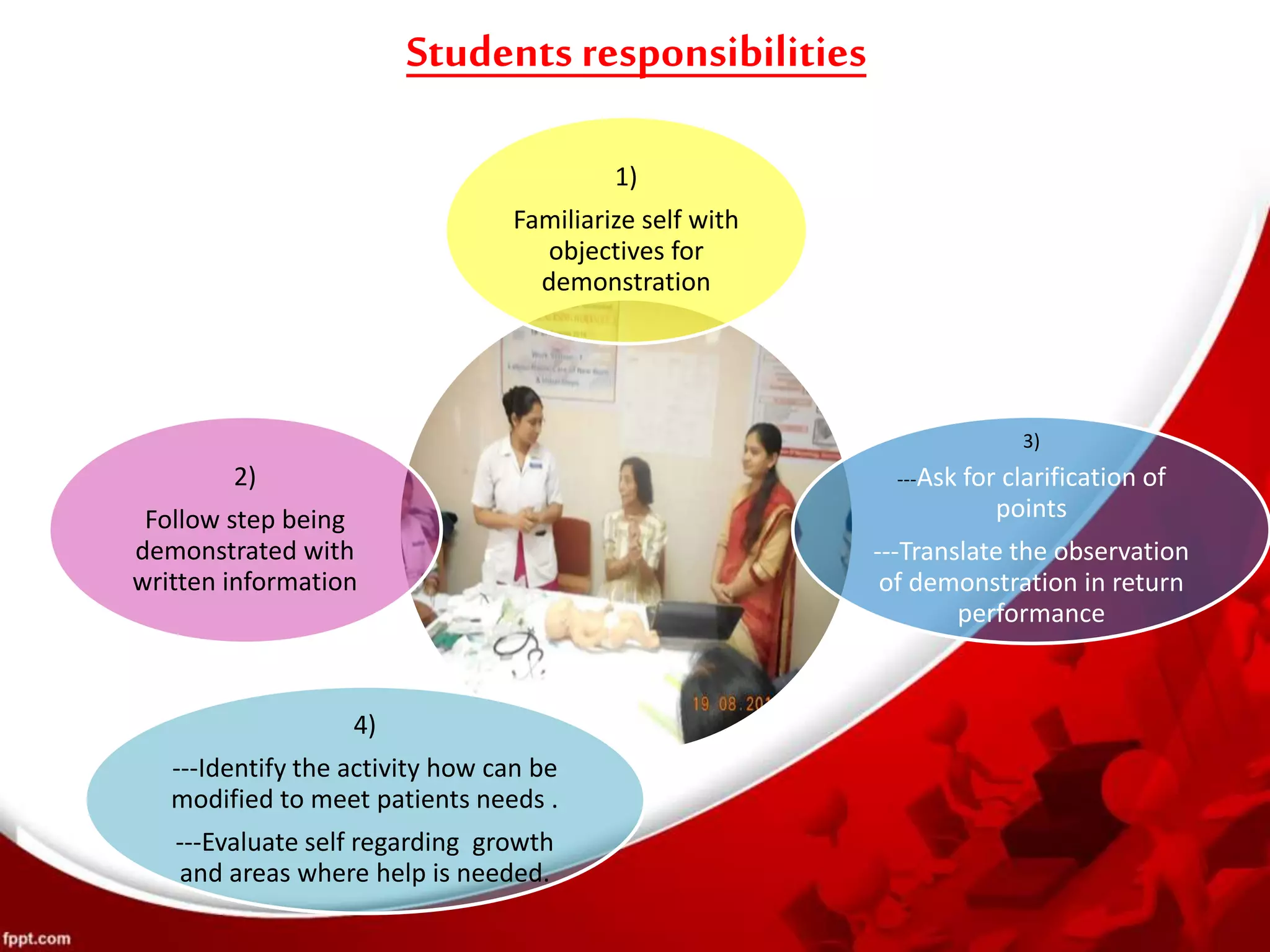
Students responsibilities
1)
Familiarize self with
objectives for
demonstration
3)
---Ask for clarification of
points
---Translate the observation
of demonstration in return
performance
4)
---Identify the activity how can be
modified to meet patients needs .
---Evaluate self regarding growth
and areas where help is needed.
2)
Follow step being
demonstrated with
written information
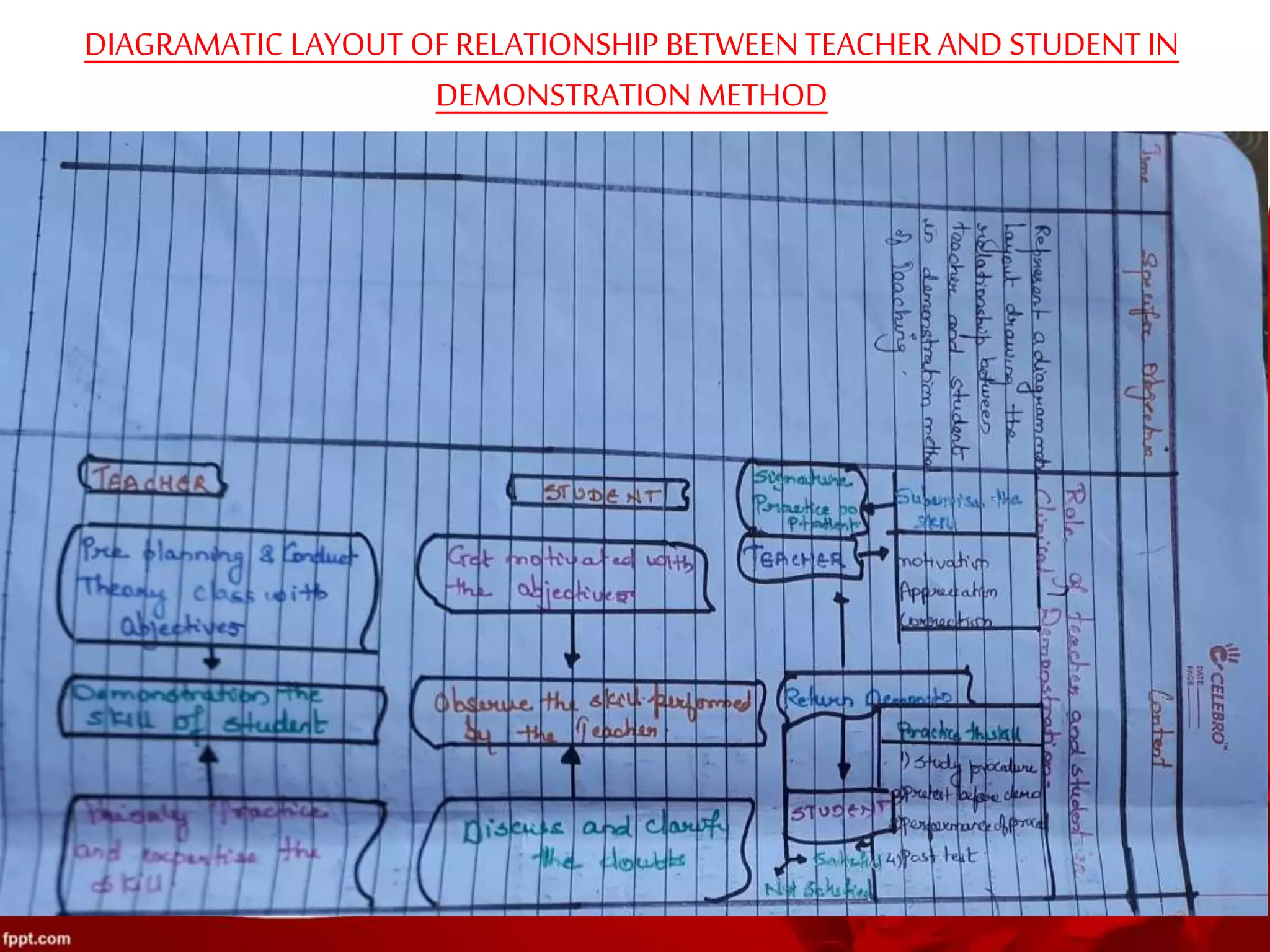
DIAGRAMATIC LAYOUT OFRELATIONSHIP BETWEEN TEACHER AND STUDENT IN
DEMONSTRATION METHOD
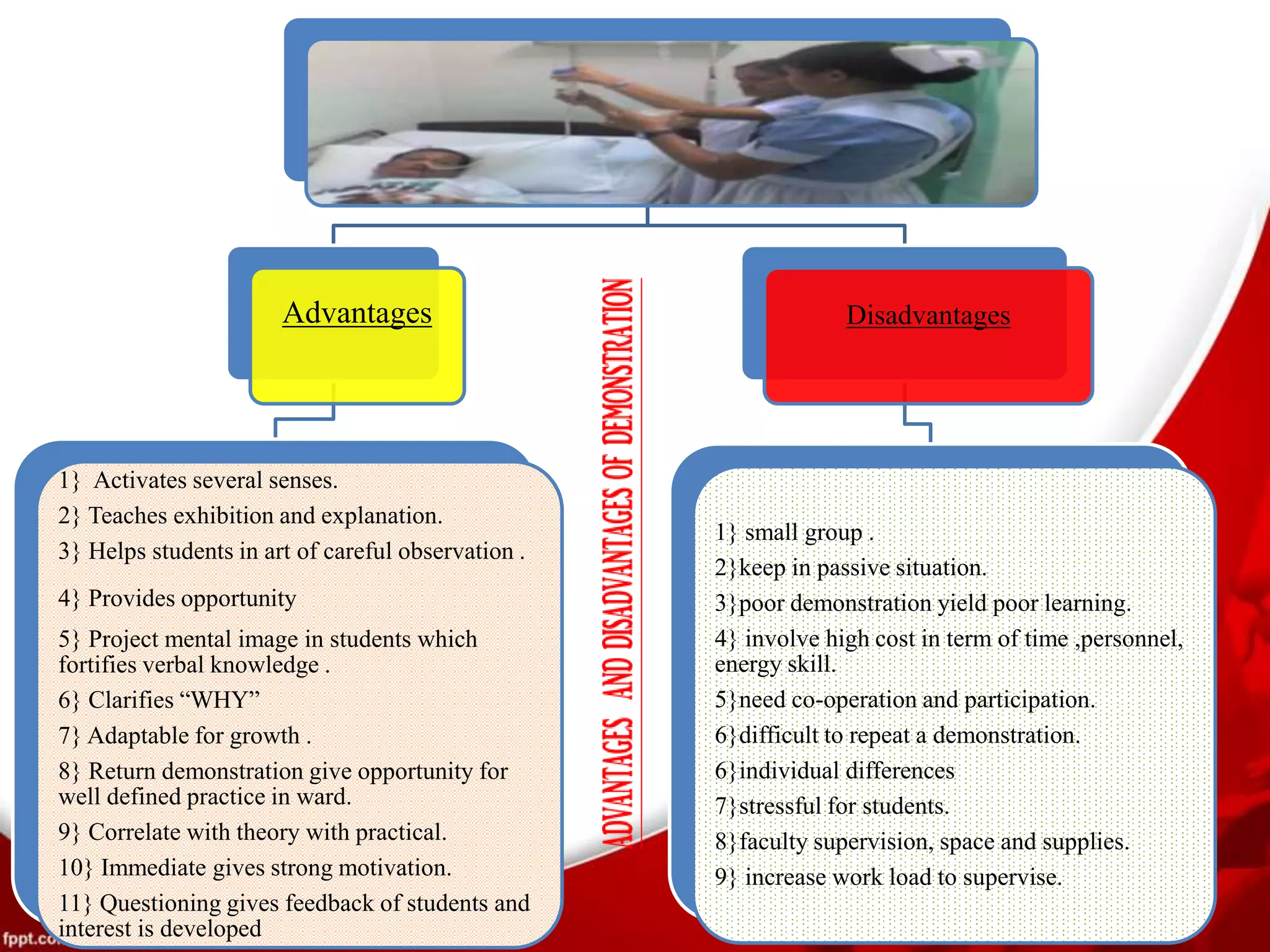
Advantages
1} Activates several senses.
2} Teaches exhibition and explanation.
3} Helps students in art of careful observation .
4} Provides opportunity
5} Project mental image in students which
fortifies verbal knowledge .
6} Clarifies “WHY”
7} Adaptable for growth .
8} Return demonstration give opportunity for
well defined practice in ward.
9} Correlate with theory with practical.
10} Immediate gives strong motivation.
11} Questioning gives feedback of students and
interest is developed
Disadvantages
1} small group .
2}keep in passive situation.
3}poor demonstration yield poor learning.
4} involve high cost in term of time ,personnel,
energy skill.
5}need co-operation and participation.
6}difficult to repeat a demonstration.
6}individual differences
7}stressful for students.
8}faculty supervision, space and supplies.
9} increase work load to supervise.
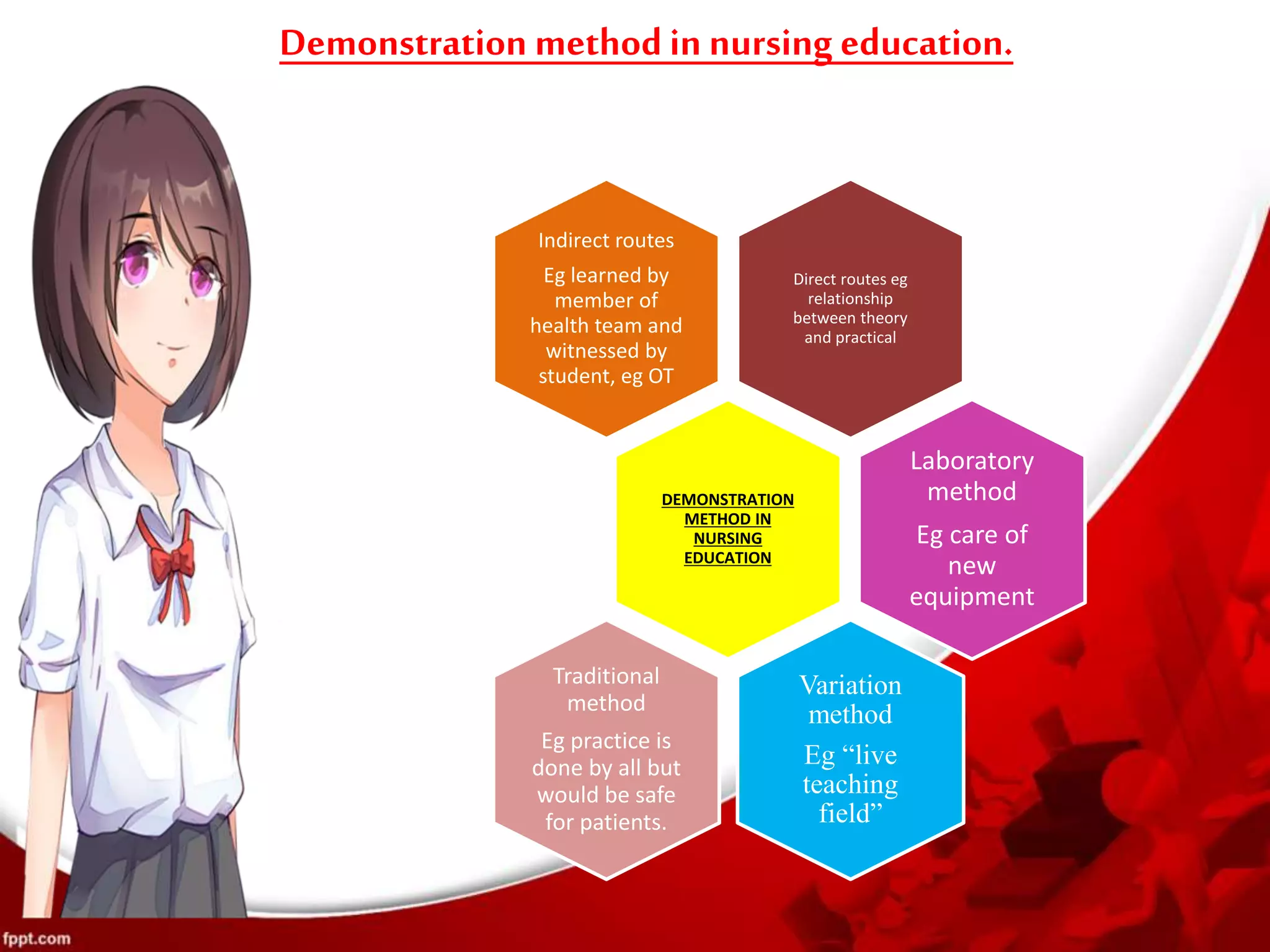
Demonstration method in nursing education.
Direct routes eg
relationship
between theory
and practical
Indirect routes
Eg learned by
member of
health team and
witnessed by
student, eg OT
DEMONSTRATION
METHOD IN
NURSING
EDUCATION
Laboratory
method
Eg care of
new
equipment
Variation
method
Eg “live
teaching
field”
Traditional
method
Eg practice is
done by all but
would be safe
for patients.
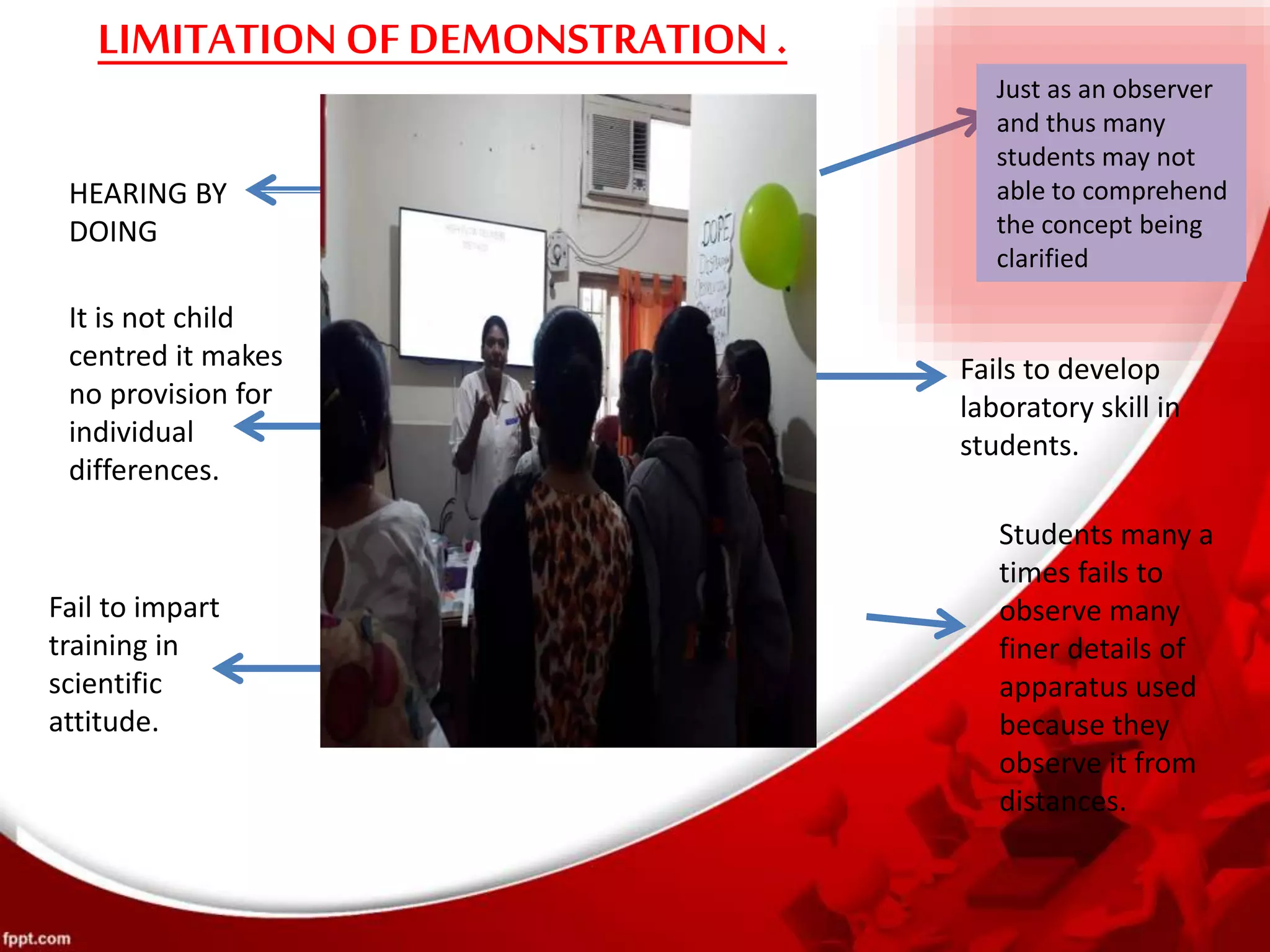
LIMITATION OFDEMONSTRATION .
Just as an observer
and thus many
students may not
able to comprehend
the concept being
clarified
HEARING BY
DOING
It is not child
centred it makes
no provision for
individual
differences.
Fails to develop
laboratory skill in
students.
Fail to impart
training in
scientific
attitude.
Students many a
times fails to
observe many
finer details of
apparatus used
because they
observe it from
distances.
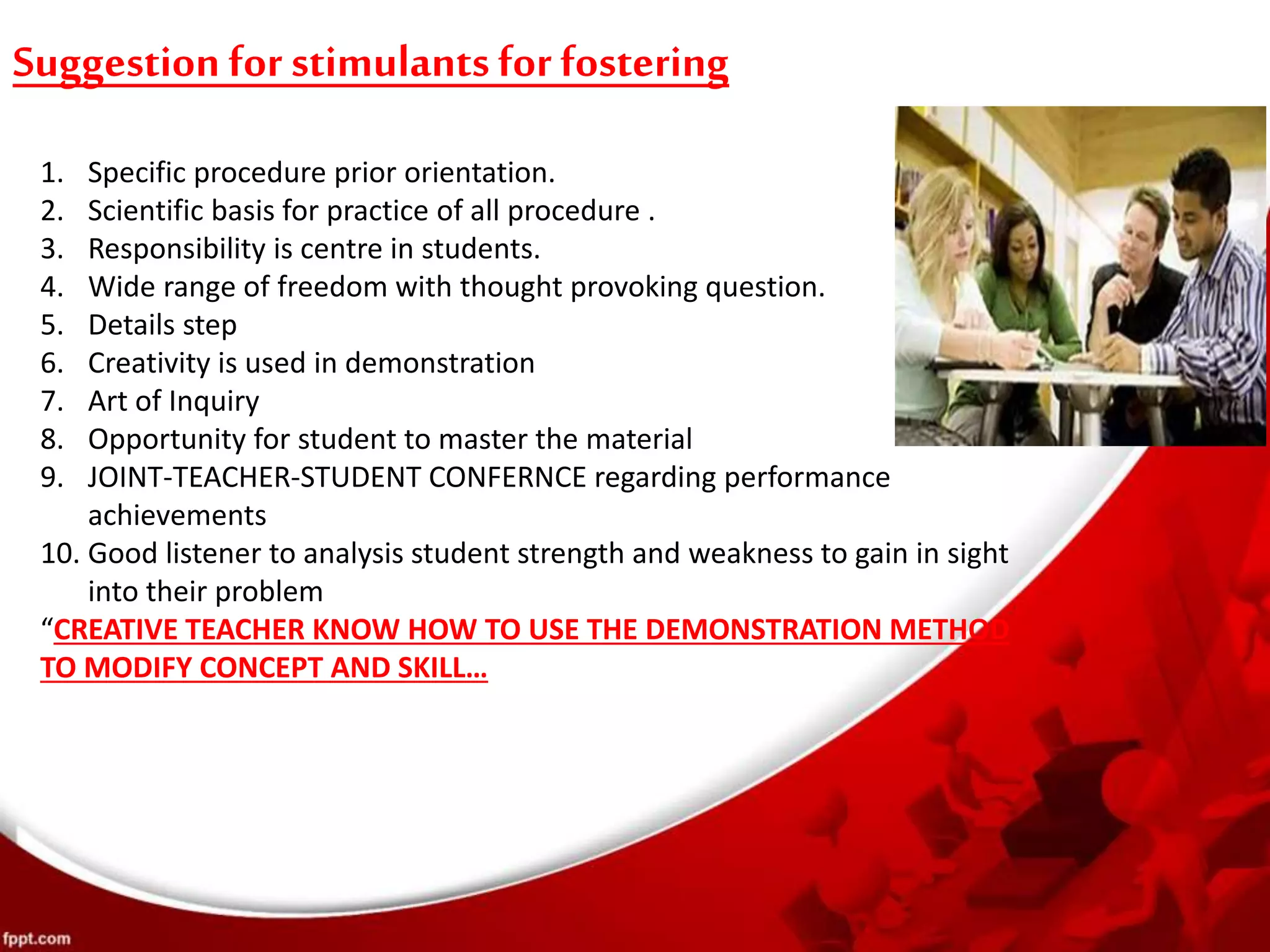
Suggestion for stimulantsfor fostering
1. Specific procedure prior orientation.
2. Scientific basis for practice of all procedure .
3. Responsibility is centre in students.
4. Wide range of freedom with thought provoking question.
5. Details step
6. Creativity is used in demonstration
7. Art of Inquiry
8. Opportunity for student to master the material
9. JOINT-TEACHER-STUDENT CONFERNCE regarding performance
achievements
10. Good listener to analysis student strength and weakness to gain in sight
into their problem
“CREATIVE TEACHER KNOW HOW TO USE THE DEMONSTRATION METHOD
TO MODIFY CONCEPT AND SKILL…
Summarizethetopic
• Today in the class ,I have discussed the
definition , meaning, purpose , types ,
characteristic, requirement ,steps ,
common error, responsibilities of student
and teacher ,role of teacher and student in
clinical demonstration , advantages and
disadvantages, demonstration method in
nursing education , limitation ,
suggestion.
ANY DOUBTS?
27
Bibliography.
1. Communication and educational technology ,2nd edition , suresh.k. sharma ,
reena sharma page no -228-230.
2. Eshita chanda introduction to nursing education pv books 2011 edition page
no- 84-88.
3. Eshita chanda introduction to nursing education pv books 2012edition page
no- 66-68.
4. Communication and educational technology for Nurses veerabhadrappa. GM
,vora medical publication 110-112
5. nursing pbbsc solved question paper, 2nd year Dr I.clement phd (n) EMMESS
medical publication 2019 to 2008page no 569
6. Nursing education BT Basvanthappa Jaypee Brother 1st edition 2003 page no
346-350
7. Demonstration method of teaching-june 2015 available from
www.studylecturenotes.com
8. www.google.com-demonstration wikepedia free.
1. Write short note on
demonstration method ?
(April 2010)
2)Define demonstration?
(April 2003)
3) Advantages and disadvantages of
demonstration method ?
(april 2007)
DEMONSTRATION A TEACHING METHOD

DEMONSTRATION A TEACHING METHOD

  • 3.
  • 4.
    WHOBROUGHT THIS CONCEPTOF DEMONSTRATION • The construction propounded will be possible too, and once more the demonstration will correspond, in the reverse order to the analysis; but if we come upon something that is admitted is impossible the problem will also be impossible. It is quite possible to accept that Plato 'discovered' the method of Analysis, in the same sense as Aristotle discovered the syllogism; that is to say, he was the first to reflect upon the process of thought involved and to describe it in contrast with the process of Synthesis. • The idea that the order of demonstrationwas theorderof nature camefrom Plato.Aristotlesaid that theorderof discoverywasthereverseof the orderof demonstration. WHOBROUGHT THIS CONCEPT OF DEMONSTRATION PLATO átōn; c. 427 BC – c. 347 BC) was an immensely influential classical Greek philosopher, student of Socrates, teacher of Aristotle, writer of philosophical dialogues, and founder of the Academy in Athens.
  • 5.
    Lesson plan on DEMONSTRATION.. SUBMITTED BY ESTELAJOHN RANGARE P.B.DIPOLOMA IN PEDIATRIC NURSING. INE ,J.J HOSPITAL MUMBAI. BATCH 2020-2021
  • 6.
    OBJECTIVES SPECIFIC OBJECTIVES :- Atthe end of the lecture students will be able to gain knowledge and understand the concept of “DEMONSTRATION” as a method of teaching . GENERAL OBJECTIVES :- At the end of the teaching students will be able to 1. Understand the concept of “DEMONSTRATION” as a method of teaching . 2. Give meaning of Demonstration. 3. Define Demonstration. 4. Enlist its purposes. 5. Classify its types. 6. Elaborate the phases of demonstration. 7. Explain the characteristic of demonstration. 8. Enlist the pre-requisite of good demonstration. 9. Explain the steps of demonstration. 10. What are the common error occur during demonstration. 11. Enlist responsibilities of Teacher &Student. 12. Diagrammatic layout relations between the teacher &student in demonstration. 13. Explain advantages &disadvantages of demonstration. 14. Elaborates the method of demonstration in Nursing. 15. Describe limitation in demonstration lecture cum presentation. 16. Discuss the suggestion for stimulant for fostering creativity in use in demonstration.
  • 7.
    INTRODUCTION • Demonstration isa technique which is often used by all teacher to teach various subjects. • Demonstration is a type of “Group Teaching Method”. • An experienced and skilled teacher uses a variety of technique & teaching Aids . • It increases interest of student and persuades them to adopt. • It is simple method by Exhibition and Explanation of procedure & Experiments.
  • 8.
    MEANINGOF DEMONSTRATION 1. VerbalExplanation +Live display/ Use of apparatus= DEMONSTRATION 2. To show in correct way. 3. Activity that describe. 4. Illustrate by experiments. 5. Programme or intervention that is tested. 6. Logically to prove the truth. 7. Proof provided by logic argument. 8. Doing ;step-by-step
  • 9.
  • 10.
    Purposes Of Demonstration •To teach Psychomotor Skill. • To Orient a new equipment/procedure. • To render teacher loving care. • To educate the patients. • To promote learning by doing limitation. • To utilise the sense of sight & touch. • To present the procedure. • To develop skill & attitude. • Conducive learning environment. • To retain and able to use the achievement skill. • Technique of demonstration. To improve skill of the student • Provide a vicarious learning experience • Visual representation helps to memorize the content • Observation skill will be improved • Improves the confidence level
  • 11.
    Special purpose inNursing. • Teaches new procedure either at bedside , ward ,nursing laboratory. • Applies knowledge of underlying scientific principal in NSG care situations. • Teaches the uses, function & care of new equipment. • Teaches application on of observation techniques. • Teaches maintain of health & preventive health care measures to patient & family.
  • 12.
  • 13.
    PHASES OF DEMONSTRATION •Planning & Preparation phase • Framing the objectives. • Planning the work • Motivates the students • Time plan • Explanation phase :- • Must be clear to the objectives • The instructor must convey the students precise action they are performing • Instructor should describe the end result of these effort • Befor leaving should encourage student to ask question of any step of procedure.
  • 14.
    PHASES OF DEMONSTRATION •Performance phase • Two phases • A) student performance of physical and mental skill they have been explain and demonstrated . • B) Instructor supervision :- • Students performance requires “ACT AND DO”. • Learn skill student must practice. • Instructor should allot enough time for meaningful students activity.
  • 15.
    PHASES OF DEMONSTRATION 1.Instructor judges students performances 2. Students display what ever competence has been attained and the instructor discover how well skill been learned 3. To test them allow them to work independently 4. From this measurement teacher detemines “EFFECTIVENESS OF DEMONSTRATION”.
  • 16.
    REQUIREMENT OF GOODDEMONSTRATION Success of any Demonstration following points should be kept in mind. 1. Planned & rehearsed. 2. Should be seen by the whole class. 3. Allow them to sit in benches to enable them a better view. 4. Lightning arrangement. 5. Pieces of apparatus should be placed on left hand side and to be arranged in the same order which is likely to be used. 6. Clear statement for the purpose to be made . 7. Make sure for student participation 8. It should be quick ,slick . 9. Must be interesting so that it captures the attention of the students . 10. It should be better if teacher demonstrate with the material or things that the children handle in everyday life. 11. Teacher should write the summary and used blackboard for drawing necessary diagram .
  • 17.
    Components /steps fordemonstration. BEFORE DEMONSTRATION • PSYCHOMOTOR SKILL • Formulate behavioural objectives • Perform skill analysis. • Asses entry behaviour of learner and determine pre-requisites . • Formulate the lesson plan for demonstration DURING DEMONSTRATION • State the objectives to learner by explaining why the skill is required. • Demonstrate the complete skill at a normal speed. • Demonstrate each partial skill slowly in correct sequence. • Obtain feedback by questioning and observation of non verbal behaviour. • Avoid use of negative example and variation in technique. AFTER DEMONSTRATION • Provide immediate supervised practice with adequate time allowance. • Make the environment psychologically safe by providing a friendly atmosphere and constructive criticism. • Discuss the points for improvement and provide constructive critic and feed back.
  • 18.
    Common error in demonstration Apparatus may notbe ready for use Their may be not an apparent relation between demonstration experiment and the topic under discussion Black board summary not up to the mark. Teacher may be in hurry Teacher may have not allowed sufficient time for recording of data. Teacher may talk too much which will loose the enthusiasm of students Teacher may fail to ask the right type of question
  • 19.
    RESPONSIBILITIES OF TEACHERSIN DEMONSTRATIONS Students background of knowledge • Readiness for practice of new knowledge Demonstration should be actual situation as possible • Provide students with advance as possible. Arrange physical setting so that all observer will feel comfortable and see • Purpose, result and equipment proceed with each step of activity in a logical sequence • State the scientific principle underlying the step of an activity.
  • 20.
    Students responsibilities 1) Familiarize selfwith objectives for demonstration 3) ---Ask for clarification of points ---Translate the observation of demonstration in return performance 4) ---Identify the activity how can be modified to meet patients needs . ---Evaluate self regarding growth and areas where help is needed. 2) Follow step being demonstrated with written information
  • 21.
    DIAGRAMATIC LAYOUT OFRELATIONSHIPBETWEEN TEACHER AND STUDENT IN DEMONSTRATION METHOD
  • 22.
    Advantages 1} Activates severalsenses. 2} Teaches exhibition and explanation. 3} Helps students in art of careful observation . 4} Provides opportunity 5} Project mental image in students which fortifies verbal knowledge . 6} Clarifies “WHY” 7} Adaptable for growth . 8} Return demonstration give opportunity for well defined practice in ward. 9} Correlate with theory with practical. 10} Immediate gives strong motivation. 11} Questioning gives feedback of students and interest is developed Disadvantages 1} small group . 2}keep in passive situation. 3}poor demonstration yield poor learning. 4} involve high cost in term of time ,personnel, energy skill. 5}need co-operation and participation. 6}difficult to repeat a demonstration. 6}individual differences 7}stressful for students. 8}faculty supervision, space and supplies. 9} increase work load to supervise.
  • 23.
    Demonstration method innursing education. Direct routes eg relationship between theory and practical Indirect routes Eg learned by member of health team and witnessed by student, eg OT DEMONSTRATION METHOD IN NURSING EDUCATION Laboratory method Eg care of new equipment Variation method Eg “live teaching field” Traditional method Eg practice is done by all but would be safe for patients.
  • 24.
    LIMITATION OFDEMONSTRATION . Justas an observer and thus many students may not able to comprehend the concept being clarified HEARING BY DOING It is not child centred it makes no provision for individual differences. Fails to develop laboratory skill in students. Fail to impart training in scientific attitude. Students many a times fails to observe many finer details of apparatus used because they observe it from distances.
  • 25.
    Suggestion for stimulantsforfostering 1. Specific procedure prior orientation. 2. Scientific basis for practice of all procedure . 3. Responsibility is centre in students. 4. Wide range of freedom with thought provoking question. 5. Details step 6. Creativity is used in demonstration 7. Art of Inquiry 8. Opportunity for student to master the material 9. JOINT-TEACHER-STUDENT CONFERNCE regarding performance achievements 10. Good listener to analysis student strength and weakness to gain in sight into their problem “CREATIVE TEACHER KNOW HOW TO USE THE DEMONSTRATION METHOD TO MODIFY CONCEPT AND SKILL…
  • 26.
    Summarizethetopic • Today inthe class ,I have discussed the definition , meaning, purpose , types , characteristic, requirement ,steps , common error, responsibilities of student and teacher ,role of teacher and student in clinical demonstration , advantages and disadvantages, demonstration method in nursing education , limitation , suggestion.
  • 27.
  • 28.
    Bibliography. 1. Communication andeducational technology ,2nd edition , suresh.k. sharma , reena sharma page no -228-230. 2. Eshita chanda introduction to nursing education pv books 2011 edition page no- 84-88. 3. Eshita chanda introduction to nursing education pv books 2012edition page no- 66-68. 4. Communication and educational technology for Nurses veerabhadrappa. GM ,vora medical publication 110-112 5. nursing pbbsc solved question paper, 2nd year Dr I.clement phd (n) EMMESS medical publication 2019 to 2008page no 569 6. Nursing education BT Basvanthappa Jaypee Brother 1st edition 2003 page no 346-350 7. Demonstration method of teaching-june 2015 available from www.studylecturenotes.com 8. www.google.com-demonstration wikepedia free.
  • 29.
    1. Write shortnote on demonstration method ? (April 2010) 2)Define demonstration? (April 2003) 3) Advantages and disadvantages of demonstration method ? (april 2007)