

CHECK LIST
PRESENTED BY:
MR. DINABANDHU BARAD
MSC TUTOR, DEPT. OF CHILD HEALTHNURSING
SNC, SOA, DTU
CHECKLIST
OBSERVATION CHECKLIST
◦It is the most commonly used instrument for performance
evaluation.
◦A checklist enables the observer to note to only whether a trait
is present or not.
◦If consist of a listening of steps, activities or behaviours the
observer records when an incident occurs.
◦The observer has to judge a certain behaviour has taken place.
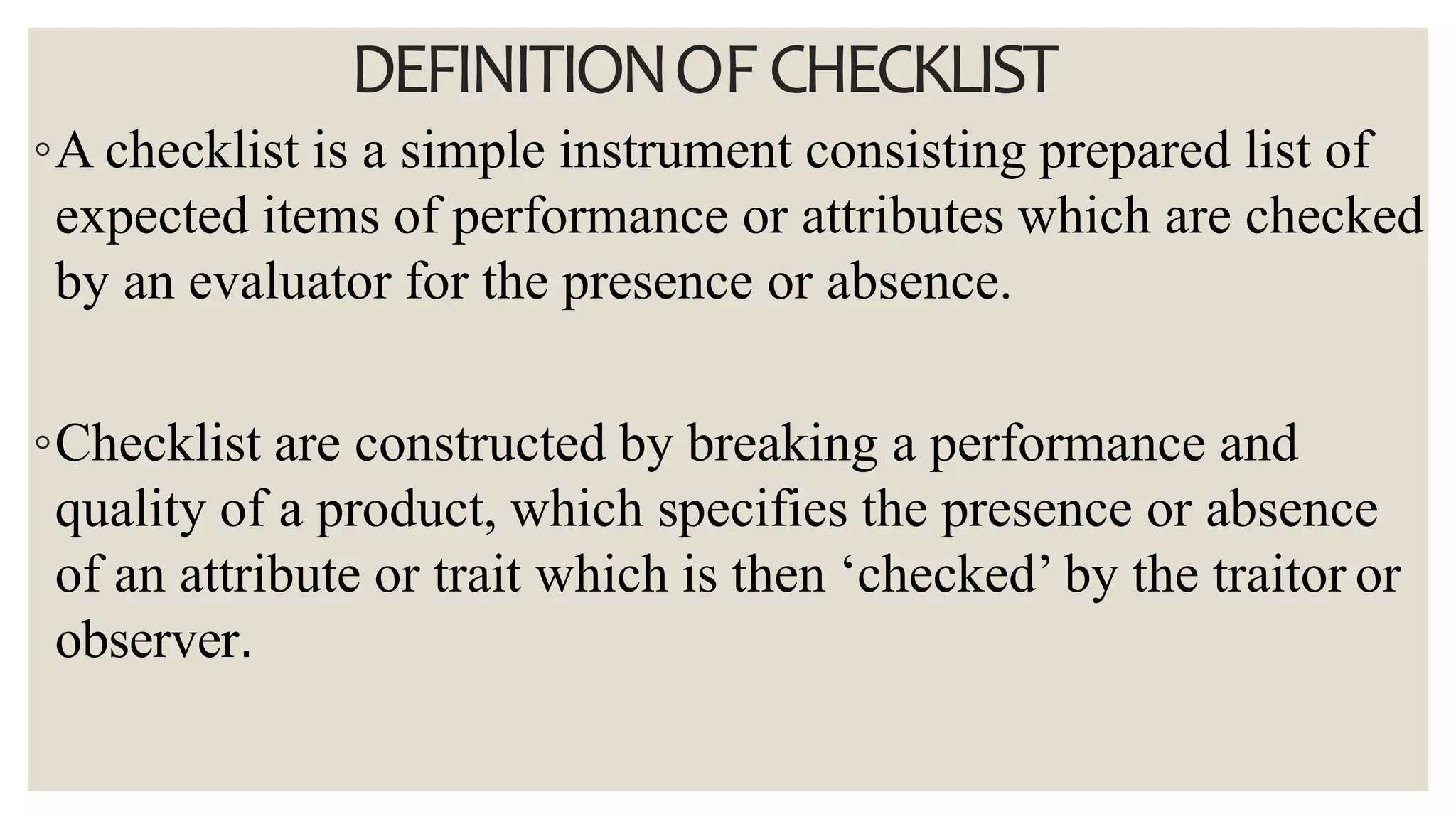
DEFINITIONOFCHECKLIST
◦A checklist is a simple instrument consisting prepared list of
expected items of performance or attributes which are checked
by an evaluator for the presence or absence.
◦Checklist are constructed by breaking a performance and
quality of a product, which specifies the presence or absence
of an attribute or trait which is then ‘checked’ by the traitor or
observer.
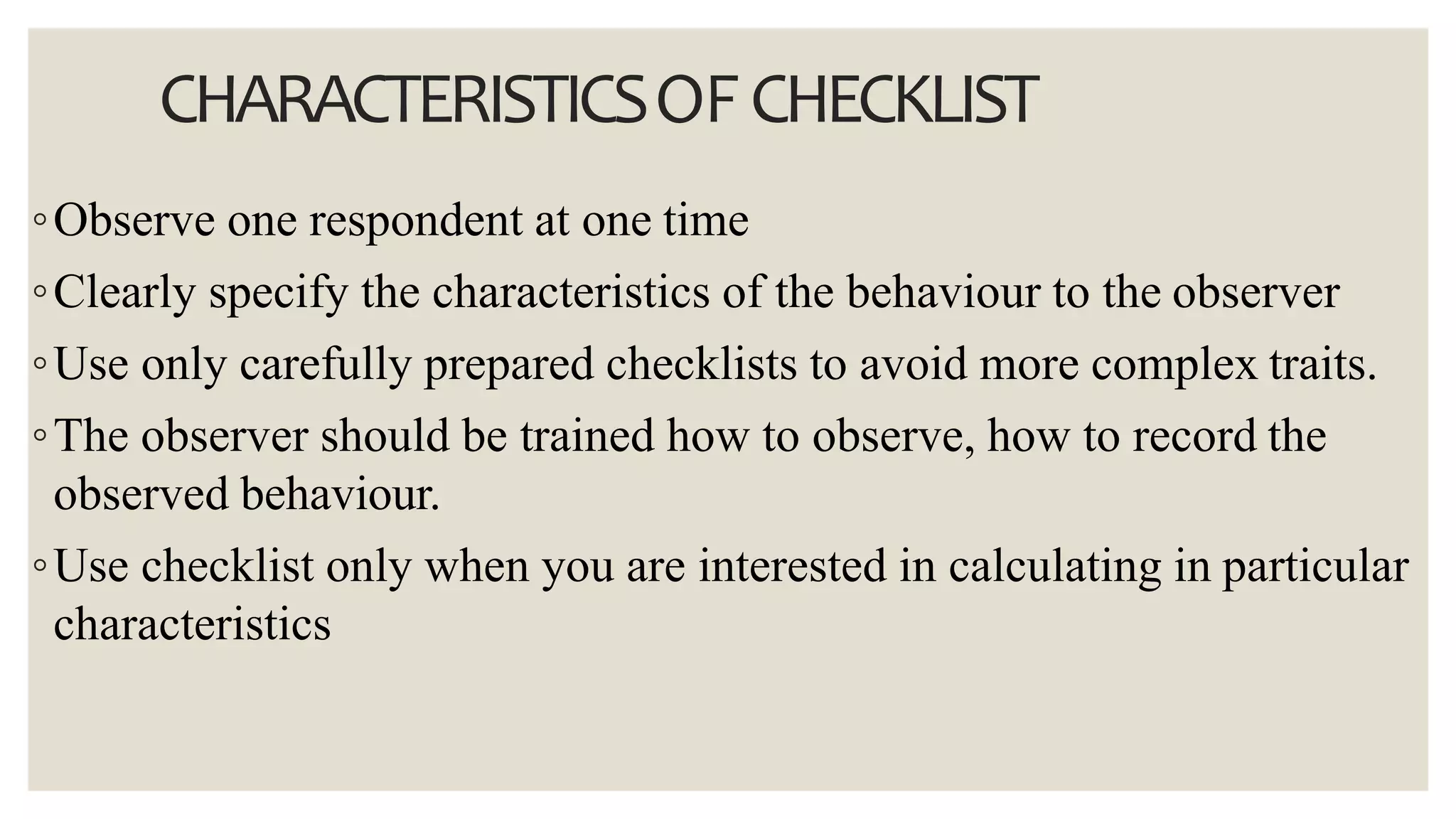
CHARACTERISTICSOFCHECKLIST
◦Observe one respondent at one time
◦Clearly specify the characteristics of the behaviour to the observer
◦Use only carefully prepared checklists to avoid more complex traits.
◦The observer should be trained how to observe, how to record the
observed behaviour.
◦Use checklist only when you are interested in calculating in particular
characteristics
CONSTRUCTIONOF ACHECKLIST
◦Express each item in clear, simple language.
◦The type of checklist to be used in particular assessment/
evaluation
◦The list of items in the checklist may be continuous or divided
into groups of related items.
◦These lists of the items are formulated on the basis of the
judgement of experts and each item is evaluated with respect
to the number of favourable and unfavourable responses.
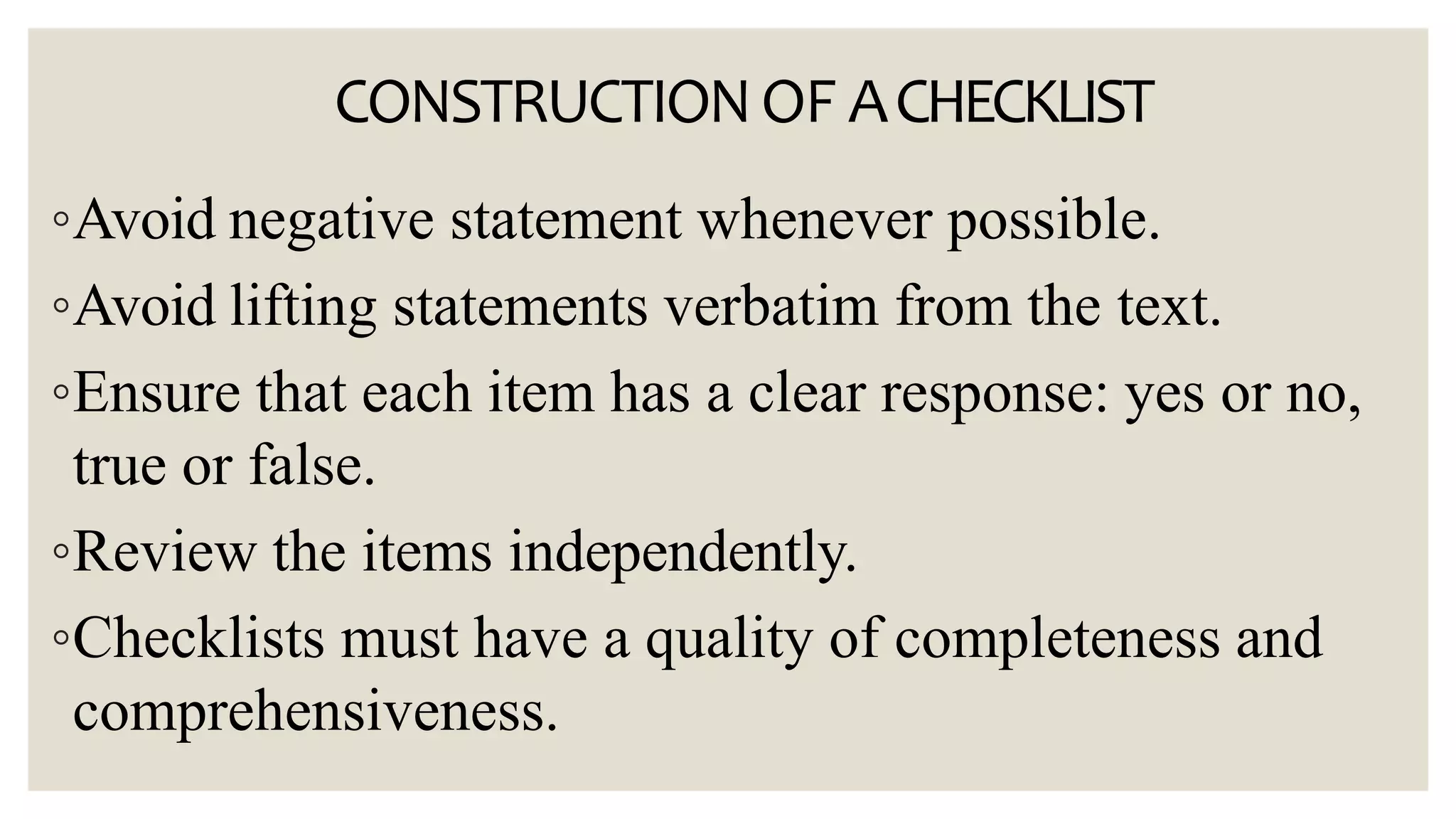
◦Avoid negative statement whenever possible.
◦Avoid lifting statements verbatim from the text.
◦Ensure that each item has a clear response: yes or no,
true or false.
◦Review the items independently.
◦Checklists must have a quality of completeness and
comprehensiveness.
CONSTRUCTIONOF ACHECKLIST
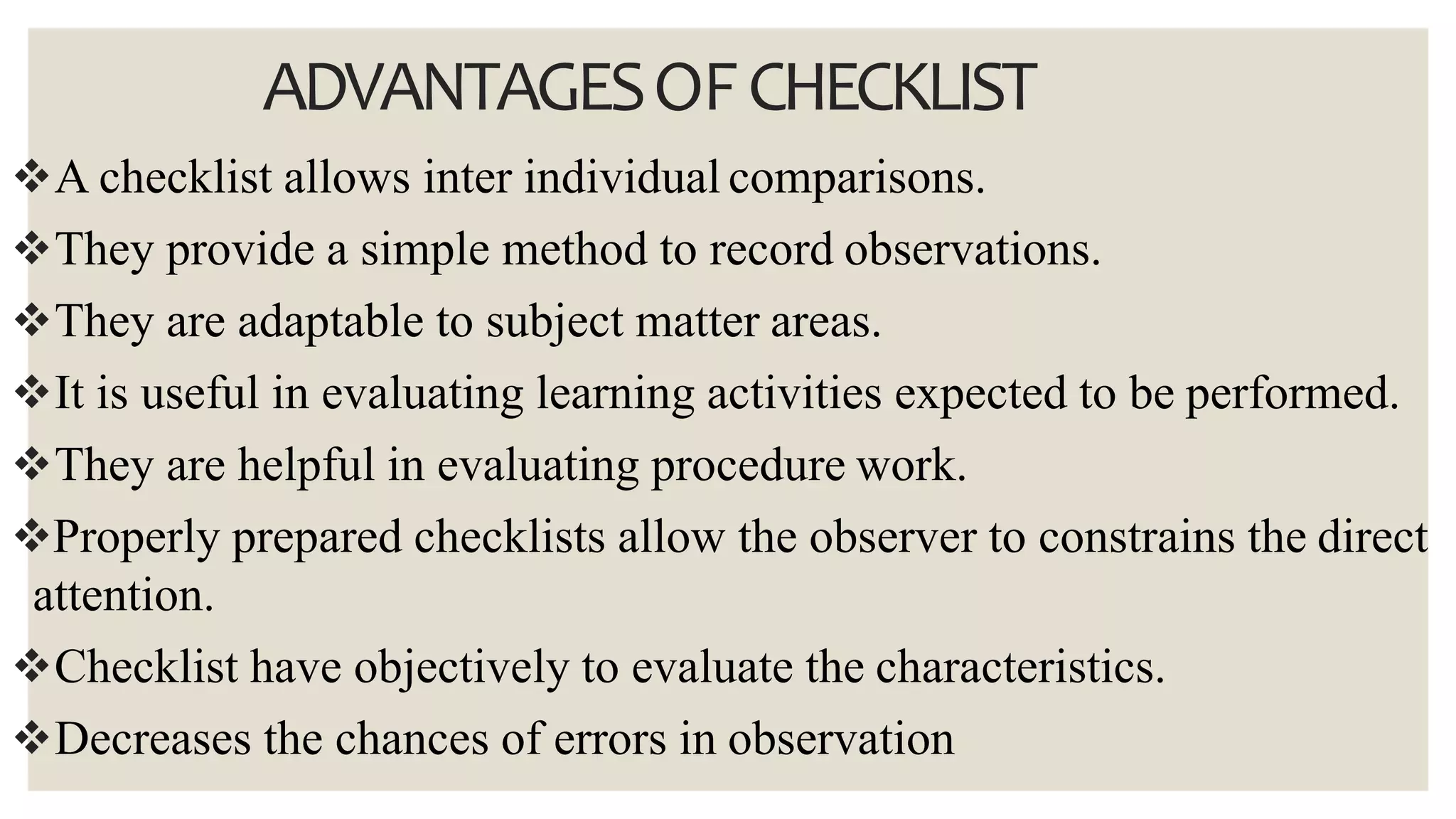
ADVANTAGESOFCHECKLIST
A checklist allows inter individual comparisons.
They provide a simple method to record observations.
They are adaptable to subject matter areas.
It is useful in evaluating learning activities expected to be performed.
They are helpful in evaluating procedure work.
Properly prepared checklists allow the observer to constrains the direct
attention.
Checklist have objectively to evaluate the characteristics.
Decreases the chances of errors in observation
DISADVANTAGESOFCHECKLIST
Checklist don’t indicate quality of performance so the usefulness of
checklists is limited.
Only a limited component of overall clinical performance can be
evaluated.
Only the presence or absence of an attribute, behaviour or
performance or parameter may be assured.
It has limited use in qualitative observations.
Checklist are not easy to prepare.
CHECK LIST
CHECK LIST
CHECK LIST
THANK YOU

CHECKLIST

  • 2.
    CHECK LIST PRESENTED BY: MR.DINABANDHU BARAD MSC TUTOR, DEPT. OF CHILD HEALTHNURSING SNC, SOA, DTU
  • 3.
  • 4.
    OBSERVATION CHECKLIST ◦It isthe most commonly used instrument for performance evaluation. ◦A checklist enables the observer to note to only whether a trait is present or not. ◦If consist of a listening of steps, activities or behaviours the observer records when an incident occurs. ◦The observer has to judge a certain behaviour has taken place.
  • 5.
    DEFINITIONOFCHECKLIST ◦A checklist isa simple instrument consisting prepared list of expected items of performance or attributes which are checked by an evaluator for the presence or absence. ◦Checklist are constructed by breaking a performance and quality of a product, which specifies the presence or absence of an attribute or trait which is then ‘checked’ by the traitor or observer.
  • 6.
    CHARACTERISTICSOFCHECKLIST ◦Observe one respondentat one time ◦Clearly specify the characteristics of the behaviour to the observer ◦Use only carefully prepared checklists to avoid more complex traits. ◦The observer should be trained how to observe, how to record the observed behaviour. ◦Use checklist only when you are interested in calculating in particular characteristics
  • 7.
    CONSTRUCTIONOF ACHECKLIST ◦Express eachitem in clear, simple language. ◦The type of checklist to be used in particular assessment/ evaluation ◦The list of items in the checklist may be continuous or divided into groups of related items. ◦These lists of the items are formulated on the basis of the judgement of experts and each item is evaluated with respect to the number of favourable and unfavourable responses.
  • 8.
    ◦Avoid negative statementwhenever possible. ◦Avoid lifting statements verbatim from the text. ◦Ensure that each item has a clear response: yes or no, true or false. ◦Review the items independently. ◦Checklists must have a quality of completeness and comprehensiveness. CONSTRUCTIONOF ACHECKLIST
  • 9.
    ADVANTAGESOFCHECKLIST A checklist allowsinter individual comparisons. They provide a simple method to record observations. They are adaptable to subject matter areas. It is useful in evaluating learning activities expected to be performed. They are helpful in evaluating procedure work. Properly prepared checklists allow the observer to constrains the direct attention. Checklist have objectively to evaluate the characteristics. Decreases the chances of errors in observation
  • 10.
    DISADVANTAGESOFCHECKLIST Checklist don’t indicatequality of performance so the usefulness of checklists is limited. Only a limited component of overall clinical performance can be evaluated. Only the presence or absence of an attribute, behaviour or performance or parameter may be assured. It has limited use in qualitative observations. Checklist are not easy to prepare.
  • 13.
  • 14.
  • 15.
  • 16.