METHODS OF
TEACHING
UNIT:- VI
JASLEEN KAUR SAGOO
MSC(N)
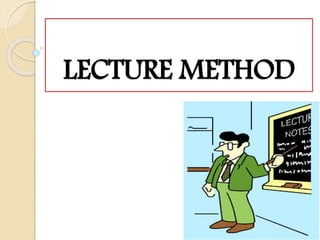
LECTURE METHOD
INTRODUCTION
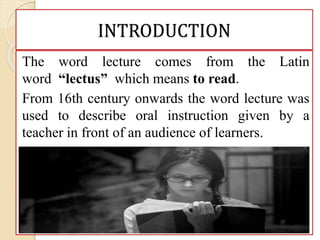
The word lecture comes from the Latin
word “lectus” which means to read.
From 16th century onwards the word lecture was
used to describe oral instruction given by a
teacher in front of an audience of learners.
DEFINITION OF LECTURE
ACCORDING TO OXFORD DICTIONARY
LECTURE IS DEFINED AS “A discourse ( a long &
serious discussion in speech or writing) given by an
audience on a ‘given subject, usually for the purpose
of instruction”
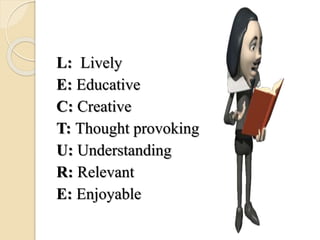
L: Lively
E: Educative
C: Creative
T: Thought provoking
U: Understanding
R: Relevant
E: Enjoyable
PURPOSE OF LECTURE
1. Lecture is a effective method for
communicating theories, ideas & facts to
students.
2. The basic purpose of lecture is the
dissemination of information.
HOW TO INTRODUCE LECTURE
INTRODUCTION OF
TOPIC
 The introduction usually
takes first three to five
minutes of the lecture.
 This time is crucial in
determining how well
students learn & retain the
information to be
presented.
HOW TO INTRODUCE LECTURE
INTRODUCTION OF TOPIC
 The main purpose is to
provide a framework for
student’s learning content
information.
 It is also necessary to gain
student’s attention.
HOW TO INTRODUCE LECTURE
POINTS TO BE REMEMBERED
1.Establish a relationship with the
audience. Make warm-up comments and
initiate rapport to set the tone of the
class. Establish friendly communication
to provide a positive learning
environment in which students feel
comfortable.
Use an ice breaker to introduce yourself
during you meet first time with students
& maintain an approachable
relationship with students in subsequent
classes.
HOW TO INTRODUCE LECTURE
2.Gain attention & foster motivation. Relate to
student’s goals & interests. You might present a
meaningful problem to students & describe the
lecture as a solution to the problem.
HOW TO INTRODUCE LECTURE
3.Prompt awareness of relevant pre-existing
knowledge. Students need to see how the new
lecture information relates to their existing
knowledge or experience. This not only promotes
interest & motivation, but also is a first step in
cognitive information processing.
HOW TO INTRODUCE LECTURE
4.Clarify the purpose of the lecture & describe how
it is organized. Research supports a correlation
between clarity of objectives & student
achievement.
Students will achieve at higher levels if they know
what knowledge & skills they should gain from
this instruction.
HOW TO INTRODUCE LECTURE
This can be accomplished by doing the following:-
a) Announce the lecture topic as a title.
b) Make a statement about the topic & how it will
be developed.
c) Make a generalization about the topic or simply
list the objectives.
ORGANIZATION & DELIVERY OF LECTURE
An effective lecture is composed of three
components:-
a) Introduction
b) Body
c) Conclusion
ORGANIZATION & DELIVERY OF LECTURE
BODY OF THE LECTURE :-
It covers the content in an organized way. This is
where you must consult your lecture rapport with
your students.
Lecture material is a combination of facts,
concepts, principles & generalizations.
ORGANIZATION & DELIVERY OF LECTURE
BODY OF THE LECTURE :-
Concepts:
Lecture should be organized based on the
relationship of the ideas presented. Examples of
relationship that can be used to organize lecture
information include the following:-
ORGANIZATION & DELIVERY OF LECTURE
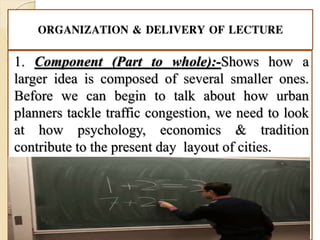
1. Component (Part to whole):-Shows how a
larger idea is composed of several smaller ones.
Before we can begin to talk about how urban
planners tackle traffic congestion, we need to look
at how psychology, economics & tradition
contribute to the present day layout of cities.
ORGANIZATION & DELIVERY OF LECTURE
2.Sequential: Deals with chronological or cause
effect relationship.
3.Material to purpose: Information & procedure is
presented & followed by its purpose or use.
4.Comparison:-Comparing two or more things,
using an explicit basis for comparison.
ORGANIZATION & DELIVERY OF LECTURE
Use transition words as you present:
Using transitions or links (therefore, because, as a
result) show how pieces of lecture information
relate to each other. Verbal or oral cues also alert
students to more significant information.
1. It is especially important to remember.
2. Please note the following.
3. You will need to memorize.
4. I will ask you to recognize.
5. You should be able to apply.
ORGANIZATION & DELIVERY OF LECTURE
POINTS TO REMEMBER
 Remember to include AV aids while delivering
lecture.
 Using power point slides, transparencies or even
chalkboard will enliven & strengthen, the
presentation of ideas & thus assist student’s
learning.
ORGANIZATION & DELIVERY OF LECTURE
Include active learning: Active learning allows
students opportunity to practice using the lecture
information & obtain feedback on the accuracy of
their responses.
For example: During lecture, ask questions or give
students problem solving activities that encourage
them to use the information that they should gain
from the lecture.
ORGANIZATION & DELIVERY OF LECTURE
At the end of the lecture, You can use the ‘minute
paper’ by asking students to respond in one or two
sentences to the following questions:-
1. What stood out as most important in today’s
lecture?
2. What ideas from today’s lecture are still unclear?
ORGANIZATION & DELIVERY OF LECTURE
Capture attention: Maintain attention throughout
the lecture by employing techniques such as
following:
 Vary students activities. Lecture for 15 minutes &
then provide an active learning activity.
 Change the mode of presentation (oral to visual)
 Employ concept- relate hmor.
 Demonstrate entusiasm about the subject.
 Encourage note taking by speaking slowly &
repeating important information.
ORGANIZATION & DELIVERY OF LECTURE
CONCLUSION:
The conclusion, the most frequently neglected
component of the lecture, should be used to
reinforce student’s learning of the information as
well as to clarify any misconceptions regarding
students learning of the information as well as to
clarify any misconceptions regarding their
understanding of the concept presented.
ORGANIZATION & DELIVERY OF LECTURE
Try to do the following in lecture conclusion:
 Repeat and emphasize main points. Signal
students that you are going to summarize and re
emphasize main points.This will help you to get
the feedback as to wheather or not students
identified the most information ,it is also helpful
to rephrase information in order to clearify key
ideas.
ORGANIZATION & DELIVERY OF LECTURE
 Encourage question from students. To allow
students time to review their their notes &
thoughts ,pause for a moments after asking for
questions.
 Ask specific leading questions. By doing so, you
will encourage students to review their notes &
formulate questions of their own.
DELIVERY OF LECTURE
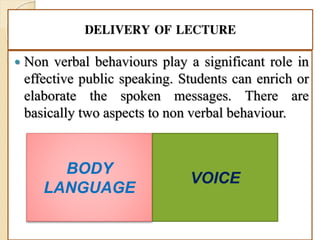
 Non verbal behaviours play a significant role in
effective public speaking. Students can enrich or
elaborate the spoken messages. There are
basically two aspects to non verbal behaviour.
BODY
LANGUAGE
VOICE
DELIVERY OF LECTURE
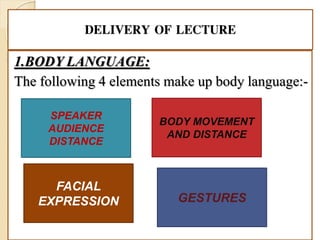
1.BODY LANGUAGE:
The following 4 elements make up body language:-
SPEAKER
AUDIENCE
DISTANCE
FACIAL
EXPRESSION GESTURES
BODY MOVEMENT
AND DISTANCE
DELIVERY OF LECTURE
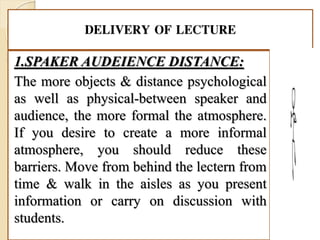
1.SPAKER AUDEIENCE DISTANCE:
The more objects & distance psychological
as well as physical-between speaker and
audience, the more formal the atmosphere.
If you desire to create a more informal
atmosphere, you should reduce these
barriers. Move from behind the lectern from
time & walk in the aisles as you present
information or carry on discussion with
students.
DELIVERY OF LECTURE
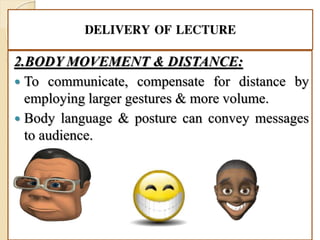
2.BODY MOVEMENT & DISTANCE:
 To communicate, compensate for distance by
employing larger gestures & more volume.
 Body language & posture can convey messages
to audience.
DELIVERY OF LECTURE
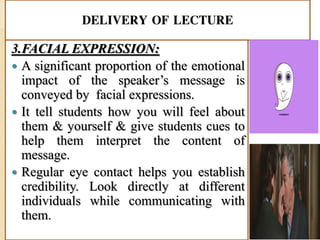
3.FACIAL EXPRESSION:
 A significant proportion of the emotional
impact of the speaker’s message is
conveyed by facial expressions.
 It tell students how you will feel about
them & yourself & give students cues to
help them interpret the content of
message.
 Regular eye contact helps you establish
credibility. Look directly at different
individuals while communicating with
them.
DELIVERY OF LECTURE
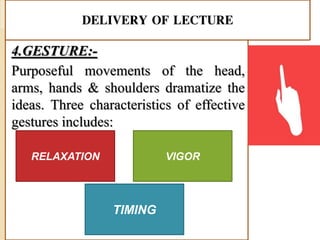
4.GESTURE:-
Purposeful movements of the head,
arms, hands & shoulders dramatize the
ideas. Three characteristics of effective
gestures includes:
RELAXATION
TIMING
VIGOR
DELIVERY OF LECTURE
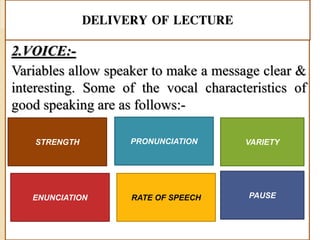
2.VOICE:-
Variables allow speaker to make a message clear &
interesting. Some of the vocal characteristics of
good speaking are as follows:-
STRENGTH VARIETY
RATE OF SPEECHENUNCIATION
PRONUNCIATION
PAUSE
DELIVERY OF LECTURE
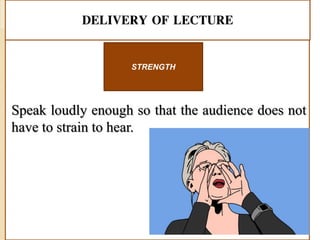
Speak loudly enough so that the audience does not
have to strain to hear.
STRENGTH
DELIVERY OF LECTURE
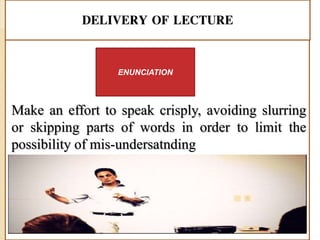
Make an effort to speak crisply, avoiding slurring
or skipping parts of words in order to limit the
possibility of mis-undersatnding
ENUNCIATION
DELIVERY OF LECTURE
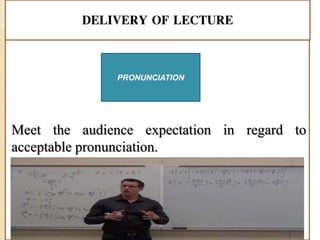
Meet the audience expectation in regard to
acceptable pronunciation.
PRONUNCIATION
DELIVERY OF LECTURE
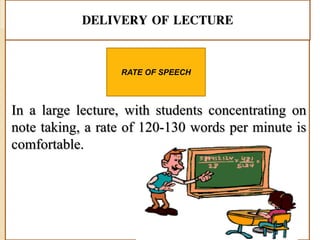
In a large lecture, with students concentrating on
note taking, a rate of 120-130 words per minute is
comfortable.
RATE OF SPEECH
DELIVERY OF LECTURE
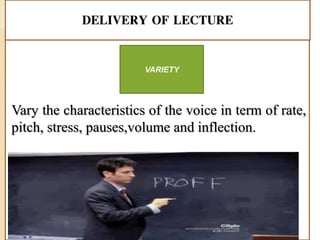
Vary the characteristics of the voice in term of rate,
pitch, stress, pauses,volume and inflection.
VARIETY
DELIVERY OF LECTURE
 Pauses can provide emphasis & allow students
time to think & take notes.
 Pausing indicates that you are a conscientious
speaker who thinks about what you are going to
say.
 Don’t make sound like um,ah,well-uh etc make
the presention seem disconnected & distracting.
PAUSE
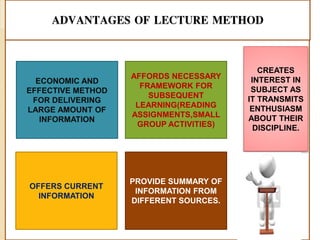
ADVANTAGES OF LECTURE METHOD
ECONOMIC AND
EFFECTIVE METHOD
FOR DELIVERING
LARGE AMOUNT OF
INFORMATION
PROVIDE SUMMARY OF
INFORMATION FROM
DIFFERENT SOURCES.
AFFORDS NECESSARY
FRAMEWORK FOR
SUBSEQUENT
LEARNING(READING
ASSIGNMENTS,SMALL
GROUP ACTIVITIES)
OFFERS CURRENT
INFORMATION
CREATES
INTEREST IN
SUBJECT AS
IT TRANSMITS
ENTHUSIASM
ABOUT THEIR
DISCIPLINE.
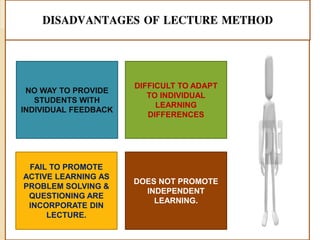
DISADVANTAGES OF LECTURE METHOD
NO WAY TO PROVIDE
STUDENTS WITH
INDIVIDUAL FEEDBACK
DOES NOT PROMOTE
INDEPENDENT
LEARNING.
DIFFICULT TO ADAPT
TO INDIVIDUAL
LEARNING
DIFFERENCES
FAIL TO PROMOTE
ACTIVE LEARNING AS
PROBLEM SOLVING &
QUESTIONING ARE
INCORPORATE DIN
LECTURE.
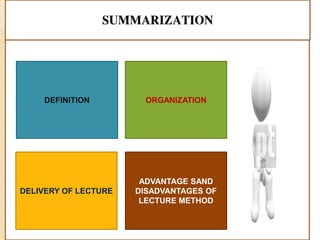
SUMMARIZATION
DEFINITION
ADVANTAGE SAND
DISADVANTAGES OF
LECTURE METHOD
ORGANIZATION
DELIVERY OF LECTURE
RECAPTULIZATION
Lecture method of teaching

Lecture method of teaching

  • 1.
  • 2.
  • 3.
    INTRODUCTION The word lecturecomes from the Latin word “lectus” which means to read. From 16th century onwards the word lecture was used to describe oral instruction given by a teacher in front of an audience of learners.
  • 4.
    DEFINITION OF LECTURE ACCORDINGTO OXFORD DICTIONARY LECTURE IS DEFINED AS “A discourse ( a long & serious discussion in speech or writing) given by an audience on a ‘given subject, usually for the purpose of instruction”
  • 5.
    L: Lively E: Educative C:Creative T: Thought provoking U: Understanding R: Relevant E: Enjoyable
  • 6.
    PURPOSE OF LECTURE 1.Lecture is a effective method for communicating theories, ideas & facts to students. 2. The basic purpose of lecture is the dissemination of information.
  • 7.
    HOW TO INTRODUCELECTURE INTRODUCTION OF TOPIC  The introduction usually takes first three to five minutes of the lecture.  This time is crucial in determining how well students learn & retain the information to be presented.
  • 8.
    HOW TO INTRODUCELECTURE INTRODUCTION OF TOPIC  The main purpose is to provide a framework for student’s learning content information.  It is also necessary to gain student’s attention.
  • 9.
    HOW TO INTRODUCELECTURE POINTS TO BE REMEMBERED 1.Establish a relationship with the audience. Make warm-up comments and initiate rapport to set the tone of the class. Establish friendly communication to provide a positive learning environment in which students feel comfortable. Use an ice breaker to introduce yourself during you meet first time with students & maintain an approachable relationship with students in subsequent classes.
  • 10.
    HOW TO INTRODUCELECTURE 2.Gain attention & foster motivation. Relate to student’s goals & interests. You might present a meaningful problem to students & describe the lecture as a solution to the problem.
  • 11.
    HOW TO INTRODUCELECTURE 3.Prompt awareness of relevant pre-existing knowledge. Students need to see how the new lecture information relates to their existing knowledge or experience. This not only promotes interest & motivation, but also is a first step in cognitive information processing.
  • 12.
    HOW TO INTRODUCELECTURE 4.Clarify the purpose of the lecture & describe how it is organized. Research supports a correlation between clarity of objectives & student achievement. Students will achieve at higher levels if they know what knowledge & skills they should gain from this instruction.
  • 13.
    HOW TO INTRODUCELECTURE This can be accomplished by doing the following:- a) Announce the lecture topic as a title. b) Make a statement about the topic & how it will be developed. c) Make a generalization about the topic or simply list the objectives.
  • 14.
    ORGANIZATION & DELIVERYOF LECTURE An effective lecture is composed of three components:- a) Introduction b) Body c) Conclusion
  • 15.
    ORGANIZATION & DELIVERYOF LECTURE BODY OF THE LECTURE :- It covers the content in an organized way. This is where you must consult your lecture rapport with your students. Lecture material is a combination of facts, concepts, principles & generalizations.
  • 16.
    ORGANIZATION & DELIVERYOF LECTURE BODY OF THE LECTURE :- Concepts: Lecture should be organized based on the relationship of the ideas presented. Examples of relationship that can be used to organize lecture information include the following:-
  • 17.
    ORGANIZATION & DELIVERYOF LECTURE 1. Component (Part to whole):-Shows how a larger idea is composed of several smaller ones. Before we can begin to talk about how urban planners tackle traffic congestion, we need to look at how psychology, economics & tradition contribute to the present day layout of cities.
  • 18.
    ORGANIZATION & DELIVERYOF LECTURE 2.Sequential: Deals with chronological or cause effect relationship. 3.Material to purpose: Information & procedure is presented & followed by its purpose or use. 4.Comparison:-Comparing two or more things, using an explicit basis for comparison.
  • 19.
    ORGANIZATION & DELIVERYOF LECTURE Use transition words as you present: Using transitions or links (therefore, because, as a result) show how pieces of lecture information relate to each other. Verbal or oral cues also alert students to more significant information. 1. It is especially important to remember. 2. Please note the following. 3. You will need to memorize. 4. I will ask you to recognize. 5. You should be able to apply.
  • 20.
    ORGANIZATION & DELIVERYOF LECTURE POINTS TO REMEMBER  Remember to include AV aids while delivering lecture.  Using power point slides, transparencies or even chalkboard will enliven & strengthen, the presentation of ideas & thus assist student’s learning.
  • 21.
    ORGANIZATION & DELIVERYOF LECTURE Include active learning: Active learning allows students opportunity to practice using the lecture information & obtain feedback on the accuracy of their responses. For example: During lecture, ask questions or give students problem solving activities that encourage them to use the information that they should gain from the lecture.
  • 22.
    ORGANIZATION & DELIVERYOF LECTURE At the end of the lecture, You can use the ‘minute paper’ by asking students to respond in one or two sentences to the following questions:- 1. What stood out as most important in today’s lecture? 2. What ideas from today’s lecture are still unclear?
  • 23.
    ORGANIZATION & DELIVERYOF LECTURE Capture attention: Maintain attention throughout the lecture by employing techniques such as following:  Vary students activities. Lecture for 15 minutes & then provide an active learning activity.  Change the mode of presentation (oral to visual)  Employ concept- relate hmor.  Demonstrate entusiasm about the subject.  Encourage note taking by speaking slowly & repeating important information.
  • 24.
    ORGANIZATION & DELIVERYOF LECTURE CONCLUSION: The conclusion, the most frequently neglected component of the lecture, should be used to reinforce student’s learning of the information as well as to clarify any misconceptions regarding students learning of the information as well as to clarify any misconceptions regarding their understanding of the concept presented.
  • 25.
    ORGANIZATION & DELIVERYOF LECTURE Try to do the following in lecture conclusion:  Repeat and emphasize main points. Signal students that you are going to summarize and re emphasize main points.This will help you to get the feedback as to wheather or not students identified the most information ,it is also helpful to rephrase information in order to clearify key ideas.
  • 26.
    ORGANIZATION & DELIVERYOF LECTURE  Encourage question from students. To allow students time to review their their notes & thoughts ,pause for a moments after asking for questions.  Ask specific leading questions. By doing so, you will encourage students to review their notes & formulate questions of their own.
  • 27.
    DELIVERY OF LECTURE Non verbal behaviours play a significant role in effective public speaking. Students can enrich or elaborate the spoken messages. There are basically two aspects to non verbal behaviour. BODY LANGUAGE VOICE
  • 28.
    DELIVERY OF LECTURE 1.BODYLANGUAGE: The following 4 elements make up body language:- SPEAKER AUDIENCE DISTANCE FACIAL EXPRESSION GESTURES BODY MOVEMENT AND DISTANCE
  • 29.
    DELIVERY OF LECTURE 1.SPAKERAUDEIENCE DISTANCE: The more objects & distance psychological as well as physical-between speaker and audience, the more formal the atmosphere. If you desire to create a more informal atmosphere, you should reduce these barriers. Move from behind the lectern from time & walk in the aisles as you present information or carry on discussion with students.
  • 30.
    DELIVERY OF LECTURE 2.BODYMOVEMENT & DISTANCE:  To communicate, compensate for distance by employing larger gestures & more volume.  Body language & posture can convey messages to audience.
  • 31.
    DELIVERY OF LECTURE 3.FACIALEXPRESSION:  A significant proportion of the emotional impact of the speaker’s message is conveyed by facial expressions.  It tell students how you will feel about them & yourself & give students cues to help them interpret the content of message.  Regular eye contact helps you establish credibility. Look directly at different individuals while communicating with them.
  • 32.
    DELIVERY OF LECTURE 4.GESTURE:- Purposefulmovements of the head, arms, hands & shoulders dramatize the ideas. Three characteristics of effective gestures includes: RELAXATION TIMING VIGOR
  • 33.
    DELIVERY OF LECTURE 2.VOICE:- Variablesallow speaker to make a message clear & interesting. Some of the vocal characteristics of good speaking are as follows:- STRENGTH VARIETY RATE OF SPEECHENUNCIATION PRONUNCIATION PAUSE
  • 34.
    DELIVERY OF LECTURE Speakloudly enough so that the audience does not have to strain to hear. STRENGTH
  • 35.
    DELIVERY OF LECTURE Makean effort to speak crisply, avoiding slurring or skipping parts of words in order to limit the possibility of mis-undersatnding ENUNCIATION
  • 36.
    DELIVERY OF LECTURE Meetthe audience expectation in regard to acceptable pronunciation. PRONUNCIATION
  • 37.
    DELIVERY OF LECTURE Ina large lecture, with students concentrating on note taking, a rate of 120-130 words per minute is comfortable. RATE OF SPEECH
  • 38.
    DELIVERY OF LECTURE Varythe characteristics of the voice in term of rate, pitch, stress, pauses,volume and inflection. VARIETY
  • 39.
    DELIVERY OF LECTURE Pauses can provide emphasis & allow students time to think & take notes.  Pausing indicates that you are a conscientious speaker who thinks about what you are going to say.  Don’t make sound like um,ah,well-uh etc make the presention seem disconnected & distracting. PAUSE
  • 40.
    ADVANTAGES OF LECTUREMETHOD ECONOMIC AND EFFECTIVE METHOD FOR DELIVERING LARGE AMOUNT OF INFORMATION PROVIDE SUMMARY OF INFORMATION FROM DIFFERENT SOURCES. AFFORDS NECESSARY FRAMEWORK FOR SUBSEQUENT LEARNING(READING ASSIGNMENTS,SMALL GROUP ACTIVITIES) OFFERS CURRENT INFORMATION CREATES INTEREST IN SUBJECT AS IT TRANSMITS ENTHUSIASM ABOUT THEIR DISCIPLINE.
  • 41.
    DISADVANTAGES OF LECTUREMETHOD NO WAY TO PROVIDE STUDENTS WITH INDIVIDUAL FEEDBACK DOES NOT PROMOTE INDEPENDENT LEARNING. DIFFICULT TO ADAPT TO INDIVIDUAL LEARNING DIFFERENCES FAIL TO PROMOTE ACTIVE LEARNING AS PROBLEM SOLVING & QUESTIONING ARE INCORPORATE DIN LECTURE.
  • 42.
  • 43.