WELCOME
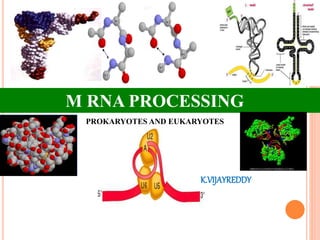
M RNA PROCESSING
PROKARYOTES AND EUKARYOTES
K.VIJAYREDDY
RNA (Ribonucleic Acid)
RNA is much more abundant than DNA
There are several important differences between
RNA and DNA.
 The pentose sugar in RNA is ribose, in DNA it’s
deoxyribose.
In RNA, uracil replaces the base thymine (U pairs
with A).
RNA is single stranded while DNA is double
stranded.
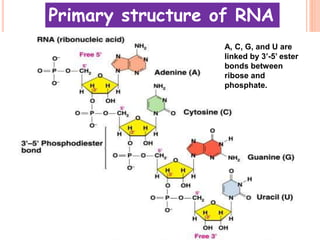
Primary structure of RNA
A, C, G, and U are
linked by 3’-5’ ester
bonds between
ribose and
phosphate.
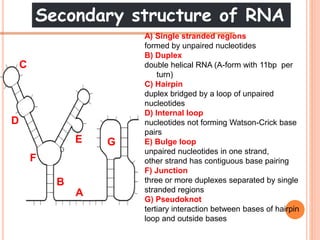
Secondary structure of RNA
D
A) Single stranded regions
formed by unpaired nucleotides
B) Duplex
double helical RNA (A-form with 11bp per
turn)
C) Hairpin
duplex bridged by a loop of unpaired
nucleotides
D) Internal loop
nucleotides not forming Watson-Crick base
pairs
E) Bulge loop
unpaired nucleotides in one strand,
other strand has contiguous base pairing
F) Junction
three or more duplexes separated by single
stranded regions
G) Pseudoknot
tertiary interaction between bases of hairpin
loop and outside bases
G
A
B
C
D
E
F
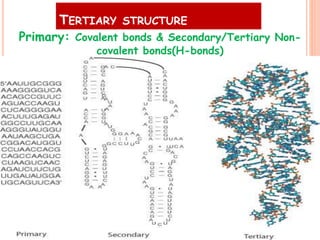
TERTIARY STRUCTURE
6
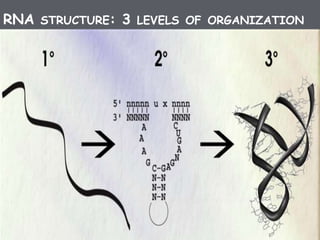
Primary: Covalent bonds & Secondary/Tertiary Non-
covalent bonds(H-bonds)
RNA STRUCTURE: 3 LEVELS OF ORGANIZATION
7
DDobbsISU-BCB444/544X:RNA
Structure&Function
Rob Knight
Univ Colorado
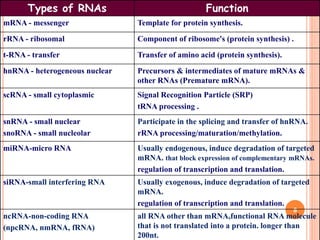
RNA TYPES & FUNCTIONS
8
Types of RNAs Function
mRNA - messenger Template for protein synthesis.
rRNA - ribosomal Component of ribosome's (protein synthesis) .
t-RNA - transfer Transfer of amino acid (protein synthesis).
hnRNA - heterogeneous nuclear Precursors & intermediates of mature mRNAs &
other RNAs (Premature mRNA).
scRNA - small cytoplasmic Signal Recognition Particle (SRP)
tRNA processing .
snRNA - small nuclear
snoRNA - small nucleolar
Participate in the splicing and transfer of hnRNA.
rRNA processing/maturation/methylation.
miRNA-micro RNA Usually endogenous, induce degradation of targeted
mRNA. that block expression of complementary mRNAs.
regulation of transcription and translation.
siRNA-small interfering RNA Usually exogenous, induce degradation of targeted
mRNA.
regulation of transcription and translation.
ncRNA-non-coding RNA
(npcRNA, nmRNA, fRNA)
all RNA other than mRNA,functional RNA molecule
that is not translated into a protein. longer than
200nt.
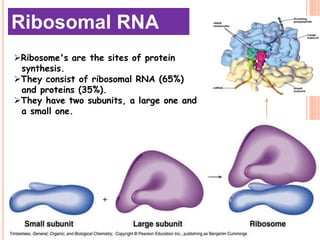
Ribosome's are the sites of protein
synthesis.
They consist of ribosomal RNA (65%)
and proteins (35%).
They have two subunits, a large one and
a small one.
Ribosomal RNA
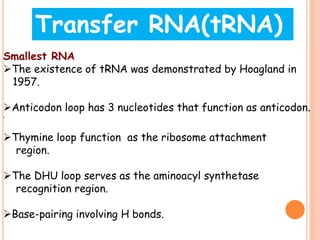
Smallest RNA
The existence of tRNA was demonstrated by Hoagland in
1957.
Anticodon loop has 3 nucleotides that function as anticodon.
.
Thymine loop function as the ribosome attachment
region.
The DHU loop serves as the aminoacyl synthetase
recognition region.
Base-pairing involving H bonds.
Transfer RNA(tRNA)
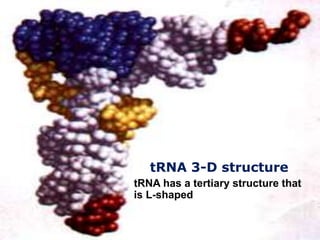
tRNA 3-D structure
tRNA has a tertiary structure that
is L-shaped
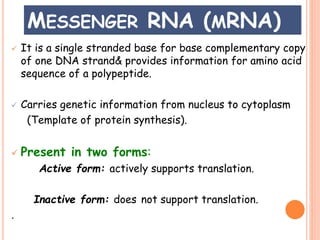
MESSENGER RNA (MRNA)
 It is a single stranded base for base complementary copy
of one DNA strand& provides information for amino acid
sequence of a polypeptide.
 Carries genetic information from nucleus to cytoplasm
(Template of protein synthesis).
 Present in two forms:
Active form: actively supports translation.
Inactive form: does not support translation.
.
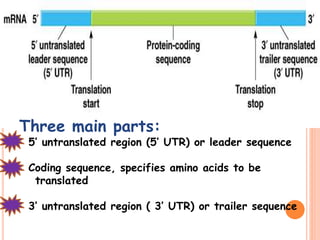
Three main parts:
5’ untranslated region (5’ UTR) or leader sequence
Coding sequence, specifies amino acids to be
translated
3’ untranslated region ( 3’ UTR) or trailer sequence
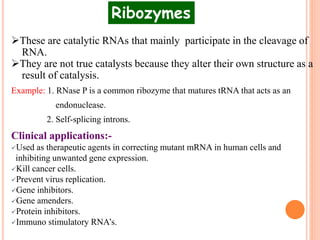
These are catalytic RNAs that mainly participate in the cleavage of
RNA.
They are not true catalysts because they alter their own structure as a
result of catalysis.
Example: 1. RNase P is a common ribozyme that matures tRNA that acts as an
endonuclease.
2. Self-splicing introns.
Clinical applications:-
Used as therapeutic agents in correcting mutant mRNA in human cells and
inhibiting unwanted gene expression.
Kill cancer cells.
Prevent virus replication.
Gene inhibitors.
Gene amenders.
Protein inhibitors.
Immuno stimulatory RNA’s.
Ribozymes
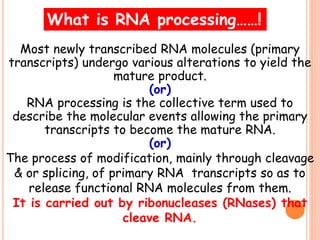
Most newly transcribed RNA molecules (primary
transcripts) undergo various alterations to yield the
mature product.
(or)
RNA processing is the collective term used to
describe the molecular events allowing the primary
transcripts to become the mature RNA.
(or)
The process of modification, mainly through cleavage
& or splicing, of primary RNA transcripts so as to
release functional RNA molecules from them.
It is carried out by ribonucleases (RNases) that
cleave RNA.
What is RNA processing……!
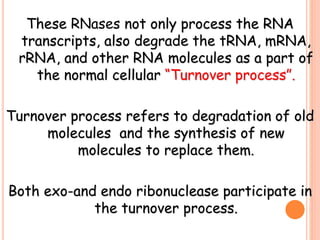
These RNases not only process the RNA
transcripts, also degrade the tRNA, mRNA,
rRNA, and other RNA molecules as a part of
the normal cellular “Turnover process”.
Turnover process refers to degradation of old
molecules and the synthesis of new
molecules to replace them.
Both exo-and endo ribonuclease participate in
the turnover process.
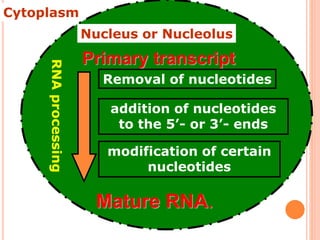
Primary transcript
Mature RNA.
Nucleus or Nucleolus
Cytoplasm
RNAprocessing
Removal of nucleotides
addition of nucleotides
to the 5’- or 3’- ends
modification of certain
nucleotides
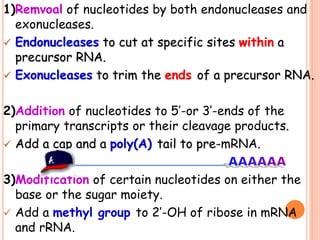
1)Remvoal of nucleotides by both endonucleases and
exonucleases.
 Endonucleases to cut at specific sites within a
precursor RNA.
 Exonucleases to trim the ends of a precursor RNA.
2)Addition of nucleotides to 5’-or 3’-ends of the
primary transcripts or their cleavage products.
 Add a cap and a poly(A) tail to pre-mRNA.
3)Modification of certain nucleotides on either the
base or the sugar moiety.
 Add a methyl group to 2’-OH of ribose in mRNA
and rRNA.
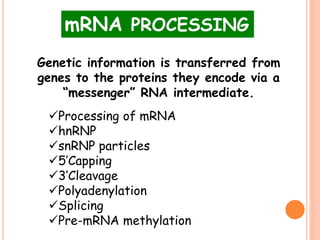
Processing of mRNA
hnRNP
snRNP particles
5’Capping
3’Cleavage
Polyadenylation
Splicing
Pre-mRNA methylation
mRNA PROCESSING
Genetic information is transferred from
genes to the proteins they encode via a
“messenger” RNA intermediate.
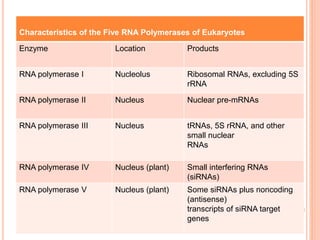
Characteristics of the Five RNA Polymerases of Eukaryotes
Enzyme Location Products
RNA polymerase I Nucleolus Ribosomal RNAs, excluding 5S
rRNA
RNA polymerase II Nucleus Nuclear pre-mRNAs
RNA polymerase III Nucleus tRNAs, 5S rRNA, and other
small nuclear
RNAs
RNA polymerase IV Nucleus (plant) Small interfering RNAs
(siRNAs)
RNA polymerase V Nucleus (plant) Some siRNAs plus noncoding
(antisense)
transcripts of siRNA target
genes
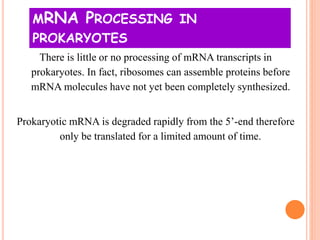
MRNA PROCESSING IN
PROKARYOTES
There is little or no processing of mRNA transcripts in
prokaryotes. In fact, ribosomes can assemble proteins before
mRNA molecules have not yet been completely synthesized.
Prokaryotic mRNA is degraded rapidly from the 5’-end therefore
only be translated for a limited amount of time.
DNA
Cytoplasm
Nucleus
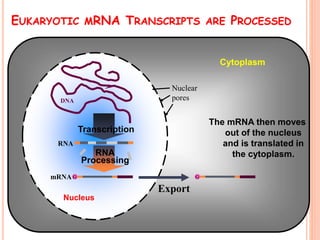
EUKARYOTIC MRNA TRANSCRIPTS ARE PROCESSED
Export
G AAAAAA
RNA
Transcription
G AAAAAA
RNA
Processing
mRNA
The mRNA then moves
out of the nucleus
and is translated in
the cytoplasm.
mRNA is synthesized by RNA Pol II as longer
precursors (pre-mRNA), the population of
different RNA Pol II transcripts are called
heterogeneous nuclear RNA (hnRNA).
Among hnRNA, those processed to give mature
mRNAs are called pre-mRNAs.
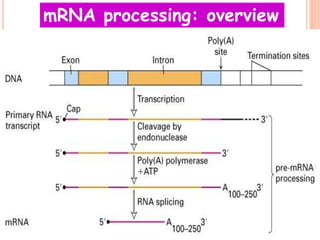
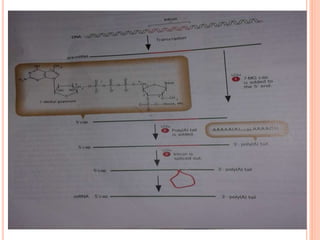
Pre-mRNA molecules are again processed to give
mature mRNAs by 5’-capping, 3’-cleavage and
poly adenylation, splicing and methylation.
Processing of mRNA
HNRNP:- HNRNA + PROTEINS
The hnRNA synthesized by RNA Pol II is mainly pre-mRNA
and rapidly becomes covered by proteins to form
heterogeneous nuclear Ribonucleoprotein (hnRNP).
The hnRNP proteins are keep the hnRNA in a single-stranded
form and to assist in the various RNA processing reactions.
SNRNP PARTICLES: SNRNA + PROTEINS
Eukaryotic nuclei contain many discreet small RNA
species called small nuclear RNAs(snRNAs) are
rich in the base uracil, which complex with
specific proteins to form snRNPs.
The most abundant snRNP are involved in pre-mRNA
splicing, U1,U2,U4,U5 and U6.
snRNAs are synthesized in the nucleus by RNA Pol II
and have a normal 5’-cap.
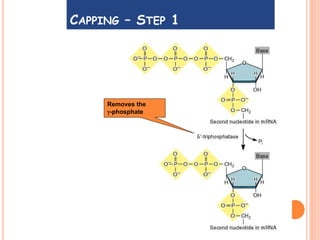
Removes the
-phosphate
CAPPING – STEP 1
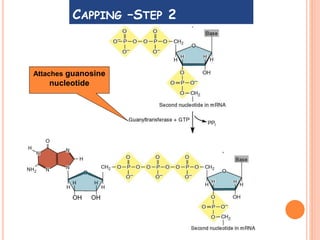
CAPPING –STEP 2
Attaches guanosine
nucleotide
OHOH
OHOH
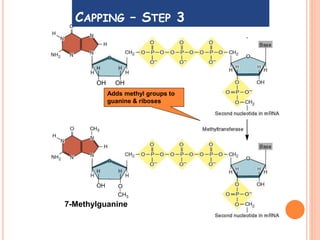
Adds methyl groups to
guanine & riboses
CAPPING – STEP 3
OH O
CH3
7-Methylguanine
5 3
5
5 3
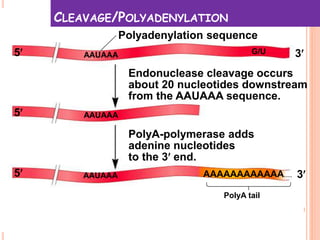
Endonuclease cleavage occurs
about 20 nucleotides downstream
from the AAUAAA sequence.
PolyA-polymerase adds
adenine nucleotides
to the 3end.
Polyadenylation sequence
PolyA tail
AAAAAAAAAAAA....AAUAAA
AAUAAA
AAUAAA
CLEAVAGE/POLYADENYLATION
G/U
SPLICING
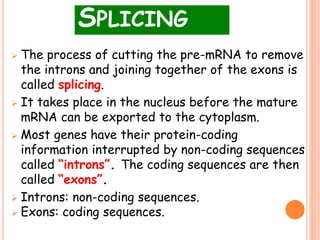
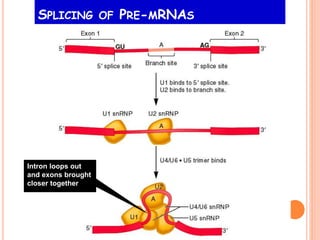
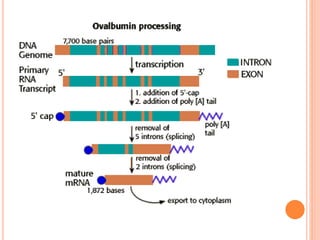
 The process of cutting the pre-mRNA to remove
the introns and joining together of the exons is
called splicing.
 It takes place in the nucleus before the mature
mRNA can be exported to the cytoplasm.
 Most genes have their protein-coding
information interrupted by non-coding sequences
called “introns”. The coding sequences are then
called “exons”.
 Introns: non-coding sequences.
 Exons: coding sequences.
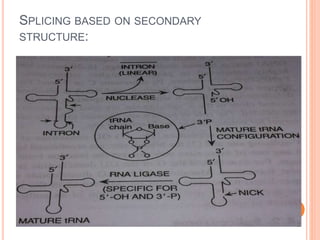
SPLICING BASED ON SECONDARY
STRUCTURE:
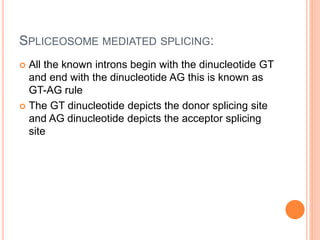
SPLICEOSOME MEDIATED SPLICING:
 All the known introns begin with the dinucleotide GT
and end with the dinucleotide AG this is known as
GT-AG rule
 The GT dinucleotide depicts the donor splicing site
and AG dinucleotide depicts the acceptor splicing
site
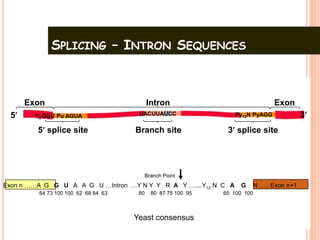
SPLICING – INTRON SEQUENCES
35
5 splice site 3 splice siteBranch site
IntronExon Exon
Py12N PyAGGA/CGGU Pu AGUA UACUUAUCC
Exon n ……A G G U A A G U …Intron …Y N Y Y R A Y …....Y12 N C A G N ….. Exon n+1
64 73 100 100 62 68 84 63 80 80 87 75 100 95 65 100 100
Branch Point
Yeast consensus
Intron loops out
and exons brought
closer together
SPLICING OF PRE-MRNAS
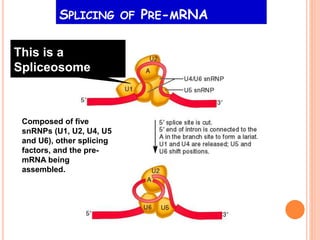
SPLICING OF PRE-MRNA
This is a
Spliceosome
Composed of five
snRNPs (U1, U2, U4, U5
and U6), other splicing
factors, and the pre-
mRNA being
assembled.
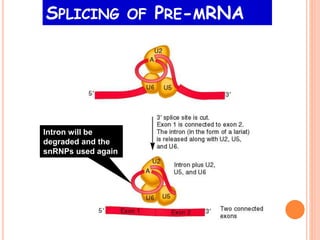
Intron will be
degraded and the
snRNPs used again
SPLICING OF PRE-MRNA
All noncoding introns are spliced out of a pre-
mRNA by the Spliceosome.
But not all exons are included in the final mRNA.
mRNA can undergo alternative splicing.
The selective inclusion or exclusion of exons
occur.
From one pre-mRNA can make many different
mRNA(thus different proteins)
>50% of human genes undergo alternative
splicing.
ALTERNATIVE SPLICING
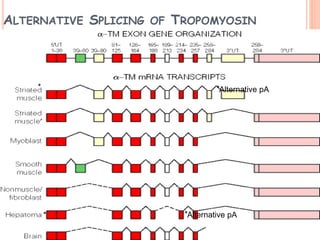
ALTERNATIVE SPLICING OF TROPOMYOSIN
* Alternative pA*
* Alternative pA*
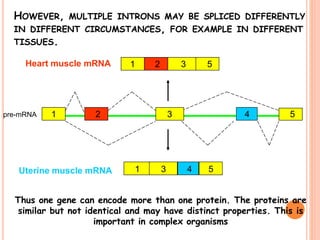
HOWEVER, MULTIPLE INTRONS MAY BE SPLICED DIFFERENTLY
IN DIFFERENT CIRCUMSTANCES, FOR EXAMPLE IN DIFFERENT
TISSUES.
1 2 3 5Heart muscle mRNA
1 43 5Uterine muscle mRNA
Thus one gene can encode more than one protein. The proteins are
similar but not identical and may have distinct properties. This is
important in complex organisms
3 5421pre-mRNA
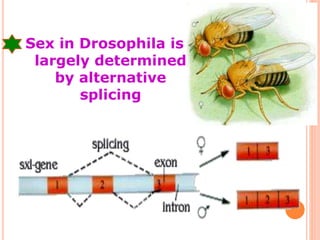
Sex in Drosophila is
largely determined
by alternative
splicing
RNA EDITING
This is a form of RNA processing in which
the nucleotide sequence of the primary
transcript is altered by either
Changing residues,
Deleting residues,
Inserting residues at specific points
along the molecule
Changing RNA sequence (after transcription).
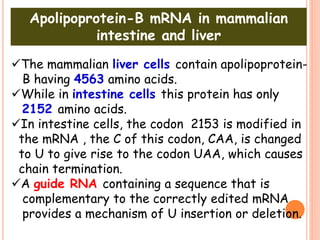
Apolipoprotein-B mRNA in mammalian
intestine and liver
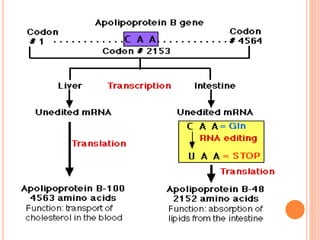
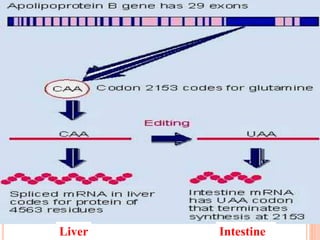
The mammalian liver cells contain apolipoprotein-
B having 4563 amino acids.
While in intestine cells this protein has only
2152 amino acids.
In intestine cells, the codon 2153 is modified in
the mRNA , the C of this codon, CAA, is changed
to U to give rise to the codon UAA, which causes
chain termination.
A guide RNA containing a sequence that is
complementary to the correctly edited mRNA
provides a mechanism of U insertion or deletion.
Liver Intestine
mRNA processing: overview
POSSIBLE QUESTIONS:
 Describe in detail about mRNA processing ?
 Difference between splicing and alternate splicing?
 RNA editing?
REFERNCES:
 GENETICS- B.D.SINGH
 PRINCIPLES OF GENETICS- SNUSTARD AND SIMMONS
Rna processing

Rna processing

  • 1.
  • 2.
    M RNA PROCESSING PROKARYOTESAND EUKARYOTES K.VIJAYREDDY
  • 3.
    RNA (Ribonucleic Acid) RNAis much more abundant than DNA There are several important differences between RNA and DNA.  The pentose sugar in RNA is ribose, in DNA it’s deoxyribose. In RNA, uracil replaces the base thymine (U pairs with A). RNA is single stranded while DNA is double stranded.
  • 4.
    Primary structure ofRNA A, C, G, and U are linked by 3’-5’ ester bonds between ribose and phosphate.
  • 5.
    Secondary structure ofRNA D A) Single stranded regions formed by unpaired nucleotides B) Duplex double helical RNA (A-form with 11bp per turn) C) Hairpin duplex bridged by a loop of unpaired nucleotides D) Internal loop nucleotides not forming Watson-Crick base pairs E) Bulge loop unpaired nucleotides in one strand, other strand has contiguous base pairing F) Junction three or more duplexes separated by single stranded regions G) Pseudoknot tertiary interaction between bases of hairpin loop and outside bases G A B C D E F
  • 6.
    TERTIARY STRUCTURE 6 Primary: Covalentbonds & Secondary/Tertiary Non- covalent bonds(H-bonds)
  • 7.
    RNA STRUCTURE: 3LEVELS OF ORGANIZATION 7 DDobbsISU-BCB444/544X:RNA Structure&Function Rob Knight Univ Colorado
  • 8.
    RNA TYPES &FUNCTIONS 8 Types of RNAs Function mRNA - messenger Template for protein synthesis. rRNA - ribosomal Component of ribosome's (protein synthesis) . t-RNA - transfer Transfer of amino acid (protein synthesis). hnRNA - heterogeneous nuclear Precursors & intermediates of mature mRNAs & other RNAs (Premature mRNA). scRNA - small cytoplasmic Signal Recognition Particle (SRP) tRNA processing . snRNA - small nuclear snoRNA - small nucleolar Participate in the splicing and transfer of hnRNA. rRNA processing/maturation/methylation. miRNA-micro RNA Usually endogenous, induce degradation of targeted mRNA. that block expression of complementary mRNAs. regulation of transcription and translation. siRNA-small interfering RNA Usually exogenous, induce degradation of targeted mRNA. regulation of transcription and translation. ncRNA-non-coding RNA (npcRNA, nmRNA, fRNA) all RNA other than mRNA,functional RNA molecule that is not translated into a protein. longer than 200nt.
  • 9.
    Ribosome's are thesites of protein synthesis. They consist of ribosomal RNA (65%) and proteins (35%). They have two subunits, a large one and a small one. Ribosomal RNA
  • 10.
    Smallest RNA The existenceof tRNA was demonstrated by Hoagland in 1957. Anticodon loop has 3 nucleotides that function as anticodon. . Thymine loop function as the ribosome attachment region. The DHU loop serves as the aminoacyl synthetase recognition region. Base-pairing involving H bonds. Transfer RNA(tRNA)
  • 11.
    tRNA 3-D structure tRNAhas a tertiary structure that is L-shaped
  • 12.
    MESSENGER RNA (MRNA) It is a single stranded base for base complementary copy of one DNA strand& provides information for amino acid sequence of a polypeptide.  Carries genetic information from nucleus to cytoplasm (Template of protein synthesis).  Present in two forms: Active form: actively supports translation. Inactive form: does not support translation. .
  • 13.
    Three main parts: 5’untranslated region (5’ UTR) or leader sequence Coding sequence, specifies amino acids to be translated 3’ untranslated region ( 3’ UTR) or trailer sequence
  • 14.
    These are catalyticRNAs that mainly participate in the cleavage of RNA. They are not true catalysts because they alter their own structure as a result of catalysis. Example: 1. RNase P is a common ribozyme that matures tRNA that acts as an endonuclease. 2. Self-splicing introns. Clinical applications:- Used as therapeutic agents in correcting mutant mRNA in human cells and inhibiting unwanted gene expression. Kill cancer cells. Prevent virus replication. Gene inhibitors. Gene amenders. Protein inhibitors. Immuno stimulatory RNA’s. Ribozymes
  • 15.
    Most newly transcribedRNA molecules (primary transcripts) undergo various alterations to yield the mature product. (or) RNA processing is the collective term used to describe the molecular events allowing the primary transcripts to become the mature RNA. (or) The process of modification, mainly through cleavage & or splicing, of primary RNA transcripts so as to release functional RNA molecules from them. It is carried out by ribonucleases (RNases) that cleave RNA. What is RNA processing……!
  • 16.
    These RNases notonly process the RNA transcripts, also degrade the tRNA, mRNA, rRNA, and other RNA molecules as a part of the normal cellular “Turnover process”. Turnover process refers to degradation of old molecules and the synthesis of new molecules to replace them. Both exo-and endo ribonuclease participate in the turnover process.
  • 17.
    Primary transcript Mature RNA. Nucleusor Nucleolus Cytoplasm RNAprocessing Removal of nucleotides addition of nucleotides to the 5’- or 3’- ends modification of certain nucleotides
  • 18.
    1)Remvoal of nucleotidesby both endonucleases and exonucleases.  Endonucleases to cut at specific sites within a precursor RNA.  Exonucleases to trim the ends of a precursor RNA. 2)Addition of nucleotides to 5’-or 3’-ends of the primary transcripts or their cleavage products.  Add a cap and a poly(A) tail to pre-mRNA. 3)Modification of certain nucleotides on either the base or the sugar moiety.  Add a methyl group to 2’-OH of ribose in mRNA and rRNA.
  • 19.
    Processing of mRNA hnRNP snRNPparticles 5’Capping 3’Cleavage Polyadenylation Splicing Pre-mRNA methylation mRNA PROCESSING Genetic information is transferred from genes to the proteins they encode via a “messenger” RNA intermediate.
  • 20.
    Characteristics of theFive RNA Polymerases of Eukaryotes Enzyme Location Products RNA polymerase I Nucleolus Ribosomal RNAs, excluding 5S rRNA RNA polymerase II Nucleus Nuclear pre-mRNAs RNA polymerase III Nucleus tRNAs, 5S rRNA, and other small nuclear RNAs RNA polymerase IV Nucleus (plant) Small interfering RNAs (siRNAs) RNA polymerase V Nucleus (plant) Some siRNAs plus noncoding (antisense) transcripts of siRNA target genes
  • 21.
    MRNA PROCESSING IN PROKARYOTES Thereis little or no processing of mRNA transcripts in prokaryotes. In fact, ribosomes can assemble proteins before mRNA molecules have not yet been completely synthesized. Prokaryotic mRNA is degraded rapidly from the 5’-end therefore only be translated for a limited amount of time.
  • 22.
    DNA Cytoplasm Nucleus EUKARYOTIC MRNA TRANSCRIPTSARE PROCESSED Export G AAAAAA RNA Transcription G AAAAAA RNA Processing mRNA The mRNA then moves out of the nucleus and is translated in the cytoplasm.
  • 23.
    mRNA is synthesizedby RNA Pol II as longer precursors (pre-mRNA), the population of different RNA Pol II transcripts are called heterogeneous nuclear RNA (hnRNA). Among hnRNA, those processed to give mature mRNAs are called pre-mRNAs. Pre-mRNA molecules are again processed to give mature mRNAs by 5’-capping, 3’-cleavage and poly adenylation, splicing and methylation. Processing of mRNA
  • 24.
    HNRNP:- HNRNA +PROTEINS The hnRNA synthesized by RNA Pol II is mainly pre-mRNA and rapidly becomes covered by proteins to form heterogeneous nuclear Ribonucleoprotein (hnRNP). The hnRNP proteins are keep the hnRNA in a single-stranded form and to assist in the various RNA processing reactions.
  • 25.
    SNRNP PARTICLES: SNRNA+ PROTEINS Eukaryotic nuclei contain many discreet small RNA species called small nuclear RNAs(snRNAs) are rich in the base uracil, which complex with specific proteins to form snRNPs. The most abundant snRNP are involved in pre-mRNA splicing, U1,U2,U4,U5 and U6. snRNAs are synthesized in the nucleus by RNA Pol II and have a normal 5’-cap.
  • 26.
  • 27.
    CAPPING –STEP 2 Attachesguanosine nucleotide OHOH
  • 28.
    OHOH Adds methyl groupsto guanine & riboses CAPPING – STEP 3 OH O CH3 7-Methylguanine
  • 29.
    5 3 5 5 3 Endonucleasecleavage occurs about 20 nucleotides downstream from the AAUAAA sequence. PolyA-polymerase adds adenine nucleotides to the 3end. Polyadenylation sequence PolyA tail AAAAAAAAAAAA....AAUAAA AAUAAA AAUAAA CLEAVAGE/POLYADENYLATION G/U
  • 30.
    SPLICING  The processof cutting the pre-mRNA to remove the introns and joining together of the exons is called splicing.  It takes place in the nucleus before the mature mRNA can be exported to the cytoplasm.  Most genes have their protein-coding information interrupted by non-coding sequences called “introns”. The coding sequences are then called “exons”.  Introns: non-coding sequences.  Exons: coding sequences.
  • 31.
    SPLICING BASED ONSECONDARY STRUCTURE:
  • 32.
    SPLICEOSOME MEDIATED SPLICING: All the known introns begin with the dinucleotide GT and end with the dinucleotide AG this is known as GT-AG rule  The GT dinucleotide depicts the donor splicing site and AG dinucleotide depicts the acceptor splicing site
  • 33.
    SPLICING – INTRONSEQUENCES 35 5 splice site 3 splice siteBranch site IntronExon Exon Py12N PyAGGA/CGGU Pu AGUA UACUUAUCC Exon n ……A G G U A A G U …Intron …Y N Y Y R A Y …....Y12 N C A G N ….. Exon n+1 64 73 100 100 62 68 84 63 80 80 87 75 100 95 65 100 100 Branch Point Yeast consensus
  • 34.
    Intron loops out andexons brought closer together SPLICING OF PRE-MRNAS
  • 35.
    SPLICING OF PRE-MRNA Thisis a Spliceosome Composed of five snRNPs (U1, U2, U4, U5 and U6), other splicing factors, and the pre- mRNA being assembled.
  • 36.
    Intron will be degradedand the snRNPs used again SPLICING OF PRE-MRNA
  • 37.
    All noncoding intronsare spliced out of a pre- mRNA by the Spliceosome. But not all exons are included in the final mRNA. mRNA can undergo alternative splicing. The selective inclusion or exclusion of exons occur. From one pre-mRNA can make many different mRNA(thus different proteins) >50% of human genes undergo alternative splicing. ALTERNATIVE SPLICING
  • 38.
    ALTERNATIVE SPLICING OFTROPOMYOSIN * Alternative pA* * Alternative pA*
  • 39.
    HOWEVER, MULTIPLE INTRONSMAY BE SPLICED DIFFERENTLY IN DIFFERENT CIRCUMSTANCES, FOR EXAMPLE IN DIFFERENT TISSUES. 1 2 3 5Heart muscle mRNA 1 43 5Uterine muscle mRNA Thus one gene can encode more than one protein. The proteins are similar but not identical and may have distinct properties. This is important in complex organisms 3 5421pre-mRNA
  • 40.
    Sex in Drosophilais largely determined by alternative splicing
  • 41.
    RNA EDITING This isa form of RNA processing in which the nucleotide sequence of the primary transcript is altered by either Changing residues, Deleting residues, Inserting residues at specific points along the molecule Changing RNA sequence (after transcription).
  • 42.
    Apolipoprotein-B mRNA inmammalian intestine and liver The mammalian liver cells contain apolipoprotein- B having 4563 amino acids. While in intestine cells this protein has only 2152 amino acids. In intestine cells, the codon 2153 is modified in the mRNA , the C of this codon, CAA, is changed to U to give rise to the codon UAA, which causes chain termination. A guide RNA containing a sequence that is complementary to the correctly edited mRNA provides a mechanism of U insertion or deletion.
  • 44.
  • 45.
  • 48.
    POSSIBLE QUESTIONS:  Describein detail about mRNA processing ?  Difference between splicing and alternate splicing?  RNA editing?
  • 49.
    REFERNCES:  GENETICS- B.D.SINGH PRINCIPLES OF GENETICS- SNUSTARD AND SIMMONS