Kevin Standish 
Introduction to Counselling
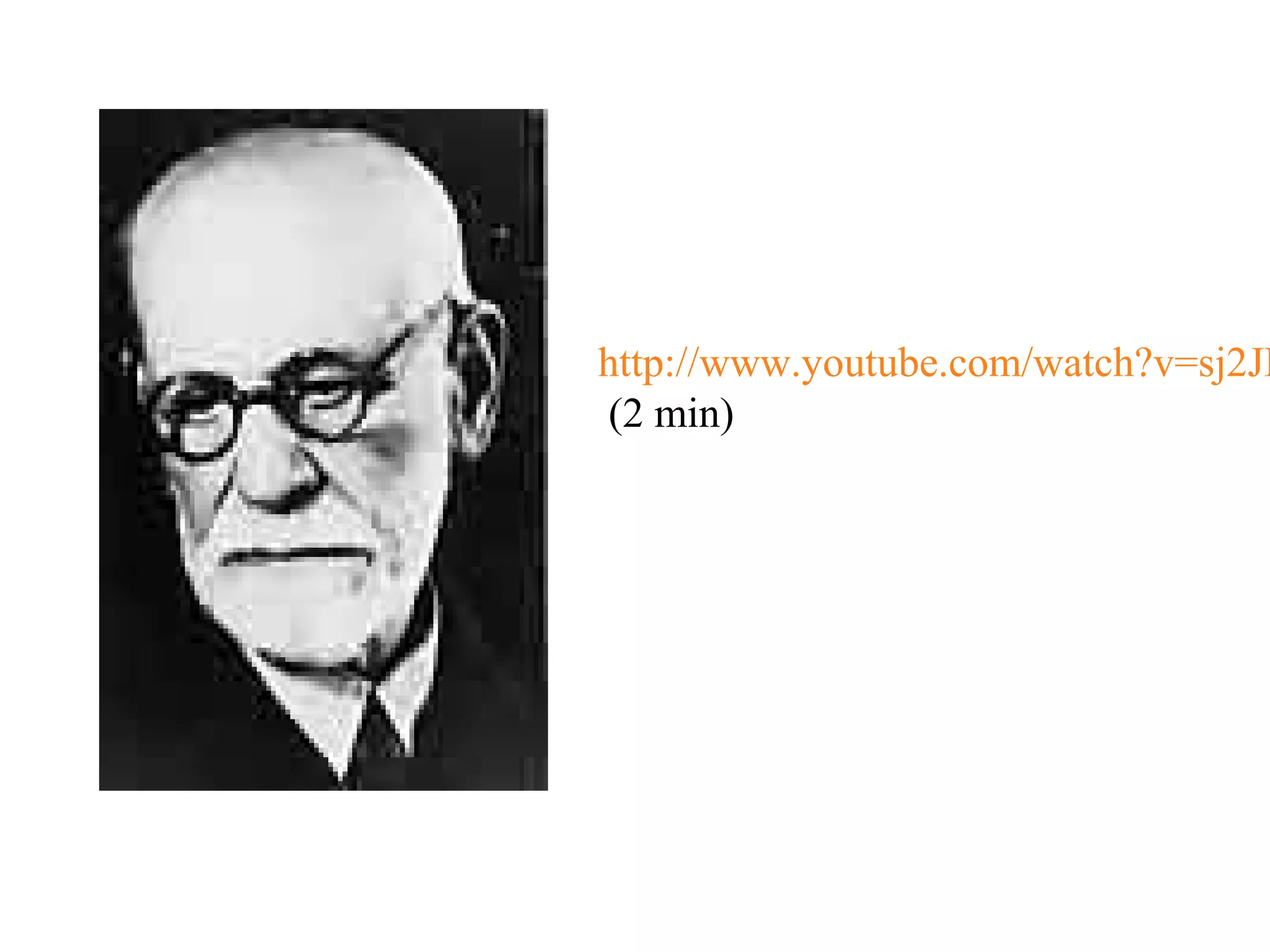
http://www.youtube.com/watch?v=sj2JFI4BsRQ&(2 min)
 Historical context and schools of 
psychodynamic thought 
 Freudian concepts the idea of psychic 
conflict; 
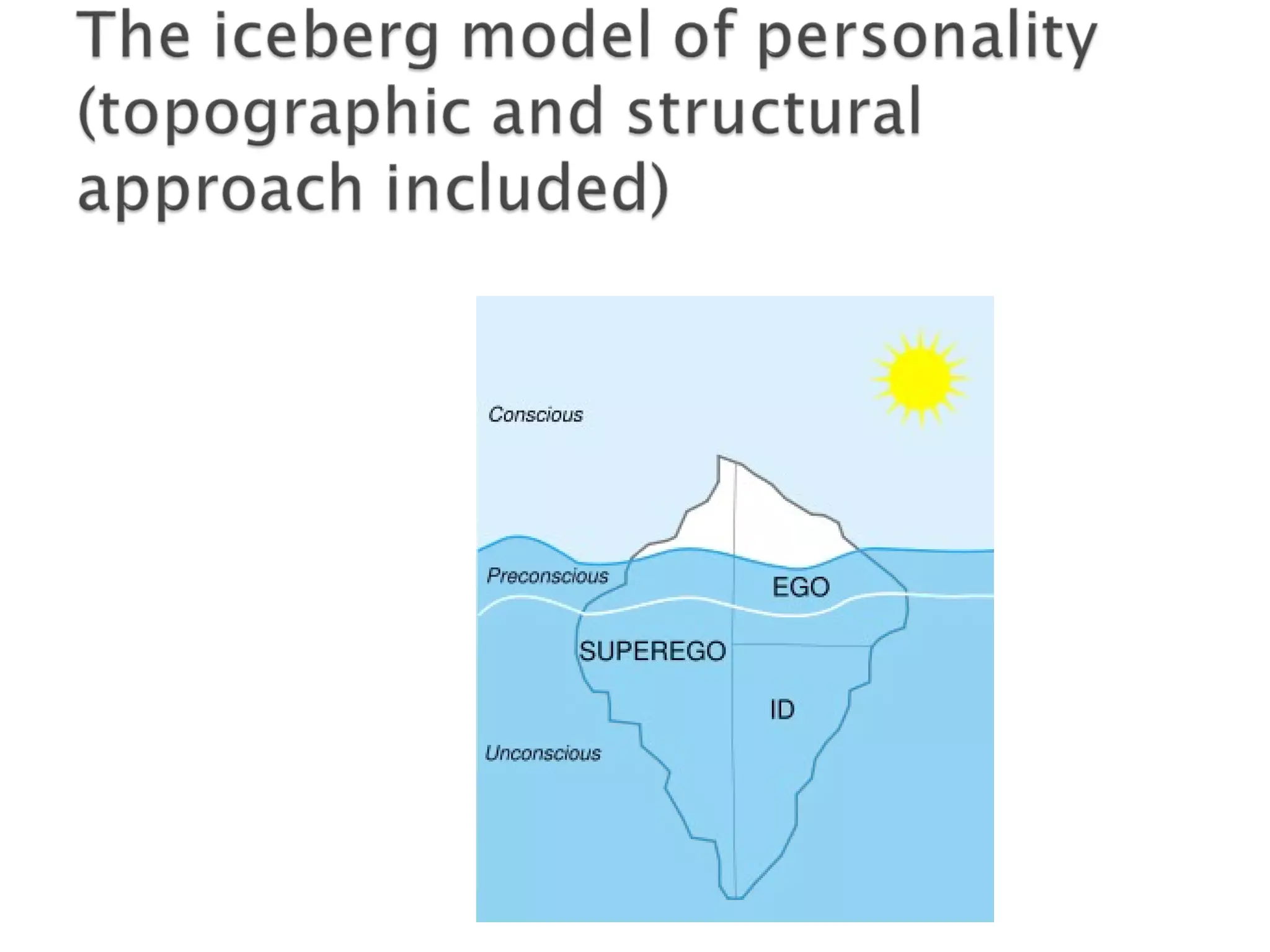
 Models of the mind: topographical model; 
structural model 
 Developmental model of personality 
 Psychopathology conceptualised and 
defensive mechanisms 
 Critical limitations
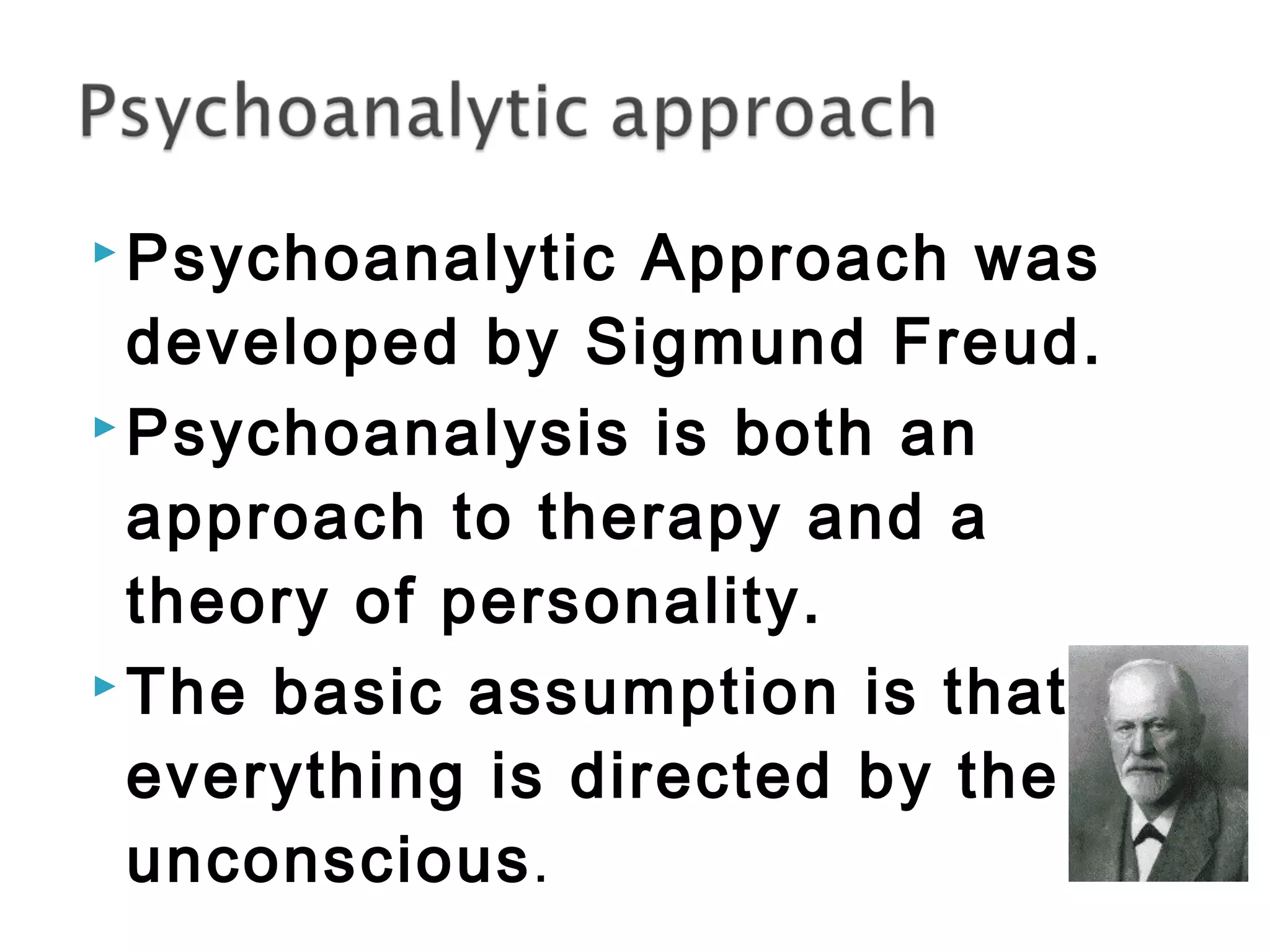
Psychoanalytic Approach was 
developed by Sigmund Freud. 
Psychoanalysis is both an 
approach to therapy and a 
theory of personality. 
The basic assumption is that 
everything is directed by the 
unconscious.
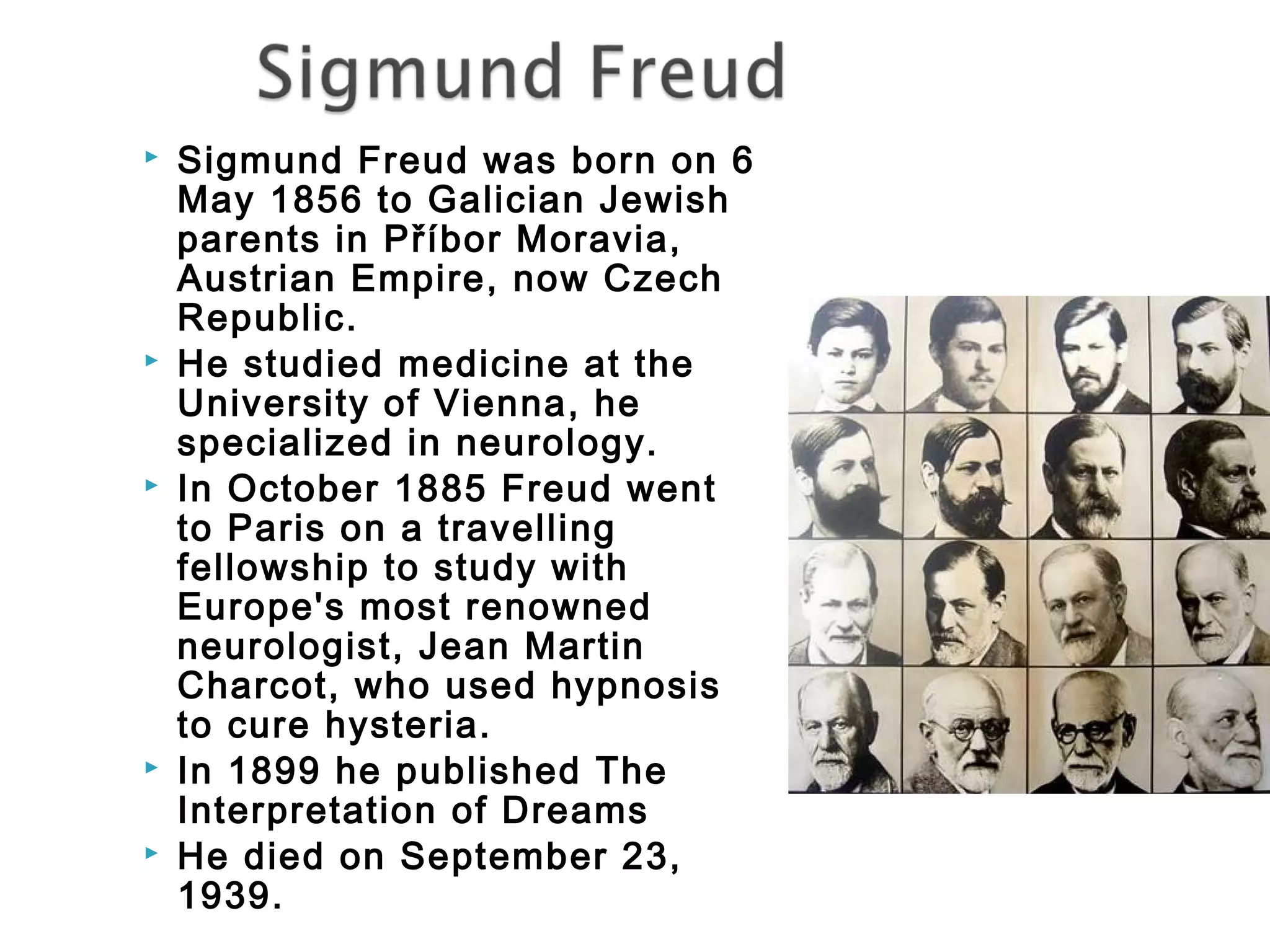
 Sigmund Freud was born on 6 
May 1856 to Galician Jewish 
parents in Příbor Moravia, 
Austrian Empire, now Czech 
Republic. 
 He studied medicine at the 
University of Vienna, he 
specialized in neurology. 
 In October 1885 Freud went 
to Paris on a travelling 
fellowship to study with 
Europe's most renowned 
neurologist, Jean Martin 
Charcot, who used hypnosis 
to cure hysteria. 
 In 1899 he published The 
Interpretation of Dreams 
 He died on September 23, 
1939.
1. Classical Freudian psychoanalysis:To make the 
unconscious conscious through “Insight” 
2. Analytic-psychotherapy: Jung:I ts aim is 
wholeness through the integration of 
unconscious forces and motivations underlying 
human behavior using archetypal psychology, 
employs the model of the unconscious mind as 
the source of healing and development in an 
individual. 
3. Ego Psychology (Anna Freud) - enhancing and 
maintaining ego function according to the 
demands of reality.
4. Object Relations: Klein: human beings 
are always shaped in relation to 
significant others 
5. Selfpsychology – Kohut:the self as 
perceived in relation to the 
establishment of boundaries and the 
differentiations of self from others.
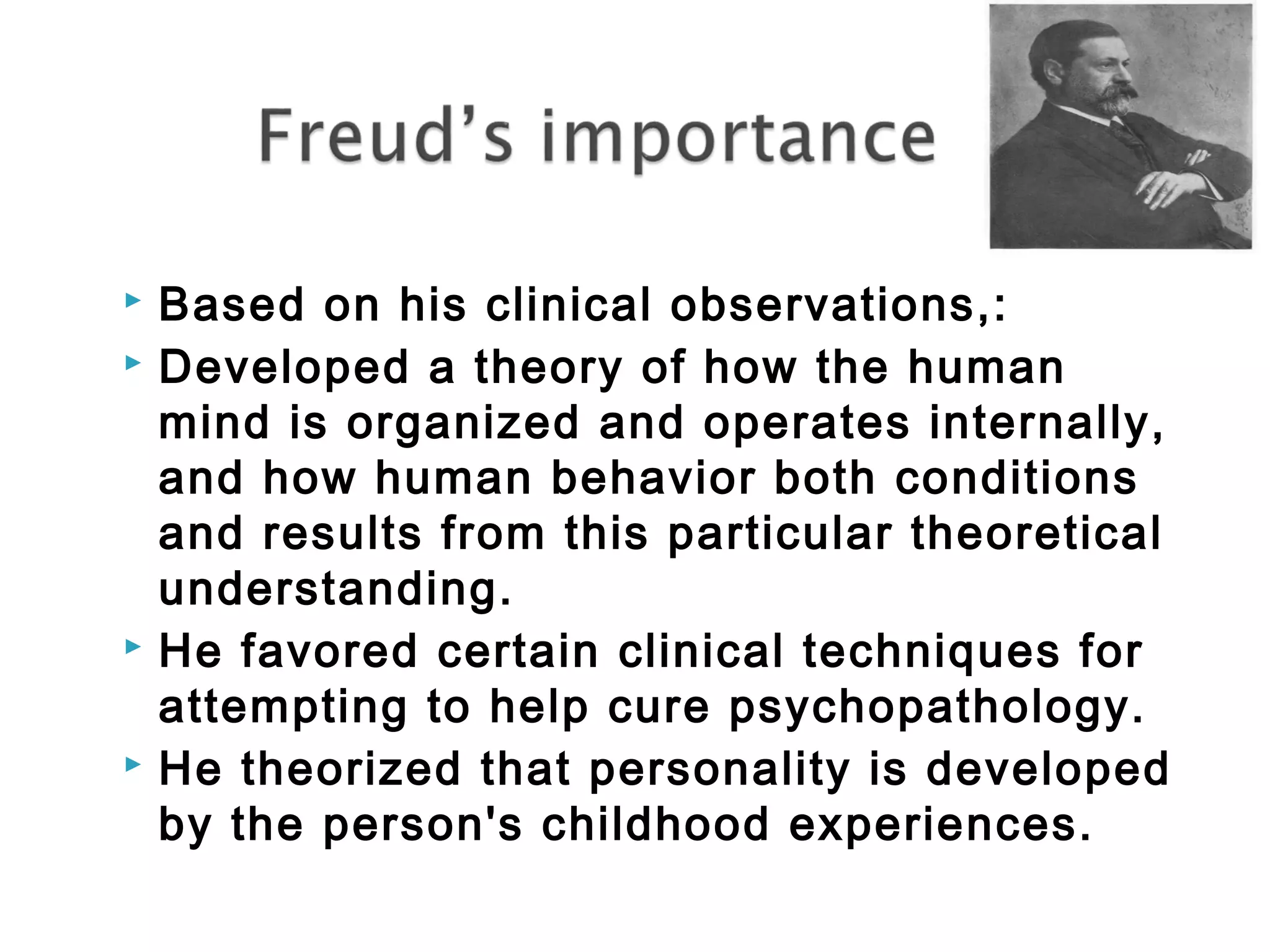
 Based on his clinical observations,: 
 Developed a theory of how the human 
mind is organized and operates internally, 
and how human behavior both conditions 
and results from this particular theoretical 
understanding. 
 He favored certain clinical techniques for 
attempting to help cure psychopathology. 
 He theorized that personality is developed 
by the person's childhood experiences.
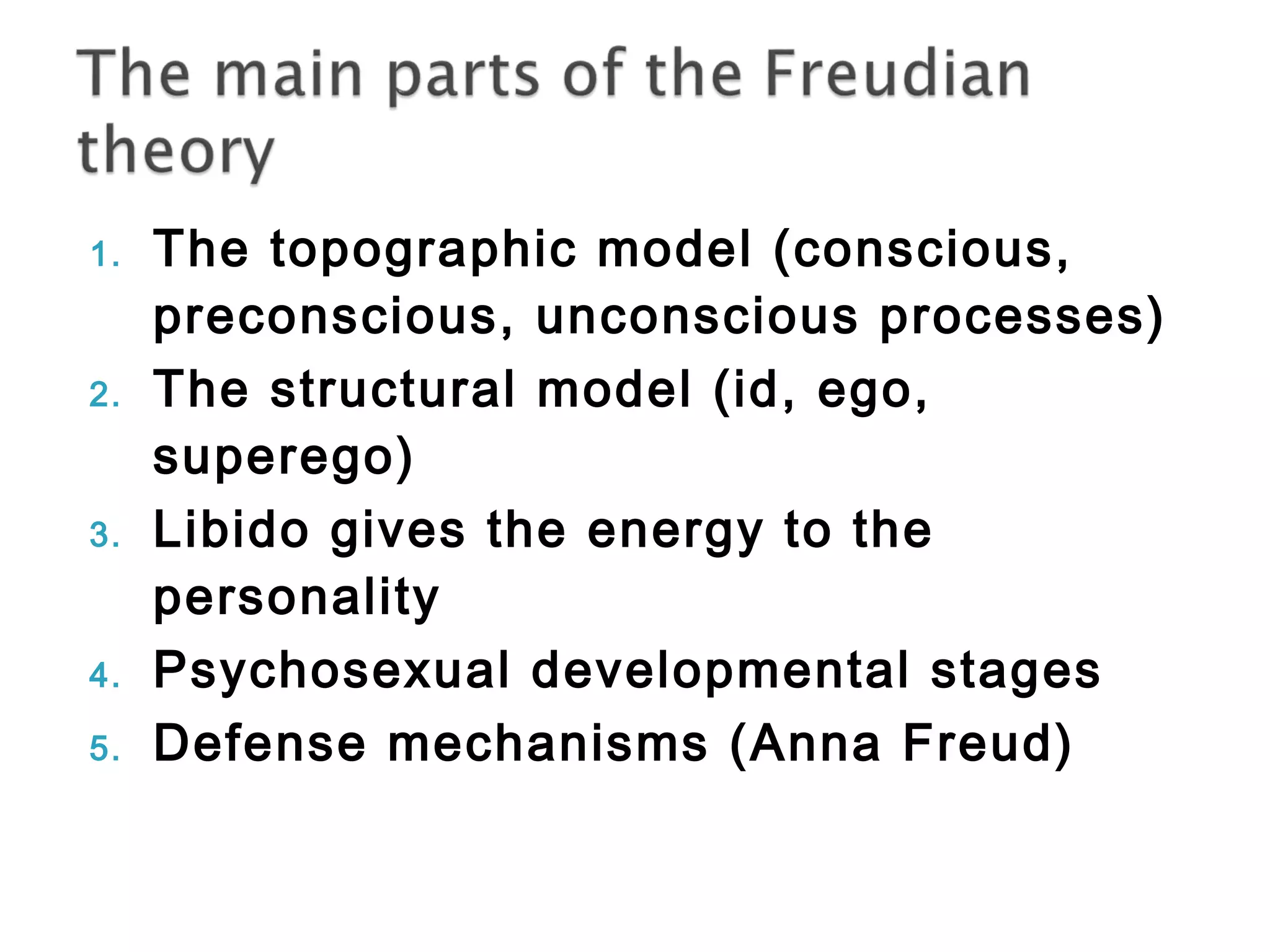
1. The topographic model (conscious, 
preconscious, unconscious processes) 
2. The structural model (id, ego, 
superego) 
3. Libido gives the energy to the 
personality 
4. Psychosexual developmental stages 
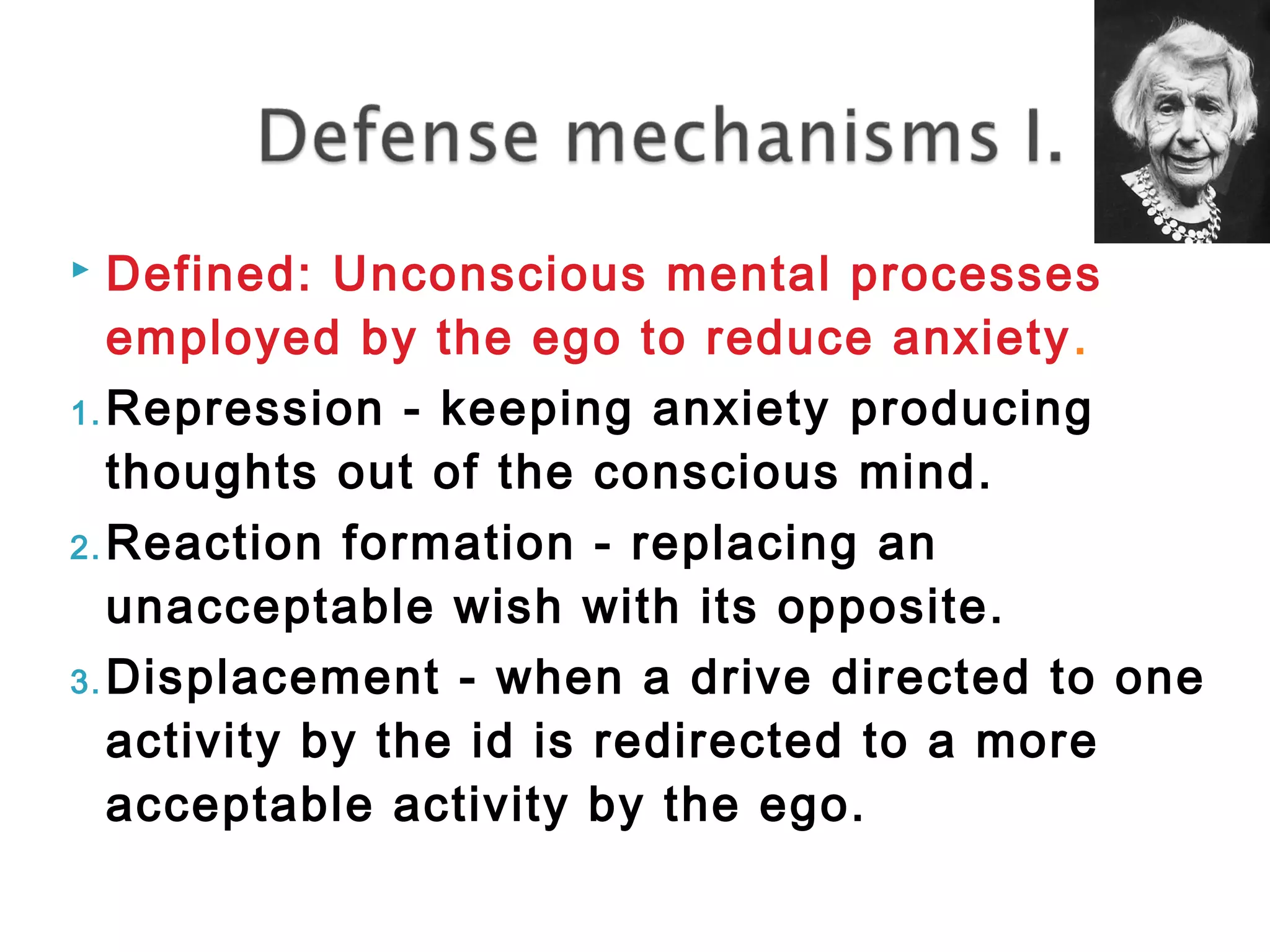
5. Defense mechanisms (Anna Freud)
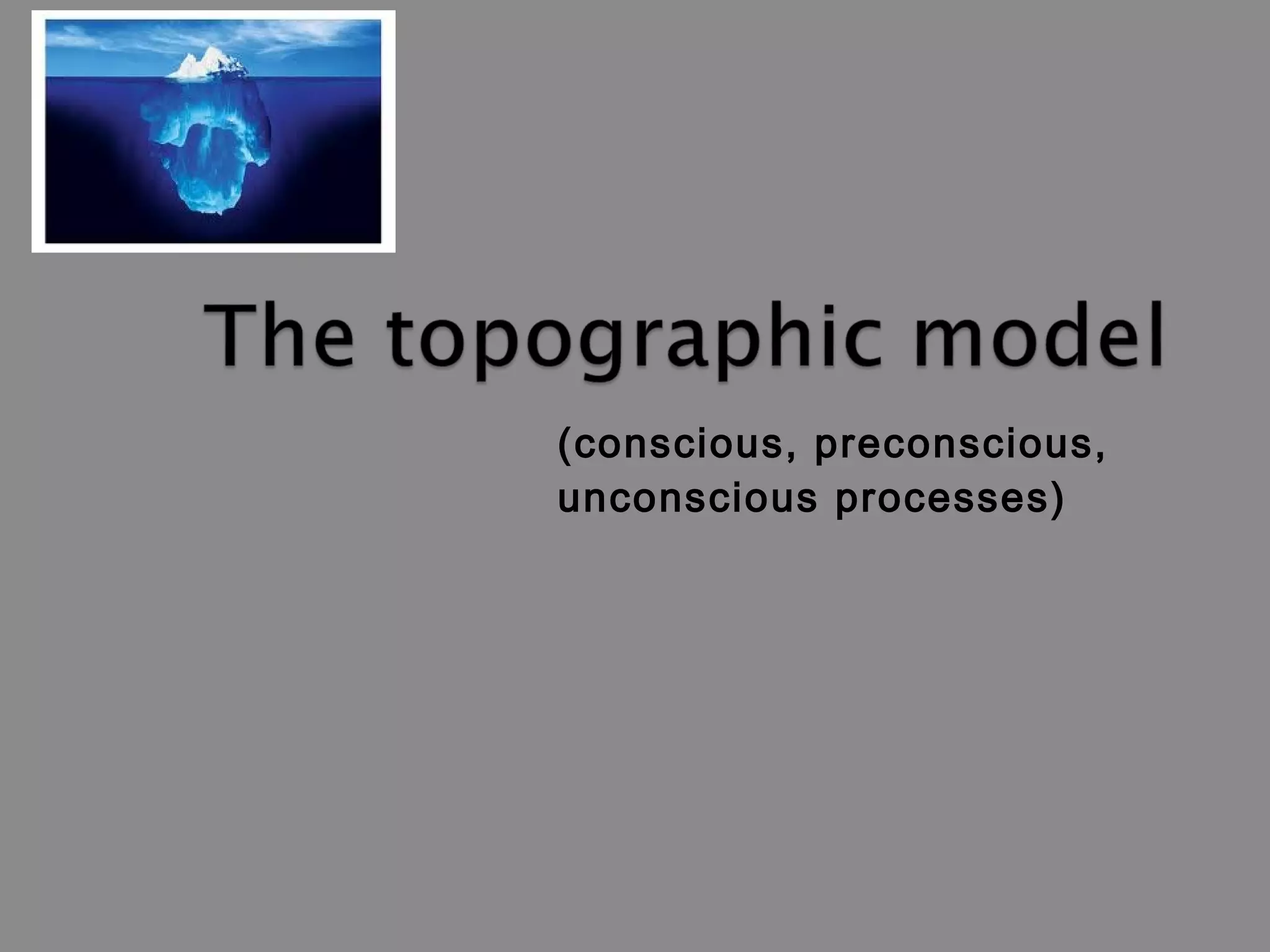
(conscious, preconscious, 
unconscious processes)
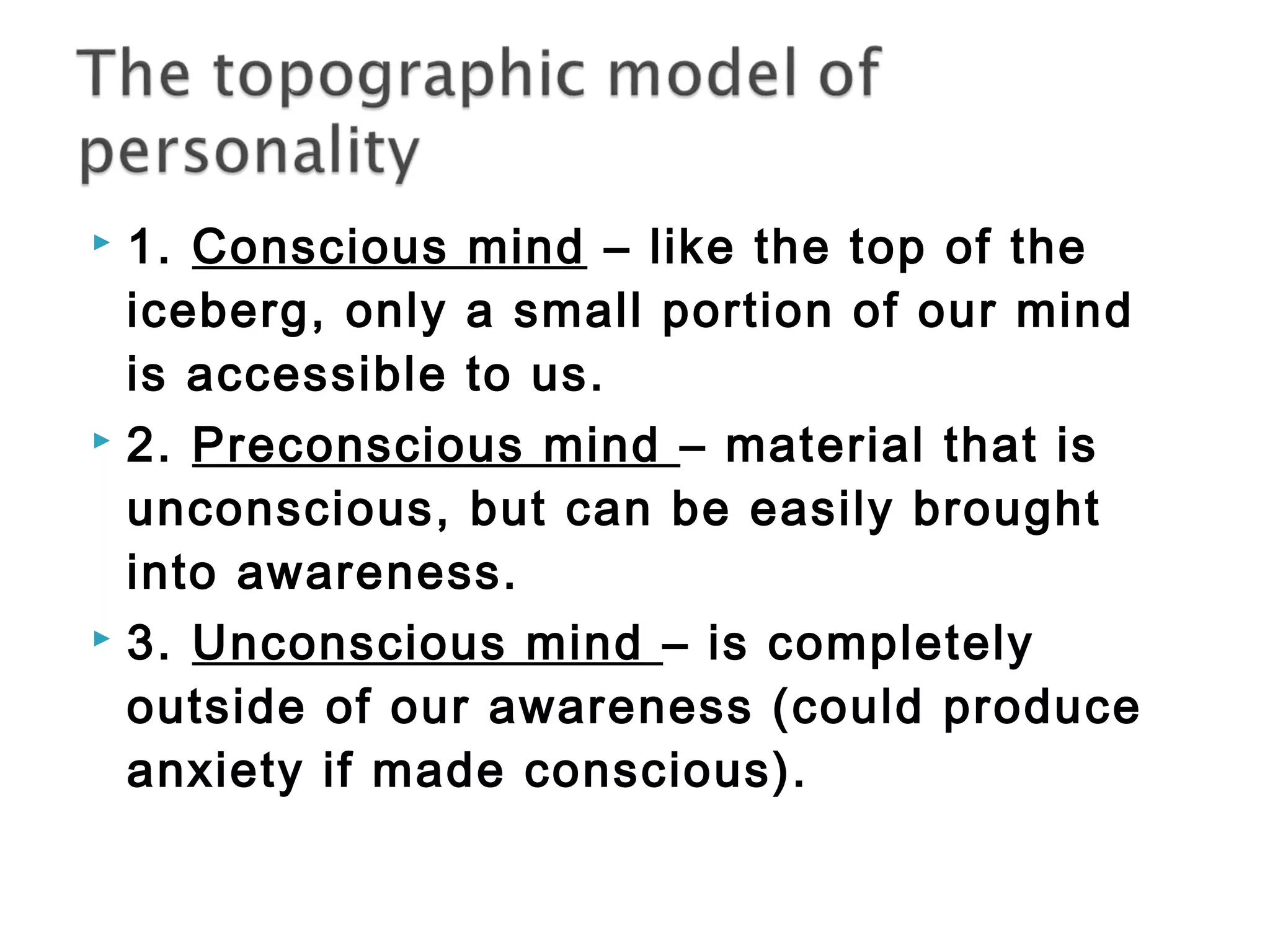
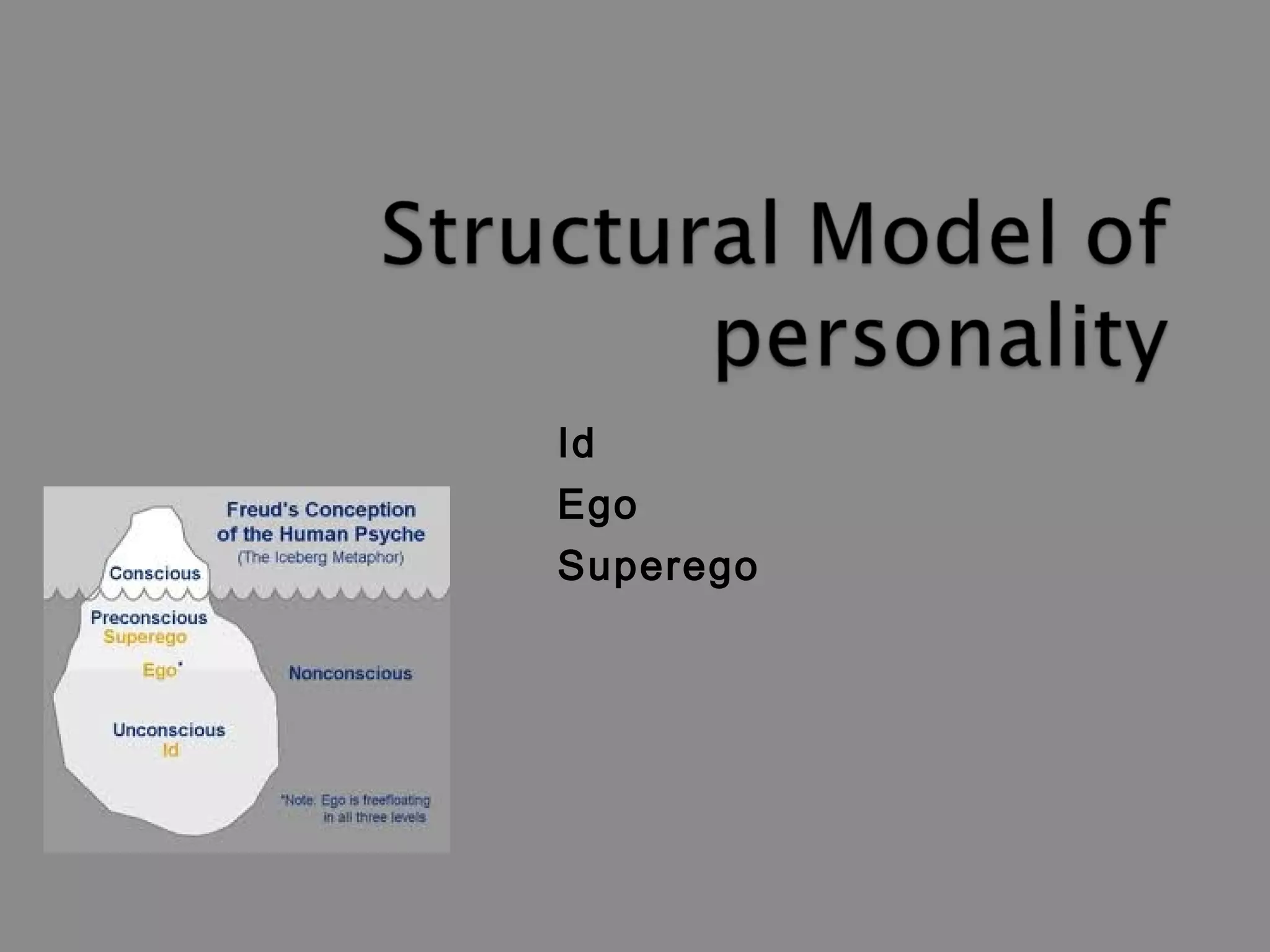
 1. Conscious mind – like the top of the 
iceberg, only a small portion of our mind 
is accessible to us. 
 2. Preconscious mind – material that is 
unconscious, but can be easily brought 
into awareness. 
 3. Unconscious mind – is completely 
outside of our awareness (could produce 
anxiety if made conscious).
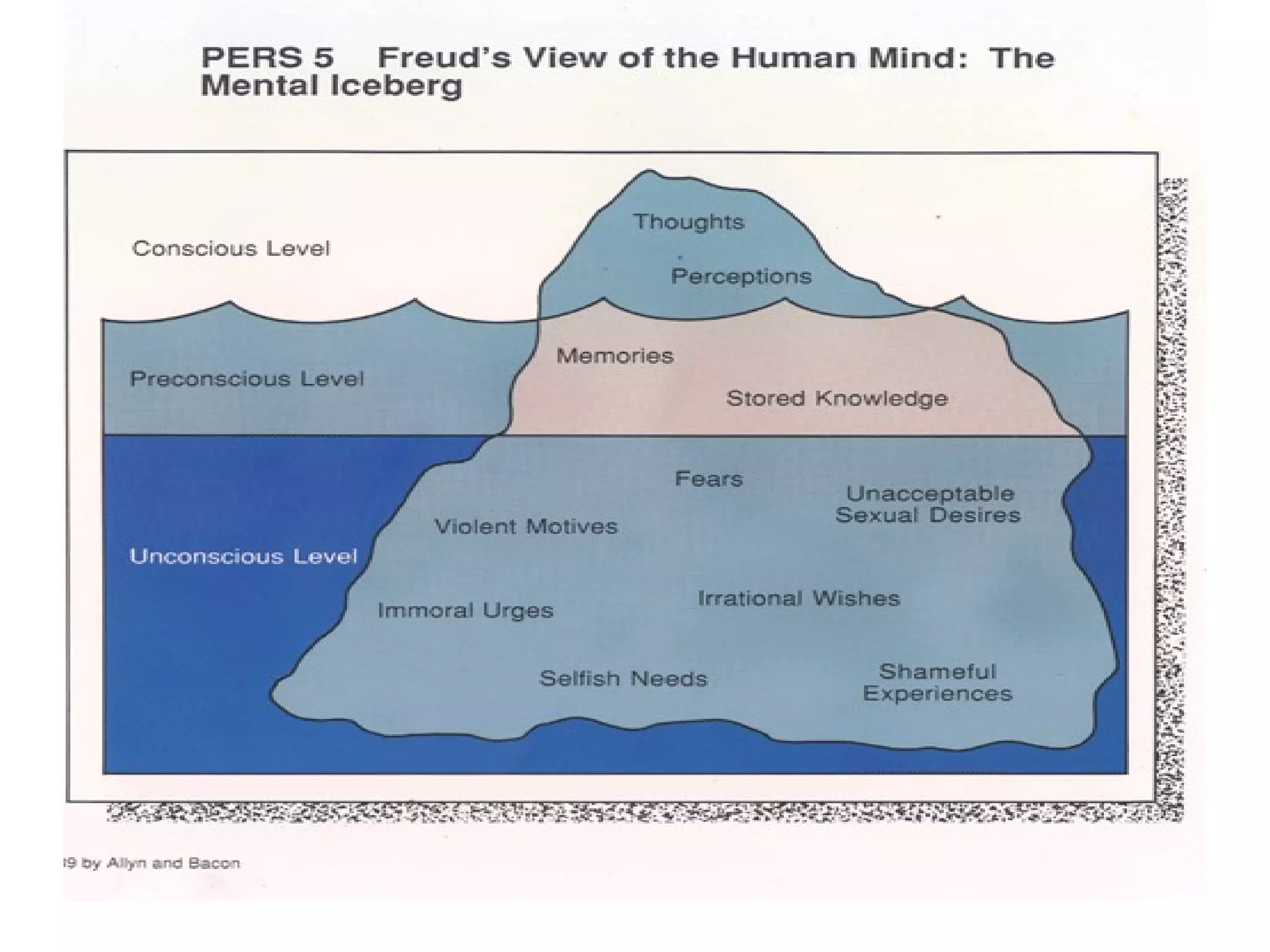
Top of the iceberg: 
Conscious mind (smallest 
part – say, 10%). We can 
access this, we are aware 
of this part of “us.” We 
understand it logically.
Middle of iceberg: Preconscious 
(medium size, about 10-15%). 
Ordinary memory. You don’t keep a lot 
of information in your conscious mind 
all the time – why? 
 If you need to know something (where 
you parked your car, your sister’s 
birthday, your 7th grade Stardust 
Dance, etc.) you can bring it “up”) to 
your Conscious mind.
Bottom of iceberg: Unconscious 
(huge – dwarfs the other two, 
75-80% of our mind). 
“Underwater” 
The unconscious: Plays a very 
large role in how we function as 
human beings. Most of the work 
among the Id, Ego, and 
Superego happens here.
Id 
Ego 
Superego
THE UNCONSCIOUS MIND: 
 A “dumping ground” for all of our 
desires, anxieties, urges, especially 
those which are painful – why? 
 Nothing in the unconscious goes away. 
Even if we aren’t aware of it, what is in 
the unconscious influences us every day 
in every way. 
 Can’t directly or easily access the 
unconscious with conscious mind. 
“Speaks” a different language (ex. 
Dreams).
Freud’s theory of Identity is based on a 
CONFLICT 
MODEL 
Important! Radical notion! 
(Keep in mind that with Freud, identity becomes 
confusing – hard to use pronouns to describe 
ourselves. Who am “I”? Is “I” really “We”?)
 Conflict Model: The self is NOT UNIFIED; it 
is not a coherent, singular entity. Not 
entirely rational, not entirely in control of 
yourself . 
 There are competing elements within 
ourselves. 
 No way to resolve competing elements – 
only way to stay healthy is to not let any 
one of them “get the upper hand” or 
sickness (i.e. neurosis or psychosis) can 
occur.
 1. Id – unconscious impulses that 
want to be gratified, without regard 
to potential punishment. Is source of 
psychic energy (libido). 
 2. Ego (primarily conscious) – tries 
to satisfy id impulses while 
minimizing punishment, guilt. 
 3. Superego – the moral center of 
our personality (somewhat 
conscious).
Freud’s conflict model is based on the idea 
of the Id, the Ego, and the Superego. 
These are the components of the self. 
First: 
 THE ID: The oldest part of our mind – 
most primal, most fundamental, most 
primitive. 
 The Id precedes culture! And is universal.
Home of instinctual Drives 
“I want it and I want it NOW” 
Completely unconscious 
Present at birth 
Operates on the Pleasure 
Principle and 
Primary Process Thinking
 Pleasure Principle: constant drive to 
reduce tension thru expression of 
instinctual urges. 
 The source for libido (psychic energy, 
not just sexual in meaning like today’s 
connotation) 
 Psychic energy fuels our thoughts, 
memories, sexual desires, perceptions, 
etc. 
 Primary Process Thinking: Not cause-effect; 
illogical; fantasy; only concern 
is immediate gratification (drive
“Id” does NOT stand for 
“Identity.” 
Rather, it means “It” 
It is irrational, emotional, 
demanding…and 
STRONG
Created by the ID to help it 
interface with external reality 
Mediates between the ID, 
Superego, and reality 
Partly conscious 
Uses Secondary Process Thinking: 
◦ Logical, rational
 The Ego employs “ego defense 
mechanisms” 
 They serve to protect an individual 
from unpleasant thoughts or 
emotions 
◦ Keep unconscious conflicts 
unconscious 
 Defense Mechanisms are primarily 
unconscious
Result from interactions between 
the ID, Ego, and Superego 
Thus, they’re compromises: 
◦Attempts to express an impulse (to 
satisfy the ID) in a socially 
acceptable or disguised way (so 
that the Superego can deal with it)
 Less mature defenses protect the 
person from anxiety and negative 
feelings, but at price 
 Some defense mechanisms explain 
aspects of psychopathology: 
◦ Ex. Identification with aggressor: 
can explain tendency of some 
abused kids to grow into abusers
Conflict arises when the ID’s drives 
threaten to overwhelm the controls 
of the Ego and Superego 
Ego pushes ID impulses deeper into 
the unconscious via repression 
Material pushed into unconscious 
does not sit quietly- causes 
symptoms
Internalized morals/values-sense 
of right and wrong 
Suppresses instinctual drives of 
ID (thru guilt and shame) and 
serves as the moral conscience
 Largely unconscious, but has 
conscious component 
 Develops with socialization, and 
thru identification with same-sex 
parent (via introjection) at the 
resolution of the Oedipal Conflict 
 Introjection: absorbing rules for 
behavior from role models
Conscience: Dictates what is 
proscribed (should not be done/ 
prohibited); results in guilt 
Ego-Ideal: Dictates what is 
prescribed (should be done); 
results in shame
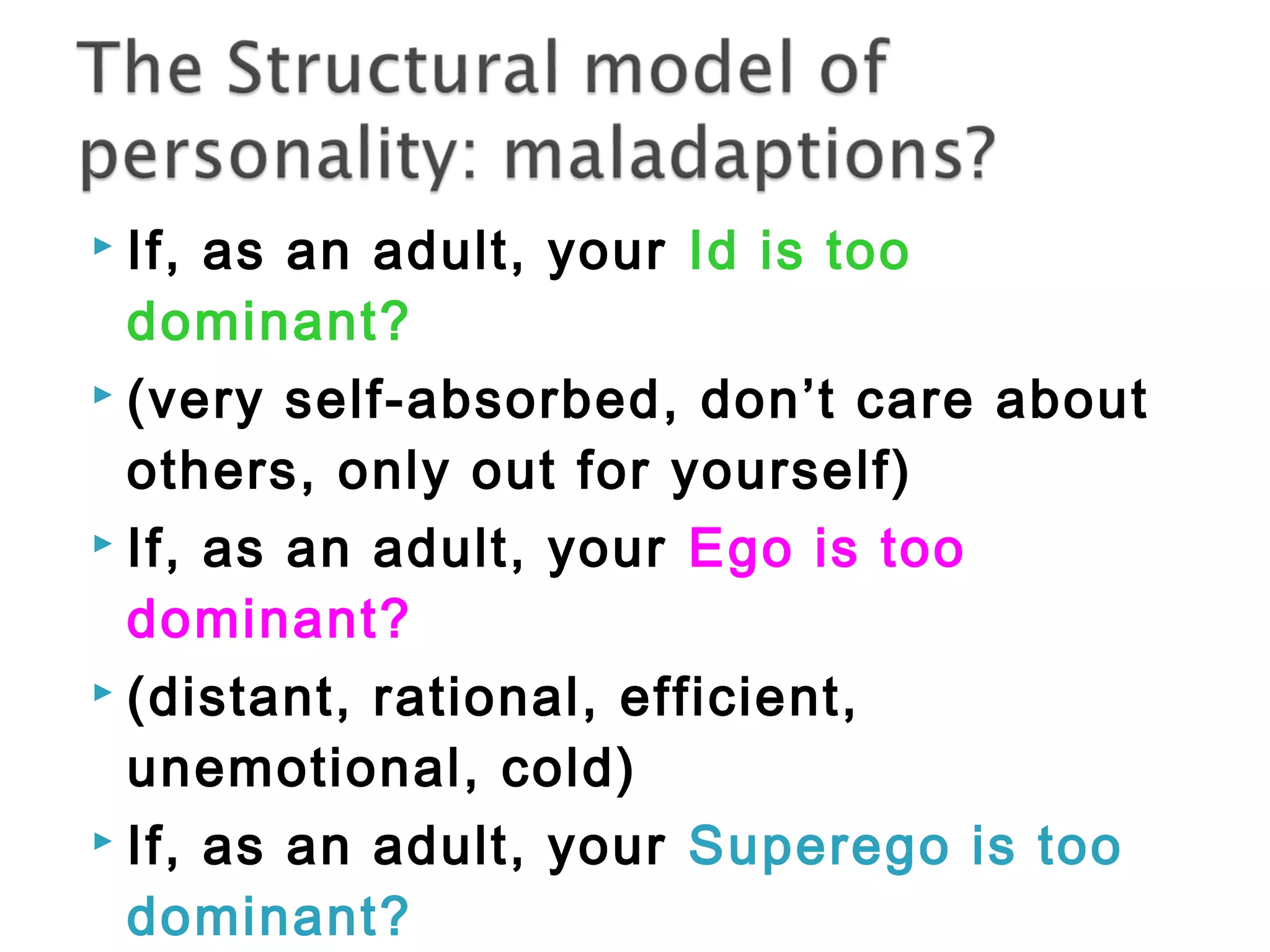
 If, as an adult, your Id is too 
dominant? 
 (very self-absorbed, don’t care about 
others, only out for yourself) 
 If, as an adult, your Ego is too 
dominant? 
 (distant, rational, efficient, 
unemotional, cold) 
 If, as an adult, your Superego is too 
dominant?
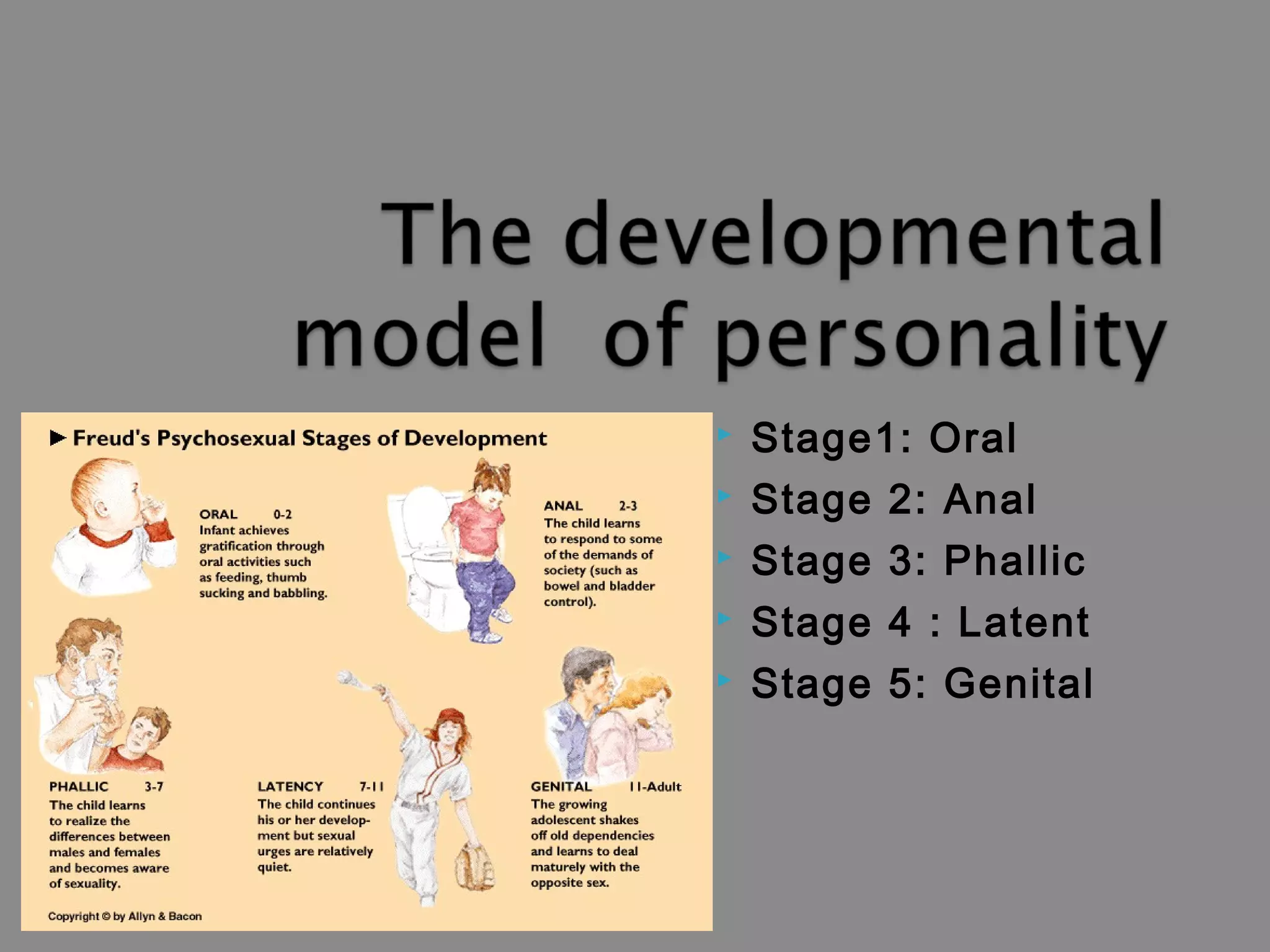
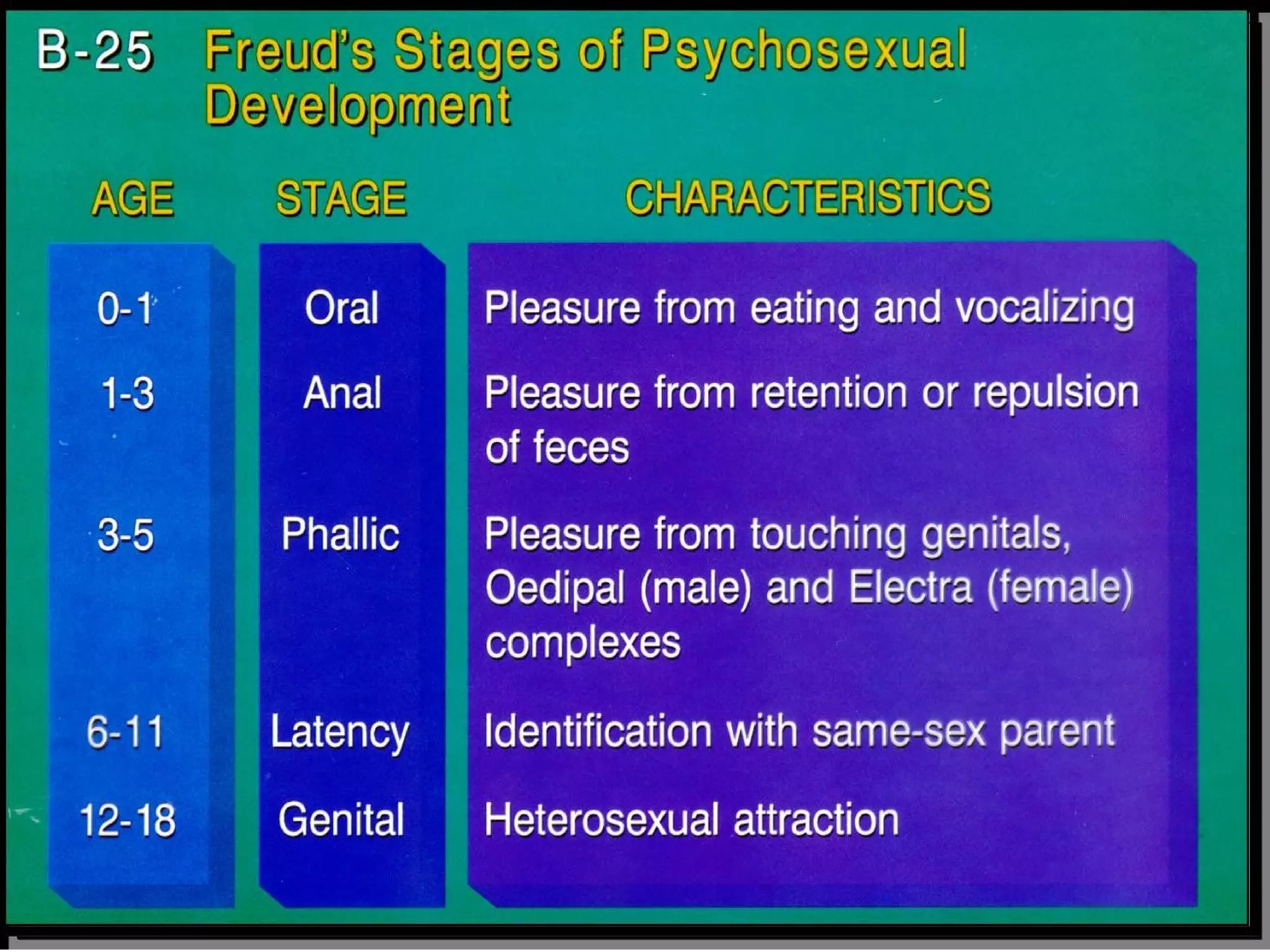
 Stage1: Oral 
 Stage 2: Anal 
 Stage 3: Phallic 
 Stage 4 : Latent 
 Stage 5: Genital
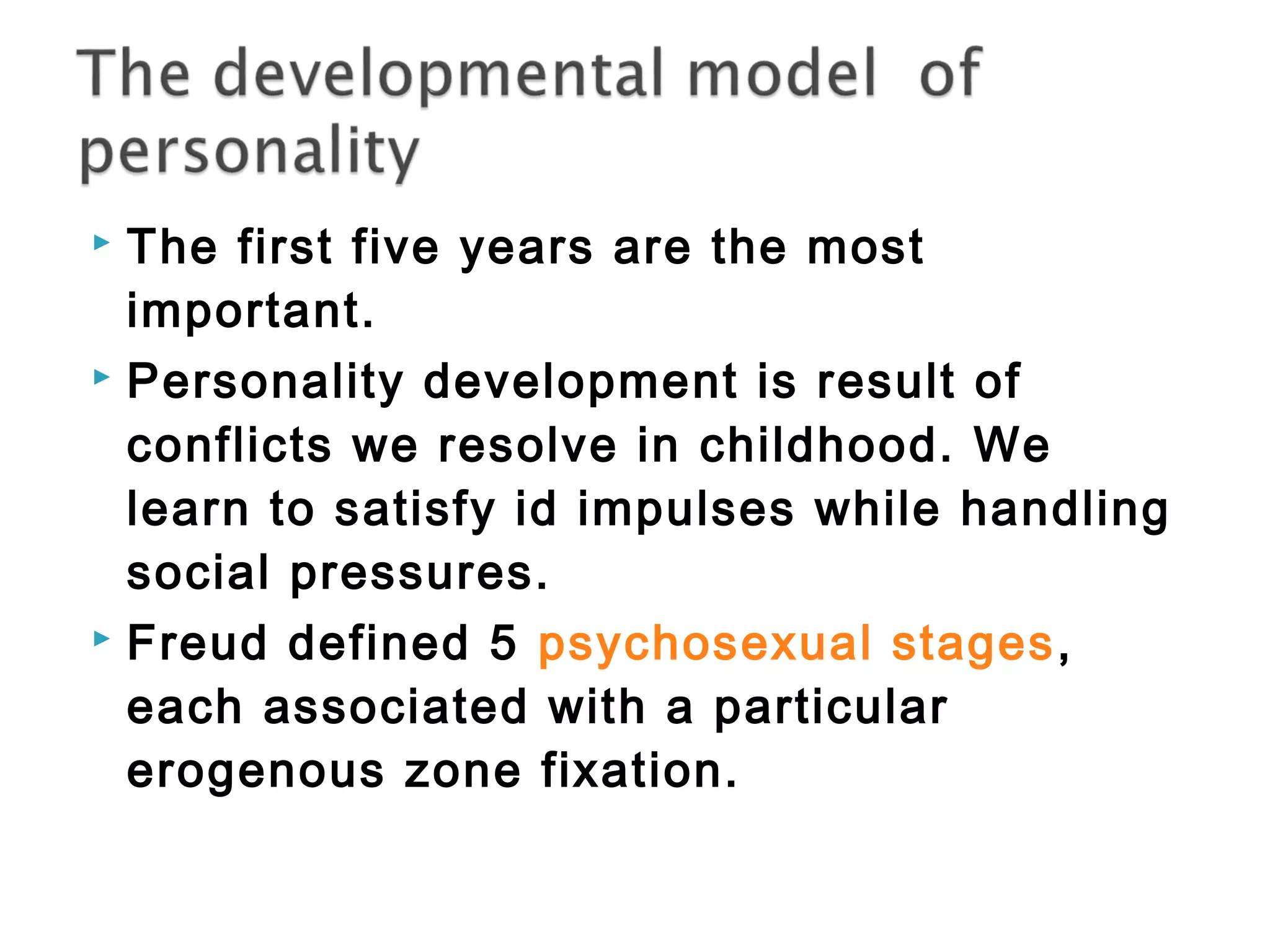
 The first five years are the most 
important. 
 Personality development is result of 
conflicts we resolve in childhood. We 
learn to satisfy id impulses while handling 
social pressures. 
 Freud defined 5 psychosexual stages, 
each associated with a particular 
erogenous zone fixation.
 If a conflict is not resolved during a 
psychosexual stage, the fixation 
persists. 
 This fixation can be manifested either in 
overexpressing or under-expressing 
specific activities. 
 This is often regarded as neurosis by 
psychodynamic theorists and clinicians.
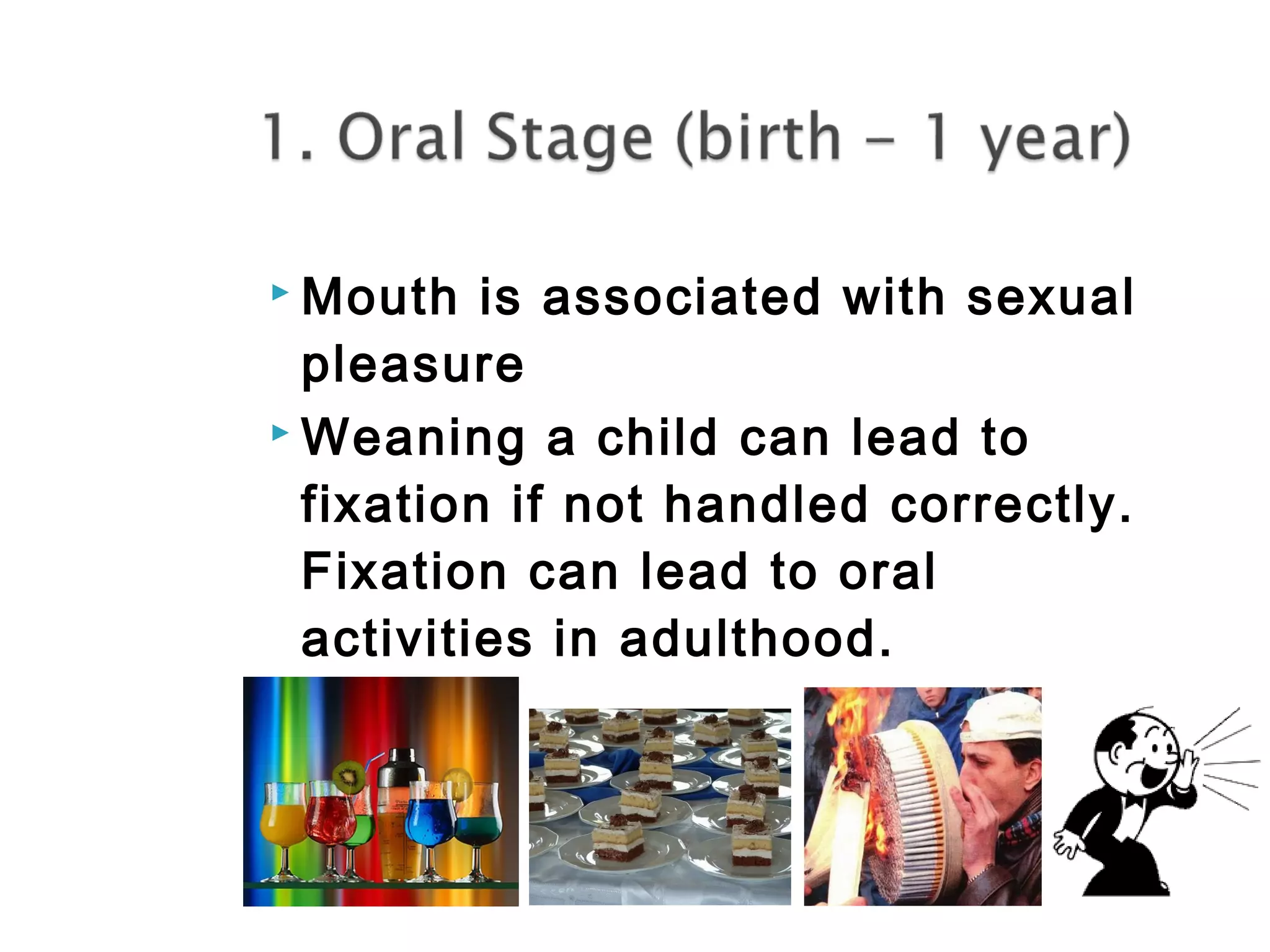
Mouth is associated with sexual 
pleasure 
Weaning a child can lead to 
fixation if not handled correctly. 
Fixation can lead to oral 
activities in adulthood.
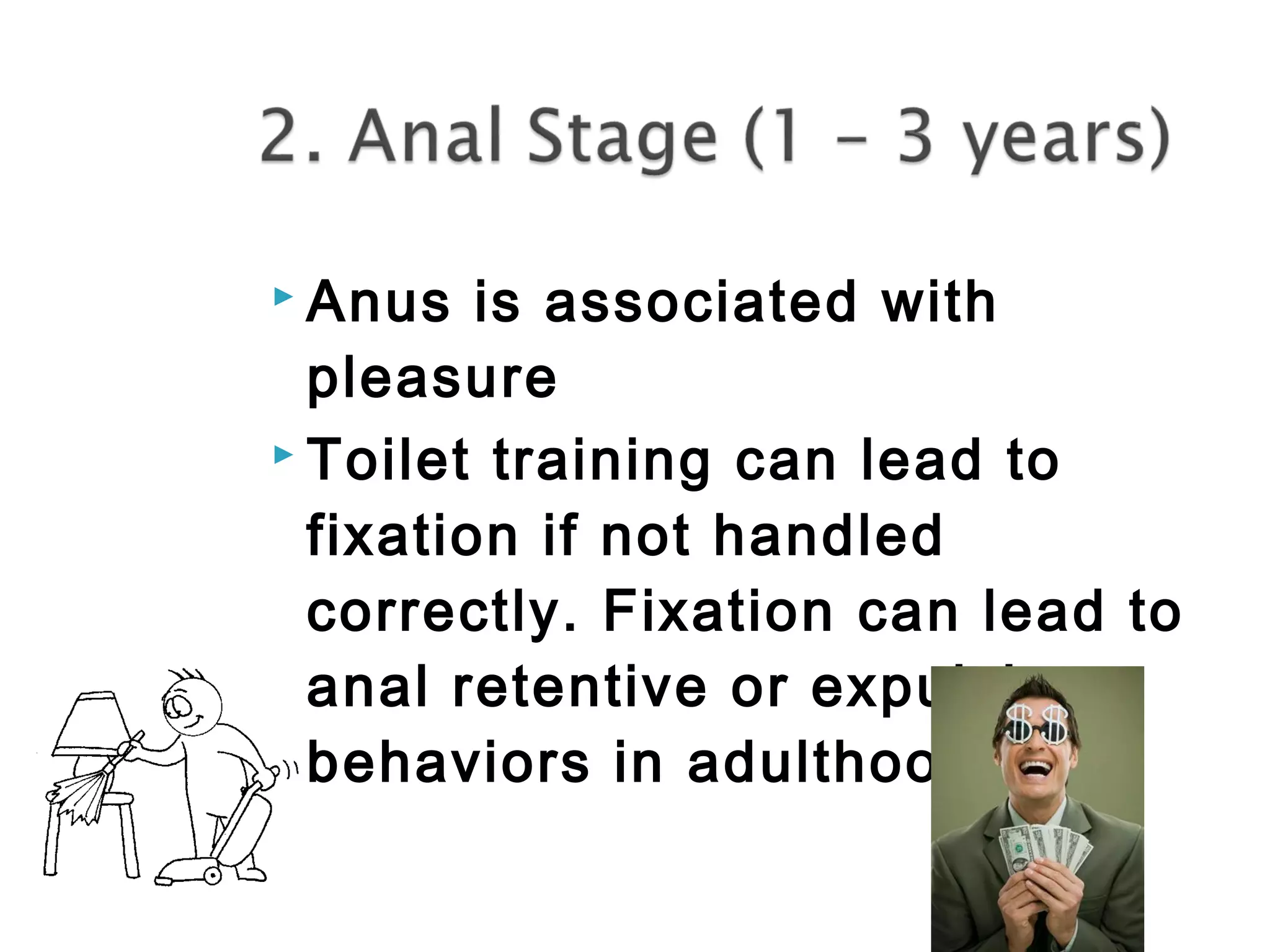
 Anus is associated with 
pleasure 
 Toilet training can lead to 
fixation if not handled 
correctly. Fixation can lead to 
anal retentive or expulsive 
behaviors in adulthood.
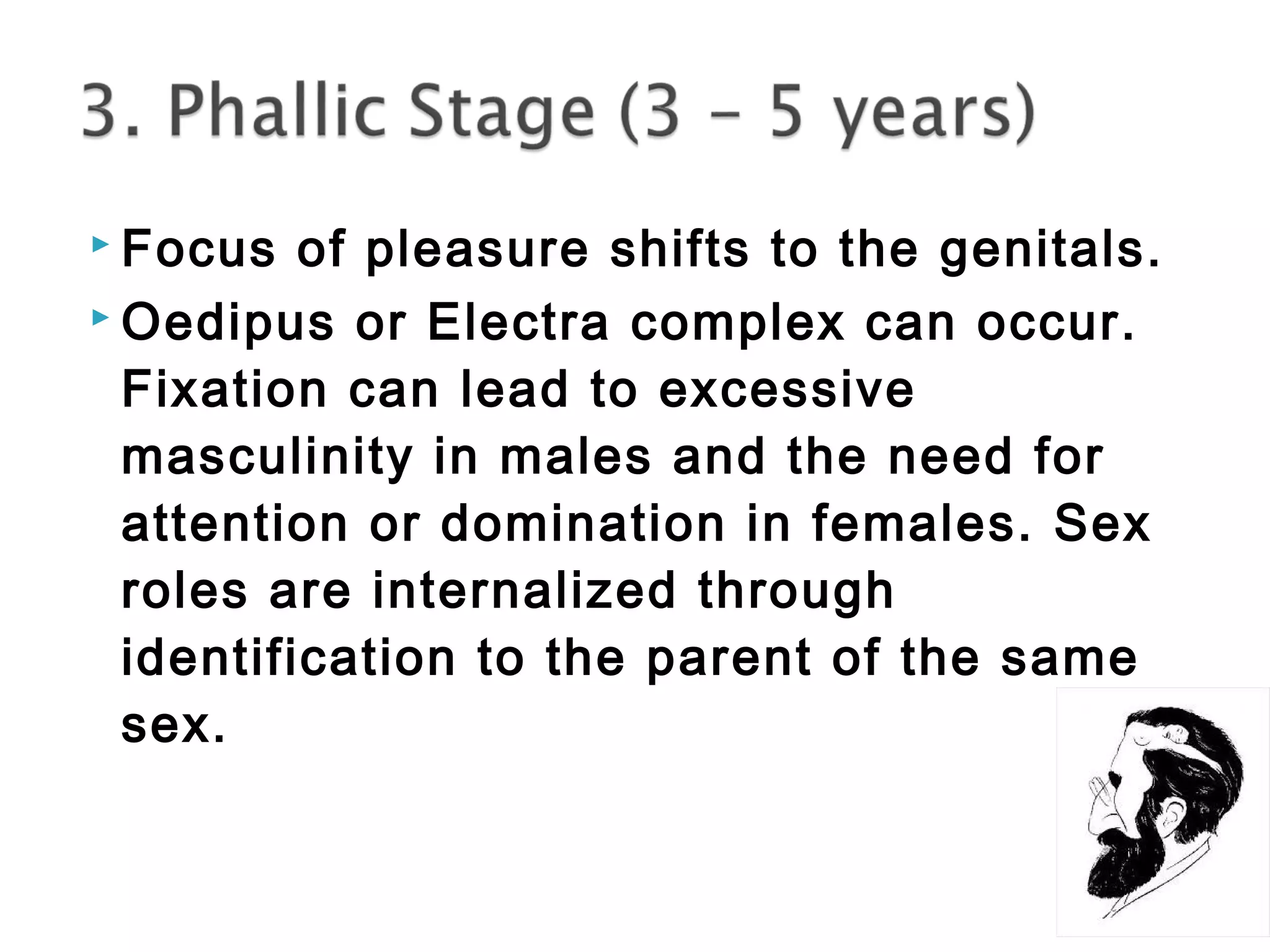
 Focus of pleasure shifts to the genitals. 
Oedipus or Electra complex can occur. 
Fixation can lead to excessive 
masculinity in males and the need for 
attention or domination in females. Sex 
roles are internalized through 
identification to the parent of the same 
sex.
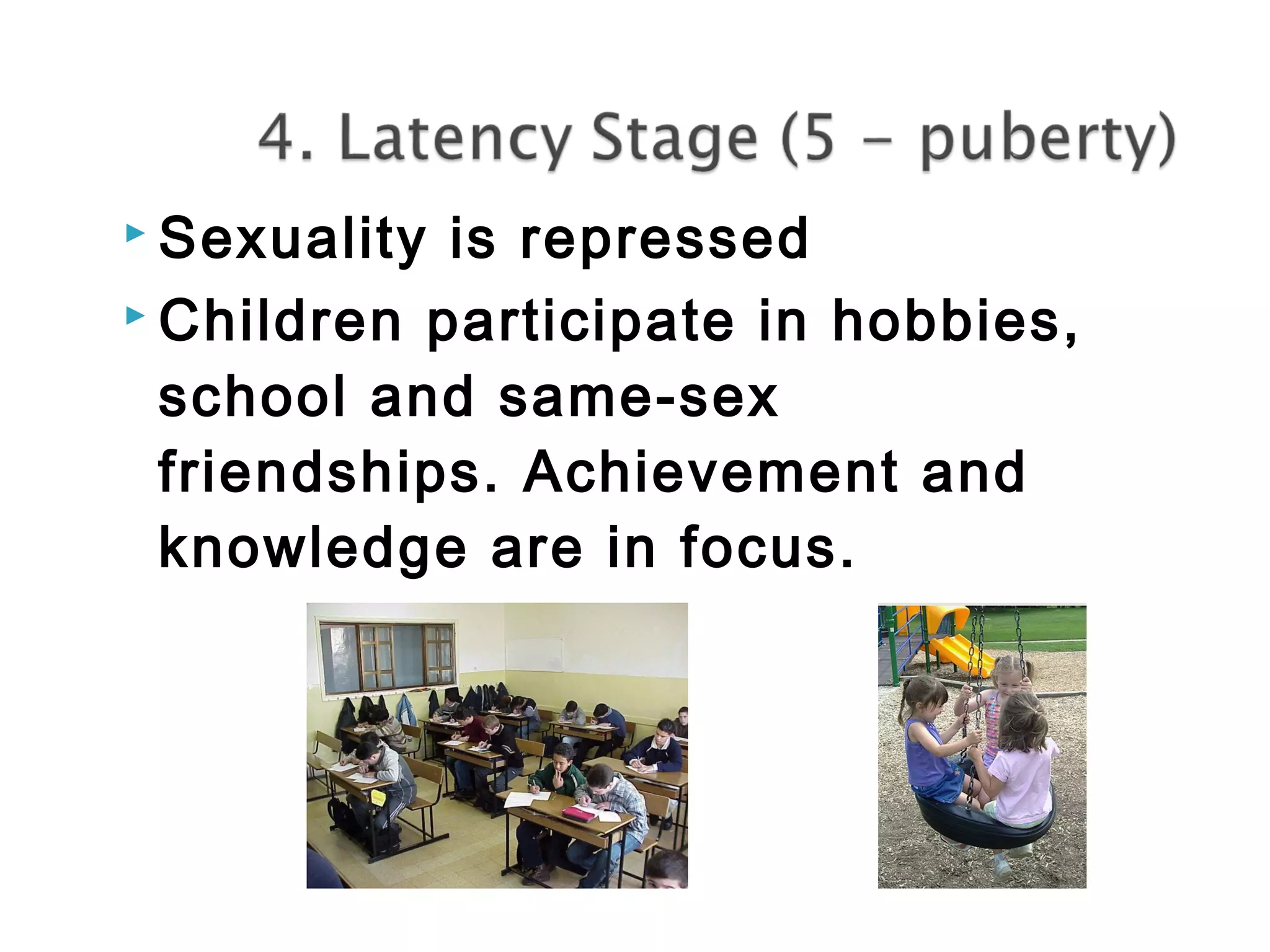
 Sexuality is repressed 
 Children participate in hobbies, 
school and same-sex 
friendships. Achievement and 
knowledge are in focus.
 Sexual feelings re-emerge and are 
oriented toward others. 
 Healthy adults find pleasure in love 
and work, fixated adults have their 
energy tied up in earlier stages.
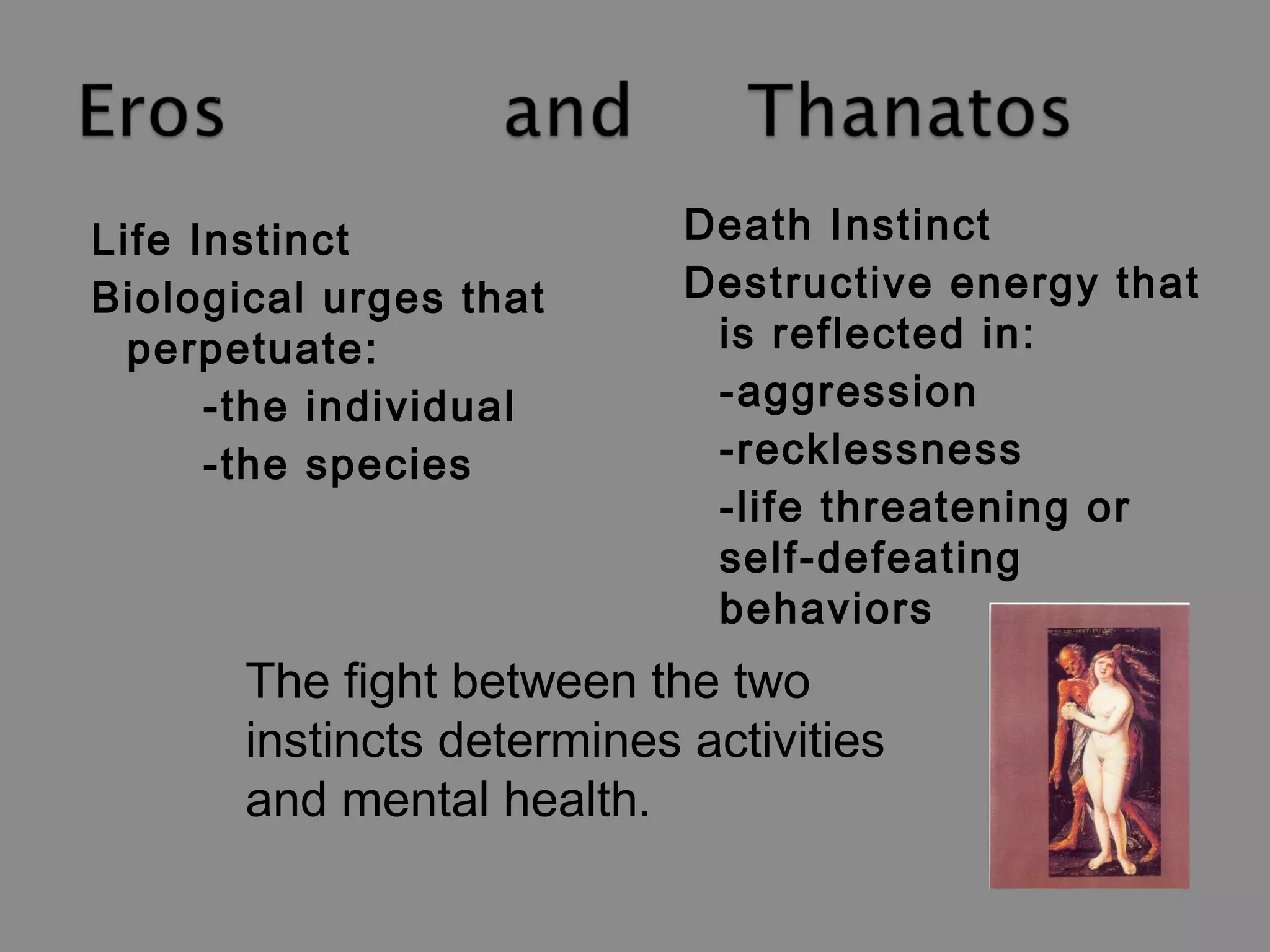
Life Instinct 
Biological urges that 
perpetuate: 
-the individual 
-the species 
Death Instinct 
Destructive energy that 
is reflected in: 
-aggression 
-recklessness 
-life threatening or 
self-defeating 
behaviors 
The fight between the two 
instincts determines activities 
and mental health.
 Id, Ego, & Superego continually in 
conflict 
 Conflict generates anxiety 
 Psychopathology results from conflicts 
among these unconscious forces. 
Fixation 
 – Too little or too much gratification 
leads to 
 fixation at that stage 
 – When stressed, individual regresses 
to earlier stage
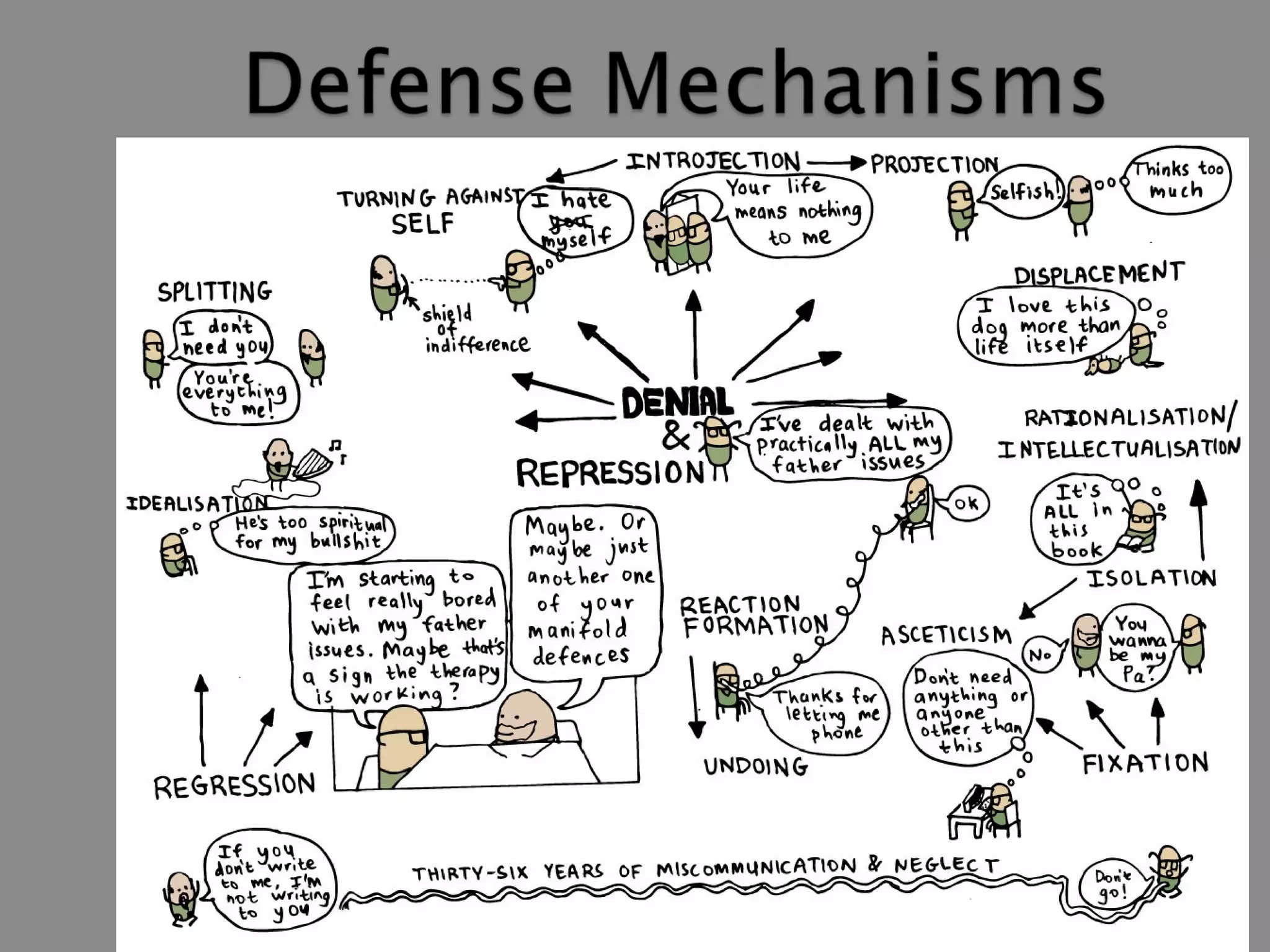
 Defined: Unconscious mental processes 
employed by the ego to reduce anxiety. 
1.Repression - keeping anxiety producing 
thoughts out of the conscious mind. 
2.Reaction formation - replacing an 
unacceptable wish with its opposite. 
3.Displacement - when a drive directed to one 
activity by the id is redirected to a more 
acceptable activity by the ego.
4.Sublimation - displacement to 
activities that are valued by society 
5.Projection - reducing anxiety by 
attributing unacceptable impulses to 
someone else 
6.Rationalization - reasoning away 
anxiety-producing thoughts 
7.Regression - retreating to a mode of 
behavior characteristic of an earlier 
stage of development
 “Talking cure” 
 Free associations 
 Interpretation of dreams 
 Patients attend five x fifty minute sessions 
weekly, 
 usually for several years, 
 working with their psychoanalyst to examine 
and to explore unconscious conflicts of feeling, 
emotion and phantasy that are at the root of 
their symptoms and the problems that are 
troubling them.
 Freud had no scientific data to support 
his theories. 
 Freud’s theories (unconscious, libido, 
etc.) cannot be observed. 
 Theory explains behavior after the fact. 
Observations are not representative of 
population.
 He argued that childhood experiences 
are important in personality 
development. 
 Information outside of awareness 
does influence us. 
 Defense mechanisms provide good 
descriptions of some of our behaviors.
 Not particularly “psychological” 
 Interesting and popular 
 Not much evidence of their efficacy 
 Not listed among empirically 
supported treatments 
 Exception is Interpersonal 
Psychotherapy
 Traditional psychoanalysis – economically not 
feasible 
 Lack of emphasis upon behavior change – 
frustrating to many consumers 
 Brief forms of psychodynamic therapy are the 
future 
 Increasing pressure to empirically test 
psychodynamic therapies 
 http://www.youtube.com/watch?v=WrOpqg8ipQA&list=a discussion video on psychodynamic therapy 
session
 Karen Horney’s focus on security  
Object relations theories (Melanie 
Klein, D. W. Winnicott) 
 Alfred Adler’s individual psychology 
 Erik Erikson’s psychosocial 
development 
 Carl G. Jung’s analytical psychology 
 Selfpsychology - Hartmann, Kohut 
 http://www.youtube.com/watch?v=WrOpqg8ipQA&list=TLQH2ew8ggi9MUmUaqH8EPgVzkkEeYoKMT 
a discussion video on psychodynamic therapy session
 http://www.youtube.com/watch?v=gNYdtV29eIw 
 5 min
 1.McLeod J. (2009) An Introduction to Counselling. Chap 4 
 2.Corey, G. (2009) Theory and Practice of Counselling and 
Psychotherapy. Chap 4 & 5 
 3. Colledge, R (2002) Mastering Counselling Theory. Chap 1 
& 2 
 4.Dryden, W ( 2007) Dryden’s Handbook of Individual 
therapy (5th ed). Chap 2 
 5.Cave, S (1999) Therapeutic Approaches in Psychology, 
Chap 3 
 Advanced reading 
 1. Andrews & Brewin (2000)What did Freud get right 
 2. Weinberger & Westen (2001) Science and 
Psychodynamics From Arguments About Freud to Data 
 3. Fonagy (1999) Relation of theory and practice in 
psychodynamic therapy 
 4. Dryden (2007) chap 2, 3; 4
Lecture 2 freud

Lecture 2 freud

  • 1.
  • 2.
  • 3.
     Historical contextand schools of psychodynamic thought  Freudian concepts the idea of psychic conflict;  Models of the mind: topographical model; structural model  Developmental model of personality  Psychopathology conceptualised and defensive mechanisms  Critical limitations
  • 4.
    Psychoanalytic Approach was developed by Sigmund Freud. Psychoanalysis is both an approach to therapy and a theory of personality. The basic assumption is that everything is directed by the unconscious.
  • 5.
     Sigmund Freudwas born on 6 May 1856 to Galician Jewish parents in Příbor Moravia, Austrian Empire, now Czech Republic.  He studied medicine at the University of Vienna, he specialized in neurology.  In October 1885 Freud went to Paris on a travelling fellowship to study with Europe's most renowned neurologist, Jean Martin Charcot, who used hypnosis to cure hysteria.  In 1899 he published The Interpretation of Dreams  He died on September 23, 1939.
  • 6.
    1. Classical Freudianpsychoanalysis:To make the unconscious conscious through “Insight” 2. Analytic-psychotherapy: Jung:I ts aim is wholeness through the integration of unconscious forces and motivations underlying human behavior using archetypal psychology, employs the model of the unconscious mind as the source of healing and development in an individual. 3. Ego Psychology (Anna Freud) - enhancing and maintaining ego function according to the demands of reality.
  • 7.
    4. Object Relations:Klein: human beings are always shaped in relation to significant others 5. Selfpsychology – Kohut:the self as perceived in relation to the establishment of boundaries and the differentiations of self from others.
  • 8.
     Based onhis clinical observations,:  Developed a theory of how the human mind is organized and operates internally, and how human behavior both conditions and results from this particular theoretical understanding.  He favored certain clinical techniques for attempting to help cure psychopathology.  He theorized that personality is developed by the person's childhood experiences.
  • 9.
    1. The topographicmodel (conscious, preconscious, unconscious processes) 2. The structural model (id, ego, superego) 3. Libido gives the energy to the personality 4. Psychosexual developmental stages 5. Defense mechanisms (Anna Freud)
  • 10.
  • 11.
     1. Consciousmind – like the top of the iceberg, only a small portion of our mind is accessible to us.  2. Preconscious mind – material that is unconscious, but can be easily brought into awareness.  3. Unconscious mind – is completely outside of our awareness (could produce anxiety if made conscious).
  • 13.
    Top of theiceberg: Conscious mind (smallest part – say, 10%). We can access this, we are aware of this part of “us.” We understand it logically.
  • 14.
    Middle of iceberg:Preconscious (medium size, about 10-15%). Ordinary memory. You don’t keep a lot of information in your conscious mind all the time – why?  If you need to know something (where you parked your car, your sister’s birthday, your 7th grade Stardust Dance, etc.) you can bring it “up”) to your Conscious mind.
  • 15.
    Bottom of iceberg:Unconscious (huge – dwarfs the other two, 75-80% of our mind). “Underwater” The unconscious: Plays a very large role in how we function as human beings. Most of the work among the Id, Ego, and Superego happens here.
  • 16.
  • 17.
    THE UNCONSCIOUS MIND:  A “dumping ground” for all of our desires, anxieties, urges, especially those which are painful – why?  Nothing in the unconscious goes away. Even if we aren’t aware of it, what is in the unconscious influences us every day in every way.  Can’t directly or easily access the unconscious with conscious mind. “Speaks” a different language (ex. Dreams).
  • 18.
    Freud’s theory ofIdentity is based on a CONFLICT MODEL Important! Radical notion! (Keep in mind that with Freud, identity becomes confusing – hard to use pronouns to describe ourselves. Who am “I”? Is “I” really “We”?)
  • 19.
     Conflict Model:The self is NOT UNIFIED; it is not a coherent, singular entity. Not entirely rational, not entirely in control of yourself .  There are competing elements within ourselves.  No way to resolve competing elements – only way to stay healthy is to not let any one of them “get the upper hand” or sickness (i.e. neurosis or psychosis) can occur.
  • 20.
     1. Id– unconscious impulses that want to be gratified, without regard to potential punishment. Is source of psychic energy (libido).  2. Ego (primarily conscious) – tries to satisfy id impulses while minimizing punishment, guilt.  3. Superego – the moral center of our personality (somewhat conscious).
  • 22.
    Freud’s conflict modelis based on the idea of the Id, the Ego, and the Superego. These are the components of the self. First:  THE ID: The oldest part of our mind – most primal, most fundamental, most primitive.  The Id precedes culture! And is universal.
  • 23.
    Home of instinctualDrives “I want it and I want it NOW” Completely unconscious Present at birth Operates on the Pleasure Principle and Primary Process Thinking
  • 24.
     Pleasure Principle:constant drive to reduce tension thru expression of instinctual urges.  The source for libido (psychic energy, not just sexual in meaning like today’s connotation)  Psychic energy fuels our thoughts, memories, sexual desires, perceptions, etc.  Primary Process Thinking: Not cause-effect; illogical; fantasy; only concern is immediate gratification (drive
  • 25.
    “Id” does NOTstand for “Identity.” Rather, it means “It” It is irrational, emotional, demanding…and STRONG
  • 26.
    Created by theID to help it interface with external reality Mediates between the ID, Superego, and reality Partly conscious Uses Secondary Process Thinking: ◦ Logical, rational
  • 27.
     The Egoemploys “ego defense mechanisms”  They serve to protect an individual from unpleasant thoughts or emotions ◦ Keep unconscious conflicts unconscious  Defense Mechanisms are primarily unconscious
  • 28.
    Result from interactionsbetween the ID, Ego, and Superego Thus, they’re compromises: ◦Attempts to express an impulse (to satisfy the ID) in a socially acceptable or disguised way (so that the Superego can deal with it)
  • 29.
     Less maturedefenses protect the person from anxiety and negative feelings, but at price  Some defense mechanisms explain aspects of psychopathology: ◦ Ex. Identification with aggressor: can explain tendency of some abused kids to grow into abusers
  • 30.
    Conflict arises whenthe ID’s drives threaten to overwhelm the controls of the Ego and Superego Ego pushes ID impulses deeper into the unconscious via repression Material pushed into unconscious does not sit quietly- causes symptoms
  • 31.
    Internalized morals/values-sense ofright and wrong Suppresses instinctual drives of ID (thru guilt and shame) and serves as the moral conscience
  • 32.
     Largely unconscious,but has conscious component  Develops with socialization, and thru identification with same-sex parent (via introjection) at the resolution of the Oedipal Conflict  Introjection: absorbing rules for behavior from role models
  • 33.
    Conscience: Dictates whatis proscribed (should not be done/ prohibited); results in guilt Ego-Ideal: Dictates what is prescribed (should be done); results in shame
  • 34.
     If, asan adult, your Id is too dominant?  (very self-absorbed, don’t care about others, only out for yourself)  If, as an adult, your Ego is too dominant?  (distant, rational, efficient, unemotional, cold)  If, as an adult, your Superego is too dominant?
  • 35.
     Stage1: Oral  Stage 2: Anal  Stage 3: Phallic  Stage 4 : Latent  Stage 5: Genital
  • 36.
     The firstfive years are the most important.  Personality development is result of conflicts we resolve in childhood. We learn to satisfy id impulses while handling social pressures.  Freud defined 5 psychosexual stages, each associated with a particular erogenous zone fixation.
  • 38.
     If aconflict is not resolved during a psychosexual stage, the fixation persists.  This fixation can be manifested either in overexpressing or under-expressing specific activities.  This is often regarded as neurosis by psychodynamic theorists and clinicians.
  • 39.
    Mouth is associatedwith sexual pleasure Weaning a child can lead to fixation if not handled correctly. Fixation can lead to oral activities in adulthood.
  • 40.
     Anus isassociated with pleasure  Toilet training can lead to fixation if not handled correctly. Fixation can lead to anal retentive or expulsive behaviors in adulthood.
  • 41.
     Focus ofpleasure shifts to the genitals. Oedipus or Electra complex can occur. Fixation can lead to excessive masculinity in males and the need for attention or domination in females. Sex roles are internalized through identification to the parent of the same sex.
  • 42.
     Sexuality isrepressed  Children participate in hobbies, school and same-sex friendships. Achievement and knowledge are in focus.
  • 43.
     Sexual feelingsre-emerge and are oriented toward others.  Healthy adults find pleasure in love and work, fixated adults have their energy tied up in earlier stages.
  • 44.
    Life Instinct Biologicalurges that perpetuate: -the individual -the species Death Instinct Destructive energy that is reflected in: -aggression -recklessness -life threatening or self-defeating behaviors The fight between the two instincts determines activities and mental health.
  • 45.
     Id, Ego,& Superego continually in conflict  Conflict generates anxiety  Psychopathology results from conflicts among these unconscious forces. Fixation  – Too little or too much gratification leads to  fixation at that stage  – When stressed, individual regresses to earlier stage
  • 47.
     Defined: Unconsciousmental processes employed by the ego to reduce anxiety. 1.Repression - keeping anxiety producing thoughts out of the conscious mind. 2.Reaction formation - replacing an unacceptable wish with its opposite. 3.Displacement - when a drive directed to one activity by the id is redirected to a more acceptable activity by the ego.
  • 48.
    4.Sublimation - displacementto activities that are valued by society 5.Projection - reducing anxiety by attributing unacceptable impulses to someone else 6.Rationalization - reasoning away anxiety-producing thoughts 7.Regression - retreating to a mode of behavior characteristic of an earlier stage of development
  • 49.
     “Talking cure”  Free associations  Interpretation of dreams  Patients attend five x fifty minute sessions weekly,  usually for several years,  working with their psychoanalyst to examine and to explore unconscious conflicts of feeling, emotion and phantasy that are at the root of their symptoms and the problems that are troubling them.
  • 50.
     Freud hadno scientific data to support his theories.  Freud’s theories (unconscious, libido, etc.) cannot be observed.  Theory explains behavior after the fact. Observations are not representative of population.
  • 51.
     He arguedthat childhood experiences are important in personality development.  Information outside of awareness does influence us.  Defense mechanisms provide good descriptions of some of our behaviors.
  • 52.
     Not particularly“psychological”  Interesting and popular  Not much evidence of their efficacy  Not listed among empirically supported treatments  Exception is Interpersonal Psychotherapy
  • 53.
     Traditional psychoanalysis– economically not feasible  Lack of emphasis upon behavior change – frustrating to many consumers  Brief forms of psychodynamic therapy are the future  Increasing pressure to empirically test psychodynamic therapies  http://www.youtube.com/watch?v=WrOpqg8ipQA&list=a discussion video on psychodynamic therapy session
  • 54.
     Karen Horney’sfocus on security  Object relations theories (Melanie Klein, D. W. Winnicott)  Alfred Adler’s individual psychology  Erik Erikson’s psychosocial development  Carl G. Jung’s analytical psychology  Selfpsychology - Hartmann, Kohut  http://www.youtube.com/watch?v=WrOpqg8ipQA&list=TLQH2ew8ggi9MUmUaqH8EPgVzkkEeYoKMT a discussion video on psychodynamic therapy session
  • 55.
  • 56.
     1.McLeod J.(2009) An Introduction to Counselling. Chap 4  2.Corey, G. (2009) Theory and Practice of Counselling and Psychotherapy. Chap 4 & 5  3. Colledge, R (2002) Mastering Counselling Theory. Chap 1 & 2  4.Dryden, W ( 2007) Dryden’s Handbook of Individual therapy (5th ed). Chap 2  5.Cave, S (1999) Therapeutic Approaches in Psychology, Chap 3  Advanced reading  1. Andrews & Brewin (2000)What did Freud get right  2. Weinberger & Westen (2001) Science and Psychodynamics From Arguments About Freud to Data  3. Fonagy (1999) Relation of theory and practice in psychodynamic therapy  4. Dryden (2007) chap 2, 3; 4

Editor's Notes

  • #24 ((Use a funny picture of someone, perhaps of an MS1))
  • #27 ((Show Eggo Waffles picture))
  • #31 ((Show clip from PBS))