Lecture 10: Guidance on 
Writing your Dissertation 
Kevin Standish
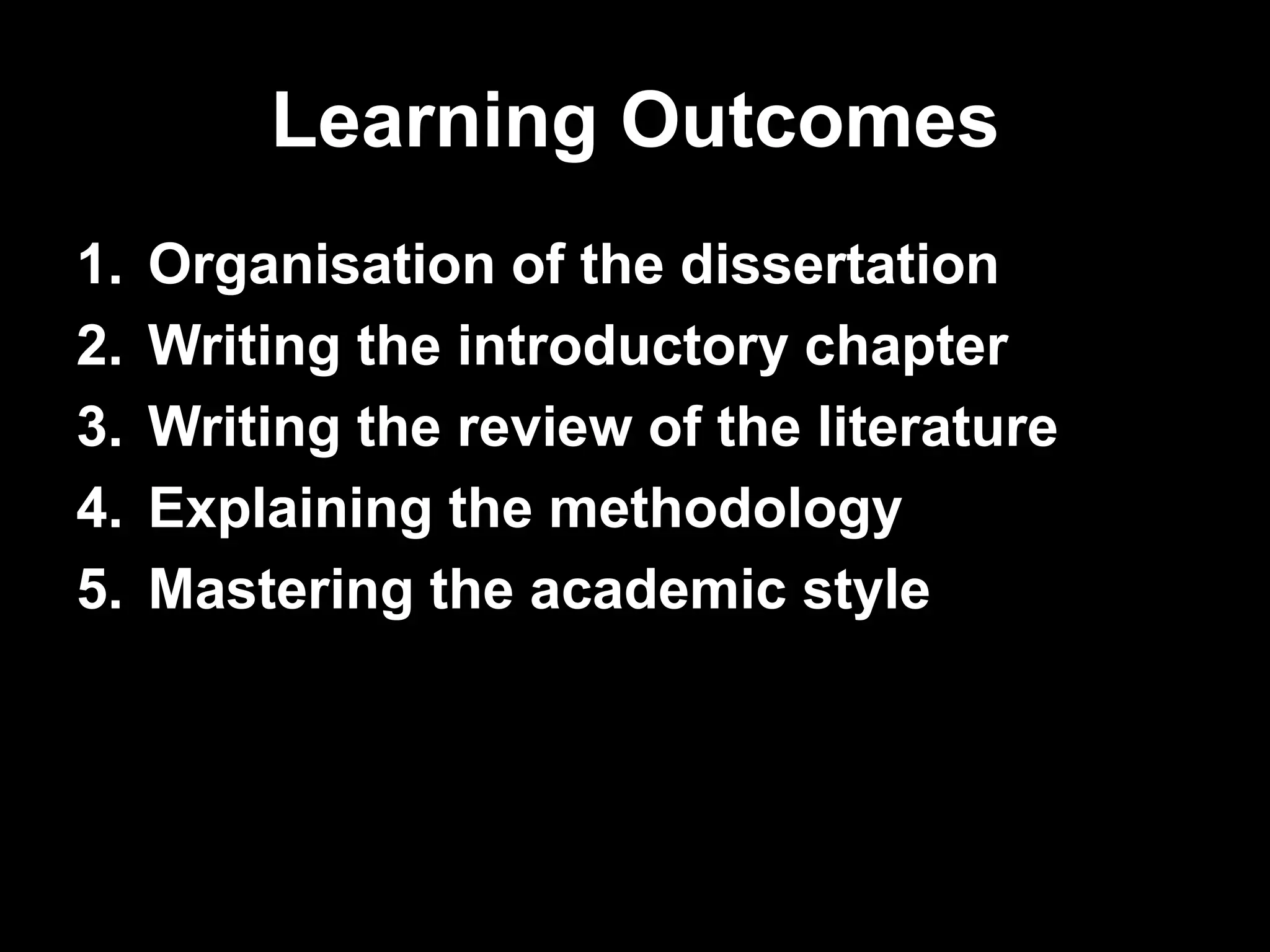
Learning Outcomes 
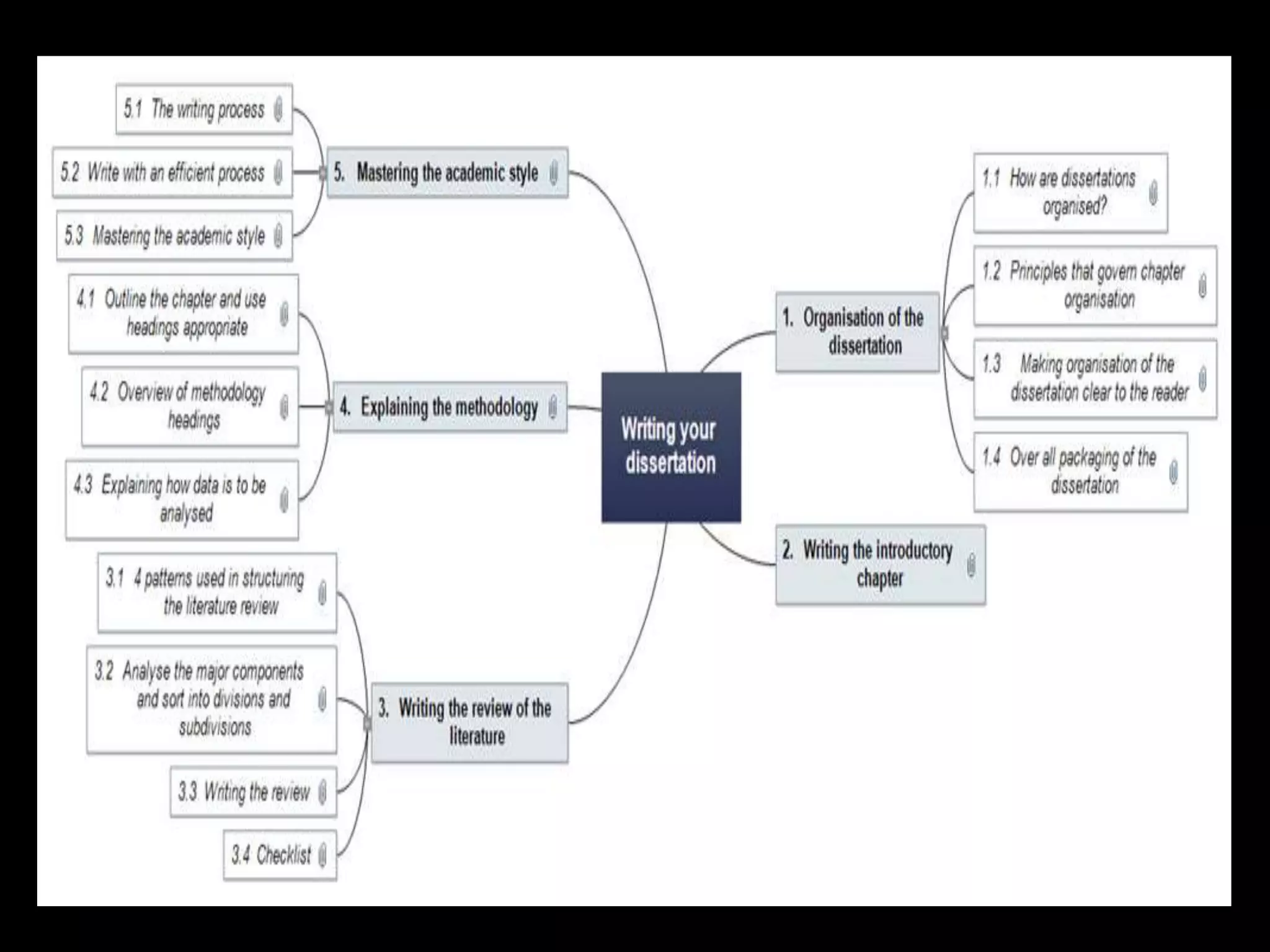
1. Organisation of the dissertation 
2. Writing the introductory chapter 
3. Writing the review of the literature 
4. Explaining the methodology 
5. Mastering the academic style
1. How are dissertations organised? 
2. Principles that govern chapter organisation 
3. Making organisation of the dissertation clear to 
the reader 
4. Overall packaging of the dissertation 
1. ORGANISATION OF THE 
DISSERTATION
1.1. How are dissertations 
organised? 
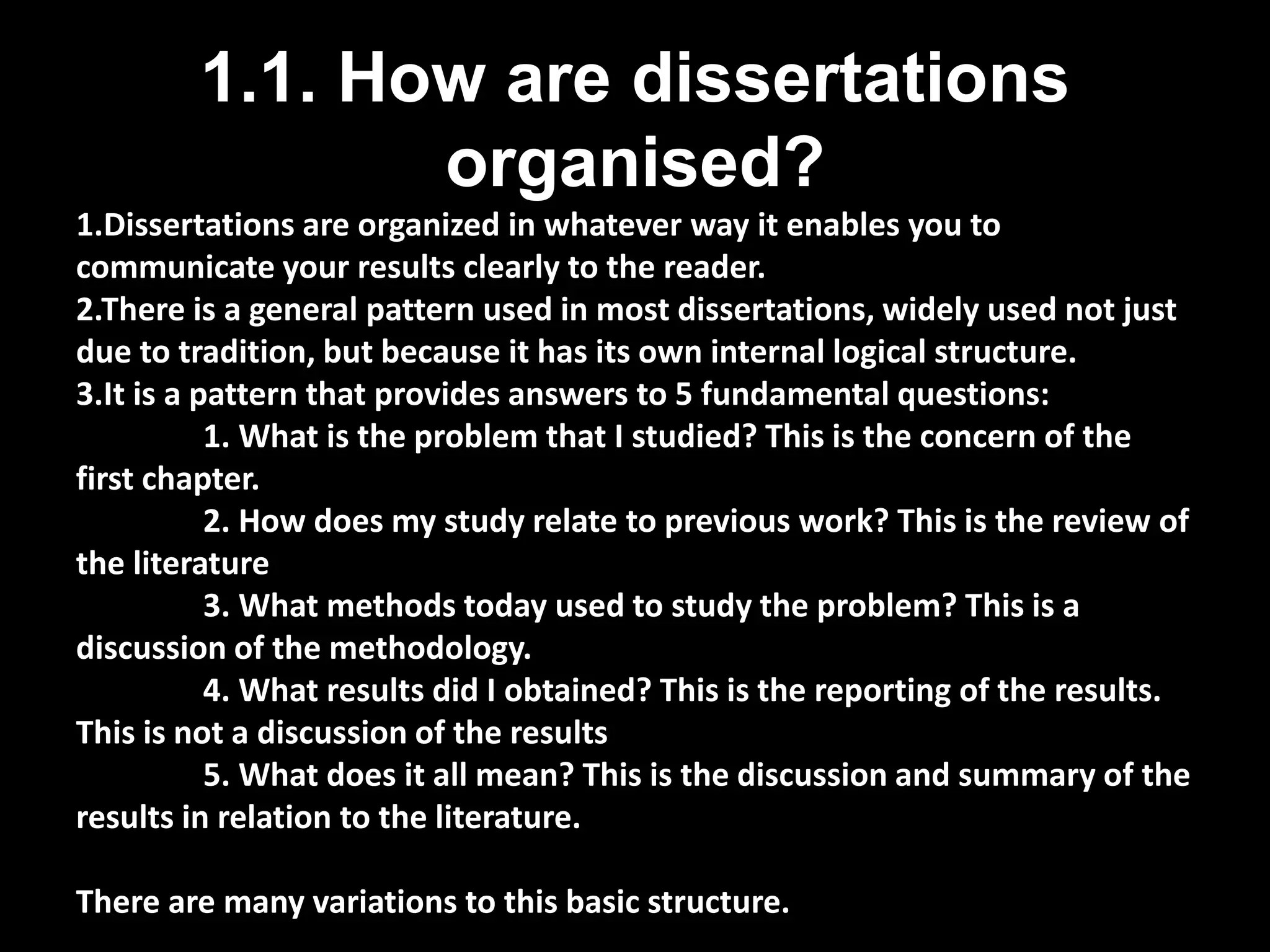
1.Dissertations are organized in whatever way it enables you to 
communicate your results clearly to the reader. 
2.There is a general pattern used in most dissertations, widely used not just 
due to tradition, but because it has its own internal logical structure. 
3.It is a pattern that provides answers to 5 fundamental questions: 
1. What is the problem that I studied? This is the concern of the 
first chapter. 
2. How does my study relate to previous work? This is the review of 
the literature 
3. What methods today used to study the problem? This is a 
discussion of the methodology. 
4. What results did I obtained? This is the reporting of the results. 
This is not a discussion of the results 
5. What does it all mean? This is the discussion and summary of the 
results in relation to the literature. 
There are many variations to this basic structure.
1.2. Principles that govern 
chapter organisation 
1. Each chapter must be seen to relate to the whole of the 
dissertation. 
2. The reader should have a feeling that are reading a unified 
narrative, not a collection of individual pieces of work. 
3. However each chapter should make sense by itself, 
organised in a way that the reader can easily follow the line 
of argument. 
4. The parts of the chapter should clearly relate to each 
other, conveying a sense of order and form. 
5. Ensure that each chapter is correctly framed with a clear 
introduction that opens chapter suggesting what is to come, 
and a clear conclusion that draws the chapter to a close.
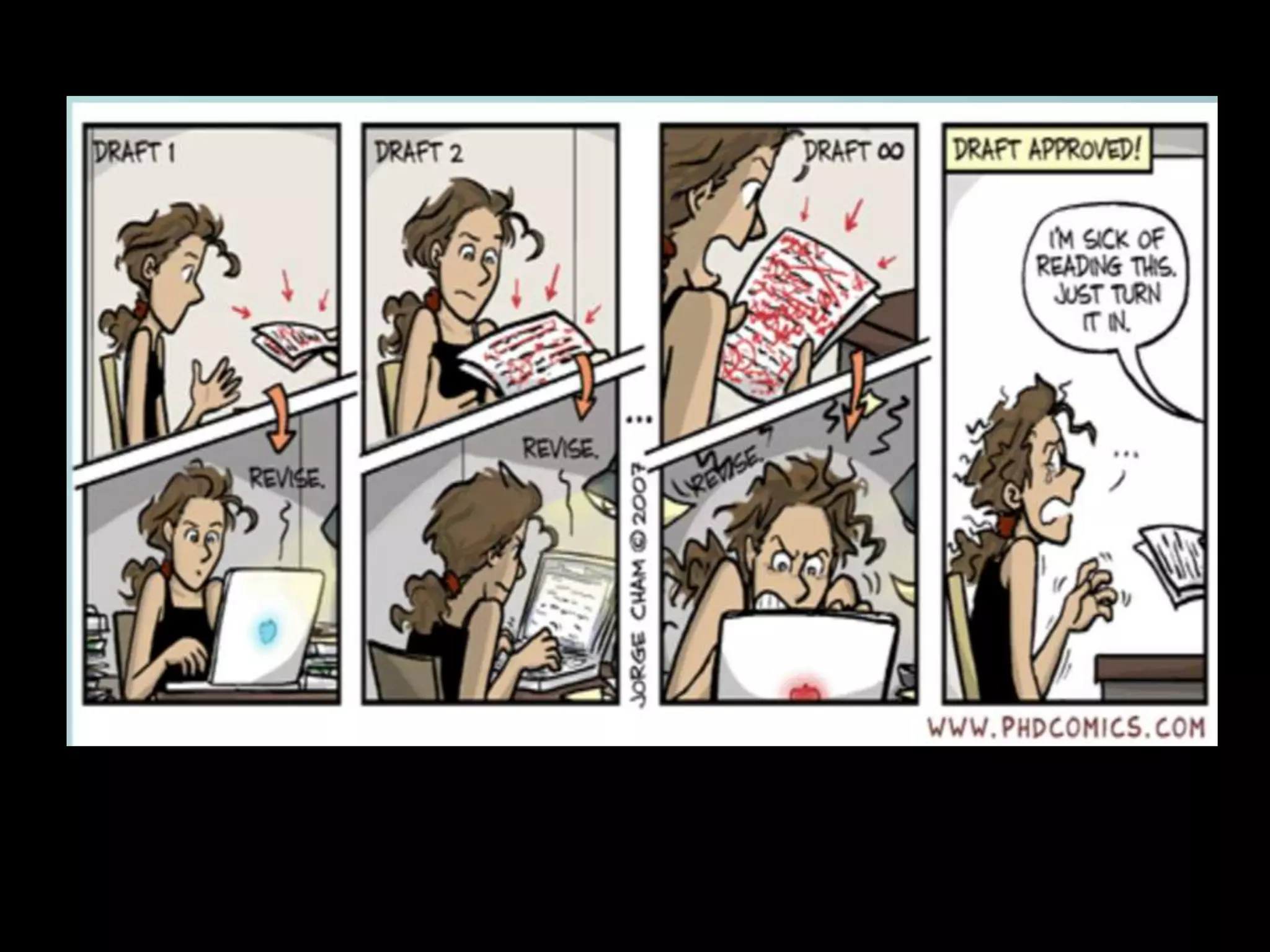
1.3.Making organisation of the 
dissertation clear to the reader 
A clear organization of the dissertation is important in order to 
communicate with your reader what you have done. 
You have an obligation to make your plan clear, to provide the 
reader with a verbal roadmap so that the journey is made 
without detours. 
The broad structure is: 
1. Statement of the problem 
2. Review of the literature 
3. The methodology of the study 
4. The results of the study 
5. The summary and discussion
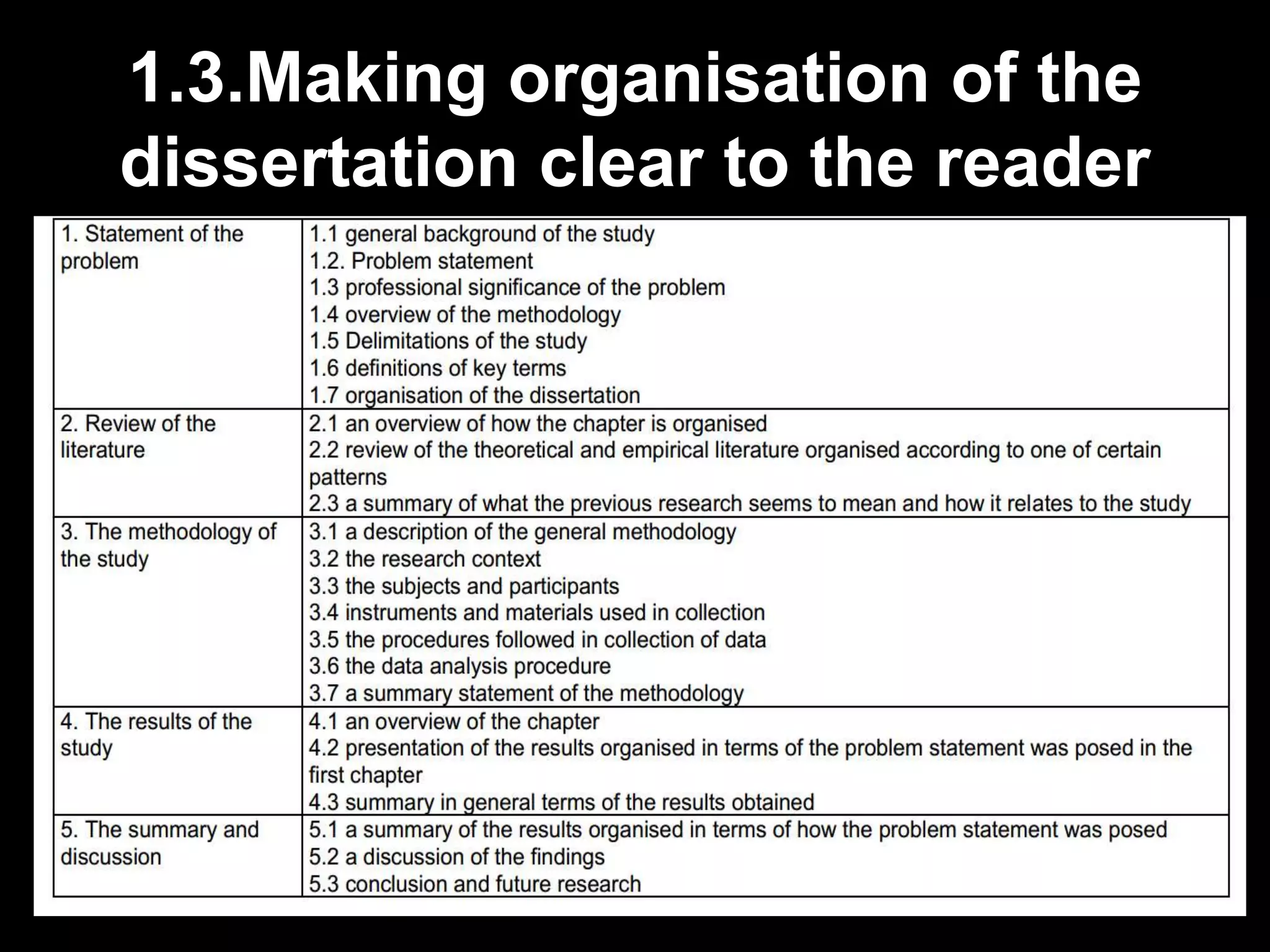
1.3.Making organisation of the 
dissertation clear to the reader
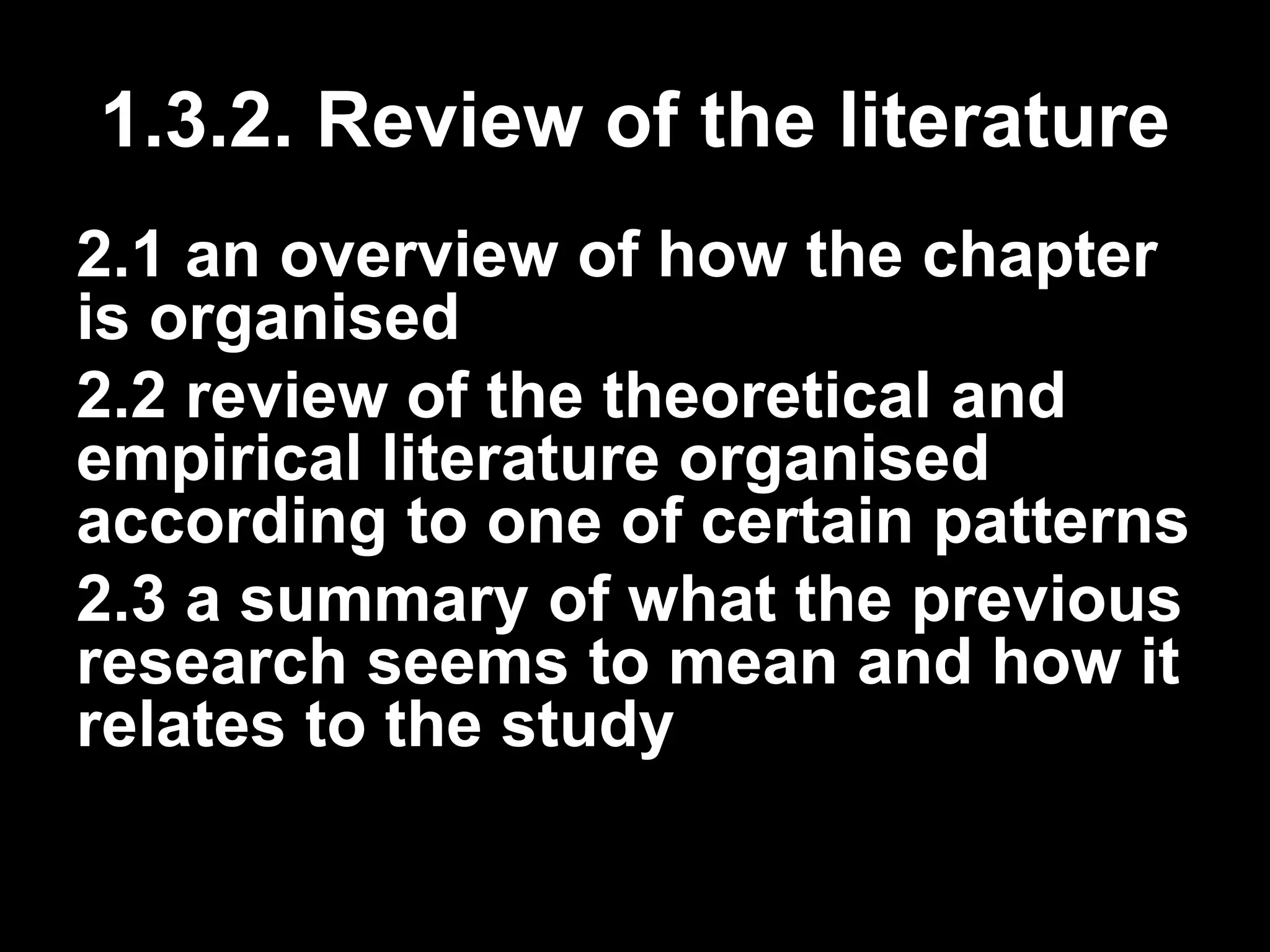
1.3.1. Statement of the problem 
1.1 general background of the study 
1.2. Problem statement 
1.3 professional significance of the 
problem 
1.4 overview of the methodology 
1.5 Delimitations of the study 
1.6 definitions of key terms 
1.7 organisation of the dissertation
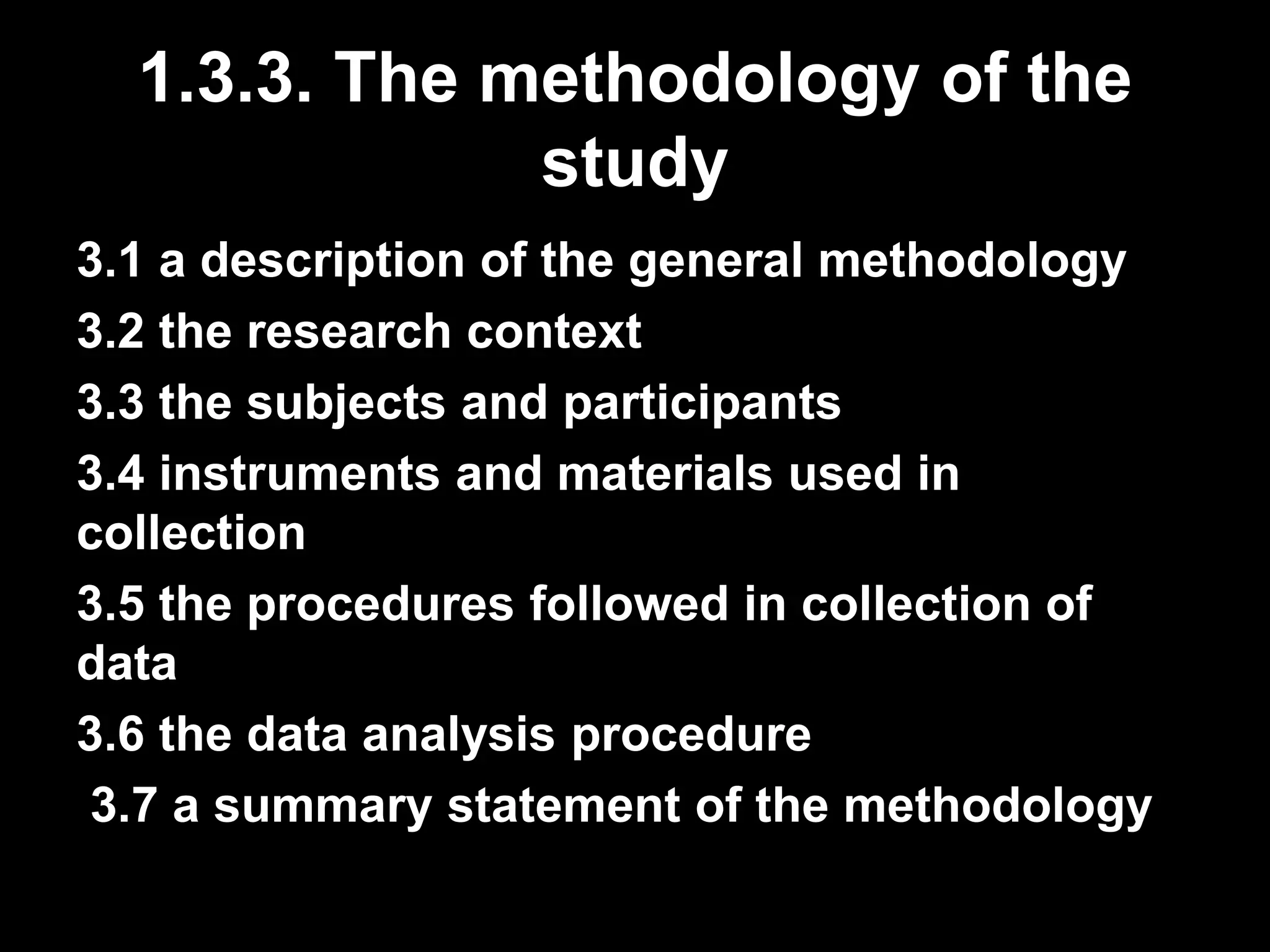
1.3.2. Review of the literature 
2.1 an overview of how the chapter 
is organised 
2.2 review of the theoretical and 
empirical literature organised 
according to one of certain patterns 
2.3 a summary of what the previous 
research seems to mean and how it 
relates to the study
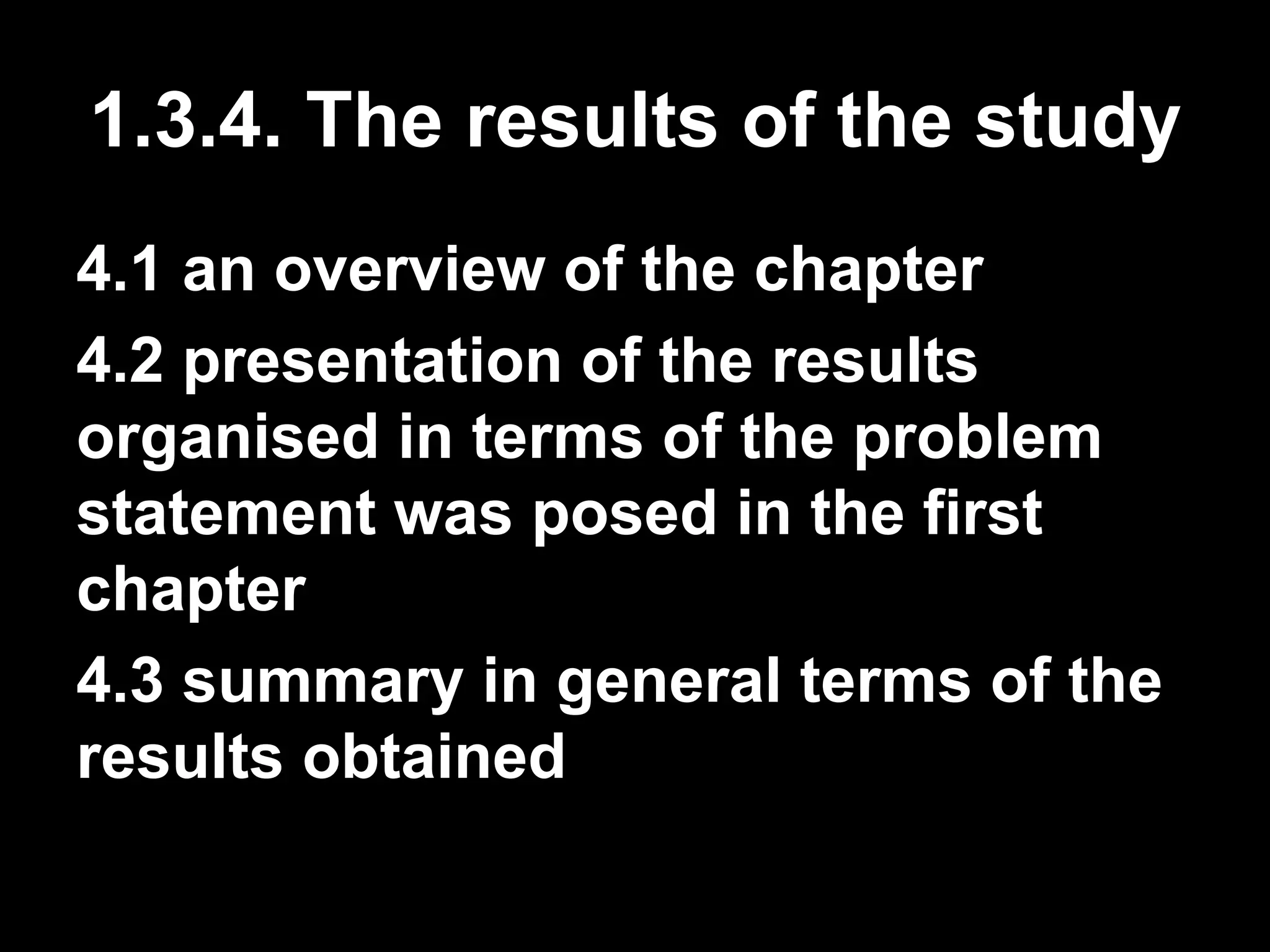
1.3.3. The methodology of the 
study 
3.1 a description of the general methodology 
3.2 the research context 
3.3 the subjects and participants 
3.4 instruments and materials used in 
collection 
3.5 the procedures followed in collection of 
data 
3.6 the data analysis procedure 
3.7 a summary statement of the methodology
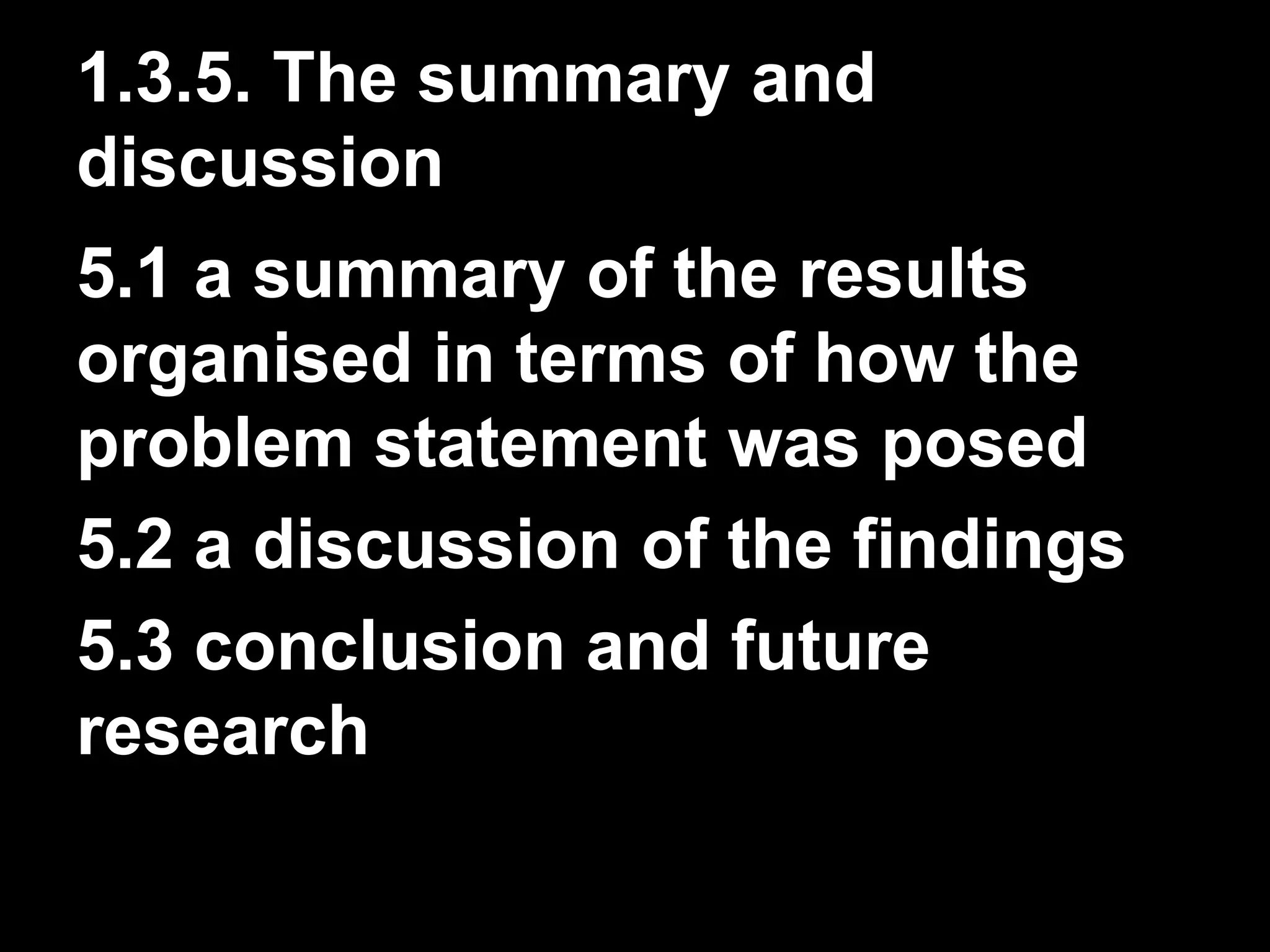
1.3.4. The results of the study 
4.1 an overview of the chapter 
4.2 presentation of the results 
organised in terms of the problem 
statement was posed in the first 
chapter 
4.3 summary in general terms of the 
results obtained
1.3.5. The summary and 
discussion 
5.1 a summary of the results 
organised in terms of how the 
problem statement was posed 
5.2 a discussion of the findings 
5.3 conclusion and future 
research
1.6 General Comments 
• Throughout your writing you need to ensure you have 
linking statements that connect the various chapters 
within each other, and links the chapters in meaningful 
manner. 
• You open each chapter by linking it with the previous 
chapter and by indicating what will come. 
• Use headings and subheadings as major divisions of 
the chapter. 
• Make use of transition paragraphs or sentences to link 
the major sections of the paper. The first sentence 
looks back at the previous section or division, the 
second sentence looks ahead. 
• For example: "in addition to this examination of the 
types of questions used previously, researchers have 
also studied the frequency of asking....".
1.6 General Comments 
• Use your paragraphing effectively as an aid to organising the sections 
that you are writing. Paragraphs tend to be longer and you end a 
paragraph when you have fully developed an idea. You begin a new 
one when you're ready to move to a new idea. dissertations tend to 
have longer paragraphs, suggesting seriousness, formality and depth. 
A rule of thumb is 100 word minimum per paragraph. Shorter 
paragraphs will seem superficial 
• Make use of topic sentences to aid organisation which clearly state 
the main idea of the paragraph. Topic sentences usually come first or 
early in the paragraph and tie the rest of the paragraph together. 
• Within paragraphs make appropriate use of transition devices in your 
writing; which is an expression or verbal strategy helps the reader 
make connections. Example using counting: firstly, secondly, next and 
finally. 
• In other words you need to make each paragraph have an appropriate 
PEE WH: ….P: POINT E: EVIDENCE E: EXPLANATION 
• W: What/why/How H: HOWEVER.. criticism and counter criticism.
1.6.Over all packaging of the 
dissertation 
There is a standard order in the presentation of a dissertation 
that is generally expected. this order can be adjusted to meet 
the appropriate structuring of your topic. 
· Title page 
· Abstract 
· Acknowledgements page 
· Contents page 
· List of tables and figures 
· The chapters presented in the order that is clearest. 
· References/bibliography 
· Appendices
The introductory chapter orientates the reader to the 
overall structure focus and goal of the dissertation. 
This makes it an important chapter to write, with clear 
structure, focus and overview. 
2. WRITING THE 
INTRODUCTORY CHAPTER
2.Writing the introductory 
chapter 
The following general pattern that seems to work for most 
dissertations: 
1. Introduction to the chapter: This can be brief, as short as one 
paragraph, or as long as is needed without boring the reader. 
This orientates the reader to the overall study 
2. Background of the study: this provides a context of your 
study. This places study against a background in order to make 
sense of why it is being done. 
3. The problem statement: this a very brief section in which you 
state the problem as clearly as possible. It is crucial the way 
you state the problem as this will directly influence the way 
you present and summarise the results.
• 4. The professional significance of the study: 
your purpose here is simple: answer the 
question "why did you bother to conduct the 
study?". You need to be specific about the need 
for the significance of this study. 
• 5. A brief overview of the methodology: this is a 
general statement of the methodology used, and 
not a discussion of the methodology itself. 
• 6. The delimitations of the study: describe the 
boundaries of the study, and the ways in which 
the findings may lack generalisability. 
• 7. Definition of key terms.do not feel obligated to 
define terms unless there are special terms 
being used in the study that need clarification.
2.Writing the introductory 
chapter 
• The introductory chapter is not quite a 
summary of the dissertation that reflects 
the beginning point of the journey 
highlighting some of the key elements the 
reader will encounter in your dissertation. 
• You should conclude the introduction 
with the paragraph that looks ahead to the 
rest of the dissertation, indicating to 
readers what they may expect.
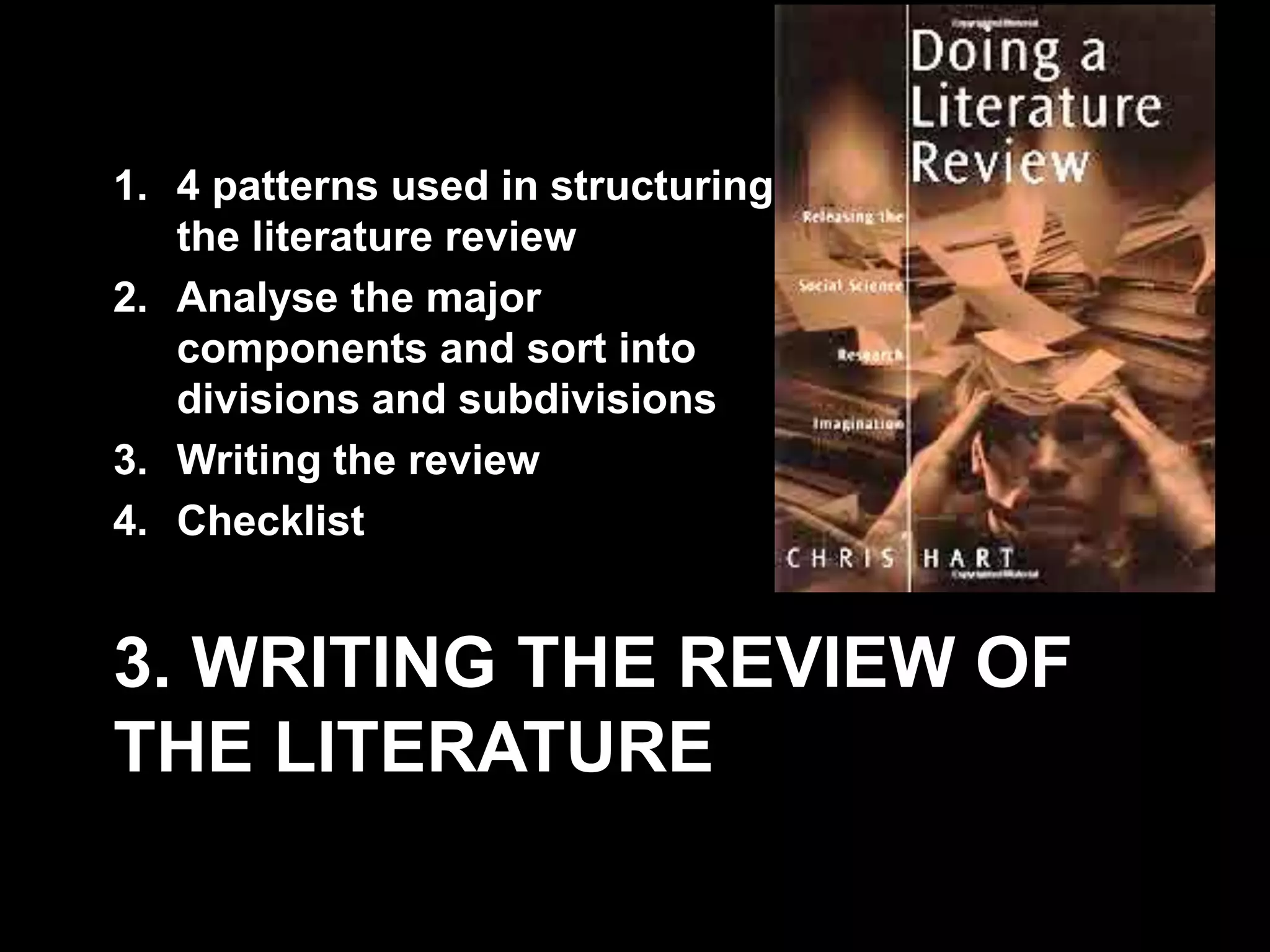
1. 4 patterns used in structuring 
the literature review 
2. Analyse the major 
components and sort into 
divisions and subdivisions 
3. Writing the review 
4. Checklist 
3. WRITING THE REVIEW OF 
THE LITERATURE
3.1. The 4 patterns used in 
structuring the literature review 
• The first step in outlining 
involves identifying the major 
components of your literature 
review. 
• Some reviews include an 
explanation of search 
processes that were used in 
assembling the review 
• Some reviews include a 
discussion of the theoretical 
literature 
• Pattern 1: 
• The search process 
• The theoretical literature 
• The empirical research 
• Pattern 2: 
• The search process 
• The empirical research 
• Pattern 3 
• The theoretical literature 
• The empirical research 
• Pattern 4 
• The empirical research
3.2.Analyse the major 
components and sort into 
divisions and subdivisions 
Once you have decided on an overall approach that is 
suitable for your dissertation you now need to 
determine the divisions and subdivisions. 
You do this by reflecting on the question: "what the big 
pieces of this component?" 
This will have been made easier in the way have 
structured your files and preliminary readings you 
have done as these should have made logical 
structuring. 
You may want to divide complex divisions into 
subdivisions that or important part of the discussion 
processes and critical to the review of the literature.
3.2.Analyse the major 
components and sort into 
divisions and subdivisions 
• Make use of a clear numbering system in order to clarify 
divisions and subdivisions. Make sure you use the word 
styles function when setting up these divisions and 
subdivisions so that they appear in your contents 
table.E.g. 1 title. 1.1 heading. 1.2 heading. 1.2.1 
subheading 
• By structuring your literature review using divisions and 
subdivisions you should have an overview of the various 
topics that need to go in each section and subsections. 
• Four levels of headings should be sufficient for clarity 
without getting to complex. 
• The title of the chapter is considered level I; the main 
divisions of the chapter level II; subdivisions level III; and 
sub subdivisions level IV.
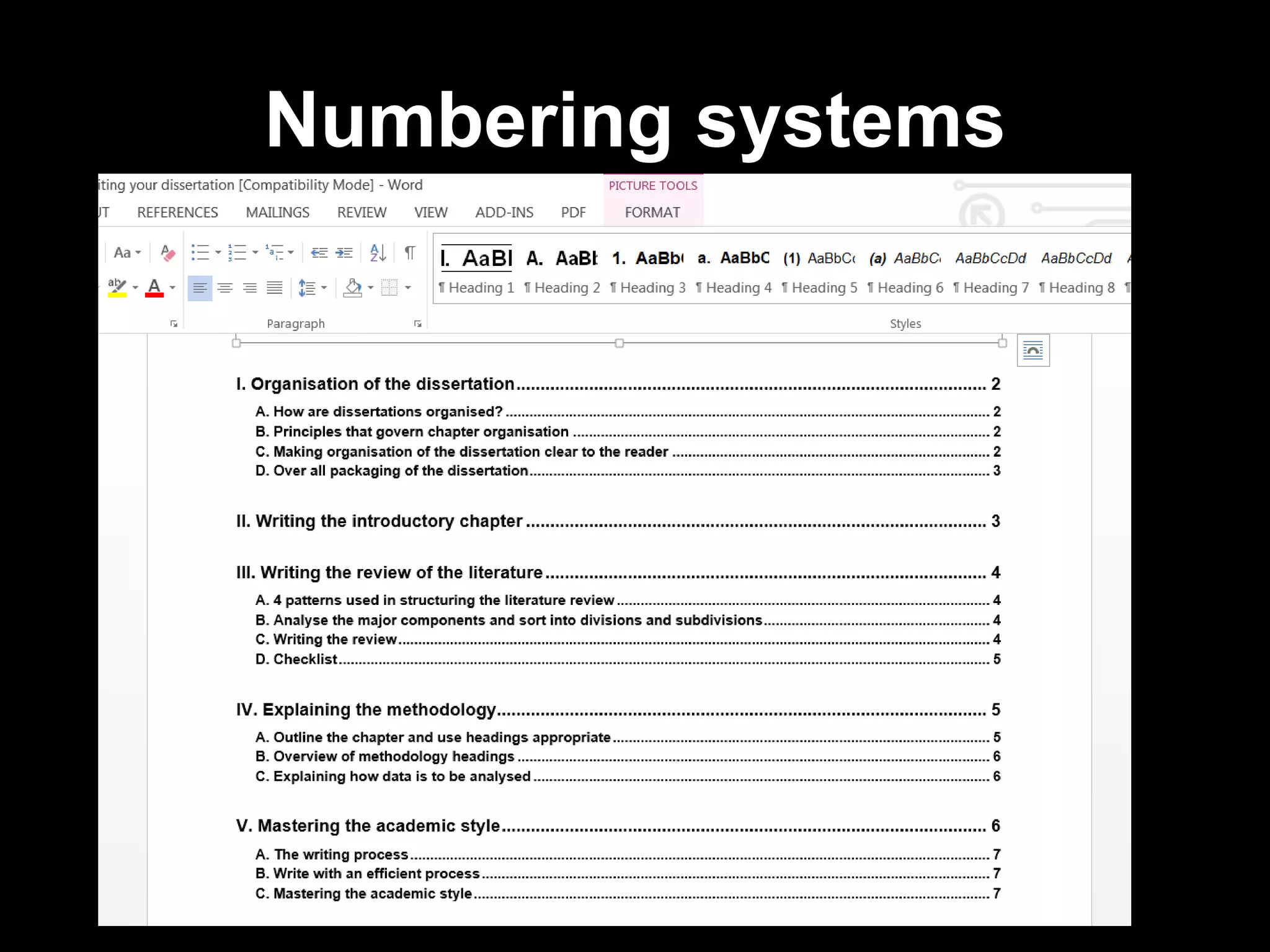
Numbering systems
3.3. Writing the review 
Using the different sections and subsections that you have 
identified in your overall structure you now need to write the 
details involved. 
A brief introductory paragraph at the beginning of the chapter 
provides an overview of the chapter elements. 
In writing each section of the review the following pattern is used 
to structure the section: 
1. Provide an overview: 
2. Generalise: 
3. Specify: 
Conclude the chapter with a summary that reviews the content of 
the chapter and brings together the conclusions of all the 
empirical research. 
When you have finished writing the chapter put it aside for awhile. 
Then revise it using aids such as spellcheck, grammar checker 
and style checkers.
1. Provide an overview: 
• Provide a brief overview of the section 
which helps the reader understand how 
the section is organised and what its 
main divisions are. 
• It is a brief introduction to the section
2. Generalise: 
• write the main developmental paragraphs of 
that section. You should begin the 
developmental paragraphs with one or two 
sentences that generalise what the studies 
show. 
• You have an obligation to the reader to make 
coherent sense of the literature rather than 
simply describing. 
• It is more than simply naming the conclusions 
of the study but rather bringing these together 
into a meaningful analysis.
3. Specify: 
• with a generalisation made, you then provide the 
specific evidence, citing and discussing each study 
relating to that generalisation. 
• How much space you devote to each study depends 
upon its importance. 
• The more important to study and central to your 
dissertation the greater the discussion required. 
• This important studies may be simply noted and 
discussed more briefly in a paragraph or two. 
• The length of treatment corresponds to importance.
3.4.Checklist 
When you revise your chapter you need to answer the following in 
relation to the review. 
Is the review... 
1. Comprehensive, including all major works relating to your topic? 
2. In-depth, providing the reader depth of knowledge about the prior 
research? 
3. Current, including works published recently? 
4. Selective, discriminating between major and this important 
studies? 
5. Unbiased, without the writer skewing the prior research to suit his 
or her point of view? 
6. Clearly organised, so that the reader can easily follow the plan and 
flow of the chapter? 
7. Coherent, making sense of the studies, not simply describing 
them? 
8. Effectively written in an academic style? 
If you are unable to tick off each of these questions you need to 
consider rewriting the literature review.
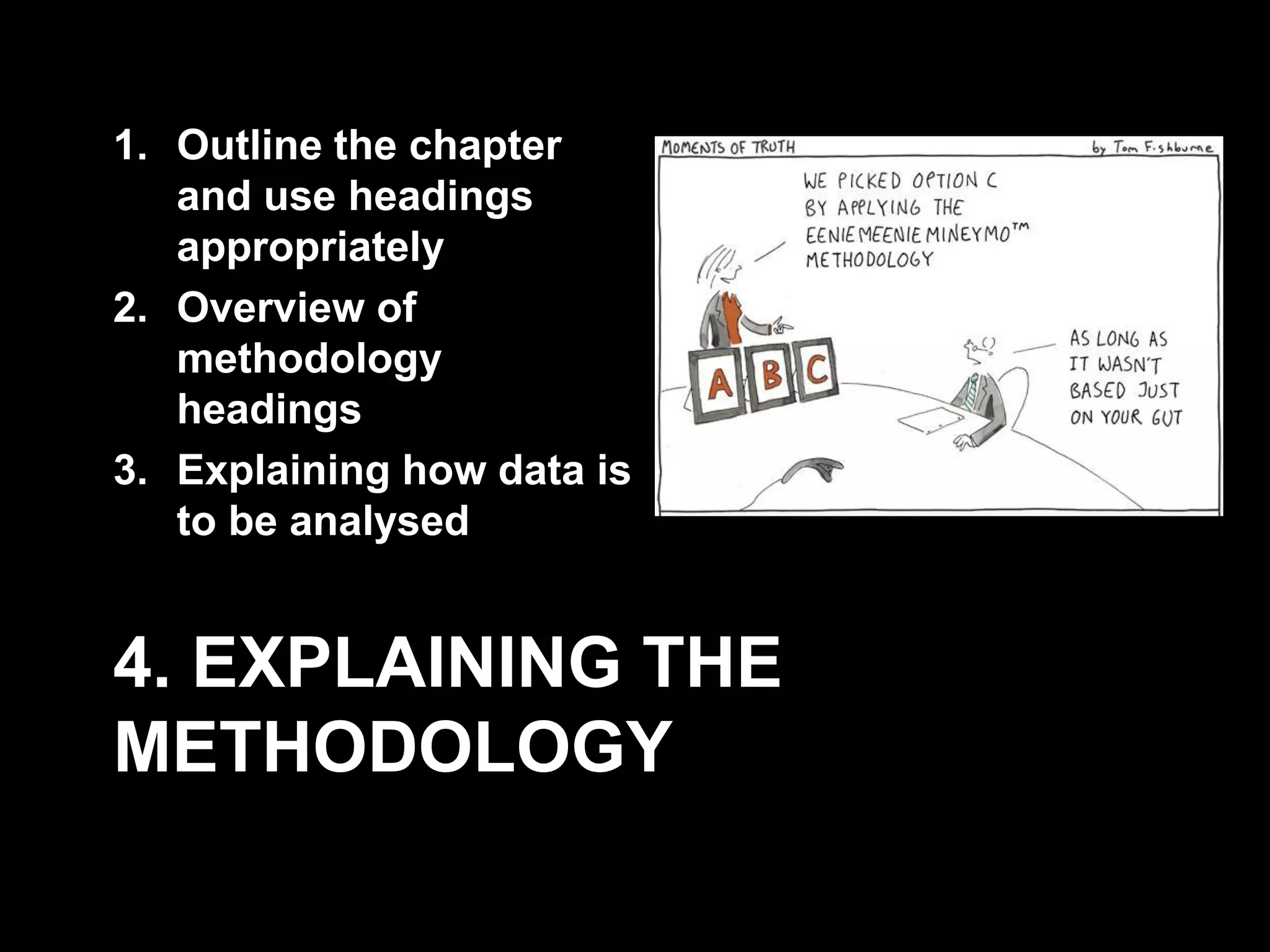
1. Outline the chapter 
and use headings 
appropriately 
2. Overview of 
methodology 
headings 
3. Explaining how data is 
to be analysed 
4. EXPLAINING THE 
METHODOLOGY
4. Explaining the methodology 
• Most students tend to skimp in their writing of the 
methodology which is a serious shortfall in the 
dissertation. 
• The methodology provides the reader a clear 
understanding of your research design and methods 
used. 
• They should be written in a manner that allows 
reader to be able to follow the steps taken in 
gathering the data if the research was to be repeated 
• Objectivity is especially important in this chapter. 
Avoid making unsupported statements and 
sweeping generalisations. Provide specific data and 
descriptions.
4. Explaining the methodology 
• Most descriptions of the methodology 
chapter cover the following content: 
• 1.The general research perspective and 
research type 
• 2. The research context, including 
specifics of time and place as needed 
• 3. The researcher participants 
• 4. The method and instruments used in 
data collection 
• 5. The way the data will be analysed
4.1. Outline the chapter and use 
headings appropriately 
When you have decided on the content you should then determine 
the overall organisational pattern of the chapter 
There are 4 patterns used in dissertations: 
1. Logical order: most chapters use a logical order, organising the 
content in terms of the relationships of the concepts. You reflect 
on the processes you used and determine how best to group them 
2. Chronological order: some researchers using a qualitative or 
action research approach prefer to follow chronological order, 
discussing the steps in the order in which there were taken. This 
pattern is especially useful when the sequence of steps is 
important to the result 
3. Research – question order: explain the methodology in relation 
to the research questions answered. 
4. Research – methods order: organise chapter in relation to the 
research methods used
4.1. Outline the chapter and use 
headings appropriately 
• Common elements: regardless of the 
organisational pattern used to initial 
elements common to most 
dissertations 
• 1. The general perspective 
• 2. The research context 
• You need to discuss both of these as 
part of your structuring
4.2.Overview of methodology 
headings 
• Structure your chapter that makes 
meaningful sense using the 
previously described organisational 
ideas. 
• The following is the most common 
way of structuring the methodology 
chapter: 
• The research methodology is normally 
chapter 3 so its layout would look 
something like this:
3. Methodology: Brief overview of the chapter 
3.1. The general perspective: Discuss the general 
overview in a little more detail 
3.2. The research context: Describe the context in 
which the study took place 
3.3. The research participants: Define the research 
participants and recruitment thereof 
3.4. Instruments used in the data collection: What 
instruments questionnaires and recording devices et 
cetera were used for data collection 
3.5. Procedures used.: What procedures were used in 
the process of data collection 
3.6. Data analysis: What strategies will you use to 
analyse the data 
3.7. Summary of the methodology: Summarise the 
methodology as a whole.
4.3. Explaining how data is to be 
analysed 
All studies result in a mass of raw data. Thus a key component of 
the methodology is explaining to the reader how you will handle 
this data. 
Data analysis usually includes three procedures: 
1. You explain how you reduced the data to meaningful 
information. When you reduce the data, to group the raw data in 
order to make initial sense of them. 
For example, In analysing interview data, these steps were taken 
in reducing the data: 
1. Transcribing interviews. 
2. Reading the transcripts to identify categories of responses. 
3. Testing the tentative categories by classifying responses in the 
first hour of the interviews 
4. Using final categories to code all responses 
5. Tallying coded responses
4.3. Explaining how data is to be 
analysed 
• 2. Explain how you decided to report and displayed the 
raw data. You have several methods of reporting raw 
data: percentages, mean, medium, standardise scores. 
You have several methods for displaying data: narrative 
text, matrixes, tables, graphs, and any other figures that 
are relevant 
• 3. Explain how you will analyse this data to determine 
what they mean: in quantitative studies you report to 
statistical tests and procedures to be used: t-test, chi 
squared etc. In qualitative studies you explain how 
interpret the data: thematic analysis, IPA, grounded 
theory, constant comparison method.
http://writeitright.uelconnect.org.u 
k/pages/redrafting_and_finishing/1 
16/checking_your_academic_style. 
html 
1. The writing process 
2. Write with an efficient process 
3. Mastering the academic style 
5. MASTERING THE 
ACADEMIC STYLE
5. Mastering the academic style 
• The most common error in 
dissertations that result in low marks 
and failures is poor academic style. In 
writing your dissertation you need to 
meet the minimum academic standards 
required at level VI. 
• Whilst this may be obvious it is 
important to state the following are the 
common errors encountered in 
dissertations and writing style:
common errors 
• 1. Grammar errors 
• 2. Spelling errors 
• 3. Punctuation errors 
• 4. Poor sentence construction 
• 5. Poor paragraph construction 
• 6. Inadequate,and incorrectly formatted citations 
• 7. Incorrectly formatted bibliography. 
• 8. Citations not appearing in the bibliography 
• There appear to be 2 errors in writing: 
• 1. out of a fear of plagiarism students are over-paraphrasing the 
literature to the point that it becomes meaningless. You cannot 
paraphrase key concepts words or ideas. Use the authors words and 
ensure you use correct citations. 
• 2. In an attempt to appear academic, attempts at complex writing is 
made that does not make sense or add up. Do not be complex for 
complex sake. Present ideas clearly in the first place and only later 
add any other element to that idea.
5.1. The writing process 
Developing an effective approach to writing is an 
important component of a successful dissertation. 
The standard process model of writing a dissertation is 
the following: plan; write draft; edit; proof read. 
Ensure you fully understand and use all the computer-based 
technology to assist you in the writing of the 
dissertation. If you have make use of Zotero, or Docear, 
and the minimum you do need to make use of areas the 
referencing function in word, and the styles function in 
word. 
Develop a writing schedule that will help you write 
systematically and effectively. If you have planned a 
program and deadlines you will be on track to 
complete your dissertation well before the hand in 
date.
5.1. The writing process 
• You need to schedule longer blocks of 
uninterrupted time in order to write a section 
successfully. 
• Most people need at least a three hour block 
of time to get some good writing done. 
• This follows a process of a slow warmup 
period in which you struggle to get going, 
you then hit your stride and find the flow of 
the topic, and any interruption at this point 
you lose the momentum. 
• Your writing time should be free of 
distractions and interruptions.
5.1. Using an Editor 
• To assist you in your writing please ensure you have 
somebody who can proof read and help edit your 
dissertation. 
• Editors function is to read carefully your good drafts and 
make suggestions or improvements in organisation and 
style. 
• This is not the task of your supervisor! 
• The editor does not write for you, this is dishonest and 
and ethical. 
• The editor's task is to suggest how the chapter might be 
reorganised what paragraphs need for the development 
and indicate how some sentences can be rewritten. 
• The editor helps with the proof reading of your 
assignment to identify the errors that you cannot see. 
• You know what you mean in your writing, but is this what 
you have written?
5.2.Write with an efficient 
process 
You have to experiment to find the process that works best 
for you. 
You should find the following process useful: 
1. Begin by systematising your knowledge: read and reflect 
and think about what you have read, gathered and analysed 
in your results. Called to mind what you know and start to 
think about a systematic way of ordering that knowledge. 
2. Plan your chapter: structure your chapter according to 
the previous discussions so they make logical sense 
3. Reduce your plan to a written topical outline: have 
somebody review your overall chapter outline before you 
begin writing it as you are to close your material to be a 
reliable judge of the structure sometimes.giving somebody 
a bullet point form of your chapter or help them see whether 
it is logical or not
5.2.Write with an efficient 
process 
• 4. Begin to write: follow your outline in your writing 
and ensure you state within the broad structure. 
• If you encounter writers block, the best way is to 
just continue writing whatever comes into your head 
in relation to the topic even if it seems bad. 
• Too many students attempt to write the final 
dissertation in a single sitting or as a single draft. 
• You need to write your dissertation at least three 
times. If you get completely stuck Skip section and 
go on to the next idea. 
• Come back to the missed section and review what is 
causing the blockage: lack of understanding, lack of 
information, confusion over topic, or simple 
tiredness.
5.2.Write with an efficient 
process 
Revise as you write. Write a paragraph. Stop and 
read what was just written. Revise a paragraph. 
Write the next paragraph And stop the cycle all 
over again. 
Or find a style that works for you... Some do a 
quick draft without devising anything and then 
polish the entire draft.... 
Whenever you have finished a draft put it aside 
for a few hours and reread it with a fresh eye.
5.3. Mastering the academic 
style 
The key element of writing the dissertation is that you are learning 
to write like a scholar. This formal posh style of academic writing 
is essential to successful dissertation 
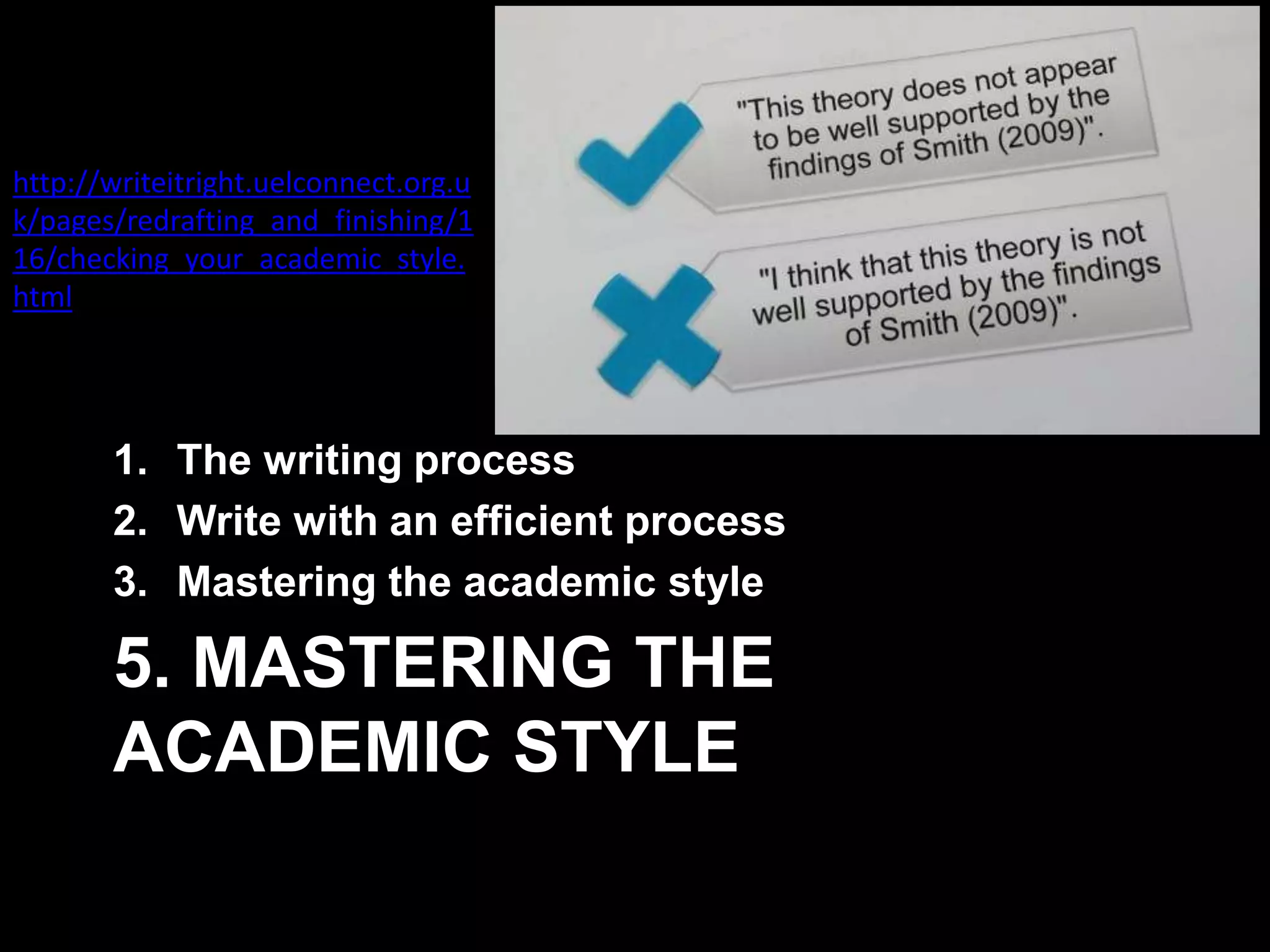
There are a number of elements that need attention in order to 
meet the standard overall. The following is a short summary of 
some of the key elements: 
1.Third person persona: write in the third person throughout your 
dissertation; an attempt is draft clarity, project maturity and a 
sense of formality throughout your writing with an appropriate 
balance between confidence in your findings yet sufficiently 
tentative. 
2. Document assertions: the right to provide evidence for 
statements that might be reasonably challenged. Good 
paraphrasing and the use of citations is vital throughout your 
dissertation
5.3. Mastering the academic 
style 
• 3. Vary the way you identify sources: there are 
several ways to cite sources. Do not just rely on 
having a single citation at the end of a paragraph. 
This is not sufficient. Vary the way you cite your 
resources to avoid excessive repetition. For 
example: according to Walker (1998), ....or Walker 
(1998) concluded that... 
• 4. Use appropriate paragraphing: each paragraph 
should be about one main idea. Paragraphs tend 
to move from general to specific. Is.the paragraph 
with a general statement and then provide the 
specifics to develop and support the general 
statement.
5.3. Mastering the academic 
style 
• 5. Write complex sentences by combining shorter sentences 
to form more complex ideas. However do not make 
excessive use of and to convey various ideas. This involves 
better sentence construction 
• 6. Word choice and form: be careful in your use of jargon 
keeping it to a minimum and avoid terms that are outdated 
or used to often. avoid colloquial expressions that are 
vague and in accurate example a lot of; check up on..;avoid 
the sexist use of the masculine pronoun e.g. "man is a wise 
figure in..." when the appropriate term may be his/her or 
they..; 
• 7. Use tables to present complex data and in the text itself 
refer to the table commenting on the highlights without 
repeating what is included in the table.
Lecture 10 guidence on writing your dissertation

Lecture 10 guidence on writing your dissertation

  • 1.
    Lecture 10: Guidanceon Writing your Dissertation Kevin Standish
  • 3.
    Learning Outcomes 1.Organisation of the dissertation 2. Writing the introductory chapter 3. Writing the review of the literature 4. Explaining the methodology 5. Mastering the academic style
  • 4.
    1. How aredissertations organised? 2. Principles that govern chapter organisation 3. Making organisation of the dissertation clear to the reader 4. Overall packaging of the dissertation 1. ORGANISATION OF THE DISSERTATION
  • 5.
    1.1. How aredissertations organised? 1.Dissertations are organized in whatever way it enables you to communicate your results clearly to the reader. 2.There is a general pattern used in most dissertations, widely used not just due to tradition, but because it has its own internal logical structure. 3.It is a pattern that provides answers to 5 fundamental questions: 1. What is the problem that I studied? This is the concern of the first chapter. 2. How does my study relate to previous work? This is the review of the literature 3. What methods today used to study the problem? This is a discussion of the methodology. 4. What results did I obtained? This is the reporting of the results. This is not a discussion of the results 5. What does it all mean? This is the discussion and summary of the results in relation to the literature. There are many variations to this basic structure.
  • 6.
    1.2. Principles thatgovern chapter organisation 1. Each chapter must be seen to relate to the whole of the dissertation. 2. The reader should have a feeling that are reading a unified narrative, not a collection of individual pieces of work. 3. However each chapter should make sense by itself, organised in a way that the reader can easily follow the line of argument. 4. The parts of the chapter should clearly relate to each other, conveying a sense of order and form. 5. Ensure that each chapter is correctly framed with a clear introduction that opens chapter suggesting what is to come, and a clear conclusion that draws the chapter to a close.
  • 7.
    1.3.Making organisation ofthe dissertation clear to the reader A clear organization of the dissertation is important in order to communicate with your reader what you have done. You have an obligation to make your plan clear, to provide the reader with a verbal roadmap so that the journey is made without detours. The broad structure is: 1. Statement of the problem 2. Review of the literature 3. The methodology of the study 4. The results of the study 5. The summary and discussion
  • 8.
    1.3.Making organisation ofthe dissertation clear to the reader
  • 9.
    1.3.1. Statement ofthe problem 1.1 general background of the study 1.2. Problem statement 1.3 professional significance of the problem 1.4 overview of the methodology 1.5 Delimitations of the study 1.6 definitions of key terms 1.7 organisation of the dissertation
  • 10.
    1.3.2. Review ofthe literature 2.1 an overview of how the chapter is organised 2.2 review of the theoretical and empirical literature organised according to one of certain patterns 2.3 a summary of what the previous research seems to mean and how it relates to the study
  • 11.
    1.3.3. The methodologyof the study 3.1 a description of the general methodology 3.2 the research context 3.3 the subjects and participants 3.4 instruments and materials used in collection 3.5 the procedures followed in collection of data 3.6 the data analysis procedure 3.7 a summary statement of the methodology
  • 12.
    1.3.4. The resultsof the study 4.1 an overview of the chapter 4.2 presentation of the results organised in terms of the problem statement was posed in the first chapter 4.3 summary in general terms of the results obtained
  • 13.
    1.3.5. The summaryand discussion 5.1 a summary of the results organised in terms of how the problem statement was posed 5.2 a discussion of the findings 5.3 conclusion and future research
  • 14.
    1.6 General Comments • Throughout your writing you need to ensure you have linking statements that connect the various chapters within each other, and links the chapters in meaningful manner. • You open each chapter by linking it with the previous chapter and by indicating what will come. • Use headings and subheadings as major divisions of the chapter. • Make use of transition paragraphs or sentences to link the major sections of the paper. The first sentence looks back at the previous section or division, the second sentence looks ahead. • For example: "in addition to this examination of the types of questions used previously, researchers have also studied the frequency of asking....".
  • 15.
    1.6 General Comments • Use your paragraphing effectively as an aid to organising the sections that you are writing. Paragraphs tend to be longer and you end a paragraph when you have fully developed an idea. You begin a new one when you're ready to move to a new idea. dissertations tend to have longer paragraphs, suggesting seriousness, formality and depth. A rule of thumb is 100 word minimum per paragraph. Shorter paragraphs will seem superficial • Make use of topic sentences to aid organisation which clearly state the main idea of the paragraph. Topic sentences usually come first or early in the paragraph and tie the rest of the paragraph together. • Within paragraphs make appropriate use of transition devices in your writing; which is an expression or verbal strategy helps the reader make connections. Example using counting: firstly, secondly, next and finally. • In other words you need to make each paragraph have an appropriate PEE WH: ….P: POINT E: EVIDENCE E: EXPLANATION • W: What/why/How H: HOWEVER.. criticism and counter criticism.
  • 16.
    1.6.Over all packagingof the dissertation There is a standard order in the presentation of a dissertation that is generally expected. this order can be adjusted to meet the appropriate structuring of your topic. · Title page · Abstract · Acknowledgements page · Contents page · List of tables and figures · The chapters presented in the order that is clearest. · References/bibliography · Appendices
  • 17.
    The introductory chapterorientates the reader to the overall structure focus and goal of the dissertation. This makes it an important chapter to write, with clear structure, focus and overview. 2. WRITING THE INTRODUCTORY CHAPTER
  • 18.
    2.Writing the introductory chapter The following general pattern that seems to work for most dissertations: 1. Introduction to the chapter: This can be brief, as short as one paragraph, or as long as is needed without boring the reader. This orientates the reader to the overall study 2. Background of the study: this provides a context of your study. This places study against a background in order to make sense of why it is being done. 3. The problem statement: this a very brief section in which you state the problem as clearly as possible. It is crucial the way you state the problem as this will directly influence the way you present and summarise the results.
  • 19.
    • 4. Theprofessional significance of the study: your purpose here is simple: answer the question "why did you bother to conduct the study?". You need to be specific about the need for the significance of this study. • 5. A brief overview of the methodology: this is a general statement of the methodology used, and not a discussion of the methodology itself. • 6. The delimitations of the study: describe the boundaries of the study, and the ways in which the findings may lack generalisability. • 7. Definition of key terms.do not feel obligated to define terms unless there are special terms being used in the study that need clarification.
  • 20.
    2.Writing the introductory chapter • The introductory chapter is not quite a summary of the dissertation that reflects the beginning point of the journey highlighting some of the key elements the reader will encounter in your dissertation. • You should conclude the introduction with the paragraph that looks ahead to the rest of the dissertation, indicating to readers what they may expect.
  • 21.
    1. 4 patternsused in structuring the literature review 2. Analyse the major components and sort into divisions and subdivisions 3. Writing the review 4. Checklist 3. WRITING THE REVIEW OF THE LITERATURE
  • 22.
    3.1. The 4patterns used in structuring the literature review • The first step in outlining involves identifying the major components of your literature review. • Some reviews include an explanation of search processes that were used in assembling the review • Some reviews include a discussion of the theoretical literature • Pattern 1: • The search process • The theoretical literature • The empirical research • Pattern 2: • The search process • The empirical research • Pattern 3 • The theoretical literature • The empirical research • Pattern 4 • The empirical research
  • 23.
    3.2.Analyse the major components and sort into divisions and subdivisions Once you have decided on an overall approach that is suitable for your dissertation you now need to determine the divisions and subdivisions. You do this by reflecting on the question: "what the big pieces of this component?" This will have been made easier in the way have structured your files and preliminary readings you have done as these should have made logical structuring. You may want to divide complex divisions into subdivisions that or important part of the discussion processes and critical to the review of the literature.
  • 24.
    3.2.Analyse the major components and sort into divisions and subdivisions • Make use of a clear numbering system in order to clarify divisions and subdivisions. Make sure you use the word styles function when setting up these divisions and subdivisions so that they appear in your contents table.E.g. 1 title. 1.1 heading. 1.2 heading. 1.2.1 subheading • By structuring your literature review using divisions and subdivisions you should have an overview of the various topics that need to go in each section and subsections. • Four levels of headings should be sufficient for clarity without getting to complex. • The title of the chapter is considered level I; the main divisions of the chapter level II; subdivisions level III; and sub subdivisions level IV.
  • 25.
  • 26.
    3.3. Writing thereview Using the different sections and subsections that you have identified in your overall structure you now need to write the details involved. A brief introductory paragraph at the beginning of the chapter provides an overview of the chapter elements. In writing each section of the review the following pattern is used to structure the section: 1. Provide an overview: 2. Generalise: 3. Specify: Conclude the chapter with a summary that reviews the content of the chapter and brings together the conclusions of all the empirical research. When you have finished writing the chapter put it aside for awhile. Then revise it using aids such as spellcheck, grammar checker and style checkers.
  • 27.
    1. Provide anoverview: • Provide a brief overview of the section which helps the reader understand how the section is organised and what its main divisions are. • It is a brief introduction to the section
  • 28.
    2. Generalise: •write the main developmental paragraphs of that section. You should begin the developmental paragraphs with one or two sentences that generalise what the studies show. • You have an obligation to the reader to make coherent sense of the literature rather than simply describing. • It is more than simply naming the conclusions of the study but rather bringing these together into a meaningful analysis.
  • 29.
    3. Specify: •with a generalisation made, you then provide the specific evidence, citing and discussing each study relating to that generalisation. • How much space you devote to each study depends upon its importance. • The more important to study and central to your dissertation the greater the discussion required. • This important studies may be simply noted and discussed more briefly in a paragraph or two. • The length of treatment corresponds to importance.
  • 30.
    3.4.Checklist When yourevise your chapter you need to answer the following in relation to the review. Is the review... 1. Comprehensive, including all major works relating to your topic? 2. In-depth, providing the reader depth of knowledge about the prior research? 3. Current, including works published recently? 4. Selective, discriminating between major and this important studies? 5. Unbiased, without the writer skewing the prior research to suit his or her point of view? 6. Clearly organised, so that the reader can easily follow the plan and flow of the chapter? 7. Coherent, making sense of the studies, not simply describing them? 8. Effectively written in an academic style? If you are unable to tick off each of these questions you need to consider rewriting the literature review.
  • 31.
    1. Outline thechapter and use headings appropriately 2. Overview of methodology headings 3. Explaining how data is to be analysed 4. EXPLAINING THE METHODOLOGY
  • 32.
    4. Explaining themethodology • Most students tend to skimp in their writing of the methodology which is a serious shortfall in the dissertation. • The methodology provides the reader a clear understanding of your research design and methods used. • They should be written in a manner that allows reader to be able to follow the steps taken in gathering the data if the research was to be repeated • Objectivity is especially important in this chapter. Avoid making unsupported statements and sweeping generalisations. Provide specific data and descriptions.
  • 33.
    4. Explaining themethodology • Most descriptions of the methodology chapter cover the following content: • 1.The general research perspective and research type • 2. The research context, including specifics of time and place as needed • 3. The researcher participants • 4. The method and instruments used in data collection • 5. The way the data will be analysed
  • 34.
    4.1. Outline thechapter and use headings appropriately When you have decided on the content you should then determine the overall organisational pattern of the chapter There are 4 patterns used in dissertations: 1. Logical order: most chapters use a logical order, organising the content in terms of the relationships of the concepts. You reflect on the processes you used and determine how best to group them 2. Chronological order: some researchers using a qualitative or action research approach prefer to follow chronological order, discussing the steps in the order in which there were taken. This pattern is especially useful when the sequence of steps is important to the result 3. Research – question order: explain the methodology in relation to the research questions answered. 4. Research – methods order: organise chapter in relation to the research methods used
  • 35.
    4.1. Outline thechapter and use headings appropriately • Common elements: regardless of the organisational pattern used to initial elements common to most dissertations • 1. The general perspective • 2. The research context • You need to discuss both of these as part of your structuring
  • 36.
    4.2.Overview of methodology headings • Structure your chapter that makes meaningful sense using the previously described organisational ideas. • The following is the most common way of structuring the methodology chapter: • The research methodology is normally chapter 3 so its layout would look something like this:
  • 37.
    3. Methodology: Briefoverview of the chapter 3.1. The general perspective: Discuss the general overview in a little more detail 3.2. The research context: Describe the context in which the study took place 3.3. The research participants: Define the research participants and recruitment thereof 3.4. Instruments used in the data collection: What instruments questionnaires and recording devices et cetera were used for data collection 3.5. Procedures used.: What procedures were used in the process of data collection 3.6. Data analysis: What strategies will you use to analyse the data 3.7. Summary of the methodology: Summarise the methodology as a whole.
  • 38.
    4.3. Explaining howdata is to be analysed All studies result in a mass of raw data. Thus a key component of the methodology is explaining to the reader how you will handle this data. Data analysis usually includes three procedures: 1. You explain how you reduced the data to meaningful information. When you reduce the data, to group the raw data in order to make initial sense of them. For example, In analysing interview data, these steps were taken in reducing the data: 1. Transcribing interviews. 2. Reading the transcripts to identify categories of responses. 3. Testing the tentative categories by classifying responses in the first hour of the interviews 4. Using final categories to code all responses 5. Tallying coded responses
  • 39.
    4.3. Explaining howdata is to be analysed • 2. Explain how you decided to report and displayed the raw data. You have several methods of reporting raw data: percentages, mean, medium, standardise scores. You have several methods for displaying data: narrative text, matrixes, tables, graphs, and any other figures that are relevant • 3. Explain how you will analyse this data to determine what they mean: in quantitative studies you report to statistical tests and procedures to be used: t-test, chi squared etc. In qualitative studies you explain how interpret the data: thematic analysis, IPA, grounded theory, constant comparison method.
  • 40.
    http://writeitright.uelconnect.org.u k/pages/redrafting_and_finishing/1 16/checking_your_academic_style. html 1. The writing process 2. Write with an efficient process 3. Mastering the academic style 5. MASTERING THE ACADEMIC STYLE
  • 41.
    5. Mastering theacademic style • The most common error in dissertations that result in low marks and failures is poor academic style. In writing your dissertation you need to meet the minimum academic standards required at level VI. • Whilst this may be obvious it is important to state the following are the common errors encountered in dissertations and writing style:
  • 42.
    common errors •1. Grammar errors • 2. Spelling errors • 3. Punctuation errors • 4. Poor sentence construction • 5. Poor paragraph construction • 6. Inadequate,and incorrectly formatted citations • 7. Incorrectly formatted bibliography. • 8. Citations not appearing in the bibliography • There appear to be 2 errors in writing: • 1. out of a fear of plagiarism students are over-paraphrasing the literature to the point that it becomes meaningless. You cannot paraphrase key concepts words or ideas. Use the authors words and ensure you use correct citations. • 2. In an attempt to appear academic, attempts at complex writing is made that does not make sense or add up. Do not be complex for complex sake. Present ideas clearly in the first place and only later add any other element to that idea.
  • 43.
    5.1. The writingprocess Developing an effective approach to writing is an important component of a successful dissertation. The standard process model of writing a dissertation is the following: plan; write draft; edit; proof read. Ensure you fully understand and use all the computer-based technology to assist you in the writing of the dissertation. If you have make use of Zotero, or Docear, and the minimum you do need to make use of areas the referencing function in word, and the styles function in word. Develop a writing schedule that will help you write systematically and effectively. If you have planned a program and deadlines you will be on track to complete your dissertation well before the hand in date.
  • 44.
    5.1. The writingprocess • You need to schedule longer blocks of uninterrupted time in order to write a section successfully. • Most people need at least a three hour block of time to get some good writing done. • This follows a process of a slow warmup period in which you struggle to get going, you then hit your stride and find the flow of the topic, and any interruption at this point you lose the momentum. • Your writing time should be free of distractions and interruptions.
  • 45.
    5.1. Using anEditor • To assist you in your writing please ensure you have somebody who can proof read and help edit your dissertation. • Editors function is to read carefully your good drafts and make suggestions or improvements in organisation and style. • This is not the task of your supervisor! • The editor does not write for you, this is dishonest and and ethical. • The editor's task is to suggest how the chapter might be reorganised what paragraphs need for the development and indicate how some sentences can be rewritten. • The editor helps with the proof reading of your assignment to identify the errors that you cannot see. • You know what you mean in your writing, but is this what you have written?
  • 46.
    5.2.Write with anefficient process You have to experiment to find the process that works best for you. You should find the following process useful: 1. Begin by systematising your knowledge: read and reflect and think about what you have read, gathered and analysed in your results. Called to mind what you know and start to think about a systematic way of ordering that knowledge. 2. Plan your chapter: structure your chapter according to the previous discussions so they make logical sense 3. Reduce your plan to a written topical outline: have somebody review your overall chapter outline before you begin writing it as you are to close your material to be a reliable judge of the structure sometimes.giving somebody a bullet point form of your chapter or help them see whether it is logical or not
  • 47.
    5.2.Write with anefficient process • 4. Begin to write: follow your outline in your writing and ensure you state within the broad structure. • If you encounter writers block, the best way is to just continue writing whatever comes into your head in relation to the topic even if it seems bad. • Too many students attempt to write the final dissertation in a single sitting or as a single draft. • You need to write your dissertation at least three times. If you get completely stuck Skip section and go on to the next idea. • Come back to the missed section and review what is causing the blockage: lack of understanding, lack of information, confusion over topic, or simple tiredness.
  • 48.
    5.2.Write with anefficient process Revise as you write. Write a paragraph. Stop and read what was just written. Revise a paragraph. Write the next paragraph And stop the cycle all over again. Or find a style that works for you... Some do a quick draft without devising anything and then polish the entire draft.... Whenever you have finished a draft put it aside for a few hours and reread it with a fresh eye.
  • 49.
    5.3. Mastering theacademic style The key element of writing the dissertation is that you are learning to write like a scholar. This formal posh style of academic writing is essential to successful dissertation There are a number of elements that need attention in order to meet the standard overall. The following is a short summary of some of the key elements: 1.Third person persona: write in the third person throughout your dissertation; an attempt is draft clarity, project maturity and a sense of formality throughout your writing with an appropriate balance between confidence in your findings yet sufficiently tentative. 2. Document assertions: the right to provide evidence for statements that might be reasonably challenged. Good paraphrasing and the use of citations is vital throughout your dissertation
  • 50.
    5.3. Mastering theacademic style • 3. Vary the way you identify sources: there are several ways to cite sources. Do not just rely on having a single citation at the end of a paragraph. This is not sufficient. Vary the way you cite your resources to avoid excessive repetition. For example: according to Walker (1998), ....or Walker (1998) concluded that... • 4. Use appropriate paragraphing: each paragraph should be about one main idea. Paragraphs tend to move from general to specific. Is.the paragraph with a general statement and then provide the specifics to develop and support the general statement.
  • 51.
    5.3. Mastering theacademic style • 5. Write complex sentences by combining shorter sentences to form more complex ideas. However do not make excessive use of and to convey various ideas. This involves better sentence construction • 6. Word choice and form: be careful in your use of jargon keeping it to a minimum and avoid terms that are outdated or used to often. avoid colloquial expressions that are vague and in accurate example a lot of; check up on..;avoid the sexist use of the masculine pronoun e.g. "man is a wise figure in..." when the appropriate term may be his/her or they..; • 7. Use tables to present complex data and in the text itself refer to the table commenting on the highlights without repeating what is included in the table.