Law for Counsellors
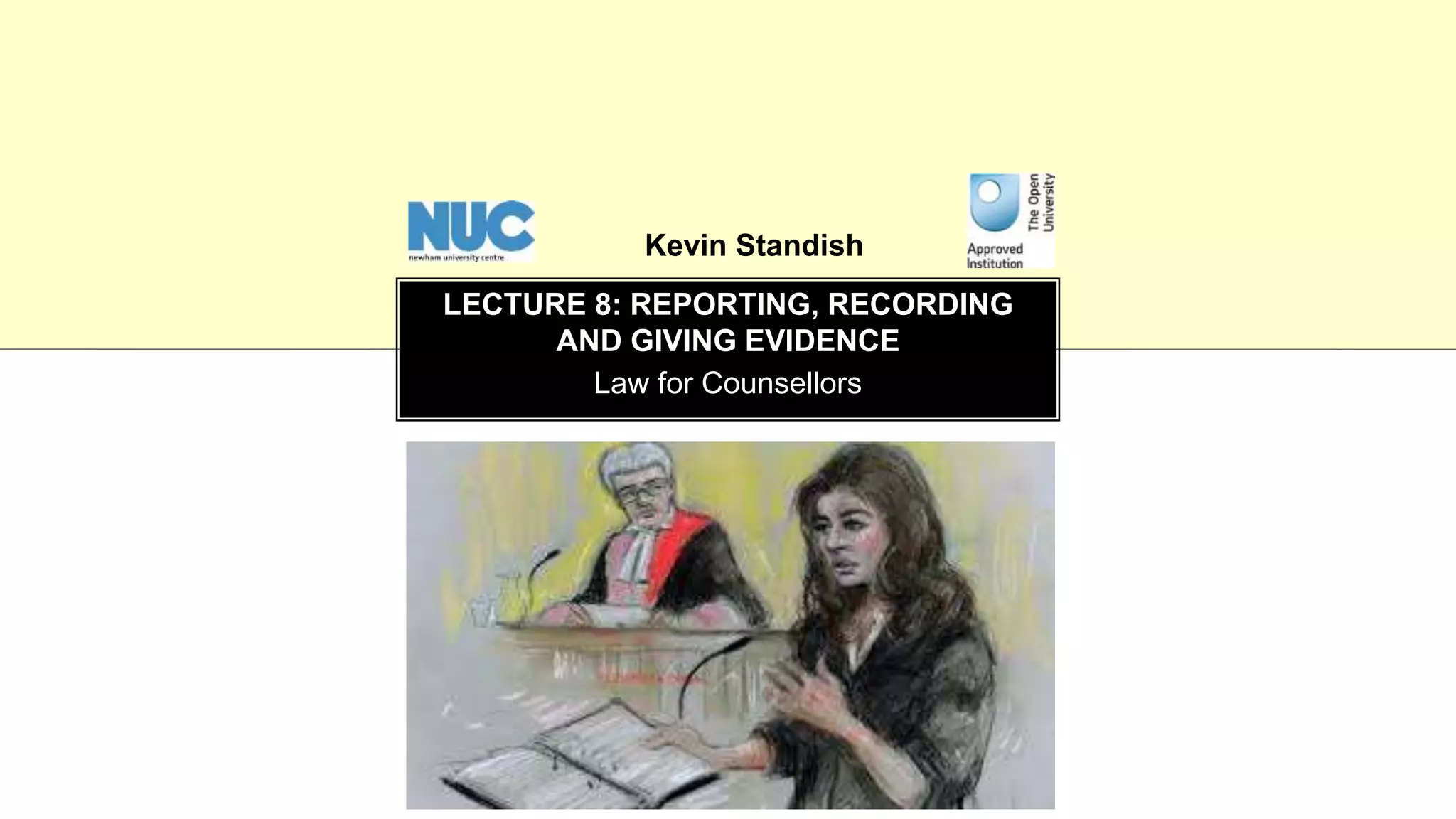
LECTURE 8: REPORTING, RECORDING
AND GIVING EVIDENCE
Kevin Standish
LEARNING OUTCOMES
Part A: Therapist in Legal System
1. Writing Reports
2. Appearing as a Witness
Part B Working with clients involved in the law
1. Counselling Child Witnesses
2. Counselling Adult Victims and Witnesses
INTRODUCTION
1. Therapists will come into contact with the courts only in
exceptional circumstances. Yet these may occur from time to time,
and could include:
• attending Coroner’s Court following the suicide of a client;
• supporting a client taking legal action against alleged abusers,
either via a criminal prosecution or in a civil case for damages;
• providing pre-trial therapy for a vulnerable client;
• being called as a witness;
• acting as an expert witness;
• undertaking judicial review of a decision or policy
1. Criminal Psychology is the study of criminal behaviour (Howitt, 2009).
The term “forensic” is generally used to refer to psychologists who work with
offenders, and/or victims of crime. Forensic psychology is concerned with
the application of psychological principles within the judicial system, as it
examines the interface between criminal justice and psychology.
2. Wrightsman (2001) regards forensic psychology as “any application of
psychological knowledge or methods to a task faced by the legal system”.
3. The focus of this course places an emphasis on the practical application
of psychological theory in a forensic environment. The course aims to train
students to apply psychological insights, concepts and skills to the
understanding and functioning of the legal and criminal justice system.
FORENSIC PSYCHOLOGY – AN INTRODUCTION
Haward (1981) – Forensic Psychology – roles of psychologists in criminal
proceedings include clinical, experimental, actuarial and advisory roles.
Clinical Role – Clinical interviewing, psychological assessments/evaluations,
question of psychological disorder, psychometric testing, etc.
Experimental Role – Experiments for the defence/prosecution –eye witness
testimony.
Actuarial Role – Statistical probabilities to behavioural data. Probabilistic
reasoning. The incidence of a given human event in an appropriate sample of
the population, i.e. young male drivers.
Advisory Role – Examining the evidence of other experts. Advice to
defence/prosecution. Investigative psychology.
ROLES OF THE FORENSIC PSYCHOLOGIST
WHAT DOES A FORENSIC PSYCHOLOGIST DO?
1.Forensic Psychologists are involved in the
practical application of psychology in forensic
environments They generally work with
offenders and/or victims of crime
2. Where? – Prisons, hospitals, law enforcement
settings, court.
3. Who? – Juvenile offenders, paedophiles,
spousal abusers, psychopaths, terrorists, those
suffering from mental disorder, homicidal
offenders, stalkers, sex offenders, etc.
4. Liaison with those that are involved in the
criminal justice system – offenders, police, legal
profession, courts, prisons, probation and
welfare service, victim support, NGO’s,
criminologists, social workers, hospitals.
1. Tasks include:
 Eyewitness testimony.
 Clinical interviews.
 Psychological tests.
 Forensic profiling.
 Risk Assessments.
 Treatment – i.e. cognitive
behavioural programmes, therapy, etc.
 Academia and research
 Jury selection.
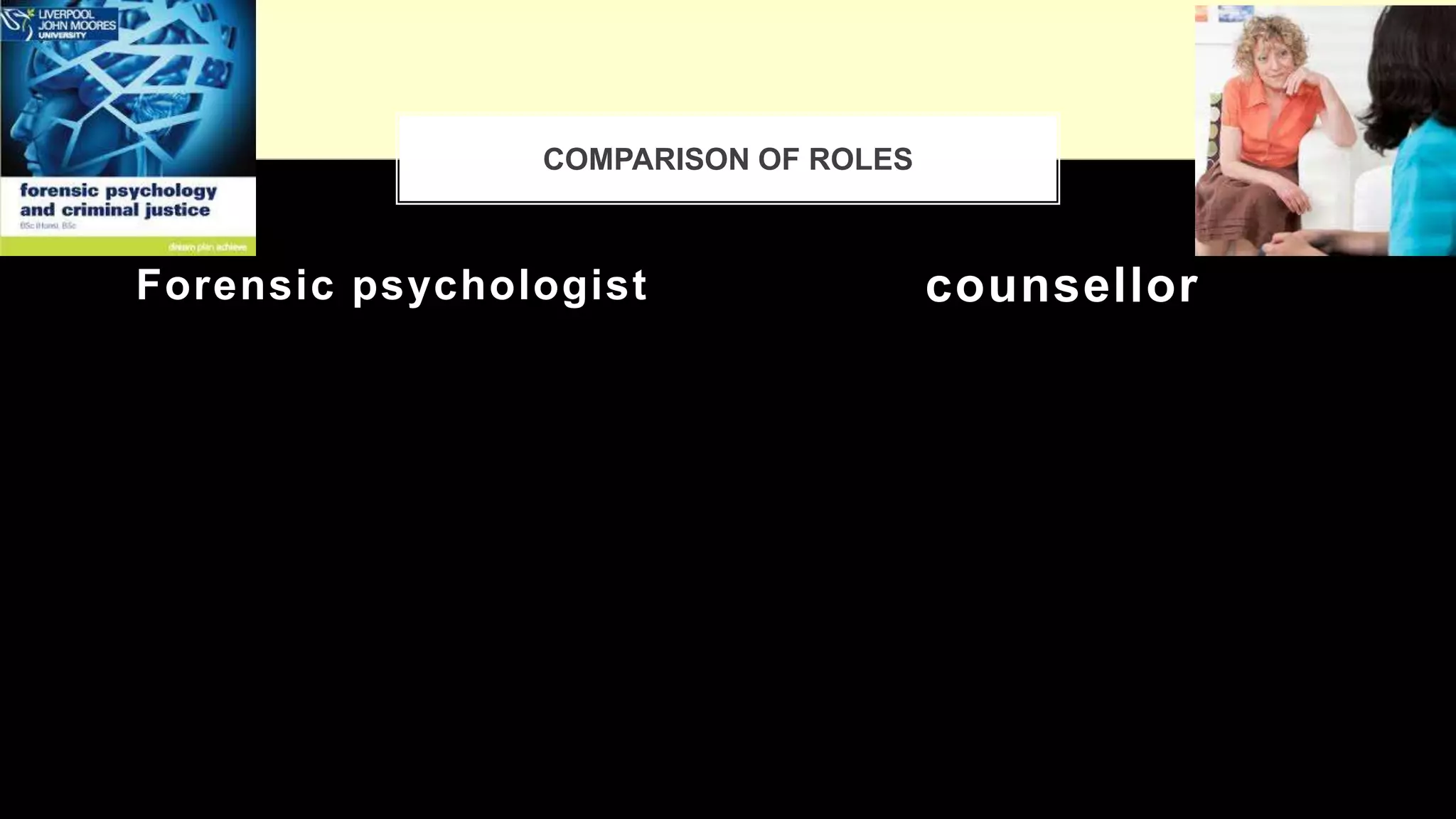
Forensic psychologist counsellor
COMPARISON OF ROLES
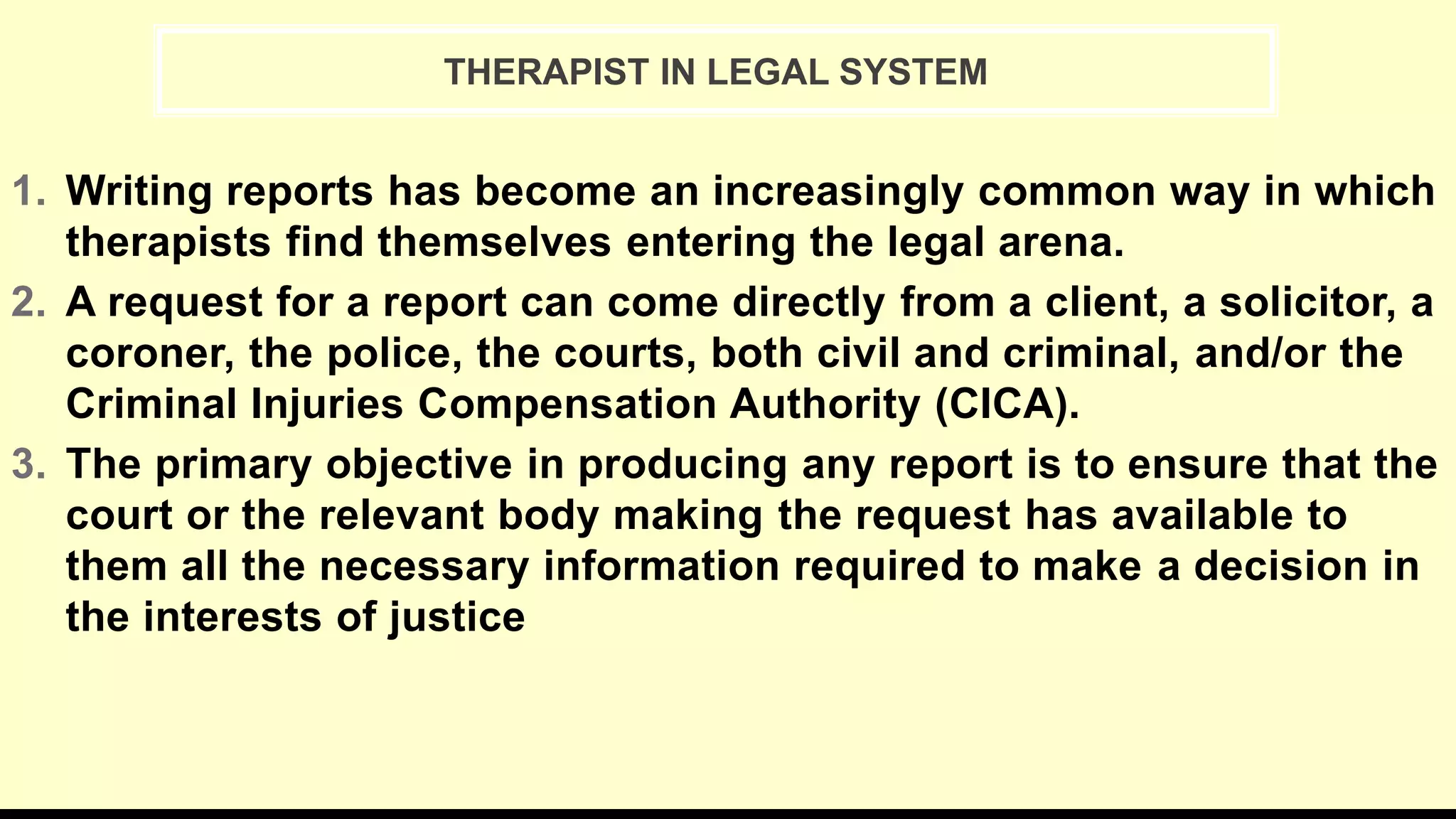
PART A: THERAPIST IN LEGAL SYSTEM
WRITING REPORTS
APPEARING AS A WITNESS
1. Writing reports has become an increasingly common way in which
therapists find themselves entering the legal arena.
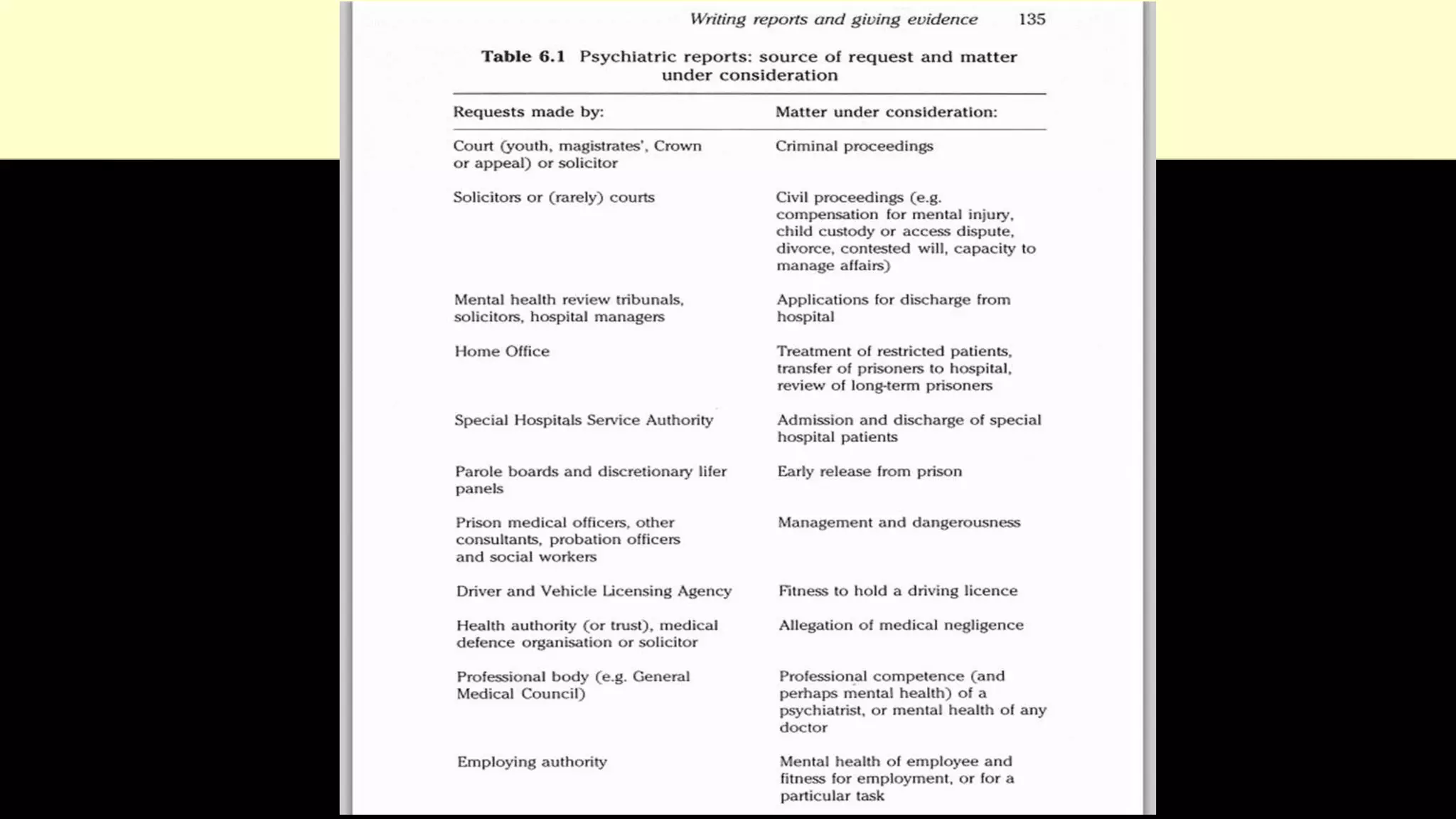
2. A request for a report can come directly from a client, a solicitor, a
coroner, the police, the courts, both civil and criminal, and/or the
Criminal Injuries Compensation Authority (CICA).
3. The primary objective in producing any report is to ensure that the
court or the relevant body making the request has available to
them all the necessary information required to make a decision in
the interests of justice
THERAPIST IN LEGAL SYSTEM
• Preparing reports for the legal system involves significantly different
approaches to those involved in producing therapeutic case studies for
training and professional development.
General principles to consider when preparing reports
1. The document will be read by a busy and sometimes impatient person
who is accustomed to listening and reading concise details of legally
significant facts.
2. In the context of a courtroom, a judge cherishes clarity and brevity in
order to be able to focus on the relevant issues.
3. Reports need be set out so that arguments can be logically drawn from
them.
4. The judge will be wary of flattery, incompleteness or anything with a
hint of emotional manipulation.
WRITING GENERAL COURT REPORT
5. It is imperative that therapists stay focused on the purpose of the
report and include only the information that is required to achieve that
purpose. You should strive to remain as impartial as possible.
6. Words or phrases that have been so overused that they have lost their
meaning need to be avoided. For example the phrase ‘behavioural
problem’ can be used to describe everything from fidgeting to arson
and, therefore, may convey very little to the reader.
7. Therapists are trained to communicate with clients in gentle and
supportive terms…..This style of communication is not appropriate
when writing a report for the court. It is advisable to stay factual,
focused and to avoid glossing over problems.
8. Reading through the text out loud helps to identify what has actually
been written but may not have been intended. Our ears detect things
that our eyes or computer can miss. Aim to produce short, simple
sentences that fully express a single idea
GENERAL PRINCIPLES TO CONSIDER WHEN PREPARING
GENERAL COURT REPORTS
1. Expert reports is that experts not only report the facts known to
them but also give opinions about possible interpretations of
those facts.
2. There is no fixed test to qualify as an author of an expert report.
3. Anyone who has special expertise in an area can be considered as
an expert.
4. Expertise does not depend on qualifications alone, although
frequently the expert will be highly qualified in his or her field.
Extensive experience in the field can be considered “expert”.
5. The expert’s overriding duty is to the court:
• They report on matters that are not within the common knowledge of
the court.
• Assist in the task of resolving a dispute or examining a situation.
• Ensure the court has access to specialist information from an
impartial and independent source
EXPERT REPORTS
1. The independent nature of the expert witness is an important characteristic
2. When clients have asked their own therapists to write an ‘expert report’ for
use in court. The therapists would need to make the following clear to their
clients:
• A report put to the court by an independent expert who has never treated the
client, will normally carry more weight than an ‘expert’ report put forward by
the treating therapist, especially if the purpose of the report is to provide an
assessment.
• • In some circumstances, an expert report from a treating therapist may be
requested, especially for proceedings concerning children and families
where it is considered that increasing the number of professionals involved
with the family would be disruptive to the best interests of the children.
• • Clients need to know that the expert’s responsibility is to the court and that
they have responsibility to report all relevant facts, whether or not they are
advantageous to the client
EXPERT REPORTS
When writing the report it is important to be mindful that the report could be used in
evidence and care should be taken to make it inclusive of all relevant facts.
A report of this nature must comply with the following:
1. It should be addressed to the court and not to the party from whom you have
received your instructions.
2. Set out your qualifications and sometimes your experience that qualifies you to be
an expert.
3. State your sources of information, documentary and in person, typically by
interviewing the person concerned.
4. Contain a section which sets out the substance of all the facts known to you that
are relevant to the case. It is important to be attentive to distinguishing fact from
opinion in all expert reports but especially when the report is from a treating
therapist. Facts are determined by objective standards and processes. This will
usually exclude the subjective experience of the therapist.
5. Distinguish facts that are known directly to you from facts that are reported to you
and state the sources of the latter.
THE STRUCTURE OF AN EXPERT REPORT
6. Give your professional opinion based on the facts and on reasoned
analysis.
7. Where a fact could support several opinions, state all of these possible
opinions and give reasoned argument in favour of any preferred
opinion (sometimes it is not possible to choose a single opinion).
Indicating the types of facts required to resolve a choice between
possible opinions may help the court carry out its task and to obtain
the missing information.
8. Give details of any literature or other material which you have relied
upon in making the report
9. Provide a summary of the conclusions reached.
10. Include a statement of truth confirming that you understand that your
duty is to the court, and that you have complied with that duty
THE STRUCTURE OF AN EXPERT REPORT
APPEARING AS A WITNESS
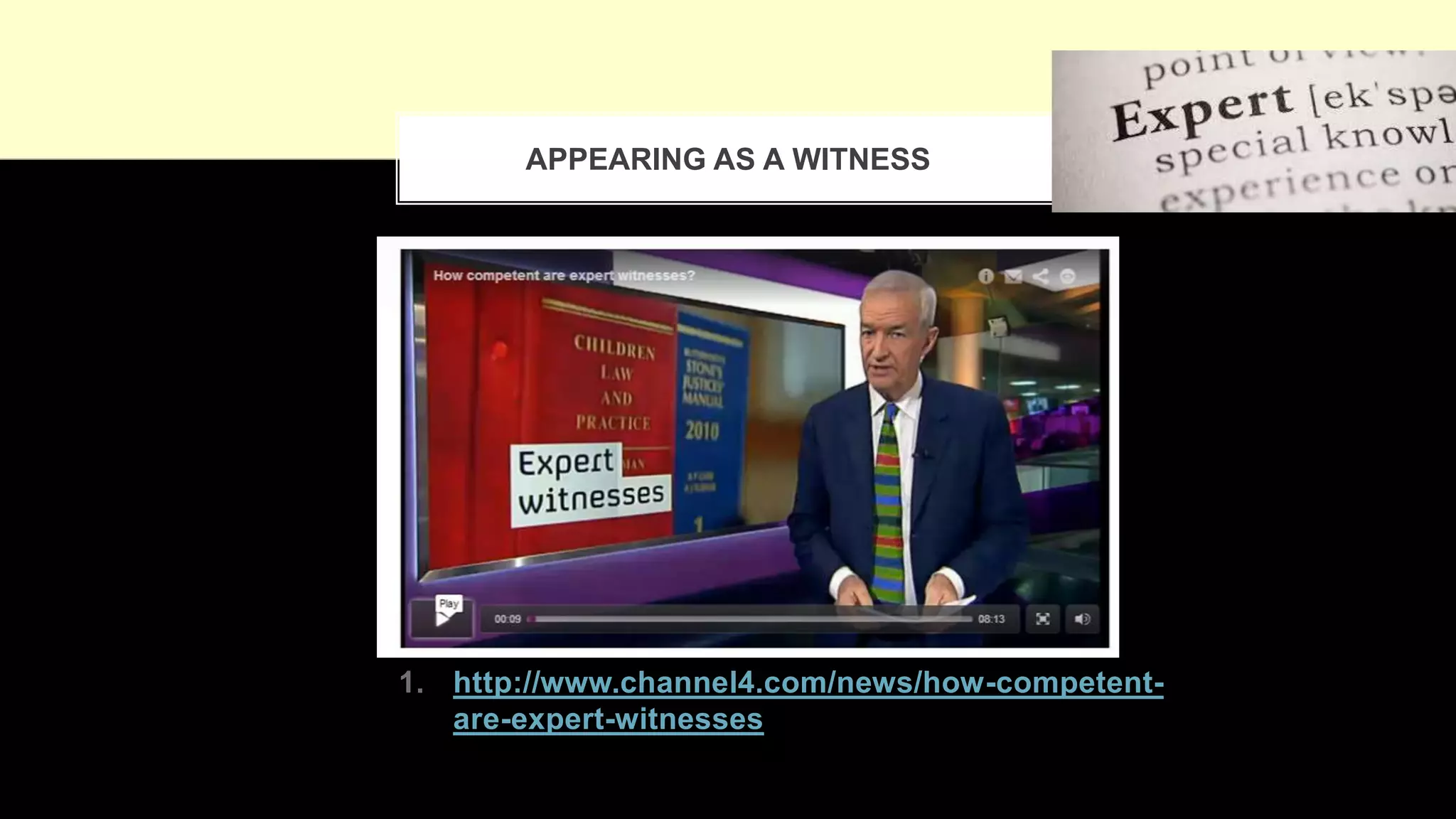
1. http://www.channel4.com/news/how-competent-
are-expert-witnesses
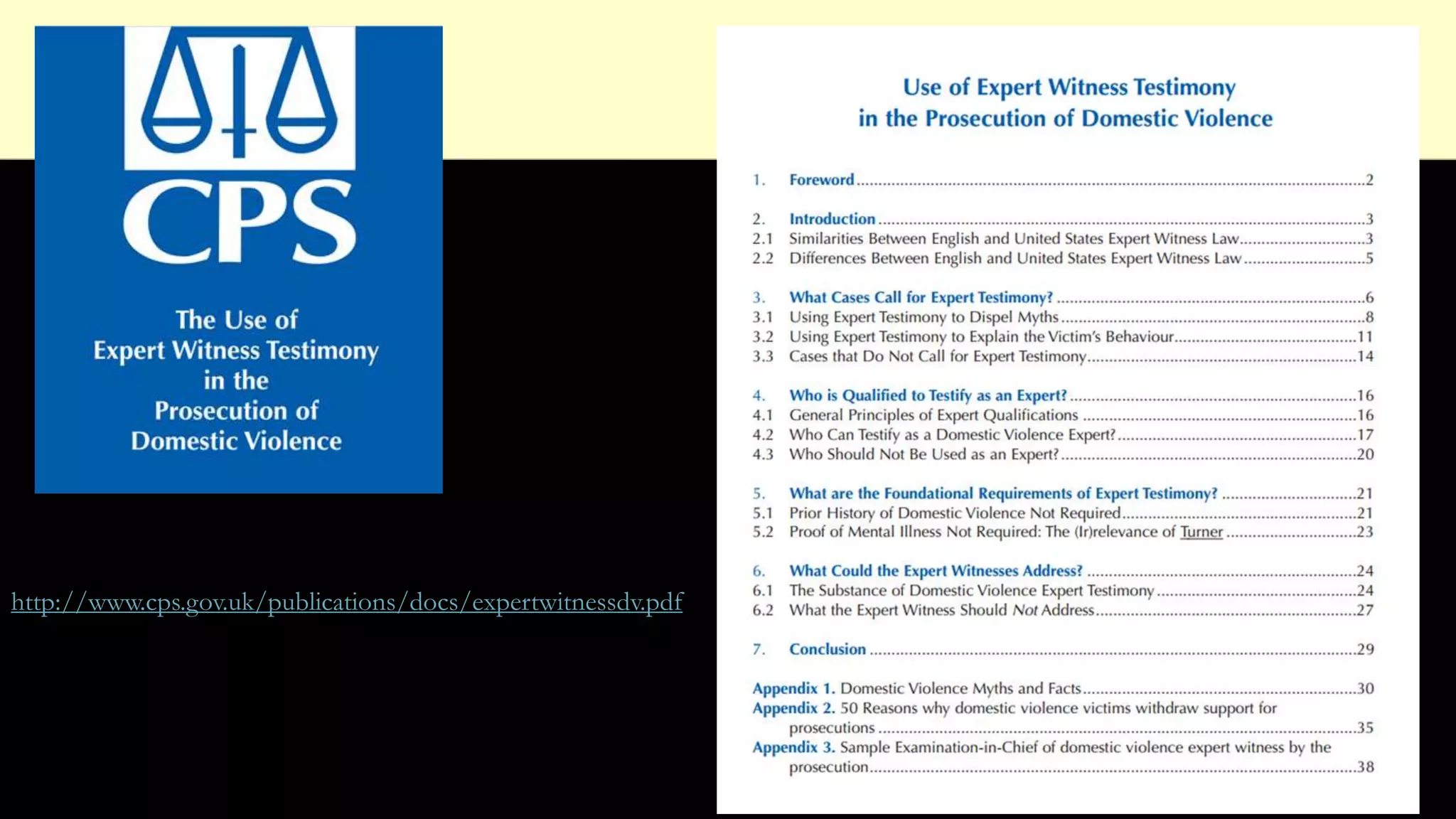
http://www.cps.gov.uk/publications/docs/expertwitnessdv.pdf
1. Being asked to give evidence can be a daunting prospect for therapists as the law
frequently requires that any fact, which needs to be proved, is to be established by
giving oral evidence in public, particularly in criminal cases.
2. The court could require your counselling notes and content of sessions to be
examined by a court at some time in the future; in such cases you can be compelled
to attend as a witness. One of the purposes of a judicial trial is to establish a true
version of events and the court can compel your attendance if it feels that without
your evidence a fair trial would not be possible
3. Important to distinguish between being a witness of fact and an expert witness.
4. A witness of fact is someone who is called to give evidence about what happened in
a case. They are asked to recall what they saw or heard during an incident but not
to give opinions. There is a requirement to discuss the facts they remember or have
recorded in notes.
5. In the context of counselling a therapist may say that a client was present at a
specified time and date for the purpose of counselling. Evidence of facts also
include those which therapists have observed in the session.
6. You cannot refuse to attend court as a witness of fact.
APPEARING AS A WITNESS
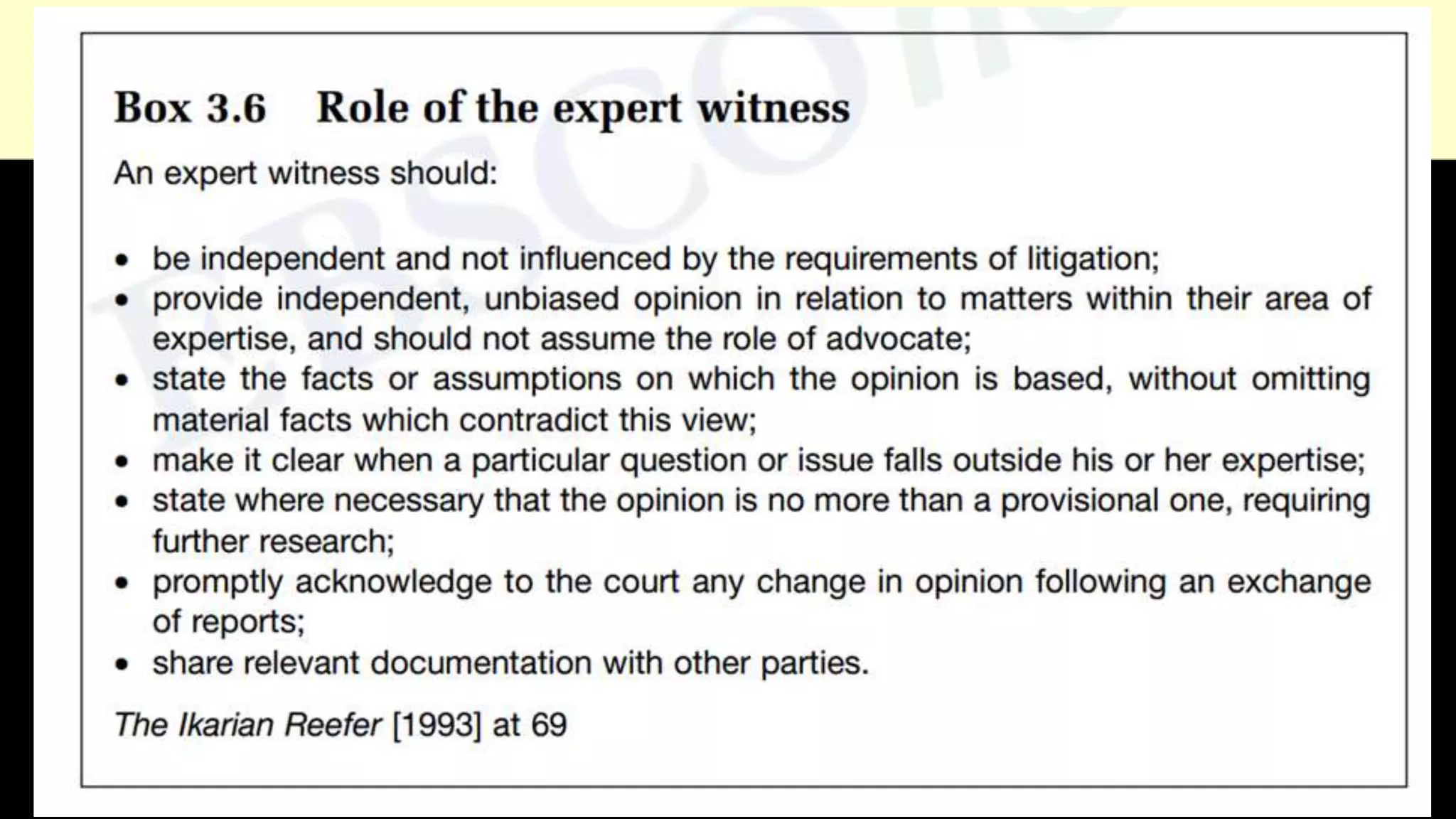
1. Expert opinion is allowed on matters not within the common
knowledge of the court.
2. Expert witnesses should be individuals with qualifications and
experience which equip them to give opinions on the facts of the
case.
3. A therapist who is called to give evidence in an expert capacity
needs to ensure their independence from the case, despite being
paid by one of the parties to give evidence.
4. You can refuse to act as an expert witness.
APPEARING AS AN EXPERT WITNESS
1. Inadequate instructions from a solicitor.
2. Failure to deliver independent or impartial advice. Ensure it is the
therapist’s opinion and not the solicitor’s or that of anyone else.
3. Failure or lack of communication between the solicitor and the
expert.
4. Failure to have a written contract which agrees what service the
therapist is providing for the instructing solicitors.
5. Breaching confidentiality and defamation of an individual in the
report.
6. Technical errors.
7. Failing to acknowledge other possibilities
THE COMMON PROBLEMS AND PITFALLS IN RELATION TO
EXPERT WITNESSES
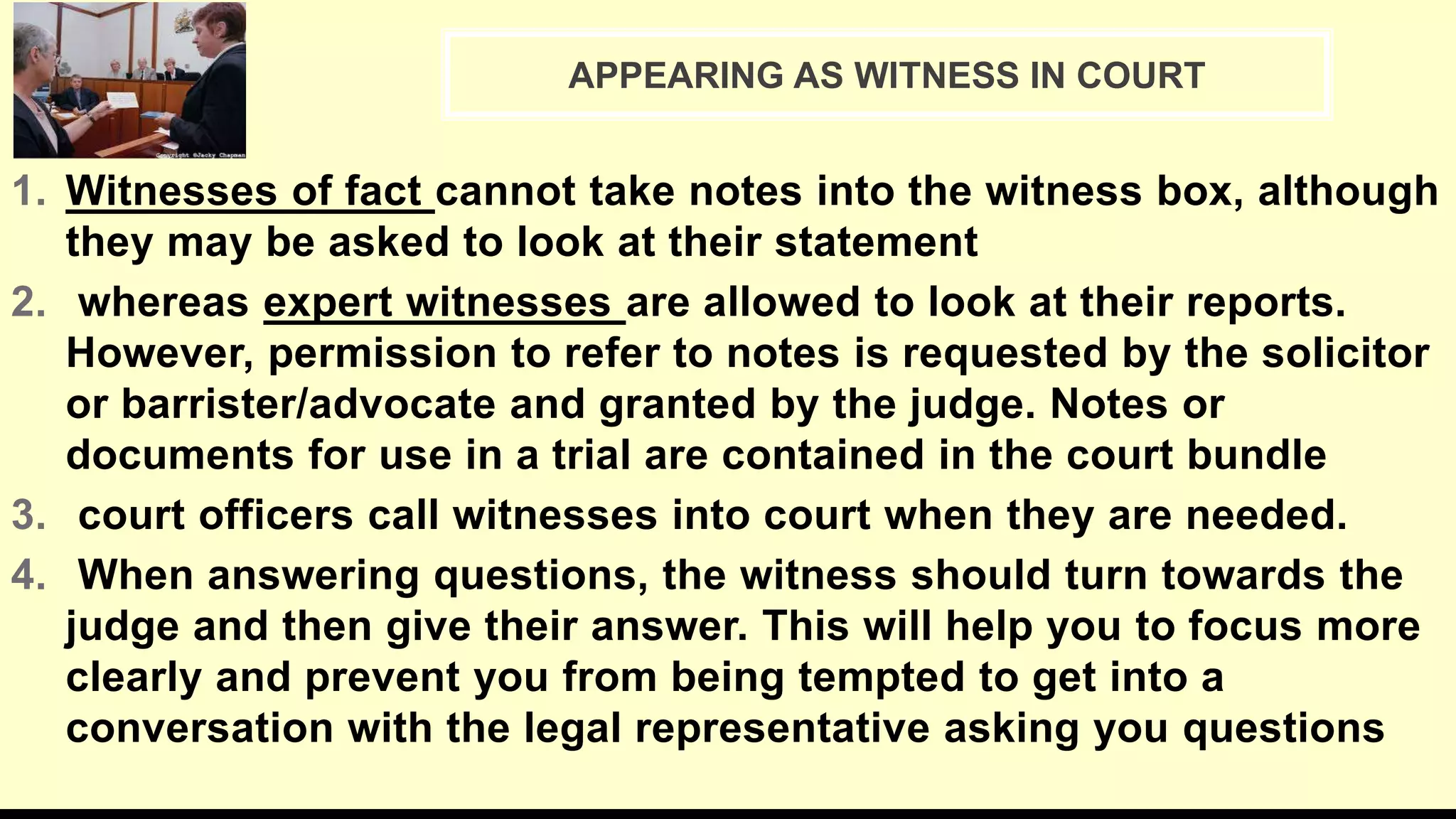
1. Witnesses of fact cannot take notes into the witness box, although
they may be asked to look at their statement
2. whereas expert witnesses are allowed to look at their reports.
However, permission to refer to notes is requested by the solicitor
or barrister/advocate and granted by the judge. Notes or
documents for use in a trial are contained in the court bundle
3. court officers call witnesses into court when they are needed.
4. When answering questions, the witness should turn towards the
judge and then give their answer. This will help you to focus more
clearly and prevent you from being tempted to get into a
conversation with the legal representative asking you questions
APPEARING AS WITNESS IN COURT
1. The judge or magistrates will note the following with regard to expert evidence:
• The precision and accuracy of thought as demonstrated by the answers.
• The response to searching and informed cross-examination.
• The extent to which a witness faces up to and accepts the logic of a proposition put in
cross-examination or is prepared to defend valid opinions or concede points that are
seen to be incorrect.
2. Examination-in-chief
This is the process whereby a witness is questioned by the legal representative who
has called them as a witness.
3. Cross-examination
This is where the opposition’s legal representation will question the witness.
4. Re-examination
This does not always take place in a hearing but is an option for the legal
representative if they wish to have something clarified or to remind the court of the
significance of the evidence that has been given.
APPEARING AS WITNESS IN COURT
PART B: WORKING WITH CLIENTS INVOLVED IN
THE LAW:
COUNSELLING CHILD WITNESSES
COUNSELLING ADULT VICTIMS AND WITNESSES
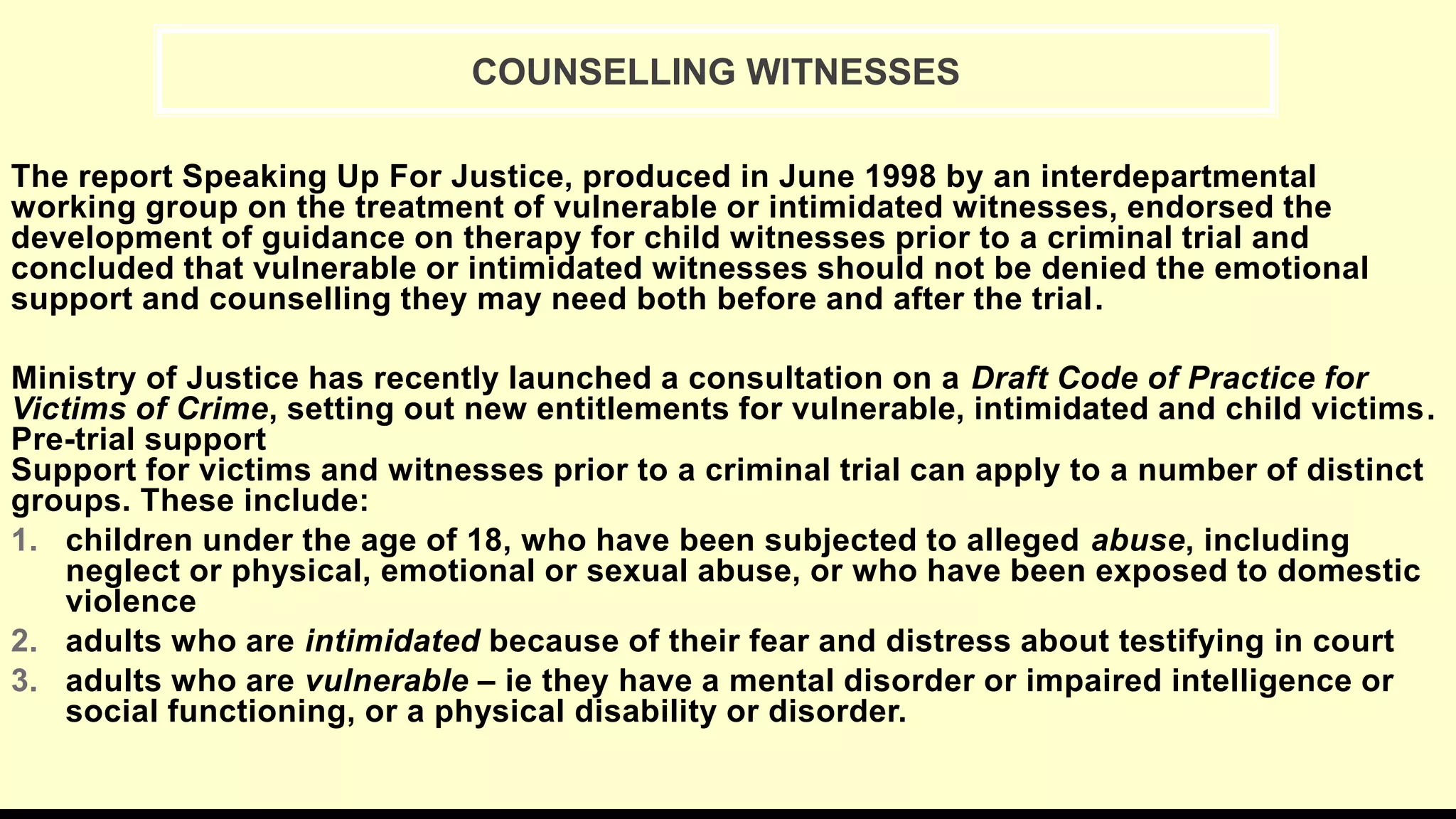
The report Speaking Up For Justice, produced in June 1998 by an interdepartmental
working group on the treatment of vulnerable or intimidated witnesses, endorsed the
development of guidance on therapy for child witnesses prior to a criminal trial and
concluded that vulnerable or intimidated witnesses should not be denied the emotional
support and counselling they may need both before and after the trial.
Ministry of Justice has recently launched a consultation on a Draft Code of Practice for
Victims of Crime, setting out new entitlements for vulnerable, intimidated and child victims.
Pre-trial support
Support for victims and witnesses prior to a criminal trial can apply to a number of distinct
groups. These include:
1. children under the age of 18, who have been subjected to alleged abuse, including
neglect or physical, emotional or sexual abuse, or who have been exposed to domestic
violence
2. adults who are intimidated because of their fear and distress about testifying in court
3. adults who are vulnerable – ie they have a mental disorder or impaired intelligence or
social functioning, or a physical disability or disorder.
COUNSELLING WITNESSES
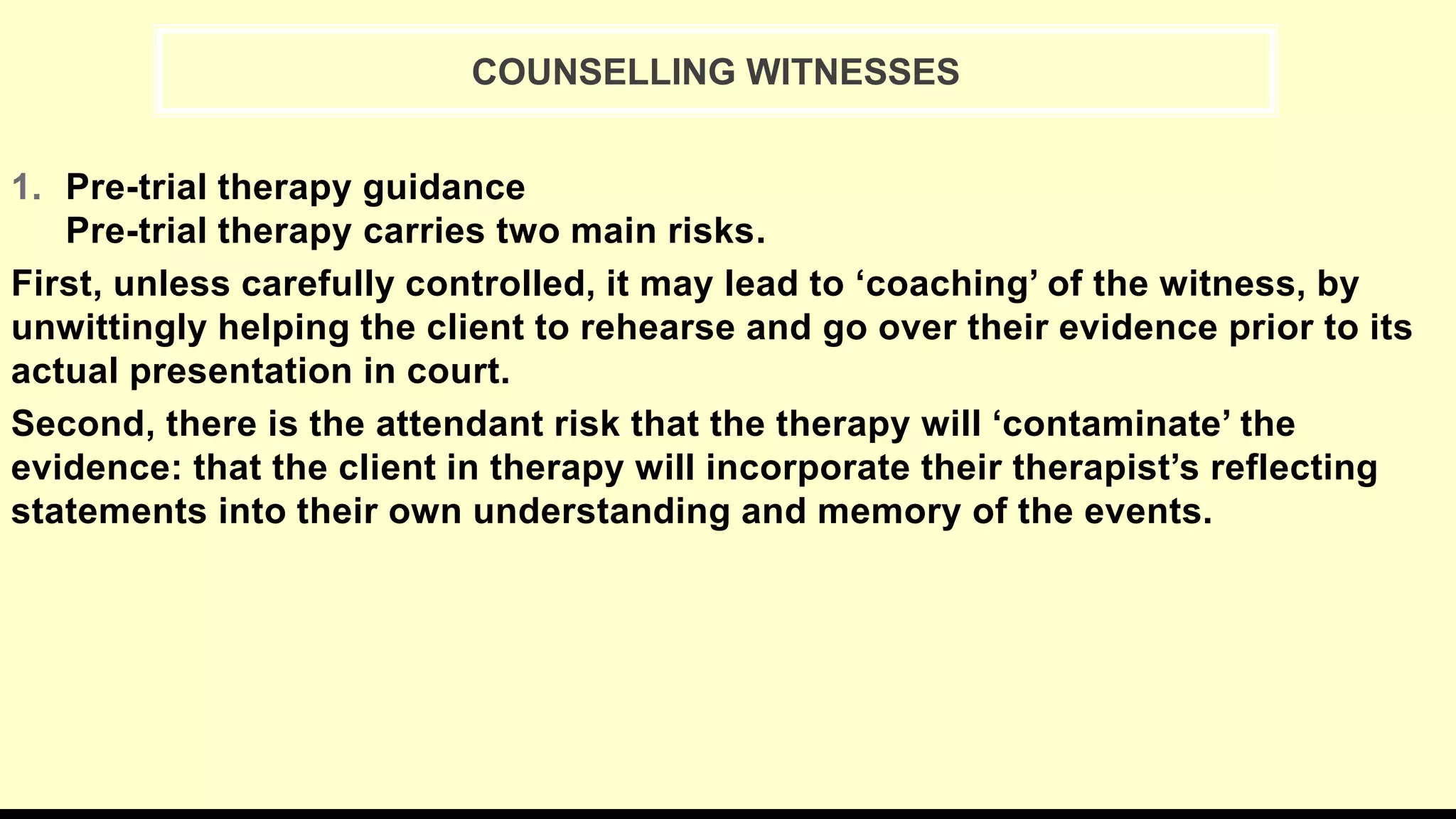
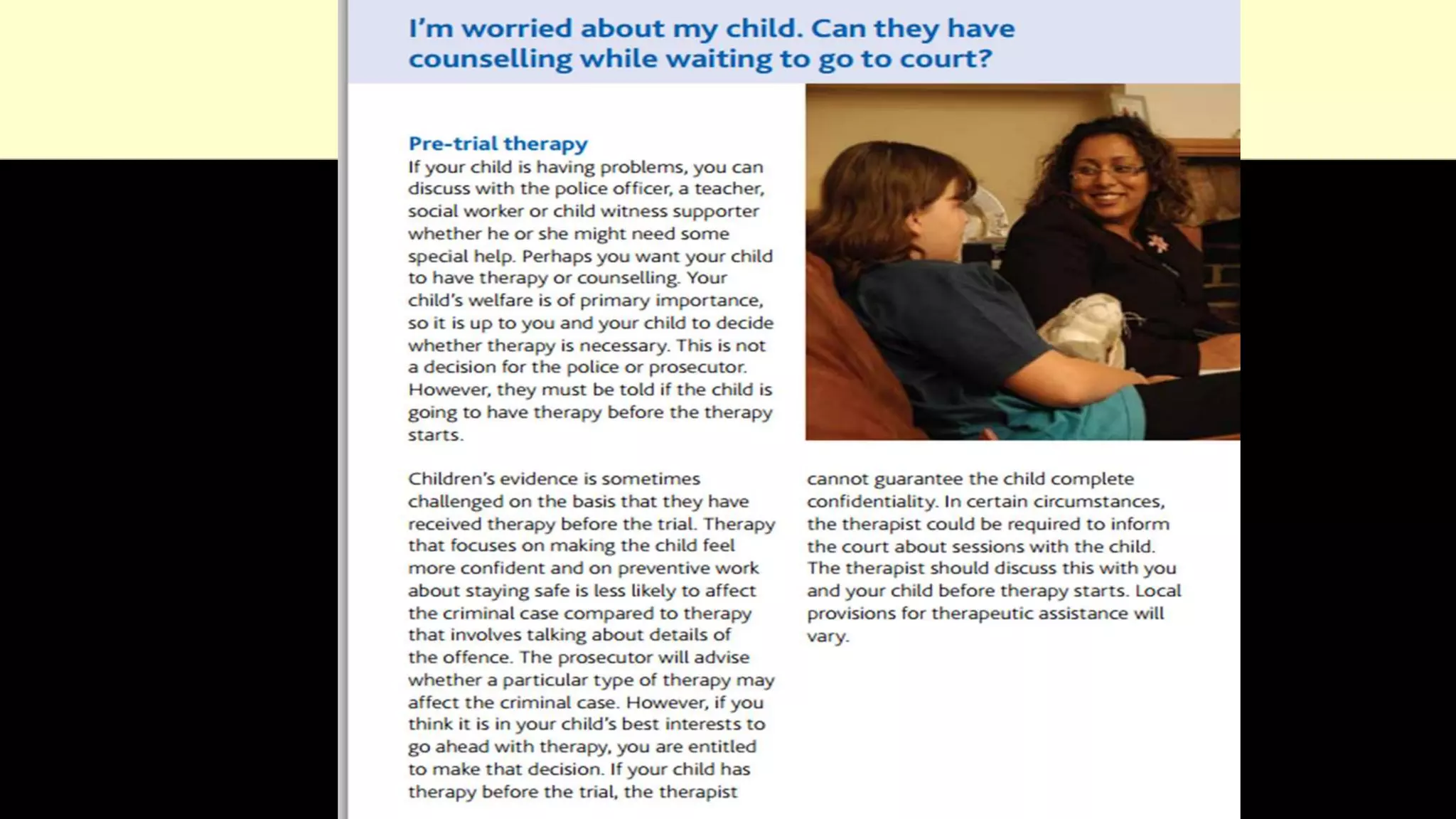
1. Pre-trial therapy guidance
Pre-trial therapy carries two main risks.
First, unless carefully controlled, it may lead to ‘coaching’ of the witness, by
unwittingly helping the client to rehearse and go over their evidence prior to its
actual presentation in court.
Second, there is the attendant risk that the therapy will ‘contaminate’ the
evidence: that the client in therapy will incorporate their therapist’s reflecting
statements into their own understanding and memory of the events.
COUNSELLING WITNESSES
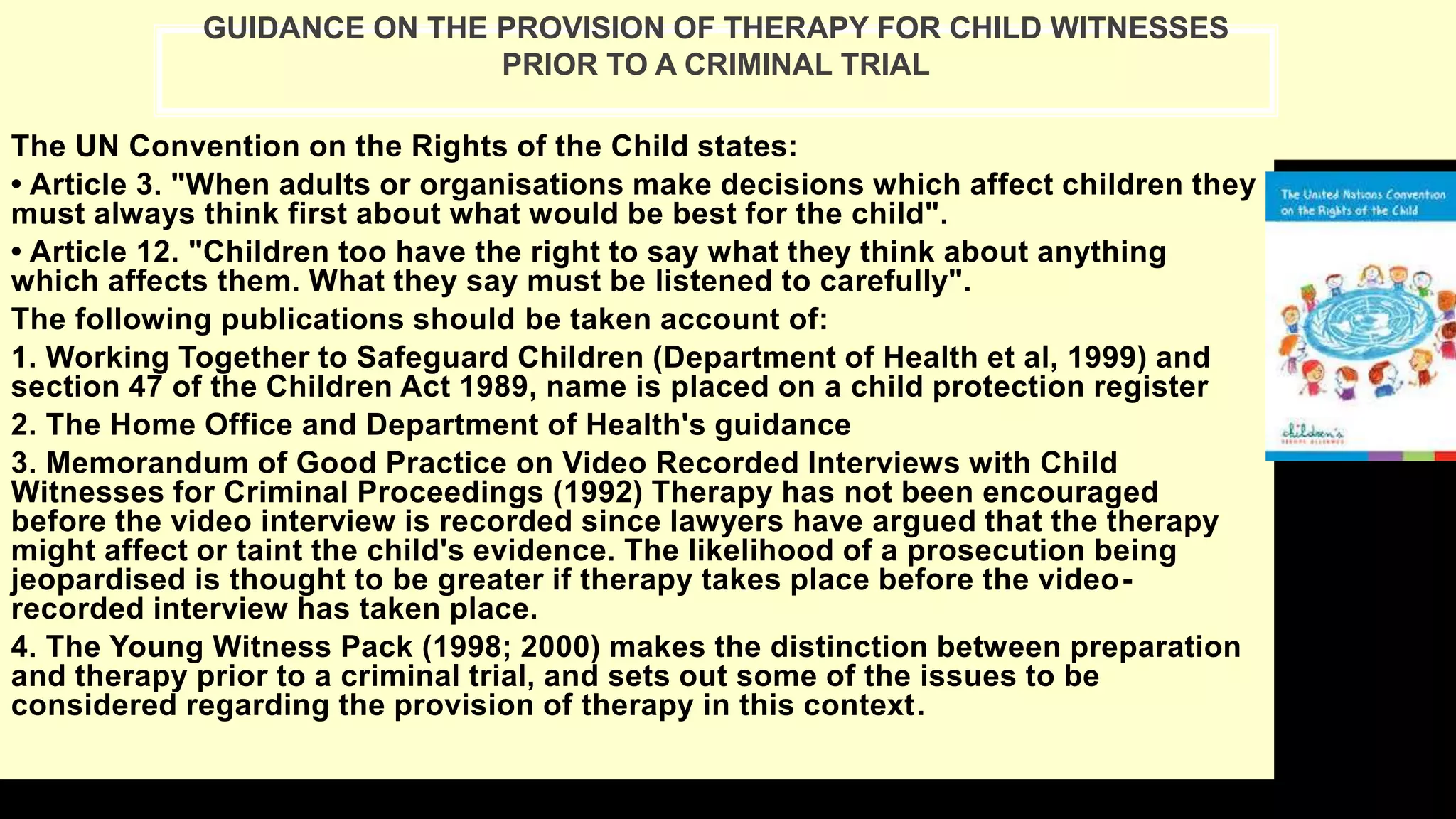
The UN Convention on the Rights of the Child states:
• Article 3. "When adults or organisations make decisions which affect children they
must always think first about what would be best for the child".
• Article 12. "Children too have the right to say what they think about anything
which affects them. What they say must be listened to carefully".
The following publications should be taken account of:
1. Working Together to Safeguard Children (Department of Health et al, 1999) and
section 47 of the Children Act 1989, name is placed on a child protection register
2. The Home Office and Department of Health's guidance
3. Memorandum of Good Practice on Video Recorded Interviews with Child
Witnesses for Criminal Proceedings (1992) Therapy has not been encouraged
before the video interview is recorded since lawyers have argued that the therapy
might affect or taint the child's evidence. The likelihood of a prosecution being
jeopardised is thought to be greater if therapy takes place before the video-
recorded interview has taken place.
4. The Young Witness Pack (1998; 2000) makes the distinction between preparation
and therapy prior to a criminal trial, and sets out some of the issues to be
considered regarding the provision of therapy in this context.
GUIDANCE ON THE PROVISION OF THERAPY FOR CHILD WITNESSES
PRIOR TO A CRIMINAL TRIAL
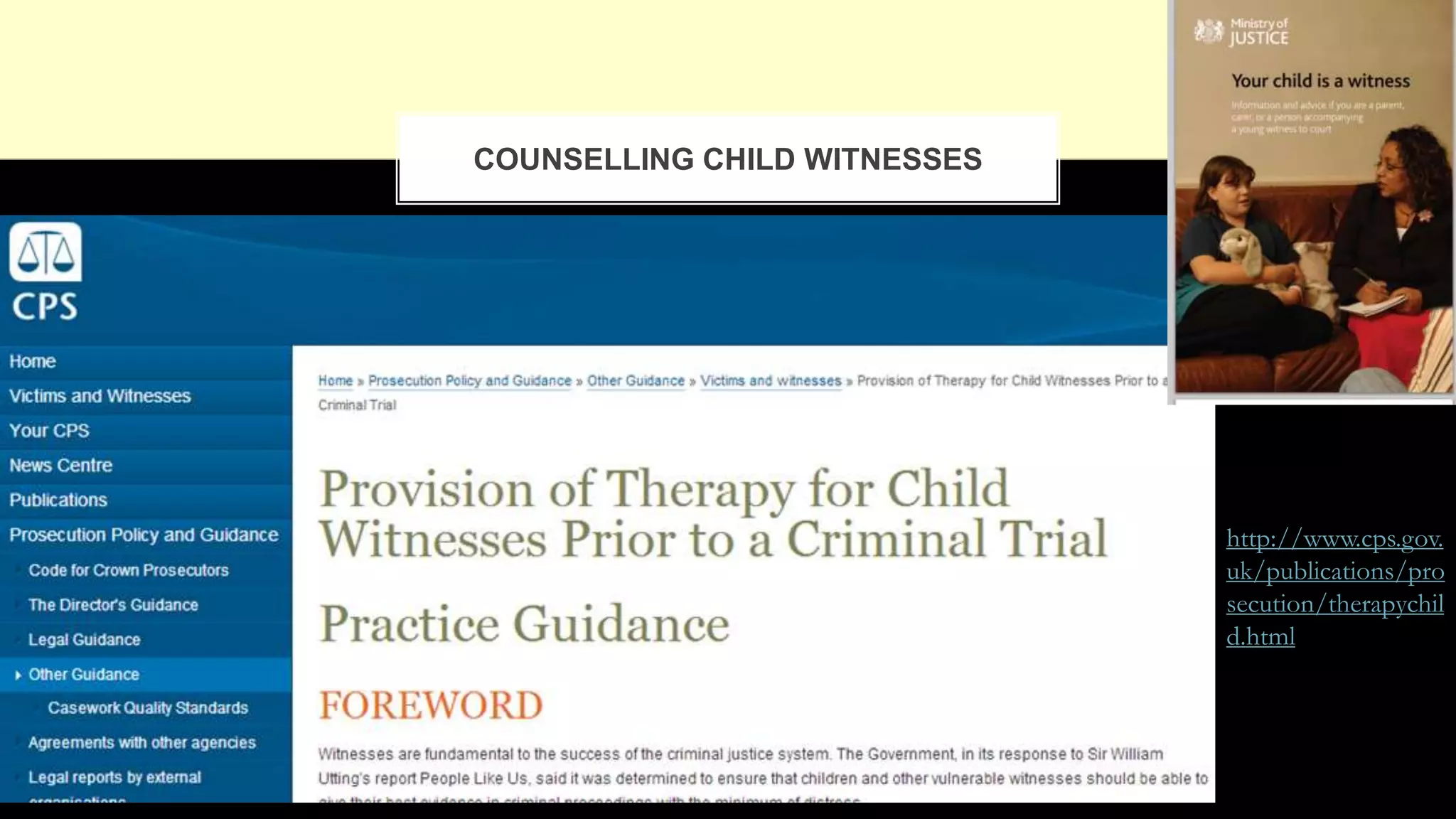
COUNSELLING CHILD WITNESSES
http://www.cps.gov.
uk/publications/pro
secution/therapychil
d.html
• Therapists working with child victims and witnesses of crime have to cope
with the emotional impact of their ordeal at the hands of their perpetrator,
while having to deal with the traumatic experience of coming into contact with
law enforcement agencies and taking legal action against their offender.
• Described as secondary victimisation at the hands of the legal system
• Even where therapists attempt to help clients in addressing and resolving
these problems, their efforts are hampered by the constraints of legal rules
relating to the contamination of evidence
• Furthermore, where a trial is still ongoing, the therapist is sometimes drawn
into the proceedings through requests for notes, attendance at court as a
witness and reports
• Three areas which therapists need to consider when counselling child victims
and witnesses of crime:
1. Secondary traumatisation and the role of therapy.
2. Pre-trial therapy and the risk of contaminating evidence.
3. Involvement of therapists in the legal process
COUNSELLING CHILD WITNESSES
1. Where a child has been a victim of physical or sexual abuse, he or she may
have endured a physical examination, often an intimate medical examination
and a video interview conducted by police and social services within a very
short space of time. In such cases therapists need to be particularly sensitive
2. Very often the problems following a traumatic experience are the result of
victims and witnesses being unable to create a coherent narrative, i.e. to
construct a story that makes sense. Giving evidence may provide structure
and encouragement to tell the story that may otherwise be too frightening to
tell.
3. Most child witnesses do not expect to find the experience of giving evidence
as being therapeutic. Standing up in court and re-telling the story can be a
daunting prospect and the growing involvement of children in criminal
proceedings has led to a number of changes in the law.
4. children suffer additional stress in taking part in court proceedings. That
such stress may affect the way they give evidence. That there is nevertheless
a need to bring to justice people who offend against children
SECONDARY TRAUMATISATION AND THE ROLE OF THERAPY.
1. Child witnesses have sometimes been denied access to therapy if
a prosecution is pending.
2. Discussions about the content of evidence prior to a trial may give
rise to questions about the validity of the victim’s evidence.
3. This is not a psychological question about the reliability of the
child’s memory, but a legal question about the perceived
credibility of the evidence
PRE-TRIAL THERAPY AND THE RISK OF CONTAMINATING
EVIDENCE
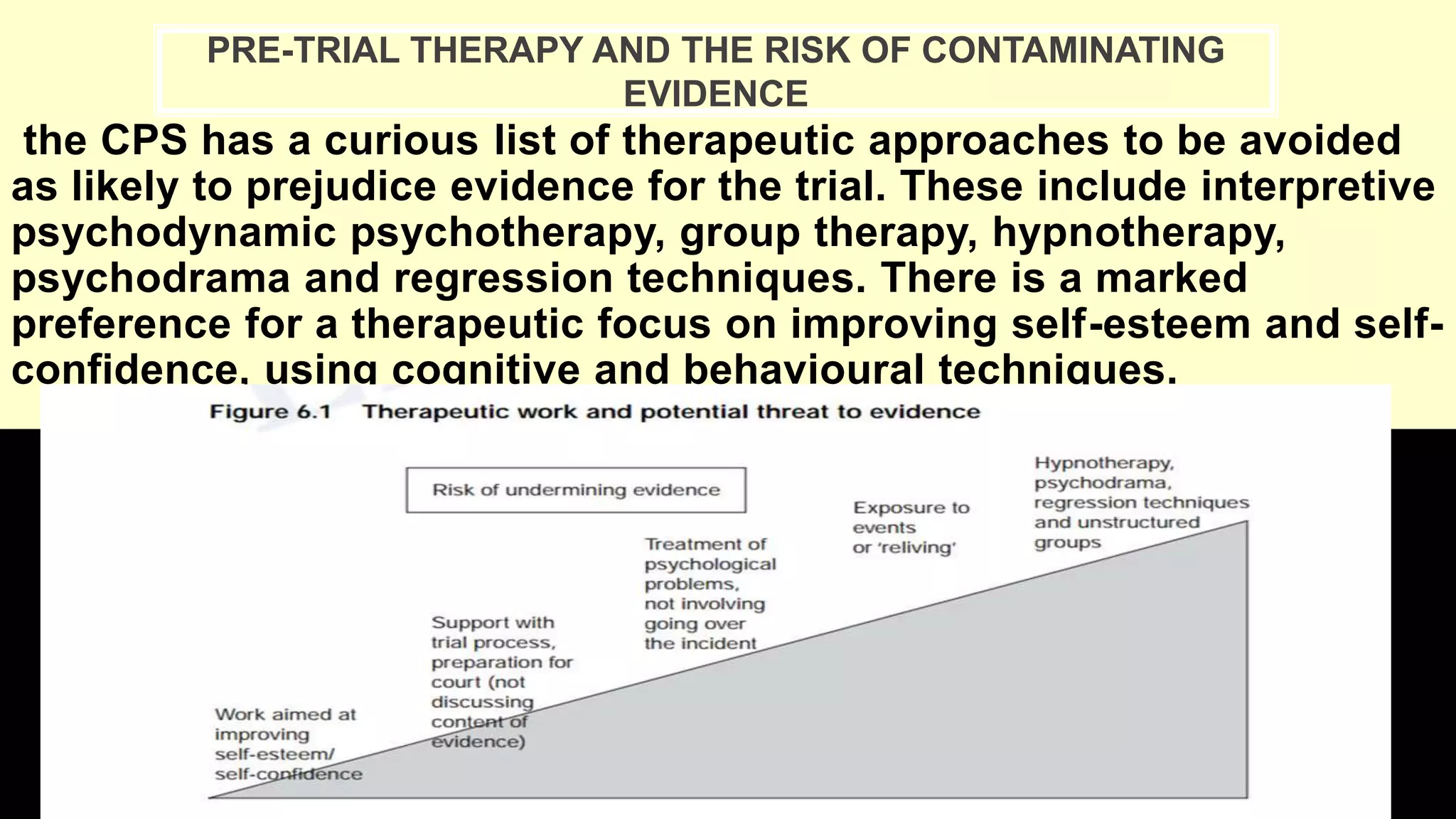
the CPS has a curious list of therapeutic approaches to be avoided
as likely to prejudice evidence for the trial. These include interpretive
psychodynamic psychotherapy, group therapy, hypnotherapy,
psychodrama and regression techniques. There is a marked
preference for a therapeutic focus on improving self-esteem and self-
confidence, using cognitive and behavioural techniques.
PRE-TRIAL THERAPY AND THE RISK OF CONTAMINATING
EVIDENCE
1. issues surrounding the confidential nature of the therapy need to be
addressed by the therapist.
2. As the client’s therapist, you may be asked to complete a report or give
evidence concerning the impact of the crime on the child or young person.
3. This might be as part of a criminal prosecution, or as part of a compensation
claim
4. Therapists may be called on behalf of the prosecution, in their capacity as a
professional witness to give their professional opinion relating to the impact
of a crime on the child.
5. However, therapists are advised against this because the court may
question the impartiality of a therapist who has developed a therapeutic
alliance with a client which may undermine the credibility of the evidence.
6. The court may want answers to questions that were not covered within the
counselling sessions, so the practitioner has to decide how far, if at all, to
stray from their therapeutic agenda in order to meet the needs of the court,
which may or may not be in the client’s best interests.
INVOLVEMENT OF THERAPISTS IN THE LEGAL PROCESS
COUNSELLING ADULT VICTIMS AND WITNESSES
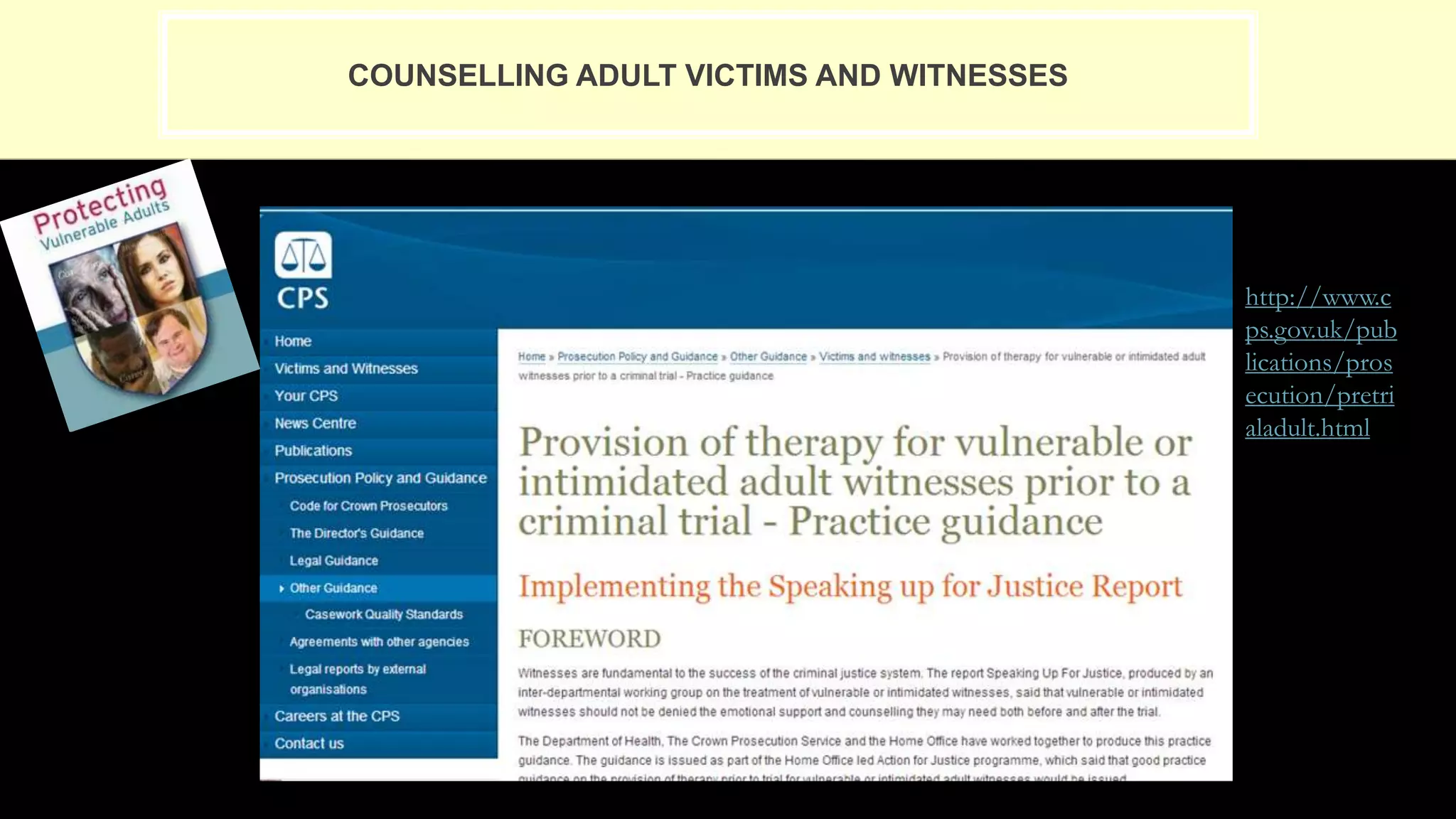
http://www.c
ps.gov.uk/pub
lications/pros
ecution/pretri
aladult.html
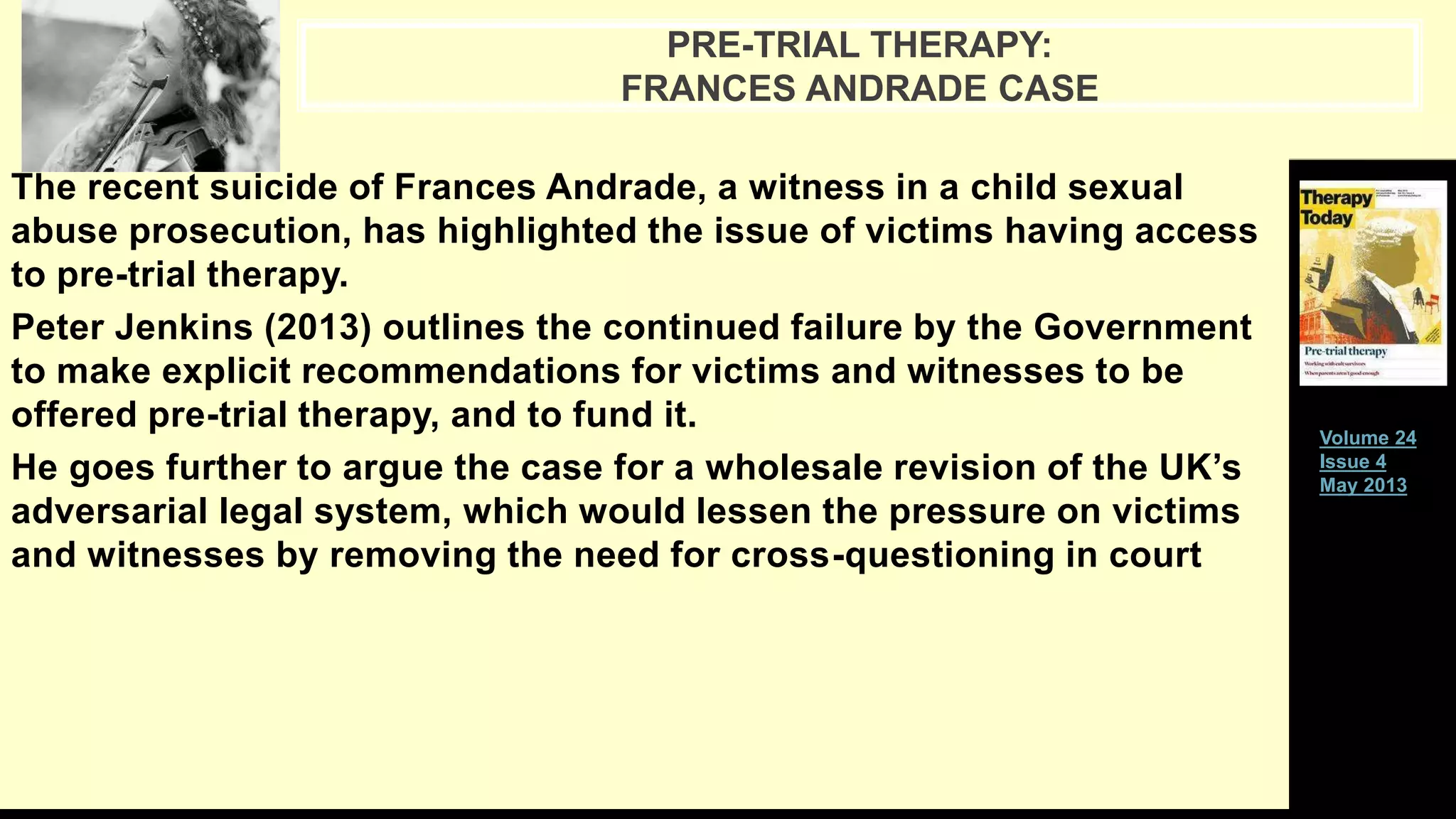
The recent suicide of Frances Andrade, a witness in a child sexual
abuse prosecution, has highlighted the issue of victims having access
to pre-trial therapy.
Peter Jenkins (2013) outlines the continued failure by the Government
to make explicit recommendations for victims and witnesses to be
offered pre-trial therapy, and to fund it.
He goes further to argue the case for a wholesale revision of the UK’s
adversarial legal system, which would lessen the pressure on victims
and witnesses by removing the need for cross-questioning in court
PRE-TRIAL THERAPY:
FRANCES ANDRADE CASE
Volume 24
Issue 4
May 2013
Bond,T.& Sandhu, A. (2005)
1. Chapter 3 - Writing Reports
2. Chapter 4 - Appearing as a Witness
3. Chapter 6 - Counselling Child Witnesses
4. Chapter 7 - Counselling Adult Victims and Witnesses
Mitchels, B. & Bond, T (2011)
1. Chap 10 Forensic Work
Jenkins (2002)
1. Chapter 9 - Counselling in Legal Settings: Provision for Jury
Members, Vulnerable Witness and Victims of Crime
CORE READINGS
1. Tribe, R. & Morrissey, J (editors) (2005) chapter 8 writing a report
for use in court on appearing in court as a health professional
and/or expert witness by Alan Winthrop
2. Jenkins (2002) Chapter 6 - Preparing Reports and Presenting
Evidence in Court: A Guide for Counsellors and Psychotherapists
Journal article
1. Philip Barker & Dr Gary Rolfe (2003) Client and witness: the
provision of therapy for vulnerable or intimidated adult witnesses
prior to a criminal trial: practice guidance
ADVANCED READINGS
Lecture 8 reports and giving evidence in court

Lecture 8 reports and giving evidence in court

  • 1.
    Law for Counsellors LECTURE8: REPORTING, RECORDING AND GIVING EVIDENCE Kevin Standish
  • 2.
    LEARNING OUTCOMES Part A:Therapist in Legal System 1. Writing Reports 2. Appearing as a Witness Part B Working with clients involved in the law 1. Counselling Child Witnesses 2. Counselling Adult Victims and Witnesses
  • 4.
    INTRODUCTION 1. Therapists willcome into contact with the courts only in exceptional circumstances. Yet these may occur from time to time, and could include: • attending Coroner’s Court following the suicide of a client; • supporting a client taking legal action against alleged abusers, either via a criminal prosecution or in a civil case for damages; • providing pre-trial therapy for a vulnerable client; • being called as a witness; • acting as an expert witness; • undertaking judicial review of a decision or policy
  • 5.
    1. Criminal Psychologyis the study of criminal behaviour (Howitt, 2009). The term “forensic” is generally used to refer to psychologists who work with offenders, and/or victims of crime. Forensic psychology is concerned with the application of psychological principles within the judicial system, as it examines the interface between criminal justice and psychology. 2. Wrightsman (2001) regards forensic psychology as “any application of psychological knowledge or methods to a task faced by the legal system”. 3. The focus of this course places an emphasis on the practical application of psychological theory in a forensic environment. The course aims to train students to apply psychological insights, concepts and skills to the understanding and functioning of the legal and criminal justice system. FORENSIC PSYCHOLOGY – AN INTRODUCTION
  • 6.
    Haward (1981) –Forensic Psychology – roles of psychologists in criminal proceedings include clinical, experimental, actuarial and advisory roles. Clinical Role – Clinical interviewing, psychological assessments/evaluations, question of psychological disorder, psychometric testing, etc. Experimental Role – Experiments for the defence/prosecution –eye witness testimony. Actuarial Role – Statistical probabilities to behavioural data. Probabilistic reasoning. The incidence of a given human event in an appropriate sample of the population, i.e. young male drivers. Advisory Role – Examining the evidence of other experts. Advice to defence/prosecution. Investigative psychology. ROLES OF THE FORENSIC PSYCHOLOGIST
  • 7.
    WHAT DOES AFORENSIC PSYCHOLOGIST DO? 1.Forensic Psychologists are involved in the practical application of psychology in forensic environments They generally work with offenders and/or victims of crime 2. Where? – Prisons, hospitals, law enforcement settings, court. 3. Who? – Juvenile offenders, paedophiles, spousal abusers, psychopaths, terrorists, those suffering from mental disorder, homicidal offenders, stalkers, sex offenders, etc. 4. Liaison with those that are involved in the criminal justice system – offenders, police, legal profession, courts, prisons, probation and welfare service, victim support, NGO’s, criminologists, social workers, hospitals. 1. Tasks include:  Eyewitness testimony.  Clinical interviews.  Psychological tests.  Forensic profiling.  Risk Assessments.  Treatment – i.e. cognitive behavioural programmes, therapy, etc.  Academia and research  Jury selection.
  • 8.
  • 9.
    PART A: THERAPISTIN LEGAL SYSTEM WRITING REPORTS APPEARING AS A WITNESS
  • 10.
    1. Writing reportshas become an increasingly common way in which therapists find themselves entering the legal arena. 2. A request for a report can come directly from a client, a solicitor, a coroner, the police, the courts, both civil and criminal, and/or the Criminal Injuries Compensation Authority (CICA). 3. The primary objective in producing any report is to ensure that the court or the relevant body making the request has available to them all the necessary information required to make a decision in the interests of justice THERAPIST IN LEGAL SYSTEM
  • 11.
    • Preparing reportsfor the legal system involves significantly different approaches to those involved in producing therapeutic case studies for training and professional development. General principles to consider when preparing reports 1. The document will be read by a busy and sometimes impatient person who is accustomed to listening and reading concise details of legally significant facts. 2. In the context of a courtroom, a judge cherishes clarity and brevity in order to be able to focus on the relevant issues. 3. Reports need be set out so that arguments can be logically drawn from them. 4. The judge will be wary of flattery, incompleteness or anything with a hint of emotional manipulation. WRITING GENERAL COURT REPORT
  • 12.
    5. It isimperative that therapists stay focused on the purpose of the report and include only the information that is required to achieve that purpose. You should strive to remain as impartial as possible. 6. Words or phrases that have been so overused that they have lost their meaning need to be avoided. For example the phrase ‘behavioural problem’ can be used to describe everything from fidgeting to arson and, therefore, may convey very little to the reader. 7. Therapists are trained to communicate with clients in gentle and supportive terms…..This style of communication is not appropriate when writing a report for the court. It is advisable to stay factual, focused and to avoid glossing over problems. 8. Reading through the text out loud helps to identify what has actually been written but may not have been intended. Our ears detect things that our eyes or computer can miss. Aim to produce short, simple sentences that fully express a single idea GENERAL PRINCIPLES TO CONSIDER WHEN PREPARING GENERAL COURT REPORTS
  • 13.
    1. Expert reportsis that experts not only report the facts known to them but also give opinions about possible interpretations of those facts. 2. There is no fixed test to qualify as an author of an expert report. 3. Anyone who has special expertise in an area can be considered as an expert. 4. Expertise does not depend on qualifications alone, although frequently the expert will be highly qualified in his or her field. Extensive experience in the field can be considered “expert”. 5. The expert’s overriding duty is to the court: • They report on matters that are not within the common knowledge of the court. • Assist in the task of resolving a dispute or examining a situation. • Ensure the court has access to specialist information from an impartial and independent source EXPERT REPORTS
  • 14.
    1. The independentnature of the expert witness is an important characteristic 2. When clients have asked their own therapists to write an ‘expert report’ for use in court. The therapists would need to make the following clear to their clients: • A report put to the court by an independent expert who has never treated the client, will normally carry more weight than an ‘expert’ report put forward by the treating therapist, especially if the purpose of the report is to provide an assessment. • • In some circumstances, an expert report from a treating therapist may be requested, especially for proceedings concerning children and families where it is considered that increasing the number of professionals involved with the family would be disruptive to the best interests of the children. • • Clients need to know that the expert’s responsibility is to the court and that they have responsibility to report all relevant facts, whether or not they are advantageous to the client EXPERT REPORTS
  • 15.
    When writing thereport it is important to be mindful that the report could be used in evidence and care should be taken to make it inclusive of all relevant facts. A report of this nature must comply with the following: 1. It should be addressed to the court and not to the party from whom you have received your instructions. 2. Set out your qualifications and sometimes your experience that qualifies you to be an expert. 3. State your sources of information, documentary and in person, typically by interviewing the person concerned. 4. Contain a section which sets out the substance of all the facts known to you that are relevant to the case. It is important to be attentive to distinguishing fact from opinion in all expert reports but especially when the report is from a treating therapist. Facts are determined by objective standards and processes. This will usually exclude the subjective experience of the therapist. 5. Distinguish facts that are known directly to you from facts that are reported to you and state the sources of the latter. THE STRUCTURE OF AN EXPERT REPORT
  • 16.
    6. Give yourprofessional opinion based on the facts and on reasoned analysis. 7. Where a fact could support several opinions, state all of these possible opinions and give reasoned argument in favour of any preferred opinion (sometimes it is not possible to choose a single opinion). Indicating the types of facts required to resolve a choice between possible opinions may help the court carry out its task and to obtain the missing information. 8. Give details of any literature or other material which you have relied upon in making the report 9. Provide a summary of the conclusions reached. 10. Include a statement of truth confirming that you understand that your duty is to the court, and that you have complied with that duty THE STRUCTURE OF AN EXPERT REPORT
  • 18.
    APPEARING AS AWITNESS 1. http://www.channel4.com/news/how-competent- are-expert-witnesses
  • 19.
  • 20.
    1. Being askedto give evidence can be a daunting prospect for therapists as the law frequently requires that any fact, which needs to be proved, is to be established by giving oral evidence in public, particularly in criminal cases. 2. The court could require your counselling notes and content of sessions to be examined by a court at some time in the future; in such cases you can be compelled to attend as a witness. One of the purposes of a judicial trial is to establish a true version of events and the court can compel your attendance if it feels that without your evidence a fair trial would not be possible 3. Important to distinguish between being a witness of fact and an expert witness. 4. A witness of fact is someone who is called to give evidence about what happened in a case. They are asked to recall what they saw or heard during an incident but not to give opinions. There is a requirement to discuss the facts they remember or have recorded in notes. 5. In the context of counselling a therapist may say that a client was present at a specified time and date for the purpose of counselling. Evidence of facts also include those which therapists have observed in the session. 6. You cannot refuse to attend court as a witness of fact. APPEARING AS A WITNESS
  • 21.
    1. Expert opinionis allowed on matters not within the common knowledge of the court. 2. Expert witnesses should be individuals with qualifications and experience which equip them to give opinions on the facts of the case. 3. A therapist who is called to give evidence in an expert capacity needs to ensure their independence from the case, despite being paid by one of the parties to give evidence. 4. You can refuse to act as an expert witness. APPEARING AS AN EXPERT WITNESS
  • 22.
    1. Inadequate instructionsfrom a solicitor. 2. Failure to deliver independent or impartial advice. Ensure it is the therapist’s opinion and not the solicitor’s or that of anyone else. 3. Failure or lack of communication between the solicitor and the expert. 4. Failure to have a written contract which agrees what service the therapist is providing for the instructing solicitors. 5. Breaching confidentiality and defamation of an individual in the report. 6. Technical errors. 7. Failing to acknowledge other possibilities THE COMMON PROBLEMS AND PITFALLS IN RELATION TO EXPERT WITNESSES
  • 23.
    1. Witnesses offact cannot take notes into the witness box, although they may be asked to look at their statement 2. whereas expert witnesses are allowed to look at their reports. However, permission to refer to notes is requested by the solicitor or barrister/advocate and granted by the judge. Notes or documents for use in a trial are contained in the court bundle 3. court officers call witnesses into court when they are needed. 4. When answering questions, the witness should turn towards the judge and then give their answer. This will help you to focus more clearly and prevent you from being tempted to get into a conversation with the legal representative asking you questions APPEARING AS WITNESS IN COURT
  • 24.
    1. The judgeor magistrates will note the following with regard to expert evidence: • The precision and accuracy of thought as demonstrated by the answers. • The response to searching and informed cross-examination. • The extent to which a witness faces up to and accepts the logic of a proposition put in cross-examination or is prepared to defend valid opinions or concede points that are seen to be incorrect. 2. Examination-in-chief This is the process whereby a witness is questioned by the legal representative who has called them as a witness. 3. Cross-examination This is where the opposition’s legal representation will question the witness. 4. Re-examination This does not always take place in a hearing but is an option for the legal representative if they wish to have something clarified or to remind the court of the significance of the evidence that has been given. APPEARING AS WITNESS IN COURT
  • 26.
    PART B: WORKINGWITH CLIENTS INVOLVED IN THE LAW: COUNSELLING CHILD WITNESSES COUNSELLING ADULT VICTIMS AND WITNESSES
  • 27.
    The report SpeakingUp For Justice, produced in June 1998 by an interdepartmental working group on the treatment of vulnerable or intimidated witnesses, endorsed the development of guidance on therapy for child witnesses prior to a criminal trial and concluded that vulnerable or intimidated witnesses should not be denied the emotional support and counselling they may need both before and after the trial. Ministry of Justice has recently launched a consultation on a Draft Code of Practice for Victims of Crime, setting out new entitlements for vulnerable, intimidated and child victims. Pre-trial support Support for victims and witnesses prior to a criminal trial can apply to a number of distinct groups. These include: 1. children under the age of 18, who have been subjected to alleged abuse, including neglect or physical, emotional or sexual abuse, or who have been exposed to domestic violence 2. adults who are intimidated because of their fear and distress about testifying in court 3. adults who are vulnerable – ie they have a mental disorder or impaired intelligence or social functioning, or a physical disability or disorder. COUNSELLING WITNESSES
  • 28.
    1. Pre-trial therapyguidance Pre-trial therapy carries two main risks. First, unless carefully controlled, it may lead to ‘coaching’ of the witness, by unwittingly helping the client to rehearse and go over their evidence prior to its actual presentation in court. Second, there is the attendant risk that the therapy will ‘contaminate’ the evidence: that the client in therapy will incorporate their therapist’s reflecting statements into their own understanding and memory of the events. COUNSELLING WITNESSES
  • 29.
    The UN Conventionon the Rights of the Child states: • Article 3. "When adults or organisations make decisions which affect children they must always think first about what would be best for the child". • Article 12. "Children too have the right to say what they think about anything which affects them. What they say must be listened to carefully". The following publications should be taken account of: 1. Working Together to Safeguard Children (Department of Health et al, 1999) and section 47 of the Children Act 1989, name is placed on a child protection register 2. The Home Office and Department of Health's guidance 3. Memorandum of Good Practice on Video Recorded Interviews with Child Witnesses for Criminal Proceedings (1992) Therapy has not been encouraged before the video interview is recorded since lawyers have argued that the therapy might affect or taint the child's evidence. The likelihood of a prosecution being jeopardised is thought to be greater if therapy takes place before the video- recorded interview has taken place. 4. The Young Witness Pack (1998; 2000) makes the distinction between preparation and therapy prior to a criminal trial, and sets out some of the issues to be considered regarding the provision of therapy in this context. GUIDANCE ON THE PROVISION OF THERAPY FOR CHILD WITNESSES PRIOR TO A CRIMINAL TRIAL
  • 30.
  • 32.
    • Therapists workingwith child victims and witnesses of crime have to cope with the emotional impact of their ordeal at the hands of their perpetrator, while having to deal with the traumatic experience of coming into contact with law enforcement agencies and taking legal action against their offender. • Described as secondary victimisation at the hands of the legal system • Even where therapists attempt to help clients in addressing and resolving these problems, their efforts are hampered by the constraints of legal rules relating to the contamination of evidence • Furthermore, where a trial is still ongoing, the therapist is sometimes drawn into the proceedings through requests for notes, attendance at court as a witness and reports • Three areas which therapists need to consider when counselling child victims and witnesses of crime: 1. Secondary traumatisation and the role of therapy. 2. Pre-trial therapy and the risk of contaminating evidence. 3. Involvement of therapists in the legal process COUNSELLING CHILD WITNESSES
  • 33.
    1. Where achild has been a victim of physical or sexual abuse, he or she may have endured a physical examination, often an intimate medical examination and a video interview conducted by police and social services within a very short space of time. In such cases therapists need to be particularly sensitive 2. Very often the problems following a traumatic experience are the result of victims and witnesses being unable to create a coherent narrative, i.e. to construct a story that makes sense. Giving evidence may provide structure and encouragement to tell the story that may otherwise be too frightening to tell. 3. Most child witnesses do not expect to find the experience of giving evidence as being therapeutic. Standing up in court and re-telling the story can be a daunting prospect and the growing involvement of children in criminal proceedings has led to a number of changes in the law. 4. children suffer additional stress in taking part in court proceedings. That such stress may affect the way they give evidence. That there is nevertheless a need to bring to justice people who offend against children SECONDARY TRAUMATISATION AND THE ROLE OF THERAPY.
  • 34.
    1. Child witnesseshave sometimes been denied access to therapy if a prosecution is pending. 2. Discussions about the content of evidence prior to a trial may give rise to questions about the validity of the victim’s evidence. 3. This is not a psychological question about the reliability of the child’s memory, but a legal question about the perceived credibility of the evidence PRE-TRIAL THERAPY AND THE RISK OF CONTAMINATING EVIDENCE
  • 35.
    the CPS hasa curious list of therapeutic approaches to be avoided as likely to prejudice evidence for the trial. These include interpretive psychodynamic psychotherapy, group therapy, hypnotherapy, psychodrama and regression techniques. There is a marked preference for a therapeutic focus on improving self-esteem and self- confidence, using cognitive and behavioural techniques. PRE-TRIAL THERAPY AND THE RISK OF CONTAMINATING EVIDENCE
  • 36.
    1. issues surroundingthe confidential nature of the therapy need to be addressed by the therapist. 2. As the client’s therapist, you may be asked to complete a report or give evidence concerning the impact of the crime on the child or young person. 3. This might be as part of a criminal prosecution, or as part of a compensation claim 4. Therapists may be called on behalf of the prosecution, in their capacity as a professional witness to give their professional opinion relating to the impact of a crime on the child. 5. However, therapists are advised against this because the court may question the impartiality of a therapist who has developed a therapeutic alliance with a client which may undermine the credibility of the evidence. 6. The court may want answers to questions that were not covered within the counselling sessions, so the practitioner has to decide how far, if at all, to stray from their therapeutic agenda in order to meet the needs of the court, which may or may not be in the client’s best interests. INVOLVEMENT OF THERAPISTS IN THE LEGAL PROCESS
  • 37.
    COUNSELLING ADULT VICTIMSAND WITNESSES http://www.c ps.gov.uk/pub lications/pros ecution/pretri aladult.html
  • 40.
    The recent suicideof Frances Andrade, a witness in a child sexual abuse prosecution, has highlighted the issue of victims having access to pre-trial therapy. Peter Jenkins (2013) outlines the continued failure by the Government to make explicit recommendations for victims and witnesses to be offered pre-trial therapy, and to fund it. He goes further to argue the case for a wholesale revision of the UK’s adversarial legal system, which would lessen the pressure on victims and witnesses by removing the need for cross-questioning in court PRE-TRIAL THERAPY: FRANCES ANDRADE CASE Volume 24 Issue 4 May 2013
  • 41.
    Bond,T.& Sandhu, A.(2005) 1. Chapter 3 - Writing Reports 2. Chapter 4 - Appearing as a Witness 3. Chapter 6 - Counselling Child Witnesses 4. Chapter 7 - Counselling Adult Victims and Witnesses Mitchels, B. & Bond, T (2011) 1. Chap 10 Forensic Work Jenkins (2002) 1. Chapter 9 - Counselling in Legal Settings: Provision for Jury Members, Vulnerable Witness and Victims of Crime CORE READINGS
  • 42.
    1. Tribe, R.& Morrissey, J (editors) (2005) chapter 8 writing a report for use in court on appearing in court as a health professional and/or expert witness by Alan Winthrop 2. Jenkins (2002) Chapter 6 - Preparing Reports and Presenting Evidence in Court: A Guide for Counsellors and Psychotherapists Journal article 1. Philip Barker & Dr Gary Rolfe (2003) Client and witness: the provision of therapy for vulnerable or intimidated adult witnesses prior to a criminal trial: practice guidance ADVANCED READINGS