Modified by Elizabeth
T Santosa, M.Psi, psi.
Theories Personality
& Assessment
+
Definition of Personality?
■Personality refers to the relatively enduring
characteristics that differentiate one person
from another and that lead people to act in a
consistent and predictable manner, both in
different situations and over extended periods
of time.
■Personality is defined as: the enduring or
lasting patterns of behavior and thought (across
time and situation).
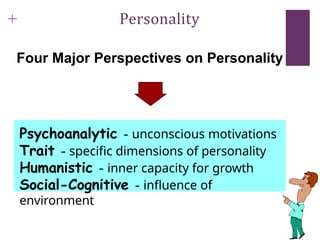
+ Personality
Four Major Perspectives on Personality
Psychoanalytic - unconscious motivations
Trait - specific dimensions of personality
Humanistic - inner capacity for growth
Social-Cognitive - influence of
environment
+
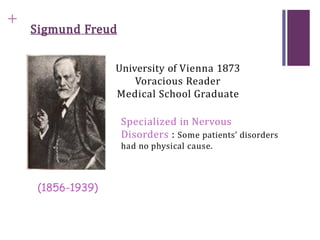
Sigmund Freud
University of Vienna 1873
Voracious Reader
Medical School Graduate
Specialized in Nervous
Disorders : Some patients’ disorders
had no physical cause.
(1856-1939)
+ Sigmund Freud
■What is the structure and development of
personality, according to Sigmund Freud and
his successors (i.e.,psychoanalysts)?
■According to psychoanalysts, much of
behavior is caused by parts of personality
which are found in the unconscious and of
which we are unaware.
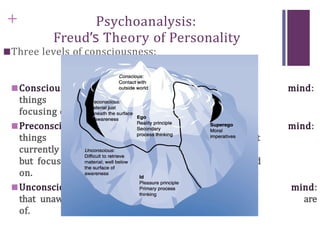
■Freud’s 3 levels of awareness/consciousness:
■the conscious mind;
■the preconscious mind; and
■the unconscious mind.
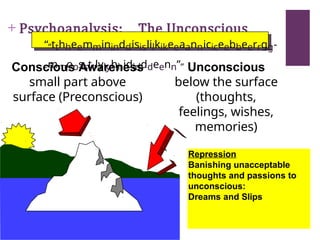
+ Psychoanalysis: The Unconscious
““tthheemmininddisislilkikeeaanniciceebbeerrgg-
-mmoossttlylyhhididddeenn””
Conscious Awareness
small part above
surface (Preconscious)
Unconscious
below the surface
(thoughts,
feelings, wishes,
memories)
Repression
Banishing unacceptable
thoughts and passions to
unconscious:
Dreams and Slips
+ Psychoanalysis:
Freud’s Theory of Personality
■Three levels of consciousness:
■Conscious
things
focusing on.
■Preconscious
things
currently
but focus
on.
■Unconscious
that unaware
of.
mind:
we are
mind:
are are not
aware of
which we could
which we
mind:
are
+ Psychoanalysis: Freud’s
Theory of Personality
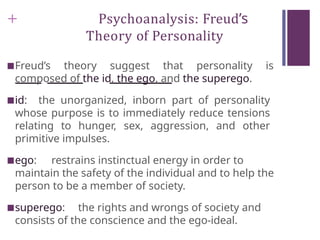
■Freud’s theory suggest that personality is
composed of the id, the ego, and the superego.
■id: the unorganized, inborn part of personality
whose purpose is to immediately reduce tensions
relating to hunger, sex, aggression, and other
primitive impulses.
■ego: restrains instinctual energy in order to
maintain the safety of the individual and to help the
person to be a member of society.
■superego: the rights and wrongs of society and
consists of the conscience and the ego-ideal.
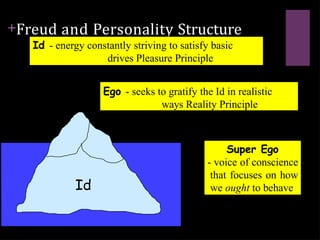
+Freud and Personality Structure
Id - energy constantly striving to satisfy basic
drives Pleasure Principle
Ego - seeks to gratify the Id in realistic
ways Reality Principle
Super Ego
- voice of conscience
that focuses on how
we ought to behave
Id
+ Freud’s Theory:
“the ID”
■The id uses the most primitive of thinking process.
■Basic biological urges (e.g., hunger, self-protection).
■The id operates on the Pleasure Principle.
■Seeks pleasure and avoids pain:“I want what I want
NOW!”
■The id operates completely at an unconscious level.
■No direct contact with reality.
■The id has 2 major
instincts:
■Eros: life instinct = motivates people to focus on
pleasure-
seeking tendencies (e.g., sexual
urges).
■Thanatos: death instinct = motivates people to use
aggressive
urges to
destroy.
■The energy for the id’s instincts comes from the libido,
(the energy storehouse).
+ Freud’s Theory:
“the Ego”
■The ego consists of a conscious faculty for
perceiving and dealing intelligently with
reality.
■The ego acts as a mediator between the id
and the superego.
■The ego is partly conscious.
■Deals with the demands of reality.
■Makes rational decisions.
+
Freud’s Theory:
“the Ego”
■ The ego serves the ID:
■ The rational part of personality that
maintains contact with reality.
■ Governed by ‘Reality Principle’
■ “What consequences are there to my behavior?”
■ The ego is the Executive of the personality
■ The ego controls higher mental processes.
■ Reasoning, problem solving.
■ The ego uses these higher mental processes to help satisfy the urges of the ID.
+
Freud’s Theory:
“the Superego”
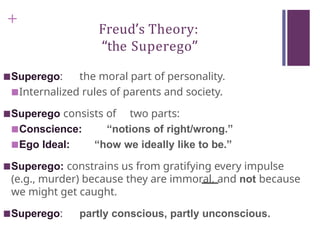
■Superego: the moral part of personality.
■Internalized rules of parents and society.
■Superego consists of two parts:
■Conscience: “notions of right/wrong.”
■Ego Ideal: “how we ideally like to be.”
■Superego: constrains us from gratifying every impulse
(e.g., murder) because they are immoral, and not because
we might get caught.
■Superego: partly conscious, partly unconscious.
+
Freud: superego, id, and ego
■According to Freud, an individual’s
feelings, thoughts, and behaviors are the
result of the interaction of the id, the
superego, and the ego.
+
Freud’s Theory of Personality:
■The id, the ego, and the superego are continually in
conflict with one another.
■This conflict generates anxiety.
■If the ego did not effectively handle the resulting
anxiety, people would be so overwhelmed with anxiety
that they would not be able to carry on with the tasks of
everyday living.
■The ego tries to control anxiety (i.e., to reduce
anxiety) through the use of ego defense
mechanisms.
+ Ego Defense Mechanisms:
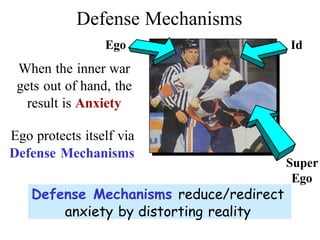
Defense Mechanisms
Id
Super
Ego
Ego
When the inner war
gets out of hand, the
result is Anxiety
Ego protects itself via
Defense Mechanisms
Defense Mechanisms reduce/redirect
anxiety by distorting reality
+ Ego Defense Mechanisms
■Definition: An defense mechanism is a
psychology tendency that the ego uses to help
prevent people from becoming overwhelmed by
any conflict (and resulting anxiety) among the id,
the ego, and the superego.
■Defense mechanisms operate at an
unconscious level:
■We are not aware of them during the time that we
are actually using them.
■However, we may later become aware of
their previous operation and use.
+ Freud’s Theory:
Defense Mechanisms
■Repression: pushing unacceptable and anxiety-
producing thoughts into the unconscious; involves
intentional forgetting but not consciously done;
repressed material can be memories or unacceptable
impulses.
■A rape victim cannot recall the details of the attack.
■Regression: acting in ways characteristic of
earlier life stages/earlier stage of personality.
■A young adult, anxious on a trip to his parents/
home, sits in the corner reading comic books, as
he often did in grade school.
+ Freud’s Theory:
Defense Mechanisms
■Reaction formation: replacing an anxiety-
producing feeling with its exact opposite,
typically going overboard; repressed thoughts
appear as mirror opposites.
■A man who is anxious about his interest in gay
men begins dating women several times a
week.
■Rationalization: creating false but believable
excuses to justify inappropriate behavior; real
motive for behavior is not accepted by ego.
■A student cheats on an exam, explaining that
cheating is legitimate on an unfair examination.
+ Freud’s Theory:
Defense Mechanisms
■Denial: claiming and believing that something
which is actually true is false.
■A person disbelieves that she is age, asserting
that “I am not getting older.”
■Displacement: redirecting emotional feelings
(e.g., anger) to a substitute target; involves
directing unacceptable impulses onto a less
threatening object/person.
■A husband, angry at the way his boss treated
him, screams at his children.
■Instead of telling your professor what you really
think of her, you tailgate and harass a slow driver
on your way home from school.
+ Freud’s Theory:
Defense Mechanisms
■Projection: attributing one’s own unacceptable
feelings or beliefs to others; perceiving the external
world in terms of one’s own personal conflicts.
■An employee at a store, tempted to steal
some merchandise, suspects that other
employees are stealing.
■Sublimation: substitute socially acceptable
behavior for unacceptable impulses.
■Playing video games instead of getting in a fight.
+ Freud:
Stages of Personality Development
■Freud’s psychoanalytic theory of
personality suggests that personality develops
through a series of stages, each of which is
associated with a major biological function.
■More specifically, Freud theorized that as
people age, they pass through several systematic
stages of psychosexual development in their
personality.
+ Psychosexual Stages of Development
are Source of Unconscious Conflicts.
■The stages of personality development involve
critical events that occur in every child’s life.
■At each level, there is a conflict between pleasure
and reality.
■The resolution of this conflict determines
personality.
■At any stage, “a fixation” can occur:
■If needs are either under-gratified or over-
gratified, we become fixated at a particular stage.
■Each stage also involves an erogenous zone.
■Parts of the body that involve sexual pleasure.
Freud and Personality
Development
“personality forms during the first few years of life,
rooted in unresolved conflicts of early childhood”
“personality forms during the first few years of life,
rooted in unresolved conflicts of early childhood”
Psychosexual Stages
Oral (0-18 mos) - centered on the mouth
Anal (18-36 mos) - focus on bowel/bladder elim.
Phallic (3-6 yrs) - focus on genitals/“Oedipus
Complex”
(Identification & Gender Identity)
Latency (6-puberty) - sexuality is dormant
Genital (puberty on) - sexual feelings toward others
Strong conflict can fixate an individual at Stages 1,2 or 3
+ Freud’s Stages of Personality
Development:
■Oral stage: the oral state is the first period,
occurring during the first year of life.
■Anal stage: next comes the anal stage, lasting
from approximately age 1 to age 3.
■Phallic stage: the phallic stages follows, with
interest focusing on the genitals.
■Latency period: then follows the latency period
lasting until puberty.
■Genital stage: after puberty, people move
into the genital stage, a period of mature
sexuality.
+
(1) Oral stage of development:
■Time period: Birth to 18 months:
■Erogenous zone is mouth.
■Gratification through sucking and
swallowing.
■Oral fixation has two possible outcomes.
■Oral receptive personality:
■Preoccupied with eating/drinking.
■Reduce tension through oral activity.
■eating, drinking, smoking, biting nails
■Passive and needy; sensitive to rejection.
■Oral aggressive personality:
■
+
(2) Anal stage of development:
■Time period: 1 1/2 to 3 years of age.
■Erogenous zone is the anus.
■Conflict surrounds toilet training.
■Anal fixation has two possible outcomes.
■Anal retentive personality.
■Stingy, compulsive orderliness, stubborn,
perfectionistic.
■Anal expulsive personality.
■Lack of self control, messy, careless.
+
(3) Phallic stage of development:
■Time period: 3 to 6 years.
■Erogenous zone is the genitals: self-stimulation of
the genitals produces pleasure.
■At age 5 or 6, near the end of the phallic stage,
children experience the Oedipal conflict (boys)/the
Electra conflict (girls)--a process through which they
learn to identify with the same gender parent by
acting as much like that parent as possible.
■Oedipus complex (boys) vs Electra complex (girls)
■Child is sexually attracted to the other sex parent
and wishes to replace the same sex parent.
+
(3) Phallic stage of development:
■Oedipus complex (little boys):
■Castration anxiety:
■Son believes father knows about his desire for
mom.
■Fears dad will castrate him.
■Represses his desire and defensively identifies
with dad.
+
(3) Phallic stage (continued):
■Electra complex (little girls):
■Penis envy:
■Daughter is initially attached to mom.
■Shift of attachment occurs when she realizes she
lacks a penis.
■She desires dad whom she sees as a means to
obtain a penis substitute (a child).
■Represses her desire for dad.
■incorporates the values of her mother
■accepts her inherent “inferiority” in society
+
(4) Latency Period:
■During the latency period, little girls and little
boys try to socialize only with members of their
own gender.
■Freud posits that children do this so as to
help minimize the awareness of “sexuality.”
■Thus, they continue the process of sexual
repression that began in the previous stage (for
those who successfully made it through the
Oedipal Complex/Electra Complex).
+
(5) Genital Stage:
■ When adolescence begin puberty, they enter the 5th stage of
psychosexual development.
■ They develop secondary sexual characteristics (e.g., pubic
hair).
■ The onset of the physical sexual characteristics “re-awakens”
people sexual urges, and thus they are no longer able to
successfully repress their sexual desires, impulses, and
urges.
■ They begin searching for a marital mate, with whom they can
share sex and intimacy.
+
Summary of Freud (on personality):
■Freud’s psychoanalytic theory has provoked a
number of criticisms.
• a lack of supportive scientific data;
• the theory’s inadequacy in making predictions; and
• its limitations owing to the restricted population on
which it is based.
■Still, the theory remains popular.
• For instance, the neo-Freudian psychoanalytic
theorists built upon Freud’s work, although they
placed greater emphasis on the role of the ego and
paid greater attention to social factors in
determining behavior.
+ Psychoanalysis:
Freud and Personality
Evaluating the Psychoanalytic
Perspective
Were Freud’s
theories the “best of
his time” or were they
simply incorrect?
Current
research
contradicts
many of
Freud’s
specific ideas
Development does not
stop in childhood
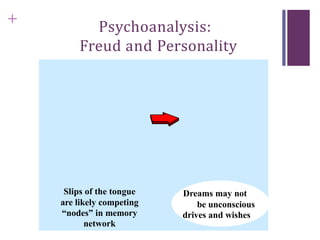
Dreams may not
be unconscious
drives and wishes
Slips of the tongue
are likely competing
“nodes” in memory
network
+ Summary:
Freud and Personality
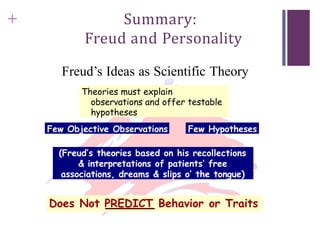
Freud’s Ideas as Scientific Theory
Theories must explain
observations and offer testable
hypotheses
Few Objective Observations Few Hypotheses
(Freud’s theories based on his recollections
& interpretations of patients’ free
associations, dreams & slips o’ the tongue)
Does Not PREDICT Behavior or Traits
+ 4 Types of Personality Theories:
(1) Psychodynamic
approaches to
personality.
(2) Humanistic
approaches to
personality.
(3) Trait approaches to
personality.
(4) Social Cognitive
approaches to personality.
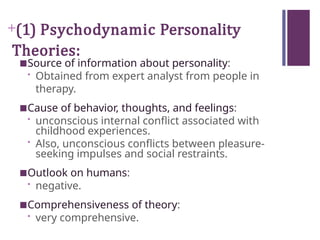
+(1) Psychodynamic Personality
Theories:
■Source of information about personality:
• Obtained from expert analyst from people in
therapy.
■Cause of behavior, thoughts, and feelings:
• unconscious internal conflict associated with
childhood experiences.
• Also, unconscious conflicts between pleasure-
seeking impulses and social restraints.
■Outlook on humans:
• negative.
■Comprehensiveness of theory:
• very comprehensive.
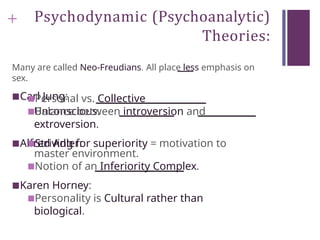
+ Psychodynamic (Psychoanalytic)
Theories:
Many are called Neo-Freudians. All place less emphasis on
sex.
■Carl Jung:
■Personal vs. Collective
Unconscious.
■Balance between introversion and
extroversion.
■Alfred Adler:
■Striving for superiority = motivation to
master environment.
■Notion of an Inferiority Complex.
■Karen Horney:
■Personality is Cultural rather than
biological.
+(2) Humanistic Personality
Theories:
■ Source of information about personality:
• obtained from self-reports from the
general population and people in
therapy.
■ Cause of behavior, thoughts, and feelings:
• self concepts,
• self-actualizing tendencies.
• conscious feelings about oneself (based on
one’s previous experiences).
■ Outlook on humans:
• positive.
■ Comprehensiveness of theory:
• fairly comprehensive.
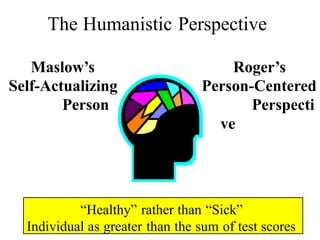
The Humanistic Perspective
Maslow’s
Self-Actualizing
Person
Roger’s
Person-Centered
Perspecti
ve
“Healthy” rather than “Sick”
Individual as greater than the sum of test scores
+ Humanistic Personality Theories:
Maslow and Rogers
■Humanistic approach (Third Force):
■Rejected Freud’s pessimistic view of
personality.
■Rejected Behaviorist’s mechanistic view.
■More optimistic/positive about human
nature.
■Humans are free and basically good.
■Humans are inner-directed.
■Everyone has the potential for healthy
growth.
■Health growth involves Self actualization:
■“Be all you can be.”
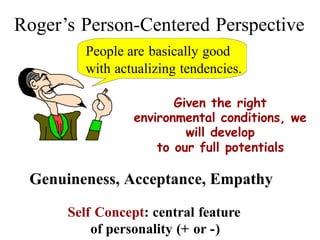
Roger’s Person-Centered Perspective
People are basically good
with actualizing tendencies.
Given the right
environmental conditions, we
will develop
to our full potentials
Genuineness, Acceptance, Empathy
Self Concept: central feature
of personality (+ or -)
+
Humanistic Personality Theories:
Carl Rogers
■Self-concept: our image or perception of
ourselves (Real Self versus Ideal Self).
■We have a need for positive regard/approval
from others.
■Conditions of worth or conditional positive
regard.
■The conditions under which other people will
approve of us.
■We change our behavior to obtain approval.
■What we need is: Unconditional positive
regard.
■Anxiety signifies that we are not being true to our ideal
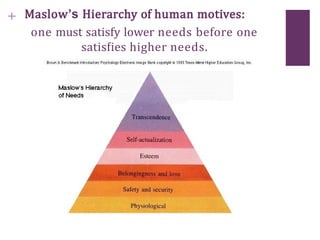
+ Maslow’s Hierarchy of human motives:
one must satisfy lower needs before one
satisfies higher needs.
+
Humanistic Personality Theories:
Abraham Maslow
■Self-actualization is the culmination of a lifetime of
inner- directed growth and improvement:
• Challenging ourselves to the fullest.
• Can you identify a self-actualized individual?
• Characteristics of the self-actualized person:
■Creative and open to new experiences.
■Committed to a cause or a higher goal.
■Trusting and caring of others, yet not dependent.
■Have the courage to act on their convictions.
(+3) Trait Personality
Theories:
■Source of information about personality:
• obtained from observation of behavior and
questionnaire responses from the general
population as well as from people in therapy.
■Cause of behavior, thoughts, and feelings:
• stable internal characteristics;
• some emphasize genetic basis.
■Outlook on humans:
• neutral - neither positive nor negative.
■Comprehensiveness of theory:
• not very comprehensive.
(+3) Trait Personality Theories
(cont):
■Trait approaches have tried to identify the most
basic and relatively enduring dimensions along
which people differ from one another--dimensions
known as traits.
■How many trait dimensions are there?
■How can we measure these trait dimensions?
■Where do these trait dimensions originate?
+
(3) Trait Personality Theories (cont):
Allport
■Allport: Most important personality traits are
those that reflect our values.
■Allport suggested that there are 3 kinds of traits:
• cardinal: a single personality trait that directs
most of a person’s activities (e.g., greed, lust,
kindness).
• central: a set of major characteristics that make
up the core of a person’s personality.
• secondary: less important personality traits
that do not affect behavior as much as central and
cardinal traits do.
(3) Trait Personality Theories (cont):
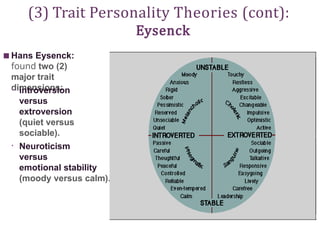
Eysenck
■ Hans Eysenck:
found two (2)
major trait
dimensions:
•
• introversion
versus
extroversion
(quiet versus
sociable).
Neuroticism
versus
emotional stability
(moody versus calm).
+ (3) Trait Personality Theories (cont):
Cattell’s Theory of Personality:
■Cattell’s Trait Theory:
■Distinguished 3 types of traits:
■Dynamic.
■Ability.
■Temperament.
■Also:
■Surface Traits: Less important to
personality.
■Source Traits: More important basic
underlying traits.
■Cattell identified 16 basic traits.
• He developed the 16PF to measure these
+(3) Trait Personality Theories
(cont):
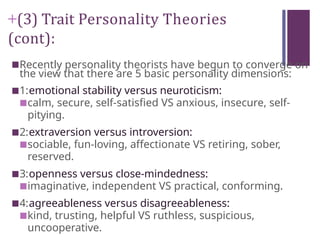
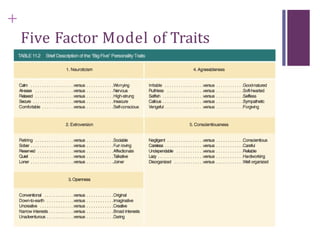
■Recently personality theorists have begun to converge on
the view that there are 5 basic personality dimensions:
■1:emotional stability versus neuroticism:
■calm, secure, self-satisfied VS anxious, insecure, self-
pitying.
■2:extraversion versus introversion:
■sociable, fun-loving, affectionate VS retiring, sober,
reserved.
■3:openness versus close-mindedness:
■imaginative, independent VS practical, conforming.
■4:agreeableness versus disagreeableness:
■kind, trusting, helpful VS ruthless, suspicious,
uncooperative.
+
Five Factor Model of Traits
+
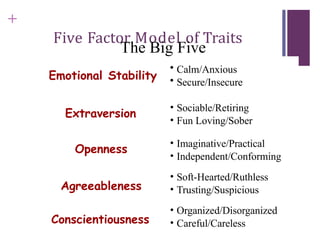
Five Factor Model of Traits
The Big Five
Emotional Stability
Extraversion
Openness
Agreeableness
Conscientiousness
• Calm/Anxious
• Secure/Insecure
• Sociable/Retiring
• Fun Loving/Sober
• Imaginative/Practical
• Independent/Conforming
• Soft-Hearted/Ruthless
• Trusting/Suspicious
• Organized/Disorganized
• Careful/Careless
+
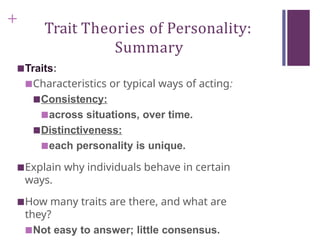
Trait Theories of Personality:
Summary
■Traits:
■Characteristics or typical ways of acting:
■Consistency:
■across situations, over time.
■Distinctiveness:
■each personality is unique.
■Explain why individuals behave in certain
ways.
■How many traits are there, and what are
they?
■Not easy to answer; little consensus.
+ Assessing Personality Traits
How can we assess traits?
(aim to simplify a person’s behavior patterns)
Personality Inventories
MMPI:
• most widely used personality inventory.
• assess psychological
disorders (not normal traits).
• empirically derived - test items selected
based upon how well they discriminate
between groups of traits.
+
Do traits exist?
The Trait-Situation Debate
■ Walter Mischel (1968) argued that:
■ Behavior is not consistent across time or situation.
■ If no consistency, not much point in arguing for “personality.”
■ Thus, “personality” is an illusion.
■ Situationism:
■ Mischel believed that behavior is influenced more by the situation than any
internal “trait.”
■ Person x situation interactionism:
■ Both (a) internal traits and (b) the situation we are in are
important determinants of behavior.
+
(4) Social-Cognitive (Learning)
Approaches to
■ Source of information about personality:
ObtaPineerdsofrnomalietxypeTrhimeoenrtise,so:bservati
ons of behavior, and questionnaire responses from the
general population.
■ Cause of behavior, thoughts, and feelings:
• reciprocal influence between people (cognitions and
behavior) and their environmental situations, colored by
their perceptions of control.
■ Outlook on humans:
•neutral: neither positive nor negative.
■ Comprehensiveness of theory:
•not very comprehensive.
+
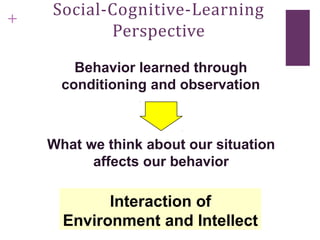
Social-Cognitive-Learning
Perspective
Behavior learned through
conditioning and observation
What we think about our situation
affects our behavior
Interaction of
Environment and Intellect
+ Social-Cognitive Personality
Theories:
Social Learning Theory
■Bandura: Theoretical origins in behaviorism.
■Emphasizes the role of learning in personality.
■Classical Conditioning.
■Operant Conditioning .
■Modeling.
■Instead of studying what’s going on inside the person
(traits), study what is going on outside the person
(environment).
■How does the environment shape personality?
+ Social-Cognitive Personality
Theories:
Social Learning Theory
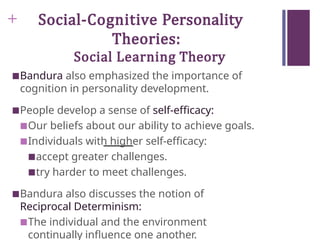
■Bandura also emphasized the importance of
cognition in personality development.
■People develop a sense of self-efficacy:
■Our beliefs about our ability to achieve goals.
■Individuals with higher self-efficacy:
■accept greater challenges.
■try harder to meet challenges.
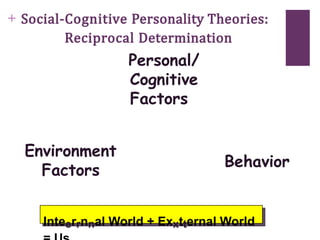
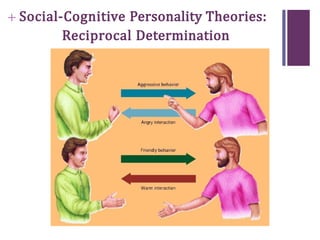
■Bandura also discusses the notion of
Reciprocal Determinism:
■The individual and the environment
continually influence one another.
+ Social-Cognitive Personality Theories:
Reciprocal Determination
Personal/
Cognitive
Factors
Behavior
Environment
Factors
Inteerrnnal World + Exxtternal World
+ Social-Cognitive Personality Theories:
Reciprocal Determination
+ Social-Cognitive Personality Theories:
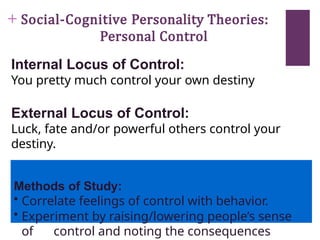
Personal Control
Internal Locus of Control:
You pretty much control your own destiny
External Locus of Control:
Luck, fate and/or powerful others control your
destiny.
Methods of Study:
• Correlate feelings of control with behavior.
• Experiment by raising/lowering people’s sense
of control and noting the consequences
+ Social-Cognitive Personality Theories:
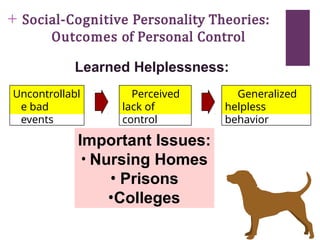
Outcomes of Personal Control
Learned Helplessness:
Uncontrollabl
e bad
events
Perceived
lack of
control
Generalized
helpless
behavior
Important Issues:
• Nursing Homes
• Prisons
•Colleges
+
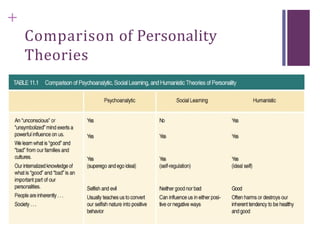
Comparison of Personality
Theories
+
Personality Assessment
■Personality assessment involves the techniques
for systematically gathering information about a
person in order to understand and predict
behavior.
■Goal of personality assessment: to obtain
reliable, valid measures of individual differences
that will permit the accurate prediction of
behavior.
+
How do we measure “Personality”?
■(1) Interview:
■Ask the person about themselves.
■Obtain information that reveals personality.
■(2) Behavioral Observation:
■Watch the individual’s behavior in an actual or
simulated situation.
■Personality Tests:
■(3) Objective tests (questionnaire tests).
■(4) Projective tests.
+
How do we measure personality?
(2) Behavioral assessment
■Behavioral assessment is based on the principles
of learning theory.
■Behavioral assessment employs direct
measurement of behavior to determine the
characteristics related to personality.
+ How do we measure personality?
(3) Objective Test Assessment
■Objective personality tests (self-report
questionnaires) present the test taker with a
number of specific items to which she is asked to
respond, either on paper or on a computer
screen.
■Self-report measures ask people about a
sample range of their behaviors.
■These reports are used to infer the presence
of particular personality characteristics.
+
How do we measure personality?
(3) Objective Test Assessment
■Examples of objective personality measures:
■the MMPI (the Minnesota Multiphasic
Personality Inventory).
■the 16 PF (the Sixteen Personality
Factor Questionnaire).
■the NEO-PI (the NEO Personality
Inventory).
■The most commonly used self-report measure is
the Minnesota Multiphasic Personality Inventory
(MMPI- 2), designed to differentiate people with
specific sorts of psychological difficulties from
normal individuals.
+
Minnesota Multiphasic
Personality Inventory
(MMPI-2)
■Most widely used personality instrument.
■Used in clinical and employment settings.
■MMPI-2 Has several different scales (multiphasic).
■MMPI sample items:
■‘I usually feel that life is worthwhile and
interesting (FALSE) = Depression.
■‘I seem to hear things that other people can’t
hear’ (TRUE) = Schizophrenia.
■Measures aspects of personality that, if extreme,
suggest a problem:
■Extreme suspiciousness may indicate paranoia.
+ How do we measure personality?
(4) Projective Test Assessment
■ A projective personality test is one in which the
subject is given an ambiguous stimulus and asked
to respond spontaneously.
■pictures or inkblots.
■No clear answer.
■The ambiguous stimulus allows test takers to
project their own needs, dreams, feelings into
their response.
■The observer’s responses to the stimulus are then
used to infer information about the observer’s
personality.
+
How do we measure personality?
(4) Projective Test Assessment (continued)
■All projective tests are based on the projective
hypothesis which states that the individual's response
to an ambiguous stimulus represents a projection of
his or her own inner, often unconscious, feelings and
needs.
■Indirect method of personality assessment:
■Based on psychoanalytic assumptions:
■Personality is mostly unconscious.
■People are unaware of contents of unconscious.
+
How do we measure personality?
(4) Projective Test Assessment (continued):
■The 2 most frequently used projective tests are:
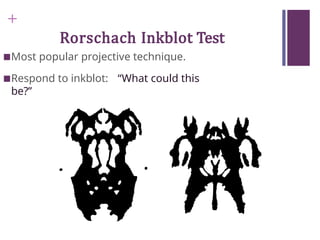
• the Rorschach: reactions to inkblots are
employed to classify personality types.
• the Thematic Apperception Test (TAT): stories
about ambiguous pictures are used to draw
inferences about the storyteller’s personality.
+
Rorschach Inkblot Test
■Most popular projective technique.
■Respond to inkblot: “What could this
be?”
+
THE END

1-theoriesofpersonality-130222131722-phpapp02.pptx

  • 1.
    Modified by Elizabeth TSantosa, M.Psi, psi. Theories Personality & Assessment
  • 2.
    + Definition of Personality? ■Personalityrefers to the relatively enduring characteristics that differentiate one person from another and that lead people to act in a consistent and predictable manner, both in different situations and over extended periods of time. ■Personality is defined as: the enduring or lasting patterns of behavior and thought (across time and situation).
  • 3.
    + Personality Four MajorPerspectives on Personality Psychoanalytic - unconscious motivations Trait - specific dimensions of personality Humanistic - inner capacity for growth Social-Cognitive - influence of environment
  • 4.
    + Sigmund Freud University ofVienna 1873 Voracious Reader Medical School Graduate Specialized in Nervous Disorders : Some patients’ disorders had no physical cause. (1856-1939)
  • 5.
    + Sigmund Freud ■Whatis the structure and development of personality, according to Sigmund Freud and his successors (i.e.,psychoanalysts)? ■According to psychoanalysts, much of behavior is caused by parts of personality which are found in the unconscious and of which we are unaware. ■Freud’s 3 levels of awareness/consciousness: ■the conscious mind; ■the preconscious mind; and ■the unconscious mind.
  • 6.
    + Psychoanalysis: TheUnconscious ““tthheemmininddisislilkikeeaanniciceebbeerrgg- -mmoossttlylyhhididddeenn”” Conscious Awareness small part above surface (Preconscious) Unconscious below the surface (thoughts, feelings, wishes, memories) Repression Banishing unacceptable thoughts and passions to unconscious: Dreams and Slips
  • 7.
    + Psychoanalysis: Freud’s Theoryof Personality ■Three levels of consciousness: ■Conscious things focusing on. ■Preconscious things currently but focus on. ■Unconscious that unaware of. mind: we are mind: are are not aware of which we could which we mind: are
  • 8.
    + Psychoanalysis: Freud’s Theoryof Personality ■Freud’s theory suggest that personality is composed of the id, the ego, and the superego. ■id: the unorganized, inborn part of personality whose purpose is to immediately reduce tensions relating to hunger, sex, aggression, and other primitive impulses. ■ego: restrains instinctual energy in order to maintain the safety of the individual and to help the person to be a member of society. ■superego: the rights and wrongs of society and consists of the conscience and the ego-ideal.
  • 9.
    +Freud and PersonalityStructure Id - energy constantly striving to satisfy basic drives Pleasure Principle Ego - seeks to gratify the Id in realistic ways Reality Principle Super Ego - voice of conscience that focuses on how we ought to behave Id
  • 10.
    + Freud’s Theory: “theID” ■The id uses the most primitive of thinking process. ■Basic biological urges (e.g., hunger, self-protection). ■The id operates on the Pleasure Principle. ■Seeks pleasure and avoids pain:“I want what I want NOW!” ■The id operates completely at an unconscious level. ■No direct contact with reality. ■The id has 2 major instincts: ■Eros: life instinct = motivates people to focus on pleasure- seeking tendencies (e.g., sexual urges). ■Thanatos: death instinct = motivates people to use aggressive urges to destroy. ■The energy for the id’s instincts comes from the libido, (the energy storehouse).
  • 11.
    + Freud’s Theory: “theEgo” ■The ego consists of a conscious faculty for perceiving and dealing intelligently with reality. ■The ego acts as a mediator between the id and the superego. ■The ego is partly conscious. ■Deals with the demands of reality. ■Makes rational decisions.
  • 12.
    + Freud’s Theory: “the Ego” ■The ego serves the ID: ■ The rational part of personality that maintains contact with reality. ■ Governed by ‘Reality Principle’ ■ “What consequences are there to my behavior?” ■ The ego is the Executive of the personality ■ The ego controls higher mental processes. ■ Reasoning, problem solving. ■ The ego uses these higher mental processes to help satisfy the urges of the ID.
  • 13.
    + Freud’s Theory: “the Superego” ■Superego:the moral part of personality. ■Internalized rules of parents and society. ■Superego consists of two parts: ■Conscience: “notions of right/wrong.” ■Ego Ideal: “how we ideally like to be.” ■Superego: constrains us from gratifying every impulse (e.g., murder) because they are immoral, and not because we might get caught. ■Superego: partly conscious, partly unconscious.
  • 14.
    + Freud: superego, id,and ego ■According to Freud, an individual’s feelings, thoughts, and behaviors are the result of the interaction of the id, the superego, and the ego.
  • 15.
    + Freud’s Theory ofPersonality: ■The id, the ego, and the superego are continually in conflict with one another. ■This conflict generates anxiety. ■If the ego did not effectively handle the resulting anxiety, people would be so overwhelmed with anxiety that they would not be able to carry on with the tasks of everyday living. ■The ego tries to control anxiety (i.e., to reduce anxiety) through the use of ego defense mechanisms.
  • 16.
    + Ego DefenseMechanisms: Defense Mechanisms Id Super Ego Ego When the inner war gets out of hand, the result is Anxiety Ego protects itself via Defense Mechanisms Defense Mechanisms reduce/redirect anxiety by distorting reality
  • 17.
    + Ego DefenseMechanisms ■Definition: An defense mechanism is a psychology tendency that the ego uses to help prevent people from becoming overwhelmed by any conflict (and resulting anxiety) among the id, the ego, and the superego. ■Defense mechanisms operate at an unconscious level: ■We are not aware of them during the time that we are actually using them. ■However, we may later become aware of their previous operation and use.
  • 18.
    + Freud’s Theory: DefenseMechanisms ■Repression: pushing unacceptable and anxiety- producing thoughts into the unconscious; involves intentional forgetting but not consciously done; repressed material can be memories or unacceptable impulses. ■A rape victim cannot recall the details of the attack. ■Regression: acting in ways characteristic of earlier life stages/earlier stage of personality. ■A young adult, anxious on a trip to his parents/ home, sits in the corner reading comic books, as he often did in grade school.
  • 19.
    + Freud’s Theory: DefenseMechanisms ■Reaction formation: replacing an anxiety- producing feeling with its exact opposite, typically going overboard; repressed thoughts appear as mirror opposites. ■A man who is anxious about his interest in gay men begins dating women several times a week. ■Rationalization: creating false but believable excuses to justify inappropriate behavior; real motive for behavior is not accepted by ego. ■A student cheats on an exam, explaining that cheating is legitimate on an unfair examination.
  • 20.
    + Freud’s Theory: DefenseMechanisms ■Denial: claiming and believing that something which is actually true is false. ■A person disbelieves that she is age, asserting that “I am not getting older.” ■Displacement: redirecting emotional feelings (e.g., anger) to a substitute target; involves directing unacceptable impulses onto a less threatening object/person. ■A husband, angry at the way his boss treated him, screams at his children. ■Instead of telling your professor what you really think of her, you tailgate and harass a slow driver on your way home from school.
  • 21.
    + Freud’s Theory: DefenseMechanisms ■Projection: attributing one’s own unacceptable feelings or beliefs to others; perceiving the external world in terms of one’s own personal conflicts. ■An employee at a store, tempted to steal some merchandise, suspects that other employees are stealing. ■Sublimation: substitute socially acceptable behavior for unacceptable impulses. ■Playing video games instead of getting in a fight.
  • 22.
    + Freud: Stages ofPersonality Development ■Freud’s psychoanalytic theory of personality suggests that personality develops through a series of stages, each of which is associated with a major biological function. ■More specifically, Freud theorized that as people age, they pass through several systematic stages of psychosexual development in their personality.
  • 23.
    + Psychosexual Stagesof Development are Source of Unconscious Conflicts. ■The stages of personality development involve critical events that occur in every child’s life. ■At each level, there is a conflict between pleasure and reality. ■The resolution of this conflict determines personality. ■At any stage, “a fixation” can occur: ■If needs are either under-gratified or over- gratified, we become fixated at a particular stage. ■Each stage also involves an erogenous zone. ■Parts of the body that involve sexual pleasure.
  • 24.
    Freud and Personality Development “personalityforms during the first few years of life, rooted in unresolved conflicts of early childhood” “personality forms during the first few years of life, rooted in unresolved conflicts of early childhood” Psychosexual Stages Oral (0-18 mos) - centered on the mouth Anal (18-36 mos) - focus on bowel/bladder elim. Phallic (3-6 yrs) - focus on genitals/“Oedipus Complex” (Identification & Gender Identity) Latency (6-puberty) - sexuality is dormant Genital (puberty on) - sexual feelings toward others Strong conflict can fixate an individual at Stages 1,2 or 3
  • 25.
    + Freud’s Stagesof Personality Development: ■Oral stage: the oral state is the first period, occurring during the first year of life. ■Anal stage: next comes the anal stage, lasting from approximately age 1 to age 3. ■Phallic stage: the phallic stages follows, with interest focusing on the genitals. ■Latency period: then follows the latency period lasting until puberty. ■Genital stage: after puberty, people move into the genital stage, a period of mature sexuality.
  • 26.
    + (1) Oral stageof development: ■Time period: Birth to 18 months: ■Erogenous zone is mouth. ■Gratification through sucking and swallowing. ■Oral fixation has two possible outcomes. ■Oral receptive personality: ■Preoccupied with eating/drinking. ■Reduce tension through oral activity. ■eating, drinking, smoking, biting nails ■Passive and needy; sensitive to rejection. ■Oral aggressive personality: ■
  • 27.
    + (2) Anal stageof development: ■Time period: 1 1/2 to 3 years of age. ■Erogenous zone is the anus. ■Conflict surrounds toilet training. ■Anal fixation has two possible outcomes. ■Anal retentive personality. ■Stingy, compulsive orderliness, stubborn, perfectionistic. ■Anal expulsive personality. ■Lack of self control, messy, careless.
  • 28.
    + (3) Phallic stageof development: ■Time period: 3 to 6 years. ■Erogenous zone is the genitals: self-stimulation of the genitals produces pleasure. ■At age 5 or 6, near the end of the phallic stage, children experience the Oedipal conflict (boys)/the Electra conflict (girls)--a process through which they learn to identify with the same gender parent by acting as much like that parent as possible. ■Oedipus complex (boys) vs Electra complex (girls) ■Child is sexually attracted to the other sex parent and wishes to replace the same sex parent.
  • 29.
    + (3) Phallic stageof development: ■Oedipus complex (little boys): ■Castration anxiety: ■Son believes father knows about his desire for mom. ■Fears dad will castrate him. ■Represses his desire and defensively identifies with dad.
  • 30.
    + (3) Phallic stage(continued): ■Electra complex (little girls): ■Penis envy: ■Daughter is initially attached to mom. ■Shift of attachment occurs when she realizes she lacks a penis. ■She desires dad whom she sees as a means to obtain a penis substitute (a child). ■Represses her desire for dad. ■incorporates the values of her mother ■accepts her inherent “inferiority” in society
  • 31.
    + (4) Latency Period: ■Duringthe latency period, little girls and little boys try to socialize only with members of their own gender. ■Freud posits that children do this so as to help minimize the awareness of “sexuality.” ■Thus, they continue the process of sexual repression that began in the previous stage (for those who successfully made it through the Oedipal Complex/Electra Complex).
  • 32.
    + (5) Genital Stage: ■When adolescence begin puberty, they enter the 5th stage of psychosexual development. ■ They develop secondary sexual characteristics (e.g., pubic hair). ■ The onset of the physical sexual characteristics “re-awakens” people sexual urges, and thus they are no longer able to successfully repress their sexual desires, impulses, and urges. ■ They begin searching for a marital mate, with whom they can share sex and intimacy.
  • 33.
    + Summary of Freud(on personality): ■Freud’s psychoanalytic theory has provoked a number of criticisms. • a lack of supportive scientific data; • the theory’s inadequacy in making predictions; and • its limitations owing to the restricted population on which it is based. ■Still, the theory remains popular. • For instance, the neo-Freudian psychoanalytic theorists built upon Freud’s work, although they placed greater emphasis on the role of the ego and paid greater attention to social factors in determining behavior.
  • 34.
    + Psychoanalysis: Freud andPersonality Evaluating the Psychoanalytic Perspective Were Freud’s theories the “best of his time” or were they simply incorrect? Current research contradicts many of Freud’s specific ideas Development does not stop in childhood Dreams may not be unconscious drives and wishes Slips of the tongue are likely competing “nodes” in memory network
  • 35.
    + Summary: Freud andPersonality Freud’s Ideas as Scientific Theory Theories must explain observations and offer testable hypotheses Few Objective Observations Few Hypotheses (Freud’s theories based on his recollections & interpretations of patients’ free associations, dreams & slips o’ the tongue) Does Not PREDICT Behavior or Traits
  • 36.
    + 4 Typesof Personality Theories: (1) Psychodynamic approaches to personality. (2) Humanistic approaches to personality. (3) Trait approaches to personality. (4) Social Cognitive approaches to personality.
  • 37.
    +(1) Psychodynamic Personality Theories: ■Sourceof information about personality: • Obtained from expert analyst from people in therapy. ■Cause of behavior, thoughts, and feelings: • unconscious internal conflict associated with childhood experiences. • Also, unconscious conflicts between pleasure- seeking impulses and social restraints. ■Outlook on humans: • negative. ■Comprehensiveness of theory: • very comprehensive.
  • 38.
    + Psychodynamic (Psychoanalytic) Theories: Manyare called Neo-Freudians. All place less emphasis on sex. ■Carl Jung: ■Personal vs. Collective Unconscious. ■Balance between introversion and extroversion. ■Alfred Adler: ■Striving for superiority = motivation to master environment. ■Notion of an Inferiority Complex. ■Karen Horney: ■Personality is Cultural rather than biological.
  • 39.
    +(2) Humanistic Personality Theories: ■Source of information about personality: • obtained from self-reports from the general population and people in therapy. ■ Cause of behavior, thoughts, and feelings: • self concepts, • self-actualizing tendencies. • conscious feelings about oneself (based on one’s previous experiences). ■ Outlook on humans: • positive. ■ Comprehensiveness of theory: • fairly comprehensive.
  • 40.
  • 41.
    + Humanistic PersonalityTheories: Maslow and Rogers ■Humanistic approach (Third Force): ■Rejected Freud’s pessimistic view of personality. ■Rejected Behaviorist’s mechanistic view. ■More optimistic/positive about human nature. ■Humans are free and basically good. ■Humans are inner-directed. ■Everyone has the potential for healthy growth. ■Health growth involves Self actualization: ■“Be all you can be.”
  • 42.
    Roger’s Person-Centered Perspective Peopleare basically good with actualizing tendencies. Given the right environmental conditions, we will develop to our full potentials Genuineness, Acceptance, Empathy Self Concept: central feature of personality (+ or -)
  • 43.
    + Humanistic Personality Theories: CarlRogers ■Self-concept: our image or perception of ourselves (Real Self versus Ideal Self). ■We have a need for positive regard/approval from others. ■Conditions of worth or conditional positive regard. ■The conditions under which other people will approve of us. ■We change our behavior to obtain approval. ■What we need is: Unconditional positive regard. ■Anxiety signifies that we are not being true to our ideal
  • 44.
    + Maslow’s Hierarchyof human motives: one must satisfy lower needs before one satisfies higher needs.
  • 45.
    + Humanistic Personality Theories: AbrahamMaslow ■Self-actualization is the culmination of a lifetime of inner- directed growth and improvement: • Challenging ourselves to the fullest. • Can you identify a self-actualized individual? • Characteristics of the self-actualized person: ■Creative and open to new experiences. ■Committed to a cause or a higher goal. ■Trusting and caring of others, yet not dependent. ■Have the courage to act on their convictions.
  • 46.
    (+3) Trait Personality Theories: ■Sourceof information about personality: • obtained from observation of behavior and questionnaire responses from the general population as well as from people in therapy. ■Cause of behavior, thoughts, and feelings: • stable internal characteristics; • some emphasize genetic basis. ■Outlook on humans: • neutral - neither positive nor negative. ■Comprehensiveness of theory: • not very comprehensive.
  • 47.
    (+3) Trait PersonalityTheories (cont): ■Trait approaches have tried to identify the most basic and relatively enduring dimensions along which people differ from one another--dimensions known as traits. ■How many trait dimensions are there? ■How can we measure these trait dimensions? ■Where do these trait dimensions originate?
  • 48.
    + (3) Trait PersonalityTheories (cont): Allport ■Allport: Most important personality traits are those that reflect our values. ■Allport suggested that there are 3 kinds of traits: • cardinal: a single personality trait that directs most of a person’s activities (e.g., greed, lust, kindness). • central: a set of major characteristics that make up the core of a person’s personality. • secondary: less important personality traits that do not affect behavior as much as central and cardinal traits do.
  • 49.
    (3) Trait PersonalityTheories (cont): Eysenck ■ Hans Eysenck: found two (2) major trait dimensions: • • introversion versus extroversion (quiet versus sociable). Neuroticism versus emotional stability (moody versus calm).
  • 50.
    + (3) TraitPersonality Theories (cont): Cattell’s Theory of Personality: ■Cattell’s Trait Theory: ■Distinguished 3 types of traits: ■Dynamic. ■Ability. ■Temperament. ■Also: ■Surface Traits: Less important to personality. ■Source Traits: More important basic underlying traits. ■Cattell identified 16 basic traits. • He developed the 16PF to measure these
  • 51.
    +(3) Trait PersonalityTheories (cont): ■Recently personality theorists have begun to converge on the view that there are 5 basic personality dimensions: ■1:emotional stability versus neuroticism: ■calm, secure, self-satisfied VS anxious, insecure, self- pitying. ■2:extraversion versus introversion: ■sociable, fun-loving, affectionate VS retiring, sober, reserved. ■3:openness versus close-mindedness: ■imaginative, independent VS practical, conforming. ■4:agreeableness versus disagreeableness: ■kind, trusting, helpful VS ruthless, suspicious, uncooperative.
  • 52.
  • 53.
    + Five Factor Modelof Traits The Big Five Emotional Stability Extraversion Openness Agreeableness Conscientiousness • Calm/Anxious • Secure/Insecure • Sociable/Retiring • Fun Loving/Sober • Imaginative/Practical • Independent/Conforming • Soft-Hearted/Ruthless • Trusting/Suspicious • Organized/Disorganized • Careful/Careless
  • 54.
    + Trait Theories ofPersonality: Summary ■Traits: ■Characteristics or typical ways of acting: ■Consistency: ■across situations, over time. ■Distinctiveness: ■each personality is unique. ■Explain why individuals behave in certain ways. ■How many traits are there, and what are they? ■Not easy to answer; little consensus.
  • 55.
    + Assessing PersonalityTraits How can we assess traits? (aim to simplify a person’s behavior patterns) Personality Inventories MMPI: • most widely used personality inventory. • assess psychological disorders (not normal traits). • empirically derived - test items selected based upon how well they discriminate between groups of traits.
  • 56.
    + Do traits exist? TheTrait-Situation Debate ■ Walter Mischel (1968) argued that: ■ Behavior is not consistent across time or situation. ■ If no consistency, not much point in arguing for “personality.” ■ Thus, “personality” is an illusion. ■ Situationism: ■ Mischel believed that behavior is influenced more by the situation than any internal “trait.” ■ Person x situation interactionism: ■ Both (a) internal traits and (b) the situation we are in are important determinants of behavior.
  • 57.
    + (4) Social-Cognitive (Learning) Approachesto ■ Source of information about personality: ObtaPineerdsofrnomalietxypeTrhimeoenrtise,so:bservati ons of behavior, and questionnaire responses from the general population. ■ Cause of behavior, thoughts, and feelings: • reciprocal influence between people (cognitions and behavior) and their environmental situations, colored by their perceptions of control. ■ Outlook on humans: •neutral: neither positive nor negative. ■ Comprehensiveness of theory: •not very comprehensive.
  • 58.
    + Social-Cognitive-Learning Perspective Behavior learned through conditioningand observation What we think about our situation affects our behavior Interaction of Environment and Intellect
  • 59.
    + Social-Cognitive Personality Theories: SocialLearning Theory ■Bandura: Theoretical origins in behaviorism. ■Emphasizes the role of learning in personality. ■Classical Conditioning. ■Operant Conditioning . ■Modeling. ■Instead of studying what’s going on inside the person (traits), study what is going on outside the person (environment). ■How does the environment shape personality?
  • 60.
    + Social-Cognitive Personality Theories: SocialLearning Theory ■Bandura also emphasized the importance of cognition in personality development. ■People develop a sense of self-efficacy: ■Our beliefs about our ability to achieve goals. ■Individuals with higher self-efficacy: ■accept greater challenges. ■try harder to meet challenges. ■Bandura also discusses the notion of Reciprocal Determinism: ■The individual and the environment continually influence one another.
  • 61.
    + Social-Cognitive PersonalityTheories: Reciprocal Determination Personal/ Cognitive Factors Behavior Environment Factors Inteerrnnal World + Exxtternal World
  • 62.
    + Social-Cognitive PersonalityTheories: Reciprocal Determination
  • 63.
    + Social-Cognitive PersonalityTheories: Personal Control Internal Locus of Control: You pretty much control your own destiny External Locus of Control: Luck, fate and/or powerful others control your destiny. Methods of Study: • Correlate feelings of control with behavior. • Experiment by raising/lowering people’s sense of control and noting the consequences
  • 64.
    + Social-Cognitive PersonalityTheories: Outcomes of Personal Control Learned Helplessness: Uncontrollabl e bad events Perceived lack of control Generalized helpless behavior Important Issues: • Nursing Homes • Prisons •Colleges
  • 65.
  • 66.
    + Personality Assessment ■Personality assessmentinvolves the techniques for systematically gathering information about a person in order to understand and predict behavior. ■Goal of personality assessment: to obtain reliable, valid measures of individual differences that will permit the accurate prediction of behavior.
  • 67.
    + How do wemeasure “Personality”? ■(1) Interview: ■Ask the person about themselves. ■Obtain information that reveals personality. ■(2) Behavioral Observation: ■Watch the individual’s behavior in an actual or simulated situation. ■Personality Tests: ■(3) Objective tests (questionnaire tests). ■(4) Projective tests.
  • 68.
    + How do wemeasure personality? (2) Behavioral assessment ■Behavioral assessment is based on the principles of learning theory. ■Behavioral assessment employs direct measurement of behavior to determine the characteristics related to personality.
  • 69.
    + How dowe measure personality? (3) Objective Test Assessment ■Objective personality tests (self-report questionnaires) present the test taker with a number of specific items to which she is asked to respond, either on paper or on a computer screen. ■Self-report measures ask people about a sample range of their behaviors. ■These reports are used to infer the presence of particular personality characteristics.
  • 70.
    + How do wemeasure personality? (3) Objective Test Assessment ■Examples of objective personality measures: ■the MMPI (the Minnesota Multiphasic Personality Inventory). ■the 16 PF (the Sixteen Personality Factor Questionnaire). ■the NEO-PI (the NEO Personality Inventory). ■The most commonly used self-report measure is the Minnesota Multiphasic Personality Inventory (MMPI- 2), designed to differentiate people with specific sorts of psychological difficulties from normal individuals.
  • 71.
    + Minnesota Multiphasic Personality Inventory (MMPI-2) ■Mostwidely used personality instrument. ■Used in clinical and employment settings. ■MMPI-2 Has several different scales (multiphasic). ■MMPI sample items: ■‘I usually feel that life is worthwhile and interesting (FALSE) = Depression. ■‘I seem to hear things that other people can’t hear’ (TRUE) = Schizophrenia. ■Measures aspects of personality that, if extreme, suggest a problem: ■Extreme suspiciousness may indicate paranoia.
  • 72.
    + How dowe measure personality? (4) Projective Test Assessment ■ A projective personality test is one in which the subject is given an ambiguous stimulus and asked to respond spontaneously. ■pictures or inkblots. ■No clear answer. ■The ambiguous stimulus allows test takers to project their own needs, dreams, feelings into their response. ■The observer’s responses to the stimulus are then used to infer information about the observer’s personality.
  • 73.
    + How do wemeasure personality? (4) Projective Test Assessment (continued) ■All projective tests are based on the projective hypothesis which states that the individual's response to an ambiguous stimulus represents a projection of his or her own inner, often unconscious, feelings and needs. ■Indirect method of personality assessment: ■Based on psychoanalytic assumptions: ■Personality is mostly unconscious. ■People are unaware of contents of unconscious.
  • 74.
    + How do wemeasure personality? (4) Projective Test Assessment (continued): ■The 2 most frequently used projective tests are: • the Rorschach: reactions to inkblots are employed to classify personality types. • the Thematic Apperception Test (TAT): stories about ambiguous pictures are used to draw inferences about the storyteller’s personality.
  • 75.
    + Rorschach Inkblot Test ■Mostpopular projective technique. ■Respond to inkblot: “What could this be?”
  • 76.