Gestalt
Therapy
Contents:
Definition of Gestalt
Introduction: Gestalt according to
Fritz Perls / Laura Perls
Relational Gestalt Therapy
The main goal
Key concepts
Gestalt is a German word meaning a
whole or completion, or a form that
cannot be separated into parts without
losing its essence.
Gestalt – a structure, configuration, or
pattern of physical, biological, or
psychological phenomena, to constitute
a functional unit that is non-derivable
by summation of its parts.
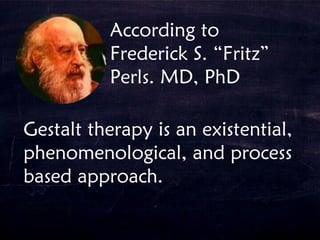
According to
Frederick S. “Fritz”
Perls. MD, PhD
Gestalt therapy is an existential,
phenomenological, and process
based approach.
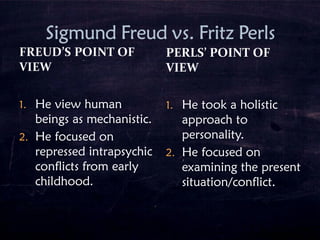
1. He view human
beings as mechanistic.
2. He focused on
repressed intrapsychic
conflicts from early
childhood.
PERLS’ POINT OF
VIEW
1. He took a holistic
approach to
personality.
2. He focused on
examining the present
situation/conflict.
The Gestalt approach focuses much
more on process than on content:
Perls asserted that how individuals
behave in the present moment is far
more crucial to self-understanding
than why they behave as they do.
The main goal of Gestalt therapy is to
enhance and or provide self-
acceptance, knowledge of the
environment, responsibility for
choices, and the ability to make
contact with their field ( a dynamic
system of interrelationships) and the
people in it, all of which are based on
a here-and-now experience that is
always changing.
Key Concepts
•View of Human Nature
• Some Principles of Gestalt Therapy
Theory (Holism, Field theory, and
The Figure Formation Process.)
• Organismic Self-regulation
The gestalt view of human nature is
rooted in existential philosophy,
phenomenology, and field theory.
The therapy aims not at analysis or
introspection but at awareness and
contact with the environment.
Is consists of both the external and internal
worlds.
External world refers to the quality of
contact from other people and or places
and situations.
Internal world refers to the part of the self;
including the “Disowned part.”
The re-owning of parts of oneself that have
been disowned and the unification process
proceed step by step until client’s become
strong enough to carry on with their own
personal growth.
By becoming aware, the clients become able
to make informed choices and thus to live
more meaningful existence.
A basic assumption of Gestalt therapy is
that individuals have the capacity to self-
regulate when they are aware of what is
happening in and around them.
Therefore, therapy provides the setting
and opportunity for that awareness to be
supported and restored.
“The more we work at becoming who or
what we are not, the more we remain the
same.”
- Fritz
Perls
“Authentic change occurs more from being
who we are than from trying to be who we
are not.”
Holism: “ a form that cannot be
separated into parts without losing its
essence.” because Gestalt therapists are
interested in the whole person, they
place no superior value on a particular
aspect/part of the individual.
( thoughts, feelings, behaviors, body,
memories and dreams.)
Field Theory
Gestalt therapy is based on field theory; the
organism must be seen in its environment, or
in its context, as part of the constantly
changing filed.
Its principle: everything is relational, in flux,
interrelated, and in process.
“The field is the entire situation of the
therapist, the client, and all that goes on
between them. The field is made and
constantly remade.” – Parlett (2005)
Describes how the individual organizes
experience from moment to moment.
Field = entire situation.
Foreground = Figure (individual)
Background = setting
The figure formation process tracks how
some aspect of the environmental field
emerges from the background and becomes
the focal point of the individual’s attention
and interest.
Is intertwined with the principle of figure
formation process, a process by which
equilibrium is “disturbed” by the emergence
of a need, sensation, or an interest.
Organisms will do their best to regulate
themselves, given their own capabilities and
the resources of their environment.
Therapeutic work is associated with
what is of interest to or what the
client needs to be able to regain a
sense of equilibrium.
The goal is to help the client to obtain
closure of unfinished situations,
destroy fixed gestalts, and incorporate
more satisfying gestalts.
Prepared By: Dominic D. Olayvar
Instagram: @diioww
By: Sarah Jeane Naungayan
CAS-06-701A
Submitted to: Mrs. Agnes Montalbo
Day/Time: 10:30-1:30
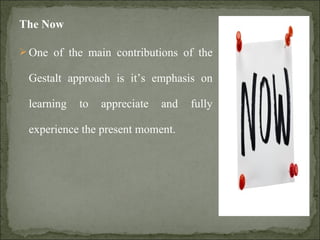
The Now
 One of the main contributions of the
Gestalt approach is it’s emphasis on
learning to appreciate and fully
experience the present moment.
 focusing on the past and future
can be a way to avoid coming to
terms with the present.
 Polster and Polster (1973)
- developed the thesis that “
power is in the present”.
Phenomenological inquiry
- involves paying attention to
what is occuring now.
- gestalt therapists ask “what”
and “how” questions, but rarely
ask “why” questions.
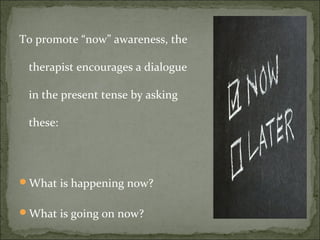
To promote “now” awareness, the
therapist encourages a dialogue
in the present tense by asking
these:
What is happening now?
What is going on now?
What are you experiencing as you sit
there and attempt to talk?
What is your awareness at this
moment?
How are you experiencing your fear?
How are you attempting to withdraw
at this moment?
Most people can stay in present for only
a short time and are inclined to find
ways of interrupting the flow of the
present.
Gestalt therapists recognize that the
past will make regular appearances in
the present moment, usually because of
some lack of completion of that past.
One way to bring vitality to the
therapy sessions is to pay attention
to the immediacy and the quality
of the relationship between the
client and therapist.
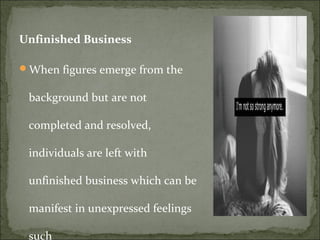
Unfinished Business
When figures emerge from the
background but are not
completed and resolved,
individuals are left with
unfinished business which can be
manifest in unexpressed feelings
such
resentment, rage, hatred, pain,
anxiety, grief, guilt, and
abandonment.
Unacknowledged feelings create
unnecessary emotional debris that
clutters present-centered
awareness.
Impasse or stock point
Is the time when external support is
not available or the customary way
of being does not work.
The therapist’s task is to accompany
clients in experiencing the impasse
without rescuing frustrating them.
Contact and Resistances to
Contact
In gestalt therapy contact is
necessary if change and growth are
to occur.
Contact
is made by seeing, hearing,
smelling, touching, and moving.
Prerequisite of good contact are
clear awareness, full energy, and
the ability to express oneself
(Zinker, 1978).
Miriam polster (1987) claimed
that contact is the lifeblood of
growth.
Polster and Polster (1973) describe
five different kinds of contact
boundary disturbances that
interrupt the cycle of experience:
Introjections
Is the tendency to uncritically accept
other’s beliefs and standard without
assimilating them to make them
congruent with who we are.
Projection
We disdown certain aspects of
ourselves by assigning them to the
environment.
Retroflection
Consist of turning back onto
ourselves what we would like to
do someone else or doing to
ourselves what we would like
someone else to do to or for us.
Defelction
is the process of distraction or veering
off, so that it is difficult to maintain a
sustained sense of contact.
Confluence
Involves blurring the differentiation
between the self and environment.
Energy and Blocks to Enery
In gestalt therapy special attention is
given to where energy in located, how
it is used, and how it can be blocked.
Much of therapeutic endeavour
involves finding the focus of
interrupted
energy and bringing these sensations
to the client’s awareness.
One task of the therapist is to help
clients to identify the ways in which
they are blocking energy and
transform this blocked energy into
more adaptive behaviors.
Prepared by:
Rommerk B. Perez
CAS-06-701A
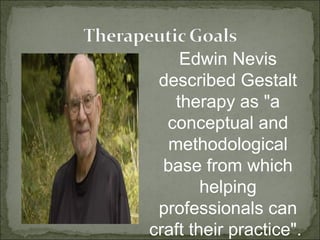
Edwin Nevis
described Gestalt
therapy as "a
conceptual and
methodological
base from which
helping
professionals can
craft their practice".
Continuum of Experience
The Here and Now
The Paradoxical Theory of Change
The Experiment
The Authentic Encounter
Process Oriented Diagnosis
Assisting the Client to Attain
Greater Awareness
1. Knowing the Environment
2. Knowing Oneself
3. Accepting Oneself
4. Being Able to Make Contact
Move toward increased
awareness of themselves.
Gradually assume ownership of
their experience
Develop skills and acquire values
that will allow them to satisfy
their needs
Become more aware of all of
their senses
Learn to accept responsibility
for what they do
Be able to ask for and get help
from others and be able to give
to others.
Perls, Hefferline and Goodman
stated that the therapist’s job is to
invite clients into an active
partnership where they can learn
about themselves by adopting an
experimental attitude toward life in
which they try out new behaviors
and notice what happens.
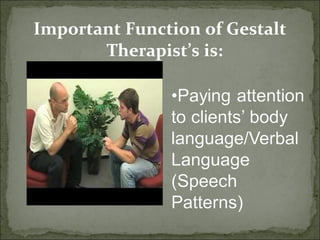
Important Function of Gestalt
Therapist’s is:
“It” Talk
“You” Talk
Questions
Language that Denies Power
Listening to Clients’ Metaphors
Listening for Language that Uncovers
a Story
THE THERAPISTS ARE
RESPONSIBLE FOR:
The Quality of their Presence
For Knowing Themselves and the
Client
Remaining Open to the Client
Establishing and Maintaining a
Therapeutic Atmosphere
THANK YOU….
Application: Therapeutic
Technique and Procedures
Marvin C. Vasquez
The Experiment in Gestalt
Therapy
•In Creative Process in Gestalt
Therapy, Zinker, emphasizes the
role of the therapist as a creative
agent of change, an inventor and a
compassionate and caring human
being.
•
The Experiment in Gestalt
Therapy
•Differentiate Exercise from
Experiment
–Exercise – are technique that are
some used to make something
happen
•
The Experiment in Gestalt
Therapy
•Differentiate Exercise from
Experiment
–Experiments – as a method that shifts
the focus of counselling from talking
about a topic to an activity that will
heighten the client’s awareness and
understanding though experience.
•
The Experiment in Gestalt
Therapy
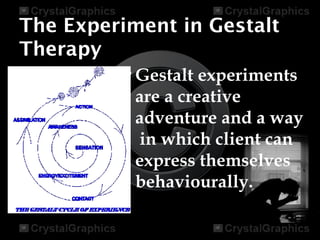
•Gestalt experiments
are a creative
adventure and a way
in which client can
express themselves
behaviourally.
The Experiment in Gestalt
Therapy
•Gestalt therapists
invite clients to
engage in
experiments that
lead to fresh
emotional
experiencing and
new insights
The Experiment in Gestalt
Therapy
•Forms of Gestalt Experiments
– Imagining a threatening future
encounter
–Setting up a dialogue between
a client and some significant
persons in his or her life.
The Experiment in Gestalt
Therapy
•Forms of Gestalt Experiments
– Dramatizing the memory of a
painful pain.
–Relieving a particularly
profound early experience in
the present.
The Experiment in Gestalt
Therapy
•Forms of Gestalt Experiments
– Assuming the identity of one’s
mother or a father through role
playing
–Carrying on a dialogue between
two conflicting aspects within
the person
Preparing the Clients for
Gestalt Therapy
•It is important for counselors to
personally experience the power
of Gestalt experiments and to feel
comfortable suggesting them to
clients .
Preparing the Clients for
Gestalt Therapy
•The essence of current gestalt
therapy involves honoring and
respecting reluctance or
resistance and supporting clients
to become more aware of their
experience.
Preparing the Clients for
Gestalt Therapy
•Guidelines in the Preparation
– Counselors need to know when
to leave client alone
– Counselor needs to know when
to introduce experiments
Preparing the Clients for
Gestalt Therapy
•Guidelines in the Preparation
– Experiments depend on
persons problems, what the
person is experiencing
- Clients active role in self-
exploration
Preparing the Clients for
Gestalt Therapy
•Guidelines in the Preparation
– Respectful of the client's
cultural background
– Counselor needs to be flexible
The Role of Confrontation
• It is important to be direct and
confrontational
• It can be done in an inviting
manner and not harsh
Gestalt Therapy
GESTALT THERAPY FROM A
MULTICULTURAL PERSPECTIVE
Reported by: Rechelle Binas
STRENGTHS FROM A
DIVERSITY PERSPECTIVE
 Frew (2008)
has made the case that
“contemporary Gestalt
Therapy has evolved as a
culturally sensitive and diversity
friendly orientation”
 Fernbacher (2005)
she suggest: “to
develop awareness of
one’s cultural identity,
one must attend to its
influence not only in
training but also as part
of ongoing
development of a
Gestalt practitioner”
 “to undertake work across cultures from a Gestalt
perspective, it is essential that we explore our own cultural
selves … to make contact and encourage contact in and
with others, we need to know about ourselves”
 Gestalt therapy
particularly effective in helping people integrate the
polarities within themselves.
o Many bicultural clients experience an ongoing struggle to
reconcile what appear to be diverse aspects of the two
cultures in which they live.
 There are many opportunities to apply Gestalt
experiments in creative ways with diverse client
populations.
o In cultures where indirect speech is the norms, nonverbal
behaviors may emphasize the unspoken content of verbal
communication.
o Clients may express themselves nonverbally more
expressively than they do with words.
o Gestalt therapists may ask clients to focus on their gestures,
facial expressions, and what they are experiencing within their own
body.
o They attempt to fully understand the background of their
clients’ culture.
o They are concerned about how and which aspects of this
background become central or figural for their clients and
what meaning clients place on these figures.
SHORTCOMINGS FROM A
DIVERSITY PERSPECTIVE
 Gestalt methods tend to produce a high level of intense
feelings. This focus on affect has some clear limitations
with those clients who have been culturally conditioned to
be emotionally reserved.
 Counselors who operate on the assumption that catharsis is
necessary for any change to occur are likely to find certain
clients becoming increasingly resistant, and such clients may
prematurely terminate counseling .
 Gestalt therapist who have truly integrated their approach
are sensitive enough to practice in flexible way. They
consider the client’s cultural framework and are able to
adapt methods that are likely to be well received. The strive
to help clients experience themselves as fully as possible in
the present, yet they are not rigidly bound by dictates, nor
do they routinely intervene whenever clients stray from the
present.
 Sensitively staying in contact with a client’s flow f
experiencing entails the ability to focus on the person and
not on the mechanical use of techniques for a certain effect
THANK YOU 
THE INTERNAL DIALOGUE EXERCISE
One goal of Gestalt Therapy is to bring about
integrated functioning and acceptance of
aspects of one’s personality that have been
disowned and denied. Gestalt Therapist pay
close attention to splits in personality
function. A main division is between the “top
dog” and the “under dog” and therapy often
focuses on the war between the two.
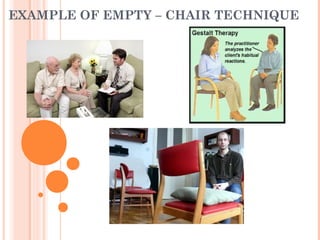
EMPTY – CHAIR TECHNIQUE
Is one way of getting the client to externalized the
introject, a technique Perls used a great deal. Using
two chairs, the therapist asks the client to sit in one
chair and be fully the top dog and then shift to the
other chair and become the under dog.
The dialogue can continue between both sides of the
client. Essentially, this is a role playing technique in
which all the pars are played by the client.
The goal of this exercise is to promote a higher level
of integration between the polarities and conflicts
that exist in everyone. The aim in not to rid oneself of
certain traits but to learn to accept and live with the
polarities.
MAKING THE ROUNDS
Making the rounds is a Gestalt exercise that
involves asking a person in a group to go up
to others in the group and either speak to or
do something with each person. The purpose
is to confront, to risk, to disclose the self, to
experiment with new behavior, and to grow
and change.
THE REVERSAL EXERCISE
Certain symptoms and behaviors often
represent of underlying or latent impulses.
Thus, the therapist could ask a person who
claims to suffer from severe inhibitions and
excessive timidity to play the role of an
exhibitionist.
THE REHEARSAL EXERCISE
Oftentimes we get stuck rehearsing silently to
ourselves so that we will gain acceptance. When it
comes to the performance, we experience stage fright,
or anxiety, because we fear that we will not play our
role well. Internal rehearsal consumes much energy
and frequently inhibits our spontaneity and
willingness to experiment with new behavior. When
clients share their rehearsals out loud with a
therapist, they become more aware of the many
preparatory means they use in bolstering their social
roles.
THE EXAGGERATION EXERCISE
One aim of Gestalt therapy is for clients to become
more aware of the subtle signals and cues they are
sending through body language. Movements,
postures, and gestures may communicate significant
meanings, yet the cues may be incomplete. In this
exercise the person is asked to exaggerate the
movement or gesture repeatedly, which usually in
tensifies the feeling attached to the behavior and
makes the inner meaning clearer. (Some examples) of
behaviors that lend themselves to the exaggeration
technique are trembling (shaking hand, legs),
slouched posture and bent shoulders, cleached fists,
tight frowning, facial grimacing, crossed arms, and so
forth.
STAYING WITH THE FEELING
Most clients desire to escape from fearful stimuli and
to avoid unpleasant feelings. At key moments when
clients refer to a feeling or a mood that is unpleasant
and from which they have a great desire to flee, the
therapist may urge clients to stay with their feeling
and encourage them to go deeper into the feeling or
behavior they wish to avoid. Facing and experiencing
feelings not only takes courage but also is a mark of a
willingness to endure the pain necessary for
unblocking and making way for newer of growth.
THE GESTALT APPROACH TO
DREAM WORK
In psychoanalysis dreams are interpreted,
intellectual insight is stressed, and free association is
used to explore the unconscious meanings of dreams.
The Gestalt approach does not interpret and analyze
dreams. Instead, the intent is to bring dreams back to
life and relive them as though they were happening
now. The dream is acted out in the present, and the
dreamer becomes a part of his or her dream.
EXAMPLE OF EMPTY – CHAIR TECHNIQUE
Presented by: Mark David Roque
Prepared by: Rachel B. Agpaoa
Gestalt Therapy is an
experiential approach
that stresses present
awareness and the
guilty of contact
between the individual
and the environment.
Another therapeutic aim is
to assist clients in
exploring how they make
contact with elements of
their environment.
Change occurs through
the heightened awareness
of “what is”.
The therapist works with
the client to identify the
figures, or most salient
aspects of the individual-
environmental field, as
they emerge from the
background.
Contributions of
Gestalt Therapy
One contribution of
Gestalt therapy is the
exciting way in which
the past is dealt with in
a lively manner by
bringing relevant
aspects into the present.
Cain (2002) identifies
the most significant
contributions of the
Gestalt approach
The critical importance of
contact with oneself,
others, and the
environment.
The central role of
authentic relationship and
dialogue in therapy.
The emphasis on the field
theory, phenomenology,
and awareness
The therapeutic focus on
the present, the here-and-
now experiencing of the
client.
The creative and
spontaneous use of active
experiments as a pathway
to experiential learning.
Gestalt approach to
working with dreams is
a unique pathway for
people to increase their
awareness of key
themes in their lives.
Gestalt therapy is a
holistic approach that
values each aspect of the
individual’s experience
equally.
Strumpfel and Goldman
(2002) note that both process
and outcome studies have
advanced the theory and
practice of Gestalt therapy,
and they summarize a
number of significant
findings based on outcome
research:
Outcome studies have
demonstrated Gestalt therapy to
be equal to or greater than other
therapies for various disorders.
More recent studies have shown
that Gestalt therapy has a
beneficial impact with
personality disturbances,
psychosomatic problems, and
substance addictions.
The effects of Gestalt therapy
tend to be stable in follow-up
studies 1 to 3 years after the
termination of treatment.
Gestalt therapy has
demonstrated effectiveness in
treating a variety of
psychological disorders.
Limitations and
Criticisms of
Gestalt Therapy
Most of criticisms of
Gestalt therapy pertain to
the older version, or the
style of Fritz Perls, which
emphasized confrontation
and de-emphasized the
cognitive factors of
personality.
In Gestalt therapy clients
clarify their thinking,
explore beliefs, and put
meaning to experiences they
are relieving in therapy.
Gestalt practice places a
high value on the contact
and dialogue between
therapist and client.
Gestalt therapists are
highly active, and if
they do not have the
characteristics their
experiments can easily
boomerang mentioned
by Zinker (1978).
Ethical practice depends on
adequate training and
supervision of therapists, and
the most immediate limitation
of Gestalt or any other
therapy is the skill, training,
experience, and judgment of
the therapist.
Thank You 

Gestalt Therapy

  • 1.
  • 2.
    Contents: Definition of Gestalt Introduction:Gestalt according to Fritz Perls / Laura Perls Relational Gestalt Therapy The main goal Key concepts
  • 3.
    Gestalt is aGerman word meaning a whole or completion, or a form that cannot be separated into parts without losing its essence. Gestalt – a structure, configuration, or pattern of physical, biological, or psychological phenomena, to constitute a functional unit that is non-derivable by summation of its parts.
  • 4.
    According to Frederick S.“Fritz” Perls. MD, PhD Gestalt therapy is an existential, phenomenological, and process based approach.
  • 5.
    1. He viewhuman beings as mechanistic. 2. He focused on repressed intrapsychic conflicts from early childhood. PERLS’ POINT OF VIEW 1. He took a holistic approach to personality. 2. He focused on examining the present situation/conflict.
  • 6.
    The Gestalt approachfocuses much more on process than on content: Perls asserted that how individuals behave in the present moment is far more crucial to self-understanding than why they behave as they do.
  • 7.
    The main goalof Gestalt therapy is to enhance and or provide self- acceptance, knowledge of the environment, responsibility for choices, and the ability to make contact with their field ( a dynamic system of interrelationships) and the people in it, all of which are based on a here-and-now experience that is always changing.
  • 8.
    Key Concepts •View ofHuman Nature • Some Principles of Gestalt Therapy Theory (Holism, Field theory, and The Figure Formation Process.) • Organismic Self-regulation
  • 9.
    The gestalt viewof human nature is rooted in existential philosophy, phenomenology, and field theory. The therapy aims not at analysis or introspection but at awareness and contact with the environment.
  • 10.
    Is consists ofboth the external and internal worlds. External world refers to the quality of contact from other people and or places and situations. Internal world refers to the part of the self; including the “Disowned part.”
  • 11.
    The re-owning ofparts of oneself that have been disowned and the unification process proceed step by step until client’s become strong enough to carry on with their own personal growth. By becoming aware, the clients become able to make informed choices and thus to live more meaningful existence.
  • 12.
    A basic assumptionof Gestalt therapy is that individuals have the capacity to self- regulate when they are aware of what is happening in and around them. Therefore, therapy provides the setting and opportunity for that awareness to be supported and restored.
  • 13.
    “The more wework at becoming who or what we are not, the more we remain the same.” - Fritz Perls “Authentic change occurs more from being who we are than from trying to be who we are not.”
  • 14.
    Holism: “ aform that cannot be separated into parts without losing its essence.” because Gestalt therapists are interested in the whole person, they place no superior value on a particular aspect/part of the individual. ( thoughts, feelings, behaviors, body, memories and dreams.)
  • 15.
    Field Theory Gestalt therapyis based on field theory; the organism must be seen in its environment, or in its context, as part of the constantly changing filed. Its principle: everything is relational, in flux, interrelated, and in process. “The field is the entire situation of the therapist, the client, and all that goes on between them. The field is made and constantly remade.” – Parlett (2005)
  • 16.
    Describes how theindividual organizes experience from moment to moment. Field = entire situation. Foreground = Figure (individual) Background = setting The figure formation process tracks how some aspect of the environmental field emerges from the background and becomes the focal point of the individual’s attention and interest.
  • 17.
    Is intertwined withthe principle of figure formation process, a process by which equilibrium is “disturbed” by the emergence of a need, sensation, or an interest. Organisms will do their best to regulate themselves, given their own capabilities and the resources of their environment.
  • 18.
    Therapeutic work isassociated with what is of interest to or what the client needs to be able to regain a sense of equilibrium. The goal is to help the client to obtain closure of unfinished situations, destroy fixed gestalts, and incorporate more satisfying gestalts.
  • 19.
    Prepared By: DominicD. Olayvar Instagram: @diioww
  • 21.
    By: Sarah JeaneNaungayan CAS-06-701A Submitted to: Mrs. Agnes Montalbo Day/Time: 10:30-1:30
  • 22.
    The Now  Oneof the main contributions of the Gestalt approach is it’s emphasis on learning to appreciate and fully experience the present moment.
  • 23.
     focusing onthe past and future can be a way to avoid coming to terms with the present.  Polster and Polster (1973) - developed the thesis that “ power is in the present”.
  • 24.
    Phenomenological inquiry - involvespaying attention to what is occuring now. - gestalt therapists ask “what” and “how” questions, but rarely ask “why” questions.
  • 25.
    To promote “now”awareness, the therapist encourages a dialogue in the present tense by asking these: What is happening now? What is going on now?
  • 26.
    What are youexperiencing as you sit there and attempt to talk? What is your awareness at this moment? How are you experiencing your fear? How are you attempting to withdraw at this moment?
  • 27.
    Most people canstay in present for only a short time and are inclined to find ways of interrupting the flow of the present. Gestalt therapists recognize that the past will make regular appearances in the present moment, usually because of some lack of completion of that past.
  • 28.
    One way tobring vitality to the therapy sessions is to pay attention to the immediacy and the quality of the relationship between the client and therapist.
  • 29.
    Unfinished Business When figuresemerge from the background but are not completed and resolved, individuals are left with unfinished business which can be manifest in unexpressed feelings such
  • 30.
    resentment, rage, hatred,pain, anxiety, grief, guilt, and abandonment. Unacknowledged feelings create unnecessary emotional debris that clutters present-centered awareness.
  • 31.
    Impasse or stockpoint Is the time when external support is not available or the customary way of being does not work. The therapist’s task is to accompany clients in experiencing the impasse without rescuing frustrating them.
  • 32.
    Contact and Resistancesto Contact In gestalt therapy contact is necessary if change and growth are to occur. Contact is made by seeing, hearing, smelling, touching, and moving.
  • 33.
    Prerequisite of goodcontact are clear awareness, full energy, and the ability to express oneself (Zinker, 1978). Miriam polster (1987) claimed that contact is the lifeblood of growth.
  • 34.
    Polster and Polster(1973) describe five different kinds of contact boundary disturbances that interrupt the cycle of experience:
  • 35.
    Introjections Is the tendencyto uncritically accept other’s beliefs and standard without assimilating them to make them congruent with who we are.
  • 36.
    Projection We disdown certainaspects of ourselves by assigning them to the environment.
  • 37.
    Retroflection Consist of turningback onto ourselves what we would like to do someone else or doing to ourselves what we would like someone else to do to or for us.
  • 38.
    Defelction is the processof distraction or veering off, so that it is difficult to maintain a sustained sense of contact. Confluence Involves blurring the differentiation between the self and environment.
  • 39.
    Energy and Blocksto Enery In gestalt therapy special attention is given to where energy in located, how it is used, and how it can be blocked. Much of therapeutic endeavour involves finding the focus of interrupted
  • 40.
    energy and bringingthese sensations to the client’s awareness. One task of the therapist is to help clients to identify the ways in which they are blocking energy and transform this blocked energy into more adaptive behaviors.
  • 43.
    Prepared by: Rommerk B.Perez CAS-06-701A
  • 44.
    Edwin Nevis described Gestalt therapyas "a conceptual and methodological base from which helping professionals can craft their practice".
  • 45.
    Continuum of Experience TheHere and Now The Paradoxical Theory of Change The Experiment The Authentic Encounter Process Oriented Diagnosis
  • 46.
    Assisting the Clientto Attain Greater Awareness 1. Knowing the Environment 2. Knowing Oneself 3. Accepting Oneself 4. Being Able to Make Contact
  • 47.
    Move toward increased awarenessof themselves. Gradually assume ownership of their experience Develop skills and acquire values that will allow them to satisfy their needs
  • 48.
    Become more awareof all of their senses Learn to accept responsibility for what they do Be able to ask for and get help from others and be able to give to others.
  • 49.
    Perls, Hefferline andGoodman stated that the therapist’s job is to invite clients into an active partnership where they can learn about themselves by adopting an experimental attitude toward life in which they try out new behaviors and notice what happens.
  • 50.
    Important Function ofGestalt Therapist’s is:
  • 51.
    “It” Talk “You” Talk Questions Languagethat Denies Power Listening to Clients’ Metaphors Listening for Language that Uncovers a Story
  • 52.
    THE THERAPISTS ARE RESPONSIBLEFOR: The Quality of their Presence For Knowing Themselves and the Client Remaining Open to the Client Establishing and Maintaining a Therapeutic Atmosphere
  • 53.
  • 55.
    Application: Therapeutic Technique andProcedures Marvin C. Vasquez
  • 56.
    The Experiment inGestalt Therapy •In Creative Process in Gestalt Therapy, Zinker, emphasizes the role of the therapist as a creative agent of change, an inventor and a compassionate and caring human being. •
  • 57.
    The Experiment inGestalt Therapy •Differentiate Exercise from Experiment –Exercise – are technique that are some used to make something happen •
  • 58.
    The Experiment inGestalt Therapy •Differentiate Exercise from Experiment –Experiments – as a method that shifts the focus of counselling from talking about a topic to an activity that will heighten the client’s awareness and understanding though experience. •
  • 59.
    The Experiment inGestalt Therapy •Gestalt experiments are a creative adventure and a way in which client can express themselves behaviourally.
  • 60.
    The Experiment inGestalt Therapy •Gestalt therapists invite clients to engage in experiments that lead to fresh emotional experiencing and new insights
  • 61.
    The Experiment inGestalt Therapy •Forms of Gestalt Experiments – Imagining a threatening future encounter –Setting up a dialogue between a client and some significant persons in his or her life.
  • 62.
    The Experiment inGestalt Therapy •Forms of Gestalt Experiments – Dramatizing the memory of a painful pain. –Relieving a particularly profound early experience in the present.
  • 63.
    The Experiment inGestalt Therapy •Forms of Gestalt Experiments – Assuming the identity of one’s mother or a father through role playing –Carrying on a dialogue between two conflicting aspects within the person
  • 64.
    Preparing the Clientsfor Gestalt Therapy •It is important for counselors to personally experience the power of Gestalt experiments and to feel comfortable suggesting them to clients .
  • 65.
    Preparing the Clientsfor Gestalt Therapy •The essence of current gestalt therapy involves honoring and respecting reluctance or resistance and supporting clients to become more aware of their experience.
  • 66.
    Preparing the Clientsfor Gestalt Therapy •Guidelines in the Preparation – Counselors need to know when to leave client alone – Counselor needs to know when to introduce experiments
  • 67.
    Preparing the Clientsfor Gestalt Therapy •Guidelines in the Preparation – Experiments depend on persons problems, what the person is experiencing - Clients active role in self- exploration
  • 68.
    Preparing the Clientsfor Gestalt Therapy •Guidelines in the Preparation – Respectful of the client's cultural background – Counselor needs to be flexible
  • 69.
    The Role ofConfrontation • It is important to be direct and confrontational • It can be done in an inviting manner and not harsh
  • 70.
  • 73.
    GESTALT THERAPY FROMA MULTICULTURAL PERSPECTIVE Reported by: Rechelle Binas
  • 74.
    STRENGTHS FROM A DIVERSITYPERSPECTIVE  Frew (2008) has made the case that “contemporary Gestalt Therapy has evolved as a culturally sensitive and diversity friendly orientation”
  • 75.
     Fernbacher (2005) shesuggest: “to develop awareness of one’s cultural identity, one must attend to its influence not only in training but also as part of ongoing development of a Gestalt practitioner”
  • 76.
     “to undertakework across cultures from a Gestalt perspective, it is essential that we explore our own cultural selves … to make contact and encourage contact in and with others, we need to know about ourselves”
  • 77.
     Gestalt therapy particularlyeffective in helping people integrate the polarities within themselves. o Many bicultural clients experience an ongoing struggle to reconcile what appear to be diverse aspects of the two cultures in which they live.
  • 78.
     There aremany opportunities to apply Gestalt experiments in creative ways with diverse client populations. o In cultures where indirect speech is the norms, nonverbal behaviors may emphasize the unspoken content of verbal communication. o Clients may express themselves nonverbally more expressively than they do with words. o Gestalt therapists may ask clients to focus on their gestures, facial expressions, and what they are experiencing within their own body.
  • 79.
    o They attemptto fully understand the background of their clients’ culture. o They are concerned about how and which aspects of this background become central or figural for their clients and what meaning clients place on these figures.
  • 80.
    SHORTCOMINGS FROM A DIVERSITYPERSPECTIVE  Gestalt methods tend to produce a high level of intense feelings. This focus on affect has some clear limitations with those clients who have been culturally conditioned to be emotionally reserved.  Counselors who operate on the assumption that catharsis is necessary for any change to occur are likely to find certain clients becoming increasingly resistant, and such clients may prematurely terminate counseling .
  • 81.
     Gestalt therapistwho have truly integrated their approach are sensitive enough to practice in flexible way. They consider the client’s cultural framework and are able to adapt methods that are likely to be well received. The strive to help clients experience themselves as fully as possible in the present, yet they are not rigidly bound by dictates, nor do they routinely intervene whenever clients stray from the present.
  • 82.
     Sensitively stayingin contact with a client’s flow f experiencing entails the ability to focus on the person and not on the mechanical use of techniques for a certain effect
  • 83.
  • 85.
    THE INTERNAL DIALOGUEEXERCISE One goal of Gestalt Therapy is to bring about integrated functioning and acceptance of aspects of one’s personality that have been disowned and denied. Gestalt Therapist pay close attention to splits in personality function. A main division is between the “top dog” and the “under dog” and therapy often focuses on the war between the two.
  • 86.
    EMPTY – CHAIRTECHNIQUE Is one way of getting the client to externalized the introject, a technique Perls used a great deal. Using two chairs, the therapist asks the client to sit in one chair and be fully the top dog and then shift to the other chair and become the under dog. The dialogue can continue between both sides of the client. Essentially, this is a role playing technique in which all the pars are played by the client. The goal of this exercise is to promote a higher level of integration between the polarities and conflicts that exist in everyone. The aim in not to rid oneself of certain traits but to learn to accept and live with the polarities.
  • 87.
    MAKING THE ROUNDS Makingthe rounds is a Gestalt exercise that involves asking a person in a group to go up to others in the group and either speak to or do something with each person. The purpose is to confront, to risk, to disclose the self, to experiment with new behavior, and to grow and change.
  • 88.
    THE REVERSAL EXERCISE Certainsymptoms and behaviors often represent of underlying or latent impulses. Thus, the therapist could ask a person who claims to suffer from severe inhibitions and excessive timidity to play the role of an exhibitionist.
  • 89.
    THE REHEARSAL EXERCISE Oftentimeswe get stuck rehearsing silently to ourselves so that we will gain acceptance. When it comes to the performance, we experience stage fright, or anxiety, because we fear that we will not play our role well. Internal rehearsal consumes much energy and frequently inhibits our spontaneity and willingness to experiment with new behavior. When clients share their rehearsals out loud with a therapist, they become more aware of the many preparatory means they use in bolstering their social roles.
  • 90.
    THE EXAGGERATION EXERCISE Oneaim of Gestalt therapy is for clients to become more aware of the subtle signals and cues they are sending through body language. Movements, postures, and gestures may communicate significant meanings, yet the cues may be incomplete. In this exercise the person is asked to exaggerate the movement or gesture repeatedly, which usually in tensifies the feeling attached to the behavior and makes the inner meaning clearer. (Some examples) of behaviors that lend themselves to the exaggeration technique are trembling (shaking hand, legs), slouched posture and bent shoulders, cleached fists, tight frowning, facial grimacing, crossed arms, and so forth.
  • 91.
    STAYING WITH THEFEELING Most clients desire to escape from fearful stimuli and to avoid unpleasant feelings. At key moments when clients refer to a feeling or a mood that is unpleasant and from which they have a great desire to flee, the therapist may urge clients to stay with their feeling and encourage them to go deeper into the feeling or behavior they wish to avoid. Facing and experiencing feelings not only takes courage but also is a mark of a willingness to endure the pain necessary for unblocking and making way for newer of growth.
  • 92.
    THE GESTALT APPROACHTO DREAM WORK In psychoanalysis dreams are interpreted, intellectual insight is stressed, and free association is used to explore the unconscious meanings of dreams. The Gestalt approach does not interpret and analyze dreams. Instead, the intent is to bring dreams back to life and relive them as though they were happening now. The dream is acted out in the present, and the dreamer becomes a part of his or her dream.
  • 93.
    EXAMPLE OF EMPTY– CHAIR TECHNIQUE
  • 94.
    Presented by: MarkDavid Roque
  • 96.
  • 97.
    Gestalt Therapy isan experiential approach that stresses present awareness and the guilty of contact between the individual and the environment.
  • 98.
    Another therapeutic aimis to assist clients in exploring how they make contact with elements of their environment. Change occurs through the heightened awareness of “what is”.
  • 99.
    The therapist workswith the client to identify the figures, or most salient aspects of the individual- environmental field, as they emerge from the background.
  • 100.
  • 101.
    One contribution of Gestalttherapy is the exciting way in which the past is dealt with in a lively manner by bringing relevant aspects into the present.
  • 102.
    Cain (2002) identifies themost significant contributions of the Gestalt approach
  • 103.
    The critical importanceof contact with oneself, others, and the environment. The central role of authentic relationship and dialogue in therapy.
  • 104.
    The emphasis onthe field theory, phenomenology, and awareness The therapeutic focus on the present, the here-and- now experiencing of the client.
  • 105.
    The creative and spontaneoususe of active experiments as a pathway to experiential learning.
  • 106.
    Gestalt approach to workingwith dreams is a unique pathway for people to increase their awareness of key themes in their lives.
  • 107.
    Gestalt therapy isa holistic approach that values each aspect of the individual’s experience equally.
  • 108.
    Strumpfel and Goldman (2002)note that both process and outcome studies have advanced the theory and practice of Gestalt therapy, and they summarize a number of significant findings based on outcome research:
  • 109.
    Outcome studies have demonstratedGestalt therapy to be equal to or greater than other therapies for various disorders. More recent studies have shown that Gestalt therapy has a beneficial impact with personality disturbances, psychosomatic problems, and substance addictions.
  • 110.
    The effects ofGestalt therapy tend to be stable in follow-up studies 1 to 3 years after the termination of treatment. Gestalt therapy has demonstrated effectiveness in treating a variety of psychological disorders.
  • 111.
  • 112.
    Most of criticismsof Gestalt therapy pertain to the older version, or the style of Fritz Perls, which emphasized confrontation and de-emphasized the cognitive factors of personality.
  • 113.
    In Gestalt therapyclients clarify their thinking, explore beliefs, and put meaning to experiences they are relieving in therapy.
  • 114.
    Gestalt practice placesa high value on the contact and dialogue between therapist and client.
  • 115.
    Gestalt therapists are highlyactive, and if they do not have the characteristics their experiments can easily boomerang mentioned by Zinker (1978).
  • 116.
    Ethical practice dependson adequate training and supervision of therapists, and the most immediate limitation of Gestalt or any other therapy is the skill, training, experience, and judgment of the therapist.
  • 117.