REALITY THERAPY
(CHOICE THEORY)
COUNSELING THEORIES OF AND
MULTI-CULTURAL APPROACH
Presented by: Vanessa Grace Manos, RPm
WHO IS WILLIAM
GLASSER?
meet
the
theorist
A psychiatrist known for
establishing choice theory and
reality therapy, which was
applied not only to counseling
situations, but also the
American education system.
(Vitello, 2013)
Glasser was born May 11, 1925 to Betty and
Ben Glasser, who was a watch and clock
repairman.
He was a shy young man, who felt the need
to overcome his modest background. Earned
a chemical engineering degree from Case
Western Reserve University, but was
unhappy in this career path.
Glasser returned to the university and earned
a second bachelor’s degree in psychology in
1953, completing his residency at a Veterans
Administration hospital in Los Angeles.
WILLIAM GLASSER
During his first job at a girls reform school in
Ventura, California he completed case studies
that were used in developing his Reality
Therapy concept. Eventually, he founded the
William Glasser Institute in Chicago, which
trained several thousand educators and
counselors in Choice Theory.
WILLIAM GLASSER
The Institute also has helped establish 20
school districts that implement his theories,
which are called “Glasser Quality Schools”
(Vitello, 2013).(2010)
WHAT IS
REALITY
THERAPY ?
Reality therapy is a type of psychotherapy rooted in choice theory, which
is the idea that a person’s circumstances are a result of their choices.
In reality therapy, clients are taught that they can control their actions,
thoughts, and even how they feel through the choices they make.
The goal is to help people make more responsible, effective, and healthy
choices that improve their lives and reduce their suffering.
Reality
Therapy
Reality therapy does not focus on the influence of childhood trauma, attachment issues, or
other root causes of a person’s problems. Instead, it focuses on current problems and issues.
Like solution-focused therapy, reality therapy is usually short-term and focused on problem-
solving.
Similar to motivational Interviewing, most reality therapy techniques are aimed at helping
people make behavioral changes. It focuses more on behavior than other common forms of
therapy like cognitive behavioral therapy (CBT) and dialectical behavioral therapy (DBT),
which are focused on thought patterns and coping skills.
Reality Therapy Vs. Traditional Talk Therapy
Models
Reality therapy is rooted in the idea that people choose their thoughts, feelings, actions,
and reactions.
Reality therapists work based on the principle that when these choices are irresponsible
or ineffective, they cause psychological distress.
Dr. William Glasser, the developer of reality therapy, considered all choices an attempt to
meet certain basic human needs.
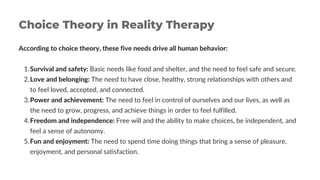
Choice Theory in Reality Therapy
HUMAN BEHAVIOR IS GUIDED BY FIVE BASIC NEEDS:
NEED FOR
SURVIVAL
NEED FOR
LOVE AND
BELONGING
NEED FOR
POWER
NEED FOR
FREEDOM
NEED FOR
FUN
Survival and safety: Basic needs like food and shelter, and the need to feel safe and secure.
Love and belonging: The need to have close, healthy, strong relationships with others and
to feel loved, accepted, and connected.
Power and achievement: The need to feel in control of ourselves and our lives, as well as
the need to grow, progress, and achieve things in order to feel fulfilled.
Freedom and independence: Free will and the ability to make choices, be independent, and
feel a sense of autonomy.
Fun and enjoyment: The need to spend time doing things that bring a sense of pleasure,
enjoyment, and personal satisfaction.
According to choice theory, these five needs drive all human behavior:
1.
2.
3.
4.
5.
Choice Theory in Reality Therapy
WHAT CAN REALITY THERAPY HELP WITH?
Unlike some therapy approaches, reality-based therapy does not market itself as a
treatment for any particular mental health condition or psychological problem.
It is sometimes part of a more comprehensive or eclectic therapeutic plan, and isn’t
necessarily used alone. It is often criticized for being anti-establishment and denying the
validity of diagnosing and treating mental illness.
WHAT CAN REALITY
THERAPY HELP WITH?
Mental health issues like mood disorders or anxiety
disorders
Behavioral problems in children, teens, or adults
Substance use disorders or behavioral addictions
Relationship conflicts with friends, family, or partners
Existential anxiety or people looking for meaning or
fulfillment
Problem solving for specific issues at work, in life, or
in relationships
Reality therapy is sometimes used to help people
struggling with:
REALITY THERAPY
TECHNIQUES
Here are eight common
reality therapy
techniques:
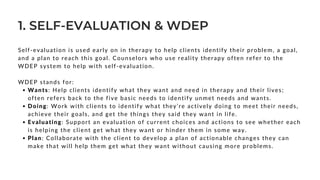
1. SELF-EVALUATION & WDEP
Wants: Help clients identify what they want and need in therapy and their lives;
often refers back to the five basic needs to identify unmet needs and wants.
Doing: Work with clients to identify what they’re actively doing to meet their needs,
achieve their goals, and get the things they said they want in life.
Evaluating: Support an evaluation of current choices and actions to see whether each
is helping the client get what they want or hinder them in some way.
Plan: Collaborate with the client to develop a plan of actionable changes they can
make that will help them get what they want without causing more problems.
Self-evaluation is used early on in therapy to help clients identify their problem, a goal,
and a plan to reach this goal. Counselors who use reality therapy often refer to the
WDEP system to help with self-evaluation.
WDEP stands for:
W Wants- What do you want to be and do?
Your “picture album”
D Doing and Direction- What are you doing?
Where do you want to go?
E Evaluation- Does your present behavior have a reasonable
chance of getting you what you want?
P Planning- “SAMIC”
CHANGE THE “WDEP” SYSTEM
S Simple- Easy to understand, specific and concrete
A Attainable- Within the capacities and motivation of the
client
M Measurable- Are the changes observable and helpful?
I Immediate and Involved- What can be done today?
What can you do?
C Controlled- Can you do this by yourself or will you be
dependent on other?
PLANNING FOR CHANGE
2. ACTION PLANNING
Focus of control: Encourage clients to stay focused on problems they have the power
to change or improve and not the problems beyond their control.
SMART goals: Help clients develop goals that are specific, measurable, attainable,
relevant, and time-bound (SMART).
Responsibility: Hold clients accountable for the changes they outline in their plan by
assigning homework, following up, and encouraging clients to not make excuses.
Revision: Once plans are created, they may be continuously revised, updated or
changed to reflect changes in a client’s priorities, goals, or behavior.
An action plan is another reality therapy technique that involves helping clients make a
plan to overcome their problems and achieve their goals. This often requires the
therapist to steer and direct the sessions to stay focused on actionable changes the
client can make.
Techniques reality therapists may use to make action plans include:
3. REFRAMING
Switch their focus away from the problem and towards the solution
Stay present-focused and avoid discussing the past or future
Interrupt unhelpful comparisons between a person’s expectations and
their reality
Encourage people to take responsibility for their actions instead of using
denial, minimization, or excuses
Cognitive reframing is a skill that is usually attributed to Cognitive
Behavioral Therapy, but it’s also used in reality-based therapy. This
technique helps people change the way they think about something.
Reality therapists may use reframing to help clients:
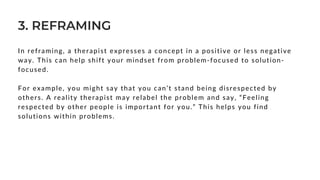
3. REFRAMING
In reframing, a therapist expresses a concept in a positive or less negative
way. This can help shift your mindset from problem-focused to solution-
focused.
For example, you might say that you can’t stand being disrespected by
others. A reality therapist may relabel the problem and say, “Feeling
respected by other people is important for you.” This helps you find
solutions within problems.
4. BEHAVIORAL REHEARSAL
Behavioral rehearsal is essentially any role-playing activity a therapist might ask clients
to do in sessions.
These role-plays may be used in couples therapy or group therapy to help two or more
people practice healthier methods of communication or conflict resolution.
In individual reality therapy sessions, they may be used to help clients practice using
specific skills or responding in different ways to certain situations.
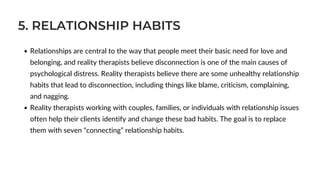
5. RELATIONSHIP HABITS
Relationships are central to the way that people meet their basic need for love and
belonging, and reality therapists believe disconnection is one of the main causes of
psychological distress. Reality therapists believe there are some unhealthy relationship
habits that lead to disconnection, including things like blame, criticism, complaining,
and nagging.
Reality therapists working with couples, families, or individuals with relationship issues
often help their clients identify and change these bad habits. The goal is to replace
them with seven “connecting” relationship habits.
5. RELATIONSHIP HABITS
Supporting
Encouraging
Listening
Accepting
Trusting
Respecting
Negotiating differences
The seven connecting relationship habits are:
6. QUALITY VS. PERCEIVED WORLD
In reality therapy, the perceived world refers to what the client thinks reality is, while
the quality world is what the client actually wants.
The perceived world is based on the client’s life experiences and background. The
larger the gap between the client’s perceived world and quality world, the lower their
life satisfaction is likely to be.
One goal of reality therapy is to bring the two worlds closer together in order to
increase the client’s satisfaction.
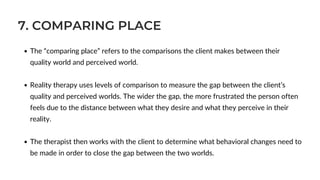
7. COMPARING PLACE
The “comparing place” refers to the comparisons the client makes between their
quality world and perceived world.
Reality therapy uses levels of comparison to measure the gap between the client’s
quality and perceived worlds. The wider the gap, the more frustrated the person often
feels due to the distance between what they desire and what they perceive in their
reality.
The therapist then works with the client to determine what behavioral changes need to
be made in order to close the gap between the two worlds.
8. EXTERNAL VS. INTERNAL CONTROL
Reality therapy posits that behavioral choices are determined by internal control. Being
controlled by external factors is a barrier to change, so reality therapists work with
clients to increase self-awareness of the choices that they have control over.
By being more aware and intentional with the choices clients have regarding their
behavior, they can begin to make positive changes in their behavioral patterns.
GLASSER INDENTIFIED TWO GENRERAL TYPES OF
PERSONALITY:
People who view themselves
from their own internal frames of
reference
Those who perceived of
themselves as others see them.
CLIENT’S
ROLE IN
REALITY
THERAPY
A client in reality therapy will likely
be encouraged to do the following
● Focus on the present, not the past
● Avoid discussing symptoms
● Focus their energy on changing
their thoughts and behavior
● Avoid criticizing, blaming, and/or
comparing themselves to others
● Avoid relying on excuses for their
behavior, whether they are legitimate
or not
● Make specific plans and smart goals
(William Glasser Institute, 2010).
BENEFITS OF
REALITY THERAPY
Increases hope
Provides accountability
Raises self-awareness
Promotes self-control
Focuses on the present
Builds problem-solving skills
Empowers clients with the agency
to make positive choices
Reality therapy often combines well
with other therapeutic interventions,
and has a number of benefits,
including:
CRITIQUES & LIMITATIONS OF REALITY THERAPY
Reality therapy has been criticized because it doesn’t take mental illness or
personality disorders into account as a contributing factor; instead, it suggests
that emotional distress is a result of unmet psychological needs. For this reason,
most therapists who use this approach don’t diagnose people with psychiatric
disorders or prescribe medications
It could be argued that choice theory, a central tenet of reality therapy, blames
and stigmatizes people with mental illnesses by suggesting their symptoms are a
result of their poor or irresponsible choices. This could be offensive to people
with a diagnosed mental illness who may feel like the therapist is telling them
their problems are imagined or self-created.
CRITIQUES & LIMITATIONS OF REALITY THERAPY
Reality therapy focuses on the present and does not investigate root causes,
including childhood trauma, attachment issues, or underlying insecurities or
core beliefs.
Reality-based therapy does not focus on unconscious or subconscious
thoughts or feelings that may drive behaviors; instead, it believes that all
behavior is an intentional attempt to meet one of the five basic needs.
Reality therapy may be influenced by the counselor’s biases or personal
beliefs about “right vs. wrong” choices or behaviors.
Reality therapy rejects the notion that any person or external circumstances
beyond a person’s control can be a source of unhappiness.
Other elements of reality therapy that have been criticized include:
FINAL THOUGHTS ON REALITY THERAPY
Reality therapy is an approach that focuses on individual choices, personal
responsibility, and actionable solutions. This approach is founded on choice theory,
which endorses the idea that personal problems (including mental health issues) are the
result of personal choices.
People looking for short-term, solution-focused therapy may be interested in reality
therapy. Those interested in a more traditional approach to treating a diagnosed mental
health condition may want to explore other styles of psychotherapy.
01
02
THANK YOU FOR
LISTENING!

REALITY THERAPY.pdf

  • 1.
    REALITY THERAPY (CHOICE THEORY) COUNSELINGTHEORIES OF AND MULTI-CULTURAL APPROACH Presented by: Vanessa Grace Manos, RPm
  • 2.
    WHO IS WILLIAM GLASSER? meet the theorist Apsychiatrist known for establishing choice theory and reality therapy, which was applied not only to counseling situations, but also the American education system. (Vitello, 2013)
  • 3.
    Glasser was bornMay 11, 1925 to Betty and Ben Glasser, who was a watch and clock repairman. He was a shy young man, who felt the need to overcome his modest background. Earned a chemical engineering degree from Case Western Reserve University, but was unhappy in this career path. Glasser returned to the university and earned a second bachelor’s degree in psychology in 1953, completing his residency at a Veterans Administration hospital in Los Angeles. WILLIAM GLASSER
  • 4.
    During his firstjob at a girls reform school in Ventura, California he completed case studies that were used in developing his Reality Therapy concept. Eventually, he founded the William Glasser Institute in Chicago, which trained several thousand educators and counselors in Choice Theory. WILLIAM GLASSER The Institute also has helped establish 20 school districts that implement his theories, which are called “Glasser Quality Schools” (Vitello, 2013).(2010)
  • 5.
  • 6.
    Reality therapy isa type of psychotherapy rooted in choice theory, which is the idea that a person’s circumstances are a result of their choices. In reality therapy, clients are taught that they can control their actions, thoughts, and even how they feel through the choices they make. The goal is to help people make more responsible, effective, and healthy choices that improve their lives and reduce their suffering. Reality Therapy
  • 7.
    Reality therapy doesnot focus on the influence of childhood trauma, attachment issues, or other root causes of a person’s problems. Instead, it focuses on current problems and issues. Like solution-focused therapy, reality therapy is usually short-term and focused on problem- solving. Similar to motivational Interviewing, most reality therapy techniques are aimed at helping people make behavioral changes. It focuses more on behavior than other common forms of therapy like cognitive behavioral therapy (CBT) and dialectical behavioral therapy (DBT), which are focused on thought patterns and coping skills. Reality Therapy Vs. Traditional Talk Therapy Models
  • 8.
    Reality therapy isrooted in the idea that people choose their thoughts, feelings, actions, and reactions. Reality therapists work based on the principle that when these choices are irresponsible or ineffective, they cause psychological distress. Dr. William Glasser, the developer of reality therapy, considered all choices an attempt to meet certain basic human needs. Choice Theory in Reality Therapy
  • 9.
    HUMAN BEHAVIOR ISGUIDED BY FIVE BASIC NEEDS: NEED FOR SURVIVAL NEED FOR LOVE AND BELONGING NEED FOR POWER NEED FOR FREEDOM NEED FOR FUN
  • 10.
    Survival and safety:Basic needs like food and shelter, and the need to feel safe and secure. Love and belonging: The need to have close, healthy, strong relationships with others and to feel loved, accepted, and connected. Power and achievement: The need to feel in control of ourselves and our lives, as well as the need to grow, progress, and achieve things in order to feel fulfilled. Freedom and independence: Free will and the ability to make choices, be independent, and feel a sense of autonomy. Fun and enjoyment: The need to spend time doing things that bring a sense of pleasure, enjoyment, and personal satisfaction. According to choice theory, these five needs drive all human behavior: 1. 2. 3. 4. 5. Choice Theory in Reality Therapy
  • 11.
    WHAT CAN REALITYTHERAPY HELP WITH? Unlike some therapy approaches, reality-based therapy does not market itself as a treatment for any particular mental health condition or psychological problem. It is sometimes part of a more comprehensive or eclectic therapeutic plan, and isn’t necessarily used alone. It is often criticized for being anti-establishment and denying the validity of diagnosing and treating mental illness.
  • 12.
    WHAT CAN REALITY THERAPYHELP WITH? Mental health issues like mood disorders or anxiety disorders Behavioral problems in children, teens, or adults Substance use disorders or behavioral addictions Relationship conflicts with friends, family, or partners Existential anxiety or people looking for meaning or fulfillment Problem solving for specific issues at work, in life, or in relationships Reality therapy is sometimes used to help people struggling with:
  • 13.
    REALITY THERAPY TECHNIQUES Here areeight common reality therapy techniques:
  • 14.
    1. SELF-EVALUATION &WDEP Wants: Help clients identify what they want and need in therapy and their lives; often refers back to the five basic needs to identify unmet needs and wants. Doing: Work with clients to identify what they’re actively doing to meet their needs, achieve their goals, and get the things they said they want in life. Evaluating: Support an evaluation of current choices and actions to see whether each is helping the client get what they want or hinder them in some way. Plan: Collaborate with the client to develop a plan of actionable changes they can make that will help them get what they want without causing more problems. Self-evaluation is used early on in therapy to help clients identify their problem, a goal, and a plan to reach this goal. Counselors who use reality therapy often refer to the WDEP system to help with self-evaluation. WDEP stands for:
  • 15.
    W Wants- Whatdo you want to be and do? Your “picture album” D Doing and Direction- What are you doing? Where do you want to go? E Evaluation- Does your present behavior have a reasonable chance of getting you what you want? P Planning- “SAMIC” CHANGE THE “WDEP” SYSTEM
  • 16.
    S Simple- Easyto understand, specific and concrete A Attainable- Within the capacities and motivation of the client M Measurable- Are the changes observable and helpful? I Immediate and Involved- What can be done today? What can you do? C Controlled- Can you do this by yourself or will you be dependent on other? PLANNING FOR CHANGE
  • 17.
    2. ACTION PLANNING Focusof control: Encourage clients to stay focused on problems they have the power to change or improve and not the problems beyond their control. SMART goals: Help clients develop goals that are specific, measurable, attainable, relevant, and time-bound (SMART). Responsibility: Hold clients accountable for the changes they outline in their plan by assigning homework, following up, and encouraging clients to not make excuses. Revision: Once plans are created, they may be continuously revised, updated or changed to reflect changes in a client’s priorities, goals, or behavior. An action plan is another reality therapy technique that involves helping clients make a plan to overcome their problems and achieve their goals. This often requires the therapist to steer and direct the sessions to stay focused on actionable changes the client can make. Techniques reality therapists may use to make action plans include:
  • 18.
    3. REFRAMING Switch theirfocus away from the problem and towards the solution Stay present-focused and avoid discussing the past or future Interrupt unhelpful comparisons between a person’s expectations and their reality Encourage people to take responsibility for their actions instead of using denial, minimization, or excuses Cognitive reframing is a skill that is usually attributed to Cognitive Behavioral Therapy, but it’s also used in reality-based therapy. This technique helps people change the way they think about something. Reality therapists may use reframing to help clients:
  • 19.
    3. REFRAMING In reframing,a therapist expresses a concept in a positive or less negative way. This can help shift your mindset from problem-focused to solution- focused. For example, you might say that you can’t stand being disrespected by others. A reality therapist may relabel the problem and say, “Feeling respected by other people is important for you.” This helps you find solutions within problems.
  • 20.
    4. BEHAVIORAL REHEARSAL Behavioralrehearsal is essentially any role-playing activity a therapist might ask clients to do in sessions. These role-plays may be used in couples therapy or group therapy to help two or more people practice healthier methods of communication or conflict resolution. In individual reality therapy sessions, they may be used to help clients practice using specific skills or responding in different ways to certain situations.
  • 21.
    5. RELATIONSHIP HABITS Relationshipsare central to the way that people meet their basic need for love and belonging, and reality therapists believe disconnection is one of the main causes of psychological distress. Reality therapists believe there are some unhealthy relationship habits that lead to disconnection, including things like blame, criticism, complaining, and nagging. Reality therapists working with couples, families, or individuals with relationship issues often help their clients identify and change these bad habits. The goal is to replace them with seven “connecting” relationship habits.
  • 22.
  • 24.
    6. QUALITY VS.PERCEIVED WORLD In reality therapy, the perceived world refers to what the client thinks reality is, while the quality world is what the client actually wants. The perceived world is based on the client’s life experiences and background. The larger the gap between the client’s perceived world and quality world, the lower their life satisfaction is likely to be. One goal of reality therapy is to bring the two worlds closer together in order to increase the client’s satisfaction.
  • 25.
    7. COMPARING PLACE The“comparing place” refers to the comparisons the client makes between their quality world and perceived world. Reality therapy uses levels of comparison to measure the gap between the client’s quality and perceived worlds. The wider the gap, the more frustrated the person often feels due to the distance between what they desire and what they perceive in their reality. The therapist then works with the client to determine what behavioral changes need to be made in order to close the gap between the two worlds.
  • 26.
    8. EXTERNAL VS.INTERNAL CONTROL Reality therapy posits that behavioral choices are determined by internal control. Being controlled by external factors is a barrier to change, so reality therapists work with clients to increase self-awareness of the choices that they have control over. By being more aware and intentional with the choices clients have regarding their behavior, they can begin to make positive changes in their behavioral patterns.
  • 27.
    GLASSER INDENTIFIED TWOGENRERAL TYPES OF PERSONALITY: People who view themselves from their own internal frames of reference Those who perceived of themselves as others see them.
  • 28.
    CLIENT’S ROLE IN REALITY THERAPY A clientin reality therapy will likely be encouraged to do the following ● Focus on the present, not the past ● Avoid discussing symptoms ● Focus their energy on changing their thoughts and behavior ● Avoid criticizing, blaming, and/or comparing themselves to others ● Avoid relying on excuses for their behavior, whether they are legitimate or not ● Make specific plans and smart goals (William Glasser Institute, 2010).
  • 29.
    BENEFITS OF REALITY THERAPY Increaseshope Provides accountability Raises self-awareness Promotes self-control Focuses on the present Builds problem-solving skills Empowers clients with the agency to make positive choices Reality therapy often combines well with other therapeutic interventions, and has a number of benefits, including:
  • 30.
    CRITIQUES & LIMITATIONSOF REALITY THERAPY Reality therapy has been criticized because it doesn’t take mental illness or personality disorders into account as a contributing factor; instead, it suggests that emotional distress is a result of unmet psychological needs. For this reason, most therapists who use this approach don’t diagnose people with psychiatric disorders or prescribe medications It could be argued that choice theory, a central tenet of reality therapy, blames and stigmatizes people with mental illnesses by suggesting their symptoms are a result of their poor or irresponsible choices. This could be offensive to people with a diagnosed mental illness who may feel like the therapist is telling them their problems are imagined or self-created.
  • 31.
    CRITIQUES & LIMITATIONSOF REALITY THERAPY Reality therapy focuses on the present and does not investigate root causes, including childhood trauma, attachment issues, or underlying insecurities or core beliefs. Reality-based therapy does not focus on unconscious or subconscious thoughts or feelings that may drive behaviors; instead, it believes that all behavior is an intentional attempt to meet one of the five basic needs. Reality therapy may be influenced by the counselor’s biases or personal beliefs about “right vs. wrong” choices or behaviors. Reality therapy rejects the notion that any person or external circumstances beyond a person’s control can be a source of unhappiness. Other elements of reality therapy that have been criticized include:
  • 32.
    FINAL THOUGHTS ONREALITY THERAPY Reality therapy is an approach that focuses on individual choices, personal responsibility, and actionable solutions. This approach is founded on choice theory, which endorses the idea that personal problems (including mental health issues) are the result of personal choices. People looking for short-term, solution-focused therapy may be interested in reality therapy. Those interested in a more traditional approach to treating a diagnosed mental health condition may want to explore other styles of psychotherapy. 01 02
  • 33.