Lecture 6: Systemic therapy with
Individuals
Systemic Comparative
Kevin Standish
Newham College University Centre
Learning Outcomes
• Social constructionist approaches to Self
• Describe the changes to the core Milan
principles: Curiosity to self-other-reflexivity
• Give a critical review in relation to their own
model of practice
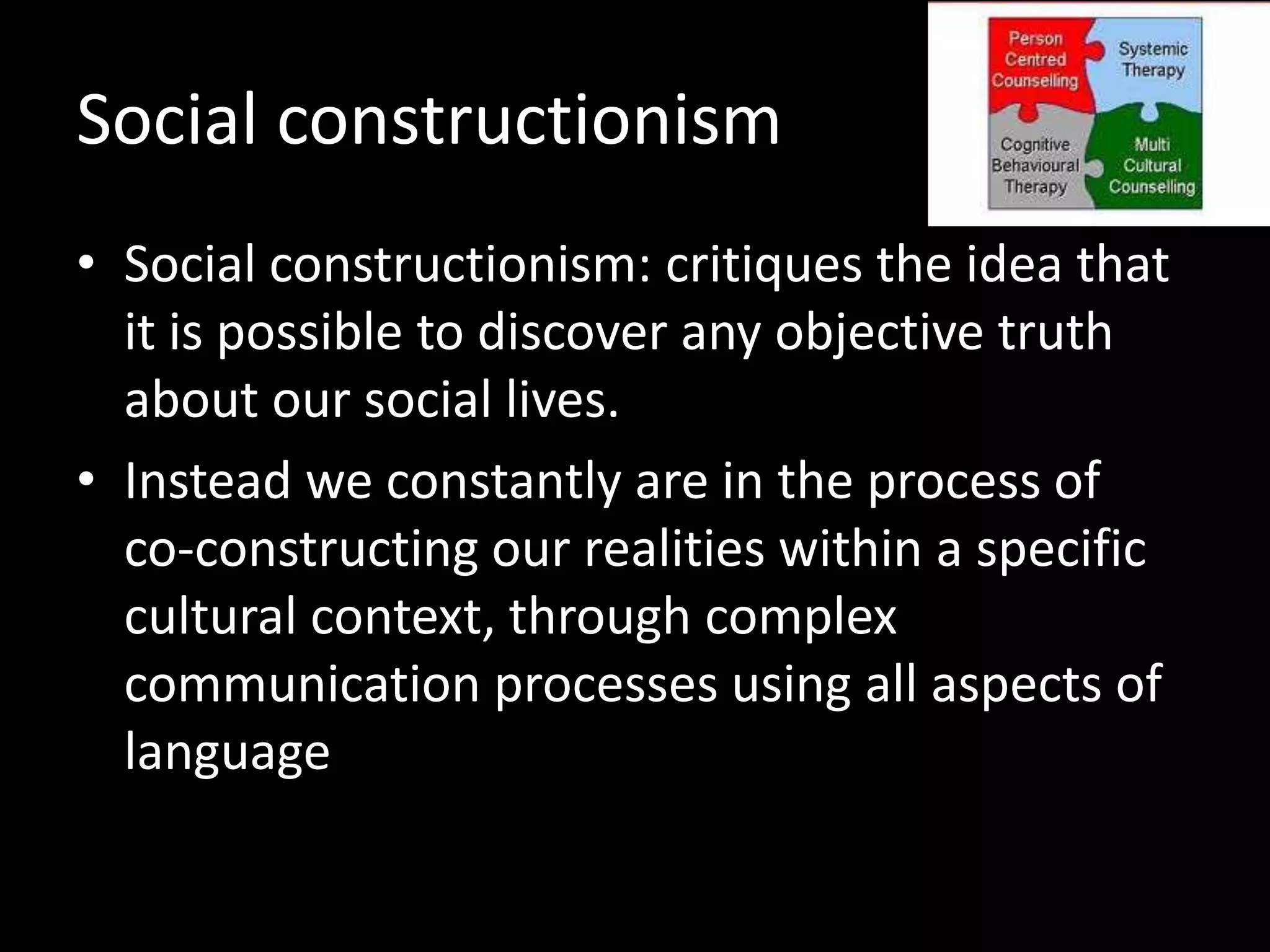
Social constructionism
• Social constructionism: critiques the idea that
it is possible to discover any objective truth
about our social lives.
• Instead we constantly are in the process of
co-constructing our realities within a specific
cultural context, through complex
communication processes using all aspects of
language
Social constructionism
• The post-Milan systemic practitioners embraced social
constructionist thinking.
• Constructivism: communication as a cognitive process
of knowing through perception.
• Constructionism: communication as a social process of
creating the world.
• Language creates reality:
• Things are what we say they are!
or
Things are what we say they are!
Social constructionism
• The influence on therapy: clients are invited to
answer from their own experience and tell the
therapist about their world view.
• Rather than the therapist making statements or
giving interpretations which tell the client what
therapist knows.
• This created a profound shift to an interpersonal
perspective and helped liberate individuals from
the oppressive and pathologising frameworks of
older models
SOCIAL CONSTRUCTIONIST
APPROACHES TO SELF
Social constructionist approaches to Self
• Nature versus Nurture debate- most would argue that
human beings are much more than a collection of physical
and psychological characteristics. Our selves are a
combination of nature and nurture.
• At birth, babies have no sense of self. They do act on their
own- the eat, cry, sleep, and so on, but this is not a conscious
of self which develops later in life. Babies cry when they are
hungry not because they think "If I cry, I will get Mom's
attention," but rather because they feel discomfort. As
children age, they are able to exert greater control over their
conduct. However, humans also must develop cognitive
capacities through interactions with others that allow them
to differentiate self from others, to understand and use
symbolic language, and to take the roles of others.
Social constructionist approaches to Self
• To distinguish yourself from others, you must first recognize
yourself as a distinct entity. The first step is to distinguish
yourself (your face and body) from the rest of the physical
environment. Humans are not born with this ability, but most
studies suggest that it develops around 18-months of age.
• The second step in the acquisition of self is the development of
speech. Language acquisition relies on neurological
development as well as input from others, often from parents.
• Parents speak with children, and children learn to make the
sounds, imitate sounds, and use sounds as symbols for particular
physical sensations or objects. This learning process gives the
child access to the pre-existing linguistic world in which his or
her parents and others live. The child learns the names of
concrete objects as well as abstract ideas that cannot be directly
perceived.
Social constructionist approaches to
Self
• Children learn that they are objects and have names. A
child who learns that others are referring to her when
they make the sound "Elena," and that she can too use
"Elena" to refer to herself, has taken a significant leap
forward in the acquisition of self.
• The child now can visualize herself as a part of the
named world and the named relationships to which
she belongs. By observing how people act toward
themselves, they can learn the meaning of
themselves.
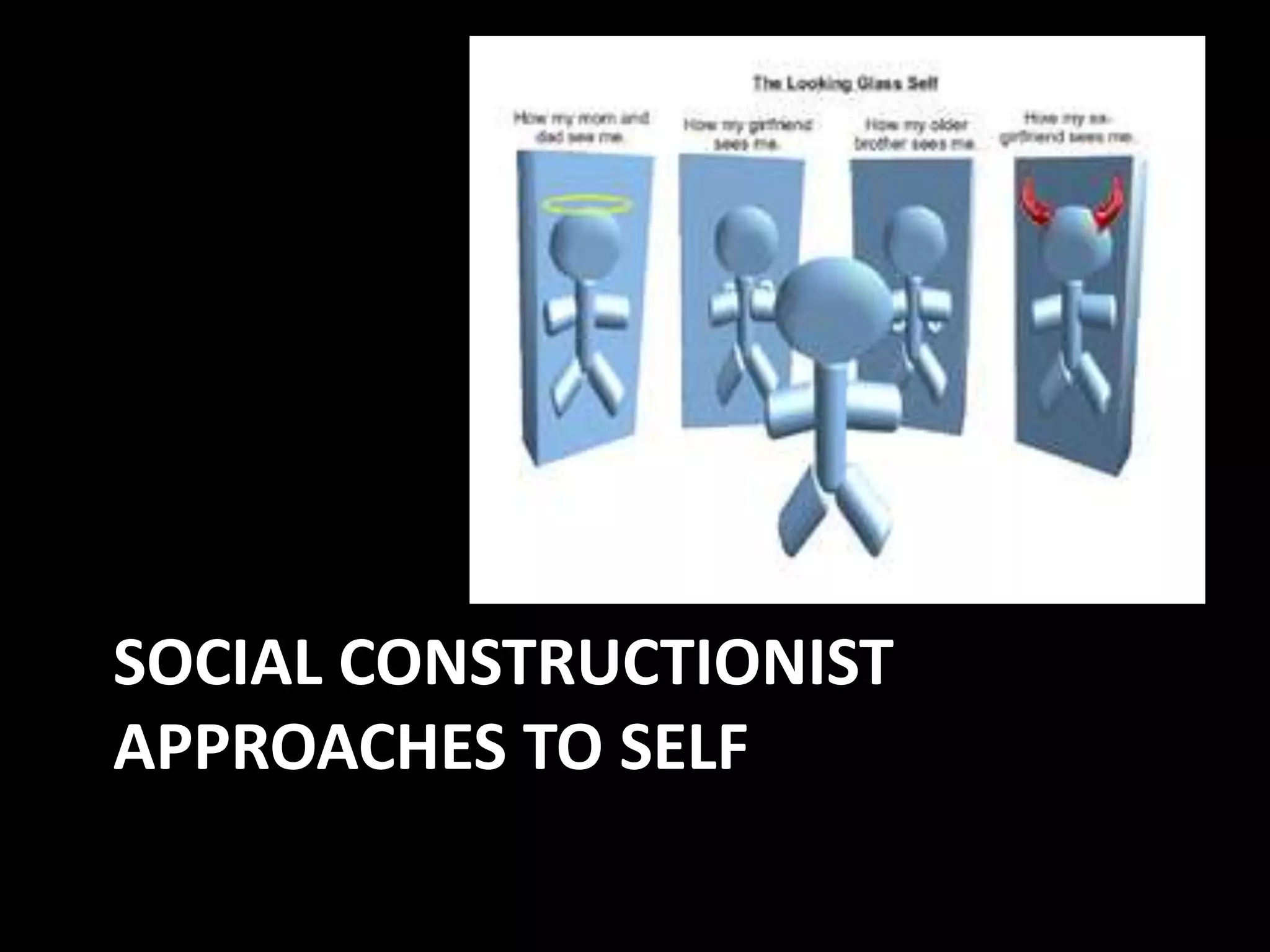
• symbolic interactionists referred to this process as
acquisition of the looking glass self.
Social constructionist approaches to
Self
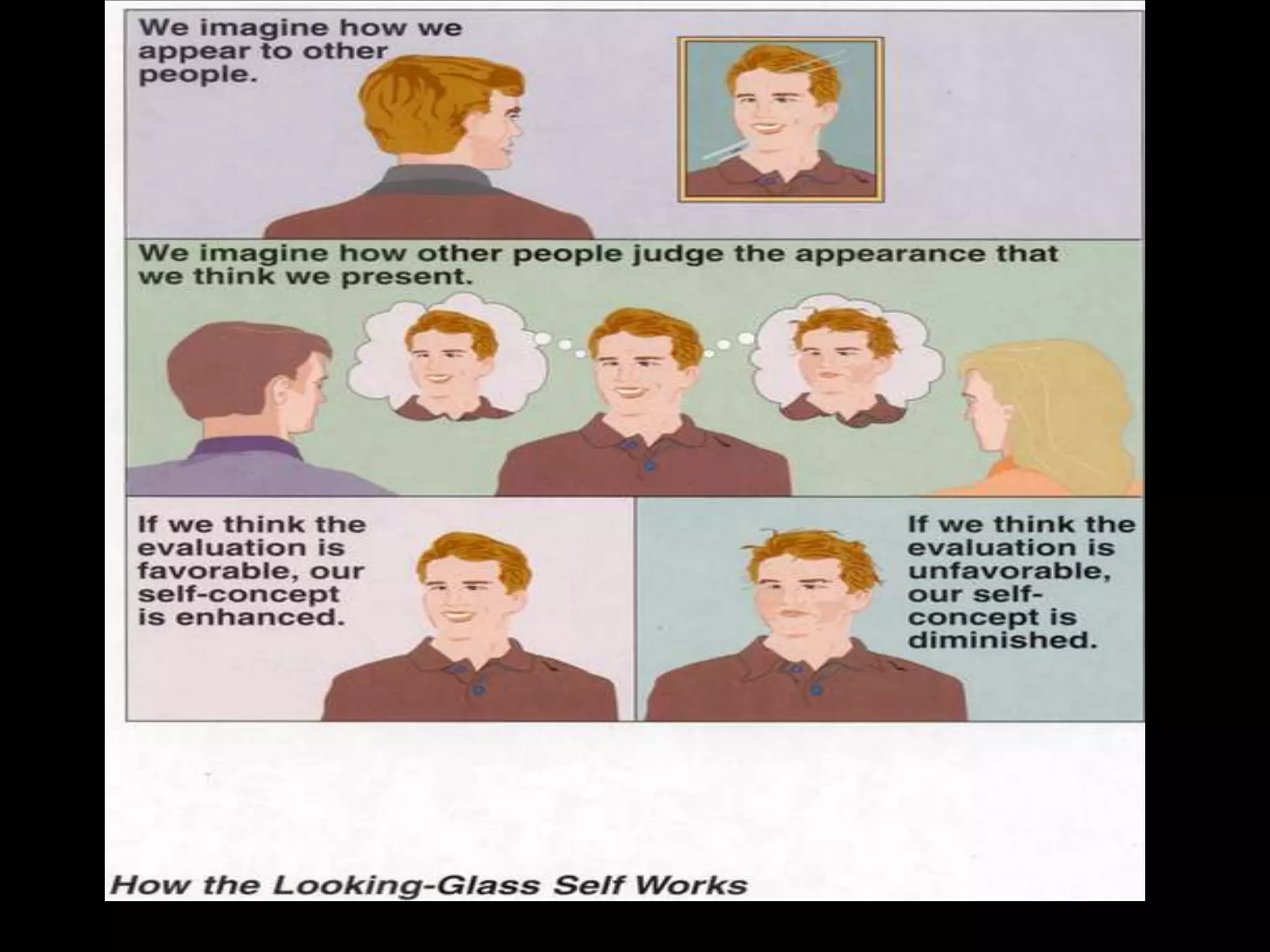
• In this process we imagine how we might look
to other people; interpret their responses to
us; form a self-concept, based on pride or
shame, from their response.
• Reflected appraisal- the idea that a person
bases his or her self-concept on the reaction
he or she perceives from others during social
interaction
Social constructionist approaches to Self
• Studies show that it is the perceived reactions
of others, rather than their actual reactions,
that are crucial for self-concept formation.
• This occurs because feedback we receive is
often inconsistent or even contradictory; is
ambiguous and often difficult to interpret
• we must rely on our perceptions of others'
reactions to construct our self-concepts.
The importance to therapy
• Since therapists are afforded a powerful
position in our culture, the therapist’s ways of
talking and acting have a powerful impact on
the reality that gets co-constructed with in the
therapeutic conversation.
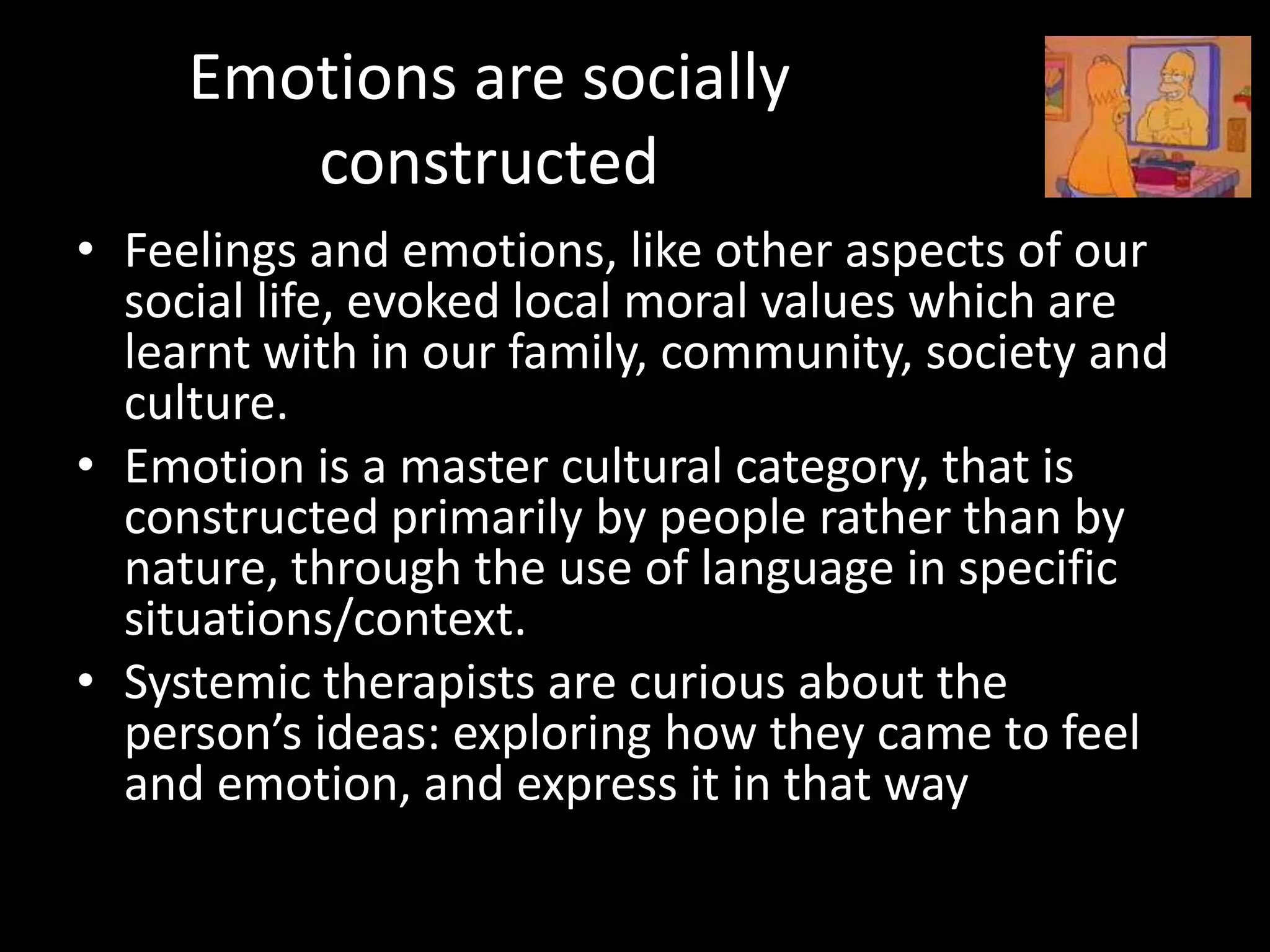
• The way we talk with clients affects how they
come to describe themselves
Emotions are socially
constructed
• Feelings and emotions, like other aspects of our
social life, evoked local moral values which are
learnt with in our family, community, society and
culture.
• Emotion is a master cultural category, that is
constructed primarily by people rather than by
nature, through the use of language in specific
situations/context.
• Systemic therapists are curious about the
person’s ideas: exploring how they came to feel
and emotion, and express it in that way
Emotions are socially constructed
• Feelings and emotions are learnt within family
community and culture
• Emotions of culturally constructed and culturally
specific
• Emotions are historically specific: e.g. melancholy has
now been replaced with depression
• We need to be curious about where and in which
context a person has develop their unique ways of
doing particular feelings
• The therapist’s job is to help the client in deconstruct
their emotions making sense of the social and cultural
rules involved
Emotions are socially constructed
• The rules for the correct use of emotion falls
into four groups:
• 1. The felt bodily disturbance;
• 2. The characteristic display of the emotion in
context;
• 3. The word be choose to describe the
emotion;
• 4. The social act of communicating the
emotion.
The importance of context
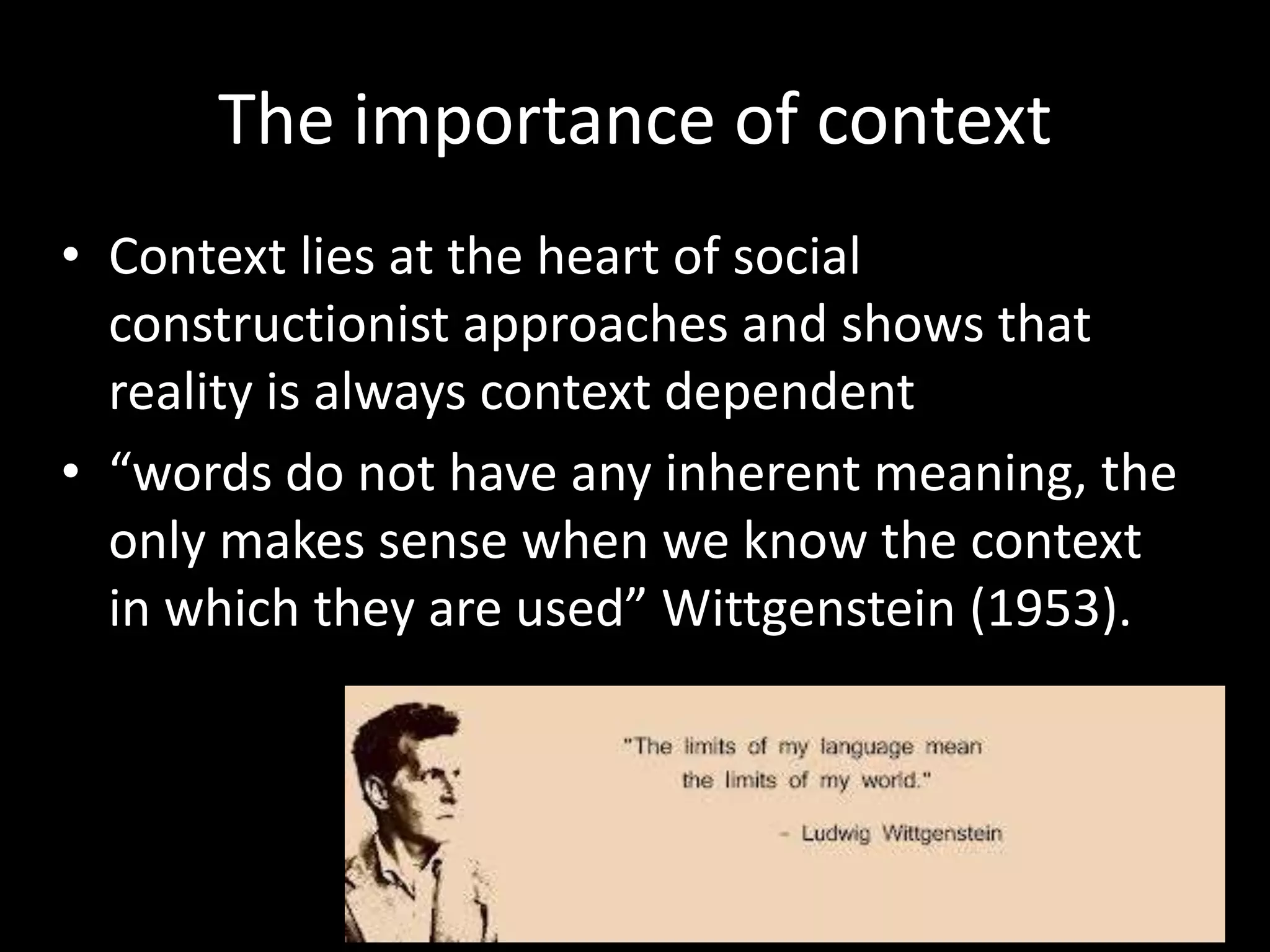
• Context lies at the heart of social
constructionist approaches and shows that
reality is always context dependent
• “words do not have any inherent meaning, the
only makes sense when we know the context
in which they are used” Wittgenstein (1953).
The importance of context
• In every context there are potential numerous
meanings, if we are willing to see them.
• New information can shift the context and the
meaning of an action
• By seeing action in a different context, unnoticed
aspects become visible and the whole meaning of
the interaction is altered.
• When the client describes thoughts, feelings and
actions in their lives, all these have taken place
within the context of particular relationships
The importance of context
• Particular stories and actions affect a context,
and the context in turn affects those stories
and actions: recursive feedback loops.
• Coordinated management of the meaning
(CMM) Cronen & Pearce (1991/2):the
language we use and actions we take are
influenced by what we perceive as the context
in which we act.
The importance of context
• When a story does not fit it is useful to explore
other context to which client could be connecting
• Bateson (1972) noted three significant contexts
that operate within every conversation:
– The context of time
– The context of the definition of the relationship
– Context of place

• Therapy is a very specific time and place and
relationship
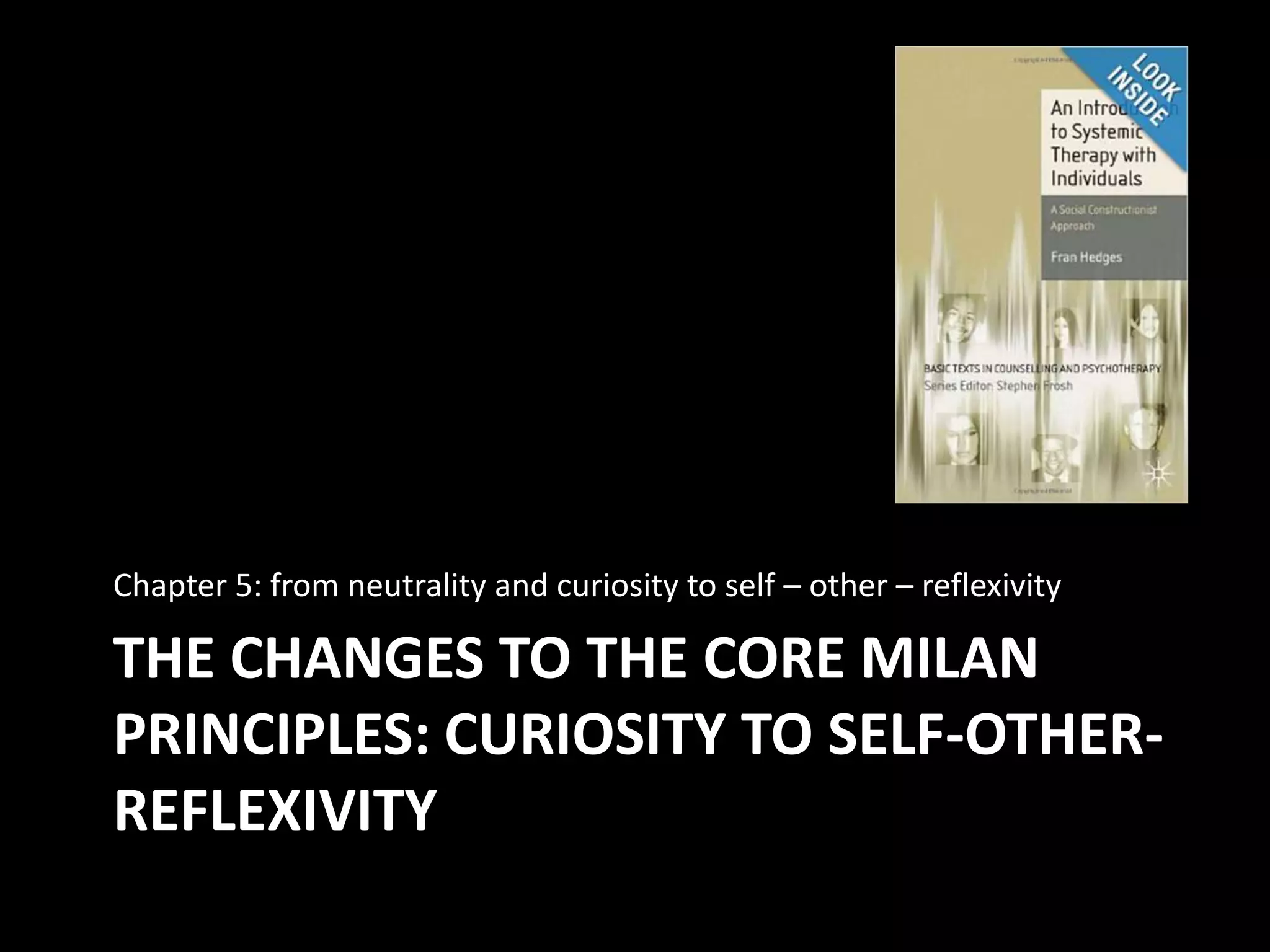
Chapter 5: from neutrality and curiosity to self – other – reflexivity

THE CHANGES TO THE CORE MILAN
PRINCIPLES: CURIOSITY TO SELF-OTHERREFLEXIVITY
the changes to the core Milan principles:
Curiosity to self-other-reflexivity
• CECCHIN (1987) Hypothesizing, Circularity,
and Neutrality Revisited: An Invitation to
Curiosity.
• This seminal article moves away from the idea
of “knowing”, to developing curiosity to
question prejudice, and reflect on the
recursive nature of the three elements in
therapy
the changes to the core Milan principles:
Curiosity to self-other-reflexivity
• If we are curious, we question premises: our own and
those of the family we are treating.
• A family's interactions with us should facilitate
questioning our own premises. Not only are we
intervening in their systems, but families are also
intervening in our systems: helping us to become
better systemic thinkers.
• The idea of a recursive relationship among neutrality,
hypothesizing, and circularity proposes a framework
that invites us to be more curious about symptoms in
therapy those of families as well as of therapists.
the changes to the core Milan principles:
Curiosity to self-other-reflexivity
• By remaining curious we can never be certain
because there’s always more to descriptions,
connections and interactions going on that we
are not aware of in the client’s life.
• This is the stance of perpetual doubt and not
knowing
• Curiosity encourages the therapist to remain
puzzled and questioning
• It allows us to be self reflexive on our theories
prejudices and stories in our work with clients.
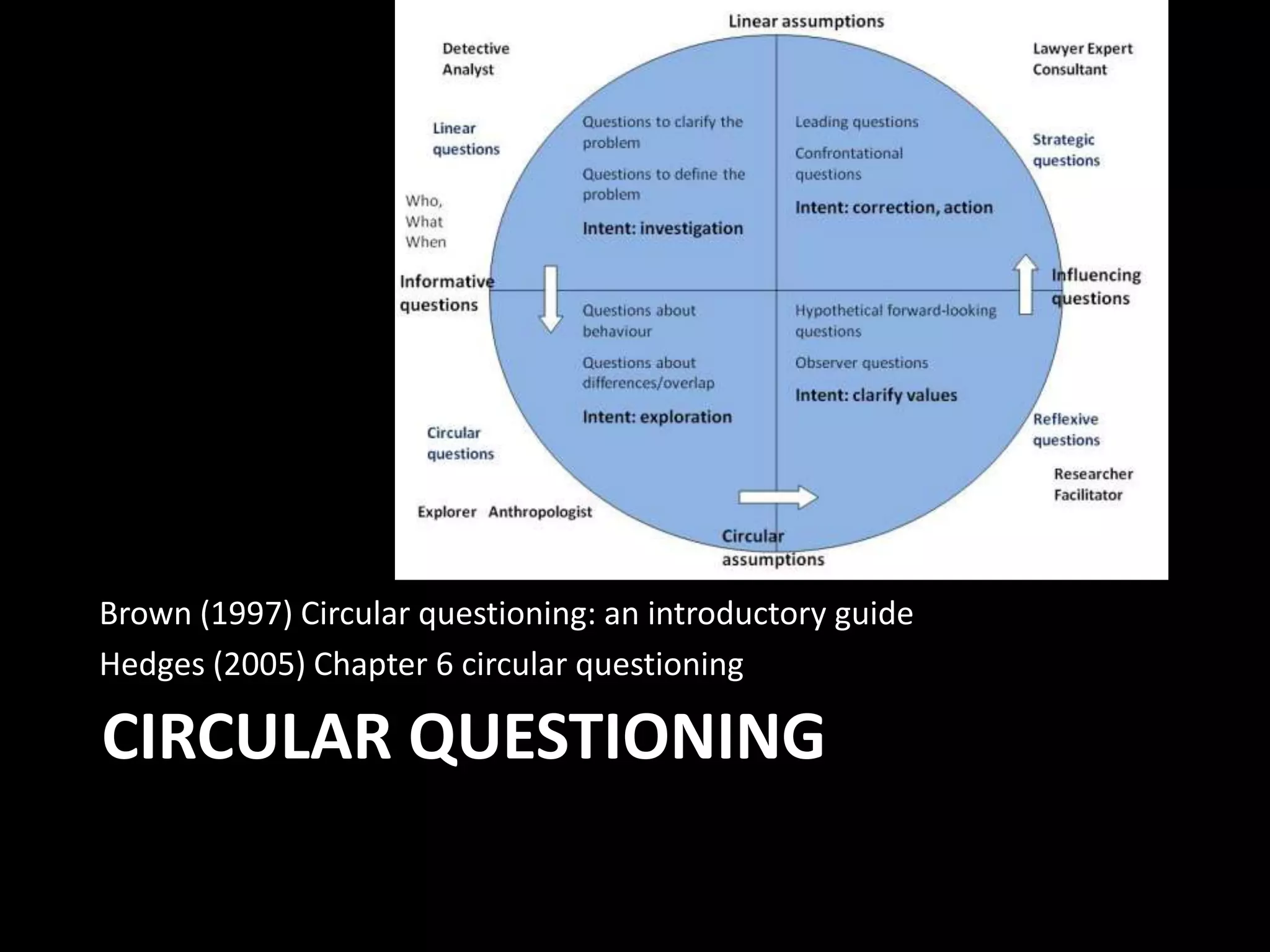
Brown (1997) Circular questioning: an introductory guide
Hedges (2005) Chapter 6 circular questioning

CIRCULAR QUESTIONING
Circular Questioning
• Circular questioning enables therapist to enter
the interpersonal systemic frame
• Otherwise known as “relationship questions”
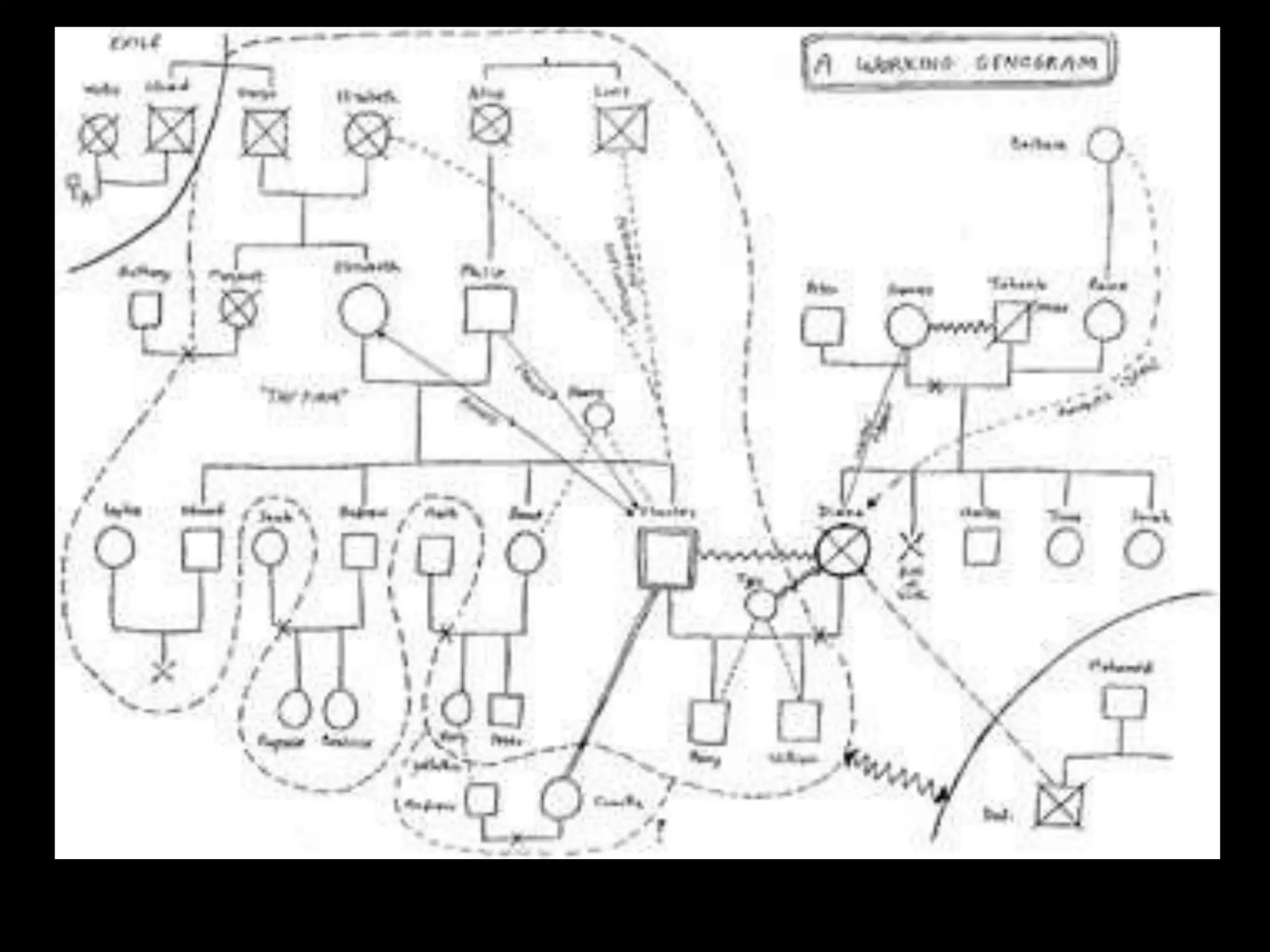
• The use of Genograms can help map the
individual’s relationships in the absence of
family.
• Add significant friends professionals
relationships which are influential
Circular Questioning
• Include information known as SOCIAL
GRRAACCCES:
– Gender, race, religion, age, abilities, class, culture,
colour, ethnicity and sexual orientation

• Information is difference: difference is a
relationship
• The goal is to help clients notice change and
difference over time in order to draw
distinctions. Circular questions target
perceptions of difference not facts.
Language is linear
• Because the language is linear it creates the idea of
cores – effect
• Language distinguishes between a subject and object:
person who performs the action and the person who
receives the action; creates an assumption that the
world is organised in a linear way.
• Replace the verb to be with the verb to show:
“appearance is not necessarily reality”
• Hypothesise about what the motion/behaviour shows
as a communication and the meaning of this. Avoid
intra psychic explanations
What circular questions do
• Circular questions enable therapists to think relationally and
therefore systemically, thereby developing new connections. They:
– Broaden the frame from the individual to interaction
– Shift from “linear” cause-effect to interaction
– Demonstrate the importance of relationship
– Bring forth unheard-of voices
– Make connections between the meaning of important events
– Make links between present, future hopes and past stories
– Keeps therapist curiosity alive
– Help the client become more curious about their life
– Enable us to test out and refute hypotheses
– Introduce difference
– Open space for new connections
– To respect the client as an expert in their life
– Facilitate changing the story
Circular/Relationship Questioning
• Seeks information about differences between:
– People: “who notices most when I feel low?”
– Behaviour: “who is most rude, John or Mary?”
– Events: “did John do more around the house
before he got promotion or before you were at
home or?”
– Relationships: between all the above
Individual systemic therapy
approaches.
• Solution focused therapy
• Narrative Therapy
• Emotion Focused Therapy (EFT)
Lecture 6 systemic therapy with individuals

Lecture 6 systemic therapy with individuals

  • 1.
    Lecture 6: Systemictherapy with Individuals Systemic Comparative Kevin Standish Newham College University Centre
  • 2.
    Learning Outcomes • Socialconstructionist approaches to Self • Describe the changes to the core Milan principles: Curiosity to self-other-reflexivity • Give a critical review in relation to their own model of practice
  • 3.
    Social constructionism • Socialconstructionism: critiques the idea that it is possible to discover any objective truth about our social lives. • Instead we constantly are in the process of co-constructing our realities within a specific cultural context, through complex communication processes using all aspects of language
  • 4.
    Social constructionism • Thepost-Milan systemic practitioners embraced social constructionist thinking. • Constructivism: communication as a cognitive process of knowing through perception. • Constructionism: communication as a social process of creating the world. • Language creates reality: • Things are what we say they are! or Things are what we say they are!
  • 5.
    Social constructionism • Theinfluence on therapy: clients are invited to answer from their own experience and tell the therapist about their world view. • Rather than the therapist making statements or giving interpretations which tell the client what therapist knows. • This created a profound shift to an interpersonal perspective and helped liberate individuals from the oppressive and pathologising frameworks of older models
  • 6.
  • 7.
    Social constructionist approachesto Self • Nature versus Nurture debate- most would argue that human beings are much more than a collection of physical and psychological characteristics. Our selves are a combination of nature and nurture. • At birth, babies have no sense of self. They do act on their own- the eat, cry, sleep, and so on, but this is not a conscious of self which develops later in life. Babies cry when they are hungry not because they think "If I cry, I will get Mom's attention," but rather because they feel discomfort. As children age, they are able to exert greater control over their conduct. However, humans also must develop cognitive capacities through interactions with others that allow them to differentiate self from others, to understand and use symbolic language, and to take the roles of others.
  • 8.
    Social constructionist approachesto Self • To distinguish yourself from others, you must first recognize yourself as a distinct entity. The first step is to distinguish yourself (your face and body) from the rest of the physical environment. Humans are not born with this ability, but most studies suggest that it develops around 18-months of age. • The second step in the acquisition of self is the development of speech. Language acquisition relies on neurological development as well as input from others, often from parents. • Parents speak with children, and children learn to make the sounds, imitate sounds, and use sounds as symbols for particular physical sensations or objects. This learning process gives the child access to the pre-existing linguistic world in which his or her parents and others live. The child learns the names of concrete objects as well as abstract ideas that cannot be directly perceived.
  • 9.
    Social constructionist approachesto Self • Children learn that they are objects and have names. A child who learns that others are referring to her when they make the sound "Elena," and that she can too use "Elena" to refer to herself, has taken a significant leap forward in the acquisition of self. • The child now can visualize herself as a part of the named world and the named relationships to which she belongs. By observing how people act toward themselves, they can learn the meaning of themselves. • symbolic interactionists referred to this process as acquisition of the looking glass self.
  • 10.
    Social constructionist approachesto Self • In this process we imagine how we might look to other people; interpret their responses to us; form a self-concept, based on pride or shame, from their response. • Reflected appraisal- the idea that a person bases his or her self-concept on the reaction he or she perceives from others during social interaction
  • 11.
    Social constructionist approachesto Self • Studies show that it is the perceived reactions of others, rather than their actual reactions, that are crucial for self-concept formation. • This occurs because feedback we receive is often inconsistent or even contradictory; is ambiguous and often difficult to interpret • we must rely on our perceptions of others' reactions to construct our self-concepts.
  • 13.
    The importance totherapy • Since therapists are afforded a powerful position in our culture, the therapist’s ways of talking and acting have a powerful impact on the reality that gets co-constructed with in the therapeutic conversation. • The way we talk with clients affects how they come to describe themselves
  • 14.
    Emotions are socially constructed •Feelings and emotions, like other aspects of our social life, evoked local moral values which are learnt with in our family, community, society and culture. • Emotion is a master cultural category, that is constructed primarily by people rather than by nature, through the use of language in specific situations/context. • Systemic therapists are curious about the person’s ideas: exploring how they came to feel and emotion, and express it in that way
  • 15.
    Emotions are sociallyconstructed • Feelings and emotions are learnt within family community and culture • Emotions of culturally constructed and culturally specific • Emotions are historically specific: e.g. melancholy has now been replaced with depression • We need to be curious about where and in which context a person has develop their unique ways of doing particular feelings • The therapist’s job is to help the client in deconstruct their emotions making sense of the social and cultural rules involved
  • 16.
    Emotions are sociallyconstructed • The rules for the correct use of emotion falls into four groups: • 1. The felt bodily disturbance; • 2. The characteristic display of the emotion in context; • 3. The word be choose to describe the emotion; • 4. The social act of communicating the emotion.
  • 17.
    The importance ofcontext • Context lies at the heart of social constructionist approaches and shows that reality is always context dependent • “words do not have any inherent meaning, the only makes sense when we know the context in which they are used” Wittgenstein (1953).
  • 18.
    The importance ofcontext • In every context there are potential numerous meanings, if we are willing to see them. • New information can shift the context and the meaning of an action • By seeing action in a different context, unnoticed aspects become visible and the whole meaning of the interaction is altered. • When the client describes thoughts, feelings and actions in their lives, all these have taken place within the context of particular relationships
  • 19.
    The importance ofcontext • Particular stories and actions affect a context, and the context in turn affects those stories and actions: recursive feedback loops. • Coordinated management of the meaning (CMM) Cronen & Pearce (1991/2):the language we use and actions we take are influenced by what we perceive as the context in which we act.
  • 20.
    The importance ofcontext • When a story does not fit it is useful to explore other context to which client could be connecting • Bateson (1972) noted three significant contexts that operate within every conversation: – The context of time – The context of the definition of the relationship – Context of place • Therapy is a very specific time and place and relationship
  • 21.
    Chapter 5: fromneutrality and curiosity to self – other – reflexivity THE CHANGES TO THE CORE MILAN PRINCIPLES: CURIOSITY TO SELF-OTHERREFLEXIVITY
  • 22.
    the changes tothe core Milan principles: Curiosity to self-other-reflexivity • CECCHIN (1987) Hypothesizing, Circularity, and Neutrality Revisited: An Invitation to Curiosity. • This seminal article moves away from the idea of “knowing”, to developing curiosity to question prejudice, and reflect on the recursive nature of the three elements in therapy
  • 23.
    the changes tothe core Milan principles: Curiosity to self-other-reflexivity • If we are curious, we question premises: our own and those of the family we are treating. • A family's interactions with us should facilitate questioning our own premises. Not only are we intervening in their systems, but families are also intervening in our systems: helping us to become better systemic thinkers. • The idea of a recursive relationship among neutrality, hypothesizing, and circularity proposes a framework that invites us to be more curious about symptoms in therapy those of families as well as of therapists.
  • 24.
    the changes tothe core Milan principles: Curiosity to self-other-reflexivity • By remaining curious we can never be certain because there’s always more to descriptions, connections and interactions going on that we are not aware of in the client’s life. • This is the stance of perpetual doubt and not knowing • Curiosity encourages the therapist to remain puzzled and questioning • It allows us to be self reflexive on our theories prejudices and stories in our work with clients.
  • 25.
    Brown (1997) Circularquestioning: an introductory guide Hedges (2005) Chapter 6 circular questioning CIRCULAR QUESTIONING
  • 26.
    Circular Questioning • Circularquestioning enables therapist to enter the interpersonal systemic frame • Otherwise known as “relationship questions” • The use of Genograms can help map the individual’s relationships in the absence of family. • Add significant friends professionals relationships which are influential
  • 27.
    Circular Questioning • Includeinformation known as SOCIAL GRRAACCCES: – Gender, race, religion, age, abilities, class, culture, colour, ethnicity and sexual orientation • Information is difference: difference is a relationship • The goal is to help clients notice change and difference over time in order to draw distinctions. Circular questions target perceptions of difference not facts.
  • 29.
    Language is linear •Because the language is linear it creates the idea of cores – effect • Language distinguishes between a subject and object: person who performs the action and the person who receives the action; creates an assumption that the world is organised in a linear way. • Replace the verb to be with the verb to show: “appearance is not necessarily reality” • Hypothesise about what the motion/behaviour shows as a communication and the meaning of this. Avoid intra psychic explanations
  • 30.
    What circular questionsdo • Circular questions enable therapists to think relationally and therefore systemically, thereby developing new connections. They: – Broaden the frame from the individual to interaction – Shift from “linear” cause-effect to interaction – Demonstrate the importance of relationship – Bring forth unheard-of voices – Make connections between the meaning of important events – Make links between present, future hopes and past stories – Keeps therapist curiosity alive – Help the client become more curious about their life – Enable us to test out and refute hypotheses – Introduce difference – Open space for new connections – To respect the client as an expert in their life – Facilitate changing the story
  • 31.
    Circular/Relationship Questioning • Seeksinformation about differences between: – People: “who notices most when I feel low?” – Behaviour: “who is most rude, John or Mary?” – Events: “did John do more around the house before he got promotion or before you were at home or?” – Relationships: between all the above
  • 32.
    Individual systemic therapy approaches. •Solution focused therapy • Narrative Therapy • Emotion Focused Therapy (EFT)