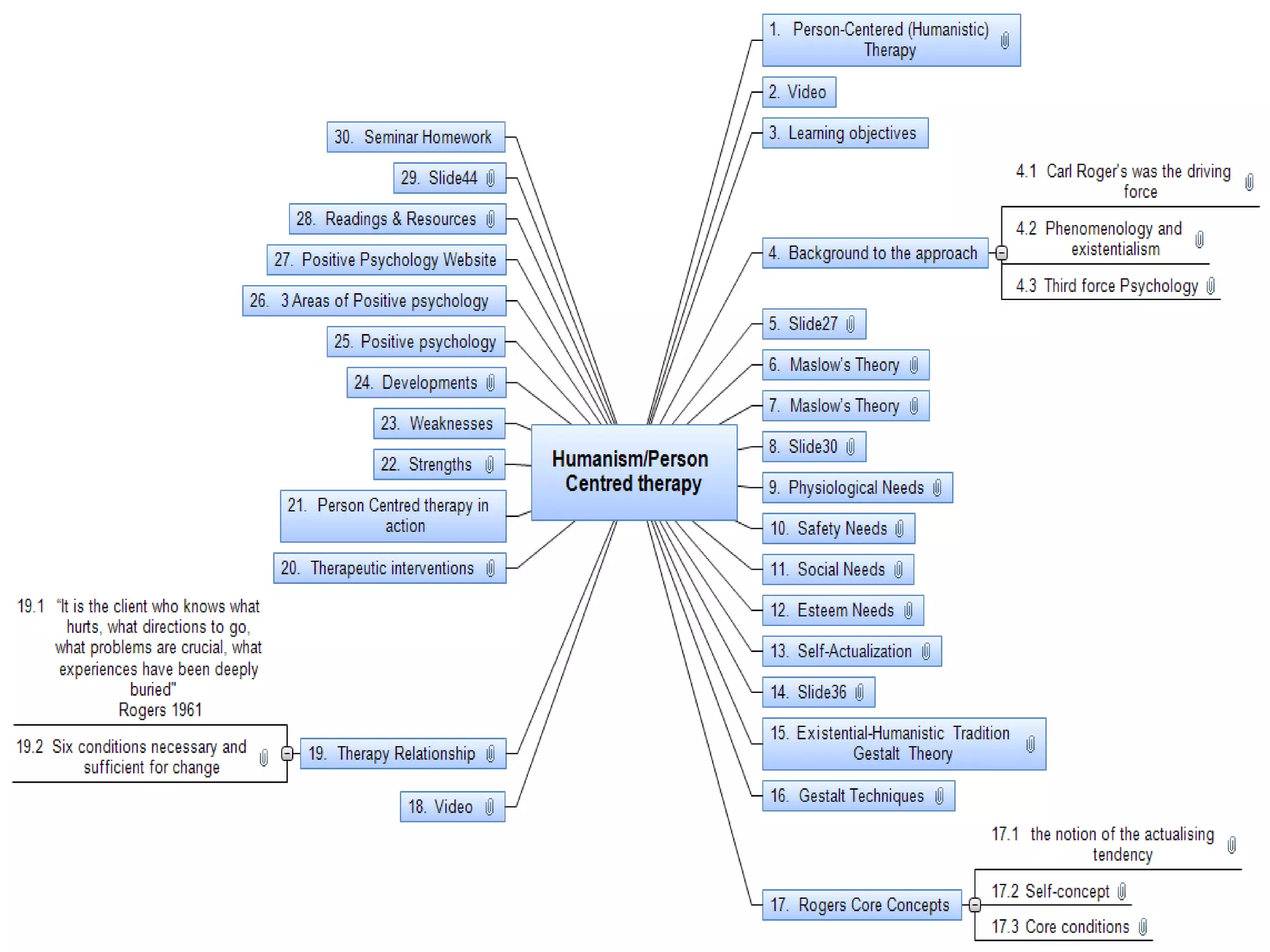
Lecture 3 
Humanistic 
Approaches & 
Person- 
CenteredTherapy 
Introduction to Counselling Module 
Kevin Standish
Review of behaviourism
Video 
• Fully functioning person: 2.5 min 
• http://www.youtube.com/watch?v=RZwMz-807uE
Learning objectives 
1.Define and describe the central 
concepts in Humanistic approach 
2.Describe the core conditions 
used in the client -therapist 
relationship 
3.Evaluate the strengths and 
weaknesses of humanism
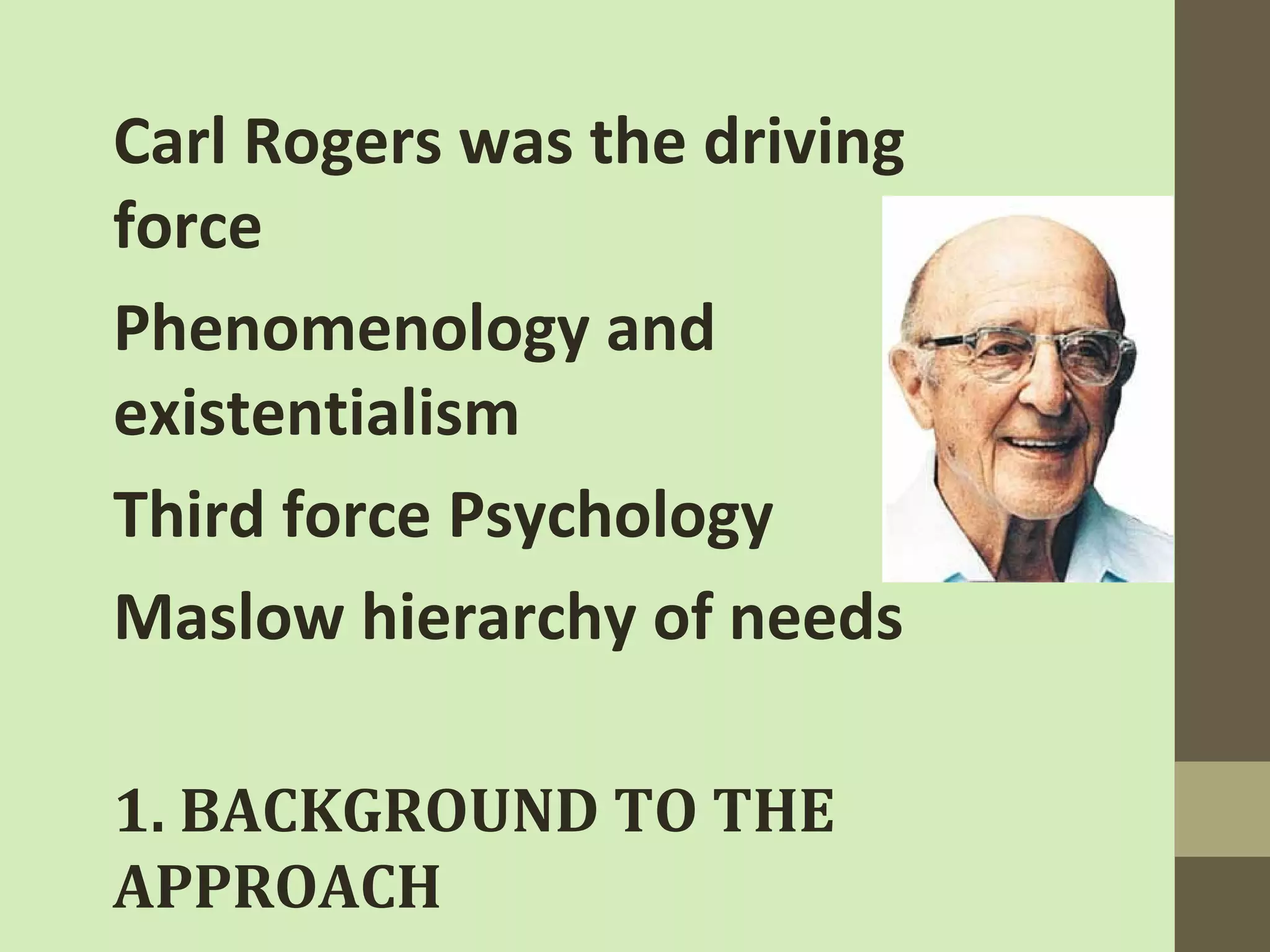
Carl Rogers was the driving 
force 
Phenomenology and 
existentialism 
Third force Psychology 
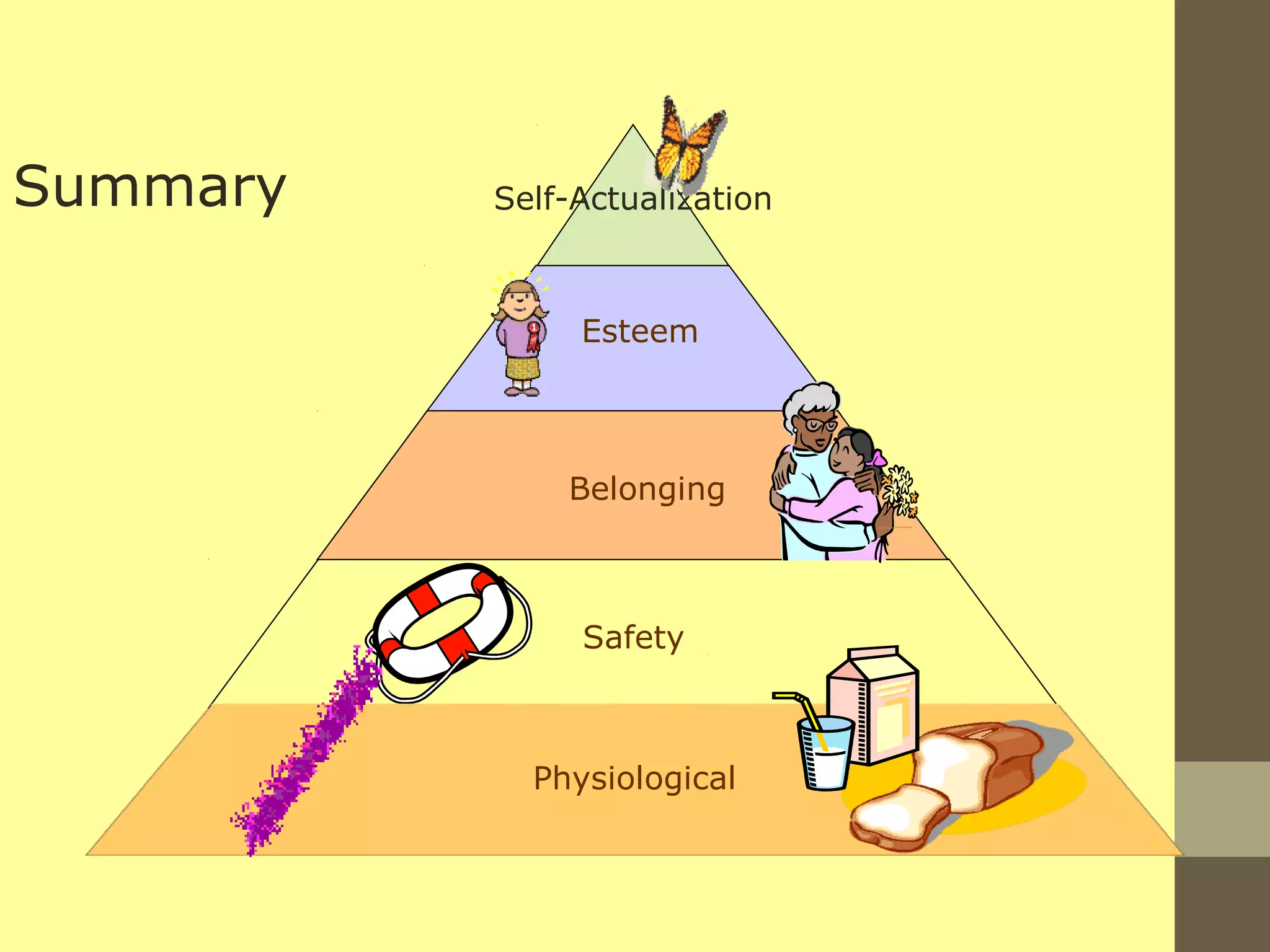
Maslow hierarchy of needs 
1. BACKGROUND TO THE 
APPROACH
Carl Roger's was the 
driving force 
1. Rogers based the approach from a 
psychological point of view 
2. Used the scientific method for 
object of measurement 
3. Was a reaction against the 
psychoanalytic and behaviourism 
4. His aim was to study the effect on 
the client of directive vs 
nondirective behaviour
Question: 2 minutes 
•What are the characteristics 
of directive therapy? 
•What are the 
characteristics of non-directive 
therapy?
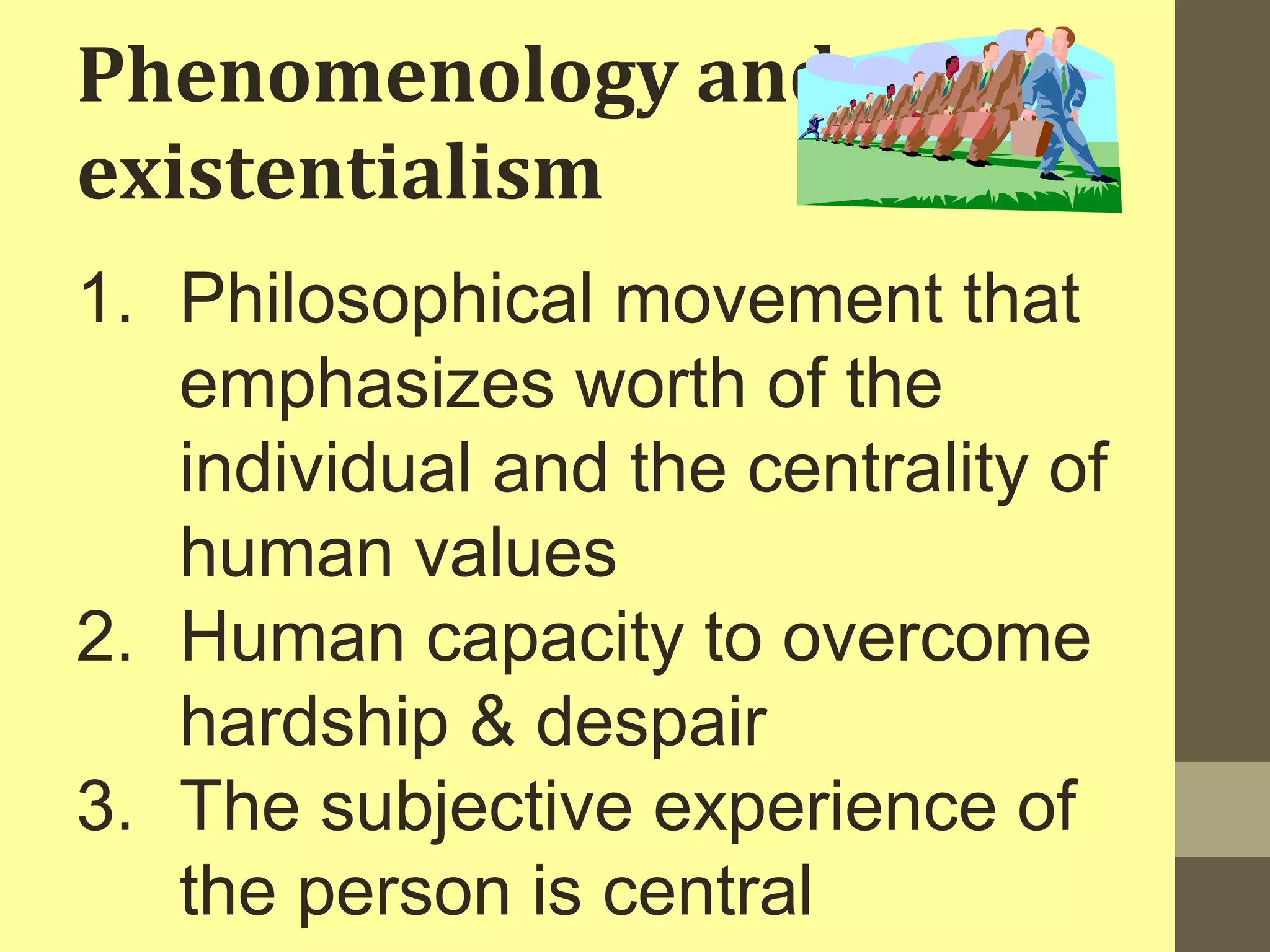
Phenomenology and 
existentialism 
1. Philosophical movement that 
emphasizes worth of the 
individual and the centrality of 
human values 
2. Human capacity to overcome 
hardship & despair 
3. The subjective experience of 
the person is central
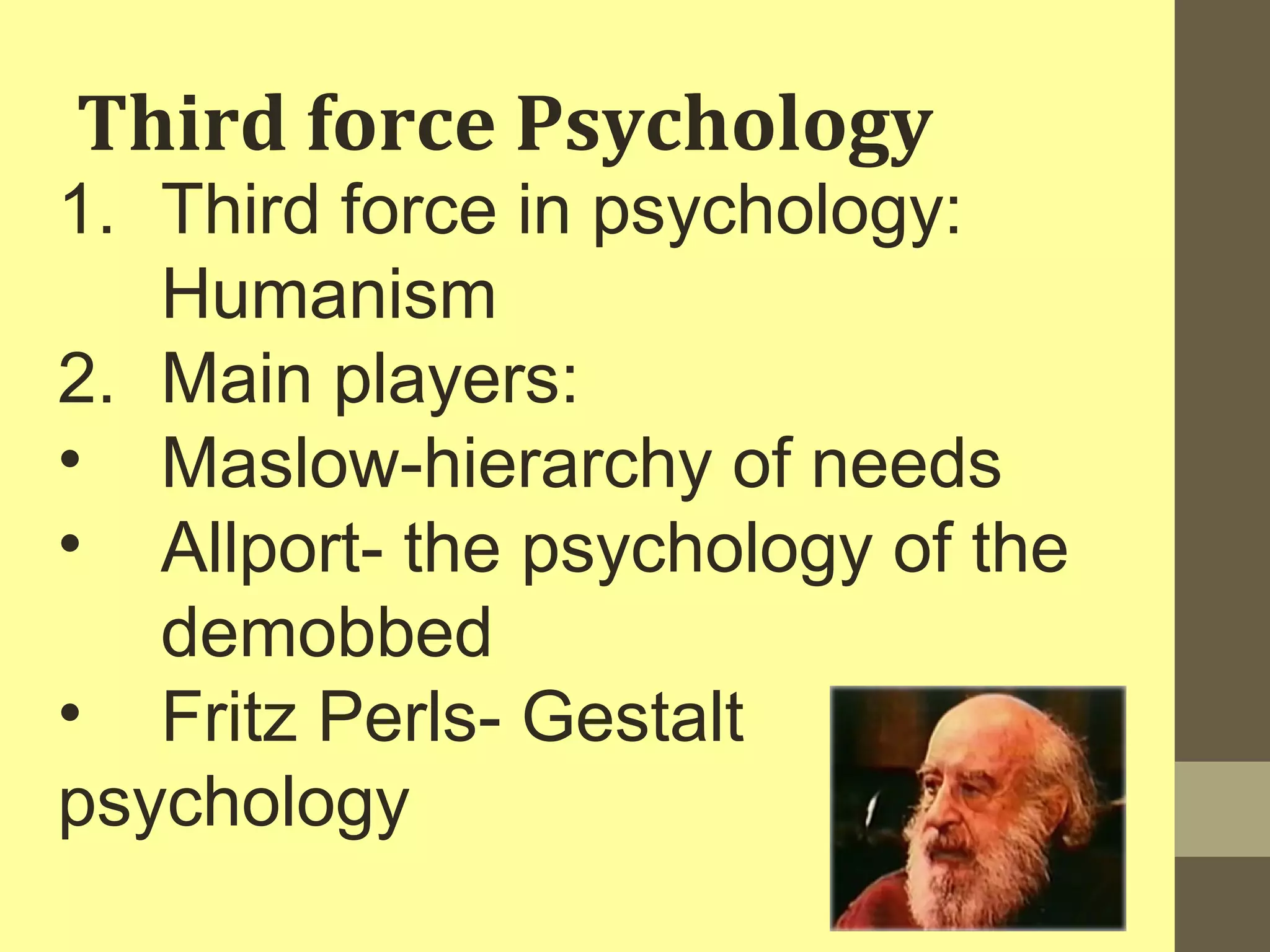
Third force Psychology 
1. Third force in psychology: 
Humanism 
2. Main players: 
• Maslow-hierarchy of needs 
• Allport- the psychology of the 
demobbed 
• Fritz Perls- Gestalt 
psychology
The Humanistic Tradition: 
The Motive to Self-Actualize 
Maslow’s Hierarchy of Needs 
 Needs are hierarchically organized 
 Needs must be satisfied at the lower levels 
before we proceed to satisfy the higher 
needs 
 Lower needs are more powerful and 
pressing
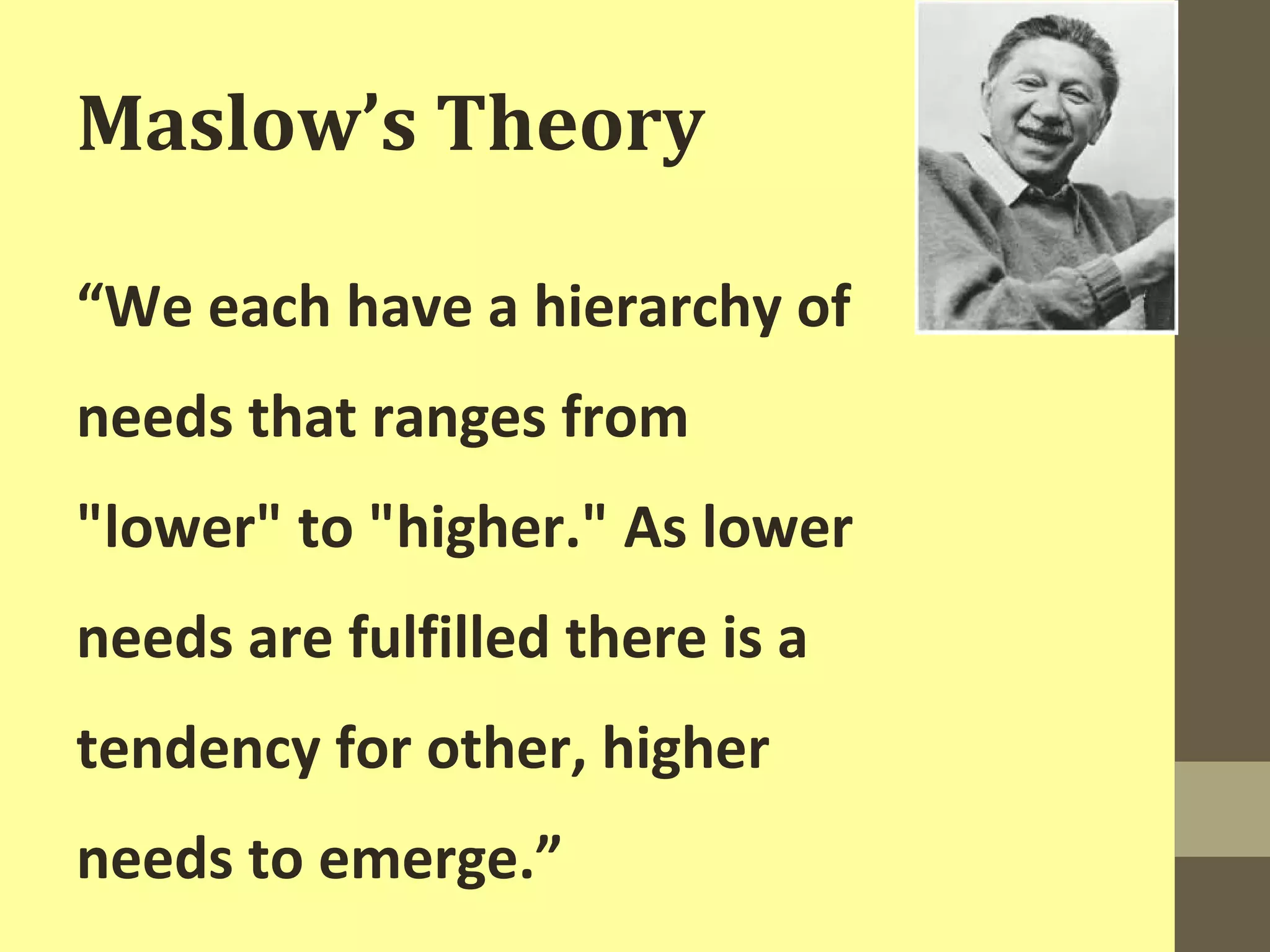
Maslow’s Theory 
“We each have a hierarchy of 
needs that ranges from 
"lower" to "higher." As lower 
needs are fulfilled there is a 
tendency for other, higher 
needs to emerge.”
Maslow’s Theory 
Maslow’s theory maintains that a person does 
not feel a higher need until the needs of the 
current level have been satisfied. 
Question: Reflect on how you have met your 
own needs at each level. Write these down. 
Maslow's basic needs are as follows:
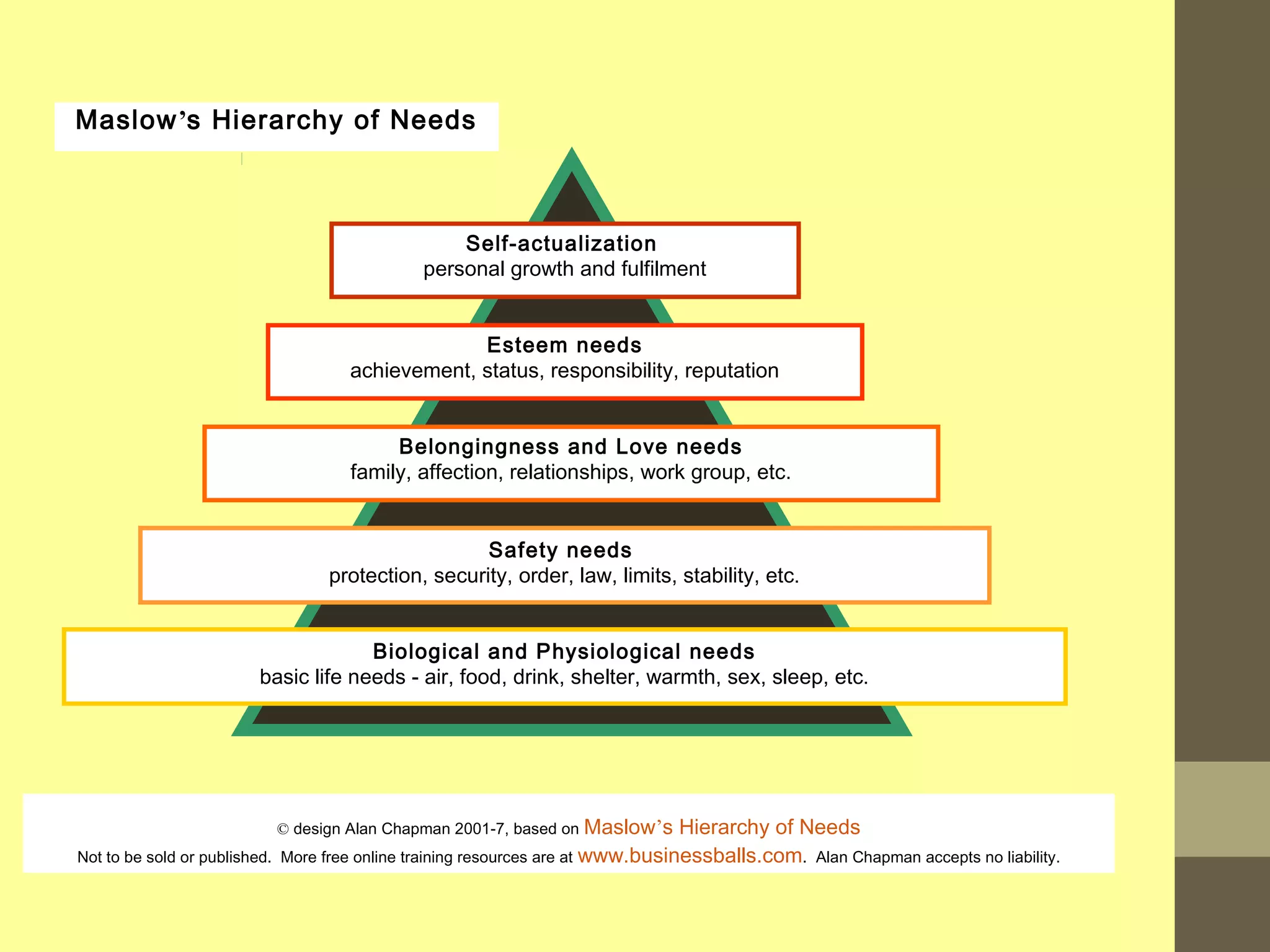
Maslow’s Hierarchy of Needs 
Self-actualization 
personal growth and fulfilment 
Esteem needs 
achievement, status, responsibility, reputation 
Belongingness and Love needs 
family, affection, relationships, work group, etc. 
Safety needs 
protection, security, order, law, limits, stability, etc. 
Biological and Physiological needs 
basic life needs - air, food, drink, shelter, warmth, sex, sleep, etc. 
© design Alan Chapman 2001-7, based on Maslow’s Hierarchy of Needs 
Not to be sold or published. More free online training resources are at www.businessballs.com. Alan Chapman accepts no liability.
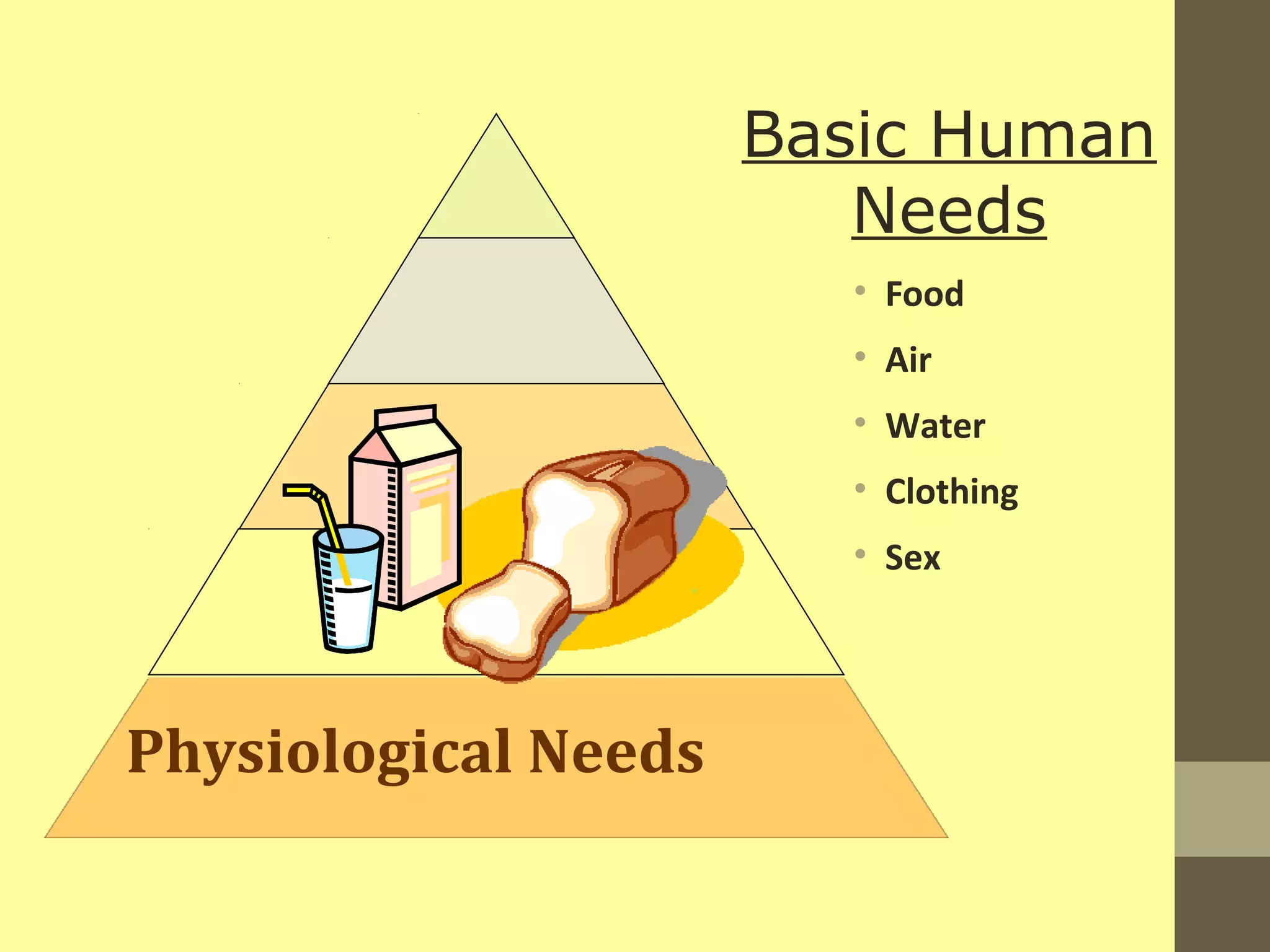
Physiological Needs 
Basic Human 
Needs 
• Food 
• Air 
• Water 
• Clothing 
• Sex
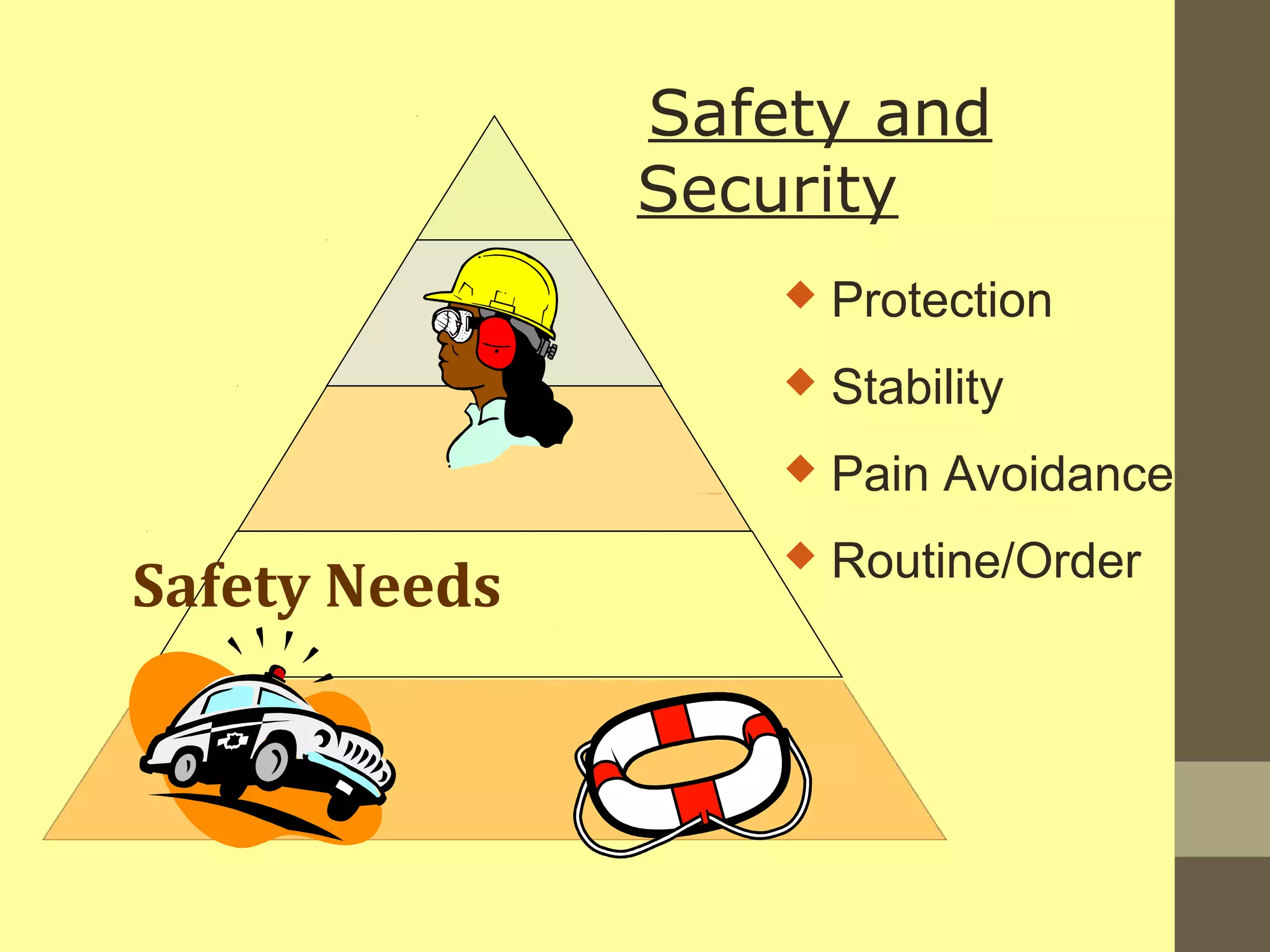
Safety Needs 
Safety and 
Security 
 Protection 
 Stability 
 Pain Avoidance 
 Routine/Order
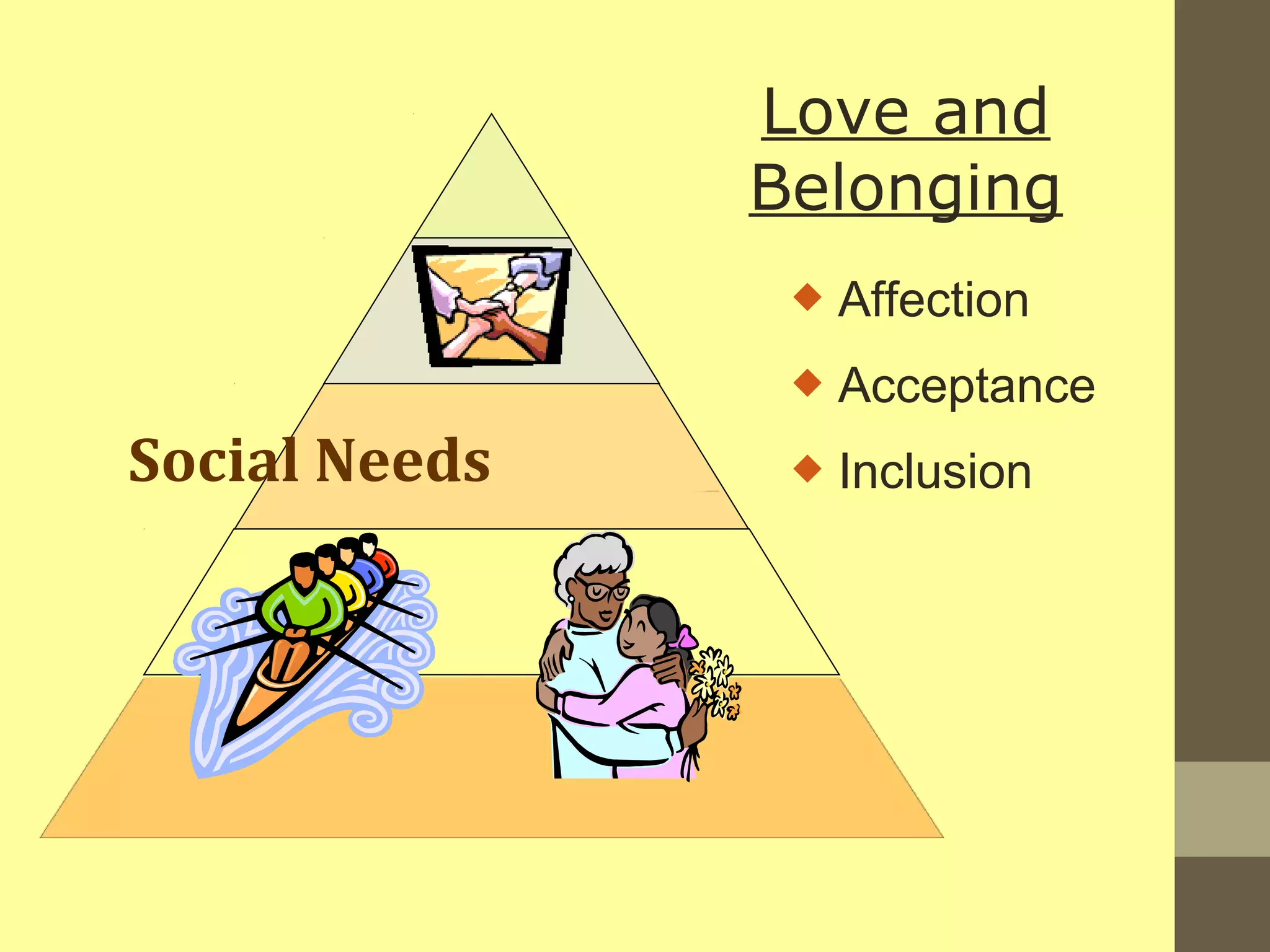
Social Needs 
Love and 
Belonging 
 Affection 
 Acceptance 
 Inclusion
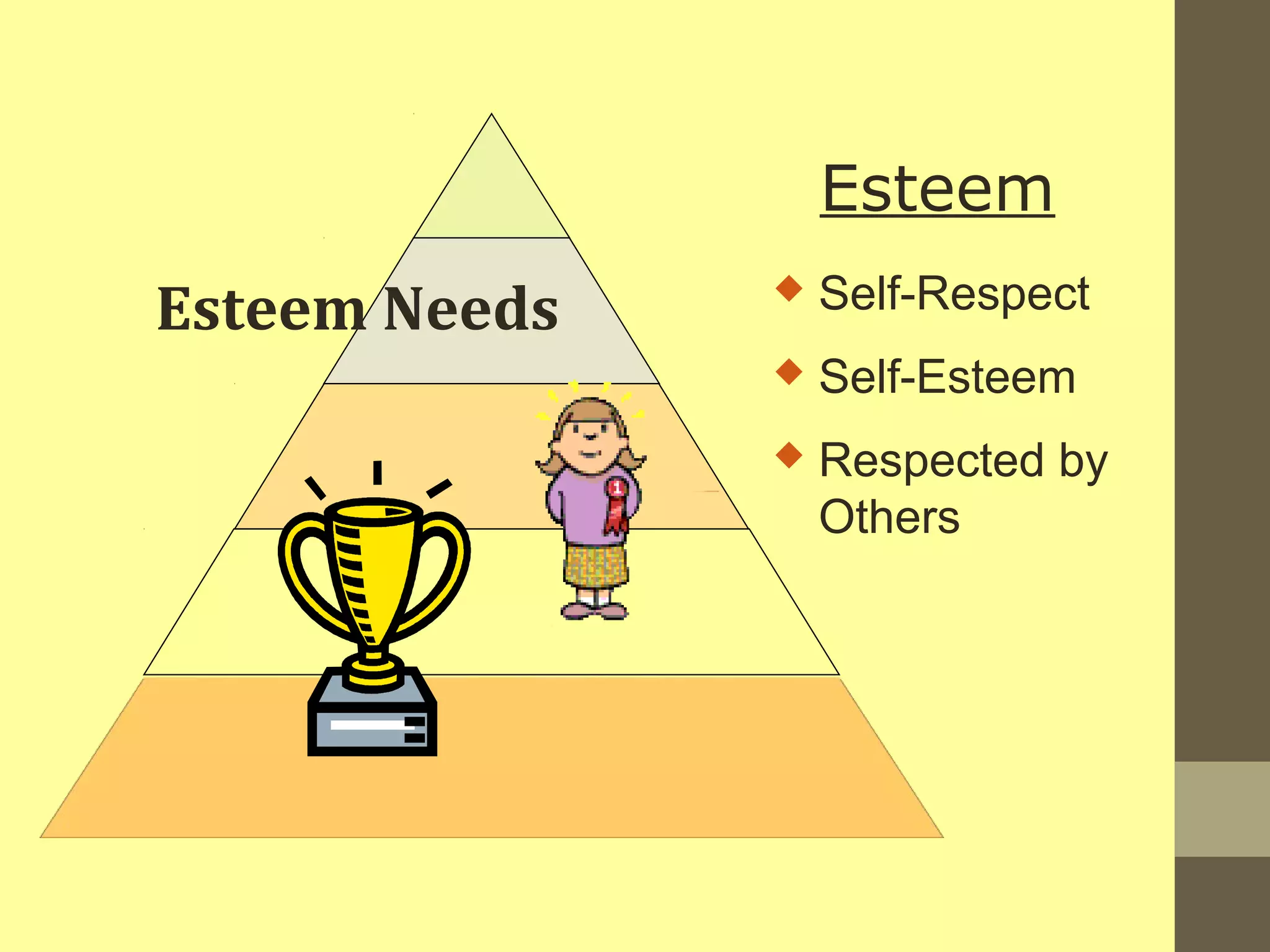
Esteem 
Esteem Needs  Self-Respect 
 Self-Esteem 
 Respected by 
Others
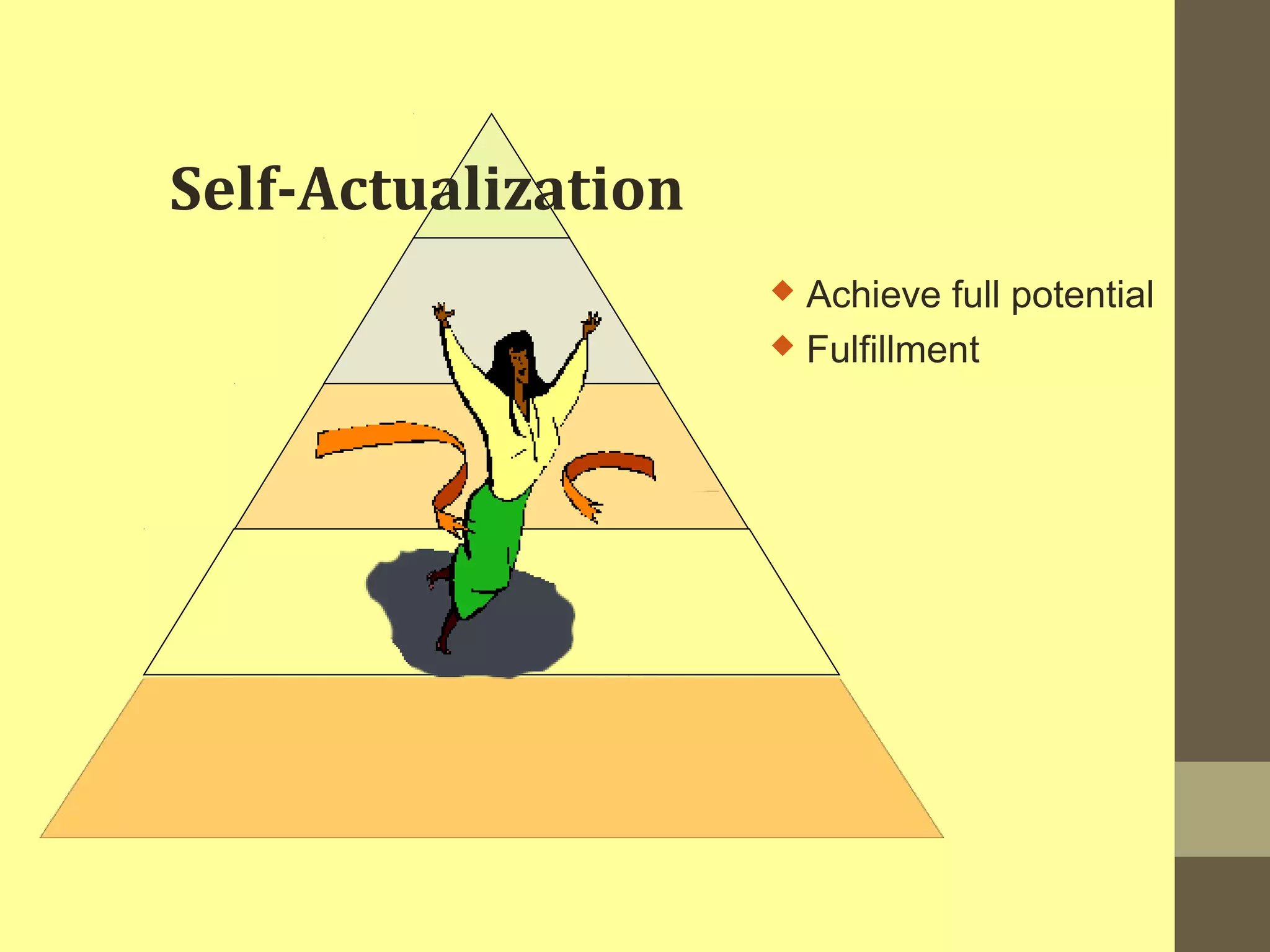
Self-Actualization 
 Achieve full potential 
 Fulfillment
Self-Actualization 
Esteem 
Belonging 
Safety 
Physiological 
Summary
2. EXISTENTIAL-HUMANISTIC 
TRADITION 
GESTALT THEORY
Existential-Humanistic Tradition 
Gestalt Theory 
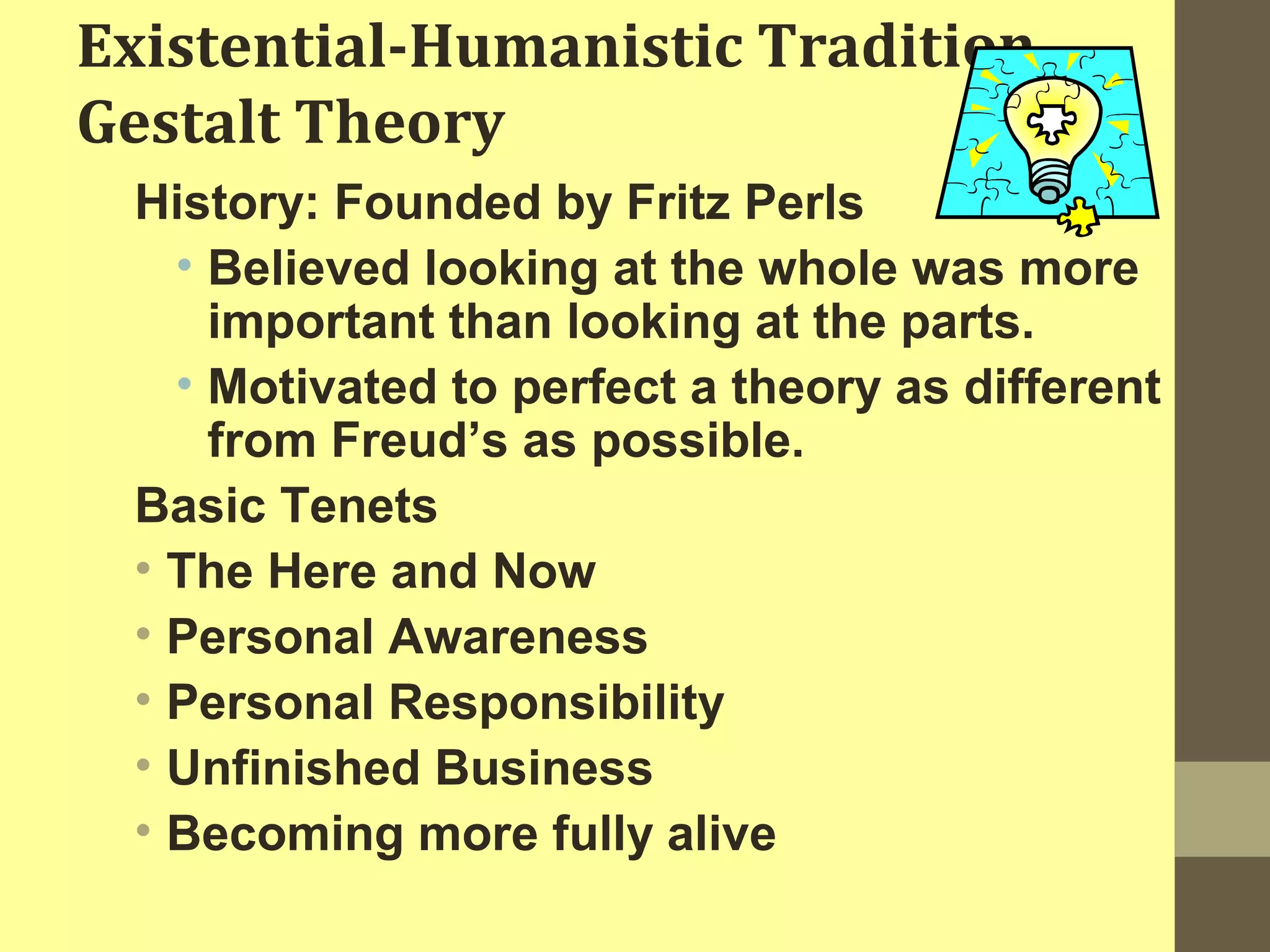
History: Founded by Fritz Perls 
• Believed looking at the whole was more 
important than looking at the parts. 
• Motivated to perfect a theory as different 
from Freud’s as possible. 
Basic Tenets 
• The Here and Now 
• Personal Awareness 
• Personal Responsibility 
• Unfinished Business 
• Becoming more fully alive
Gestalt Techniques 
• The Here and Now: Everything important 
happens in the present. 
• Unfinished Business: Things from the past, 
haunt us in the present. 
• Channels of Resistance: Blocks people use to 
prevent themselves from having contact with 
others. 
• Choices of Language: Client’s aren’t allow to 
overgeneralize.
Impact of Gestalt Therapy
The Actualising 
Tendency 
Self-concept: Sense of 
self 
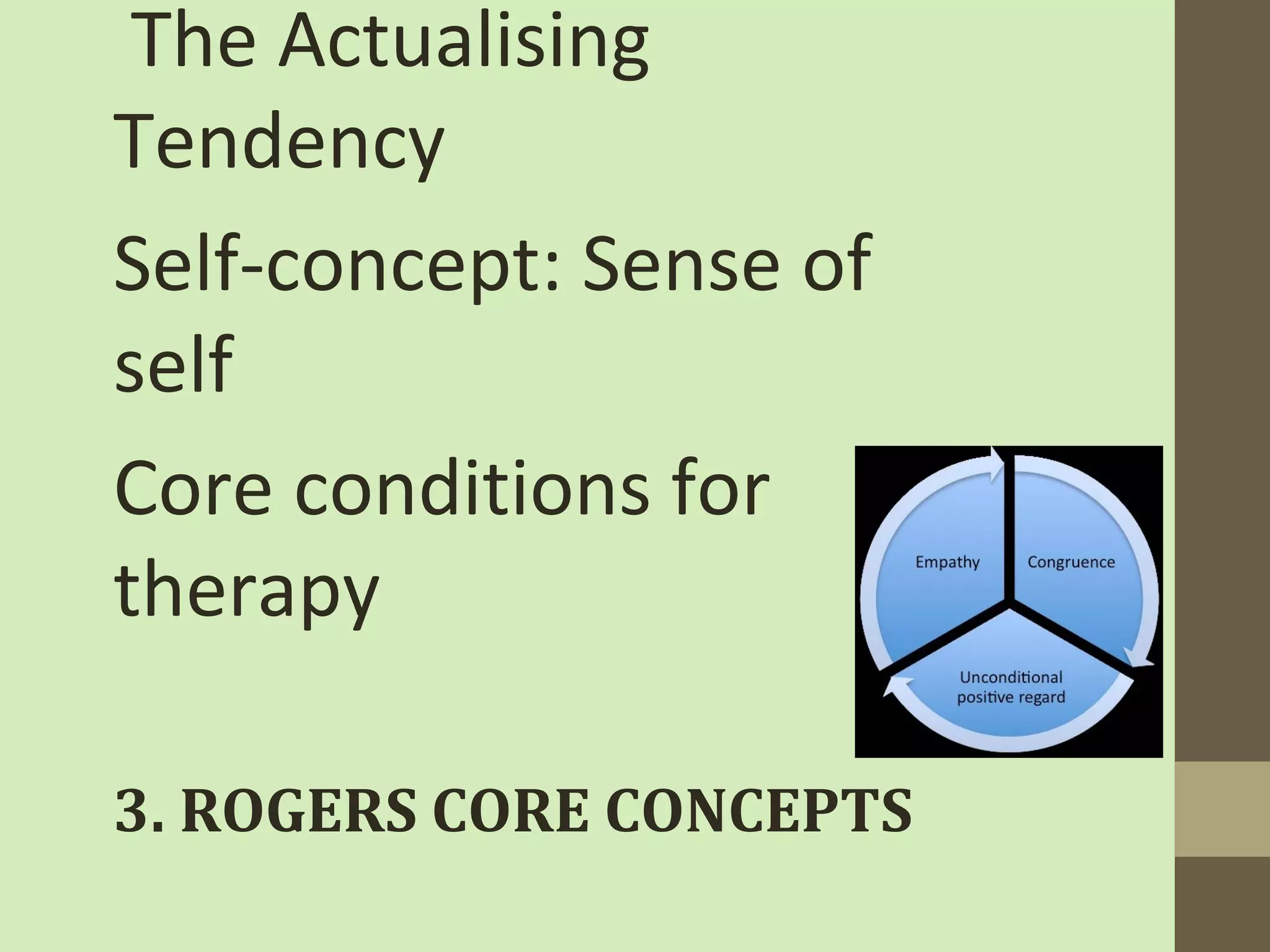
Core conditions for 
therapy 
3. ROGERS CORE CONCEPTS
Video 
• 13 elements (4 min) 
• http://www.youtube.com/watch? 
v=WWSm8FLid9c&feature=related
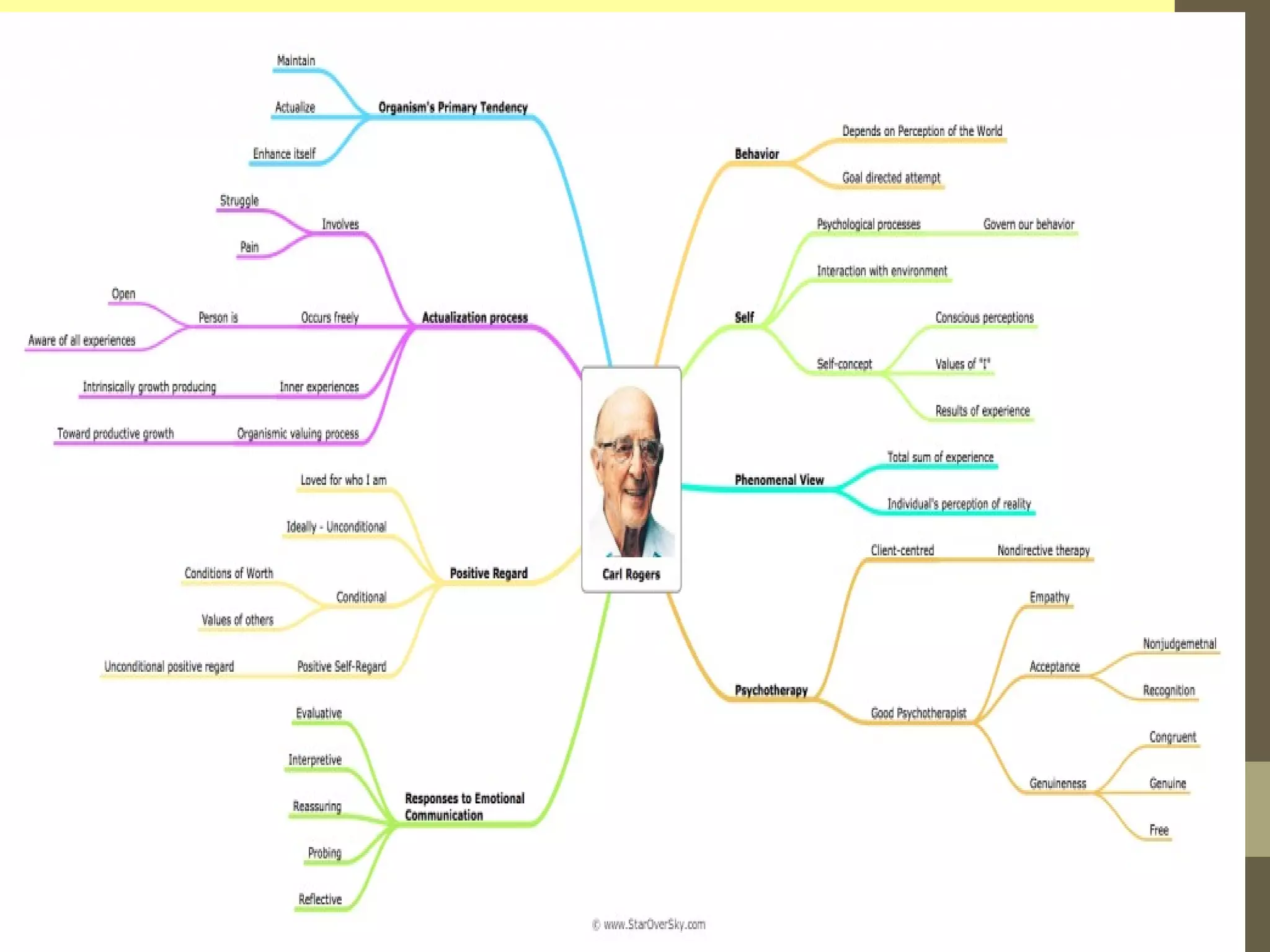
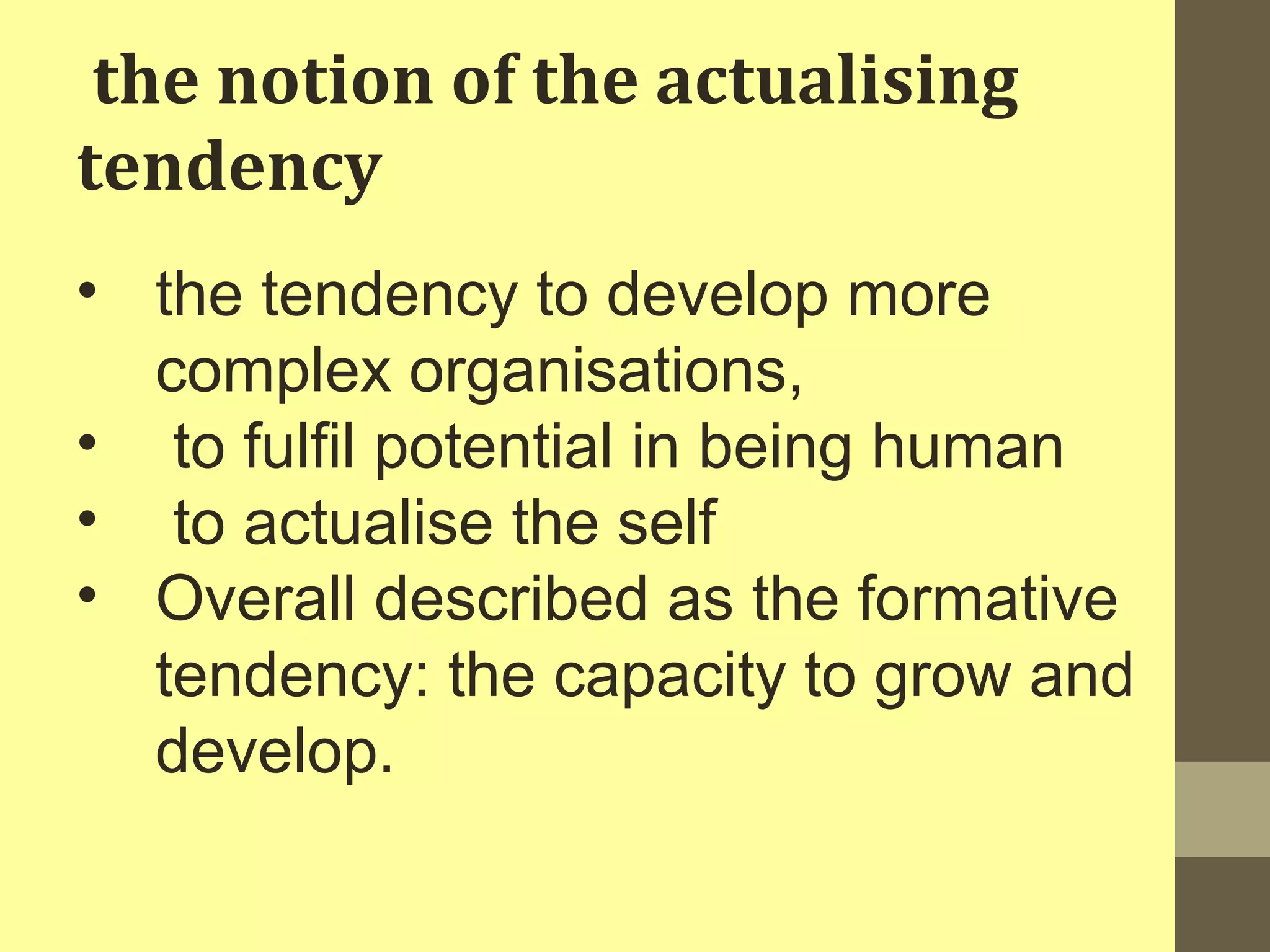
the notion of the actualising 
tendency 
• the tendency to develop more 
complex organisations, 
• to fulfil potential in being human 
• to actualise the self 
• Overall described as the formative 
tendency: the capacity to grow and 
develop.
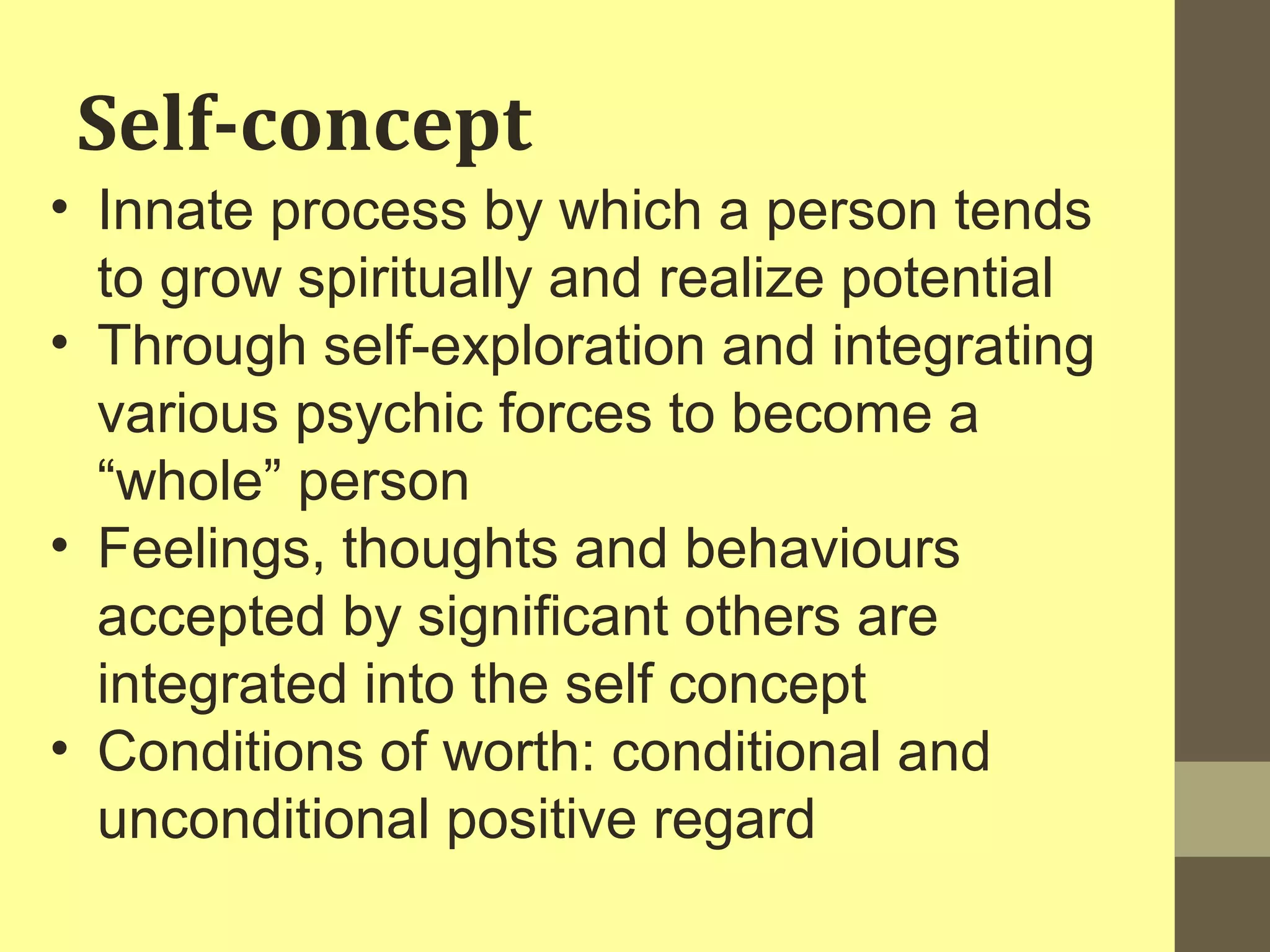
Self-concept 
• Innate process by which a person tends 
to grow spiritually and realize potential 
• Through self-exploration and integrating 
various psychic forces to become a 
“whole” person 
• Feelings, thoughts and behaviours 
accepted by significant others are 
integrated into the self concept 
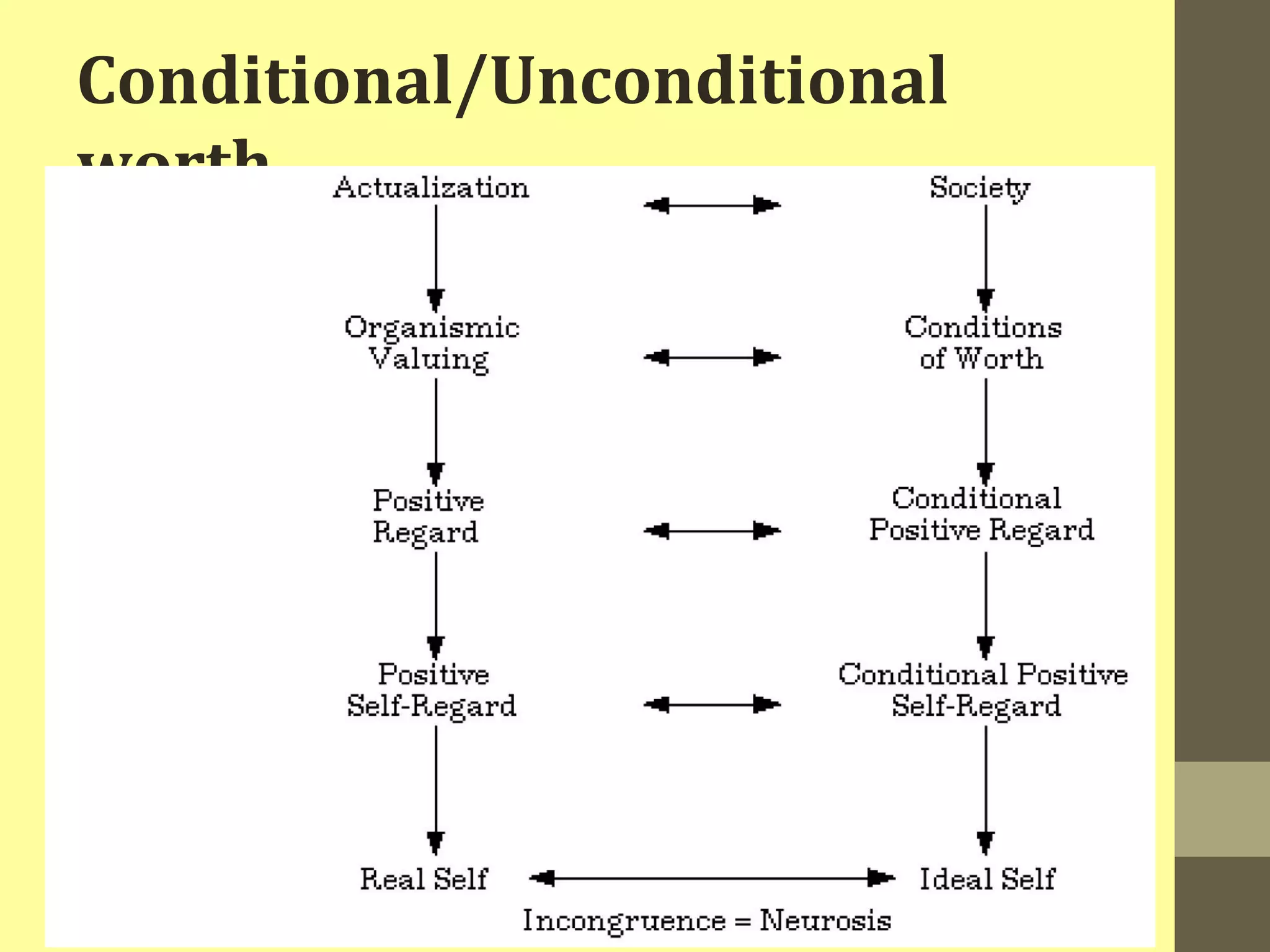
• Conditions of worth: conditional and 
unconditional positive regard
Conditional/Unconditional 
worth
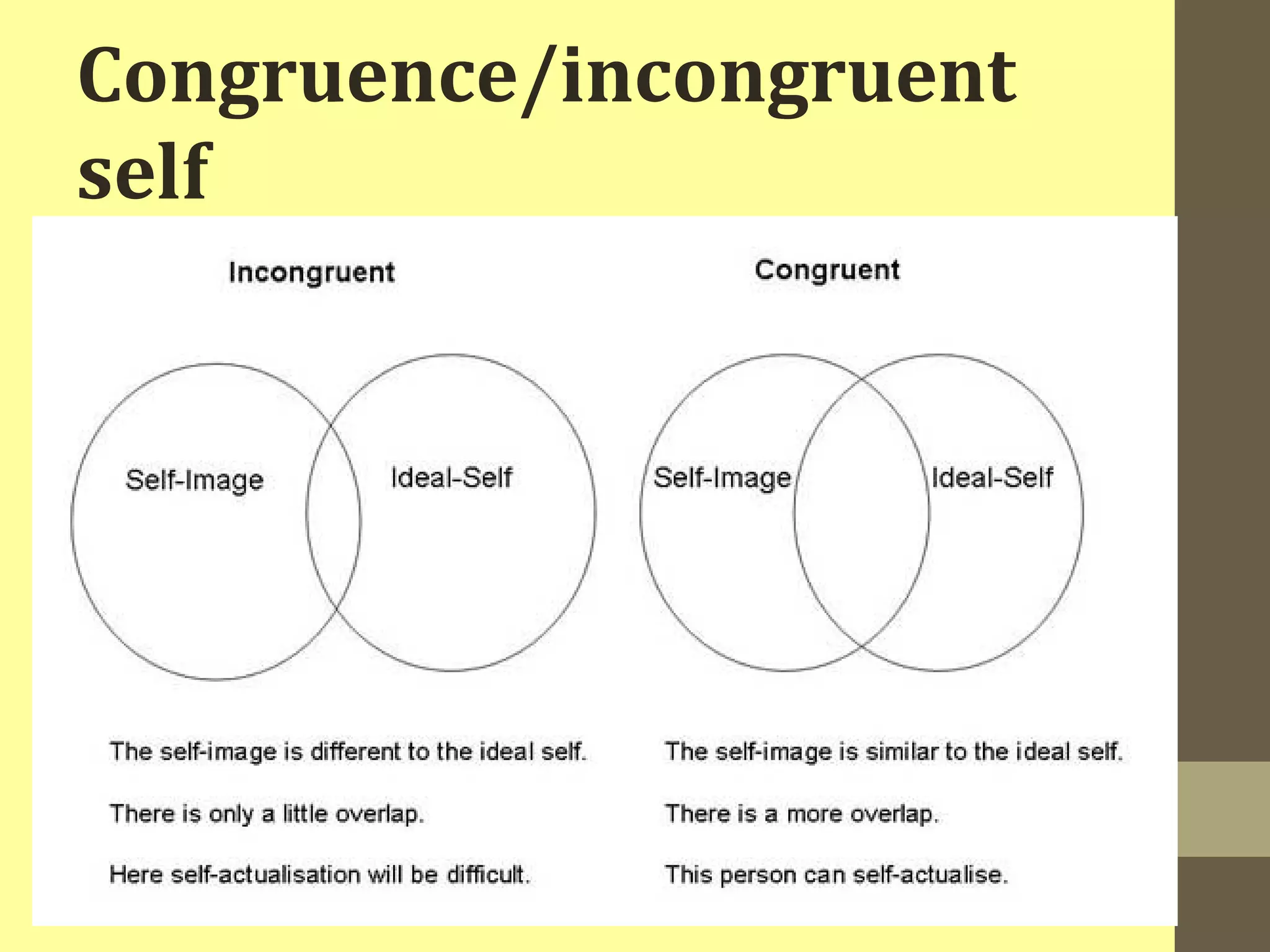
Congruence/incongruent 
self
Question (3 minutes) 
• Briefly reflect on an encounter with 
another person where you felt deeply 
understood and accepted by that 
person. 
• List some of the qualities that allowed 
for that understanding to occur 
• How did acceptance occur? 
• How did it make you feel to be so 
deeply understood?
Core conditions 
Based on conditions of worth 
1. Congruence - genuineness or realness, in 
relationship between therapist & client -being 
oneself in the therapeutic relationship with 
client 
2. Unconditional positive regard- acceptance 
and caring, but not approval of all behaviour 
3. Accurate empathic understanding – 
understanding of client’s frame of reference, 
ability to deeply grasp the client’s subjective 
world & communicate this back to the client
Therapy Relationship 
• Based on the actualising 
tendency 
• The client is the expert on 
themselves 
• In other words: The Client 
Knows Best 
• This influences all aspects of 
therapy
“It is the client who knows 
what hurts, what directions 
to go, what problems are 
crucial, what experiences 
have been deeply buried" 
Rogers 1961
Six conditions necessary and 
sufficient for change 
1. Two persons are in psychological contact 
2. The first, the client, is experiencing incongruency, is 
vulnerable and anxious 
3. The second person, the therapist, is congruent or 
integrated in the relationship 
4. The therapist experiences unconditional positive regard 
or real caring for the client 
5. The therapist experiences empathy for the client’s 
internal frame of reference and endeavors to 
communicate this to the client 
6. The client perceives, to a minimal degree, this 
unconditional positive and imperfect understanding by the 
therapist.
3. THERAPEUTIC PROCESS
Therapeutic Process 
1.The therapist does not attempt to 
solve the problem 
2.The therapist trusts the actualising 
tendency of the client 
3.Through a trusting relationship 
where they are understood and 
accepted, the actualising tendency 
motivates the person towards health
Therapeutic Process 
4. It is a collaborative relationship: the 
therapist and client on a therapeutic 
journey together 
5. The therapist communicates empathy, 
Checks understanding with the client, and 
in the process discloses a non-judgemental 
attitude.
Person Centred therapy in 
action 
• http://www.youtube.com/watch?v=Ew8CAr1v48M 
• 5min
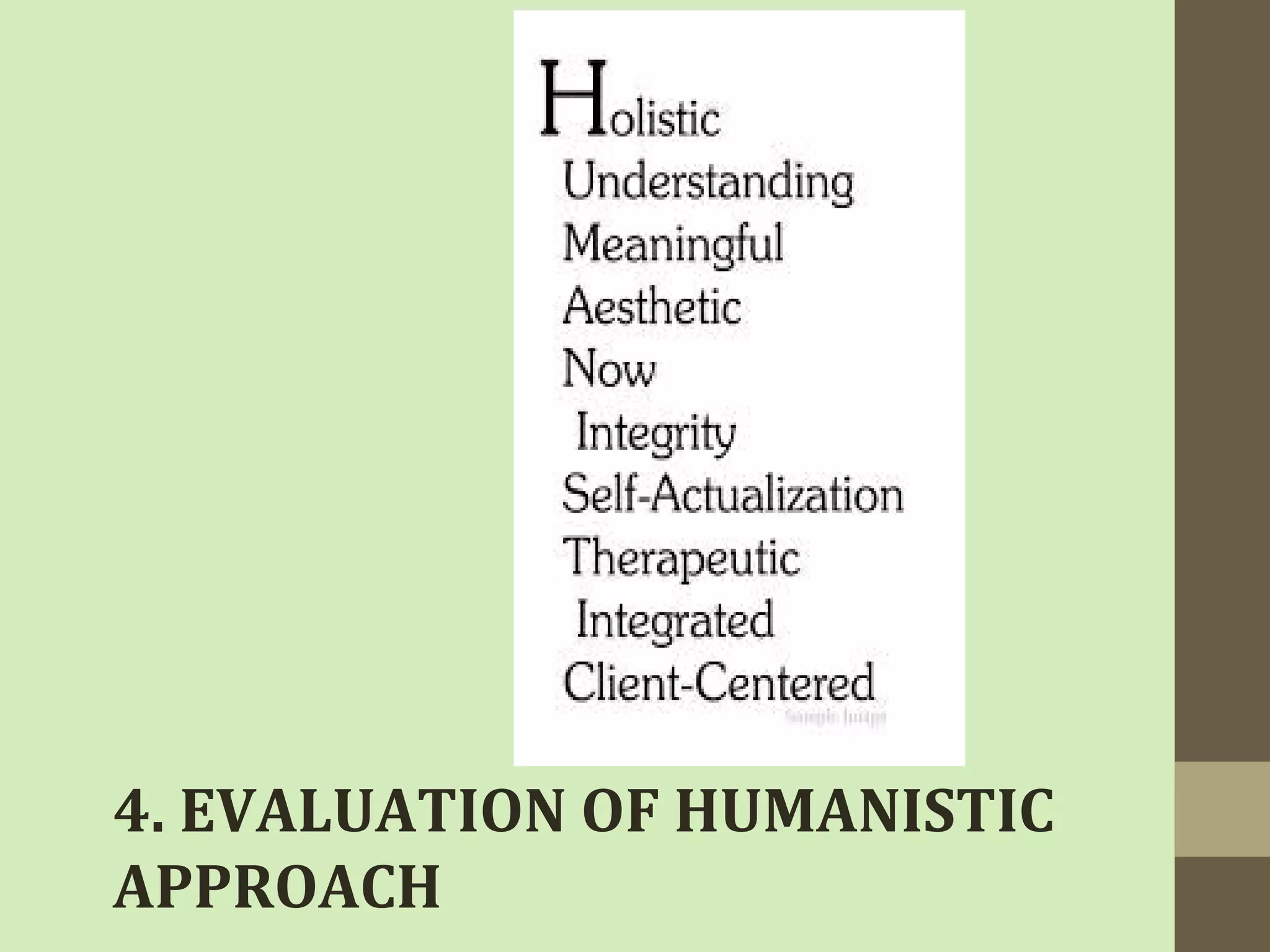
4. EVALUATION OF HUMANISTIC 
APPROACH
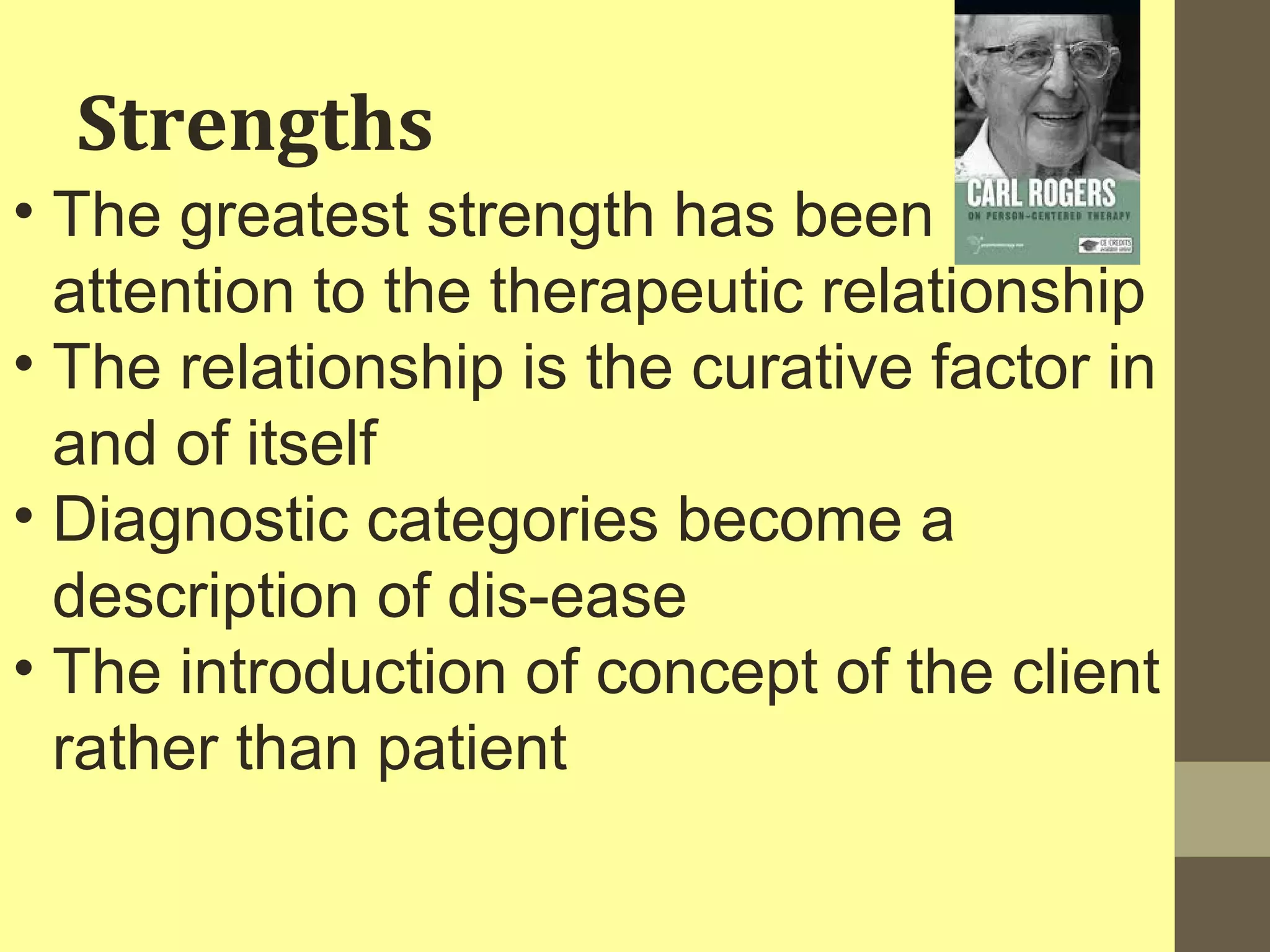
Strengths 
• The greatest strength has been 
attention to the therapeutic relationship 
• The relationship is the curative factor in 
and of itself 
• Diagnostic categories become a 
description of dis-ease 
• The introduction of concept of the client 
rather than patient
Weaknesses 
• Overly focused on the therapy relationship excludes 
other factors that may cause psychological distress 
• The theory separates and isolates individual from 
society: the individual can heal himself? 
• The assumption that disturbances are the result of 
individual's personal history rather than their social 
context: e.g. Poverty, oppression, racism etc 
• "pitfall of reducing the political to the person" 
Chantler 
• It is dependent upon the ability and talent of 
individual practitioner fufilling the core conditions. 
There are no techniques or interventions to fall back 
on.
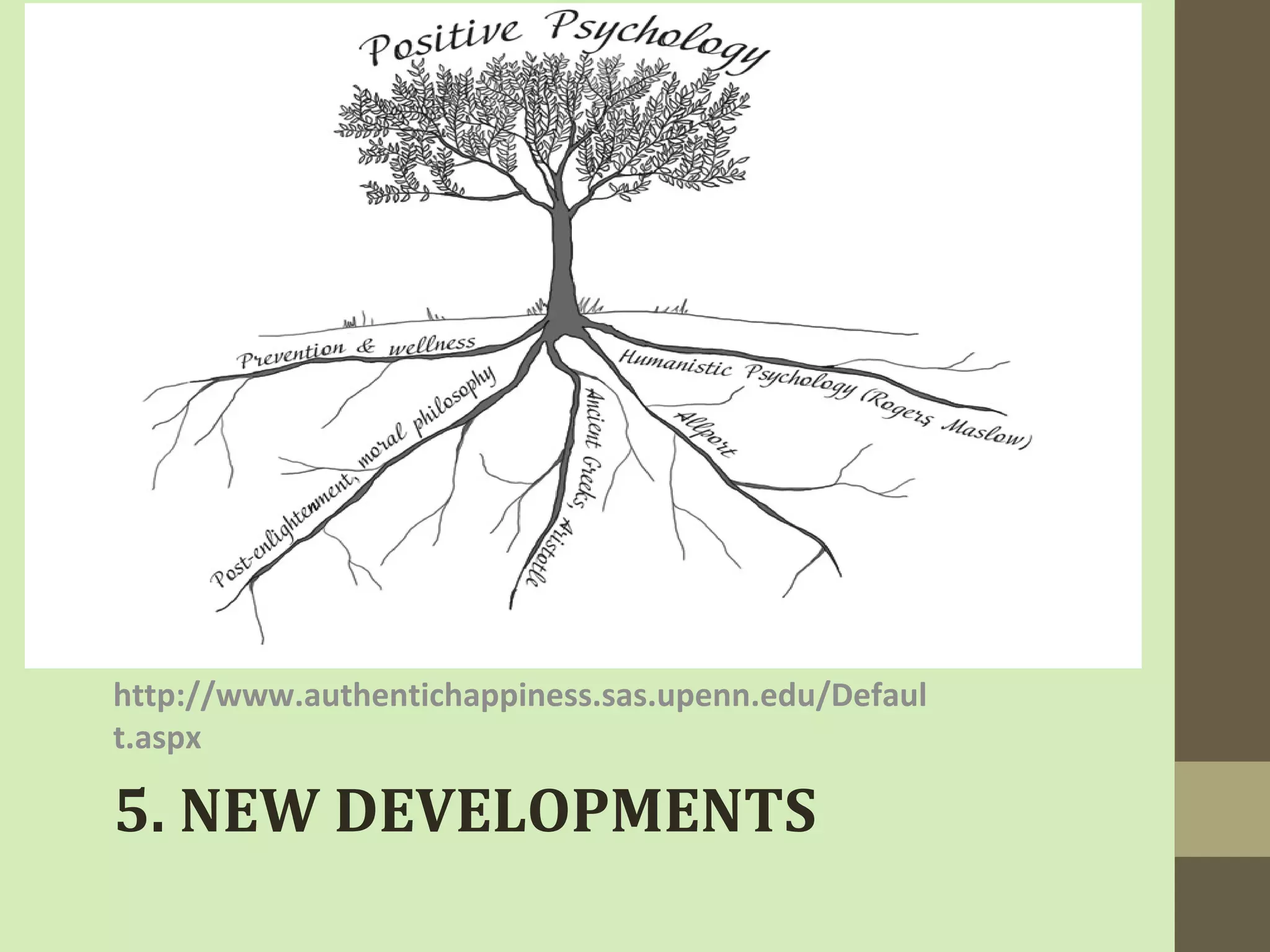
http://www.authentichappiness.sas.upenn.edu/Defaul 
t.aspx 
5. NEW DEVELOPMENTS
Positive psychology 
• Positive psychology is a recent branch of 
psychology whose purpose was summed up 
in 2000 by Martin Seligman 
• "We believe that a psychology of positive human 
functioning will arise that achieves a scientific 
understanding and effective interventions to 
build thriving in individuals, families, and 
communities.“ 
• Positive psychologists seek "to find and nurture 
genius and talent", and "to make normal life 
more fulfilling", not simply to treat mental illness
3 Areas of Positive 
psychology 
1. Pleasant Life, or the "life of enjoyment“: 
how people optimally experience positive 
feelings and emotions of normal and 
healthy living (e.g. relationships, hobbies, 
interests, entertainment, etc.). 
2. The Good Life, or the "life of engagement“: 
the beneficial affects of individuals feel 
when optimally engaged with their primary 
activities: when there is a positive match 
between a person's strength and the task 
they are doing
3 Areas of Positive 
psychology 
3. The Meaningful Life, or "life of affiliation“: individuals 
derive a positive sense of well-being, belonging, 
meaning, and purpose from being part of and 
contributing back to something larger and more 
permanent than themselves (e.g. nature, social 
groups, organizations, movements, traditions, belief 
systems).
Positive Psychology 
Website 
•http://www.ppc.sas.upenn.edu/
Readings & Resources 
1. McLeod J. (2009) An Introduction to Counselling. Chap 6 
2. Corey, G. (2009) Theory and Practice of Counseling and Psychotherapy. 
Chap 7 
3. Colledge, R (2002) Mastering Counselling. Chap 5 & 9. 
4. Dryden, W ( 2007) Dryden’s Handbook of Individual therapy (5th ed). 
Chap 6 
5. Cave, S (1999) Therapeutic Approaches in Psychology, chap 6 
Advanced Reading 
1. Rogers (1961) On Becoming a Person: A therapist’s view of 
psychotherapy 
2. Kirschenbaum & Hendersonn (1990) The Carl Rogers Reader. 
3. Wilkins (2010) Person-centred Therapy: 100 key points 
4. Feltham ( 2010) Chap 1 the pros and cons of UPR; chap 24 Limitations of 
person centred approach; chap 43 is counselling non directive and value 
free? 
5.Dryden (2007) chap 6 , 9,
Lecture 3 humanistic approach person centered therapy

Lecture 3 humanistic approach person centered therapy

  • 1.
    Lecture 3 Humanistic Approaches & Person- CenteredTherapy Introduction to Counselling Module Kevin Standish
  • 2.
  • 3.
    Video • Fullyfunctioning person: 2.5 min • http://www.youtube.com/watch?v=RZwMz-807uE
  • 4.
    Learning objectives 1.Defineand describe the central concepts in Humanistic approach 2.Describe the core conditions used in the client -therapist relationship 3.Evaluate the strengths and weaknesses of humanism
  • 6.
    Carl Rogers wasthe driving force Phenomenology and existentialism Third force Psychology Maslow hierarchy of needs 1. BACKGROUND TO THE APPROACH
  • 7.
    Carl Roger's wasthe driving force 1. Rogers based the approach from a psychological point of view 2. Used the scientific method for object of measurement 3. Was a reaction against the psychoanalytic and behaviourism 4. His aim was to study the effect on the client of directive vs nondirective behaviour
  • 8.
    Question: 2 minutes •What are the characteristics of directive therapy? •What are the characteristics of non-directive therapy?
  • 9.
    Phenomenology and existentialism 1. Philosophical movement that emphasizes worth of the individual and the centrality of human values 2. Human capacity to overcome hardship & despair 3. The subjective experience of the person is central
  • 10.
    Third force Psychology 1. Third force in psychology: Humanism 2. Main players: • Maslow-hierarchy of needs • Allport- the psychology of the demobbed • Fritz Perls- Gestalt psychology
  • 11.
    The Humanistic Tradition: The Motive to Self-Actualize Maslow’s Hierarchy of Needs  Needs are hierarchically organized  Needs must be satisfied at the lower levels before we proceed to satisfy the higher needs  Lower needs are more powerful and pressing
  • 12.
    Maslow’s Theory “Weeach have a hierarchy of needs that ranges from "lower" to "higher." As lower needs are fulfilled there is a tendency for other, higher needs to emerge.”
  • 13.
    Maslow’s Theory Maslow’stheory maintains that a person does not feel a higher need until the needs of the current level have been satisfied. Question: Reflect on how you have met your own needs at each level. Write these down. Maslow's basic needs are as follows:
  • 14.
    Maslow’s Hierarchy ofNeeds Self-actualization personal growth and fulfilment Esteem needs achievement, status, responsibility, reputation Belongingness and Love needs family, affection, relationships, work group, etc. Safety needs protection, security, order, law, limits, stability, etc. Biological and Physiological needs basic life needs - air, food, drink, shelter, warmth, sex, sleep, etc. © design Alan Chapman 2001-7, based on Maslow’s Hierarchy of Needs Not to be sold or published. More free online training resources are at www.businessballs.com. Alan Chapman accepts no liability.
  • 15.
    Physiological Needs BasicHuman Needs • Food • Air • Water • Clothing • Sex
  • 16.
    Safety Needs Safetyand Security  Protection  Stability  Pain Avoidance  Routine/Order
  • 17.
    Social Needs Loveand Belonging  Affection  Acceptance  Inclusion
  • 18.
    Esteem Esteem Needs Self-Respect  Self-Esteem  Respected by Others
  • 19.
    Self-Actualization  Achievefull potential  Fulfillment
  • 20.
    Self-Actualization Esteem Belonging Safety Physiological Summary
  • 21.
  • 22.
    Existential-Humanistic Tradition GestaltTheory History: Founded by Fritz Perls • Believed looking at the whole was more important than looking at the parts. • Motivated to perfect a theory as different from Freud’s as possible. Basic Tenets • The Here and Now • Personal Awareness • Personal Responsibility • Unfinished Business • Becoming more fully alive
  • 23.
    Gestalt Techniques •The Here and Now: Everything important happens in the present. • Unfinished Business: Things from the past, haunt us in the present. • Channels of Resistance: Blocks people use to prevent themselves from having contact with others. • Choices of Language: Client’s aren’t allow to overgeneralize.
  • 24.
  • 25.
    The Actualising Tendency Self-concept: Sense of self Core conditions for therapy 3. ROGERS CORE CONCEPTS
  • 28.
    Video • 13elements (4 min) • http://www.youtube.com/watch? v=WWSm8FLid9c&feature=related
  • 29.
    the notion ofthe actualising tendency • the tendency to develop more complex organisations, • to fulfil potential in being human • to actualise the self • Overall described as the formative tendency: the capacity to grow and develop.
  • 30.
    Self-concept • Innateprocess by which a person tends to grow spiritually and realize potential • Through self-exploration and integrating various psychic forces to become a “whole” person • Feelings, thoughts and behaviours accepted by significant others are integrated into the self concept • Conditions of worth: conditional and unconditional positive regard
  • 31.
  • 32.
  • 33.
    Question (3 minutes) • Briefly reflect on an encounter with another person where you felt deeply understood and accepted by that person. • List some of the qualities that allowed for that understanding to occur • How did acceptance occur? • How did it make you feel to be so deeply understood?
  • 34.
    Core conditions Basedon conditions of worth 1. Congruence - genuineness or realness, in relationship between therapist & client -being oneself in the therapeutic relationship with client 2. Unconditional positive regard- acceptance and caring, but not approval of all behaviour 3. Accurate empathic understanding – understanding of client’s frame of reference, ability to deeply grasp the client’s subjective world & communicate this back to the client
  • 35.
    Therapy Relationship •Based on the actualising tendency • The client is the expert on themselves • In other words: The Client Knows Best • This influences all aspects of therapy
  • 36.
    “It is theclient who knows what hurts, what directions to go, what problems are crucial, what experiences have been deeply buried" Rogers 1961
  • 37.
    Six conditions necessaryand sufficient for change 1. Two persons are in psychological contact 2. The first, the client, is experiencing incongruency, is vulnerable and anxious 3. The second person, the therapist, is congruent or integrated in the relationship 4. The therapist experiences unconditional positive regard or real caring for the client 5. The therapist experiences empathy for the client’s internal frame of reference and endeavors to communicate this to the client 6. The client perceives, to a minimal degree, this unconditional positive and imperfect understanding by the therapist.
  • 38.
  • 39.
    Therapeutic Process 1.Thetherapist does not attempt to solve the problem 2.The therapist trusts the actualising tendency of the client 3.Through a trusting relationship where they are understood and accepted, the actualising tendency motivates the person towards health
  • 40.
    Therapeutic Process 4.It is a collaborative relationship: the therapist and client on a therapeutic journey together 5. The therapist communicates empathy, Checks understanding with the client, and in the process discloses a non-judgemental attitude.
  • 41.
    Person Centred therapyin action • http://www.youtube.com/watch?v=Ew8CAr1v48M • 5min
  • 42.
    4. EVALUATION OFHUMANISTIC APPROACH
  • 43.
    Strengths • Thegreatest strength has been attention to the therapeutic relationship • The relationship is the curative factor in and of itself • Diagnostic categories become a description of dis-ease • The introduction of concept of the client rather than patient
  • 44.
    Weaknesses • Overlyfocused on the therapy relationship excludes other factors that may cause psychological distress • The theory separates and isolates individual from society: the individual can heal himself? • The assumption that disturbances are the result of individual's personal history rather than their social context: e.g. Poverty, oppression, racism etc • "pitfall of reducing the political to the person" Chantler • It is dependent upon the ability and talent of individual practitioner fufilling the core conditions. There are no techniques or interventions to fall back on.
  • 45.
  • 46.
    Positive psychology •Positive psychology is a recent branch of psychology whose purpose was summed up in 2000 by Martin Seligman • "We believe that a psychology of positive human functioning will arise that achieves a scientific understanding and effective interventions to build thriving in individuals, families, and communities.“ • Positive psychologists seek "to find and nurture genius and talent", and "to make normal life more fulfilling", not simply to treat mental illness
  • 47.
    3 Areas ofPositive psychology 1. Pleasant Life, or the "life of enjoyment“: how people optimally experience positive feelings and emotions of normal and healthy living (e.g. relationships, hobbies, interests, entertainment, etc.). 2. The Good Life, or the "life of engagement“: the beneficial affects of individuals feel when optimally engaged with their primary activities: when there is a positive match between a person's strength and the task they are doing
  • 48.
    3 Areas ofPositive psychology 3. The Meaningful Life, or "life of affiliation“: individuals derive a positive sense of well-being, belonging, meaning, and purpose from being part of and contributing back to something larger and more permanent than themselves (e.g. nature, social groups, organizations, movements, traditions, belief systems).
  • 49.
    Positive Psychology Website •http://www.ppc.sas.upenn.edu/
  • 50.
    Readings & Resources 1. McLeod J. (2009) An Introduction to Counselling. Chap 6 2. Corey, G. (2009) Theory and Practice of Counseling and Psychotherapy. Chap 7 3. Colledge, R (2002) Mastering Counselling. Chap 5 & 9. 4. Dryden, W ( 2007) Dryden’s Handbook of Individual therapy (5th ed). Chap 6 5. Cave, S (1999) Therapeutic Approaches in Psychology, chap 6 Advanced Reading 1. Rogers (1961) On Becoming a Person: A therapist’s view of psychotherapy 2. Kirschenbaum & Hendersonn (1990) The Carl Rogers Reader. 3. Wilkins (2010) Person-centred Therapy: 100 key points 4. Feltham ( 2010) Chap 1 the pros and cons of UPR; chap 24 Limitations of person centred approach; chap 43 is counselling non directive and value free? 5.Dryden (2007) chap 6 , 9,

Editor's Notes

  • #2 Studied in Seminary, became child psychologist influenced by Adler’s concepts of work with children and families Emphasized taking personal responsibility for one’s own life In his life: questioning stance, deep openness to change, courage to go into unknown places Humanism Philosophical movement that emphasizes worth of the individual and the centrality of human values Attends to matters of ethics & personal worth Gives credit to the human spirit Emphasis on creative, spontaneous & active nature of humans-optimistic Human capacity to overcome hardship & despair Nondeterministic Rogers like the Existentialists would argue that it is an oversimplification to view people as controlled by fixed physical laws People cannot be viewed simply as “cogs in a vast machine” Encouragement of therapy that considers individual initiative, creativity, & self-fulfillment Focus on active, positive aspects of human growth and achievement Self-Actualization Innate process by which a person tends to grow spiritually and realize potential Through self-exploration person could live in harmony with nature and all of humanity by integrating various psychic forces to become “whole” person Selfish drives could be explored, understood & integrated with the spiritual aspects of human The Experiencing Person Important issues must be defined by individual-special concern are discrepancies between what a person thinks of himself & total range of things he experiences People tend to develop in a positive direction, that unless thwarted, they achieve their potential Belief in natural goodness of people-Rousseau Inner self-control is better than forced, external control Human Potential Movement Begun in 1960’s-Roger’s ended his life in this movement-His special focus Peace & Racial Harmony Use small group meetings, self-disclosure, & introspection People realize their inner potentials Encounter groups, massage, meditation, consciousness raising, communing with nature, organic food E.g.: Environmental concerns, Quality Circles, Team self-management Person-Centered Therapy A reaction against the directive and psychoanalytic approaches A reaction against “Medical Model” called clients rather than patients People are essentially trustworthy, vast potential for understanding selves, & resolving their own problems without direct intervention by therapist & are capable of self-directed growth if involved in therapeutic relationship Roger’s Challenged Traditional Models of Therapy He questioned assumption that “the counselor knows best” He questioned validity of advice, suggestion, persuasion, teaching, diagnosis & interpretation He challenged belief that clients cannot understand & resolve their own problems with direct help from experts He questioned focus on problems rather than on people in therapy Person-Centered Therapy’s Emphasis Therapy as a journey shared by two fallible people The person’s innate striving for self-actualization The personal characteristics of the therapist and the quality of the therapeutic relationship The counselor’s creation of a permissive, “growth promoting” climate People are capable of self-directed growth if involved in a therapeutic relationship Necessary Conditions from Therapist to Client Attitudes more important than knowledge Congruence - genuineness or realness, in relations between therapist & client -being oneself in the therapeutic relationship with client Unconditional positive regard- acceptance and caring, but not approval of all behavior Accurate empathic understanding – understanding of client’s frame of references, ability to deeply grasp the client’s subjective world & communicate this to the client Six Conditions(necessary and sufficient for personality changes to occur) Two persons are in psychological contact The first, the client, is experiencing incongruency The second person, the therapist, is congruent or integrated in the relationship The therapist experiences unconditional positive regard or real caring for the client The therapist experiences empathy for the client’s internal frame of reference and endeavors to communicate this to the client The communication to the client is, to a minimal degree, achieved Congruence & Genuineness Therapist is real, genuine, integrated & authentic during therapy-model human being struggling for realness Therapist has no false front, match of inner & outer expression of experience Therapist can openly express feelings, thoughts, reactions & attitudes present in relationships with client Unconditional Positive Regard Therapist communicates deep & genuine caring for client as a person Caring is unconditional-no evaluation or judgment of client’s feelings, thoughts or behaviors Caring does not come from need of reciprocal caring of therapist by client Acceptance & recognition of client’s right to have own beliefs & feelings Accurate Empathic Understanding Therapist understands client’s experience & feelings as revealed in interaction Therapist tries to sense client’s subjective experience in here and now Sense the other’s feelings as if my own Capable of reflecting the experience of client back to client-encourages client to be more reflective Encourages client’s own understanding & clarification of beliefs and worldviews Process of Therapy Client’s communications about externals & not self Client describes feelings but not recognize or “own” them personally Client talks about self as an object in terms of past experiences Client experiences feelings in present-just describes them with distrust & fear Client experiences & expresses feelings freely in present-feelings bubble up Client accepts own feelings in immediacy & richness Client trusts new experiences & relates to others openly & freely The Therapist Focuses on the quality of the therapeutic relationship Serves as a model of a human being struggling toward greater realness Is genuine, integrated, and authentic, without a false front Can openly express feelings and attitudes that are present in the relationship with the client Techniques used in Person Centered Therapy Listening Accepting Respecting Understanding Responding