Leigh Falls Holman, Ph.D., LPC-S, RPTS, NCC, CSC 
President-Elect, International Association of Addiction 
and Offender Counselors (IAAOC)
 “To play games of chance for money or other 
rewards” (Cambridge International Dictionary, 
1996). 
 “Any activity that has an uncertain outcome and 
involves risking something of value with the hope 
of increasing one’s wealth, status, or security” 
(Chamberlain, 2004, p. 129).
 “Maladaptive form of gambling behavior associated with impaired 
functioning, reduced quality of life, and high rates of bankruptcy and 
divorce” (Grant & Odlaug, 2014). 
 “Gambling behavior that causes disruptions in any major area of a 
persons life” (National Council on Problem Gambling, 2000). 
 The compulsion of gambling increasingly takes over an individual’s 
resources (time, money, energy etc.) and intrapsychic life (thoughts & 
dreams).
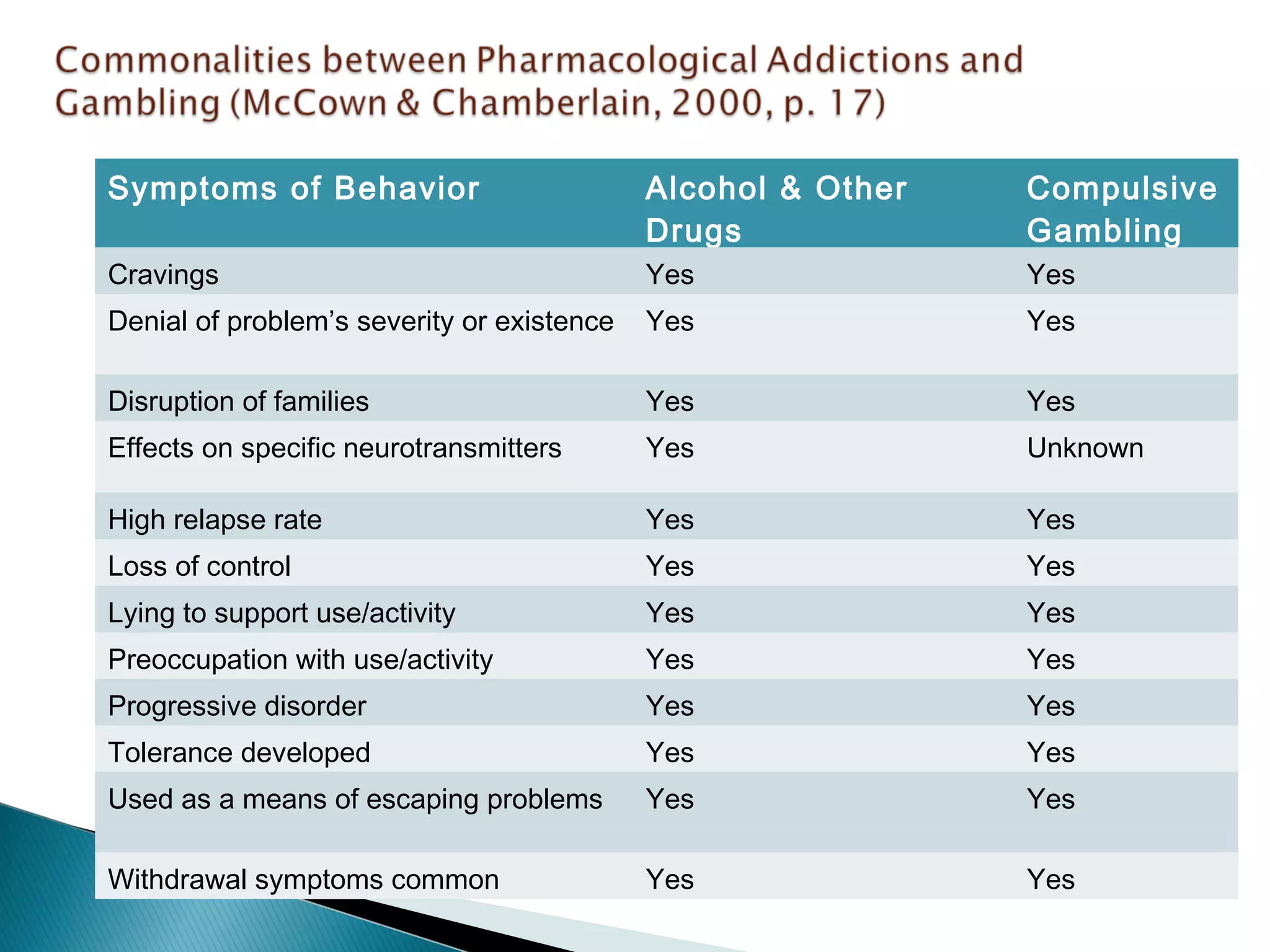
Symptoms of Behavior Alcohol & Other 
Drugs 
Compulsive 
Gambling 
Cravings Yes Yes 
Denial of problem’s severity or existence Yes Yes 
Disruption of families Yes Yes 
Effects on specific neurotransmitters Yes Unknown 
High relapse rate Yes Yes 
Loss of control Yes Yes 
Lying to support use/activity Yes Yes 
Preoccupation with use/activity Yes Yes 
Progressive disorder Yes Yes 
Tolerance developed Yes Yes 
Used as a means of escaping problems Yes Yes 
Withdrawal symptoms common Yes Yes
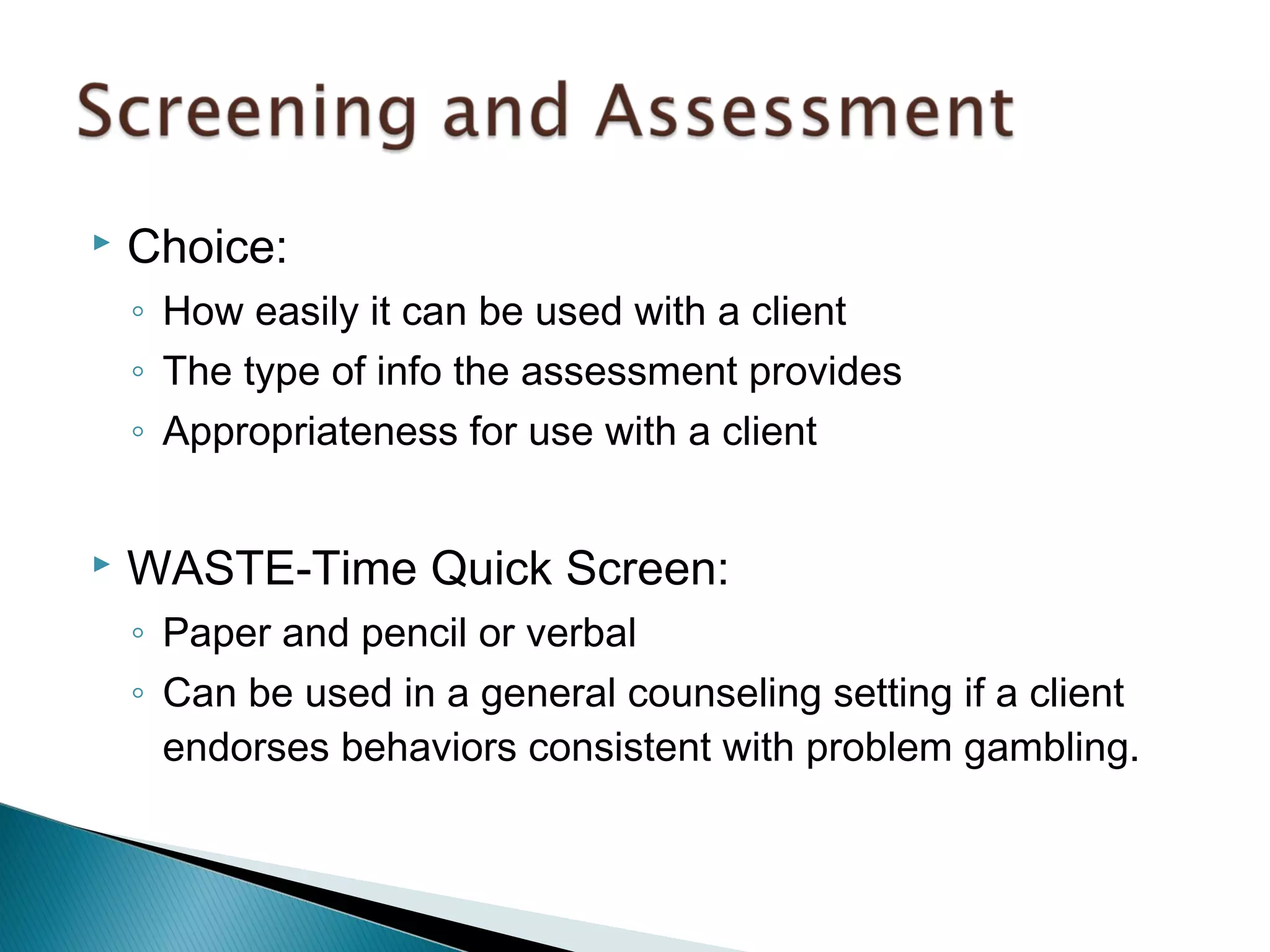
 Choice: 
◦ How easily it can be used with a client 
◦ The type of info the assessment provides 
◦ Appropriateness for use with a client 
 WASTE-Time Quick Screen: 
◦ Paper and pencil or verbal 
◦ Can be used in a general counseling setting if a client 
endorses behaviors consistent with problem gambling.
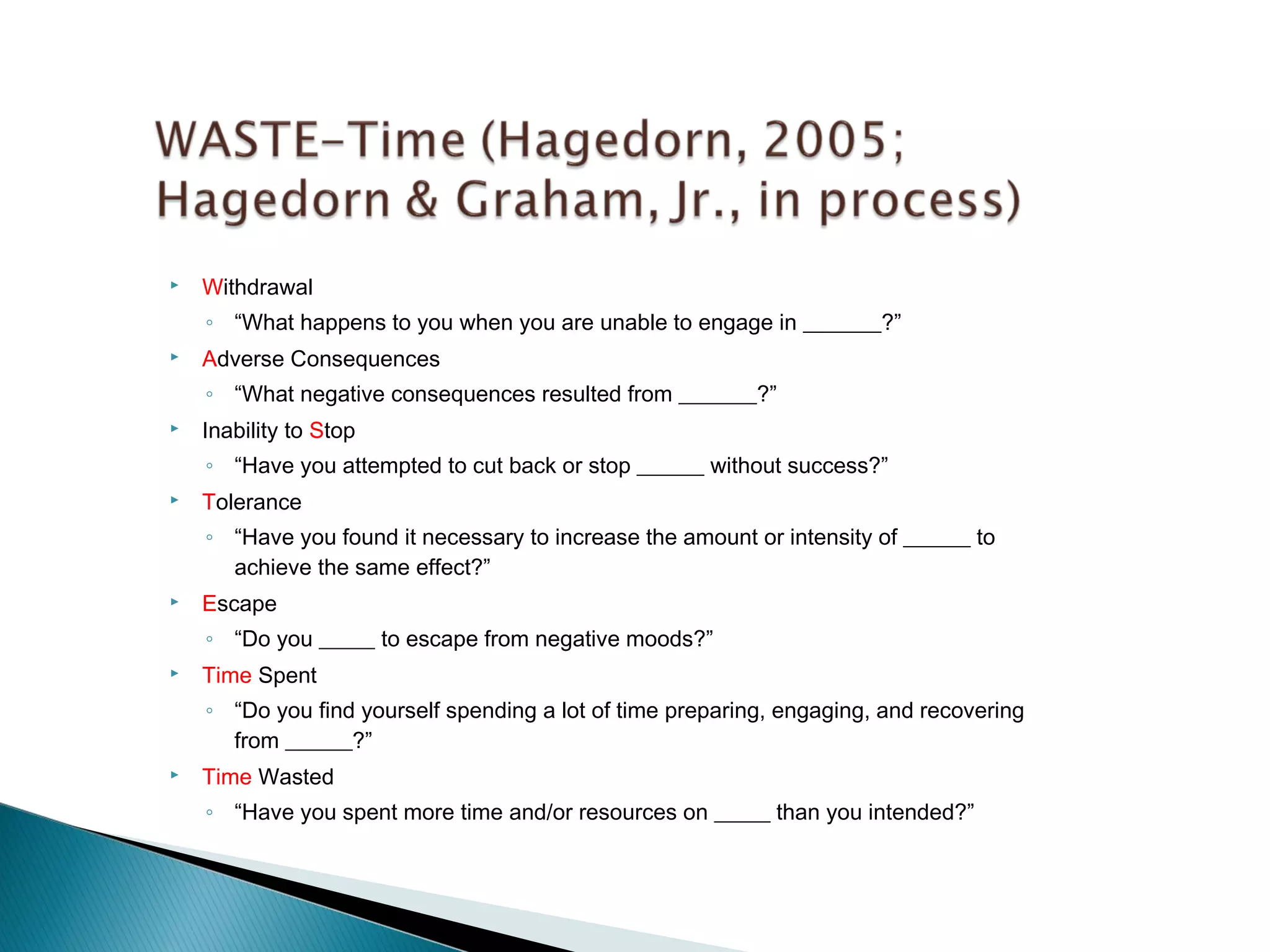
 Withdrawal 
◦ “What happens to you when you are unable to engage in _______?” 
 Adverse Consequences 
◦ “What negative consequences resulted from _______?” 
 Inability to Stop 
◦ “Have you attempted to cut back or stop ______ without success?” 
 Tolerance 
◦ “Have you found it necessary to increase the amount or intensity of ______ to 
achieve the same effect?” 
 Escape 
◦ “Do you _____ to escape from negative moods?” 
 Time Spent 
◦ “Do you find yourself spending a lot of time preparing, engaging, and recovering 
from ______?” 
 Time Wasted 
◦ “Have you spent more time and/or resources on _____ than you intended?”
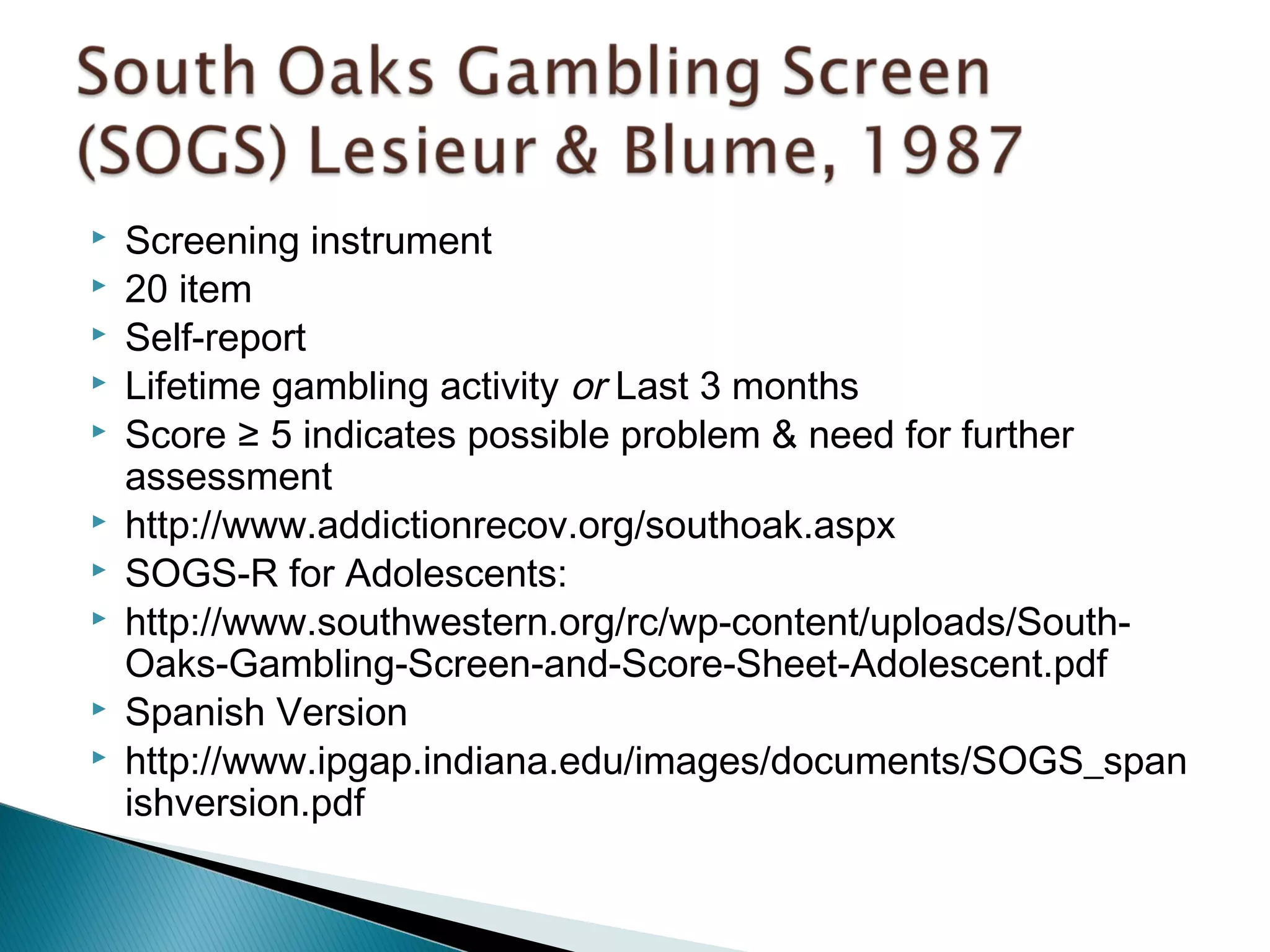
 Screening instrument 
 20 item 
 Self-report 
 Lifetime gambling activity or Last 3 months 
 Score ≥ 5 indicates possible problem & need for further 
assessment 
 http://www.addictionrecov.org/southoak.aspx 
 SOGS-R for Adolescents: 
 http://www.southwestern.org/rc/wp-content/uploads/South- 
Oaks-Gambling-Screen-and-Score-Sheet-Adolescent.pdf 
 Spanish Version 
 http://www.ipgap.indiana.edu/images/documents/SOGS_span 
ishversion.pdf
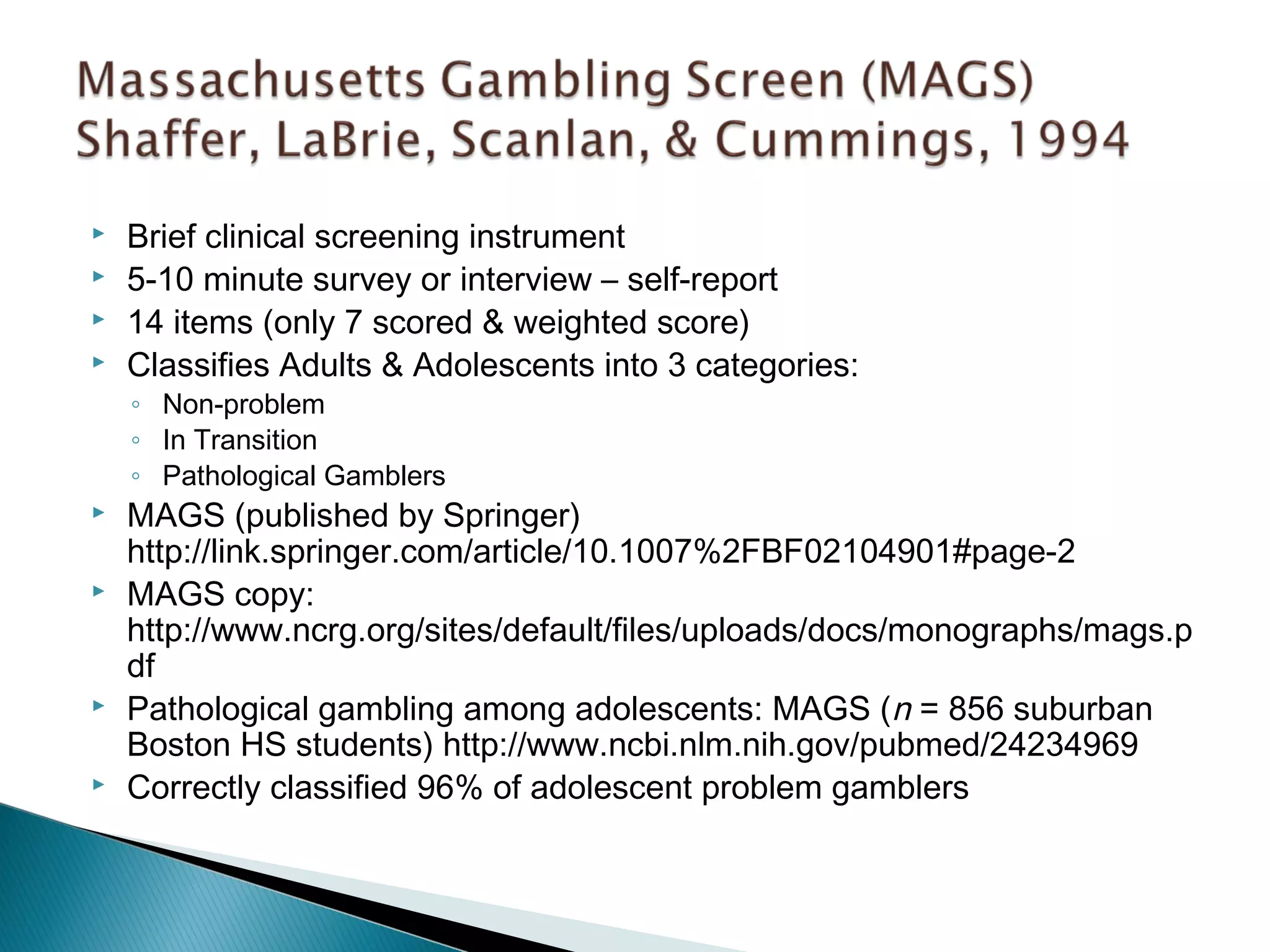
 Brief clinical screening instrument 
 5-10 minute survey or interview – self-report 
 14 items (only 7 scored & weighted score) 
 Classifies Adults & Adolescents into 3 categories: 
◦ Non-problem 
◦ In Transition 
◦ Pathological Gamblers 
 MAGS (published by Springer) 
http://link.springer.com/article/10.1007%2FBF02104901#page-2 
 MAGS copy: 
http://www.ncrg.org/sites/default/files/uploads/docs/monographs/mags.p 
df 
 Pathological gambling among adolescents: MAGS (n = 856 suburban 
Boston HS students) http://www.ncbi.nlm.nih.gov/pubmed/24234969 
 Correctly classified 96% of adolescent problem gamblers
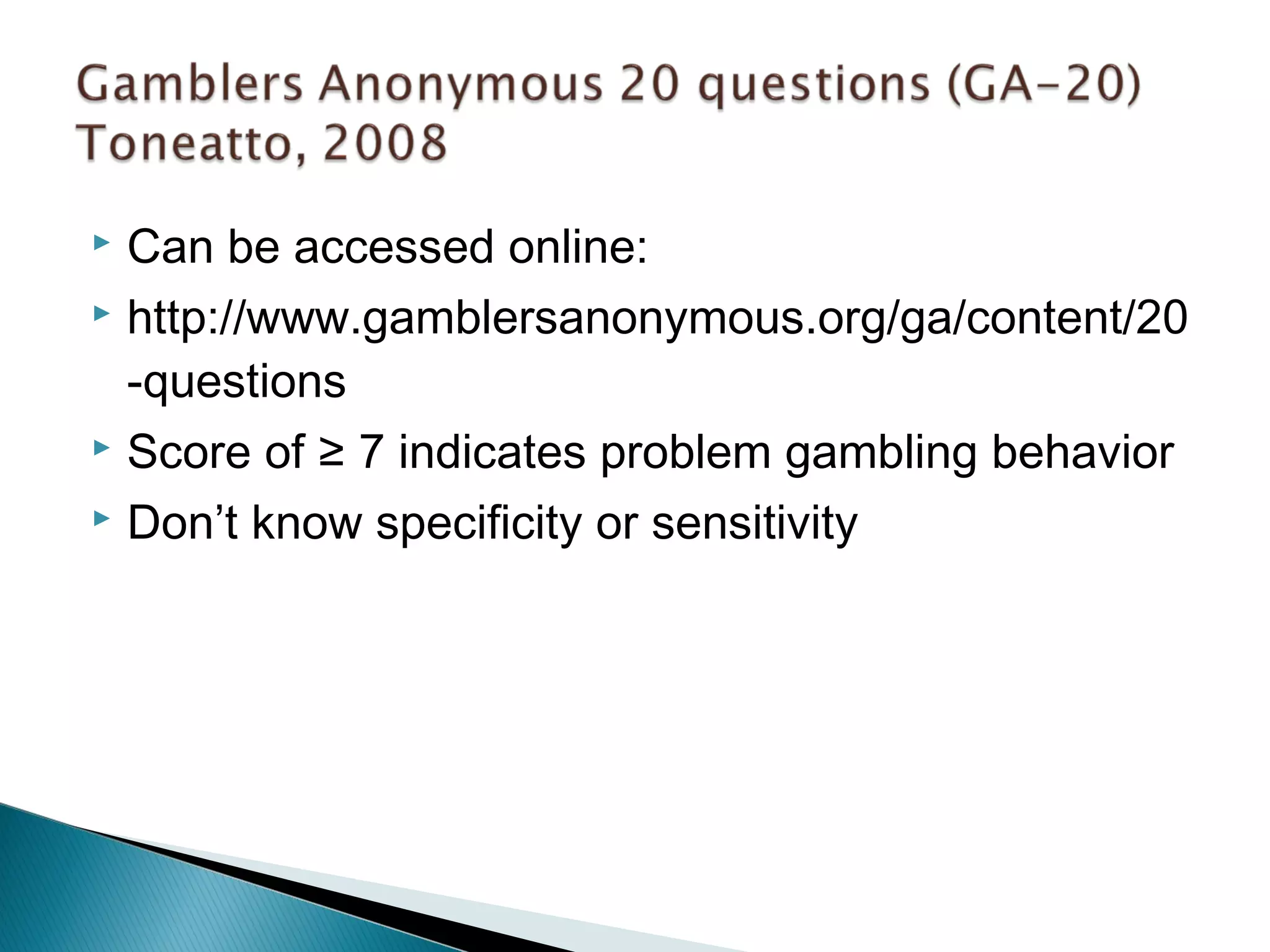
 Can be accessed online: 
 http://www.gamblersanonymous.org/ga/content/20 
-questions 
 Score of ≥ 7 indicates problem gambling behavior 
 Don’t know specificity or sensitivity
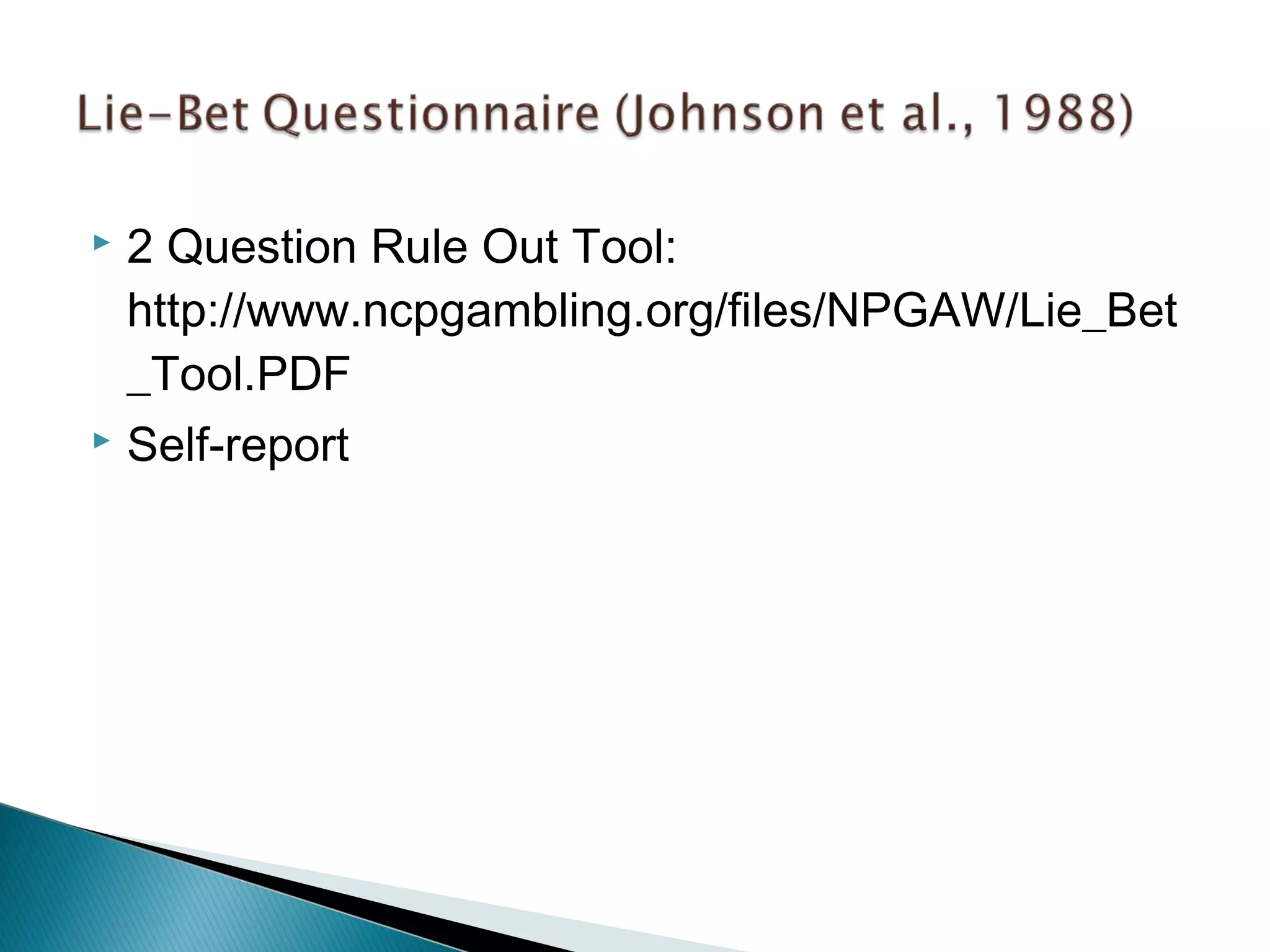
 2 Question Rule Out Tool: 
http://www.ncpgambling.org/files/NPGAW/Lie_Bet 
_Tool.PDF 
 Self-report
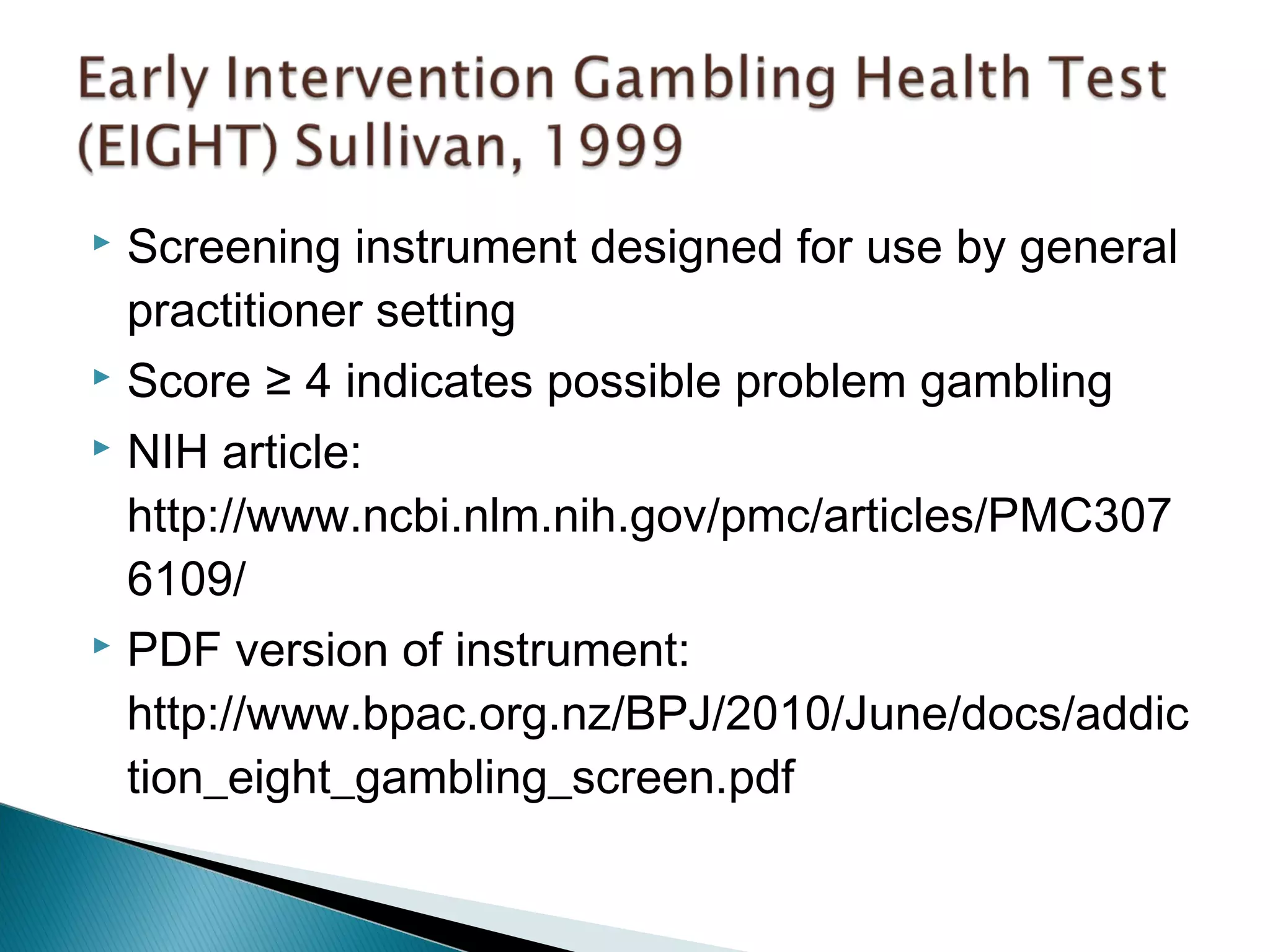
 Screening instrument designed for use by general 
practitioner setting 
 Score ≥ 4 indicates possible problem gambling 
 NIH article: 
http://www.ncbi.nlm.nih.gov/pmc/articles/PMC307 
6109/ 
 PDF version of instrument: 
http://www.bpac.org.nz/BPJ/2010/June/docs/addic 
tion_eight_gambling_screen.pdf
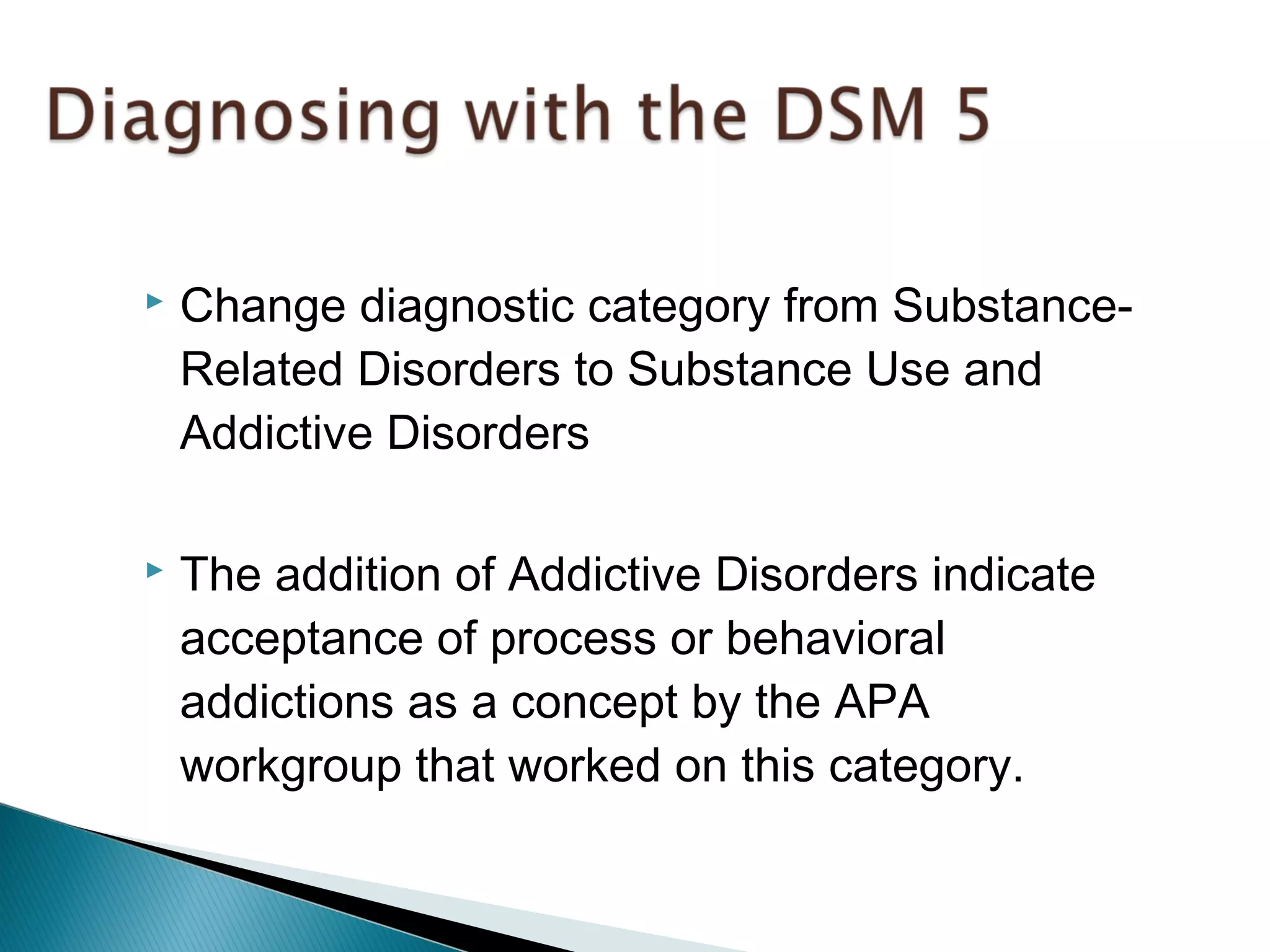
 Change diagnostic category from Substance- 
Related Disorders to Substance Use and 
Addictive Disorders 
 The addition of Addictive Disorders indicate 
acceptance of process or behavioral 
addictions as a concept by the APA 
workgroup that worked on this category.
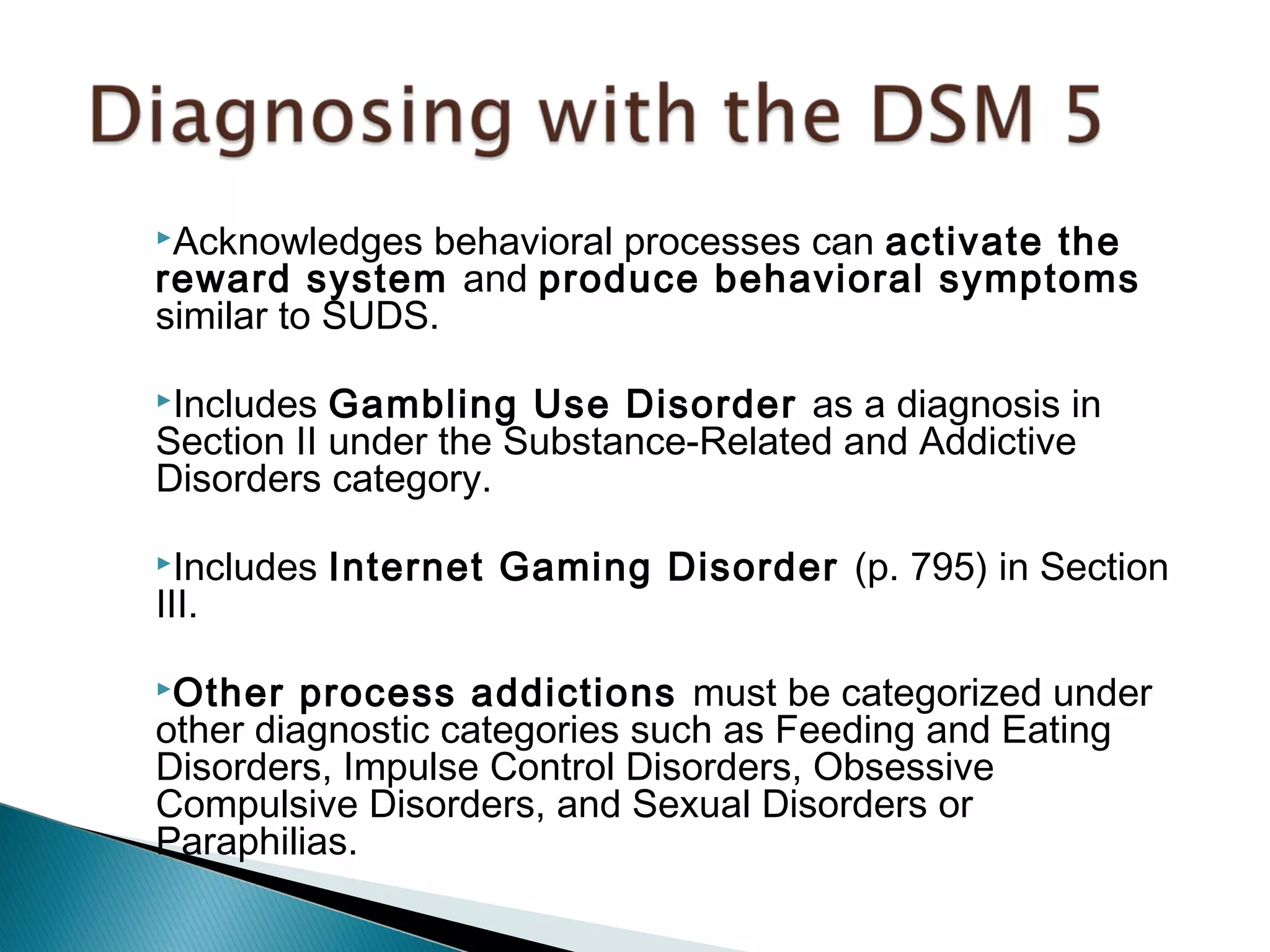
Acknowledges behavioral processes can activate the 
reward system and produce behavioral symptoms 
similar to SUDS. 
Includes Gambling Use Disorder as a diagnosis in 
Section II under the Substance-Related and Addictive 
Disorders category. 
Includes Internet Gaming Disorder (p. 795) in Section 
III. 
Other process addictions must be categorized under 
other diagnostic categories such as Feeding and Eating 
Disorders, Impulse Control Disorders, Obsessive 
Compulsive Disorders, and Sexual Disorders or 
Paraphilias.
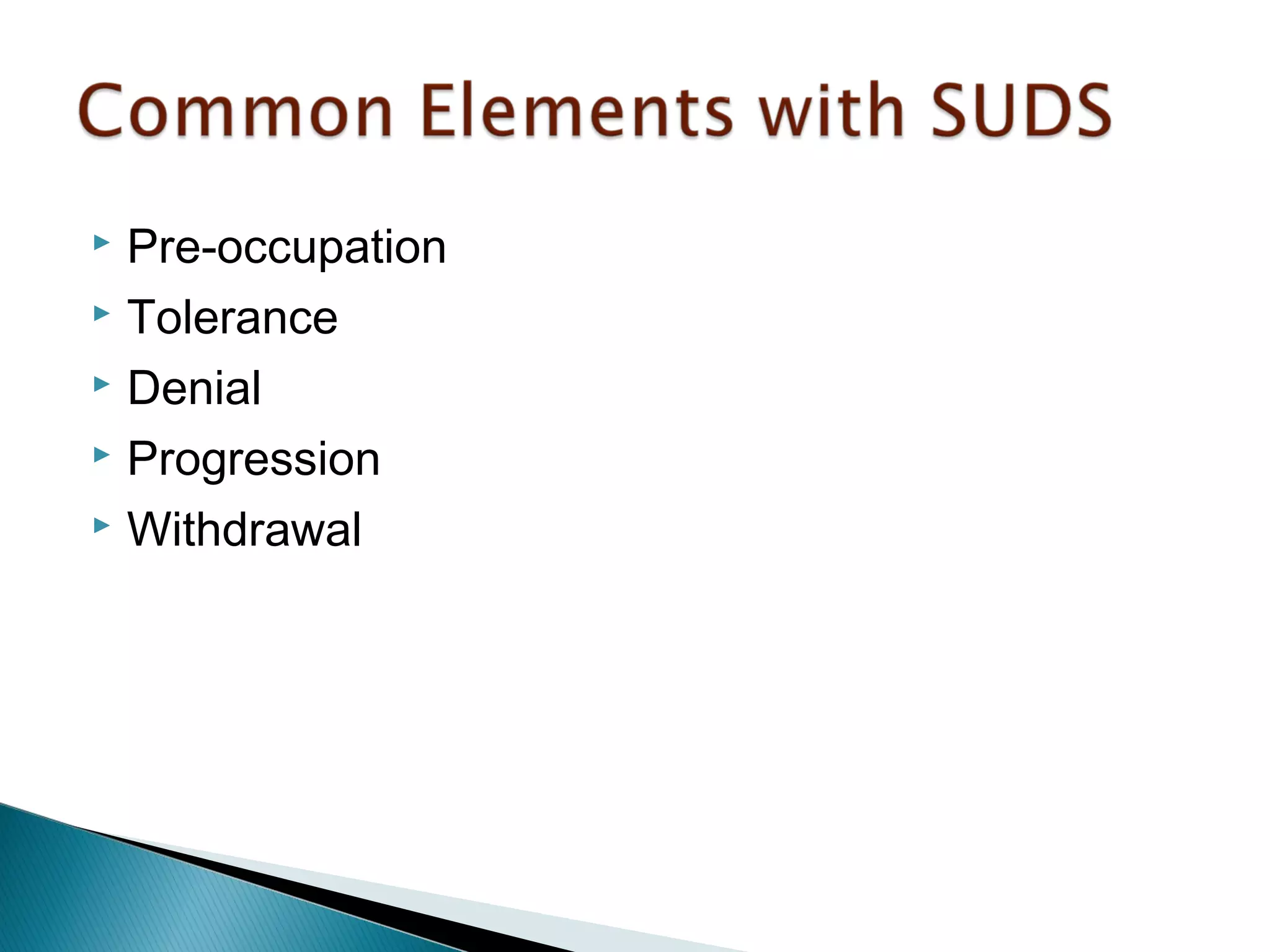
 Pre-occupation 
 Tolerance 
 Denial 
 Progression 
 Withdrawal
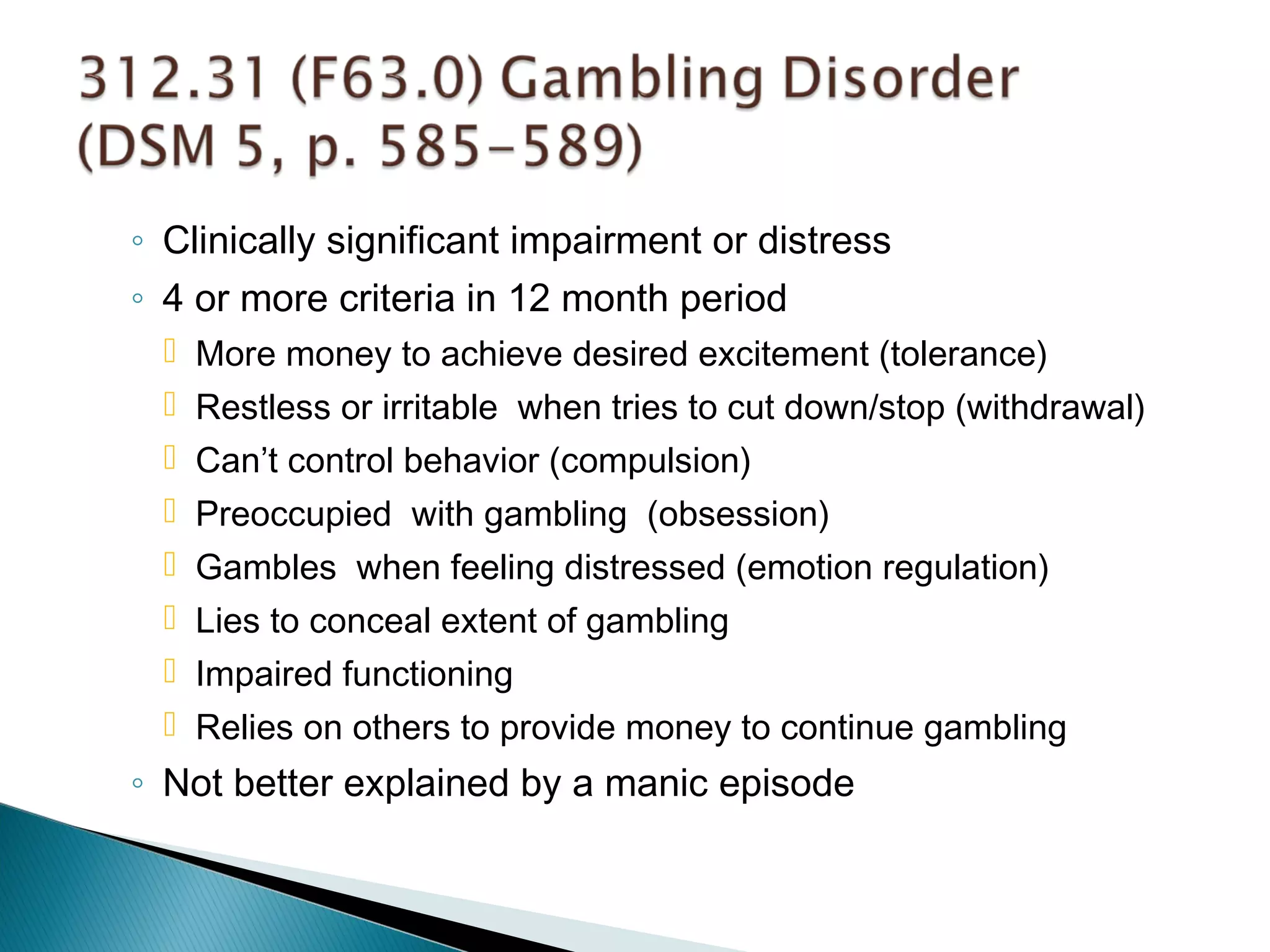
◦ Clinically significant impairment or distress 
◦ 4 or more criteria in 12 month period 
 More money to achieve desired excitement (tolerance) 
 Restless or irritable when tries to cut down/stop (withdrawal) 
 Can’t control behavior (compulsion) 
 Preoccupied with gambling (obsession) 
 Gambles when feeling distressed (emotion regulation) 
 Lies to conceal extent of gambling 
 Impaired functioning 
 Relies on others to provide money to continue gambling 
◦ Not better explained by a manic episode
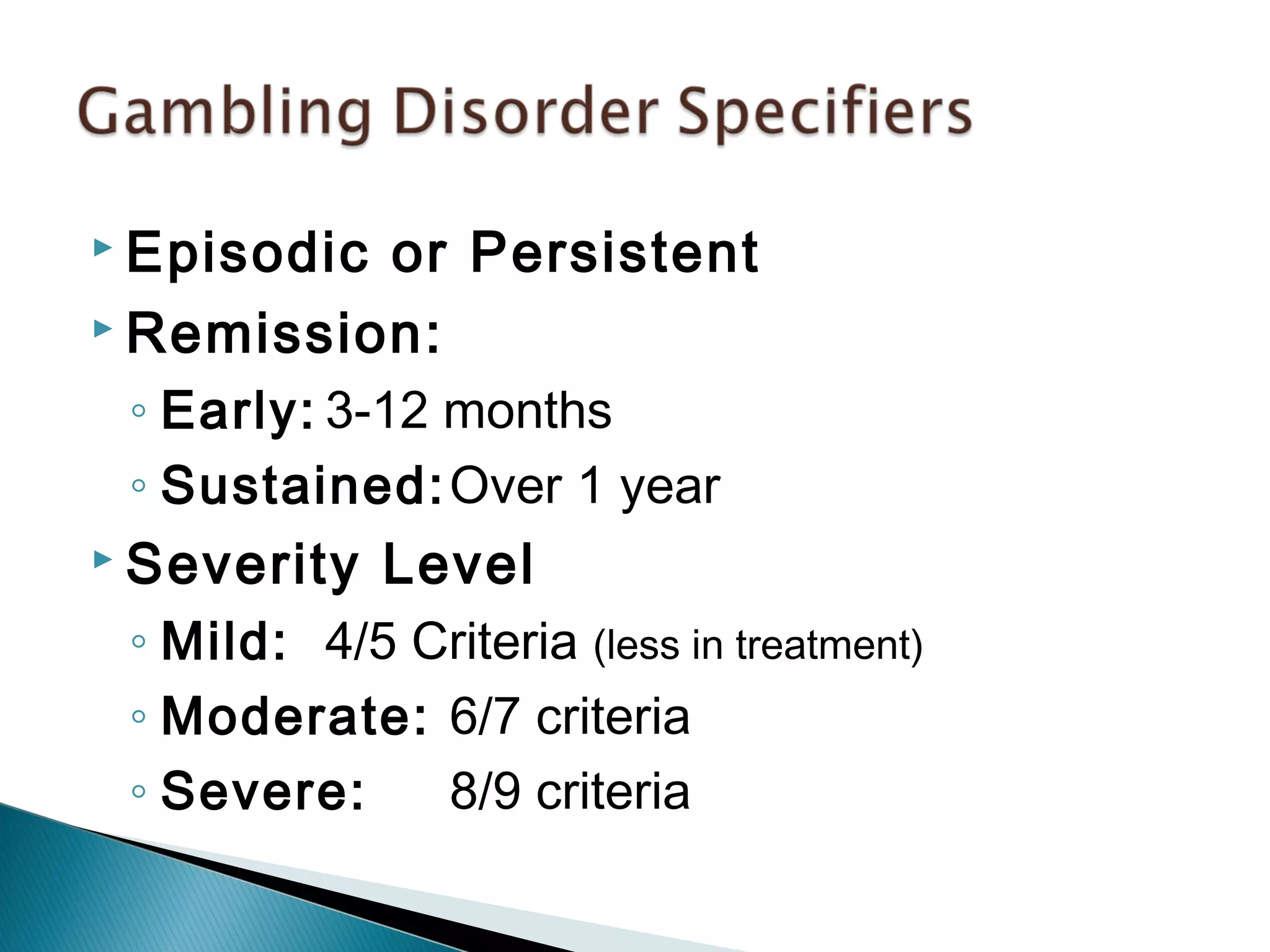
 Episodic or Persistent 
 Remission: 
◦ Early: 3-12 months 
◦ Sustained:Over 1 year 
 Severity Level 
◦ Mild: 4/5 Criteria (less in treatment) 
◦ Moderate: 6/7 criteria 
◦ Severe: 8/9 criteria
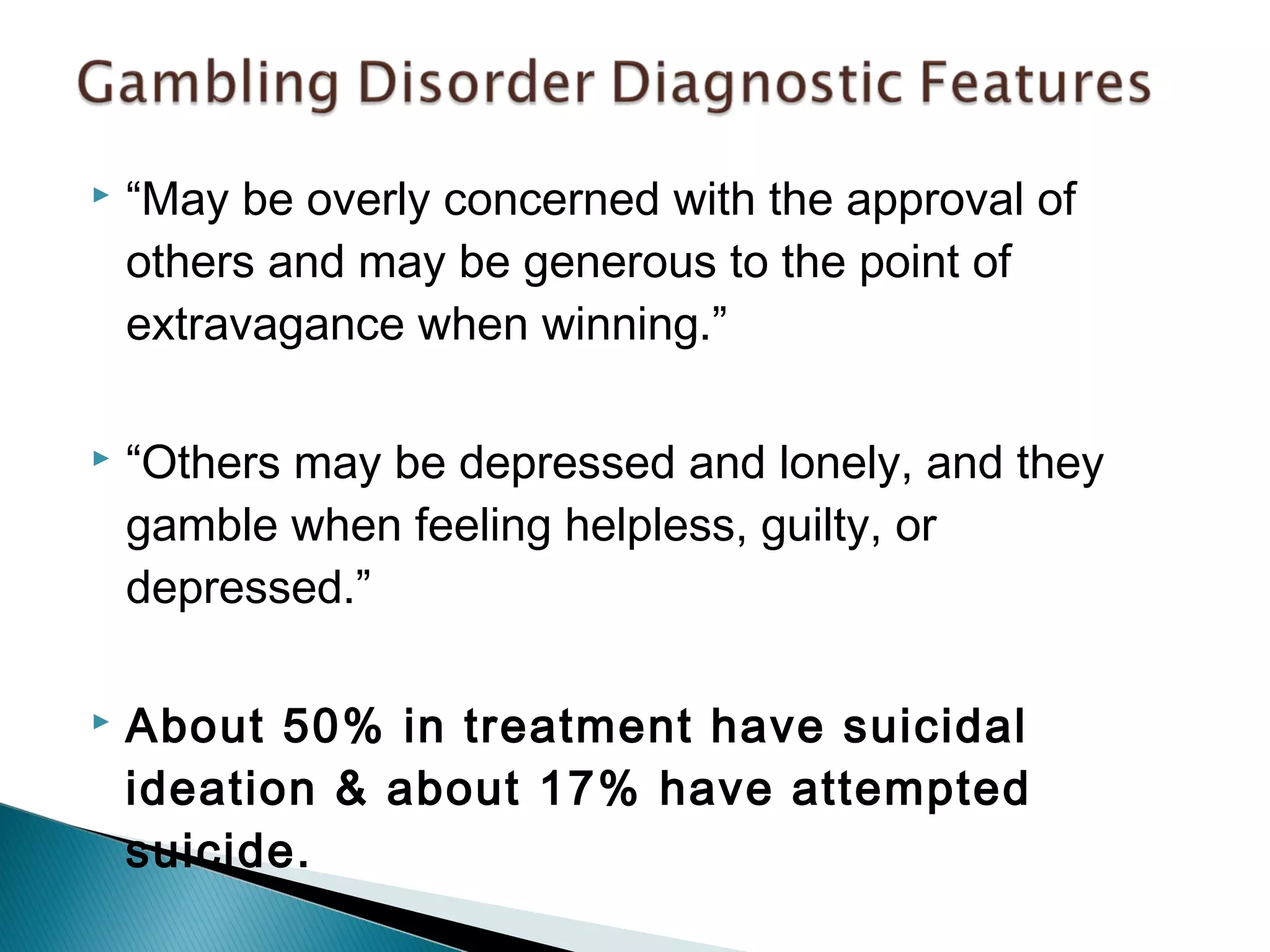
 Distorted Thinking: 
◦ Denial 
◦ Superstitions 
◦ Sense of power & control over the outcome of chance 
events 
◦ Overconfidence 
 “Some are impulsive, competitive, energetic, 
restless, and easily bored” (p. 587).
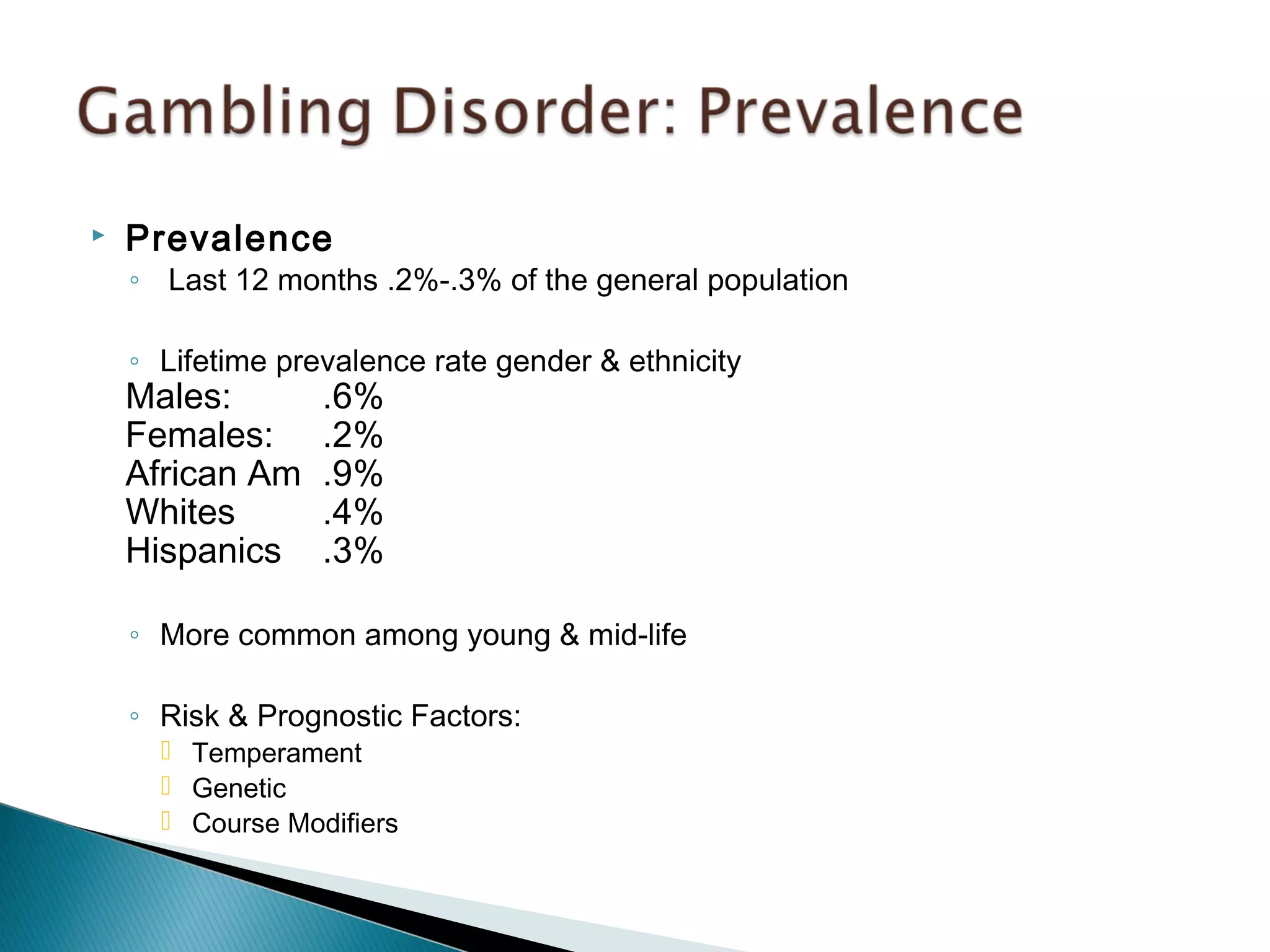
 “May be overly concerned with the approval of 
others and may be generous to the point of 
extravagance when winning.” 
 “Others may be depressed and lonely, and they 
gamble when feeling helpless, guilty, or 
depressed.” 
 About 50% in treatment have suicidal 
ideation & about 17% have attempted 
suicide.
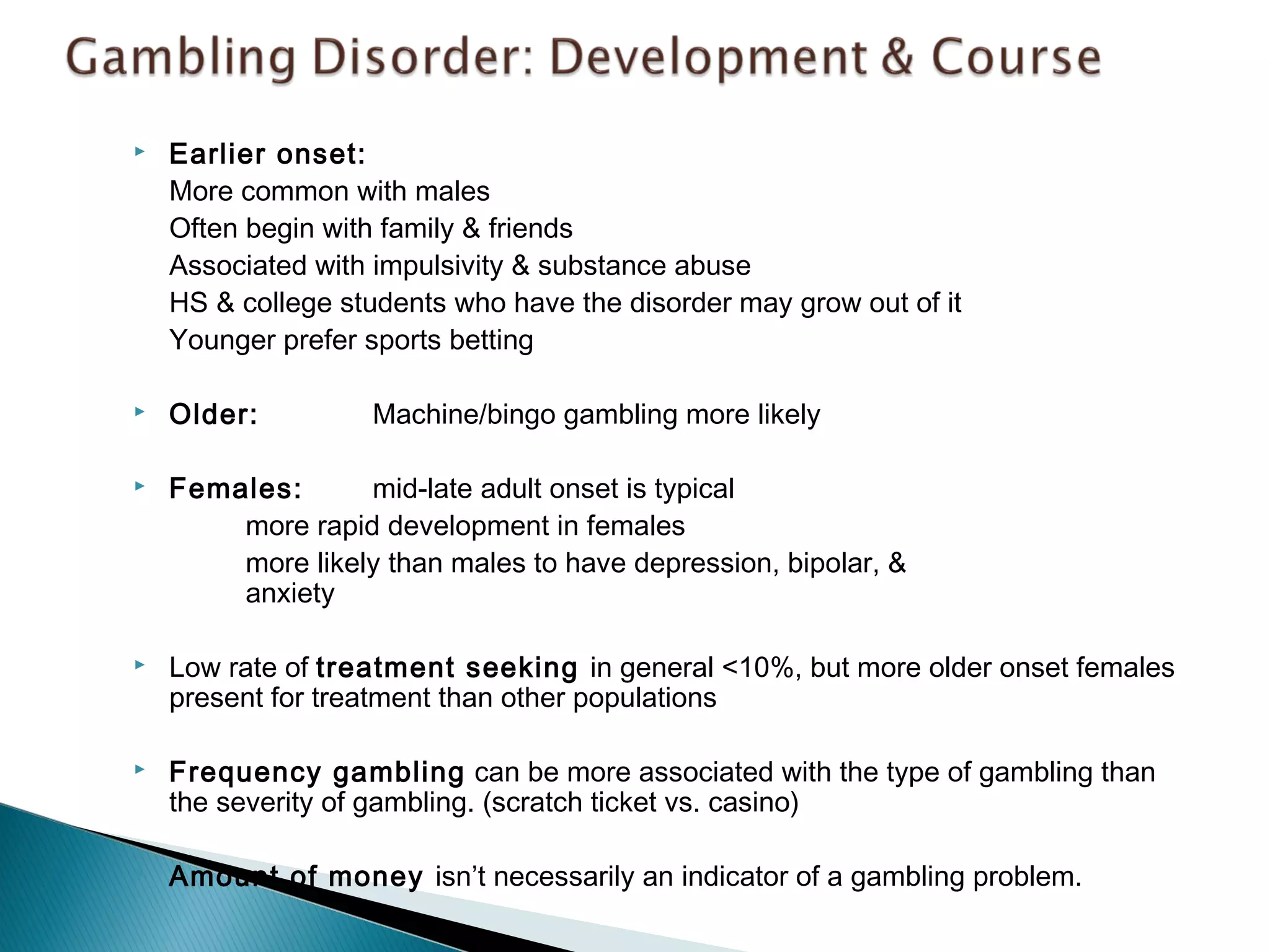
 Prevalence 
◦ Last 12 months .2%-.3% of the general population 
◦ Lifetime prevalence rate gender & ethnicity 
Males: .6% 
Females: .2% 
African Am .9% 
Whites .4% 
Hispanics .3% 
◦ More common among young & mid-life 
◦ Risk & Prognostic Factors: 
 Temperament 
 Genetic 
 Course Modifiers
 Earlier onset: 
More common with males 
Often begin with family & friends 
Associated with impulsivity & substance abuse 
HS & college students who have the disorder may grow out of it 
Younger prefer sports betting 
 Older: Machine/bingo gambling more likely 
 Females: mid-late adult onset is typical 
more rapid development in females 
more likely than males to have depression, bipolar, & 
anxiety 
 Low rate of treatment seeking in general <10%, but more older onset females 
present for treatment than other populations 
 Frequency gambling can be more associated with the type of gambling than 
the severity of gambling. (scratch ticket vs. casino) 
 Amount of money isn’t necessarily an indicator of a gambling problem.
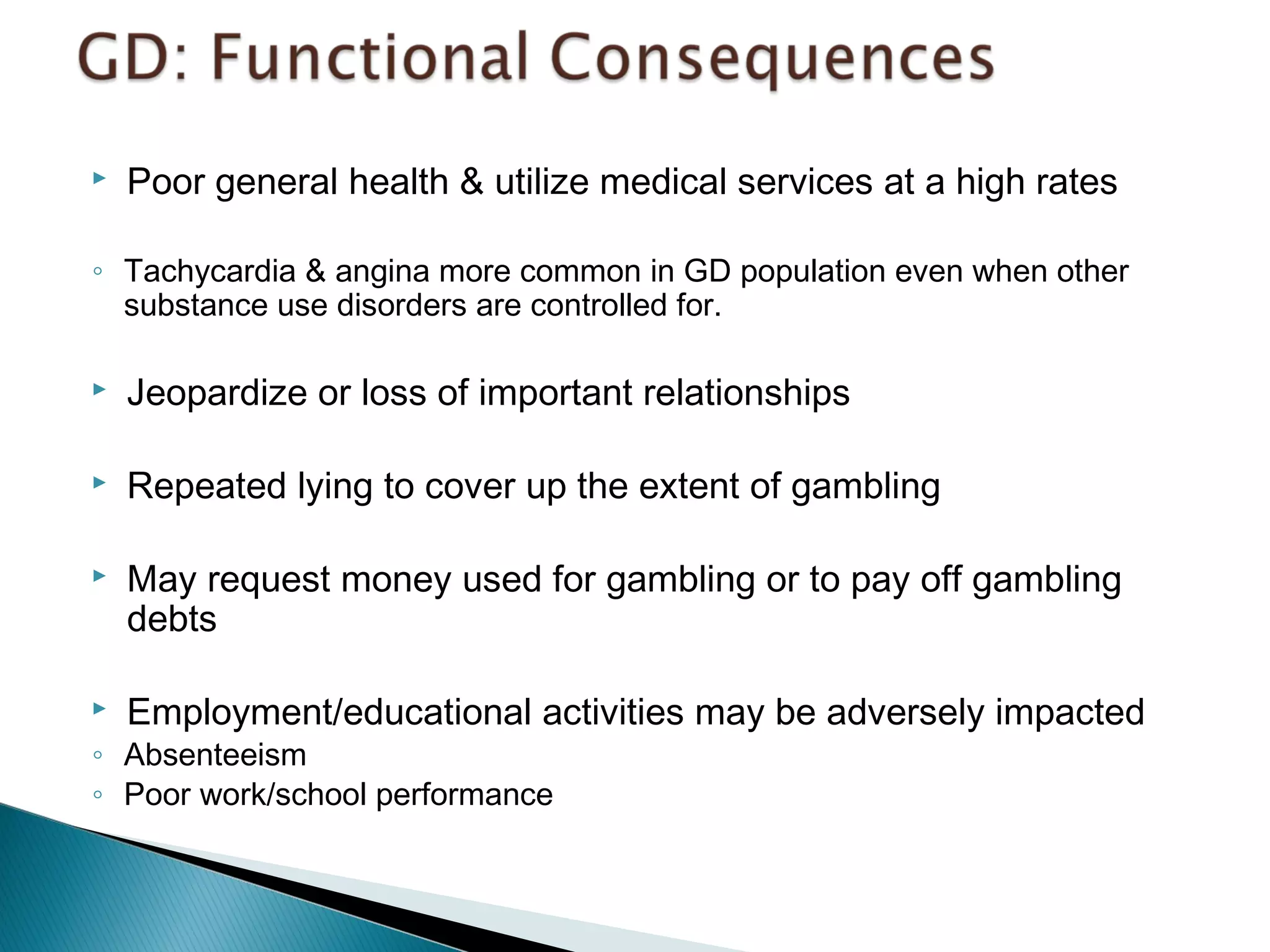
 Poor general health & utilize medical services at a high rates 
◦ Tachycardia & angina more common in GD population even when other 
substance use disorders are controlled for. 
 Jeopardize or loss of important relationships 
 Repeated lying to cover up the extent of gambling 
 May request money used for gambling or to pay off gambling 
debts 
 Employment/educational activities may be adversely impacted 
◦ Absenteeism 
◦ Poor work/school performance
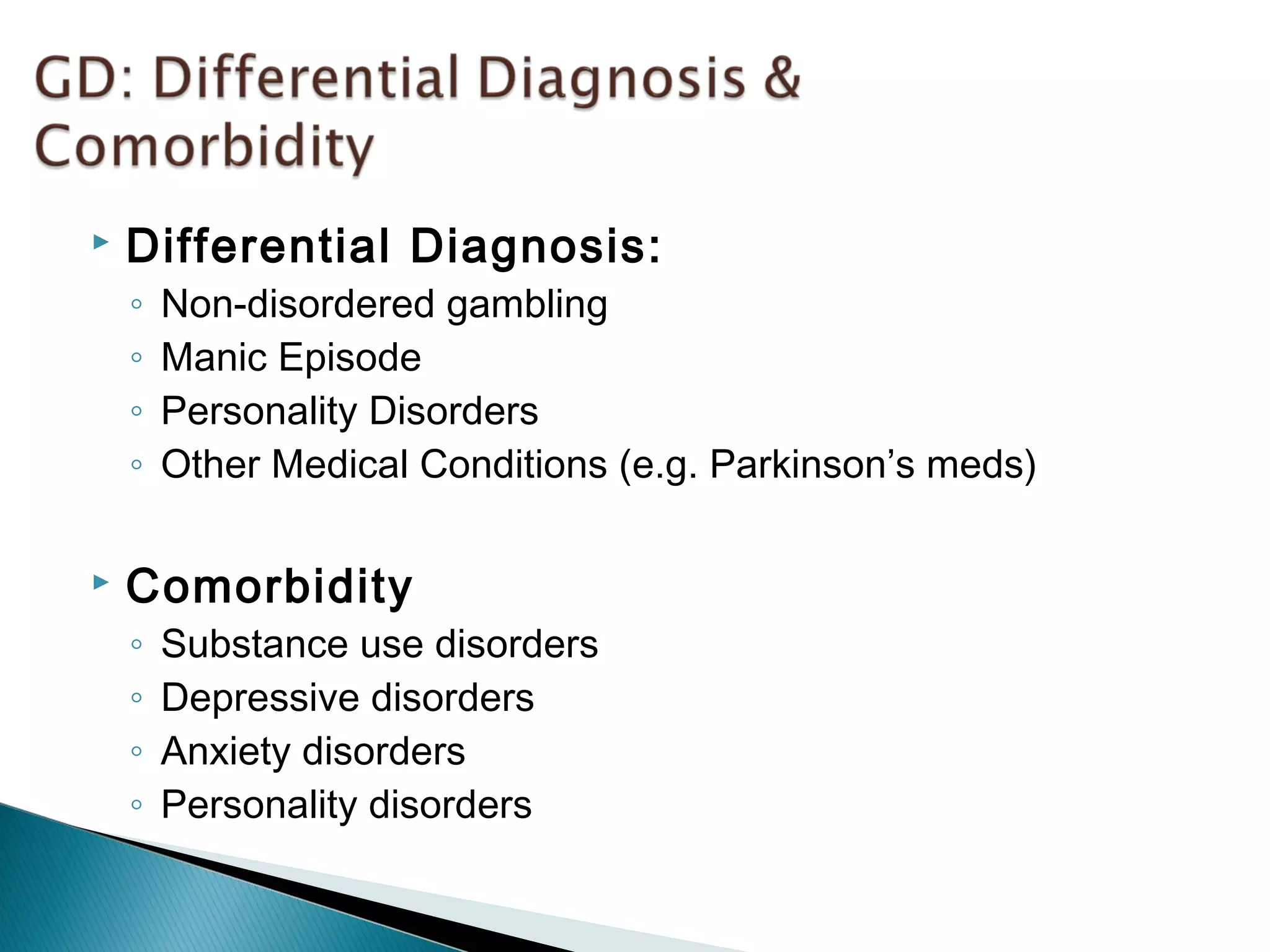
 Differential Diagnosis: 
◦ Non-disordered gambling 
◦ Manic Episode 
◦ Personality Disorders 
◦ Other Medical Conditions (e.g. Parkinson’s meds) 
 Comorbidity 
◦ Substance use disorders 
◦ Depressive disorders 
◦ Anxiety disorders 
◦ Personality disorders
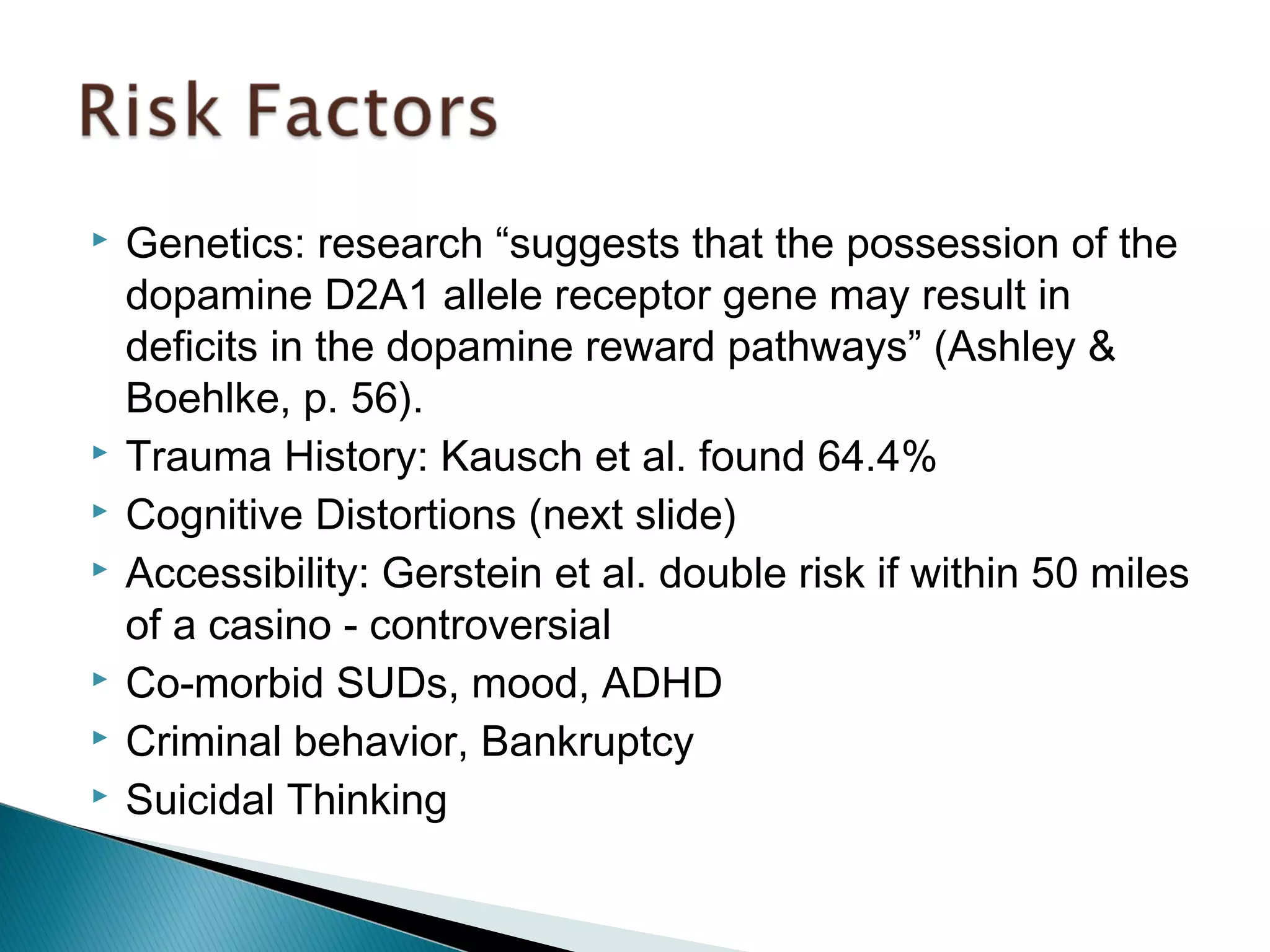
 Genetics: research “suggests that the possession of the 
dopamine D2A1 allele receptor gene may result in 
deficits in the dopamine reward pathways” (Ashley & 
Boehlke, p. 56). 
 Trauma History: Kausch et al. found 64.4% 
 Cognitive Distortions (next slide) 
 Accessibility: Gerstein et al. double risk if within 50 miles 
of a casino - controversial 
 Co-morbid SUDs, mood, ADHD 
 Criminal behavior, Bankruptcy 
 Suicidal Thinking
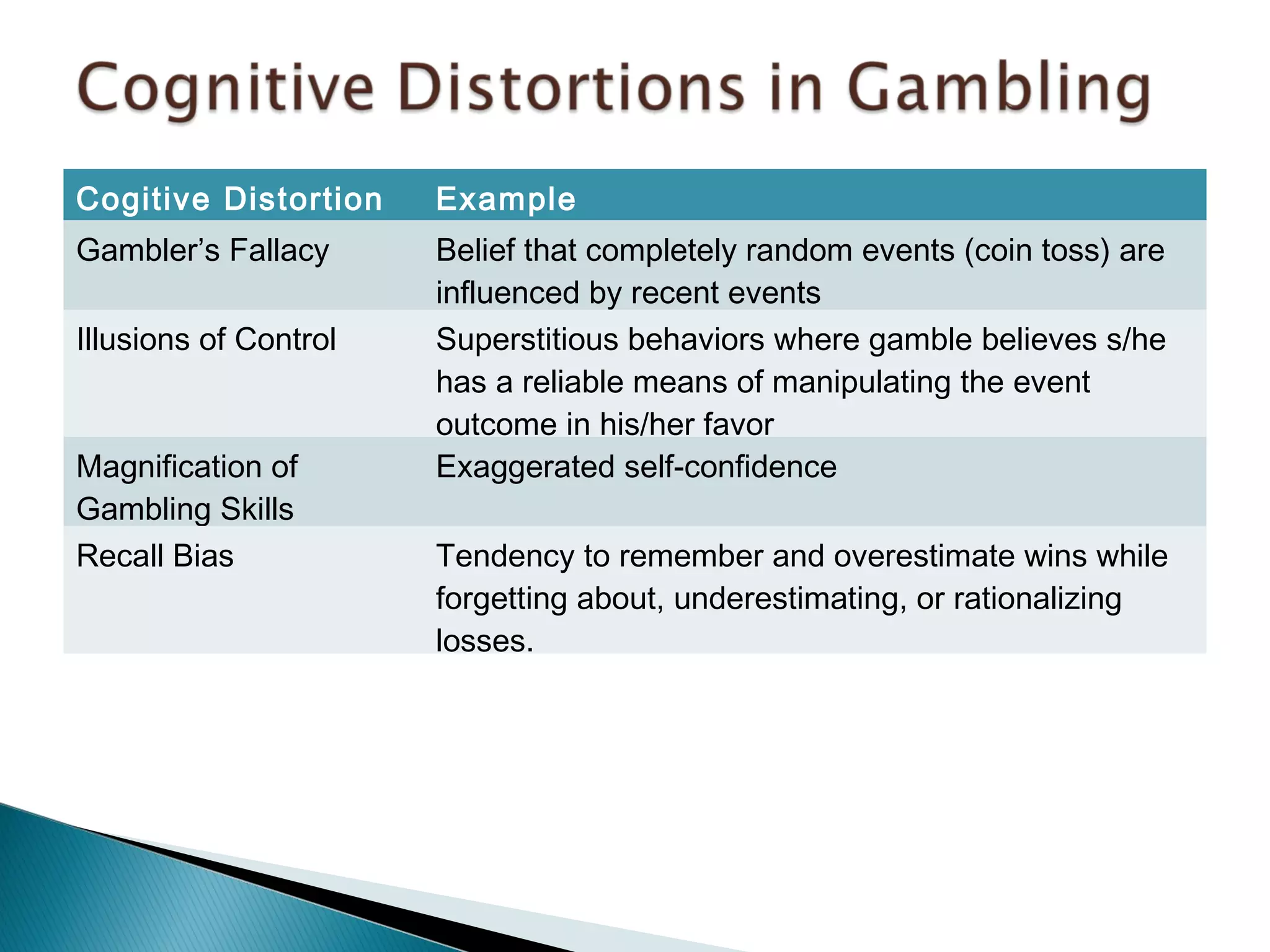
Cogitive Distortion Example 
Gambler’s Fallacy Belief that completely random events (coin toss) are 
influenced by recent events 
Illusions of Control Superstitious behaviors where gamble believes s/he 
has a reliable means of manipulating the event 
outcome in his/her favor 
Magnification of 
Gambling Skills 
Exaggerated self-confidence 
Recall Bias Tendency to remember and overestimate wins while 
forgetting about, underestimating, or rationalizing 
losses.
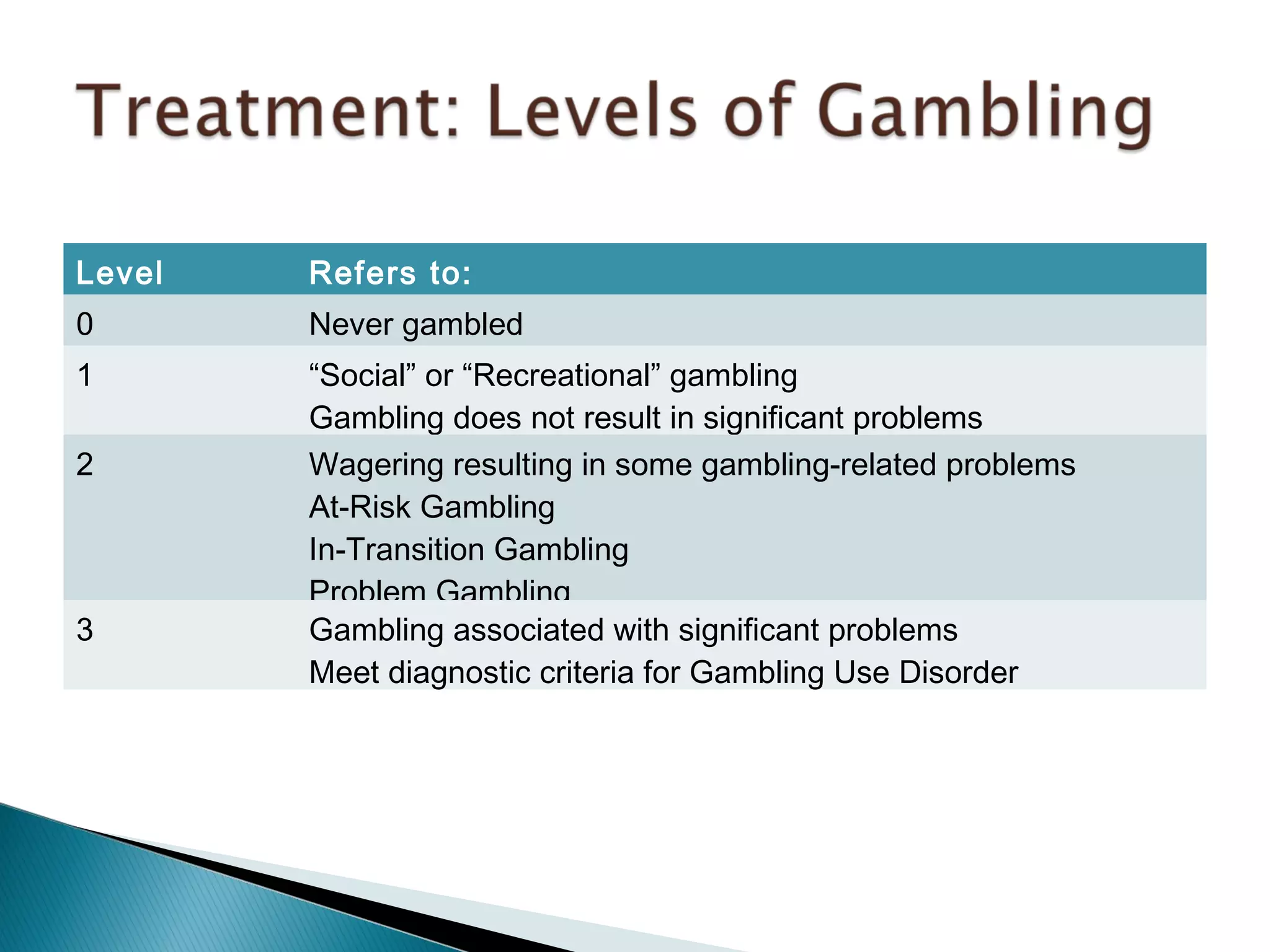
Level Refers to: 
0 Never gambled 
1 “Social” or “Recreational” gambling 
Gambling does not result in significant problems 
2 Wagering resulting in some gambling-related problems 
At-Risk Gambling 
In-Transition Gambling 
Problem Gambling 
3 Gambling associated with significant problems 
Meet diagnostic criteria for Gambling Use Disorder
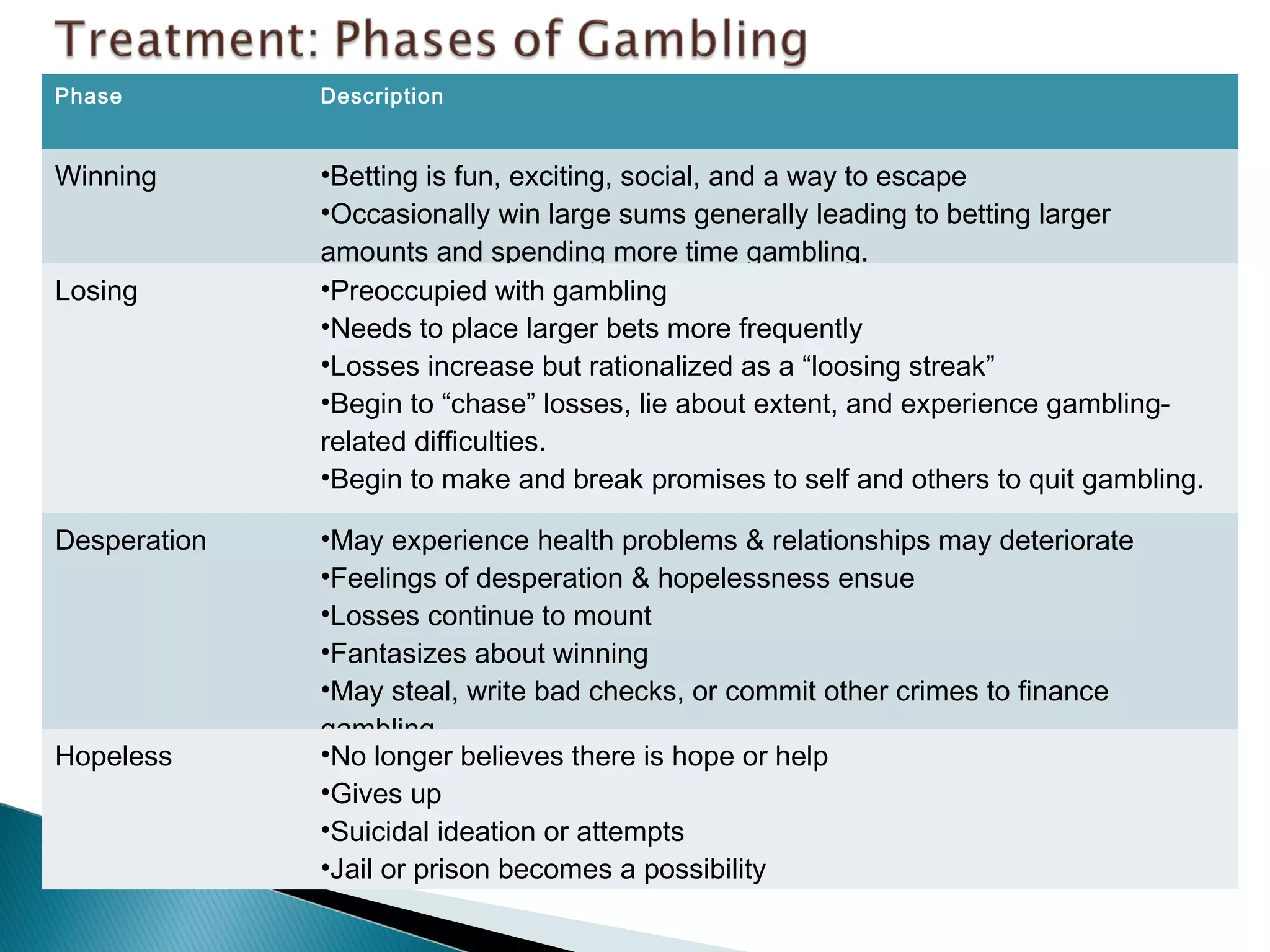
Phase Description 
Winning •Betting is fun, exciting, social, and a way to escape 
•Occasionally win large sums generally leading to betting larger 
amounts and spending more time gambling. 
Losing •Preoccupied with gambling 
•Needs to place larger bets more frequently 
•Losses increase but rationalized as a “loosing streak” 
•Begin to “chase” losses, lie about extent, and experience gambling-related 
difficulties. 
•Begin to make and break promises to self and others to quit gambling. 
Desperation •May experience health problems & relationships may deteriorate 
•Feelings of desperation & hopelessness ensue 
•Losses continue to mount 
•Fantasizes about winning 
•May steal, write bad checks, or commit other crimes to finance 
gambling 
Hopeless •No longer believes there is hope or help 
•Gives up 
•Suicidal ideation or attempts 
•Jail or prison becomes a possibility
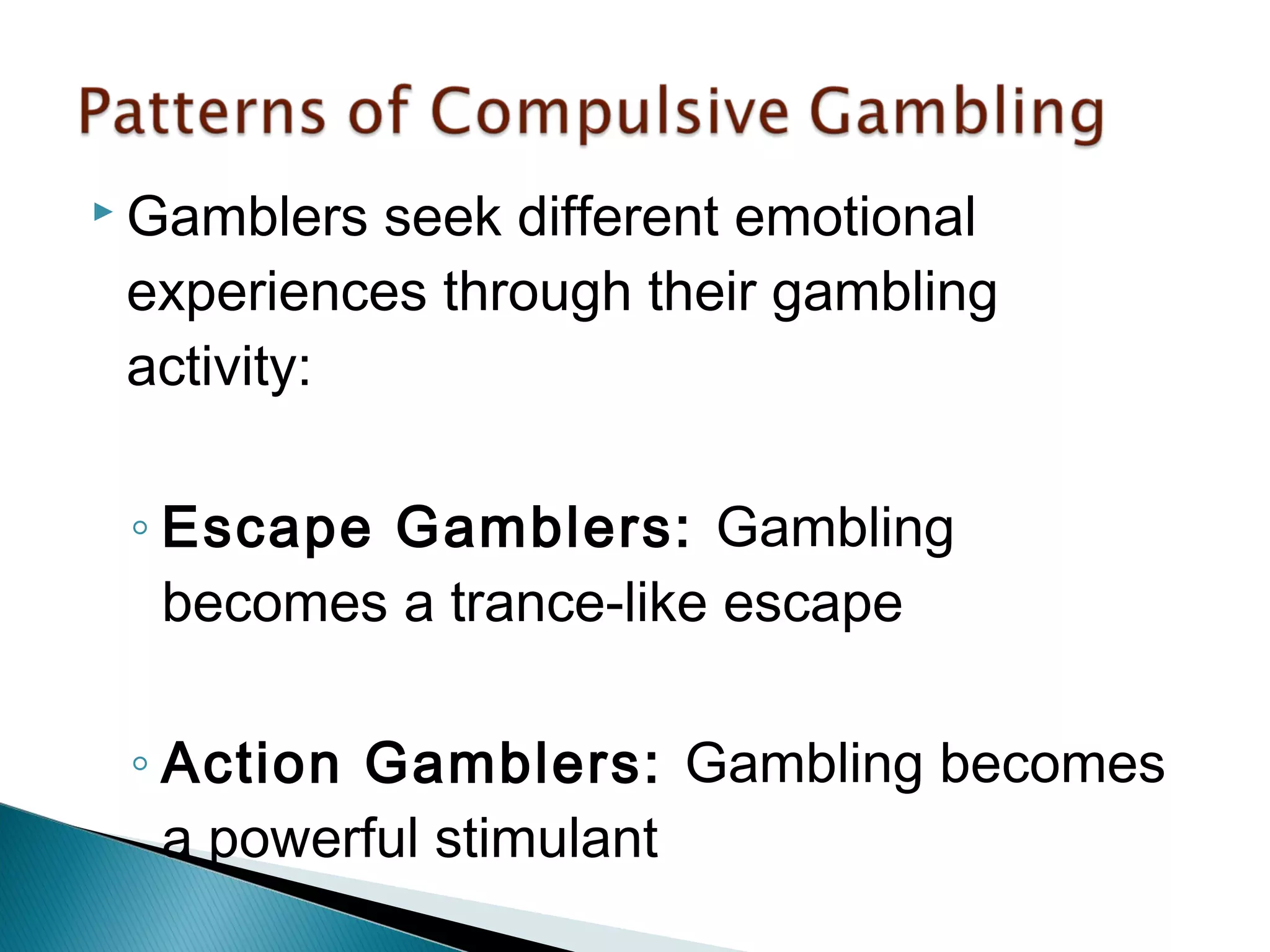
Gamblers seek different emotional 
experiences through their gambling 
activity: 
◦ Escape Gamblers: Gambling 
becomes a trance-like escape 
◦ Action Gamblers: Gambling becomes 
a powerful stimulant
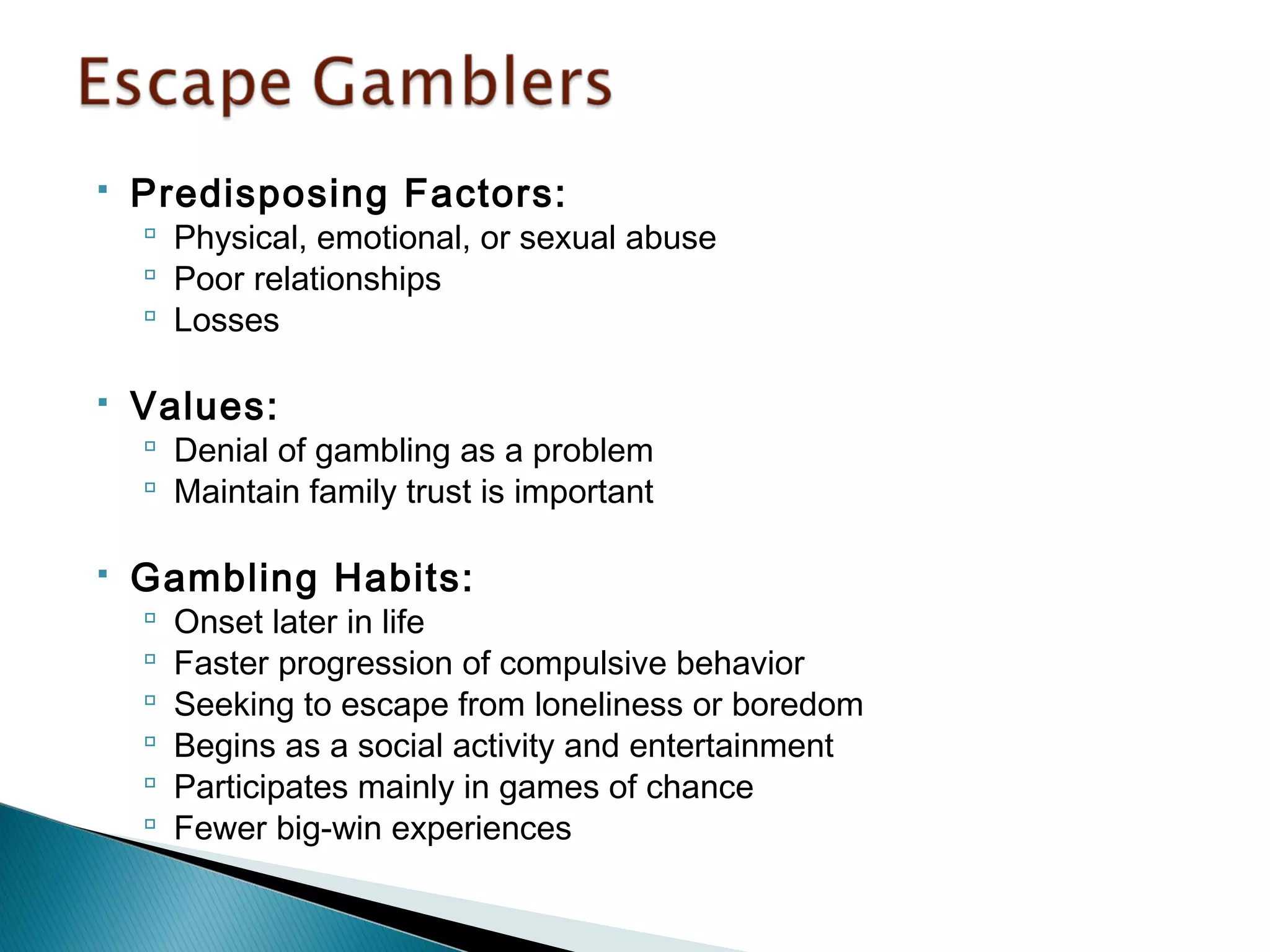
 Predisposing Factors: 
 Physical, emotional, or sexual abuse 
 Poor relationships 
 Losses 
 Values: 
 Denial of gambling as a problem 
 Maintain family trust is important 
 Gambling Habits: 
 Onset later in life 
 Faster progression of compulsive behavior 
 Seeking to escape from loneliness or boredom 
 Begins as a social activity and entertainment 
 Participates mainly in games of chance 
 Fewer big-win experiences
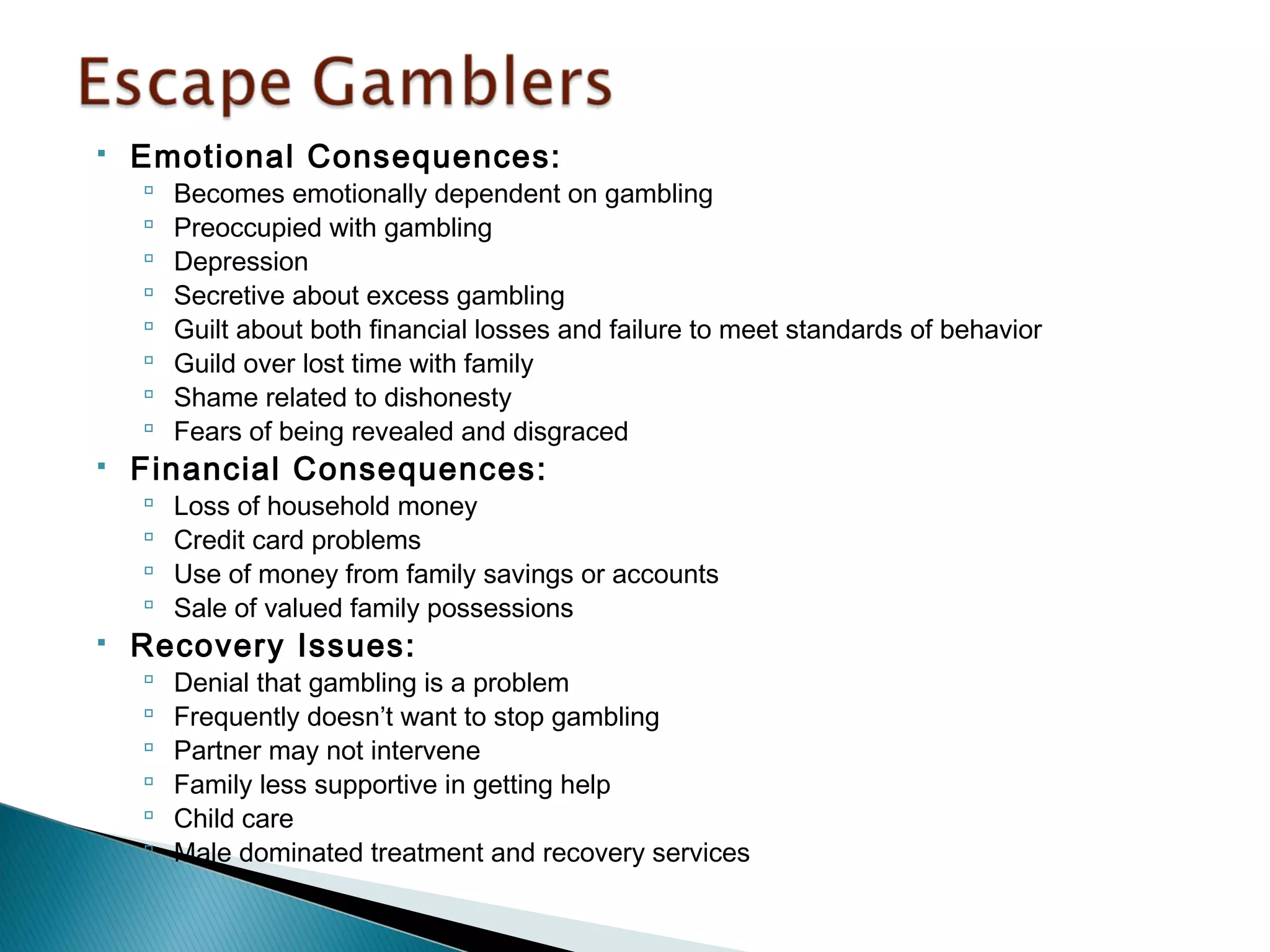
 Emotional Consequences: 
 Becomes emotionally dependent on gambling 
 Preoccupied with gambling 
 Depression 
 Secretive about excess gambling 
 Guilt about both financial losses and failure to meet standards of behavior 
 Guild over lost time with family 
 Shame related to dishonesty 
 Fears of being revealed and disgraced 
 Financial Consequences: 
 Loss of household money 
 Credit card problems 
 Use of money from family savings or accounts 
 Sale of valued family possessions 
 Recovery Issues: 
 Denial that gambling is a problem 
 Frequently doesn’t want to stop gambling 
 Partner may not intervene 
 Family less supportive in getting help 
 Child care 
 Male dominated treatment and recovery services
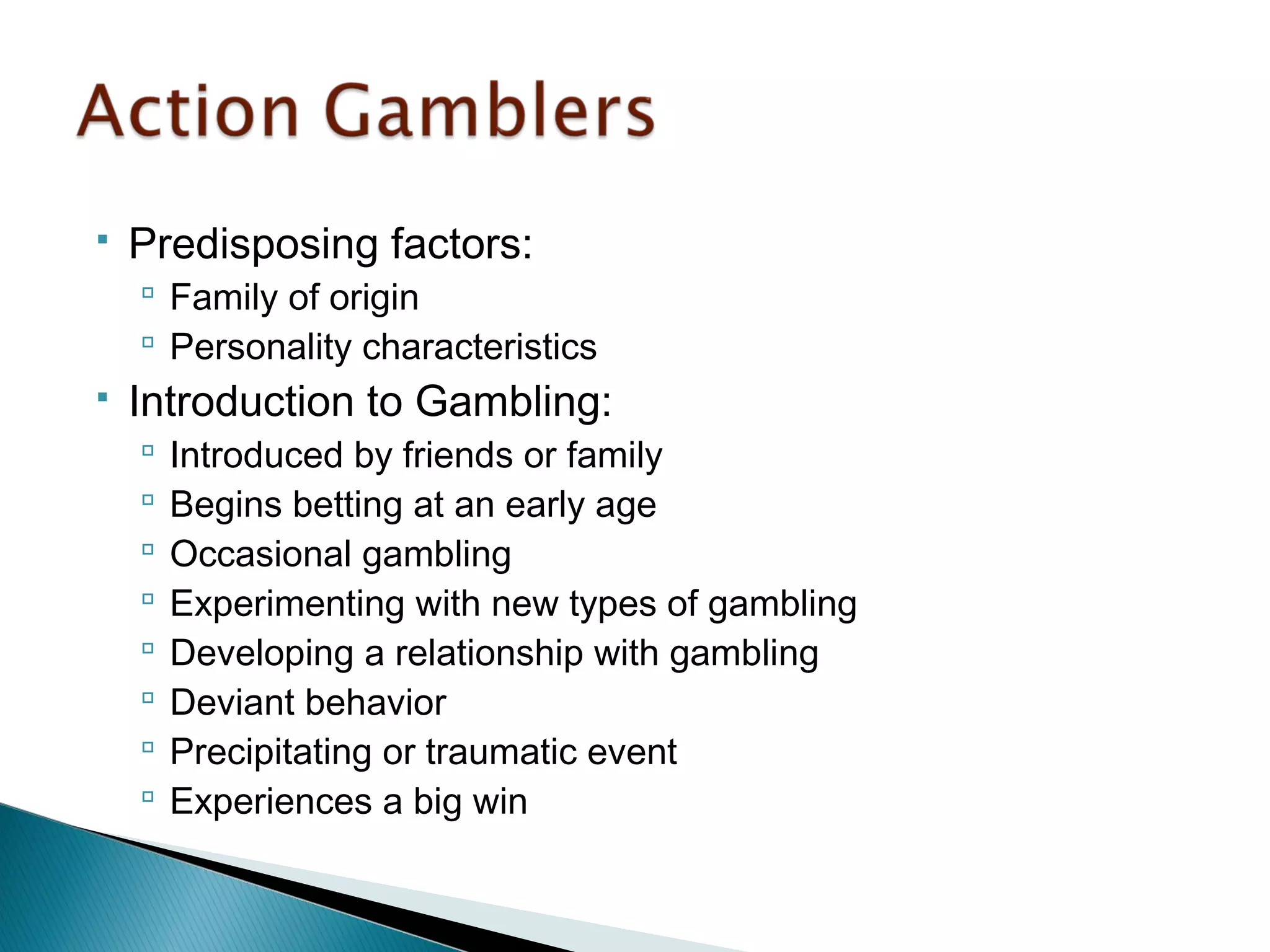
 Predisposing factors: 
 Family of origin 
 Personality characteristics 
 Introduction to Gambling: 
 Introduced by friends or family 
 Begins betting at an early age 
 Occasional gambling 
 Experimenting with new types of gambling 
 Developing a relationship with gambling 
 Deviant behavior 
 Precipitating or traumatic event 
 Experiences a big win
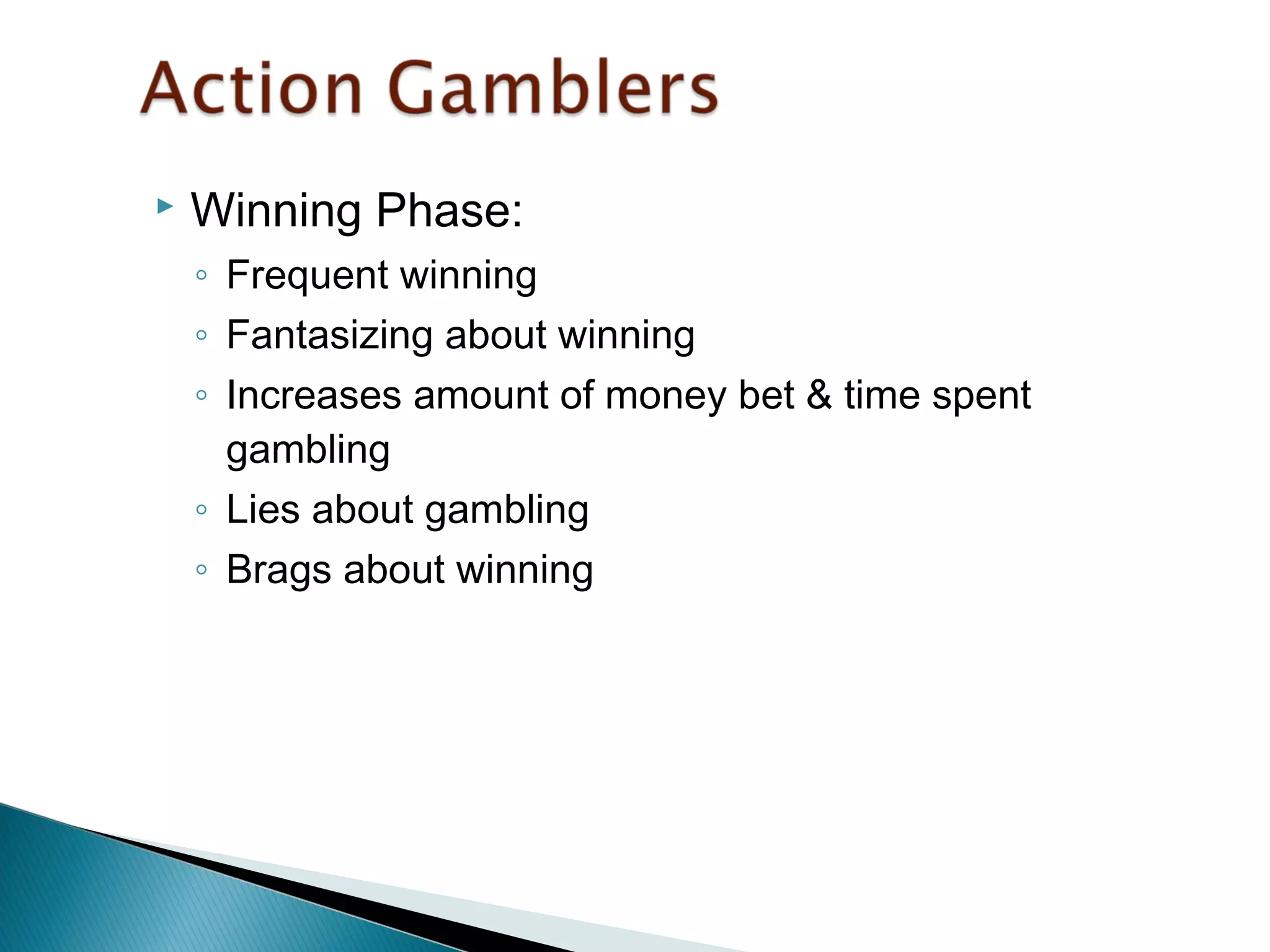
 Winning Phase: 
◦ Frequent winning 
◦ Fantasizing about winning 
◦ Increases amount of money bet & time spent 
gambling 
◦ Lies about gambling 
◦ Brags about winning
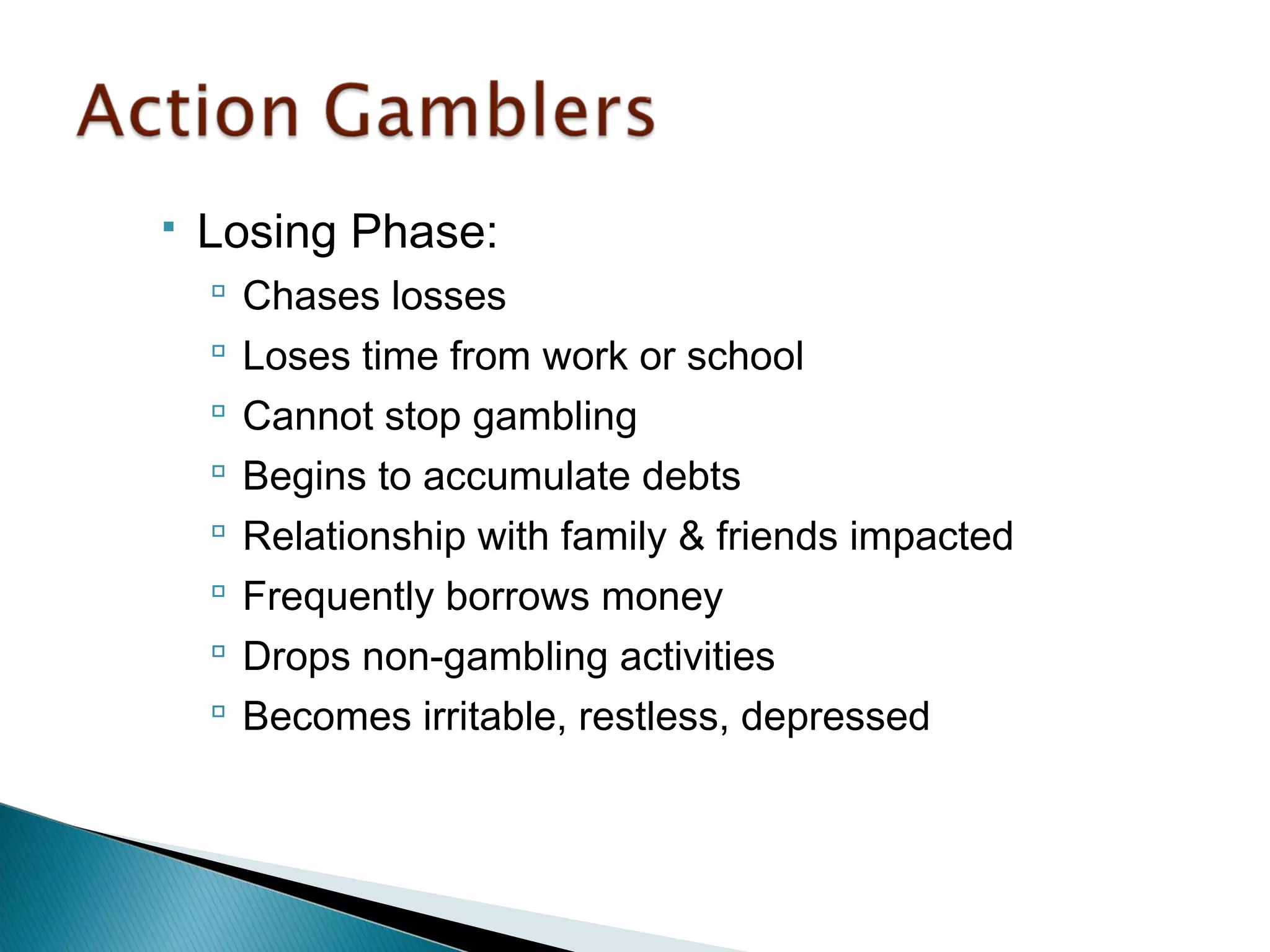
 Losing Phase: 
 Chases losses 
 Loses time from work or school 
 Cannot stop gambling 
 Begins to accumulate debts 
 Relationship with family & friends impacted 
 Frequently borrows money 
 Drops non-gambling activities 
 Becomes irritable, restless, depressed
 Desperation Phase: 
 Unable to pay debts 
 Sells possessions or family valuables 
 Increases drug/alcohol use 
 Thoughts of committing crimes to finance gambling 
 Loss of job or drops out of school 
 Withdraws from family & friends 
 Blames others 
 Shame, guilt, despair 
 Thoughts of or attempts at suicide 
 Emotional, physical, financial breakdown.
 Often begins when a recreational gambler wins big. 
 Predominantly male, view gambling as a skill to be learned 
& as a desirable way to make a living without the drudgery 
of employment 
 Experience an unequaled rush of sensation; feel powerful 
& special, adrenaline rush; enjoy recognition & status 
 Tend to play games requiring skill like black jack, craps, or 
poker; or a handicapping sporting event (like racing).
 Often describe a system they have 
 Generally much more competitive personalities 
 Like to be perceived as a high-roller, respected & 
admired, viewed as talented and skilled 
 Stimulated by overcoming the odds – even purposely 
take irrational risks to provide more stimulation that 
comes from digging out of a hole
 Compulsive Activity 
 Loss of Control 
 Continued Use Despite Adverse Consequences
 Stein, Hollander, & Liebowitz (1993) define compulsive 
gambling as “a conflict between a gambler’s stated 
intention, such as to not gamble, or to not gamble more 
than X amount, and the actual behavior, which violates 
the intention.” 
 May experience ‘fugue-like’ states where they “find 
themselves engaging in unplanned, spontaneous 
gambling activity” (Chamberlain, 2004, p. 135). 
 Triggers: internal & external
 The Chase (1984) – the more they lose the more they gamble – 
chasing losses 
 Double Down: double each bet they make following a loss with the 
intention of winning the bet that will eliminate the loss. 
 Downward spiral of loss of more than intended and continuing to 
gamble to try to win back the losses. 
 Gambling binges frequently end in exhaustion, disoriented, & an 
overwhelming sense of despair and depression that is 
unavoidable. 
 Reports of being overpowered by the impulse to gamble 
 Increasing pervasiveness of gambling in a person’s life to the point 
that all activities center around gambling.
 Mental health consequences include anxiety, 
depression, substance abuse, loss of a sense of self, 
loss of hope, feelings of shame & embarrassment, fear 
of consequences, suicidal ideation & attempts. 
 Financial consequences, job loss 
 Relationship issues: abandonment of family members; 
wives of compulsive gamblers are 4 times more likely to 
commit suicide than the general population (Lesieur, 
1993); miss family commitments; irritability, 
defensiveness, verbal and physical violence.
 “The risk for self-destructive behavior is higher [in 
gambling] than with any other addiction” 
(Chamberlain, 2004). 
 The longer they are able to hide the gambling, the 
more problematic it becomes. There are no obvious 
signs of intoxication, like substance dependence. 
 Gambling is non-linear in it’s consequences (may 
have a win as they are going through a downward 
spiral, where substance addiction consequences 
generally progressively get worse.)
 CBT 
◦ Abstinence or 
◦ Harm reduction 
 MI 
 12 Step
 4 Strategies: 
◦ Cognitive Restructuring 
◦ Developing Problem-Solving Skills (alternative responses to stress) 
◦ Social Skills Training 
◦ Relapse Prevention (identify, avoid, and/or cope with High Risk 
Factors (HRFs) 
 CBT Research Studies: 
◦ * Many studies compare CBT intervention with wait list or Gamblers 
Anonymous, which are both non-treatment. So it’s difficult to discern 
whether these studies are only indicating that treatment is better than 
no treatment. 
◦ Tend to be short-term follow up 
◦ Placebo effect is high
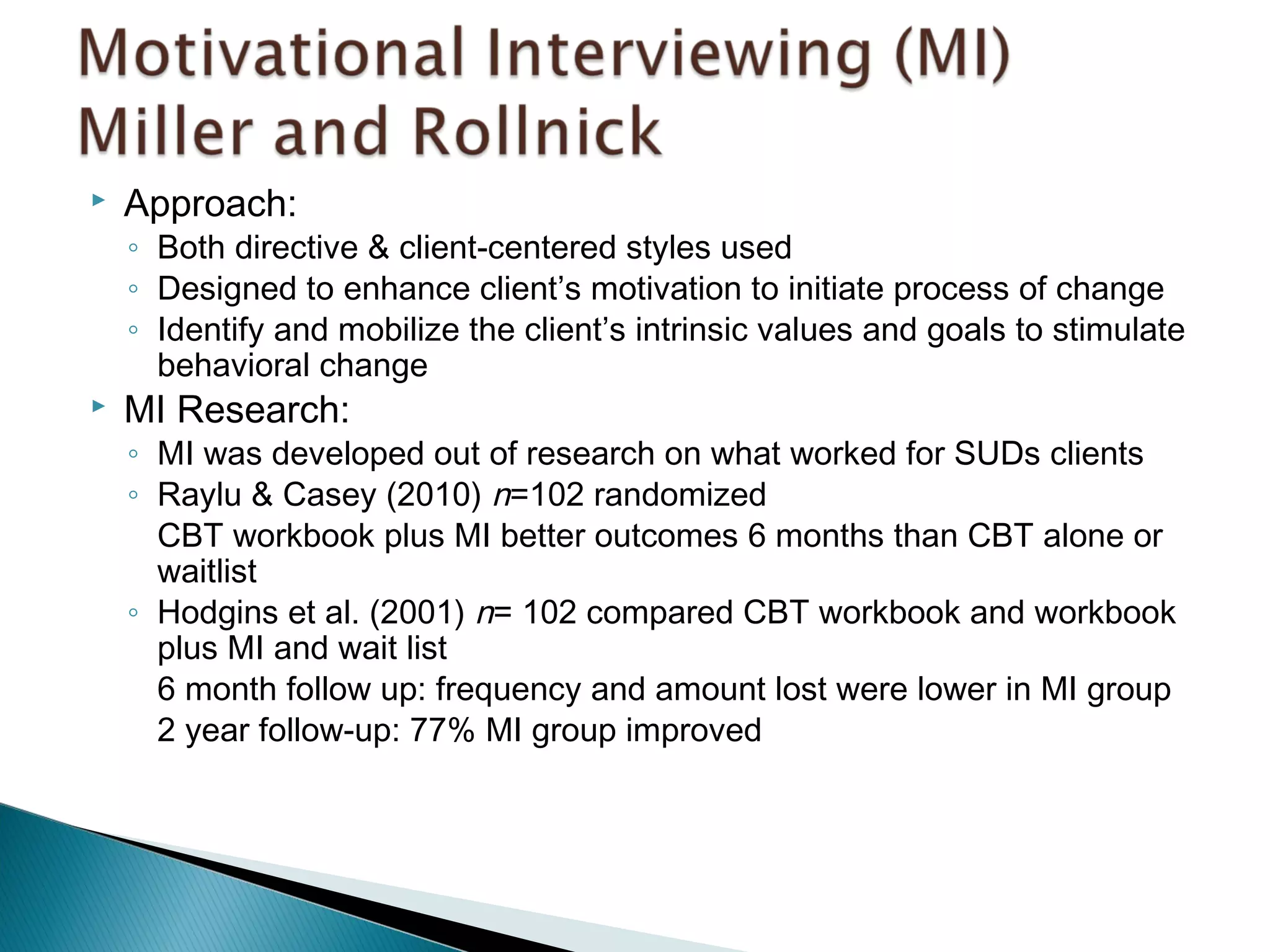
 Approach: 
◦ Both directive & client-centered styles used 
◦ Designed to enhance client’s motivation to initiate process of change 
◦ Identify and mobilize the client’s intrinsic values and goals to stimulate 
behavioral change 
 MI Research: 
◦ MI was developed out of research on what worked for SUDs clients 
◦ Raylu & Casey (2010) n=102 randomized 
CBT workbook plus MI better outcomes 6 months than CBT alone or 
waitlist 
◦ Hodgins et al. (2001) n= 102 compared CBT workbook and workbook 
plus MI and wait list 
6 month follow up: frequency and amount lost were lower in MI group 
2 year follow-up: 77% MI group improved
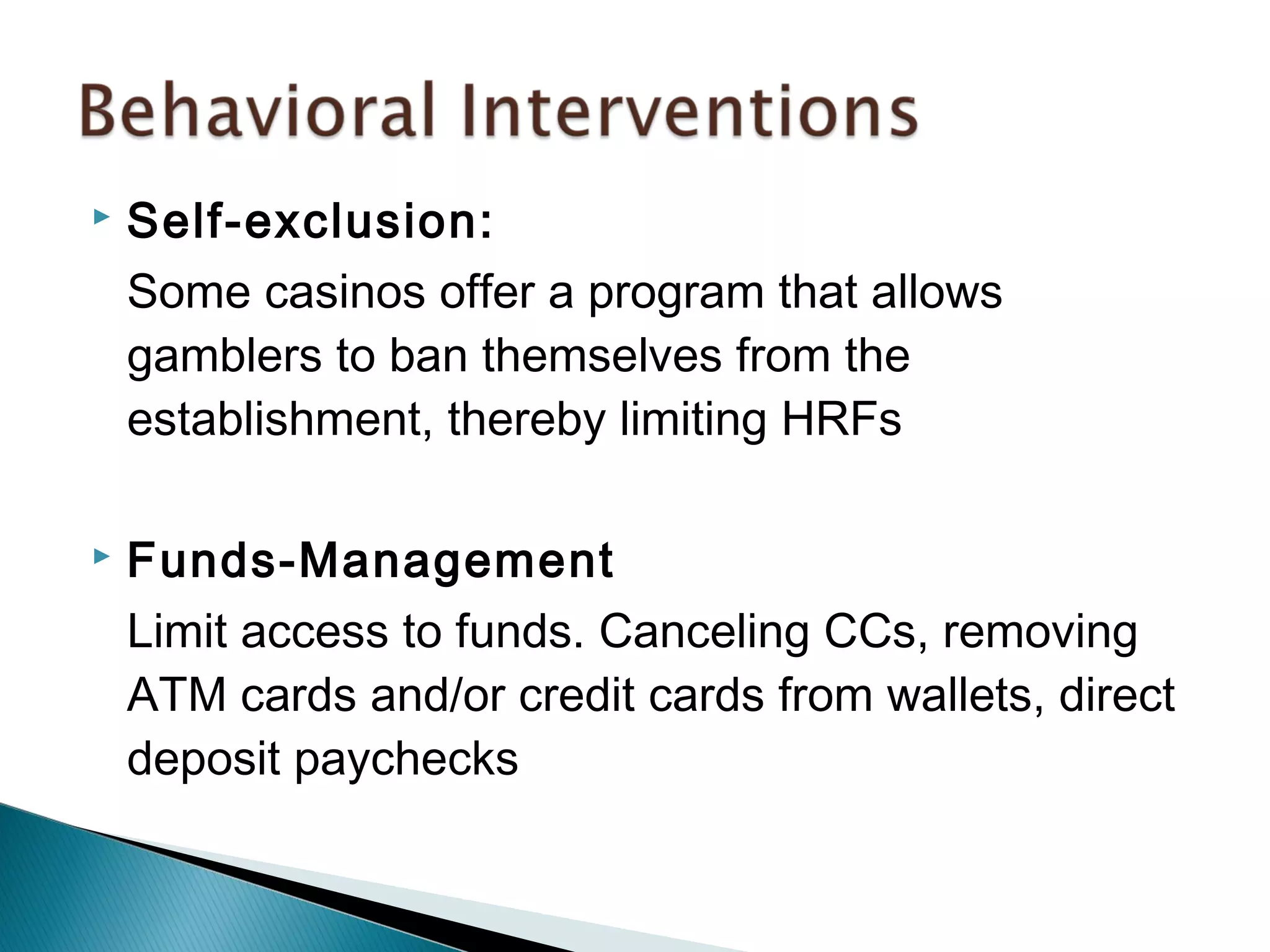
 Self-exclusion: 
Some casinos offer a program that allows 
gamblers to ban themselves from the 
establishment, thereby limiting HRFs 
 Funds-Management 
Limit access to funds. Canceling CCs, removing 
ATM cards and/or credit cards from wallets, direct 
deposit paychecks
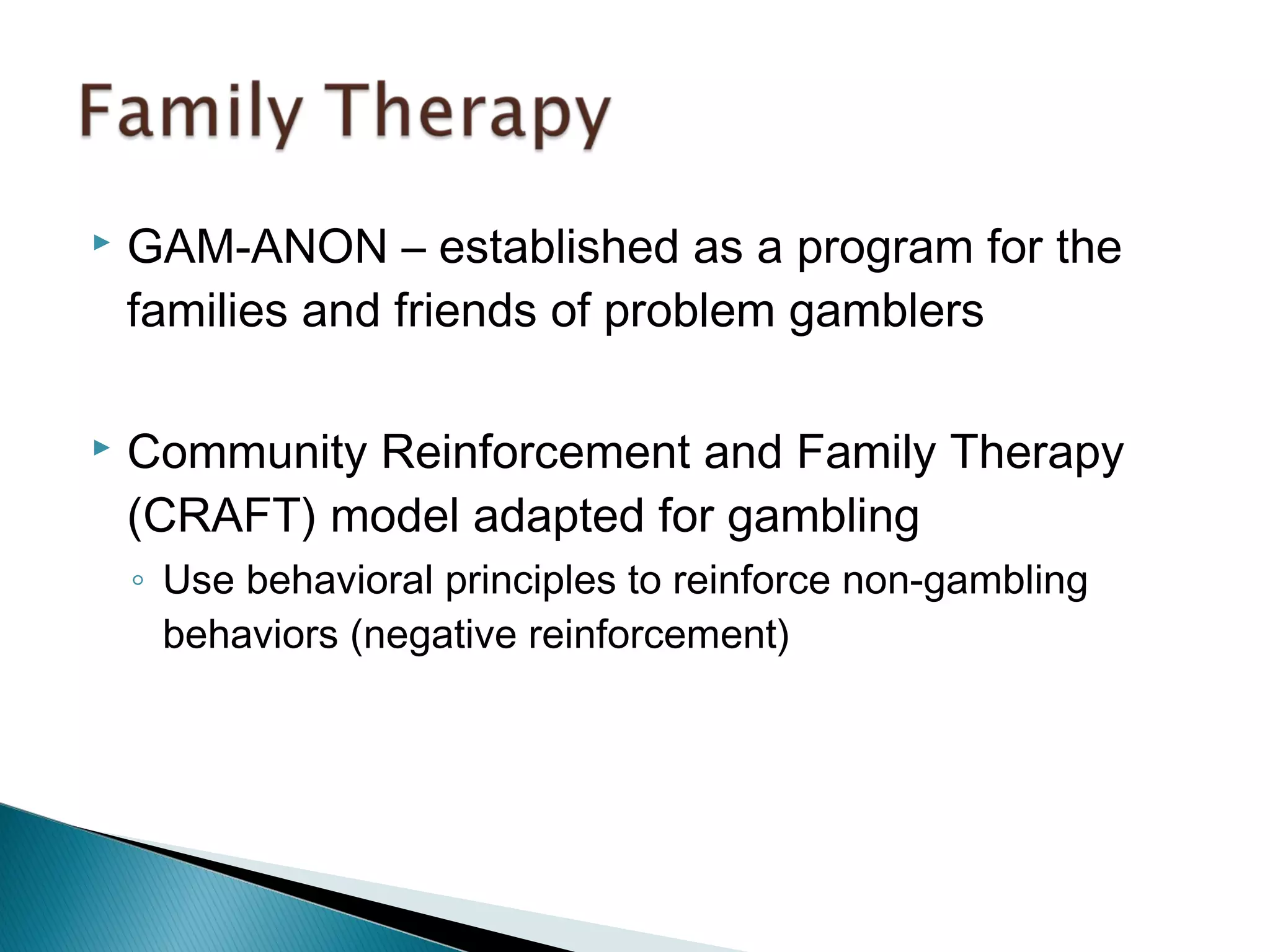
 GAM-ANON – established as a program for the 
families and friends of problem gamblers 
 Community Reinforcement and Family Therapy 
(CRAFT) model adapted for gambling 
◦ Use behavioral principles to reinforce non-gambling 
behaviors (negative reinforcement)
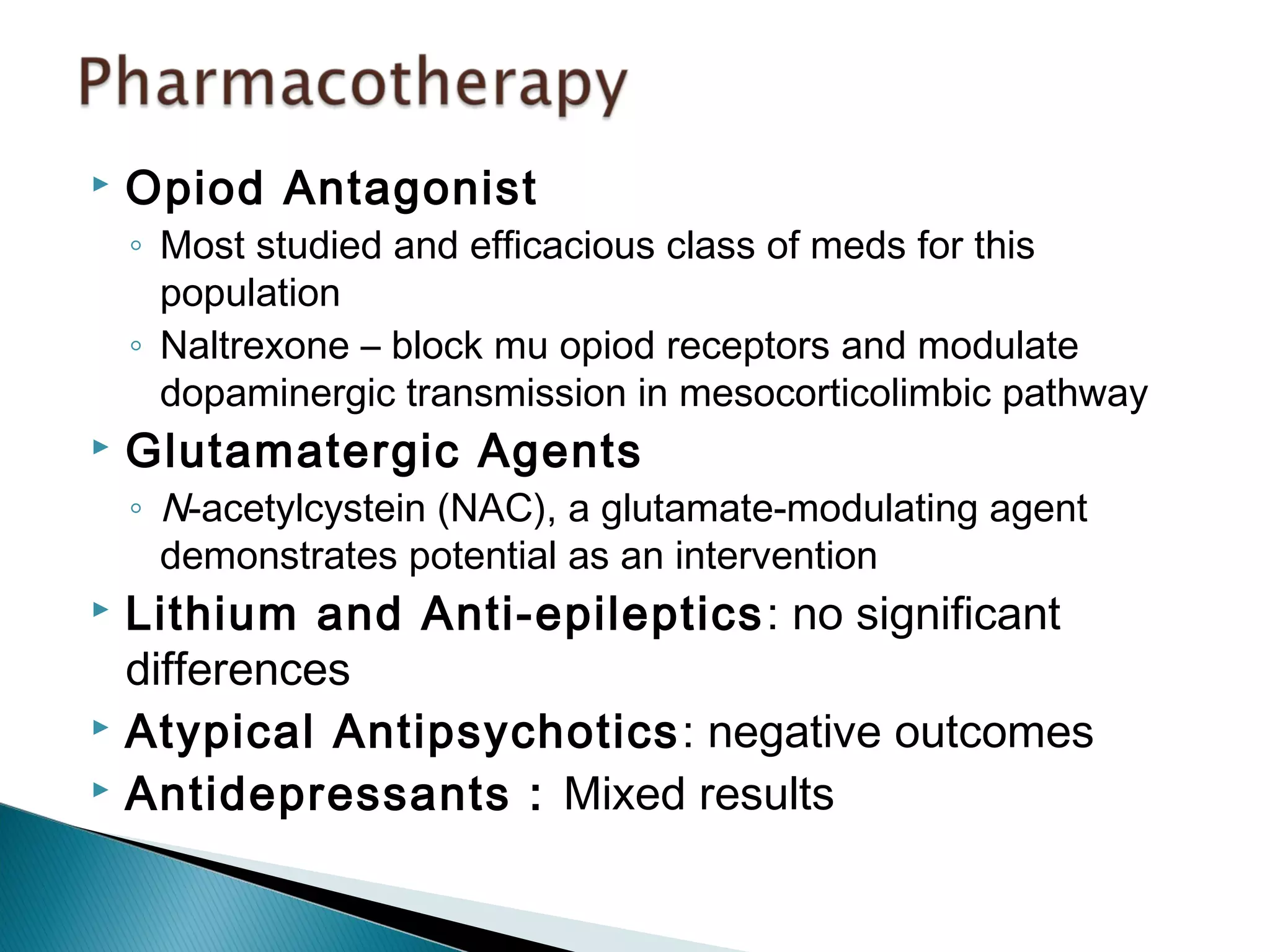
 Opiod Antagonist 
◦ Most studied and efficacious class of meds for this 
population 
◦ Naltrexone – block mu opiod receptors and modulate 
dopaminergic transmission in mesocorticolimbic pathway 
 Glutamatergic Agents 
◦ N-acetylcystein (NAC), a glutamate-modulating agent 
demonstrates potential as an intervention 
 Lithium and Anti-epileptics: no significant 
differences 
 Atypical Antipsychotics: negative outcomes 
 Antidepressants : Mixed results
 Journal of Addiction and Offender Counseling 
 Journal of Gambling Studies (Springer publishes) 
 Gamblers Anonymous 
http://www.gamblersanonymous.org/ga/ 
 24 hour confidential National Gambling Helpline: 
1-800-522-4700
 American Psychiatric Association . (2013). Diagnostic and statistical manual of mental disorders (5th ed.). 
Washington, D.C.: APA. 
 Grant, J. E., & Odlaug, B. L. (2014). Diagnosis and treatment of gambling disorder. In Behavioral addictions: 
Criteria, Evidence, and Treatment. K. P. Rosenberg & L. C. Feder (Eds.). Boston, MA: Elesvier.

Gambling use disorder process addictions

  • 1.
    Leigh Falls Holman,Ph.D., LPC-S, RPTS, NCC, CSC President-Elect, International Association of Addiction and Offender Counselors (IAAOC)
  • 2.
     “To playgames of chance for money or other rewards” (Cambridge International Dictionary, 1996).  “Any activity that has an uncertain outcome and involves risking something of value with the hope of increasing one’s wealth, status, or security” (Chamberlain, 2004, p. 129).
  • 3.
     “Maladaptive formof gambling behavior associated with impaired functioning, reduced quality of life, and high rates of bankruptcy and divorce” (Grant & Odlaug, 2014).  “Gambling behavior that causes disruptions in any major area of a persons life” (National Council on Problem Gambling, 2000).  The compulsion of gambling increasingly takes over an individual’s resources (time, money, energy etc.) and intrapsychic life (thoughts & dreams).
  • 4.
    Symptoms of BehaviorAlcohol & Other Drugs Compulsive Gambling Cravings Yes Yes Denial of problem’s severity or existence Yes Yes Disruption of families Yes Yes Effects on specific neurotransmitters Yes Unknown High relapse rate Yes Yes Loss of control Yes Yes Lying to support use/activity Yes Yes Preoccupation with use/activity Yes Yes Progressive disorder Yes Yes Tolerance developed Yes Yes Used as a means of escaping problems Yes Yes Withdrawal symptoms common Yes Yes
  • 5.
     Choice: ◦How easily it can be used with a client ◦ The type of info the assessment provides ◦ Appropriateness for use with a client  WASTE-Time Quick Screen: ◦ Paper and pencil or verbal ◦ Can be used in a general counseling setting if a client endorses behaviors consistent with problem gambling.
  • 6.
     Withdrawal ◦“What happens to you when you are unable to engage in _______?”  Adverse Consequences ◦ “What negative consequences resulted from _______?”  Inability to Stop ◦ “Have you attempted to cut back or stop ______ without success?”  Tolerance ◦ “Have you found it necessary to increase the amount or intensity of ______ to achieve the same effect?”  Escape ◦ “Do you _____ to escape from negative moods?”  Time Spent ◦ “Do you find yourself spending a lot of time preparing, engaging, and recovering from ______?”  Time Wasted ◦ “Have you spent more time and/or resources on _____ than you intended?”
  • 7.
     Screening instrument  20 item  Self-report  Lifetime gambling activity or Last 3 months  Score ≥ 5 indicates possible problem & need for further assessment  http://www.addictionrecov.org/southoak.aspx  SOGS-R for Adolescents:  http://www.southwestern.org/rc/wp-content/uploads/South- Oaks-Gambling-Screen-and-Score-Sheet-Adolescent.pdf  Spanish Version  http://www.ipgap.indiana.edu/images/documents/SOGS_span ishversion.pdf
  • 8.
     Brief clinicalscreening instrument  5-10 minute survey or interview – self-report  14 items (only 7 scored & weighted score)  Classifies Adults & Adolescents into 3 categories: ◦ Non-problem ◦ In Transition ◦ Pathological Gamblers  MAGS (published by Springer) http://link.springer.com/article/10.1007%2FBF02104901#page-2  MAGS copy: http://www.ncrg.org/sites/default/files/uploads/docs/monographs/mags.p df  Pathological gambling among adolescents: MAGS (n = 856 suburban Boston HS students) http://www.ncbi.nlm.nih.gov/pubmed/24234969  Correctly classified 96% of adolescent problem gamblers
  • 9.
     Can beaccessed online:  http://www.gamblersanonymous.org/ga/content/20 -questions  Score of ≥ 7 indicates problem gambling behavior  Don’t know specificity or sensitivity
  • 10.
     2 QuestionRule Out Tool: http://www.ncpgambling.org/files/NPGAW/Lie_Bet _Tool.PDF  Self-report
  • 11.
     Screening instrumentdesigned for use by general practitioner setting  Score ≥ 4 indicates possible problem gambling  NIH article: http://www.ncbi.nlm.nih.gov/pmc/articles/PMC307 6109/  PDF version of instrument: http://www.bpac.org.nz/BPJ/2010/June/docs/addic tion_eight_gambling_screen.pdf
  • 12.
     Change diagnosticcategory from Substance- Related Disorders to Substance Use and Addictive Disorders  The addition of Addictive Disorders indicate acceptance of process or behavioral addictions as a concept by the APA workgroup that worked on this category.
  • 13.
    Acknowledges behavioral processescan activate the reward system and produce behavioral symptoms similar to SUDS. Includes Gambling Use Disorder as a diagnosis in Section II under the Substance-Related and Addictive Disorders category. Includes Internet Gaming Disorder (p. 795) in Section III. Other process addictions must be categorized under other diagnostic categories such as Feeding and Eating Disorders, Impulse Control Disorders, Obsessive Compulsive Disorders, and Sexual Disorders or Paraphilias.
  • 14.
     Pre-occupation Tolerance  Denial  Progression  Withdrawal
  • 15.
    ◦ Clinically significantimpairment or distress ◦ 4 or more criteria in 12 month period  More money to achieve desired excitement (tolerance)  Restless or irritable when tries to cut down/stop (withdrawal)  Can’t control behavior (compulsion)  Preoccupied with gambling (obsession)  Gambles when feeling distressed (emotion regulation)  Lies to conceal extent of gambling  Impaired functioning  Relies on others to provide money to continue gambling ◦ Not better explained by a manic episode
  • 16.
     Episodic orPersistent  Remission: ◦ Early: 3-12 months ◦ Sustained:Over 1 year  Severity Level ◦ Mild: 4/5 Criteria (less in treatment) ◦ Moderate: 6/7 criteria ◦ Severe: 8/9 criteria
  • 17.
     Distorted Thinking: ◦ Denial ◦ Superstitions ◦ Sense of power & control over the outcome of chance events ◦ Overconfidence  “Some are impulsive, competitive, energetic, restless, and easily bored” (p. 587).
  • 18.
     “May beoverly concerned with the approval of others and may be generous to the point of extravagance when winning.”  “Others may be depressed and lonely, and they gamble when feeling helpless, guilty, or depressed.”  About 50% in treatment have suicidal ideation & about 17% have attempted suicide.
  • 19.
     Prevalence ◦Last 12 months .2%-.3% of the general population ◦ Lifetime prevalence rate gender & ethnicity Males: .6% Females: .2% African Am .9% Whites .4% Hispanics .3% ◦ More common among young & mid-life ◦ Risk & Prognostic Factors:  Temperament  Genetic  Course Modifiers
  • 20.
     Earlier onset: More common with males Often begin with family & friends Associated with impulsivity & substance abuse HS & college students who have the disorder may grow out of it Younger prefer sports betting  Older: Machine/bingo gambling more likely  Females: mid-late adult onset is typical more rapid development in females more likely than males to have depression, bipolar, & anxiety  Low rate of treatment seeking in general <10%, but more older onset females present for treatment than other populations  Frequency gambling can be more associated with the type of gambling than the severity of gambling. (scratch ticket vs. casino)  Amount of money isn’t necessarily an indicator of a gambling problem.
  • 21.
     Poor generalhealth & utilize medical services at a high rates ◦ Tachycardia & angina more common in GD population even when other substance use disorders are controlled for.  Jeopardize or loss of important relationships  Repeated lying to cover up the extent of gambling  May request money used for gambling or to pay off gambling debts  Employment/educational activities may be adversely impacted ◦ Absenteeism ◦ Poor work/school performance
  • 22.
     Differential Diagnosis: ◦ Non-disordered gambling ◦ Manic Episode ◦ Personality Disorders ◦ Other Medical Conditions (e.g. Parkinson’s meds)  Comorbidity ◦ Substance use disorders ◦ Depressive disorders ◦ Anxiety disorders ◦ Personality disorders
  • 23.
     Genetics: research“suggests that the possession of the dopamine D2A1 allele receptor gene may result in deficits in the dopamine reward pathways” (Ashley & Boehlke, p. 56).  Trauma History: Kausch et al. found 64.4%  Cognitive Distortions (next slide)  Accessibility: Gerstein et al. double risk if within 50 miles of a casino - controversial  Co-morbid SUDs, mood, ADHD  Criminal behavior, Bankruptcy  Suicidal Thinking
  • 24.
    Cogitive Distortion Example Gambler’s Fallacy Belief that completely random events (coin toss) are influenced by recent events Illusions of Control Superstitious behaviors where gamble believes s/he has a reliable means of manipulating the event outcome in his/her favor Magnification of Gambling Skills Exaggerated self-confidence Recall Bias Tendency to remember and overestimate wins while forgetting about, underestimating, or rationalizing losses.
  • 25.
    Level Refers to: 0 Never gambled 1 “Social” or “Recreational” gambling Gambling does not result in significant problems 2 Wagering resulting in some gambling-related problems At-Risk Gambling In-Transition Gambling Problem Gambling 3 Gambling associated with significant problems Meet diagnostic criteria for Gambling Use Disorder
  • 26.
    Phase Description Winning•Betting is fun, exciting, social, and a way to escape •Occasionally win large sums generally leading to betting larger amounts and spending more time gambling. Losing •Preoccupied with gambling •Needs to place larger bets more frequently •Losses increase but rationalized as a “loosing streak” •Begin to “chase” losses, lie about extent, and experience gambling-related difficulties. •Begin to make and break promises to self and others to quit gambling. Desperation •May experience health problems & relationships may deteriorate •Feelings of desperation & hopelessness ensue •Losses continue to mount •Fantasizes about winning •May steal, write bad checks, or commit other crimes to finance gambling Hopeless •No longer believes there is hope or help •Gives up •Suicidal ideation or attempts •Jail or prison becomes a possibility
  • 27.
    Gamblers seek differentemotional experiences through their gambling activity: ◦ Escape Gamblers: Gambling becomes a trance-like escape ◦ Action Gamblers: Gambling becomes a powerful stimulant
  • 28.
     Predisposing Factors:  Physical, emotional, or sexual abuse  Poor relationships  Losses  Values:  Denial of gambling as a problem  Maintain family trust is important  Gambling Habits:  Onset later in life  Faster progression of compulsive behavior  Seeking to escape from loneliness or boredom  Begins as a social activity and entertainment  Participates mainly in games of chance  Fewer big-win experiences
  • 29.
     Emotional Consequences:  Becomes emotionally dependent on gambling  Preoccupied with gambling  Depression  Secretive about excess gambling  Guilt about both financial losses and failure to meet standards of behavior  Guild over lost time with family  Shame related to dishonesty  Fears of being revealed and disgraced  Financial Consequences:  Loss of household money  Credit card problems  Use of money from family savings or accounts  Sale of valued family possessions  Recovery Issues:  Denial that gambling is a problem  Frequently doesn’t want to stop gambling  Partner may not intervene  Family less supportive in getting help  Child care  Male dominated treatment and recovery services
  • 30.
     Predisposing factors:  Family of origin  Personality characteristics  Introduction to Gambling:  Introduced by friends or family  Begins betting at an early age  Occasional gambling  Experimenting with new types of gambling  Developing a relationship with gambling  Deviant behavior  Precipitating or traumatic event  Experiences a big win
  • 31.
     Winning Phase: ◦ Frequent winning ◦ Fantasizing about winning ◦ Increases amount of money bet & time spent gambling ◦ Lies about gambling ◦ Brags about winning
  • 32.
     Losing Phase:  Chases losses  Loses time from work or school  Cannot stop gambling  Begins to accumulate debts  Relationship with family & friends impacted  Frequently borrows money  Drops non-gambling activities  Becomes irritable, restless, depressed
  • 33.
     Desperation Phase:  Unable to pay debts  Sells possessions or family valuables  Increases drug/alcohol use  Thoughts of committing crimes to finance gambling  Loss of job or drops out of school  Withdraws from family & friends  Blames others  Shame, guilt, despair  Thoughts of or attempts at suicide  Emotional, physical, financial breakdown.
  • 34.
     Often beginswhen a recreational gambler wins big.  Predominantly male, view gambling as a skill to be learned & as a desirable way to make a living without the drudgery of employment  Experience an unequaled rush of sensation; feel powerful & special, adrenaline rush; enjoy recognition & status  Tend to play games requiring skill like black jack, craps, or poker; or a handicapping sporting event (like racing).
  • 35.
     Often describea system they have  Generally much more competitive personalities  Like to be perceived as a high-roller, respected & admired, viewed as talented and skilled  Stimulated by overcoming the odds – even purposely take irrational risks to provide more stimulation that comes from digging out of a hole
  • 36.
     Compulsive Activity  Loss of Control  Continued Use Despite Adverse Consequences
  • 37.
     Stein, Hollander,& Liebowitz (1993) define compulsive gambling as “a conflict between a gambler’s stated intention, such as to not gamble, or to not gamble more than X amount, and the actual behavior, which violates the intention.”  May experience ‘fugue-like’ states where they “find themselves engaging in unplanned, spontaneous gambling activity” (Chamberlain, 2004, p. 135).  Triggers: internal & external
  • 38.
     The Chase(1984) – the more they lose the more they gamble – chasing losses  Double Down: double each bet they make following a loss with the intention of winning the bet that will eliminate the loss.  Downward spiral of loss of more than intended and continuing to gamble to try to win back the losses.  Gambling binges frequently end in exhaustion, disoriented, & an overwhelming sense of despair and depression that is unavoidable.  Reports of being overpowered by the impulse to gamble  Increasing pervasiveness of gambling in a person’s life to the point that all activities center around gambling.
  • 39.
     Mental healthconsequences include anxiety, depression, substance abuse, loss of a sense of self, loss of hope, feelings of shame & embarrassment, fear of consequences, suicidal ideation & attempts.  Financial consequences, job loss  Relationship issues: abandonment of family members; wives of compulsive gamblers are 4 times more likely to commit suicide than the general population (Lesieur, 1993); miss family commitments; irritability, defensiveness, verbal and physical violence.
  • 40.
     “The riskfor self-destructive behavior is higher [in gambling] than with any other addiction” (Chamberlain, 2004).  The longer they are able to hide the gambling, the more problematic it becomes. There are no obvious signs of intoxication, like substance dependence.  Gambling is non-linear in it’s consequences (may have a win as they are going through a downward spiral, where substance addiction consequences generally progressively get worse.)
  • 41.
     CBT ◦Abstinence or ◦ Harm reduction  MI  12 Step
  • 42.
     4 Strategies: ◦ Cognitive Restructuring ◦ Developing Problem-Solving Skills (alternative responses to stress) ◦ Social Skills Training ◦ Relapse Prevention (identify, avoid, and/or cope with High Risk Factors (HRFs)  CBT Research Studies: ◦ * Many studies compare CBT intervention with wait list or Gamblers Anonymous, which are both non-treatment. So it’s difficult to discern whether these studies are only indicating that treatment is better than no treatment. ◦ Tend to be short-term follow up ◦ Placebo effect is high
  • 43.
     Approach: ◦Both directive & client-centered styles used ◦ Designed to enhance client’s motivation to initiate process of change ◦ Identify and mobilize the client’s intrinsic values and goals to stimulate behavioral change  MI Research: ◦ MI was developed out of research on what worked for SUDs clients ◦ Raylu & Casey (2010) n=102 randomized CBT workbook plus MI better outcomes 6 months than CBT alone or waitlist ◦ Hodgins et al. (2001) n= 102 compared CBT workbook and workbook plus MI and wait list 6 month follow up: frequency and amount lost were lower in MI group 2 year follow-up: 77% MI group improved
  • 44.
     Self-exclusion: Somecasinos offer a program that allows gamblers to ban themselves from the establishment, thereby limiting HRFs  Funds-Management Limit access to funds. Canceling CCs, removing ATM cards and/or credit cards from wallets, direct deposit paychecks
  • 45.
     GAM-ANON –established as a program for the families and friends of problem gamblers  Community Reinforcement and Family Therapy (CRAFT) model adapted for gambling ◦ Use behavioral principles to reinforce non-gambling behaviors (negative reinforcement)
  • 46.
     Opiod Antagonist ◦ Most studied and efficacious class of meds for this population ◦ Naltrexone – block mu opiod receptors and modulate dopaminergic transmission in mesocorticolimbic pathway  Glutamatergic Agents ◦ N-acetylcystein (NAC), a glutamate-modulating agent demonstrates potential as an intervention  Lithium and Anti-epileptics: no significant differences  Atypical Antipsychotics: negative outcomes  Antidepressants : Mixed results
  • 47.
     Journal ofAddiction and Offender Counseling  Journal of Gambling Studies (Springer publishes)  Gamblers Anonymous http://www.gamblersanonymous.org/ga/  24 hour confidential National Gambling Helpline: 1-800-522-4700
  • 48.
     American PsychiatricAssociation . (2013). Diagnostic and statistical manual of mental disorders (5th ed.). Washington, D.C.: APA.  Grant, J. E., & Odlaug, B. L. (2014). Diagnosis and treatment of gambling disorder. In Behavioral addictions: Criteria, Evidence, and Treatment. K. P. Rosenberg & L. C. Feder (Eds.). Boston, MA: Elesvier.

Editor's Notes

  • #7 Regina
  • #13 Leigh
  • #14 Leigh
  • #16 Gambling Disorder: Persistent and recurrent problematic gambling behavior leading to clinically significant impairment or distress, as indicated by the individual exhibiting four (or more) of the following in a 12-month period: Needs to gamble with increasing amounts of money in order to achieve the desired excitement. (tolerance) Is restless or irritable when attempting to cut down or stop gambling. (withdrawal) Has made repeated unsuccessful efforts to control, cut back, or stop gambling. (Loss of control/compulsion) Is often preoccupied with gambling (e.g., having persistent thoughts of relieving past gambling experiences, handicapping or planning the next venture, thinking of ways to get money with which to gamble). (obsession) Often gambles when feeling distressed (e.g., helpless, guilty, anxious, depressed). (emotion regulation) Impaired Functioning 6. After losing money gambling, often returns another day to get even (“chasing” one’s losses). 7. Lies to conceal the extent of involvement with gambling. (Criteria 8 and 9 are least endorsed – usually most severe cases) 8. Has jeopardized or lost a significant relationship, job, or educational or career opportunity because of gambling. 9. Relies on others to provide money to relieve desperate financial situations caused by gambling. B. The Gambling Behavior is not better explained by a manic episode.
  • #17 Episodic: Meets Diagnostic Criteria at more than one time point Symptoms subsiding between episodes for several months Or Persistent: Continuous symptoms for multiple years In Early Remission After diagnosis, none of the criteria have been met between 3 and 12 months or In Sustained Remission After diagnosis, none of the criteria met 1 year or longer Severity Level Mild: 4-5 criteria met Moderate:6/7 criteria met Severe:8/9 criteria met “Those presenting for treatment most often are at the moderate to severe level of severity” (p. 586).
  • #20 Prevalence – Last 12 months .2%-.3% in general population. Lifetime prevalence rate Males: .6% Females: .2% African Am.9% Whites.4% Hispanics.3% More common among young &amp; mid-life Risk &amp; Prognostic Factors Temperamental: Gambling beginning in childhood or early adolescence is associated with increased rates of gambling disorder. GD appears to aggregate with antisocial PD, depressive &amp; bipolar disorders, and other substance use disorders (particularly alcohol) Genetic Can aggregate in families related to both genetic &amp; environmental factors More frequent in monozygotic than dizygotic twins More frequent among first degree relatives of individuals with moderate-severe alcohol use disorder
  • #21 Development Earlier onset: more common with males Youth – often begin with family &amp; friends associated with impulsivity &amp; substance abuse HS &amp; college students who have the disorder may grow out of it Younger prefer sports betting OlderMachine/bingo gambling more likely Females:mid-late adult onset is typical more rapid development in females more likely than males to have depression, bipolar, and anxiety Low rate of treatment seeking in general &amp;lt;10%, but more older onset females present for treatment than other populations Course Modifiers Many individuals are likely to resolve gambling disorder problems over time Strong predictor of future gambling problems is prior gambling problems Frequency gambling can be more associated with the type of gambling than the severity of gambling. (scratch ticket vs. casino) Amount of money isn’t necessarily an indicator of a gambling problem.
  • #23 Differential Diagnosis: Non-disordered Gambling: Professional gambling – risks are limited &amp; discipline is central Social gambling typically occurs with friends or colleagues &amp; lasts for a limited period of time, with acceptable losses. Manic Episode: Loss of judgment associated with excessive gambling may occur during a manic episode. Only give GD if the behavior isn’t better explained by mania. Similarly, a person with GD may exhibit behavior consistent with mania when gambling but does not exhibit this behavior away from gambling. Personality Disorders: Antisocial PD &amp; some other personality disorders may be more prone to GD. Full criteria for both disorders must be met in order to diagnose both. Other Medical Conditions: Determine if dopaminergic medications (i.e. for Parkinson’s disease) are resulting in experiencing urges to gamble. – don’t give GD if so Comorbidity: Poor general health Tachycardia &amp; angina more common in GD population even when other substance use disorders are controlled for. Substance us disorders Depressive disorders Anxiety disorders Personality disorders