Lecture 6: Vicarious
traumatization and Self-care
in treating complex
traumatic stress disorders
Complex Casework
Kevin Standish
1
© Beth Hudnall Stamm, 2009. www.ProQOL.org© Beth Hudnall Stamm, 2009. www.ProQOL.org
Learning Objectives
Define the terms related to Vicarious trauma:
Burnout /Countertransference/Projective
identification/Vicarious Trauma/Compassion
fatigue
Discuss trauma, it’s symptoms, impact on
helpers
Discuss self care and coping skills to manage VT
© Beth Hudnall Stamm, 2009. www.ProQOL.org© Beth Hudnall Stamm, 2009. www.ProQOL.org
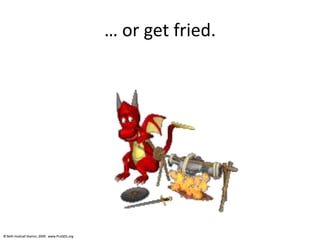
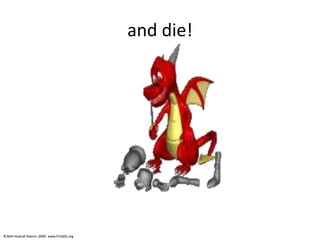
The dragons of stress, burnout and
vicarious trauma may be attacking…
Take Dragon Fighting Lessons
© Beth Hudnall Stamm, 2009. www.ProQOL.org© Beth Hudnall Stamm, 2009. www.ProQOL.org
… or get fried.
© Beth Hudnall Stamm, 2009. www.ProQOL.org© Beth Hudnall Stamm, 2009. www.ProQOL.org
and die!
© Beth Hudnall Stamm, 2009. www.ProQOL.org© Beth Hudnall Stamm, 2009. www.ProQOL.org
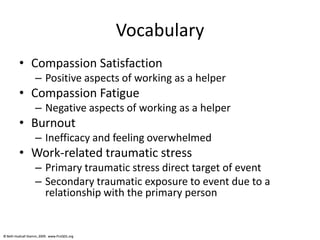
How Our Work Affects Us
What are 3 negative reactions/effects from your
work you have experienced?
© Beth Hudnall Stamm, 2009. www.ProQOL.org
For more information see www.proqol.org
This work changes us…
© Beth Hudnall Stamm, 2009. www.ProQOL.org© Beth Hudnall Stamm, 2009. www.ProQOL.org
Vocabulary
• Compassion Satisfaction
– Positive aspects of working as a helper
• Compassion Fatigue
– Negative aspects of working as a helper
• Burnout
– Inefficacy and feeling overwhelmed
• Work-related traumatic stress
– Primary traumatic stress direct target of event
– Secondary traumatic exposure to event due to a
relationship with the primary person
© Beth Hudnall Stamm, 2009. www.ProQOL.org© Beth Hudnall Stamm, 2009. www.ProQOL.org
Definitions:
• Vicarious Trauma- cumulative transformative effect upon the
professional who is working with survivors of traumatic life
events
• Secondary Trauma- the emotional & psychological effects
experienced through vicarious exposure to the details of the
traumatic experiences of others
• Compassion Fatigue- the emotional residue of exposure to
working with those suffering from the consequences of
traumatic events.
• Burnout- associated with work stress; feelings resulting as
things that inspire passion/enthusiasm are stripped away, and
tedious/unpleasant things crowd in.
© Beth Hudnall Stamm, 2009. www.ProQOL.org© Beth Hudnall Stamm, 2009. www.ProQOL.org
• “The effects of vicarious trauma are
cumulative and build upon memories
obtained through listening to the stories of
one inhumane act of cruelty after another.
This creates a permanent, subtle or marked
change in the personal, spiritual and
professional outlook of the counselor or
advocate (Richardson, 2001).”
© Beth Hudnall Stamm, 2009. www.ProQOL.org© Beth Hudnall Stamm, 2009. www.ProQOL.org
• “Experiencing and listening to the pain, hurt,
difficulties, frustrations, and trauma of others
gets transferred to the victim service provider.
. .Vicarious trauma isn’t an issue of ‘If’ but
rather ‘When’ (COVA, 2005).”
© Beth Hudnall Stamm, 2009. www.ProQOL.org© Beth Hudnall Stamm, 2009. www.ProQOL.org
Vicarious Trauma and related
concepts
 Vicarious traumatization (VT)
 Secondary post traumatic stress reaction
 Secondary traumatic stress
 Secondary traumatic stress disorder
 Compassion fatigue
 Compassion stress
 Soul sadness
 Empathic strain
 Contact victimization
It’s not a matter of “If” it’s a matter of “When”
© Beth Hudnall Stamm, 2009. www.ProQOL.org© Beth Hudnall Stamm, 2009. www.ProQOL.org
Vicarious Trauma
“There is a soul weariness that comes with
caring. From daily doing business with the
handiwork of fear. Sometimes it lives at the
edges of one’s life, brushing against hope and
barely making its presence known. At other
times, it comes crashing in, overtaking one with
its vivid images of another’s terror with its
profound demands for attention; nightmares,
strange fears, and generalized hopelessness.”
B. Hudnall Stamm, Ph.D.
© Beth Hudnall Stamm, 2009. www.ProQOL.org© Beth Hudnall Stamm, 2009. www.ProQOL.org
Definitions
Burnout:
 Related to feeling of being overloaded
 Work stress
 Joy of work is lost
 Can occur in any professional setting
 Progresses gradually as a result of emotional
exhaustion, cynicism, and feelings of inefficacy.
 Does NOT lead to changes in trust, feelings of
control, issues of intimacy, safety concerns, and
intrusive traumatic imagery that are foundational
to Vicarious Trauma.
© Beth Hudnall Stamm, 2009. www.ProQOL.org© Beth Hudnall Stamm, 2009. www.ProQOL.org
Countertransference
• The process of seeing oneself in the patient, of over-
identifying with the patient, or of meeting one’s own needs
through the patient.
• Counter-transference occurs when the clinician begins to
project his or her own unresolved conflicts onto the patient.
• Good clinicians are those who can tune into their own
countertransference feelings and quickly assess whether it is
coming from them or the patient. This is one of the reasons it
is so important for clinicians to do their own work.
© Beth Hudnall Stamm, 2009. www.ProQOL.org© Beth Hudnall Stamm, 2009. www.ProQOL.org
Projective Identification
The result of developmental impingement that occurred before
the patient had acquired language (pre-verbal). Since patient
has no language to communicate their internal struggles, they
induce the feelings in another in order to be understood.
• Both a defense mechanism and a mode of communication.
• As a defense mechanism… it creates a psychological distance
from unwanted (often frightening) aspects of the self.
• As a mode of communication… patient’s own feelings are
induced in another person (therapist/helper), creating a sense
of being understood by the other person.
© Beth Hudnall Stamm, 2009. www.ProQOL.org© Beth Hudnall Stamm, 2009. www.ProQOL.org
Vicarious Trauma
• Vicarious trauma is the process of change that
happens because you care about other people
who have been hurt, and feel committed or
responsible to help them. Over time this
process can lead to changes in your
psychological, physical and spiritual well-
being. (Headington Institute)
© Beth Hudnall Stamm, 2009. www.ProQOL.org© Beth Hudnall Stamm, 2009. www.ProQOL.org
Vicarious Trauma
• Cumulative –happens over time as you work
with survivors of trauma, disasters, people
who are struggling.
• Process of change is ongoing – this is hopeful
as it provides opportunities for us to recognize
the impact the work has on your lives early
and to develop strategies to protect and care
for ourselves.
© Beth Hudnall Stamm, 2009. www.ProQOL.org© Beth Hudnall Stamm, 2009. www.ProQOL.org
Vicarious Trauma
Empathy
• When you identify with the pain of people
who have endured terrible things, you bring
their grief, fear, anger, and despair into your
own awareness and experience.
– What sort of problems or people do you find it
easy (or difficult) to empathize with?
– What are some ways that caring about people
who have been hurt affects you?
© Beth Hudnall Stamm, 2009. www.ProQOL.org© Beth Hudnall Stamm, 2009. www.ProQOL.org
Vicarious Trauma
Feeling committed or responsible to help
 Your commitment and sense of responsibility can
lead to high expectations and eventually contribute
to your feeling burdened, overwhelmed, and
hopeless/helpless.
 Can lead you to extend yourself beyond what is
reasonable for your own well-being or the best
long-term interests of your patients.
 How does your sense of commitment and responsibility to
your work help you? How might it be hurting you?
© Beth Hudnall Stamm, 2009. www.ProQOL.org© Beth Hudnall Stamm, 2009. www.ProQOL.org
Joining vs. Merging
The empathic process:
• Merging touches our own unresolved issues – our
countertransference
• Joining supports differentiation between you and patient–
being attuned/in resonance/healthy boundary
• Patients whose boundaries have been so abused/ruptured – it
may be nearly impossible for them to maintain appropriate
boundaries. It is essential that we have or develop healthy
boundaries as clinicians.
• Patients with borderline characteristics will merge easily and
violate boundaries frequently and ask us to violate our
boundaries
© Beth Hudnall Stamm, 2009. www.ProQOL.org© Beth Hudnall Stamm, 2009. www.ProQOL.org
Joining vs. Merging
Warning signs of merging:
• Something will happen in our system to decrease our contact with our felt
sense
• We are uncomfortable with someone who dissociates or leaves their body
• We’re not ok until they are ok
• We feel unsettled, unclear, tired, not present
• Think about patient outside of session more often than our comfort level
• We think we are indispensable – were are the only ones who can help
• Boundaries get blurred – we go overtime, stay late, we start taking on
their stuff, have dreams about them
© Beth Hudnall Stamm, 2009. www.ProQOL.org© Beth Hudnall Stamm, 2009. www.ProQOL.org
Joining vs. Merging
Joining
• We need to be grounded and in our bodies and resourced ourselves
• Can’t prevent merging but reset boundaries after this happens
• Ask how does merging touch our own stuff? What shadow piece of me is
showing up?
• Don’t get too caught up in their story
• Stay present within your boundaries without withdrawing – helps patient
begin to develop trust
• Come back to your belief in the patients own ability to heal. And the
knowledge that they have taken care of themselves for years without us
and will continue to do so
• Respect their need for boundaries – on both sides of the relationship
© Beth Hudnall Stamm, 2009. www.ProQOL.org© Beth Hudnall Stamm, 2009. www.ProQOL.org
Vicarious Trauma
• Changes in spirituality
– Your deepest sense of meaning and purpose,
hope, faith
– Humanitarian workers often refer to this as
“existential angst” - being constantly pushed out
of your comfort zone and forced to question the
meaning of events, and their own and others
actions and reactions.
• What are some ways your work has had a positive
influence on the way you see the world, yourself, belief
in God, what matters to you? In what ways has the
influence been negative?
© Beth Hudnall Stamm, 2009. www.ProQOL.org© Beth Hudnall Stamm, 2009. www.ProQOL.org
Vicarious Trauma
• Understanding risk factors:
– Personality and coping style
– Personal trauma history
– Current life circumstances
– Social support
– Spiritual resources
– Work style – work/life boundaries
– Professional role/work setting/degree of exposure
– Agency support
– Affected populations response or reaction
– Cultural styles of expressing distress and extending and receiving
assistance
© Beth Hudnall Stamm, 2009. www.ProQOL.org© Beth Hudnall Stamm, 2009. www.ProQOL.org
Signs and symptoms
• Feeling frustration or anger about a patient’s choices
• Thinking about a patient outside of work more than you want
to
• Feeling anxious about working with a patient
• Feeling dread when you anticipate seeing a patient
• Feeling more worried than you think is necessary about a
patient
• Feeling angry at a patient
• Feeling de-skilled or incompetent when you meet with a
patient
• Taking on too much responsibility- difficulty leaving work at
end of day – stepping in to control other’s lives
© Beth Hudnall Stamm, 2009. www.ProQOL.org© Beth Hudnall Stamm, 2009. www.ProQOL.org
Signs and symptoms
• Feeling disconnected or dissociated from the patient, their
emotions or the content of the session
• Having physical discomfort or pain while meeting with a
patient, which seems connected with what you’re working on
• Having other physical reactions to a patient’s stories, e.g.
increased heart rate, rapid or shallow breathing, nausea,
feeling frozen etc.
• Feeling traumatized after talking with a patient about specifics
of their abuse
• Wanting to cry during/after meeting with a patient
• Feeling helpless about your work with a patient
• Feeling enraged at a patient’s perpetrators
© Beth Hudnall Stamm, 2009. www.ProQOL.org© Beth Hudnall Stamm, 2009. www.ProQOL.org
Compassion fatigue vs burnout
• Burnout---is a term that describes low job
satisfaction, feeling powerless, overwhelmed,
depleted and frustrated by their work
environment
• Many persons in ‘non-helping’ jobs may
experience burnout, who are not particularly
in a traumatic environment
© Beth Hudnall Stamm, 2009. www.ProQOL.org© Beth Hudnall Stamm, 2009. www.ProQOL.org
Compassion fatigue vs depression
• Employees who considered most of their days
to be quite a bit or extremely stressful were
over three times more likely to suffer a major
depressive episode, compared with those who
reported low levels of general stress
• Chronic Compassion Fatigue can lead to
depression, anxiety, addiction, mental and
physical illnesses if left unchecked
© Beth Hudnall Stamm, 2009. www.ProQOL.org© Beth Hudnall Stamm, 2009. www.ProQOL.org
Compassion fatigue vs vicarious
traumatization
• Vicarious Traumatization, a termed coined by
Laurie Ann Pearlman and Karen Saakvitne, is
used to describe the profound shift that
workers experience in their world view when
they work with clients who have experienced
trauma
• Helpers notice that the way they think about
clients and the world, is somehow changed by
the cumulative process of repeated exposure.
© Beth Hudnall Stamm, 2009. www.ProQOL.org© Beth Hudnall Stamm, 2009. www.ProQOL.org
Compassion fatigue vs primary and
secondary trauma
• Primary Trauma refers to trauma that is
happening to you, either from your personal
life or even in the line of duty
• Secondary Trauma is the exposure to trauma
via retelling of stories by client or co-worker,
reading case files, hearing court testimonies
or watching disturbing news footage
© Beth Hudnall Stamm, 2009. www.ProQOL.org
Professional Quality of Life
Compassion Satisfaction
• The positive aspects
of helping
• “The good stuff”
Compassion Fatigue
• The negative aspects of
helping
• “The bad stuff’
© Beth Hudnall Stamm, 2009. www.ProQOL.org
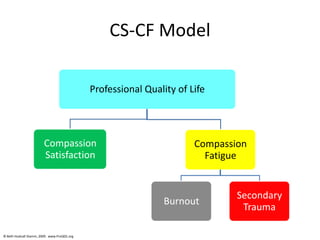
CS-CF Model
Professional Quality of Life
Compassion
Satisfaction
Compassion
Fatigue
Burnout
Secondary
Trauma
© Beth Hudnall Stamm, 2009. www.ProQOL.org© Beth Hudnall Stamm, 2009. www.ProQOL.org
Compassion Satisfaction
• The positive aspects of helping
– Pleasure and satisfaction derived from working in
helping, care giving systems
• May be related to
– Providing care
– To the system
– Work with colleagues
– Beliefs about self
– Altruism
© Beth Hudnall Stamm, 2009. www.ProQOL.org© Beth Hudnall Stamm, 2009. www.ProQOL.org
Compassion Fatigue
• The negative aspects of helping
• The negative aspects of working in helping
systems may be related to
– Providing care
– To the system
– Work with colleagues
– Beliefs about self
• Burnout
• Work-related trauma
© Beth Hudnall Stamm, 2009. www.ProQOL.org© Beth Hudnall Stamm, 2009. www.ProQOL.org
Burnout and Secondary Trauma
Stress: Co-Travelers
• Burnout
– Work-related hopelessness and feelings of
inefficacy
• STS
– Work-related secondary exposure to extremely or
traumatically stressful events
• Both share negative affect
– Burnout is about being worn out
– STS is about being afraid
© Beth Hudnall Stamm, 2009. Professional Quality of Life Scale (ProQOL).
www.proqol.org. This test may be freely copied as long as (a) author is credited,
(b) no changes are made without author authorization, and (c) it is not sold.
© Beth Hudnall Stamm, 2009. www.ProQOL.org
Factors that Influence Susceptibility
to VT
Individual
Factors
Life Situation
Factors
Organizational/Cultural
Factors
© Beth Hudnall Stamm, 2009. www.ProQOL.org© Beth Hudnall Stamm, 2009. www.ProQOL.org
Personal risk factors
• Personality and coping style
• Personal history
• Current life circumstances
• Social support
• Spiritual resources
• Work style
© Beth Hudnall Stamm, 2009. www.ProQOL.org© Beth Hudnall Stamm, 2009. www.ProQOL.org
Situational risk factors
• Professional role, work setting and exposure
• Agency support
• Affected population’s responses and reactions
© Beth Hudnall Stamm, 2009. www.ProQOL.org© Beth Hudnall Stamm, 2009. www.ProQOL.org
What Makes us Vulnerable in our Work
Context?
• empathy;
• personal experience;
• workload;
• age, experience & qualifications/perceptions of it;
• hearing the heart-wrenching, shocking stories;
• wanting to make a difference;
• guilt and discomfort.
© Beth Hudnall Stamm, 2009. www.ProQOL.org© Beth Hudnall Stamm, 2009. www.ProQOL.org
Institutional Cultural risk factors
• Cultures of intolerance
• Cultural styles of expressing distress and
extending and receiving assistance
• The culture of humanitarian work
© Beth Hudnall Stamm, 2009. www.ProQOL.org© Beth Hudnall Stamm, 2009. www.ProQOL.org
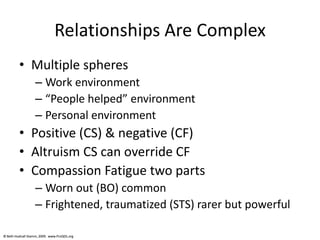
Relationships Are Complex
• Multiple spheres
– Work environment
– “People helped” environment
– Personal environment
• Positive (CS) & negative (CF)
• Altruism CS can override CF
• Compassion Fatigue two parts
– Worn out (BO) common
– Frightened, traumatized (STS) rarer but powerful
© Beth Hudnall Stamm, 2009. www.ProQOL.org
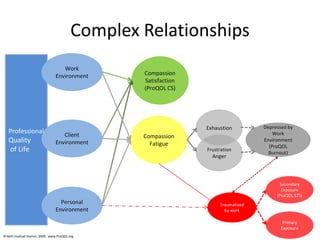
Complex Relationships
Professional
Quality
of Life
Compassion
Fatigue
Compassion
Satisfaction
(ProQOL CS)
Work
Environment
Client
Environment
Personal
Environment
Traumatized
by work
Secondary
Exposure
(ProQOL STS)
Primary
Exposure
Frustration
Anger
Exhaustion Depressed by
Work
Environment
(ProQOL
Burnout)
© Beth Hudnall Stamm, 2009. www.ProQOL.org© Beth Hudnall Stamm, 2009. www.ProQOL.org
Measuring CS & CF: The Professional
Quality of Life Scale (ProQOL)
• The ProQOL is free
• A 30 item self report measure of the positive
and negative aspects of caring
• The ProQOL measures Compassion
Satisfaction and Compassion Fatigue
• Compassion Fatigue has two subscales
– Burnout
– Secondary Trauma
© Beth Hudnall Stamm, 2009. www.ProQOL.org© Beth Hudnall Stamm, 2009. www.ProQOL.org
Well Established
• The ProQOL is the most widely used measure
of the positive and negative aspects of helping
in the world
• The ProQOL has proven to be a valid measure
of compassion satisfaction and fatigue
• It has been used for over 15 years
• The measure was developed with data from
over 3000 people
© Beth Hudnall Stamm, 2009. www.ProQOL.org© Beth Hudnall Stamm, 2009. www.ProQOL.org
Easy to Use
• The ProQOL is easy to use
• It can be given individually or in groups
• It can be given online or at an individual
computer
© Beth Hudnall Stamm, 2009. www.ProQOL.org© Beth Hudnall Stamm, 2009. www.ProQOL.org
Easy to Score
• Full scoring
– More detailed and specific information but takes
longer
– Better for research or administration
• The simplified scoring
– Less specific but can be completed quickly and can
be intuitively understood
– Good for training situations
© Beth Hudnall Stamm, 2009. www.ProQOL.org© Beth Hudnall Stamm, 2009. www.ProQOL.org
Not a Medical Test
• Helps understand the positive and negative
aspects of helping
• Not a “psychological test”
• Not a “medical test”
• Can be viewed as a screening for stress-
related health problems
© Beth Hudnall Stamm, 2009. www.ProQOL.org© Beth Hudnall Stamm, 2009. www.ProQOL.org
Interpreting Scores
• Scores on individual scales tell us about a
person’s responses on each of the constructs
• Viewing the combination of scores helps us
“paint a picture” of what the person is telling
us
• Can be used to track an individual’s CS and CF
© Beth Hudnall Stamm, 2009. www.ProQOL.org© Beth Hudnall Stamm, 2009. www.ProQOL.org
Resiliency Planning
• Individual, personally
– The ProQOL can help you plan where to put your
energy to increase our resilience
• Organizational planning
– Can help organizations find ways to maximize the
positive aspects and reduce the negative aspects of
helping
• Supportive Supervision
– The ProQOL can be used as information for
discussions
© Beth Hudnall Stamm, 2009. www.ProQOL.org© Beth Hudnall Stamm, 2009. www.ProQOL.org
What can you do?
• Identifying strategies to prevent vicarious
trauma from becoming severe and
problematic
• Manage vicarious trauma during times when
it is more problematic
© Beth Hudnall Stamm, 2009. www.ProQOL.org
Barriers to Self-care are many…
“Take my advice,
I am not using it”
© Beth Hudnall Stamm, 2009. www.ProQOL.org© Beth Hudnall Stamm, 2009. www.ProQOL.org
Prevention: Working protectively
How you do your work
 Change some things that bother you - Intentionally
make choices when you can
 Connect with (or disconnect from) with people
 Try something different at work
 Find ways to retain or regain perspective during the
day
 Invest in professional networks and relationships
with colleagues
 Find more than one healthy habit
© Beth Hudnall Stamm, 2009. www.ProQOL.org© Beth Hudnall Stamm, 2009. www.ProQOL.org
Prevention: Working protectively
How you think about your work
Think about your answers to these questions:
 Why do you do this work?
 Do you know what you’re doing in your work and
why?
 How do you measure success in your work?
 What can you control in your work?
 What are the costs and rewards of this work, and
how are you personally challenged?
© Beth Hudnall Stamm, 2009. www.ProQOL.org© Beth Hudnall Stamm, 2009. www.ProQOL.org
Develop Good Coping Strategies!
Things that help you take care of yourself. Especially things that
help you:
• Escape: Get away from it all, physically or mentally (books or
films, vacation or “stay”cations, playing video games, talking
to friends about things other than work)
• Rest: Having no goal or time line, or doing things you find
relaxing (lying on the grass watching the clouds go by, sipping
a cup of tea, taking a nap, getting a massage, etc.)
• Play: Engaging in activities that make you laugh or lighten
your spirits (sharing funny stories with a friend, playing with a
child, being creative, being physically active, etc.)
© Beth Hudnall Stamm, 2009. www.ProQOL.org
For more information see www.proqol.org
Transforming vicarious trauma
Identifying ways to nurture a sense of
meaning and hope
© Beth Hudnall Stamm, 2009. www.ProQOL.org© Beth Hudnall Stamm, 2009. www.ProQOL.org
Connecting (or reconnecting) with sources
of meaning, and hope
• Reminding yourself of the importance and value of mental
health work
• Staying connected with family, friends and colleagues
• Noticing and deliberately paying attention to the “little
things”
• Marking transitions, celebrating joys, and mourning losses
with people you care about
• Taking time to reflect
• Identifying and challenging your own cynical beliefs
• Undertaking growth – promoting activities
© Beth Hudnall Stamm, 2009. www.ProQOL.org© Beth Hudnall Stamm, 2009. www.ProQOL.org
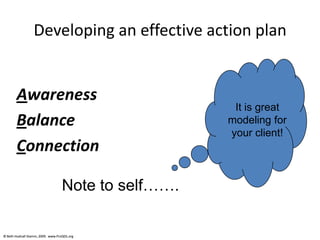
Developing an effective action plan
Awareness
Balance
Connection
It is great
modeling for
your client!
Note to self…….
© Beth Hudnall Stamm, 2009. www.ProQOL.org© Beth Hudnall Stamm, 2009. www.ProQOL.org
Developing an effective action plan
• Awareness
Understanding your responses: Recognize your early
warning signs and make adjustments to your work
and personal care strategies.
Awareness/Mindfulness: Being aware of what you’re
doing while you’re doing it, deliberately keeping your
mind and your body in the same place.
© Beth Hudnall Stamm, 2009. www.ProQOL.org© Beth Hudnall Stamm, 2009. www.ProQOL.org
Developing an effective action plan
• Balance
 Work-life balance: Make sure each work day
includes some breaks for meals and physical activity
or rest
 Take time away from work for rest and relaxation, for
friends and family, for spiritual renewal and for
professional development. (Check that off your list
today. )
 Balance on the job: Make sure you can still be doing
this same work two years from now if you want to.
 Stopping work after a reasonable amount of time
 Balance more and less challenging tasks
© Beth Hudnall Stamm, 2009. www.ProQOL.org© Beth Hudnall Stamm, 2009. www.ProQOL.org
Developing an effective action plan
• Connection
Connecting with other people: Social support
through professional and personal
communities.
… with a sense of awe, joy, wonder, purpose
and hope.
© Beth Hudnall Stamm, 2009. www.ProQOL.org© Beth Hudnall Stamm, 2009. www.ProQOL.org
Self Care Tips in the Work Place
• Sharing with colleagues / talking it through at work
• Regular Breaks
• Openness about difficulties experienced at work
• Time-Management
• Time-Out (including occasional half days)
• Unwinding outside work with colleagues
• Formal talk therapy and counselling outside of work
• Debriefing
• Support from supervision, managers; work-load
management; clear reporting strategies; fairness at
work
© Beth Hudnall Stamm, 2009. www.ProQOL.org
Study Results: Coping Strategies and
Resilience
• Balance
• Exercise
• Humor
• Positive community activities
• Professional development
• Faith/spiritual life
• Channeling our outrage into
social and political change
© Beth Hudnall Stamm, 2009. www.ProQOL.org
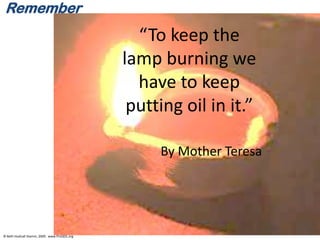
“To keep the
lamp burning we
have to keep
putting oil in it.”
By Mother Teresa
Remember
© Beth Hudnall Stamm, 2009. www.ProQOL.org© Beth Hudnall Stamm, 2009. www.ProQOL.org
Self Care strategies to consider
 Yoga/ Tai Chi /Dance Long baths/aromatherapy
 Mindful eating Biking, hiking, running
 Journaling, singing Massage
 Travel Time with friends
 Personal psychotherapy Sex
 Eat and sleep Laugh
 Seek spiritual renewal/pray Meditation
 Hobbies, sports, creative interests Gardening/baking
 Bubble baths/movie night Forgive yourself
 Walking/petting dog
 Establish boundaries separating work from home
 Guard against addictive behaviors
 Acupressure/tapping
 Seek out experiences which instill hope and comfort
© Beth Hudnall Stamm, 2009. www.ProQOL.org
© Beth Hudnall Stamm, 2009. www.ProQOL.org© Beth Hudnall Stamm, 2009. www.ProQOL.org
Readings
Core Reading
• 1. Sanderson (2013) Part V: Professional
Issues. 24. Practitioner Self Care
Advanced reading
• 2. Courtois & Ford (2009) chapter 10. Living
and Working Self-Reflectively to Address
Vicarious Trauma by Laurie Anne Pearlman
and James Caring
• Journal articles on New Learning
© Beth Hudnall Stamm, 2009. www.ProQOL.org© Beth Hudnall Stamm, 2009. www.ProQOL.org
Befriend your Stress Dragon!

Lecture 6 vicarious traumatisation in complex trauma therapy

  • 1.
    Lecture 6: Vicarious traumatizationand Self-care in treating complex traumatic stress disorders Complex Casework Kevin Standish 1
  • 2.
    © Beth HudnallStamm, 2009. www.ProQOL.org© Beth Hudnall Stamm, 2009. www.ProQOL.org Learning Objectives Define the terms related to Vicarious trauma: Burnout /Countertransference/Projective identification/Vicarious Trauma/Compassion fatigue Discuss trauma, it’s symptoms, impact on helpers Discuss self care and coping skills to manage VT
  • 3.
    © Beth HudnallStamm, 2009. www.ProQOL.org© Beth Hudnall Stamm, 2009. www.ProQOL.org The dragons of stress, burnout and vicarious trauma may be attacking… Take Dragon Fighting Lessons
  • 4.
    © Beth HudnallStamm, 2009. www.ProQOL.org© Beth Hudnall Stamm, 2009. www.ProQOL.org … or get fried.
  • 5.
    © Beth HudnallStamm, 2009. www.ProQOL.org© Beth Hudnall Stamm, 2009. www.ProQOL.org and die!
  • 6.
    © Beth HudnallStamm, 2009. www.ProQOL.org© Beth Hudnall Stamm, 2009. www.ProQOL.org How Our Work Affects Us What are 3 negative reactions/effects from your work you have experienced?
  • 7.
    © Beth HudnallStamm, 2009. www.ProQOL.org For more information see www.proqol.org This work changes us…
  • 8.
    © Beth HudnallStamm, 2009. www.ProQOL.org© Beth Hudnall Stamm, 2009. www.ProQOL.org Vocabulary • Compassion Satisfaction – Positive aspects of working as a helper • Compassion Fatigue – Negative aspects of working as a helper • Burnout – Inefficacy and feeling overwhelmed • Work-related traumatic stress – Primary traumatic stress direct target of event – Secondary traumatic exposure to event due to a relationship with the primary person
  • 9.
    © Beth HudnallStamm, 2009. www.ProQOL.org© Beth Hudnall Stamm, 2009. www.ProQOL.org Definitions: • Vicarious Trauma- cumulative transformative effect upon the professional who is working with survivors of traumatic life events • Secondary Trauma- the emotional & psychological effects experienced through vicarious exposure to the details of the traumatic experiences of others • Compassion Fatigue- the emotional residue of exposure to working with those suffering from the consequences of traumatic events. • Burnout- associated with work stress; feelings resulting as things that inspire passion/enthusiasm are stripped away, and tedious/unpleasant things crowd in.
  • 10.
    © Beth HudnallStamm, 2009. www.ProQOL.org© Beth Hudnall Stamm, 2009. www.ProQOL.org • “The effects of vicarious trauma are cumulative and build upon memories obtained through listening to the stories of one inhumane act of cruelty after another. This creates a permanent, subtle or marked change in the personal, spiritual and professional outlook of the counselor or advocate (Richardson, 2001).”
  • 11.
    © Beth HudnallStamm, 2009. www.ProQOL.org© Beth Hudnall Stamm, 2009. www.ProQOL.org • “Experiencing and listening to the pain, hurt, difficulties, frustrations, and trauma of others gets transferred to the victim service provider. . .Vicarious trauma isn’t an issue of ‘If’ but rather ‘When’ (COVA, 2005).”
  • 12.
    © Beth HudnallStamm, 2009. www.ProQOL.org© Beth Hudnall Stamm, 2009. www.ProQOL.org Vicarious Trauma and related concepts  Vicarious traumatization (VT)  Secondary post traumatic stress reaction  Secondary traumatic stress  Secondary traumatic stress disorder  Compassion fatigue  Compassion stress  Soul sadness  Empathic strain  Contact victimization It’s not a matter of “If” it’s a matter of “When”
  • 13.
    © Beth HudnallStamm, 2009. www.ProQOL.org© Beth Hudnall Stamm, 2009. www.ProQOL.org Vicarious Trauma “There is a soul weariness that comes with caring. From daily doing business with the handiwork of fear. Sometimes it lives at the edges of one’s life, brushing against hope and barely making its presence known. At other times, it comes crashing in, overtaking one with its vivid images of another’s terror with its profound demands for attention; nightmares, strange fears, and generalized hopelessness.” B. Hudnall Stamm, Ph.D.
  • 14.
    © Beth HudnallStamm, 2009. www.ProQOL.org© Beth Hudnall Stamm, 2009. www.ProQOL.org Definitions Burnout:  Related to feeling of being overloaded  Work stress  Joy of work is lost  Can occur in any professional setting  Progresses gradually as a result of emotional exhaustion, cynicism, and feelings of inefficacy.  Does NOT lead to changes in trust, feelings of control, issues of intimacy, safety concerns, and intrusive traumatic imagery that are foundational to Vicarious Trauma.
  • 15.
    © Beth HudnallStamm, 2009. www.ProQOL.org© Beth Hudnall Stamm, 2009. www.ProQOL.org Countertransference • The process of seeing oneself in the patient, of over- identifying with the patient, or of meeting one’s own needs through the patient. • Counter-transference occurs when the clinician begins to project his or her own unresolved conflicts onto the patient. • Good clinicians are those who can tune into their own countertransference feelings and quickly assess whether it is coming from them or the patient. This is one of the reasons it is so important for clinicians to do their own work.
  • 16.
    © Beth HudnallStamm, 2009. www.ProQOL.org© Beth Hudnall Stamm, 2009. www.ProQOL.org Projective Identification The result of developmental impingement that occurred before the patient had acquired language (pre-verbal). Since patient has no language to communicate their internal struggles, they induce the feelings in another in order to be understood. • Both a defense mechanism and a mode of communication. • As a defense mechanism… it creates a psychological distance from unwanted (often frightening) aspects of the self. • As a mode of communication… patient’s own feelings are induced in another person (therapist/helper), creating a sense of being understood by the other person.
  • 17.
    © Beth HudnallStamm, 2009. www.ProQOL.org© Beth Hudnall Stamm, 2009. www.ProQOL.org Vicarious Trauma • Vicarious trauma is the process of change that happens because you care about other people who have been hurt, and feel committed or responsible to help them. Over time this process can lead to changes in your psychological, physical and spiritual well- being. (Headington Institute)
  • 18.
    © Beth HudnallStamm, 2009. www.ProQOL.org© Beth Hudnall Stamm, 2009. www.ProQOL.org Vicarious Trauma • Cumulative –happens over time as you work with survivors of trauma, disasters, people who are struggling. • Process of change is ongoing – this is hopeful as it provides opportunities for us to recognize the impact the work has on your lives early and to develop strategies to protect and care for ourselves.
  • 19.
    © Beth HudnallStamm, 2009. www.ProQOL.org© Beth Hudnall Stamm, 2009. www.ProQOL.org Vicarious Trauma Empathy • When you identify with the pain of people who have endured terrible things, you bring their grief, fear, anger, and despair into your own awareness and experience. – What sort of problems or people do you find it easy (or difficult) to empathize with? – What are some ways that caring about people who have been hurt affects you?
  • 20.
    © Beth HudnallStamm, 2009. www.ProQOL.org© Beth Hudnall Stamm, 2009. www.ProQOL.org Vicarious Trauma Feeling committed or responsible to help  Your commitment and sense of responsibility can lead to high expectations and eventually contribute to your feeling burdened, overwhelmed, and hopeless/helpless.  Can lead you to extend yourself beyond what is reasonable for your own well-being or the best long-term interests of your patients.  How does your sense of commitment and responsibility to your work help you? How might it be hurting you?
  • 21.
    © Beth HudnallStamm, 2009. www.ProQOL.org© Beth Hudnall Stamm, 2009. www.ProQOL.org Joining vs. Merging The empathic process: • Merging touches our own unresolved issues – our countertransference • Joining supports differentiation between you and patient– being attuned/in resonance/healthy boundary • Patients whose boundaries have been so abused/ruptured – it may be nearly impossible for them to maintain appropriate boundaries. It is essential that we have or develop healthy boundaries as clinicians. • Patients with borderline characteristics will merge easily and violate boundaries frequently and ask us to violate our boundaries
  • 22.
    © Beth HudnallStamm, 2009. www.ProQOL.org© Beth Hudnall Stamm, 2009. www.ProQOL.org Joining vs. Merging Warning signs of merging: • Something will happen in our system to decrease our contact with our felt sense • We are uncomfortable with someone who dissociates or leaves their body • We’re not ok until they are ok • We feel unsettled, unclear, tired, not present • Think about patient outside of session more often than our comfort level • We think we are indispensable – were are the only ones who can help • Boundaries get blurred – we go overtime, stay late, we start taking on their stuff, have dreams about them
  • 23.
    © Beth HudnallStamm, 2009. www.ProQOL.org© Beth Hudnall Stamm, 2009. www.ProQOL.org Joining vs. Merging Joining • We need to be grounded and in our bodies and resourced ourselves • Can’t prevent merging but reset boundaries after this happens • Ask how does merging touch our own stuff? What shadow piece of me is showing up? • Don’t get too caught up in their story • Stay present within your boundaries without withdrawing – helps patient begin to develop trust • Come back to your belief in the patients own ability to heal. And the knowledge that they have taken care of themselves for years without us and will continue to do so • Respect their need for boundaries – on both sides of the relationship
  • 24.
    © Beth HudnallStamm, 2009. www.ProQOL.org© Beth Hudnall Stamm, 2009. www.ProQOL.org Vicarious Trauma • Changes in spirituality – Your deepest sense of meaning and purpose, hope, faith – Humanitarian workers often refer to this as “existential angst” - being constantly pushed out of your comfort zone and forced to question the meaning of events, and their own and others actions and reactions. • What are some ways your work has had a positive influence on the way you see the world, yourself, belief in God, what matters to you? In what ways has the influence been negative?
  • 25.
    © Beth HudnallStamm, 2009. www.ProQOL.org© Beth Hudnall Stamm, 2009. www.ProQOL.org Vicarious Trauma • Understanding risk factors: – Personality and coping style – Personal trauma history – Current life circumstances – Social support – Spiritual resources – Work style – work/life boundaries – Professional role/work setting/degree of exposure – Agency support – Affected populations response or reaction – Cultural styles of expressing distress and extending and receiving assistance
  • 26.
    © Beth HudnallStamm, 2009. www.ProQOL.org© Beth Hudnall Stamm, 2009. www.ProQOL.org Signs and symptoms • Feeling frustration or anger about a patient’s choices • Thinking about a patient outside of work more than you want to • Feeling anxious about working with a patient • Feeling dread when you anticipate seeing a patient • Feeling more worried than you think is necessary about a patient • Feeling angry at a patient • Feeling de-skilled or incompetent when you meet with a patient • Taking on too much responsibility- difficulty leaving work at end of day – stepping in to control other’s lives
  • 27.
    © Beth HudnallStamm, 2009. www.ProQOL.org© Beth Hudnall Stamm, 2009. www.ProQOL.org Signs and symptoms • Feeling disconnected or dissociated from the patient, their emotions or the content of the session • Having physical discomfort or pain while meeting with a patient, which seems connected with what you’re working on • Having other physical reactions to a patient’s stories, e.g. increased heart rate, rapid or shallow breathing, nausea, feeling frozen etc. • Feeling traumatized after talking with a patient about specifics of their abuse • Wanting to cry during/after meeting with a patient • Feeling helpless about your work with a patient • Feeling enraged at a patient’s perpetrators
  • 28.
    © Beth HudnallStamm, 2009. www.ProQOL.org© Beth Hudnall Stamm, 2009. www.ProQOL.org Compassion fatigue vs burnout • Burnout---is a term that describes low job satisfaction, feeling powerless, overwhelmed, depleted and frustrated by their work environment • Many persons in ‘non-helping’ jobs may experience burnout, who are not particularly in a traumatic environment
  • 29.
    © Beth HudnallStamm, 2009. www.ProQOL.org© Beth Hudnall Stamm, 2009. www.ProQOL.org Compassion fatigue vs depression • Employees who considered most of their days to be quite a bit or extremely stressful were over three times more likely to suffer a major depressive episode, compared with those who reported low levels of general stress • Chronic Compassion Fatigue can lead to depression, anxiety, addiction, mental and physical illnesses if left unchecked
  • 30.
    © Beth HudnallStamm, 2009. www.ProQOL.org© Beth Hudnall Stamm, 2009. www.ProQOL.org Compassion fatigue vs vicarious traumatization • Vicarious Traumatization, a termed coined by Laurie Ann Pearlman and Karen Saakvitne, is used to describe the profound shift that workers experience in their world view when they work with clients who have experienced trauma • Helpers notice that the way they think about clients and the world, is somehow changed by the cumulative process of repeated exposure.
  • 31.
    © Beth HudnallStamm, 2009. www.ProQOL.org© Beth Hudnall Stamm, 2009. www.ProQOL.org Compassion fatigue vs primary and secondary trauma • Primary Trauma refers to trauma that is happening to you, either from your personal life or even in the line of duty • Secondary Trauma is the exposure to trauma via retelling of stories by client or co-worker, reading case files, hearing court testimonies or watching disturbing news footage
  • 32.
    © Beth HudnallStamm, 2009. www.ProQOL.org Professional Quality of Life Compassion Satisfaction • The positive aspects of helping • “The good stuff” Compassion Fatigue • The negative aspects of helping • “The bad stuff’
  • 33.
    © Beth HudnallStamm, 2009. www.ProQOL.org CS-CF Model Professional Quality of Life Compassion Satisfaction Compassion Fatigue Burnout Secondary Trauma
  • 34.
    © Beth HudnallStamm, 2009. www.ProQOL.org© Beth Hudnall Stamm, 2009. www.ProQOL.org Compassion Satisfaction • The positive aspects of helping – Pleasure and satisfaction derived from working in helping, care giving systems • May be related to – Providing care – To the system – Work with colleagues – Beliefs about self – Altruism
  • 35.
    © Beth HudnallStamm, 2009. www.ProQOL.org© Beth Hudnall Stamm, 2009. www.ProQOL.org Compassion Fatigue • The negative aspects of helping • The negative aspects of working in helping systems may be related to – Providing care – To the system – Work with colleagues – Beliefs about self • Burnout • Work-related trauma
  • 36.
    © Beth HudnallStamm, 2009. www.ProQOL.org© Beth Hudnall Stamm, 2009. www.ProQOL.org Burnout and Secondary Trauma Stress: Co-Travelers • Burnout – Work-related hopelessness and feelings of inefficacy • STS – Work-related secondary exposure to extremely or traumatically stressful events • Both share negative affect – Burnout is about being worn out – STS is about being afraid © Beth Hudnall Stamm, 2009. Professional Quality of Life Scale (ProQOL). www.proqol.org. This test may be freely copied as long as (a) author is credited, (b) no changes are made without author authorization, and (c) it is not sold.
  • 37.
    © Beth HudnallStamm, 2009. www.ProQOL.org Factors that Influence Susceptibility to VT Individual Factors Life Situation Factors Organizational/Cultural Factors
  • 38.
    © Beth HudnallStamm, 2009. www.ProQOL.org© Beth Hudnall Stamm, 2009. www.ProQOL.org Personal risk factors • Personality and coping style • Personal history • Current life circumstances • Social support • Spiritual resources • Work style
  • 39.
    © Beth HudnallStamm, 2009. www.ProQOL.org© Beth Hudnall Stamm, 2009. www.ProQOL.org Situational risk factors • Professional role, work setting and exposure • Agency support • Affected population’s responses and reactions
  • 40.
    © Beth HudnallStamm, 2009. www.ProQOL.org© Beth Hudnall Stamm, 2009. www.ProQOL.org What Makes us Vulnerable in our Work Context? • empathy; • personal experience; • workload; • age, experience & qualifications/perceptions of it; • hearing the heart-wrenching, shocking stories; • wanting to make a difference; • guilt and discomfort.
  • 41.
    © Beth HudnallStamm, 2009. www.ProQOL.org© Beth Hudnall Stamm, 2009. www.ProQOL.org Institutional Cultural risk factors • Cultures of intolerance • Cultural styles of expressing distress and extending and receiving assistance • The culture of humanitarian work
  • 42.
    © Beth HudnallStamm, 2009. www.ProQOL.org© Beth Hudnall Stamm, 2009. www.ProQOL.org Relationships Are Complex • Multiple spheres – Work environment – “People helped” environment – Personal environment • Positive (CS) & negative (CF) • Altruism CS can override CF • Compassion Fatigue two parts – Worn out (BO) common – Frightened, traumatized (STS) rarer but powerful
  • 43.
    © Beth HudnallStamm, 2009. www.ProQOL.org Complex Relationships Professional Quality of Life Compassion Fatigue Compassion Satisfaction (ProQOL CS) Work Environment Client Environment Personal Environment Traumatized by work Secondary Exposure (ProQOL STS) Primary Exposure Frustration Anger Exhaustion Depressed by Work Environment (ProQOL Burnout)
  • 44.
    © Beth HudnallStamm, 2009. www.ProQOL.org© Beth Hudnall Stamm, 2009. www.ProQOL.org Measuring CS & CF: The Professional Quality of Life Scale (ProQOL) • The ProQOL is free • A 30 item self report measure of the positive and negative aspects of caring • The ProQOL measures Compassion Satisfaction and Compassion Fatigue • Compassion Fatigue has two subscales – Burnout – Secondary Trauma
  • 45.
    © Beth HudnallStamm, 2009. www.ProQOL.org© Beth Hudnall Stamm, 2009. www.ProQOL.org Well Established • The ProQOL is the most widely used measure of the positive and negative aspects of helping in the world • The ProQOL has proven to be a valid measure of compassion satisfaction and fatigue • It has been used for over 15 years • The measure was developed with data from over 3000 people
  • 46.
    © Beth HudnallStamm, 2009. www.ProQOL.org© Beth Hudnall Stamm, 2009. www.ProQOL.org Easy to Use • The ProQOL is easy to use • It can be given individually or in groups • It can be given online or at an individual computer
  • 47.
    © Beth HudnallStamm, 2009. www.ProQOL.org© Beth Hudnall Stamm, 2009. www.ProQOL.org Easy to Score • Full scoring – More detailed and specific information but takes longer – Better for research or administration • The simplified scoring – Less specific but can be completed quickly and can be intuitively understood – Good for training situations
  • 48.
    © Beth HudnallStamm, 2009. www.ProQOL.org© Beth Hudnall Stamm, 2009. www.ProQOL.org Not a Medical Test • Helps understand the positive and negative aspects of helping • Not a “psychological test” • Not a “medical test” • Can be viewed as a screening for stress- related health problems
  • 49.
    © Beth HudnallStamm, 2009. www.ProQOL.org© Beth Hudnall Stamm, 2009. www.ProQOL.org Interpreting Scores • Scores on individual scales tell us about a person’s responses on each of the constructs • Viewing the combination of scores helps us “paint a picture” of what the person is telling us • Can be used to track an individual’s CS and CF
  • 50.
    © Beth HudnallStamm, 2009. www.ProQOL.org© Beth Hudnall Stamm, 2009. www.ProQOL.org Resiliency Planning • Individual, personally – The ProQOL can help you plan where to put your energy to increase our resilience • Organizational planning – Can help organizations find ways to maximize the positive aspects and reduce the negative aspects of helping • Supportive Supervision – The ProQOL can be used as information for discussions
  • 51.
    © Beth HudnallStamm, 2009. www.ProQOL.org© Beth Hudnall Stamm, 2009. www.ProQOL.org What can you do? • Identifying strategies to prevent vicarious trauma from becoming severe and problematic • Manage vicarious trauma during times when it is more problematic
  • 52.
    © Beth HudnallStamm, 2009. www.ProQOL.org Barriers to Self-care are many… “Take my advice, I am not using it”
  • 53.
    © Beth HudnallStamm, 2009. www.ProQOL.org© Beth Hudnall Stamm, 2009. www.ProQOL.org Prevention: Working protectively How you do your work  Change some things that bother you - Intentionally make choices when you can  Connect with (or disconnect from) with people  Try something different at work  Find ways to retain or regain perspective during the day  Invest in professional networks and relationships with colleagues  Find more than one healthy habit
  • 54.
    © Beth HudnallStamm, 2009. www.ProQOL.org© Beth Hudnall Stamm, 2009. www.ProQOL.org Prevention: Working protectively How you think about your work Think about your answers to these questions:  Why do you do this work?  Do you know what you’re doing in your work and why?  How do you measure success in your work?  What can you control in your work?  What are the costs and rewards of this work, and how are you personally challenged?
  • 55.
    © Beth HudnallStamm, 2009. www.ProQOL.org© Beth Hudnall Stamm, 2009. www.ProQOL.org Develop Good Coping Strategies! Things that help you take care of yourself. Especially things that help you: • Escape: Get away from it all, physically or mentally (books or films, vacation or “stay”cations, playing video games, talking to friends about things other than work) • Rest: Having no goal or time line, or doing things you find relaxing (lying on the grass watching the clouds go by, sipping a cup of tea, taking a nap, getting a massage, etc.) • Play: Engaging in activities that make you laugh or lighten your spirits (sharing funny stories with a friend, playing with a child, being creative, being physically active, etc.)
  • 56.
    © Beth HudnallStamm, 2009. www.ProQOL.org For more information see www.proqol.org Transforming vicarious trauma Identifying ways to nurture a sense of meaning and hope
  • 57.
    © Beth HudnallStamm, 2009. www.ProQOL.org© Beth Hudnall Stamm, 2009. www.ProQOL.org Connecting (or reconnecting) with sources of meaning, and hope • Reminding yourself of the importance and value of mental health work • Staying connected with family, friends and colleagues • Noticing and deliberately paying attention to the “little things” • Marking transitions, celebrating joys, and mourning losses with people you care about • Taking time to reflect • Identifying and challenging your own cynical beliefs • Undertaking growth – promoting activities
  • 58.
    © Beth HudnallStamm, 2009. www.ProQOL.org© Beth Hudnall Stamm, 2009. www.ProQOL.org Developing an effective action plan Awareness Balance Connection It is great modeling for your client! Note to self…….
  • 59.
    © Beth HudnallStamm, 2009. www.ProQOL.org© Beth Hudnall Stamm, 2009. www.ProQOL.org Developing an effective action plan • Awareness Understanding your responses: Recognize your early warning signs and make adjustments to your work and personal care strategies. Awareness/Mindfulness: Being aware of what you’re doing while you’re doing it, deliberately keeping your mind and your body in the same place.
  • 60.
    © Beth HudnallStamm, 2009. www.ProQOL.org© Beth Hudnall Stamm, 2009. www.ProQOL.org Developing an effective action plan • Balance  Work-life balance: Make sure each work day includes some breaks for meals and physical activity or rest  Take time away from work for rest and relaxation, for friends and family, for spiritual renewal and for professional development. (Check that off your list today. )  Balance on the job: Make sure you can still be doing this same work two years from now if you want to.  Stopping work after a reasonable amount of time  Balance more and less challenging tasks
  • 61.
    © Beth HudnallStamm, 2009. www.ProQOL.org© Beth Hudnall Stamm, 2009. www.ProQOL.org Developing an effective action plan • Connection Connecting with other people: Social support through professional and personal communities. … with a sense of awe, joy, wonder, purpose and hope.
  • 62.
    © Beth HudnallStamm, 2009. www.ProQOL.org© Beth Hudnall Stamm, 2009. www.ProQOL.org Self Care Tips in the Work Place • Sharing with colleagues / talking it through at work • Regular Breaks • Openness about difficulties experienced at work • Time-Management • Time-Out (including occasional half days) • Unwinding outside work with colleagues • Formal talk therapy and counselling outside of work • Debriefing • Support from supervision, managers; work-load management; clear reporting strategies; fairness at work
  • 63.
    © Beth HudnallStamm, 2009. www.ProQOL.org Study Results: Coping Strategies and Resilience • Balance • Exercise • Humor • Positive community activities • Professional development • Faith/spiritual life • Channeling our outrage into social and political change
  • 64.
    © Beth HudnallStamm, 2009. www.ProQOL.org “To keep the lamp burning we have to keep putting oil in it.” By Mother Teresa Remember
  • 65.
    © Beth HudnallStamm, 2009. www.ProQOL.org© Beth Hudnall Stamm, 2009. www.ProQOL.org Self Care strategies to consider  Yoga/ Tai Chi /Dance Long baths/aromatherapy  Mindful eating Biking, hiking, running  Journaling, singing Massage  Travel Time with friends  Personal psychotherapy Sex  Eat and sleep Laugh  Seek spiritual renewal/pray Meditation  Hobbies, sports, creative interests Gardening/baking  Bubble baths/movie night Forgive yourself  Walking/petting dog  Establish boundaries separating work from home  Guard against addictive behaviors  Acupressure/tapping  Seek out experiences which instill hope and comfort
  • 66.
    © Beth HudnallStamm, 2009. www.ProQOL.org
  • 67.
    © Beth HudnallStamm, 2009. www.ProQOL.org© Beth Hudnall Stamm, 2009. www.ProQOL.org Readings Core Reading • 1. Sanderson (2013) Part V: Professional Issues. 24. Practitioner Self Care Advanced reading • 2. Courtois & Ford (2009) chapter 10. Living and Working Self-Reflectively to Address Vicarious Trauma by Laurie Anne Pearlman and James Caring • Journal articles on New Learning
  • 68.
    © Beth HudnallStamm, 2009. www.ProQOL.org© Beth Hudnall Stamm, 2009. www.ProQOL.org Befriend your Stress Dragon!

Editor's Notes

  • #13 If you do this work for any matter of time you will be impacted on a personal, spiritual, or biological level.Doesn’t have to overwhelm you but you do need to be mindful of how you manage it on a ongoing basis
  • #16 Example: you begin to develop overprotective feelings for a client and realize the reason why is the client reminds you of your sister who died in a car accident.
  • #17 Example – you feel fine/grounded/rested and client comes in and you are overcome with feelings of helplessness, hopelessness, rage, terror, freeze response etc….
  • #19 Experiences of VT are continually influenced by your life experiences – both those that we choose and those that happen to us.
  • #26 What are some protective factors you have in your life helping you guard against VT?
  • #50 Same photo on both CS and CF page, both feelings can exist in the same situation