Lecture 6. Overview of
Emotionally Focused Therapy for
Couples
Couple Counselling Skills
Kevin Standish
Learning Objectives
Describe the theoretical underpinnings of
Emotionally Focused Therapy
Be familiar with the three stages and nine steps
framework of EFT
Understand the concepts of enactments, withdraw
engagement and blamer softening
Be conversant with the research supporting EFT
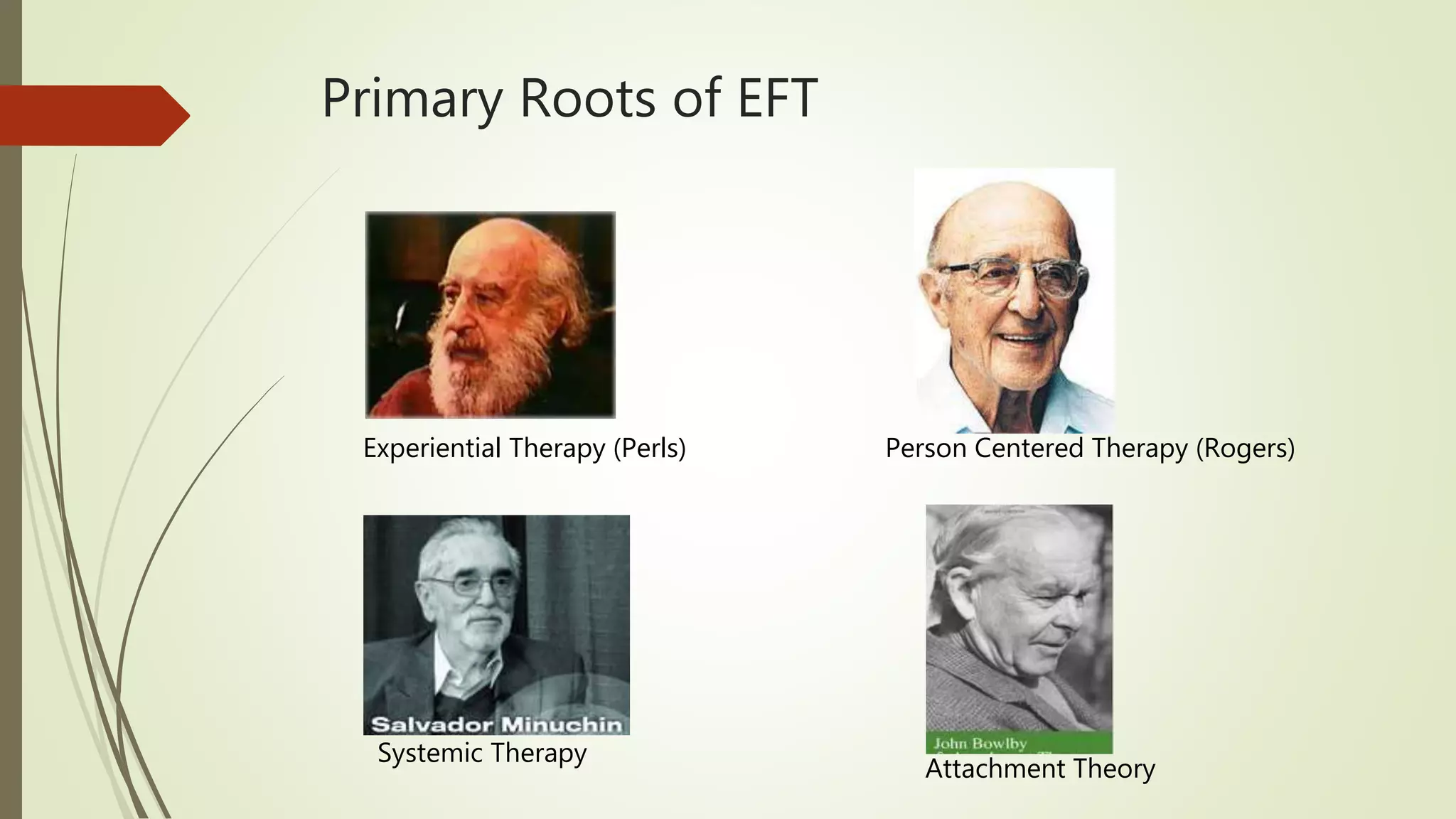
Primary Roots of EFT
Experiential Therapy (Perls) Person Centered Therapy (Rogers)
Systemic Therapy
Attachment Theory
EFT Assumptions
 1. Accessibility and responsiveness are the building blocks of a
secure attachment bond. Consequently, Couples therapy is
about A. the security of the attachment bond, B. accessibility,
and C. the responsiveness of the partner.
 2. Emotion is a target and agent of change. Emotion is A.
Source of information; B. Communicates - organizes social
interactions; C. Orients & primes responses; D. Vital element
in meaning - colors events; E. Has control precedence
 3) Emotion frequently leads to adaptive actions eg Anger
often leads to Asserting, defending; or Sadness often leads to
Seeking support, withdrawing.
EFT Assumptions
 4. Negative emotions occur at two levels: Primary and
Secondary.
 A. Primary Emotions are the deeper, more vulnerable
emotions such as sadness, hurt, fear, shame, and loneliness.
 B. Secondary Emotions are the more reactive emotions such
as anger, jealousy, resentment, and frustration. They occur as
a reaction to the primary emotions.
 Primary emotions generally draw partners closer. Secondary
emotions tend to push partners away.
 5. In trying to connect, distressed couples get caught in
negative repetitive sequences of interaction where partners
express secondary emotions rather than primary emotions
EFT Assumptions
 6. Insecure attachment leads to negative interaction cycles and, in
return, negative interaction cycles lead to insecure attachment (it is
circular).
 7. Rigid interactions reflect and create negative absorbing
emotional states. Negative absorbing emotional states reflect and
create rigid interactions (it is circular).
 8. Partners are not sick or developmentally delayed. They are stuck.
Most needs and desires are adaptive.
 9. Attachment needs are universal, although their expression is
culturally defined. The way we seek and obtain support is defined
different in various cultures and even in different families and must
be understood and respected
 10. Change involves new experiences and new relationships events.
Therapy is about creating these new relational experiences
Comparative Framework.
1. Background of the Approach
2. The Healthy/Well-Functioning versus
Pathological/Dysfunctional Couple/Marriage
3. The Role of the Therapist
4. Assessment and Treatment Planning
5. Goal Setting
6. Process and Technical Aspects of Couple Therapy
7. Curative Factors/Mechanisms of Change
8. Treatment Applicability and Empirical Support
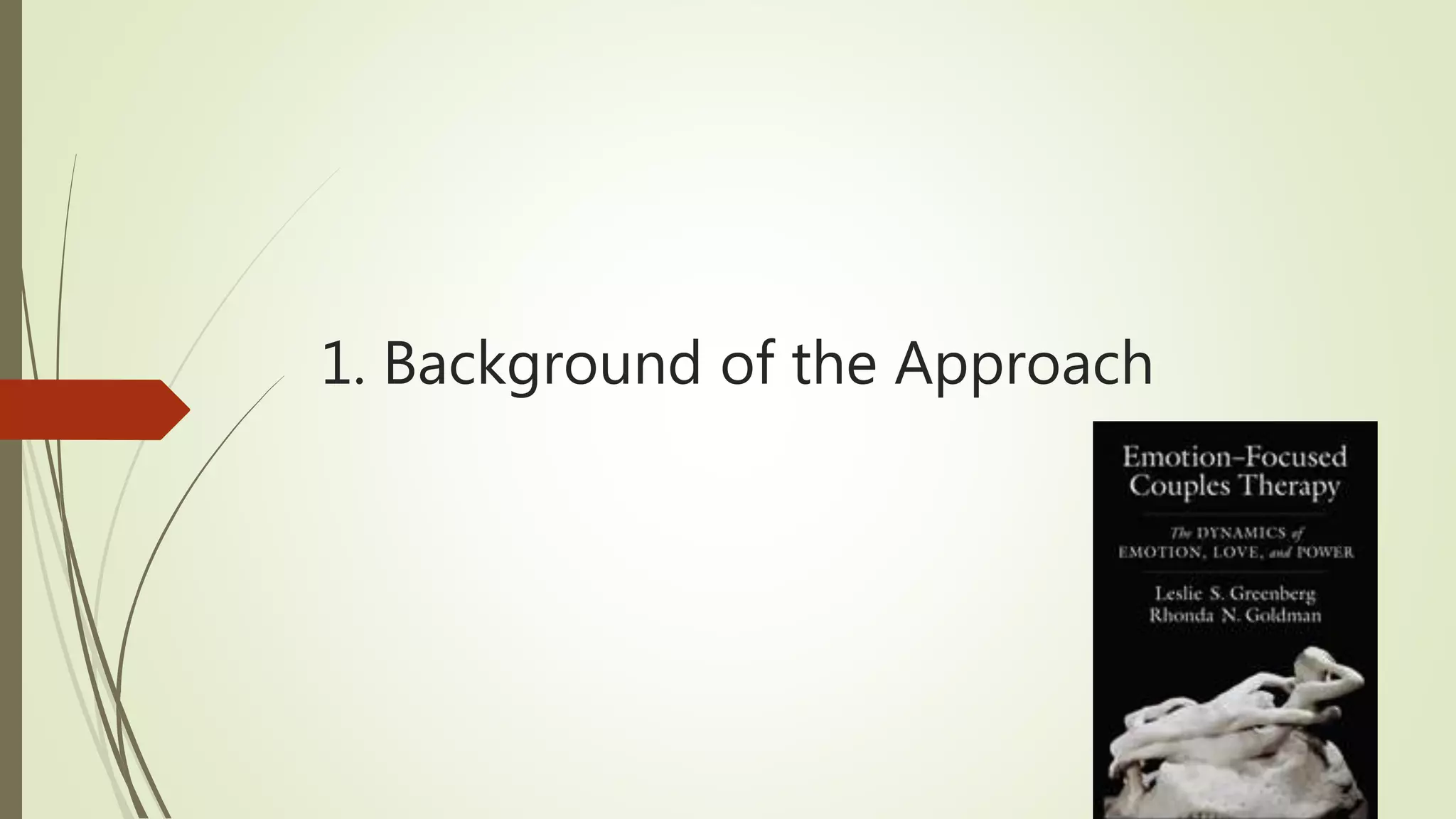
1. Background of the Approach
 It is a constructivist approach: learning is an active, contextualized process of
constructing knowledge rather than acquiring it. Knowledge is constructed based on
personal experiences and the context.
 focuses on the ongoing construction of present experience (particularly experience that
is emotionally charged),
 and a systemic approach, in that it also focuses on the construction of patterns of
interaction with intimate others based on attachment theory.
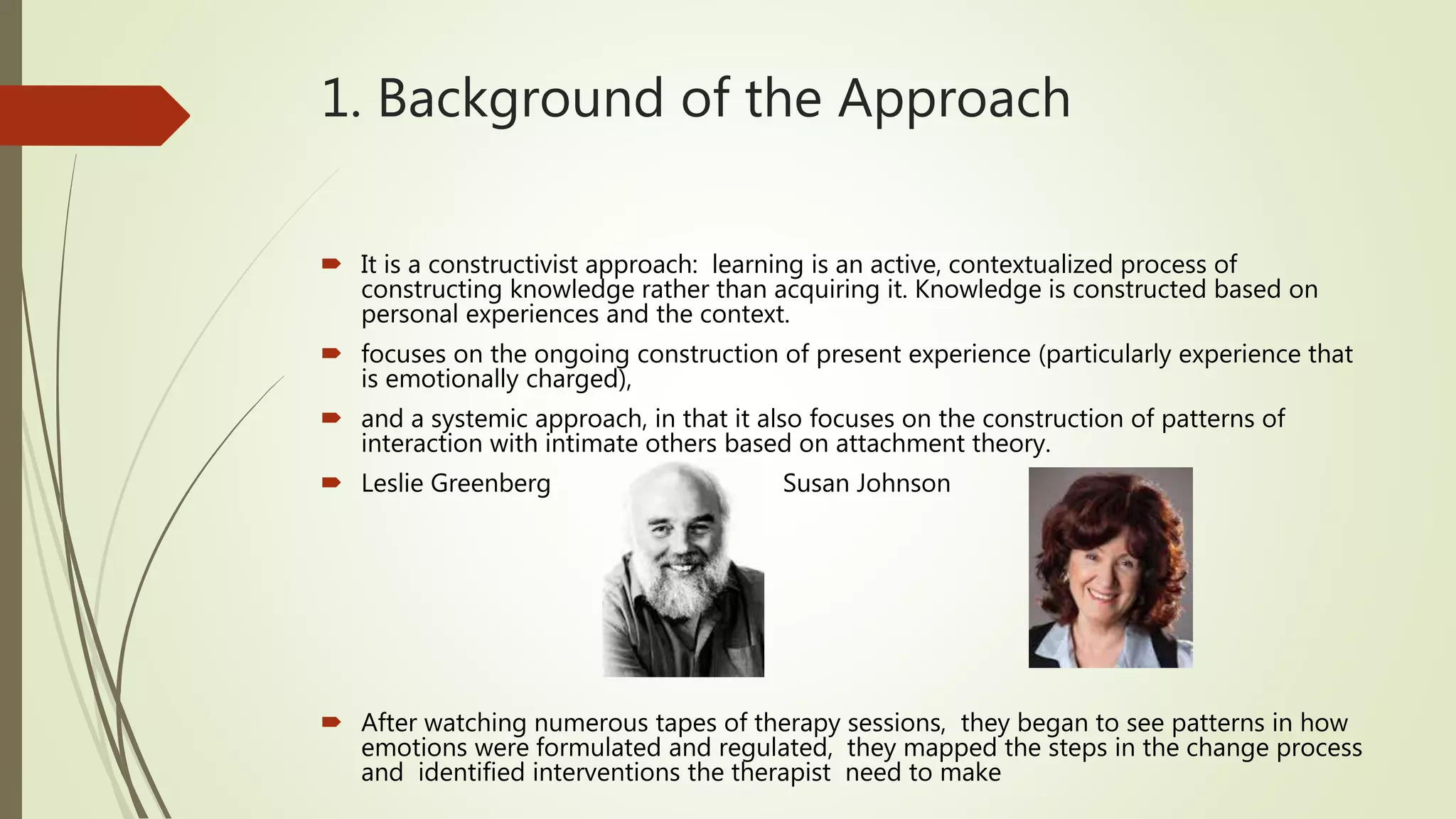
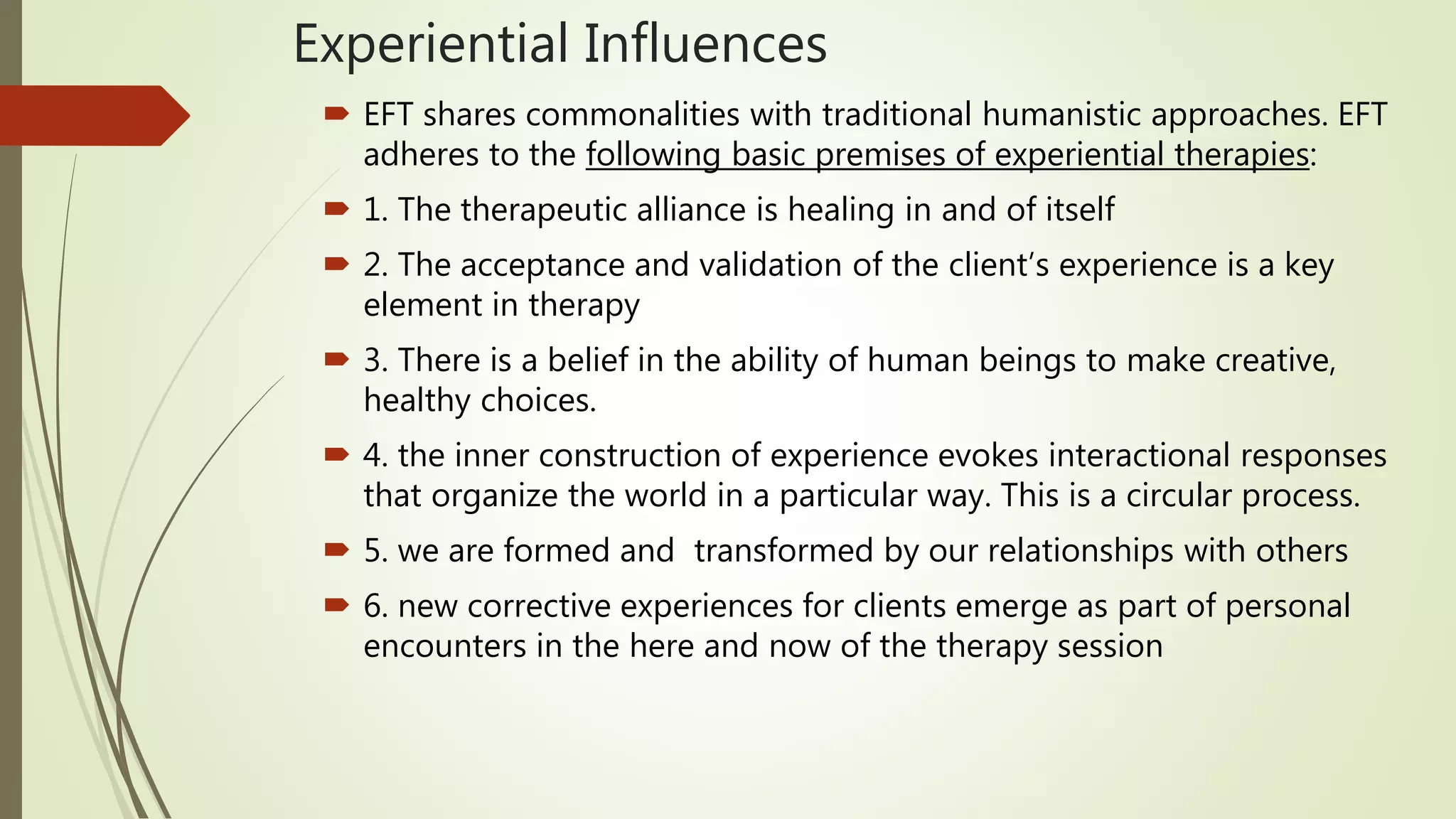
 Leslie Greenberg Susan Johnson
 After watching numerous tapes of therapy sessions, they began to see patterns in how
emotions were formulated and regulated, they mapped the steps in the change process
and identified interventions the therapist need to make
Experiential Influences
 EFT shares commonalities with traditional humanistic approaches. EFT
adheres to the following basic premises of experiential therapies:
 1. The therapeutic alliance is healing in and of itself
 2. The acceptance and validation of the client’s experience is a key
element in therapy
 3. There is a belief in the ability of human beings to make creative,
healthy choices.
 4. the inner construction of experience evokes interactional responses
that organize the world in a particular way. This is a circular process.
 5. we are formed and transformed by our relationships with others
 6. new corrective experiences for clients emerge as part of personal
encounters in the here and now of the therapy session
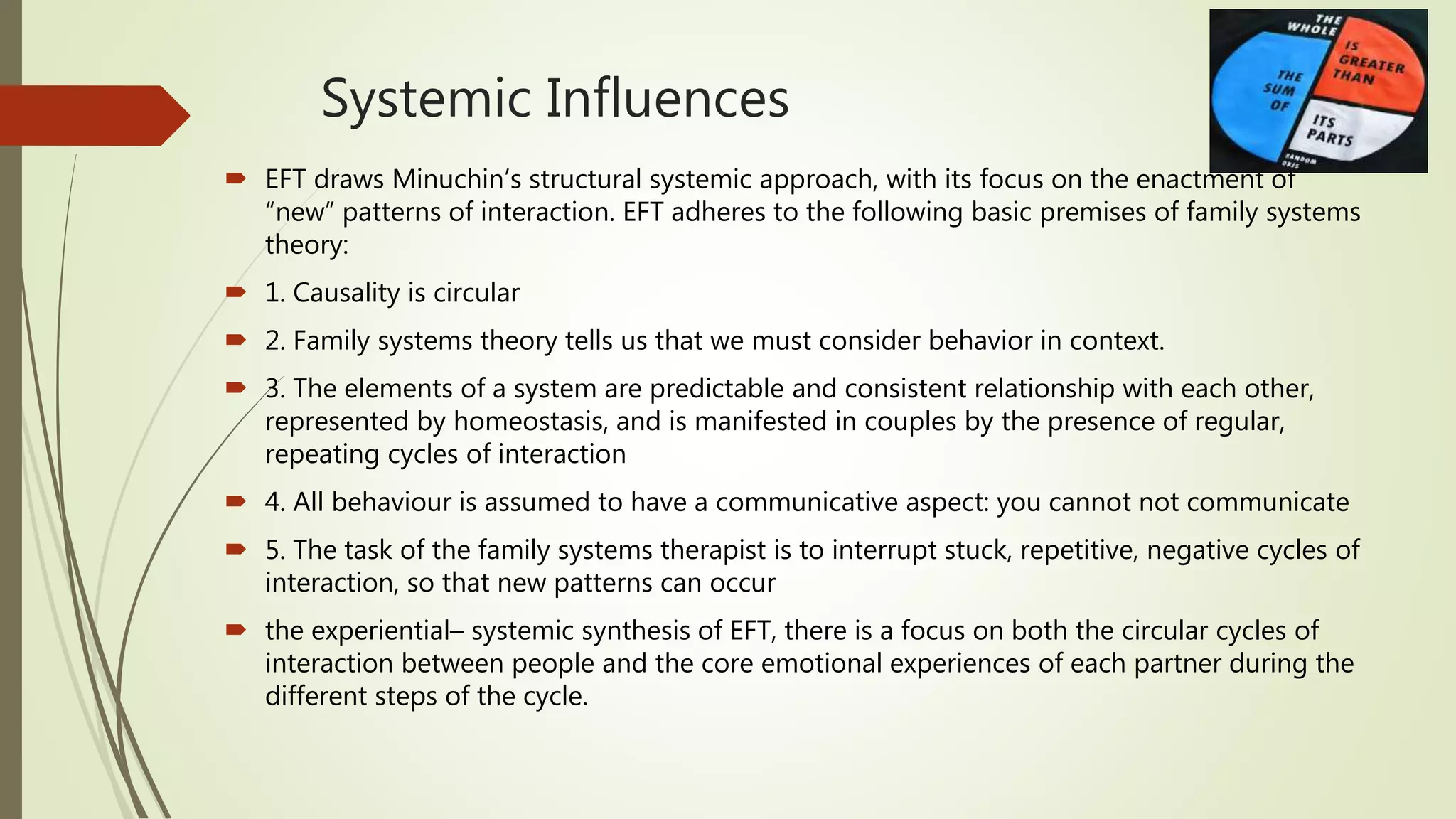
Systemic Influences
 EFT draws Minuchin’s structural systemic approach, with its focus on the enactment of
“new” patterns of interaction. EFT adheres to the following basic premises of family systems
theory:
 1. Causality is circular
 2. Family systems theory tells us that we must consider behavior in context.
 3. The elements of a system are predictable and consistent relationship with each other,
represented by homeostasis, and is manifested in couples by the presence of regular,
repeating cycles of interaction
 4. All behaviour is assumed to have a communicative aspect: you cannot not communicate
 5. The task of the family systems therapist is to interrupt stuck, repetitive, negative cycles of
interaction, so that new patterns can occur
 the experiential– systemic synthesis of EFT, there is a focus on both the circular cycles of
interaction between people and the core emotional experiences of each partner during the
different steps of the cycle.
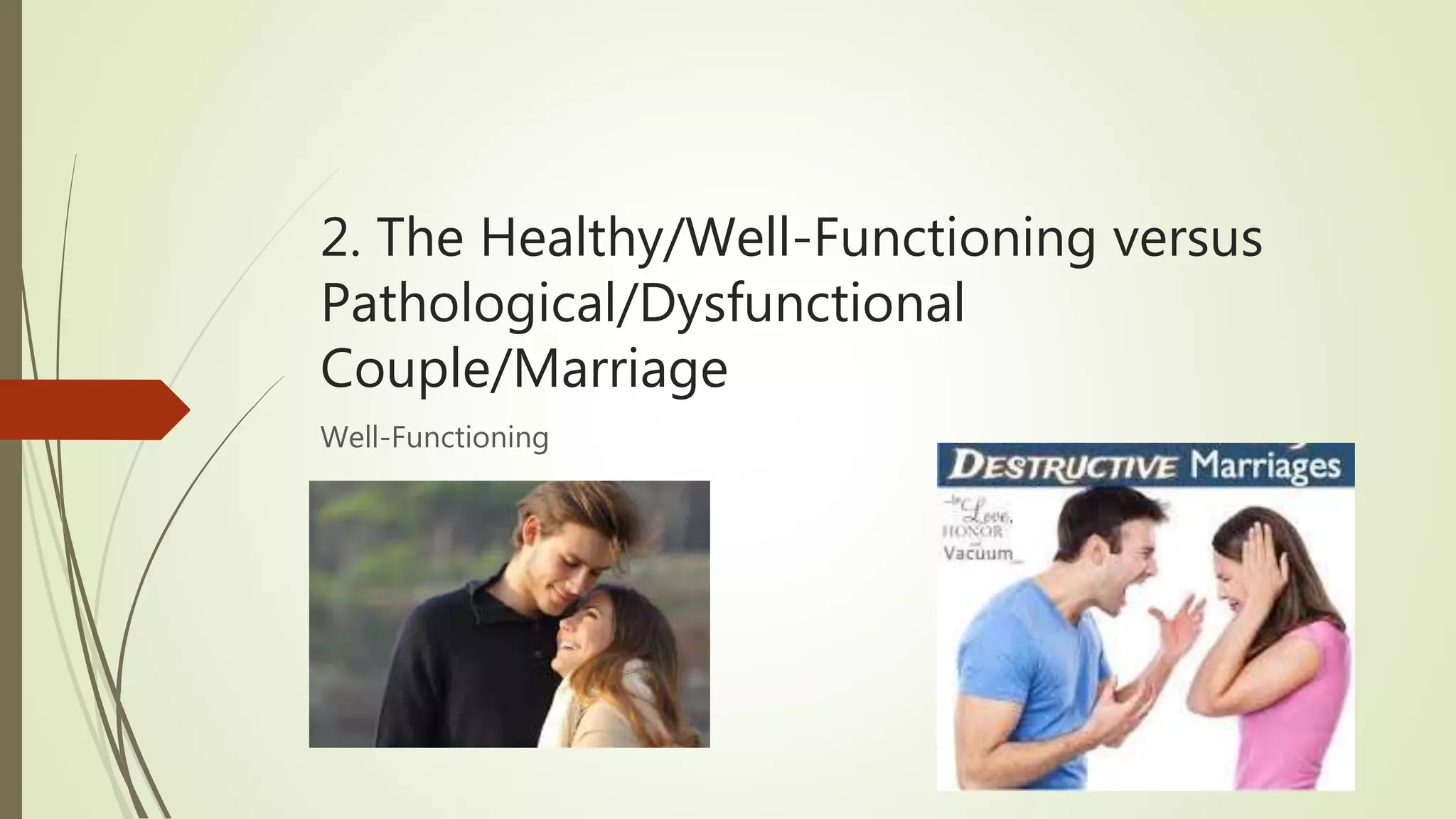
2. The Healthy/Well-Functioning versus
Pathological/Dysfunctional
Couple/Marriage
Well-Functioning
Healthy/Well-Functioning
 A healthy relationship, in EFT terms, is a secure attachment bond. Such a
bond is characterized by mutual emotional
 accessibility and responsiveness. This bond creates a safe environment
that optimizes partners’ ability to regulate their emotions, process
information, solve problems, resolve differences, and communicate
clearly. Secure relationships are associated with higher levels of intimacy,
trust, and satisfaction.
 the research on adult attachment has demonstrated that secure
relationships are associated with higher levels of intimacy, trust, and
satisfaction.
 Security in key relationships helps us regulate our emotions, process
information effectively, and communicate clearly
 Security involves inner realities, cognitive models and ways of regulating
emotion, and patterns of interaction
View of distress in EFT
EFT looks at distress in relationships through the
lens of attachment insecurity and separation
distress
Relationship distress is maintained by absorbing
negative affect.
Affect reflects and primes rigid, constricted
patterns of interaction.
Patterns make safe emotional engagement
difficult and create insecure bonding.
View of Distress
Rigid repetitive interactional patterns:
No exits – no detours/ repair impossible
Rigid narrow positions – fight/flight/freeze
Most common patterns
Criticize, complain, express contempt
Defend, distance, stonewall
Results: self reinforcing cycles or reactivity/self
protective strategies
View of Distress
Partners cannot attune to one another because
they are so absorbed in their own negative affect
Cannot communicate because of their own state.
Gottman 1979 – absorbing states of negative
affect: everything leads in, nothing leads out.
Key Principles of EFT
Key Principles
 1. A collaborative alliance offers a couple a secure base from which to
explore their relationship. The therapist is best seen as a process
consultant to the couple’s relationship.
 2. Emotion is primary in organizing attachment behaviors and how self
and other are experienced in intimate relationships. The EFT therapist
privileges emotional responses and deconstructs reactive, negative
emotions, such as anger, by expanding them to include marginalized
elements, such as fear and helplessness. The therapist also uses newly
formulated and articulated emotions, such as fear and longing or
assertive anger, to evoke new steps in the relationship dance
 3. The attachment needs and desires of partners are essentially healthy
and adaptive. It is the way such needs are enacted in a context of
perceived insecurity that creates problems.
Key Principles
4. Problems are maintained by the ways in which interactions are
organized and by the dominant emotional experience of each
partner in the relationship. Affect and interaction form a
reciprocally determining, self-reinforcing feedback loop.
5. Change occurs not through insight into the past, catharsis, or
negotiation, but through new emotional experience in the
present context of attachment-salient interactions.
6. In couple therapy, the “client” is the relationship between
partners. Problems are viewed in terms of adult insecurity and
separation distress. The ultimate goal of therapy is the creation of
new cycles of secure bonding that offer an antidote to negative
cycles and redefine the nature of the relationship.
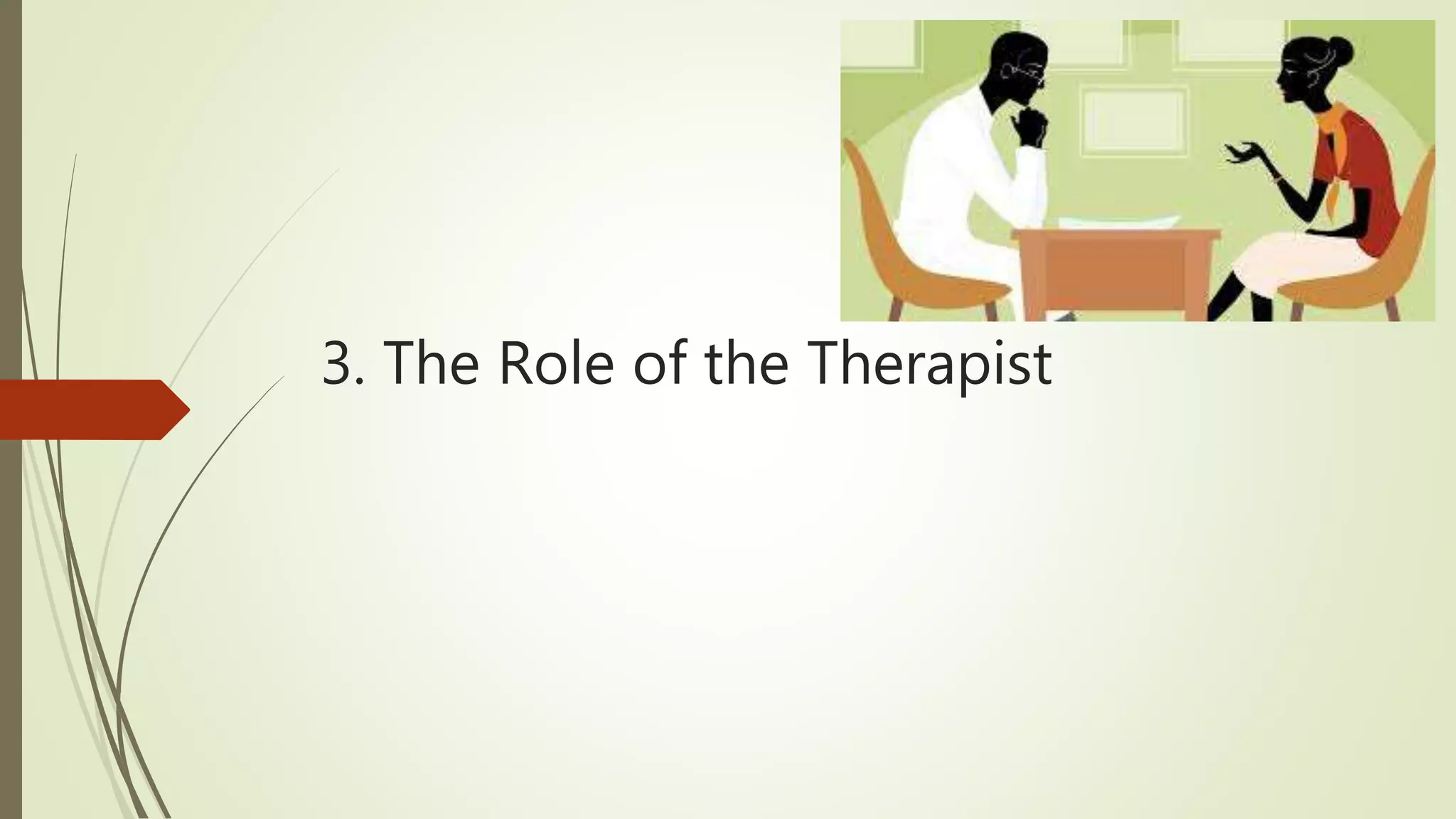
3. The Role of the Therapist
Develop an alliance, identify cycle, identify and access
underlying emotions, and work to deescalate
Engage the withdrawer
Soften the pursuer/blamer
Create new emotional bonding events and new cycles of
interaction
Consolidate new cycles of trust, connection and safety,
and apply them to old problems that may still be relevant
What Makes EFT, -- Its Look and Feel
1. Relentless Empathy
2. Attachment Frame and Language
3. De-pathologizing Model
4. RISSSC
5. Enactments
Skills forR-I-S-S-S-C
Emotional Engagement
R: The therapist intentionally REPEATS key words and
phrases for emphasis.
I:Therapist uses IMAGES or word pictures that evoke
emotions more than abstract labels tend to do.
S:Therapist frames responses to clients in SIMPLE and
concise phrases.
S:Therapist will SLOW the process of the session and the
pace of her speech to enable deepening of emotional
experience
S:Therapist will use SOFT and soothing tone of voice to
encourage a client to deepen experience.
C:Therapist uses CLIENT words and phrases in a
supportive/validating way.
4. Assessment and Treatment Planning
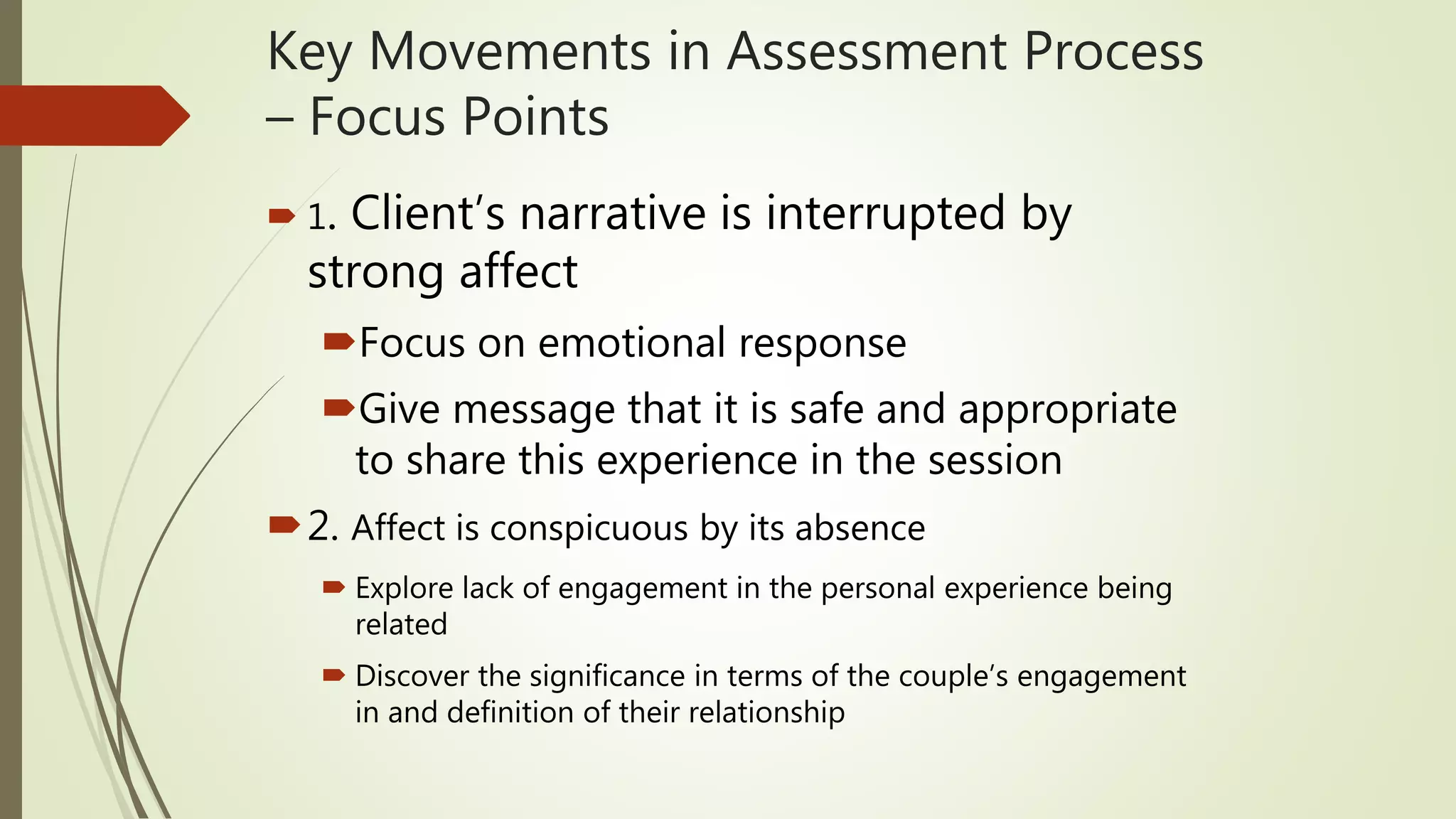
Key Movements in Assessment Process
– Focus Points
 1. Client’s narrative is interrupted by
strong affect
Focus on emotional response
Give message that it is safe and appropriate
to share this experience in the session
2. Affect is conspicuous by its absence
 Explore lack of engagement in the personal experience being
related
 Discover the significance in terms of the couple’s engagement
in and definition of their relationship
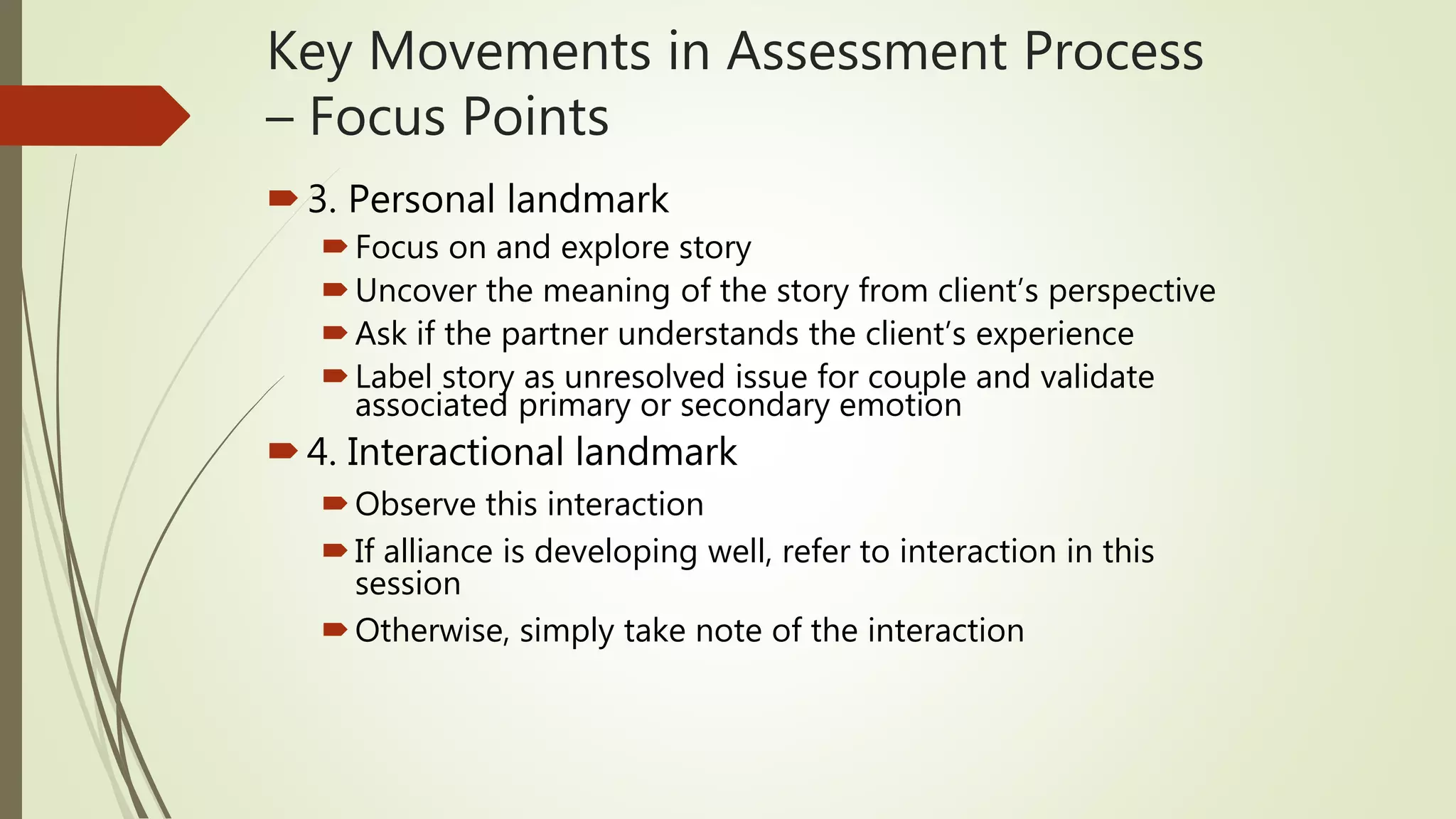
Key Movements in Assessment Process
– Focus Points
3. Personal landmark
Focus on and explore story
Uncover the meaning of the story from client’s perspective
Ask if the partner understands the client’s experience
Label story as unresolved issue for couple and validate
associated primary or secondary emotion
4. Interactional landmark
Observe this interaction
If alliance is developing well, refer to interaction in this
session
Otherwise, simply take note of the interaction
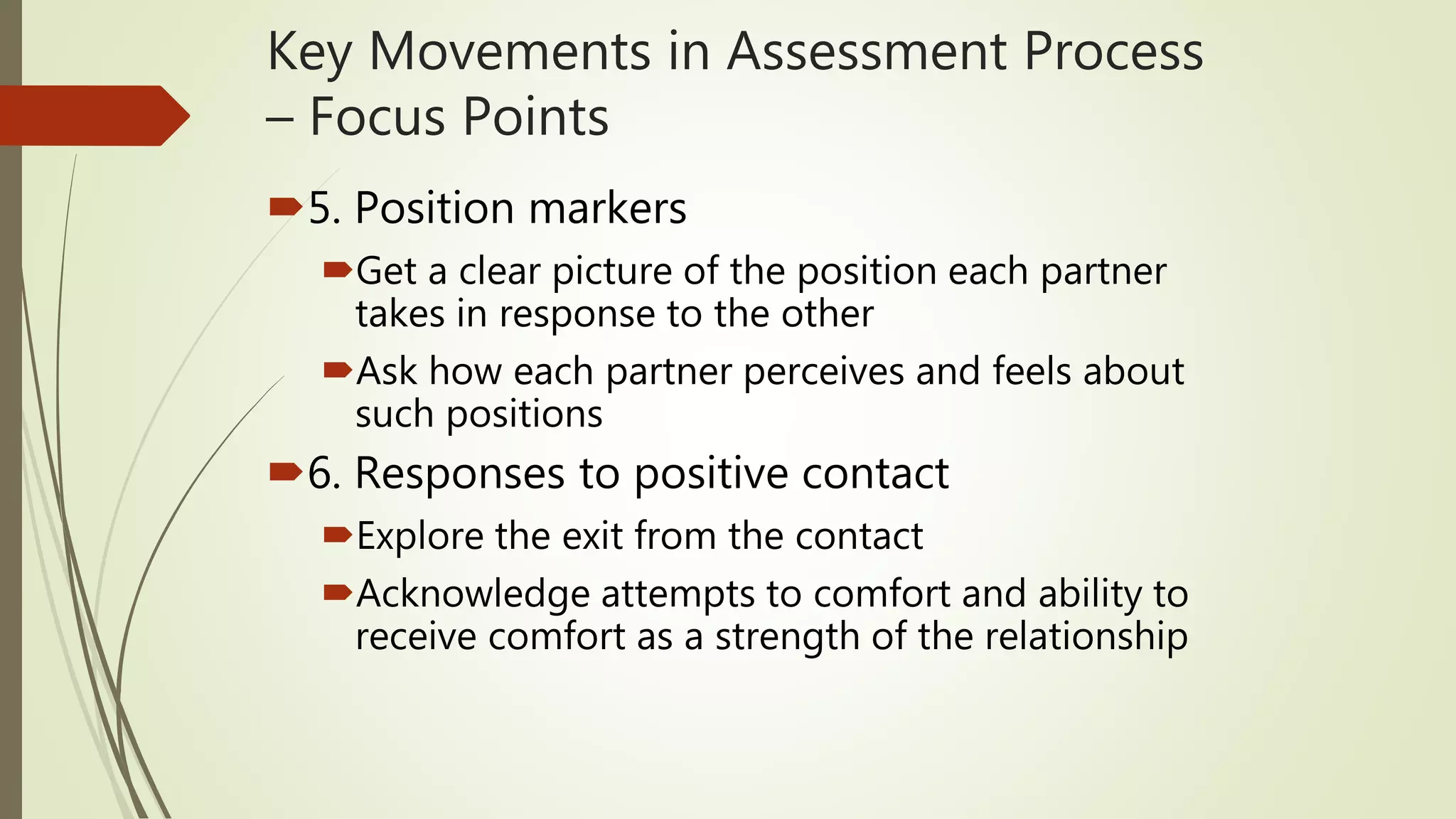
Key Movements in Assessment Process
– Focus Points
5. Position markers
Get a clear picture of the position each partner
takes in response to the other
Ask how each partner perceives and feels about
such positions
6. Responses to positive contact
Explore the exit from the contact
Acknowledge attempts to comfort and ability to
receive comfort as a strength of the relationship
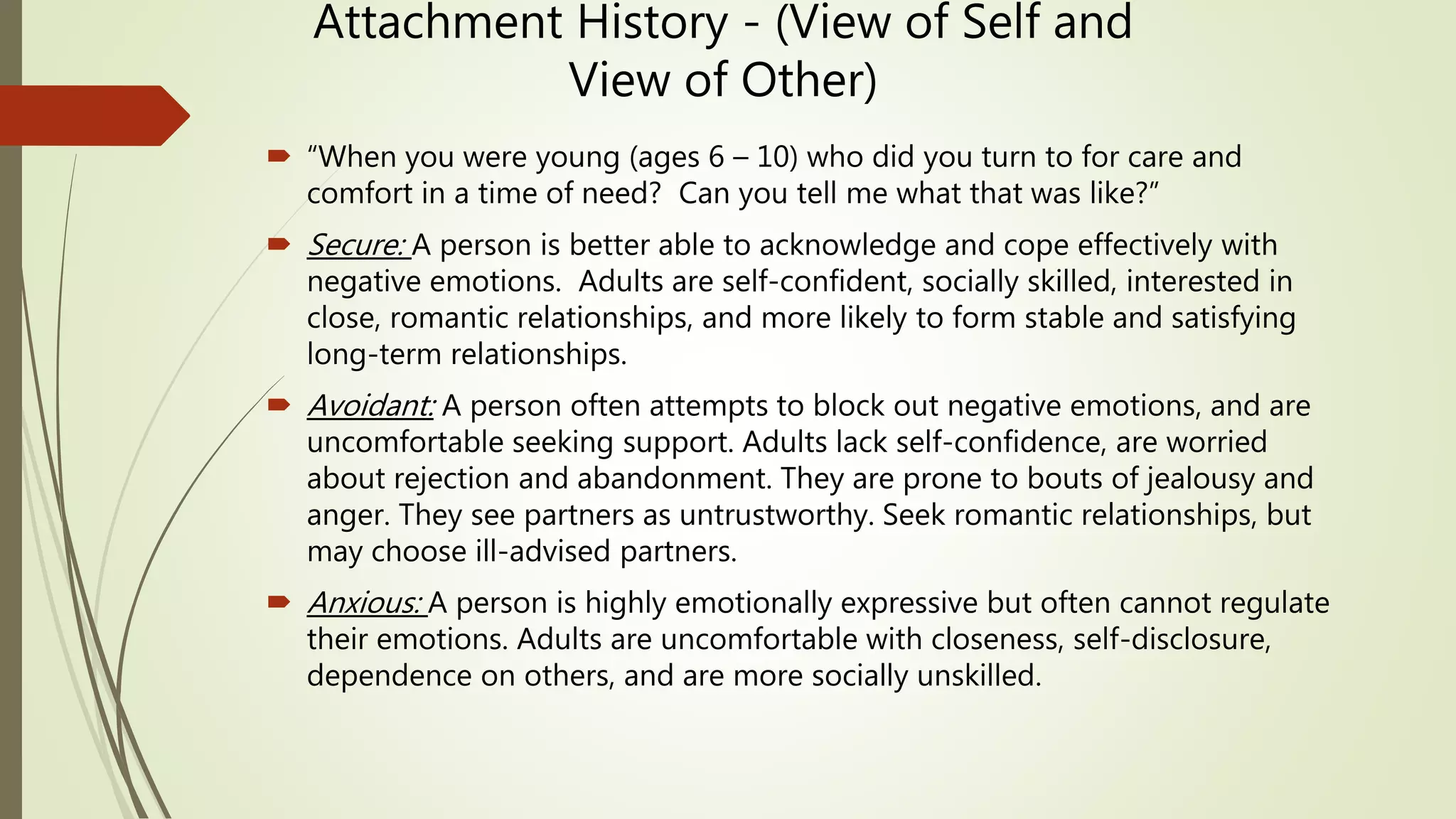
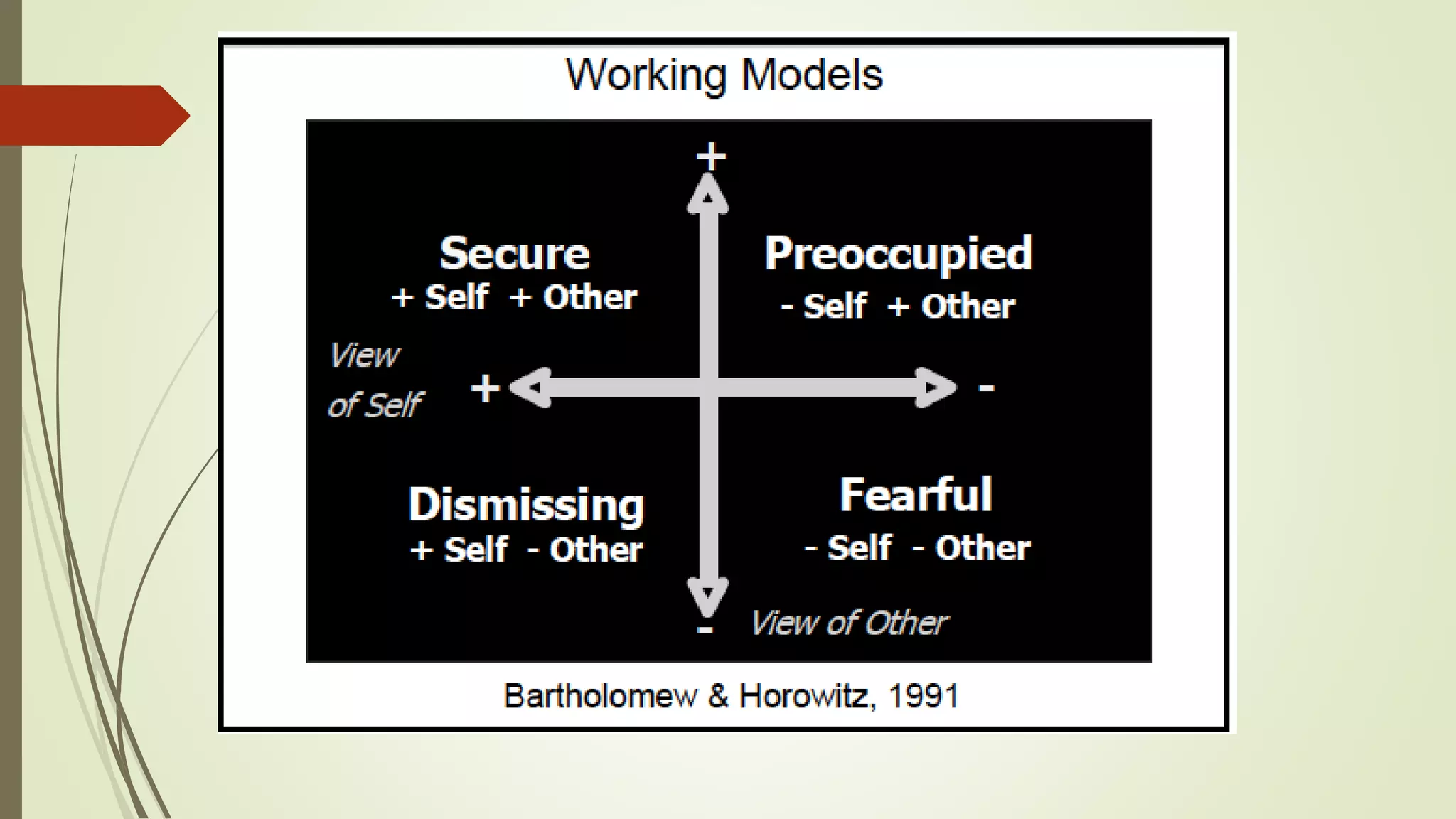
Attachment History - (View of Self and
View of Other)
 “When you were young (ages 6 – 10) who did you turn to for care and
comfort in a time of need? Can you tell me what that was like?”
 Secure: A person is better able to acknowledge and cope effectively with
negative emotions. Adults are self-confident, socially skilled, interested in
close, romantic relationships, and more likely to form stable and satisfying
long-term relationships.
 Avoidant: A person often attempts to block out negative emotions, and are
uncomfortable seeking support. Adults lack self-confidence, are worried
about rejection and abandonment. They are prone to bouts of jealousy and
anger. They see partners as untrustworthy. Seek romantic relationships, but
may choose ill-advised partners.
 Anxious: A person is highly emotionally expressive but often cannot regulate
their emotions. Adults are uncomfortable with closeness, self-disclosure,
dependence on others, and are more socially unskilled.
5. Goal Setting
5. Goal Setting: primary focus
• To expand and re-organize key emotional
responses between partners–the music of the
attachment dance.
• Create a shift in each partner’s interactional
positions in their rigid interactions with one another
and develop new cycles of interaction.
• Foster the creation of a secure bond between
partners through the creation of new interactional
experiences that redefine the relationship.
6. Process and Technical Aspects of EFT
Couple Therapy
Overview of EFT Treatment
Process
• Develop an alliance, identify cycle, identify and access
underlying emotions, and work to de-escalate
• Help couple see the negative cycle as the enemy, not
each other
• Engage the withdrawer
• Soften the pursuer/blamer
• Create new emotional bonding events and new cycles of
interaction
• Consolidate new cycles of trust, connection and safety,
and apply them to old problems that may still be
relevant
Attachment
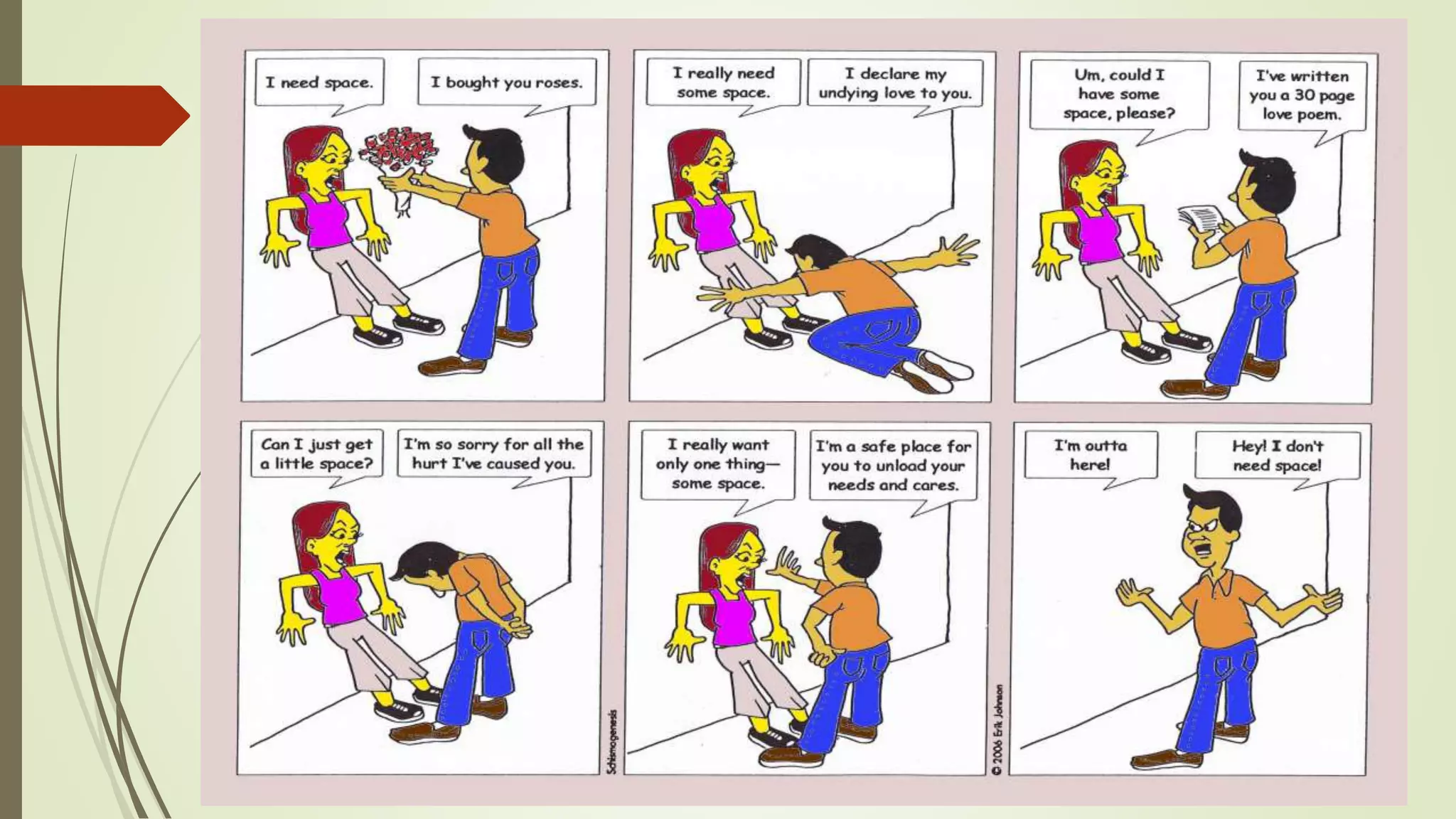
Withdrawer
“I never get it right or make her happy.”
“I don’t bother anymore what’s the point.”
(Feelings: Rejected, inadequate, fears failure,
overwhelmed, judged, shame, empty, alone)
Pursuer
“He’s never around and whenever he is he’s
always distracted.”
“She doesn’t see me. No matter what I do I don’t
count in her world.”
(Feelings: Hurt, unwanted, invisible, abandoned,
desperate, deprived, not important)
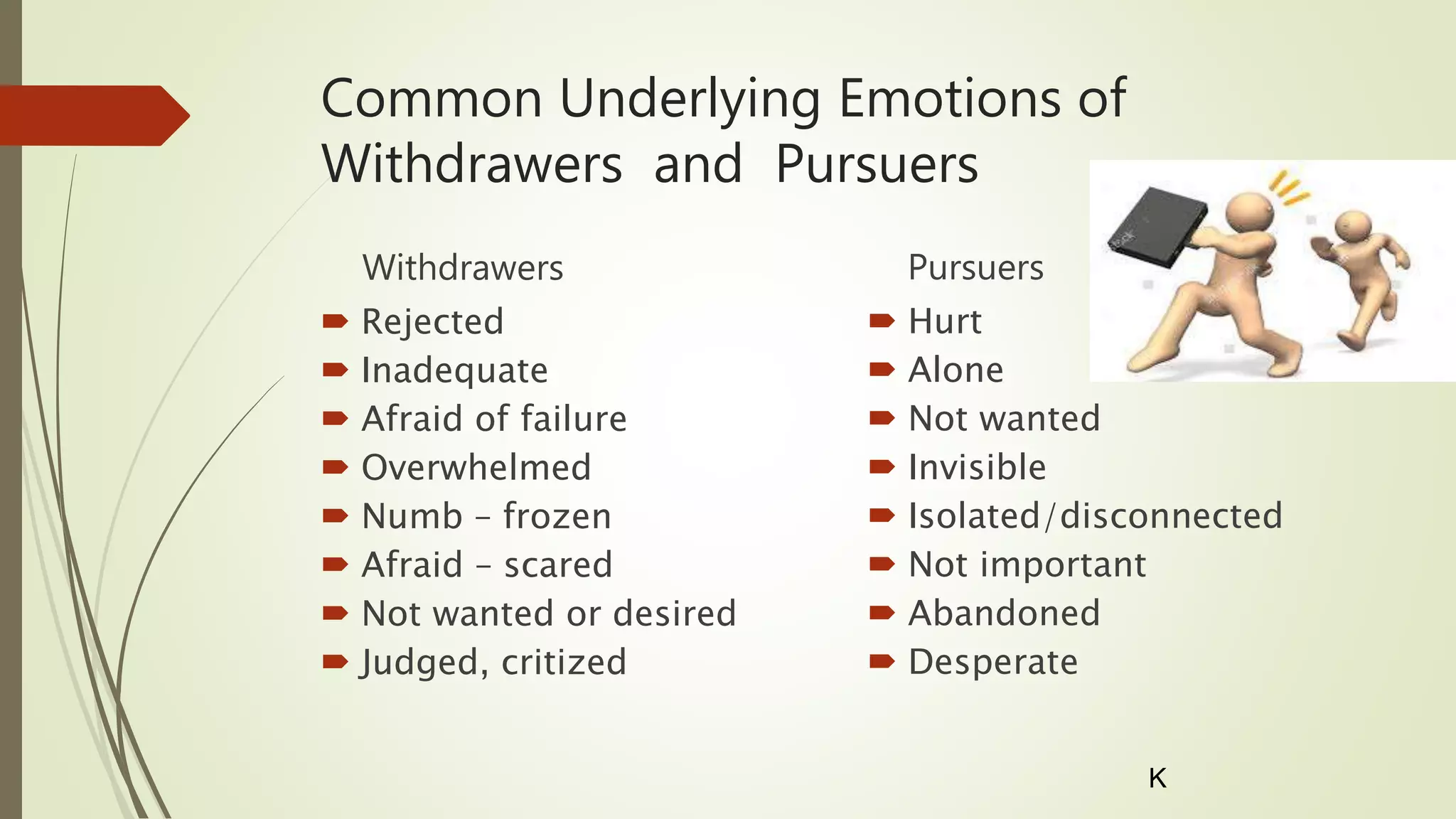
Common Underlying Emotions of
Withdrawers and Pursuers
Withdrawers
 Rejected
 Inadequate
 Afraid of failure
 Overwhelmed
 Numb – frozen
 Afraid – scared
 Not wanted or desired
 Judged, critized
Pursuers
 Hurt
 Alone
 Not wanted
 Invisible
 Isolated/disconnected
 Not important
 Abandoned
 Desperate
K
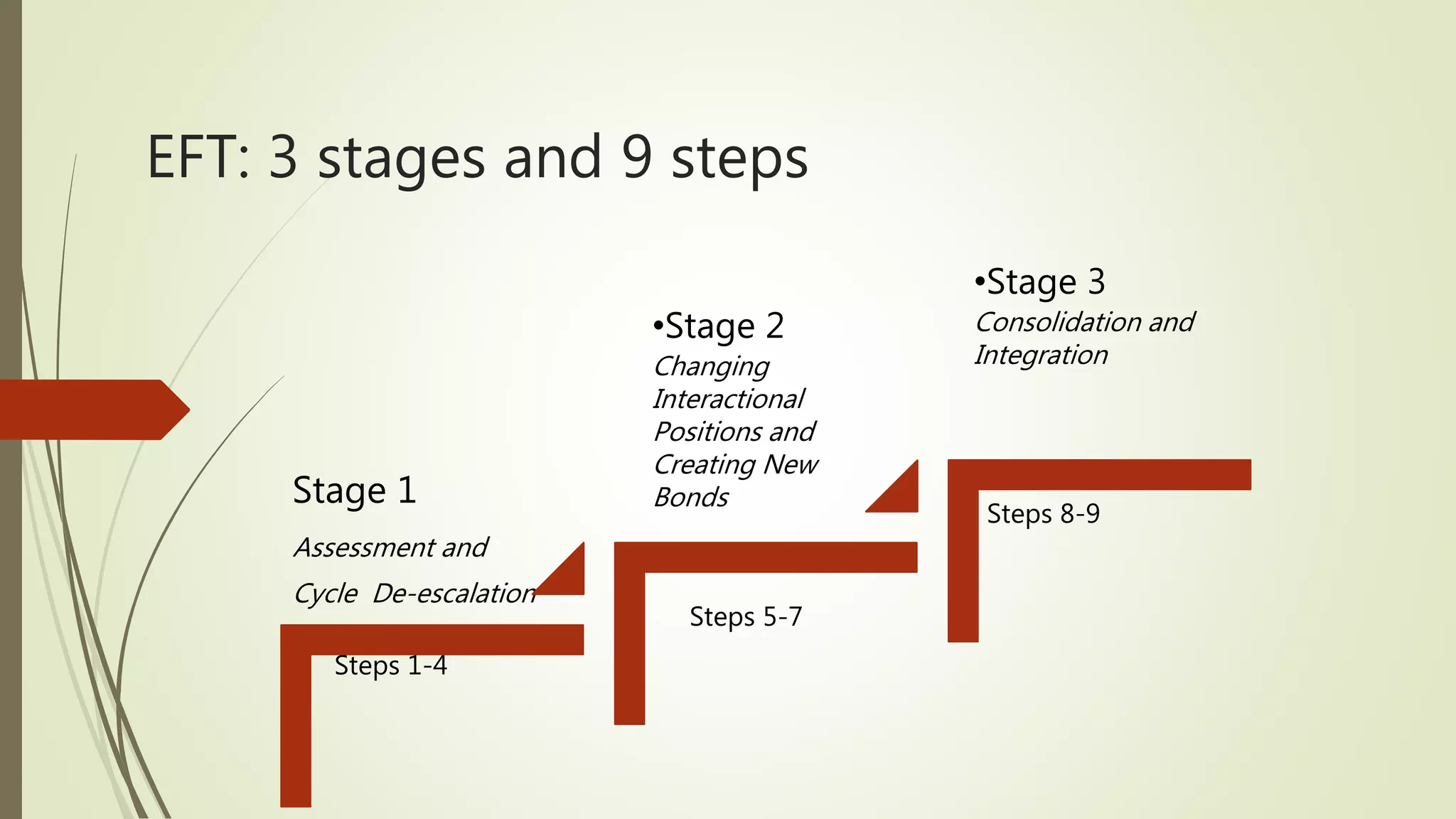
EFT: 3 stages and 9 steps
Stage 1
Assessment and
Cycle De-escalation
Steps 8-9
Steps 1-4
•Stage 2
Changing
Interactional
Positions and
Creating New
Bonds
•Stage 3
Consolidation and
Integration
Steps 5-7
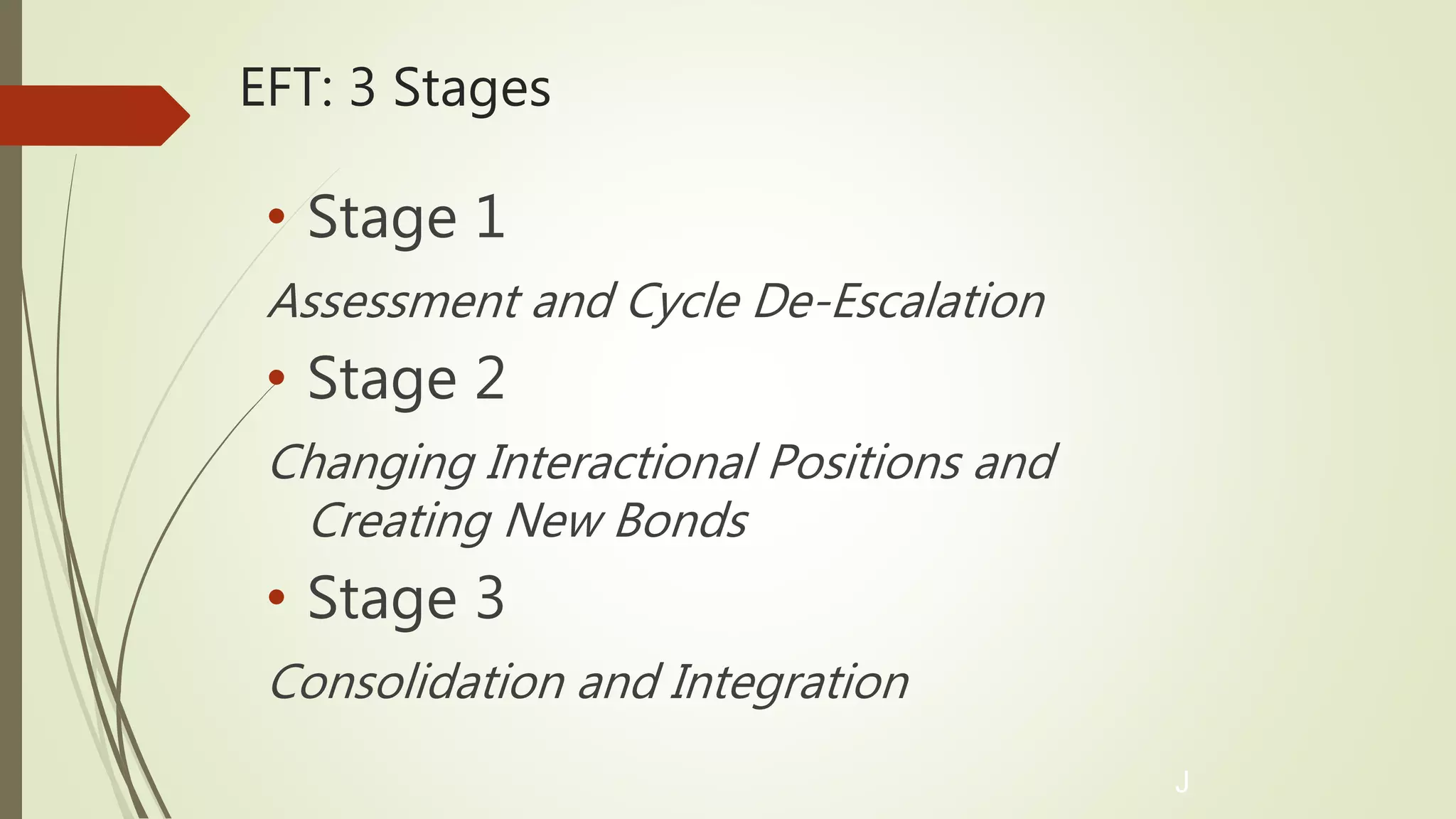
EFT: 3 Stages
• Stage 1
Assessment and Cycle De-Escalation
• Stage 2
Changing Interactional Positions and
Creating New Bonds
• Stage 3
Consolidation and Integration
J
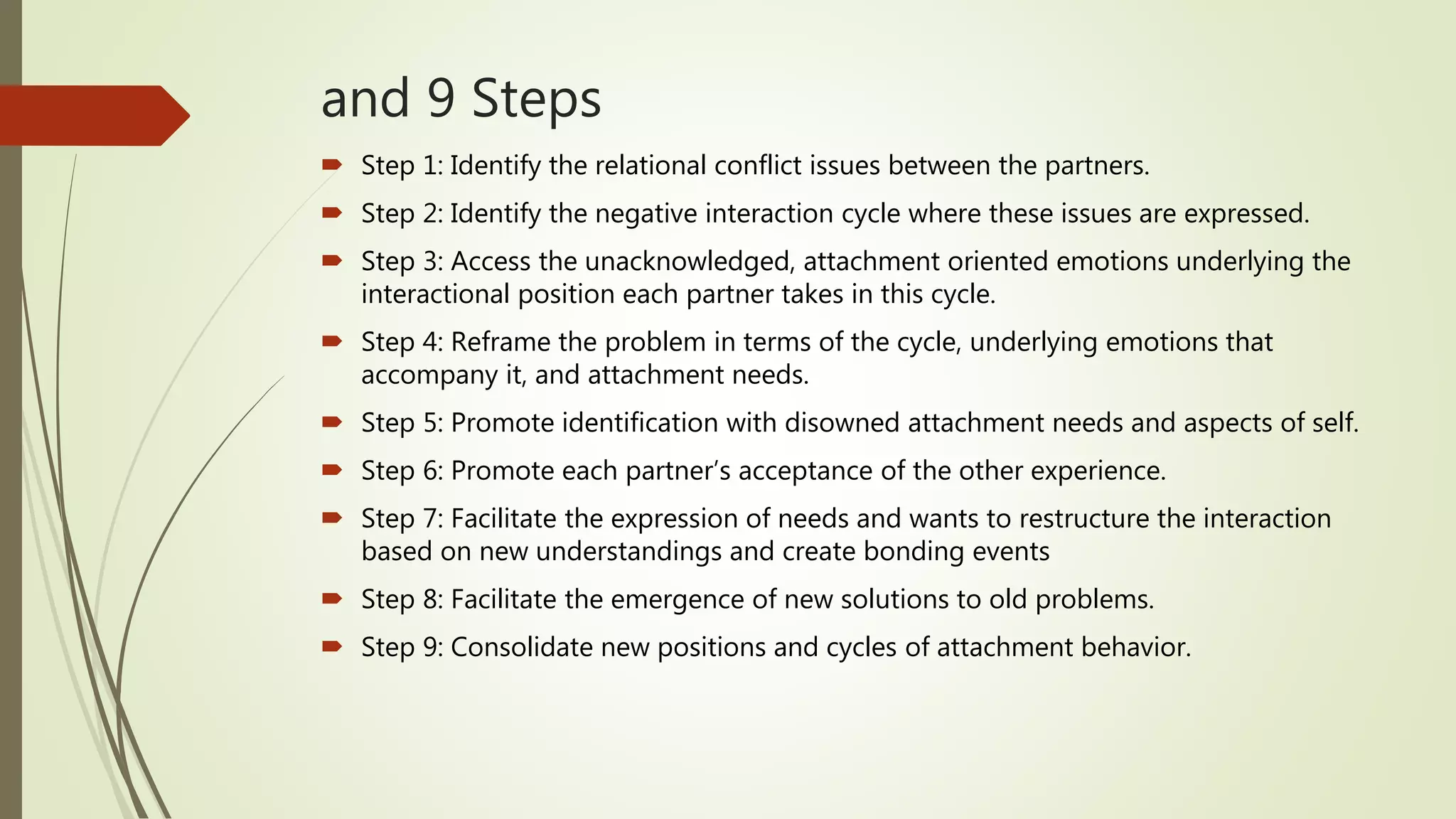
and 9 Steps
 Step 1: Identify the relational conflict issues between the partners.
 Step 2: Identify the negative interaction cycle where these issues are expressed.
 Step 3: Access the unacknowledged, attachment oriented emotions underlying the
interactional position each partner takes in this cycle.
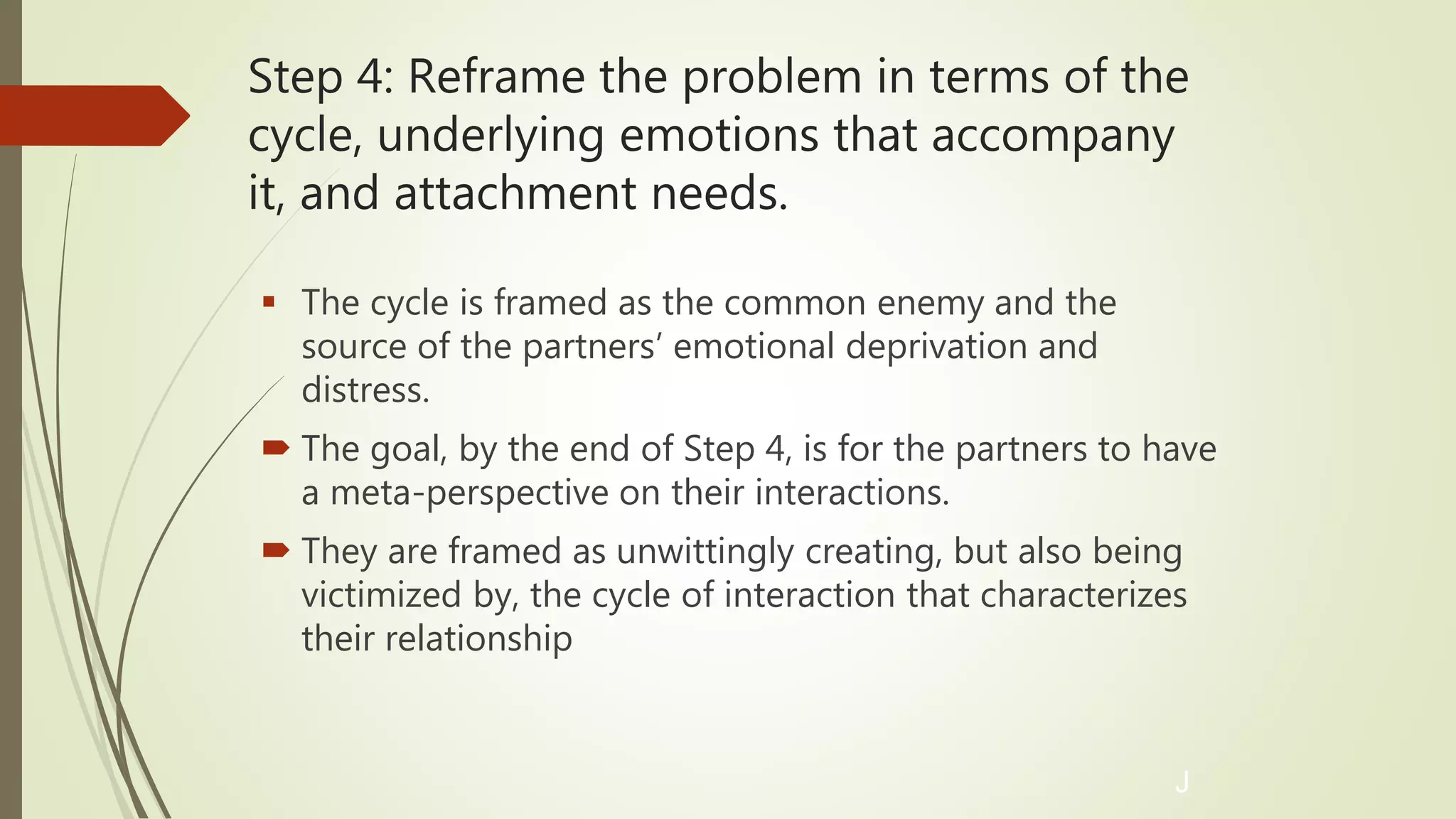
 Step 4: Reframe the problem in terms of the cycle, underlying emotions that
accompany it, and attachment needs.
 Step 5: Promote identification with disowned attachment needs and aspects of self.
 Step 6: Promote each partner’s acceptance of the other experience.
 Step 7: Facilitate the expression of needs and wants to restructure the interaction
based on new understandings and create bonding events
 Step 8: Facilitate the emergence of new solutions to old problems.
 Step 9: Consolidate new positions and cycles of attachment behavior.
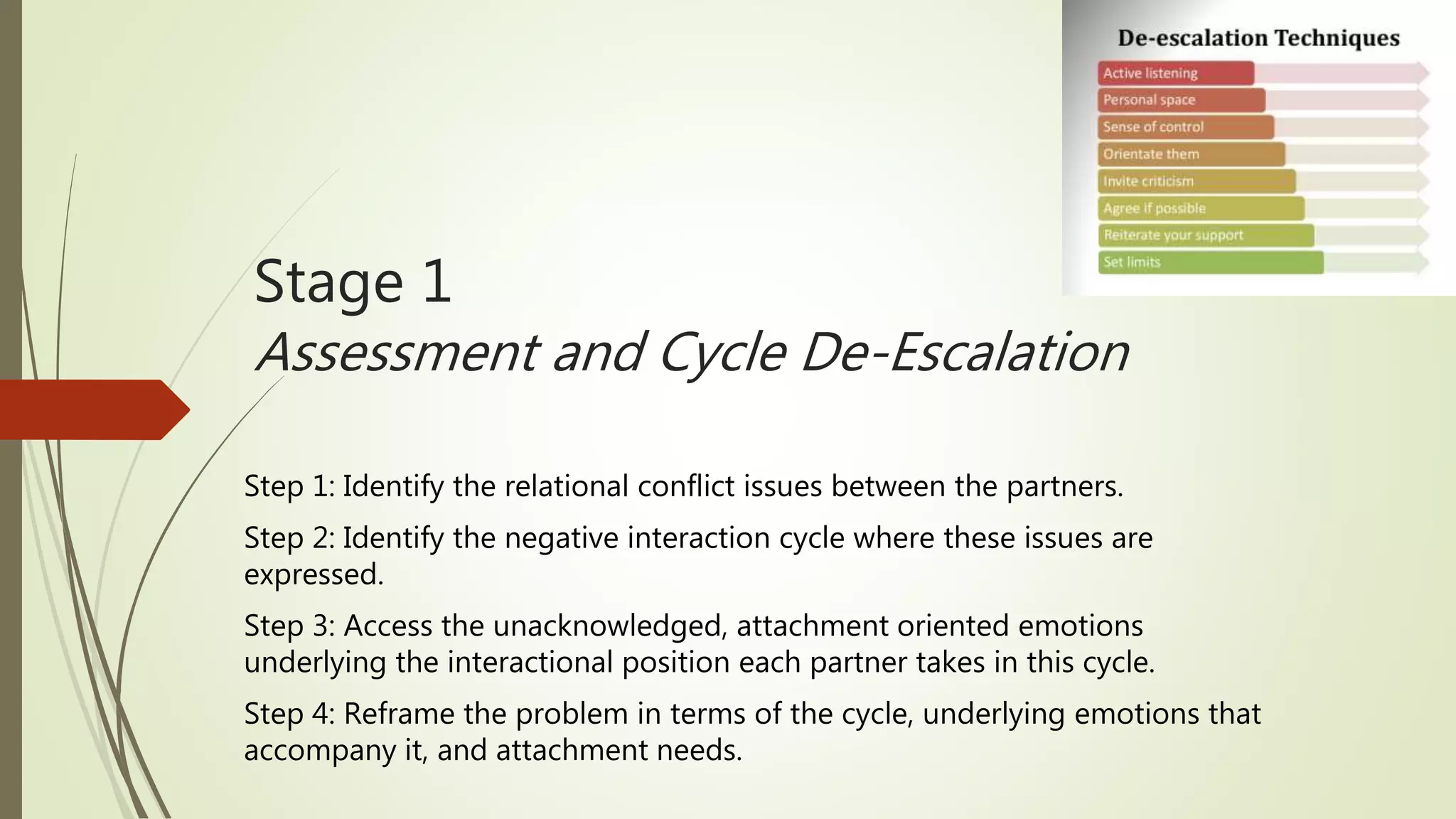
Stage 1
Assessment and Cycle De-Escalation
Step 1: Identify the relational conflict issues between the partners.
Step 2: Identify the negative interaction cycle where these issues are
expressed.
Step 3: Access the unacknowledged, attachment oriented emotions
underlying the interactional position each partner takes in this cycle.
Step 4: Reframe the problem in terms of the cycle, underlying emotions that
accompany it, and attachment needs.
The Nine Steps of Emotionally
Focused Couples Therapy
Step 1-4
• Alliance and assessment: Creating an
alliance and delineating conflict issues in
the core attachment struggle.
 What are they fighting about and how are
they related to core attachment issues?
J
Step 1: Identify the relational conflict issues
between the partners.
Alliance & assessment: Creating an alliance
and delineating conflict issues in the core
attachment struggle.
What are they fighting about and how are
they related to core attachment issues.
Establishing AN ALLIANCE
• Reflection
• Validation
• Empathic Attunement
Step 2: Identify the negative interaction
cycle where these issues are expressed.
Identify the negative interaction cycle
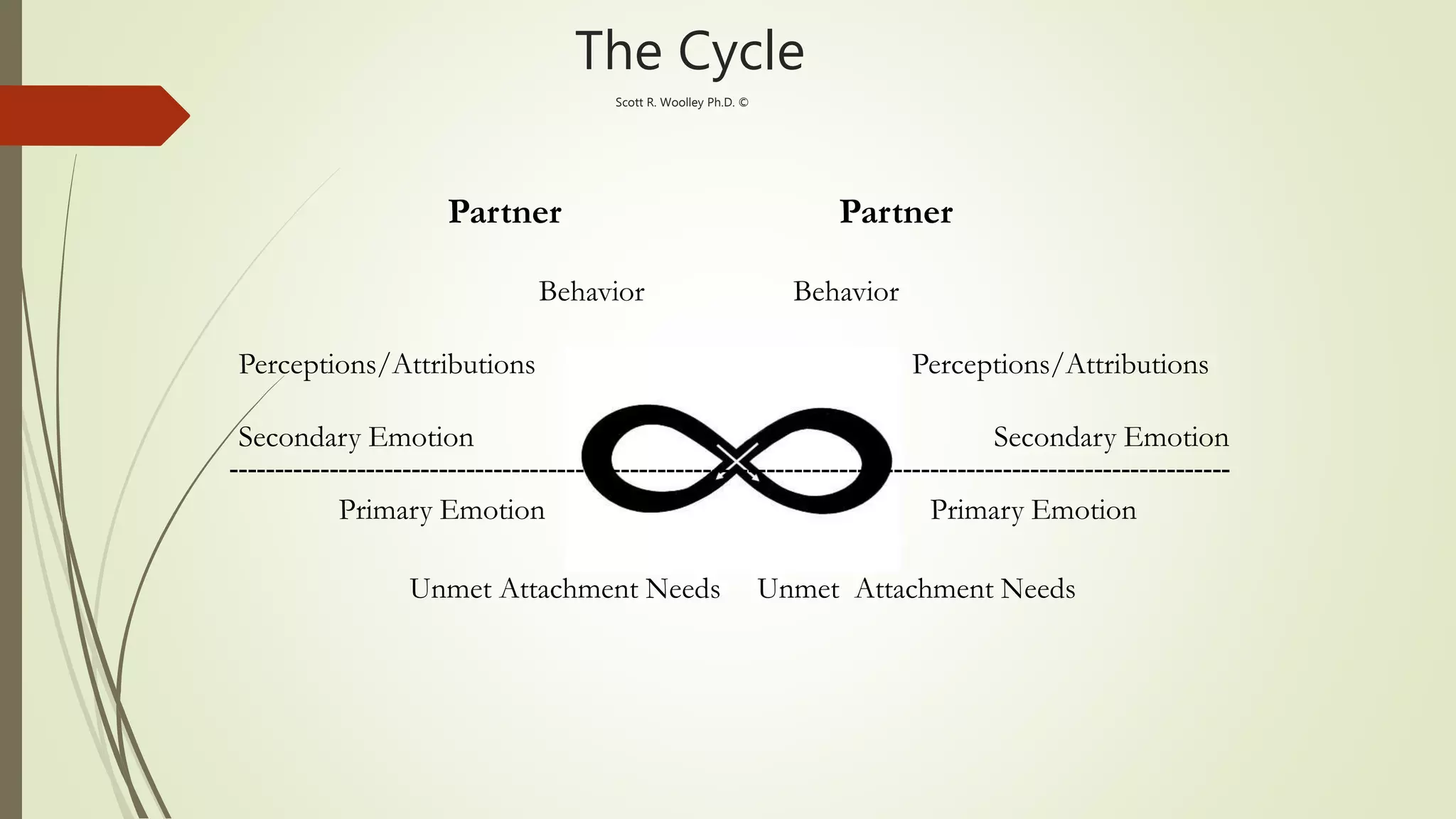
 EFT Cycle levels include
• Action tendencies (behaviors)
• Perceptions
• Secondary Emotions
• Primary Emotions
• Unmet Attachment Needs
 The goal is for the therapist to see the cycle in action and
identify and describe it to the couple and work toward
stopping it.
Identifying & Delineating
Negative Interactive Cycle
Basic Negative Cycles & Interactive Positions
Pursue/Withdraw
Withdraw/Withdraw
Attack/Attack
Complex cycles
Reactive pursue/Withdraw
EFT Emotions and Reactivity
Emotions occur at two levels: Primary and Secondary (or
reactive).
Primary Emotions are the deeper, more vulnerable and
tender emotions such as sadness, hurt, fear, shame,
and loneliness.
Secondary Emotions are the more reactive emotions such
as anger, jealousy, resentment, and frustration. They
occur as a reaction to the primary emotions. Anger,
Blame,
Primary emotions generally draw partners closer.
Secondary emotions tend to push partners away.
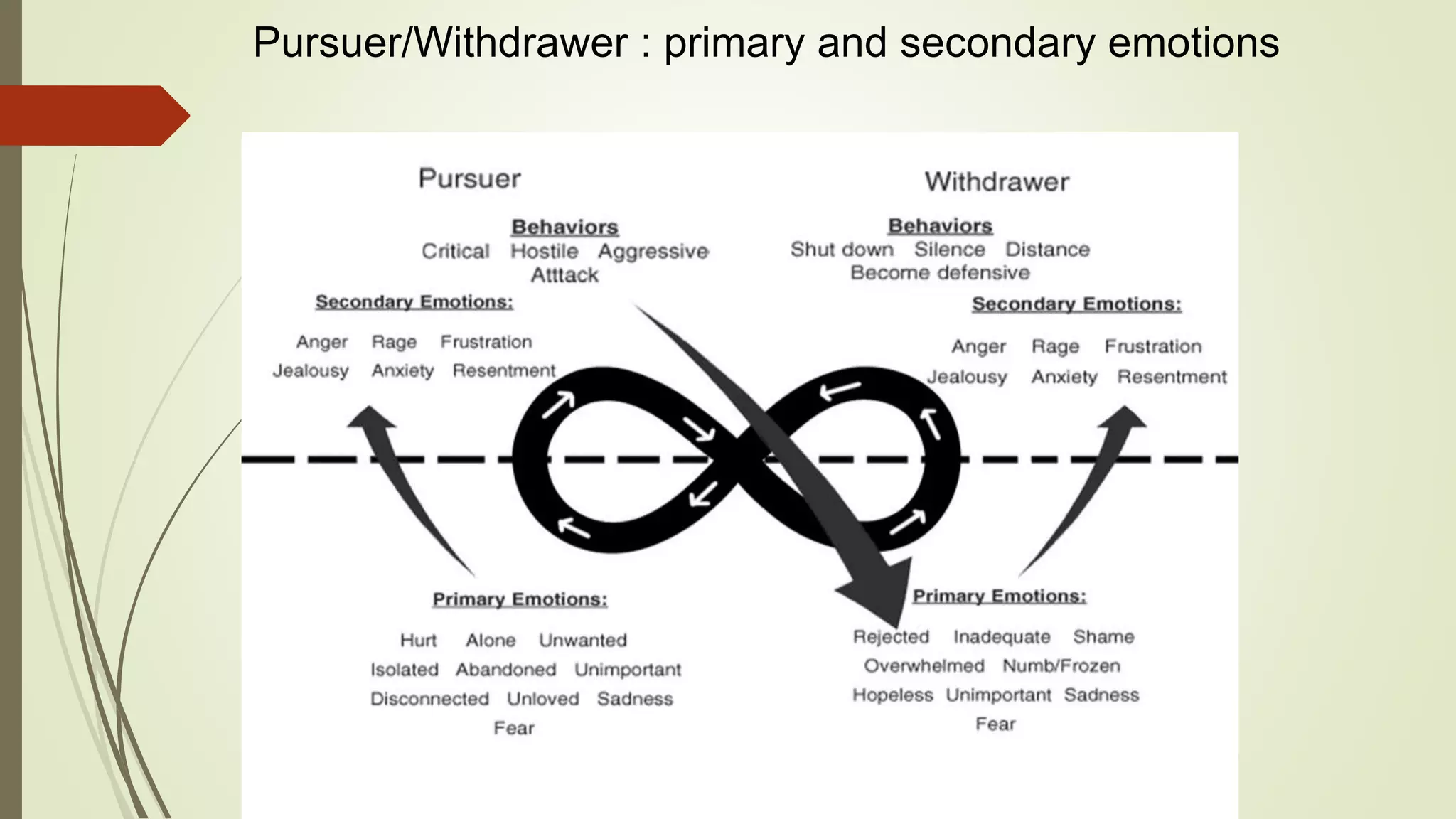
Pursuer/Withdrawer : primary and secondary emotions
STEP 2 – IDENTIFYING THE NEGATIVE
CYCLE
• Who is the Pursuer?
• Who is the Withdrawer?
• Describe the Negative Cycle
• What are the Secondary Emotions?
• What are the Primary Emotions?
E
Step 3: Access the unacknowledged, attachment
oriented emotions underlying the interactional
position each partner takes in this cycle.
 The goal is to help each member of the
couple to access and accept their
unacknowledged feelings that are
influencing their behavior in the
relationship.
 Both partners are to "reprocess and
crystallize their own experience in the
relationship" so that they can become
emotionally open to the other person.
Step 4: Reframe the problem in terms of the
cycle, underlying emotions that accompany
it, and attachment needs.
 The cycle is framed as the common enemy and the
source of the partners’ emotional deprivation and
distress.
 The goal, by the end of Step 4, is for the partners to have
a meta-perspective on their interactions.
 They are framed as unwittingly creating, but also being
victimized by, the cycle of interaction that characterizes
their relationship
J
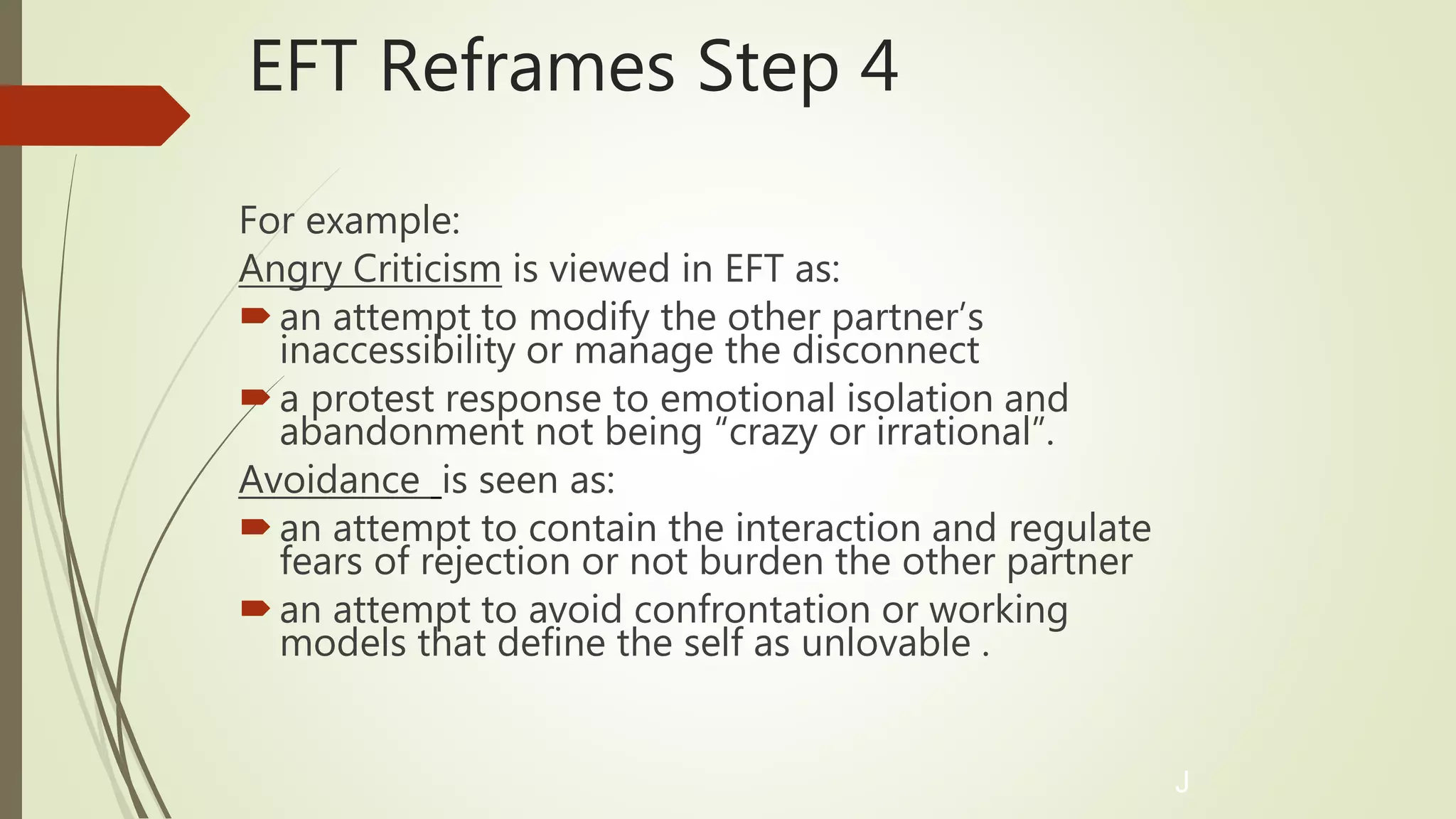
EFT Reframes Step 4
For example:
Angry Criticism is viewed in EFT as:
an attempt to modify the other partner’s
inaccessibility or manage the disconnect
a protest response to emotional isolation and
abandonment not being “crazy or irrational”.
Avoidance is seen as:
an attempt to contain the interaction and regulate
fears of rejection or not burden the other partner
an attempt to avoid confrontation or working
models that define the self as unlovable .
J
The Cycle
Scott R. Woolley Ph.D. ©
Partner Partner
Primary EmotionPrimary Emotion
Perceptions/AttributionsPerceptions/Attributions
Secondary EmotionSecondary Emotion
BehaviorBehavior
Unmet Attachment Needs Unmet Attachment Needs
--------------------------------------------------------------------------------------------------------------
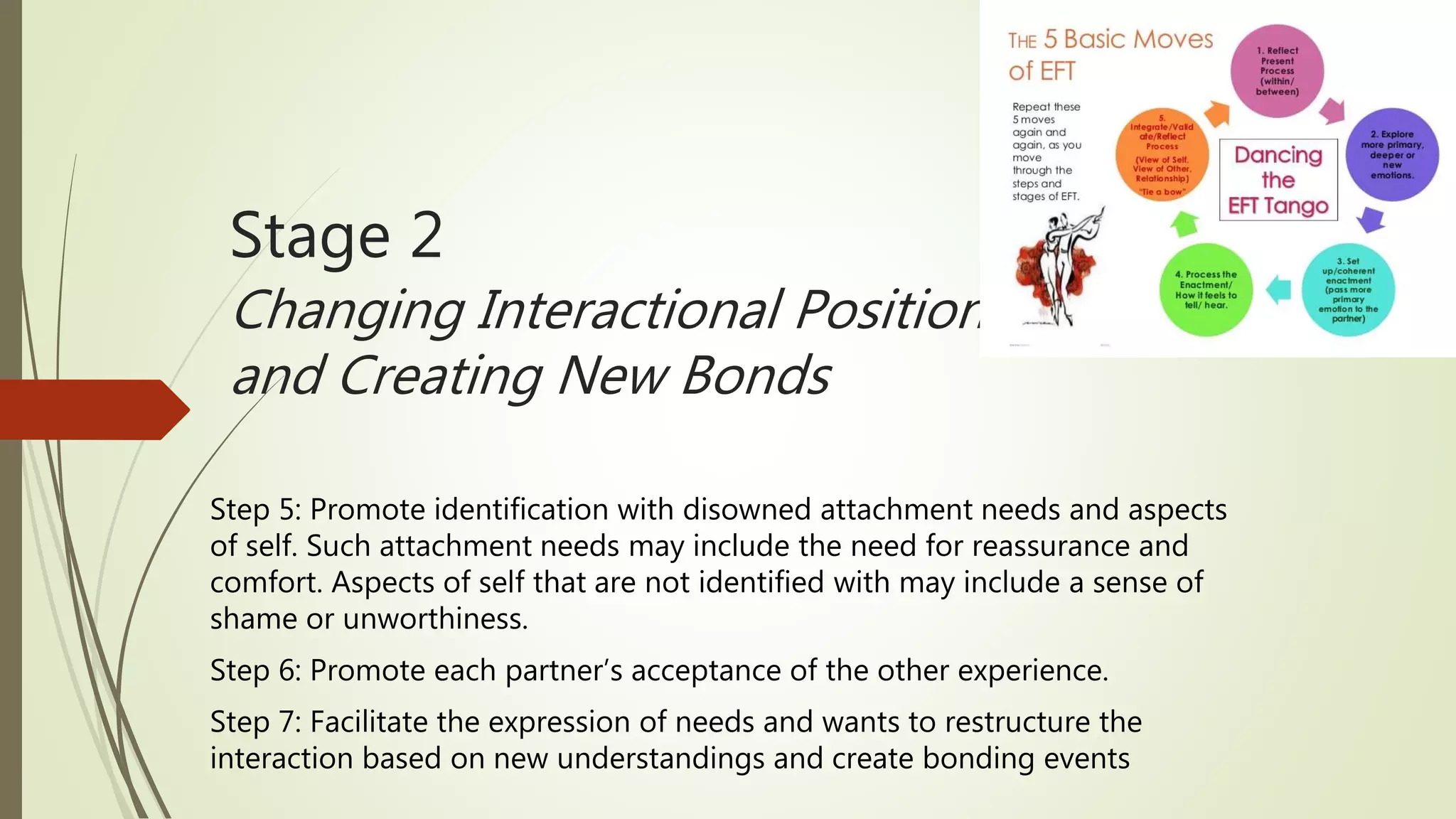
Stage 2
Changing Interactional Positions
and Creating New Bonds
Step 5: Promote identification with disowned attachment needs and aspects
of self. Such attachment needs may include the need for reassurance and
comfort. Aspects of self that are not identified with may include a sense of
shame or unworthiness.
Step 6: Promote each partner’s acceptance of the other experience.
Step 7: Facilitate the expression of needs and wants to restructure the
interaction based on new understandings and create bonding events
The Nine Steps of EFT
STAGE 2
Steps 5-7
Step 5- Withdrawer Re-Engagement
and Pursuer Softening
Promote identification with disowned attachment
emotions, needs and aspects of self, and integrate these
into relationship interactions.
 Help the couple redefine their experiences in terms of
their unacknowledged emotional needs. "I nag because I
feel abandoned and I want to be loved." "I withdraw
because I feel invaded and rejected and I need to feel
safe and loved."
A
The Nine Steps of Emotionally
Focused Couples Therapy
Step 6
Promote acceptance of the other partner’s experiences
and new interactional responses .
 Work to get each partner to accept, believe, and trust
that what the other partner is describing in terms of
underlying emotional needs is accurate.
A
The Nine Steps of Emotionally
Focused Couples Therapy
Step 7
Facilitate the expression of needs and wants and create
emotional engagement and bonding events that redefine
the attachment between the partners.
 Help them learn to express their emotional needs and
wants directly rather than through the old patterns and
create emotional engagement. This will help each person
see the other person in a more benign manner. (Feeling
vulnerable and insecure rather than rejecting.)
A
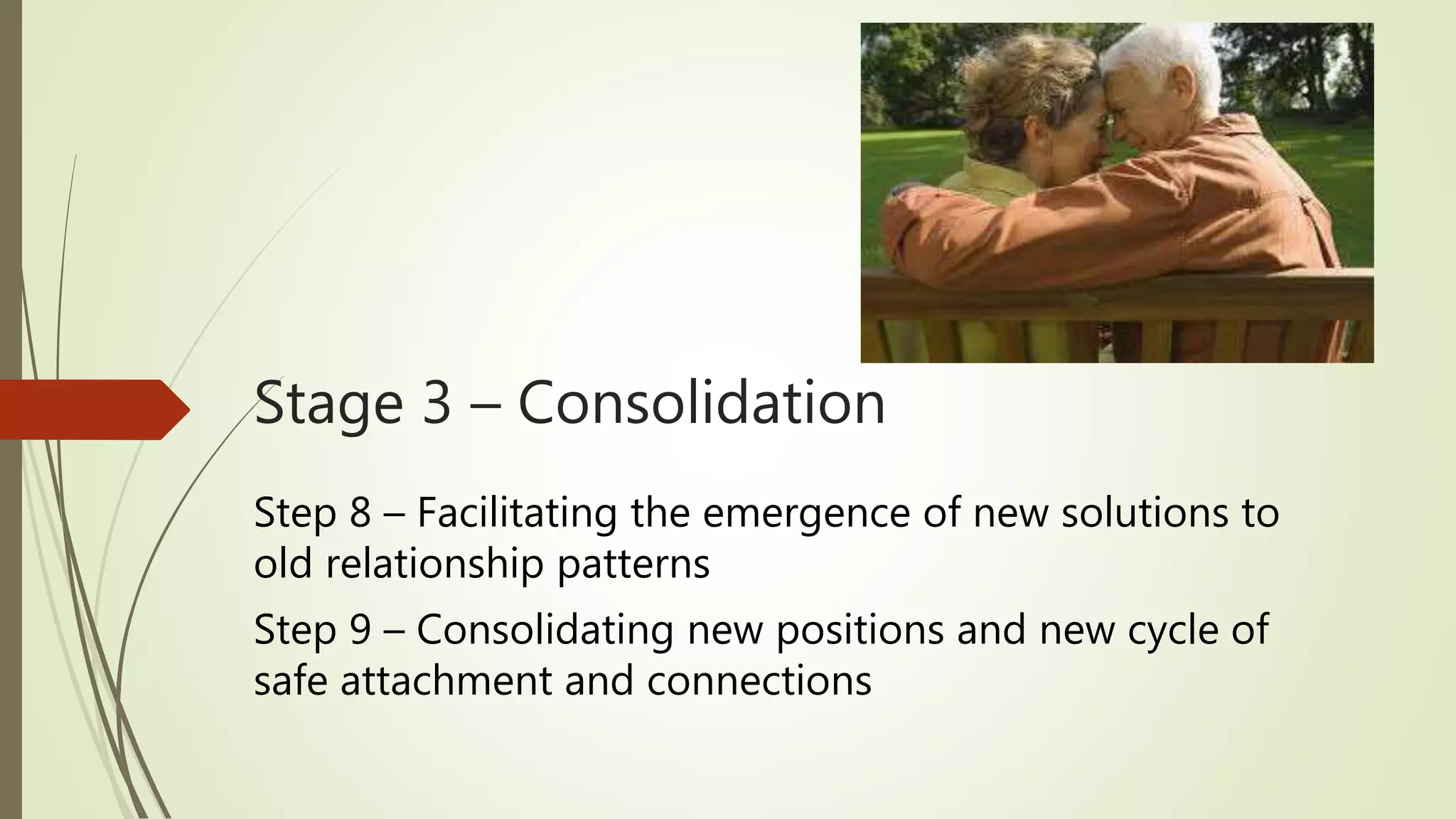
Stage 3 – Consolidation
Step 8 – Facilitating the emergence of new solutions to
old relationship patterns
Step 9 – Consolidating new positions and new cycle of
safe attachment and connections
Softening
Pre-requisites:
De-escalation of negative cycle (Stage 1)
Withdrawer re-engagement (Stage 2 change
event)
A previously hostile, critical partner accesses
“softer” emotions and risks reaching out to
his/her partner who is engaged and
responsive.
In this vulnerable state, the previously hostile
partner asks for attachment needs to be met.
Softening
At this point, both partners are attuned,
engaged and responsive (accessibility &
responsiveness)
A bonding event then occurs which redefines
the relationship as a safe haven and a secure
base.
Step 8 & 9
 The goal here is to consolidate new responses and cycles of
interaction, for example, by reviewing the accomplishments of the
partners in therapy and helping the couple create a coherent
narrative of their journey into and out of distress.
 The therapist also supports the couple to solve concrete problems
that have been destructive to the relationship.
 this is often relatively easy given that dialogues about these
problems are no longer infused with overwhelming negative affect
and issues of relationship definition.
 Without the old negative interaction style and with the new
emotional connection and attachment, it is easier to develop new
solutions to old problems.
7. Curative Factors/Mechanisms of
Change
Curative Factors/Mechanisms of Change
Once the alliance is established, there are two
basic therapeutic tasks in EFT:
 (1) the exploration and reformulation of
emotional experience, and
(2) the restructuring of interactions.
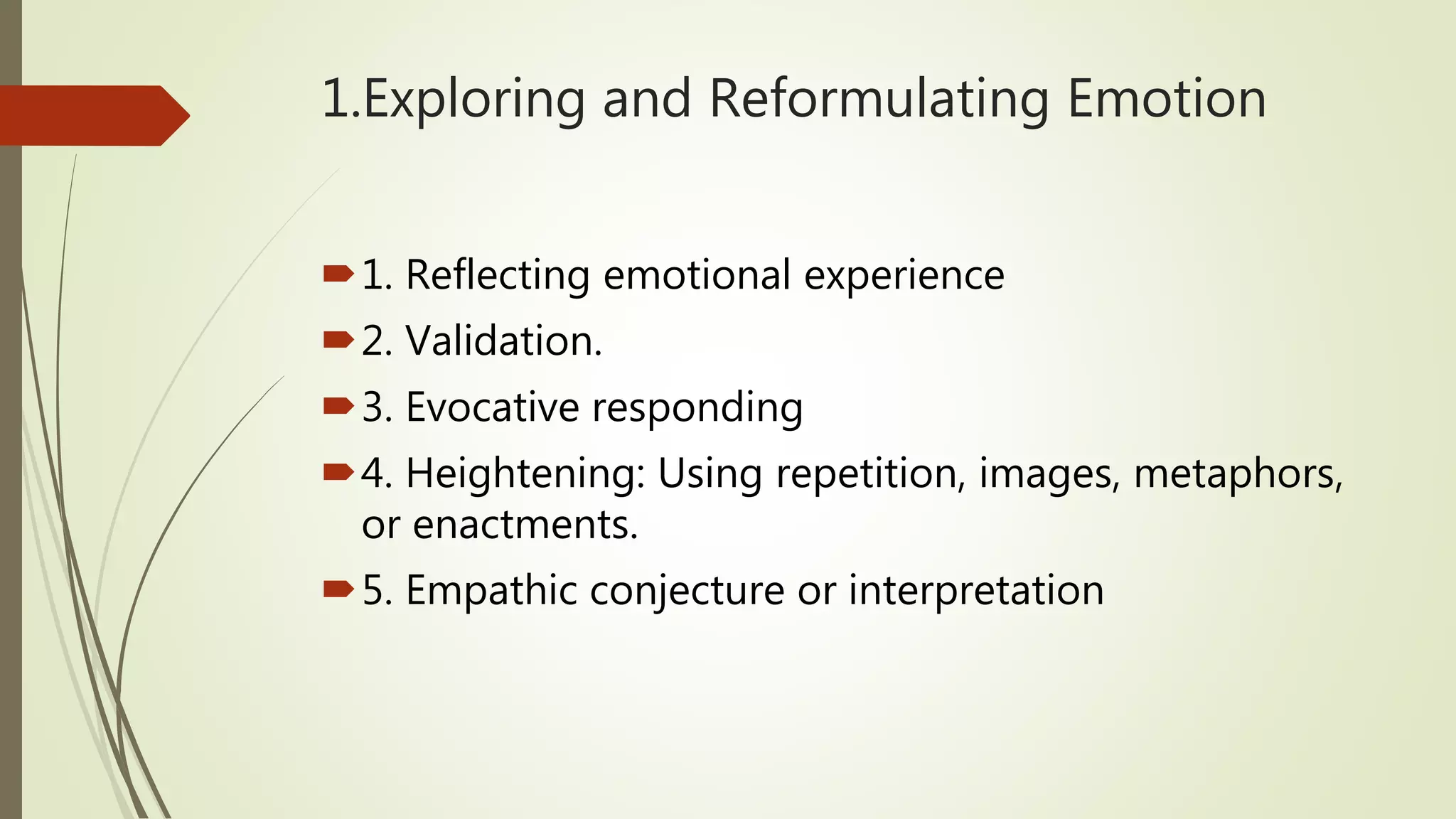
1.Exploring and Reformulating Emotion
1. Reflecting emotional experience
2. Validation.
3. Evocative responding
4. Heightening: Using repetition, images, metaphors,
or enactments.
5. Empathic conjecture or interpretation
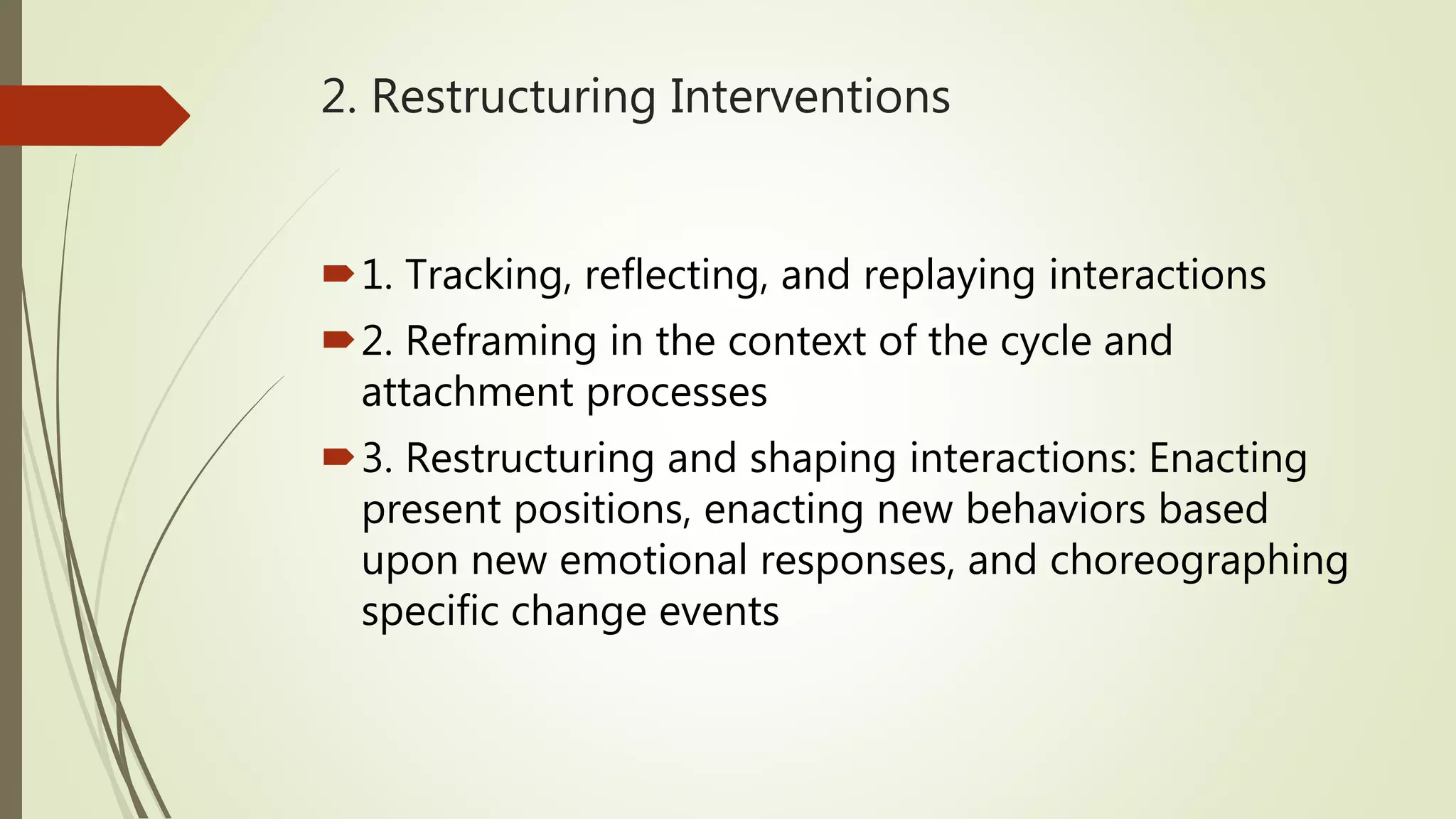
2. Restructuring Interventions
1. Tracking, reflecting, and replaying interactions
2. Reframing in the context of the cycle and
attachment processes
3. Restructuring and shaping interactions: Enacting
present positions, enacting new behaviors based
upon new emotional responses, and choreographing
specific change events
8. Treatment Applicability and
Empirical Support
Contraindications of EFT
Different Agendas
Separating Couples
Abusive Relationships
Substance Abuse
Depression and Other Psychiatric Illness
A
Research
 70 – 73% recovery rate in 10-12 sessions.
 Results stable – even under high stress.
 Depression significantly reduced.
 Variety of populations and settings.
 Best predictor of success – female faith in partner’s
caring (Not initial distress level).
K
Readings
Core reading:
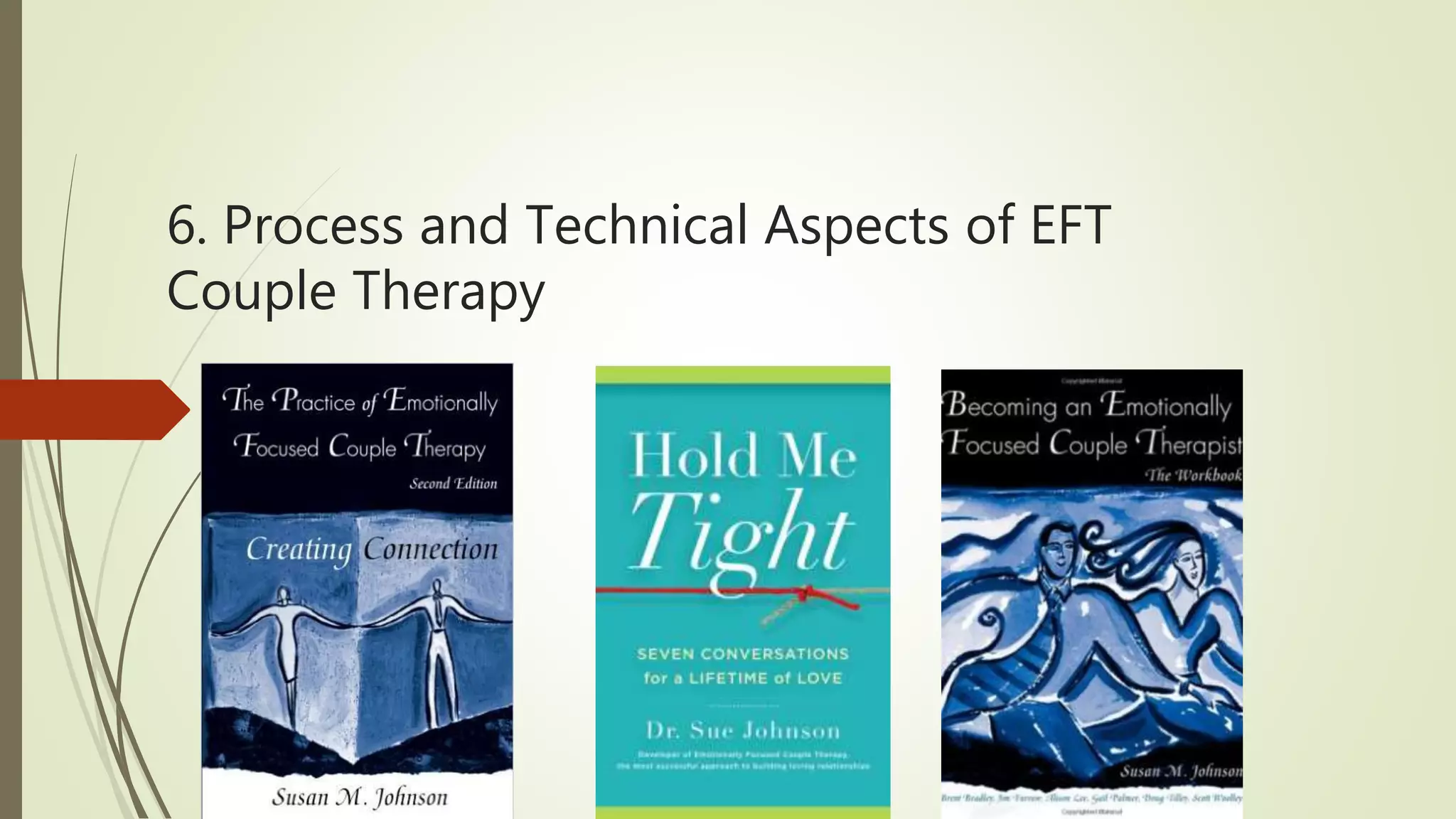
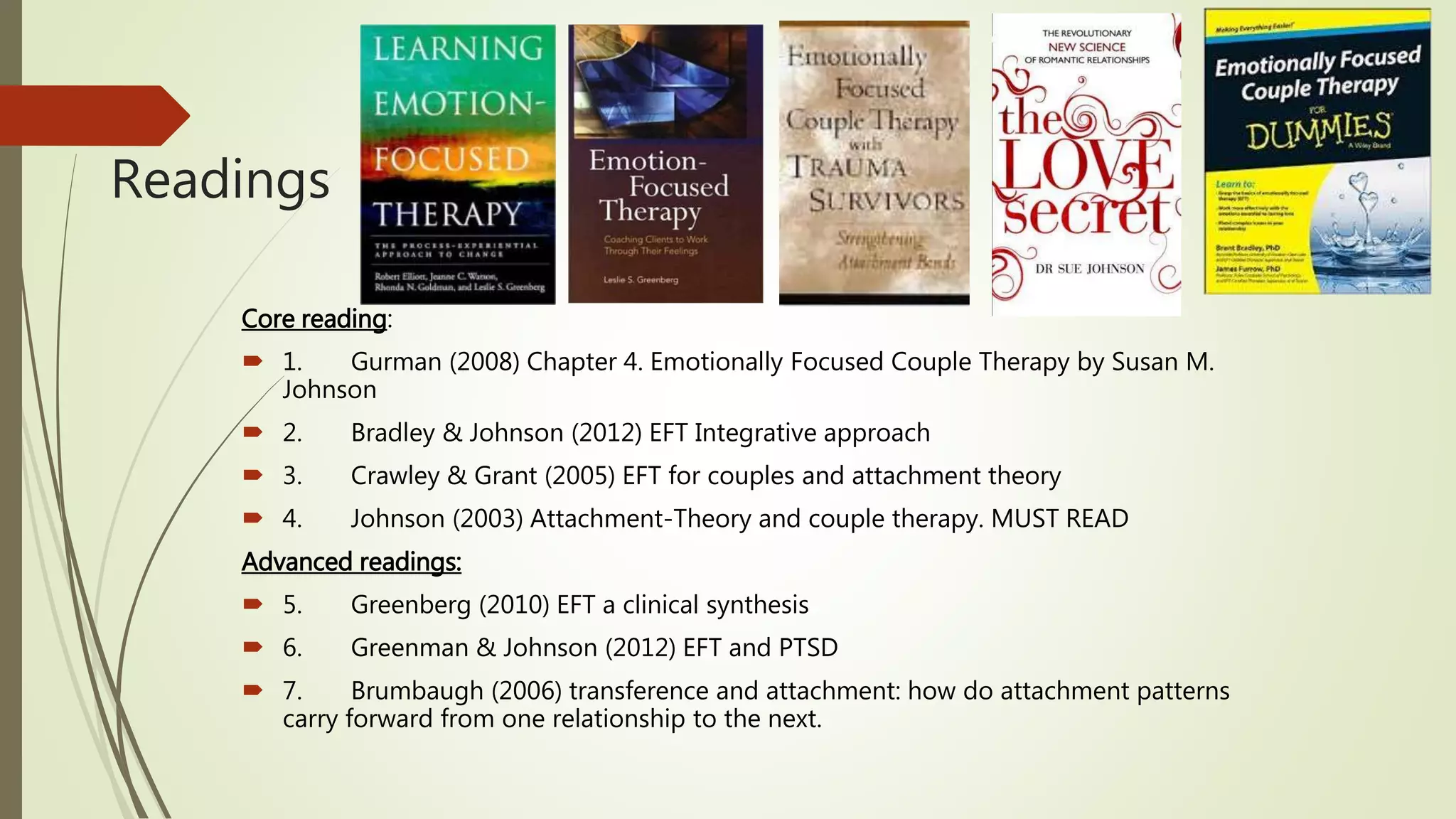
 1. Gurman (2008) Chapter 4. Emotionally Focused Couple Therapy by Susan M.
Johnson
 2. Bradley & Johnson (2012) EFT Integrative approach
 3. Crawley & Grant (2005) EFT for couples and attachment theory
 4. Johnson (2003) Attachment-Theory and couple therapy. MUST READ
Advanced readings:
 5. Greenberg (2010) EFT a clinical synthesis
 6. Greenman & Johnson (2012) EFT and PTSD
 7. Brumbaugh (2006) transference and attachment: how do attachment patterns
carry forward from one relationship to the next.
Lecture 6 Emotionally focused therapy overview

Lecture 6 Emotionally focused therapy overview

  • 1.
    Lecture 6. Overviewof Emotionally Focused Therapy for Couples Couple Counselling Skills Kevin Standish
  • 2.
    Learning Objectives Describe thetheoretical underpinnings of Emotionally Focused Therapy Be familiar with the three stages and nine steps framework of EFT Understand the concepts of enactments, withdraw engagement and blamer softening Be conversant with the research supporting EFT
  • 3.
    Primary Roots ofEFT Experiential Therapy (Perls) Person Centered Therapy (Rogers) Systemic Therapy Attachment Theory
  • 4.
    EFT Assumptions  1.Accessibility and responsiveness are the building blocks of a secure attachment bond. Consequently, Couples therapy is about A. the security of the attachment bond, B. accessibility, and C. the responsiveness of the partner.  2. Emotion is a target and agent of change. Emotion is A. Source of information; B. Communicates - organizes social interactions; C. Orients & primes responses; D. Vital element in meaning - colors events; E. Has control precedence  3) Emotion frequently leads to adaptive actions eg Anger often leads to Asserting, defending; or Sadness often leads to Seeking support, withdrawing.
  • 5.
    EFT Assumptions  4.Negative emotions occur at two levels: Primary and Secondary.  A. Primary Emotions are the deeper, more vulnerable emotions such as sadness, hurt, fear, shame, and loneliness.  B. Secondary Emotions are the more reactive emotions such as anger, jealousy, resentment, and frustration. They occur as a reaction to the primary emotions.  Primary emotions generally draw partners closer. Secondary emotions tend to push partners away.  5. In trying to connect, distressed couples get caught in negative repetitive sequences of interaction where partners express secondary emotions rather than primary emotions
  • 6.
    EFT Assumptions  6.Insecure attachment leads to negative interaction cycles and, in return, negative interaction cycles lead to insecure attachment (it is circular).  7. Rigid interactions reflect and create negative absorbing emotional states. Negative absorbing emotional states reflect and create rigid interactions (it is circular).  8. Partners are not sick or developmentally delayed. They are stuck. Most needs and desires are adaptive.  9. Attachment needs are universal, although their expression is culturally defined. The way we seek and obtain support is defined different in various cultures and even in different families and must be understood and respected  10. Change involves new experiences and new relationships events. Therapy is about creating these new relational experiences
  • 7.
    Comparative Framework. 1. Backgroundof the Approach 2. The Healthy/Well-Functioning versus Pathological/Dysfunctional Couple/Marriage 3. The Role of the Therapist 4. Assessment and Treatment Planning 5. Goal Setting 6. Process and Technical Aspects of Couple Therapy 7. Curative Factors/Mechanisms of Change 8. Treatment Applicability and Empirical Support
  • 8.
    1. Background ofthe Approach
  • 9.
    1. Background ofthe Approach  It is a constructivist approach: learning is an active, contextualized process of constructing knowledge rather than acquiring it. Knowledge is constructed based on personal experiences and the context.  focuses on the ongoing construction of present experience (particularly experience that is emotionally charged),  and a systemic approach, in that it also focuses on the construction of patterns of interaction with intimate others based on attachment theory.  Leslie Greenberg Susan Johnson  After watching numerous tapes of therapy sessions, they began to see patterns in how emotions were formulated and regulated, they mapped the steps in the change process and identified interventions the therapist need to make
  • 10.
    Experiential Influences  EFTshares commonalities with traditional humanistic approaches. EFT adheres to the following basic premises of experiential therapies:  1. The therapeutic alliance is healing in and of itself  2. The acceptance and validation of the client’s experience is a key element in therapy  3. There is a belief in the ability of human beings to make creative, healthy choices.  4. the inner construction of experience evokes interactional responses that organize the world in a particular way. This is a circular process.  5. we are formed and transformed by our relationships with others  6. new corrective experiences for clients emerge as part of personal encounters in the here and now of the therapy session
  • 11.
    Systemic Influences  EFTdraws Minuchin’s structural systemic approach, with its focus on the enactment of “new” patterns of interaction. EFT adheres to the following basic premises of family systems theory:  1. Causality is circular  2. Family systems theory tells us that we must consider behavior in context.  3. The elements of a system are predictable and consistent relationship with each other, represented by homeostasis, and is manifested in couples by the presence of regular, repeating cycles of interaction  4. All behaviour is assumed to have a communicative aspect: you cannot not communicate  5. The task of the family systems therapist is to interrupt stuck, repetitive, negative cycles of interaction, so that new patterns can occur  the experiential– systemic synthesis of EFT, there is a focus on both the circular cycles of interaction between people and the core emotional experiences of each partner during the different steps of the cycle.
  • 12.
    2. The Healthy/Well-Functioningversus Pathological/Dysfunctional Couple/Marriage Well-Functioning
  • 13.
    Healthy/Well-Functioning  A healthyrelationship, in EFT terms, is a secure attachment bond. Such a bond is characterized by mutual emotional  accessibility and responsiveness. This bond creates a safe environment that optimizes partners’ ability to regulate their emotions, process information, solve problems, resolve differences, and communicate clearly. Secure relationships are associated with higher levels of intimacy, trust, and satisfaction.  the research on adult attachment has demonstrated that secure relationships are associated with higher levels of intimacy, trust, and satisfaction.  Security in key relationships helps us regulate our emotions, process information effectively, and communicate clearly  Security involves inner realities, cognitive models and ways of regulating emotion, and patterns of interaction
  • 14.
    View of distressin EFT EFT looks at distress in relationships through the lens of attachment insecurity and separation distress Relationship distress is maintained by absorbing negative affect. Affect reflects and primes rigid, constricted patterns of interaction. Patterns make safe emotional engagement difficult and create insecure bonding.
  • 15.
    View of Distress Rigidrepetitive interactional patterns: No exits – no detours/ repair impossible Rigid narrow positions – fight/flight/freeze Most common patterns Criticize, complain, express contempt Defend, distance, stonewall Results: self reinforcing cycles or reactivity/self protective strategies
  • 16.
    View of Distress Partnerscannot attune to one another because they are so absorbed in their own negative affect Cannot communicate because of their own state. Gottman 1979 – absorbing states of negative affect: everything leads in, nothing leads out.
  • 17.
  • 18.
    Key Principles  1.A collaborative alliance offers a couple a secure base from which to explore their relationship. The therapist is best seen as a process consultant to the couple’s relationship.  2. Emotion is primary in organizing attachment behaviors and how self and other are experienced in intimate relationships. The EFT therapist privileges emotional responses and deconstructs reactive, negative emotions, such as anger, by expanding them to include marginalized elements, such as fear and helplessness. The therapist also uses newly formulated and articulated emotions, such as fear and longing or assertive anger, to evoke new steps in the relationship dance  3. The attachment needs and desires of partners are essentially healthy and adaptive. It is the way such needs are enacted in a context of perceived insecurity that creates problems.
  • 19.
    Key Principles 4. Problemsare maintained by the ways in which interactions are organized and by the dominant emotional experience of each partner in the relationship. Affect and interaction form a reciprocally determining, self-reinforcing feedback loop. 5. Change occurs not through insight into the past, catharsis, or negotiation, but through new emotional experience in the present context of attachment-salient interactions. 6. In couple therapy, the “client” is the relationship between partners. Problems are viewed in terms of adult insecurity and separation distress. The ultimate goal of therapy is the creation of new cycles of secure bonding that offer an antidote to negative cycles and redefine the nature of the relationship.
  • 20.
    3. The Roleof the Therapist
  • 21.
    3. The Roleof the Therapist Develop an alliance, identify cycle, identify and access underlying emotions, and work to deescalate Engage the withdrawer Soften the pursuer/blamer Create new emotional bonding events and new cycles of interaction Consolidate new cycles of trust, connection and safety, and apply them to old problems that may still be relevant
  • 22.
    What Makes EFT,-- Its Look and Feel 1. Relentless Empathy 2. Attachment Frame and Language 3. De-pathologizing Model 4. RISSSC 5. Enactments
  • 23.
    Skills forR-I-S-S-S-C Emotional Engagement R:The therapist intentionally REPEATS key words and phrases for emphasis. I:Therapist uses IMAGES or word pictures that evoke emotions more than abstract labels tend to do. S:Therapist frames responses to clients in SIMPLE and concise phrases. S:Therapist will SLOW the process of the session and the pace of her speech to enable deepening of emotional experience S:Therapist will use SOFT and soothing tone of voice to encourage a client to deepen experience. C:Therapist uses CLIENT words and phrases in a supportive/validating way.
  • 24.
    4. Assessment andTreatment Planning
  • 25.
    Key Movements inAssessment Process – Focus Points  1. Client’s narrative is interrupted by strong affect Focus on emotional response Give message that it is safe and appropriate to share this experience in the session 2. Affect is conspicuous by its absence  Explore lack of engagement in the personal experience being related  Discover the significance in terms of the couple’s engagement in and definition of their relationship
  • 26.
    Key Movements inAssessment Process – Focus Points 3. Personal landmark Focus on and explore story Uncover the meaning of the story from client’s perspective Ask if the partner understands the client’s experience Label story as unresolved issue for couple and validate associated primary or secondary emotion 4. Interactional landmark Observe this interaction If alliance is developing well, refer to interaction in this session Otherwise, simply take note of the interaction
  • 27.
    Key Movements inAssessment Process – Focus Points 5. Position markers Get a clear picture of the position each partner takes in response to the other Ask how each partner perceives and feels about such positions 6. Responses to positive contact Explore the exit from the contact Acknowledge attempts to comfort and ability to receive comfort as a strength of the relationship
  • 28.
    Attachment History -(View of Self and View of Other)  “When you were young (ages 6 – 10) who did you turn to for care and comfort in a time of need? Can you tell me what that was like?”  Secure: A person is better able to acknowledge and cope effectively with negative emotions. Adults are self-confident, socially skilled, interested in close, romantic relationships, and more likely to form stable and satisfying long-term relationships.  Avoidant: A person often attempts to block out negative emotions, and are uncomfortable seeking support. Adults lack self-confidence, are worried about rejection and abandonment. They are prone to bouts of jealousy and anger. They see partners as untrustworthy. Seek romantic relationships, but may choose ill-advised partners.  Anxious: A person is highly emotionally expressive but often cannot regulate their emotions. Adults are uncomfortable with closeness, self-disclosure, dependence on others, and are more socially unskilled.
  • 30.
  • 31.
    5. Goal Setting:primary focus • To expand and re-organize key emotional responses between partners–the music of the attachment dance. • Create a shift in each partner’s interactional positions in their rigid interactions with one another and develop new cycles of interaction. • Foster the creation of a secure bond between partners through the creation of new interactional experiences that redefine the relationship.
  • 32.
    6. Process andTechnical Aspects of EFT Couple Therapy
  • 33.
    Overview of EFTTreatment Process • Develop an alliance, identify cycle, identify and access underlying emotions, and work to de-escalate • Help couple see the negative cycle as the enemy, not each other • Engage the withdrawer • Soften the pursuer/blamer • Create new emotional bonding events and new cycles of interaction • Consolidate new cycles of trust, connection and safety, and apply them to old problems that may still be relevant
  • 34.
    Attachment Withdrawer “I never getit right or make her happy.” “I don’t bother anymore what’s the point.” (Feelings: Rejected, inadequate, fears failure, overwhelmed, judged, shame, empty, alone) Pursuer “He’s never around and whenever he is he’s always distracted.” “She doesn’t see me. No matter what I do I don’t count in her world.” (Feelings: Hurt, unwanted, invisible, abandoned, desperate, deprived, not important)
  • 35.
    Common Underlying Emotionsof Withdrawers and Pursuers Withdrawers  Rejected  Inadequate  Afraid of failure  Overwhelmed  Numb – frozen  Afraid – scared  Not wanted or desired  Judged, critized Pursuers  Hurt  Alone  Not wanted  Invisible  Isolated/disconnected  Not important  Abandoned  Desperate K
  • 36.
    EFT: 3 stagesand 9 steps Stage 1 Assessment and Cycle De-escalation Steps 8-9 Steps 1-4 •Stage 2 Changing Interactional Positions and Creating New Bonds •Stage 3 Consolidation and Integration Steps 5-7
  • 37.
    EFT: 3 Stages •Stage 1 Assessment and Cycle De-Escalation • Stage 2 Changing Interactional Positions and Creating New Bonds • Stage 3 Consolidation and Integration J
  • 38.
    and 9 Steps Step 1: Identify the relational conflict issues between the partners.  Step 2: Identify the negative interaction cycle where these issues are expressed.  Step 3: Access the unacknowledged, attachment oriented emotions underlying the interactional position each partner takes in this cycle.  Step 4: Reframe the problem in terms of the cycle, underlying emotions that accompany it, and attachment needs.  Step 5: Promote identification with disowned attachment needs and aspects of self.  Step 6: Promote each partner’s acceptance of the other experience.  Step 7: Facilitate the expression of needs and wants to restructure the interaction based on new understandings and create bonding events  Step 8: Facilitate the emergence of new solutions to old problems.  Step 9: Consolidate new positions and cycles of attachment behavior.
  • 39.
    Stage 1 Assessment andCycle De-Escalation Step 1: Identify the relational conflict issues between the partners. Step 2: Identify the negative interaction cycle where these issues are expressed. Step 3: Access the unacknowledged, attachment oriented emotions underlying the interactional position each partner takes in this cycle. Step 4: Reframe the problem in terms of the cycle, underlying emotions that accompany it, and attachment needs.
  • 40.
    The Nine Stepsof Emotionally Focused Couples Therapy Step 1-4 • Alliance and assessment: Creating an alliance and delineating conflict issues in the core attachment struggle.  What are they fighting about and how are they related to core attachment issues? J
  • 41.
    Step 1: Identifythe relational conflict issues between the partners. Alliance & assessment: Creating an alliance and delineating conflict issues in the core attachment struggle. What are they fighting about and how are they related to core attachment issues.
  • 42.
    Establishing AN ALLIANCE •Reflection • Validation • Empathic Attunement
  • 43.
    Step 2: Identifythe negative interaction cycle where these issues are expressed. Identify the negative interaction cycle  EFT Cycle levels include • Action tendencies (behaviors) • Perceptions • Secondary Emotions • Primary Emotions • Unmet Attachment Needs  The goal is for the therapist to see the cycle in action and identify and describe it to the couple and work toward stopping it.
  • 44.
    Identifying & Delineating NegativeInteractive Cycle Basic Negative Cycles & Interactive Positions Pursue/Withdraw Withdraw/Withdraw Attack/Attack Complex cycles Reactive pursue/Withdraw
  • 45.
    EFT Emotions andReactivity Emotions occur at two levels: Primary and Secondary (or reactive). Primary Emotions are the deeper, more vulnerable and tender emotions such as sadness, hurt, fear, shame, and loneliness. Secondary Emotions are the more reactive emotions such as anger, jealousy, resentment, and frustration. They occur as a reaction to the primary emotions. Anger, Blame, Primary emotions generally draw partners closer. Secondary emotions tend to push partners away.
  • 46.
    Pursuer/Withdrawer : primaryand secondary emotions
  • 47.
    STEP 2 –IDENTIFYING THE NEGATIVE CYCLE • Who is the Pursuer? • Who is the Withdrawer? • Describe the Negative Cycle • What are the Secondary Emotions? • What are the Primary Emotions? E
  • 48.
    Step 3: Accessthe unacknowledged, attachment oriented emotions underlying the interactional position each partner takes in this cycle.  The goal is to help each member of the couple to access and accept their unacknowledged feelings that are influencing their behavior in the relationship.  Both partners are to "reprocess and crystallize their own experience in the relationship" so that they can become emotionally open to the other person.
  • 49.
    Step 4: Reframethe problem in terms of the cycle, underlying emotions that accompany it, and attachment needs.  The cycle is framed as the common enemy and the source of the partners’ emotional deprivation and distress.  The goal, by the end of Step 4, is for the partners to have a meta-perspective on their interactions.  They are framed as unwittingly creating, but also being victimized by, the cycle of interaction that characterizes their relationship J
  • 50.
    EFT Reframes Step4 For example: Angry Criticism is viewed in EFT as: an attempt to modify the other partner’s inaccessibility or manage the disconnect a protest response to emotional isolation and abandonment not being “crazy or irrational”. Avoidance is seen as: an attempt to contain the interaction and regulate fears of rejection or not burden the other partner an attempt to avoid confrontation or working models that define the self as unlovable . J
  • 51.
    The Cycle Scott R.Woolley Ph.D. © Partner Partner Primary EmotionPrimary Emotion Perceptions/AttributionsPerceptions/Attributions Secondary EmotionSecondary Emotion BehaviorBehavior Unmet Attachment Needs Unmet Attachment Needs --------------------------------------------------------------------------------------------------------------
  • 52.
    Stage 2 Changing InteractionalPositions and Creating New Bonds Step 5: Promote identification with disowned attachment needs and aspects of self. Such attachment needs may include the need for reassurance and comfort. Aspects of self that are not identified with may include a sense of shame or unworthiness. Step 6: Promote each partner’s acceptance of the other experience. Step 7: Facilitate the expression of needs and wants to restructure the interaction based on new understandings and create bonding events
  • 53.
    The Nine Stepsof EFT STAGE 2 Steps 5-7 Step 5- Withdrawer Re-Engagement and Pursuer Softening Promote identification with disowned attachment emotions, needs and aspects of self, and integrate these into relationship interactions.  Help the couple redefine their experiences in terms of their unacknowledged emotional needs. "I nag because I feel abandoned and I want to be loved." "I withdraw because I feel invaded and rejected and I need to feel safe and loved." A
  • 54.
    The Nine Stepsof Emotionally Focused Couples Therapy Step 6 Promote acceptance of the other partner’s experiences and new interactional responses .  Work to get each partner to accept, believe, and trust that what the other partner is describing in terms of underlying emotional needs is accurate. A
  • 55.
    The Nine Stepsof Emotionally Focused Couples Therapy Step 7 Facilitate the expression of needs and wants and create emotional engagement and bonding events that redefine the attachment between the partners.  Help them learn to express their emotional needs and wants directly rather than through the old patterns and create emotional engagement. This will help each person see the other person in a more benign manner. (Feeling vulnerable and insecure rather than rejecting.) A
  • 56.
    Stage 3 –Consolidation Step 8 – Facilitating the emergence of new solutions to old relationship patterns Step 9 – Consolidating new positions and new cycle of safe attachment and connections
  • 57.
    Softening Pre-requisites: De-escalation of negativecycle (Stage 1) Withdrawer re-engagement (Stage 2 change event) A previously hostile, critical partner accesses “softer” emotions and risks reaching out to his/her partner who is engaged and responsive. In this vulnerable state, the previously hostile partner asks for attachment needs to be met.
  • 58.
    Softening At this point,both partners are attuned, engaged and responsive (accessibility & responsiveness) A bonding event then occurs which redefines the relationship as a safe haven and a secure base.
  • 59.
    Step 8 &9  The goal here is to consolidate new responses and cycles of interaction, for example, by reviewing the accomplishments of the partners in therapy and helping the couple create a coherent narrative of their journey into and out of distress.  The therapist also supports the couple to solve concrete problems that have been destructive to the relationship.  this is often relatively easy given that dialogues about these problems are no longer infused with overwhelming negative affect and issues of relationship definition.  Without the old negative interaction style and with the new emotional connection and attachment, it is easier to develop new solutions to old problems.
  • 60.
  • 61.
    Curative Factors/Mechanisms ofChange Once the alliance is established, there are two basic therapeutic tasks in EFT:  (1) the exploration and reformulation of emotional experience, and (2) the restructuring of interactions.
  • 62.
    1.Exploring and ReformulatingEmotion 1. Reflecting emotional experience 2. Validation. 3. Evocative responding 4. Heightening: Using repetition, images, metaphors, or enactments. 5. Empathic conjecture or interpretation
  • 63.
    2. Restructuring Interventions 1.Tracking, reflecting, and replaying interactions 2. Reframing in the context of the cycle and attachment processes 3. Restructuring and shaping interactions: Enacting present positions, enacting new behaviors based upon new emotional responses, and choreographing specific change events
  • 64.
    8. Treatment Applicabilityand Empirical Support
  • 65.
    Contraindications of EFT DifferentAgendas Separating Couples Abusive Relationships Substance Abuse Depression and Other Psychiatric Illness A
  • 66.
    Research  70 –73% recovery rate in 10-12 sessions.  Results stable – even under high stress.  Depression significantly reduced.  Variety of populations and settings.  Best predictor of success – female faith in partner’s caring (Not initial distress level). K
  • 67.
    Readings Core reading:  1.Gurman (2008) Chapter 4. Emotionally Focused Couple Therapy by Susan M. Johnson  2. Bradley & Johnson (2012) EFT Integrative approach  3. Crawley & Grant (2005) EFT for couples and attachment theory  4. Johnson (2003) Attachment-Theory and couple therapy. MUST READ Advanced readings:  5. Greenberg (2010) EFT a clinical synthesis  6. Greenman & Johnson (2012) EFT and PTSD  7. Brumbaugh (2006) transference and attachment: how do attachment patterns carry forward from one relationship to the next.