Lecture 6 Doing a 
literature review for your 
undergraduate 
dissertation 
Dissertation Module 
Kevin Standish
Learning outcomes 
• Understand the role of theories in your dissertation 
• Describe Purpose of a literature review 
• Name the three stages of literature search 
• Review the writing up the literature review 
• Describe Review frameworks
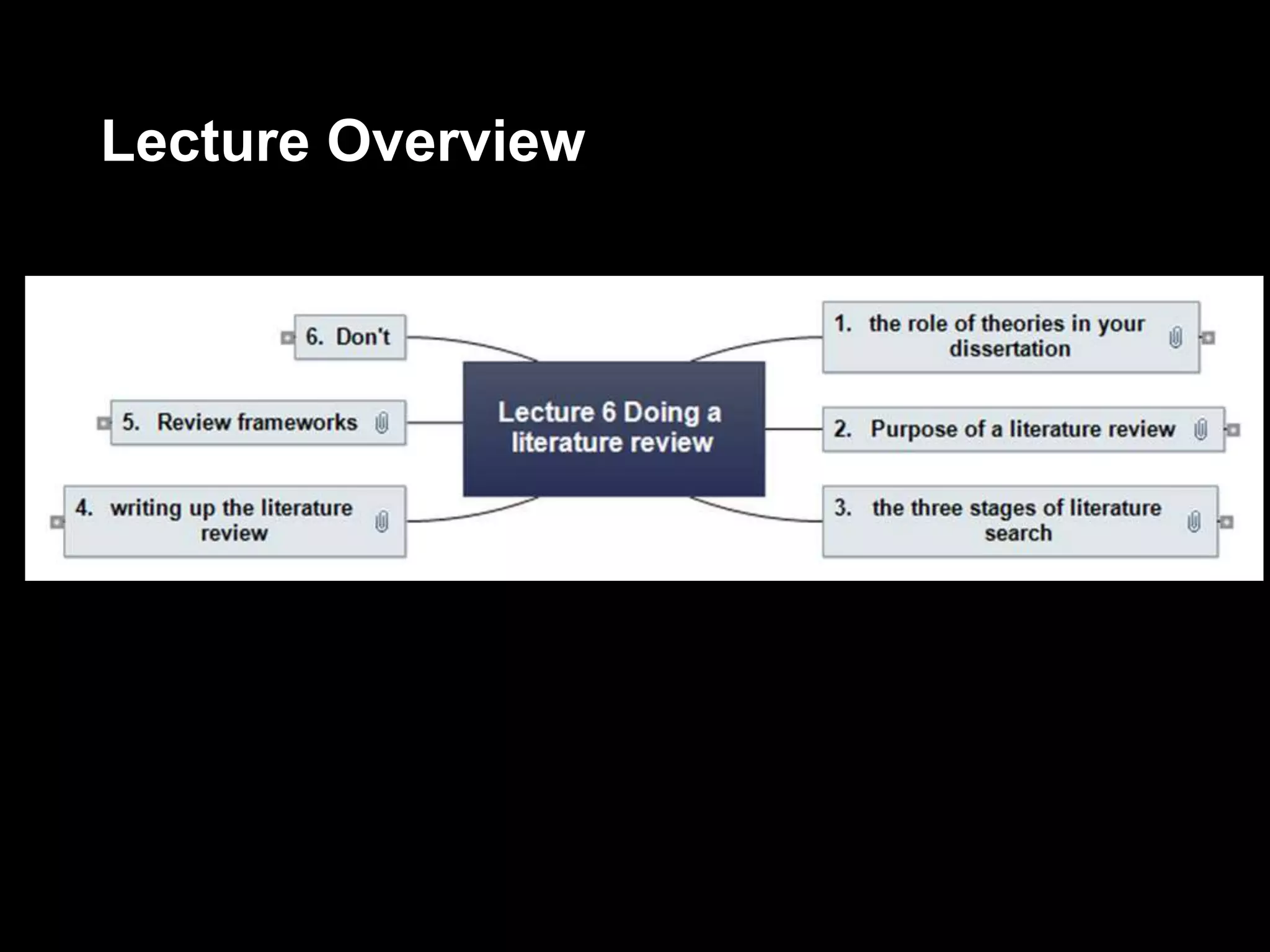
Lecture Overview
1. The role of theories in your 
dissertation
Kuada (2012) the role of theories in 
your project.pdf 
1. the role of theories in your 
dissertation 
• a review of the literature is important 
because without it you will not acquire an 
understanding of your topic, of what has 
already been done on it, how it has been 
researched, and what the key issues are. 
• In your written project you will be expected 
to show that you understand previous 
research on your topic. 
• This amounts to showing that you have 
understood the main theories in the subject 
area and how they have been applied and 
developed, as well as the main criticisms 
that have been made of work on the topic.
1. 2. what is a theory? 
• theory provides the language, the concepts, and 
assumptions that help researchers to make sense of the 
phenomenon that they seek to investigate. It enables 
researchers to connect the issues they are 
investigating to the existing body of knowledge in the 
area 
• The researcher must produce a concept or build a 
theoretical structure that can explain facts and the 
relationships between them . . . The importance of 
theory is to help the investigator summarize previous 
information and guide his future course of action. 
Sometimes the formulation of a theory may indicate 
missing ideas or links and the kinds of additional data 
required. Thus, a theory is an essential tool of research 
in stimulating the advancement of knowledge still 
further.
1.2. what is a theory? 
•theories may be defined as series of 
systematic inter-related statements or 
generalisations that explain and/ or 
anticipate developments in a specific 
context or phenomenon. 
• Strauss and Corbin (1998:15) define 
theory as “a set of well-developed 
concepts related through statements 
of relationship which together 
constitute an integrated framework 
that can be used to explain or predict 
phenomena”
1.3. Classification of 
theories 
1. Metatheories 
2. Grand theories 
3. Midrange theories 
4. Microtheories
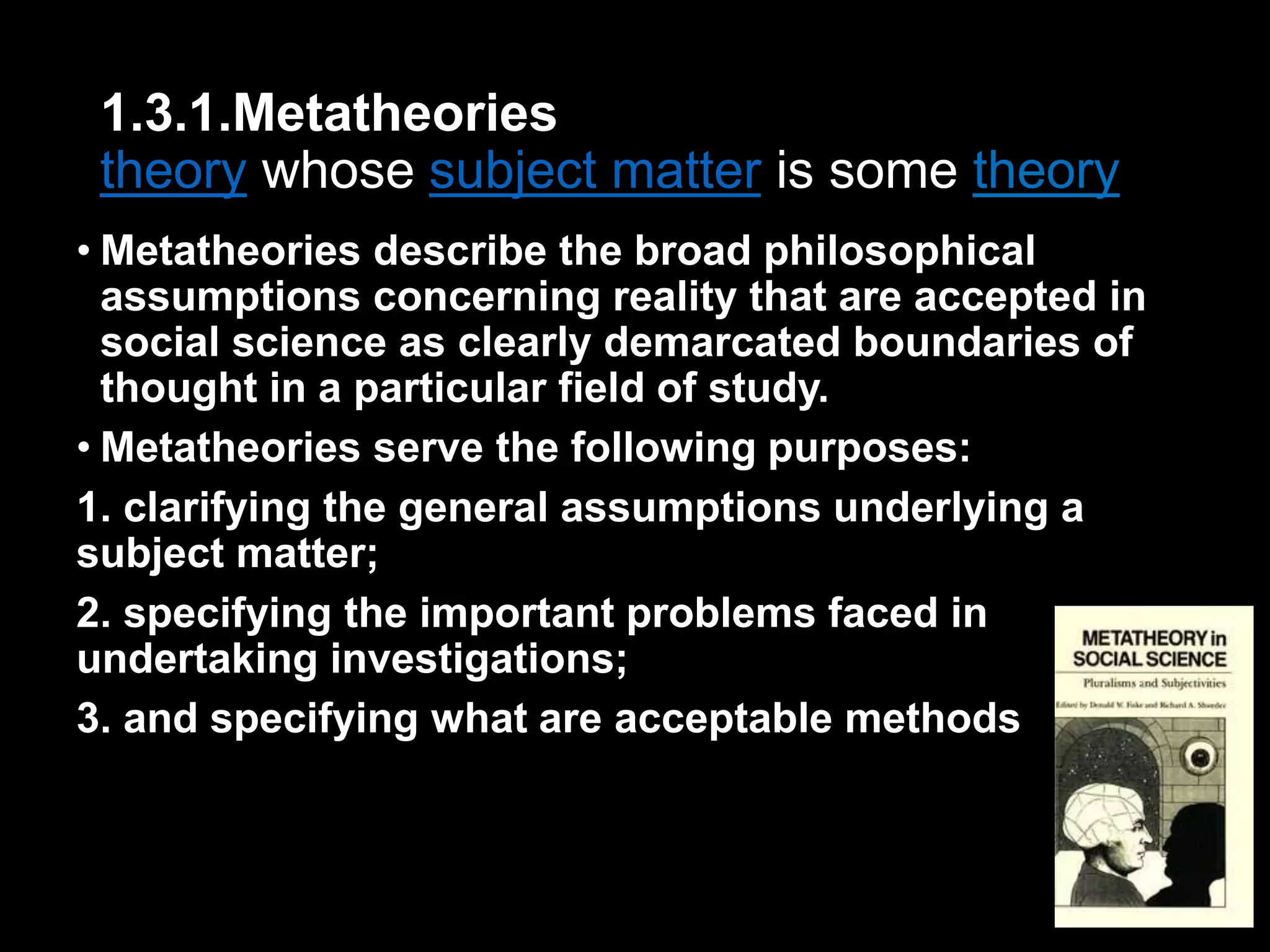
1.3.1.Metatheories 
theory whose subject matter is some theory 
• Metatheories describe the broad philosophical 
assumptions concerning reality that are accepted in 
social science as clearly demarcated boundaries of 
thought in a particular field of study. 
• Metatheories serve the following purposes: 
1. clarifying the general assumptions underlying a 
subject matter; 
2. specifying the important problems faced in 
undertaking investigations; 
3. and specifying what are acceptable methods
1.3.2. Grand theories 
A grand theory is defined as an all-inclusive unified 
theory that 
1. seeks to explain social behaviour, social 
organization, and social change in human experience. 
2. It normally provides the key concepts and principles 
of the social science discipline and is therefore 
consistent with the dominant metatheories or 
paradigms of the discipline. 
3. Examples of Grand theories: Feminism, marxism, and 
democracy
1.3.3. Midrange theories 
• Midrange theory represents theories that 
connect grand theories with empirical evidence. 
• It consists of limited sets of assumptions from 
which specific hypotheses are logically derived 
and confirmed by empirical investigation 
• Thus, when you engage in literature review, you 
are mostly discussing midrange theories. 
• For example if you adopt a social constructivist 
approach to your cultural research, you will 
justify your arguments by using studies that 
have adopted this approach
1.3.4. Microtheories 
Microtheories constitute the lowest level of 
theories. They focus on: 
• individuals or small groups located in specific 
contexts. As such explanations found in 
microtheories are of limited generalization on 
their own. 
• They can, however, constitute essential inputs 
in the generation of new perspectives and 
theory development. 
• For example: scholars use case studies to 
generate microtheories that are then further 
developed through multiple case studies to 
become important inputs in midrange theory 
formulation
1.4. Use of Theories 
Each of the levels of theory listed above will play a different role in your 
project. 
• The metatheories define the philosophical foundations of your project 
• The grand theories define the boundaries of your subject of 
investigation. They combine with the metatheories to establish the 
platform on which you will base your research. 
• But much of the discussion in your theoretical chapters will draw on 
midrange theories. 
• Midrange theories can also be used to develop variables to analyse 
and the connections between them: an analytical framework. 
• They therefore help you identify what kind of information you require 
for the analysis and what is the most appropriate means of acquiring 
this information. 
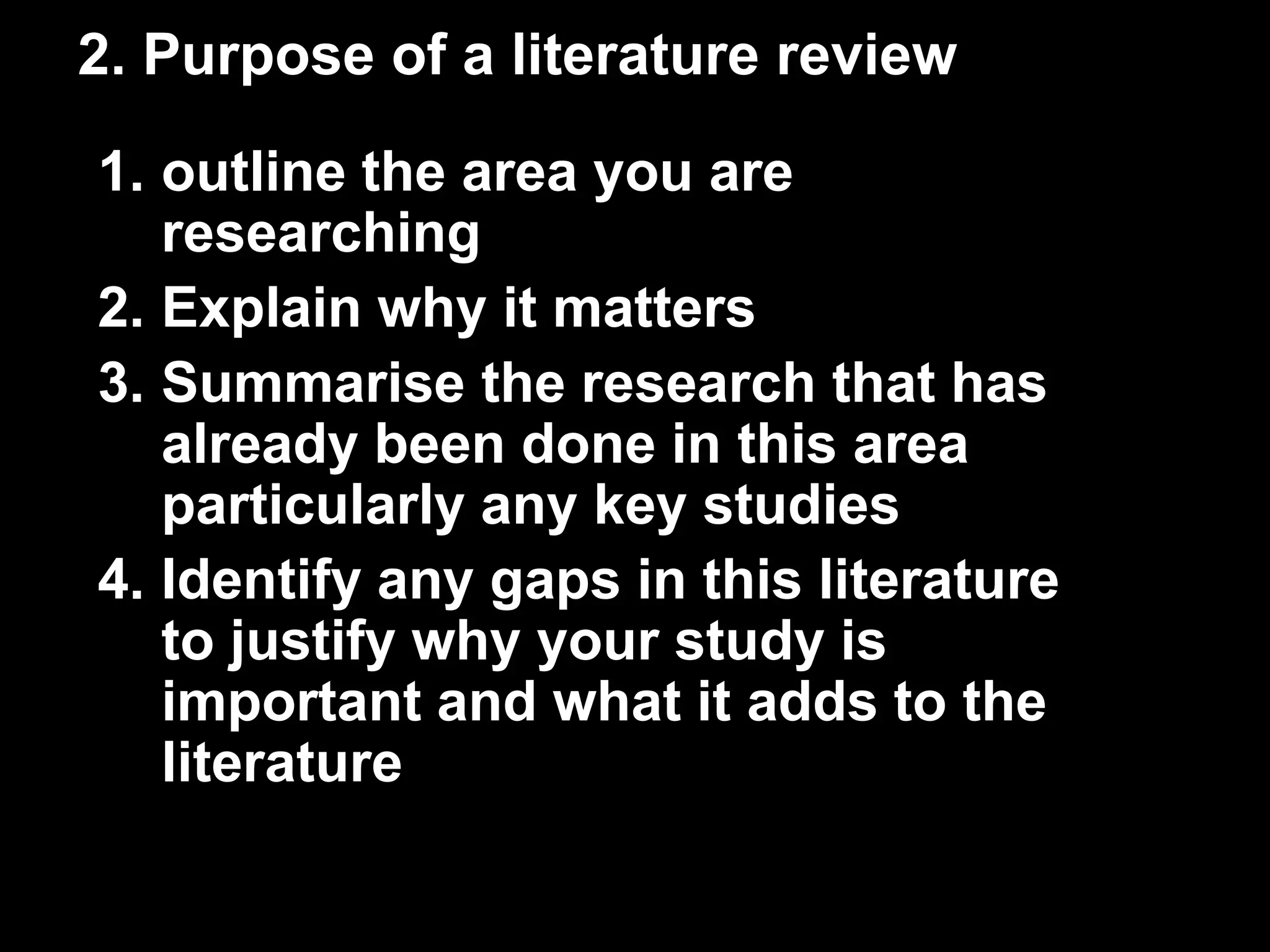
• Without such an analytical framework you will risk drowning in a sea 
of information, since you will be unable to sort out the relevant from 
the irrelevant 
• An essential task in the project work process is for you to discuss 
most of the leading theories that attempt to explain the problem of 
interest, comparing the strengths of the arguments underlying them 
and their empirical foundation
2. Purpose of a literature 
review 
Bell (2010) The review of the literature.pdf
2. Purpose of a literature review 
1. outline the area you are 
researching 
2. Explain why it matters 
3. Summarise the research that has 
already been done in this area 
particularly any key studies 
4. Identify any gaps in this literature 
to justify why your study is 
important and what it adds to the 
literature
2. Purpose of a literature review 
5. Present your research questions (qualitative 
research) or hypotheses (quantitative research). 
These should be set out at the end of the 
literature review 
6. Be sure to return to your literature review 
afterwards to read drafted in order to ensure that 
it gives a clear argument leading up to your 
research rather than simply summarising past 
research. 
7. Include all key studies and theories 
8. The review of the literature for a research 
proposal does not need to be as extensive as that 
for the final research write-up.
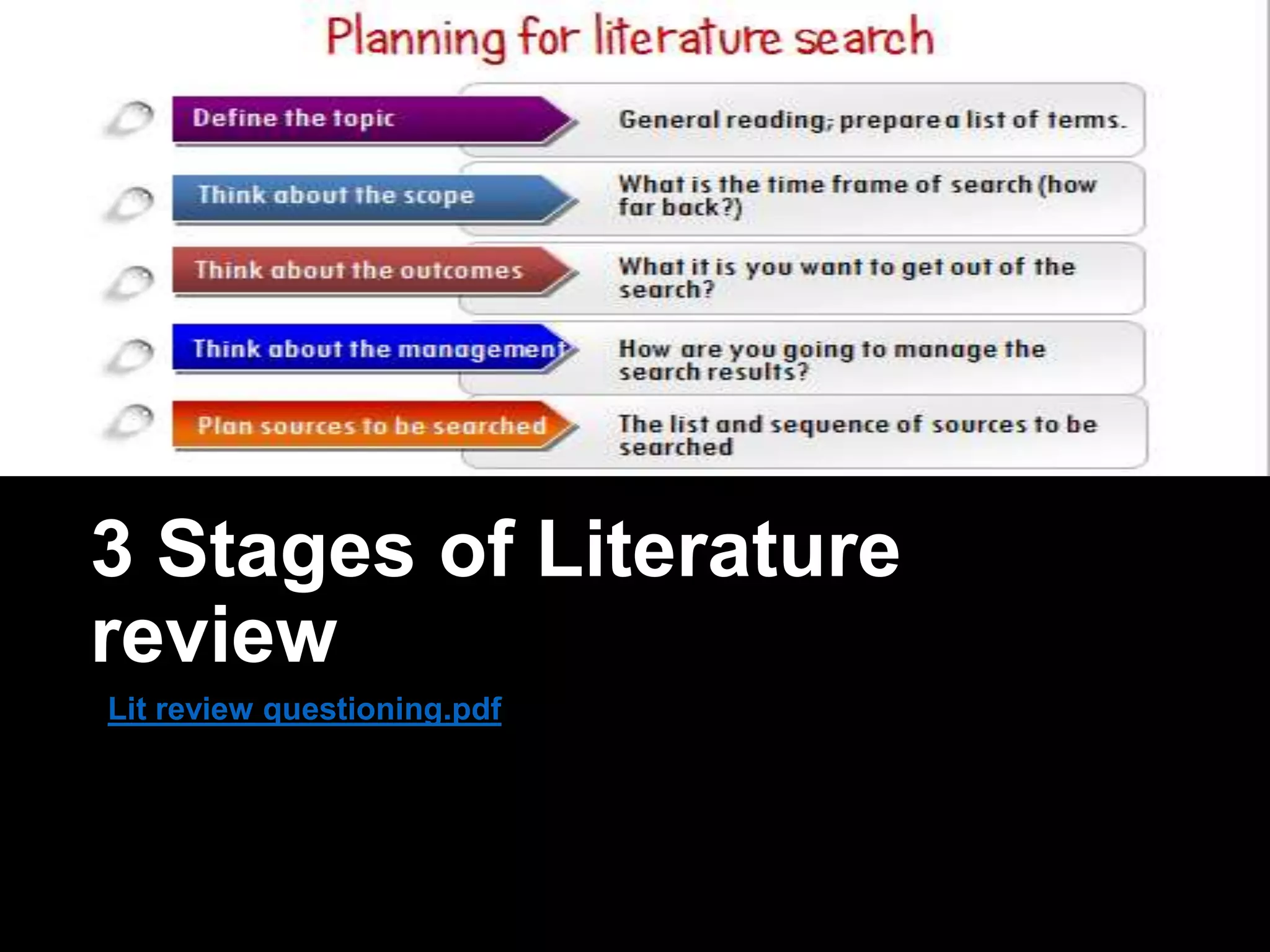
3 Stages of Literature 
review 
Lit review questioning.pdf
•Review of the Literature 
Vs 
Literature Review: 
•For your research proposal you will 
present a broad survey/summary of the 
current literature reviewed in forming 
your proposal. 
•This is NOT the same as a Literature 
Review which is the critical evaluation 
and analysis of the literature upon which 
your dissertation rests theoretically.
the three stages of literature search 
• first stage: using search engines and other 
resources to queue make a large collection 
of relevant materials 
•Second stage: reading through the 
abstracts, summaries et cetera, that you 
have obtained using these to find further 
materials 
•Third stage: consider all the material and 
determine which papers and chapters need 
to be read in depth where the gaps in the 
literature lie.
three key points in a project 
• Literature reviews usually happen at three key 
points in a project: 
1. during the development of your research 
question; 
2. during the planning stages, as you work out the 
rationale of the steps you need to take 
3. to complete your project; and towards the end of 
the project, either because: 
• preliminary analysis points you towards literature 
you had not previously considered, or 
• to check for relevant studies published since your 
previous literature searches.
Importance of theory 
• The theory in your project is essential; serving the 
following purpose: 
1.They demonstrate your understanding of the 
current body of knowledge in your chosen field of 
study. 
2.They provide you with a philosophical foundation 
on which you can ground your study. 
3.They constitute an important part of the overall 
research design of the project.
4. writing up the literature 
review 
Barker (2015) Chap 5 Doing a Literature Review.pdf
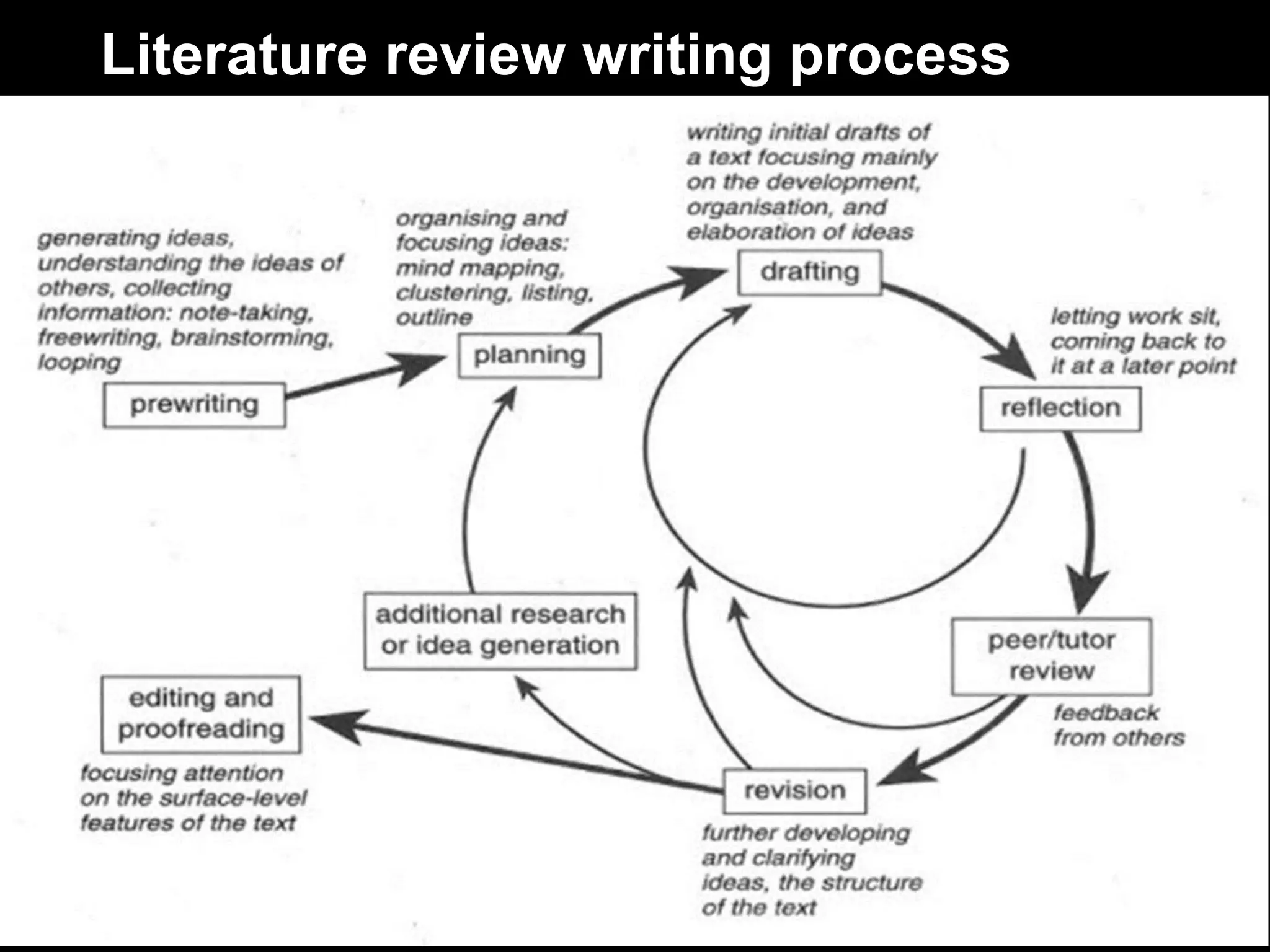
Literature review writing process
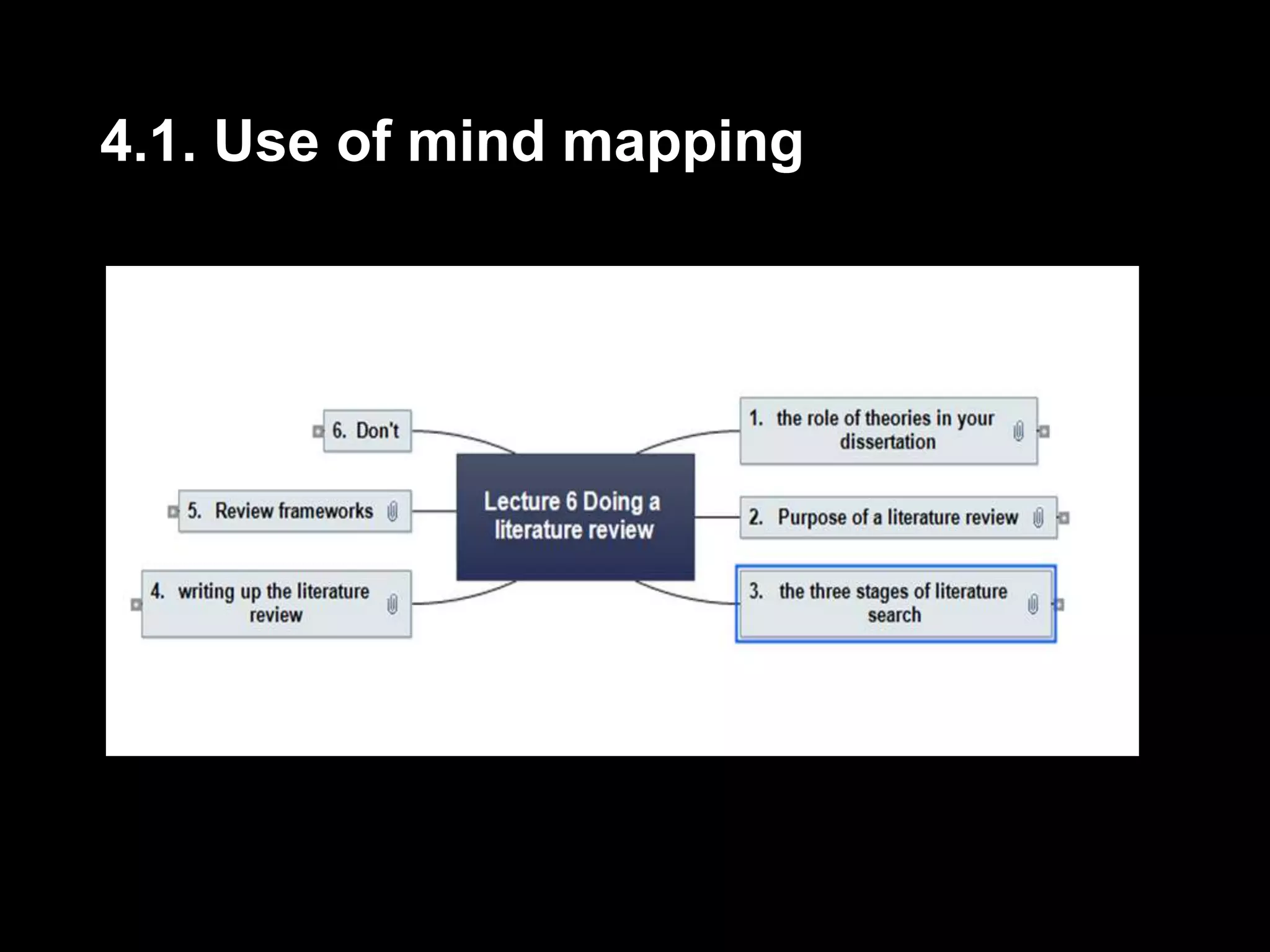
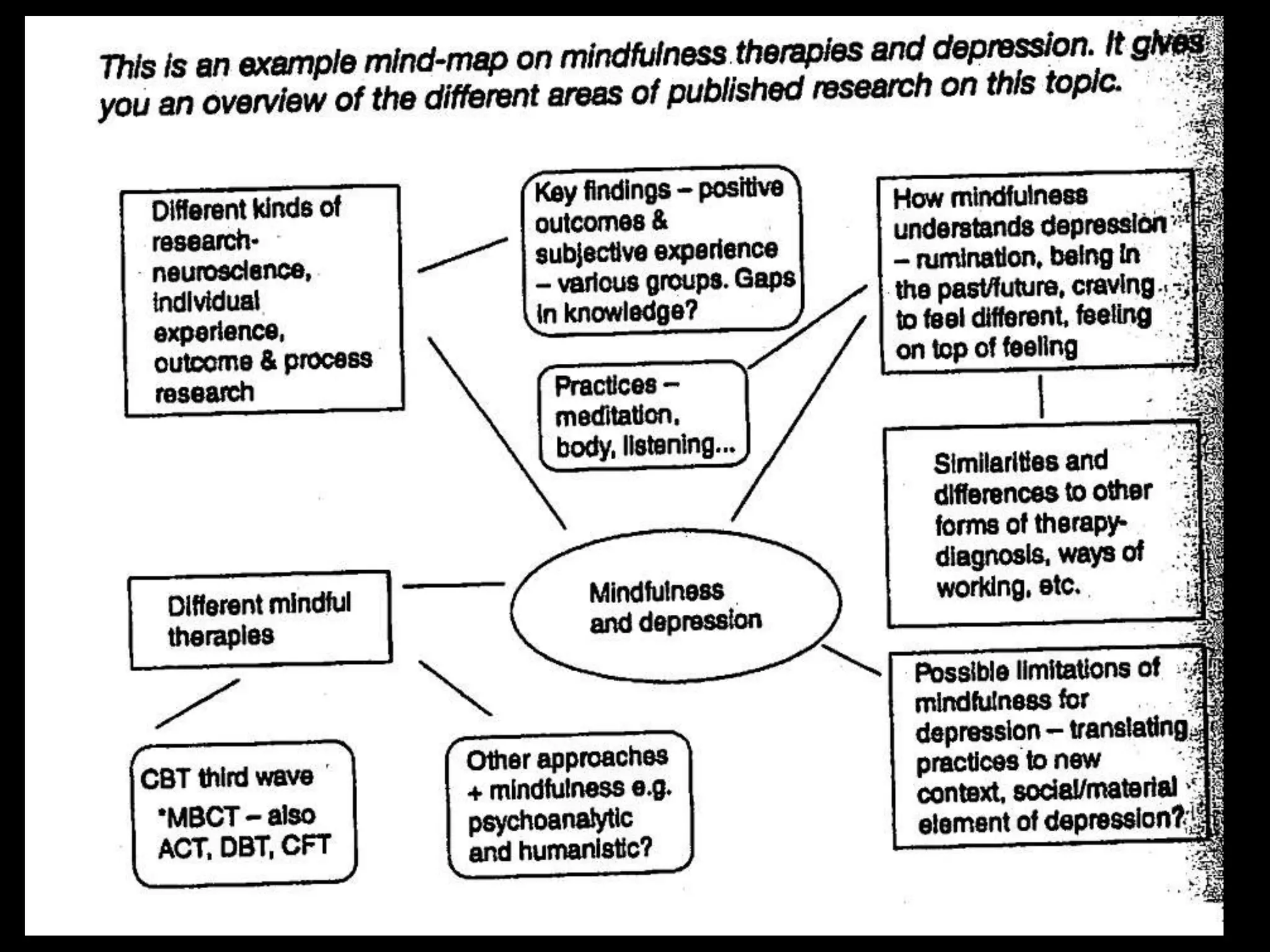
4.1. Use of mind mapping
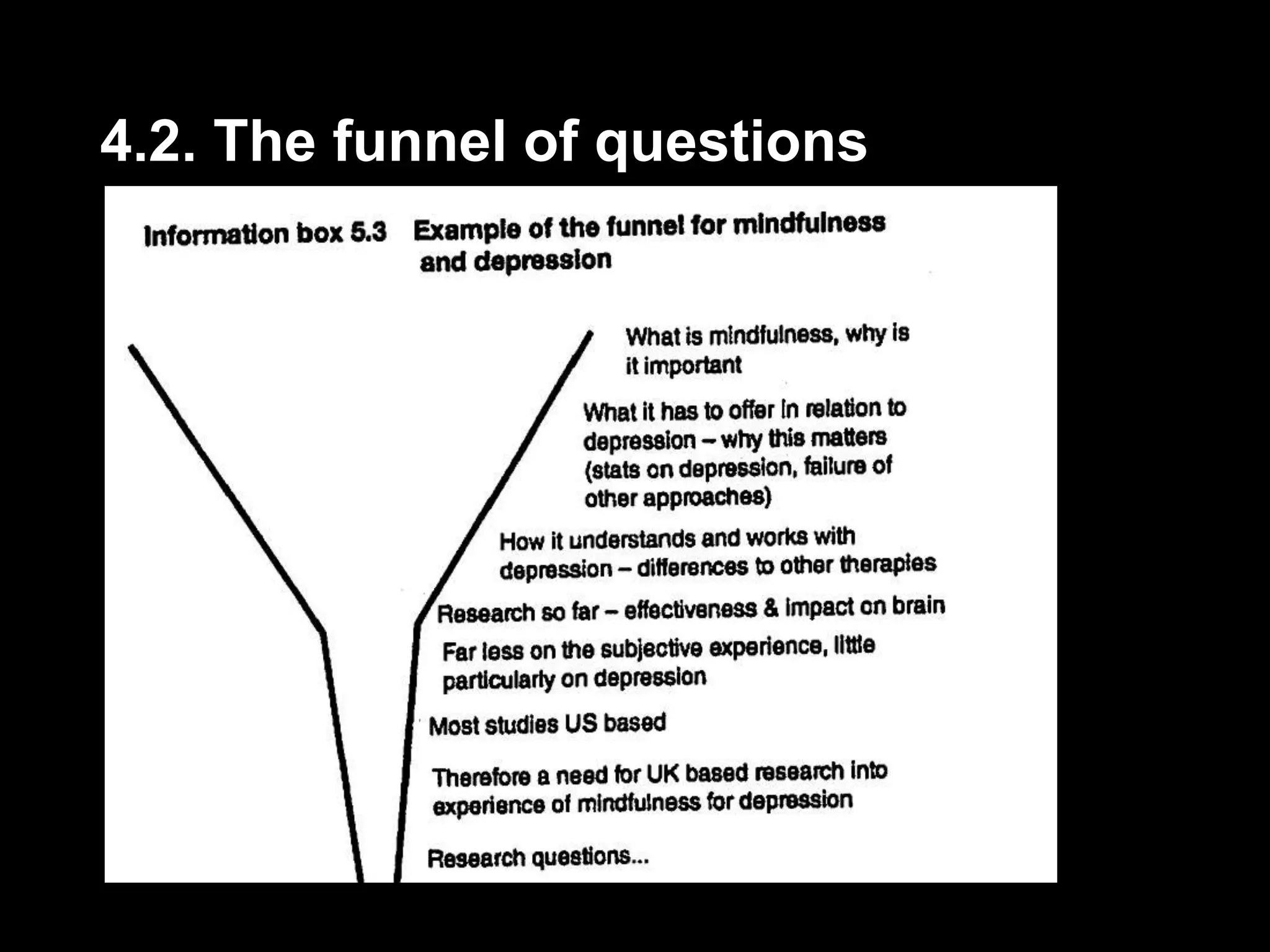
4.2. The funnel of questions
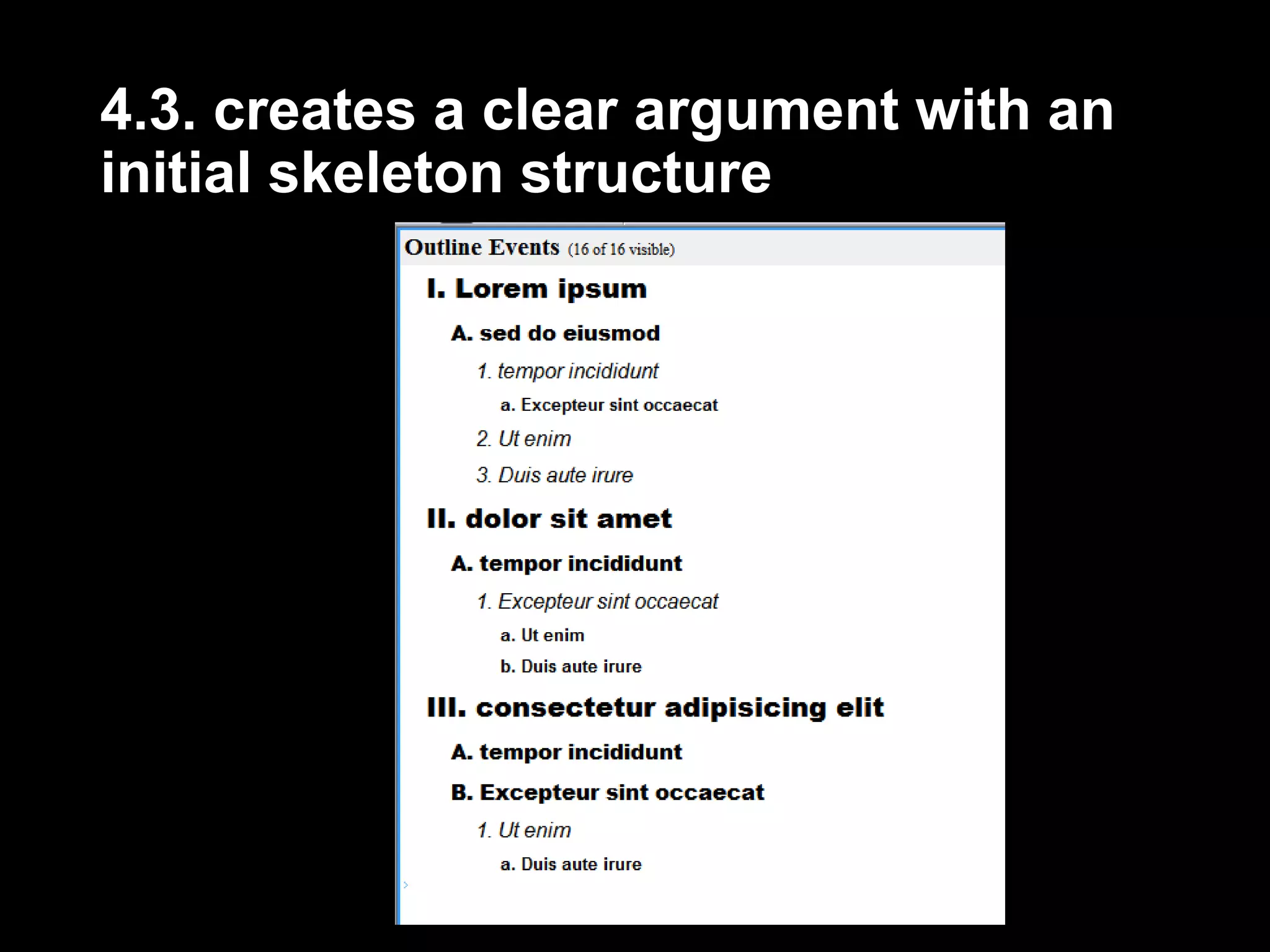
4.3. creates a clear argument with an 
initial skeleton structure
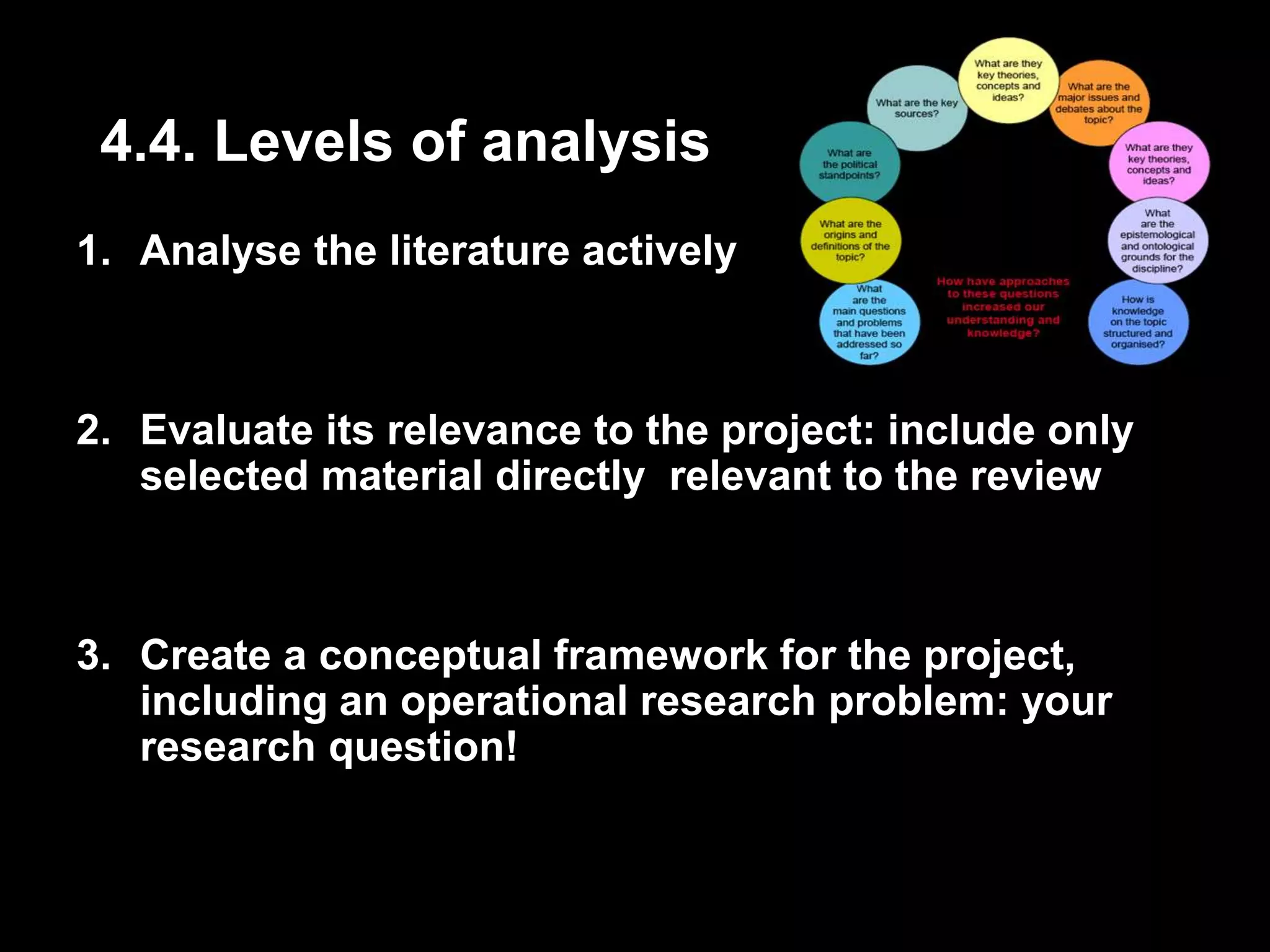
4.4. Levels of analysis 
1. Analyse the literature actively 
2. Evaluate its relevance to the project: include only 
selected material directly relevant to the review 
3. Create a conceptual framework for the project, 
including an operational research problem: your 
research question!
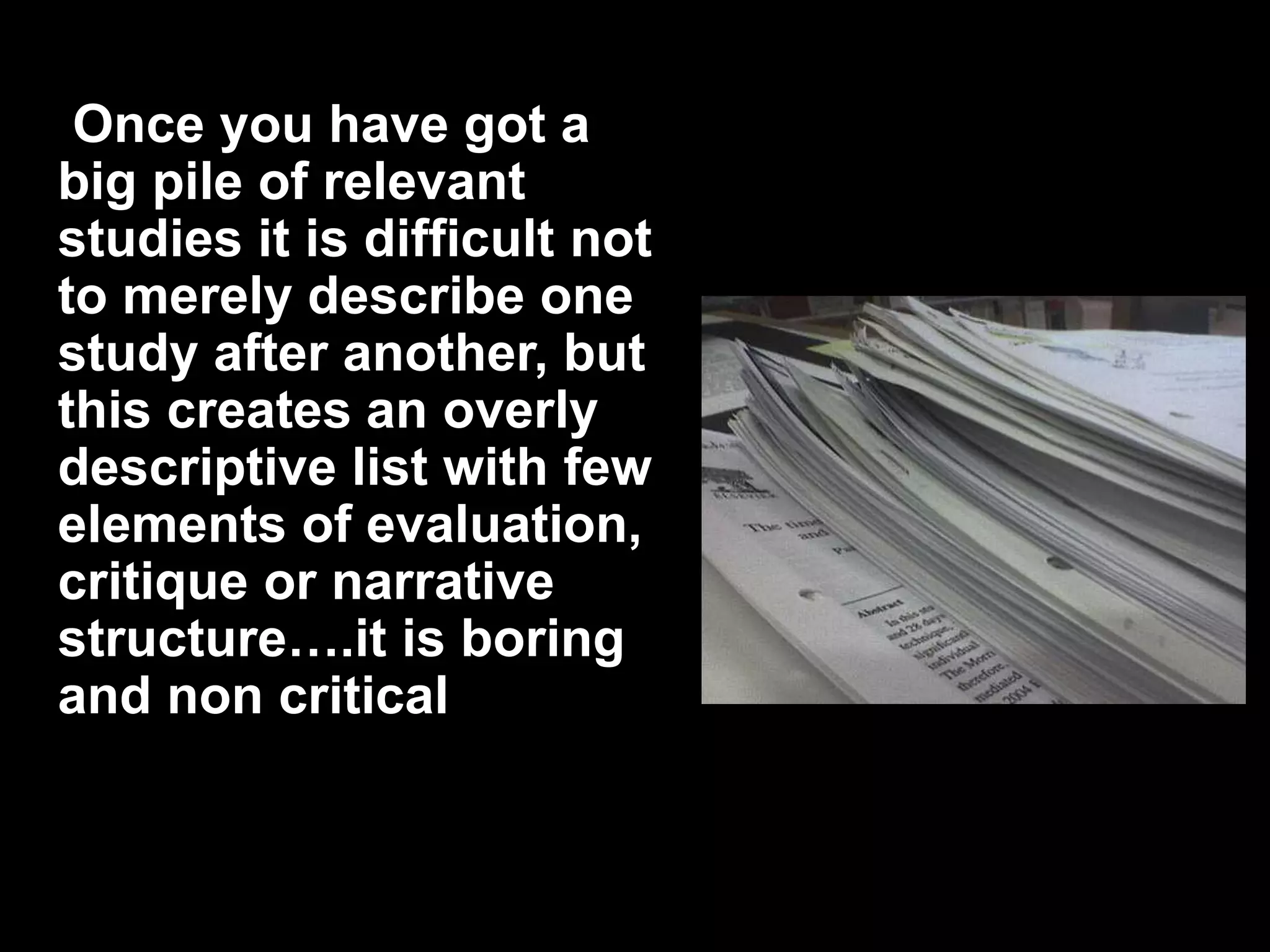
Once you have got a 
big pile of relevant 
studies it is difficult not 
to merely describe one 
study after another, but 
this creates an overly 
descriptive list with few 
elements of evaluation, 
critique or narrative 
structure….it is boring 
and non critical
4.5.Students who use overly 
descriptive styles of writing tend: 
• not to explain why these studies might be of 
interest 
• not to clearly highlight the focus of the 
studies; 
• not to show how the studies they are 
reviewing fit into a more general picture of 
the emerging or existent literature 
• not to critically evaluate the literature they 
are reviewing 
• not to offer a coherent narrative
4.6.develop your own narrative 
• It is a creative act to bring together the research relevant to 
your study that shows your reader the patterns in what 
you’ve found in an evaluative and coherent way that 
highlights the issues, findings and debates in the field and 
which leads to being able to ask a relevant and interesting 
research question, or set of research questions 
Reviews that have their own narrative: 
• offer a coherent, logical story that is written in your own 
words; 
• include relevant studies and interpret them; 
• set out a framework so that the reader can gain a good idea 
of how one study is related to another; 
• use these studies to develop a conceptual understanding of 
the topic; 
• draw out the significance of these studies for our 
understanding of the topic
4.7.Putting the Literature 
Review Together 
1. Using Hooks 
2. Using Anecdotes 
3. Define and discuss Main Concepts 
4. Find and Use the Source Texts
4.7.1.Using Hooks 
• Strong hooks are attention-seeking headlines 
which frame the review or any particular section 
within it. 
• These should not be newspaper-style 
sensationalism, but grounded in the research area. 
The use of statistics is often very effective 
Timelines: why the research should be done 
now, and why they should therefore keep reading the 
review 
Relevance of the research today
4.7.2.Using Anecdotes 
• Anecdote: 
a short account of a particular incident or event, especially 
of an interesting or amusing nature. What happened to 
me type story…… 
• Anecdotal accounts can bring the text to life but can 
become wearisome if overused
4.7.3. Define and discuss Main 
Concepts 
• It is important to define your key terms 
and concepts to inform the reader what 
you mean by the terms being used.
4.7.4.Find and Use the Source Texts 
• Do not merely accept the received view of an 
author’s work. 
• Always locate and carefully read the key works 
yourself, 
• and find good reviews of those texts which tease 
out the variety of interpretations and uses made of 
them over the years.
4.7.5.Introduce and Link Texts 
• Assembling a review is in effect assembling an academic argument, 
at the heart of which lies a challenge. 
• In writing a literature review, you are: 
1. critically engaging with what has gone before, 
2. synthesising areas, 
3. challenging existing orthodoxy, 
4. seeking to extend debate, 
5. and identifying issues which you wish to pursue further. 
The component parts of the review must then hang 
together in a sustained, academically rigorous manner 
with a logical flow.
The dissertation as a whole is a 
persuasive, argumentative, exploratory 
narrative, and your literature review 
needs to pick up and connect your 
research question with the area of work 
in which it fits, while exposing the gap 
you seek to fill or the problem which 
you wish to raise. 
review check list.pdf
5. Review frameworks 
1. Chronological reviews 
2. Thematic reviews 
3. Cross-disciplinary review 
4. Theoretical framework reviews 
Forrester (2012) doing a lietrature 
review.pdf
5.1. Chronological reviews 
• your aim is to provide an overview, history or 
chronology of the literature that you have selected 
for inclusion in your review. 
• Here you have to be careful that your overview 
doesn’t just simply fall into the trap of being a rather 
boring descriptive list as discussed above. 
• Instead, try to tell a story about the literature from 
your notes collated from the articles that you 
selected as being relevant to your project. 
• At the end of your chronological review you need to 
create a summary that leads into the formulation of 
the research question you are going to ask
2. Thematic reviews 
• it is possible to identify patterns of research and to group the studies 
according to these patterns or themes. These can be discussed under 
different headings to give an overview of the relevant research for your 
Project. at the end of a theme, summarise the key points and include a 
linking sentence to the next paragraph 
Advantages of doing a thematic review include: 
• You have less concern with who did what and when and in what 
particular order. This is especially useful if research developments in 
your area of interest occurred in parallel rather than linearly, which 
often happens in areas that employ qualitative methods 
• This structure encourages analysis and interpretation of the 
material, since identifying your themes requires you to think analytically 
about the topic. 
• Identifying and drawing out themes facilitates the production of a 
coherent account of a body of literature and critical discussion of the 
material from a particular theoretical or methodological perspective. This 
is often a hallmark of an excellent project.
3. Cross-disciplinary review 
• a cross-disciplinary framework where studies within a 
particular discipline can be described and discussed with 
reference to the theoretical focus that a specific 
discipline might orient towards. 
• When going through the various studies relevant to your 
project you could firstly locate where each work sits and 
then, when summarising the work provide some 
background to the distinct disciplinary orientation these 
studies tend to have. 
• This will also help you identify issues yet to be addressed 
from the perspective that you are coming from 
• Cross-disciplinary reviews are usually written with a bias 
towards your own Discipline.
4. Theoretical framework reviews 
• theoretical framework acts as a lens so that the 
studies are evaluated specifically in relation to 
how they relate to the assumptions of a 
particular approach or theory 
• Taking up of a particular viewpoint, and then 
providing a review that offers a critical account, 
gaining a deeper understanding of an area. 
• As you develop your skills you will also begin to 
develop your own particular theoretical 
allegiances and orientations, which may 
influence how you want to write your review
Don't 
•Feel like you have to find everything ever written 
on topic 
•Write your literature review with out structuring it 
• Do not write when you not in the right space for 
it 
• Attempt to write perfectly in the first draft: go 
back and polish 
•Simply describe the literature: create an 
argument 
•Worry if you have anxieties about writing: 
everyone does
Lecture 6 doing a literature review

Lecture 6 doing a literature review

  • 1.
    Lecture 6 Doinga literature review for your undergraduate dissertation Dissertation Module Kevin Standish
  • 2.
    Learning outcomes •Understand the role of theories in your dissertation • Describe Purpose of a literature review • Name the three stages of literature search • Review the writing up the literature review • Describe Review frameworks
  • 3.
  • 5.
    1. The roleof theories in your dissertation
  • 6.
    Kuada (2012) therole of theories in your project.pdf 1. the role of theories in your dissertation • a review of the literature is important because without it you will not acquire an understanding of your topic, of what has already been done on it, how it has been researched, and what the key issues are. • In your written project you will be expected to show that you understand previous research on your topic. • This amounts to showing that you have understood the main theories in the subject area and how they have been applied and developed, as well as the main criticisms that have been made of work on the topic.
  • 7.
    1. 2. whatis a theory? • theory provides the language, the concepts, and assumptions that help researchers to make sense of the phenomenon that they seek to investigate. It enables researchers to connect the issues they are investigating to the existing body of knowledge in the area • The researcher must produce a concept or build a theoretical structure that can explain facts and the relationships between them . . . The importance of theory is to help the investigator summarize previous information and guide his future course of action. Sometimes the formulation of a theory may indicate missing ideas or links and the kinds of additional data required. Thus, a theory is an essential tool of research in stimulating the advancement of knowledge still further.
  • 8.
    1.2. what isa theory? •theories may be defined as series of systematic inter-related statements or generalisations that explain and/ or anticipate developments in a specific context or phenomenon. • Strauss and Corbin (1998:15) define theory as “a set of well-developed concepts related through statements of relationship which together constitute an integrated framework that can be used to explain or predict phenomena”
  • 9.
    1.3. Classification of theories 1. Metatheories 2. Grand theories 3. Midrange theories 4. Microtheories
  • 10.
    1.3.1.Metatheories theory whosesubject matter is some theory • Metatheories describe the broad philosophical assumptions concerning reality that are accepted in social science as clearly demarcated boundaries of thought in a particular field of study. • Metatheories serve the following purposes: 1. clarifying the general assumptions underlying a subject matter; 2. specifying the important problems faced in undertaking investigations; 3. and specifying what are acceptable methods
  • 11.
    1.3.2. Grand theories A grand theory is defined as an all-inclusive unified theory that 1. seeks to explain social behaviour, social organization, and social change in human experience. 2. It normally provides the key concepts and principles of the social science discipline and is therefore consistent with the dominant metatheories or paradigms of the discipline. 3. Examples of Grand theories: Feminism, marxism, and democracy
  • 12.
    1.3.3. Midrange theories • Midrange theory represents theories that connect grand theories with empirical evidence. • It consists of limited sets of assumptions from which specific hypotheses are logically derived and confirmed by empirical investigation • Thus, when you engage in literature review, you are mostly discussing midrange theories. • For example if you adopt a social constructivist approach to your cultural research, you will justify your arguments by using studies that have adopted this approach
  • 13.
    1.3.4. Microtheories Microtheoriesconstitute the lowest level of theories. They focus on: • individuals or small groups located in specific contexts. As such explanations found in microtheories are of limited generalization on their own. • They can, however, constitute essential inputs in the generation of new perspectives and theory development. • For example: scholars use case studies to generate microtheories that are then further developed through multiple case studies to become important inputs in midrange theory formulation
  • 14.
    1.4. Use ofTheories Each of the levels of theory listed above will play a different role in your project. • The metatheories define the philosophical foundations of your project • The grand theories define the boundaries of your subject of investigation. They combine with the metatheories to establish the platform on which you will base your research. • But much of the discussion in your theoretical chapters will draw on midrange theories. • Midrange theories can also be used to develop variables to analyse and the connections between them: an analytical framework. • They therefore help you identify what kind of information you require for the analysis and what is the most appropriate means of acquiring this information. • Without such an analytical framework you will risk drowning in a sea of information, since you will be unable to sort out the relevant from the irrelevant • An essential task in the project work process is for you to discuss most of the leading theories that attempt to explain the problem of interest, comparing the strengths of the arguments underlying them and their empirical foundation
  • 15.
    2. Purpose ofa literature review Bell (2010) The review of the literature.pdf
  • 16.
    2. Purpose ofa literature review 1. outline the area you are researching 2. Explain why it matters 3. Summarise the research that has already been done in this area particularly any key studies 4. Identify any gaps in this literature to justify why your study is important and what it adds to the literature
  • 17.
    2. Purpose ofa literature review 5. Present your research questions (qualitative research) or hypotheses (quantitative research). These should be set out at the end of the literature review 6. Be sure to return to your literature review afterwards to read drafted in order to ensure that it gives a clear argument leading up to your research rather than simply summarising past research. 7. Include all key studies and theories 8. The review of the literature for a research proposal does not need to be as extensive as that for the final research write-up.
  • 18.
    3 Stages ofLiterature review Lit review questioning.pdf
  • 19.
    •Review of theLiterature Vs Literature Review: •For your research proposal you will present a broad survey/summary of the current literature reviewed in forming your proposal. •This is NOT the same as a Literature Review which is the critical evaluation and analysis of the literature upon which your dissertation rests theoretically.
  • 20.
    the three stagesof literature search • first stage: using search engines and other resources to queue make a large collection of relevant materials •Second stage: reading through the abstracts, summaries et cetera, that you have obtained using these to find further materials •Third stage: consider all the material and determine which papers and chapters need to be read in depth where the gaps in the literature lie.
  • 21.
    three key pointsin a project • Literature reviews usually happen at three key points in a project: 1. during the development of your research question; 2. during the planning stages, as you work out the rationale of the steps you need to take 3. to complete your project; and towards the end of the project, either because: • preliminary analysis points you towards literature you had not previously considered, or • to check for relevant studies published since your previous literature searches.
  • 22.
    Importance of theory • The theory in your project is essential; serving the following purpose: 1.They demonstrate your understanding of the current body of knowledge in your chosen field of study. 2.They provide you with a philosophical foundation on which you can ground your study. 3.They constitute an important part of the overall research design of the project.
  • 23.
    4. writing upthe literature review Barker (2015) Chap 5 Doing a Literature Review.pdf
  • 24.
  • 25.
    4.1. Use ofmind mapping
  • 27.
    4.2. The funnelof questions
  • 28.
    4.3. creates aclear argument with an initial skeleton structure
  • 29.
    4.4. Levels ofanalysis 1. Analyse the literature actively 2. Evaluate its relevance to the project: include only selected material directly relevant to the review 3. Create a conceptual framework for the project, including an operational research problem: your research question!
  • 30.
    Once you havegot a big pile of relevant studies it is difficult not to merely describe one study after another, but this creates an overly descriptive list with few elements of evaluation, critique or narrative structure….it is boring and non critical
  • 31.
    4.5.Students who useoverly descriptive styles of writing tend: • not to explain why these studies might be of interest • not to clearly highlight the focus of the studies; • not to show how the studies they are reviewing fit into a more general picture of the emerging or existent literature • not to critically evaluate the literature they are reviewing • not to offer a coherent narrative
  • 32.
    4.6.develop your ownnarrative • It is a creative act to bring together the research relevant to your study that shows your reader the patterns in what you’ve found in an evaluative and coherent way that highlights the issues, findings and debates in the field and which leads to being able to ask a relevant and interesting research question, or set of research questions Reviews that have their own narrative: • offer a coherent, logical story that is written in your own words; • include relevant studies and interpret them; • set out a framework so that the reader can gain a good idea of how one study is related to another; • use these studies to develop a conceptual understanding of the topic; • draw out the significance of these studies for our understanding of the topic
  • 33.
    4.7.Putting the Literature Review Together 1. Using Hooks 2. Using Anecdotes 3. Define and discuss Main Concepts 4. Find and Use the Source Texts
  • 34.
    4.7.1.Using Hooks •Strong hooks are attention-seeking headlines which frame the review or any particular section within it. • These should not be newspaper-style sensationalism, but grounded in the research area. The use of statistics is often very effective Timelines: why the research should be done now, and why they should therefore keep reading the review Relevance of the research today
  • 35.
    4.7.2.Using Anecdotes •Anecdote: a short account of a particular incident or event, especially of an interesting or amusing nature. What happened to me type story…… • Anecdotal accounts can bring the text to life but can become wearisome if overused
  • 36.
    4.7.3. Define anddiscuss Main Concepts • It is important to define your key terms and concepts to inform the reader what you mean by the terms being used.
  • 37.
    4.7.4.Find and Usethe Source Texts • Do not merely accept the received view of an author’s work. • Always locate and carefully read the key works yourself, • and find good reviews of those texts which tease out the variety of interpretations and uses made of them over the years.
  • 38.
    4.7.5.Introduce and LinkTexts • Assembling a review is in effect assembling an academic argument, at the heart of which lies a challenge. • In writing a literature review, you are: 1. critically engaging with what has gone before, 2. synthesising areas, 3. challenging existing orthodoxy, 4. seeking to extend debate, 5. and identifying issues which you wish to pursue further. The component parts of the review must then hang together in a sustained, academically rigorous manner with a logical flow.
  • 39.
    The dissertation asa whole is a persuasive, argumentative, exploratory narrative, and your literature review needs to pick up and connect your research question with the area of work in which it fits, while exposing the gap you seek to fill or the problem which you wish to raise. review check list.pdf
  • 40.
    5. Review frameworks 1. Chronological reviews 2. Thematic reviews 3. Cross-disciplinary review 4. Theoretical framework reviews Forrester (2012) doing a lietrature review.pdf
  • 41.
    5.1. Chronological reviews • your aim is to provide an overview, history or chronology of the literature that you have selected for inclusion in your review. • Here you have to be careful that your overview doesn’t just simply fall into the trap of being a rather boring descriptive list as discussed above. • Instead, try to tell a story about the literature from your notes collated from the articles that you selected as being relevant to your project. • At the end of your chronological review you need to create a summary that leads into the formulation of the research question you are going to ask
  • 42.
    2. Thematic reviews • it is possible to identify patterns of research and to group the studies according to these patterns or themes. These can be discussed under different headings to give an overview of the relevant research for your Project. at the end of a theme, summarise the key points and include a linking sentence to the next paragraph Advantages of doing a thematic review include: • You have less concern with who did what and when and in what particular order. This is especially useful if research developments in your area of interest occurred in parallel rather than linearly, which often happens in areas that employ qualitative methods • This structure encourages analysis and interpretation of the material, since identifying your themes requires you to think analytically about the topic. • Identifying and drawing out themes facilitates the production of a coherent account of a body of literature and critical discussion of the material from a particular theoretical or methodological perspective. This is often a hallmark of an excellent project.
  • 43.
    3. Cross-disciplinary review • a cross-disciplinary framework where studies within a particular discipline can be described and discussed with reference to the theoretical focus that a specific discipline might orient towards. • When going through the various studies relevant to your project you could firstly locate where each work sits and then, when summarising the work provide some background to the distinct disciplinary orientation these studies tend to have. • This will also help you identify issues yet to be addressed from the perspective that you are coming from • Cross-disciplinary reviews are usually written with a bias towards your own Discipline.
  • 44.
    4. Theoretical frameworkreviews • theoretical framework acts as a lens so that the studies are evaluated specifically in relation to how they relate to the assumptions of a particular approach or theory • Taking up of a particular viewpoint, and then providing a review that offers a critical account, gaining a deeper understanding of an area. • As you develop your skills you will also begin to develop your own particular theoretical allegiances and orientations, which may influence how you want to write your review
  • 45.
    Don't •Feel likeyou have to find everything ever written on topic •Write your literature review with out structuring it • Do not write when you not in the right space for it • Attempt to write perfectly in the first draft: go back and polish •Simply describe the literature: create an argument •Worry if you have anxieties about writing: everyone does