Research Methodology
(Theory of research)
&
Research Design (The action
of Research): Method &
Techniques
Dissertation Module
Kevin Standish
Learning outcomes
• Distinguish Research Methodology from
Research methods
• Compare Qualitative and Quantitative Methods
• Describe Variables and hypothesis
• Identify sampling methods
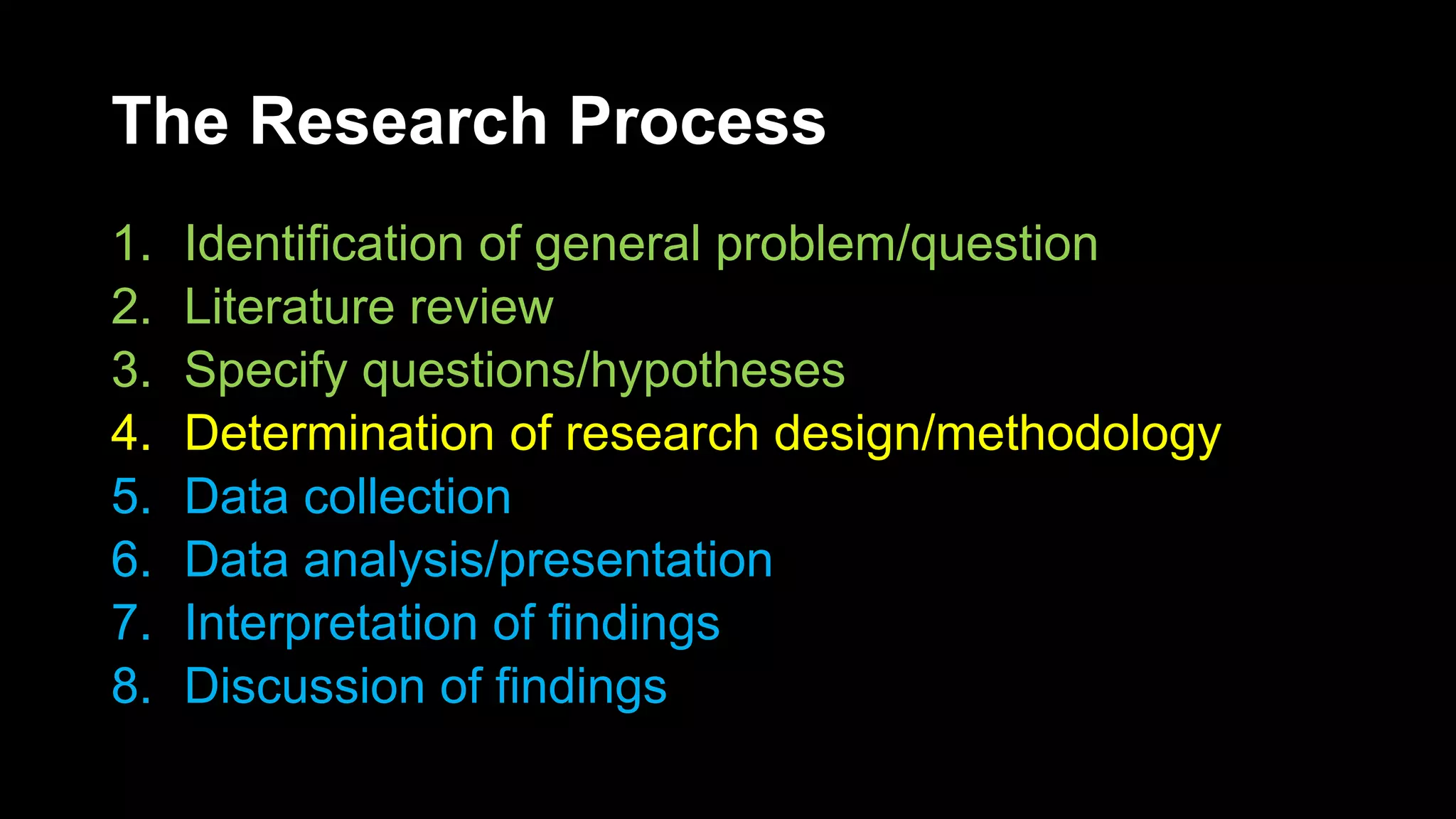
The Research Process
1. Identification of general problem/question
2. Literature review
3. Specify questions/hypotheses
4. Determination of research design/methodology
5. Data collection
6. Data analysis/presentation
7. Interpretation of findings
8. Discussion of findings
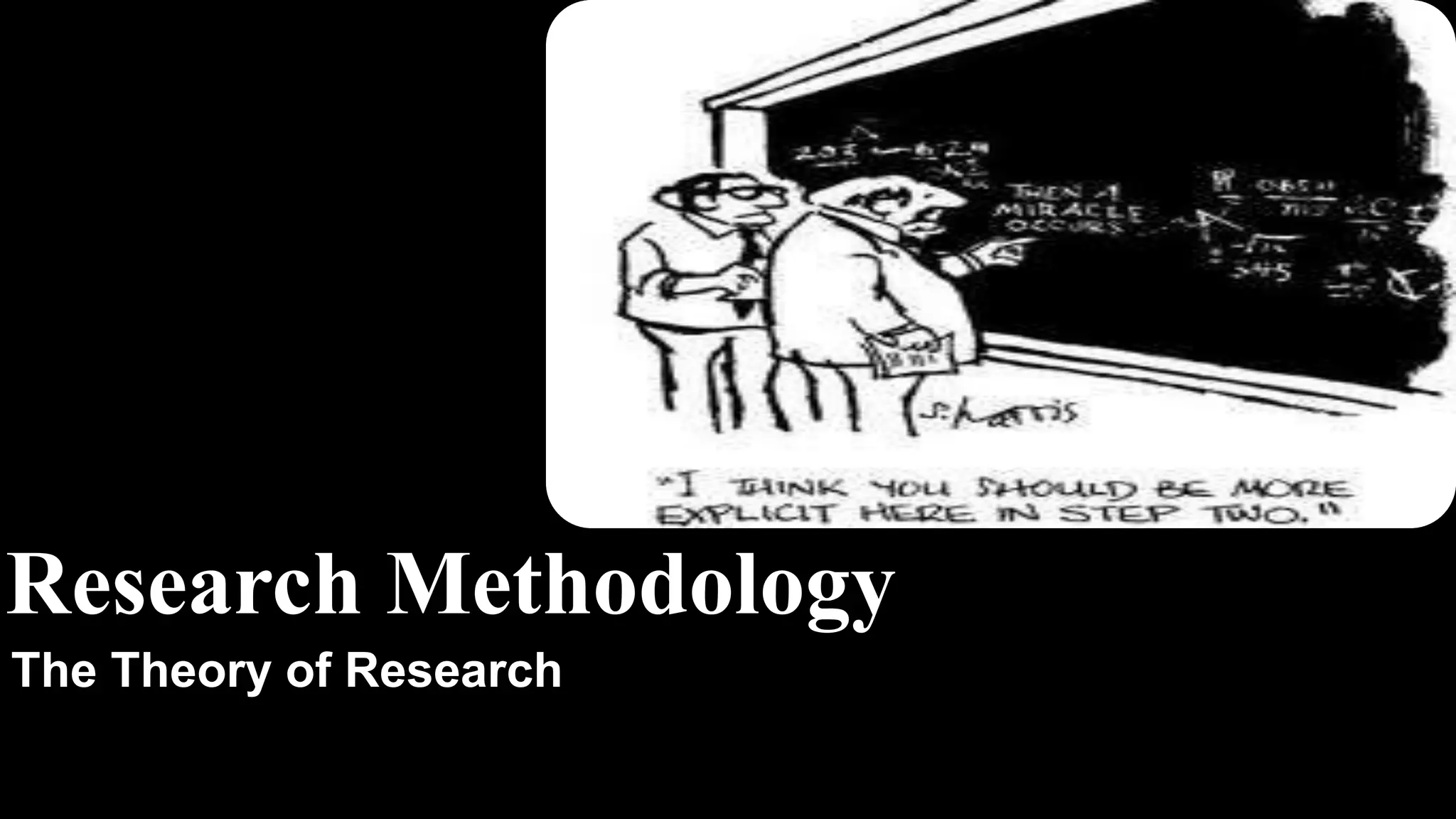
Research Methodology
The Theory of Research
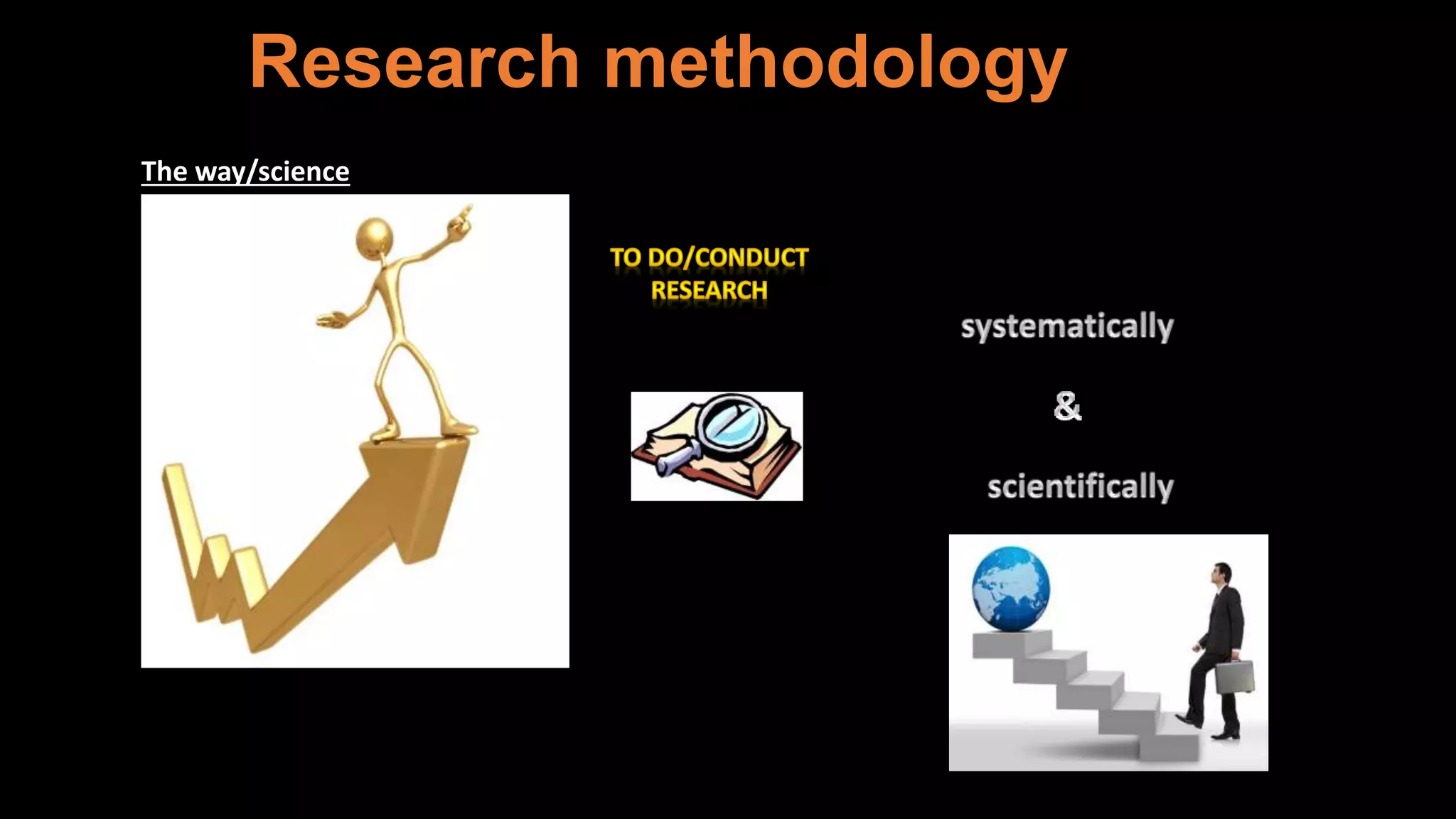
Research methodology
The way/science
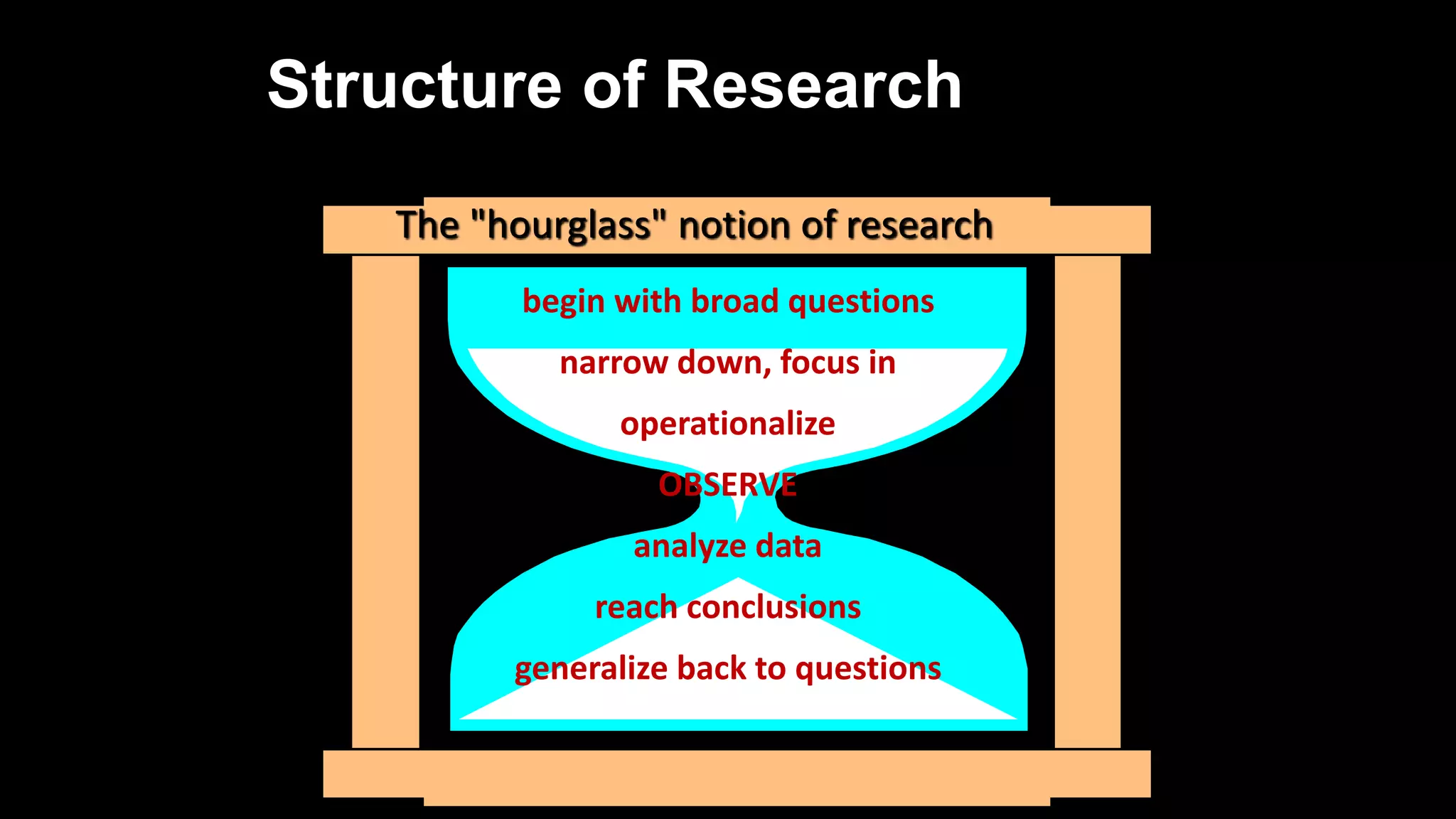
Structure of Research
begin with broad questions
narrow down, focus in
operationalize
OBSERVE
analyze data
reach conclusions
generalize back to questions
The "hourglass" notion of research
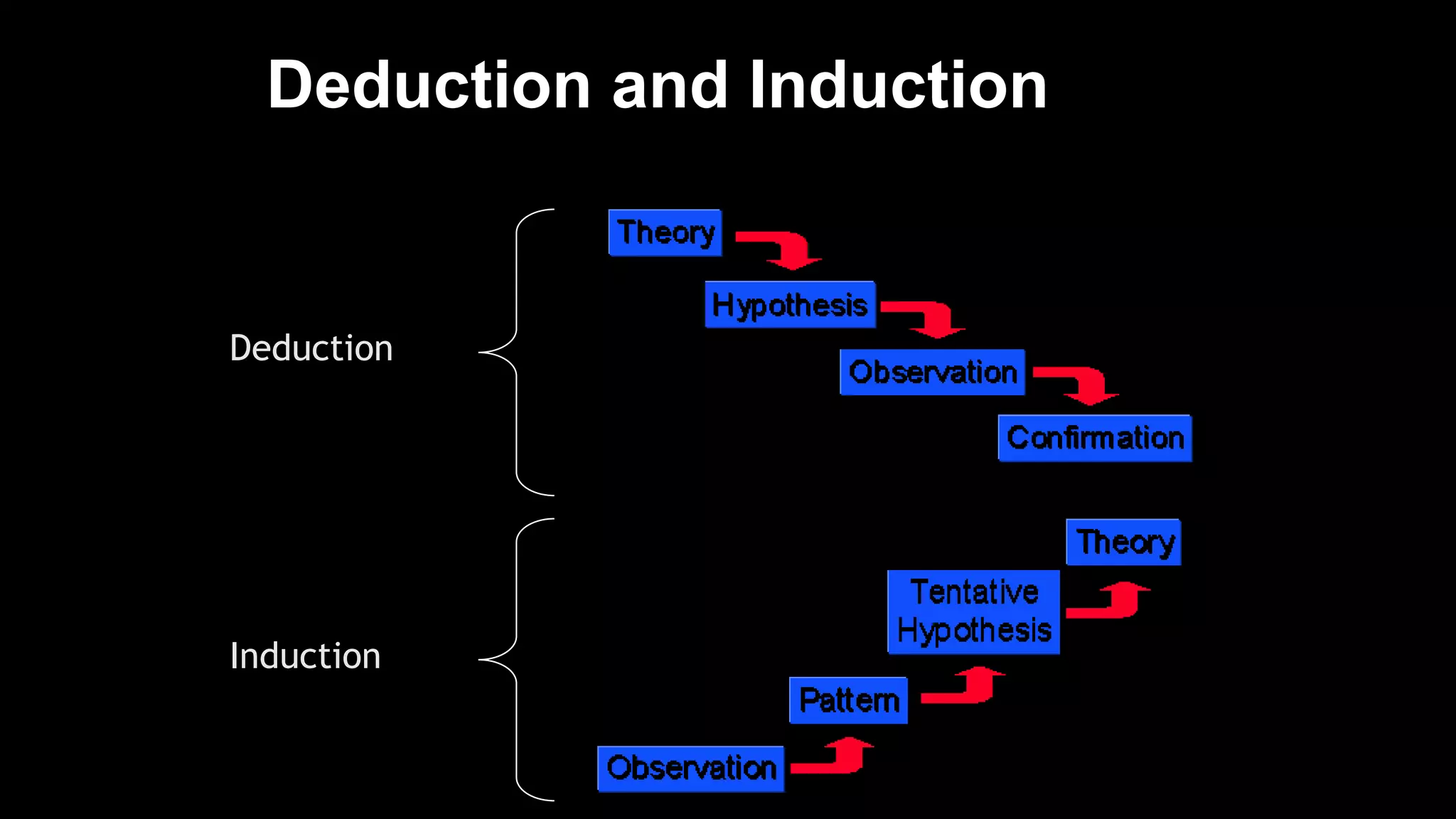
Deduction and Induction
Deduction
Induction
Research Methodology
• Research methodology is a way to
systematically solve the research problem.
• It may be understood as a science of studying
how research is done scientifically.
• In it we study the various steps that are
generally adopted by a researcher in studying
his research problem along with the logic
behind them
Research methodology..
• Research Methodology says the
how
to do/conduct research
systematically & scientifically.
• Research methodology not only provides
the knowledge of various types of methods & techniques
for Sampling , data collection, data analysis & report writing etc.
but also guides
that which particular method or technique
for sampling/data collection/data analysis should be used or not
& why should /shouldn't do so.
Research Methodology
• There are different ways of “knowing” and the
epistemological standpoint will determine the nature of
that knowing
• One may explore their reality using statistical data as
evidence while another may have first-hand accounts
of how the person has been effected, which is their
reality.
• Each represents a particular Paradigm of knowledge.
Neither is right or wrong it is just a different view.
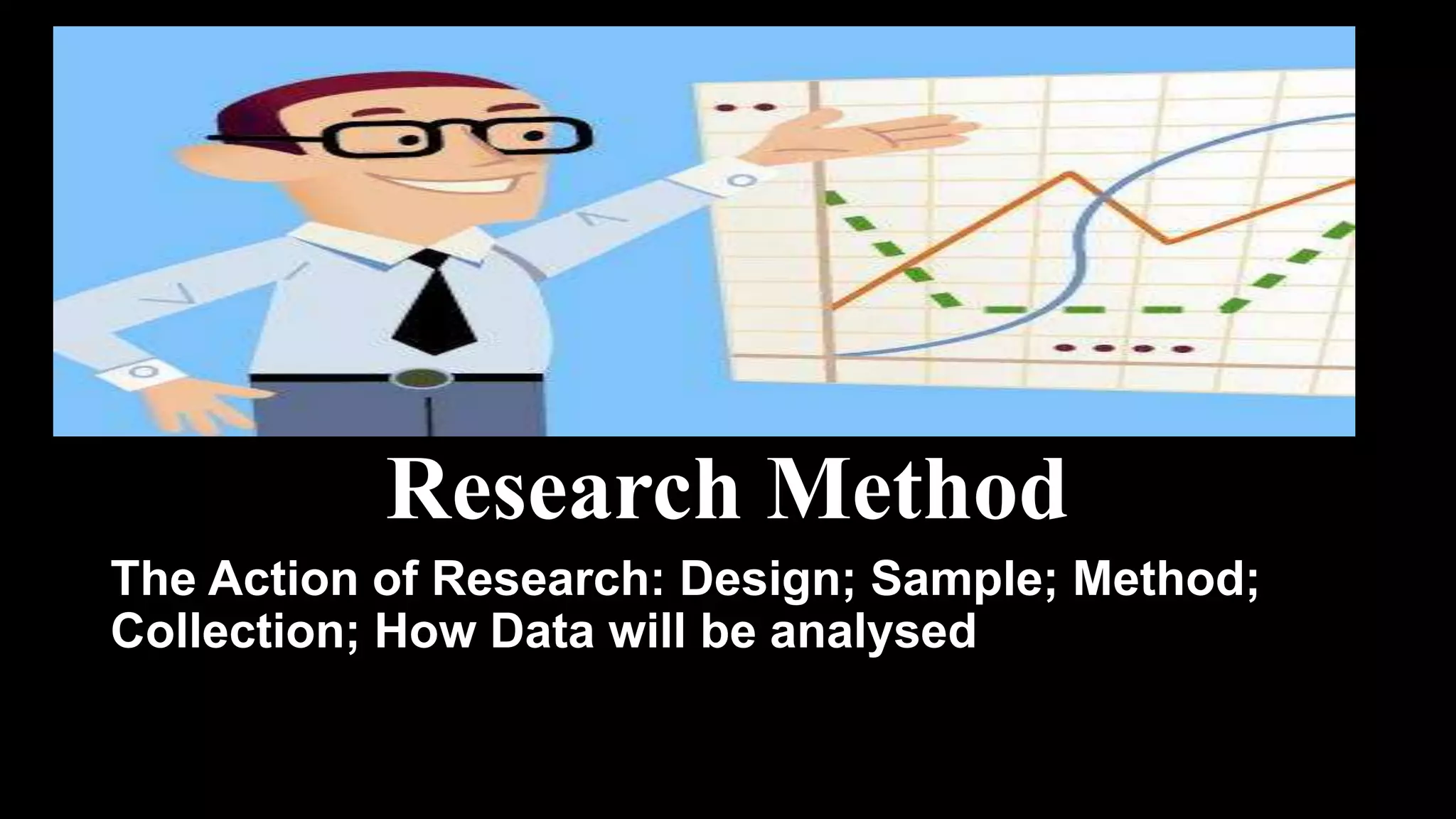
Research Method
The Action of Research: Design; Sample; Method;
Collection; How Data will be analysed
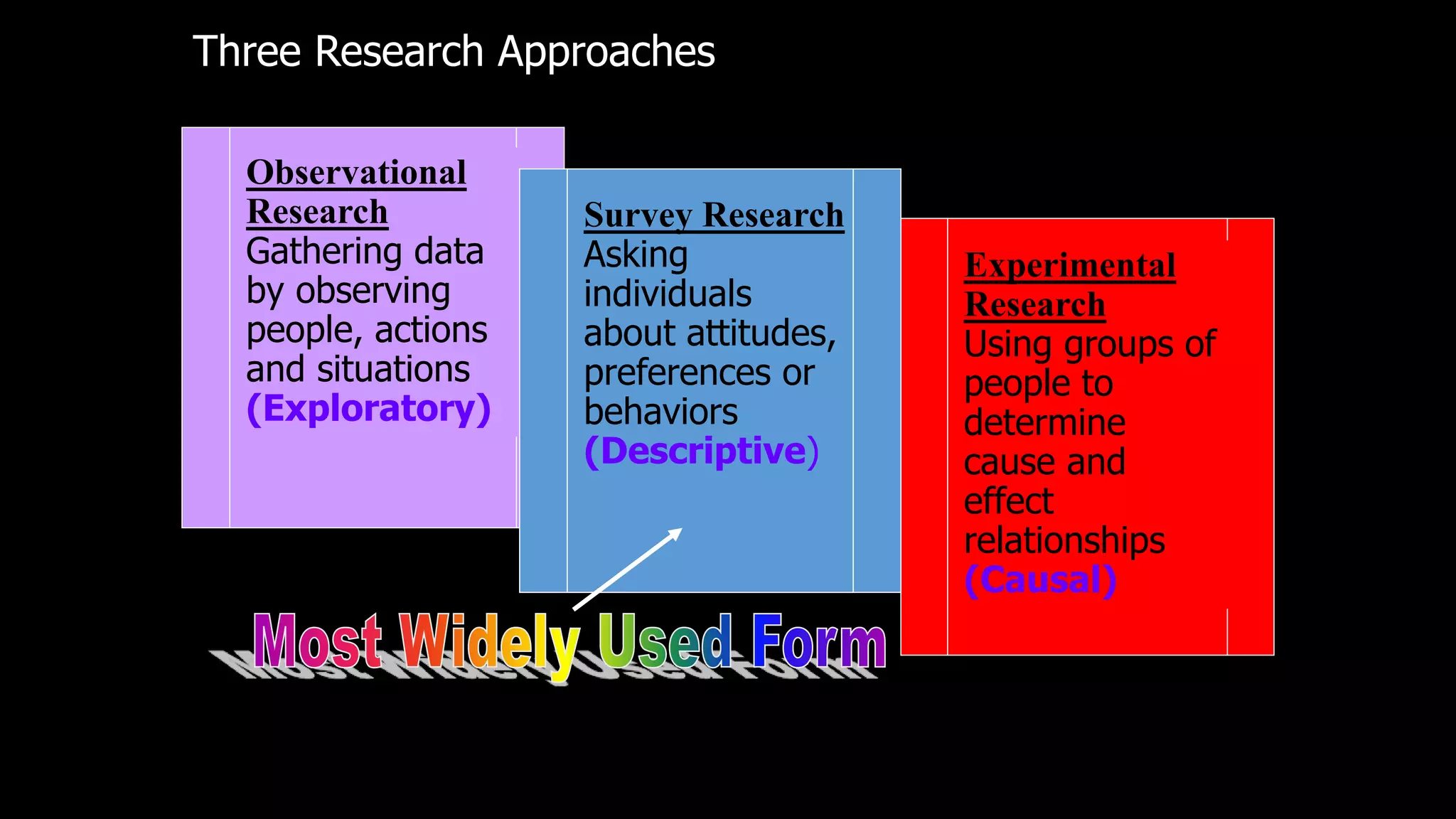
Observational
Research
Gathering data
by observing
people, actions
and situations
(Exploratory)
Experimental
Research
Using groups of
people to
determine
cause and
effect
relationships
(Causal)
Survey Research
Asking
individuals
about attitudes,
preferences or
behaviors
(Descriptive)
Three Research Approaches
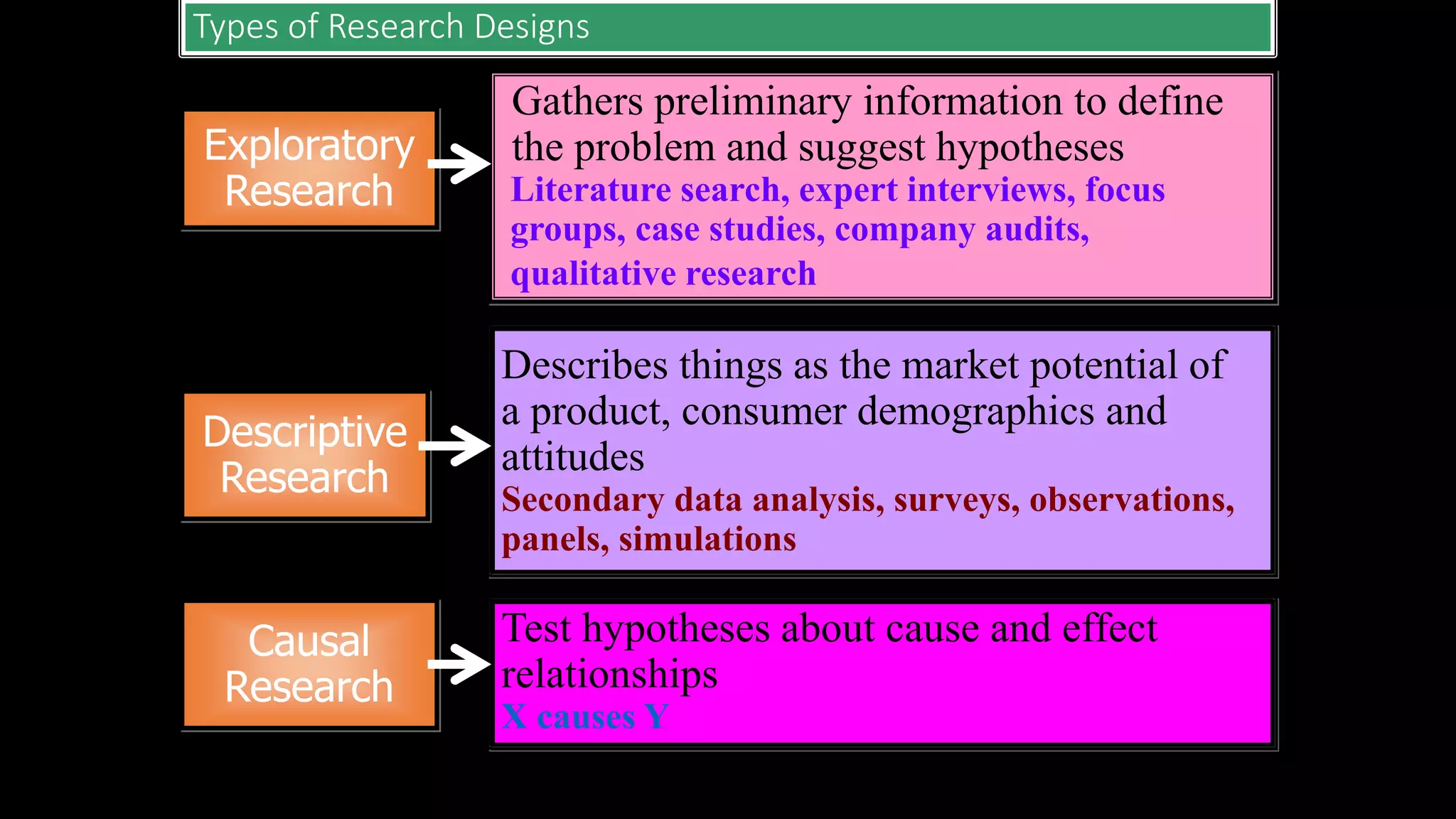
Types of Research Designs
Exploratory
Research
Descriptive
Research
Causal
Research
Test hypotheses about cause and effect
relationships
X causes Y
Gathers preliminary information to define
the problem and suggest hypotheses
Literature search, expert interviews, focus
groups, case studies, company audits,
qualitative research
Describes things as the market potential of
a product, consumer demographics and
attitudes
Secondary data analysis, surveys, observations,
panels, simulations
Research Methods
 Descriptive research
Analytical research
 Applied research
Basic research
Research Methods
 Quantitative research
Qualitative research
 Conceptual research
Empirical research
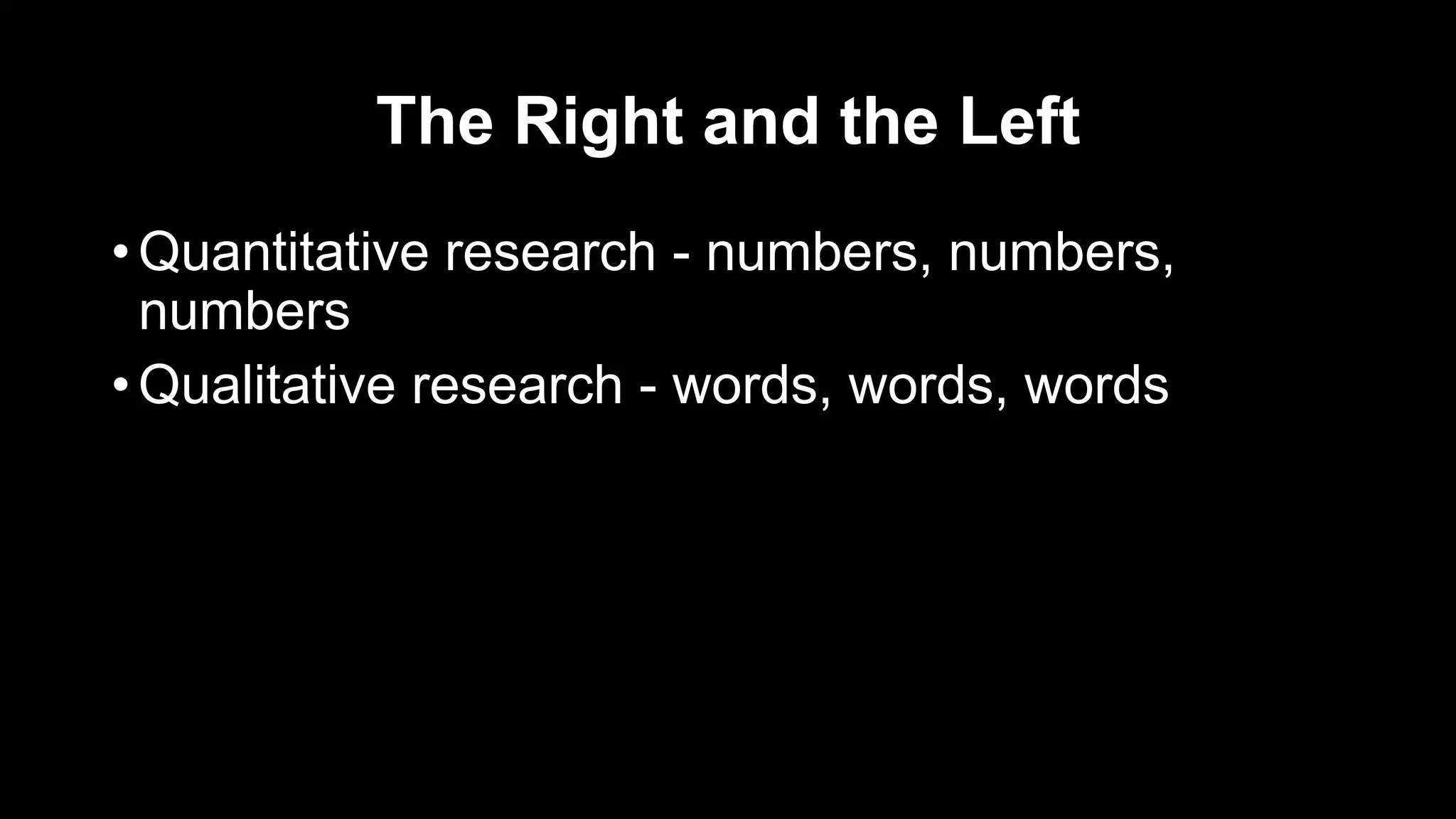
The Right and the Left
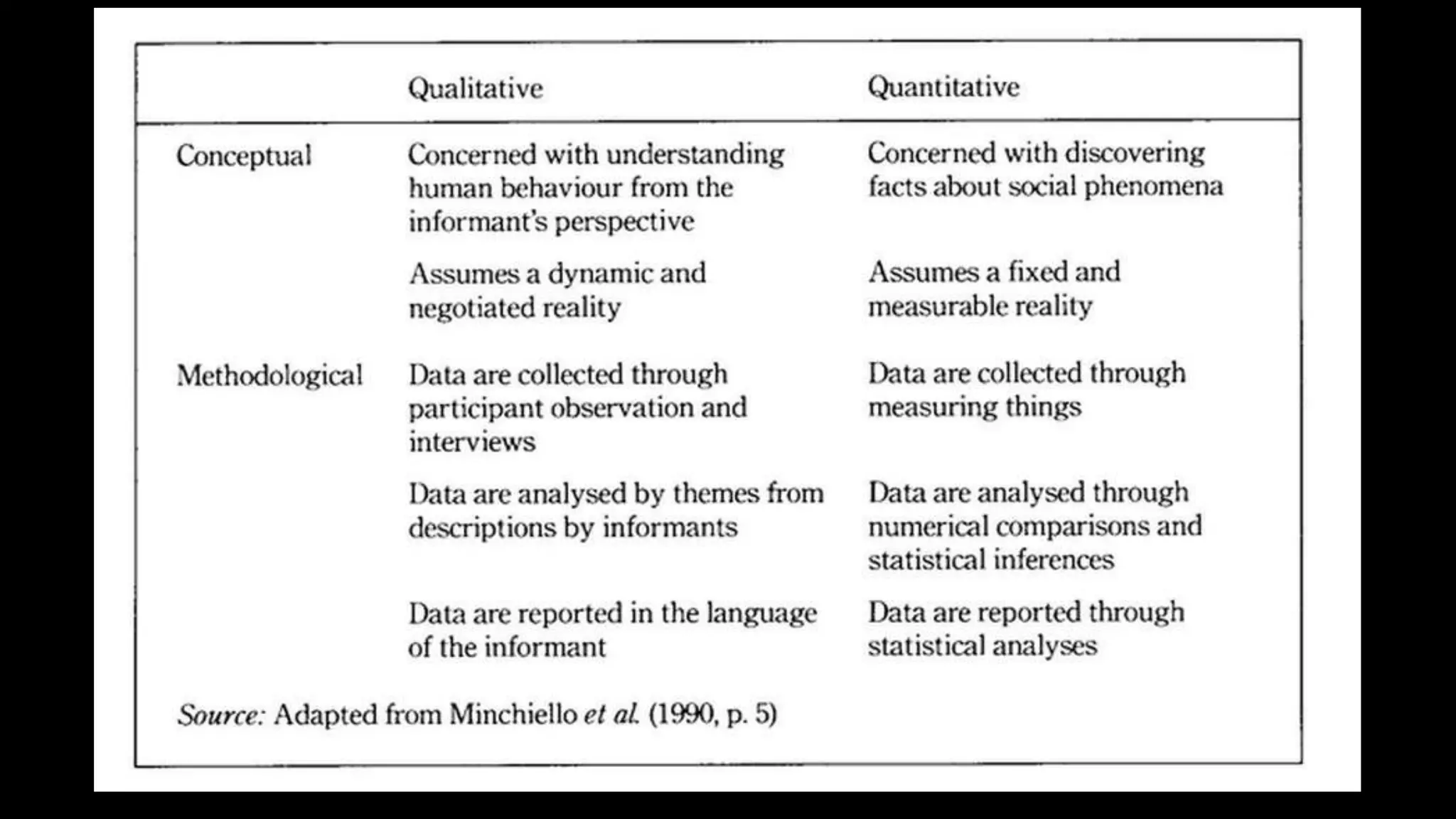
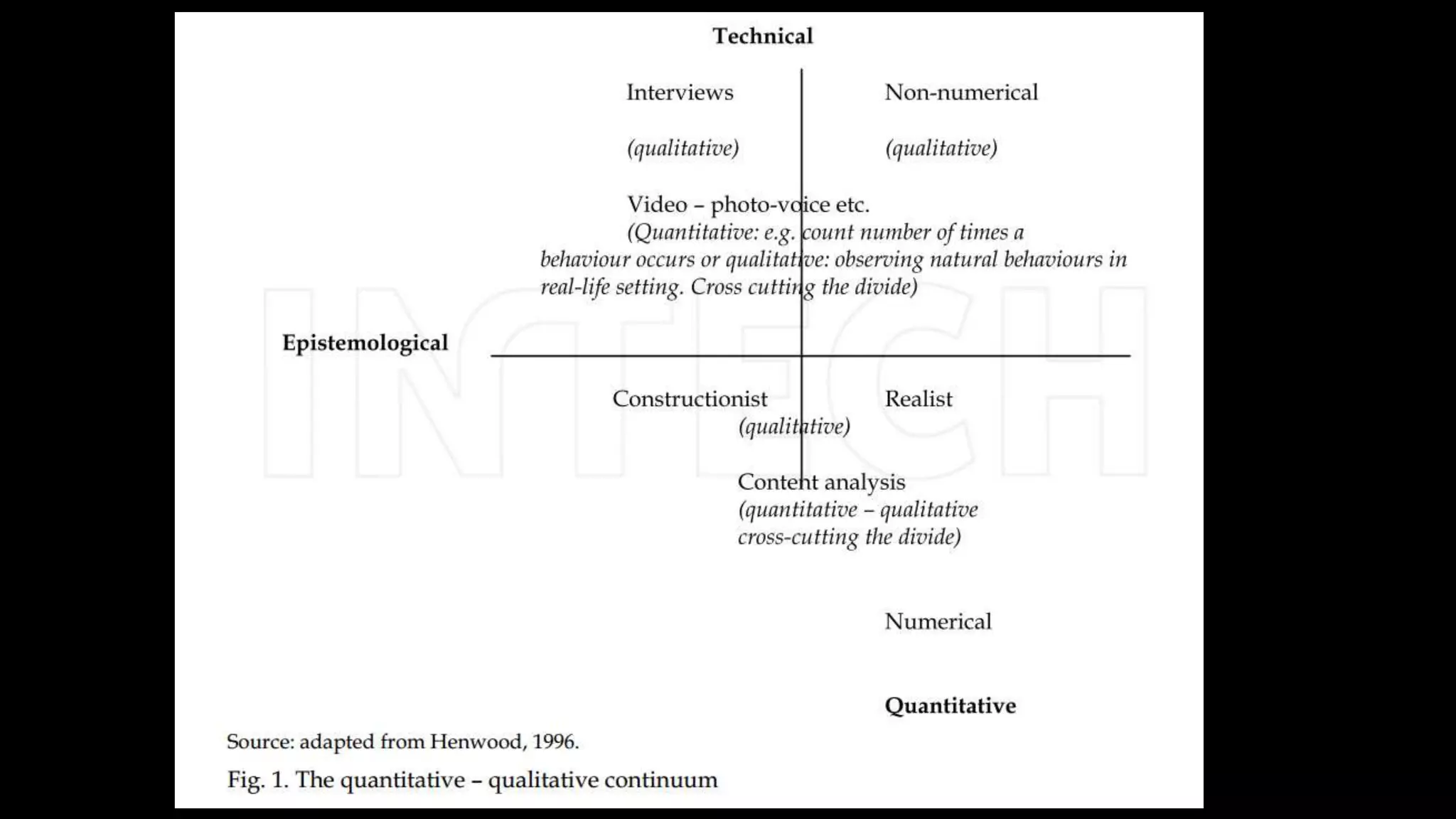
• Quantitative research - numbers, numbers,
numbers
• Qualitative research - words, words, words
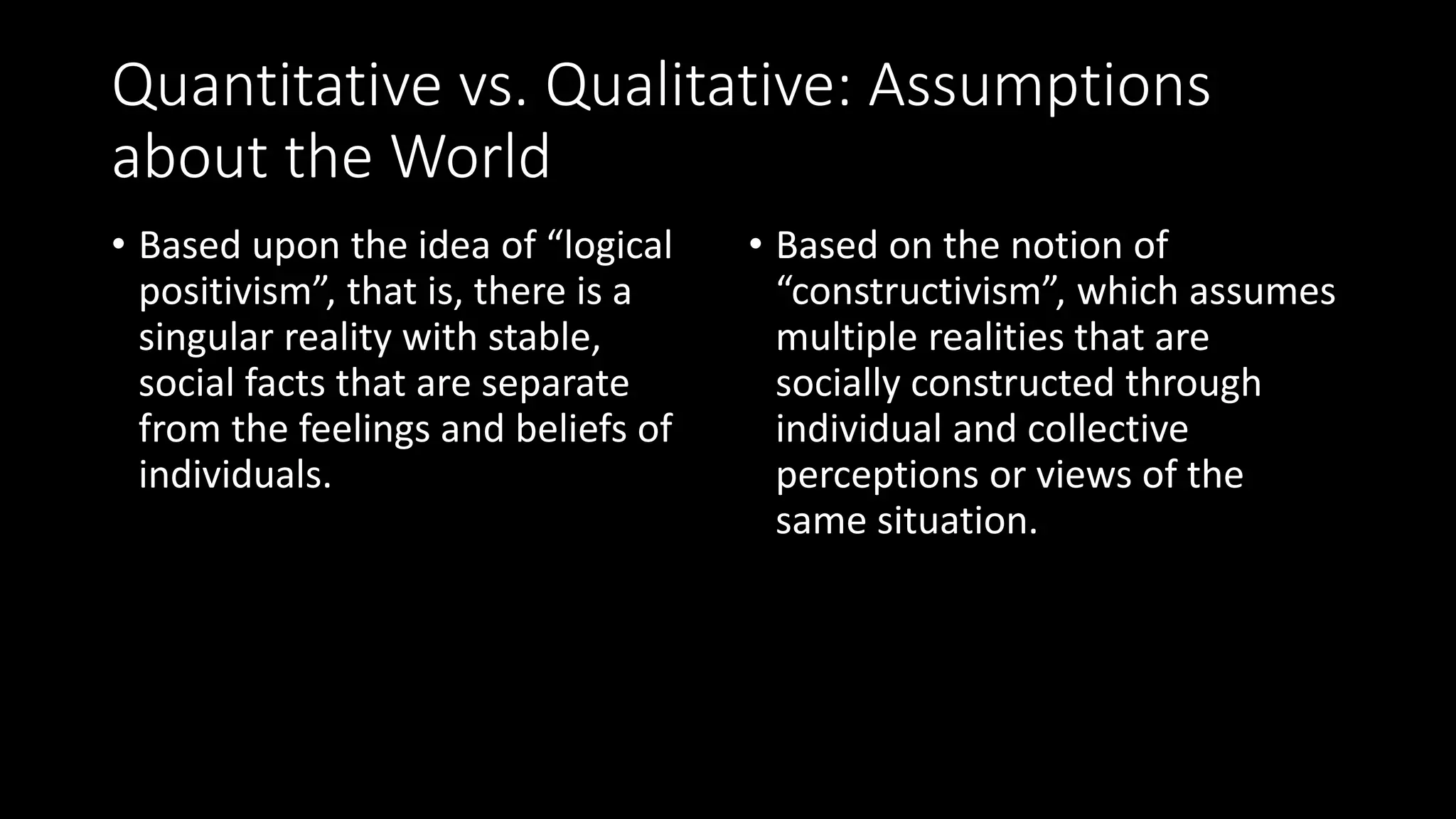
Quantitative vs. Qualitative: Assumptions
about the World
• Based upon the idea of “logical
positivism”, that is, there is a
singular reality with stable,
social facts that are separate
from the feelings and beliefs of
individuals.
• Based on the notion of
“constructivism”, which assumes
multiple realities that are
socially constructed through
individual and collective
perceptions or views of the
same situation.
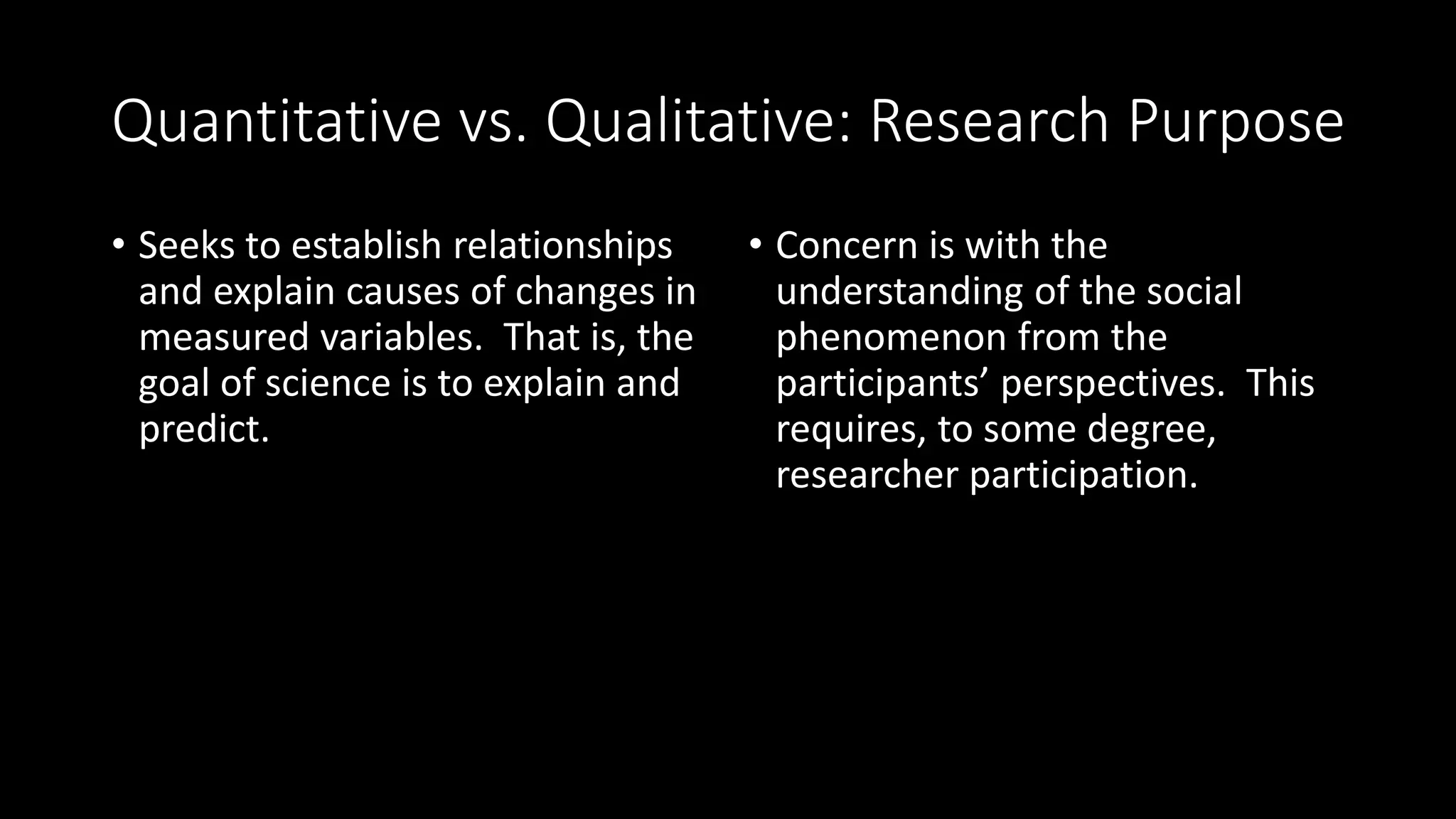
Quantitative vs. Qualitative: Research Purpose
• Seeks to establish relationships
and explain causes of changes in
measured variables. That is, the
goal of science is to explain and
predict.
• Concern is with the
understanding of the social
phenomenon from the
participants’ perspectives. This
requires, to some degree,
researcher participation.
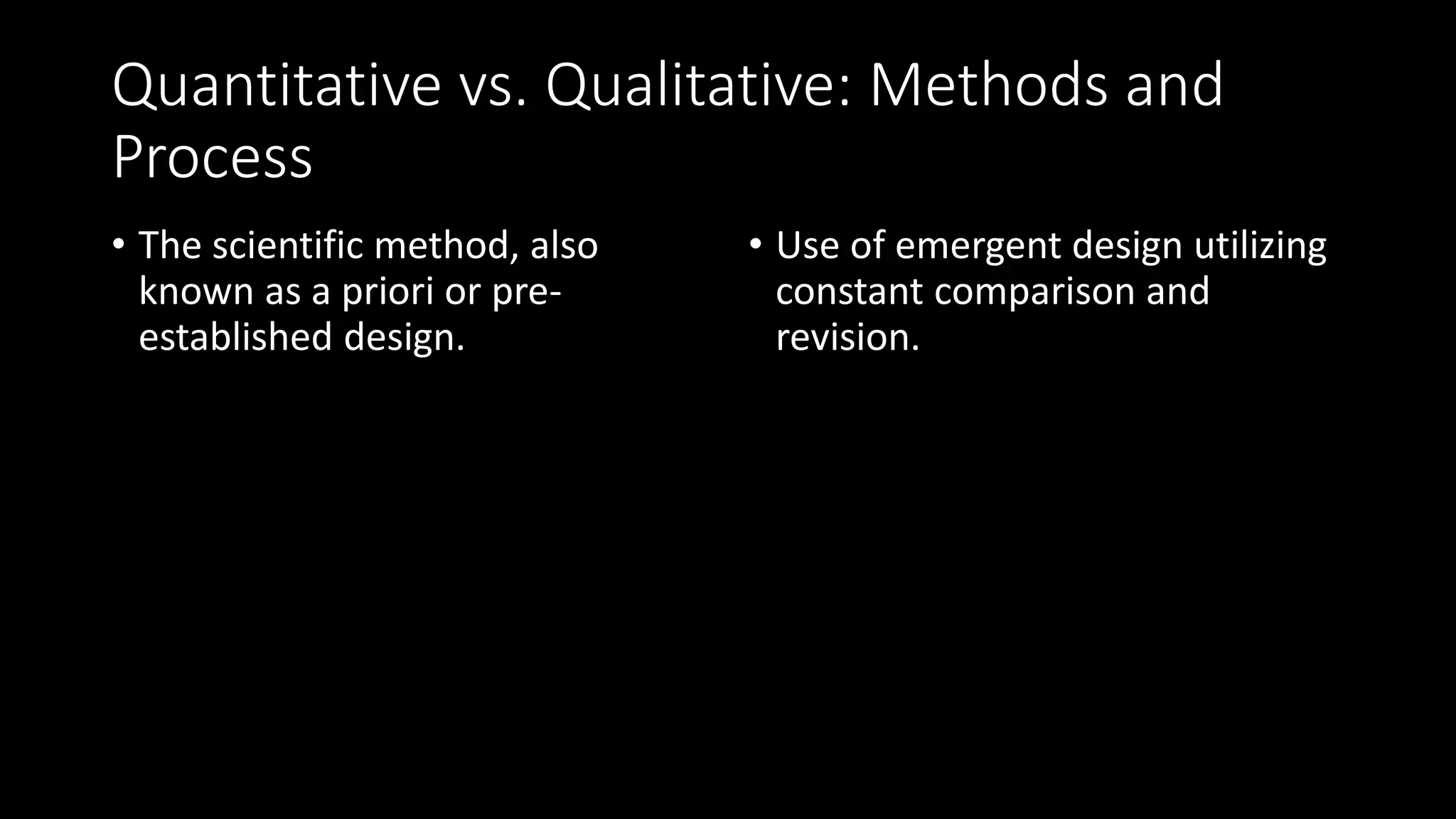
Quantitative vs. Qualitative: Methods and
Process
• The scientific method, also
known as a priori or pre-
established design.
• Use of emergent design utilizing
constant comparison and
revision.
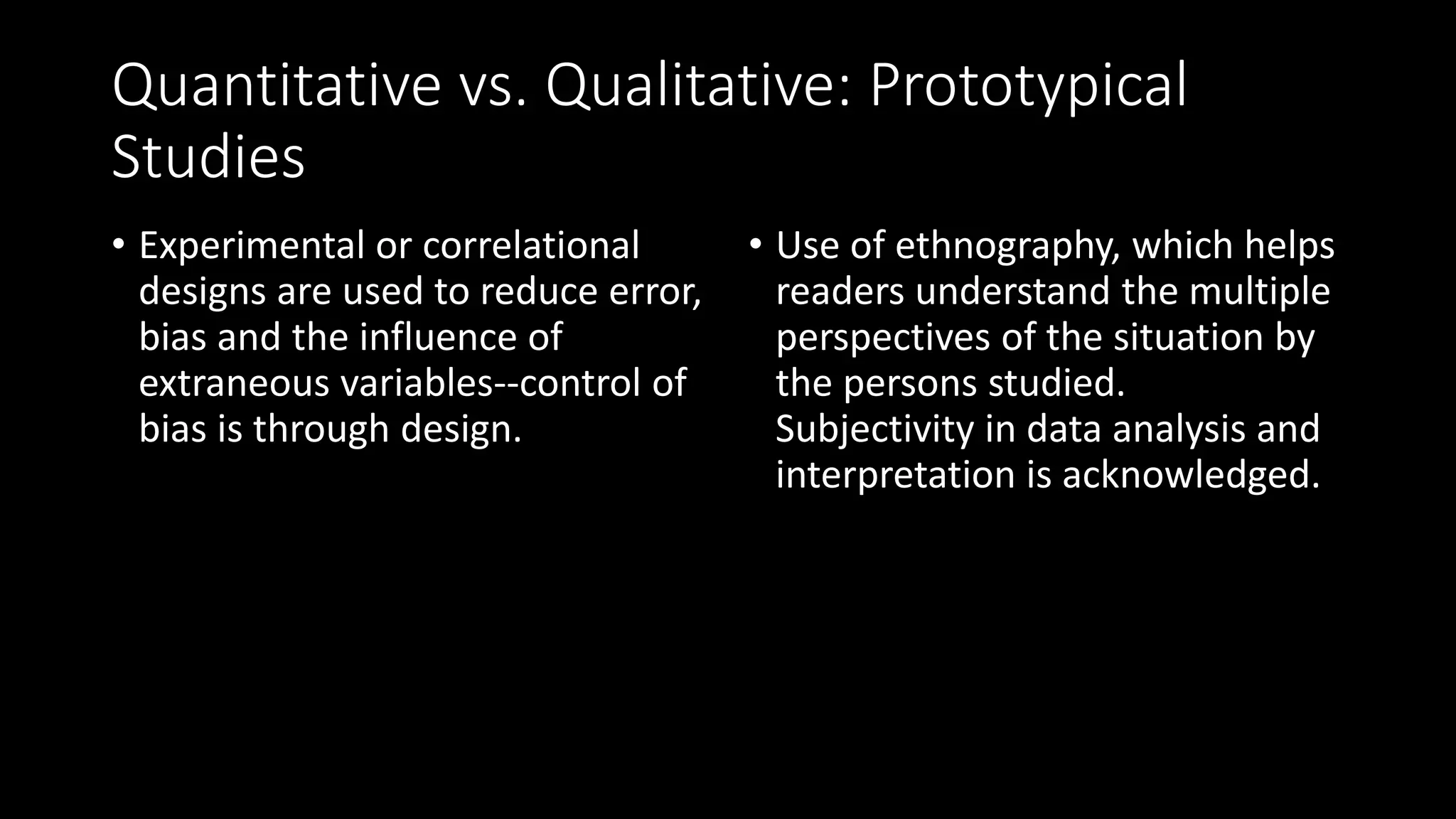
Quantitative vs. Qualitative: Prototypical
Studies
• Experimental or correlational
designs are used to reduce error,
bias and the influence of
extraneous variables--control of
bias is through design.
• Use of ethnography, which helps
readers understand the multiple
perspectives of the situation by
the persons studied.
Subjectivity in data analysis and
interpretation is acknowledged.
Quantitative vs. Qualitative: Researcher Role
• Detachment from study in order
to avoid bias.
• Immersion in situation and the
phenomenon being studied.
Quantitative vs. Qualitative: Context
• Context-free generalizations • Generalizations are contextually-
bound.
Quantitative vs. Qualitative: Precision
• Obtained through the use of
measurement and statistics
• Provided by detailed description
of phenomenon
Quantitative vs. Qualitative: Verification
• Results replicated by others. • Extension of understandings by
others.
Quantitative vs. Qualitative: Explanation
• Traditionally, parsimonious
explanations were sought, but
this may be changing due to
technology.
• Summary through narrative--
importance is placed on
reducing complex realities to
simple explanations.
Quantitative vs. Qualitative: Logical Reasoning
• DEDUCTIVE--What’s the classic
example?
• INDUCTIVE--anyone have an
example?
Quantitative vs. Qualitative: Conditional
Conclusions
• Statements of statistical
probability.
• Tentative summary
interpretations.
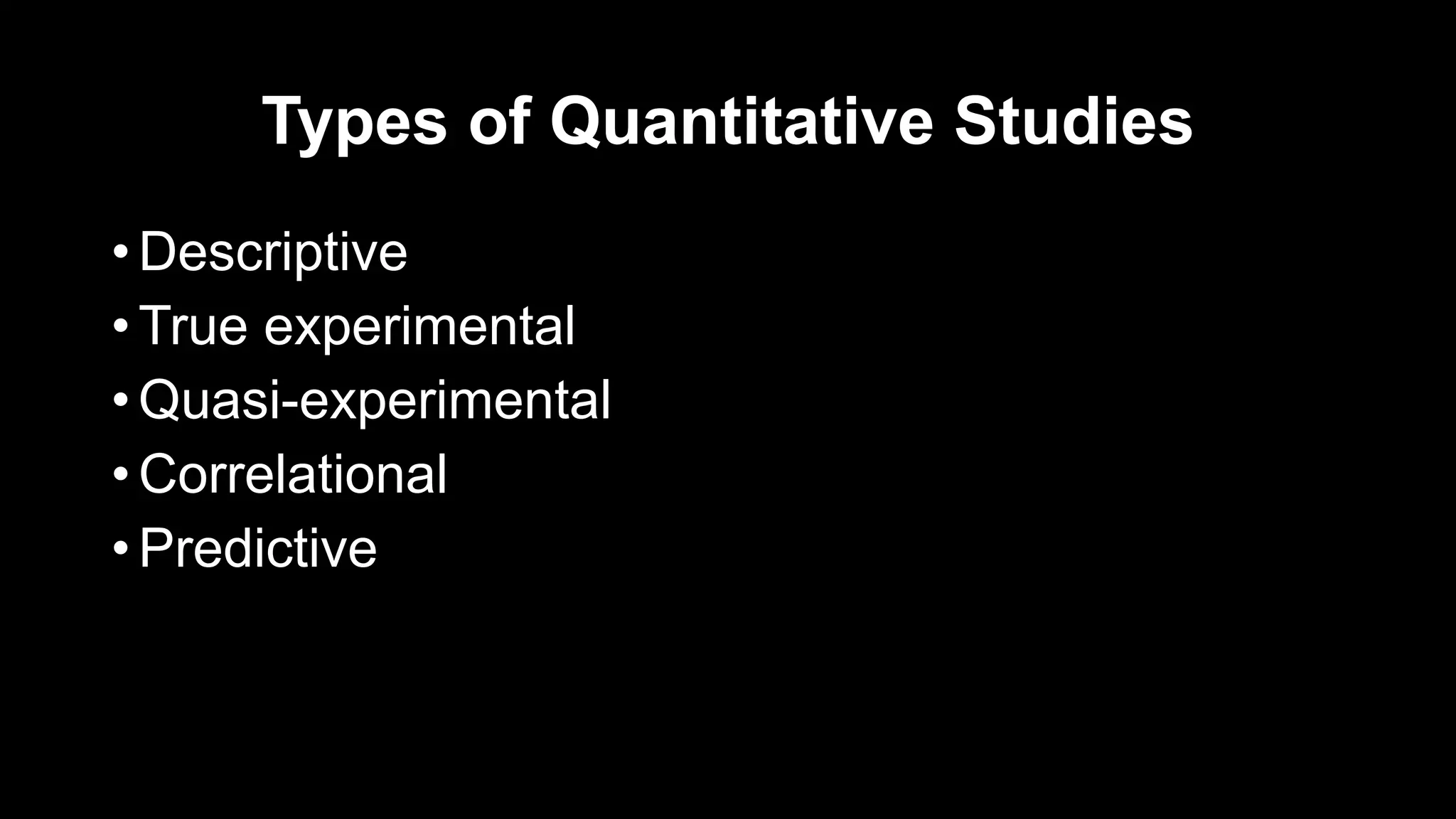
Types of Quantitative Studies
• Descriptive
• True experimental
• Quasi-experimental
• Correlational
• Predictive
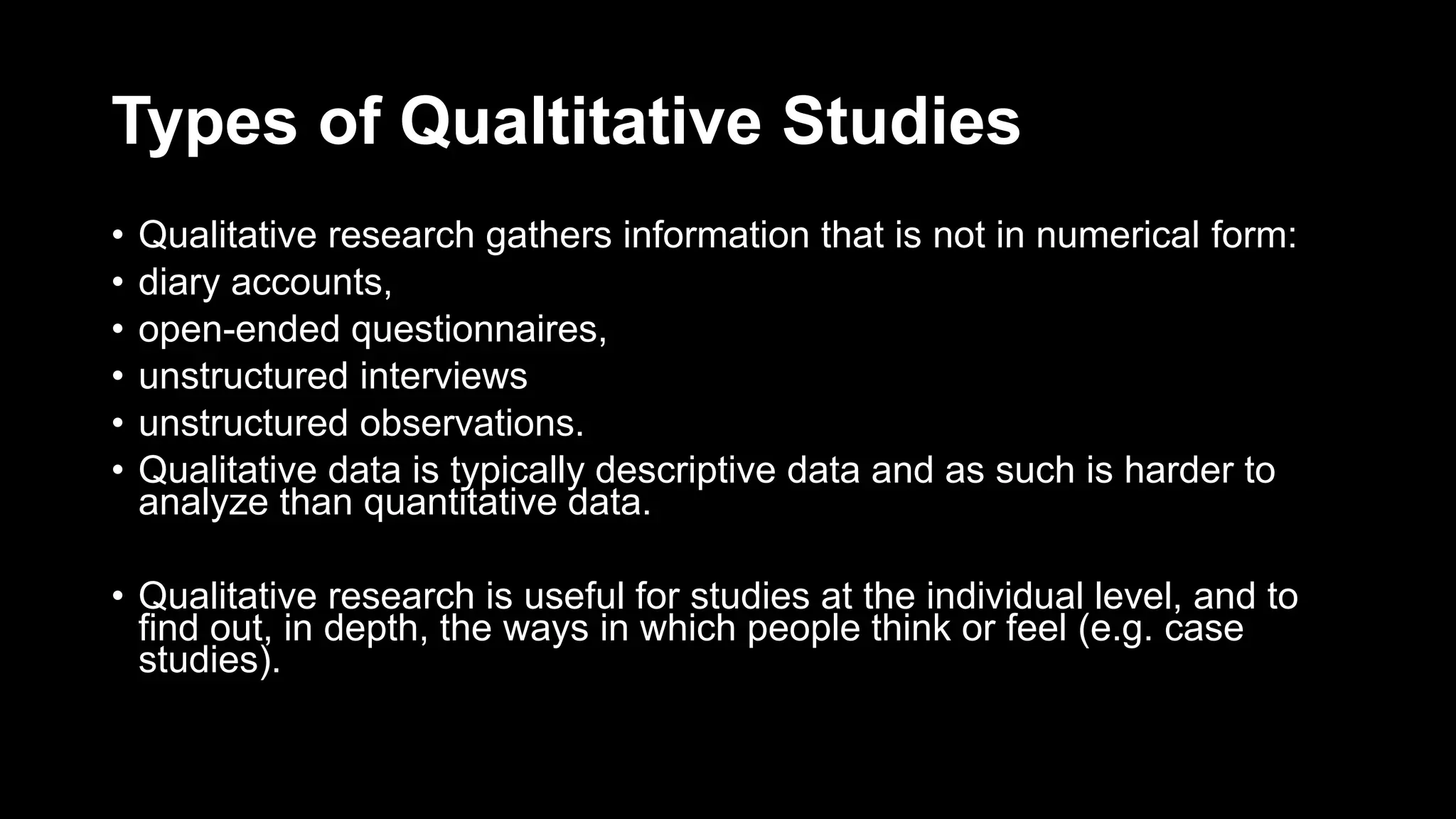
Types of Qualtitative Studies
• Qualitative research gathers information that is not in numerical form:
• diary accounts,
• open-ended questionnaires,
• unstructured interviews
• unstructured observations.
• Qualitative data is typically descriptive data and as such is harder to
analyze than quantitative data.
• Qualitative research is useful for studies at the individual level, and to
find out, in depth, the ways in which people think or feel (e.g. case
studies).
Types of Qualtitative Studies
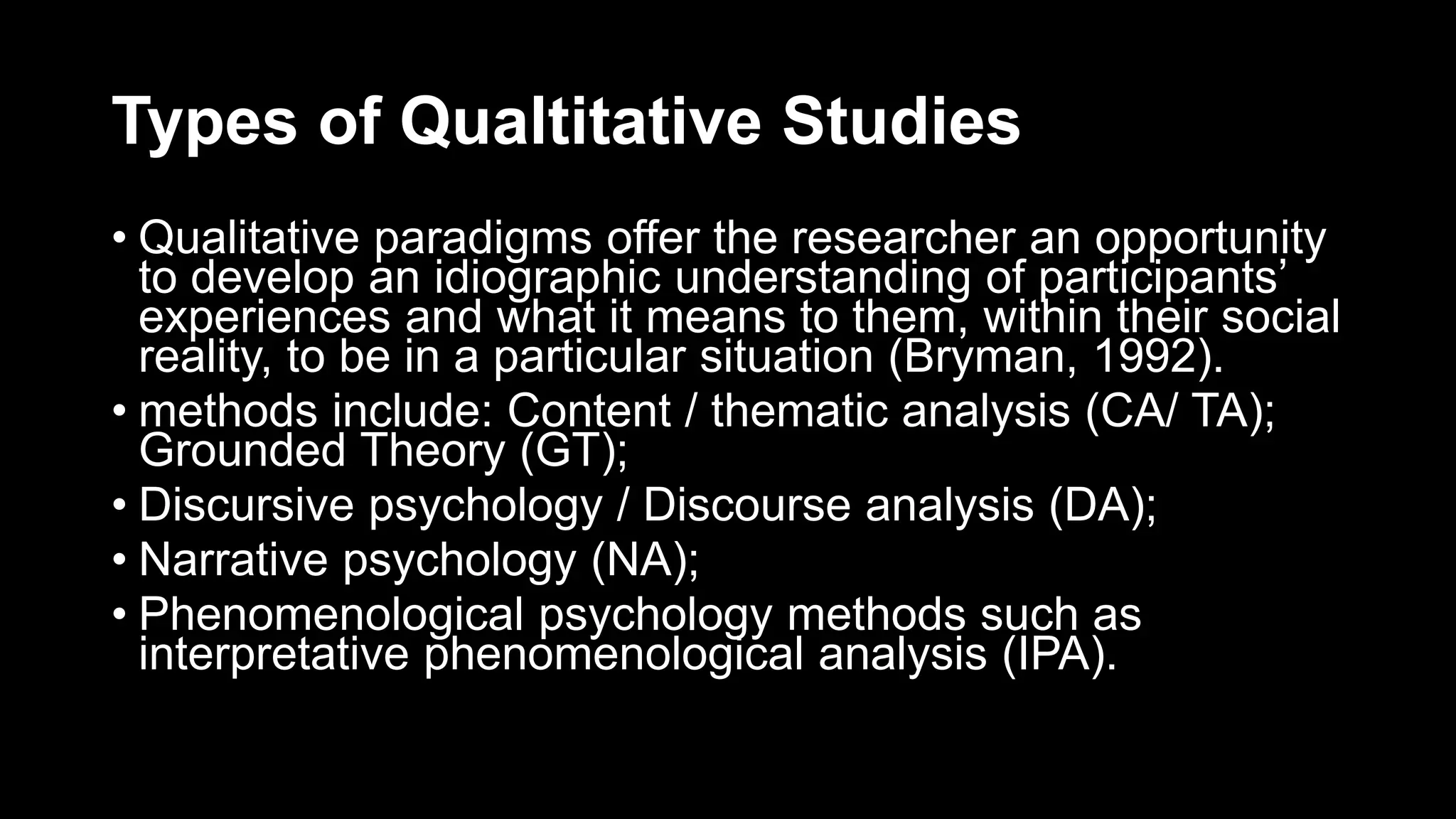
• Qualitative paradigms offer the researcher an opportunity
to develop an idiographic understanding of participants’
experiences and what it means to them, within their social
reality, to be in a particular situation (Bryman, 1992).
• methods include: Content / thematic analysis (CA/ TA);
Grounded Theory (GT);
• Discursive psychology / Discourse analysis (DA);
• Narrative psychology (NA);
• Phenomenological psychology methods such as
interpretative phenomenological analysis (IPA).
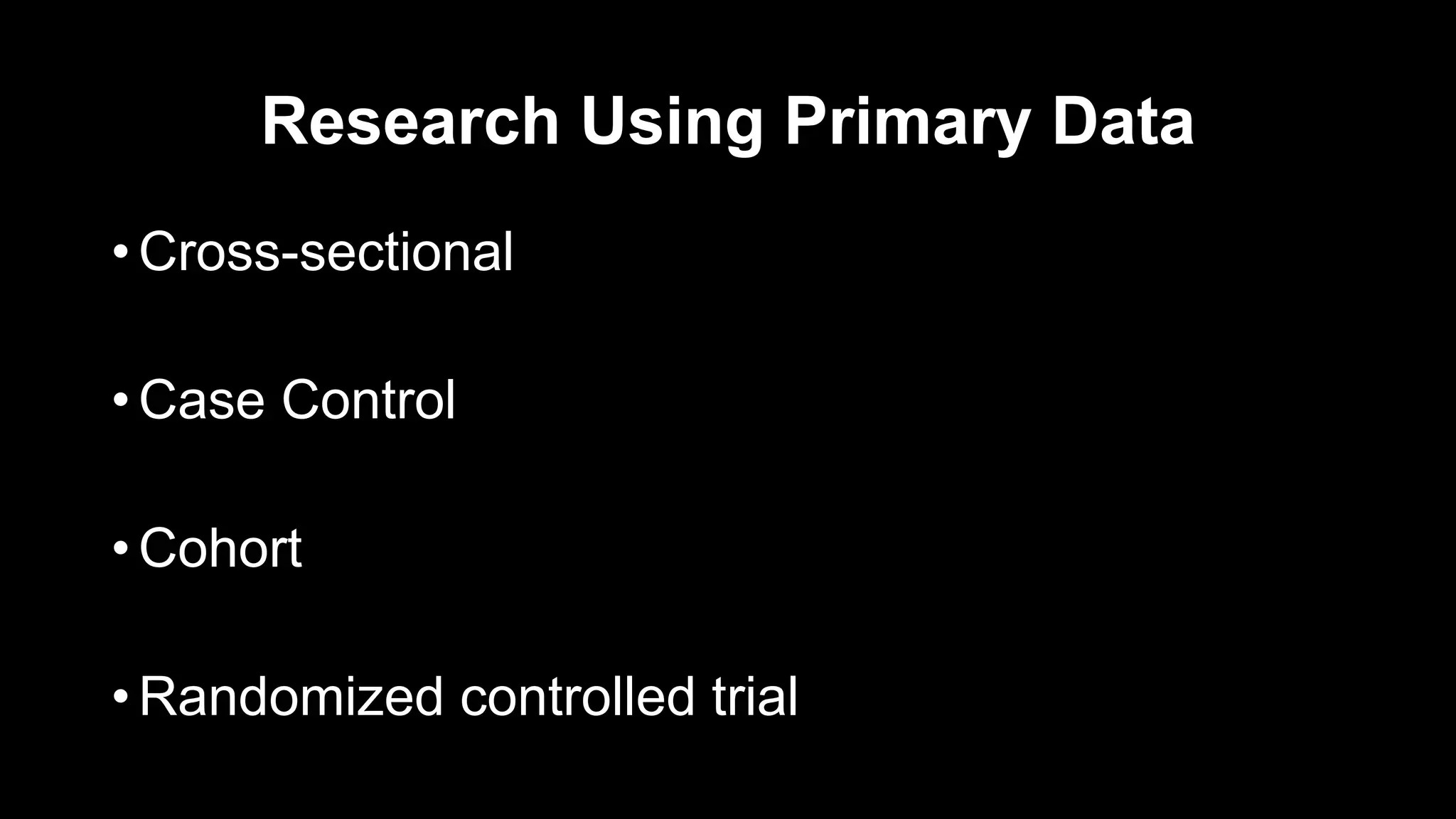
Research Using Primary Data
• Cross-sectional
• Case Control
• Cohort
• Randomized controlled trial
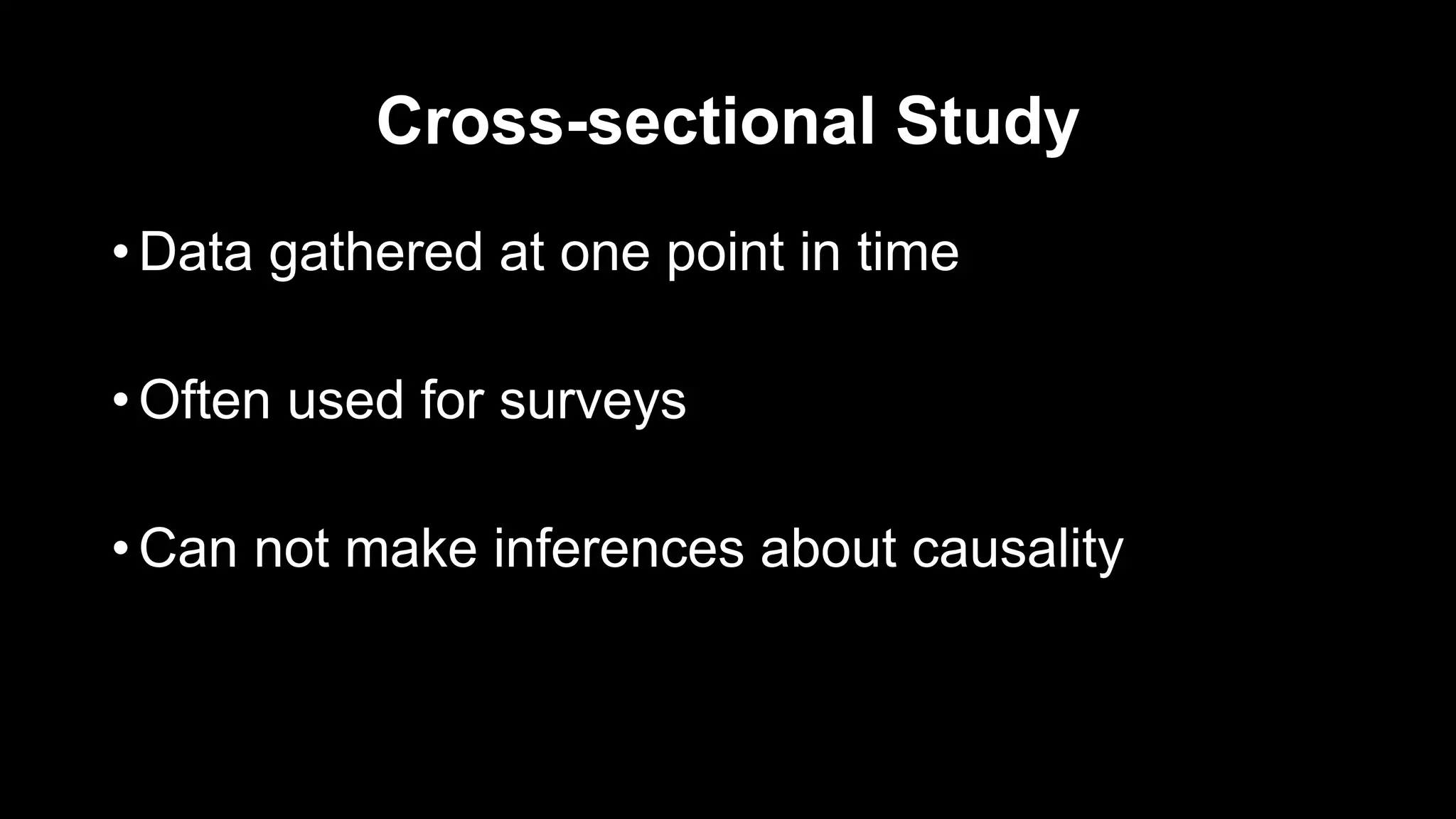
Cross-sectional Study
• Data gathered at one point in time
• Often used for surveys
• Can not make inferences about causality
Case Control Study
• Start with the outcome- identify a sample with the
condition of interest
• Identify a similar control group
• Look back to determine exposure
• Calculate the risk in the cases and controls- odds
ratio used
• Can not use to establish prevalence
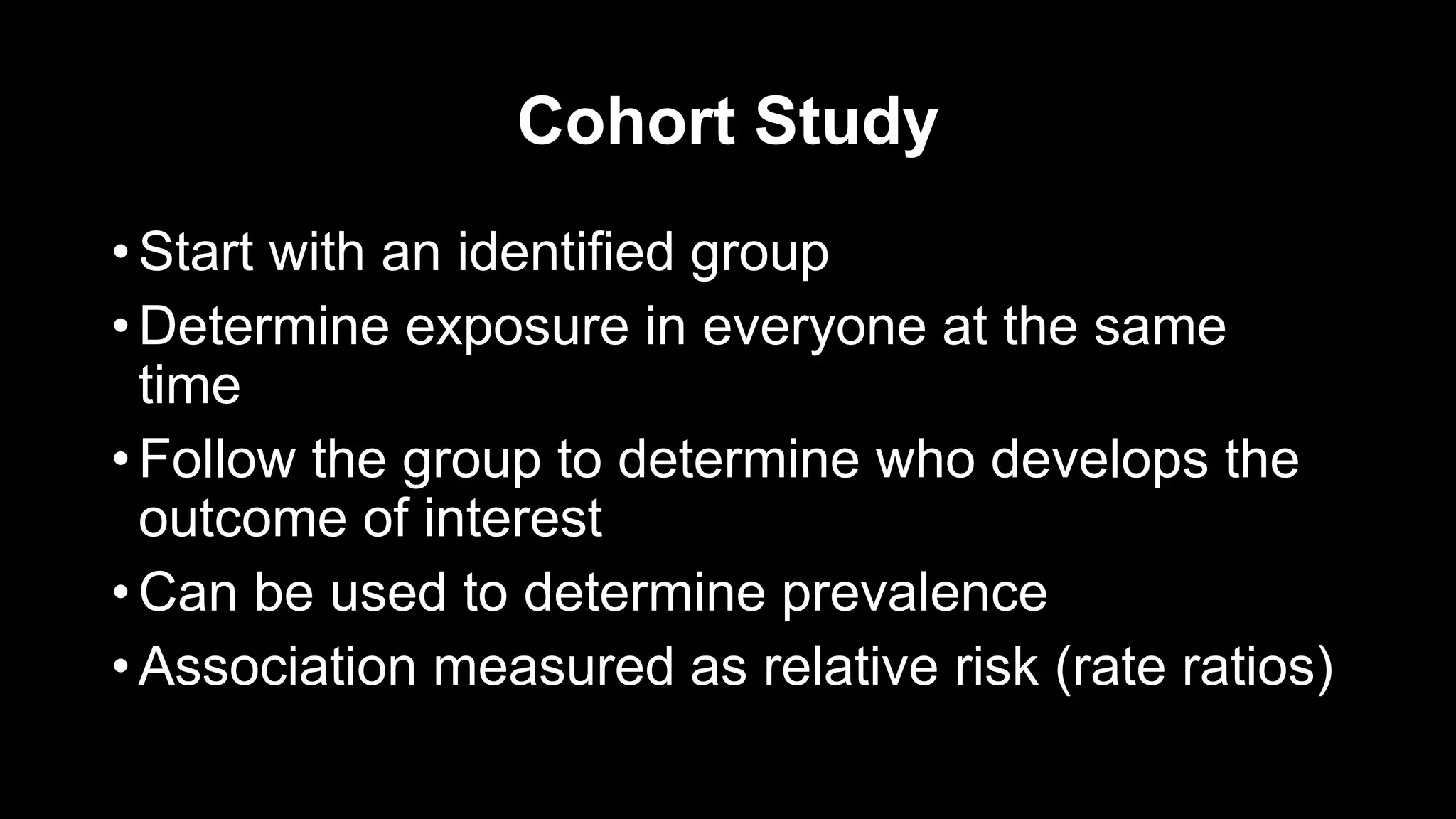
Cohort Study
• Start with an identified group
• Determine exposure in everyone at the same
time
• Follow the group to determine who develops the
outcome of interest
• Can be used to determine prevalence
• Association measured as relative risk (rate ratios)
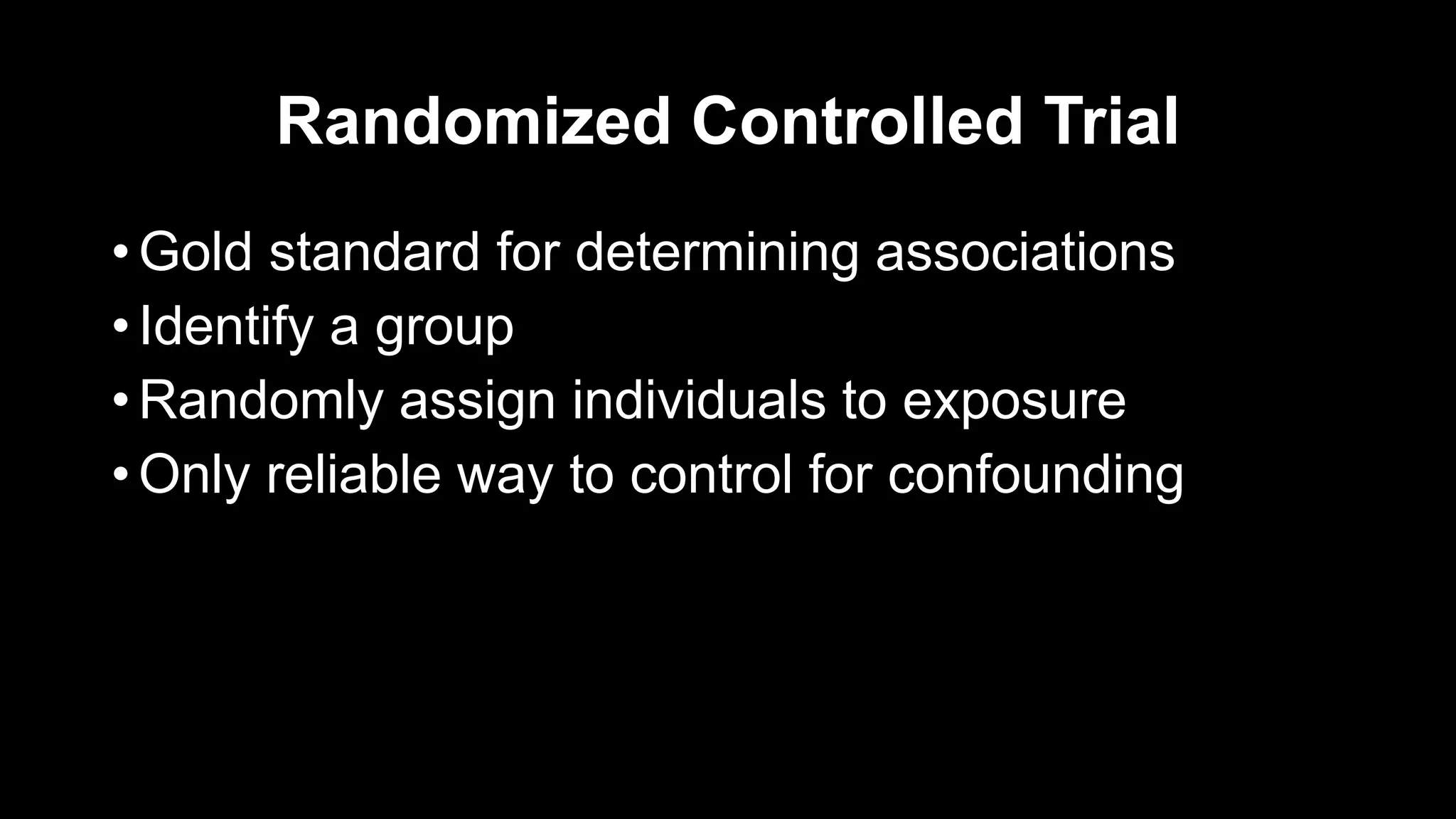
Randomized Controlled Trial
• Gold standard for determining associations
• Identify a group
• Randomly assign individuals to exposure
• Only reliable way to control for confounding
Research Using Secondary Data
•Literature review
•Systematic review
•Metanalysis
•Analysis of existing data collected
for another purpose
Literature Review
• Gather articles on a topic of interest
• Summarize the findings
Systematic Review
• Gather articles using a pre-defined search
strategy- may include unpublished studies
• Develop a-priori objective criteria to evaluate the
quality of the studies
• Summarize the quality of the data and the results
Metanalysis
• Do a systematic review
• Obtain the primary data if possible
• Summarize the data quantitatively
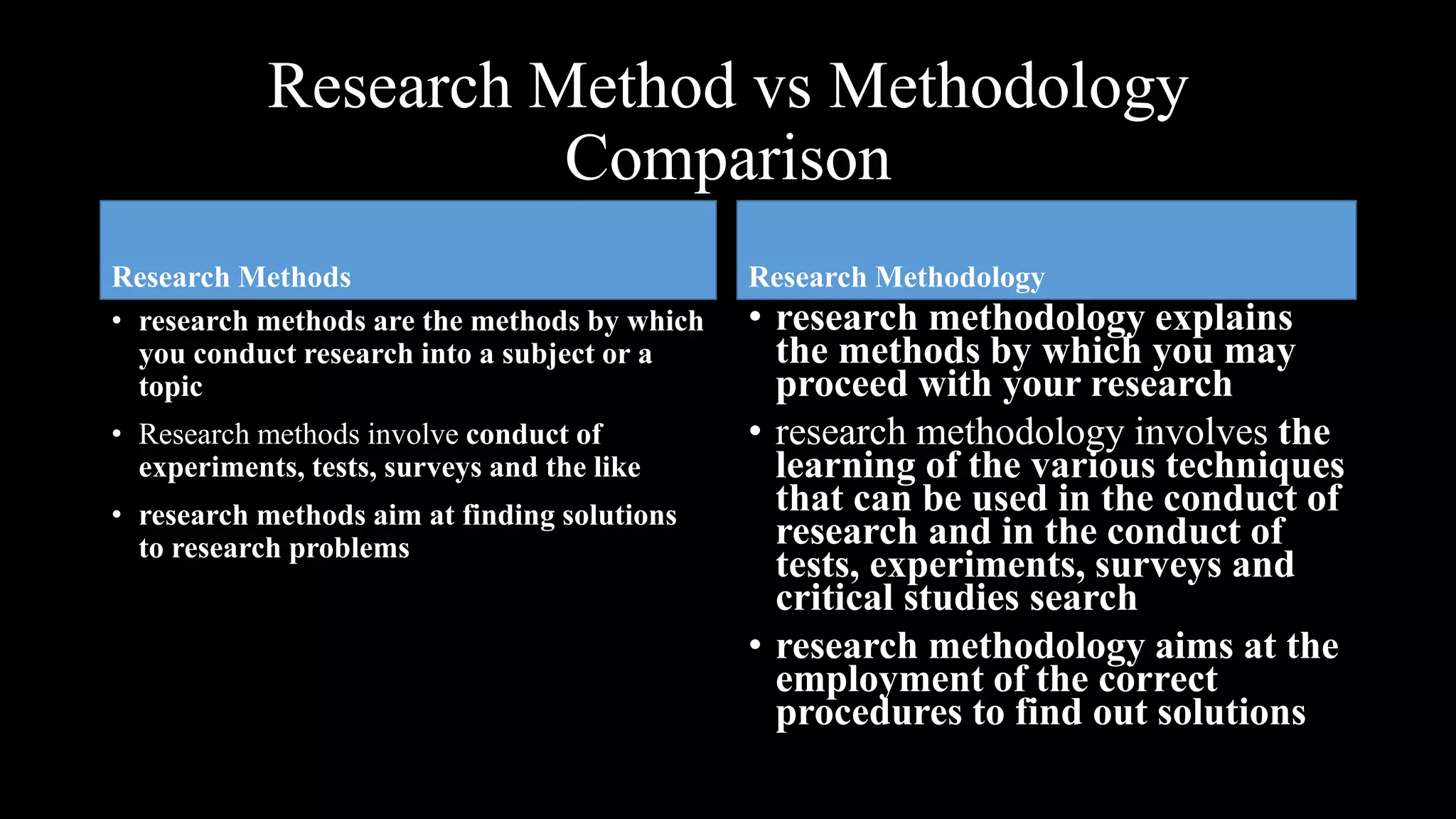
Research Method vs Methodology
Comparison
Research Methods Research Methodology
• research methods are the methods by which
you conduct research into a subject or a
topic
• Research methods involve conduct of
experiments, tests, surveys and the like
• research methods aim at finding solutions
to research problems
• research methodology explains
the methods by which you may
proceed with your research
• research methodology involves the
learning of the various techniques
that can be used in the conduct of
research and in the conduct of
tests, experiments, surveys and
critical studies search
• research methodology aims at the
employment of the correct
procedures to find out solutions
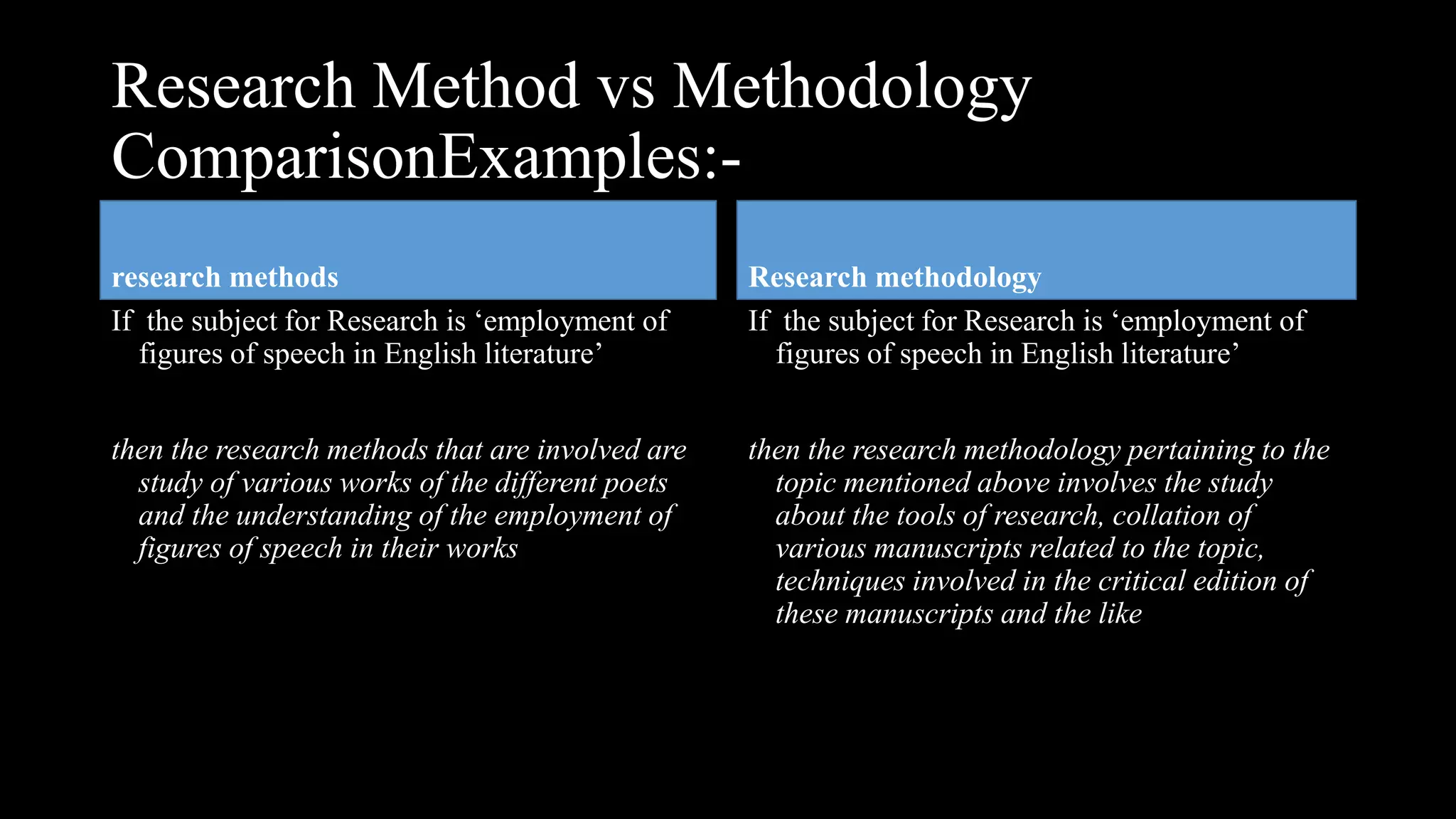
Research Method vs Methodology
ComparisonExamples:-
research methods Research methodology
If the subject for Research is ‘employment of
figures of speech in English literature’
then the research methods that are involved are
study of various works of the different poets
and the understanding of the employment of
figures of speech in their works
If the subject for Research is ‘employment of
figures of speech in English literature’
then the research methodology pertaining to the
topic mentioned above involves the study
about the tools of research, collation of
various manuscripts related to the topic,
techniques involved in the critical edition of
these manuscripts and the like
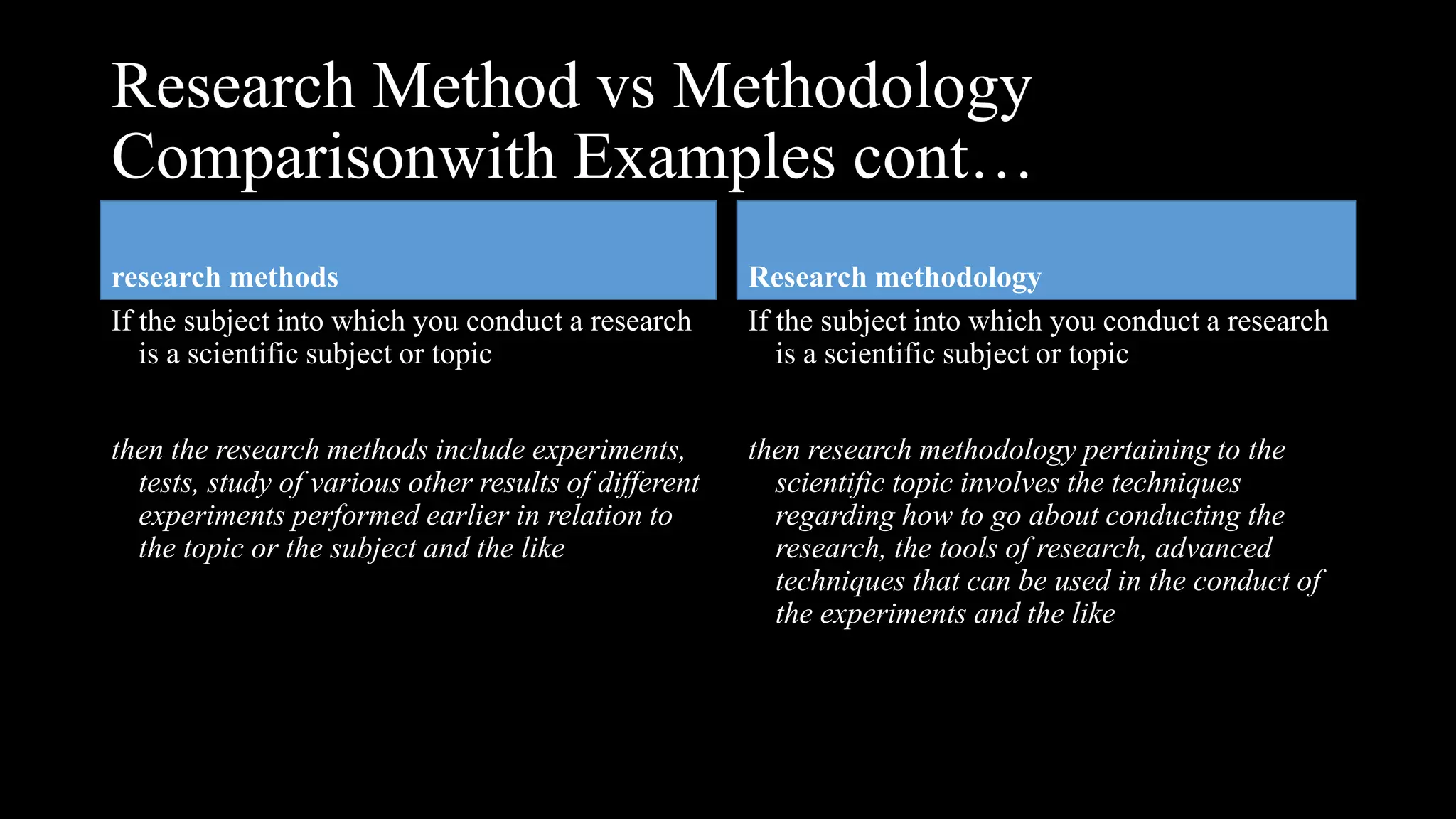
Research Method vs Methodology
Comparisonwith Examples cont…
research methods Research methodology
If the subject into which you conduct a research
is a scientific subject or topic
then the research methods include experiments,
tests, study of various other results of different
experiments performed earlier in relation to
the topic or the subject and the like
If the subject into which you conduct a research
is a scientific subject or topic
then research methodology pertaining to the
scientific topic involves the techniques
regarding how to go about conducting the
research, the tools of research, advanced
techniques that can be used in the conduct of
the experiments and the like
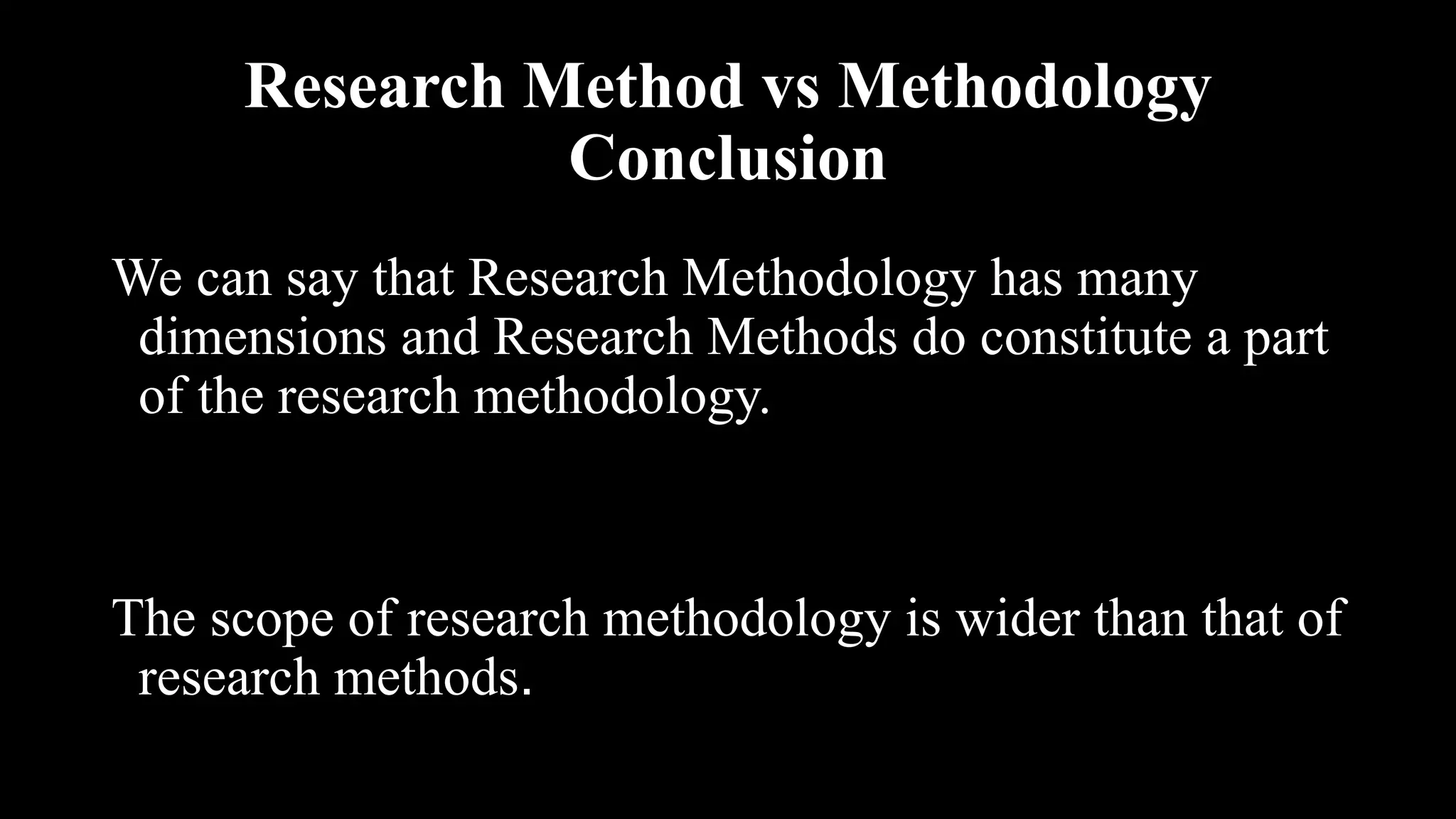
Research Method vs Methodology
Conclusion
We can say that Research Methodology has many
dimensions and Research Methods do constitute a part
of the research methodology.
The scope of research methodology is wider than that of
research methods.
Variables
Meaning
• Known as a property of proposition being studied
• Also known as the constructs of a proposition
• A symbol to which we assign numerals or values
• Numerical value assigned to a variable is based on its
properties
• 3 types of Variables: Dichotomous; Discrete; Continuous
1. Dichotomous Variables
• These variables are so called because they have
TWO values, reflecting presence or absence of a
property.
• For example: pass or fail, exists or does not exist,
employed - unemployed, male - female, yes - no.
• The dichotomous variables can be assigned with a
numerical value of ‘0’ or ‘1’ for analysis purpose.
2. Discrete Variables
• These are categorical variables.
• For example, the demographic variables race or
religion are the examples of discrete variables.
• Religion: Hindu, Islam, Buddhism, and Jain can
be assigned numerical values of 1, 2, 3, and 4
respectively.
• The numerical values assigned to these variables
will be of absolute nature; not like 3.5, or 4.7.
3. Continuous Variables
• These variables take on values with a given
range or, in some cases, an infinite set.
• For example, test scores may range from 0 - 100,
age may be 2.5 years, present income of a
person could be £. 15000, you may disclose your
property worth more than £.500,000.
Variables
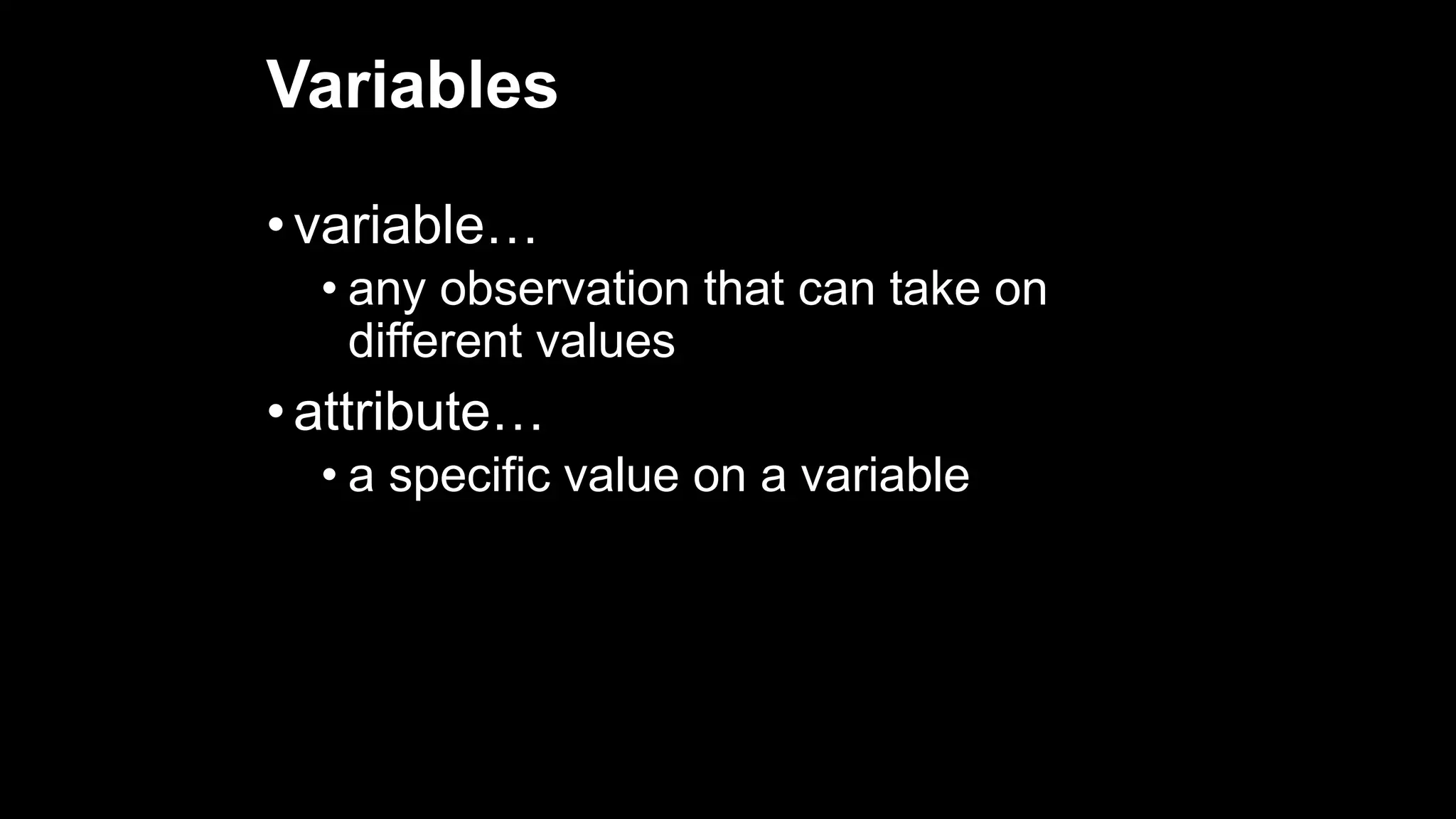
• variable…
• any observation that can take on
different values
• attribute…
• a specific value on a variable
Examples
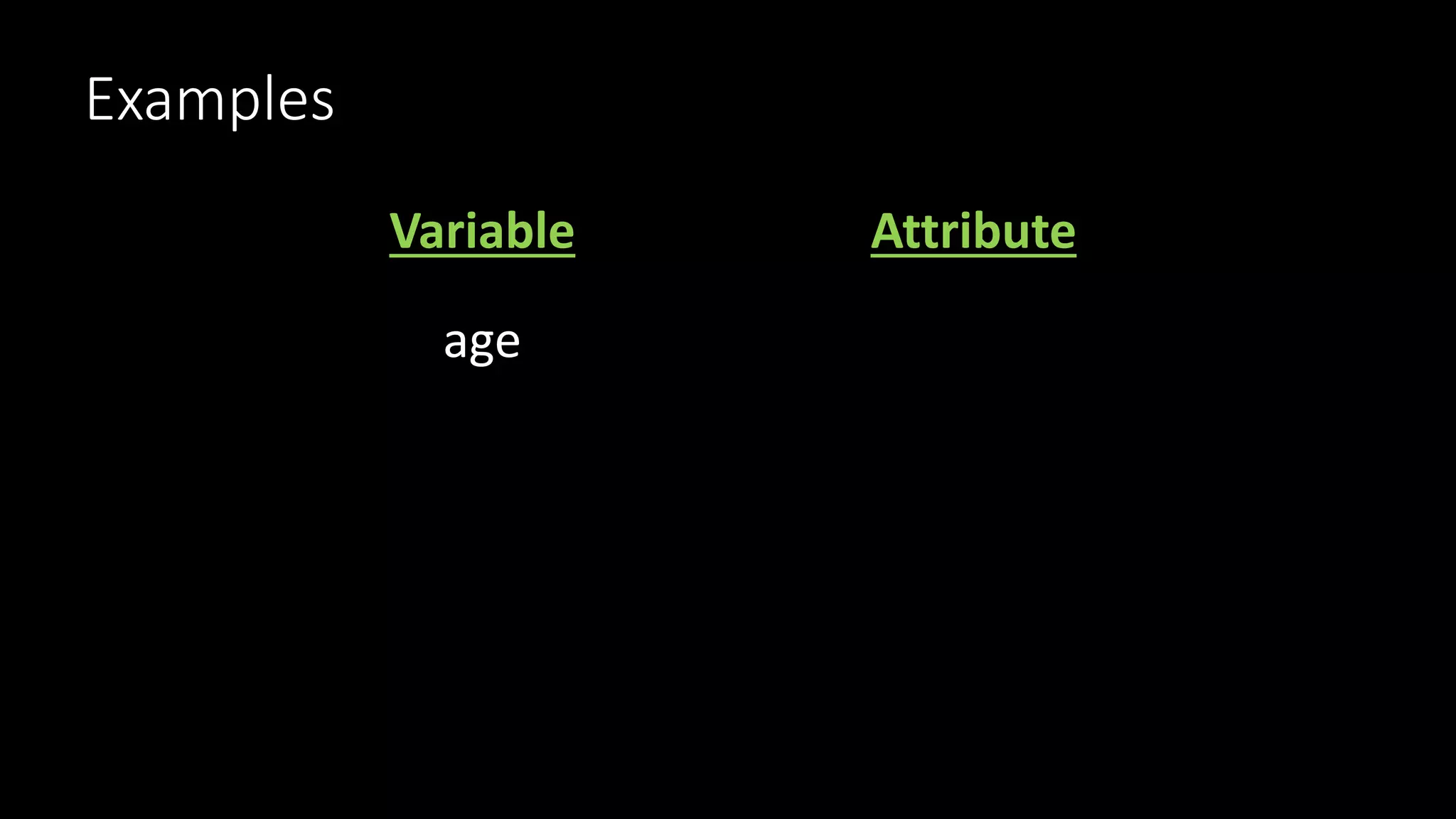
Variable Attribute
age
Examples
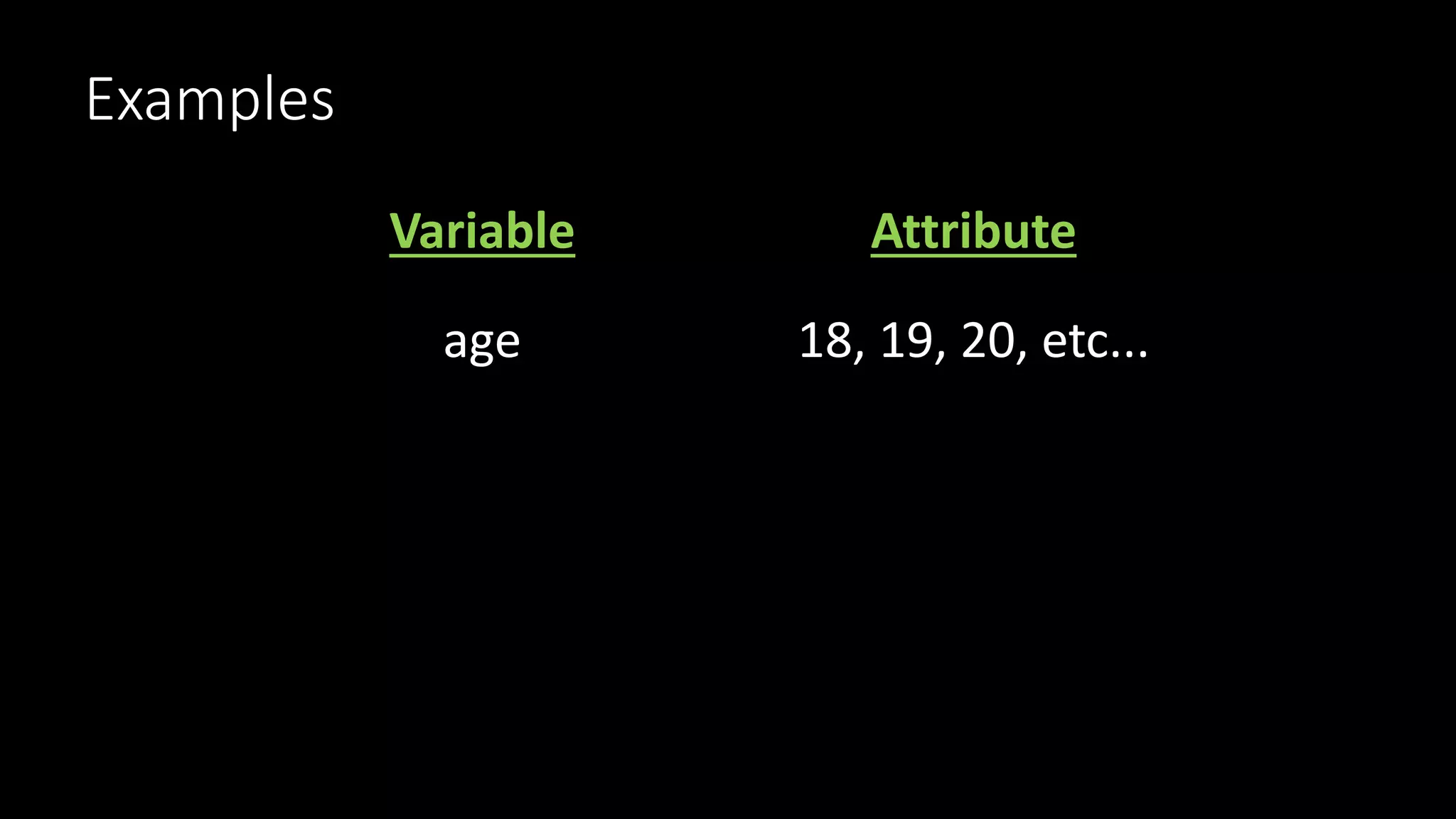
Variable Attribute
age 18, 19, 20, etc...
Examples
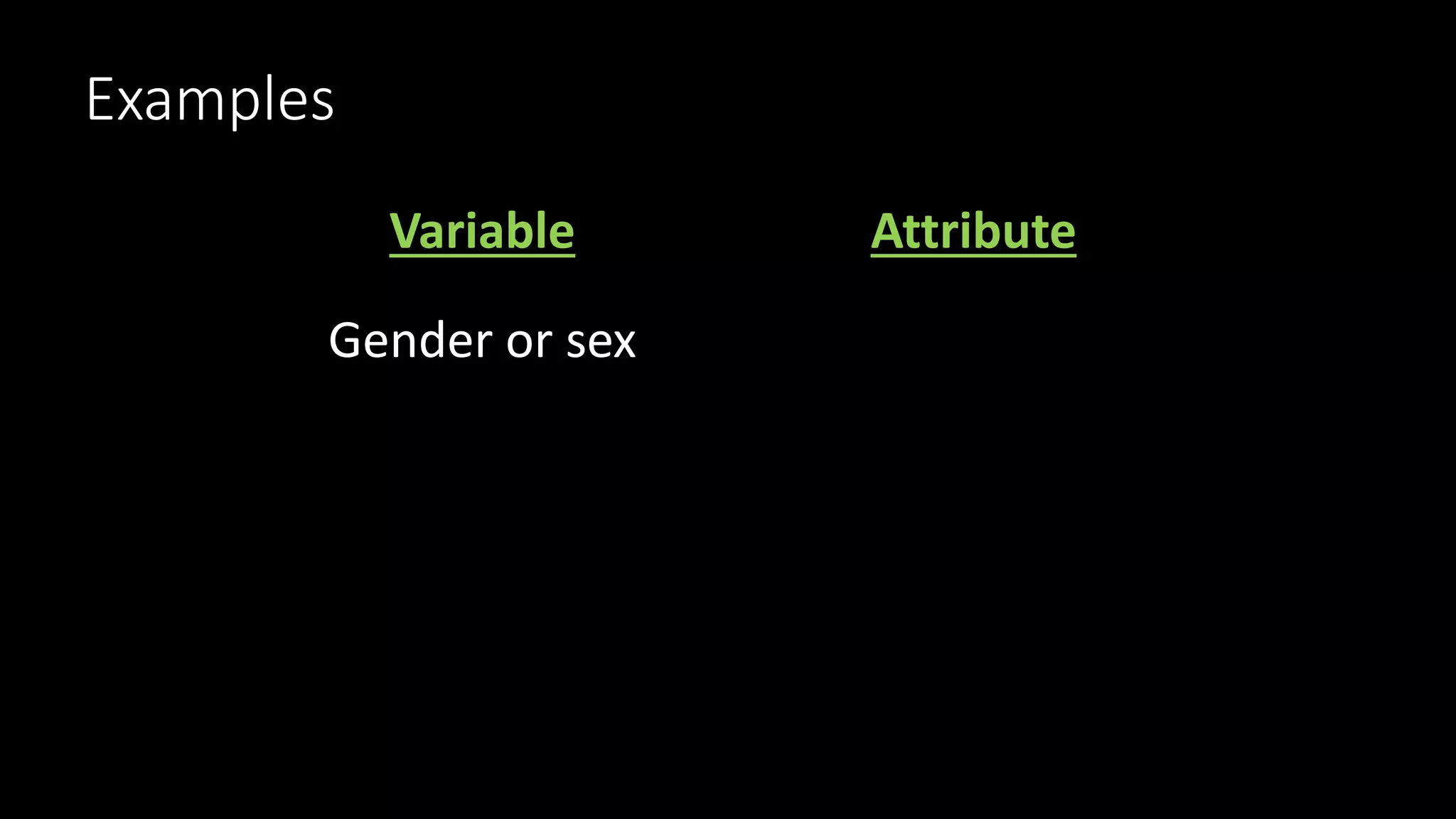
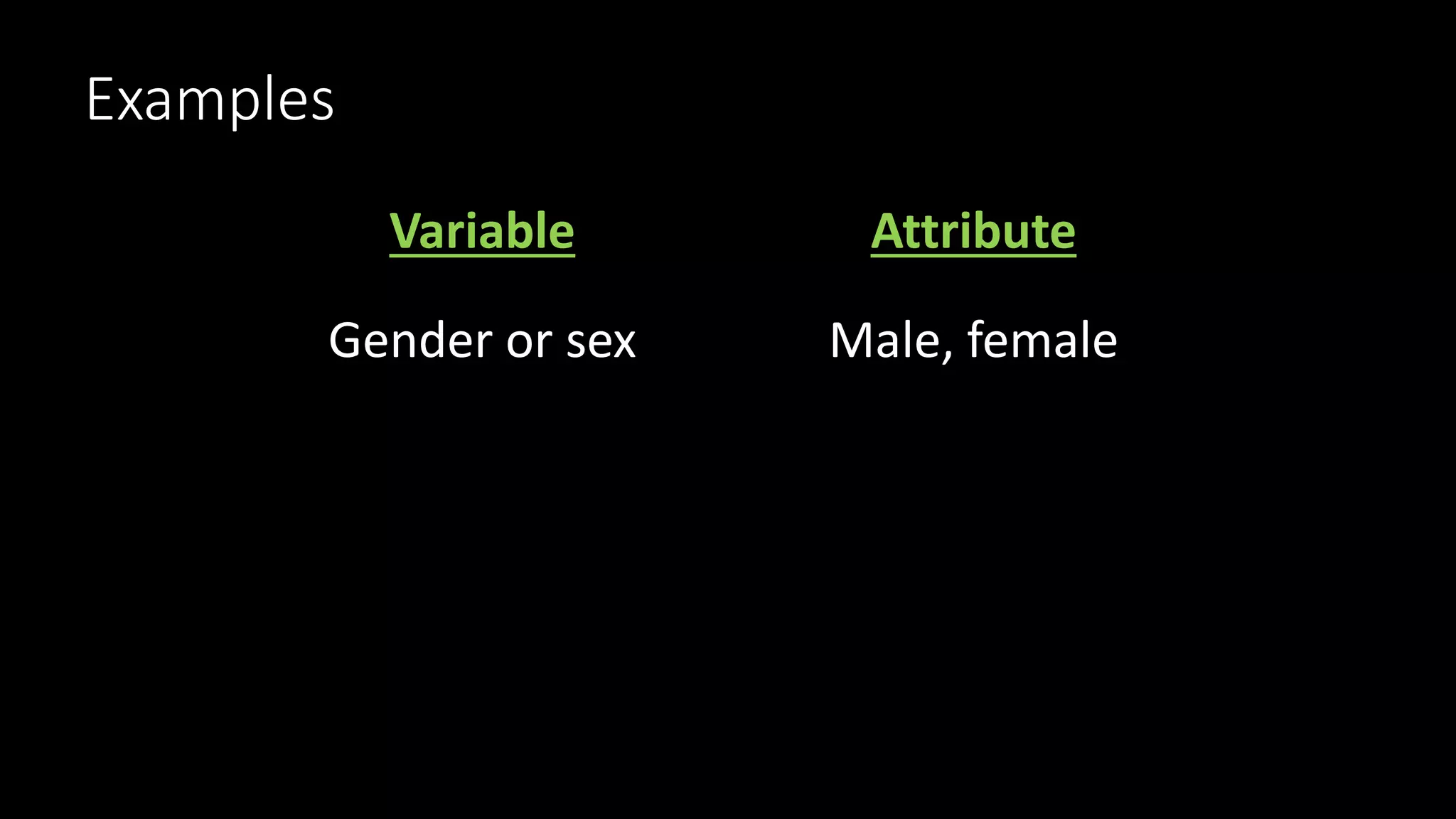
Variable Attribute
Gender or sex
Examples
Variable Attribute
Gender or sex Male, female
Examples
Variable Attribute
satisfaction
Examples
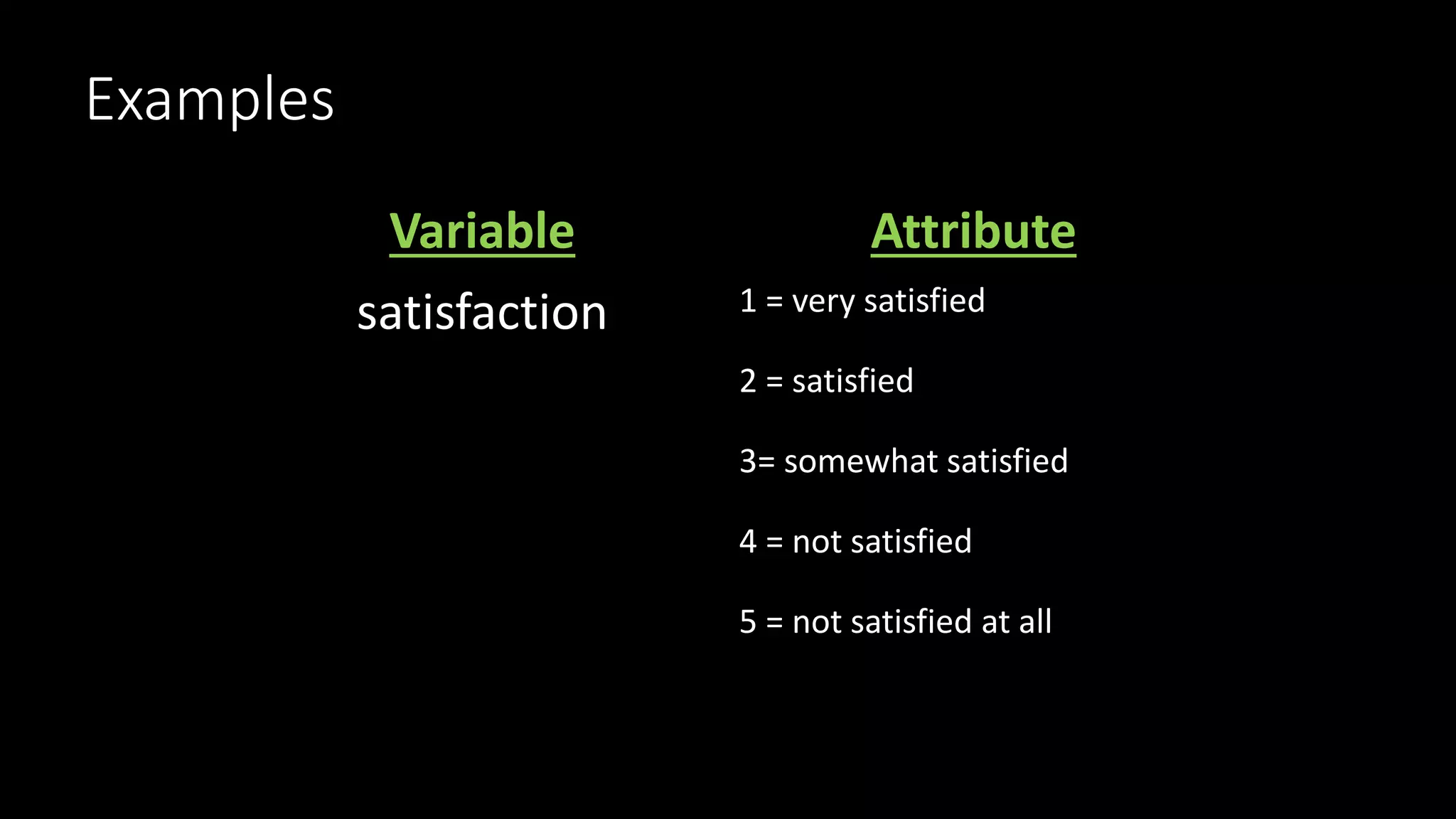
Variable Attribute
satisfaction 1 = very satisfied
2 = satisfied
3= somewhat satisfied
4 = not satisfied
5 = not satisfied at all
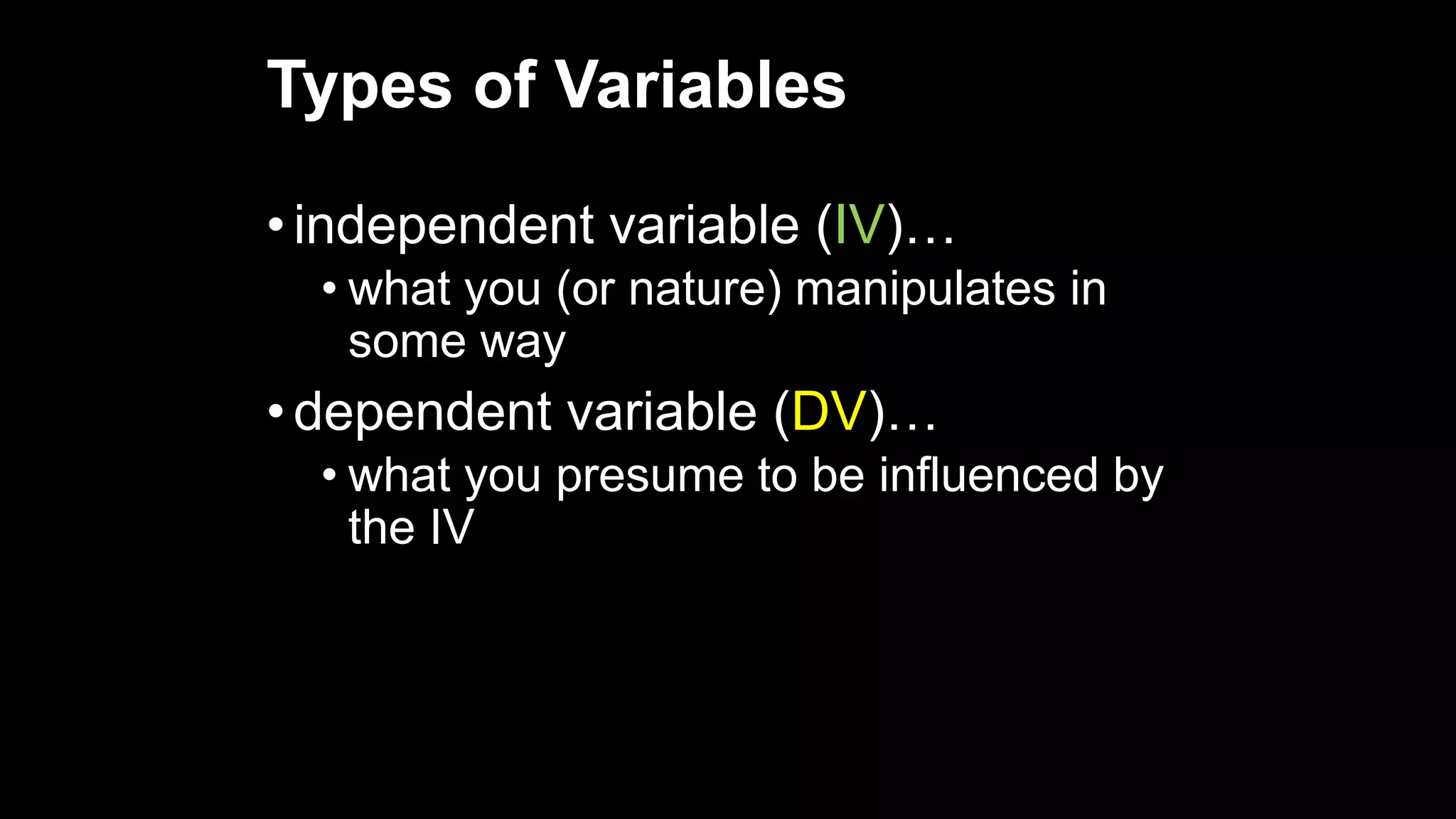
Types of Variables
• independent variable (IV)…
• what you (or nature) manipulates in
some way
• dependent variable (DV)…
• what you presume to be influenced by
the IV
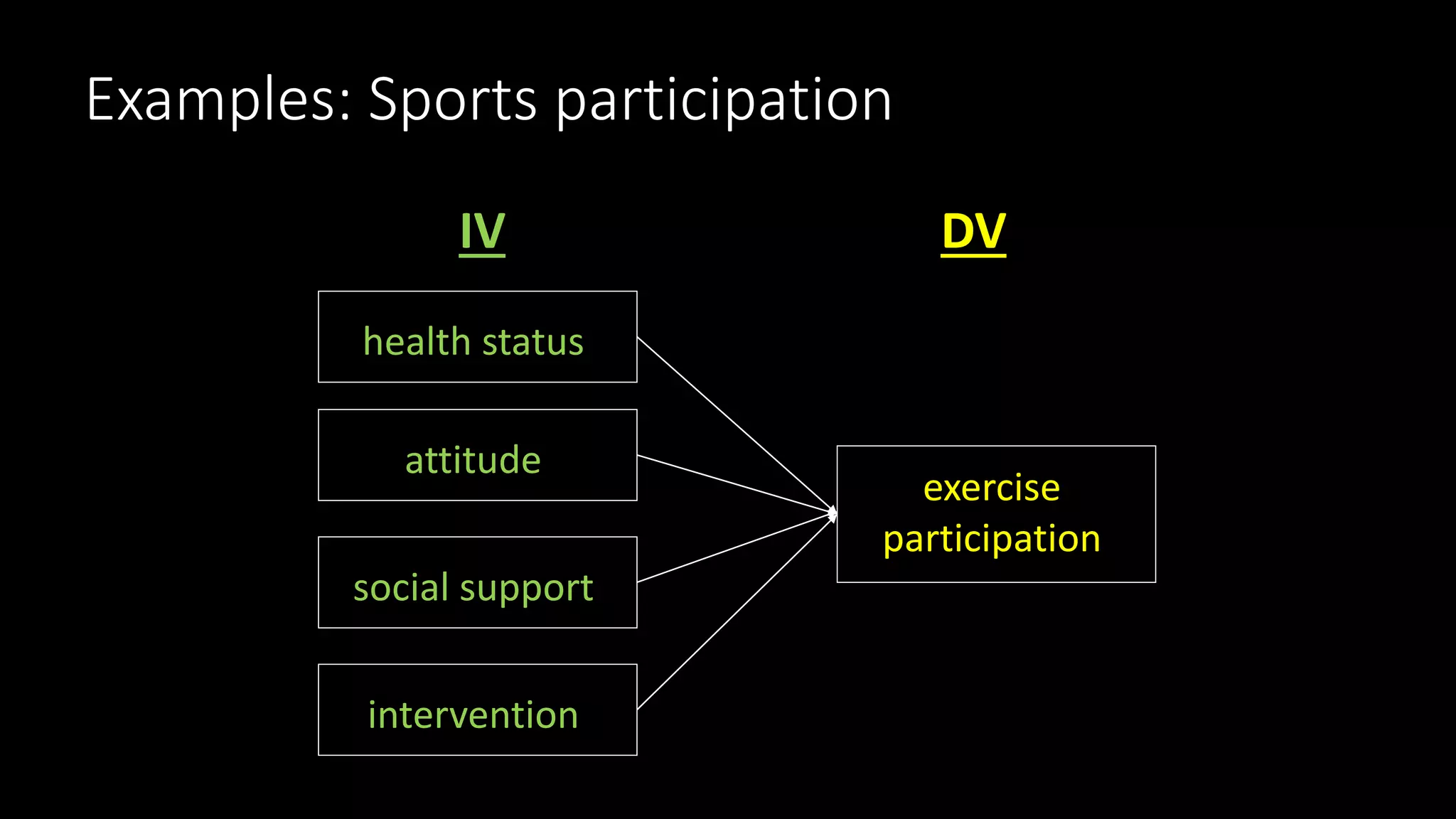
Examples: Sports participation
IV DV
exercise
participation
health status
attitude
social support
intervention
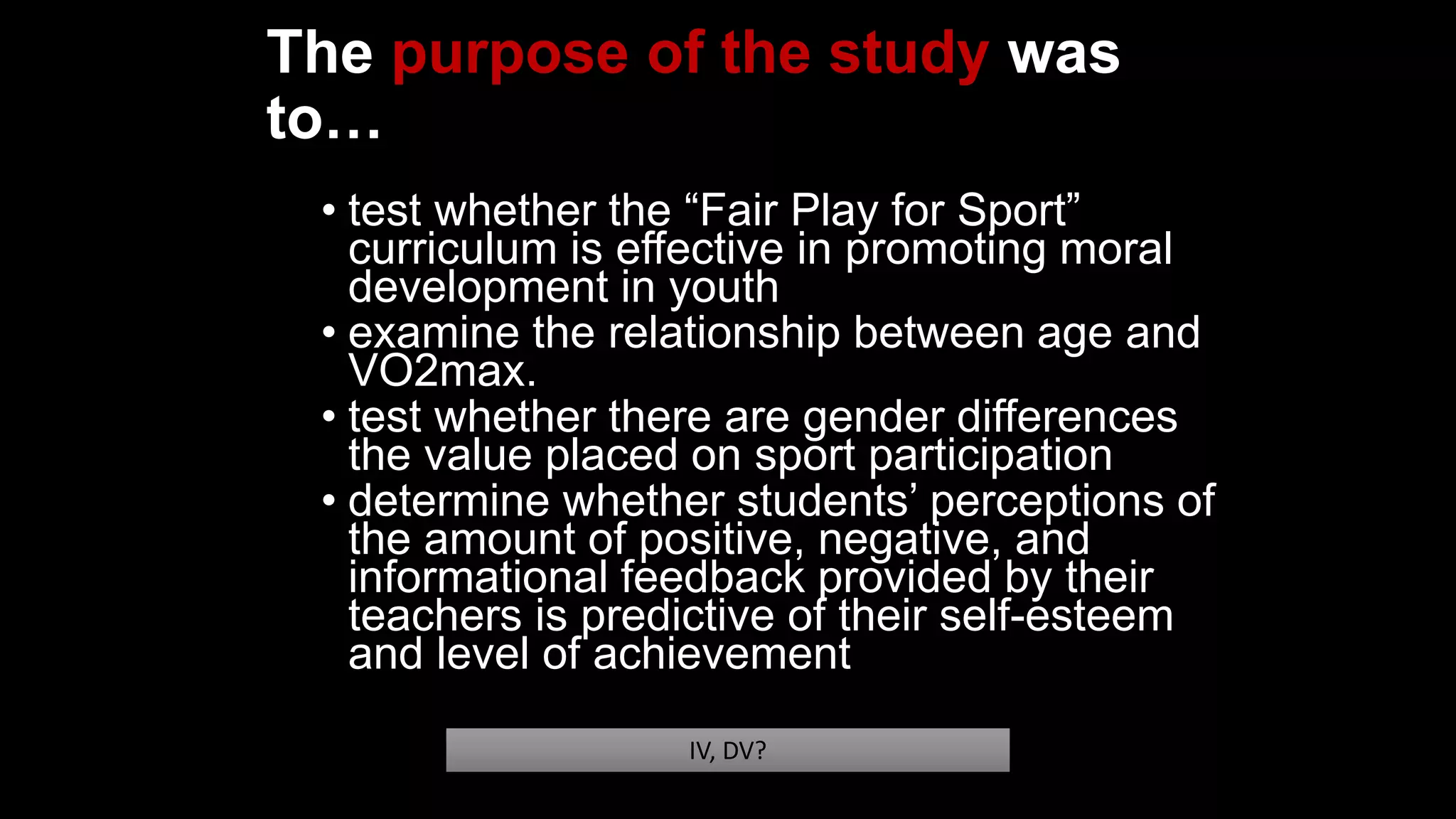
The purpose of the study was
to…
• test whether the “Fair Play for Sport”
curriculum is effective in promoting moral
development in youth
• examine the relationship between age and
VO2max.
• test whether there are gender differences
the value placed on sport participation
• determine whether students’ perceptions of
the amount of positive, negative, and
informational feedback provided by their
teachers is predictive of their self-esteem
and level of achievement
IV, DV?
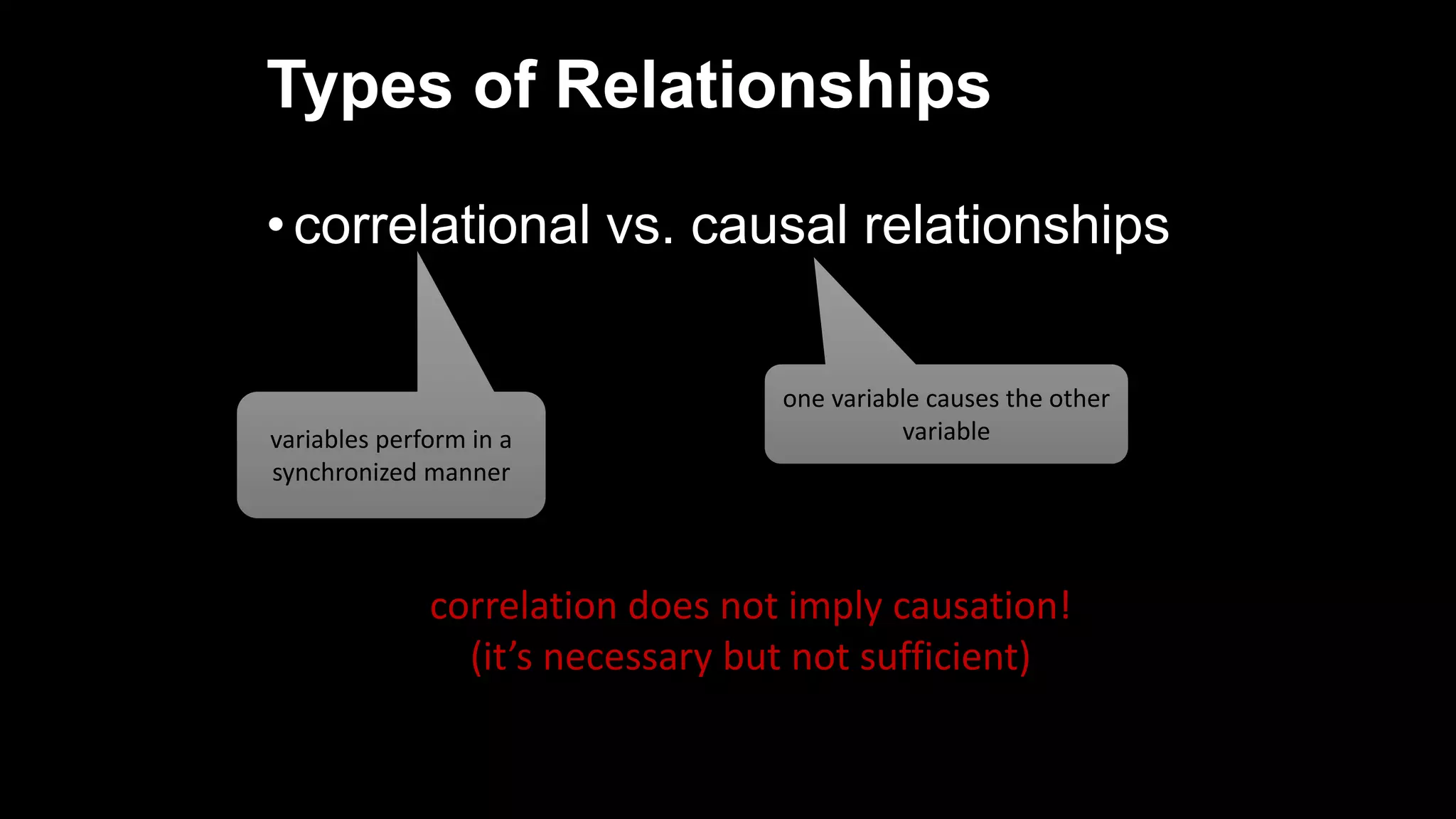
Types of Relationships
• correlational vs. causal relationships
correlation does not imply causation!
(it’s necessary but not sufficient)
variables perform in a
synchronized manner
one variable causes the other
variable
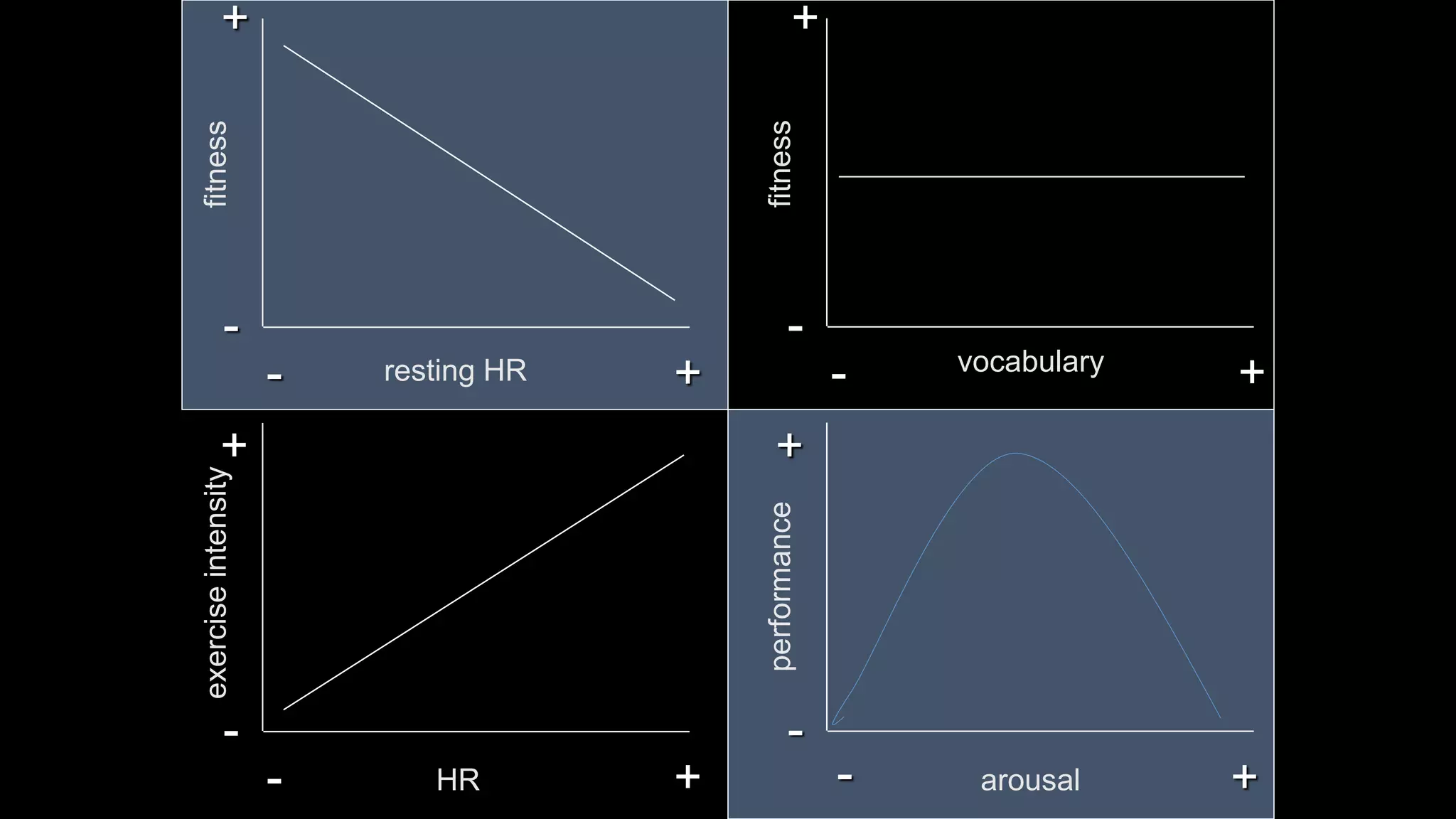
Types of Relationships
• patterns of relationships…
• no relationship
• positive relationship
• negative relationship
• curvilinear relationship
- +
-
+
resting HR
fitness
- +
-
+
vocabulary
fitness- +
-
HR
exerciseintensity
- +
-
arousalperformance
+ +
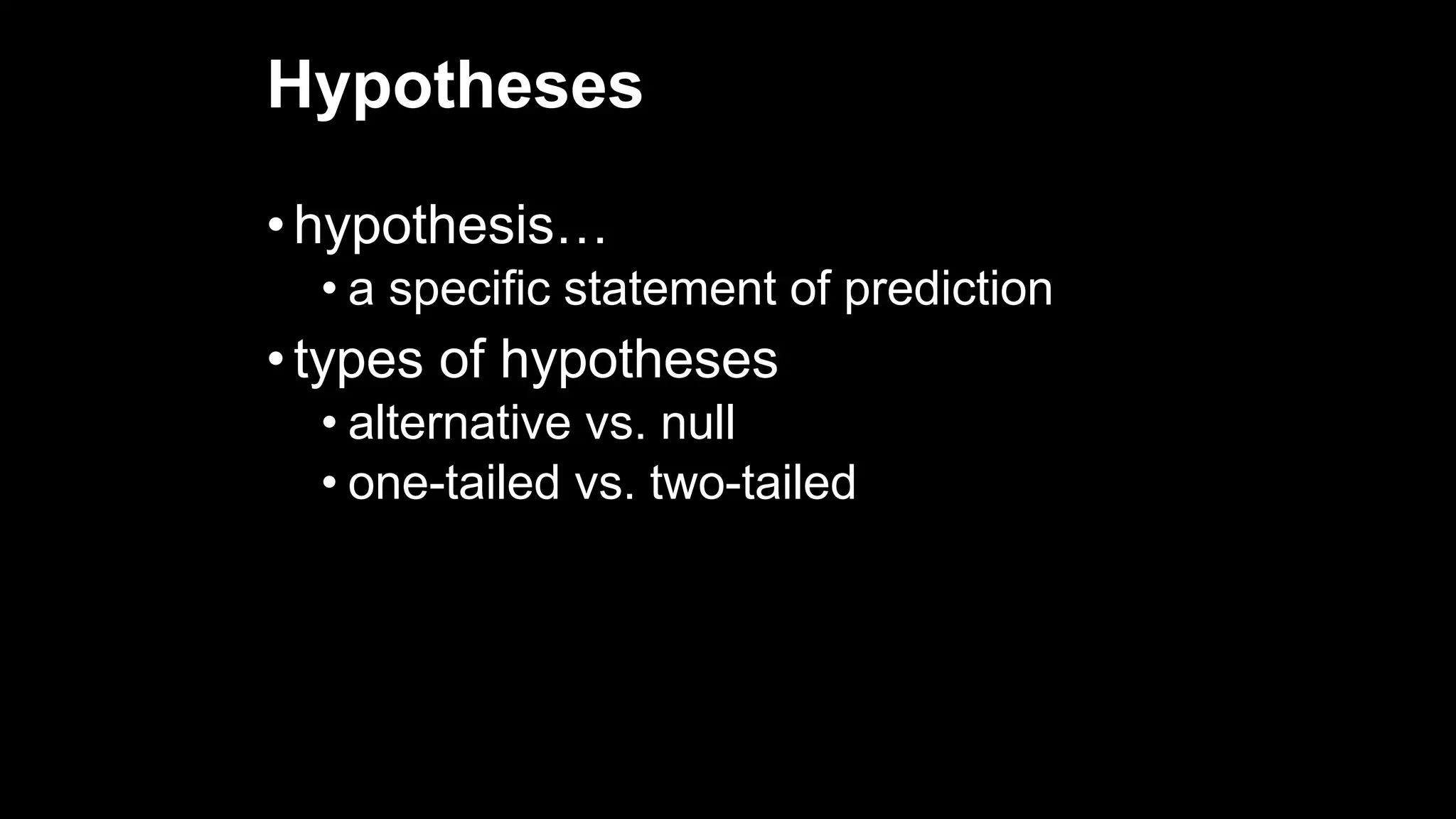
Hypotheses
• hypothesis…
• a specific statement of prediction
• types of hypotheses
• alternative vs. null
• one-tailed vs. two-tailed
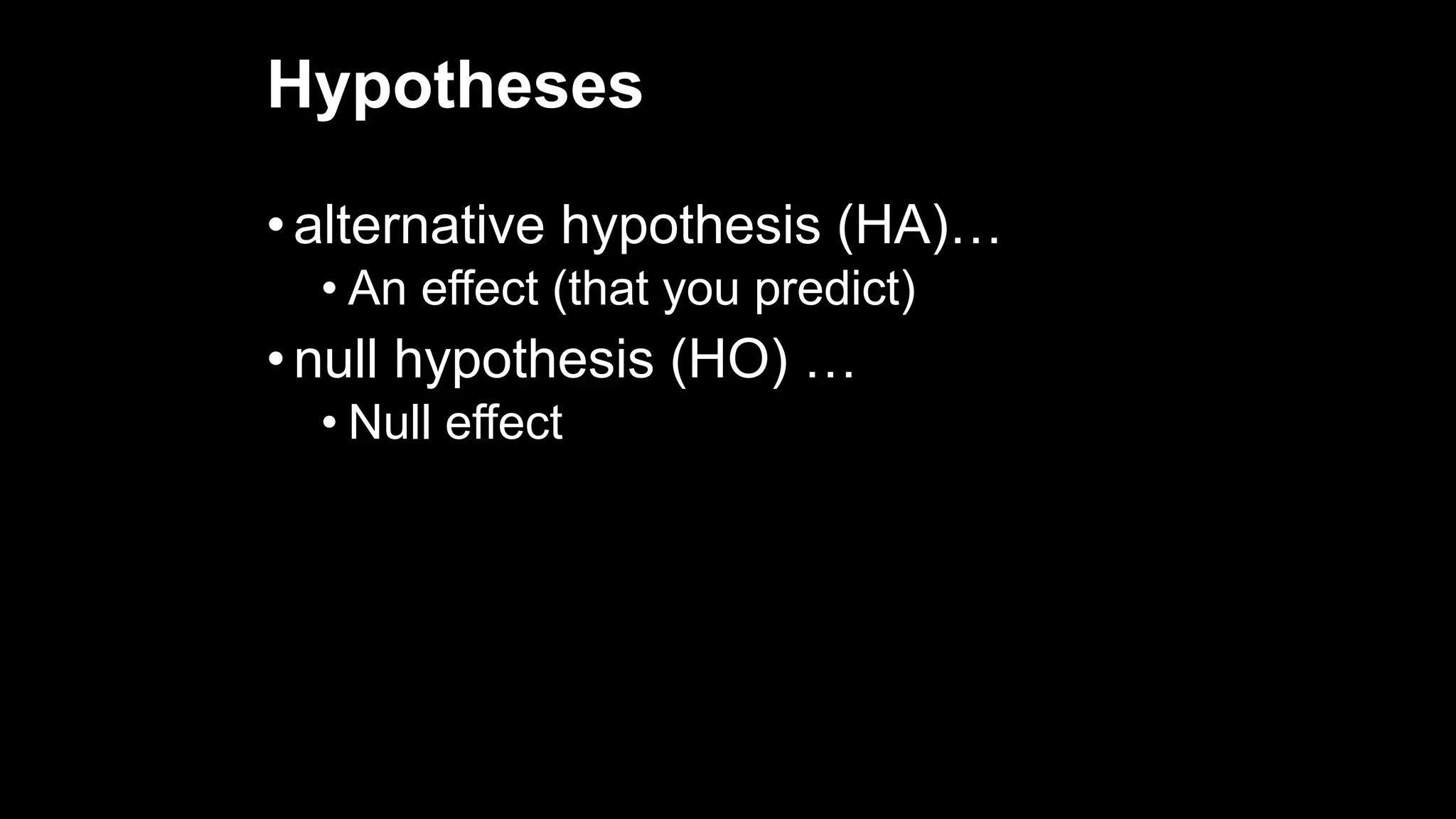
Hypotheses
• alternative hypothesis (HA)…
• An effect (that you predict)
• null hypothesis (HO) …
• Null effect
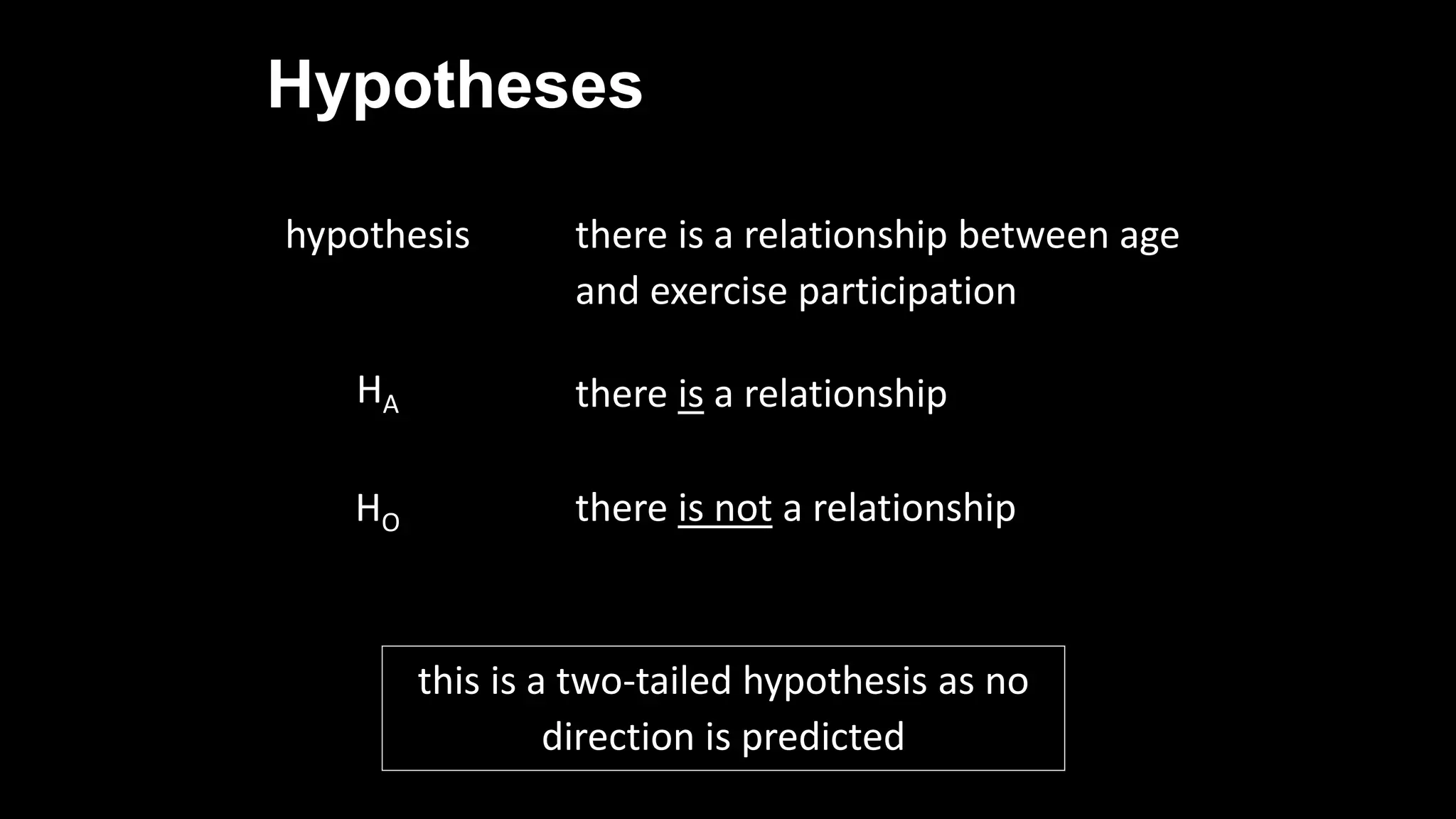
Hypotheses
hypothesis there is a relationship between age
and exercise participation
HA there is a relationship
HO there is not a relationship
this is a two-tailed hypothesis as no
direction is predicted
Hypotheses
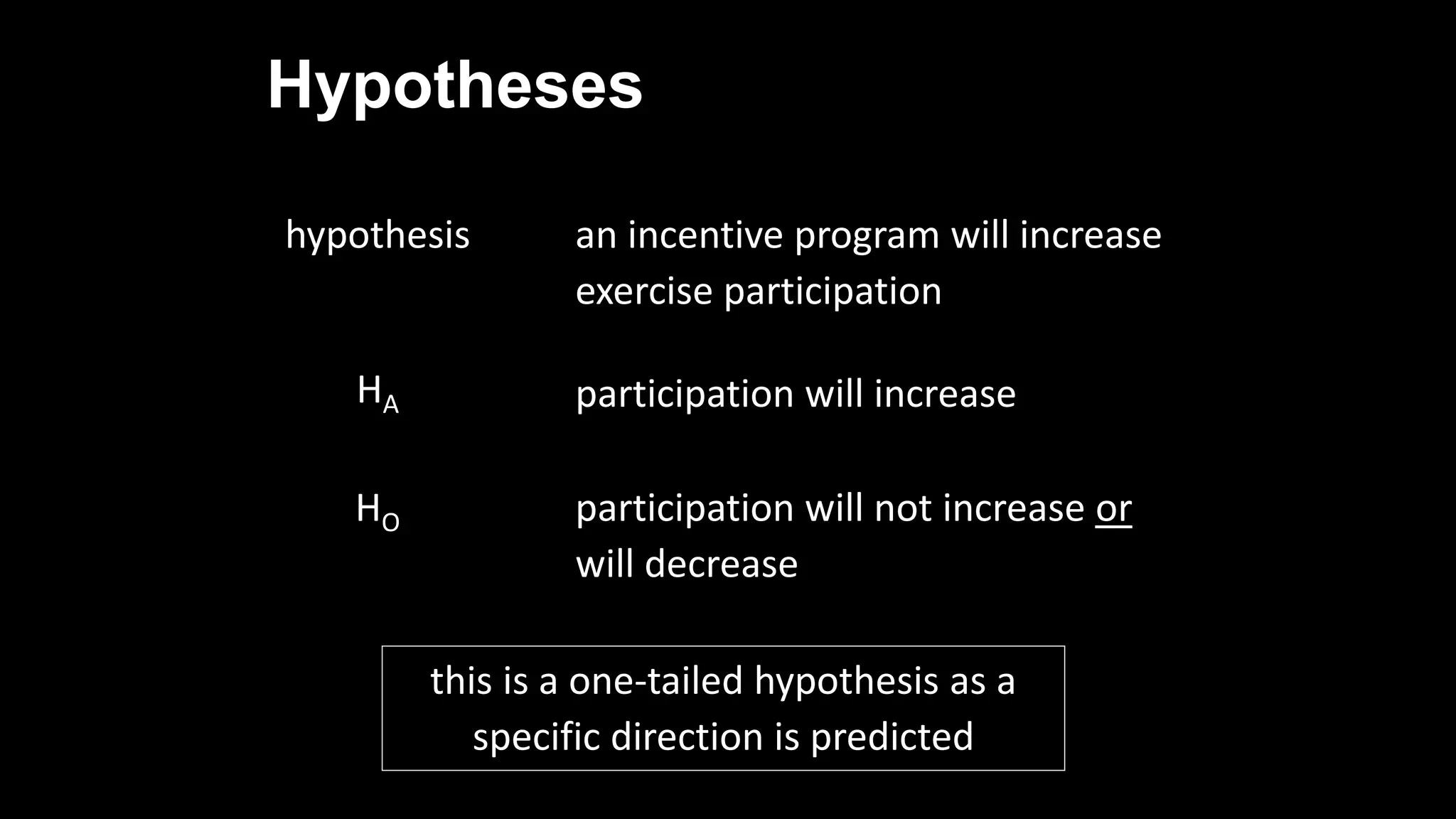
hypothesis an incentive program will increase
exercise participation
HA participation will increase
HO participation will not increase or
will decrease
this is a one-tailed hypothesis as a
specific direction is predicted
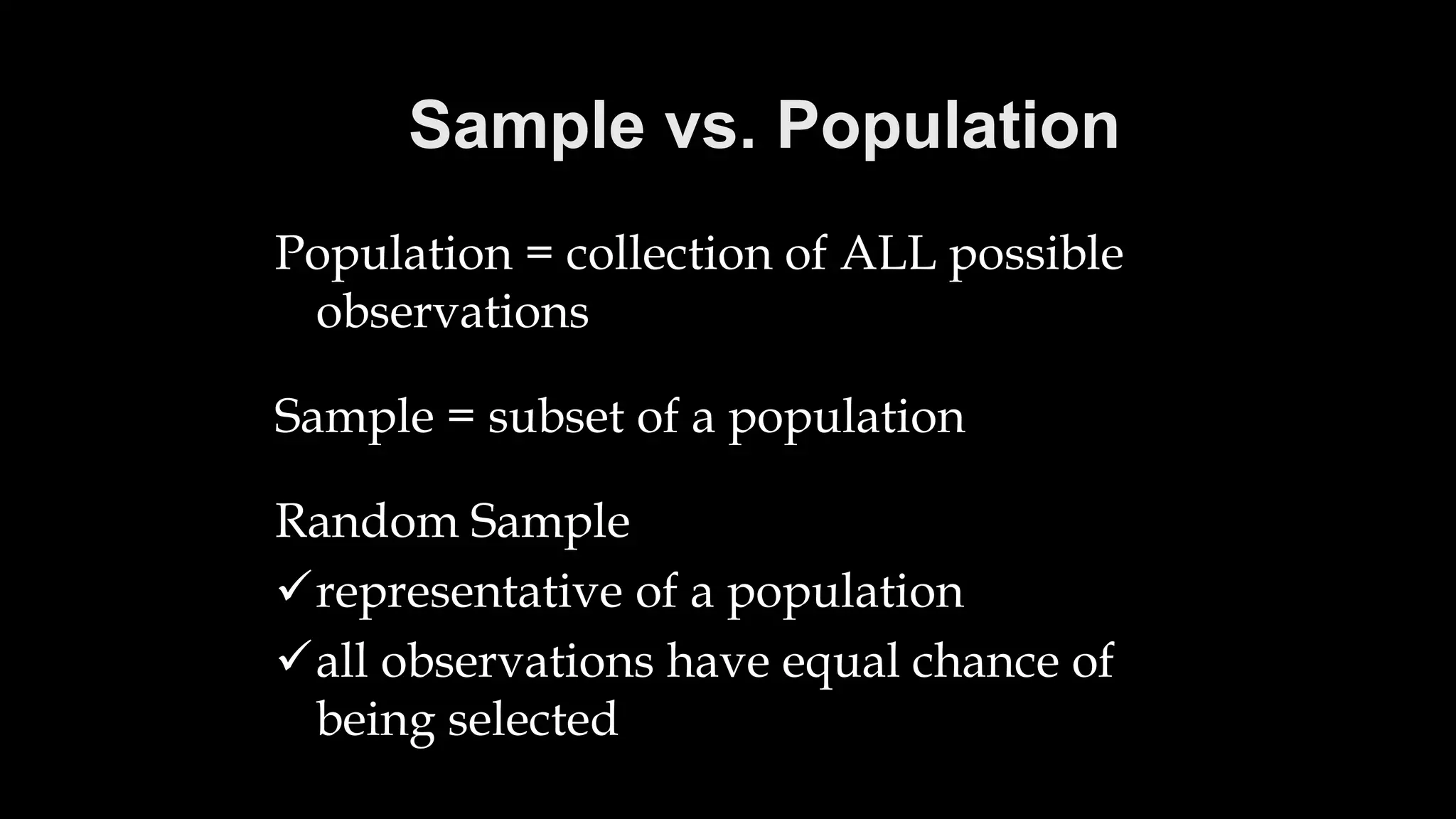
Sample vs. Population
Population = collection of ALL possible
observations
Sample = subset of a population
Random Sample
representative of a population
all observations have equal chance of
being selected
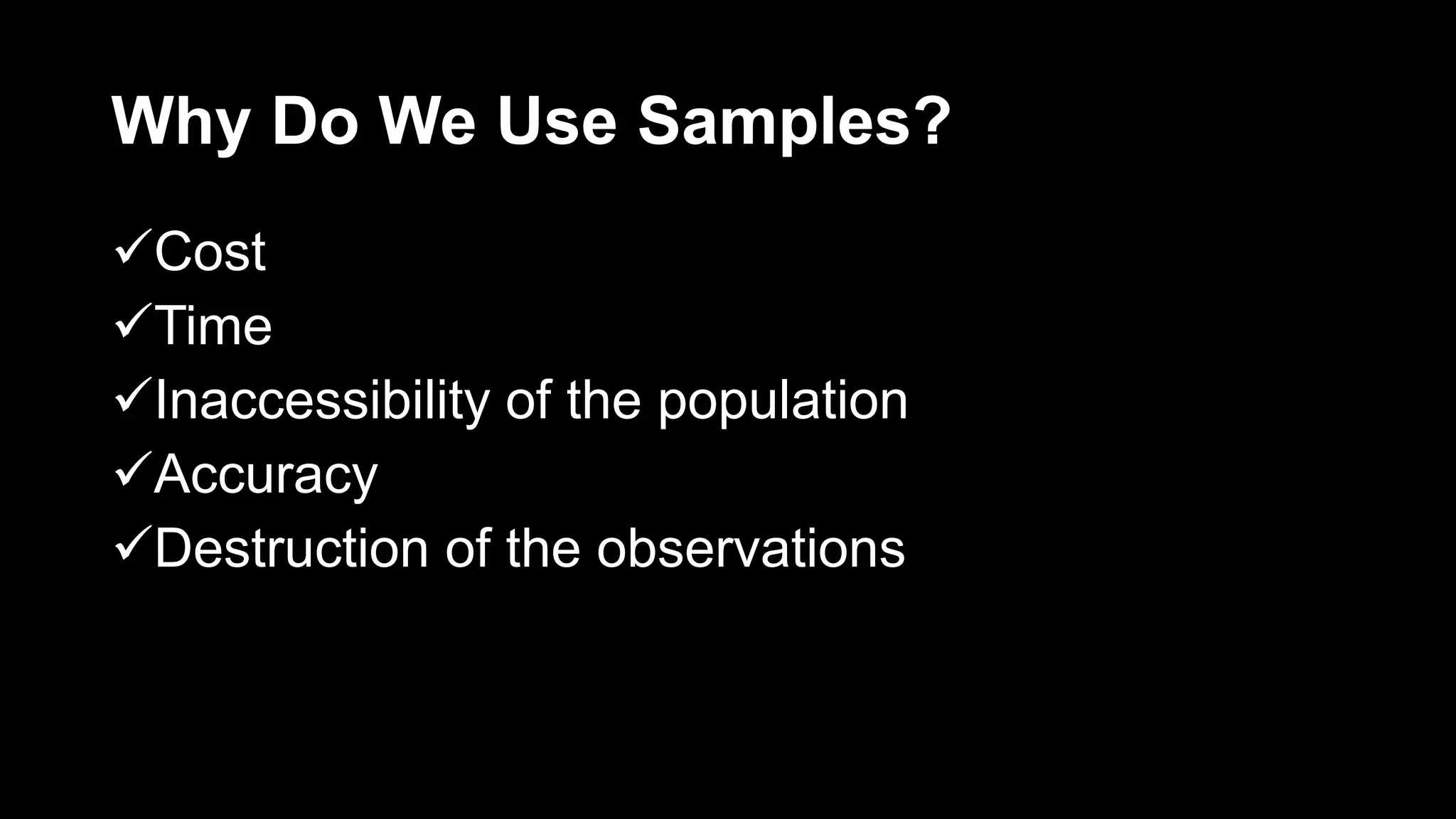
Why Do We Use Samples?
Cost
Time
Inaccessibility of the population
Accuracy
Destruction of the observations
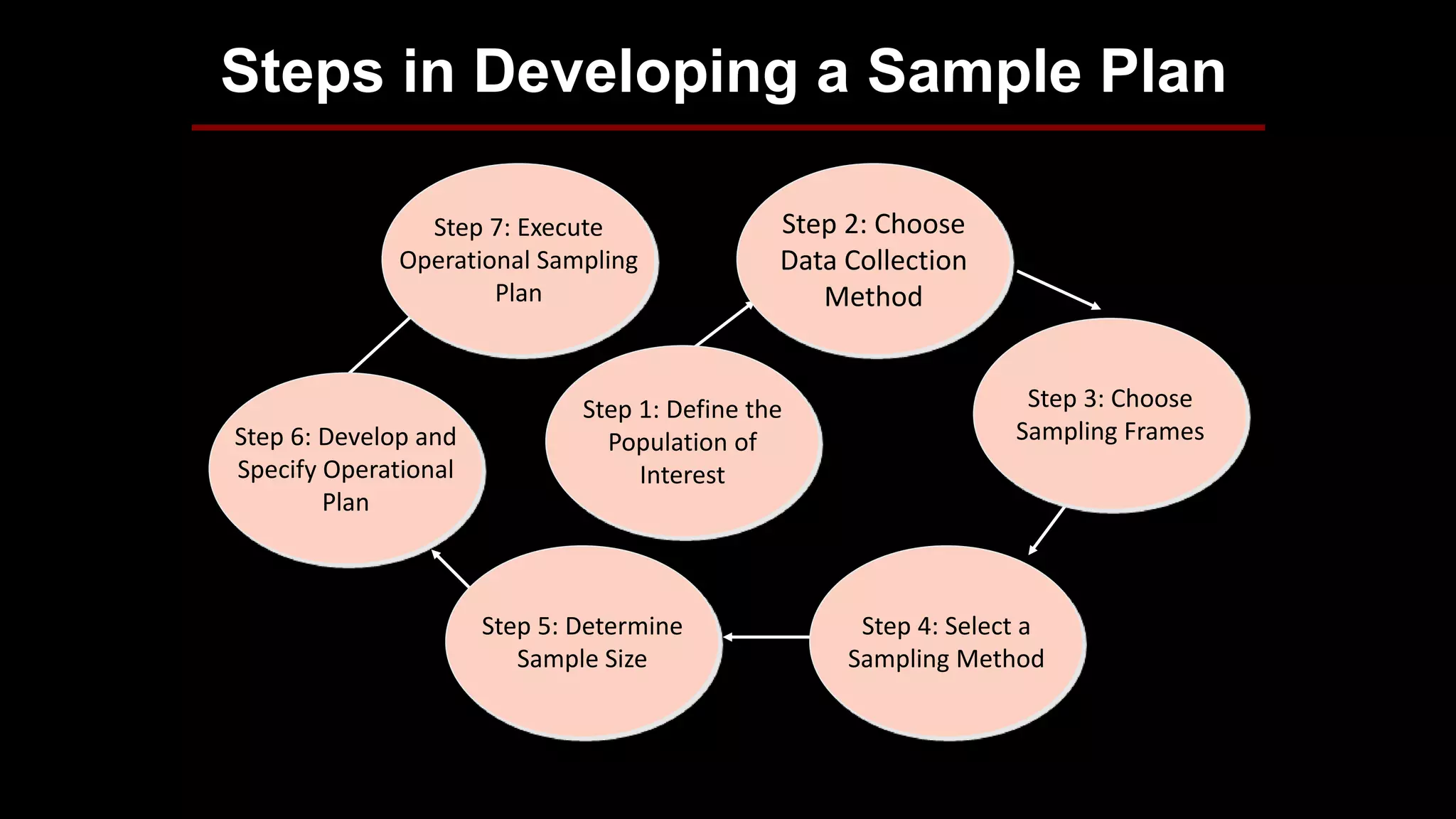
Steps in Developing a Sample Plan
Step 1: Define the
Population of
Interest
Step 2: Choose
Data Collection
Method
Step 3: Choose
Sampling Frames
Step 4: Select a
Sampling Method
Step 5: Determine
Sample Size
Step 6: Develop and
Specify Operational
Plan
Step 7: Execute
Operational Sampling
Plan
Sampling Methods
•Probability vs. Nonprobability
•Probability
• members in the population have a known
chance (probability) of being selected into the
sample
•Nonprobability
• the probability of selecting members from the
population is not known
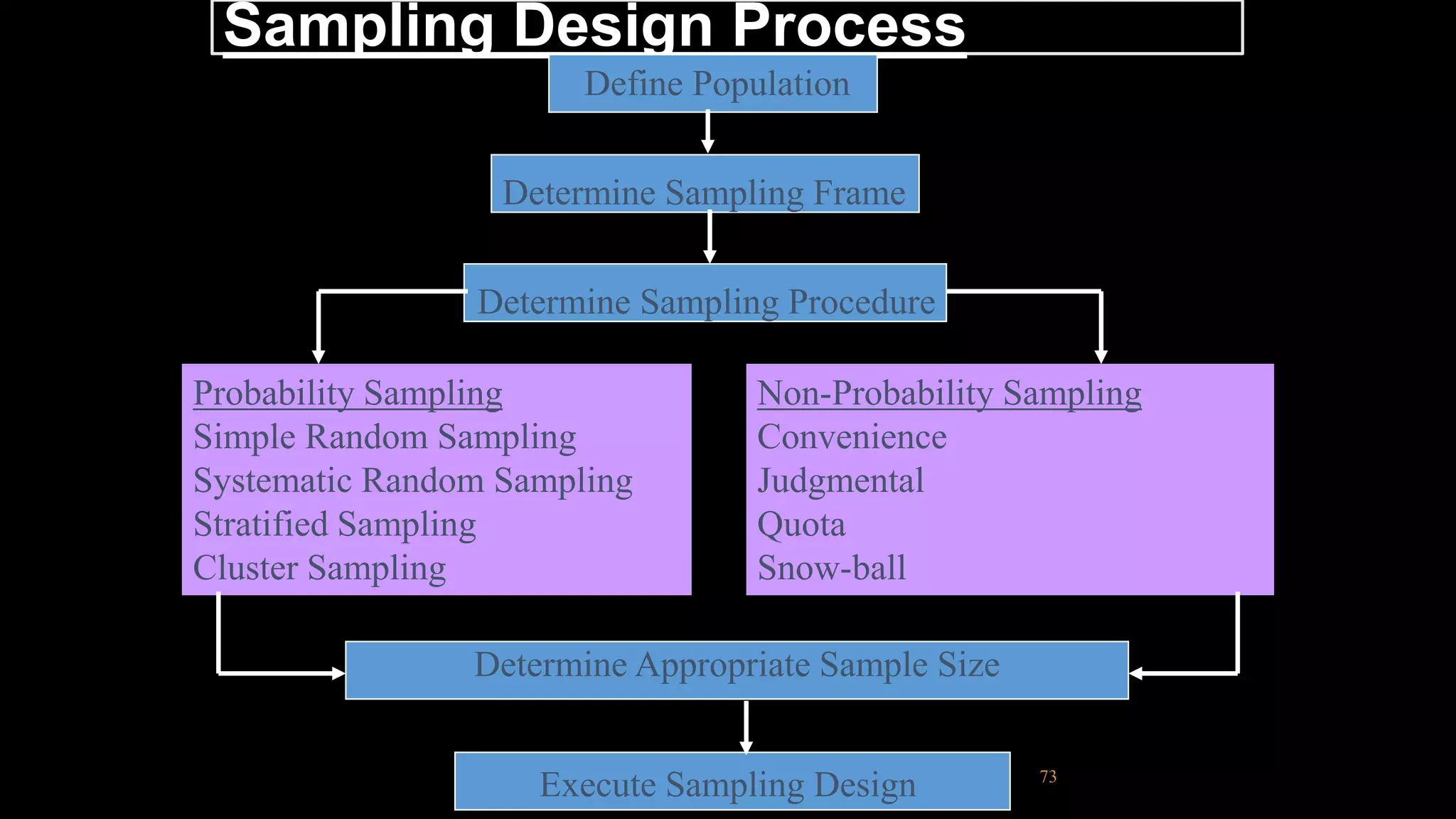
Sampling Design Process
73
Define Population
Determine Sampling Frame
Determine Sampling Procedure
Probability Sampling
Simple Random Sampling
Systematic Random Sampling
Stratified Sampling
Cluster Sampling
Non-Probability Sampling
Convenience
Judgmental
Quota
Snow-ball
Determine Appropriate Sample Size
Execute Sampling Design
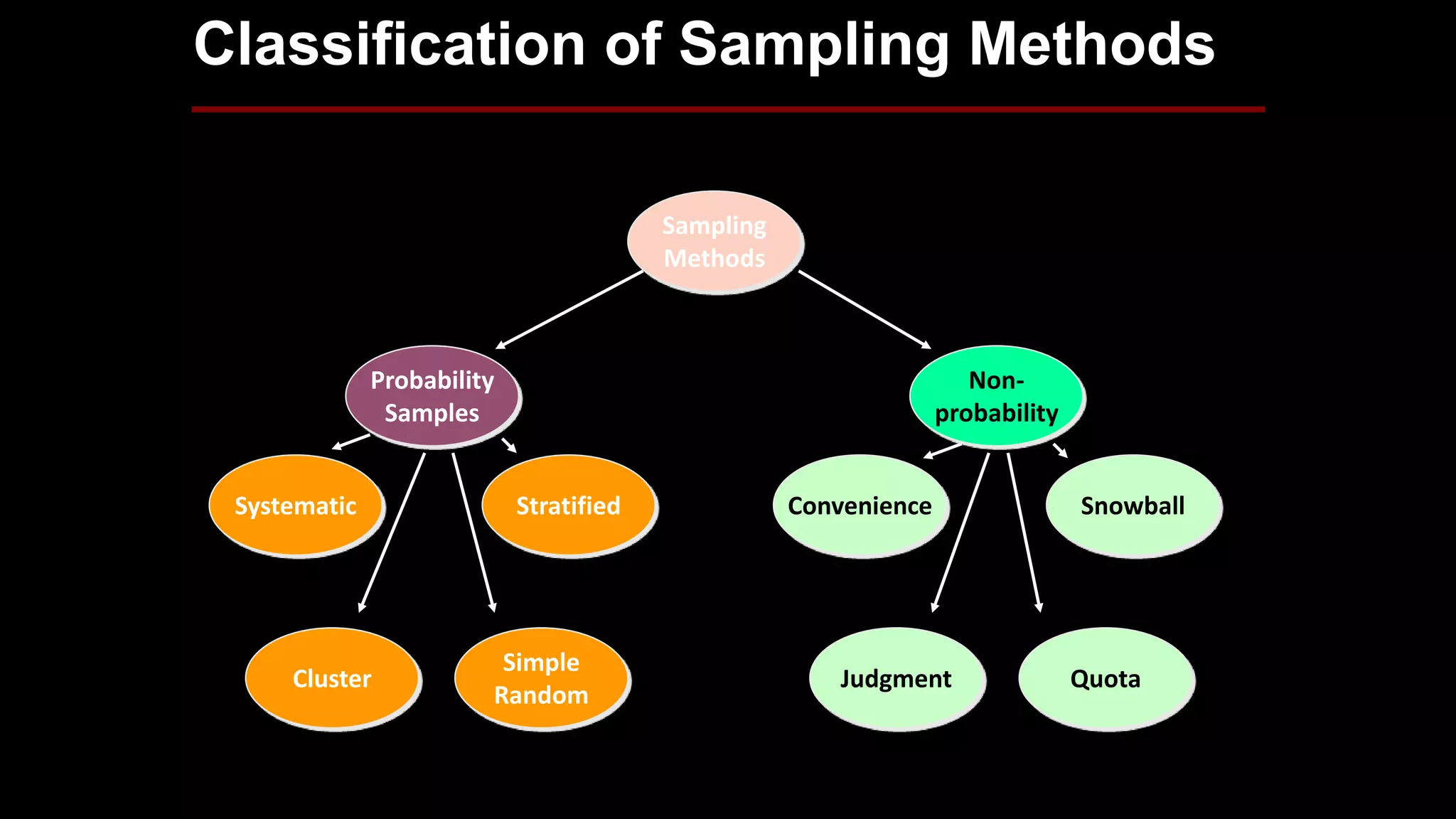
Classification of Sampling Methods
Sampling
Methods
Probability
Samples
Simple
Random
Cluster
Systematic Stratified
Non-
probability
QuotaJudgment
Convenience Snowball
Sampling
• Once you are clear about your procedure, you need to
locate participants will undergo the research
procedure
• Quantitative methodology is concerned with
representativeness of the sample
• The key question here is sample size as the bigger
sample size the more precise the results
• Qualitative research is less focused on sample and
generalizability. Sampling tends to mean a relevant
case, theory base case, a critical case, an interview et
cetera
Key questions to answer in your
methodology
• What kind of research methods are you going to use? Are they
mostly:
• Quantitative, or qualitative, or a mixture of both?
• What do you think your methods will enable you to discover?
• What might they prevent you from discovering?
• What kinds of research methods would be best suited to the kind
of research you are undertaking and the research questions you
are pursuing?
• What sort of problems do you envisage in setting up these
methods?
• What are their benefits?
• What will you need to do to ensure they gather useful data?
Summary
• “Methodology” implies more than simply the methods you intend to use
to collect data.
• It is necessary to include a consideration of the concepts and theories
which underlie the methods.
• you have to show that you understand the underlying concepts of the
methodology.
• When you describe your methods it is necessary to state how you have
addressed the research questions and/or hypotheses.
• The methods should be described in enough detail for the study to be
replicated, or at least repeated in a similar way in another situation.
• Every stage should be explained and justified with clear reasons for the
choice of your particular methods and materials.
Lecture 7 research methodology in counselling

Lecture 7 research methodology in counselling

  • 1.
    Research Methodology (Theory ofresearch) & Research Design (The action of Research): Method & Techniques Dissertation Module Kevin Standish
  • 2.
    Learning outcomes • DistinguishResearch Methodology from Research methods • Compare Qualitative and Quantitative Methods • Describe Variables and hypothesis • Identify sampling methods
  • 3.
    The Research Process 1.Identification of general problem/question 2. Literature review 3. Specify questions/hypotheses 4. Determination of research design/methodology 5. Data collection 6. Data analysis/presentation 7. Interpretation of findings 8. Discussion of findings
  • 4.
  • 5.
  • 6.
    Structure of Research beginwith broad questions narrow down, focus in operationalize OBSERVE analyze data reach conclusions generalize back to questions The "hourglass" notion of research
  • 7.
  • 8.
    Research Methodology • Researchmethodology is a way to systematically solve the research problem. • It may be understood as a science of studying how research is done scientifically. • In it we study the various steps that are generally adopted by a researcher in studying his research problem along with the logic behind them
  • 9.
    Research methodology.. • ResearchMethodology says the how to do/conduct research systematically & scientifically. • Research methodology not only provides the knowledge of various types of methods & techniques for Sampling , data collection, data analysis & report writing etc. but also guides that which particular method or technique for sampling/data collection/data analysis should be used or not & why should /shouldn't do so.
  • 10.
  • 11.
    Research Methodology • Thereare different ways of “knowing” and the epistemological standpoint will determine the nature of that knowing • One may explore their reality using statistical data as evidence while another may have first-hand accounts of how the person has been effected, which is their reality. • Each represents a particular Paradigm of knowledge. Neither is right or wrong it is just a different view.
  • 12.
    Research Method The Actionof Research: Design; Sample; Method; Collection; How Data will be analysed
  • 13.
    Observational Research Gathering data by observing people,actions and situations (Exploratory) Experimental Research Using groups of people to determine cause and effect relationships (Causal) Survey Research Asking individuals about attitudes, preferences or behaviors (Descriptive) Three Research Approaches
  • 14.
    Types of ResearchDesigns Exploratory Research Descriptive Research Causal Research Test hypotheses about cause and effect relationships X causes Y Gathers preliminary information to define the problem and suggest hypotheses Literature search, expert interviews, focus groups, case studies, company audits, qualitative research Describes things as the market potential of a product, consumer demographics and attitudes Secondary data analysis, surveys, observations, panels, simulations
  • 15.
    Research Methods  Descriptiveresearch Analytical research  Applied research Basic research
  • 16.
    Research Methods  Quantitativeresearch Qualitative research  Conceptual research Empirical research
  • 17.
    The Right andthe Left • Quantitative research - numbers, numbers, numbers • Qualitative research - words, words, words
  • 18.
    Quantitative vs. Qualitative:Assumptions about the World • Based upon the idea of “logical positivism”, that is, there is a singular reality with stable, social facts that are separate from the feelings and beliefs of individuals. • Based on the notion of “constructivism”, which assumes multiple realities that are socially constructed through individual and collective perceptions or views of the same situation.
  • 19.
    Quantitative vs. Qualitative:Research Purpose • Seeks to establish relationships and explain causes of changes in measured variables. That is, the goal of science is to explain and predict. • Concern is with the understanding of the social phenomenon from the participants’ perspectives. This requires, to some degree, researcher participation.
  • 20.
    Quantitative vs. Qualitative:Methods and Process • The scientific method, also known as a priori or pre- established design. • Use of emergent design utilizing constant comparison and revision.
  • 21.
    Quantitative vs. Qualitative:Prototypical Studies • Experimental or correlational designs are used to reduce error, bias and the influence of extraneous variables--control of bias is through design. • Use of ethnography, which helps readers understand the multiple perspectives of the situation by the persons studied. Subjectivity in data analysis and interpretation is acknowledged.
  • 22.
    Quantitative vs. Qualitative:Researcher Role • Detachment from study in order to avoid bias. • Immersion in situation and the phenomenon being studied.
  • 23.
    Quantitative vs. Qualitative:Context • Context-free generalizations • Generalizations are contextually- bound.
  • 24.
    Quantitative vs. Qualitative:Precision • Obtained through the use of measurement and statistics • Provided by detailed description of phenomenon
  • 25.
    Quantitative vs. Qualitative:Verification • Results replicated by others. • Extension of understandings by others.
  • 26.
    Quantitative vs. Qualitative:Explanation • Traditionally, parsimonious explanations were sought, but this may be changing due to technology. • Summary through narrative-- importance is placed on reducing complex realities to simple explanations.
  • 27.
    Quantitative vs. Qualitative:Logical Reasoning • DEDUCTIVE--What’s the classic example? • INDUCTIVE--anyone have an example?
  • 28.
    Quantitative vs. Qualitative:Conditional Conclusions • Statements of statistical probability. • Tentative summary interpretations.
  • 31.
    Types of QuantitativeStudies • Descriptive • True experimental • Quasi-experimental • Correlational • Predictive
  • 32.
    Types of QualtitativeStudies • Qualitative research gathers information that is not in numerical form: • diary accounts, • open-ended questionnaires, • unstructured interviews • unstructured observations. • Qualitative data is typically descriptive data and as such is harder to analyze than quantitative data. • Qualitative research is useful for studies at the individual level, and to find out, in depth, the ways in which people think or feel (e.g. case studies).
  • 33.
    Types of QualtitativeStudies • Qualitative paradigms offer the researcher an opportunity to develop an idiographic understanding of participants’ experiences and what it means to them, within their social reality, to be in a particular situation (Bryman, 1992). • methods include: Content / thematic analysis (CA/ TA); Grounded Theory (GT); • Discursive psychology / Discourse analysis (DA); • Narrative psychology (NA); • Phenomenological psychology methods such as interpretative phenomenological analysis (IPA).
  • 35.
    Research Using PrimaryData • Cross-sectional • Case Control • Cohort • Randomized controlled trial
  • 36.
    Cross-sectional Study • Datagathered at one point in time • Often used for surveys • Can not make inferences about causality
  • 37.
    Case Control Study •Start with the outcome- identify a sample with the condition of interest • Identify a similar control group • Look back to determine exposure • Calculate the risk in the cases and controls- odds ratio used • Can not use to establish prevalence
  • 38.
    Cohort Study • Startwith an identified group • Determine exposure in everyone at the same time • Follow the group to determine who develops the outcome of interest • Can be used to determine prevalence • Association measured as relative risk (rate ratios)
  • 39.
    Randomized Controlled Trial •Gold standard for determining associations • Identify a group • Randomly assign individuals to exposure • Only reliable way to control for confounding
  • 40.
    Research Using SecondaryData •Literature review •Systematic review •Metanalysis •Analysis of existing data collected for another purpose
  • 41.
    Literature Review • Gatherarticles on a topic of interest • Summarize the findings
  • 42.
    Systematic Review • Gatherarticles using a pre-defined search strategy- may include unpublished studies • Develop a-priori objective criteria to evaluate the quality of the studies • Summarize the quality of the data and the results
  • 43.
    Metanalysis • Do asystematic review • Obtain the primary data if possible • Summarize the data quantitatively
  • 44.
    Research Method vsMethodology Comparison Research Methods Research Methodology • research methods are the methods by which you conduct research into a subject or a topic • Research methods involve conduct of experiments, tests, surveys and the like • research methods aim at finding solutions to research problems • research methodology explains the methods by which you may proceed with your research • research methodology involves the learning of the various techniques that can be used in the conduct of research and in the conduct of tests, experiments, surveys and critical studies search • research methodology aims at the employment of the correct procedures to find out solutions
  • 45.
    Research Method vsMethodology ComparisonExamples:- research methods Research methodology If the subject for Research is ‘employment of figures of speech in English literature’ then the research methods that are involved are study of various works of the different poets and the understanding of the employment of figures of speech in their works If the subject for Research is ‘employment of figures of speech in English literature’ then the research methodology pertaining to the topic mentioned above involves the study about the tools of research, collation of various manuscripts related to the topic, techniques involved in the critical edition of these manuscripts and the like
  • 46.
    Research Method vsMethodology Comparisonwith Examples cont… research methods Research methodology If the subject into which you conduct a research is a scientific subject or topic then the research methods include experiments, tests, study of various other results of different experiments performed earlier in relation to the topic or the subject and the like If the subject into which you conduct a research is a scientific subject or topic then research methodology pertaining to the scientific topic involves the techniques regarding how to go about conducting the research, the tools of research, advanced techniques that can be used in the conduct of the experiments and the like
  • 47.
    Research Method vsMethodology Conclusion We can say that Research Methodology has many dimensions and Research Methods do constitute a part of the research methodology. The scope of research methodology is wider than that of research methods.
  • 48.
    Variables Meaning • Known asa property of proposition being studied • Also known as the constructs of a proposition • A symbol to which we assign numerals or values • Numerical value assigned to a variable is based on its properties • 3 types of Variables: Dichotomous; Discrete; Continuous
  • 49.
    1. Dichotomous Variables •These variables are so called because they have TWO values, reflecting presence or absence of a property. • For example: pass or fail, exists or does not exist, employed - unemployed, male - female, yes - no. • The dichotomous variables can be assigned with a numerical value of ‘0’ or ‘1’ for analysis purpose.
  • 50.
    2. Discrete Variables •These are categorical variables. • For example, the demographic variables race or religion are the examples of discrete variables. • Religion: Hindu, Islam, Buddhism, and Jain can be assigned numerical values of 1, 2, 3, and 4 respectively. • The numerical values assigned to these variables will be of absolute nature; not like 3.5, or 4.7.
  • 51.
    3. Continuous Variables •These variables take on values with a given range or, in some cases, an infinite set. • For example, test scores may range from 0 - 100, age may be 2.5 years, present income of a person could be £. 15000, you may disclose your property worth more than £.500,000.
  • 52.
    Variables • variable… • anyobservation that can take on different values • attribute… • a specific value on a variable
  • 53.
  • 54.
  • 55.
  • 56.
  • 57.
  • 58.
    Examples Variable Attribute satisfaction 1= very satisfied 2 = satisfied 3= somewhat satisfied 4 = not satisfied 5 = not satisfied at all
  • 59.
    Types of Variables •independent variable (IV)… • what you (or nature) manipulates in some way • dependent variable (DV)… • what you presume to be influenced by the IV
  • 60.
    Examples: Sports participation IVDV exercise participation health status attitude social support intervention
  • 61.
    The purpose ofthe study was to… • test whether the “Fair Play for Sport” curriculum is effective in promoting moral development in youth • examine the relationship between age and VO2max. • test whether there are gender differences the value placed on sport participation • determine whether students’ perceptions of the amount of positive, negative, and informational feedback provided by their teachers is predictive of their self-esteem and level of achievement IV, DV?
  • 62.
    Types of Relationships •correlational vs. causal relationships correlation does not imply causation! (it’s necessary but not sufficient) variables perform in a synchronized manner one variable causes the other variable
  • 63.
    Types of Relationships •patterns of relationships… • no relationship • positive relationship • negative relationship • curvilinear relationship
  • 64.
    - + - + resting HR fitness -+ - + vocabulary fitness- + - HR exerciseintensity - + - arousalperformance + +
  • 65.
    Hypotheses • hypothesis… • aspecific statement of prediction • types of hypotheses • alternative vs. null • one-tailed vs. two-tailed
  • 66.
    Hypotheses • alternative hypothesis(HA)… • An effect (that you predict) • null hypothesis (HO) … • Null effect
  • 67.
    Hypotheses hypothesis there isa relationship between age and exercise participation HA there is a relationship HO there is not a relationship this is a two-tailed hypothesis as no direction is predicted
  • 68.
    Hypotheses hypothesis an incentiveprogram will increase exercise participation HA participation will increase HO participation will not increase or will decrease this is a one-tailed hypothesis as a specific direction is predicted
  • 69.
    Sample vs. Population Population= collection of ALL possible observations Sample = subset of a population Random Sample representative of a population all observations have equal chance of being selected
  • 70.
    Why Do WeUse Samples? Cost Time Inaccessibility of the population Accuracy Destruction of the observations
  • 71.
    Steps in Developinga Sample Plan Step 1: Define the Population of Interest Step 2: Choose Data Collection Method Step 3: Choose Sampling Frames Step 4: Select a Sampling Method Step 5: Determine Sample Size Step 6: Develop and Specify Operational Plan Step 7: Execute Operational Sampling Plan
  • 72.
    Sampling Methods •Probability vs.Nonprobability •Probability • members in the population have a known chance (probability) of being selected into the sample •Nonprobability • the probability of selecting members from the population is not known
  • 73.
    Sampling Design Process 73 DefinePopulation Determine Sampling Frame Determine Sampling Procedure Probability Sampling Simple Random Sampling Systematic Random Sampling Stratified Sampling Cluster Sampling Non-Probability Sampling Convenience Judgmental Quota Snow-ball Determine Appropriate Sample Size Execute Sampling Design
  • 74.
    Classification of SamplingMethods Sampling Methods Probability Samples Simple Random Cluster Systematic Stratified Non- probability QuotaJudgment Convenience Snowball
  • 75.
    Sampling • Once youare clear about your procedure, you need to locate participants will undergo the research procedure • Quantitative methodology is concerned with representativeness of the sample • The key question here is sample size as the bigger sample size the more precise the results • Qualitative research is less focused on sample and generalizability. Sampling tends to mean a relevant case, theory base case, a critical case, an interview et cetera
  • 76.
    Key questions toanswer in your methodology • What kind of research methods are you going to use? Are they mostly: • Quantitative, or qualitative, or a mixture of both? • What do you think your methods will enable you to discover? • What might they prevent you from discovering? • What kinds of research methods would be best suited to the kind of research you are undertaking and the research questions you are pursuing? • What sort of problems do you envisage in setting up these methods? • What are their benefits? • What will you need to do to ensure they gather useful data?
  • 77.
    Summary • “Methodology” impliesmore than simply the methods you intend to use to collect data. • It is necessary to include a consideration of the concepts and theories which underlie the methods. • you have to show that you understand the underlying concepts of the methodology. • When you describe your methods it is necessary to state how you have addressed the research questions and/or hypotheses. • The methods should be described in enough detail for the study to be replicated, or at least repeated in a similar way in another situation. • Every stage should be explained and justified with clear reasons for the choice of your particular methods and materials.