Metaphors
in Therapy
RANDY WILHELM
Why Use Metaphors In Therapy?
Therapeutic metaphors offer new choices especially new ways of looking at things and can tap a
variety of experiences, beliefs, and ideas that have been dormant in the listeners mind.
Made indirectly, the points are less likely to be resisted and the chances of the storyteller being
seen as moralistic are much reduced.
It allows clients to use it their OWN way. It offers choice. Therapy is not telling people what to
do, it is more of a matter of helping people see things differently and to feel differently about
them.
Why Use Metaphors In Therapy?
Metaphors are less threatening because they deal indirectly, provide gentle points, and give
implicit meanings. Sometimes vague metaphors are the best to let clients fill the gaps with
their own resources.
When direct points are made directly, there is the chance the client will resist and quite
consciously reject them; this could damage the rapport.
Stories can also directly affect the unconscious mind and attitudes. They can be flexible and can
be used as a channel for many sorts of communication. It is a gentle art of reframing.
Embedded messages can be in the story.
Stories also give an incredible way to establish rapport.
Types of Metaphors
Major stories with complex clinical situations
Anecdotes and short stories-specific, limiting goals
Analogies, similes and brief metaphorical statements or phrases that illustrate or emphasize specific
points
Relationship metaphors
Tasks with metaphorical meanings. Prescribed or rehearsed. Couples choreography, Burning items
representative of someone else leaving
Metaphorical objects. To represent something other than what they are
Artistic metaphors
How Might You Construct a Metaphor?
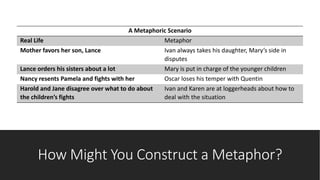
A Metaphoric Scenario
Real Life Metaphor
Mother favors her son, Lance Ivan always takes his daughter, Mary’s side in
disputes
Lance orders his sisters about a lot Mary is put in charge of the younger children
Nancy resents Pamela and fights with her Oscar loses his temper with Quentin
Harold and Jane disagree over what to do about
the children’s fights
Ivan and Karen are at loggerheads about how to
deal with the situation
References
Barker, P. (1985). Using metaphors in psychotherapy. New York: Brunner/Mazel

Metaphors in therapy

  • 1.
  • 2.
    Why Use MetaphorsIn Therapy? Therapeutic metaphors offer new choices especially new ways of looking at things and can tap a variety of experiences, beliefs, and ideas that have been dormant in the listeners mind. Made indirectly, the points are less likely to be resisted and the chances of the storyteller being seen as moralistic are much reduced. It allows clients to use it their OWN way. It offers choice. Therapy is not telling people what to do, it is more of a matter of helping people see things differently and to feel differently about them.
  • 3.
    Why Use MetaphorsIn Therapy? Metaphors are less threatening because they deal indirectly, provide gentle points, and give implicit meanings. Sometimes vague metaphors are the best to let clients fill the gaps with their own resources. When direct points are made directly, there is the chance the client will resist and quite consciously reject them; this could damage the rapport. Stories can also directly affect the unconscious mind and attitudes. They can be flexible and can be used as a channel for many sorts of communication. It is a gentle art of reframing. Embedded messages can be in the story. Stories also give an incredible way to establish rapport.
  • 4.
    Types of Metaphors Majorstories with complex clinical situations Anecdotes and short stories-specific, limiting goals Analogies, similes and brief metaphorical statements or phrases that illustrate or emphasize specific points Relationship metaphors Tasks with metaphorical meanings. Prescribed or rehearsed. Couples choreography, Burning items representative of someone else leaving Metaphorical objects. To represent something other than what they are Artistic metaphors
  • 5.
    How Might YouConstruct a Metaphor? A Metaphoric Scenario Real Life Metaphor Mother favors her son, Lance Ivan always takes his daughter, Mary’s side in disputes Lance orders his sisters about a lot Mary is put in charge of the younger children Nancy resents Pamela and fights with her Oscar loses his temper with Quentin Harold and Jane disagree over what to do about the children’s fights Ivan and Karen are at loggerheads about how to deal with the situation
  • 6.
    References Barker, P. (1985).Using metaphors in psychotherapy. New York: Brunner/Mazel