The document provides an overview of couples counseling and the life cycle of couple relationships. It discusses key stages in relationships including newly married couples, families with young children, families with adolescents, and families in later life. It also examines characteristics of happy and unhappy couples, the basis for partner choice, and theories around marriage and divorce rates. The document then outlines several models of couple therapy and frameworks for assessing couples counseling approaches.
Overview of couples counselling, outcomes of the session, including understanding marriage, divorce, and key skills.
Examines marriage evolution with economic and social norm changes affecting marital expectations.
Explores how cultural influences shape marriage views and trends in marriage statistics.
Presents various statistical data on marriage in 2012, including trends, civil ceremonies, and age demographics.
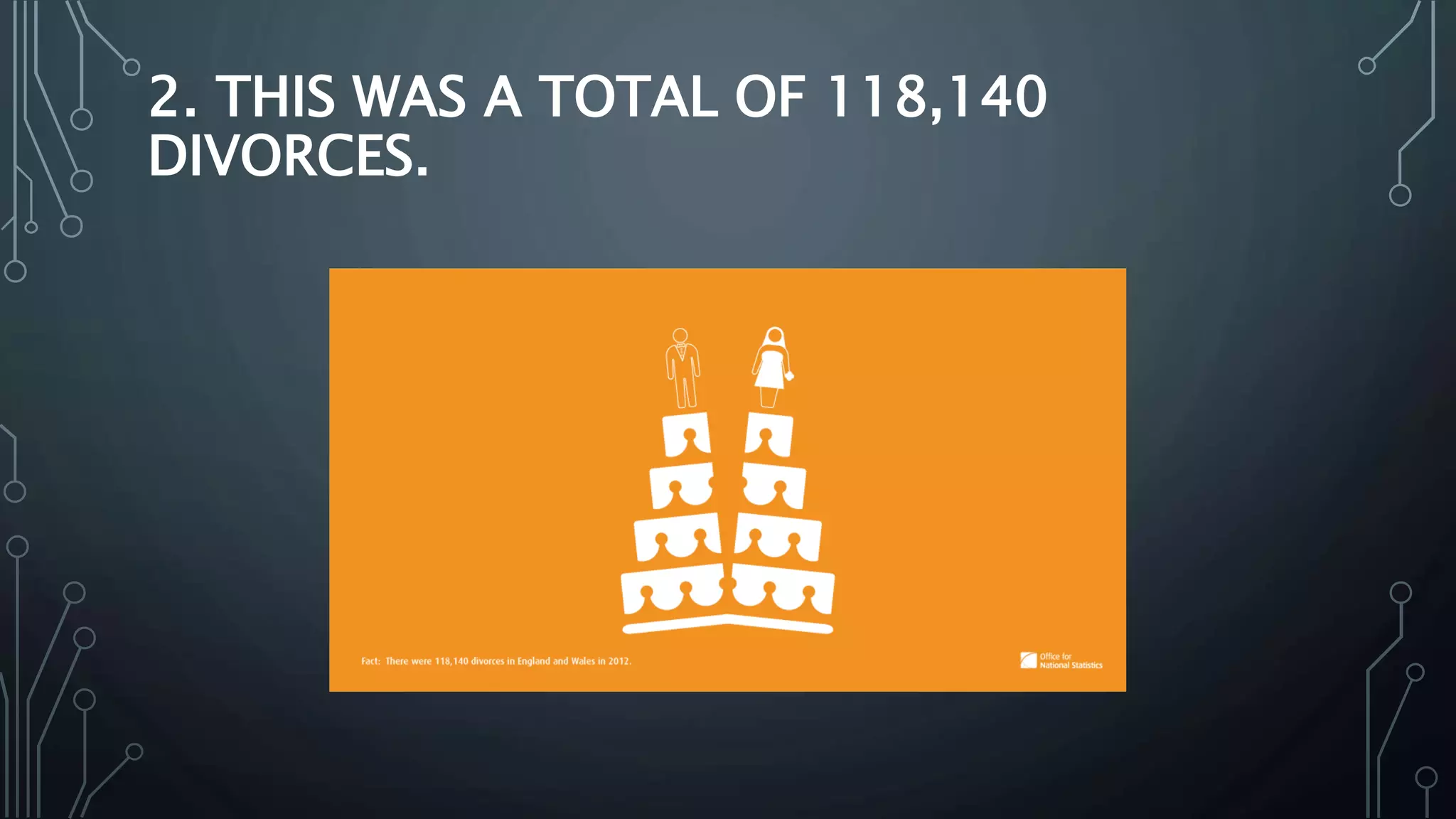
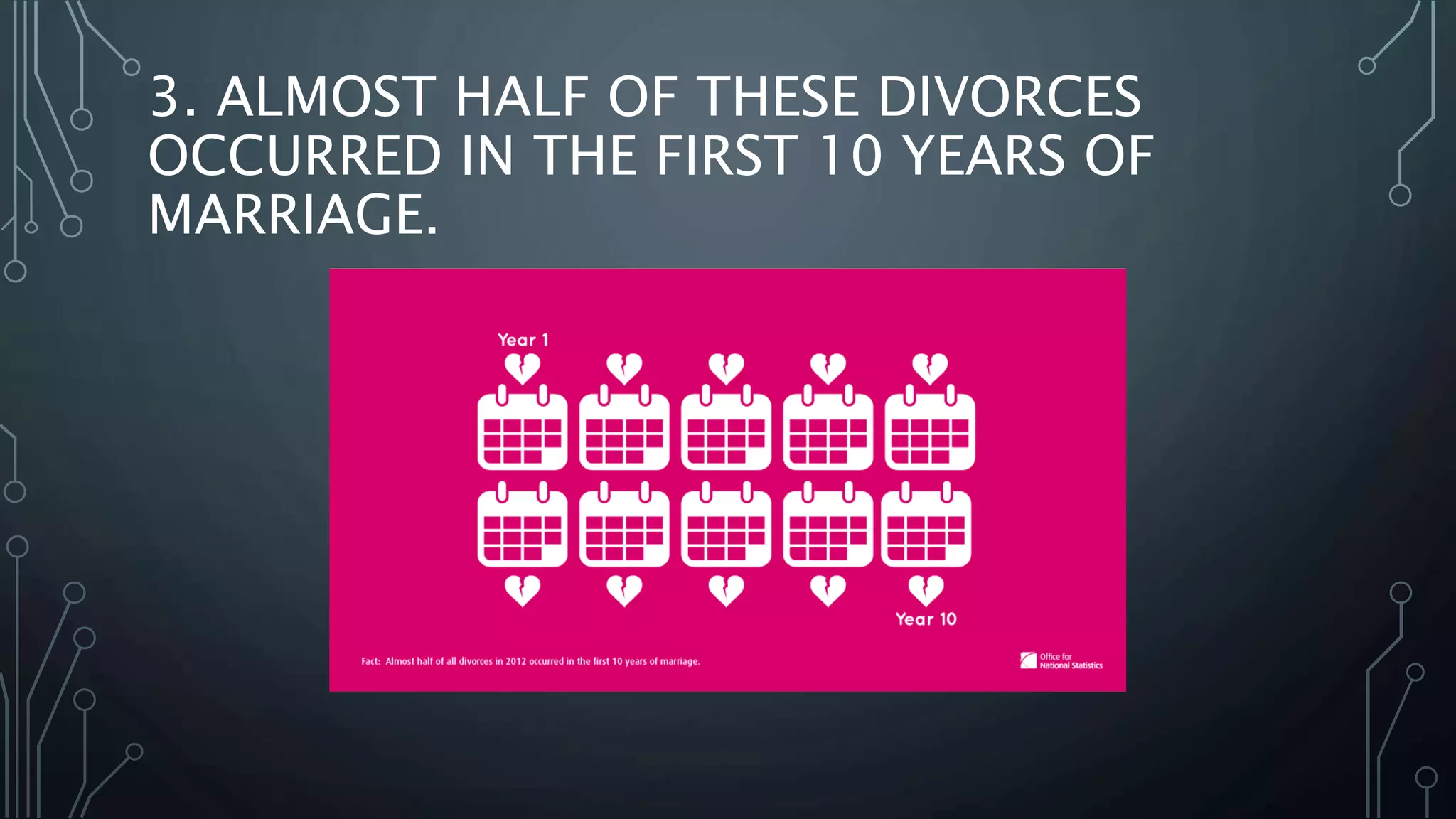
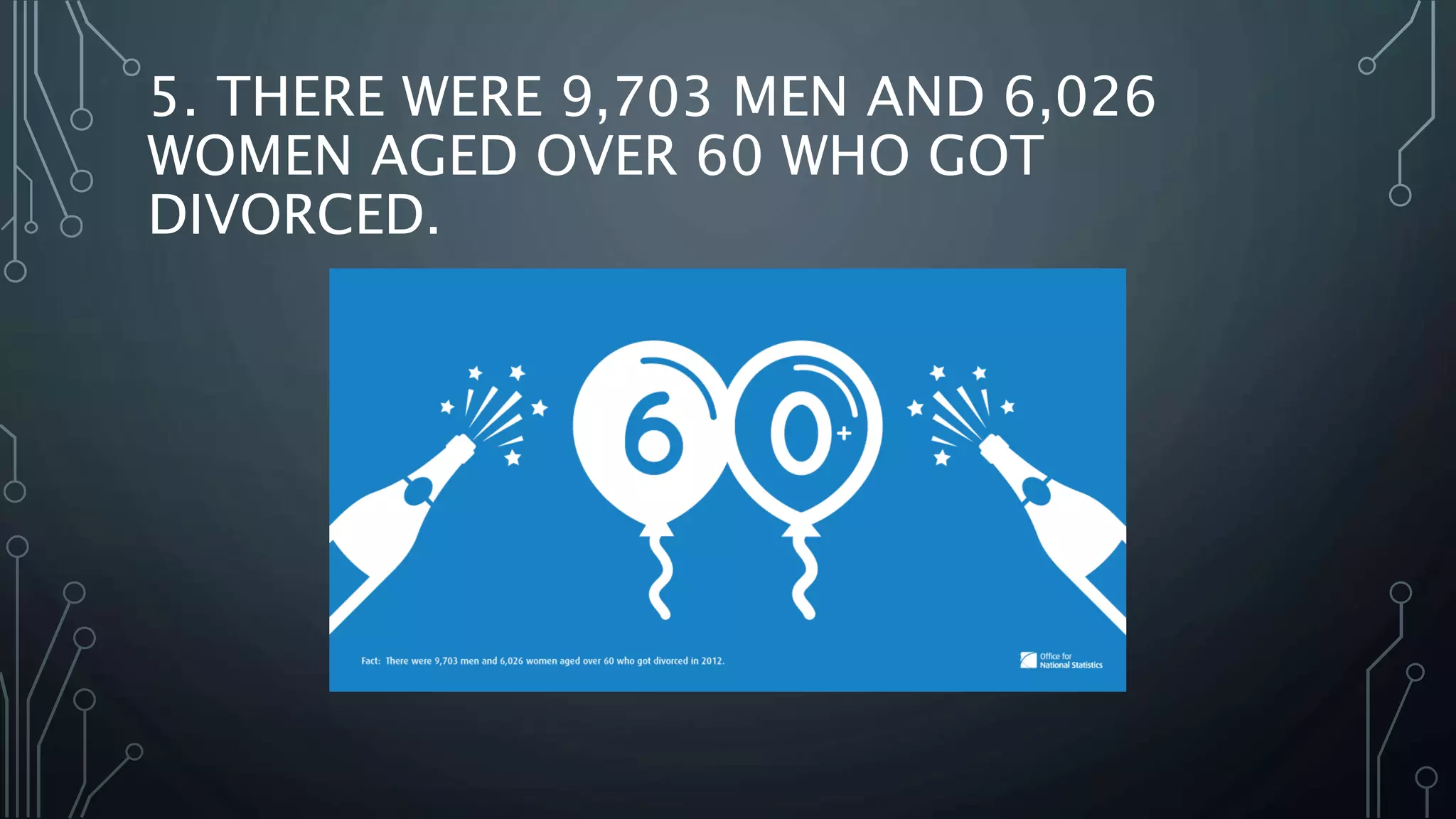
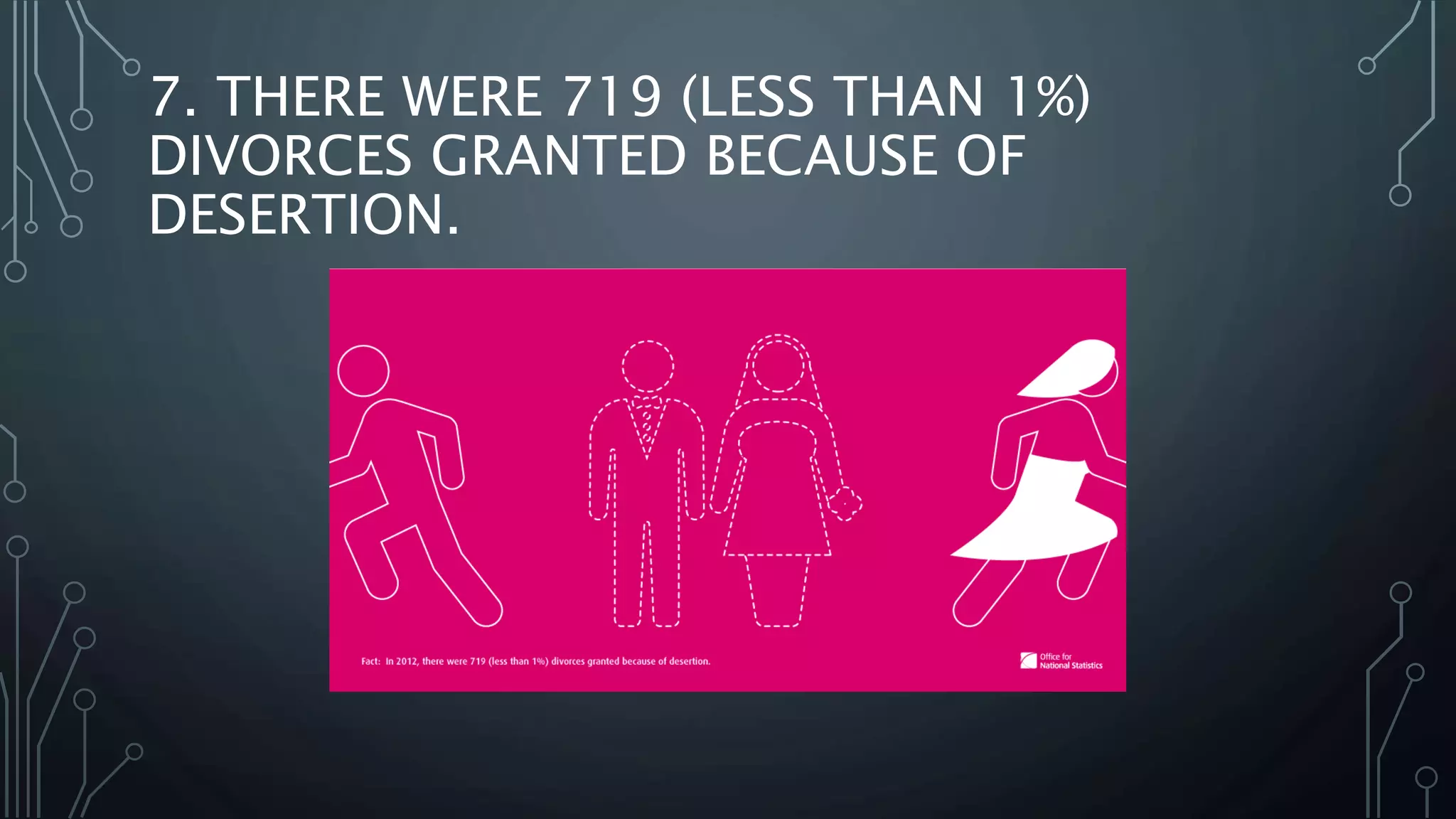
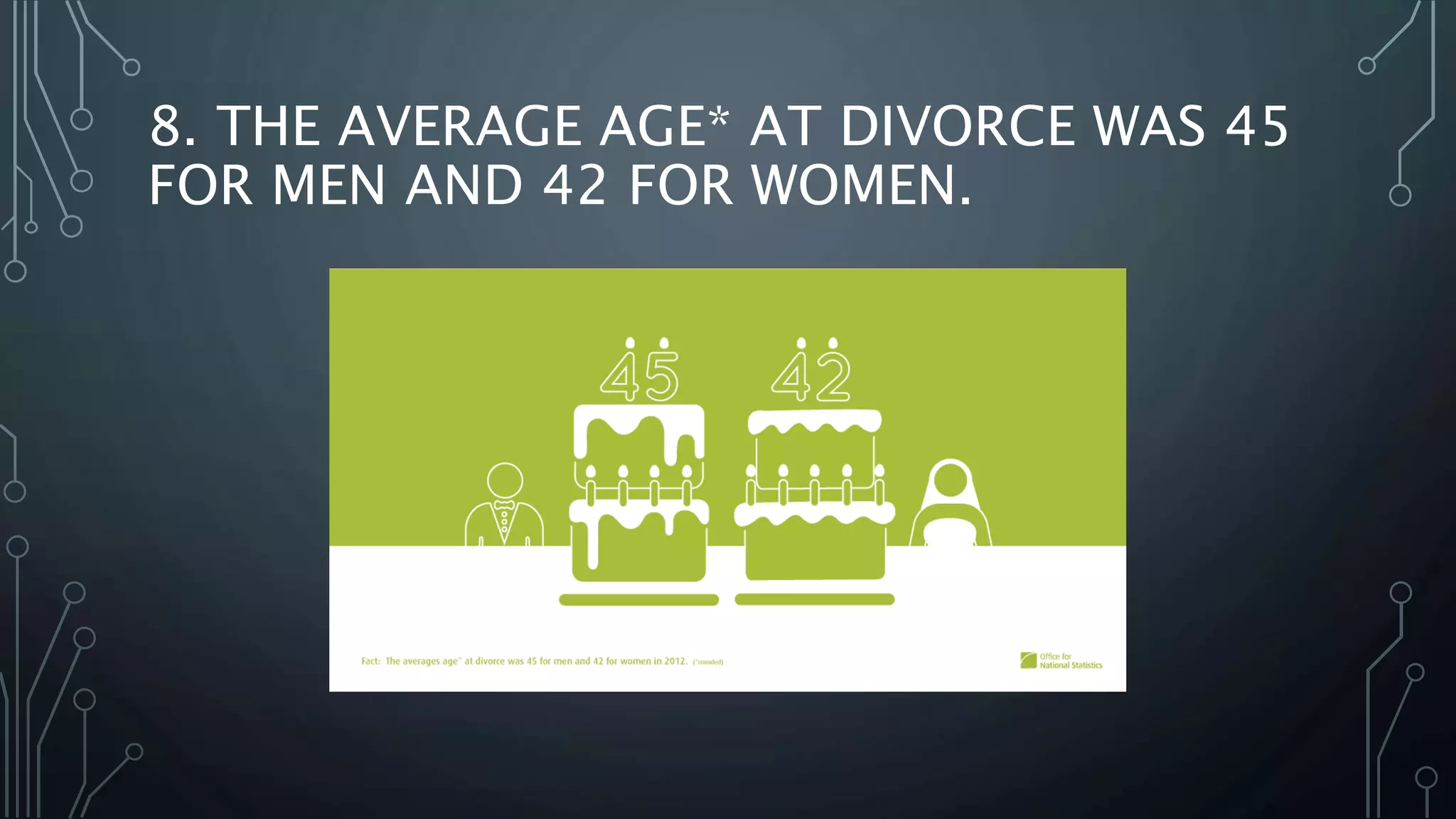
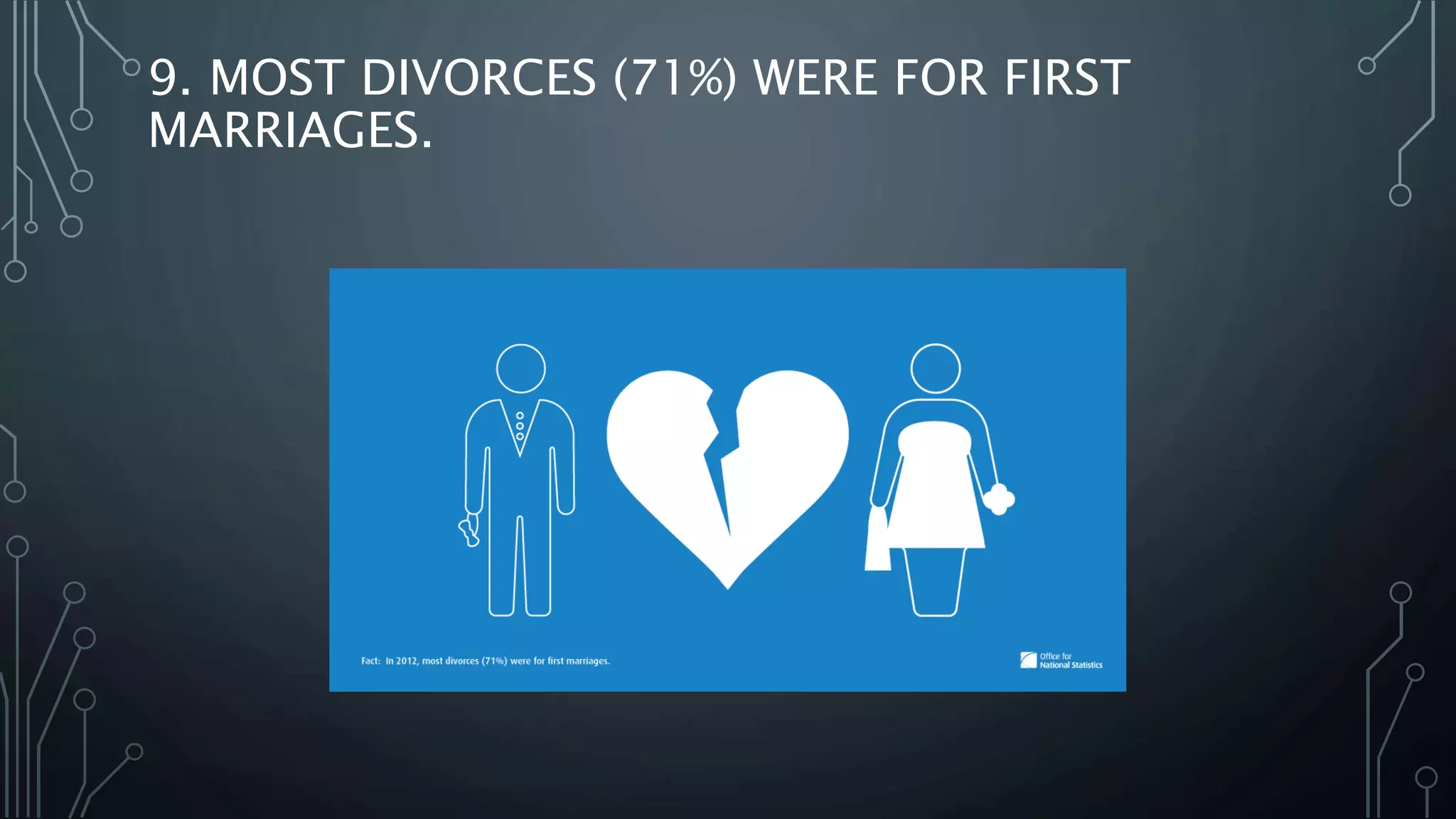
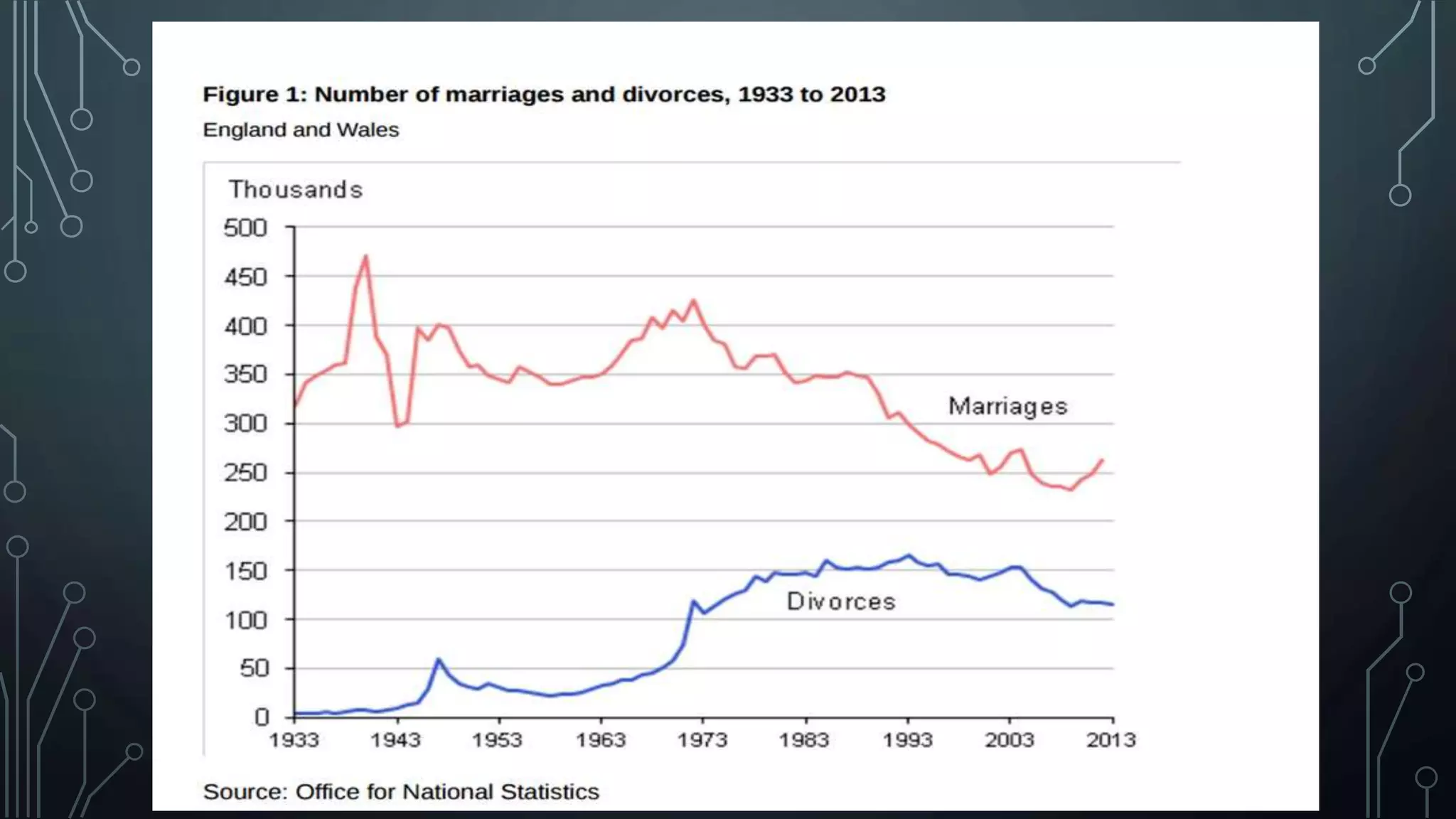
Provides extensive statistics on divorce rates in England and Wales, highlighting trends and demographics.
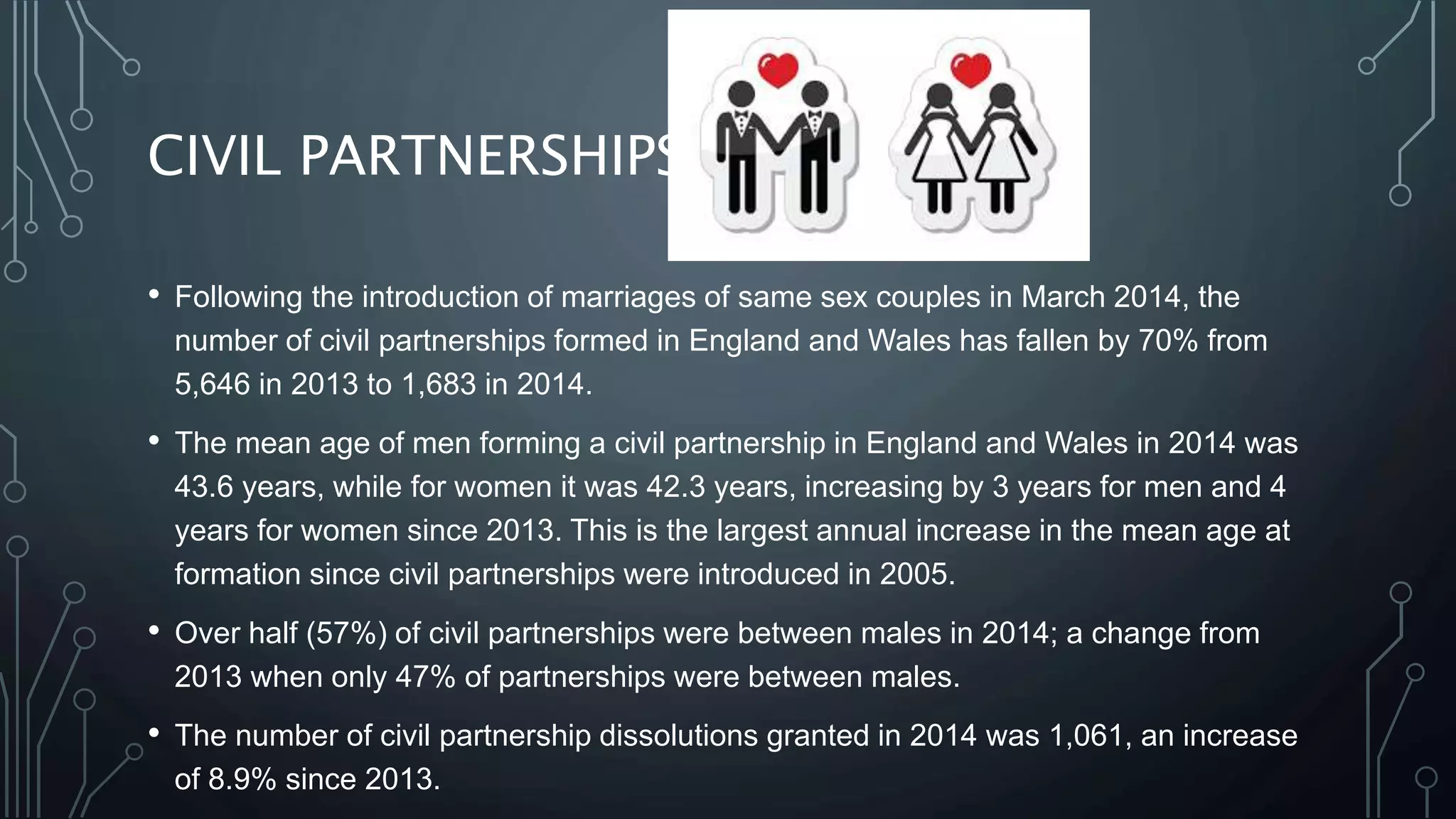
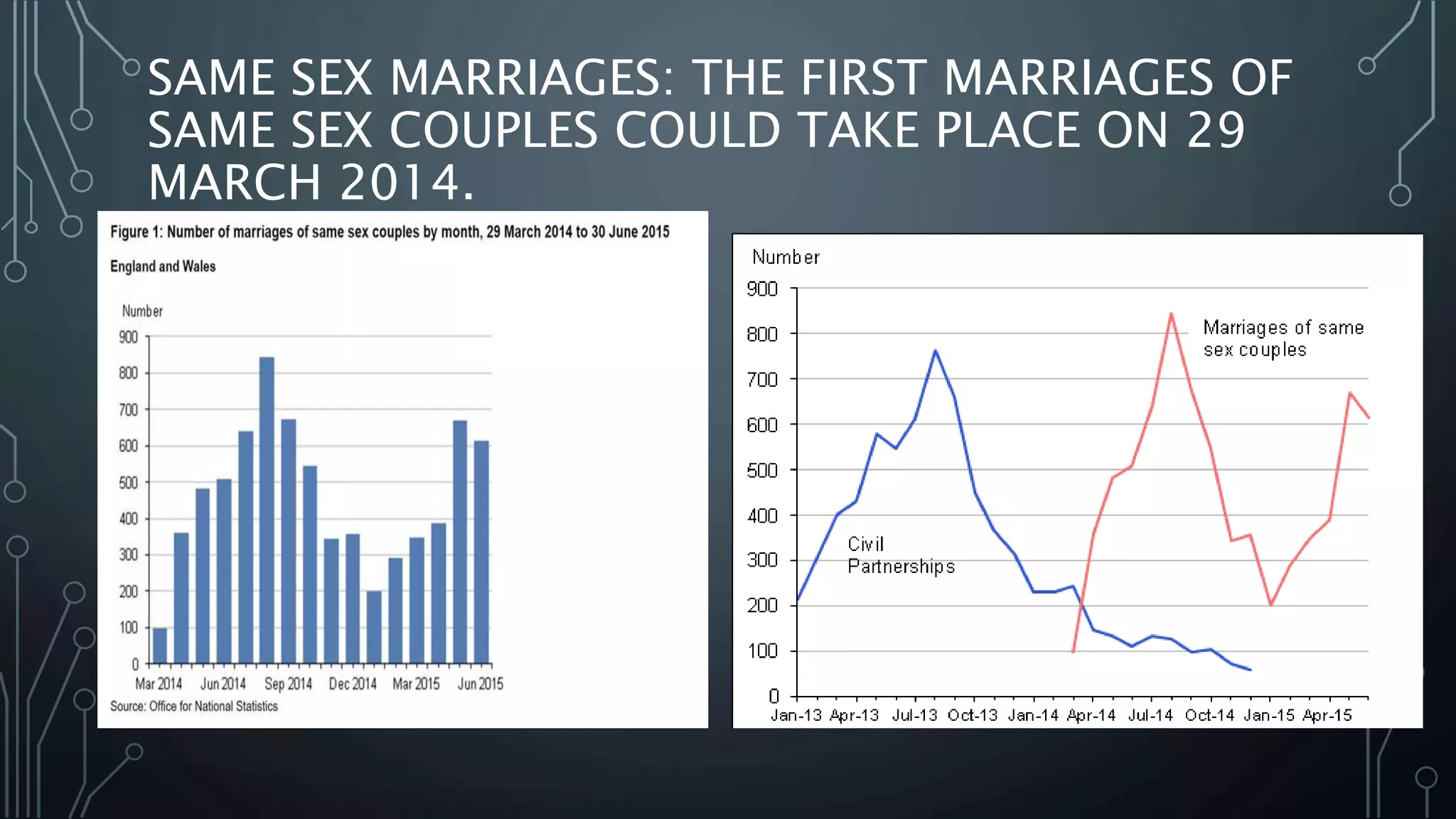
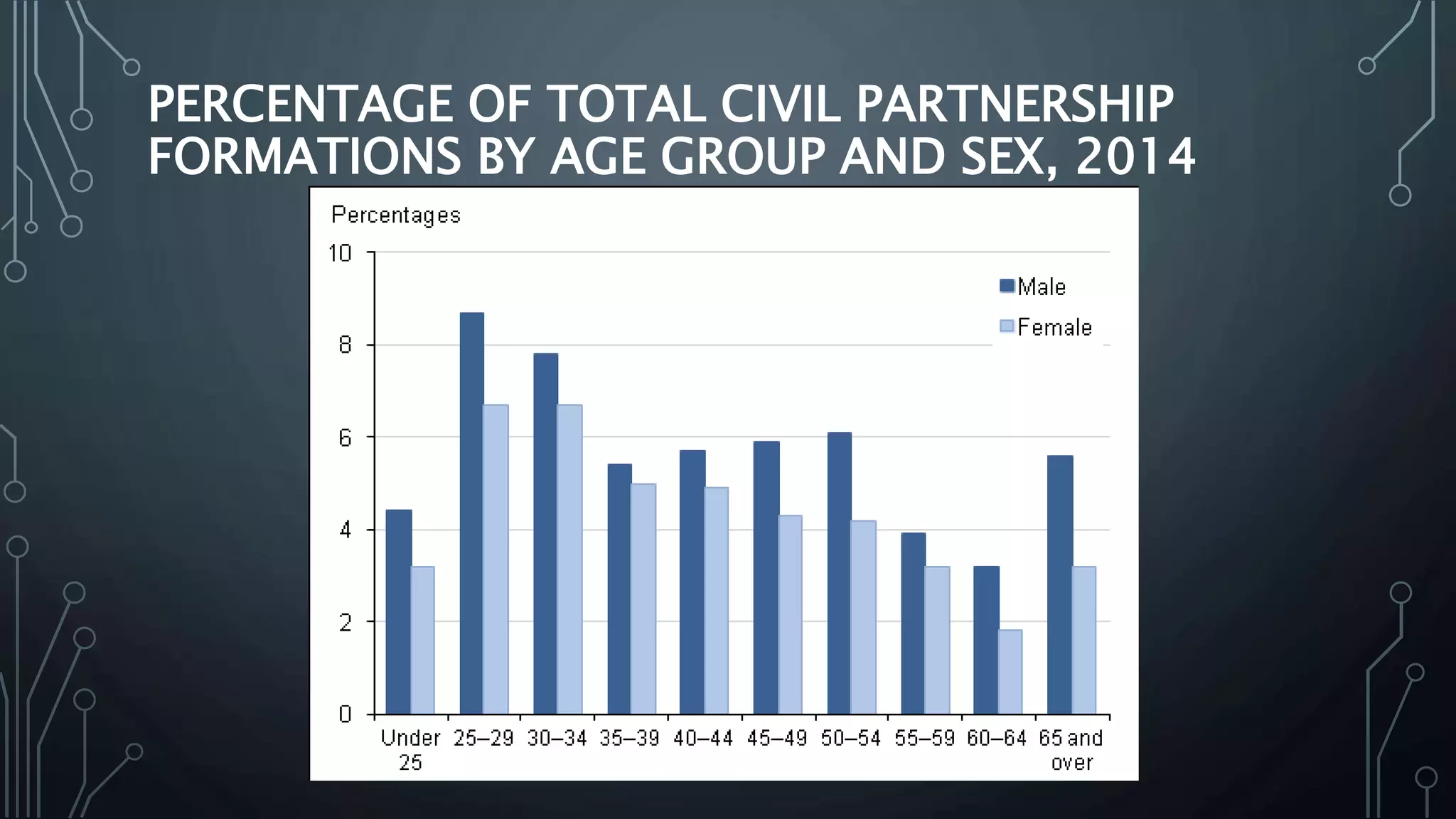
Details on civil partnerships and the introduction of same-sex marriages, including statistics and demographic changes.
Discusses attributes of happy and unhappy marriages, including conflict resolution and communication aspects.
Analyzes the components of romantic love and the psychological factors influencing partner selection.
Discusses common pitfalls in partner selection and the realistic expectations in romantic relationships.
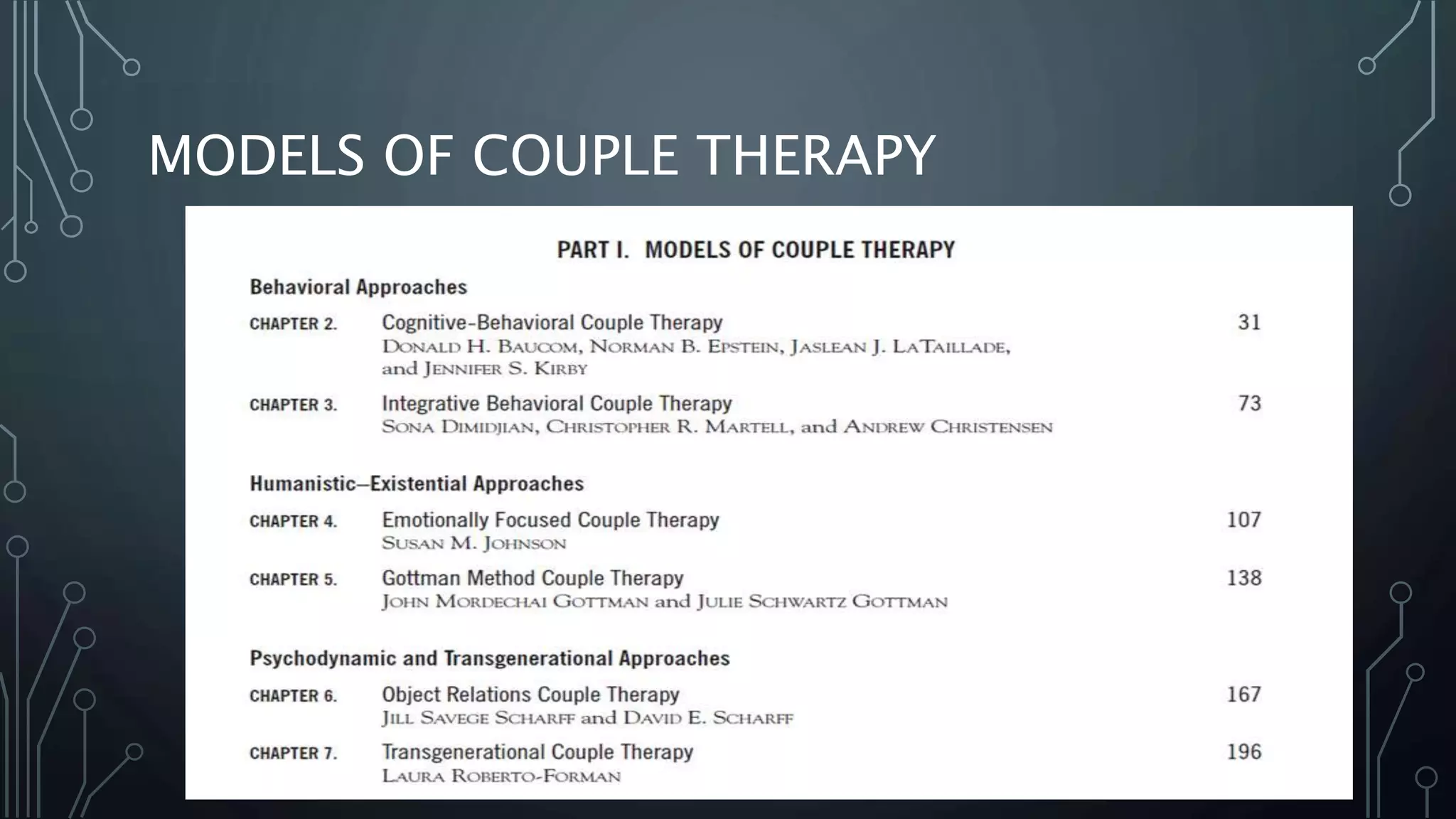
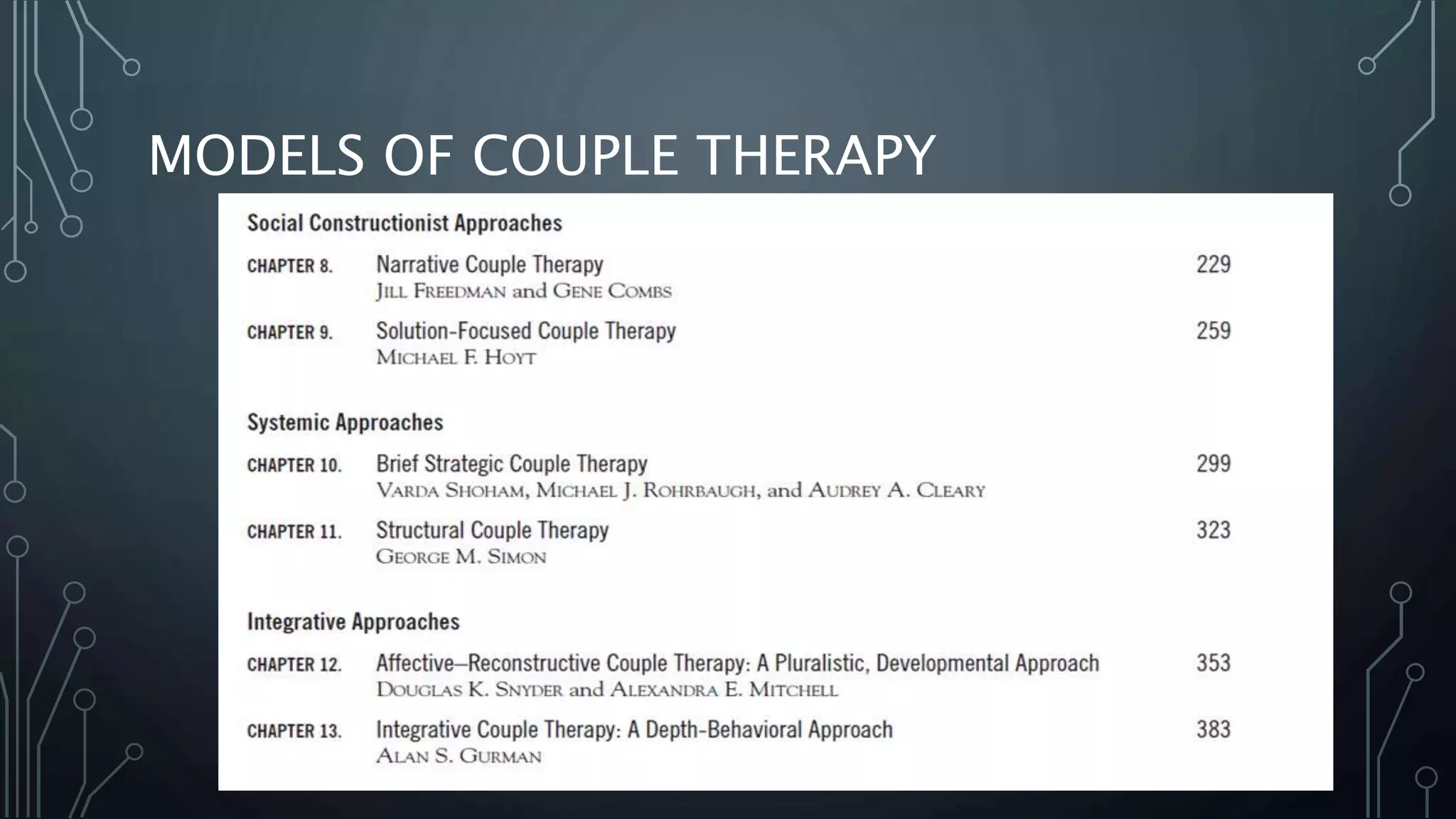
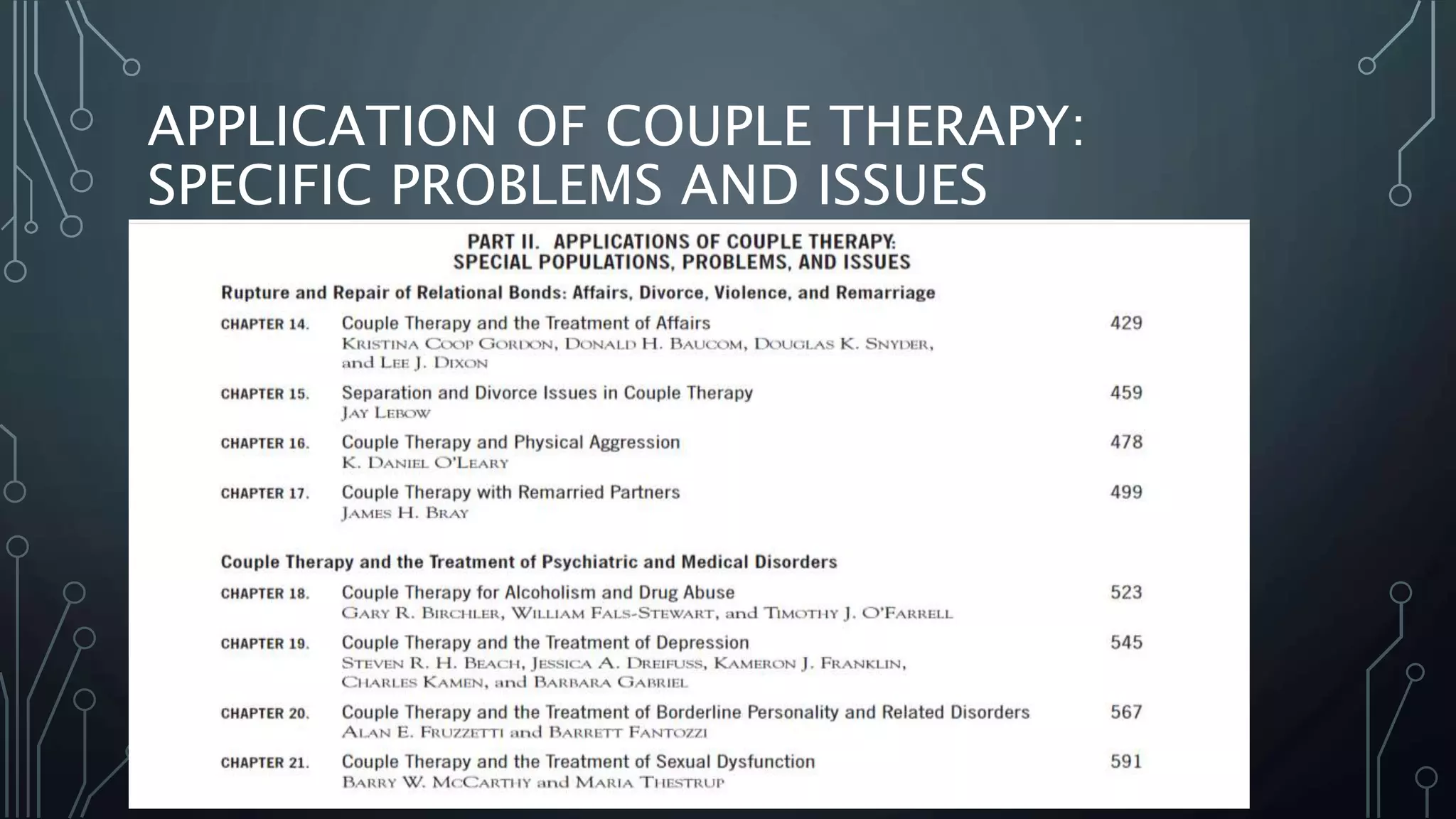
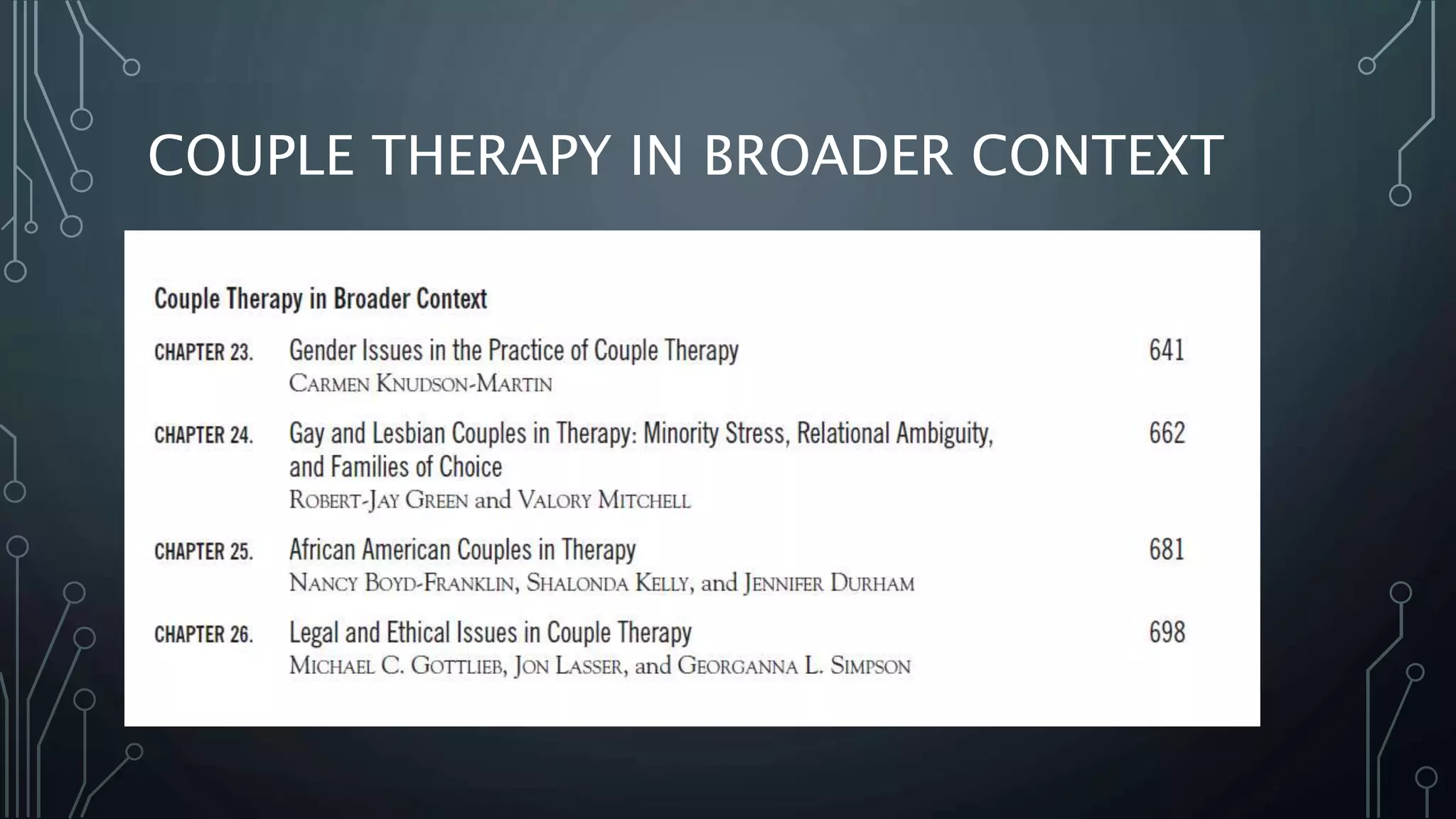
Explains the family life cycle, developmental stages, and the need for couples to adapt and grow.Outlines a framework for analyzing different couple therapy models and their applicable issues.
Lists core and advanced readings for understanding couple therapy methodologies and principles.
LECTURE 1. INTRODUCTIONTO
COUPLES COUNSELLING: LIFE
CYCLE OF COUPLE
RELATIONSHIPS
COUPLE COUNSELLING SKILLS
KEVIN STANDISH
2.
LEARNING OUTCOMES
• Describebasic ideas about marriage and divorce
• Identify the characteristics of happy and unhappy couples
• Explain the process of partner choice
• Explain the critical points in the family/marriage life cycle
• Articulate the key elements used in the Comparative Study of
Couple Therapy
• To describe the assessment task and use of case studies
3.
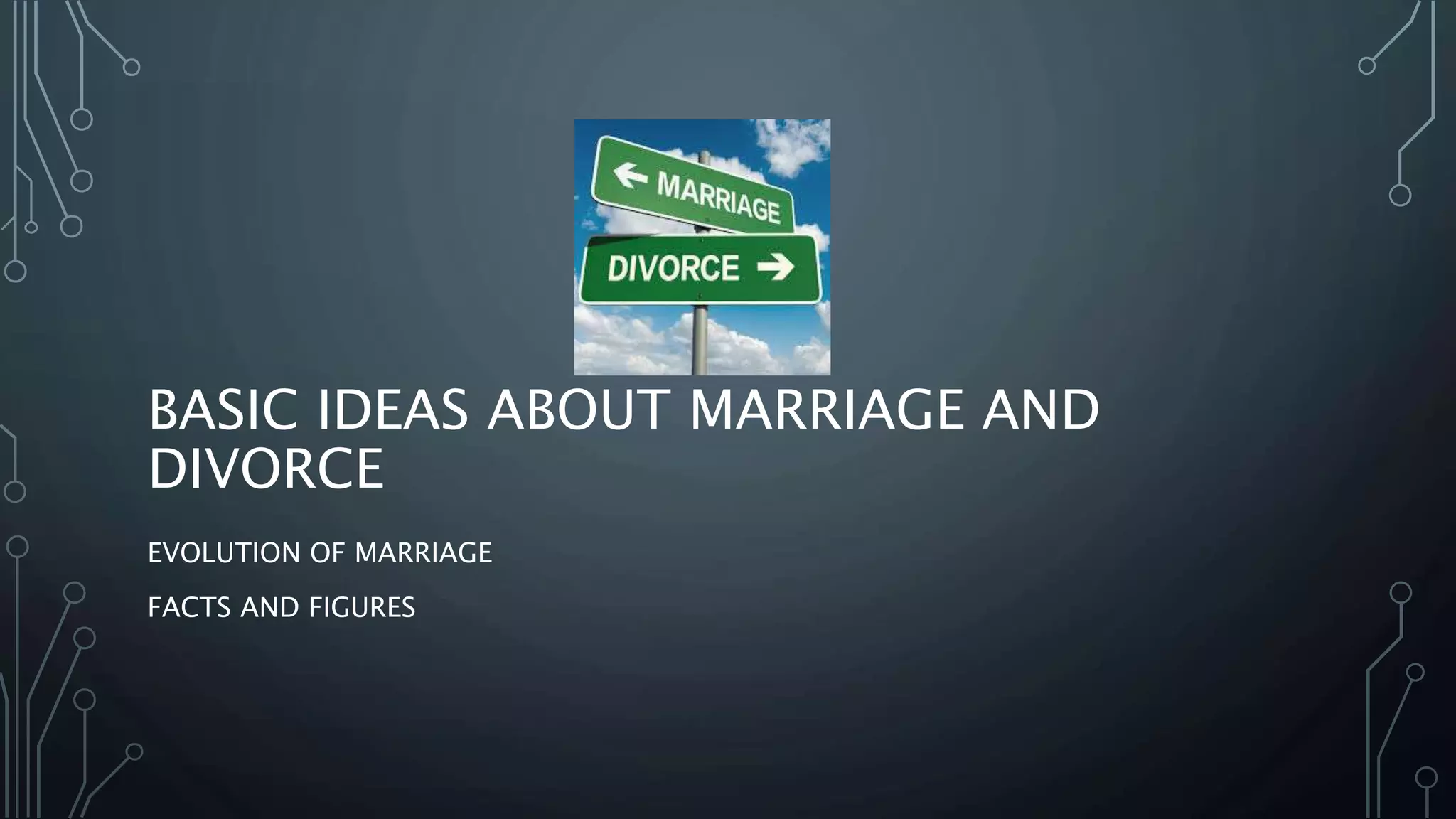
BASIC IDEAS ABOUTMARRIAGE AND
DIVORCE
EVOLUTION OF MARRIAGE
FACTS AND FIGURES
4.
POST WW-II HISTORYOF MARRIAGE
• Economics
• Shift in type of work due to industrialization
• Necessity of dual incomes
• Technology
• Industrialization
• Transportation
• Birth control
• Social Norms (next slide)
5.
THE CHANGE INSOCIAL NORMS
• Shift from external, role-oriented criteria (e.g., good worker, provider, mother,
wife) to internal criteria of personal satisfaction.
• Studies of changing themes in popular magazine articles about marriage since
the '50s document increased emphasis on self-development, flexible and
negotiable roles, and open communication about problems. Surveys show
similarly dramatic changes in criteria for "marital satisfaction".
• These changes reflect increases in individualism and our standard of living, as
well as improved contraceptive methods and greater availability of abortions.
• Could you conceive of staying in a marriage unless you're happy?
• Increasing acceptance of same sex partnerships leading to civil partnerships or
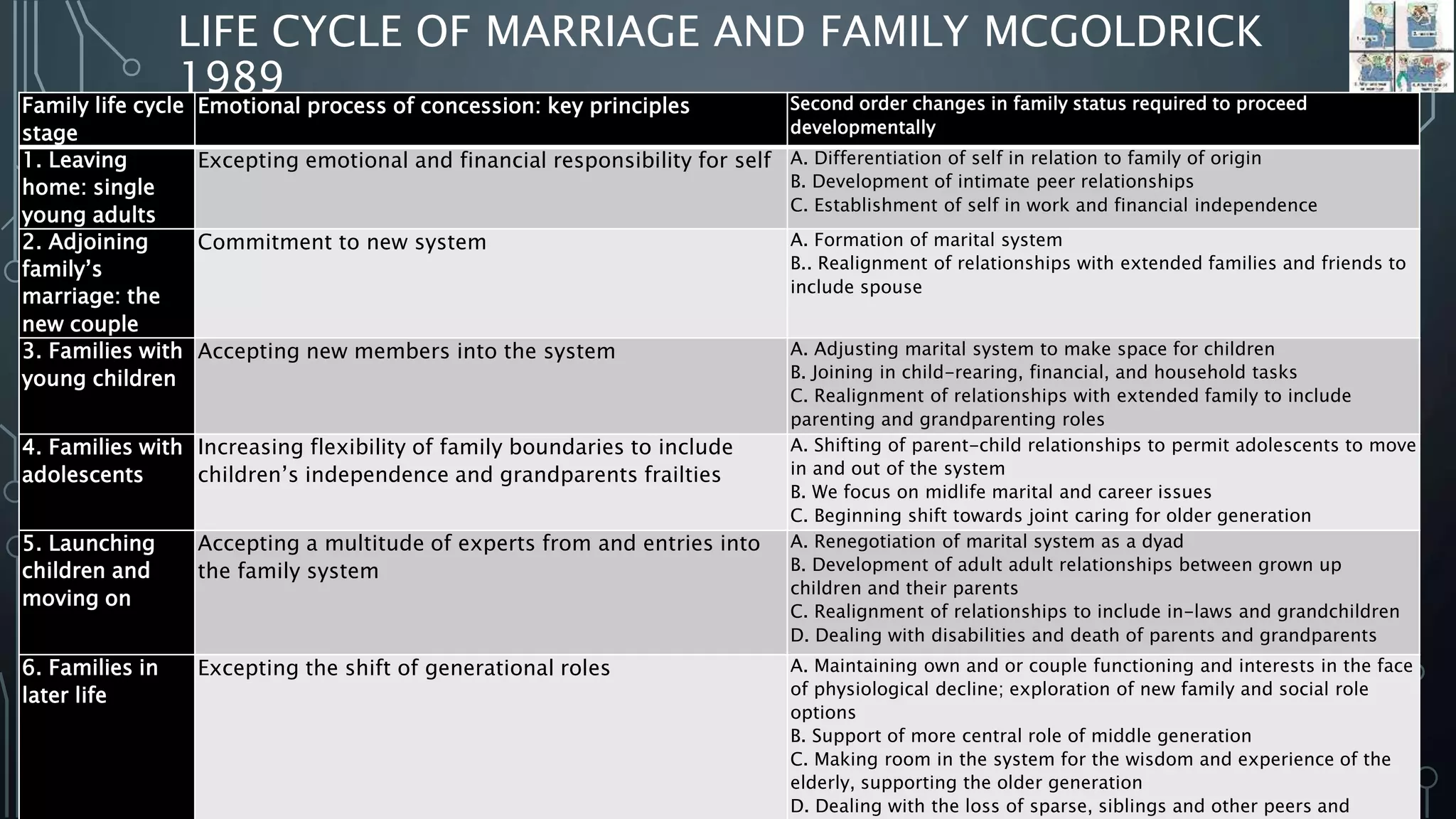
same sex marriage
• BUT these are WESTERN norm changes. What of other social norms?
6.
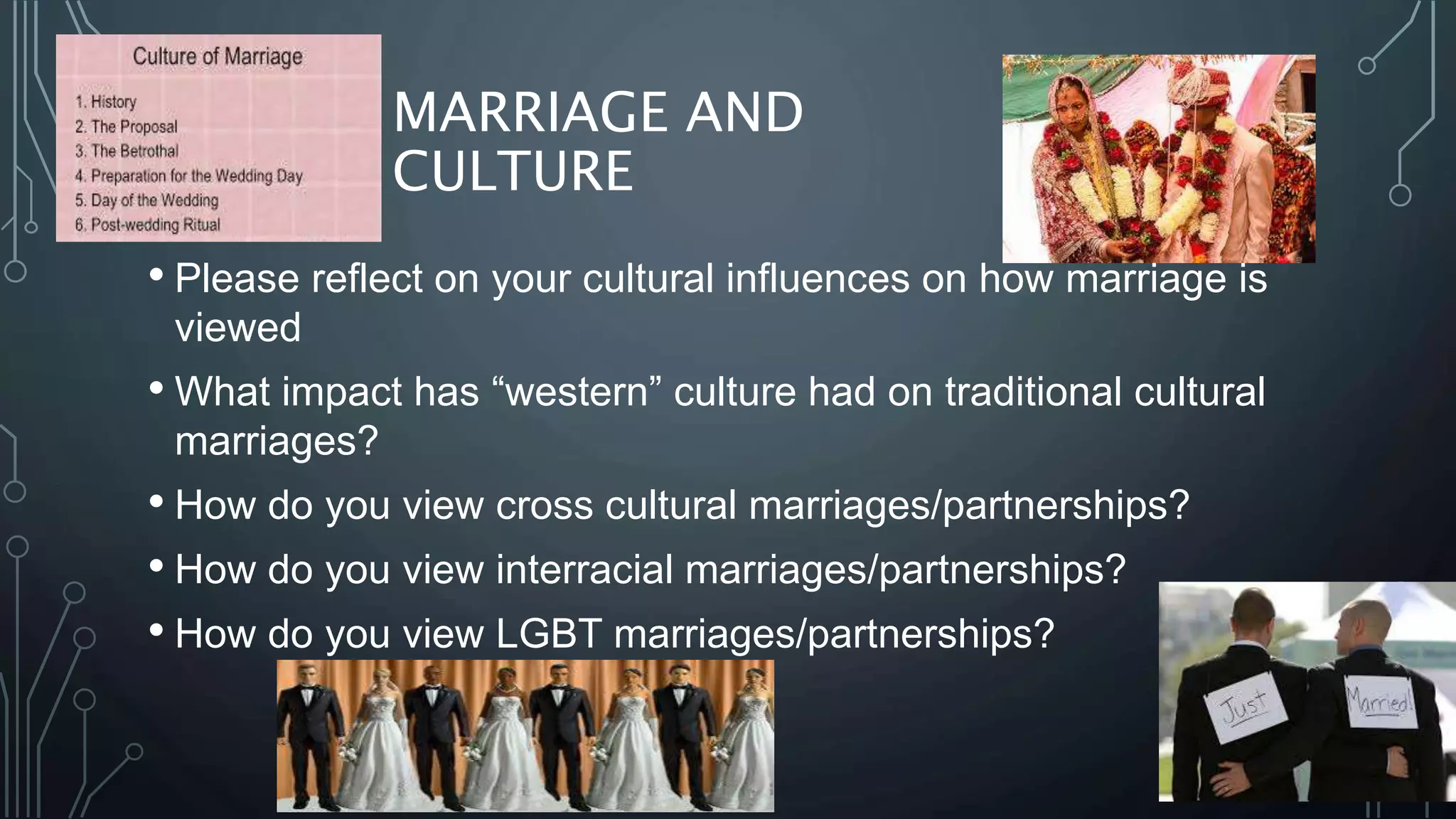
MARRIAGE AND
CULTURE
• Pleasereflect on your cultural influences on how marriage is
viewed
• What impact has “western” culture had on traditional cultural
marriages?
• How do you view cross cultural marriages/partnerships?
• How do you view interracial marriages/partnerships?
• How do you view LGBT marriages/partnerships?
7.
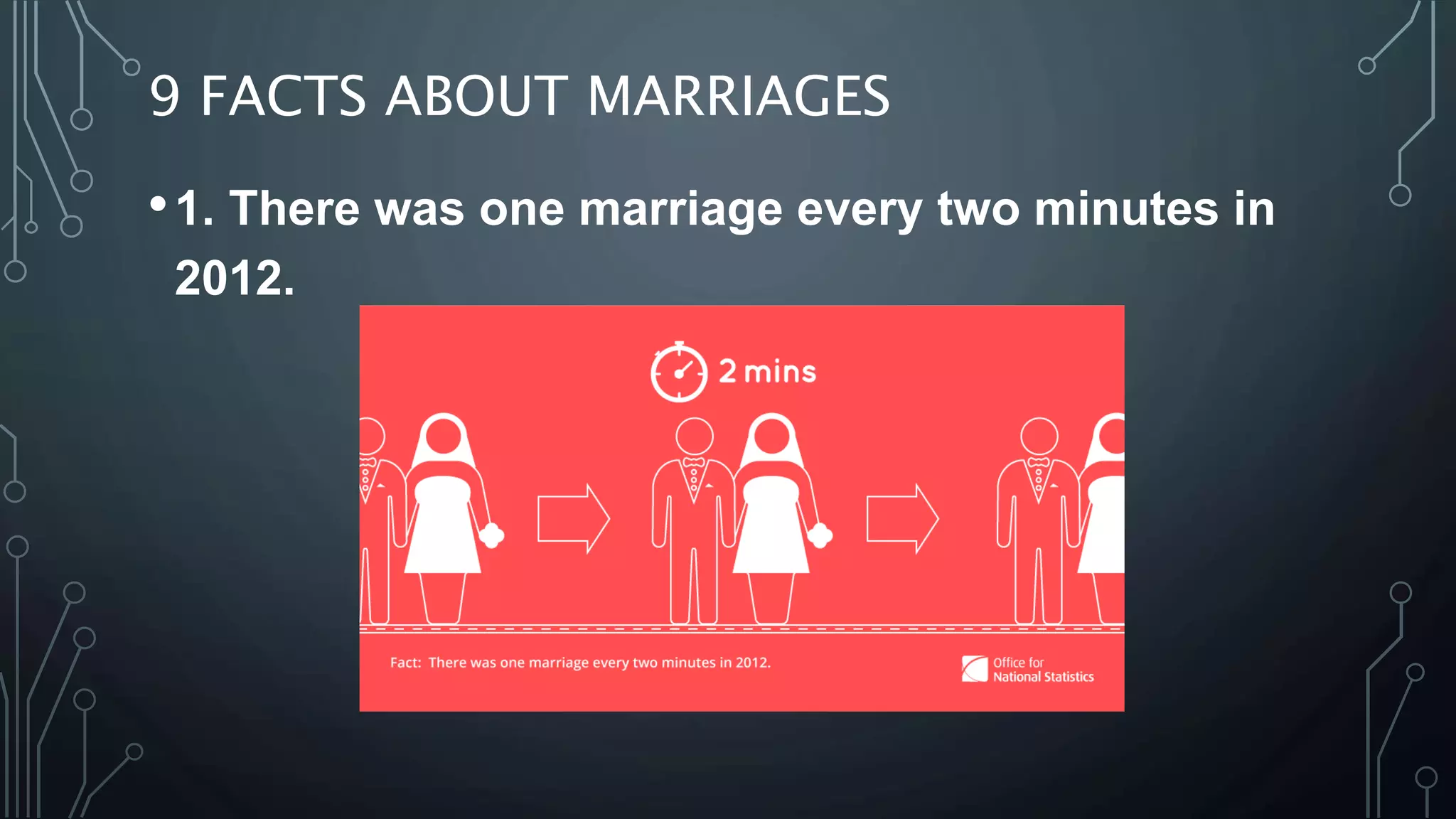
9 FACTS ABOUTMARRIAGES
•1. There was one marriage every two minutes in
2012.
8.
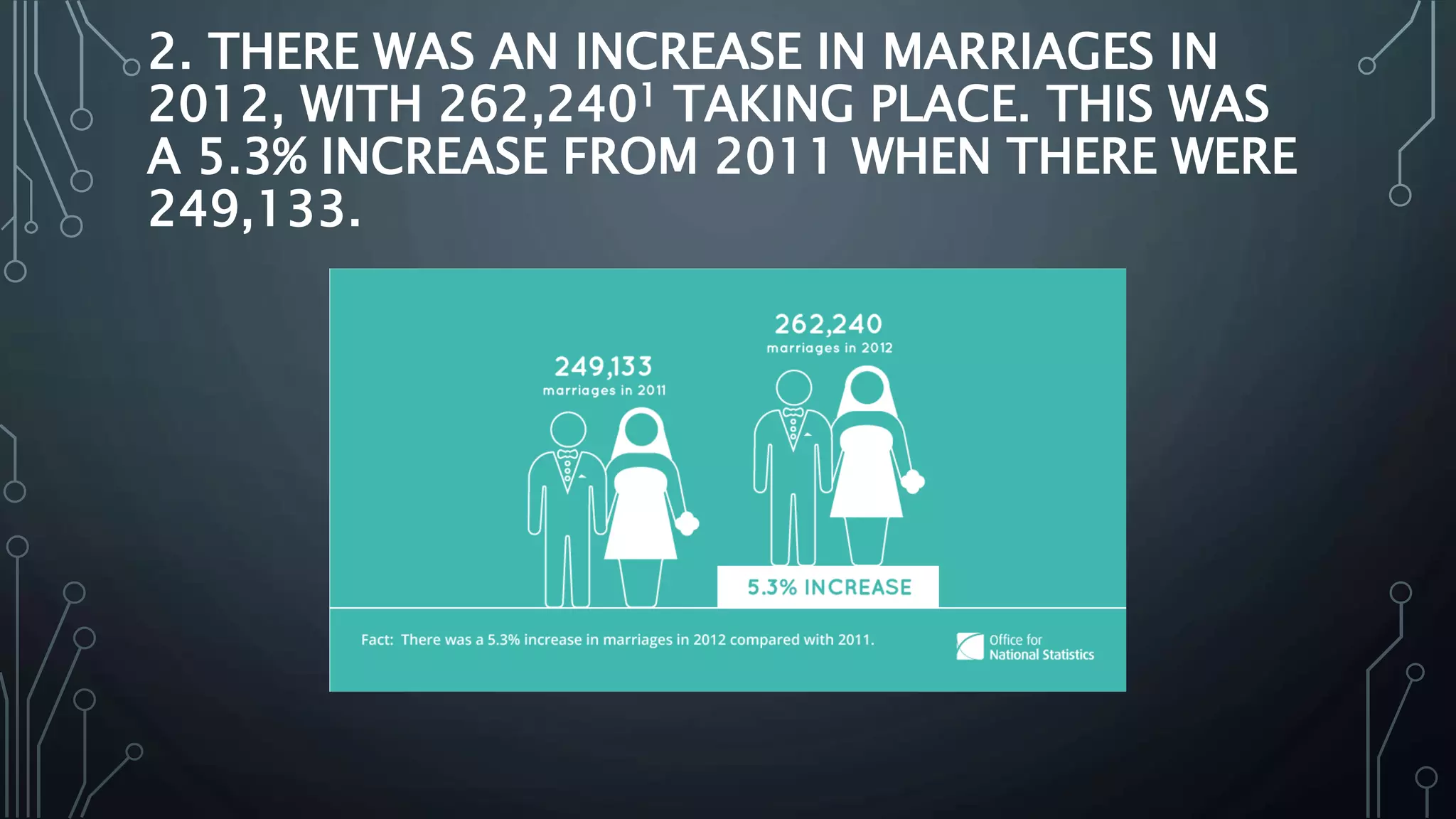
2. THERE WASAN INCREASE IN MARRIAGES IN
2012, WITH 262,2401 TAKING PLACE. THIS WAS
A 5.3% INCREASE FROM 2011 WHEN THERE WERE
249,133.
9.
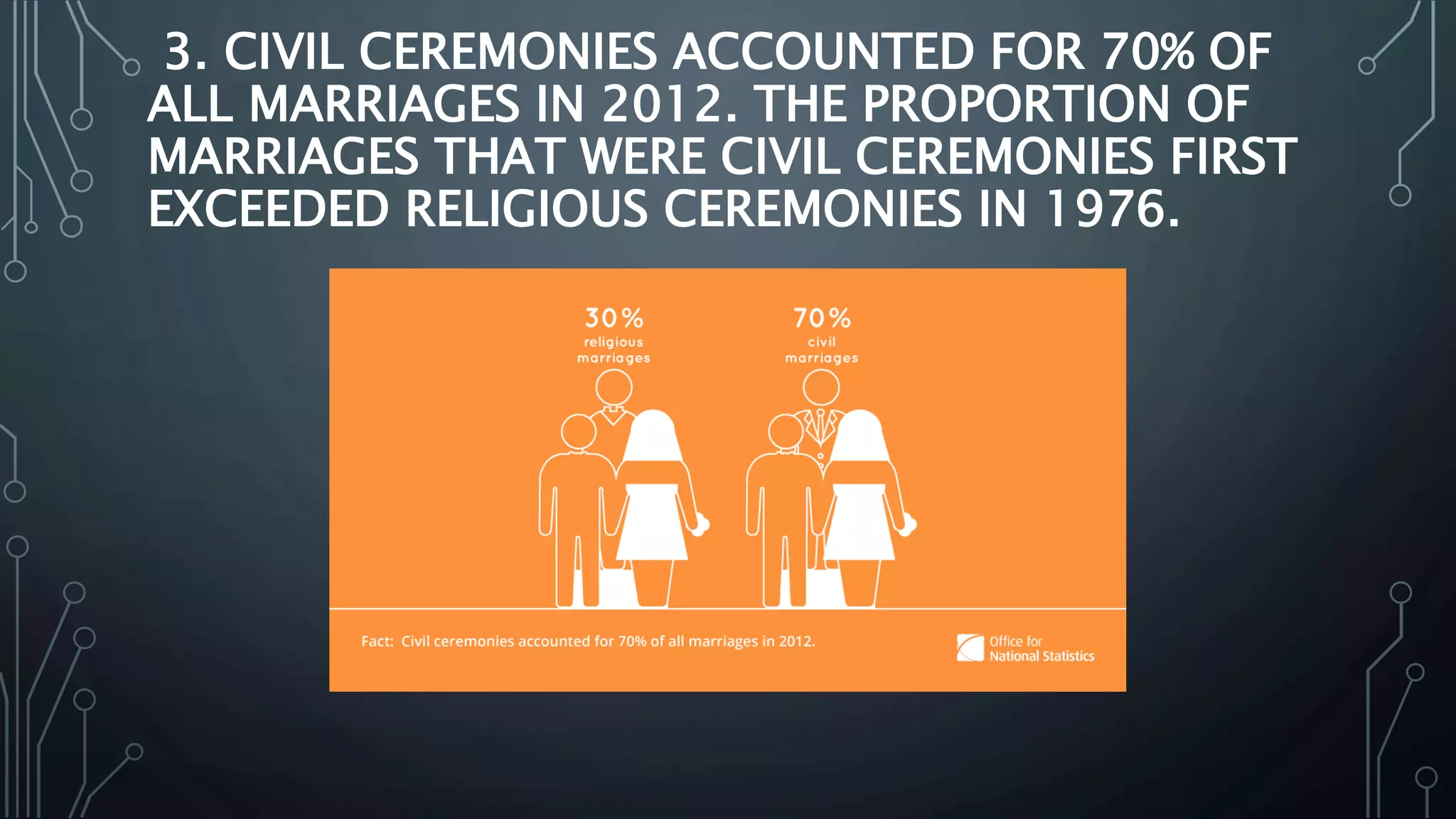
3. CIVIL CEREMONIESACCOUNTED FOR 70% OF
ALL MARRIAGES IN 2012. THE PROPORTION OF
MARRIAGES THAT WERE CIVIL CEREMONIES FIRST
EXCEEDED RELIGIOUS CEREMONIES IN 1976.
10.
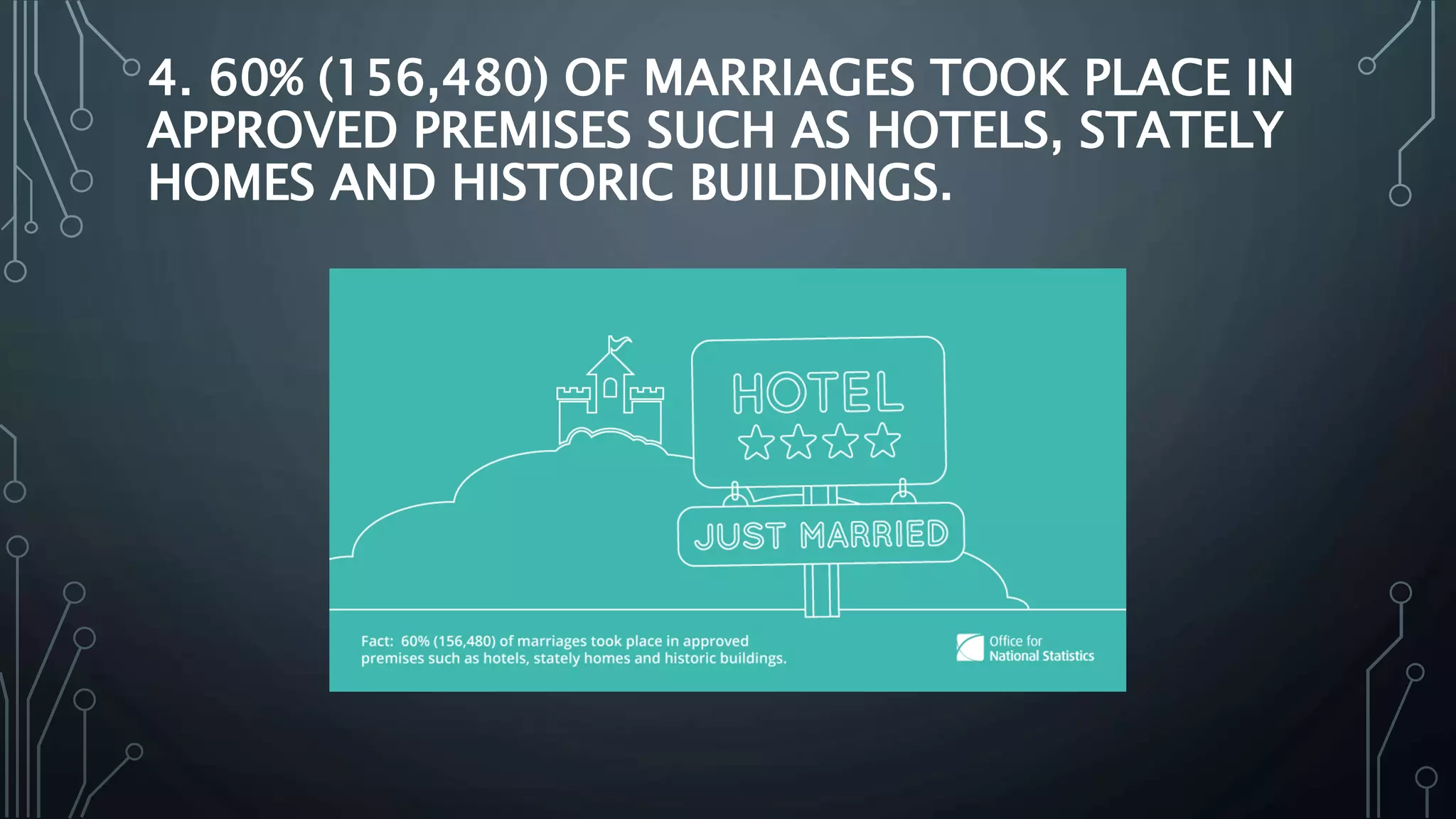
4. 60% (156,480)OF MARRIAGES TOOK PLACE IN
APPROVED PREMISES SUCH AS HOTELS, STATELY
HOMES AND HISTORIC BUILDINGS.
11.
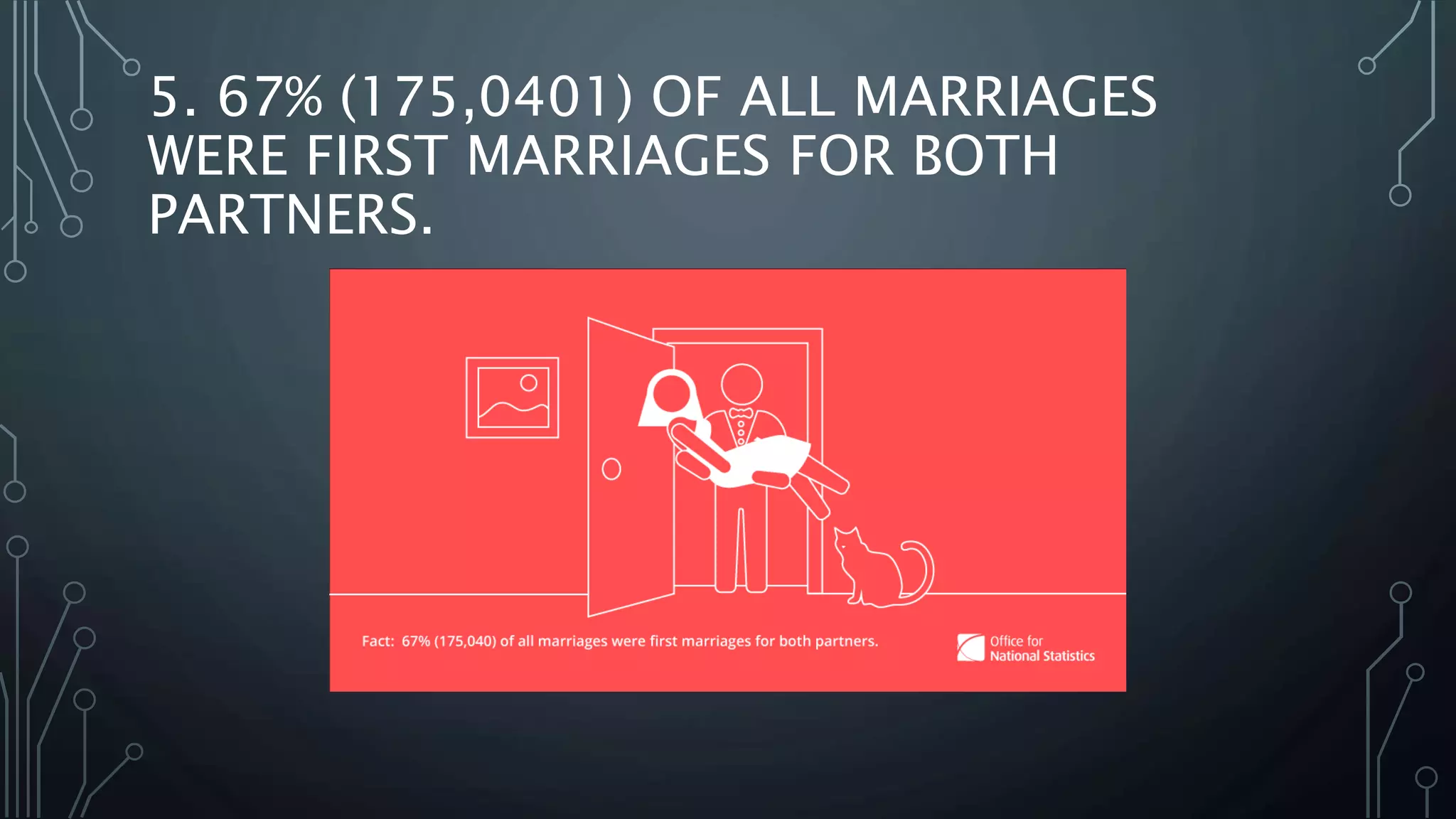
5. 67% (175,0401)OF ALL MARRIAGES
WERE FIRST MARRIAGES FOR BOTH
PARTNERS.
12.
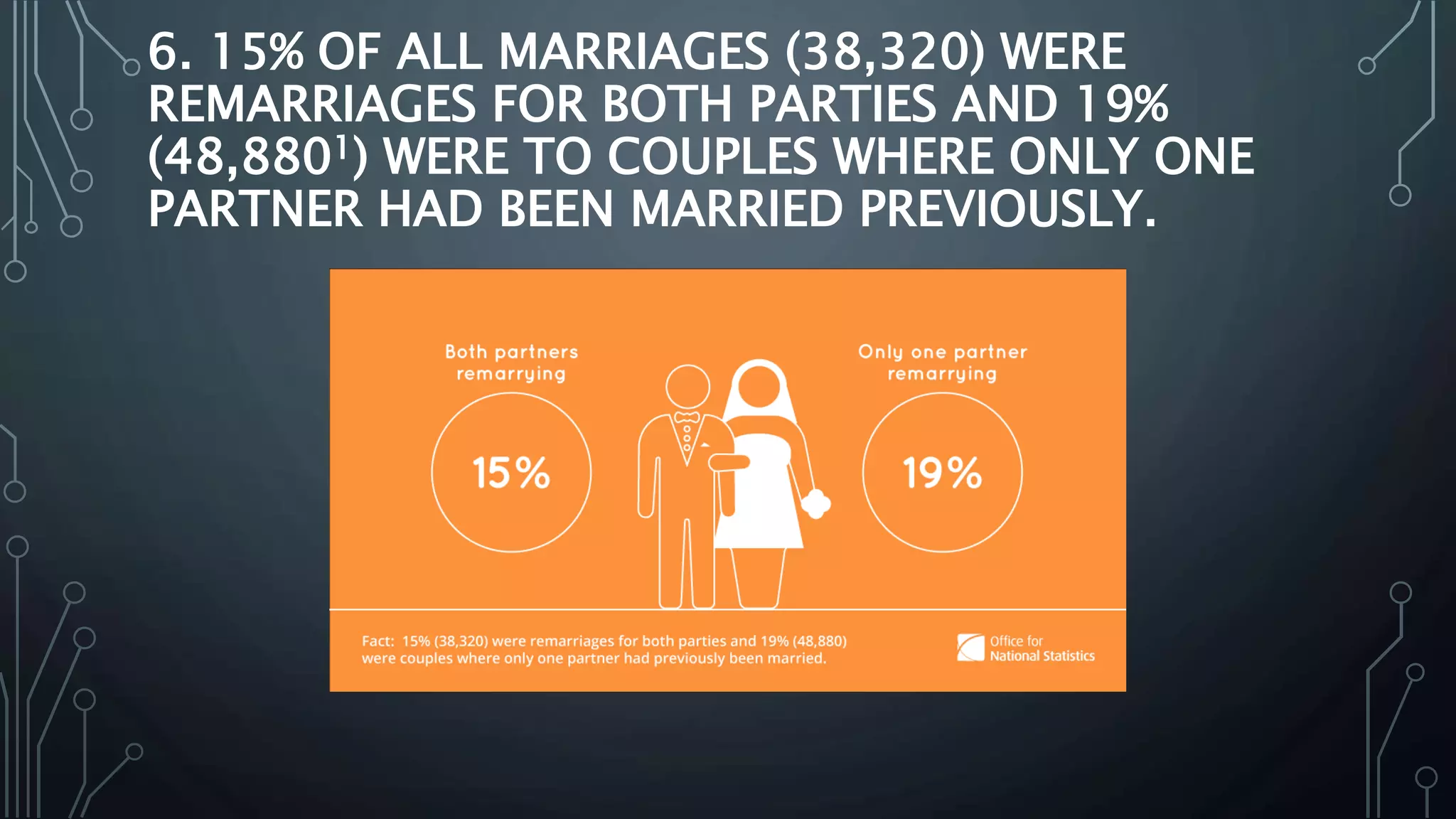
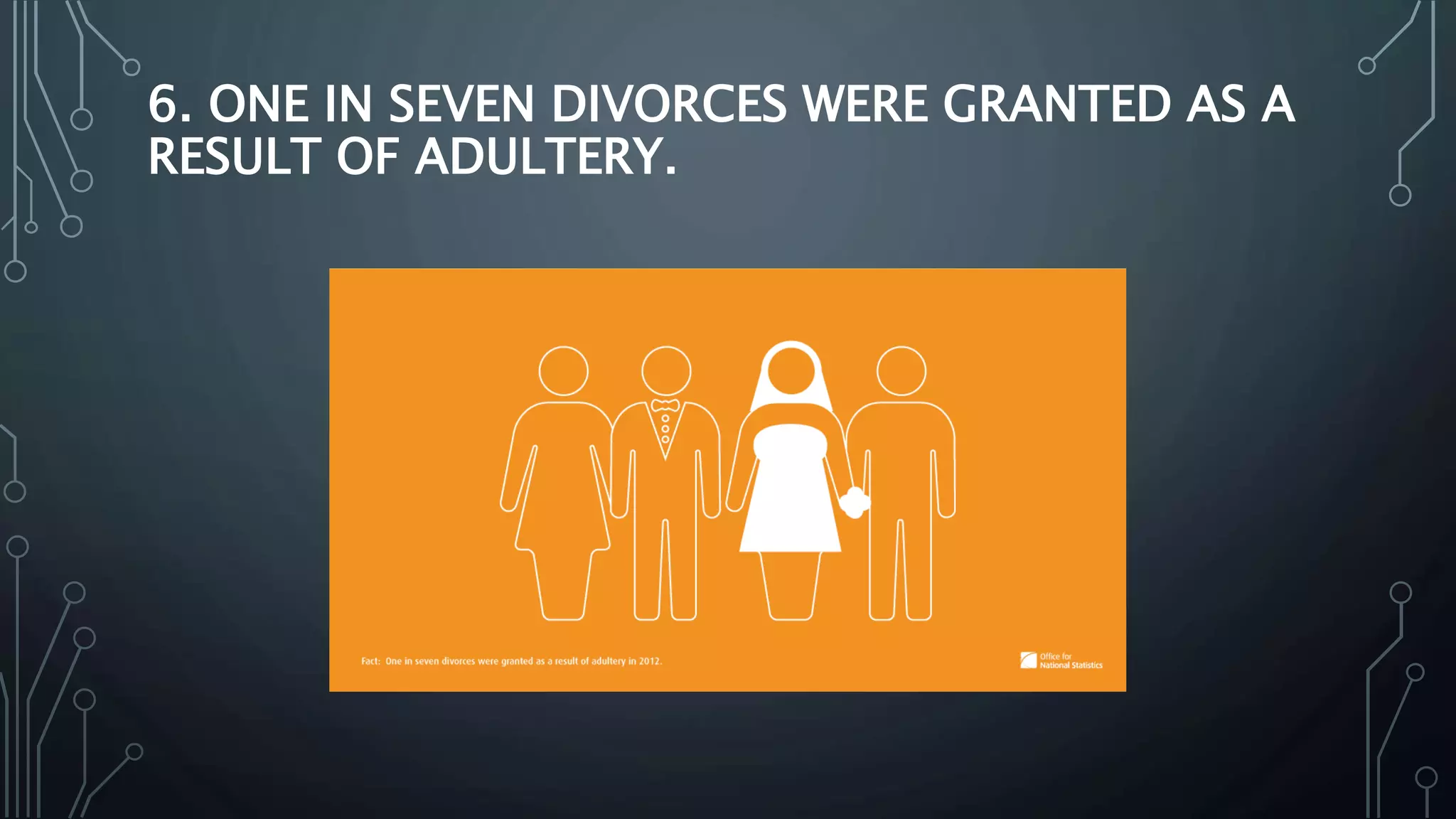
6. 15% OFALL MARRIAGES (38,320) WERE
REMARRIAGES FOR BOTH PARTIES AND 19%
(48,8801) WERE TO COUPLES WHERE ONLY ONE
PARTNER HAD BEEN MARRIED PREVIOUSLY.
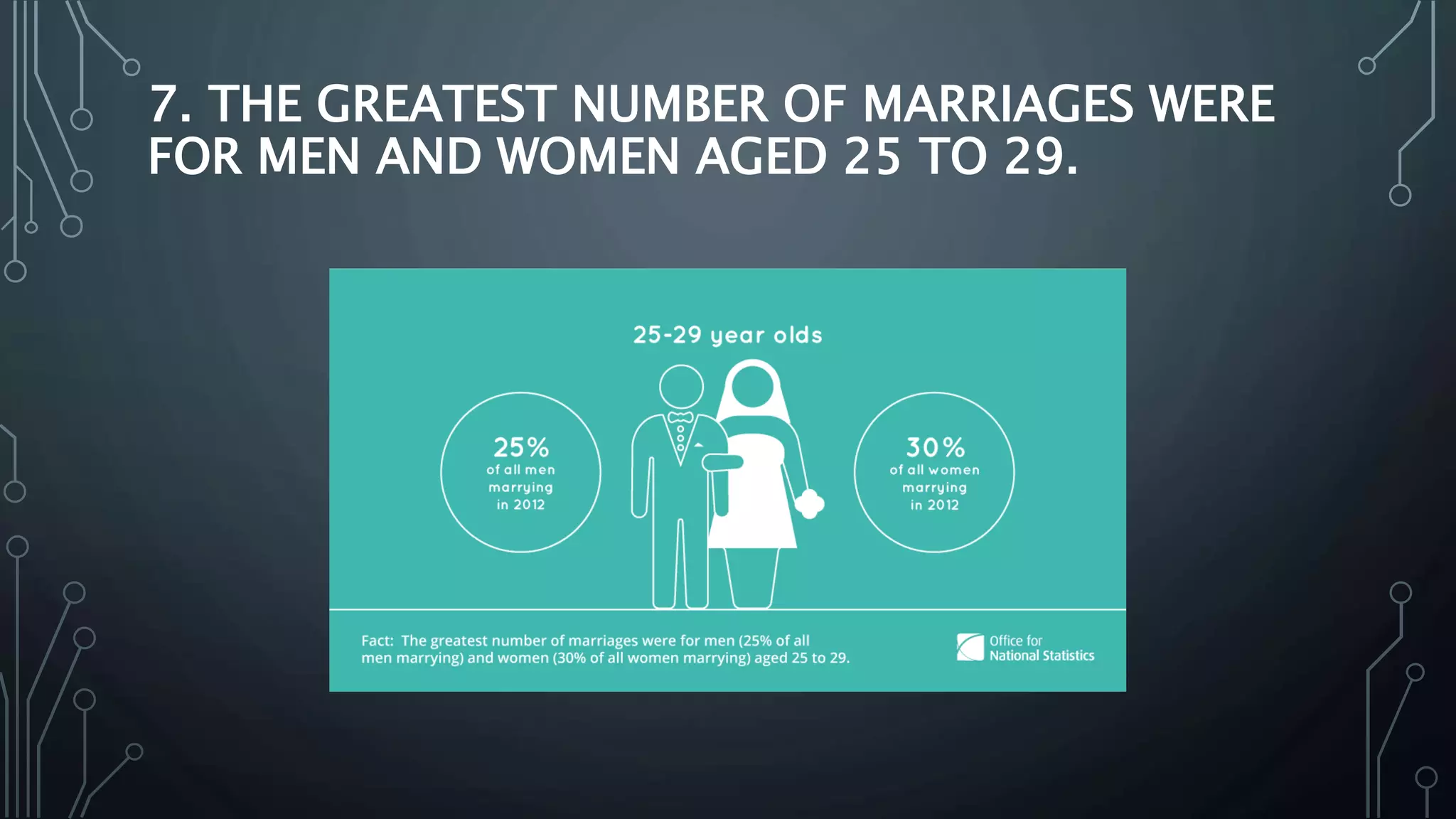
13.
7. THE GREATESTNUMBER OF MARRIAGES WERE
FOR MEN AND WOMEN AGED 25 TO 29.
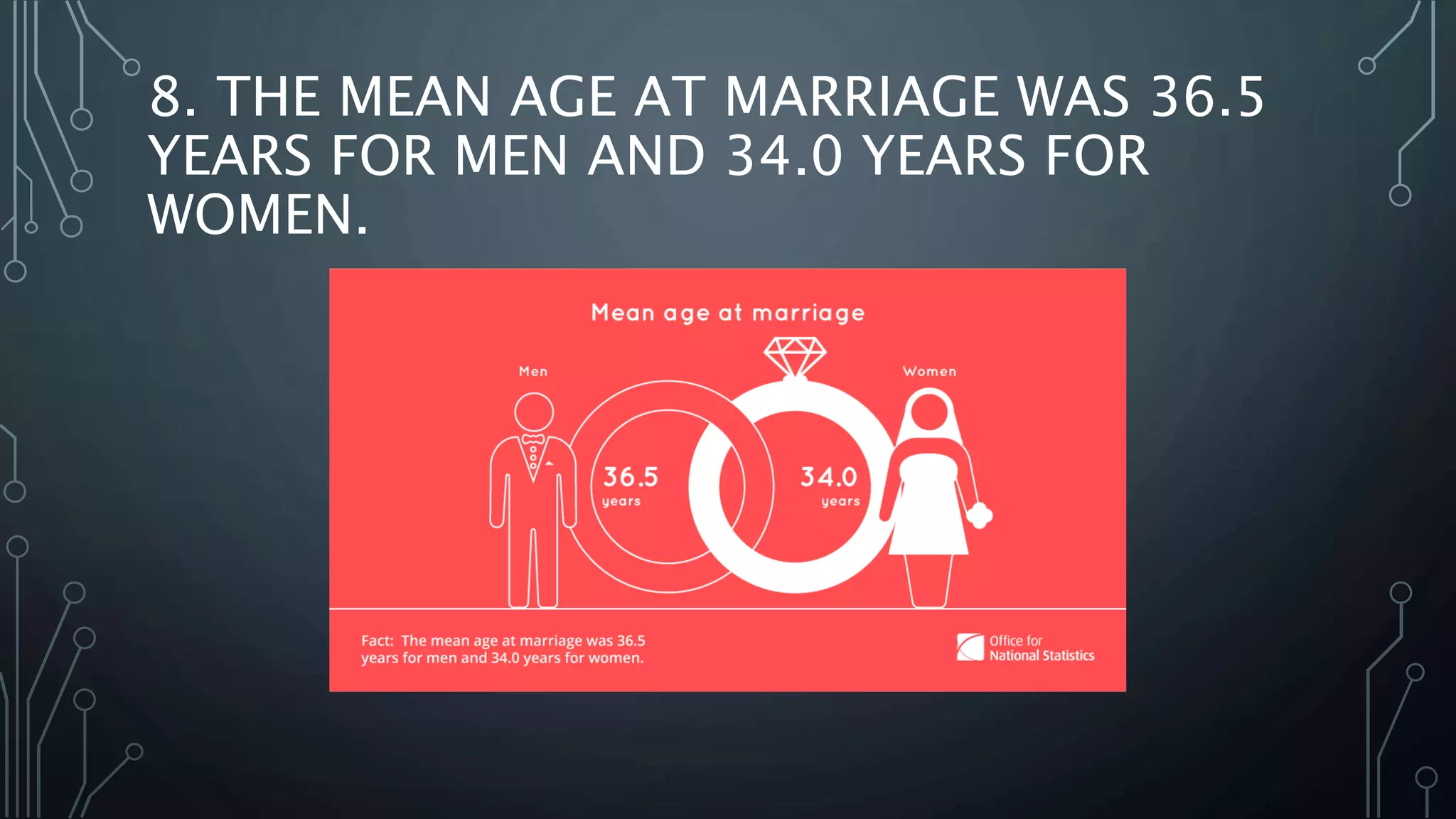
14.
8. THE MEANAGE AT MARRIAGE WAS 36.5
YEARS FOR MEN AND 34.0 YEARS FOR
WOMEN.
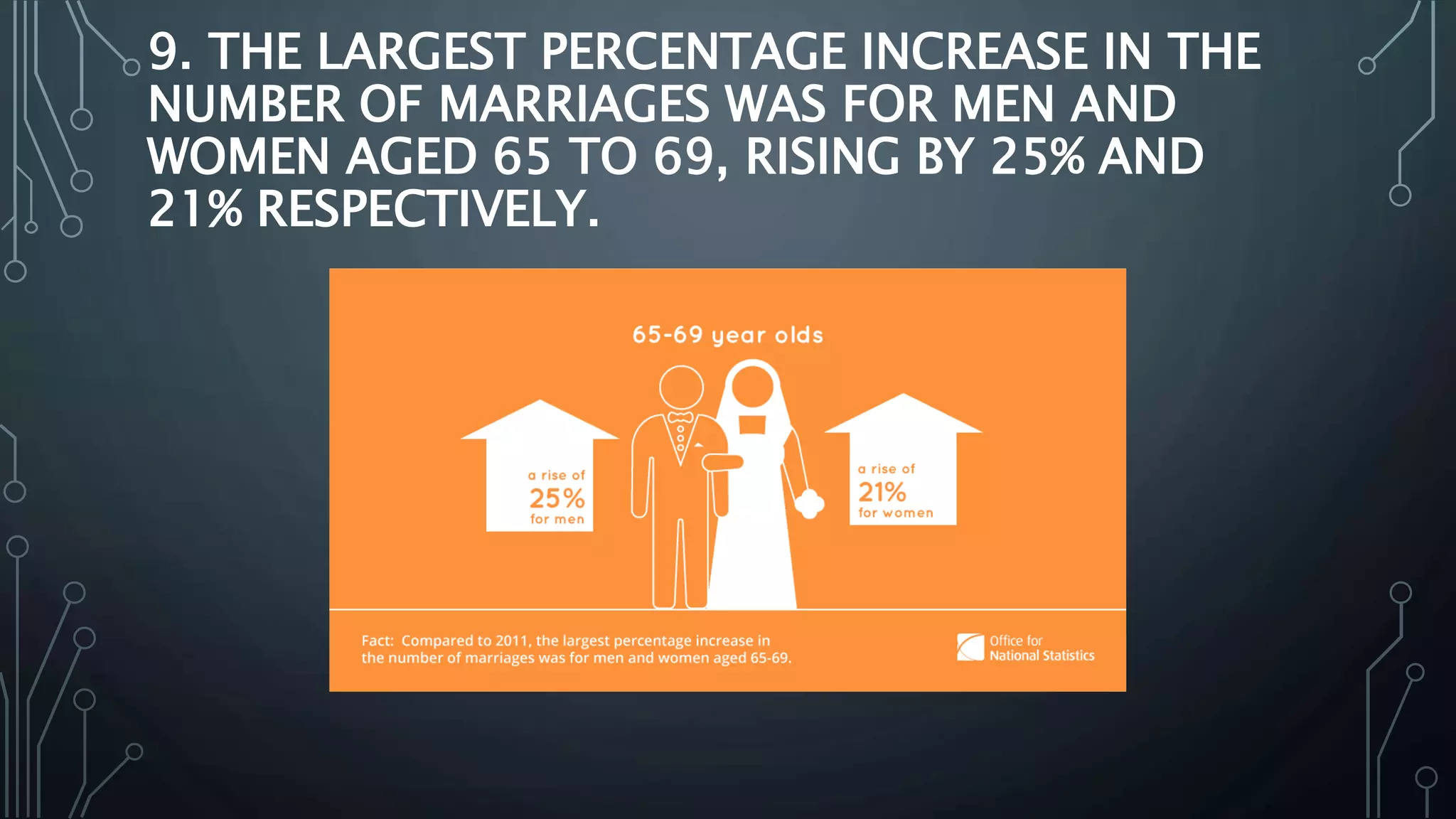
15.
9. THE LARGESTPERCENTAGE INCREASE IN THE
NUMBER OF MARRIAGES WAS FOR MEN AND
WOMEN AGED 65 TO 69, RISING BY 25% AND
21% RESPECTIVELY.
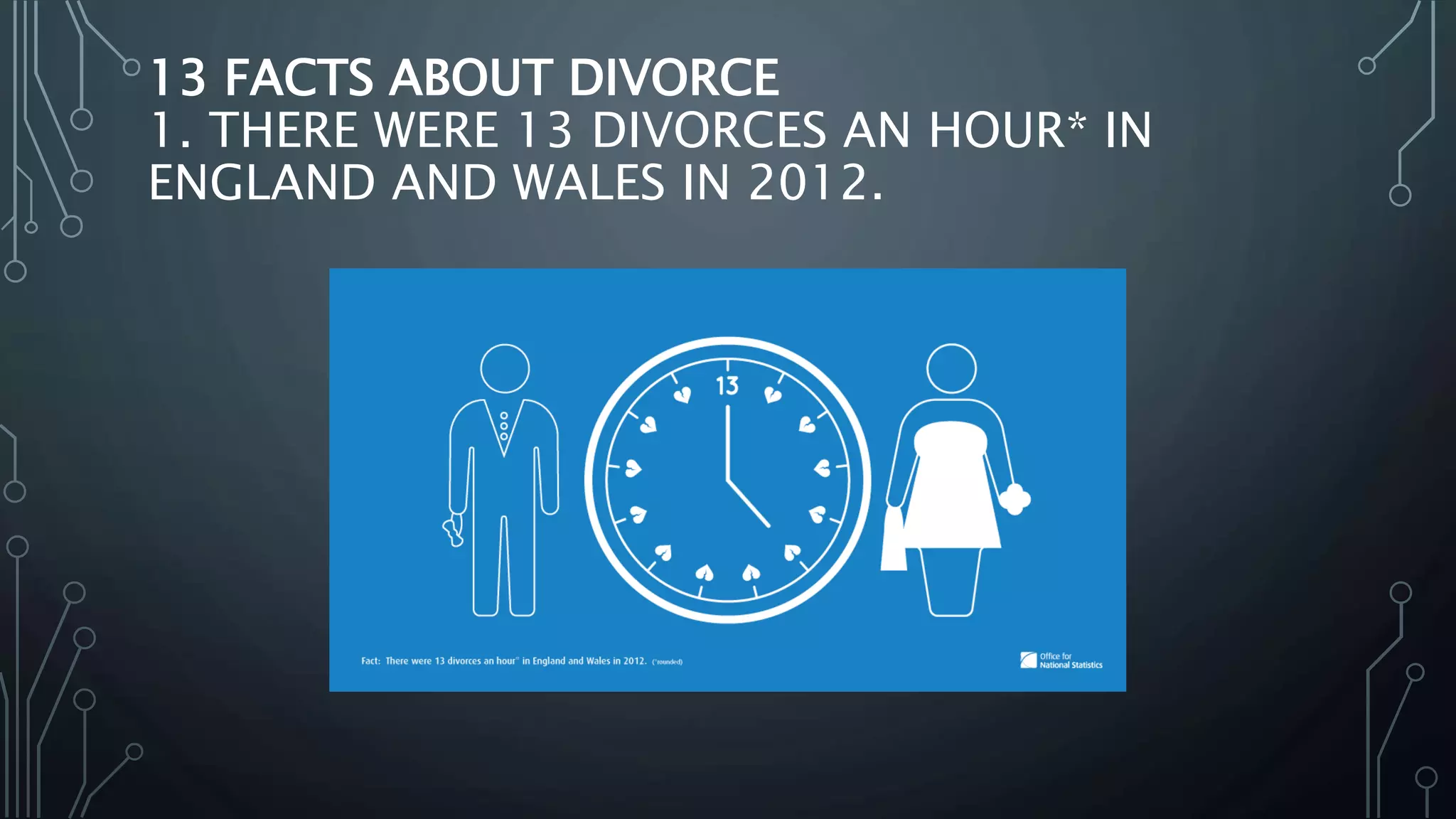
16.
13 FACTS ABOUTDIVORCE
1. THERE WERE 13 DIVORCES AN HOUR* IN
ENGLAND AND WALES IN 2012.
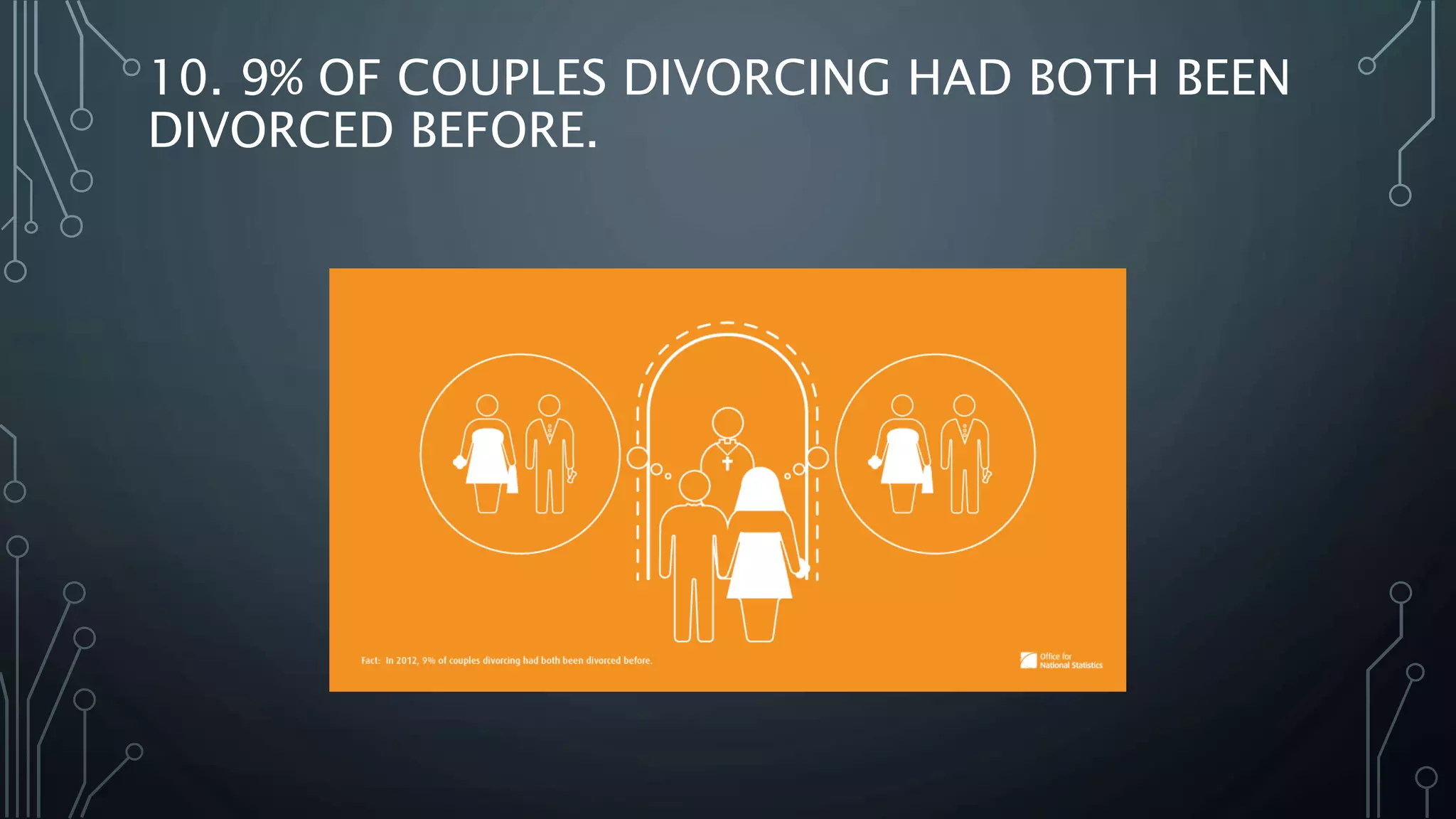
10. 9% OFCOUPLES DIVORCING HAD BOTH BEEN
DIVORCED BEFORE.
26.
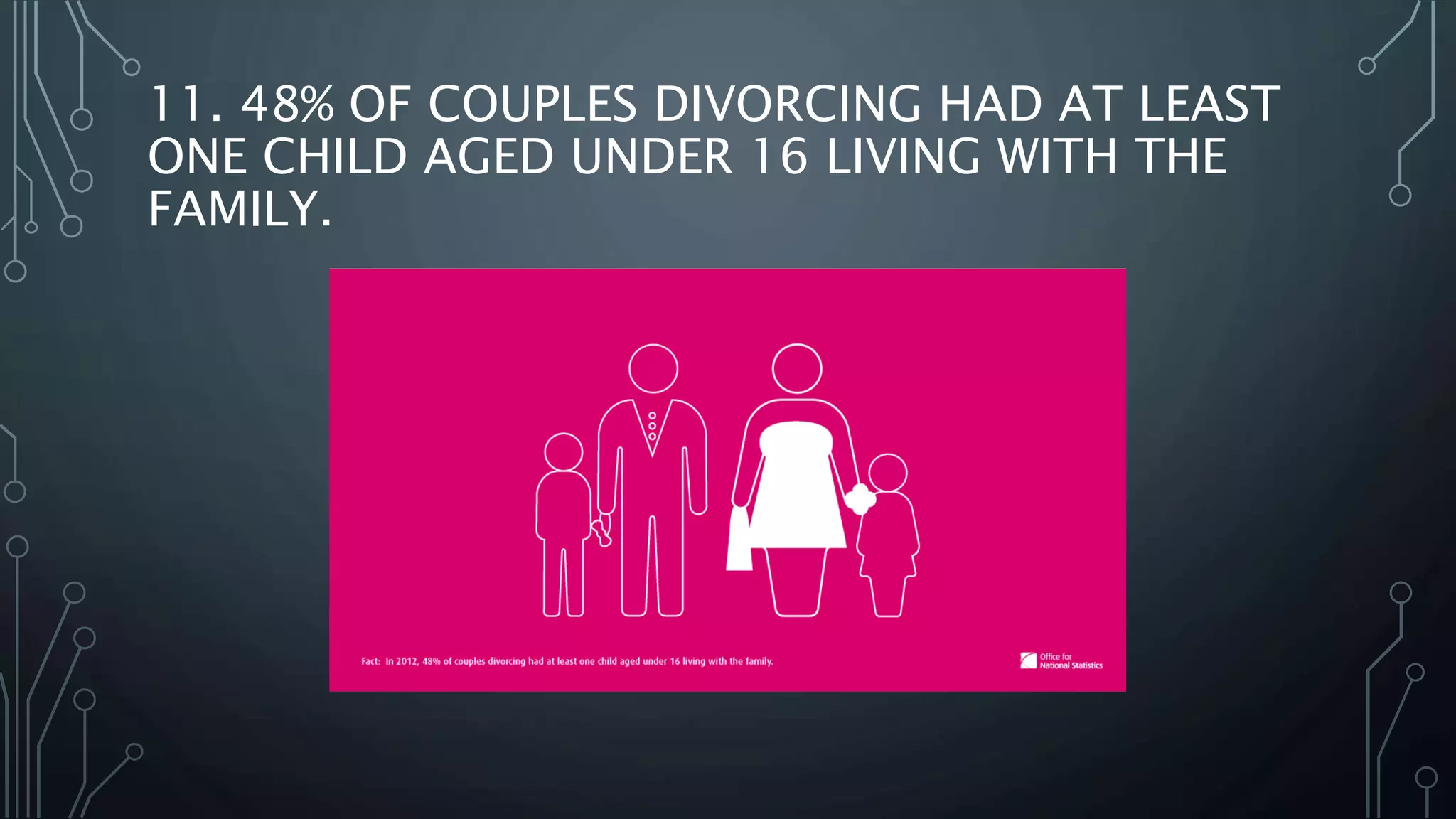
11. 48% OFCOUPLES DIVORCING HAD AT LEAST
ONE CHILD AGED UNDER 16 LIVING WITH THE
FAMILY.
27.
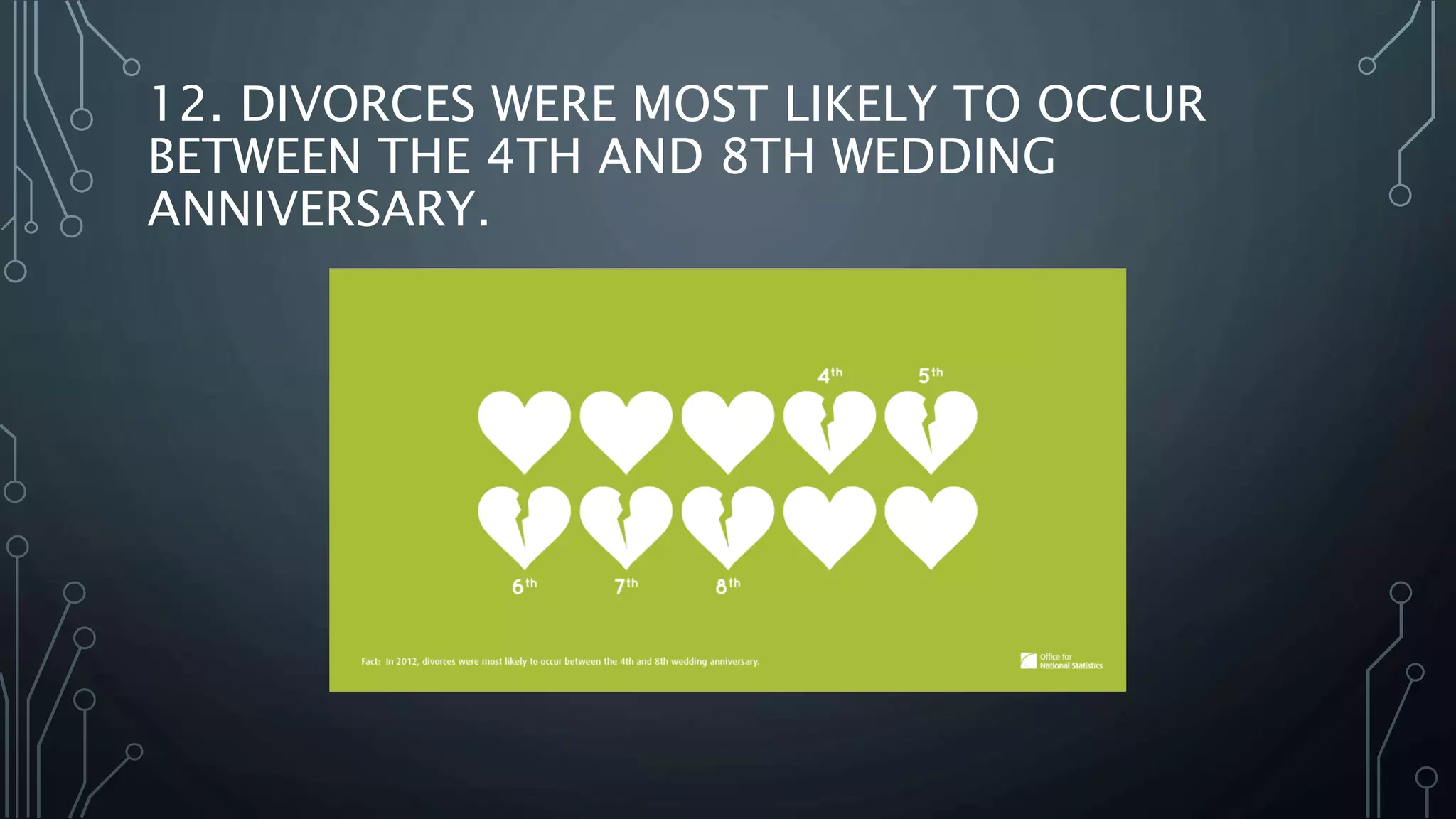
12. DIVORCES WEREMOST LIKELY TO OCCUR
BETWEEN THE 4TH AND 8TH WEDDING
ANNIVERSARY.
28.
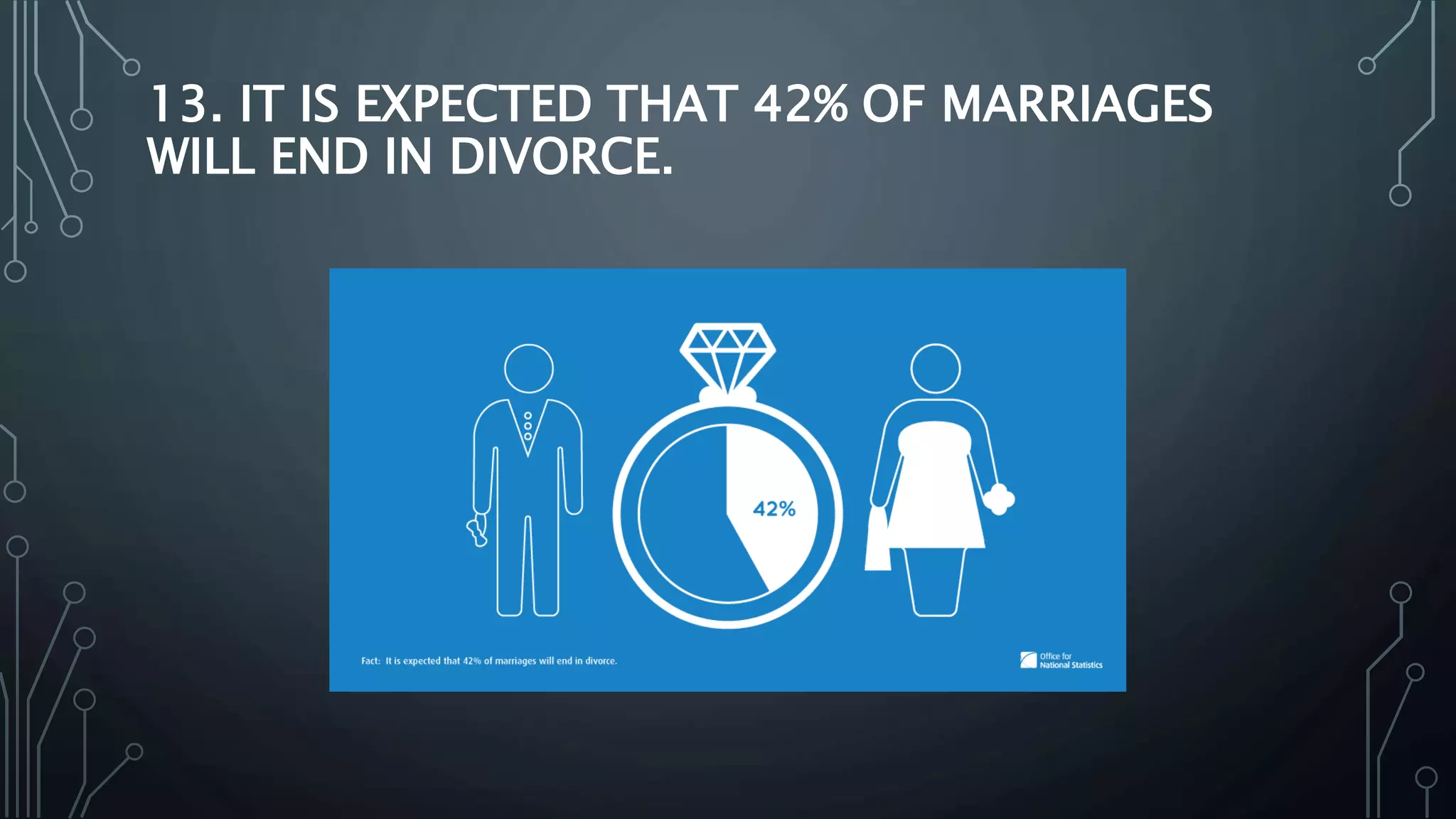
13. IT ISEXPECTED THAT 42% OF MARRIAGES
WILL END IN DIVORCE.
29.
DIVORCES IN ENGLANDAND WALES, 2013
• There were 114,720 divorces in England and Wales in 2013, a decrease of
2.9% since 2012, when there were 118,140 divorces.
• In 2013, there were 9.8 men divorcing per thousand married males and 9.8
women divorcing per thousand married females. A decrease of 27% for men
and 26% for women compared with 2003. Background note 3 has more
information about divorce rates.
• The number of divorces in 2013 was highest among men and women aged
40 to 44.
• For those married in 1968, 20% of marriages had ended in divorce by the
15th wedding anniversary whereas for those married in 1998, almost a third
of marriages (32%) had ended by this time.
31.
CIVIL PARTNERSHIPS
• Followingthe introduction of marriages of same sex couples in March 2014, the
number of civil partnerships formed in England and Wales has fallen by 70% from
5,646 in 2013 to 1,683 in 2014.
• The mean age of men forming a civil partnership in England and Wales in 2014 was
43.6 years, while for women it was 42.3 years, increasing by 3 years for men and 4
years for women since 2013. This is the largest annual increase in the mean age at
formation since civil partnerships were introduced in 2005.
• Over half (57%) of civil partnerships were between males in 2014; a change from
2013 when only 47% of partnerships were between males.
• The number of civil partnership dissolutions granted in 2014 was 1,061, an increase
of 8.9% since 2013.
32.
SAME SEX MARRIAGES:THE FIRST MARRIAGES OF
SAME SEX COUPLES COULD TAKE PLACE ON 29
MARCH 2014.
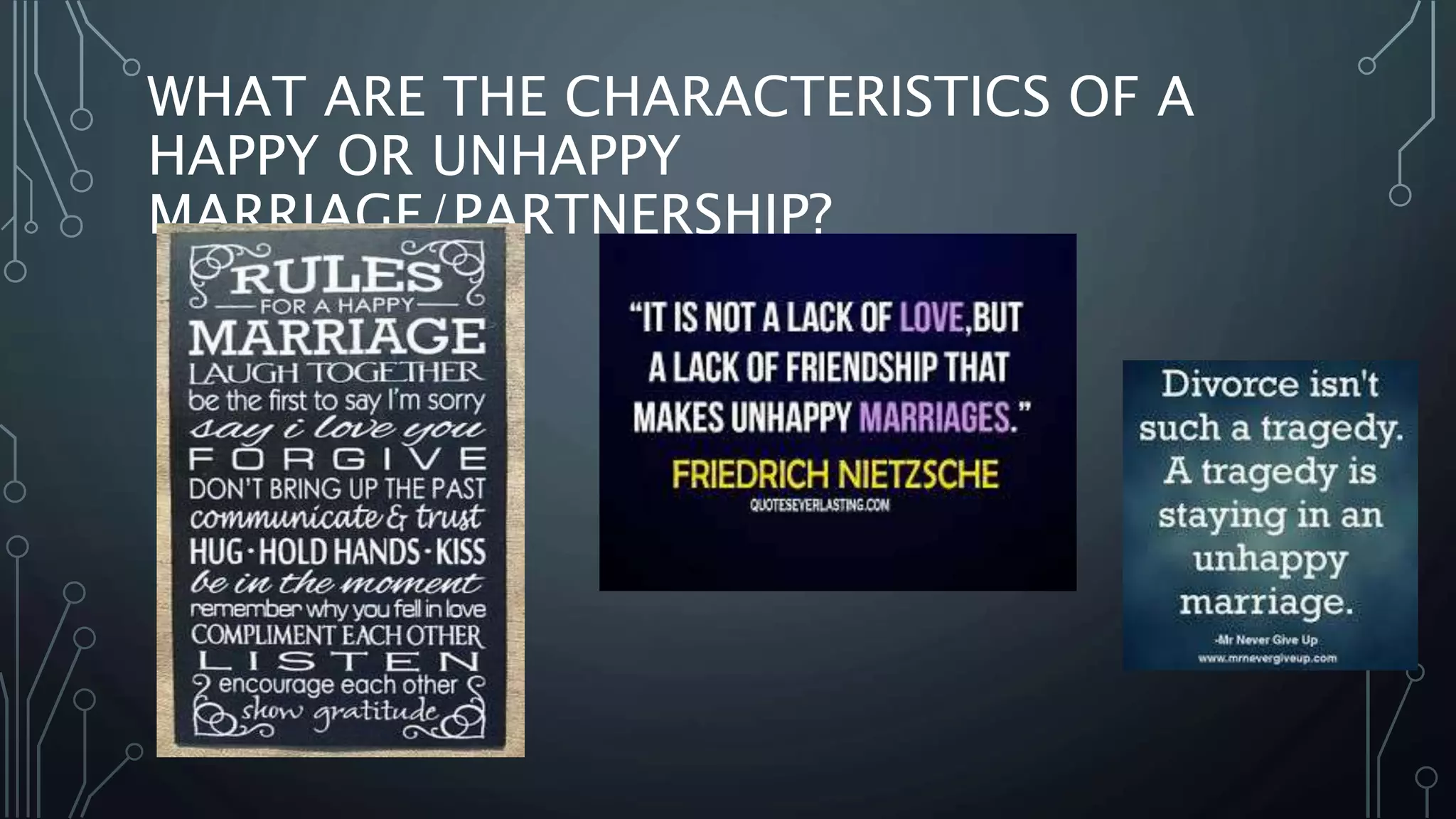
WHAT ARE THECHARACTERISTICS OF A
HAPPY OR UNHAPPY
MARRIAGE/PARTNERSHIP?
36.
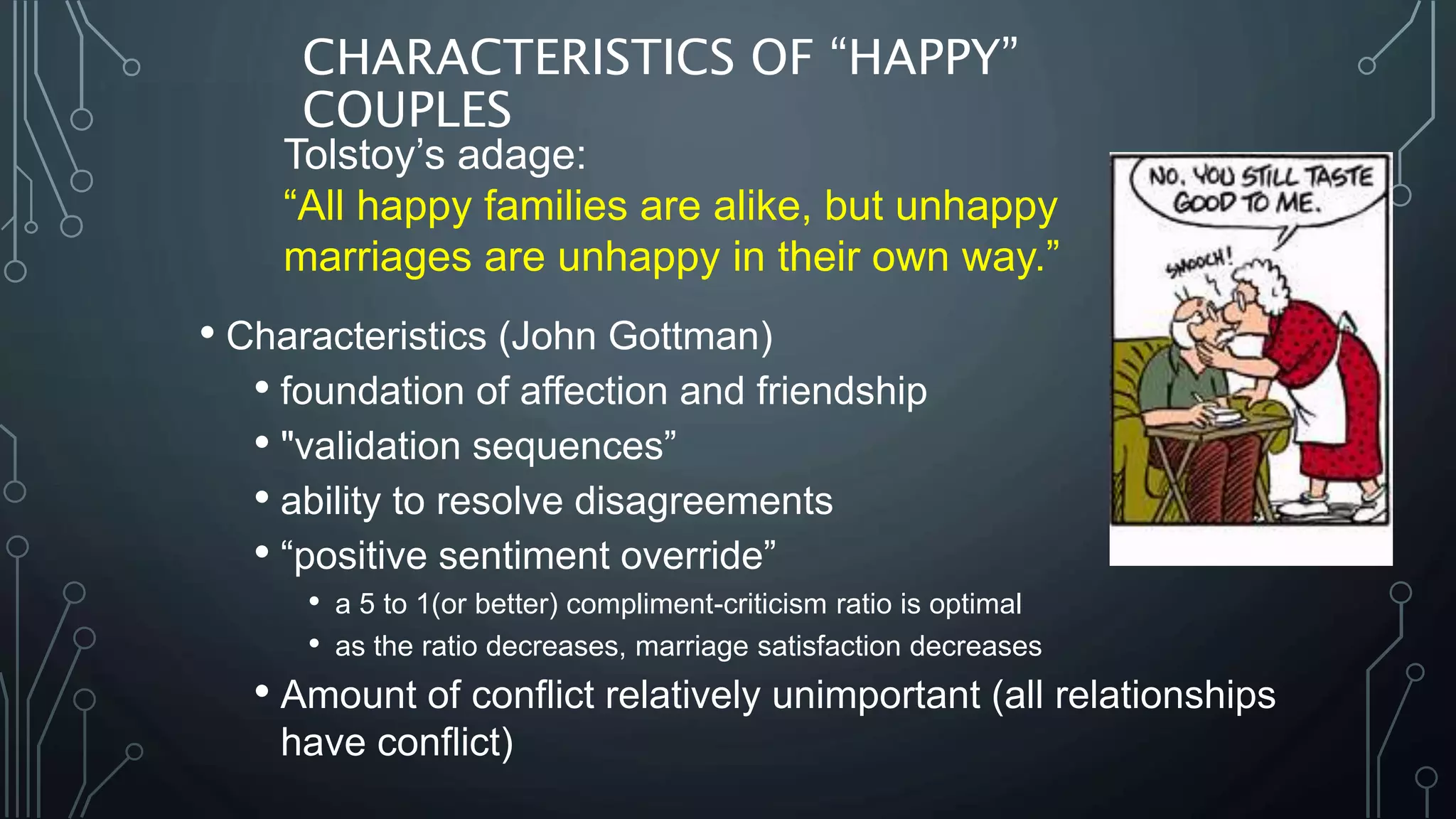
CHARACTERISTICS OF “HAPPY”
COUPLES
•Characteristics (John Gottman)
• foundation of affection and friendship
• "validation sequences”
• ability to resolve disagreements
• “positive sentiment override”
• a 5 to 1(or better) compliment-criticism ratio is optimal
• as the ratio decreases, marriage satisfaction decreases
• Amount of conflict relatively unimportant (all relationships
have conflict)
Tolstoy’s adage:
“All happy families are alike, but unhappy
marriages are unhappy in their own way.”
37.
DISTRESSED COUPLES (GOTTMAN
CONT.)
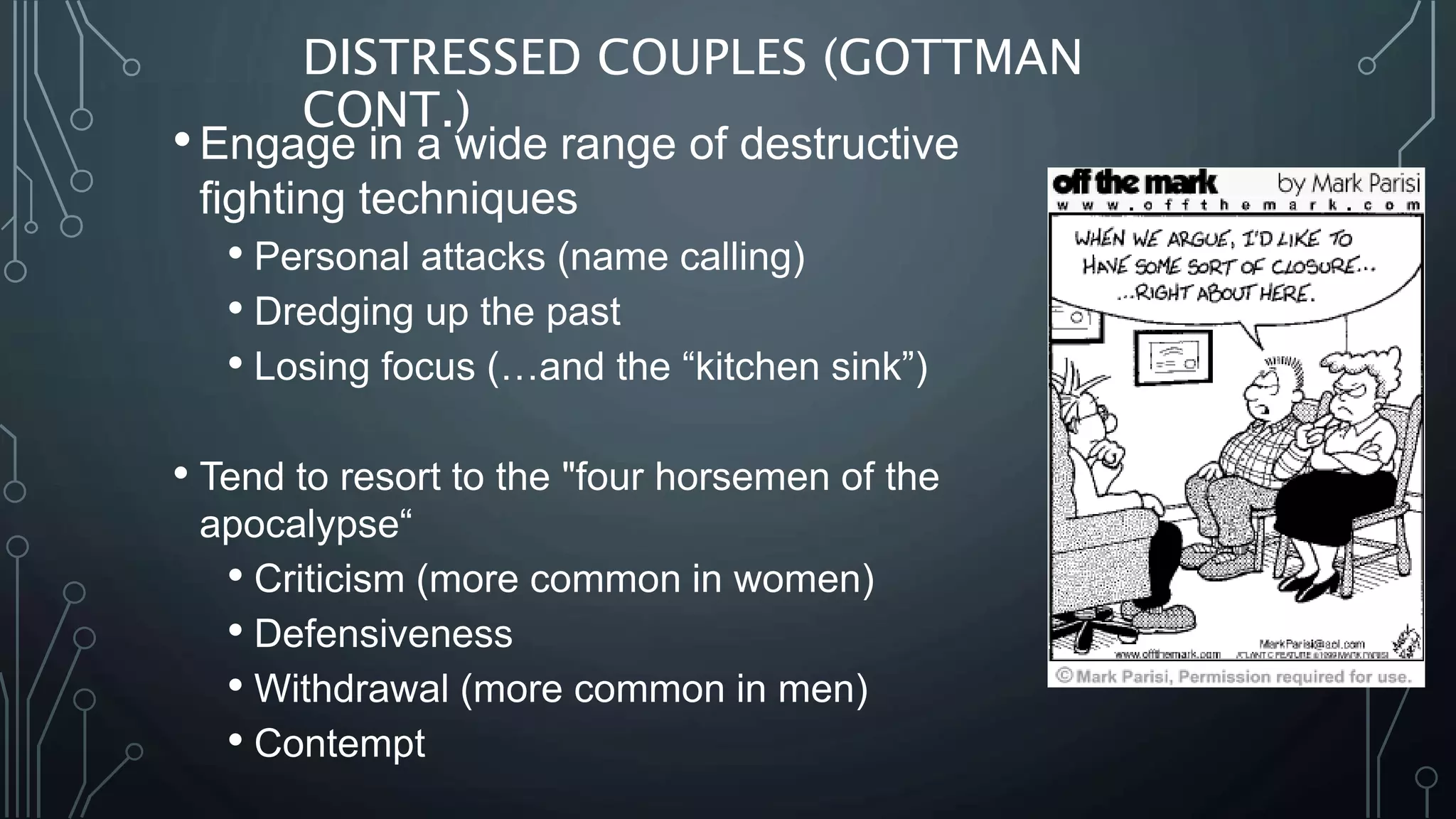
•Engagein a wide range of destructive
fighting techniques
• Personal attacks (name calling)
• Dredging up the past
• Losing focus (…and the “kitchen sink”)
• Tend to resort to the "four horsemen of the
apocalypse“
• Criticism (more common in women)
• Defensiveness
• Withdrawal (more common in men)
• Contempt
38.
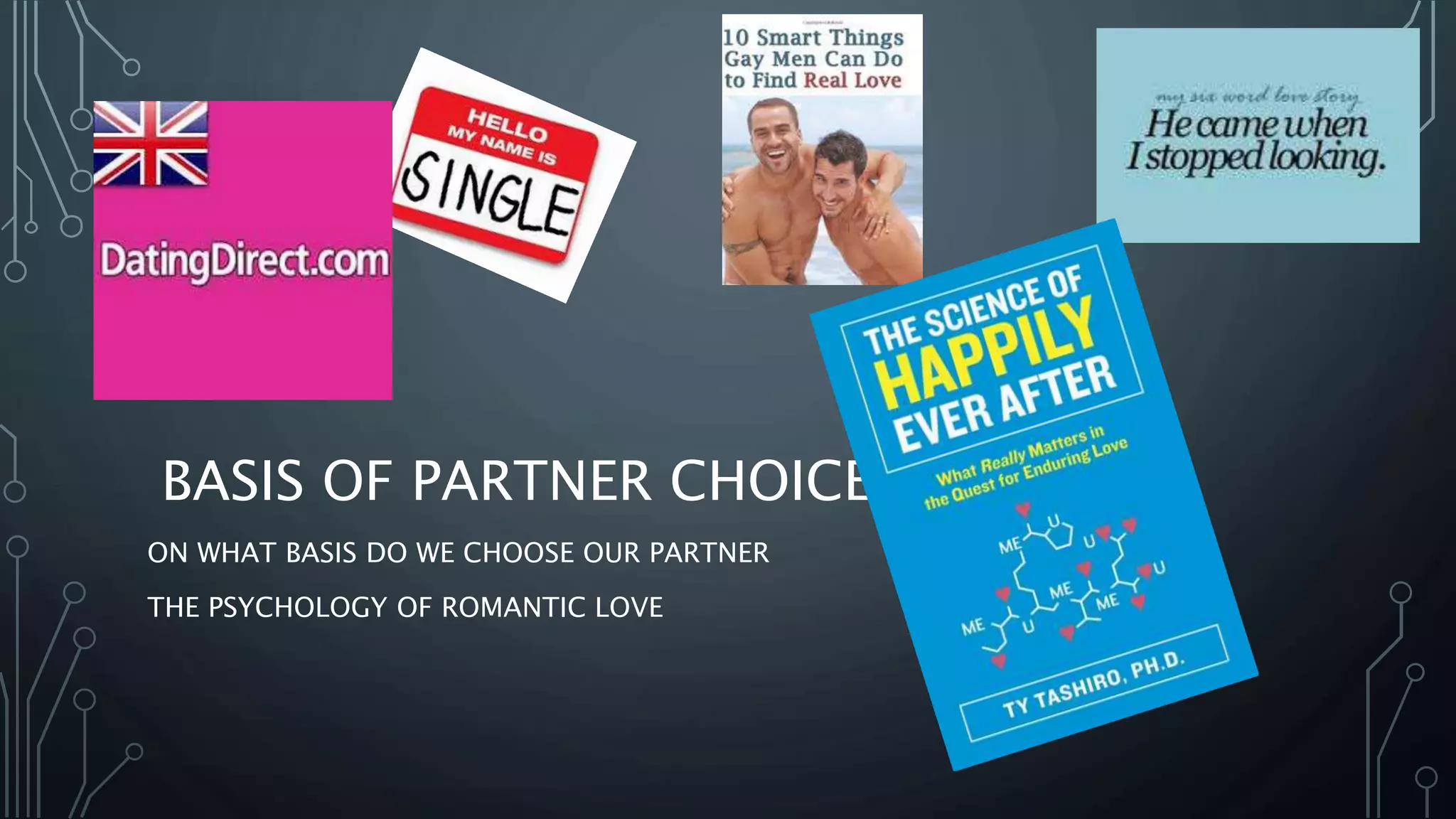
BASIS OF PARTNERCHOICE
ON WHAT BASIS DO WE CHOOSE OUR PARTNER
THE PSYCHOLOGY OF ROMANTIC LOVE
39.
“DOES HAPPILY EVERAFTER EVEN EXIST?”
• fair question from a group of young people who watched almost
50% of their parents’ generation divorce, another 10% permanently
separate and another 7% remain in unhappy marriages
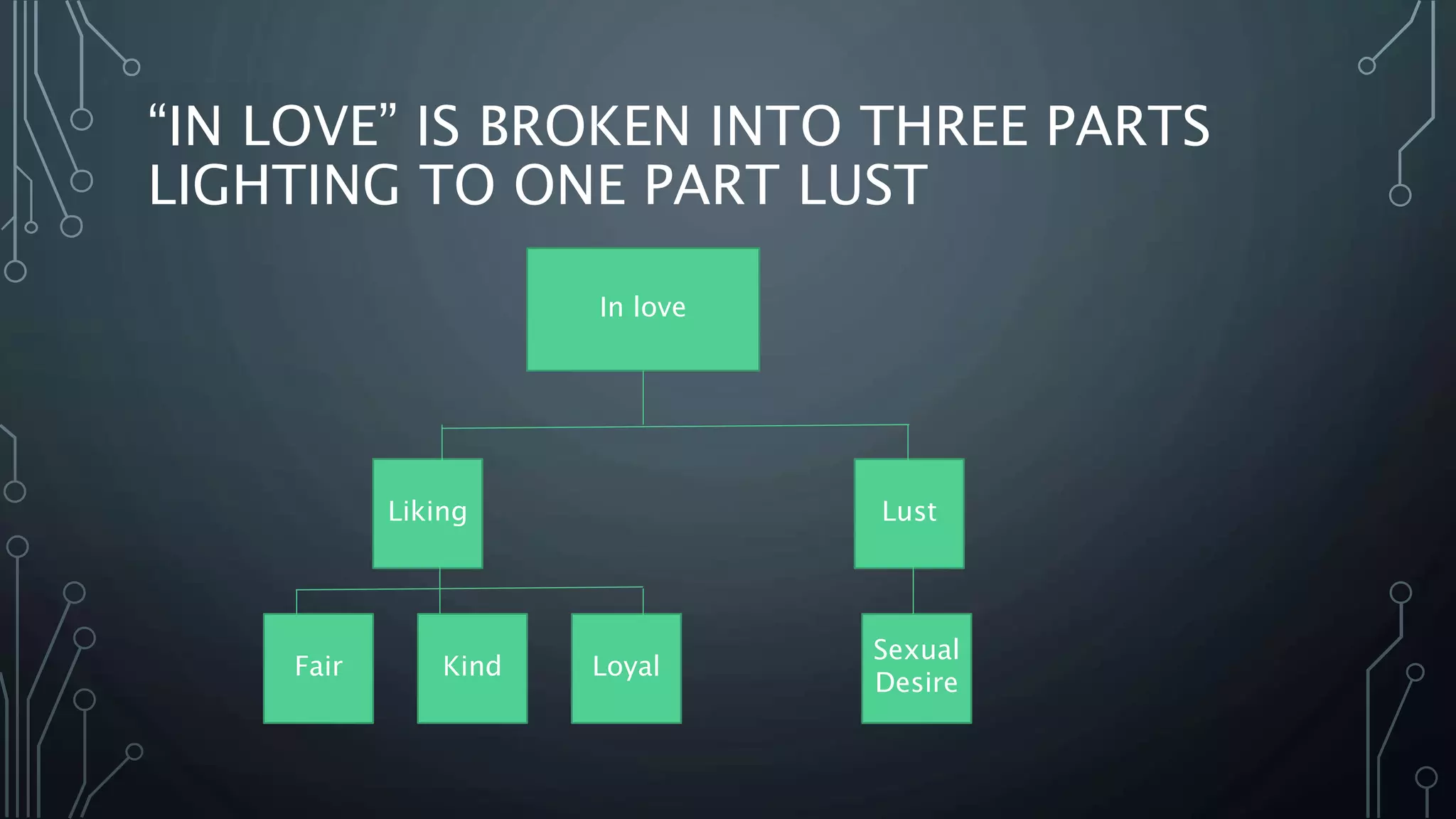
• Being “in love” is equivalent to having a “liking” (fairness, kindness,
loyalty) and a “lust” (sexual desire).
• Children’s fairy-tale belief about love is beautiful girl falling in for a
brave hero and they fall for each other in minutes. This is far from
what happens in reality
http://ashishb.net/book-summary/book-summary-
the-science-of-happily-ever-after-by-t-y-tashiro/
40.
“IN LOVE” ISBROKEN INTO THREE PARTS
LIGHTING TO ONE PART LUST
In love
Liking
Fair Kind Loyal
Sexual
Desire
Lust
41.
TASHIRO, T (2014)THE SCIENCE OF HAPPILY
EVER AFTER: WHAT REALLY MATTERS IN THE
QUEST FOR ENDURING LOVE. ONTARIO.
HARLEQUIN
•Post-marriage, liking declines at about 3% annually
while lust declines 8% annually (in first 7 years of
marriage) => from a long term perspective, its better
to invest in liking than lust.
42.
WHY YOU GETONLY THREE WISHES FOR
LOVE• Stability of traits – Traits rarely change. The traits which people carry during their
initial period of dating are indicative of how they will behave in future.
• Due to “positive illusions”, we ignore annoying traits of the person we are dating.
• The friends/observers of the relation had better perception of the relation.
• The popular notion of being intoxicated by love is not that incorrect
• Singles end up wishing for an unreasonable number of traits in their partners. They
usually end up grabbing partners based on the traits they first see (in lieu of traits
they would have most wished for).
• Most choices are by chance
• Wishing for at most three wishes for a partner is a pragmatic choice, anything
beyond is too wishful.
43.
WISHING FOR THEWRONG PARTNER
WHY WE SQUANDER OUR WISHES
• Strategic marriage: Before 1800s, short life expectancies and constant struggle for survival. In a dangerous environment
for struggle, thinking of marrying someone for romantic inklings would be far fetched. Marriage was about
survival..choose the strongest, fittest healthiest
• Romantic marriage: As the life expectancy began to rise and urbanization happened (more mating options in close
proximity), “marrying for love” was actually possible. While investing in reproductive fitness had a good return on
investment during the previous era, now with much healthier individuals, its role is limited.
• When asked to rank traits, physical attractiveness was 4th for men and 5th for women (among list of 10 traits) and
resources were at the bottom while agreeableness and intelligence were high up. But when they were forced to
choose only a small number of traits, they chose physical attractiveness and resources (men prioritized looks and
women prioritized resources).
• When singles were asked to rate themselves and partners on certain traits, in terms of physical attractiveness and
wealth, there was strong to moderate similarity while on personality traits like kindness, extroversion etc. there were only
weak associations. So, a modern marriage game is about fighting the urge of reproductively fit mate with the
psychological urge of a happy marriage.
• Most broken real life marriages are about passionate lovers falling apart once the ephemeral passionate love phase is
over. It leaves people with lovely moments and tragic endings.
44.
WISHES FOR LOVE
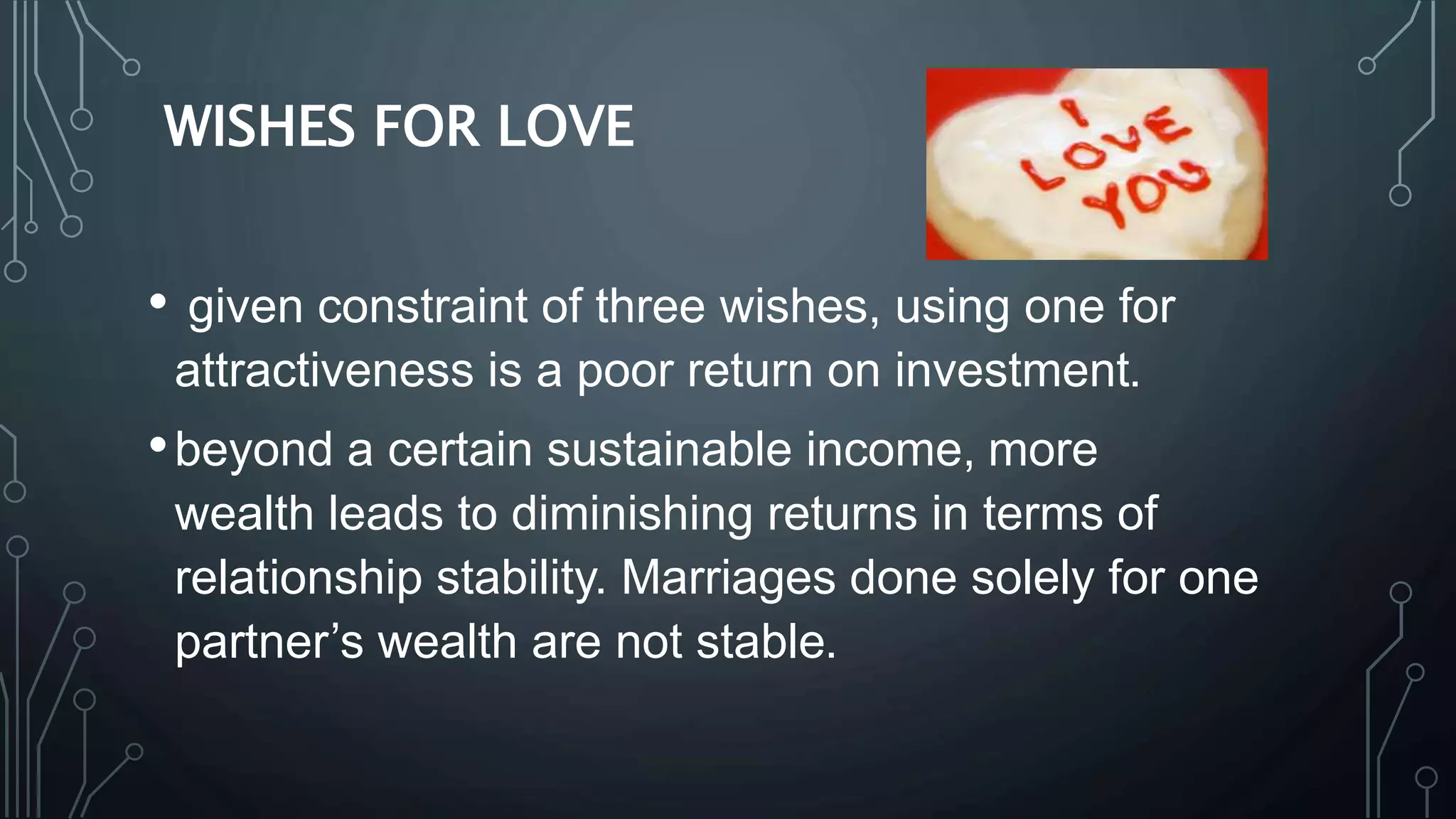
•given constraint of three wishes, using one for
attractiveness is a poor return on investment.
•beyond a certain sustainable income, more
wealth leads to diminishing returns in terms of
relationship stability. Marriages done solely for one
partner’s wealth are not stable.
45.
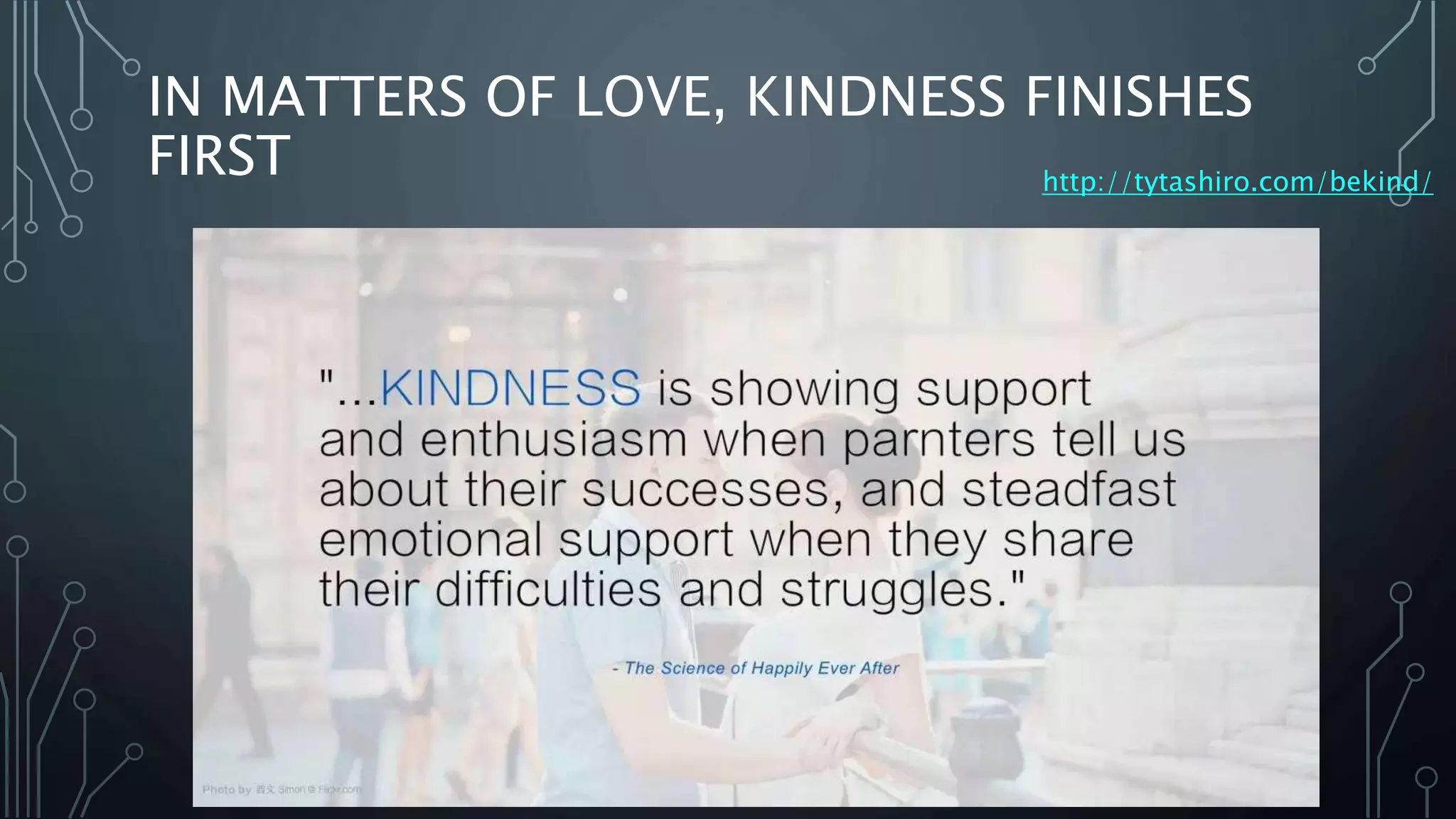
IN MATTERS OFLOVE, KINDNESS FINISHES
FIRST http://tytashiro.com/bekind/
46.
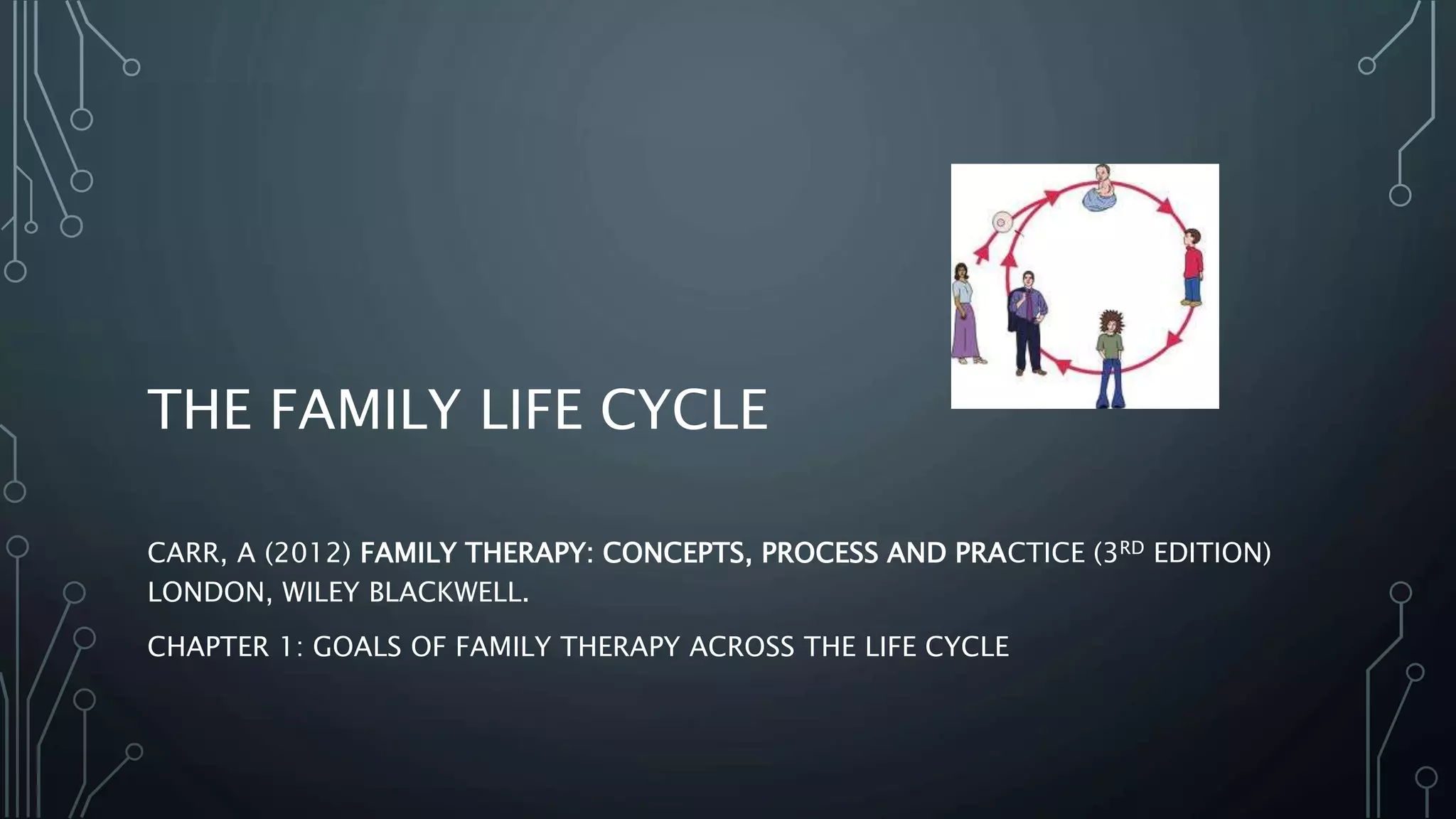
THE FAMILY LIFECYCLE
CARR, A (2012) FAMILY THERAPY: CONCEPTS, PROCESS AND PRACTICE (3RD EDITION)
LONDON, WILEY BLACKWELL.
CHAPTER 1: GOALS OF FAMILY THERAPY ACROSS THE LIFE CYCLE
47.
THE FAMILY LIFECYCLE
•Each family is unique, due to variations in
personal characteristics and cultural styles;
•The family is an interactional system whose
component parts have constantly shifting
boundaries and varying degrees of
resistance to change;
48.
THE FAMILY LIFECYCLE
•Families must fulfill a variety of functions for
each member, both collectively and
individually, if each member is to grow and
develop;
•Families pass through developmental and
non-developmental changes that produce
stress affecting all members.
49.
THE FAMILY LIFECYCLE
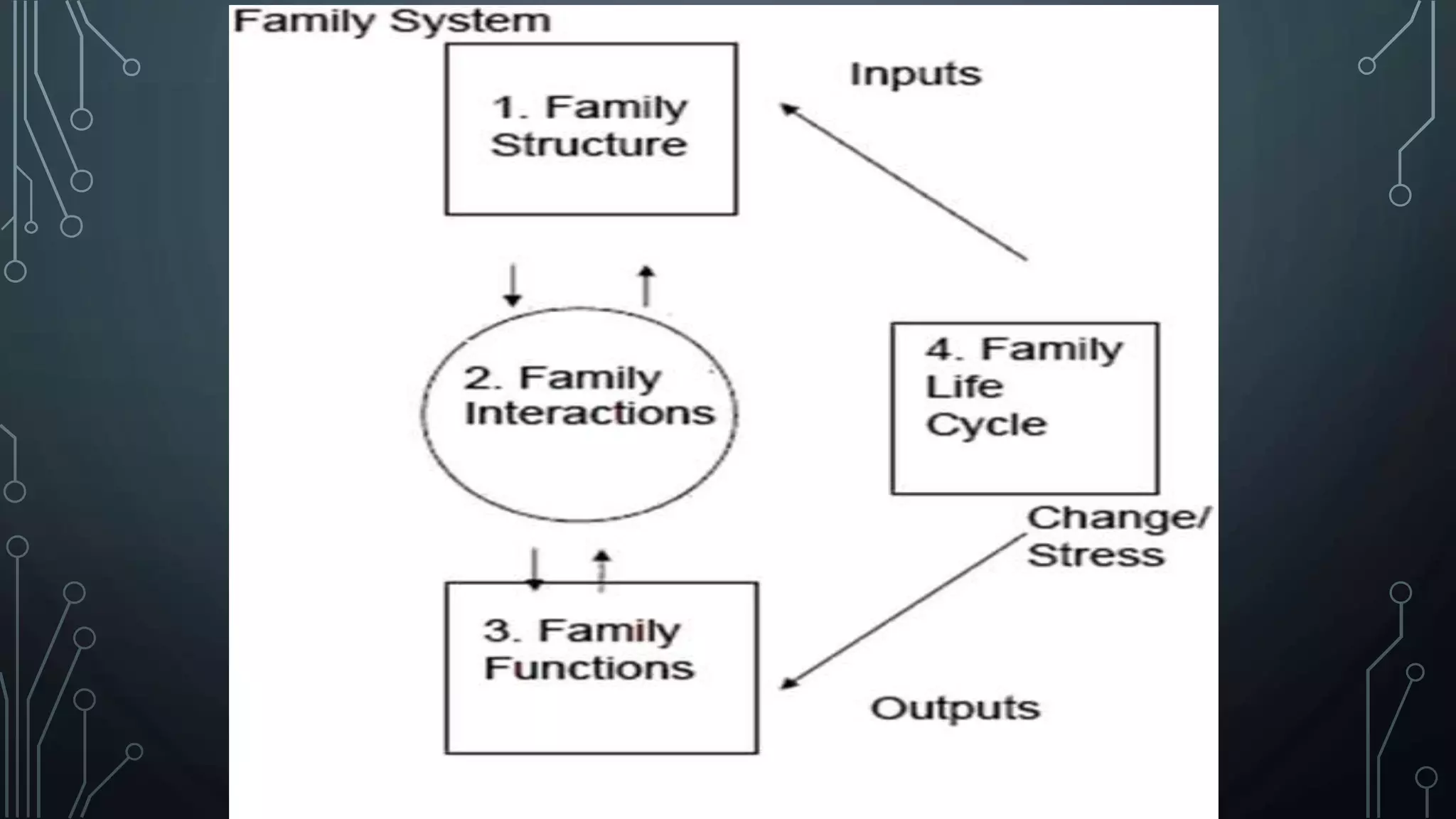
• The family life cycle introduces the element of change
into the family system.
• As the family moves through time, developmental and
non-developmental changes alter the family structure
and/or the family’s needs.
• These, in turn, produce change in the way the family
interacts.
50.
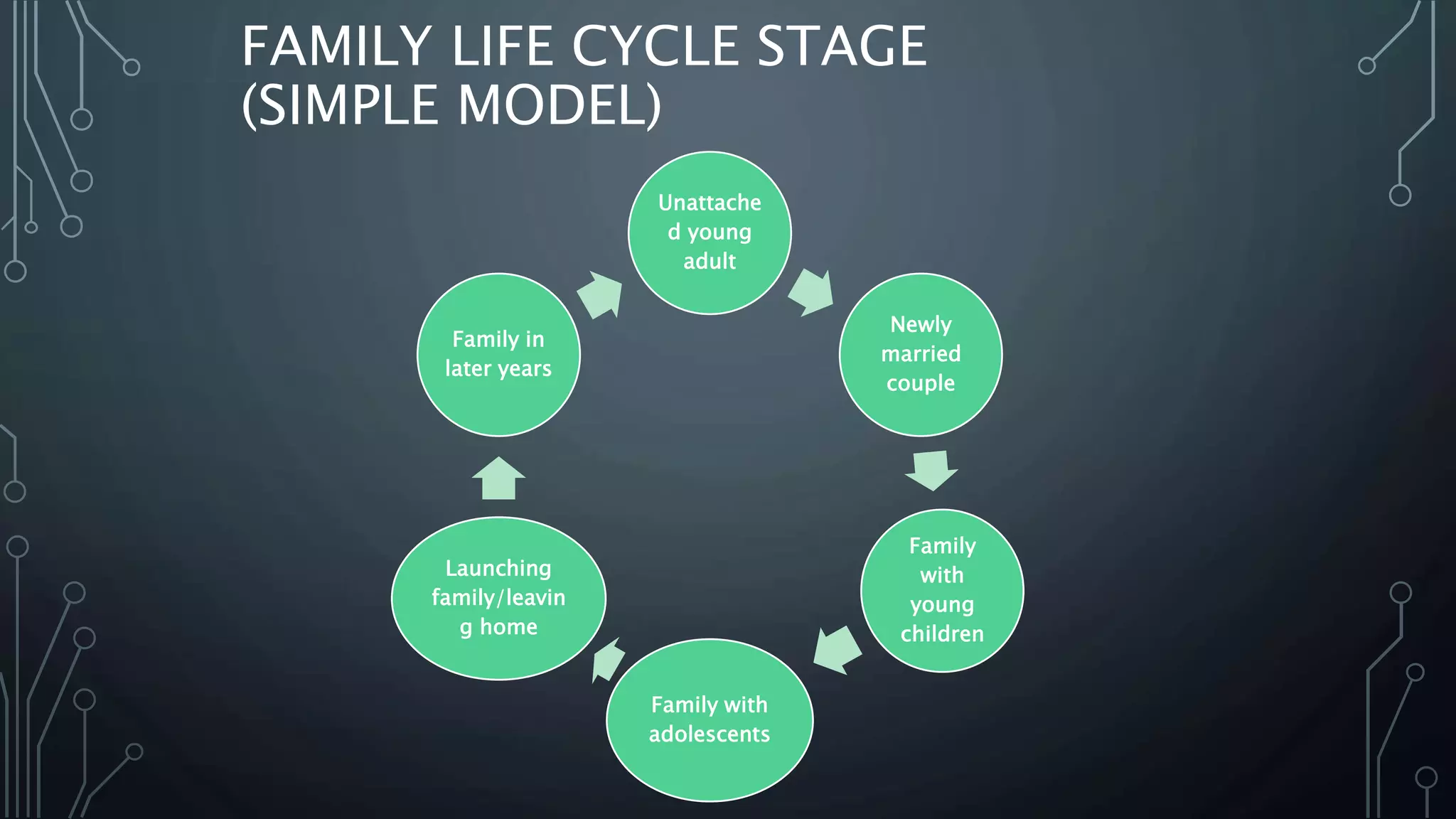
FAMILY LIFE CYCLESTAGE
(SIMPLE MODEL)
Unattache
d young
adult
Newly
married
couple
Family
with
young
children
Family with
adolescents
Launching
family/leavin
g home
Family in
later years
51.
THE FAMILY LIFECYCLE
•The family is not just a collection of individuals. It is
a whole larger than the sum of its parts.
•A Delicate Balance: A change in the family
situation means readjustment of the total system
and can pose problems and challenges for every
single member.
53.
THE DEVELOPMENTAL FAMILYLIFE CYCLE
PARADIGM
• Within each stage of the life cycle are specific tasks that must be
accomplished before family members can successfully move onto the next
stage.
• Families often become derailed as it tried to move from one stage to the
next
• When earlier transitions have not been negotiated successfully subsequent
stages are difficult and chaotic
• Couples often seek therapy during transition periods
• The developmental stages of the individual, couple and family must be
viewed simultaneously
54.
LIFE CYCLE OFMARRIAGE AND FAMILY MCGOLDRICK
1989Family life cycle
stage
Emotional process of concession: key principles Second order changes in family status required to proceed
developmentally
1. Leaving
home: single
young adults
Excepting emotional and financial responsibility for self A. Differentiation of self in relation to family of origin
B. Development of intimate peer relationships
C. Establishment of self in work and financial independence
2. Adjoining
family’s
marriage: the
new couple
Commitment to new system A. Formation of marital system
B.. Realignment of relationships with extended families and friends to
include spouse
3. Families with
young children
Accepting new members into the system A. Adjusting marital system to make space for children
B. Joining in child-rearing, financial, and household tasks
C. Realignment of relationships with extended family to include
parenting and grandparenting roles
4. Families with
adolescents
Increasing flexibility of family boundaries to include
children’s independence and grandparents frailties
A. Shifting of parent-child relationships to permit adolescents to move
in and out of the system
B. We focus on midlife marital and career issues
C. Beginning shift towards joint caring for older generation
5. Launching
children and
moving on
Accepting a multitude of experts from and entries into
the family system
A. Renegotiation of marital system as a dyad
B. Development of adult adult relationships between grown up
children and their parents
C. Realignment of relationships to include in-laws and grandchildren
D. Dealing with disabilities and death of parents and grandparents
6. Families in
later life
Excepting the shift of generational roles A. Maintaining own and or couple functioning and interests in the face
of physiological decline; exploration of new family and social role
options
B. Support of more central role of middle generation
C. Making room in the system for the wisdom and experience of the
elderly, supporting the older generation
D. Dealing with the loss of sparse, siblings and other peers and
A FRAMEWORK FORTHE COMPARATIVE
STUDY OF COUPLE THERAPY
In considering each model a consistent framework is used to analyse the model.
1. Background of the Approach
2. The Healthy/Well-Functioning versus Pathological/Dysfunctional Couple/Marriage
3. The Role of the Therapist
4. Assessment and Treatment Planning
5. Goal Setting
6. Process and Technical Aspects of Couple Therapy
7. Curative Factors/Mechanisms of Change
8. Treatment Applicability and Empirical Support
• Please use this structure in your comparative of the 2 models for the assessment task
READINGS
• Core readings:
•Gurman (2008) Chapter 1 a framework for the Comparative Study of Couple
Therapy: History, Models, and applications
• Synder & Halford (2012) Evidence-based couple therapy
• Weeks & Fife (2014) Couples in treatment techniques and approaches text book
chapter 1
• Cowan (ND) becoming parents: what has to change for couples
• Qualls (1994) marital therapy with later life couples
• Advanced reading
• Tashiro (2014) the science of happily ever after: what really matters in the quest for
enduring love. Chap 1 & 2
• Hazan (2003) the essential nature of couple relationships found in Johnson and
Whiffen (2003)