8.1. Inner Product Spaces
Inner product
Linear functional
Adjoint
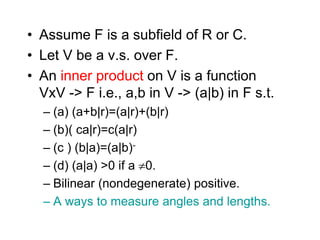
• Assume F is a subfield of R or C.
• Let V be a v.s. over F.
• An inner product on V is a function
VxV -> F i.e., a,b in V -> (a|b) in F s.t.
– (a) (a+b|r)=(a|r)+(b|r)
– (b)( ca|r)=c(a|r)
– (c ) (b|a)=(a|b)-
– (d) (a|a) >0 if a 0.
– Bilinear (nondegenerate) positive.
– A ways to measure angles and lengths.
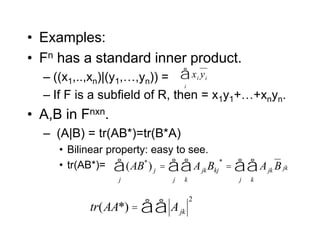
• Examples:
• Fn has a standard inner product.
– ((x1,..,xn)|(y1,…,yn)) =
– If F is a subfield of R, then = x1y1+…+xnyn.
• A,B in Fnxn.
– (A|B) = tr(AB*)=tr(B*A)
• Bilinear property: easy to see.
• tr(AB*)= (AB*
) j
j
å = Ajk
k
å
j
å Bkj
*
= Ajk
k
å
j
å B jk
xi
i
å yi
tr(AA*) = Ajk
å
å
2
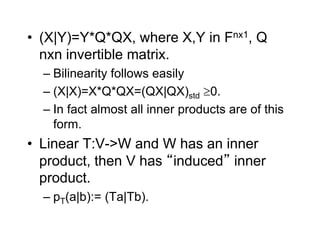
• (X|Y)=Y*Q*QX, where X,Y in Fnx1, Q
nxn invertible matrix.
– Bilinearity follows easily
– (X|X)=X*Q*QX=(QX|QX)std 0.
– In fact almost all inner products are of this
form.
• Linear T:V->W and W has an inner
product, then V has “induced” inner
product.
– pT(a|b):= (Ta|Tb).
• (a) For any basis B={a1,…,an}, there is
an inner-product s.t. (ai|aj)=ij.
– Define T:V->Fn s.t. ai -> ei.
– Then pT(ai|aj)=(ei|ej)= ij.
• (b) V={f:[0,1]->C| f is continuous }.
– (f|g)= 0
1 fg- dt for f,g in V is an inner
product.
– T:V->V defined by f(t) -> tf(t) is linear.
– pT(f,g)= 0
1tftg- dt=0
1t2fg- dt is an inner
product.
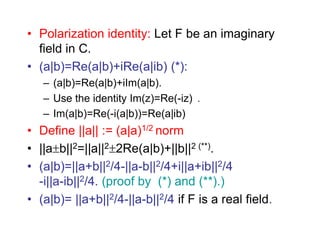
• Polarization identity: Let F be an imaginary
field in C.
• (a|b)=Re(a|b)+iRe(a|ib) (*):
– (a|b)=Re(a|b)+iIm(a|b).
– Use the identity Im(z)=Re(-iz) .
– Im(a|b)=Re(-i(a|b))=Re(a|ib)
• Define ||a|| := (a|a)1/2 norm
• ||ab||2=||a||22Re(a|b)+||b||2 (**).
• (a|b)=||a+b||2/4-||a-b||2/4+i||a+ib||2/4
-i||a-ib||2/4. (proof by (*) and (**).)
• (a|b)= ||a+b||2/4-||a-b||2/4 if F is a real field.
• When V is finite-dimensional, inner
products can be classified.
• Given a basis B={a1,…,an} and any
inner product ( | ):
(a|b) = Y*GX for X=[a]B, Y=[b]B
– G is an nxn-matrix and G=G*, X*GX0 for
any X, X0.
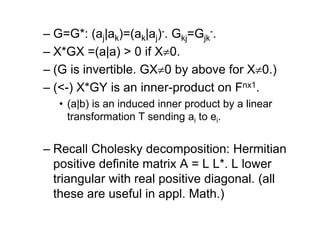
• Proof: (->) Let Gjk=(ak|aj).
a = xk
k
å ak,b = y jaj
j
å
(a |b) = ( xk
k
å ak,b) = xk
k
å y j (ak | aj
j
å ) = Y*
GX
– G=G*: (aj|ak)=(ak|aj)-. Gkj=Gjk
-.
– X*GX =(a|a) > 0 if X0.
– (G is invertible. GX0 by above for X0.)
– (<-) X*GY is an inner-product on Fnx1.
• (a|b) is an induced inner product by a linear
transformation T sending ai to ei.
– Recall Cholesky decomposition: Hermitian
positive definite matrix A = L L*. L lower
triangular with real positive diagonal. (all
these are useful in appl. Math.)
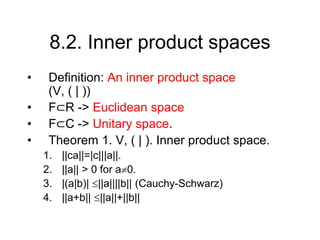
8.2. Inner product spaces
• Definition: An inner product space
(V, ( | ))
• F⊂R -> Euclidean space
• F⊂C -> Unitary space.
• Theorem 1. V, ( | ). Inner product space.
1. ||ca||=|c|||a||.
2. ||a|| > 0 for a0.
3. |(a|b)| ||a||||b|| (Cauchy-Schwarz)
4. ||a+b|| ||a||+||b||
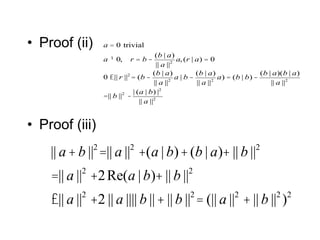
• Proof (ii)
• Proof (iii)
a = 0 trivial
a ¹ 0, r = b -
(b | a)
|| a ||2
a,(r | a) = 0
0 £|| r ||2
= (b -
(b | a)
|| a ||2
a | b -
(b | a)
|| a ||2
a) = (b | b)-
(b | a)(b | a)
|| a ||2
=|| b ||2
-
| (a | b) |2
|| a ||2
|| a+ b ||2
=|| a ||2
+(a | b)+(b | a)+ || b ||2
=|| a ||2
+2Re(a | b)+ || b ||2
£|| a ||2
+2 || a |||| b ||+ || b ||2
= (|| a ||2
+ || b ||2
)2
• In fact many inequalities follows from
Cauchy-Schwarz inequality.
• The triangle inequality also follows.
• See Example 7.
• Example 7 (d) is useful in defining
Hilbert spaces. Similar inequalities are
used much in analysis, PDE, and so on.
• Note Example 7, no computations are
involved in proving these.
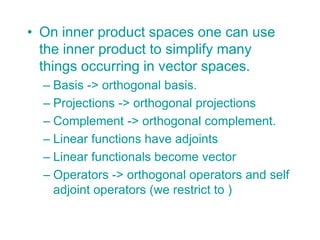
• On inner product spaces one can use
the inner product to simplify many
things occurring in vector spaces.
– Basis -> orthogonal basis.
– Projections -> orthogonal projections
– Complement -> orthogonal complement.
– Linear functions have adjoints
– Linear functionals become vector
– Operators -> orthogonal operators and self
adjoint operators (we restrict to )
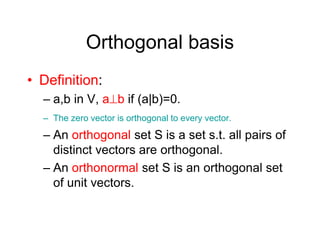
Orthogonal basis
• Definition:
– a,b in V, ab if (a|b)=0.
– The zero vector is orthogonal to every vector.
– An orthogonal set S is a set s.t. all pairs of
distinct vectors are orthogonal.
– An orthonormal set S is an orthogonal set
of unit vectors.
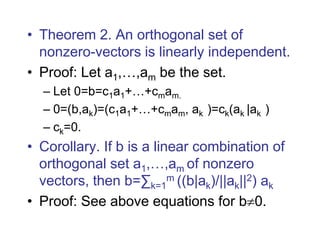
• Theorem 2. An orthogonal set of
nonzero-vectors is linearly independent.
• Proof: Let a1,…,am be the set.
– Let 0=b=c1a1+…+cmam.
– 0=(b,ak)=(c1a1+…+cmam, ak )=ck(ak |ak )
– ck=0.
• Corollary. If b is a linear combination of
orthogonal set a1,…,am of nonzero
vectors, then b=∑k=1
m ((b|ak)/||ak||2) ak
• Proof: See above equations for b0.
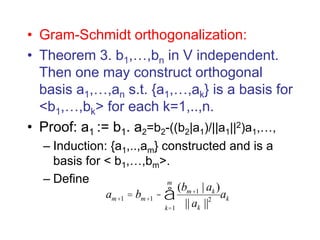
• Gram-Schmidt orthogonalization:
• Theorem 3. b1,…,bn in V independent.
Then one may construct orthogonal
basis a1,…,an s.t. {a1,…,ak} is a basis for
<b1,…,bk> for each k=1,..,n.
• Proof: a1 := b1. a2=b2-((b2|a1)/||a1||2)a1,…,
– Induction: {a1,..,am} constructed and is a
basis for < b1,…,bm>.
– Define
am+1 = bm+1 -
(bm+1 | ak )
|| ak ||2
k=1
m
å ak
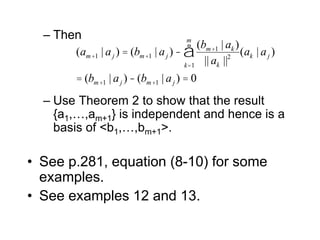
– Then
– Use Theorem 2 to show that the result
{a1,…,am+1} is independent and hence is a
basis of <b1,…,bm+1>.
• See p.281, equation (8-10) for some
examples.
• See examples 12 and 13.
(am+1 | aj ) = (bm+1 | aj ) -
(bm+1 | ak )
|| ak ||2
k=1
m
å (ak | aj )
= (bm+1 | aj ) -(bm+1 | aj ) = 0
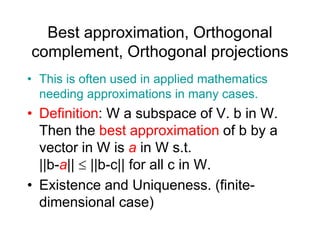
Best approximation, Orthogonal
complement, Orthogonal projections
• This is often used in applied mathematics
needing approximations in many cases.
• Definition: W a subspace of V. b in W.
Then the best approximation of b by a
vector in W is a in W s.t.
||b-a||  ||b-c|| for all c in W.
• Existence and Uniqueness. (finite-
dimensional case)
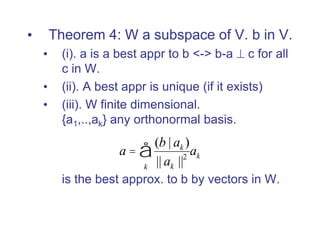
• Theorem 4: W a subspace of V. b in V.
• (i). a is a best appr to b <-> b-a  c for all
c in W.
• (ii). A best appr is unique (if it exists)
• (iii). W finite dimensional.
{a1,..,ak} any orthonormal basis.
is the best approx. to b by vectors in W.
a =
(b | ak )
|| ak ||2
k
å ak
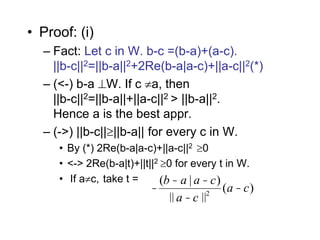
• Proof: (i)
– Fact: Let c in W. b-c =(b-a)+(a-c).
||b-c||2=||b-a||2+2Re(b-a|a-c)+||a-c||2(*)
– (<-) b-a W. If c a, then
||b-c||2=||b-a||+||a-c||2 > ||b-a||2.
Hence a is the best appr.
– (->) ||b-c||||b-a|| for every c in W.
• By (*) 2Re(b-a|a-c)+||a-c||2 0
• <-> 2Re(b-a|t)+||t||2 0 for every t in W.
• If ac, take t =
-
(b - a | a -c)
|| a -c ||2
(a -c)
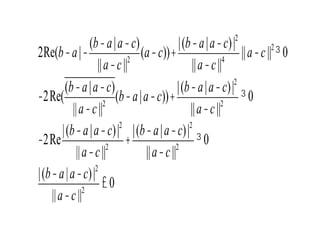
2Re(b-a|-
(b-a|a-c)
||a-c||2
(a-c))+
|(b-a|a-c)|2
||a-c||4
||a-c||2
³0
-2Re(
(b-a|a-c)
||a-c||2
(b-a|a-c))+
|(b-a|a-c)|2
||a-c||2
³0
-2Re
|(b-a|a-c)|2
||a-c||2
+
|(b-a|a-c)|2
||a-c||2
³0
|(b-a|a-c)|2
||a-c||2
£0
• This holds <-> (b-a|a-c)=0 for any c in W.
• Thus, b-a is  every vector in W.
– (ii) a,a’ best appr. to b in W.
• b-a  every v in W. b-a’  every v in W.
• If aa’, then by (*)
||b-a’||2=||b-a||2+2Re(b-a|a-a’)+||a-a’||2.
Hence, ||b-a’||>||b-a||.
• Conversely, ||b-a||>||b-a’||.
• This is a contradiction and a=a’.
-2
|(b - a | a -c) |2
|| a -c ||2
+
|(b- a | a-c) |2
|| a -c ||2
³ 0
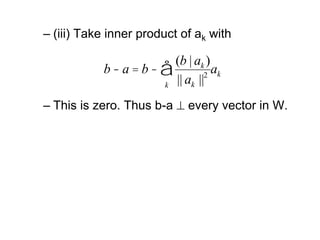
– (iii) Take inner product of ak with
– This is zero. Thus b-a  every vector in W.
b - a = b -
(b | ak )
|| ak ||2
k
å ak
Orthogonal projection
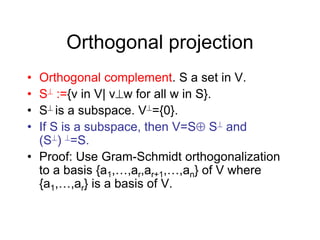
• Orthogonal complement. S a set in V.
• S :={v in V| vw for all w in S}.
• S is a subspace. V={0}.
• If S is a subspace, then V=S S and
(S) =S.
• Proof: Use Gram-Schmidt orthogonalization
to a basis {a1,…,ar,ar+1,…,an} of V where
{a1,…,ar} is a basis of V.
• Orthogonal projection: EW:V->W.
a in V -> b the best approximation in W.
• By Theorem 4, this is well-defined for
any subspace W.
• EW is linear by Theorem 5.
• EW is a projection since EW EW(v)=
EW(v).
• Theorem 5: W subspace in V. E orthogonal
projection V->W. Then E is an projection and
W=nullE and V=WW.
• Proof:
– Linearity:
• a,b in V, c in F. a-Ea, b-Eb  all v in W.
• c(a-Ea)+(b-Eb)=(ca+b)-(cE(a)+E(b))  all v in W.
• Thus by uniqueness E(ca+b)=cEa+Eb.
– null E  W : If b is in nullE, then b=b-Eb is in W.
– W  null E: If b is in W, then b-0 is in W and 0 is
the best appr to b by Theorem 4(i) and so Eb=0.
– Since V=ImEnullE, we are done.
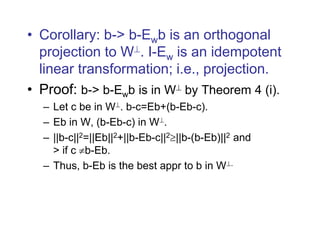
• Corollary: b-> b-Ewb is an orthogonal
projection to W. I-Ew is an idempotent
linear transformation; i.e., projection.
• Proof: b-> b-Ewb is in W by Theorem 4 (i).
– Let c be in W. b-c=Eb+(b-Eb-c).
– Eb in W, (b-Eb-c) in W.
– ||b-c||2=||Eb||2+||b-Eb-c||2||b-(b-Eb)||2 and
> if c b-Eb.
– Thus, b-Eb is the best appr to b in W.
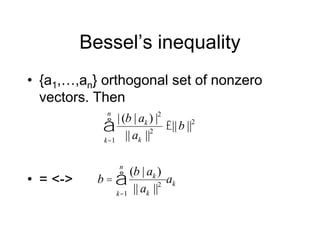
Bessel’s inequality
• {a1,…,an} orthogonal set of nonzero
vectors. Then
• = <->
|(b | ak ) |2
|| ak ||2
k=1
n
å £||b ||2
b =
(b | ak )
|| ak ||2
k=1
n
å ak

lin2007IICh8pt1.ppt

  • 1.
    8.1. Inner ProductSpaces Inner product Linear functional Adjoint
  • 2.
    • Assume Fis a subfield of R or C. • Let V be a v.s. over F. • An inner product on V is a function VxV -> F i.e., a,b in V -> (a|b) in F s.t. – (a) (a+b|r)=(a|r)+(b|r) – (b)( ca|r)=c(a|r) – (c ) (b|a)=(a|b)- – (d) (a|a) >0 if a 0. – Bilinear (nondegenerate) positive. – A ways to measure angles and lengths.
  • 3.
    • Examples: • Fnhas a standard inner product. – ((x1,..,xn)|(y1,…,yn)) = – If F is a subfield of R, then = x1y1+…+xnyn. • A,B in Fnxn. – (A|B) = tr(AB*)=tr(B*A) • Bilinear property: easy to see. • tr(AB*)= (AB* ) j j å = Ajk k å j å Bkj * = Ajk k å j å B jk xi i å yi tr(AA*) = Ajk å å 2
  • 4.
    • (X|Y)=Y*Q*QX, whereX,Y in Fnx1, Q nxn invertible matrix. – Bilinearity follows easily – (X|X)=X*Q*QX=(QX|QX)std 0. – In fact almost all inner products are of this form. • Linear T:V->W and W has an inner product, then V has “induced” inner product. – pT(a|b):= (Ta|Tb).
  • 5.
    • (a) Forany basis B={a1,…,an}, there is an inner-product s.t. (ai|aj)=ij. – Define T:V->Fn s.t. ai -> ei. – Then pT(ai|aj)=(ei|ej)= ij. • (b) V={f:[0,1]->C| f is continuous }. – (f|g)= 0 1 fg- dt for f,g in V is an inner product. – T:V->V defined by f(t) -> tf(t) is linear. – pT(f,g)= 0 1tftg- dt=0 1t2fg- dt is an inner product.
  • 6.
    • Polarization identity:Let F be an imaginary field in C. • (a|b)=Re(a|b)+iRe(a|ib) (*): – (a|b)=Re(a|b)+iIm(a|b). – Use the identity Im(z)=Re(-iz) . – Im(a|b)=Re(-i(a|b))=Re(a|ib) • Define ||a|| := (a|a)1/2 norm • ||ab||2=||a||22Re(a|b)+||b||2 (**). • (a|b)=||a+b||2/4-||a-b||2/4+i||a+ib||2/4 -i||a-ib||2/4. (proof by (*) and (**).) • (a|b)= ||a+b||2/4-||a-b||2/4 if F is a real field.
  • 7.
    • When Vis finite-dimensional, inner products can be classified. • Given a basis B={a1,…,an} and any inner product ( | ): (a|b) = Y*GX for X=[a]B, Y=[b]B – G is an nxn-matrix and G=G*, X*GX0 for any X, X0. • Proof: (->) Let Gjk=(ak|aj). a = xk k å ak,b = y jaj j å (a |b) = ( xk k å ak,b) = xk k å y j (ak | aj j å ) = Y* GX
  • 8.
    – G=G*: (aj|ak)=(ak|aj)-.Gkj=Gjk -. – X*GX =(a|a) > 0 if X0. – (G is invertible. GX0 by above for X0.) – (<-) X*GY is an inner-product on Fnx1. • (a|b) is an induced inner product by a linear transformation T sending ai to ei. – Recall Cholesky decomposition: Hermitian positive definite matrix A = L L*. L lower triangular with real positive diagonal. (all these are useful in appl. Math.)
  • 9.
    8.2. Inner productspaces • Definition: An inner product space (V, ( | )) • F⊂R -> Euclidean space • F⊂C -> Unitary space. • Theorem 1. V, ( | ). Inner product space. 1. ||ca||=|c|||a||. 2. ||a|| > 0 for a0. 3. |(a|b)| ||a||||b|| (Cauchy-Schwarz) 4. ||a+b|| ||a||+||b||
  • 10.
    • Proof (ii) •Proof (iii) a = 0 trivial a ¹ 0, r = b - (b | a) || a ||2 a,(r | a) = 0 0 £|| r ||2 = (b - (b | a) || a ||2 a | b - (b | a) || a ||2 a) = (b | b)- (b | a)(b | a) || a ||2 =|| b ||2 - | (a | b) |2 || a ||2 || a+ b ||2 =|| a ||2 +(a | b)+(b | a)+ || b ||2 =|| a ||2 +2Re(a | b)+ || b ||2 £|| a ||2 +2 || a |||| b ||+ || b ||2 = (|| a ||2 + || b ||2 )2
  • 11.
    • In factmany inequalities follows from Cauchy-Schwarz inequality. • The triangle inequality also follows. • See Example 7. • Example 7 (d) is useful in defining Hilbert spaces. Similar inequalities are used much in analysis, PDE, and so on. • Note Example 7, no computations are involved in proving these.
  • 12.
    • On innerproduct spaces one can use the inner product to simplify many things occurring in vector spaces. – Basis -> orthogonal basis. – Projections -> orthogonal projections – Complement -> orthogonal complement. – Linear functions have adjoints – Linear functionals become vector – Operators -> orthogonal operators and self adjoint operators (we restrict to )
  • 13.
    Orthogonal basis • Definition: –a,b in V, ab if (a|b)=0. – The zero vector is orthogonal to every vector. – An orthogonal set S is a set s.t. all pairs of distinct vectors are orthogonal. – An orthonormal set S is an orthogonal set of unit vectors.
  • 14.
    • Theorem 2.An orthogonal set of nonzero-vectors is linearly independent. • Proof: Let a1,…,am be the set. – Let 0=b=c1a1+…+cmam. – 0=(b,ak)=(c1a1+…+cmam, ak )=ck(ak |ak ) – ck=0. • Corollary. If b is a linear combination of orthogonal set a1,…,am of nonzero vectors, then b=∑k=1 m ((b|ak)/||ak||2) ak • Proof: See above equations for b0.
  • 15.
    • Gram-Schmidt orthogonalization: •Theorem 3. b1,…,bn in V independent. Then one may construct orthogonal basis a1,…,an s.t. {a1,…,ak} is a basis for <b1,…,bk> for each k=1,..,n. • Proof: a1 := b1. a2=b2-((b2|a1)/||a1||2)a1,…, – Induction: {a1,..,am} constructed and is a basis for < b1,…,bm>. – Define am+1 = bm+1 - (bm+1 | ak ) || ak ||2 k=1 m å ak
  • 16.
    – Then – UseTheorem 2 to show that the result {a1,…,am+1} is independent and hence is a basis of <b1,…,bm+1>. • See p.281, equation (8-10) for some examples. • See examples 12 and 13. (am+1 | aj ) = (bm+1 | aj ) - (bm+1 | ak ) || ak ||2 k=1 m å (ak | aj ) = (bm+1 | aj ) -(bm+1 | aj ) = 0
  • 17.
    Best approximation, Orthogonal complement,Orthogonal projections • This is often used in applied mathematics needing approximations in many cases. • Definition: W a subspace of V. b in W. Then the best approximation of b by a vector in W is a in W s.t. ||b-a||  ||b-c|| for all c in W. • Existence and Uniqueness. (finite- dimensional case)
  • 18.
    • Theorem 4:W a subspace of V. b in V. • (i). a is a best appr to b <-> b-a  c for all c in W. • (ii). A best appr is unique (if it exists) • (iii). W finite dimensional. {a1,..,ak} any orthonormal basis. is the best approx. to b by vectors in W. a = (b | ak ) || ak ||2 k å ak
  • 19.
    • Proof: (i) –Fact: Let c in W. b-c =(b-a)+(a-c). ||b-c||2=||b-a||2+2Re(b-a|a-c)+||a-c||2(*) – (<-) b-a W. If c a, then ||b-c||2=||b-a||+||a-c||2 > ||b-a||2. Hence a is the best appr. – (->) ||b-c||||b-a|| for every c in W. • By (*) 2Re(b-a|a-c)+||a-c||2 0 • <-> 2Re(b-a|t)+||t||2 0 for every t in W. • If ac, take t = - (b - a | a -c) || a -c ||2 (a -c)
  • 20.
  • 21.
    • This holds<-> (b-a|a-c)=0 for any c in W. • Thus, b-a is  every vector in W. – (ii) a,a’ best appr. to b in W. • b-a  every v in W. b-a’  every v in W. • If aa’, then by (*) ||b-a’||2=||b-a||2+2Re(b-a|a-a’)+||a-a’||2. Hence, ||b-a’||>||b-a||. • Conversely, ||b-a||>||b-a’||. • This is a contradiction and a=a’. -2 |(b - a | a -c) |2 || a -c ||2 + |(b- a | a-c) |2 || a -c ||2 ³ 0
  • 22.
    – (iii) Takeinner product of ak with – This is zero. Thus b-a  every vector in W. b - a = b - (b | ak ) || ak ||2 k å ak
  • 23.
    Orthogonal projection • Orthogonalcomplement. S a set in V. • S :={v in V| vw for all w in S}. • S is a subspace. V={0}. • If S is a subspace, then V=S S and (S) =S. • Proof: Use Gram-Schmidt orthogonalization to a basis {a1,…,ar,ar+1,…,an} of V where {a1,…,ar} is a basis of V.
  • 24.
    • Orthogonal projection:EW:V->W. a in V -> b the best approximation in W. • By Theorem 4, this is well-defined for any subspace W. • EW is linear by Theorem 5. • EW is a projection since EW EW(v)= EW(v).
  • 25.
    • Theorem 5:W subspace in V. E orthogonal projection V->W. Then E is an projection and W=nullE and V=WW. • Proof: – Linearity: • a,b in V, c in F. a-Ea, b-Eb  all v in W. • c(a-Ea)+(b-Eb)=(ca+b)-(cE(a)+E(b))  all v in W. • Thus by uniqueness E(ca+b)=cEa+Eb. – null E  W : If b is in nullE, then b=b-Eb is in W. – W  null E: If b is in W, then b-0 is in W and 0 is the best appr to b by Theorem 4(i) and so Eb=0. – Since V=ImEnullE, we are done.
  • 26.
    • Corollary: b->b-Ewb is an orthogonal projection to W. I-Ew is an idempotent linear transformation; i.e., projection. • Proof: b-> b-Ewb is in W by Theorem 4 (i). – Let c be in W. b-c=Eb+(b-Eb-c). – Eb in W, (b-Eb-c) in W. – ||b-c||2=||Eb||2+||b-Eb-c||2||b-(b-Eb)||2 and > if c b-Eb. – Thus, b-Eb is the best appr to b in W.
  • 27.
    Bessel’s inequality • {a1,…,an}orthogonal set of nonzero vectors. Then • = <-> |(b | ak ) |2 || ak ||2 k=1 n å £||b ||2 b = (b | ak ) || ak ||2 k=1 n å ak