Chapter 7
Inner Product Spaces
大葉大學 資訊工程系
鈴玲黃
Linear Algebra
Ch7_2
Inner Product Spaces
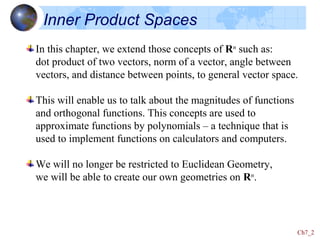
In this chapter, we extend those concepts of Rn
such as:
dot product of two vectors, norm of a vector, angle between
vectors, and distance between points, to general vector space.
This will enable us to talk about the magnitudes of functions
and orthogonal functions. This concepts are used to
approximate functions by polynomials – a technique that is
used to implement functions on calculators and computers.
We will no longer be restricted to Euclidean Geometry,
we will be able to create our own geometries on Rn
.
Ch7_3
7.1 Inner Product Spaces
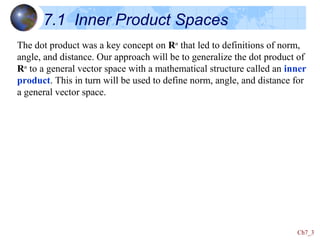
The dot product was a key concept on Rn
that led to definitions of norm,
angle, and distance. Our approach will be to generalize the dot product of
Rn
to a general vector space with a mathematical structure called an inner
product. This in turn will be used to define norm, angle, and distance for
a general vector space.
Ch7_4
Definition
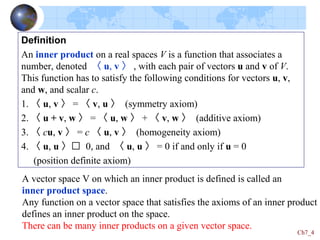
An inner product on a real spaces V is a function that associates a
number, denoted 〈 u, v 〉 , with each pair of vectors u and v of V.
This function has to satisfy the following conditions for vectors u, v,
and w, and scalar c.
1. 〈 u, v 〉 = 〈 v, u 〉 (symmetry axiom)
2. 〈 u + v, w 〉 = 〈 u, w 〉 + 〈 v, w 〉 (additive axiom)
3. 〈 cu, v 〉 = c 〈 u, v 〉 (homogeneity axiom)
4. 〈 u, u 〉 0, and 〈 u, u 〉 = 0 if and only if u = 0
(position definite axiom)
A vector space V on which an inner product is defined is called an
inner product space.
Any function on a vector space that satisfies the axioms of an inner product
defines an inner product on the space.
There can be many inner products on a given vector space.
Ch7_5
Example 1
Let u = (x1, x2), v = (y1, y2), and w = (z1, z2) be arbitrary vectors in
R2
. Prove that 〈 u, v 〉 , defined as follows, is an inner product
on R2
.
〈 u, v 〉 = x1y1 + 4x2y2
Determine the inner product of the vectors (−2, 5), (3, 1) under
this inner product.
Solution
Axiom 1: 〈 u, v 〉 = x1y1 + 4x2y2 = y1x1 + 4y2x2 = 〈 v, u 〉
Axiom 2: 〈 u + v, w 〉 = 〈 (x1, x2) + (y1, y2) , (z1, z2) 〉
= 〈 (x1 + y1, x2 + y2), (z1, z2) 〉
= (x1 + y1) z1 + 4(x2 + y2)z2
= x1z1 + 4x2z2 + y1 z1 + 4 y2z2
= 〈 (x1, x2), (z1, z2) 〉 + 〈 (y1, y2), (z1, z2) 〉
Ch7_6
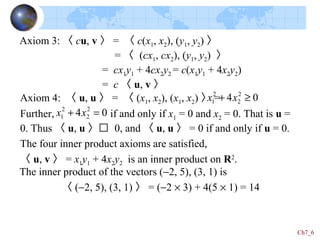
Axiom 3: 〈 cu, v 〉 = 〈 c(x1, x2), (y1, y2) 〉
= 〈 (cx1, cx2), (y1, y2) 〉
= cx1y1 + 4cx2y2 = c(x1y1 + 4x2y2)
= c 〈 u, v 〉
Axiom 4: 〈 u, u 〉 = 〈 (x1, x2), (x1, x2) 〉 = 04 2
2
2
1 ≥+ xx
Further, if and only if x1 = 0 and x2 = 0. That is u =
0. Thus 〈 u, u 〉 0, and 〈 u, u 〉 = 0 if and only if u = 0.
The four inner product axioms are satisfied,
〈 u, v 〉 = x1y1 + 4x2y2 is an inner product on R2
.
04 2
2
2
1 =+ xx
The inner product of the vectors (−2, 5), (3, 1) is
〈 (−2, 5), (3, 1) 〉 = (−2 × 3) + 4(5 × 1) = 14
Ch7_7
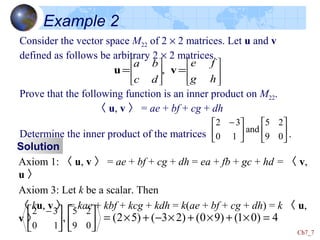
Example 2
Consider the vector space M22 of 2 × 2 matrices. Let u and v
defined as follows be arbitrary 2 × 2 matrices.
Prove that the following function is an inner product on M22.
〈 u, v 〉 = ae + bf + cg + dh
Determine the inner product of the matrices .




















==
hg
fe
dc
ba
vu ,
Solution
Axiom 1: 〈 u, v 〉 = ae + bf + cg + dh = ea + fb + gc + hd = 〈 v,
u 〉
Axiom 3: Let k be a scalar. Then
〈 ku, v 〉 = kae + kbf + kcg + kdh = k(ae + bf + cg + dh) = k 〈 u,
v 〉 4)01()90()23()52(,
09
25
10
32
=×+×+×−+×=






 −











 −
09
25
and
10
32
Ch7_8
Example 3
Consider the vector space Pn of polynomials of degree ≤ n. Let f
and g be elements of Pn. Prove that the following function
defines an inner product of Pn.
Determine the inner product of polynomials
f(x) = x2
+ 2x – 1 and g(x) = 4x + 1
∫=
1
0
)()(g, dxxgxff
Solution
Axiom 1: fgdxxfxgdxxgxfgf ,)()()()(,
1
0
1
0
=== ∫∫
hghf
dxxhxgdxxhxf
dxxhxgxhxf
dxxhxgxfhgf
,,
)()()]()([
)]()()()([
)()]()([,
1
0
1
0
1
0
1
0
+=
+=
+=
+=+
∫∫
∫
∫Axiom 2:
Ch7_9
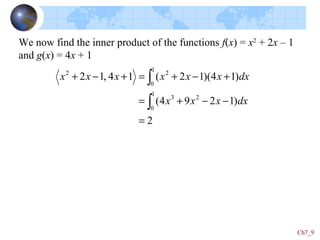
We now find the inner product of the functions f(x) = x2
+ 2x – 1
and g(x) = 4x + 1
2
)1294(
)14)(12(14,12
1
0
23
1
0
22
=
−−+=
+−+=+−+
∫
∫
dxxxx
dxxxxxxx
Ch7_10
Norm of a Vector
Definition
Let V be an inner product space. The norm of a vector v is
denoted ||v|| and it defined by
vv,v =
The norm of a vector in Rn
can be expressed in terms of the dot
product as follows
),,,(),,,(
)(),,,(
2121
22
121
nn
nn
xxxxxx
xxxxx


⋅=
++=
Generalize this definition:
The norms in general vector space do not necessary have geometric
interpretations, but are often important in numerical work.
Ch7_11
Example 4
Consider the vector space Pn of polynomials with inner product
The norm of the function f generated by this inner product is
Determine the norm of the function f(x) = 5x2
+ 1.
∫=
1
0
)()(, dxxgxfgf
∫==
1
0
2
)]([, dxxffff
Solution Using the above definition of norm, we get
3
28
1
0
24
1
0
222
]11025[
]15[15
=
++=
+=+
∫
∫
dxxx
dxxx
The norm of the function f(x) = 5x2
+ 1 is .
3
28
Ch7_12
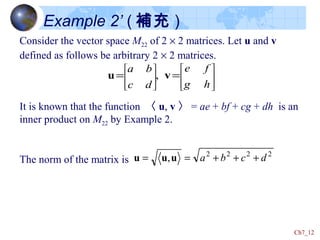
Example 2’ ( 補充 )
Consider the vector space M22 of 2 × 2 matrices. Let u and v
defined as follows be arbitrary 2 × 2 matrices.
It is known that the function 〈 u, v 〉 = ae + bf + cg + dh is an
inner product on M22 by Example 2.
The norm of the matrix is




















==
hg
fe
dc
ba
vu ,
2222
, dcba +++== uuu
Ch7_13
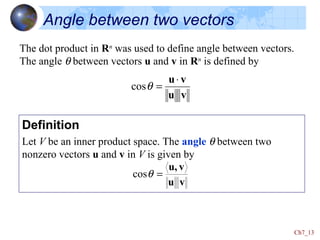
Definition
Let V be an inner product space. The angle θ between two
nonzero vectors u and v in V is given by
vu
vu,
=θcos
The dot product in Rn
was used to define angle between vectors.
The angle θ between vectors u and v in Rn
is defined by
vu
vu⋅
=θcos
Angle between two vectors
Ch7_14
Example 5
Consider the inner product space Pn of polynomials with inner
product
The angle between two nonzero functions f and g is given by
Determine the cosine of the angle between the functions
f(x) = 5x2
and g(x) = 3x
∫=
1
0
)()(, dxxgxfgf
gf
dxxgxf
gf
gf )()(,
cos
1
0∫==θ
Solution We first compute ||f || and ||g||.
3]3[3and5]5[5
1
0
2
1
0
222
==== ∫∫ dxxxdxxx
Thus
4
15
35
)3)(5()()(
cos
1
0
2
1
0
===
∫∫ dxxx
gf
dxxgxf
θ
Ch7_15
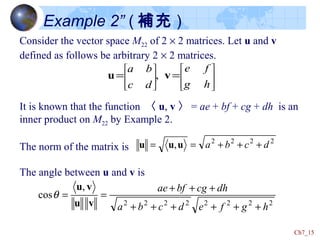
Example 2” ( 補充 )
Consider the vector space M22 of 2 × 2 matrices. Let u and v
defined as follows be arbitrary 2 × 2 matrices.
It is known that the function 〈 u, v 〉 = ae + bf + cg + dh is an
inner product on M22 by Example 2.
The norm of the matrix is
The angle between u and v is




















==
hg
fe
dc
ba
vu ,
2222
, dcba +++== uuu
22222222
,
cos
hgfedcba
dhcgbfae
++++++
+++
==
vu
vu
θ
Ch7_16
Orthogonal Vectors
Def. Let V be an inner product space. Two nonzero vectors u and
v in V are said to be orthogonal if
0, =vu
Example 6
Show that the functions f(x) = 3x – 2 and g(x) = x are orthogonal
in Pn with inner product
.)()(,
1
0∫= dxxgxfgf
Solution
0][))(23(,23 1
0
23
1
0
=−=−=− ∫ xxdxxxxx
Thus the functions f and g are orthogonal in this inner product
Space.
Ch7_17
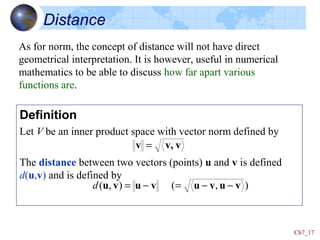
Distance
Definition
Let V be an inner product space with vector norm defined by
The distance between two vectors (points) u and v is defined
d(u,v) and is defined by
vv,v =
),(),( vuvuvuvu −−=−=d
As for norm, the concept of distance will not have direct
geometrical interpretation. It is however, useful in numerical
mathematics to be able to discuss how far apart various
functions are.
Ch7_18
Example 7
Consider the inner product space Pn of polynomials discussed
earlier. Determine which of the functions g(x) = x2
– 3x + 5 or h(x)
= x2
+ 4 is closed to f(x) = x2
.
Solution
13)53(53,53,)],([
1
0
22
=−=−−=−−= ∫ dxxxxgfgfgfd
16)4(4,4,)],([
1
0
22
=−=−−=−−= ∫ dxhfhfhfd
Thus
The distance between f and h is 4, as we might suspect, g is closer
than h to f.
.4),(and13),( == hfdgfd
Ch7_19
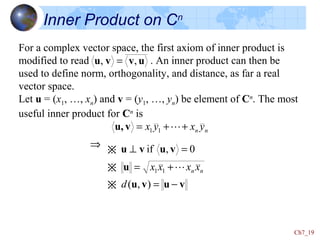
Inner Product on Cn
For a complex vector space, the first axiom of inner product is
modified to read . An inner product can then be
used to define norm, orthogonality, and distance, as far a real
vector space.
Let u = (x1, …, xn) and v = (y1, …, yn) be element of Cn
. The most
useful inner product for Cn
is
uvvu ,, =
nn yxyx ++= 11vu,
vuvu
u
vuvu
−=
+=
=⊥
),(
0,if
11
d
xxxx nn
※
※
※

⇒
Ch7_20
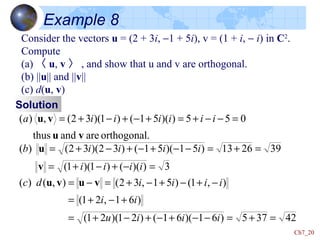
Example 8
Consider the vectors u = (2 + 3i, −1 + 5i), v = (1 + i, − i) in C2
.
Compute
(a) 〈 u, v 〉 , and show that u and v are orthogonal.
(b) ||u|| and ||v||
(c) d(u, v)
Solution
.orthogonalareandthus
055))(51()1)(32(,)(
vu
vu =−−+=+−+−+= iiiiiia
3))(()1)(1(
392613)51)(51()32)(32()(
=−+−+=
=+=−−+−+−+=
iiii
iiiib
v
u
42375)61)(61()21)(21(
)61,21(
),1()51,32(),()(
=+=−−+−+−+=
+−+=
−+−+−+=−=
iiiu
ii
iiiidc vuvu
Ch7_21
Homework
Exercise 7.1:
1, 4, 8(a), 9(a), 10, 12, 13, 15, 17(a), 19,
20(a)
Ch7_22
7.2 Non-Euclidean Geometry and
Special Relativity
Different inner products on Rn
lead to different measures of
vector norm, angle, and distance – that is, to different geometries.
dot product ⇒ Euclidean geometry
other inner products ⇒ non-Euclidean geometries
Example
Let u = (x1, x2), v = (y1, y2) be arbitrary vectors in R2
. It is proved
that 〈 u, v 〉 , defined as follows, is an inner product on R2
.
〈 u, v 〉 = x1y1 + 4x2y2
The inner product differs from the dot product in the appearance
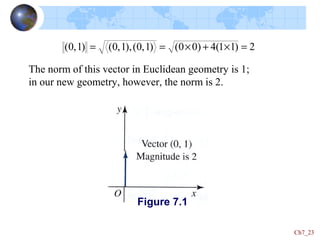
of a 4. Consider the vector (0, 1) in this space. The norm of this
vector is
Ch7_23
2)11(4)00()1,0(),1,0()1,0( =×+×==
Figure 7.1
The norm of this vector in Euclidean geometry is 1;
in our new geometry, however, the norm is 2.
Ch7_24
Consider the vectors (1, 1) and (−4, 1). The inner product of these
vectors is
0)11(4)41()1,4(),1,1( =×+−×=−
Figure 7.2
Thus these two vectors are orthogonal.
Ch7_25
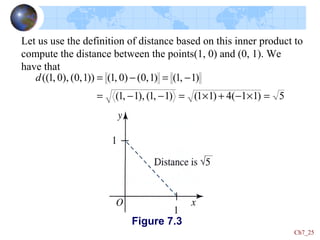
Let us use the definition of distance based on this inner product to
compute the distance between the points(1, 0) and (0, 1). We
have that
5)11(4)11()1,1(),1,1(
)1,1()1,0()0,1())1,0(),0,1((
=×−+×=−−=
−=−=d
Figure 7.3
Ch7_26
7.4 Least-Squares Curves
To find a polynomial that best fits given data points.
Ax = y :
(1) if n equations, n variables, and A−1
exists
⇒ x = A−1
y
(2) if n equations, m variables with n > m
⇒ overdetermined
How to solve it?
We will introduce a matrix called the pseudoinverse of A,
denoted pinv(A), that leads to a least-squares solution
x = pinv(A)y for an overdetermined system.
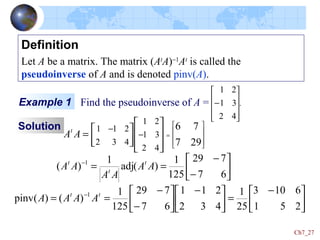
Ch7_27
Definition
Let A be a matrix. The matrix (At
A)−1
At
is called the
pseudoinverse of A and is denoted pinv(A).
Example 1 Find the pseudoinverse of A = .
42
31
21










−
Solution










=











= −
−
297
76
42
31
21
432
211
AAt






−
−
==−
67
729
125
1
)(adj
1
)( 1
AA
AA
AA t
t
t





 −
=




 −






−
−
== −
251
6103
25
1
432
211
67
729
125
1
)()(pinv 1 tt
AAAA
Ch7_28
Ax = y x = pinv(A)y
system least-squares solution
If the system Ax=y has a unique solution, the least-squares
solution is that unique solution.
If the system is overdetermined, the least-squares solution is the
closest we can get to a true solution.
The system cannot have many solutions.
Let Ax = y be a system of n linear equations in m variables with
n > m, where A is of rank m.
Ax=y ⇒ At
Ax=At
y ⇒ x = (At
A)−1
At
y
At
A is invertible
Ch7_29
Example 2
Find the least-squares solution of the following overdetermined
system of equations. Sketch the solution.
Solution
932
3
6
=+
=+−
=+
yx
yx
yx
The matrix of coefficients is








=








= −
9
3
6
32
11
11
and yA






=











= −
−
116
66
32
11
11
311
211
AAt






==−
116
66
30
1
)(adj
1
)( 1
AA
AA
AA t
t
t





 −
=




 −






−
−
== −
6120
4175
30
1
311
211
66
611
30
1
)()(pinv 1 tt
AAAA
rank(A)=2 ⇒
Ch7_30
The least-squares solution is
The least-squares solution is the point






=















 −
=
3
9
3
6
6120
4175
30
1
)(pinv 2
1
yA
).3,(2
1
P
Figure 7.9
Ch7_31
Least-Square Curves
Figure 7.10
Least-squares line or curve minimizes
22
2
2
1 nddd +++ 
Ch7_32
Example 3
Find the least-squares line for the following data points.
(1, 1), (2, 4), (3, 2), (4, 4)
Solution
Let the equation of the line by y = a + bx. Substituting for these
points into the equation of the line, we get the overdetermined
system
44
23
42
1
=+
=+
=+
=+
ba
ba
ba
ba
We find the least squares solution. The matrix of coefficients A
and column vector y are as follows.








=








=
4
2
4
1
41
31
21
11
and yA
It can be shown that






−−
−
== −
6226
1001020
20
1
)()(pinv 1 tt
AAAA
Ch7_33
The least squares solution is
Thus a = 1, b = 0.7.
The equation of the least-squares line for this data is
y = 1 + 0.7x






=














−−
−
=−
7.0
1
6226
1001020
20
1
])[(
4
2
4
1
1
ytt
AAA
Figure 7.11
Ch7_34
Example 4
Find the least-squares parabola for the following data points.
(1, 7), (2, 2), (3, 1), (4, 3)
Solution
Let the equation of the parabola be y = a + bx + cx2
. Substituting
for these points into the equation of the parabola, we get the
system
3164
193
242
7
=++
=++
=++
=++
cba
cba
cba
cba
We find the least squares solution. The matrix of coefficients A
and column vector y are as follows.








=








=
3
1
2
7
1641
931
421
111
and yA
It can be shown that






==
−−
−−
−−
−
5555
19272331
15251545
1
20
1
)()(pinv tt
AAAA
Ch7_35
The least squares solution is
Thus a = 15.25, b = -10.05, c = 1.75.
The equation of the least-squares parabola for these data points is
y = 15.25 – 10.05x + 1.75x2








=














= −
−−
−−
−−
−
75.1
05.10
25.15
3
1
2
7
5555
19272331
15251545
1
20
1
])[( ytt
AAA
Figure 7.12
Ch7_36
Let (x1, y1), …, (xn, yn) be a set of n data points. Let y = a0 + … +
amxm be a polynomial of degree m (n > m) that is to be fitted to
these points. Substituting these points into the polynomial leads
to a system Ax = y of n linear equations in the m variables a0, …,
am, where
The least-squares solution to
this system gives the coefficients
of the least-squares polynomial
for these data points.
Theorem 7.1










=










=
n
m
nn
m
y
y
xx
xx
A 


 111
and
1
1
y
Figure 7.13
y’ is the projection of y onto range(A)
Ch7_37
Homework
Exercise 7.4
3, 11, 21

1639 vector-linear algebra

  • 1.
    Chapter 7 Inner ProductSpaces 大葉大學 資訊工程系 鈴玲黃 Linear Algebra
  • 2.
    Ch7_2 Inner Product Spaces Inthis chapter, we extend those concepts of Rn such as: dot product of two vectors, norm of a vector, angle between vectors, and distance between points, to general vector space. This will enable us to talk about the magnitudes of functions and orthogonal functions. This concepts are used to approximate functions by polynomials – a technique that is used to implement functions on calculators and computers. We will no longer be restricted to Euclidean Geometry, we will be able to create our own geometries on Rn .
  • 3.
    Ch7_3 7.1 Inner ProductSpaces The dot product was a key concept on Rn that led to definitions of norm, angle, and distance. Our approach will be to generalize the dot product of Rn to a general vector space with a mathematical structure called an inner product. This in turn will be used to define norm, angle, and distance for a general vector space.
  • 4.
    Ch7_4 Definition An inner producton a real spaces V is a function that associates a number, denoted 〈 u, v 〉 , with each pair of vectors u and v of V. This function has to satisfy the following conditions for vectors u, v, and w, and scalar c. 1. 〈 u, v 〉 = 〈 v, u 〉 (symmetry axiom) 2. 〈 u + v, w 〉 = 〈 u, w 〉 + 〈 v, w 〉 (additive axiom) 3. 〈 cu, v 〉 = c 〈 u, v 〉 (homogeneity axiom) 4. 〈 u, u 〉 0, and 〈 u, u 〉 = 0 if and only if u = 0 (position definite axiom) A vector space V on which an inner product is defined is called an inner product space. Any function on a vector space that satisfies the axioms of an inner product defines an inner product on the space. There can be many inner products on a given vector space.
  • 5.
    Ch7_5 Example 1 Let u= (x1, x2), v = (y1, y2), and w = (z1, z2) be arbitrary vectors in R2 . Prove that 〈 u, v 〉 , defined as follows, is an inner product on R2 . 〈 u, v 〉 = x1y1 + 4x2y2 Determine the inner product of the vectors (−2, 5), (3, 1) under this inner product. Solution Axiom 1: 〈 u, v 〉 = x1y1 + 4x2y2 = y1x1 + 4y2x2 = 〈 v, u 〉 Axiom 2: 〈 u + v, w 〉 = 〈 (x1, x2) + (y1, y2) , (z1, z2) 〉 = 〈 (x1 + y1, x2 + y2), (z1, z2) 〉 = (x1 + y1) z1 + 4(x2 + y2)z2 = x1z1 + 4x2z2 + y1 z1 + 4 y2z2 = 〈 (x1, x2), (z1, z2) 〉 + 〈 (y1, y2), (z1, z2) 〉
  • 6.
    Ch7_6 Axiom 3: 〈cu, v 〉 = 〈 c(x1, x2), (y1, y2) 〉 = 〈 (cx1, cx2), (y1, y2) 〉 = cx1y1 + 4cx2y2 = c(x1y1 + 4x2y2) = c 〈 u, v 〉 Axiom 4: 〈 u, u 〉 = 〈 (x1, x2), (x1, x2) 〉 = 04 2 2 2 1 ≥+ xx Further, if and only if x1 = 0 and x2 = 0. That is u = 0. Thus 〈 u, u 〉 0, and 〈 u, u 〉 = 0 if and only if u = 0. The four inner product axioms are satisfied, 〈 u, v 〉 = x1y1 + 4x2y2 is an inner product on R2 . 04 2 2 2 1 =+ xx The inner product of the vectors (−2, 5), (3, 1) is 〈 (−2, 5), (3, 1) 〉 = (−2 × 3) + 4(5 × 1) = 14
  • 7.
    Ch7_7 Example 2 Consider thevector space M22 of 2 × 2 matrices. Let u and v defined as follows be arbitrary 2 × 2 matrices. Prove that the following function is an inner product on M22. 〈 u, v 〉 = ae + bf + cg + dh Determine the inner product of the matrices .                     == hg fe dc ba vu , Solution Axiom 1: 〈 u, v 〉 = ae + bf + cg + dh = ea + fb + gc + hd = 〈 v, u 〉 Axiom 3: Let k be a scalar. Then 〈 ku, v 〉 = kae + kbf + kcg + kdh = k(ae + bf + cg + dh) = k 〈 u, v 〉 4)01()90()23()52(, 09 25 10 32 =×+×+×−+×=        −             − 09 25 and 10 32
  • 8.
    Ch7_8 Example 3 Consider thevector space Pn of polynomials of degree ≤ n. Let f and g be elements of Pn. Prove that the following function defines an inner product of Pn. Determine the inner product of polynomials f(x) = x2 + 2x – 1 and g(x) = 4x + 1 ∫= 1 0 )()(g, dxxgxff Solution Axiom 1: fgdxxfxgdxxgxfgf ,)()()()(, 1 0 1 0 === ∫∫ hghf dxxhxgdxxhxf dxxhxgxhxf dxxhxgxfhgf ,, )()()]()([ )]()()()([ )()]()([, 1 0 1 0 1 0 1 0 += += += +=+ ∫∫ ∫ ∫Axiom 2:
  • 9.
    Ch7_9 We now findthe inner product of the functions f(x) = x2 + 2x – 1 and g(x) = 4x + 1 2 )1294( )14)(12(14,12 1 0 23 1 0 22 = −−+= +−+=+−+ ∫ ∫ dxxxx dxxxxxxx
  • 10.
    Ch7_10 Norm of aVector Definition Let V be an inner product space. The norm of a vector v is denoted ||v|| and it defined by vv,v = The norm of a vector in Rn can be expressed in terms of the dot product as follows ),,,(),,,( )(),,,( 2121 22 121 nn nn xxxxxx xxxxx   ⋅= ++= Generalize this definition: The norms in general vector space do not necessary have geometric interpretations, but are often important in numerical work.
  • 11.
    Ch7_11 Example 4 Consider thevector space Pn of polynomials with inner product The norm of the function f generated by this inner product is Determine the norm of the function f(x) = 5x2 + 1. ∫= 1 0 )()(, dxxgxfgf ∫== 1 0 2 )]([, dxxffff Solution Using the above definition of norm, we get 3 28 1 0 24 1 0 222 ]11025[ ]15[15 = ++= +=+ ∫ ∫ dxxx dxxx The norm of the function f(x) = 5x2 + 1 is . 3 28
  • 12.
    Ch7_12 Example 2’ (補充 ) Consider the vector space M22 of 2 × 2 matrices. Let u and v defined as follows be arbitrary 2 × 2 matrices. It is known that the function 〈 u, v 〉 = ae + bf + cg + dh is an inner product on M22 by Example 2. The norm of the matrix is                     == hg fe dc ba vu , 2222 , dcba +++== uuu
  • 13.
    Ch7_13 Definition Let V bean inner product space. The angle θ between two nonzero vectors u and v in V is given by vu vu, =θcos The dot product in Rn was used to define angle between vectors. The angle θ between vectors u and v in Rn is defined by vu vu⋅ =θcos Angle between two vectors
  • 14.
    Ch7_14 Example 5 Consider theinner product space Pn of polynomials with inner product The angle between two nonzero functions f and g is given by Determine the cosine of the angle between the functions f(x) = 5x2 and g(x) = 3x ∫= 1 0 )()(, dxxgxfgf gf dxxgxf gf gf )()(, cos 1 0∫==θ Solution We first compute ||f || and ||g||. 3]3[3and5]5[5 1 0 2 1 0 222 ==== ∫∫ dxxxdxxx Thus 4 15 35 )3)(5()()( cos 1 0 2 1 0 === ∫∫ dxxx gf dxxgxf θ
  • 15.
    Ch7_15 Example 2” (補充 ) Consider the vector space M22 of 2 × 2 matrices. Let u and v defined as follows be arbitrary 2 × 2 matrices. It is known that the function 〈 u, v 〉 = ae + bf + cg + dh is an inner product on M22 by Example 2. The norm of the matrix is The angle between u and v is                     == hg fe dc ba vu , 2222 , dcba +++== uuu 22222222 , cos hgfedcba dhcgbfae ++++++ +++ == vu vu θ
  • 16.
    Ch7_16 Orthogonal Vectors Def. LetV be an inner product space. Two nonzero vectors u and v in V are said to be orthogonal if 0, =vu Example 6 Show that the functions f(x) = 3x – 2 and g(x) = x are orthogonal in Pn with inner product .)()(, 1 0∫= dxxgxfgf Solution 0][))(23(,23 1 0 23 1 0 =−=−=− ∫ xxdxxxxx Thus the functions f and g are orthogonal in this inner product Space.
  • 17.
    Ch7_17 Distance Definition Let V bean inner product space with vector norm defined by The distance between two vectors (points) u and v is defined d(u,v) and is defined by vv,v = ),(),( vuvuvuvu −−=−=d As for norm, the concept of distance will not have direct geometrical interpretation. It is however, useful in numerical mathematics to be able to discuss how far apart various functions are.
  • 18.
    Ch7_18 Example 7 Consider theinner product space Pn of polynomials discussed earlier. Determine which of the functions g(x) = x2 – 3x + 5 or h(x) = x2 + 4 is closed to f(x) = x2 . Solution 13)53(53,53,)],([ 1 0 22 =−=−−=−−= ∫ dxxxxgfgfgfd 16)4(4,4,)],([ 1 0 22 =−=−−=−−= ∫ dxhfhfhfd Thus The distance between f and h is 4, as we might suspect, g is closer than h to f. .4),(and13),( == hfdgfd
  • 19.
    Ch7_19 Inner Product onCn For a complex vector space, the first axiom of inner product is modified to read . An inner product can then be used to define norm, orthogonality, and distance, as far a real vector space. Let u = (x1, …, xn) and v = (y1, …, yn) be element of Cn . The most useful inner product for Cn is uvvu ,, = nn yxyx ++= 11vu, vuvu u vuvu −= += =⊥ ),( 0,if 11 d xxxx nn ※ ※ ※  ⇒
  • 20.
    Ch7_20 Example 8 Consider thevectors u = (2 + 3i, −1 + 5i), v = (1 + i, − i) in C2 . Compute (a) 〈 u, v 〉 , and show that u and v are orthogonal. (b) ||u|| and ||v|| (c) d(u, v) Solution .orthogonalareandthus 055))(51()1)(32(,)( vu vu =−−+=+−+−+= iiiiiia 3))(()1)(1( 392613)51)(51()32)(32()( =−+−+= =+=−−+−+−+= iiii iiiib v u 42375)61)(61()21)(21( )61,21( ),1()51,32(),()( =+=−−+−+−+= +−+= −+−+−+=−= iiiu ii iiiidc vuvu
  • 21.
    Ch7_21 Homework Exercise 7.1: 1, 4,8(a), 9(a), 10, 12, 13, 15, 17(a), 19, 20(a)
  • 22.
    Ch7_22 7.2 Non-Euclidean Geometryand Special Relativity Different inner products on Rn lead to different measures of vector norm, angle, and distance – that is, to different geometries. dot product ⇒ Euclidean geometry other inner products ⇒ non-Euclidean geometries Example Let u = (x1, x2), v = (y1, y2) be arbitrary vectors in R2 . It is proved that 〈 u, v 〉 , defined as follows, is an inner product on R2 . 〈 u, v 〉 = x1y1 + 4x2y2 The inner product differs from the dot product in the appearance of a 4. Consider the vector (0, 1) in this space. The norm of this vector is
  • 23.
    Ch7_23 2)11(4)00()1,0(),1,0()1,0( =×+×== Figure 7.1 Thenorm of this vector in Euclidean geometry is 1; in our new geometry, however, the norm is 2.
  • 24.
    Ch7_24 Consider the vectors(1, 1) and (−4, 1). The inner product of these vectors is 0)11(4)41()1,4(),1,1( =×+−×=− Figure 7.2 Thus these two vectors are orthogonal.
  • 25.
    Ch7_25 Let us usethe definition of distance based on this inner product to compute the distance between the points(1, 0) and (0, 1). We have that 5)11(4)11()1,1(),1,1( )1,1()1,0()0,1())1,0(),0,1(( =×−+×=−−= −=−=d Figure 7.3
  • 26.
    Ch7_26 7.4 Least-Squares Curves Tofind a polynomial that best fits given data points. Ax = y : (1) if n equations, n variables, and A−1 exists ⇒ x = A−1 y (2) if n equations, m variables with n > m ⇒ overdetermined How to solve it? We will introduce a matrix called the pseudoinverse of A, denoted pinv(A), that leads to a least-squares solution x = pinv(A)y for an overdetermined system.
  • 27.
    Ch7_27 Definition Let A bea matrix. The matrix (At A)−1 At is called the pseudoinverse of A and is denoted pinv(A). Example 1 Find the pseudoinverse of A = . 42 31 21           − Solution           =            = − − 297 76 42 31 21 432 211 AAt       − − ==− 67 729 125 1 )(adj 1 )( 1 AA AA AA t t t       − =      −       − − == − 251 6103 25 1 432 211 67 729 125 1 )()(pinv 1 tt AAAA
  • 28.
    Ch7_28 Ax = yx = pinv(A)y system least-squares solution If the system Ax=y has a unique solution, the least-squares solution is that unique solution. If the system is overdetermined, the least-squares solution is the closest we can get to a true solution. The system cannot have many solutions. Let Ax = y be a system of n linear equations in m variables with n > m, where A is of rank m. Ax=y ⇒ At Ax=At y ⇒ x = (At A)−1 At y At A is invertible
  • 29.
    Ch7_29 Example 2 Find theleast-squares solution of the following overdetermined system of equations. Sketch the solution. Solution 932 3 6 =+ =+− =+ yx yx yx The matrix of coefficients is         =         = − 9 3 6 32 11 11 and yA       =            = − − 116 66 32 11 11 311 211 AAt       ==− 116 66 30 1 )(adj 1 )( 1 AA AA AA t t t       − =      −       − − == − 6120 4175 30 1 311 211 66 611 30 1 )()(pinv 1 tt AAAA rank(A)=2 ⇒
  • 30.
    Ch7_30 The least-squares solutionis The least-squares solution is the point       =                 − = 3 9 3 6 6120 4175 30 1 )(pinv 2 1 yA ).3,(2 1 P Figure 7.9
  • 31.
    Ch7_31 Least-Square Curves Figure 7.10 Least-squaresline or curve minimizes 22 2 2 1 nddd +++ 
  • 32.
    Ch7_32 Example 3 Find theleast-squares line for the following data points. (1, 1), (2, 4), (3, 2), (4, 4) Solution Let the equation of the line by y = a + bx. Substituting for these points into the equation of the line, we get the overdetermined system 44 23 42 1 =+ =+ =+ =+ ba ba ba ba We find the least squares solution. The matrix of coefficients A and column vector y are as follows.         =         = 4 2 4 1 41 31 21 11 and yA It can be shown that       −− − == − 6226 1001020 20 1 )()(pinv 1 tt AAAA
  • 33.
    Ch7_33 The least squaressolution is Thus a = 1, b = 0.7. The equation of the least-squares line for this data is y = 1 + 0.7x       =               −− − =− 7.0 1 6226 1001020 20 1 ])[( 4 2 4 1 1 ytt AAA Figure 7.11
  • 34.
    Ch7_34 Example 4 Find theleast-squares parabola for the following data points. (1, 7), (2, 2), (3, 1), (4, 3) Solution Let the equation of the parabola be y = a + bx + cx2 . Substituting for these points into the equation of the parabola, we get the system 3164 193 242 7 =++ =++ =++ =++ cba cba cba cba We find the least squares solution. The matrix of coefficients A and column vector y are as follows.         =         = 3 1 2 7 1641 931 421 111 and yA It can be shown that       == −− −− −− − 5555 19272331 15251545 1 20 1 )()(pinv tt AAAA
  • 35.
    Ch7_35 The least squaressolution is Thus a = 15.25, b = -10.05, c = 1.75. The equation of the least-squares parabola for these data points is y = 15.25 – 10.05x + 1.75x2         =               = − −− −− −− − 75.1 05.10 25.15 3 1 2 7 5555 19272331 15251545 1 20 1 ])[( ytt AAA Figure 7.12
  • 36.
    Ch7_36 Let (x1, y1),…, (xn, yn) be a set of n data points. Let y = a0 + … + amxm be a polynomial of degree m (n > m) that is to be fitted to these points. Substituting these points into the polynomial leads to a system Ax = y of n linear equations in the m variables a0, …, am, where The least-squares solution to this system gives the coefficients of the least-squares polynomial for these data points. Theorem 7.1           =           = n m nn m y y xx xx A     111 and 1 1 y Figure 7.13 y’ is the projection of y onto range(A)
  • 37.