The document discusses various topics in three dimensional geometry, including:
1. Coordinate systems define three perpendicular coordinate axes dividing space into eight parts.
2. The distance between two points P and Q is calculated as the square root of the sum of the squares of the differences between their x, y, and z coordinates.
3. Section formulae give the coordinates of points dividing or projecting onto lines between two given points.
Introduction to the topic of Three Dimensional Geometry by Urmila Bhardwaj.
Explanation of a three-dimensional coordinate system consisting of three axes dividing space.
Formulas to calculate the distance between points in 3D, and section formulae for dividing segments.
Centroid formulas for triangles and tetrahedrons, as well as direction cosines definitions and properties.
Formulas for angles between lines, projections on axes, skew lines, and calculating shortest distances.Methods to find the shortest distance between skew lines and distance formulas related to them.
General equations of planes, conditions for coplanarity, and specific cases of plane equations.
Calculating angles between planes, distance from points to planes and properties of parallel planes.
Equations of spheres in different forms, conditions for tangency to planes, and sections of spheres.
Contact details of Urmila Bhardwaj, Assistant Professor at Advanced Educational Institutions.
THREE DIMENSIONAL GEOMETRY
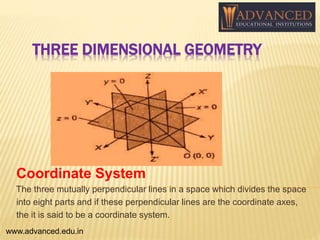
CoordinateSystem
The three mutually perpendicular lines in a space which divides the space
into eight parts and if these perpendicular lines are the coordinate axes,
the it is said to be a coordinate system.
www.advanced.edu.in
3.
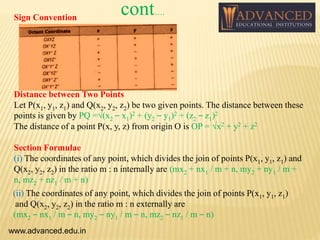
Distance between TwoPoints
Let P(x1, y1, z1) and Q(x2, y2, z2) be two given points. The distance between these
points is given by PQ =√(x2 – x1)2 + (y2 – y1)2 + (z2 – z1)2
The distance of a point P(x, y, z) from origin O is OP = √x2 + y2 + z2
Section Formulae
(i) The coordinates of any point, which divides the join of points P(x1, y1, z1) and
Q(x2, y2, z2) in the ratio m : n internally are (mx2 + nx1 / m + n, my2 + ny1 / m +
n, mz2 + nz1 / m + n)
(ii) The coordinates of any point, which divides the join of points P(x1, y1, z1)
and Q(x2, y2, z2) in the ratio m : n externally are
(mx2 – nx1 / m – n, my2 – ny1 / m – n, mz2 – nz1 / m – n)
www.advanced.edu.in
Sign Convention
cont….
4.
(iv) The coordinatesof the centroid of a triangle formed with vertices
P(x1, y1, z1) and Q(x2, y2, z2) and R(x3, y3, z3) are-
(x1 + x2 + x3 / 3 , y1 + y2 + y3 / 3, z1 + z2 + z3 / 3)
(v) Centroid of a Tetrahedron
If (x1, y1, z1), (x2, y2, z2), (x3, y3, z3) and (x4, y4, z4) are the vertices of
a tetrahedron, then its centroid G is given by-
(x1 + x2 + x3 + x4 / 4 , y1 + y2 + y3 + y4 / 4, z1 + z2 + z3 + z4 / 4)
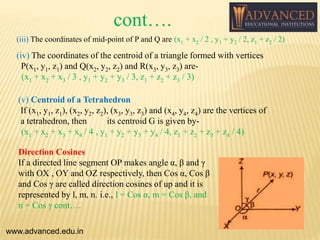
Direction Cosines
If a directed line segment OP makes angle α, β and γ
with OX , OY and OZ respectively, then Cos α, Cos β
and Cos γ are called direction cosines of up and it is
represented by l, m, n. i.e., l = Cos α, m = Cos β, and
n = Cos γ cont….
(iii) The coordinates of mid-point of P and Q are (x1 + x2 / 2 , y1 + y2 / 2, z1 + z2 / 2)
www.advanced.edu.in
cont….
5.
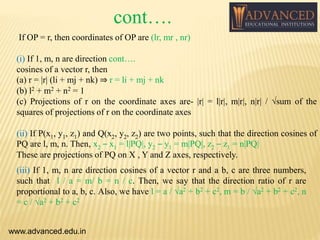
If OP =r, then coordinates of OP are (lr, mr , nr)
(i) If 1, m, n are direction cont….
cosines of a vector r, then
(a) r = |r| (li + mj + nk) ⇒ r = li + mj + nk
(b) l2 + m2 + n2 = 1
(c) Projections of r on the coordinate axes are- |r| = l|r|, m|r|, n|r| / √sum of the
squares of projections of r on the coordinate axes
(ii) If P(x1, y1, z1) and Q(x2, y2, z2) are two points, such that the direction cosines of
PQ are l, m, n. Then, x2 – x1 = l|PQ|, y2 – y1 = m|PQ|, z2 – z1 = n|PQ|
These are projections of PQ on X , Y and Z axes, respectively.
www.advanced.edu.in
(iii) If 1, m, n are direction cosines of a vector r and a b, c are three numbers,
such that l / a = m/ b = n / c. Then, we say that the direction ratio of r are
proportional to a, b, c. Also, we have l = a / √a2 + b2 + c2, m = b / √a2 + b2 + c2, n
= c / √a2 + b2 + c2
cont….
6.
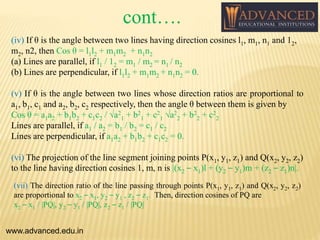
(iv) If θis the angle between two lines having direction cosines l1, m1, n1 and 12,
m2, n2, then Cos θ = l1l2 + m1m2 + n1n2
(a) Lines are parallel, if l1 / 12 = m1 / m2 = n1 / n2
(b) Lines are perpendicular, if l1l2 + m1m2 + n1n2 = 0.
(v) If θ is the angle between two lines whose direction ratios are proportional to
a1, b1, c1 and a2, b2, c2 respectively, then the angle θ between them is given by
Cos θ = a1a2 + b1b2 + c1c2 / √a2
1 + b2
1 + c2
1 √a2
2 + b2
2 + c2
2
Lines are parallel, if a1 / a2 = b1 / b2 = c1 / c2
Lines are perpendicular, if a1a2 + b1b2 + c1c2 = 0.
(vi) The projection of the line segment joining points P(x1, y1, z1) and Q(x2, y2, z2)
to the line having direction cosines 1, m, n is |(x2 – x1)l + (y2 – y1)m + (z2 – z1)n|.
www.advanced.edu.in
(vii) The direction ratio of the line passing through points P(x1, y1, z1) and Q(x2, y2, z2)
are proportional to x2 – x1, y2 – y1 , z2 – z1. Then, direction cosines of PQ are
x2 – x1 / |PQ|, y2 – y1 / |PQ|, z2 – z1 / |PQ|
cont….
7.
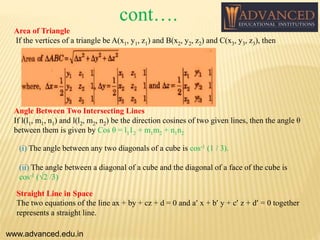
Area of Triangle
Ifthe vertices of a triangle be A(x1, y1, z1) and B(x2, y2, z2) and C(x3, y3, z3), then
Angle Between Two Intersecting Lines
If l(l1, m1, n1) and l(l2, m2, n2) be the direction cosines of two given lines, then the angle θ
between them is given by Cos θ = l112 + m1m2 + n1n2
(i) The angle between any two diagonals of a cube is cos-1 (1 / 3).
(ii) The angle between a diagonal of a cube and the diagonal of a face of the cube is
cos-1 (√2 /3)
Straight Line in Space
The two equations of the line ax + by + cz + d = 0 and a’ x + b’ y + c’ z + d’ = 0 together
represents a straight line.
www.advanced.edu.in
cont….
8.
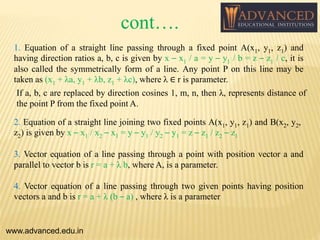
1. Equation ofa straight line passing through a fixed point A(x1, y1, z1) and
having direction ratios a, b, c is given by x – x1 / a = y – y1 / b = z – z1 / c, it is
also called the symmetrically form of a line. Any point P on this line may be
taken as (x1 + λa, y1 + λb, z1 + λc), where λ ∈ r is parameter.
If a, b, c are replaced by direction cosines 1, m, n, then λ, represents distance of
the point P from the fixed point A.
www.advanced.edu.in
2. Equation of a straight line joining two fixed points A(x1, y1, z1) and B(x2, y2,
z2) is given by x – x1 / x2 – x1 = y – y1 / y2 – y1 = z – z1 / z2 – z1
3. Vector equation of a line passing through a point with position vector a and
parallel to vector b is r = a + λ b, where A, is a parameter.
4. Vector equation of a line passing through two given points having position
vectors a and b is r = a + λ (b – a) , where λ is a parameter
cont….
9.
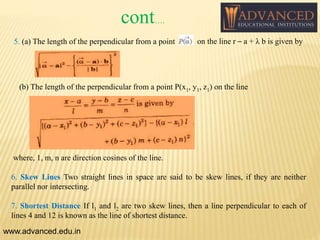
5. (a) Thelength of the perpendicular from a point on the line r – a + λ b is given by
(b) The length of the perpendicular from a point P(x1, y1, z1) on the line
where, 1, m, n are direction cosines of the line.
6. Skew Lines Two straight lines in space are said to be skew lines, if they are neither
parallel nor intersecting.
7. Shortest Distance If l1 and l2 are two skew lines, then a line perpendicular to each of
lines 4 and 12 is known as the line of shortest distance.
www.advanced.edu.in
cont….
10.
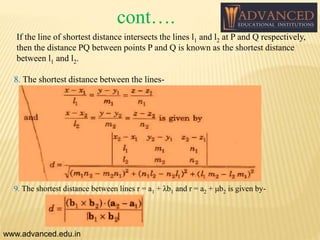
If the lineof shortest distance intersects the lines l1 and l2 at P and Q respectively,
then the distance PQ between points P and Q is known as the shortest distance
between l1 and l2.
www.advanced.edu.in
8. The shortest distance between the lines-
9. The shortest distance between lines r = a1 + λb1 and r = a2 + μb2 is given by-
cont….
11.
cont….
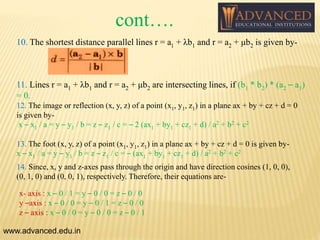
10. The shortestdistance parallel lines r = a1 + λb1 and r = a2 + μb2 is given by-
11. Lines r = a1 + λb1 and r = a2 + μb2 are intersecting lines, if (b1 * b2) * (a2 – a1)
= 0.
www.advanced.edu.in
12. The image or reflection (x, y, z) of a point (x1, y1, z1) in a plane ax + by + cz + d = 0
is given by-
x – x1 / a = y – y1 / b = z – z1 / c = – 2 (ax1 + by1 + cz1 + d) / a2 + b2 + c2
13. The foot (x, y, z) of a point (x1, y1, z1) in a plane ax + by + cz + d = 0 is given by-
x – x1 / a = y – y1 / b = z – z1 / c = – (ax1 + by1 + cz1 + d) / a2 + b2 + c2
14. Since, x, y and z-axes pass through the origin and have direction cosines (1, 0, 0),
(0, 1, 0) and (0, 0, 1), respectively. Therefore, their equations are-
x- axis : x – 0 / 1 = y – 0 / 0 = z – 0 / 0
y –axis : x – 0 / 0 = y – 0 / 1 = z – 0 / 0
z – axis : x – 0 / 0 = y – 0 / 0 = z – 0 / 1
12.
A plane isa surface such that, if two points are taken on it, a straight line joining them
lies wholly in the surface.
General Equation of the Plane
The general equation of the first degree in x, y, z always represents a plane. Hence, the
general equation of the plane is ax + by + cz + d = 0. The coefficient of x, y and z in
the Cartesian equation of a plane are the direction ratios of normal to the plane.
Equation of the Plane Passing Through a Fixed Point
The equation of a plane passing through a given point (x1, y1, z1) is given by
a(x - x1) + b (y - y1) + c (z – z1) = 0.
Normal Form of the Equation of Plane
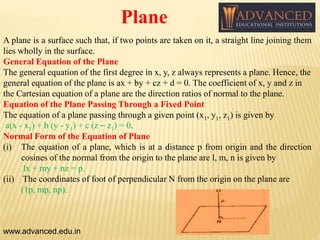
(i) The equation of a plane, which is at a distance p from origin and the direction
cosines of the normal from the origin to the plane are l, m, n is given by
lx + my + nz = p.
(ii) The coordinates of foot of perpendicular N from the origin on the plane are
(1p, mp, np).
www.advanced.edu.in
Plane
13.
Intercept Form
The interceptform of equation of plane represented in the form of x / a + y / b + z / c =
1 where, a, b and c are intercepts on X, Y and Z- axes, respectively.
For x intercept Put y = 0, z = 0 in the equation of the plane and obtain the value of x.
Similarly, we can determine for other intercepts.
Equation of Planes with Given Conditions
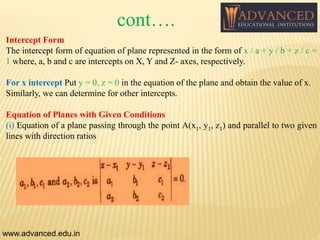
(i) Equation of a plane passing through the point A(x1, y1, z1) and parallel to two given
lines with direction ratios
www.advanced.edu.in
cont….
14.
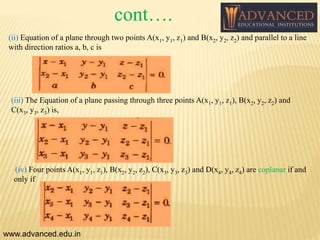
(ii) Equation ofa plane through two points A(x1, y1, z1) and B(x2, y2, z2) and parallel to a line
with direction ratios a, b, c is
(iii) The Equation of a plane passing through three points A(x1, y1, z1), B(x2, y2, z2) and
C(x3, y3, z3) is,
www.advanced.edu.in
(iv) Four points A(x1, y1, z1), B(x2, y2, z2), C(x3, y3, z3) and D(x4, y4, z4) are coplanar if and
only if
cont….
15.
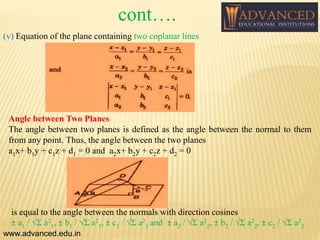
(v) Equation ofthe plane containing two coplanar lines
Angle between Two Planes
The angle between two planes is defined as the angle between the normal to them
from any point. Thus, the angle between the two planes
a1x+ b1y + c1z + d1 = 0 and a2x+ b2y + c2z + d2 = 0
is equal to the angle between the normals with direction cosines
± a1 / √Σ a2
1, ± b1 / √Σ a2
1, ± c1 / √Σ a2
1 and ± a2 / √Σ a2
2, ± b2 / √Σ a2
2, ± c2 / √Σ a2
2
www.advanced.edu.in
cont….
16.
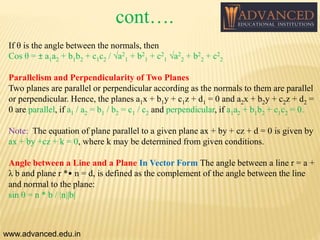
If θ isthe angle between the normals, then
Cos θ = ± a1a2 + b1b2 + c1c2 / √a2
1 + b2
1 + c2
1 √a2
2 + b2
2 + c2
2
Parallelism and Perpendicularity of Two Planes
Two planes are parallel or perpendicular according as the normals to them are parallel
or perpendicular. Hence, the planes a1x + b1y + c1z + d1 = 0 and a2x + b2y + c2z + d2 =
0 are parallel, if a1 / a2 = b1 / b2 = c1 / c2 and perpendicular, if a1a2 + b1b2 + c1c2 = 0.
Note: The equation of plane parallel to a given plane ax + by + cz + d = 0 is given by
ax + by +cz + k = 0, where k may be determined from given conditions.
Angle between a Line and a Plane In Vector Form The angle between a line r = a +
λ b and plane r *• n = d, is defined as the complement of the angle between the line
and normal to the plane:
sin θ = n * b / |n||b|
www.advanced.edu.in
cont….
17.
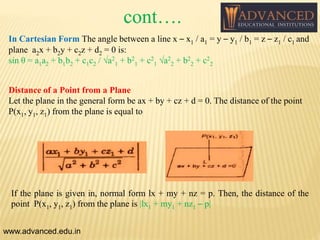
In Cartesian FormThe angle between a line x – x1 / a1 = y – y1 / b1 = z – z1 / c1 and
plane a2x + b2y + c2z + d2 = 0 is:
sin θ = a1a2 + b1b2 + c1c2 / √a2
1 + b2
1 + c2
1 √a2
2 + b2
2 + c2
2
Distance of a Point from a Plane
Let the plane in the general form be ax + by + cz + d = 0. The distance of the point
P(x1, y1, z1) from the plane is equal to
If the plane is given in, normal form lx + my + nz = p. Then, the distance of the
point P(x1, y1, z1) from the plane is |lx1 + my1 + nz1 – p|
www.advanced.edu.in
cont….
18.
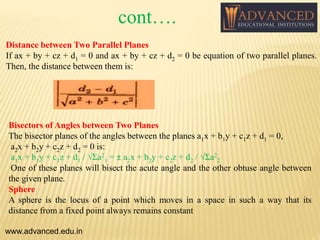
Distance between TwoParallel Planes
If ax + by + cz + d1 = 0 and ax + by + cz + d2 = 0 be equation of two parallel planes.
Then, the distance between them is:
Bisectors of Angles between Two Planes
The bisector planes of the angles between the planes a1x + b1y + c1z + d1 = 0,
a2x + b2y + c2z + d2 = 0 is:
a1x + b1y + c1z + d1 / √Σa2
1 = ± a2x + b2y + c2z + d2 / √Σa2
2
One of these planes will bisect the acute angle and the other obtuse angle between
the given plane.
Sphere
A sphere is the locus of a point which moves in a space in such a way that its
distance from a fixed point always remains constant
www.advanced.edu.in
cont….
19.
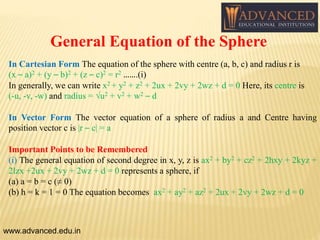
In Cartesian FormThe equation of the sphere with centre (a, b, c) and radius r is
(x – a)2 + (y – b)2 + (z – c)2 = r2 …….(i)
In generally, we can write x2 + y2 + z2 + 2ux + 2vy + 2wz + d = 0 Here, its centre is
(-u, -v, -w) and radius = √u2 + v2 + w2 – d
In Vector Form The vector equation of a sphere of radius a and Centre having
position vector c is |r – c| = a
Important Points to be Remembered
(i) The general equation of second degree in x, y, z is ax2 + by2 + cz2 + 2hxy + 2kyz +
2lzx +2ux + 2vy + 2wz + d = 0 represents a sphere, if
(a) a = b = c (≠ 0)
(b) h = k = 1 = 0 The equation becomes ax2 + ay2 + az2 + 2ux + 2vy + 2wz + d = 0
www.advanced.edu.in
General Equation of the Sphere
20.
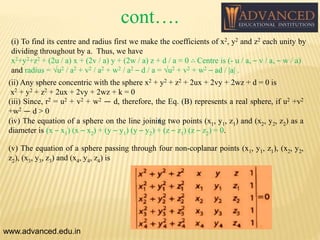
(i) To findits centre and radius first we make the coefficients of x2, y2 and z2 each unity by
dividing throughout by a. Thus, we have
x2+y2+z2 + (2u / a) x + (2v / a) y + (2w / a) z + d / a = 0 ∴ Centre is (- u / a, – v / a, – w / a)
and radius = √u2 / a2 + v2 / a2 + w2 / a2 – d / a = √u2 + v2 + w2 – ad / |a| .
www.advanced.edu.in
(
(ii) Any sphere concentric with the sphere x2 + y2 + z2 + 2ux + 2vy + 2wz + d = 0 is
x2 + y2 + z2 + 2ux + 2vy + 2wz + k = 0
(iii) Since, r2 = u2 + v2 + w2 — d, therefore, the Eq. (B) represents a real sphere, if u2 +v2
+w2 — d > 0
(iv) The equation of a sphere on the line joining two points (x1, y1, z1) and (x2, y2, z2) as a
diameter is (x – x1) (x – x2) + (y – y1) (y – y2) + (z – z1) (z – z2) = 0.
(v) The equation of a sphere passing through four non-coplanar points (x1, y1, z1), (x2, y2,
z2), (x3, y3, z3) and (x4, y4, z4) is
cont….
21.
Tangency of aPlane to a Sphere
The plane lx + my + nz = p will touch the sphere x2 + y2 + z2 + 2ux + 2vy + 2 wz + d
= 0, if length of the perpendicular from the centre ( – u, – v,— w)= radius,
i.e., |lu – mv – nw – p| / √l2 + m2 + n2 = √u2 + v2 + w2 – d
(lu – mv – nw – p)2 = (u2 + v2 + w2 – d) (l2 + m2 + n2)
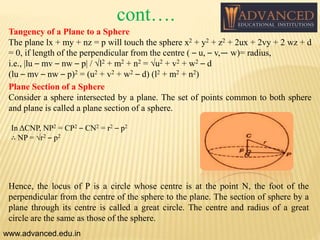
Plane Section of a Sphere
Consider a sphere intersected by a plane. The set of points common to both sphere
and plane is called a plane section of a sphere.
www.advanced.edu.in
In ΔCNP, NP2 = CP2 – CN2 = r2 – p2
∴ NP = √r2 – p2
Hence, the locus of P is a circle whose centre is at the point N, the foot of the
perpendicular from the centre of the sphere to the plane. The section of sphere by a
plane through its centre is called a great circle. The centre and radius of a great
circle are the same as those of the sphere.
cont….