Cramer's Rule
Introduction
 Cramer’s Rule is a method for solving linear
simultaneous equations. It makes use of
determinants and so a knowledge of these is
necessary before proceeding.
 Cramer’s Rule relies on determinants
Coefficient Matrices
 You can use determinants to solve a system of
linear equations.
 You use the coefficient matrix of the linear
system.
 Linear System Coeff Matrix
ax+by=e
cx+dy=f 





d
c
b
a
Cramer’s Rule for 2x2 System
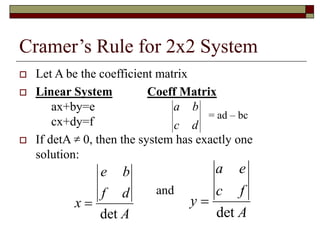
 Let A be the coefficient matrix
 Linear System Coeff Matrix
ax+by=e
cx+dy=f
 If detA 0, then the system has exactly one
solution:
and
A
d
f
b
e
x
det

A
f
c
e
a
y
det


d
c
b
a
= ad – bc
Key Points
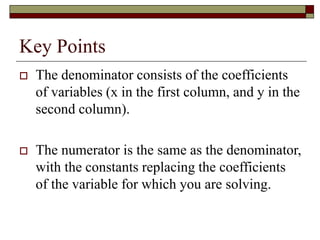
 The denominator consists of the coefficients
of variables (x in the first column, and y in the
second column).
 The numerator is the same as the denominator,
with the constants replacing the coefficients
of the variable for which you are solving.
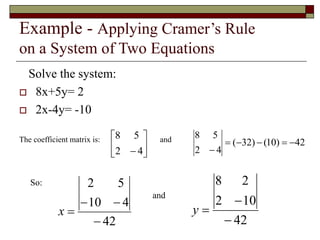
Example - Applying Cramer’s Rule
on a System of Two Equations
Solve the system:
 8x+5y= 2
 2x-4y= -10
The coefficient matrix is: and
So:
and






 4
2
5
8
42
)
10
(
)
32
(
4
2
5
8






42
4
10
5
2




x
42
10
2
2
8



y
1
42
42
42
)
50
(
8
42
4
10
5
2













x
2
42
84
42
4
80
42
10
2
2
8











y
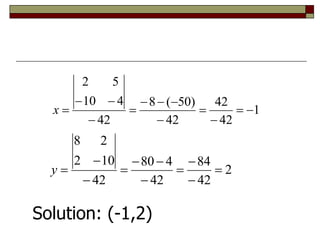
Solution: (-1,2)
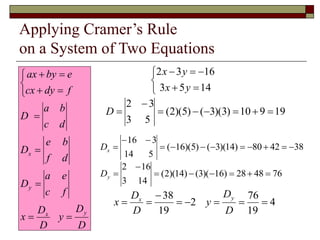
Applying Cramer’s Rule
on a System of Two Equations
D
D
y
D
D
x
f
c
e
a
D
d
f
b
e
D
d
c
b
a
D
f
dy
cx
e
by
ax
y
x
y
x




















14
5
3
16
3
2
y
x
y
x
19
9
10
)
3
)(
3
(
)
5
)(
2
(
5
3
3
2








D
38
42
80
)
14
)(
3
(
)
5
)(
16
(
5
14
3
16












x
D
76
48
28
)
16
)(
3
(
)
14
)(
2
(
14
3
16
2








y
D
4
19
76
2
19
38








D
D
y
D
D
x
y
x
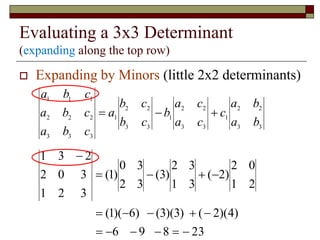
Evaluating a 3x3 Determinant
(expanding along the top row)
 Expanding by Minors (little 2x2 determinants)
3
3
2
2
1
3
3
2
2
1
3
3
2
2
1
3
3
3
2
2
2
1
1
1
b
a
b
a
c
c
a
c
a
b
c
b
c
b
a
c
b
a
c
b
a
c
b
a



23
8
9
6
)
4
)(
2
(
)
3
)(
3
(
)
6
)(
1
(
2
1
0
2
)
2
(
3
1
3
2
)
3
(
3
2
3
0
)
1
(
3
2
1
3
0
2
2
3
1
















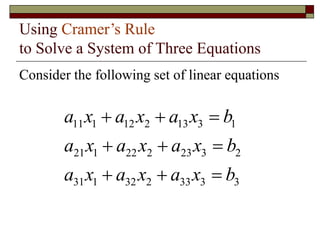
Using Cramer’s Rule
to Solve a System of Three Equations
Consider the following set of linear equations
11 1 12 2 13 3 1
21 1 22 2 23 3 2
31 1 32 2 33 3 3
a x a x a x b
a x a x a x b
a x a x a x b
  
  
  
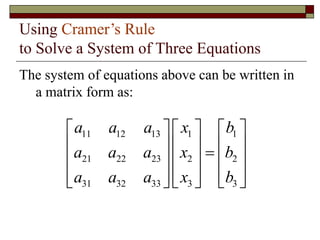
Using Cramer’s Rule
to Solve a System of Three Equations
The system of equations above can be written in
a matrix form as:
11 12 13 1 1
21 22 23 2 2
31 32 33 3 3
a a a x b
a a a x b
a a a x b
     
     

     
     
     
Using Cramer’s Rule
to Solve a System of Three Equations
Define
 
   
11 12 13
21 22 23
31 32 33
1 1
2 2
3 3
a a a
A a a a
a a a
x b
x x and B b
x b
 
 
  
 
 
   
   
   
   
   
   
3
1 2
1 2 3
If 0, then the system has a unique solution
as shown below (Cramer's Rule).
, ,
D
D
D D
x x x
D D D
         
   
    
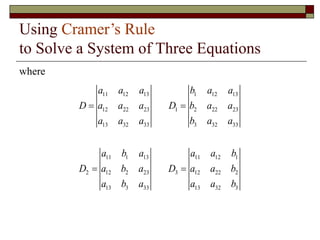
Using Cramer’s Rule
to Solve a System of Three Equations
where
11 12 13 1 12 13
12 22 23 1 2 22 23
13 32 33 3 32 33
11 1 13 11 12 1
2 12 2 23 3 12 22 2
13 3 33 13 32 3
a a a b a a
D a a a D b a a
a a a b a a
a b a a a b
D a b a D a a b
a b a a a b
  
  
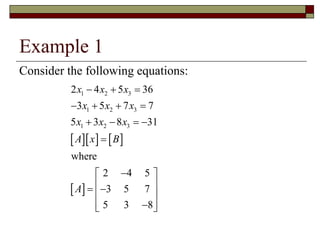
Example 1
Consider the following equations:
    
 
1 2 3
1 2 3
1 2 3
2 4 5 36
3 5 7 7
5 3 8 31
where
2 4 5
3 5 7
5 3 8
x x x
x x x
x x x
A x B
A
  
   
   


 
 
 
 
 

 
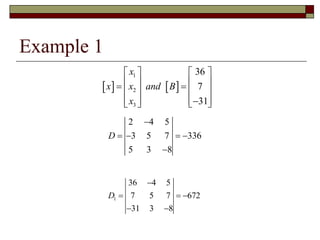
Example 1
   
1
2
3
36
7
31
x
x x and B
x
   
   
   
   
   

   
2 4 5
3 5 7 336
5 3 8
D

   

1
36 4 5
7 5 7 672
31 3 8
D

  
 
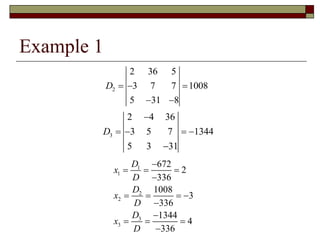
Example 1
2
2 36 5
3 7 7 1008
5 31 8
D   
 
3
2 4 36
3 5 7 1344
5 3 31
D

   

1
1
2
2
3
3
672
2
336
1008
3
336
1344
4
336
D
x
D
D
x
D
D
x
D

  

   


  

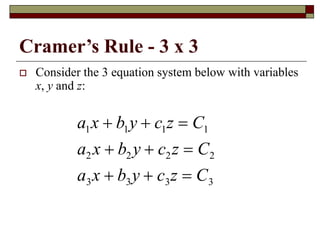
Cramer’s Rule - 3 x 3
 Consider the 3 equation system below with variables
x, y and z:
a1x  b1y  c1z  C1
a2 x  b2 y  c2z  C2
a3x  b3y  c3z  C3
Cramer’s Rule - 3 x 3
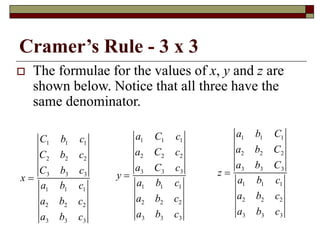
 The formulae for the values of x, y and z are
shown below. Notice that all three have the
same denominator.
x 
C1 b1 c1
C2 b2 c2
C3 b3 c3
a1 b1 c1
a2 b2 c2
a3 b3 c3
y 
a1 C1 c1
a2 C2 c2
a3 C3 c3
a1 b1 c1
a2 b2 c2
a3 b3 c3
z 
a1 b1 C1
a2 b2 C2
a3 b3 C3
a1 b1 c1
a2 b2 c2
a3 b3 c3
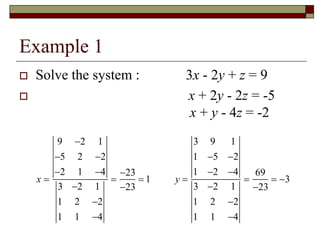
Example 1
 Solve the system : 3x - 2y + z = 9
 x + 2y - 2z = -5
x + y - 4z = -2
x 
9 2 1
5 2 2
2 1 4
3 2 1
1 2 2
1 1 4

23
23
 1 y 
3 9 1
1 5 2
1 2 4
3 2 1
1 2 2
1 1 4

69
23
 3
Example 1
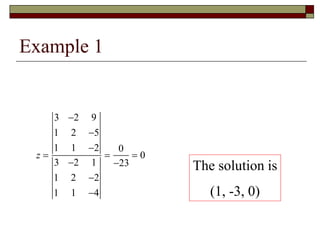
z 
3 2 9
1 2 5
1 1 2
3 2 1
1 2 2
1 1 4

0
23
 0
The solution is
(1, -3, 0)
Cramer’s Rule
 Not all systems have a definite solution. If the
determinant of the coefficient matrix is zero, a
solution cannot be found using Cramer’s Rule
because of division by zero.
 When the solution cannot be determined, one of
two conditions exists:
 The planes graphed by each equation are parallel
and there are no solutions.
 The three planes share one line (like three pages of
a book share the same spine) or represent the same
plane, in which case there are infinite solutions.

Cramer's Rule.ppt

  • 1.
  • 2.
    Introduction  Cramer’s Ruleis a method for solving linear simultaneous equations. It makes use of determinants and so a knowledge of these is necessary before proceeding.  Cramer’s Rule relies on determinants
  • 3.
    Coefficient Matrices  Youcan use determinants to solve a system of linear equations.  You use the coefficient matrix of the linear system.  Linear System Coeff Matrix ax+by=e cx+dy=f       d c b a
  • 4.
    Cramer’s Rule for2x2 System  Let A be the coefficient matrix  Linear System Coeff Matrix ax+by=e cx+dy=f  If detA 0, then the system has exactly one solution: and A d f b e x det  A f c e a y det   d c b a = ad – bc
  • 5.
    Key Points  Thedenominator consists of the coefficients of variables (x in the first column, and y in the second column).  The numerator is the same as the denominator, with the constants replacing the coefficients of the variable for which you are solving.
  • 6.
    Example - ApplyingCramer’s Rule on a System of Two Equations Solve the system:  8x+5y= 2  2x-4y= -10 The coefficient matrix is: and So: and        4 2 5 8 42 ) 10 ( ) 32 ( 4 2 5 8       42 4 10 5 2     x 42 10 2 2 8    y
  • 7.
  • 8.
    Applying Cramer’s Rule ona System of Two Equations D D y D D x f c e a D d f b e D d c b a D f dy cx e by ax y x y x                     14 5 3 16 3 2 y x y x 19 9 10 ) 3 )( 3 ( ) 5 )( 2 ( 5 3 3 2         D 38 42 80 ) 14 )( 3 ( ) 5 )( 16 ( 5 14 3 16             x D 76 48 28 ) 16 )( 3 ( ) 14 )( 2 ( 14 3 16 2         y D 4 19 76 2 19 38         D D y D D x y x
  • 9.
    Evaluating a 3x3Determinant (expanding along the top row)  Expanding by Minors (little 2x2 determinants) 3 3 2 2 1 3 3 2 2 1 3 3 2 2 1 3 3 3 2 2 2 1 1 1 b a b a c c a c a b c b c b a c b a c b a c b a    23 8 9 6 ) 4 )( 2 ( ) 3 )( 3 ( ) 6 )( 1 ( 2 1 0 2 ) 2 ( 3 1 3 2 ) 3 ( 3 2 3 0 ) 1 ( 3 2 1 3 0 2 2 3 1                
  • 10.
    Using Cramer’s Rule toSolve a System of Three Equations Consider the following set of linear equations 11 1 12 2 13 3 1 21 1 22 2 23 3 2 31 1 32 2 33 3 3 a x a x a x b a x a x a x b a x a x a x b         
  • 11.
    Using Cramer’s Rule toSolve a System of Three Equations The system of equations above can be written in a matrix form as: 11 12 13 1 1 21 22 23 2 2 31 32 33 3 3 a a a x b a a a x b a a a x b                               
  • 12.
    Using Cramer’s Rule toSolve a System of Three Equations Define       11 12 13 21 22 23 31 32 33 1 1 2 2 3 3 a a a A a a a a a a x b x x and B b x b                                    3 1 2 1 2 3 If 0, then the system has a unique solution as shown below (Cramer's Rule). , , D D D D x x x D D D                   
  • 13.
    Using Cramer’s Rule toSolve a System of Three Equations where 11 12 13 1 12 13 12 22 23 1 2 22 23 13 32 33 3 32 33 11 1 13 11 12 1 2 12 2 23 3 12 22 2 13 3 33 13 32 3 a a a b a a D a a a D b a a a a a b a a a b a a a b D a b a D a a b a b a a a b      
  • 14.
    Example 1 Consider thefollowing equations:        1 2 3 1 2 3 1 2 3 2 4 5 36 3 5 7 7 5 3 8 31 where 2 4 5 3 5 7 5 3 8 x x x x x x x x x A x B A                          
  • 15.
    Example 1    1 2 3 36 7 31 x x x and B x                          2 4 5 3 5 7 336 5 3 8 D       1 36 4 5 7 5 7 672 31 3 8 D      
  • 16.
    Example 1 2 2 365 3 7 7 1008 5 31 8 D      3 2 4 36 3 5 7 1344 5 3 31 D       1 1 2 2 3 3 672 2 336 1008 3 336 1344 4 336 D x D D x D D x D               
  • 17.
    Cramer’s Rule -3 x 3  Consider the 3 equation system below with variables x, y and z: a1x  b1y  c1z  C1 a2 x  b2 y  c2z  C2 a3x  b3y  c3z  C3
  • 18.
    Cramer’s Rule -3 x 3  The formulae for the values of x, y and z are shown below. Notice that all three have the same denominator. x  C1 b1 c1 C2 b2 c2 C3 b3 c3 a1 b1 c1 a2 b2 c2 a3 b3 c3 y  a1 C1 c1 a2 C2 c2 a3 C3 c3 a1 b1 c1 a2 b2 c2 a3 b3 c3 z  a1 b1 C1 a2 b2 C2 a3 b3 C3 a1 b1 c1 a2 b2 c2 a3 b3 c3
  • 19.
    Example 1  Solvethe system : 3x - 2y + z = 9  x + 2y - 2z = -5 x + y - 4z = -2 x  9 2 1 5 2 2 2 1 4 3 2 1 1 2 2 1 1 4  23 23  1 y  3 9 1 1 5 2 1 2 4 3 2 1 1 2 2 1 1 4  69 23  3
  • 20.
    Example 1 z  32 9 1 2 5 1 1 2 3 2 1 1 2 2 1 1 4  0 23  0 The solution is (1, -3, 0)
  • 21.
    Cramer’s Rule  Notall systems have a definite solution. If the determinant of the coefficient matrix is zero, a solution cannot be found using Cramer’s Rule because of division by zero.  When the solution cannot be determined, one of two conditions exists:  The planes graphed by each equation are parallel and there are no solutions.  The three planes share one line (like three pages of a book share the same spine) or represent the same plane, in which case there are infinite solutions.