SARASWATHY S
 INTRODUCTION
 COMPLEX NUMBER
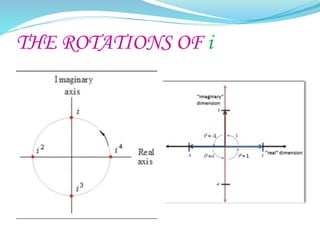
 ROTATIONS OF i
 COMPLEX NUMBER IN POLAR FORM
 EULER FORMULA
 DE MOVIRE’S THEOREM
 COMPLEX FUNCTIONS
 APPLICATIONS
INTRODUCTION
 COMPLEX NUMBERS were first introduced by an
Italian mathematician GEROLAMO CARDANO,
during his attempt to solve cubic equations in the
16th century.
 The rules of addition,
subtraction,multiplication,division of complex
number were developed by Italian mathematician
RAFAEL BOMBELI .
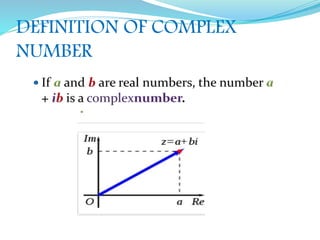
DEFINITION OF COMPLEX
NUMBER
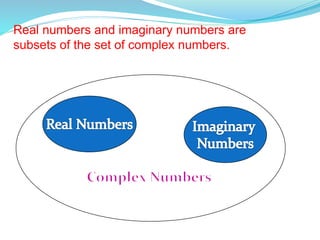
Real numbers and imaginary numbers are
subsets of the set of complex numbers.
Numbers
THE ROTATIONS OF i
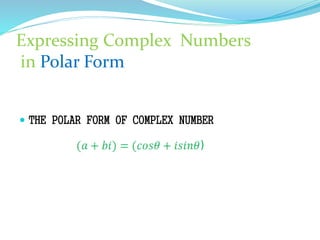
Expressing Complex Numbers
in Polar Form
 THE POLAR FORM OF COMPLEX NUMBER
)
EULER FORMULA
 The polar form of a
complex number can be
written as
z=r
=r
De Moivre’s Theorem
De Moivre's Theorem shows us how to take complex
numbers to any power easily.
De Moivre's Theorem – Let r(cos F+isin F) be a complex
number and n be any real number. Then
[r(cos F+isin F]n = rn(cos nF+isin nF)
What is this saying?
The resulting r value will be r to the nth power and
the resulting angle will be n times the original angle.
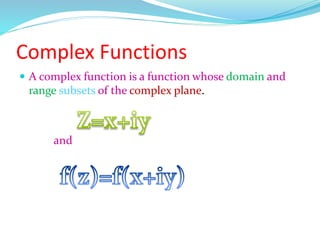
Complex Functions
 A complex function is a function whose domain and
range subsets of the complex plane.
and
APPLICATIONS
 Complex numbers are
mainly used in Electrical
Engineering
techniques,because
FOURIER
TRANSFORMS are used
in understanding
oscillations and wave
behaviour that occur
both in AC current and
in modulated signals.
 Complex Analysis is used
when we launch a
satellite by
transformation or
mapping
Complex number

Complex number

  • 1.
  • 2.
     INTRODUCTION  COMPLEXNUMBER  ROTATIONS OF i  COMPLEX NUMBER IN POLAR FORM  EULER FORMULA  DE MOVIRE’S THEOREM  COMPLEX FUNCTIONS  APPLICATIONS
  • 3.
    INTRODUCTION  COMPLEX NUMBERSwere first introduced by an Italian mathematician GEROLAMO CARDANO, during his attempt to solve cubic equations in the 16th century.  The rules of addition, subtraction,multiplication,division of complex number were developed by Italian mathematician RAFAEL BOMBELI .
  • 4.
  • 5.
    Real numbers andimaginary numbers are subsets of the set of complex numbers. Numbers
  • 6.
  • 7.
    Expressing Complex Numbers inPolar Form  THE POLAR FORM OF COMPLEX NUMBER )
  • 8.
    EULER FORMULA  Thepolar form of a complex number can be written as z=r =r
  • 9.
    De Moivre’s Theorem DeMoivre's Theorem shows us how to take complex numbers to any power easily. De Moivre's Theorem – Let r(cos F+isin F) be a complex number and n be any real number. Then [r(cos F+isin F]n = rn(cos nF+isin nF) What is this saying? The resulting r value will be r to the nth power and the resulting angle will be n times the original angle.
  • 10.
    Complex Functions  Acomplex function is a function whose domain and range subsets of the complex plane. and
  • 11.
    APPLICATIONS  Complex numbersare mainly used in Electrical Engineering techniques,because FOURIER TRANSFORMS are used in understanding oscillations and wave behaviour that occur both in AC current and in modulated signals.  Complex Analysis is used when we launch a satellite by transformation or mapping