4. Vector Spaces
ORTHOGONAL
VECTORS
in Rn
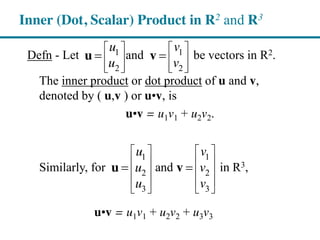
Defn - Let and be vectors in R2.
The inner product or dot product of u and v,
denoted by ( u,v ) or u•v, is
u•v = u1v1 + u2v2.
Similarly, for and in R3,
u•v = u1v1 + u2v2 + u3v3
Inner (Dot, Scalar) Product in R2 and R3
1 1
2 2
u v
u v
u v
1 1
2 2
3 3
u v
u v
u v
u v
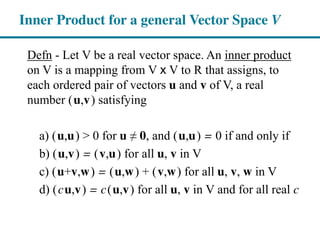
Defn - Let V be a real vector space. An inner product
on V is a mapping from V x V to R that assigns, to
each ordered pair of vectors u and v of V, a real
number (u,v) satisfying
a) (u,u) > 0 for u ≠  0, and (u,u) = 0 if and only if
b) (u,v) = (v,u) for all u, v in V
c) (u+v,w) = (u,w) + (v,w) for all u, v, w in V
d) (cu,v) = c(u,v) for all u, v in V and for all real c
Inner Product for a general Vector Space V
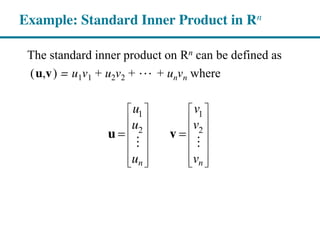
The standard inner product on Rn can be defined as
(u,v) = u1v1 + u2v2 + + unvn where
Example: Standard Inner Product in Rn
1 1
2 2
n n
u v
u v
u v
u v
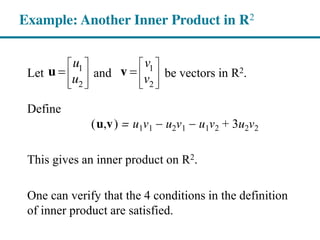
Let and be vectors in R2.
Define
(u,v) = u1v1 u2v1 u1v2 + 3u2v2
This gives an inner product on R2.
One can verify that the 4 conditions in the definition
of inner product are satisfied.
Example: Another Inner Product in R2
1 1
2 2
u v
u v
u v
Let V be the vector space C[0,1] of all continuous
functions on the interval [0,1].
For f,g Î∈V, the following expression defines an inner
product
Example: Inner Product in C[0,1]
1
0
,f g f t g t dt
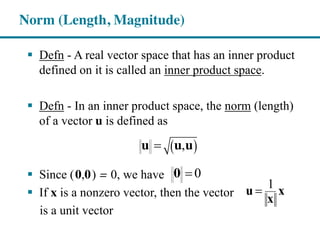
Defn - A real vector space that has an inner product
defined on it is called an inner product space.
Defn - In an inner product space, the norm (length)
of a vector u is defined as
Since (0,0) = 0, we have
If x is a nonzero vector, then the vector
is a unit vector
Norm (Length, Magnitude)
,u u u
00
u
1
x
x
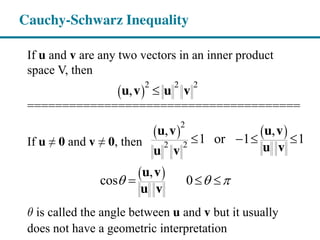
If u and v are any two vectors in an inner product
space V, then
=======================================
If u ≠  0 and v ≠  0, then
qθ is called the angle between u and v but it usually
does not have a geometric interpretation
Cauchy-Schwarz Inequality
2 2 2
,u v u v
2
2 2
, ,
1 or 1 1
u v u v
u vu v
,
cos 0
u v
u v
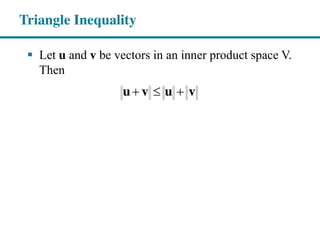
Let u and v be vectors in an inner product space V.
Then
Triangle Inequality
u v u v
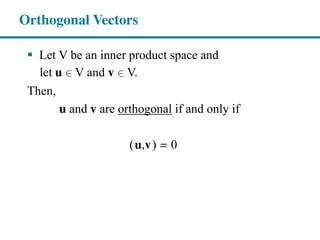
Let V be an inner product space and
let u Î∈ V and v Î∈ V.
Then,
u and v are orthogonal if and only if
(u,v) = 0
Orthogonal Vectors
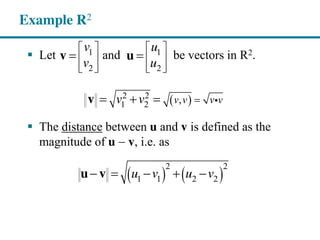
Let and be vectors in R2.
The distance between u and v is defined as the
magnitude of u v, i.e. as
Example R2
1
2
v
v
v
2 2
1 2 ,v v v vv vv
1
2
u
u
u
2 2
1 1 2 2u v u vu v
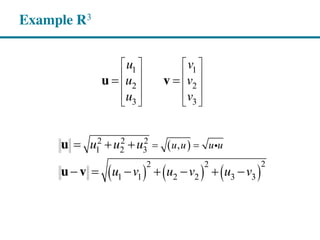
Example R3
1 1
2 2
3 3
u v
u v
u v
u v
2 2 2
1 2 3
22 2
1 1 2 2 3 3
,u u u uu u u
u v u v u v
u
u v
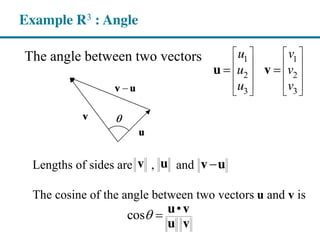
Example R3 : Angle
The angle between two vectors 1 1
2 2
3 3
u v
u v
u v
u v
Lengths of sides are , and
The cosine of the angle between two vectors u and v is
v u v u
•cos u v
u v
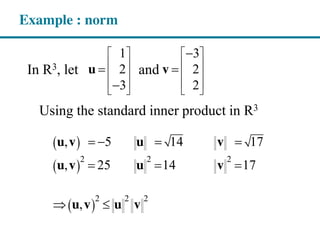
Example : norm
In R3, let and
Using the standard inner product in R3
1 3
2 2
3 2
u v
2 2 2
2 2 2
, 5 14 17
, 25 14 17
,
u v u v
u v u v
u v u v
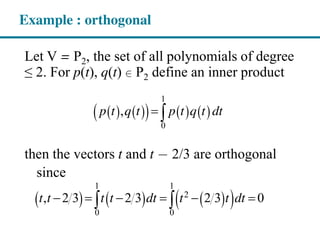
Example : orthogonal
Let V = P2, the set of all polynomials of degree
≤  2.  For  p(t), q(t) Î∈ P2 define an inner product
then the vectors t and t -− 2/3 are orthogonal
since
1
0
,p t q t p t q t dt
1 1
2
0 0
, 2 3 2 3 2 3 0t t t t dt t t dt
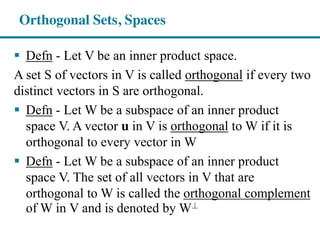
Orthogonal Sets, Spaces
Defn - Let V be an inner product space.
A set S of vectors in V is called orthogonal if every two
distinct vectors in S are orthogonal.
Defn - Let W be a subspace of an inner product
space V. A vector u in V is orthogonal to W if it is
orthogonal to every vector in W
Defn - Let W be a subspace of an inner product
space V. The set of all vectors in V that are
orthogonal to W is called the orthogonal complement
of W in V and is denoted by W^⊥
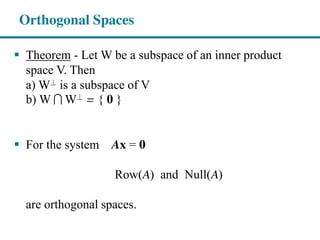
Orthogonal Spaces
Theorem - Let W be a subspace of an inner product
space V. Then
a) W^⊥ is a subspace of V
b) W W^⊥ = { 0 }
For the system Ax = 0
Row(A) and Null(A)
are orthogonal spaces.
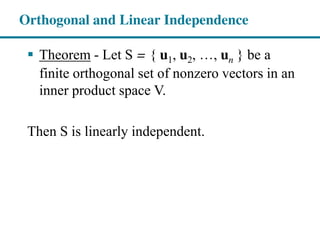
Orthogonal and Linear Independence
Theorem - Let S = { u1, u2, , un } be a
finite orthogonal set of nonzero vectors in an
inner product space V.
Then S is linearly independent.
The End

Chapter 4: Vector Spaces - Part 5/Slides By Pearson

  • 1.
  • 2.
    Defn - Letand be vectors in R2. The inner product or dot product of u and v, denoted by ( u,v ) or u•v, is u•v = u1v1 + u2v2. Similarly, for and in R3, u•v = u1v1 + u2v2 + u3v3 Inner (Dot, Scalar) Product in R2 and R3 1 1 2 2 u v u v u v 1 1 2 2 3 3 u v u v u v u v
  • 3.
    Defn - LetV be a real vector space. An inner product on V is a mapping from V x V to R that assigns, to each ordered pair of vectors u and v of V, a real number (u,v) satisfying a) (u,u) > 0 for u ≠  0, and (u,u) = 0 if and only if b) (u,v) = (v,u) for all u, v in V c) (u+v,w) = (u,w) + (v,w) for all u, v, w in V d) (cu,v) = c(u,v) for all u, v in V and for all real c Inner Product for a general Vector Space V
  • 4.
    The standard innerproduct on Rn can be defined as (u,v) = u1v1 + u2v2 + + unvn where Example: Standard Inner Product in Rn 1 1 2 2 n n u v u v u v u v
  • 5.
    Let and bevectors in R2. Define (u,v) = u1v1 u2v1 u1v2 + 3u2v2 This gives an inner product on R2. One can verify that the 4 conditions in the definition of inner product are satisfied. Example: Another Inner Product in R2 1 1 2 2 u v u v u v
  • 6.
    Let V bethe vector space C[0,1] of all continuous functions on the interval [0,1]. For f,g Î∈V, the following expression defines an inner product Example: Inner Product in C[0,1] 1 0 ,f g f t g t dt
  • 7.
    Defn - Areal vector space that has an inner product defined on it is called an inner product space. Defn - In an inner product space, the norm (length) of a vector u is defined as Since (0,0) = 0, we have If x is a nonzero vector, then the vector is a unit vector Norm (Length, Magnitude) ,u u u 00 u 1 x x
  • 8.
    If u andv are any two vectors in an inner product space V, then ======================================= If u ≠  0 and v ≠  0, then qθ is called the angle between u and v but it usually does not have a geometric interpretation Cauchy-Schwarz Inequality 2 2 2 ,u v u v 2 2 2 , , 1 or 1 1 u v u v u vu v , cos 0 u v u v
  • 9.
    Let u andv be vectors in an inner product space V. Then Triangle Inequality u v u v
  • 10.
    Let V bean inner product space and let u Î∈ V and v Î∈ V. Then, u and v are orthogonal if and only if (u,v) = 0 Orthogonal Vectors
  • 11.
    Let and bevectors in R2. The distance between u and v is defined as the magnitude of u v, i.e. as Example R2 1 2 v v v 2 2 1 2 ,v v v vv vv 1 2 u u u 2 2 1 1 2 2u v u vu v
  • 12.
    Example R3 1 1 22 3 3 u v u v u v u v 2 2 2 1 2 3 22 2 1 1 2 2 3 3 ,u u u uu u u u v u v u v u u v
  • 13.
    Example R3 :Angle The angle between two vectors 1 1 2 2 3 3 u v u v u v u v Lengths of sides are , and The cosine of the angle between two vectors u and v is v u v u •cos u v u v
  • 14.
    Example : norm InR3, let and Using the standard inner product in R3 1 3 2 2 3 2 u v 2 2 2 2 2 2 , 5 14 17 , 25 14 17 , u v u v u v u v u v u v
  • 15.
    Example : orthogonal LetV = P2, the set of all polynomials of degree ≤  2.  For  p(t), q(t) Î∈ P2 define an inner product then the vectors t and t -− 2/3 are orthogonal since 1 0 ,p t q t p t q t dt 1 1 2 0 0 , 2 3 2 3 2 3 0t t t t dt t t dt
  • 16.
    Orthogonal Sets, Spaces Defn- Let V be an inner product space. A set S of vectors in V is called orthogonal if every two distinct vectors in S are orthogonal. Defn - Let W be a subspace of an inner product space V. A vector u in V is orthogonal to W if it is orthogonal to every vector in W Defn - Let W be a subspace of an inner product space V. The set of all vectors in V that are orthogonal to W is called the orthogonal complement of W in V and is denoted by W^⊥
  • 17.
    Orthogonal Spaces Theorem -Let W be a subspace of an inner product space V. Then a) W^⊥ is a subspace of V b) W W^⊥ = { 0 } For the system Ax = 0 Row(A) and Null(A) are orthogonal spaces.
  • 18.
    Orthogonal and LinearIndependence Theorem - Let S = { u1, u2, , un } be a finite orthogonal set of nonzero vectors in an inner product space V. Then S is linearly independent.
  • 19.