Computer Organization
Instructors :
Dr. Abdul Raouf Khan
Mr.Marwan El-Haj
Computer Organization
Lec.11:Complete Computer Description
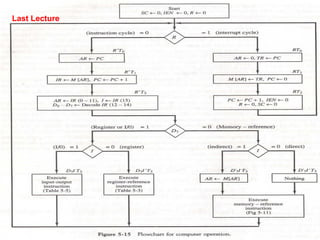
Last Lecture
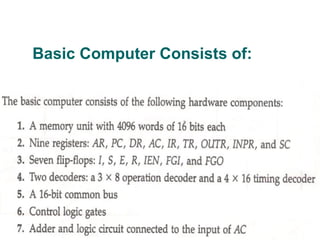
Basic Computer Consists of:
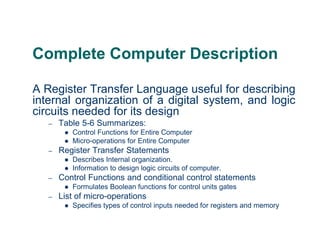
Complete Computer Description
A Register Transfer Language useful for describing
internal organization of a digital system, and logic
circuits needed for its design
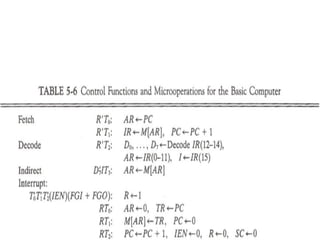
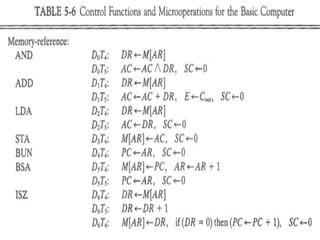
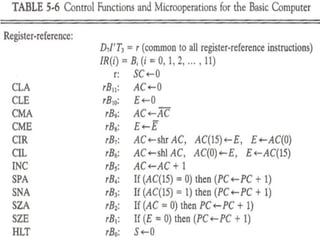
– Table 5-6 Summarizes:
 Control Functions for Entire Computer
 Micro-operations for Entire Computer
– Register Transfer Statements
 Describes Internal organization.
 Information to design logic circuits of computer.
– Control Functions and conditional control statements
 Formulates Boolean functions for control units gates
– List of micro-operations
 Specifies types of control inputs needed for registers and memory
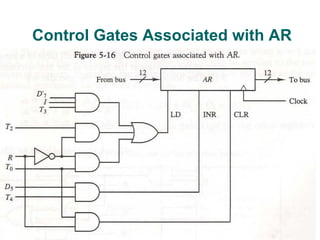
Control Gates Associated with AR
Control of Single FLIP FLOP
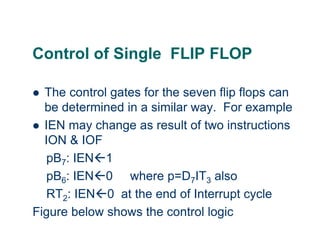
 The control gates for the seven flip flops can
be determined in a similar way. For example
 IEN may change as result of two instructions
ION & IOF
pB7: IEN1
pB6: IEN0 where p=D7IT3 also
RT2: IEN0 at the end of Interrupt cycle
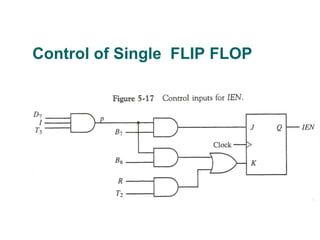
Figure below shows the control logic
Control of Single FLIP FLOP
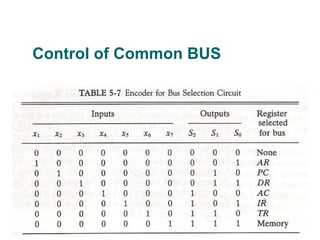
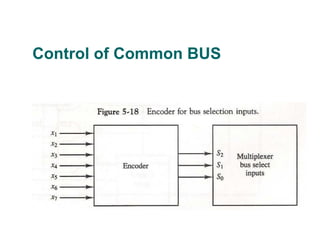
Control of Common BUS
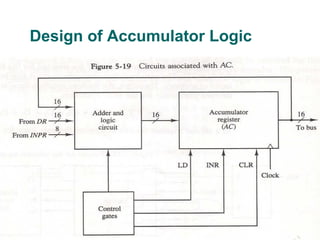
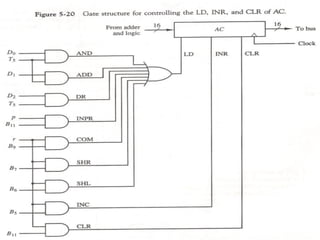
Design of Accumulator Logic
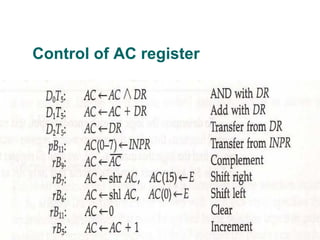
Control of AC register
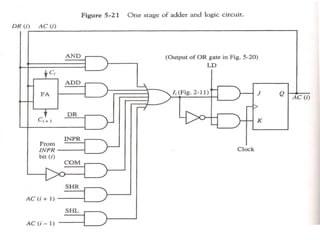
Adder & Logic Circuit
 The adder and logic circuit can be divided into
16 stages, with each stage corresponding to
one bit of AC.
 The one stage of adder and logic circuit is
shown as below.
Assignments
1. A computer uses a memory unit with 256K words of 32
bit each. A binary instruction code is stored in one word
of memory. The instruction has four parts: an indirect
bit, an operation code, a register code part and the
address part. The system has 32 registers.
a. How many bits are there in the operation code, the
register code part and the address code part?
b. Draw the instruction word format
c. How many bits are there in the data & address inputs of
the memory?
d. What is the maximum number of instructions we can
have in this computer?
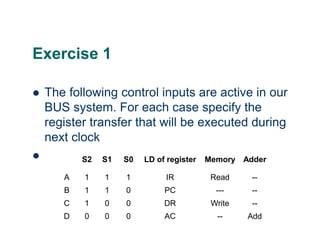
Exercise 1
 The following control inputs are active in our
BUS system. For each case specify the
register transfer that will be executed during
next clock
 S2 S1 S0 LD of register Memory Adder
A 1 1 1 IR Read --
B 1 1 0 PC --- --
C 1 0 0 DR Write --
D 0 0 0 AC -- Add
Exercise 2
 The following register transfers are to be executed in our System.
For each transfer, specify (1). the binary value to be applied to bus
select inputs S0,S1, S2. (2) the register whose LD control must be
active (3) a memory READ or Write (if needed) (4) the operation in
the adder & logic circuit.
 a. AR PC
 b. IR M[AR]
 c. M[AR]TR
 d. ACDR, DRAC (done simultaneously)
Exercise 3
 Explain why each of the following
microoperations cannot be executed during a
single clock in the system.
 a. IRM[PC]
 b. AC AC+TR
 c. DR DR + AC (AC does not change)

Lect11 organization

  • 1.
    Computer Organization Instructors : Dr.Abdul Raouf Khan Mr.Marwan El-Haj
  • 2.
  • 3.
  • 4.
  • 5.
    Complete Computer Description ARegister Transfer Language useful for describing internal organization of a digital system, and logic circuits needed for its design – Table 5-6 Summarizes:  Control Functions for Entire Computer  Micro-operations for Entire Computer – Register Transfer Statements  Describes Internal organization.  Information to design logic circuits of computer. – Control Functions and conditional control statements  Formulates Boolean functions for control units gates – List of micro-operations  Specifies types of control inputs needed for registers and memory
  • 10.
  • 11.
    Control of SingleFLIP FLOP  The control gates for the seven flip flops can be determined in a similar way. For example  IEN may change as result of two instructions ION & IOF pB7: IEN1 pB6: IEN0 where p=D7IT3 also RT2: IEN0 at the end of Interrupt cycle Figure below shows the control logic
  • 12.
  • 13.
  • 14.
  • 15.
  • 16.
    Control of ACregister
  • 18.
    Adder & LogicCircuit  The adder and logic circuit can be divided into 16 stages, with each stage corresponding to one bit of AC.  The one stage of adder and logic circuit is shown as below.
  • 20.
    Assignments 1. A computeruses a memory unit with 256K words of 32 bit each. A binary instruction code is stored in one word of memory. The instruction has four parts: an indirect bit, an operation code, a register code part and the address part. The system has 32 registers. a. How many bits are there in the operation code, the register code part and the address code part? b. Draw the instruction word format c. How many bits are there in the data & address inputs of the memory? d. What is the maximum number of instructions we can have in this computer?
  • 21.
    Exercise 1  Thefollowing control inputs are active in our BUS system. For each case specify the register transfer that will be executed during next clock  S2 S1 S0 LD of register Memory Adder A 1 1 1 IR Read -- B 1 1 0 PC --- -- C 1 0 0 DR Write -- D 0 0 0 AC -- Add
  • 22.
    Exercise 2  Thefollowing register transfers are to be executed in our System. For each transfer, specify (1). the binary value to be applied to bus select inputs S0,S1, S2. (2) the register whose LD control must be active (3) a memory READ or Write (if needed) (4) the operation in the adder & logic circuit.  a. AR PC  b. IR M[AR]  c. M[AR]TR  d. ACDR, DRAC (done simultaneously)
  • 23.
    Exercise 3  Explainwhy each of the following microoperations cannot be executed during a single clock in the system.  a. IRM[PC]  b. AC AC+TR  c. DR DR + AC (AC does not change)