Register Transfer and Micro-operations 1 Lecture 7
CSE 211, Computer Organization and Architecture Harjeet Kaur, CSE/IT
Overview
 Register Transfer Language
 Register Transfer
 Bus and Memory Transfers
 Arithmetic Micro-operations
 Logic Micro-operations
 Shift Micro-operations
 Arithmetic Logic Shift Unit
Register Transfer and Micro-operations 2 Lecture 7
CSE 211, Computer Organization and Architecture Harjeet Kaur, CSE/IT
Connecting Registers - Bus Transfer
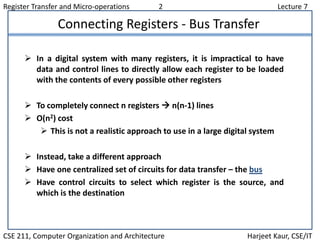
 In a digital system with many registers, it is impractical to have
data and control lines to directly allow each register to be loaded
with the contents of every possible other registers
 To completely connect n registers  n(n-1) lines
 O(n2) cost
 This is not a realistic approach to use in a large digital system
 Instead, take a different approach
 Have one centralized set of circuits for data transfer – the bus
 Have control circuits to select which register is the source, and
which is the destination
Register Transfer and Micro-operations 3 Lecture 7
CSE 211, Computer Organization and Architecture Harjeet Kaur, CSE/IT
Connecting Registers - Bus Transfer
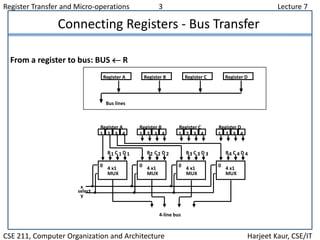
From a register to bus: BUS  R
1 2 3 4 1 2 3 4 1 2 3 4 1 2 3 4
Register A Register B Register C Register D
B C D1 1 1
4 x1
MUX
B C D2 2 2
4 x1
MUX
B C D3 3 3
4 x1
MUX
B C D4 4 4
4 x1
MUX
4-line bus
x
y
select
0 0 0 0
Register A Register B Register C Register D
Bus lines
Register Transfer and Micro-operations 4 Lecture 7
CSE 211, Computer Organization and Architecture Harjeet Kaur, CSE/IT
Connecting Registers - Bus Transfer
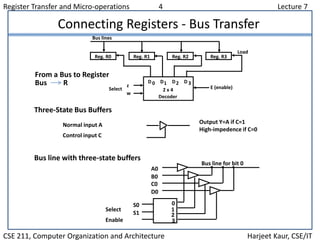
Three-State Bus Buffers
Bus line with three-state buffers
Reg. R0 Reg. R1 Reg. R2 Reg. R3
Bus lines
2 x 4
Decoder
Load
D 0 D1 D2 D 3z
w
Select E (enable)
Output Y=A if C=1
High-impedence if C=0
Normal input A
Control input C
Select
Enable
0
1
2
3
S0
S1
A0
B0
C0
D0
Bus line for bit 0
From a Bus to Register
Bus R
Register Transfer and Micro-operations 5 Lecture 7
CSE 211, Computer Organization and Architecture Harjeet Kaur, CSE/IT
Memory - RAM
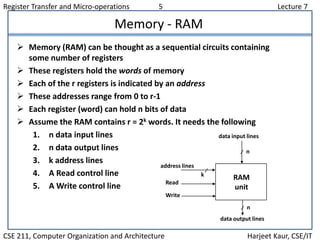
 Memory (RAM) can be thought as a sequential circuits containing
some number of registers
 These registers hold the words of memory
 Each of the r registers is indicated by an address
 These addresses range from 0 to r-1
 Each register (word) can hold n bits of data
 Assume the RAM contains r = 2k words. It needs the following
1. n data input lines
2. n data output lines
3. k address lines
4. A Read control line
5. A Write control line
data input lines
data output lines
n
n
k
address lines
Read
Write
RAM
unit
Register Transfer and Micro-operations 6 Lecture 7
CSE 211, Computer Organization and Architecture Harjeet Kaur, CSE/IT
Memory Transfer
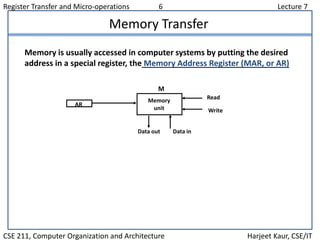
Memory is usually accessed in computer systems by putting the desired
address in a special register, the Memory Address Register (MAR, or AR)
AR
Memory
unit
Read
Write
Data inData out
M
Register Transfer and Micro-operations 7 Lecture 7
CSE 211, Computer Organization and Architecture Harjeet Kaur, CSE/IT
Memory Read
 To read a value from a location in memory and load it into a
register, the register transfer language notation looks like this:
 This causes the following to occur
1. The contents of the MAR get sent to the memory address
lines
2. A Read (= 1) gets sent to the memory unit
3. The contents of the specified address are put on the
memory’s output data lines
4. These get sent over the bus to be loaded into register R1
R1  M[MAR]
Register Transfer and Micro-operations 8 Lecture 7
CSE 211, Computer Organization and Architecture Harjeet Kaur, CSE/IT
Memory Write
 To write a value from a register to a location in memory looks like
this in register transfer language:
 This causes the following to occur
1. The contents of the MAR get sent to the memory address
lines
2. A Write (= 1) gets sent to the memory unit
3. The values in register R1 get sent over the bus to the data
input lines of the memory
4. The values get loaded into the specified address in the
memory
M[MAR]  R1
Register Transfer and Micro-operations 9 Lecture 7
CSE 211, Computer Organization and Architecture Harjeet Kaur, CSE/IT
A  B 1.Transfer content of reg. B into reg. A
AR DR(AD) 2.Transfer content of AD portion of reg. DR into reg. AR
A  constant 3.Transfer a binary constant into reg. A
ABUS  R1, R2 ← ABUS 4.Transfer content of R1 into bus A and, at the same time,
transfer content of bus A into R2
AR 5.Address register
DR 6.Data register
M[R] 7.Memory word specified by reg. R
M 8.Equivalent to M[AR]
DR  M 9.Memory read operation: transfers content of
memory word specified by AR into DR
M  DR 10.Memory write operation: transfers content of
DR into memory word specified by AR
SUMMARY OF R. TRANSFER MICROOPERATIONS
Register Transfer and Micro-operations 10 Lecture 7
CSE 211, Computer Organization and Architecture Harjeet Kaur, CSE/IT
Computer system microoperations are of four types:
 Register transfer microoperations
 Arithmetic microoperations
 Logic microoperations
 Shift microoperations
MICROOPERATIONS
Register Transfer and Micro-operations 11 Lecture 7
CSE 211, Computer Organization and Architecture Harjeet Kaur, CSE/IT
Arithmetic MICROOPERATIONS
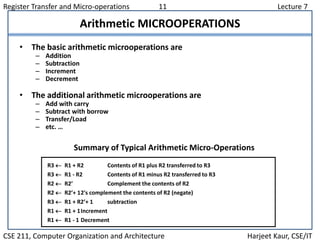
Summary of Typical Arithmetic Micro-Operations
R3  R1 + R2 Contents of R1 plus R2 transferred to R3
R3  R1 - R2 Contents of R1 minus R2 transferred to R3
R2  R2’ Complement the contents of R2
R2  R2’+ 12's complement the contents of R2 (negate)
R3  R1 + R2’+ 1 subtraction
R1  R1 + 1Increment
R1  R1 - 1 Decrement
• The basic arithmetic microoperations are
– Addition
– Subtraction
– Increment
– Decrement
• The additional arithmetic microoperations are
– Add with carry
– Subtract with borrow
– Transfer/Load
– etc. …

Lecture 7

  • 1.
    Register Transfer andMicro-operations 1 Lecture 7 CSE 211, Computer Organization and Architecture Harjeet Kaur, CSE/IT Overview  Register Transfer Language  Register Transfer  Bus and Memory Transfers  Arithmetic Micro-operations  Logic Micro-operations  Shift Micro-operations  Arithmetic Logic Shift Unit
  • 2.
    Register Transfer andMicro-operations 2 Lecture 7 CSE 211, Computer Organization and Architecture Harjeet Kaur, CSE/IT Connecting Registers - Bus Transfer  In a digital system with many registers, it is impractical to have data and control lines to directly allow each register to be loaded with the contents of every possible other registers  To completely connect n registers  n(n-1) lines  O(n2) cost  This is not a realistic approach to use in a large digital system  Instead, take a different approach  Have one centralized set of circuits for data transfer – the bus  Have control circuits to select which register is the source, and which is the destination
  • 3.
    Register Transfer andMicro-operations 3 Lecture 7 CSE 211, Computer Organization and Architecture Harjeet Kaur, CSE/IT Connecting Registers - Bus Transfer From a register to bus: BUS  R 1 2 3 4 1 2 3 4 1 2 3 4 1 2 3 4 Register A Register B Register C Register D B C D1 1 1 4 x1 MUX B C D2 2 2 4 x1 MUX B C D3 3 3 4 x1 MUX B C D4 4 4 4 x1 MUX 4-line bus x y select 0 0 0 0 Register A Register B Register C Register D Bus lines
  • 4.
    Register Transfer andMicro-operations 4 Lecture 7 CSE 211, Computer Organization and Architecture Harjeet Kaur, CSE/IT Connecting Registers - Bus Transfer Three-State Bus Buffers Bus line with three-state buffers Reg. R0 Reg. R1 Reg. R2 Reg. R3 Bus lines 2 x 4 Decoder Load D 0 D1 D2 D 3z w Select E (enable) Output Y=A if C=1 High-impedence if C=0 Normal input A Control input C Select Enable 0 1 2 3 S0 S1 A0 B0 C0 D0 Bus line for bit 0 From a Bus to Register Bus R
  • 5.
    Register Transfer andMicro-operations 5 Lecture 7 CSE 211, Computer Organization and Architecture Harjeet Kaur, CSE/IT Memory - RAM  Memory (RAM) can be thought as a sequential circuits containing some number of registers  These registers hold the words of memory  Each of the r registers is indicated by an address  These addresses range from 0 to r-1  Each register (word) can hold n bits of data  Assume the RAM contains r = 2k words. It needs the following 1. n data input lines 2. n data output lines 3. k address lines 4. A Read control line 5. A Write control line data input lines data output lines n n k address lines Read Write RAM unit
  • 6.
    Register Transfer andMicro-operations 6 Lecture 7 CSE 211, Computer Organization and Architecture Harjeet Kaur, CSE/IT Memory Transfer Memory is usually accessed in computer systems by putting the desired address in a special register, the Memory Address Register (MAR, or AR) AR Memory unit Read Write Data inData out M
  • 7.
    Register Transfer andMicro-operations 7 Lecture 7 CSE 211, Computer Organization and Architecture Harjeet Kaur, CSE/IT Memory Read  To read a value from a location in memory and load it into a register, the register transfer language notation looks like this:  This causes the following to occur 1. The contents of the MAR get sent to the memory address lines 2. A Read (= 1) gets sent to the memory unit 3. The contents of the specified address are put on the memory’s output data lines 4. These get sent over the bus to be loaded into register R1 R1  M[MAR]
  • 8.
    Register Transfer andMicro-operations 8 Lecture 7 CSE 211, Computer Organization and Architecture Harjeet Kaur, CSE/IT Memory Write  To write a value from a register to a location in memory looks like this in register transfer language:  This causes the following to occur 1. The contents of the MAR get sent to the memory address lines 2. A Write (= 1) gets sent to the memory unit 3. The values in register R1 get sent over the bus to the data input lines of the memory 4. The values get loaded into the specified address in the memory M[MAR]  R1
  • 9.
    Register Transfer andMicro-operations 9 Lecture 7 CSE 211, Computer Organization and Architecture Harjeet Kaur, CSE/IT A  B 1.Transfer content of reg. B into reg. A AR DR(AD) 2.Transfer content of AD portion of reg. DR into reg. AR A  constant 3.Transfer a binary constant into reg. A ABUS  R1, R2 ← ABUS 4.Transfer content of R1 into bus A and, at the same time, transfer content of bus A into R2 AR 5.Address register DR 6.Data register M[R] 7.Memory word specified by reg. R M 8.Equivalent to M[AR] DR  M 9.Memory read operation: transfers content of memory word specified by AR into DR M  DR 10.Memory write operation: transfers content of DR into memory word specified by AR SUMMARY OF R. TRANSFER MICROOPERATIONS
  • 10.
    Register Transfer andMicro-operations 10 Lecture 7 CSE 211, Computer Organization and Architecture Harjeet Kaur, CSE/IT Computer system microoperations are of four types:  Register transfer microoperations  Arithmetic microoperations  Logic microoperations  Shift microoperations MICROOPERATIONS
  • 11.
    Register Transfer andMicro-operations 11 Lecture 7 CSE 211, Computer Organization and Architecture Harjeet Kaur, CSE/IT Arithmetic MICROOPERATIONS Summary of Typical Arithmetic Micro-Operations R3  R1 + R2 Contents of R1 plus R2 transferred to R3 R3  R1 - R2 Contents of R1 minus R2 transferred to R3 R2  R2’ Complement the contents of R2 R2  R2’+ 12's complement the contents of R2 (negate) R3  R1 + R2’+ 1 subtraction R1  R1 + 1Increment R1  R1 - 1 Decrement • The basic arithmetic microoperations are – Addition – Subtraction – Increment – Decrement • The additional arithmetic microoperations are – Add with carry – Subtract with borrow – Transfer/Load – etc. …