Chapter 5basic computer organization designPreseneted  by : -    Nikhil  Kumar  SinghB.Sc  Computer  Sc. II yr     8130
Topics included
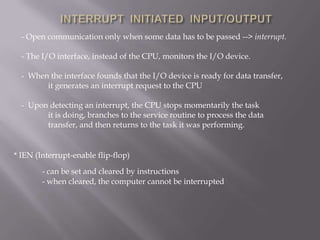
INTERRUPT  INITIATED  INPUT/OUTPUT- Open communication only when some data has to be passed --> interrupt.- The I/O interface, instead of the CPU, monitors the I/O device. -  When the interface founds that the I/O device is ready for data transfer, 	it generates an interrupt request to the CPU-  Upon detecting an interrupt, the CPU stops momentarily the task 	it is doing, branches to the service routine to process the data 	transfer, and then returns to the task it was performing.* IEN (Interrupt-enable flip-flop)- can be set and cleared by instructions- when cleared, the computer cannot be interrupted
FLOWCHART  FOR  INTERRUPT  CYCLE=0=1Interrupt cycleInstruction cycleRStore return addressFetch and decodein location 0instructionsM[0]  PC=0ExecuteIENinstructionsBranch to location 1=1PC  1=1FGI=0IEN  0   R  0=1FGO=0R  1
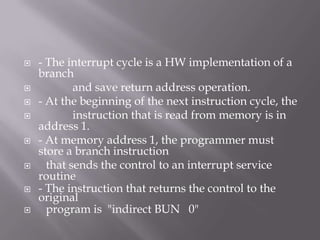
- The interrupt cycle is a HW implementation of a branch   	and save return address operation.- At the beginning of the next instruction cycle, the    	instruction that is read from memory is in address 1.- At memory address 1, the programmer must store a branch instruction 	that sends the control to an interrupt service routine- The instruction that returns the control to the original 	program is  "indirect BUN   0"
REGISTER  TRANSFER  OPERATIONS  IN  INTERRUPT CYCLEMemory Before interrupt After interrupt cycle256000BUN112010BUN1120PC = 1MainMain255255ProgramProgramPC = 256 25611201120I/OI/OProgramProgram1BUN01BUN0 Register Transfer Statements for Interrupt Cycle	- R  F/F  1     if IEN (FGI + FGO)T0T1T2 T0T1T2 (IEN)(FGI + FGO):   R  1- The fetch and decode phases of the instruction cycle   	must be modified Replace T0, T1, T2  with  R'T0, R'T1, R'T2- The interrupt cycle :	RT0:	AR  0,  TR  PC	RT1:	M[AR]  TR,  PC  0	RT2:	PC  PC + 1,  IEN  0,  R  0, SC  0
1212From busTo busARD'7IClockLDT3INRT2CLRRT0DT4CONTROL  OF  REGISTERS  AND  MEMORYAddress Register; ARScan all of the register transfer statements that change the content of AR:R’T0:      AR  PC            LD(AR)R’T2:      AR  IR(0-11)    LD(AR)D’7IT3:   AR  M[AR]       LD(AR)RT0:       AR  0               CLR(AR)D5T4:     AR  AR + 1      INR(AR)LD(AR) = R'T0 + R'T2 + D'7IT3CLR(AR) = RT0INR(AR) = D5T4
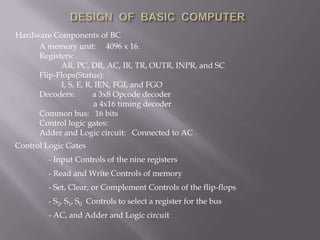
DESIGN  OF  BASIC  COMPUTERHardware Components of BC A memory unit:     4096 x 16.Registers:             AR, PC, DR, AC, IR, TR, OUTR, INPR, and SCFlip-Flops(Status):             I, S, E, R, IEN, FGI, and FGODecoders:         a 3x8 Opcode decoder                           a 4x16 timing decoderCommon bus:   16 bitsControl logic gates:Adder and Logic circuit:   Connected to ACControl Logic Gates- Input Controls of the nine registers- Read and Write Controls of memory- Set, Clear, or Complement Controls of the flip-flops- S2, S1, S0  Controls to select a register for the bus- AC, and Adder and Logic circuit

Basic computer organisation design

  • 1.
    Chapter 5basic computerorganization designPreseneted by : - Nikhil Kumar SinghB.Sc Computer Sc. II yr 8130
  • 2.
  • 3.
    INTERRUPT INITIATED INPUT/OUTPUT- Open communication only when some data has to be passed --> interrupt.- The I/O interface, instead of the CPU, monitors the I/O device. - When the interface founds that the I/O device is ready for data transfer, it generates an interrupt request to the CPU- Upon detecting an interrupt, the CPU stops momentarily the task it is doing, branches to the service routine to process the data transfer, and then returns to the task it was performing.* IEN (Interrupt-enable flip-flop)- can be set and cleared by instructions- when cleared, the computer cannot be interrupted
  • 4.
    FLOWCHART FOR INTERRUPT CYCLE=0=1Interrupt cycleInstruction cycleRStore return addressFetch and decodein location 0instructionsM[0]  PC=0ExecuteIENinstructionsBranch to location 1=1PC  1=1FGI=0IEN  0 R  0=1FGO=0R  1
  • 5.
    - The interruptcycle is a HW implementation of a branch and save return address operation.- At the beginning of the next instruction cycle, the instruction that is read from memory is in address 1.- At memory address 1, the programmer must store a branch instruction that sends the control to an interrupt service routine- The instruction that returns the control to the original program is "indirect BUN 0"
  • 6.
    REGISTER TRANSFER OPERATIONS IN INTERRUPT CYCLEMemory Before interrupt After interrupt cycle256000BUN112010BUN1120PC = 1MainMain255255ProgramProgramPC = 256 25611201120I/OI/OProgramProgram1BUN01BUN0 Register Transfer Statements for Interrupt Cycle - R F/F  1 if IEN (FGI + FGO)T0T1T2 T0T1T2 (IEN)(FGI + FGO): R  1- The fetch and decode phases of the instruction cycle must be modified Replace T0, T1, T2 with R'T0, R'T1, R'T2- The interrupt cycle : RT0: AR  0, TR  PC RT1: M[AR]  TR, PC  0 RT2: PC  PC + 1, IEN  0, R  0, SC  0
  • 7.
    1212From busTo busARD'7IClockLDT3INRT2CLRRT0DT4CONTROL OF REGISTERS AND MEMORYAddress Register; ARScan all of the register transfer statements that change the content of AR:R’T0: AR  PC LD(AR)R’T2: AR  IR(0-11) LD(AR)D’7IT3: AR  M[AR] LD(AR)RT0: AR  0 CLR(AR)D5T4: AR  AR + 1 INR(AR)LD(AR) = R'T0 + R'T2 + D'7IT3CLR(AR) = RT0INR(AR) = D5T4
  • 8.
    DESIGN OF BASIC COMPUTERHardware Components of BC A memory unit: 4096 x 16.Registers: AR, PC, DR, AC, IR, TR, OUTR, INPR, and SCFlip-Flops(Status): I, S, E, R, IEN, FGI, and FGODecoders: a 3x8 Opcode decoder a 4x16 timing decoderCommon bus: 16 bitsControl logic gates:Adder and Logic circuit: Connected to ACControl Logic Gates- Input Controls of the nine registers- Read and Write Controls of memory- Set, Clear, or Complement Controls of the flip-flops- S2, S1, S0 Controls to select a register for the bus- AC, and Adder and Logic circuit