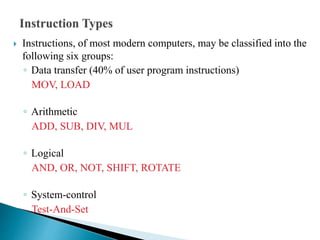
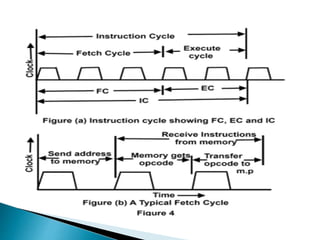
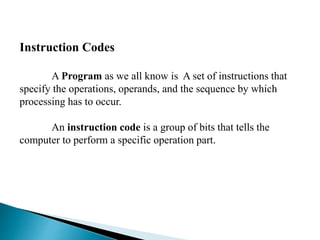
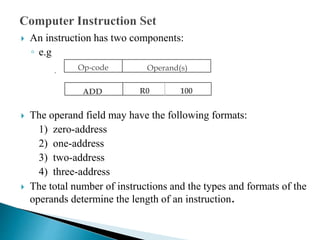
An instruction code consists of an operation code and operand(s) that specify the operation to perform and data to use. Operation codes are binary codes that define operations like addition, subtraction, etc. Early computers stored programs and data in separate memory sections and used a single accumulator register. Modern computers have multiple registers for temporary storage and performing operations faster than using only memory. Computer instructions encode an operation code and operand fields to specify the basic operations to perform on data stored in registers or memory.



![ indexed
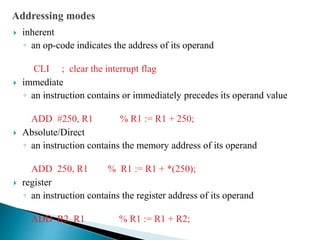
◦ an offset is added to a register to give the address of the
operand
MOV 2(R2), R1 % R1 := R2[2];
base-register
◦ a displacement is added to an implicit or explicit base register
to give the address of the operand
relative
◦ same as base-register mode except that the instruction pointer
is used as the base register](https://image.slidesharecdn.com/presentation1-180216054105/85/Instruction-codes-17-320.jpg)