Basic Computer Orgsnization and Design 1 Lecture 11
CSE 211, Computer Organization and Architecture Harneet Kaur, CSE/IT
Overview
Instruction Codes
 Computer Registers
 Computer Instructions
 Timing and Control
 Instruction Cycle
 Memory Reference Instructions
 Input-Output and Interrupt
 Complete Computer Description
Basic Computer Orgsnization and Design 2 Lecture 11
Introduction
• Every different processor type has its own design (different registers, buses,
microoperations, machine instructions, etc)
• Modern processor is a very complex device
• It contains
– Many registers
– Multiple arithmetic units, for both integer and floating point calculations
– The ability to pipeline several consecutive instructions to speed execution
– Etc.
• However, to understand how processors work, we will start with a
simplified processor model
Basic Computer Orgsnization and Design 3 Lecture 11
Basic Computer
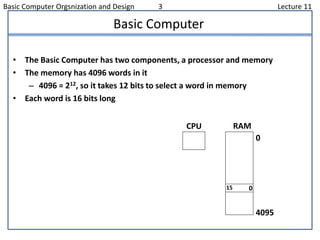
• The Basic Computer has two components, a processor and memory
• The memory has 4096 words in it
– 4096 = 212, so it takes 12 bits to select a word in memory
• Each word is 16 bits long
CPU RAM
0
4095
015
Basic Computer Orgsnization and Design 4 Lecture 11
CSE 211, Computer Organization and Architecture
Instruction
 Program
 A sequence of (machine) instructions
 (Machine) Instruction
 A group of bits that tell the computer to perform a specific operation
(a sequence of micro-operation)
 The instructions of a program, along with any needed data are stored in
memory
 The CPU reads the next instruction from memory
 It is placed in an Instruction Register (IR)
 Control circuitry in control unit then translates the instruction into the
sequence of microoperations necessary to implement it
Basic Computer Orgsnization and Design 5 Lecture 11
CSE 211, Computer Organization and Architecture
Instruction Format
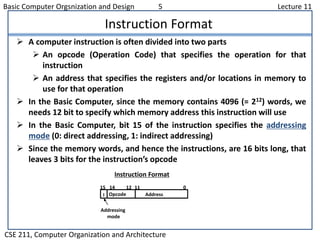
 A computer instruction is often divided into two parts
 An opcode (Operation Code) that specifies the operation for that
instruction
 An address that specifies the registers and/or locations in memory to
use for that operation
 In the Basic Computer, since the memory contains 4096 (= 212) words, we
needs 12 bit to specify which memory address this instruction will use
 In the Basic Computer, bit 15 of the instruction specifies the addressing
mode (0: direct addressing, 1: indirect addressing)
 Since the memory words, and hence the instructions, are 16 bits long, that
leaves 3 bits for the instruction’s opcode
Opcode Address
Instruction Format
15 14 12 0
I
11
Addressing
mode
Basic Computer Orgsnization and Design 6 Lecture 11
CSE 211, Computer Organization and Architecture
Addressing Mode
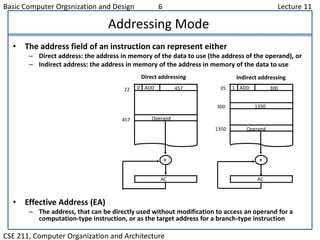
• The address field of an instruction can represent either
– Direct address: the address in memory of the data to use (the address of the operand), or
– Indirect address: the address in memory of the address in memory of the data to use
• Effective Address (EA)
– The address, that can be directly used without modification to access an operand for a
computation-type instruction, or as the target address for a branch-type instruction
0 ADD 45722
Operand457
1 ADD 30035
1350300
Operand1350
+
AC
+
AC
Direct addressing Indirect addressing
Basic Computer Orgsnization and Design 7 Lecture 11
CSE 211, Computer Organization and Architecture
Processor Register
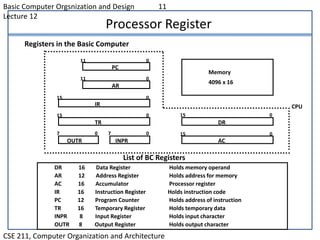
 A processor has many registers to hold instructions, addresses, data, etc
 The processor has a register, the Program Counter (PC) that holds the
memory address of the next instruction to get
Since the memory in the Basic Computer only has 4096 locations,
the PC only needs 12 bits
 In a direct or indirect addressing, the processor needs to keep track of
what locations in memory it is addressing: The Address Register (AR) is
used for this
The AR is a 12 bit register in the Basic Computer
 When an operand is found, using either direct or indirect addressing, it
is placed in the Data Register (DR). The processor then uses this value as
data for its operation
 The Basic Computer has a single general purpose register – the
Accumulator (AC)
Basic Computer Orgsnization and Design 8 Lecture 11
CSE 211, Computer Organization and Architecture
Processor Register
 The significance of a general purpose register is that it can be referred to in
instructions
e.g. load AC with the contents of a specific memory location; store the contents of AC
into a specified memory location
 Often a processor will need a scratch register to store intermediate results
or other temporary data; in the Basic Computer this is the Temporary
Register (TR)
 The Basic Computer uses a very simple model of input/output (I/O)
operations
Input devices are considered to send 8 bits of character data to the processor
The processor can send 8 bits of character data to output devices
 The Input Register (INPR) holds an 8 bit character gotten from an input
device
 The Output Register (OUTR) holds an 8 bit character to be send to an
output device
Basic Computer Orgsnization and Design 11
Lecture 12
CSE 211, Computer Organization and Architecture
Processor Register
List of BC Registers
DR 16 Data Register Holds memory operand
AR 12 Address Register Holds address for memory
AC 16 Accumulator Processor register
IR 16 Instruction Register Holds instruction code
PC 12 Program Counter Holds address of instruction
TR 16 Temporary Register Holds temporary data
INPR 8 Input Register Holds input character
OUTR 8 Output Register Holds output character
Registers in the Basic Computer
11 0
PC
15 0
IR
15 0
TR
7 0
OUTR
15 0
DR
15 0
AC
11 0
AR
INPR
0 7
Memory
4096 x 16
CPU
Basic Computer Orgsnization and Design 12
Lecture 12
CSE 211, Computer Organization and Architecture
Common Bus System
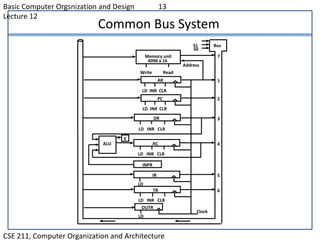
 The registers in the Basic Computer are connected using a bus
 This gives a savings in circuitry over complete connections between
registers
Basic Computer Orgsnization and Design 13
Lecture 12
CSE 211, Computer Organization and Architecture
Common Bus System
S1
S0
Bus
Memory unit
4096 x 16
LD INR CLR
Address
ReadWrite
AR
LD INR CLR
PC
LD INR CLR
DR
LD INR CLR
ACALU
E
INPR
IR
LD
LD INR CLR
TR
OUTR
LD
Clock
7
1
2
3
4
5
6
Basic Computer Orgsnization and Design 14
Lecture 12
CSE 211, Computer Organization and Architecture
Common Bus System
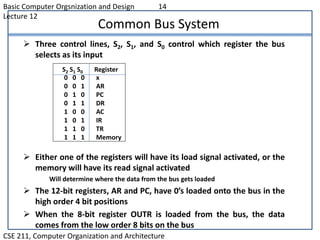
 Three control lines, S2, S1, and S0 control which register the bus
selects as its input
 Either one of the registers will have its load signal activated, or the
memory will have its read signal activated
Will determine where the data from the bus gets loaded
 The 12-bit registers, AR and PC, have 0’s loaded onto the bus in the
high order 4 bit positions
 When the 8-bit register OUTR is loaded from the bus, the data
comes from the low order 8 bits on the bus
0 0 0 x
0 0 1 AR
0 1 0 PC
0 1 1 DR
1 0 0 AC
1 0 1 IR
1 1 0 TR
1 1 1 Memory
S2 S1 S0 Register
Basic Computer Orgsnization and Design 15
Lecture 13
CSE 211, Computer Organization and Architecture
Basic Computer Instructions
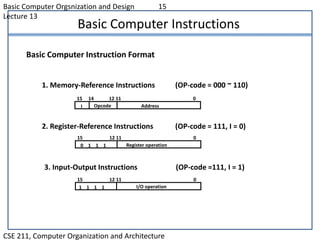
Basic Computer Instruction Format
15 14 12 11 0
I Opcode Address
1. Memory-Reference Instructions (OP-code = 000 ~ 110)
2. Register-Reference Instructions (OP-code = 111, I = 0)
3. Input-Output Instructions (OP-code =111, I = 1)
15 12 11 0
Register operation0 1 1 1
15 12 11 0
I/O operation1 1 1 1
Basic Computer Orgsnization and Design 16
Lecture 13
CSE 211, Computer Organization and Architecture
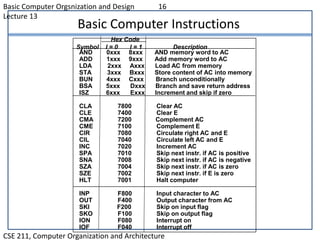
Basic Computer Instructions
AND 0xxx 8xxx AND memory word to AC
ADD 1xxx 9xxx Add memory word to AC
LDA 2xxx Axxx Load AC from memory
STA 3xxx Bxxx Store content of AC into memory
BUN 4xxx Cxxx Branch unconditionally
BSA 5xxx Dxxx Branch and save return address
ISZ 6xxx Exxx Increment and skip if zero
CLA 7800 Clear AC
CLE 7400 Clear E
CMA 7200 Complement AC
CME 7100 Complement E
CIR 7080 Circulate right AC and E
CIL 7040 Circulate left AC and E
INC 7020 Increment AC
SPA 7010 Skip next instr. if AC is positive
SNA 7008 Skip next instr. if AC is negative
SZA 7004 Skip next instr. if AC is zero
SZE 7002 Skip next instr. if E is zero
HLT 7001 Halt computer
INP F800 Input character to AC
OUT F400 Output character from AC
SKI F200 Skip on input flag
SKO F100 Skip on output flag
ION F080 Interrupt on
IOF F040 Interrupt off
Hex Code
Symbol I = 0 I = 1 Description
Basic Computer Orgsnization and Design 17
Lecture 13
CSE 211, Computer Organization and Architecture
Instruction Set Completeness
Instruction Types
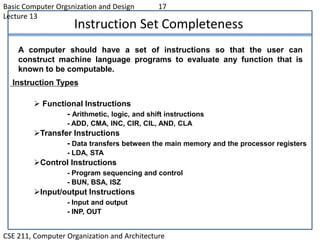
A computer should have a set of instructions so that the user can
construct machine language programs to evaluate any function that is
known to be computable.
 Functional Instructions
- Arithmetic, logic, and shift instructions
- ADD, CMA, INC, CIR, CIL, AND, CLA
Transfer Instructions
- Data transfers between the main memory and the processor registers
- LDA, STA
Control Instructions
- Program sequencing and control
- BUN, BSA, ISZ
Input/output Instructions
- Input and output
- INP, OUT
Basic Computer Orgsnization and Design 18
Lecture 14
CSE 211, Computer Organization and Architecture
Control Unit
 Control unit (CU) of a processor translates from machine
instructions to the control signals for the microoperations
that implement them
 Control units are implemented in one of two ways
Hardwired Control
CU is made up of sequential and combinational circuits to generate
the control signals
Microprogrammed Control
A control memory on the processor contains microprograms that
activate the necessary control signals
 We will consider a hardwired implementation of the control
unit for the Basic Computer
Basic Computer Orgsnization and Design 19
Lecture 14
CSE 211, Computer Organization and Architecture
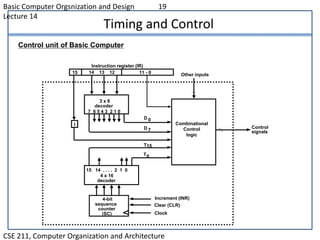
Timing and Control
Control unit of Basic Computer
Instruction register (IR)
15 14 13 12 11 - 0
3 x 8
decoder
7 6 5 4 3 2 1 0
I
D 0
15 14 . . . . 2 1 0
4 x 16
decoder
4-bit
sequence
counter
(SC)
Increment (INR)
Clear (CLR)
Clock
Other inputs
Control
signals
D
T
T
7
15
0
Combinational
Control
logic
Basic Computer Orgsnization and Design 20
Lecture 14
CSE 211, Computer Organization and Architecture
Timing Signals
Clock
T0 T1 T2 T3 T4 T0
T0
T1
T2
T3
T4
D3
CLR
SC
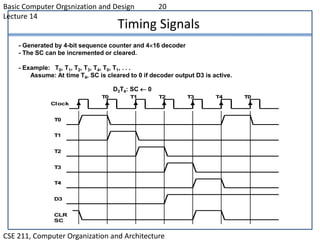
- Generated by 4-bit sequence counter and 416 decoder
- The SC can be incremented or cleared.
- Example: T0, T1, T2, T3, T4, T0, T1, . . .
Assume: At time T4, SC is cleared to 0 if decoder output D3 is active.
D3T4: SC  0
Basic Computer Orgsnization and Design 21
Lecture 15
CSE 211, Computer Organization and Architecture
Instruction Cycle
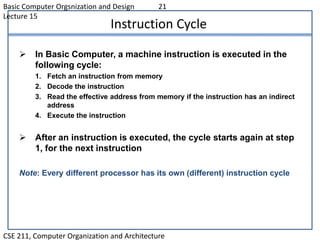
 In Basic Computer, a machine instruction is executed in the
following cycle:
1. Fetch an instruction from memory
2. Decode the instruction
3. Read the effective address from memory if the instruction has an indirect
address
4. Execute the instruction
 After an instruction is executed, the cycle starts again at step
1, for the next instruction
Note: Every different processor has its own (different) instruction cycle
Basic Computer Orgsnization and Design 22
Lecture 15
CSE 211, Computer Organization and Architecture
Fetch and Decode
Fetch and Decode T0: AR  PC (S0S1S2=010, T0=1)
T1: IR  M [AR], PC  PC + 1 (S0S1S2=111, T1=1)
T2: D0, . . . , D7  Decode IR(12-14), AR  IR(0-11), I  IR(15)
S2
S1
S0
Bus
7
Memory
unit
Address
Read
AR
LD
PC
INR
IR
LD Clock
1
2
5
Common bus
T1
T0
Basic Computer Orgsnization and Design 23
Lecture 16
CSE 211, Computer Organization and Architecture
Flow Chart (Instruction Cycle)
= 0 (direct)
Start
SC <-- 0
AR <-- PC
T0
IR <-- M[AR], PC <-- PC + 1
T1
AR <-- IR(0-11), I <-- IR(15)
Decode Opcode in IR(12-14),
T2
D7
= 0 (Memory-reference)(Register or I/O) = 1
II
Execute
register-reference
instruction
SC <-- 0
Execute
input-output
instruction
SC <-- 0
M[AR]<--AR Nothing
= 0 (register)(I/O) = 1 (indirect) = 1
T3 T3 T3 T3
Execute
memory-reference
instruction
SC <-- 0
T4
Basic Computer Orgsnization and Design 24 Lecture 16
CSE 211, Computer Organization and Architecture
Determining Type of Instruction
D'7IT3: AR M[AR]
D'7I'T3:Nothing
D7I'T3: Execute a register-reference instr.
D7IT3: Execute an input-output instr.
Basic Computer Orgsnization and Design 25 Lecture 16
CSE 211, Computer Organization and Architecture
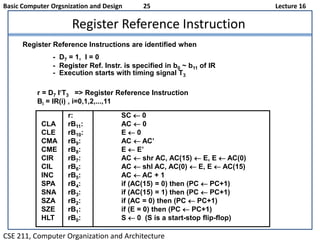
Register Reference Instruction
r = D7 IT3 => Register Reference Instruction
Bi = IR(i) , i=0,1,2,...,11
- D7 = 1, I = 0
- Register Ref. Instr. is specified in b0 ~ b11 of IR
- Execution starts with timing signal T3
Register Reference Instructions are identified when
r: SC  0
CLA rB11: AC  0
CLE rB10: E  0
CMA rB9: AC  AC’
CME rB8: E  E’
CIR rB7: AC  shr AC, AC(15)  E, E  AC(0)
CIL rB6: AC  shl AC, AC(0)  E, E  AC(15)
INC rB5: AC  AC + 1
SPA rB4: if (AC(15) = 0) then (PC  PC+1)
SNA rB3: if (AC(15) = 1) then (PC  PC+1)
SZA rB2: if (AC = 0) then (PC  PC+1)
SZE rB1: if (E = 0) then (PC  PC+1)
HLT rB0: S  0 (S is a start-stop flip-flop)
Basic Computer Orgsnization and Design 26
Lecture 17
CSE 211, Computer Organization and Architecture
Memory Reference Instructions
AND to AC
D0T4: DR  M[AR] Read operand
D0T5: AC  AC  DR, SC  0 AND with AC
ADD to AC
D1T4: DR  M[AR] Read operand
D1T5: AC  AC + DR, E  Cout, SC  0 Add to AC and store carry in E
- The effective address of the instruction is in AR and was placed there during
timing signal T2 when I = 0, or during timing signal T3 when I = 1
- Memory cycle is assumed to be short enough to complete in a CPU cycle
- The execution of MR instruction starts with T4
Symbol
Operation
Decoder
Symbolic Description
AND D0 AC  AC  M[AR]
ADD D1 AC  AC + M[AR], E  Cout
LDA D2 AC  M[AR]
STA D3 M[AR]  AC
BUN D4 PC  AR
BSA D5 M[AR]  PC, PC  AR + 1
ISZ D6 M[AR]  M[AR] + 1, if M[AR] + 1 = 0 then PC  PC+1
Basic Computer Orgsnization and Design 27
Lecture 17
CSE 211, Computer Organization and Architecture
Memory Reference Instructions
Memory, PC after execution
21
0 BSA 135
Next instruction
Subroutine
20
PC = 21
AR = 135
136
1 BUN 135
Memory, PC, AR at time T4
0 BSA 135
Next instruction
Subroutine
20
21
135
PC = 136
1 BUN 135
LDA: Load to AC
D2T4: DR  M[AR]
D2T5: AC  DR, SC  0
STA: Store AC
D3T4: M[AR]  AC, SC  0
BUN: Branch Unconditionally
D4T4: PC  AR, SC  0
BSA: Branch and Save Return Address
M[AR]  PC, PC  AR + 1
Basic Computer Orgsnization and Design 28
Lecture 17
CSE 211, Computer Organization and Architecture
Memory Reference Instructions
BSA:
D5T4: M[AR]  PC, AR  AR + 1
D5T5: PC  AR, SC  0
ISZ: Increment and Skip-if-Zero
D6T4: DR  M[AR]
D6T5: DR  DR + 1
D6T4: M[AR]  DR, if (DR = 0) then (PC  PC + 1), SC  0
Basic Computer Orgsnization and Design 29
Lecture 17
CSE 211, Computer Organization and Architecture
Flow Chart - Memory Reference Instructions
Memory-reference instruction
DR  M[AR] DR  M[AR] DR  M[AR] M[AR]  AC
SC  0
AND ADD LDA STA
AC  AC DR
SC  0
AC  AC + DR
E  Cout
SC  0
AC  DR
SC  0
D T0 4 D T1 4 D T2 4 D T3 4
D T0 5 D T1 5 D T2 5
PC  AR
SC  0
M[AR]  PC
AR  AR + 1
DR  M[AR]
BUN BSA ISZ
D T4 4 D T5 4 D T6 4
DR  DR + 1
D T5 5 D T6 5
PC  AR
SC  0
M[AR]  DR
If (DR = 0)
then (PC  PC + 1)
SC  0
D T6 6
Basic Computer Orgsnization and Design 30
Lecture 18
CSE 211, Computer Organization and Architecture
Input/Output and Interrupt
Input-Output Configuration
INPR Input register - 8 bits
OUTR Output register - 8 bits
FGI Input flag - 1 bit
FGO Output flag - 1 bit
IEN Interrupt enable - 1 bit
- The terminal sends and receives serial information
- The serial info. from the keyboard is shifted into INPR
- The serial info. for the printer is stored in the OUTR
- INPR and OUTR communicate with the terminal serially and with the AC
in parallel.
- The flags are needed to synchronize the timing difference between I/O
device and the computer
A Terminal with a keyboard and a Printer
Input-output
terminal
Serial
communication
interface
Computer
registers and
flip-flops
Printer
Keyboard
Receiver
interface
Transmitter
interface
FGOOUTR
AC
INPR FGI
Serial Communications Path
Parallel Communications Path
Basic Computer Orgsnization and Design 31
Lecture 18
CSE 211, Computer Organization and Architecture
Input/Output Instructions
D7IT3 = p
IR(i) = Bi, i = 6, …, 11
p: SC  0 Clear SC
INP pB11: AC(0-7)  INPR, FGI  0 Input char. to AC
OUT pB10: OUTR  AC(0-7), FGO  0 Output char. from AC
SKI pB9: if(FGI = 1) then (PC  PC + 1) Skip on input flag
SKO pB8: if(FGO = 1) then (PC  PC + 1) Skip on output flag
ION pB7: IEN  1 Interrupt enable on
IOF pB6: IEN  0 Interrupt enable off
Basic Computer Orgsnization and Design 32
Lecture 18
CSE 211, Computer Organization and Architecture
Interrupt Initiated Input/Output
- Open communication only when some data has to be passed --> interrupt.
- The I/O interface, instead of the CPU, monitors the I/O device.
- When the interface founds that the I/O device is ready for data transfer,
it generates an interrupt request to the CPU
- Upon detecting an interrupt, the CPU stops momentarily the task
it is doing, branches to the service routine to process the data
transfer, and then returns to the task it was performing.
IEN (Interrupt-enable flip-flop)
- can be set and cleared by instructions
- when cleared, the computer cannot be interrupted
Basic Computer Orgsnization and Design 33
Lecture 18
CSE 211, Computer Organization and Architecture
Flow Chart of Interrupt Cycle
R = Interrupt f/f
- The interrupt cycle is a HW implementation of a branch and save return address
operation.
- At the beginning of the next instruction cycle, the instruction that is read from
memory is in address 1.
- At memory address 1, the programmer must store a branch instruction that sends
the control to an interrupt service routine
- The instruction that returns the control to the original program is "indirect BUN 0"
Store return address
R
=1=0
in location 0
M[0]  PC
Branch to location 1
PC  1
IEN  0
R  0
Interrupt cycleInstruction cycle
Fetch and decode
instructions
IEN
FGI
FGO
Execute
instructions
R  1
=1
=1
=1
=0
=0
=0
INPR Input register - 8 bits
OUTR Output register - 8 bits
FGI Input flag - 1 bit
FGO Output flag - 1 bit
IEN Interrupt enable - 1 bit
Basic Computer Orgsnization and Design 34
Lecture 18
CSE 211, Computer Organization and Architecture
Register Transfer Operations in Interrupt Cycle
Register Transfer Statements for Interrupt Cycle
- R F/F  1 if IEN (FGI + FGO)T0T1T2
 T0T1T2 (IEN)(FGI + FGO): R  1
- The fetch and decode phases of the instruction cycle
must be modified Replace T0, T1, T2 with R'T0, R'T1, R'T2
- The interrupt cycle :
RT0: AR  0, TR  PC
RT1: M[AR]  TR, PC  0
RT2: PC  PC + 1, IEN  0, R  0, SC  0
After interrupt cycle
0 BUN 1120
0
1
PC = 256
255
1 BUN 0
Before interrupt
Main
Program
1120
I/O
Program
0 BUN 1120
0
PC = 1
256
255
1 BUN 0
Memory
Main
Program
1120
I/O
Program
256
Basic Computer Orgsnization and Design 35
Lecture 19
CSE 211, Computer Organization and Architecture
Complete Computer Design
=1 (I/O) =0 (Register) =1(Indir) =0(Dir)
start
SC  0, IEN  0, R  0
R
AR  PC
R’T0
IR  M[AR], PC  PC + 1
R’T1
AR  IR(0~11), I  IR(15)
D0...D7  Decode IR(12 ~ 14)
R’T2
AR  0, TR  PC
RT0
M[AR]  TR, PC  0
RT1
PC  PC + 1, IEN  0
R  0, SC  0
RT2
D7
I I
Execute
I/O
Instruction
Execute
RR
Instruction
AR <- M[AR] Idle
D7IT3 D7I’T3 D7’IT3 D7’I’T3
Execute MR
Instruction
=0(Instruction =1(Interrupt
Cycle) Cycle)
=1(Register or I/O) =0(Memory Ref)
D7’T4
INPR Input register - 8 bits
OUTR Output register - 8 bits
FGI Input flag - 1 bit
FGO Output flag - 1 bit
IEN Interrupt enable - 1 bit
Basic Computer Orgsnization and Design 36
Lecture 19
CSE 211, Computer Organization and Architecture
Complete Computer Design
Fetch
Decode
Indirect
Interrupt
Memory-Reference
AND
ADD
LDA
STA
BUN
BSA
ISZ
RT0:
RT1:
RT2:
D7IT3:
RT0:
RT1:
RT2:
D0T4:
D0T5:
D1T4:
D1T5:
D2T4:
D2T5:
D3T4:
D4T4:
D5T4:
D5T5:
D6T4:
D6T5:
D6T6:
AR  PC
IR  M[AR], PC  PC + 1
D0, ..., D7  Decode IR(12 ~ 14),
AR  IR(0 ~ 11), I  IR(15)
AR  M[AR]
R  1
AR  0, TR  PC
M[AR]  TR, PC  0
PC  PC + 1, IEN  0, R  0, SC  0
DR  M[AR]
AC  AC  DR, SC  0
DR  M[AR]
AC  AC + DR, E  Cout, SC  0
DR  M[AR]
AC  DR, SC  0
M[AR]  AC, SC  0
PC  AR, SC  0
M[AR]  PC, AR  AR + 1
PC  AR, SC  0
DR  M[AR]
DR  DR + 1
M[AR]  DR, if(DR=0) then (PC  PC + 1),
SC  0
Basic Computer Orgsnization and Design 37
Lecture 19
CSE 211, Computer Organization and Architecture
Complete Computer Design
Register-Reference
CLA
CLE
CMA
CME
CIR
CIL
INC
SPA
SNA
SZA
SZE
HLT
Input-Output
INP
OUT
SKI
SKO
ION
IOF
D7IT3 = r
IR(i) = Bi
r:
rB11:
rB10:
rB9:
rB8:
rB7:
rB6:
rB5:
rB4:
rB3:
rB2:
rB1:
rB0:
D7IT3 = p
IR(i) = Bi
p:
pB11:
pB10:
pB9:
pB8:
pB7:
pB6:
(Common to all register-reference instr)
(i = 0,1,2, ..., 11)
SC  0
AC  0
E  0
AC  AC
E  E
AC  shr AC, AC(15)  E, E  AC(0)
AC  shl AC, AC(0)  E, E  AC(15)
AC  AC + 1
If(AC(15) =0) then (PC  PC + 1)
If(AC(15) =1) then (PC  PC + 1)
If(AC = 0) then (PC  PC + 1)
If(E=0) then (PC  PC + 1)
S  0
(Common to all input-output instructions)
(i = 6,7,8,9,10,11)
SC  0
AC(0-7)  INPR, FGI  0
OUTR  AC(0-7), FGO  0
If(FGI=1) then (PC  PC + 1)
If(FGO=1) then (PC  PC + 1)
IEN  1
IEN  0
Basic Computer Orgsnization and Design 38
Lecture 19
CSE 211, Computer Organization and Architecture
Design of a Basic Computer(BC)
Hardware Components of BC
A memory unit: 4096 x 16.
Registers:
AR, PC, DR, AC, IR, TR, OUTR, INPR, and SC
Flip-Flops(Status):
I, S, E, R, IEN, FGI, and FGO
Decoders: a 3x8 Opcode decoder
a 4x16 timing decoder
Common bus: 16 bits
Control logic gates:
Adder and Logic circuit: Connected to AC
Control Logic Gates
- Input Controls of the nine registers
- Read and Write Controls of memory
- Set, Clear, or Complement Controls of the flip-flops
- S2, S1, S0 Controls to select a register for the bus
- AC, and Adder and Logic circuit

Instruction codes and computer registers

  • 1.
    Basic Computer Orgsnizationand Design 1 Lecture 11 CSE 211, Computer Organization and Architecture Harneet Kaur, CSE/IT Overview Instruction Codes  Computer Registers  Computer Instructions  Timing and Control  Instruction Cycle  Memory Reference Instructions  Input-Output and Interrupt  Complete Computer Description
  • 2.
    Basic Computer Orgsnizationand Design 2 Lecture 11 Introduction • Every different processor type has its own design (different registers, buses, microoperations, machine instructions, etc) • Modern processor is a very complex device • It contains – Many registers – Multiple arithmetic units, for both integer and floating point calculations – The ability to pipeline several consecutive instructions to speed execution – Etc. • However, to understand how processors work, we will start with a simplified processor model
  • 3.
    Basic Computer Orgsnizationand Design 3 Lecture 11 Basic Computer • The Basic Computer has two components, a processor and memory • The memory has 4096 words in it – 4096 = 212, so it takes 12 bits to select a word in memory • Each word is 16 bits long CPU RAM 0 4095 015
  • 4.
    Basic Computer Orgsnizationand Design 4 Lecture 11 CSE 211, Computer Organization and Architecture Instruction  Program  A sequence of (machine) instructions  (Machine) Instruction  A group of bits that tell the computer to perform a specific operation (a sequence of micro-operation)  The instructions of a program, along with any needed data are stored in memory  The CPU reads the next instruction from memory  It is placed in an Instruction Register (IR)  Control circuitry in control unit then translates the instruction into the sequence of microoperations necessary to implement it
  • 5.
    Basic Computer Orgsnizationand Design 5 Lecture 11 CSE 211, Computer Organization and Architecture Instruction Format  A computer instruction is often divided into two parts  An opcode (Operation Code) that specifies the operation for that instruction  An address that specifies the registers and/or locations in memory to use for that operation  In the Basic Computer, since the memory contains 4096 (= 212) words, we needs 12 bit to specify which memory address this instruction will use  In the Basic Computer, bit 15 of the instruction specifies the addressing mode (0: direct addressing, 1: indirect addressing)  Since the memory words, and hence the instructions, are 16 bits long, that leaves 3 bits for the instruction’s opcode Opcode Address Instruction Format 15 14 12 0 I 11 Addressing mode
  • 6.
    Basic Computer Orgsnizationand Design 6 Lecture 11 CSE 211, Computer Organization and Architecture Addressing Mode • The address field of an instruction can represent either – Direct address: the address in memory of the data to use (the address of the operand), or – Indirect address: the address in memory of the address in memory of the data to use • Effective Address (EA) – The address, that can be directly used without modification to access an operand for a computation-type instruction, or as the target address for a branch-type instruction 0 ADD 45722 Operand457 1 ADD 30035 1350300 Operand1350 + AC + AC Direct addressing Indirect addressing
  • 7.
    Basic Computer Orgsnizationand Design 7 Lecture 11 CSE 211, Computer Organization and Architecture Processor Register  A processor has many registers to hold instructions, addresses, data, etc  The processor has a register, the Program Counter (PC) that holds the memory address of the next instruction to get Since the memory in the Basic Computer only has 4096 locations, the PC only needs 12 bits  In a direct or indirect addressing, the processor needs to keep track of what locations in memory it is addressing: The Address Register (AR) is used for this The AR is a 12 bit register in the Basic Computer  When an operand is found, using either direct or indirect addressing, it is placed in the Data Register (DR). The processor then uses this value as data for its operation  The Basic Computer has a single general purpose register – the Accumulator (AC)
  • 8.
    Basic Computer Orgsnizationand Design 8 Lecture 11 CSE 211, Computer Organization and Architecture Processor Register  The significance of a general purpose register is that it can be referred to in instructions e.g. load AC with the contents of a specific memory location; store the contents of AC into a specified memory location  Often a processor will need a scratch register to store intermediate results or other temporary data; in the Basic Computer this is the Temporary Register (TR)  The Basic Computer uses a very simple model of input/output (I/O) operations Input devices are considered to send 8 bits of character data to the processor The processor can send 8 bits of character data to output devices  The Input Register (INPR) holds an 8 bit character gotten from an input device  The Output Register (OUTR) holds an 8 bit character to be send to an output device
  • 11.
    Basic Computer Orgsnizationand Design 11 Lecture 12 CSE 211, Computer Organization and Architecture Processor Register List of BC Registers DR 16 Data Register Holds memory operand AR 12 Address Register Holds address for memory AC 16 Accumulator Processor register IR 16 Instruction Register Holds instruction code PC 12 Program Counter Holds address of instruction TR 16 Temporary Register Holds temporary data INPR 8 Input Register Holds input character OUTR 8 Output Register Holds output character Registers in the Basic Computer 11 0 PC 15 0 IR 15 0 TR 7 0 OUTR 15 0 DR 15 0 AC 11 0 AR INPR 0 7 Memory 4096 x 16 CPU
  • 12.
    Basic Computer Orgsnizationand Design 12 Lecture 12 CSE 211, Computer Organization and Architecture Common Bus System  The registers in the Basic Computer are connected using a bus  This gives a savings in circuitry over complete connections between registers
  • 13.
    Basic Computer Orgsnizationand Design 13 Lecture 12 CSE 211, Computer Organization and Architecture Common Bus System S1 S0 Bus Memory unit 4096 x 16 LD INR CLR Address ReadWrite AR LD INR CLR PC LD INR CLR DR LD INR CLR ACALU E INPR IR LD LD INR CLR TR OUTR LD Clock 7 1 2 3 4 5 6
  • 14.
    Basic Computer Orgsnizationand Design 14 Lecture 12 CSE 211, Computer Organization and Architecture Common Bus System  Three control lines, S2, S1, and S0 control which register the bus selects as its input  Either one of the registers will have its load signal activated, or the memory will have its read signal activated Will determine where the data from the bus gets loaded  The 12-bit registers, AR and PC, have 0’s loaded onto the bus in the high order 4 bit positions  When the 8-bit register OUTR is loaded from the bus, the data comes from the low order 8 bits on the bus 0 0 0 x 0 0 1 AR 0 1 0 PC 0 1 1 DR 1 0 0 AC 1 0 1 IR 1 1 0 TR 1 1 1 Memory S2 S1 S0 Register
  • 15.
    Basic Computer Orgsnizationand Design 15 Lecture 13 CSE 211, Computer Organization and Architecture Basic Computer Instructions Basic Computer Instruction Format 15 14 12 11 0 I Opcode Address 1. Memory-Reference Instructions (OP-code = 000 ~ 110) 2. Register-Reference Instructions (OP-code = 111, I = 0) 3. Input-Output Instructions (OP-code =111, I = 1) 15 12 11 0 Register operation0 1 1 1 15 12 11 0 I/O operation1 1 1 1
  • 16.
    Basic Computer Orgsnizationand Design 16 Lecture 13 CSE 211, Computer Organization and Architecture Basic Computer Instructions AND 0xxx 8xxx AND memory word to AC ADD 1xxx 9xxx Add memory word to AC LDA 2xxx Axxx Load AC from memory STA 3xxx Bxxx Store content of AC into memory BUN 4xxx Cxxx Branch unconditionally BSA 5xxx Dxxx Branch and save return address ISZ 6xxx Exxx Increment and skip if zero CLA 7800 Clear AC CLE 7400 Clear E CMA 7200 Complement AC CME 7100 Complement E CIR 7080 Circulate right AC and E CIL 7040 Circulate left AC and E INC 7020 Increment AC SPA 7010 Skip next instr. if AC is positive SNA 7008 Skip next instr. if AC is negative SZA 7004 Skip next instr. if AC is zero SZE 7002 Skip next instr. if E is zero HLT 7001 Halt computer INP F800 Input character to AC OUT F400 Output character from AC SKI F200 Skip on input flag SKO F100 Skip on output flag ION F080 Interrupt on IOF F040 Interrupt off Hex Code Symbol I = 0 I = 1 Description
  • 17.
    Basic Computer Orgsnizationand Design 17 Lecture 13 CSE 211, Computer Organization and Architecture Instruction Set Completeness Instruction Types A computer should have a set of instructions so that the user can construct machine language programs to evaluate any function that is known to be computable.  Functional Instructions - Arithmetic, logic, and shift instructions - ADD, CMA, INC, CIR, CIL, AND, CLA Transfer Instructions - Data transfers between the main memory and the processor registers - LDA, STA Control Instructions - Program sequencing and control - BUN, BSA, ISZ Input/output Instructions - Input and output - INP, OUT
  • 18.
    Basic Computer Orgsnizationand Design 18 Lecture 14 CSE 211, Computer Organization and Architecture Control Unit  Control unit (CU) of a processor translates from machine instructions to the control signals for the microoperations that implement them  Control units are implemented in one of two ways Hardwired Control CU is made up of sequential and combinational circuits to generate the control signals Microprogrammed Control A control memory on the processor contains microprograms that activate the necessary control signals  We will consider a hardwired implementation of the control unit for the Basic Computer
  • 19.
    Basic Computer Orgsnizationand Design 19 Lecture 14 CSE 211, Computer Organization and Architecture Timing and Control Control unit of Basic Computer Instruction register (IR) 15 14 13 12 11 - 0 3 x 8 decoder 7 6 5 4 3 2 1 0 I D 0 15 14 . . . . 2 1 0 4 x 16 decoder 4-bit sequence counter (SC) Increment (INR) Clear (CLR) Clock Other inputs Control signals D T T 7 15 0 Combinational Control logic
  • 20.
    Basic Computer Orgsnizationand Design 20 Lecture 14 CSE 211, Computer Organization and Architecture Timing Signals Clock T0 T1 T2 T3 T4 T0 T0 T1 T2 T3 T4 D3 CLR SC - Generated by 4-bit sequence counter and 416 decoder - The SC can be incremented or cleared. - Example: T0, T1, T2, T3, T4, T0, T1, . . . Assume: At time T4, SC is cleared to 0 if decoder output D3 is active. D3T4: SC  0
  • 21.
    Basic Computer Orgsnizationand Design 21 Lecture 15 CSE 211, Computer Organization and Architecture Instruction Cycle  In Basic Computer, a machine instruction is executed in the following cycle: 1. Fetch an instruction from memory 2. Decode the instruction 3. Read the effective address from memory if the instruction has an indirect address 4. Execute the instruction  After an instruction is executed, the cycle starts again at step 1, for the next instruction Note: Every different processor has its own (different) instruction cycle
  • 22.
    Basic Computer Orgsnizationand Design 22 Lecture 15 CSE 211, Computer Organization and Architecture Fetch and Decode Fetch and Decode T0: AR  PC (S0S1S2=010, T0=1) T1: IR  M [AR], PC  PC + 1 (S0S1S2=111, T1=1) T2: D0, . . . , D7  Decode IR(12-14), AR  IR(0-11), I  IR(15) S2 S1 S0 Bus 7 Memory unit Address Read AR LD PC INR IR LD Clock 1 2 5 Common bus T1 T0
  • 23.
    Basic Computer Orgsnizationand Design 23 Lecture 16 CSE 211, Computer Organization and Architecture Flow Chart (Instruction Cycle) = 0 (direct) Start SC <-- 0 AR <-- PC T0 IR <-- M[AR], PC <-- PC + 1 T1 AR <-- IR(0-11), I <-- IR(15) Decode Opcode in IR(12-14), T2 D7 = 0 (Memory-reference)(Register or I/O) = 1 II Execute register-reference instruction SC <-- 0 Execute input-output instruction SC <-- 0 M[AR]<--AR Nothing = 0 (register)(I/O) = 1 (indirect) = 1 T3 T3 T3 T3 Execute memory-reference instruction SC <-- 0 T4
  • 24.
    Basic Computer Orgsnizationand Design 24 Lecture 16 CSE 211, Computer Organization and Architecture Determining Type of Instruction D'7IT3: AR M[AR] D'7I'T3:Nothing D7I'T3: Execute a register-reference instr. D7IT3: Execute an input-output instr.
  • 25.
    Basic Computer Orgsnizationand Design 25 Lecture 16 CSE 211, Computer Organization and Architecture Register Reference Instruction r = D7 IT3 => Register Reference Instruction Bi = IR(i) , i=0,1,2,...,11 - D7 = 1, I = 0 - Register Ref. Instr. is specified in b0 ~ b11 of IR - Execution starts with timing signal T3 Register Reference Instructions are identified when r: SC  0 CLA rB11: AC  0 CLE rB10: E  0 CMA rB9: AC  AC’ CME rB8: E  E’ CIR rB7: AC  shr AC, AC(15)  E, E  AC(0) CIL rB6: AC  shl AC, AC(0)  E, E  AC(15) INC rB5: AC  AC + 1 SPA rB4: if (AC(15) = 0) then (PC  PC+1) SNA rB3: if (AC(15) = 1) then (PC  PC+1) SZA rB2: if (AC = 0) then (PC  PC+1) SZE rB1: if (E = 0) then (PC  PC+1) HLT rB0: S  0 (S is a start-stop flip-flop)
  • 26.
    Basic Computer Orgsnizationand Design 26 Lecture 17 CSE 211, Computer Organization and Architecture Memory Reference Instructions AND to AC D0T4: DR  M[AR] Read operand D0T5: AC  AC  DR, SC  0 AND with AC ADD to AC D1T4: DR  M[AR] Read operand D1T5: AC  AC + DR, E  Cout, SC  0 Add to AC and store carry in E - The effective address of the instruction is in AR and was placed there during timing signal T2 when I = 0, or during timing signal T3 when I = 1 - Memory cycle is assumed to be short enough to complete in a CPU cycle - The execution of MR instruction starts with T4 Symbol Operation Decoder Symbolic Description AND D0 AC  AC  M[AR] ADD D1 AC  AC + M[AR], E  Cout LDA D2 AC  M[AR] STA D3 M[AR]  AC BUN D4 PC  AR BSA D5 M[AR]  PC, PC  AR + 1 ISZ D6 M[AR]  M[AR] + 1, if M[AR] + 1 = 0 then PC  PC+1
  • 27.
    Basic Computer Orgsnizationand Design 27 Lecture 17 CSE 211, Computer Organization and Architecture Memory Reference Instructions Memory, PC after execution 21 0 BSA 135 Next instruction Subroutine 20 PC = 21 AR = 135 136 1 BUN 135 Memory, PC, AR at time T4 0 BSA 135 Next instruction Subroutine 20 21 135 PC = 136 1 BUN 135 LDA: Load to AC D2T4: DR  M[AR] D2T5: AC  DR, SC  0 STA: Store AC D3T4: M[AR]  AC, SC  0 BUN: Branch Unconditionally D4T4: PC  AR, SC  0 BSA: Branch and Save Return Address M[AR]  PC, PC  AR + 1
  • 28.
    Basic Computer Orgsnizationand Design 28 Lecture 17 CSE 211, Computer Organization and Architecture Memory Reference Instructions BSA: D5T4: M[AR]  PC, AR  AR + 1 D5T5: PC  AR, SC  0 ISZ: Increment and Skip-if-Zero D6T4: DR  M[AR] D6T5: DR  DR + 1 D6T4: M[AR]  DR, if (DR = 0) then (PC  PC + 1), SC  0
  • 29.
    Basic Computer Orgsnizationand Design 29 Lecture 17 CSE 211, Computer Organization and Architecture Flow Chart - Memory Reference Instructions Memory-reference instruction DR  M[AR] DR  M[AR] DR  M[AR] M[AR]  AC SC  0 AND ADD LDA STA AC  AC DR SC  0 AC  AC + DR E  Cout SC  0 AC  DR SC  0 D T0 4 D T1 4 D T2 4 D T3 4 D T0 5 D T1 5 D T2 5 PC  AR SC  0 M[AR]  PC AR  AR + 1 DR  M[AR] BUN BSA ISZ D T4 4 D T5 4 D T6 4 DR  DR + 1 D T5 5 D T6 5 PC  AR SC  0 M[AR]  DR If (DR = 0) then (PC  PC + 1) SC  0 D T6 6
  • 30.
    Basic Computer Orgsnizationand Design 30 Lecture 18 CSE 211, Computer Organization and Architecture Input/Output and Interrupt Input-Output Configuration INPR Input register - 8 bits OUTR Output register - 8 bits FGI Input flag - 1 bit FGO Output flag - 1 bit IEN Interrupt enable - 1 bit - The terminal sends and receives serial information - The serial info. from the keyboard is shifted into INPR - The serial info. for the printer is stored in the OUTR - INPR and OUTR communicate with the terminal serially and with the AC in parallel. - The flags are needed to synchronize the timing difference between I/O device and the computer A Terminal with a keyboard and a Printer Input-output terminal Serial communication interface Computer registers and flip-flops Printer Keyboard Receiver interface Transmitter interface FGOOUTR AC INPR FGI Serial Communications Path Parallel Communications Path
  • 31.
    Basic Computer Orgsnizationand Design 31 Lecture 18 CSE 211, Computer Organization and Architecture Input/Output Instructions D7IT3 = p IR(i) = Bi, i = 6, …, 11 p: SC  0 Clear SC INP pB11: AC(0-7)  INPR, FGI  0 Input char. to AC OUT pB10: OUTR  AC(0-7), FGO  0 Output char. from AC SKI pB9: if(FGI = 1) then (PC  PC + 1) Skip on input flag SKO pB8: if(FGO = 1) then (PC  PC + 1) Skip on output flag ION pB7: IEN  1 Interrupt enable on IOF pB6: IEN  0 Interrupt enable off
  • 32.
    Basic Computer Orgsnizationand Design 32 Lecture 18 CSE 211, Computer Organization and Architecture Interrupt Initiated Input/Output - Open communication only when some data has to be passed --> interrupt. - The I/O interface, instead of the CPU, monitors the I/O device. - When the interface founds that the I/O device is ready for data transfer, it generates an interrupt request to the CPU - Upon detecting an interrupt, the CPU stops momentarily the task it is doing, branches to the service routine to process the data transfer, and then returns to the task it was performing. IEN (Interrupt-enable flip-flop) - can be set and cleared by instructions - when cleared, the computer cannot be interrupted
  • 33.
    Basic Computer Orgsnizationand Design 33 Lecture 18 CSE 211, Computer Organization and Architecture Flow Chart of Interrupt Cycle R = Interrupt f/f - The interrupt cycle is a HW implementation of a branch and save return address operation. - At the beginning of the next instruction cycle, the instruction that is read from memory is in address 1. - At memory address 1, the programmer must store a branch instruction that sends the control to an interrupt service routine - The instruction that returns the control to the original program is "indirect BUN 0" Store return address R =1=0 in location 0 M[0]  PC Branch to location 1 PC  1 IEN  0 R  0 Interrupt cycleInstruction cycle Fetch and decode instructions IEN FGI FGO Execute instructions R  1 =1 =1 =1 =0 =0 =0 INPR Input register - 8 bits OUTR Output register - 8 bits FGI Input flag - 1 bit FGO Output flag - 1 bit IEN Interrupt enable - 1 bit
  • 34.
    Basic Computer Orgsnizationand Design 34 Lecture 18 CSE 211, Computer Organization and Architecture Register Transfer Operations in Interrupt Cycle Register Transfer Statements for Interrupt Cycle - R F/F  1 if IEN (FGI + FGO)T0T1T2  T0T1T2 (IEN)(FGI + FGO): R  1 - The fetch and decode phases of the instruction cycle must be modified Replace T0, T1, T2 with R'T0, R'T1, R'T2 - The interrupt cycle : RT0: AR  0, TR  PC RT1: M[AR]  TR, PC  0 RT2: PC  PC + 1, IEN  0, R  0, SC  0 After interrupt cycle 0 BUN 1120 0 1 PC = 256 255 1 BUN 0 Before interrupt Main Program 1120 I/O Program 0 BUN 1120 0 PC = 1 256 255 1 BUN 0 Memory Main Program 1120 I/O Program 256
  • 35.
    Basic Computer Orgsnizationand Design 35 Lecture 19 CSE 211, Computer Organization and Architecture Complete Computer Design =1 (I/O) =0 (Register) =1(Indir) =0(Dir) start SC  0, IEN  0, R  0 R AR  PC R’T0 IR  M[AR], PC  PC + 1 R’T1 AR  IR(0~11), I  IR(15) D0...D7  Decode IR(12 ~ 14) R’T2 AR  0, TR  PC RT0 M[AR]  TR, PC  0 RT1 PC  PC + 1, IEN  0 R  0, SC  0 RT2 D7 I I Execute I/O Instruction Execute RR Instruction AR <- M[AR] Idle D7IT3 D7I’T3 D7’IT3 D7’I’T3 Execute MR Instruction =0(Instruction =1(Interrupt Cycle) Cycle) =1(Register or I/O) =0(Memory Ref) D7’T4 INPR Input register - 8 bits OUTR Output register - 8 bits FGI Input flag - 1 bit FGO Output flag - 1 bit IEN Interrupt enable - 1 bit
  • 36.
    Basic Computer Orgsnizationand Design 36 Lecture 19 CSE 211, Computer Organization and Architecture Complete Computer Design Fetch Decode Indirect Interrupt Memory-Reference AND ADD LDA STA BUN BSA ISZ RT0: RT1: RT2: D7IT3: RT0: RT1: RT2: D0T4: D0T5: D1T4: D1T5: D2T4: D2T5: D3T4: D4T4: D5T4: D5T5: D6T4: D6T5: D6T6: AR  PC IR  M[AR], PC  PC + 1 D0, ..., D7  Decode IR(12 ~ 14), AR  IR(0 ~ 11), I  IR(15) AR  M[AR] R  1 AR  0, TR  PC M[AR]  TR, PC  0 PC  PC + 1, IEN  0, R  0, SC  0 DR  M[AR] AC  AC  DR, SC  0 DR  M[AR] AC  AC + DR, E  Cout, SC  0 DR  M[AR] AC  DR, SC  0 M[AR]  AC, SC  0 PC  AR, SC  0 M[AR]  PC, AR  AR + 1 PC  AR, SC  0 DR  M[AR] DR  DR + 1 M[AR]  DR, if(DR=0) then (PC  PC + 1), SC  0
  • 37.
    Basic Computer Orgsnizationand Design 37 Lecture 19 CSE 211, Computer Organization and Architecture Complete Computer Design Register-Reference CLA CLE CMA CME CIR CIL INC SPA SNA SZA SZE HLT Input-Output INP OUT SKI SKO ION IOF D7IT3 = r IR(i) = Bi r: rB11: rB10: rB9: rB8: rB7: rB6: rB5: rB4: rB3: rB2: rB1: rB0: D7IT3 = p IR(i) = Bi p: pB11: pB10: pB9: pB8: pB7: pB6: (Common to all register-reference instr) (i = 0,1,2, ..., 11) SC  0 AC  0 E  0 AC  AC E  E AC  shr AC, AC(15)  E, E  AC(0) AC  shl AC, AC(0)  E, E  AC(15) AC  AC + 1 If(AC(15) =0) then (PC  PC + 1) If(AC(15) =1) then (PC  PC + 1) If(AC = 0) then (PC  PC + 1) If(E=0) then (PC  PC + 1) S  0 (Common to all input-output instructions) (i = 6,7,8,9,10,11) SC  0 AC(0-7)  INPR, FGI  0 OUTR  AC(0-7), FGO  0 If(FGI=1) then (PC  PC + 1) If(FGO=1) then (PC  PC + 1) IEN  1 IEN  0
  • 38.
    Basic Computer Orgsnizationand Design 38 Lecture 19 CSE 211, Computer Organization and Architecture Design of a Basic Computer(BC) Hardware Components of BC A memory unit: 4096 x 16. Registers: AR, PC, DR, AC, IR, TR, OUTR, INPR, and SC Flip-Flops(Status): I, S, E, R, IEN, FGI, and FGO Decoders: a 3x8 Opcode decoder a 4x16 timing decoder Common bus: 16 bits Control logic gates: Adder and Logic circuit: Connected to AC Control Logic Gates - Input Controls of the nine registers - Read and Write Controls of memory - Set, Clear, or Complement Controls of the flip-flops - S2, S1, S0 Controls to select a register for the bus - AC, and Adder and Logic circuit