Overview
 Parallel Processing
 Pipelining
 Characteristics of Multiprocessors
 Interconnection Structures
 Inter processor Arbitration
 Inter processor Communication and Synchronization
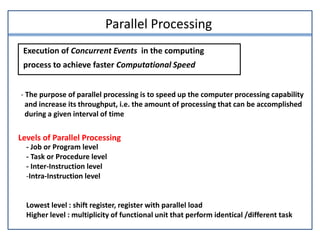
Parallel Processing
Levels of Parallel Processing
- Job or Program level
- Task or Procedure level
- Inter-Instruction level
-Intra-Instruction level
Lowest level : shift register, register with parallel load
Higher level : multiplicity of functional unit that perform identical /different task
Execution of Concurrent Events in the computing
process to achieve faster Computational Speed
- The purpose of parallel processing is to speed up the computer processing capability
and increase its throughput, i.e. the amount of processing that can be accomplished
during a given interval of time
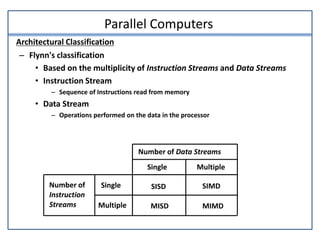
Parallel Computers
Architectural Classification
– Flynn's classification
• Based on the multiplicity of Instruction Streams and Data Streams
• Instruction Stream
– Sequence of Instructions read from memory
• Data Stream
– Operations performed on the data in the processor
Number of Data Streams
Number of
Instruction
Streams
Single
Multiple
Single Multiple
SISD SIMD
MISD MIMD
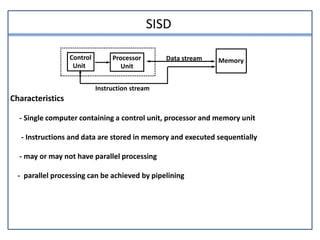
SISD
Control
Unit
Processor
Unit
Memory
Instruction stream
Data stream
Characteristics
- Single computer containing a control unit, processor and memory unit
- Instructions and data are stored in memory and executed sequentially
- may or may not have parallel processing
- parallel processing can be achieved by pipelining
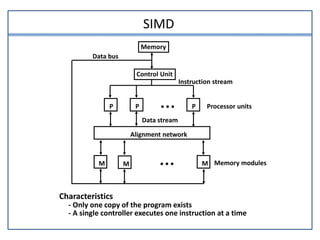
SIMD
Control Unit
Memory
Alignment network
P P P• • •
M MM • • •
Data bus
Instruction stream
Data stream
Processor units
Memory modules
Characteristics
- Only one copy of the program exists
- A single controller executes one instruction at a time
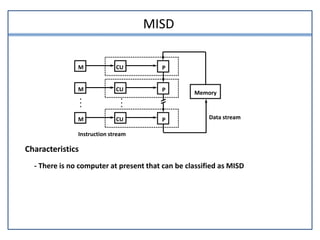
MISD
M CU P
M CU P
M CU P
•
•
•
•
•
•
Memory
Instruction stream
Data stream
Characteristics
- There is no computer at present that can be classified as MISD
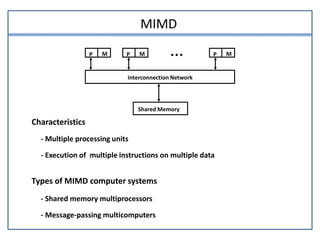
MIMD
Interconnection Network
P M P MP M • • •
Shared Memory
Characteristics
- Multiple processing units
- Execution of multiple instructions on multiple data
Types of MIMD computer systems
- Shared memory multiprocessors
- Message-passing multicomputers
Pipelining
A technique of decomposing a sequential process into sub operations, with
each sub process being executed in a special dedicated segment that
operates concurrently with all other segments.
- It is the characteristic of pipelining that several computations can be in
progress in distinct segments at the same time.
- Each segment performs partial processing dictated by the way the task is
dictated
- The result obtained from computation is in each segment is transferred
to next segment in the pipeline
- The final result is obtained after data has been passed through all
segment
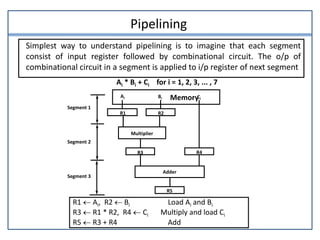
Pipelining
R1  Ai, R2  Bi Load Ai and Bi
R3  R1 * R2, R4  Ci Multiply and load Ci
R5  R3 + R4 Add
Simplest way to understand pipelining is to imagine that each segment
consist of input register followed by combinational circuit. The o/p of
combinational circuit in a segment is applied to i/p register of next segment
Ai * Bi + Ci for i = 1, 2, 3, ... , 7
Ai
R1 R2
Multiplier
R3 R4
Adder
R5
MemoryBi Ci
Segment 1
Segment 2
Segment 3
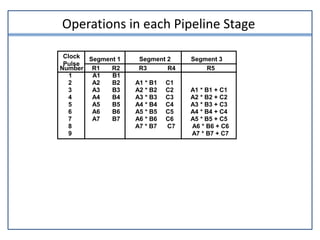
Operations in each Pipeline Stage
Clock
Pulse
Segment 1 Segment 2 Segment 3
Number R1 R2 R3 R4 R5
1 A1 B1
2 A2 B2 A1 * B1 C1
3 A3 B3 A2 * B2 C2 A1 * B1 + C1
4 A4 B4 A3 * B3 C3 A2 * B2 + C2
5 A5 B5 A4 * B4 C4 A3 * B3 + C3
6 A6 B6 A5 * B5 C5 A4 * B4 + C4
7 A7 B7 A6 * B6 C6 A5 * B5 + C5
8 A7 * B7 C7 A6 * B6 + C6
9 A7 * B7 + C7
General Pipeline
General Structure of a 4-Segment Pipeline
S R1 1 S R2 2 S R3 3 S R4 4
Input
Clock
Space-Time Diagram
1 2 3 4 5 6 7 8 9
T1
T1
T1
T1
T2
T2
T2
T2
T3
T3
T3
T3 T4
T4
T4
T4 T5
T5
T5
T5 T6
T6
T6
T6
Clock cycles
Segment 1
2
3
4
Pipeline SpeedUp
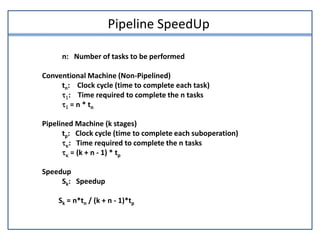
n: Number of tasks to be performed
Conventional Machine (Non-Pipelined)
tn: Clock cycle (time to complete each task)
t1: Time required to complete the n tasks
t1 = n * tn
Pipelined Machine (k stages)
tp: Clock cycle (time to complete each suboperation)
tk: Time required to complete the n tasks
tk = (k + n - 1) * tp
Speedup
Sk: Speedup
Sk = n*tn / (k + n - 1)*tp
Pipeline SpeedUp
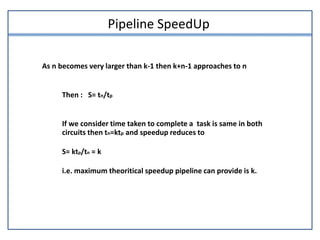
As n becomes very larger than k-1 then k+n-1 approaches to n
Then : S= tn/tp
If we consider time taken to complete a task is same in both
circuits then tn=ktp and speedup reduces to
S= ktp/tn = k
i.e. maximum theoritical speedup pipeline can provide is k.

Parallel processing and pipelining

  • 1.
    Overview  Parallel Processing Pipelining  Characteristics of Multiprocessors  Interconnection Structures  Inter processor Arbitration  Inter processor Communication and Synchronization
  • 2.
    Parallel Processing Levels ofParallel Processing - Job or Program level - Task or Procedure level - Inter-Instruction level -Intra-Instruction level Lowest level : shift register, register with parallel load Higher level : multiplicity of functional unit that perform identical /different task Execution of Concurrent Events in the computing process to achieve faster Computational Speed - The purpose of parallel processing is to speed up the computer processing capability and increase its throughput, i.e. the amount of processing that can be accomplished during a given interval of time
  • 3.
    Parallel Computers Architectural Classification –Flynn's classification • Based on the multiplicity of Instruction Streams and Data Streams • Instruction Stream – Sequence of Instructions read from memory • Data Stream – Operations performed on the data in the processor Number of Data Streams Number of Instruction Streams Single Multiple Single Multiple SISD SIMD MISD MIMD
  • 4.
    SISD Control Unit Processor Unit Memory Instruction stream Data stream Characteristics -Single computer containing a control unit, processor and memory unit - Instructions and data are stored in memory and executed sequentially - may or may not have parallel processing - parallel processing can be achieved by pipelining
  • 5.
    SIMD Control Unit Memory Alignment network PP P• • • M MM • • • Data bus Instruction stream Data stream Processor units Memory modules Characteristics - Only one copy of the program exists - A single controller executes one instruction at a time
  • 6.
    MISD M CU P MCU P M CU P • • • • • • Memory Instruction stream Data stream Characteristics - There is no computer at present that can be classified as MISD
  • 7.
    MIMD Interconnection Network P MP MP M • • • Shared Memory Characteristics - Multiple processing units - Execution of multiple instructions on multiple data Types of MIMD computer systems - Shared memory multiprocessors - Message-passing multicomputers
  • 8.
    Pipelining A technique ofdecomposing a sequential process into sub operations, with each sub process being executed in a special dedicated segment that operates concurrently with all other segments. - It is the characteristic of pipelining that several computations can be in progress in distinct segments at the same time. - Each segment performs partial processing dictated by the way the task is dictated - The result obtained from computation is in each segment is transferred to next segment in the pipeline - The final result is obtained after data has been passed through all segment
  • 9.
    Pipelining R1  Ai,R2  Bi Load Ai and Bi R3  R1 * R2, R4  Ci Multiply and load Ci R5  R3 + R4 Add Simplest way to understand pipelining is to imagine that each segment consist of input register followed by combinational circuit. The o/p of combinational circuit in a segment is applied to i/p register of next segment Ai * Bi + Ci for i = 1, 2, 3, ... , 7 Ai R1 R2 Multiplier R3 R4 Adder R5 MemoryBi Ci Segment 1 Segment 2 Segment 3
  • 10.
    Operations in eachPipeline Stage Clock Pulse Segment 1 Segment 2 Segment 3 Number R1 R2 R3 R4 R5 1 A1 B1 2 A2 B2 A1 * B1 C1 3 A3 B3 A2 * B2 C2 A1 * B1 + C1 4 A4 B4 A3 * B3 C3 A2 * B2 + C2 5 A5 B5 A4 * B4 C4 A3 * B3 + C3 6 A6 B6 A5 * B5 C5 A4 * B4 + C4 7 A7 B7 A6 * B6 C6 A5 * B5 + C5 8 A7 * B7 C7 A6 * B6 + C6 9 A7 * B7 + C7
  • 11.
    General Pipeline General Structureof a 4-Segment Pipeline S R1 1 S R2 2 S R3 3 S R4 4 Input Clock Space-Time Diagram 1 2 3 4 5 6 7 8 9 T1 T1 T1 T1 T2 T2 T2 T2 T3 T3 T3 T3 T4 T4 T4 T4 T5 T5 T5 T5 T6 T6 T6 T6 Clock cycles Segment 1 2 3 4
  • 12.
    Pipeline SpeedUp n: Numberof tasks to be performed Conventional Machine (Non-Pipelined) tn: Clock cycle (time to complete each task) t1: Time required to complete the n tasks t1 = n * tn Pipelined Machine (k stages) tp: Clock cycle (time to complete each suboperation) tk: Time required to complete the n tasks tk = (k + n - 1) * tp Speedup Sk: Speedup Sk = n*tn / (k + n - 1)*tp
  • 13.
    Pipeline SpeedUp As nbecomes very larger than k-1 then k+n-1 approaches to n Then : S= tn/tp If we consider time taken to complete a task is same in both circuits then tn=ktp and speedup reduces to S= ktp/tn = k i.e. maximum theoritical speedup pipeline can provide is k.