12/15/2014
1
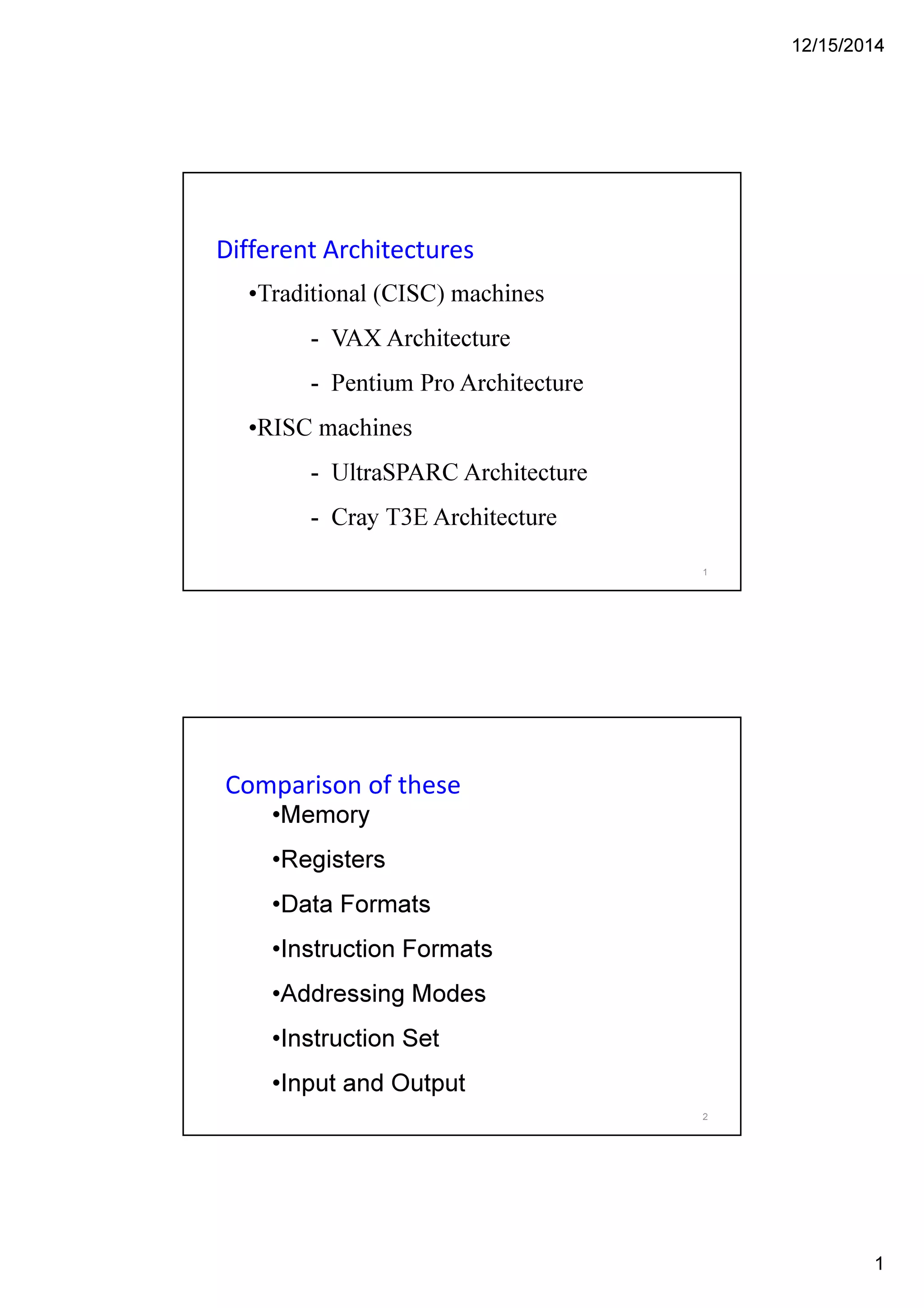
Different Architectures
•Traditional (CISC) machines
- VAX Architecture
- Pentium Pro Architecture
•RISC machines
- UltraSPARC Architecture
- Cray T3E Architecture
1
Comparison of these
•Memory
•Registers
•Data Formats
•Instruction Formats
•Addressing Modes
•Instruction Set
•Input and Output
2
12/15/2014
2
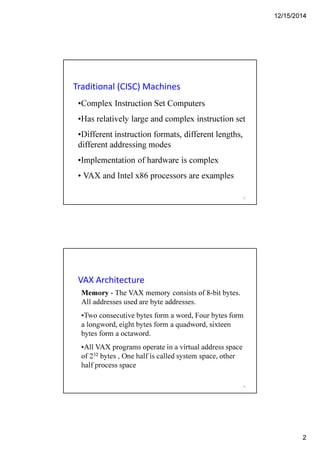
Traditional (CISC) Machines
•Complex Instruction Set Computers
•Has relatively large and complex instruction set
•Different instruction formats, different lengths,
different addressing modes
•Implementation of hardware is complex
• VAX and Intel x86 processors are examples
3
VAX Architecture
Memory - The VAX memory consists of 8-bit bytes.
All addresses used are byte addresses.
•Two consecutive bytes form a word, Four bytes form
a longword, eight bytes form a quadword, sixteen
bytes form a octaword.
•All VAX programs operate in a virtual address space
of 232 bytes , One half is called system space, other
half process space
4
12/15/2014
3
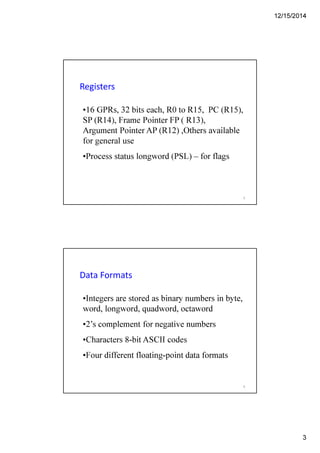
Registers
•16 GPRs, 32 bits each, R0 to R15, PC (R15),
SP (R14), Frame Pointer FP ( R13),
Argument Pointer AP (R12) ,Others available
for general use
•Process status longword (PSL) – for flags
5
Data Formats
•Integers are stored as binary numbers in byte,
word, longword, quadword, octaword
•2’s complement for negative numbers
•Characters 8-bit ASCII codes
•Four different floating-point data formats
6
12/15/2014
4
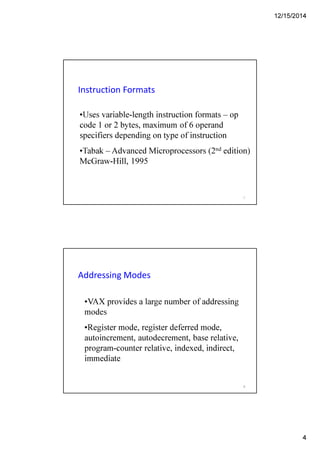
Instruction Formats
•Uses variable-length instruction formats – op
code 1 or 2 bytes, maximum of 6 operand
specifiers depending on type of instruction
•Tabak – Advanced Microprocessors (2nd edition)
McGraw-Hill, 1995
7
Addressing Modes
•VAX provides a large number of addressing
modes
•Register mode, register deferred mode,
autoincrement, autodecrement, base relative,
program-counter relative, indexed, indirect,
immediate
8
12/15/2014
5
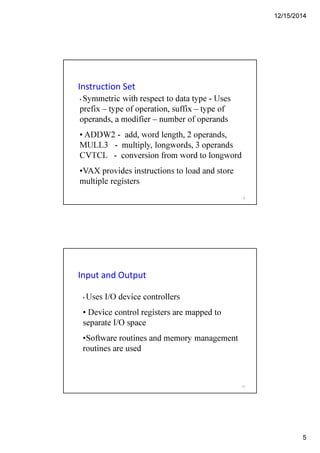
Instruction Set
• Symmetric with respect to data type - Uses
prefix – type of operation, suffix – type of
operands, a modifier – number of operands
• ADDW2 - add, word length, 2 operands,
MULL3 - multiply, longwords, 3 operands
CVTCL - conversion from word to longword
•VAX provides instructions to load and store
multiple registers
9
Input and Output
• Uses I/O device controllers
• Device control registers are mapped to
separate I/O space
•Software routines and memory management
routines are used
10
12/15/2014
6
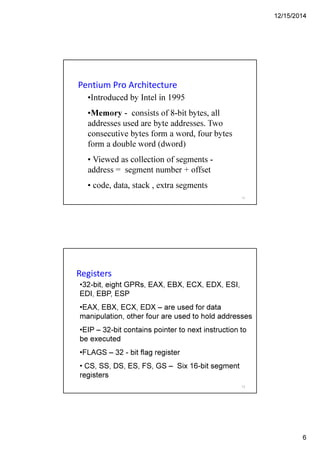
Pentium Pro Architecture
•Introduced by Intel in 1995
•Memory - consists of 8-bit bytes, all
addresses used are byte addresses. Two
consecutive bytes form a word, four bytes
form a double word (dword)
• Viewed as collection of segments -
address = segment number + offset
• code, data, stack , extra segments
11
Registers
•32-bit, eight GPRs, EAX, EBX, ECX, EDX, ESI,
EDI, EBP, ESP
•EAX, EBX, ECX, EDX – are used for data
manipulation, other four are used to hold addresses
•EIP – 32-bit contains pointer to next instruction to
be executed
•FLAGS – 32 - bit flag register
• CS, SS, DS, ES, FS, GS – Six 16-bit segment
registers
12
12/15/2014
7
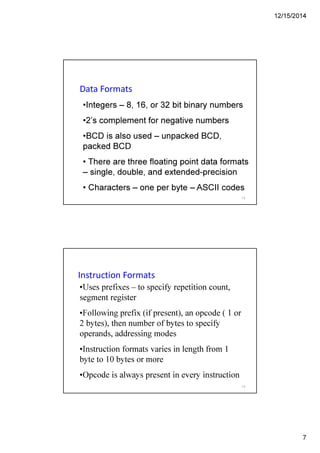
Data Formats
•Integers – 8, 16, or 32 bit binary numbers
•2’s complement for negative numbers
•BCD is also used – unpacked BCD,
packed BCD
• There are three floating point data formats
– single, double, and extended-precision
• Characters – one per byte – ASCII codes
13
Instruction Formats
•Uses prefixes – to specify repetition count,
segment register
•Following prefix (if present), an opcode ( 1 or
2 bytes), then number of bytes to specify
operands, addressing modes
•Instruction formats varies in length from 1
byte to 10 bytes or more
•Opcode is always present in every instruction
14
12/15/2014
8
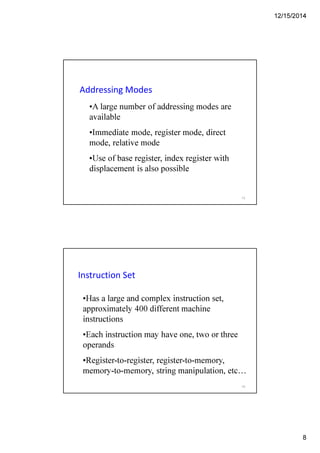
Addressing Modes
•A large number of addressing modes are
available
•Immediate mode, register mode, direct
mode, relative mode
•Use of base register, index register with
displacement is also possible
15
Instruction Set
•Has a large and complex instruction set,
approximately 400 different machine
instructions
•Each instruction may have one, two or three
operands
•Register-to-register, register-to-memory,
memory-to-memory, string manipulation, etc…
16
12/15/2014
9
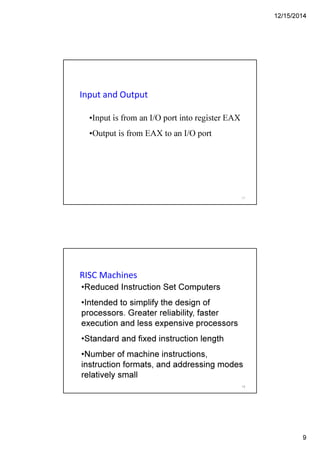
Input and Output
•Input is from an I/O port into register EAX
•Output is from EAX to an I/O port
17
RISC Machines
•Reduced Instruction Set Computers
•Intended to simplify the design of
processors. Greater reliability, faster
execution and less expensive processors
•Standard and fixed instruction length
•Number of machine instructions,
instruction formats, and addressing modes
relatively small
18
12/15/2014
10
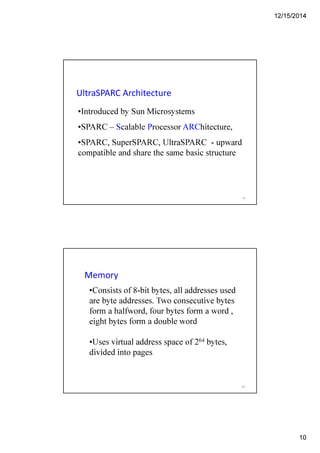
UltraSPARC Architecture
•Introduced by Sun Microsystems
•SPARC – Scalable Processor ARChitecture,
•SPARC, SuperSPARC, UltraSPARC - upward
compatible and share the same basic structure
19
Memory
•Consists of 8-bit bytes, all addresses used
are byte addresses. Two consecutive bytes
form a halfword, four bytes form a word ,
eight bytes form a double word
•Uses virtual address space of 264 bytes,
divided into pages
20
12/15/2014
11
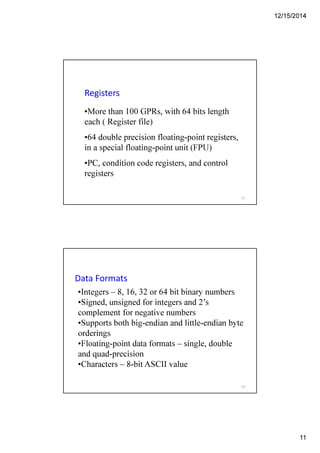
Registers
•More than 100 GPRs, with 64 bits length
each ( Register file)
•64 double precision floating-point registers,
in a special floating-point unit (FPU)
•PC, condition code registers, and control
registers
21
Data Formats
•Integers – 8, 16, 32 or 64 bit binary numbers
•Signed, unsigned for integers and 2’s
complement for negative numbers
•Supports both big-endian and little-endian byte
orderings
•Floating-point data formats – single, double
and quad-precision
•Characters – 8-bit ASCII value
22
12/15/2014
12
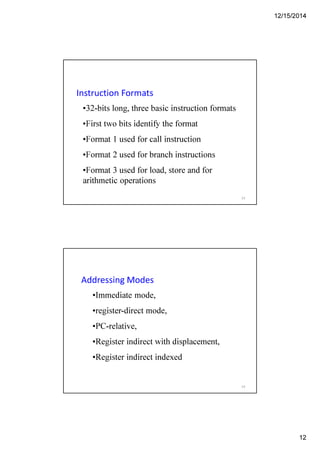
Instruction Formats
•32-bits long, three basic instruction formats
•First two bits identify the format
•Format 1 used for call instruction
•Format 2 used for branch instructions
•Format 3 used for load, store and for
arithmetic operations
23
Addressing Modes
•Immediate mode,
•register-direct mode,
•PC-relative,
•Register indirect with displacement,
•Register indirect indexed
24
12/15/2014
13
Instruction Set
•Has fewer than 100 machine instructions
•The only instructions that access memory
are loads and stores. All other instructions
are register-to-register operations
•Instruction execution is pipelined – results
in faster execution, speed increases
25
Input and Output
•Communication through I/O devices is
accomplished through memory
•A range of memory locations is logically
replaced by device registers
•When a load or store instruction refers to this
device register area of memory, the
corresponding device is activated
•There are no special I/O instructions
26
12/15/2014
14
Cray T3E Architecture
•Announced by Cray Research Inc., at the end
of 1995
•Is a massively parallel processing (MPP)
system, contains a large number of processing
elements (PE), arranged in a three-
dimensional network
•Each PE consists of a DEC Alpha EV5 RISC
processor, and local memory
27
Memory
•Each PE in T3E has its own local memory
with a capacity of from 64 megabytes to 2
gigabytes
•Consists of 8-bit bytes, all addresses used
are byte addresses. Two consecutive bytes
form a word, four bytes form a longword ,
eight bytes form a quadword
28
12/15/2014
15
Registers
•32 GPRs, with 64 bits length each called
R0 through R31, contains value zero always
•32 floating-point registers, 64 bits long
•64-bit PC, stauts , and control registers
29
Data Formats
•Integers –long and quadword binary numbers
•2’s complement for negative numbers
•Supports little-endian byte orderings
•Two different floating-point data formats –
VAX and IEEE standard
•Characters – 8-bit ASCII value
30
12/15/2014
16
Instruction Formats
•32-bits long, five basic instruction formats
•First six bits always identify the opcode
31
Addressing Modes
•Immediate mode,
•register-direct mode,
•PC-relative,
•Register indirect with displacement,
32
12/15/2014
17
Instruction Set
•Has approximately 130 machine
instructions
•There are no byte or word load and store
instructions
•Smith and Weiss – “PowerPC 601 and
Alpha 21064: A Tale of TWO RISCs “ –
Gives more information
33
Input and Output
•Communication through I/O devices is
accomplished through multiple ports and I/O
channels
•Channels are integrated into the network that
interconnects the processing elements
•All channels are accessible and controllable
from all PEs
34

Cis cvs risc

  • 1.
    12/15/2014 1 Different Architectures •Traditional (CISC)machines - VAX Architecture - Pentium Pro Architecture •RISC machines - UltraSPARC Architecture - Cray T3E Architecture 1 Comparison of these •Memory •Registers •Data Formats •Instruction Formats •Addressing Modes •Instruction Set •Input and Output 2
  • 2.
    12/15/2014 2 Traditional (CISC) Machines •ComplexInstruction Set Computers •Has relatively large and complex instruction set •Different instruction formats, different lengths, different addressing modes •Implementation of hardware is complex • VAX and Intel x86 processors are examples 3 VAX Architecture Memory - The VAX memory consists of 8-bit bytes. All addresses used are byte addresses. •Two consecutive bytes form a word, Four bytes form a longword, eight bytes form a quadword, sixteen bytes form a octaword. •All VAX programs operate in a virtual address space of 232 bytes , One half is called system space, other half process space 4
  • 3.
    12/15/2014 3 Registers •16 GPRs, 32bits each, R0 to R15, PC (R15), SP (R14), Frame Pointer FP ( R13), Argument Pointer AP (R12) ,Others available for general use •Process status longword (PSL) – for flags 5 Data Formats •Integers are stored as binary numbers in byte, word, longword, quadword, octaword •2’s complement for negative numbers •Characters 8-bit ASCII codes •Four different floating-point data formats 6
  • 4.
    12/15/2014 4 Instruction Formats •Uses variable-lengthinstruction formats – op code 1 or 2 bytes, maximum of 6 operand specifiers depending on type of instruction •Tabak – Advanced Microprocessors (2nd edition) McGraw-Hill, 1995 7 Addressing Modes •VAX provides a large number of addressing modes •Register mode, register deferred mode, autoincrement, autodecrement, base relative, program-counter relative, indexed, indirect, immediate 8
  • 5.
    12/15/2014 5 Instruction Set • Symmetricwith respect to data type - Uses prefix – type of operation, suffix – type of operands, a modifier – number of operands • ADDW2 - add, word length, 2 operands, MULL3 - multiply, longwords, 3 operands CVTCL - conversion from word to longword •VAX provides instructions to load and store multiple registers 9 Input and Output • Uses I/O device controllers • Device control registers are mapped to separate I/O space •Software routines and memory management routines are used 10
  • 6.
    12/15/2014 6 Pentium Pro Architecture •Introducedby Intel in 1995 •Memory - consists of 8-bit bytes, all addresses used are byte addresses. Two consecutive bytes form a word, four bytes form a double word (dword) • Viewed as collection of segments - address = segment number + offset • code, data, stack , extra segments 11 Registers •32-bit, eight GPRs, EAX, EBX, ECX, EDX, ESI, EDI, EBP, ESP •EAX, EBX, ECX, EDX – are used for data manipulation, other four are used to hold addresses •EIP – 32-bit contains pointer to next instruction to be executed •FLAGS – 32 - bit flag register • CS, SS, DS, ES, FS, GS – Six 16-bit segment registers 12
  • 7.
    12/15/2014 7 Data Formats •Integers –8, 16, or 32 bit binary numbers •2’s complement for negative numbers •BCD is also used – unpacked BCD, packed BCD • There are three floating point data formats – single, double, and extended-precision • Characters – one per byte – ASCII codes 13 Instruction Formats •Uses prefixes – to specify repetition count, segment register •Following prefix (if present), an opcode ( 1 or 2 bytes), then number of bytes to specify operands, addressing modes •Instruction formats varies in length from 1 byte to 10 bytes or more •Opcode is always present in every instruction 14
  • 8.
    12/15/2014 8 Addressing Modes •A largenumber of addressing modes are available •Immediate mode, register mode, direct mode, relative mode •Use of base register, index register with displacement is also possible 15 Instruction Set •Has a large and complex instruction set, approximately 400 different machine instructions •Each instruction may have one, two or three operands •Register-to-register, register-to-memory, memory-to-memory, string manipulation, etc… 16
  • 9.
    12/15/2014 9 Input and Output •Inputis from an I/O port into register EAX •Output is from EAX to an I/O port 17 RISC Machines •Reduced Instruction Set Computers •Intended to simplify the design of processors. Greater reliability, faster execution and less expensive processors •Standard and fixed instruction length •Number of machine instructions, instruction formats, and addressing modes relatively small 18
  • 10.
    12/15/2014 10 UltraSPARC Architecture •Introduced bySun Microsystems •SPARC – Scalable Processor ARChitecture, •SPARC, SuperSPARC, UltraSPARC - upward compatible and share the same basic structure 19 Memory •Consists of 8-bit bytes, all addresses used are byte addresses. Two consecutive bytes form a halfword, four bytes form a word , eight bytes form a double word •Uses virtual address space of 264 bytes, divided into pages 20
  • 11.
    12/15/2014 11 Registers •More than 100GPRs, with 64 bits length each ( Register file) •64 double precision floating-point registers, in a special floating-point unit (FPU) •PC, condition code registers, and control registers 21 Data Formats •Integers – 8, 16, 32 or 64 bit binary numbers •Signed, unsigned for integers and 2’s complement for negative numbers •Supports both big-endian and little-endian byte orderings •Floating-point data formats – single, double and quad-precision •Characters – 8-bit ASCII value 22
  • 12.
    12/15/2014 12 Instruction Formats •32-bits long,three basic instruction formats •First two bits identify the format •Format 1 used for call instruction •Format 2 used for branch instructions •Format 3 used for load, store and for arithmetic operations 23 Addressing Modes •Immediate mode, •register-direct mode, •PC-relative, •Register indirect with displacement, •Register indirect indexed 24
  • 13.
    12/15/2014 13 Instruction Set •Has fewerthan 100 machine instructions •The only instructions that access memory are loads and stores. All other instructions are register-to-register operations •Instruction execution is pipelined – results in faster execution, speed increases 25 Input and Output •Communication through I/O devices is accomplished through memory •A range of memory locations is logically replaced by device registers •When a load or store instruction refers to this device register area of memory, the corresponding device is activated •There are no special I/O instructions 26
  • 14.
    12/15/2014 14 Cray T3E Architecture •Announcedby Cray Research Inc., at the end of 1995 •Is a massively parallel processing (MPP) system, contains a large number of processing elements (PE), arranged in a three- dimensional network •Each PE consists of a DEC Alpha EV5 RISC processor, and local memory 27 Memory •Each PE in T3E has its own local memory with a capacity of from 64 megabytes to 2 gigabytes •Consists of 8-bit bytes, all addresses used are byte addresses. Two consecutive bytes form a word, four bytes form a longword , eight bytes form a quadword 28
  • 15.
    12/15/2014 15 Registers •32 GPRs, with64 bits length each called R0 through R31, contains value zero always •32 floating-point registers, 64 bits long •64-bit PC, stauts , and control registers 29 Data Formats •Integers –long and quadword binary numbers •2’s complement for negative numbers •Supports little-endian byte orderings •Two different floating-point data formats – VAX and IEEE standard •Characters – 8-bit ASCII value 30
  • 16.
    12/15/2014 16 Instruction Formats •32-bits long,five basic instruction formats •First six bits always identify the opcode 31 Addressing Modes •Immediate mode, •register-direct mode, •PC-relative, •Register indirect with displacement, 32
  • 17.
    12/15/2014 17 Instruction Set •Has approximately130 machine instructions •There are no byte or word load and store instructions •Smith and Weiss – “PowerPC 601 and Alpha 21064: A Tale of TWO RISCs “ – Gives more information 33 Input and Output •Communication through I/O devices is accomplished through multiple ports and I/O channels •Channels are integrated into the network that interconnects the processing elements •All channels are accessible and controllable from all PEs 34