ARCHITECTURE 0FARCHITECTURE 0F 80868086
MICROPROCESSORMICROPROCESSOR
1
CONTENTS
 INTRODUCTION 8086 MICROPROCESSOR
 ARCHITECTURE OF 8086 MICROPROSSESOR
 BIU AND EU
 REGISTERS OF 8086
 ALU
 QUEUING OF INSTRUCTION IN 8086
2
INTRODUCTION TO 8086
• The microprocessor 8086 is made of HMOS: high performance
metal oxide semiconductor technology with an IC circuitry
equivalent to ≈ 29000 transistors.
• Housed in a 40-pin dual in-line package.
• 8086 is a 16bit processor. It’s ALU, internal registers works with
16bit binary word.
• 8086 has a 16bit data bus. It can read or write data to a
memory/port either 16bits or 8 bit at a time.
• 8086 has a 20 bit address bus which means, it can address up to
220 = 1MB memory location.
• Frequency range of 8086 is 6-10 MHz.
3
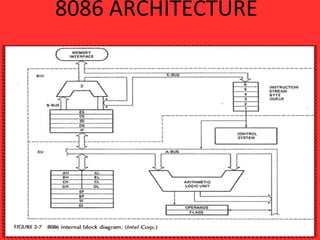
8086 ARCHITECTURE
Bus Interface Unit (BIU)
 The BIU fetches instructions, reads and writes
data, and computes the 20-bit address.
 BIU handles all the data transfers and
addresses on the buses for EU.
 EU executes instructions from the instruction
system byte queue.
Execution Unit (EU)
• The EU contains Control Circuitry, Instruction Decoder, ALU,
Pointer and Index register, Flag register.
• EU tells the BIU where to fetch instructions and data.
• The EU decodes and executes the instructions using the 16-bit
ALU.
• Decoder translates instructions into series of actions which EU
carries out.
• ALU can perform arithmetic and Logical operations.
• Control Circuitry directs internal operations.
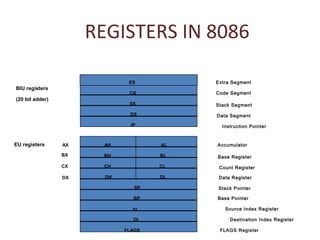
REGISTERS IN 8086
ES
CS
SS
DS
IP
AH
BH
CH
DH
AL
BL
CL
DL
SP
BP
SI
DI
FLAGS
AX
BX
CX
DX
Extra Segment
Code Segment
Stack Segment
Data Segment
Instruction Pointer
Accumulator
Base Register
Count Register
Data Register
Stack Pointer
Base Pointer
Source Index Register
BIU registers
(20 bit adder)
EU registers
Destination Index Register
FLAGS Register
Registers Description
• Registers
– Data registers
• Hold data for an operation to be performed
• There are 4 data registers (AX, BX, CX, DX)
– Address registers
• Hold the address of an instruction or data element
• Segment registers (CS, DS, ES, SS)
• Pointer registers (SP, BP, IP)
• Instructions execute faster if the data is in a register
• Low and High bytes of the data registers can be accessed separately
– AH, BH, CH, DH are the high bytes
– AL, BL, CL, and DL are the low bytes
• Data Registers are general purpose registers but they also perform special
functions
• AX
– Accumulator Register
– Preferred register to use in arithmetic, logic and data transfer
Data Registers
• BX
– Base Register
– Also serves as an address register
– Used in array operations
• CX
– Count register
– Used as a loop counter
– Used in shift and rotate operations
• DX
Data Registers (contd..)
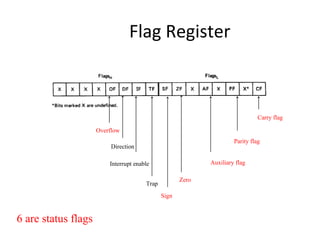
Flag Register
Carry flag
Parity flag
Auxiliary flag
Zero
Overflow
Direction
Interrupt enable
Trap
Sign
6 are status flags
Flag Register Description
• SF (sign) Contains the resulting sign of an arithmetic operation (1=negative)
• ZF (zero) Indicates when the result of arithmetic or a comparison is zero.
(1=yes)
• CF (Carry) Holds the carry out after addition or the borrow after subtraction.
• AF (auxiliary carry) Contains carry out of bit 3 into bit 4 for specialized arithmetic.
• PF (parity) Indicates the number of 1 bits that result from an operation in
accumulator.
• OF (overflow) Indicates overflow of the leftmost bit during arithmetic operation.
• DF (direction) Indicates left or right for moving or comparing string data if df=0
then then string proceed from lower address to high otherwise high add. To low
TF (trap flag)
• TF (trap) Permits operation of the processor in single
step mode .Here single stepping means to run a one
instruction at a time and see the contents of used registers
and memory avilaiable after execution of program. This is one
way to debug the program and errors can be eaisly
eliminated.
13
• IP: Instruction Pointer
Points to Next Instruction in code Memory.it calculate the 20 bit physical
address.
SP: Stack pointer
Points to Program Stack.it contains 16 bit offeset from start of
stack segment.
• BP: Base Pointer
Primarily used to access data on the stack
Pointer and Index Registers
• SI & DI: Source and Destination Index register
It is required for string operations. When string operations are performed, the SI & DI register points to memory locations in
the data segment which is addressed by the DS register.
• In case when physical address is calculated from SI and DS sI holds the 20
bit address.
• ES+DI is used to calculate the 20 bit adderess then di holds this address.
15
ALU
ALU stands for arithmetic and logic unit. It
performs,
1.Math operation like 8 or 16 bit addition,
subtraction, data conversion,
2.Logical operation like NOT, OR,XOR,AND,etc.
3.Increment ,decrement, and shift operation.
16
Instruction queue in 8086
• 8086 provides queuing facility where BIU fetches the
six instruction byte from memory while current
instruction is being executed. It speed up the
program execution.
• It works on first in first out (FIFO) fashion.
• The size of queue for 8086 is 6 bytes.
• BIU fetches the instruction code from memory and
stores in queue, EU fetches the instruction from
queue for execution.
17
THANK YOU
18

Architecture of 8086 Microprocessor

  • 1.
    ARCHITECTURE 0FARCHITECTURE 0F80868086 MICROPROCESSORMICROPROCESSOR 1
  • 2.
    CONTENTS  INTRODUCTION 8086MICROPROCESSOR  ARCHITECTURE OF 8086 MICROPROSSESOR  BIU AND EU  REGISTERS OF 8086  ALU  QUEUING OF INSTRUCTION IN 8086 2
  • 3.
    INTRODUCTION TO 8086 •The microprocessor 8086 is made of HMOS: high performance metal oxide semiconductor technology with an IC circuitry equivalent to ≈ 29000 transistors. • Housed in a 40-pin dual in-line package. • 8086 is a 16bit processor. It’s ALU, internal registers works with 16bit binary word. • 8086 has a 16bit data bus. It can read or write data to a memory/port either 16bits or 8 bit at a time. • 8086 has a 20 bit address bus which means, it can address up to 220 = 1MB memory location. • Frequency range of 8086 is 6-10 MHz. 3
  • 4.
  • 5.
    Bus Interface Unit(BIU)  The BIU fetches instructions, reads and writes data, and computes the 20-bit address.  BIU handles all the data transfers and addresses on the buses for EU.  EU executes instructions from the instruction system byte queue.
  • 6.
    Execution Unit (EU) •The EU contains Control Circuitry, Instruction Decoder, ALU, Pointer and Index register, Flag register. • EU tells the BIU where to fetch instructions and data. • The EU decodes and executes the instructions using the 16-bit ALU. • Decoder translates instructions into series of actions which EU carries out. • ALU can perform arithmetic and Logical operations. • Control Circuitry directs internal operations.
  • 7.
    REGISTERS IN 8086 ES CS SS DS IP AH BH CH DH AL BL CL DL SP BP SI DI FLAGS AX BX CX DX ExtraSegment Code Segment Stack Segment Data Segment Instruction Pointer Accumulator Base Register Count Register Data Register Stack Pointer Base Pointer Source Index Register BIU registers (20 bit adder) EU registers Destination Index Register FLAGS Register
  • 8.
    Registers Description • Registers –Data registers • Hold data for an operation to be performed • There are 4 data registers (AX, BX, CX, DX) – Address registers • Hold the address of an instruction or data element • Segment registers (CS, DS, ES, SS) • Pointer registers (SP, BP, IP)
  • 9.
    • Instructions executefaster if the data is in a register • Low and High bytes of the data registers can be accessed separately – AH, BH, CH, DH are the high bytes – AL, BL, CL, and DL are the low bytes • Data Registers are general purpose registers but they also perform special functions • AX – Accumulator Register – Preferred register to use in arithmetic, logic and data transfer Data Registers
  • 10.
    • BX – BaseRegister – Also serves as an address register – Used in array operations • CX – Count register – Used as a loop counter – Used in shift and rotate operations • DX Data Registers (contd..)
  • 11.
    Flag Register Carry flag Parityflag Auxiliary flag Zero Overflow Direction Interrupt enable Trap Sign 6 are status flags
  • 12.
    Flag Register Description •SF (sign) Contains the resulting sign of an arithmetic operation (1=negative) • ZF (zero) Indicates when the result of arithmetic or a comparison is zero. (1=yes) • CF (Carry) Holds the carry out after addition or the borrow after subtraction. • AF (auxiliary carry) Contains carry out of bit 3 into bit 4 for specialized arithmetic. • PF (parity) Indicates the number of 1 bits that result from an operation in accumulator. • OF (overflow) Indicates overflow of the leftmost bit during arithmetic operation. • DF (direction) Indicates left or right for moving or comparing string data if df=0 then then string proceed from lower address to high otherwise high add. To low
  • 13.
    TF (trap flag) •TF (trap) Permits operation of the processor in single step mode .Here single stepping means to run a one instruction at a time and see the contents of used registers and memory avilaiable after execution of program. This is one way to debug the program and errors can be eaisly eliminated. 13
  • 14.
    • IP: InstructionPointer Points to Next Instruction in code Memory.it calculate the 20 bit physical address. SP: Stack pointer Points to Program Stack.it contains 16 bit offeset from start of stack segment. • BP: Base Pointer Primarily used to access data on the stack Pointer and Index Registers
  • 15.
    • SI &DI: Source and Destination Index register It is required for string operations. When string operations are performed, the SI & DI register points to memory locations in the data segment which is addressed by the DS register. • In case when physical address is calculated from SI and DS sI holds the 20 bit address. • ES+DI is used to calculate the 20 bit adderess then di holds this address. 15
  • 16.
    ALU ALU stands forarithmetic and logic unit. It performs, 1.Math operation like 8 or 16 bit addition, subtraction, data conversion, 2.Logical operation like NOT, OR,XOR,AND,etc. 3.Increment ,decrement, and shift operation. 16
  • 17.
    Instruction queue in8086 • 8086 provides queuing facility where BIU fetches the six instruction byte from memory while current instruction is being executed. It speed up the program execution. • It works on first in first out (FIFO) fashion. • The size of queue for 8086 is 6 bytes. • BIU fetches the instruction code from memory and stores in queue, EU fetches the instruction from queue for execution. 17
  • 18.