
The document summarizes the evolution of microprocessors across five generations from 1971 to present. It describes the key developments including the first microprocessor introduced by Intel in 1971 called the 4004. Subsequent generations saw the development of 8-bit, 16-bit and 32-bit microprocessors using newer technologies that improved speed and density. The fifth generation is dominated by Intel processors like Pentium and multi-core CPUs that can exceed speeds of 1GHz.
GREEN UNIVERSITY OFBANGLADESH
Presentation
On
Evolution of Microprocessor
Presented by:
Md. Nahid Hasan
ID: 161001008
Dept.: EEE
2.
• Evolution ofMicroprocessors
• First Generation
• Second Generation
• Third Generation
• Fourth Generation
• Fifth Generation
Contents
2
3.
• First microprocessordeveloped by Intel in 1971, called
Intel 4004.
• Later different generations of microprocessors were
developed.
Evolution of Microprocessors
3
4.
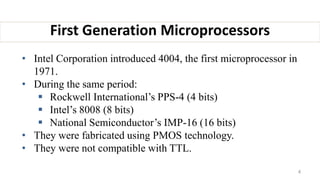
• Intel Corporationintroduced 4004, the first microprocessor in
1971.
• During the same period:
Rockwell International’s PPS-4 (4 bits)
Intel’s 8008 (8 bits)
National Semiconductor’s IMP-16 (16 bits)
• They were fabricated using PMOS technology.
• They were not compatible with TTL.
First Generation Microprocessors
4
5.
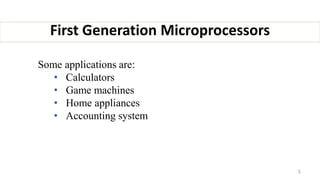
Some applications are:
•Calculators
• Game machines
• Home appliances
• Accounting system
First Generation Microprocessors
5
6.
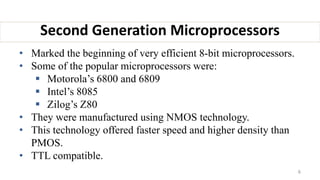
• Marked thebeginning of very efficient 8-bit microprocessors.
• Some of the popular microprocessors were:
Motorola’s 6800 and 6809
Intel’s 8085
Zilog’s Z80
• They were manufactured using NMOS technology.
• This technology offered faster speed and higher density than
PMOS.
• TTL compatible.
Second Generation Microprocessors
6
7.
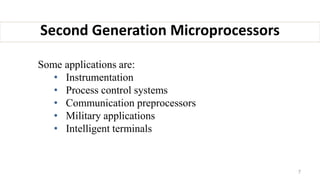
Some applications are:
•Instrumentation
• Process control systems
• Communication preprocessors
• Military applications
• Intelligent terminals
Second Generation Microprocessors
7
8.
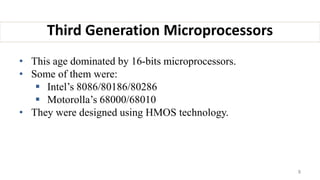
• This agedominated by 16-bits microprocessors.
• Some of them were:
Intel’s 8086/80186/80286
Motorolla’s 68000/68010
• They were designed using HMOS technology.
Third Generation Microprocessors
8
9.
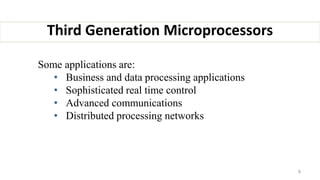
Some applications are:
•Business and data processing applications
• Sophisticated real time control
• Advanced communications
• Distributed processing networks
Third Generation Microprocessors
9
10.
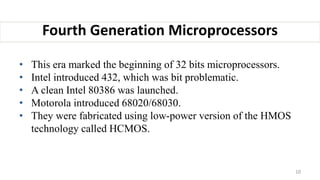
• This eramarked the beginning of 32 bits microprocessors.
• Intel introduced 432, which was bit problematic.
• A clean Intel 80386 was launched.
• Motorola introduced 68020/68030.
• They were fabricated using low-power version of the HMOS
technology called HCMOS.
Fourth Generation Microprocessors
10
11.
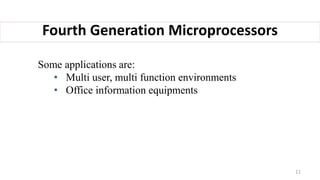
Some applications are:
•Multi user, multi function environments
• Office information equipments
Fourth Generation Microprocessors
11
12.
• Design surpassed10 million transistors per chip.
• Processing speed increased tremendously.
• A microprocessor with 1GHz clock can execute 2000 million
instruction per second.
• Intel leads the show here with Pentium, Celeron and very
recently dual and quad core processors working with up to
3.5GHz speed.
Fifth Generation Microprocessors
12