Excretory System 
• Metabolic wastes of the chemical 
reactions in the cell are removed 
from the body. 
• This process is called EXCRETION.
Function of Excretory 
System 
1. Filtration and excretion of metabolic 
wastes 
2. The regulation of blood content. 
3. The regulation of blood pH. 
4. Homeostasis.
Excretory Substances 
The metabolic wastes of cells are; 
WATER, 
CO2, 
NITROGENOUS COMPOUNDS
WATER and CO2 
• Water and CO2 are formed by means 
of cellular respiration. 
• Water is excreted by lungs, sweating 
and kidneys. 
• CO2 is excreted only by lungs.
NITROGENOUS WASTES 
•At the end of the catobolisation of 
aminoacids, AMMONIA(NH3) is formed. 
•In some organisms, ammonia is 
removed fro body directly. 
•But in some organisms ammonia is 
converted to other substances such as 
UREA and URIC ACID.
AMMONIA (NH3) 
• Ammonia is the most toxic nitrogenous 
waste material. 
• It can soluble in water. 
• Organisms need large amount of water 
for excretion of ammonia. 
• Organisms need small amount of 
energy for formation of NH3 
• Ammonia is excretory substances of 
freshwater organisms.
UREA [CO (NH2)2] 
•Urea is less toxic than ammonia. 
•It is formed in the liver by ornithin cycle. 
•Urea is excreted by the kidney. 
•Urea is the excretory substances of 
amphibians,mammals,fish and human. 
• O rganisms use more energy in formation 
of urea than formation of ammonia. 
•Living things need normal amount of 
water.
URIC ACID (C5NH4O3) 
• Uric Acid is least toxic nitrogenous waste. 
• It is insoluble in water. 
• Uric acid is excreted by with only small 
amount of water. 
• Uric acid is the excretory substance of 
terrestial organisms such as INSECTS, 
REPTILES AND BIRDS.
• There is no special excretory system in 
plants. 
• The STOMA, LENTICELS, 
HYDRATHODES are used for excretion in 
plants. 
• CO2 is excreted by stomata and lenticels. 
• Water is excreted by hydrathodes and 
stomata by TRANSPIRATION.
Excretion in 
Unicellular 
• Excretory Ostrrucgtuarne oifs pmrotsista is called 
CONTRACTILE VACUOLE. 
• Excess water and NH3 are pumped by 
contractile vacuole. 
• Some NH3 molecules release from 
unicellular organisms by diffusion.
• In simple animals such as Spongy 
and hydra excretory substances are 
excreted by diffusions.
Excretion in Planaria 
(Flatworms) 
• In planaria, excess water is excreted by 
flame cells. 
• Flame cell take ewcess water from body. 
• Than water pass excretory canal. And than 
water is given out of the body by excretory 
pore. 
• CO2 and NH3 release from planaria by 
means of DIFFUSION.
Excretion in Earthworm 
• Excretory organ of earthwom is 
nephridium. 
• Nephridium is surrounded by capillaries. 
• It takes water, glucose, minerals and wastes 
from body. Than water, food and minerals 
are reabsorbed from nephridium canal by 
capillaries. 
• And than waste materials pass into 
intestine.
Excretion in Insects 
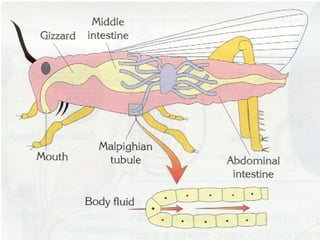
• Insects have specialized excretory 
tubules that called MLPIGHIAN 
TUBULES. 
• Wastes pass from blood into 
malpighian tubules Than malpighian 
tubules empty into digestive track. 
• Finally waste materials are excreted by 
anus with undigested materials.
GRASSHOPPER 
DRAGON FLY
The excretory and reproductive 
system of vertebrates are 
interrelated and this complex is 
called UROGENITAL SYSTEM 
• The kidney is the main excretory 
organ of vertebrates.
TYPES OF KIDNEYS 
There are three types of Kidneys; 
a) Pronephros kidney 
b) Mesonephros kidney 
c) Metanephros kidney
PRONEPHROS KIDNEY 
•Pronephros kidney is found in the 
embryonic stage of fish and amphibia and in 
adult form of shark. 
•Pronephros kidneys contain many nephridia. 
•Nephridia have ciliary funnels that is 
connected to ball of capillaries or glomerulus 
by ciliary funnels. 
•Than wastes pass wolf channel for transport 
to the cloaca.
MESONEPHROS KIDNEY 
• Mesonephros kidney is found in embryonic 
stage of reptiles, birds an mammals and 
adutlt stage of fish and amphibia. 
• In mesonephros kidney, ciliary funnels are 
replaced with Bowman’s capsules. 
• A glomerulus is located in Bowman’s 
capsule. Waste materials pass to Bowman’s 
capsule from glomerulus. 
• Than wastes flow the wolf channel. And 
than they are expelled through cloaca.
METANEPHROS KIDNEY 
• Metanephros kidney is found in adult 
reptiles, birds, mammals and human. 
• Each kidney contains a millions of 
nephrons.
CLOACA 
• In fish, amphibians, reptiles and birds; 
excretory substances, unigested 
materials and reproductive cells are 
expelled through the same channel or 
openin that called CLOACA.
PARTS OF HUMAN 
EXCRETORY SYSTEM 
1.Kidneys 
2.Ureter 
3.Urinary bladder 
4.Urethra
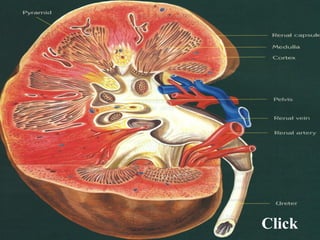
• Kidneys are bean shaped organs that 
filtere 180 lt. blood in a day. 
• Blood is come into kidney by renal 
artery. 
• Filtered blood leaves from kidney by 
renal vein.
1. They remove wastes of cellular 
metabolism from the blood. 
2. They control concentration of various 
substances found in the body fluid.
Structure of Kidneys 
1.Renal Capsule: It surrounds and protects 
the kidneys. 
2.Cortex: It contains glomerulus and 
Bowman’s capsules. 
3.Medulla:It is located under the cortex and 
has malphigian pyramids. Malphigian 
pyramids contains urine collecting canal and 
loop of henle. 
4.Pelvis: It is innermost part of kidney. The 
urine is collected in pelvis.
Click
NEPHRONS 
• They are structural unit of kidneys. 
• A nephron begins with a glomerulus. 
• Glomerulus is surrounded by a 
Bowman’s capsule. 
• Each glomerulus is formed by 
capillaries from a branch of renal 
arteriole.
• The complex of Bowman’s capsule and 
glomerulus is called malpighian body. 
Bowman’s capsule is connected with 
long tubule that is called Loop of 
Henle. 
• Loop of Henle is joined with collecting 
duct. 
Click
URINE FORMATION 
There are three steps during urine formation. 
1. Filtration 
2. Reabsorbtion 
3. Secretion 
Click
Filtration 
• During filtration, substances pass 
from the blood into the Bowman’s 
capsule. 
• Under pressure, water and many 
small molecules such as salts, urea, 
glucose and aminoacids pass from 
glomerulus into Bowman’s capsule.
Reabsorbtion 
• The absorbtion of needed materials 
such as glucose, amino acids and water 
from nephrons to blood capillaries is 
called reabsorbtion. 
• Water is reabsorbed passively by 
osmosis. But reabsorbtion of glucose, 
aminoacids and salt ions occurs by 
active transport.
• All glucose, aminoacids and many salt ions 
are reabsorb during reabsorption. 
• Most reabsorbtion takes places in loop of 
henle. 
• Antidiuretic hormone (ADH or 
Vasopressin) regulates concentration of 
water in blood. 
• It increases water permeablity of the cells of 
the distal tubules. 
Click 1 Click 2
Secretion • The cells of distal tubule excrete 
molecules such as penicilin, ammonia, 
potassium and excess acids. This 
process is called secretion. 
• After secretion, the fluid remaining in 
the nephrons is called urine. 
• Urine contains urea, uric acid, sodium, 
potassium, calcium, chlorine, 
phosphorus, water and small amount of 
cells.
• Urine flows from the tubules into the 
collecting ducts and it is stored 
temporary in pelvis. 
• Than urine is transported into the 
urinary bladder by the urether of each 
kidney. 
• And than it is expelled through the 
urethra.
Click 1 Click 2 
Click 3 Click 4 
Click 5 Click 6

Excretory systems

  • 2.
    Excretory System •Metabolic wastes of the chemical reactions in the cell are removed from the body. • This process is called EXCRETION.
  • 3.
    Function of Excretory System 1. Filtration and excretion of metabolic wastes 2. The regulation of blood content. 3. The regulation of blood pH. 4. Homeostasis.
  • 4.
    Excretory Substances Themetabolic wastes of cells are; WATER, CO2, NITROGENOUS COMPOUNDS
  • 5.
    WATER and CO2 • Water and CO2 are formed by means of cellular respiration. • Water is excreted by lungs, sweating and kidneys. • CO2 is excreted only by lungs.
  • 6.
    NITROGENOUS WASTES •Atthe end of the catobolisation of aminoacids, AMMONIA(NH3) is formed. •In some organisms, ammonia is removed fro body directly. •But in some organisms ammonia is converted to other substances such as UREA and URIC ACID.
  • 7.
    AMMONIA (NH3) •Ammonia is the most toxic nitrogenous waste material. • It can soluble in water. • Organisms need large amount of water for excretion of ammonia. • Organisms need small amount of energy for formation of NH3 • Ammonia is excretory substances of freshwater organisms.
  • 9.
    UREA [CO (NH2)2] •Urea is less toxic than ammonia. •It is formed in the liver by ornithin cycle. •Urea is excreted by the kidney. •Urea is the excretory substances of amphibians,mammals,fish and human. • O rganisms use more energy in formation of urea than formation of ammonia. •Living things need normal amount of water.
  • 10.
    URIC ACID (C5NH4O3) • Uric Acid is least toxic nitrogenous waste. • It is insoluble in water. • Uric acid is excreted by with only small amount of water. • Uric acid is the excretory substance of terrestial organisms such as INSECTS, REPTILES AND BIRDS.
  • 13.
    • There isno special excretory system in plants. • The STOMA, LENTICELS, HYDRATHODES are used for excretion in plants. • CO2 is excreted by stomata and lenticels. • Water is excreted by hydrathodes and stomata by TRANSPIRATION.
  • 18.
    Excretion in Unicellular • Excretory Ostrrucgtuarne oifs pmrotsista is called CONTRACTILE VACUOLE. • Excess water and NH3 are pumped by contractile vacuole. • Some NH3 molecules release from unicellular organisms by diffusion.
  • 21.
    • In simpleanimals such as Spongy and hydra excretory substances are excreted by diffusions.
  • 24.
    Excretion in Planaria (Flatworms) • In planaria, excess water is excreted by flame cells. • Flame cell take ewcess water from body. • Than water pass excretory canal. And than water is given out of the body by excretory pore. • CO2 and NH3 release from planaria by means of DIFFUSION.
  • 26.
    Excretion in Earthworm • Excretory organ of earthwom is nephridium. • Nephridium is surrounded by capillaries. • It takes water, glucose, minerals and wastes from body. Than water, food and minerals are reabsorbed from nephridium canal by capillaries. • And than waste materials pass into intestine.
  • 29.
    Excretion in Insects • Insects have specialized excretory tubules that called MLPIGHIAN TUBULES. • Wastes pass from blood into malpighian tubules Than malpighian tubules empty into digestive track. • Finally waste materials are excreted by anus with undigested materials.
  • 31.
  • 33.
    The excretory andreproductive system of vertebrates are interrelated and this complex is called UROGENITAL SYSTEM • The kidney is the main excretory organ of vertebrates.
  • 34.
    TYPES OF KIDNEYS There are three types of Kidneys; a) Pronephros kidney b) Mesonephros kidney c) Metanephros kidney
  • 35.
    PRONEPHROS KIDNEY •Pronephroskidney is found in the embryonic stage of fish and amphibia and in adult form of shark. •Pronephros kidneys contain many nephridia. •Nephridia have ciliary funnels that is connected to ball of capillaries or glomerulus by ciliary funnels. •Than wastes pass wolf channel for transport to the cloaca.
  • 36.
    MESONEPHROS KIDNEY •Mesonephros kidney is found in embryonic stage of reptiles, birds an mammals and adutlt stage of fish and amphibia. • In mesonephros kidney, ciliary funnels are replaced with Bowman’s capsules. • A glomerulus is located in Bowman’s capsule. Waste materials pass to Bowman’s capsule from glomerulus. • Than wastes flow the wolf channel. And than they are expelled through cloaca.
  • 37.
    METANEPHROS KIDNEY •Metanephros kidney is found in adult reptiles, birds, mammals and human. • Each kidney contains a millions of nephrons.
  • 39.
    CLOACA • Infish, amphibians, reptiles and birds; excretory substances, unigested materials and reproductive cells are expelled through the same channel or openin that called CLOACA.
  • 41.
    PARTS OF HUMAN EXCRETORY SYSTEM 1.Kidneys 2.Ureter 3.Urinary bladder 4.Urethra
  • 45.
    • Kidneys arebean shaped organs that filtere 180 lt. blood in a day. • Blood is come into kidney by renal artery. • Filtered blood leaves from kidney by renal vein.
  • 46.
    1. They removewastes of cellular metabolism from the blood. 2. They control concentration of various substances found in the body fluid.
  • 47.
    Structure of Kidneys 1.Renal Capsule: It surrounds and protects the kidneys. 2.Cortex: It contains glomerulus and Bowman’s capsules. 3.Medulla:It is located under the cortex and has malphigian pyramids. Malphigian pyramids contains urine collecting canal and loop of henle. 4.Pelvis: It is innermost part of kidney. The urine is collected in pelvis.
  • 49.
  • 50.
    NEPHRONS • Theyare structural unit of kidneys. • A nephron begins with a glomerulus. • Glomerulus is surrounded by a Bowman’s capsule. • Each glomerulus is formed by capillaries from a branch of renal arteriole.
  • 53.
    • The complexof Bowman’s capsule and glomerulus is called malpighian body. Bowman’s capsule is connected with long tubule that is called Loop of Henle. • Loop of Henle is joined with collecting duct. Click
  • 54.
    URINE FORMATION Thereare three steps during urine formation. 1. Filtration 2. Reabsorbtion 3. Secretion Click
  • 55.
    Filtration • Duringfiltration, substances pass from the blood into the Bowman’s capsule. • Under pressure, water and many small molecules such as salts, urea, glucose and aminoacids pass from glomerulus into Bowman’s capsule.
  • 56.
    Reabsorbtion • Theabsorbtion of needed materials such as glucose, amino acids and water from nephrons to blood capillaries is called reabsorbtion. • Water is reabsorbed passively by osmosis. But reabsorbtion of glucose, aminoacids and salt ions occurs by active transport.
  • 57.
    • All glucose,aminoacids and many salt ions are reabsorb during reabsorption. • Most reabsorbtion takes places in loop of henle. • Antidiuretic hormone (ADH or Vasopressin) regulates concentration of water in blood. • It increases water permeablity of the cells of the distal tubules. Click 1 Click 2
  • 58.
    Secretion • Thecells of distal tubule excrete molecules such as penicilin, ammonia, potassium and excess acids. This process is called secretion. • After secretion, the fluid remaining in the nephrons is called urine. • Urine contains urea, uric acid, sodium, potassium, calcium, chlorine, phosphorus, water and small amount of cells.
  • 59.
    • Urine flowsfrom the tubules into the collecting ducts and it is stored temporary in pelvis. • Than urine is transported into the urinary bladder by the urether of each kidney. • And than it is expelled through the urethra.
  • 60.
    Click 1 Click2 Click 3 Click 4 Click 5 Click 6