ACHARYA N.G RANGAAGRICULTURAL UNIVERSITY
Agricultural college, Bapatla
Course No : ENT 502
Course Title : Insect anatomy, physiology and nutrition
Topic : Insect sense organs (Mechanoreceptors)
Submitted to,
Dr. T. Madhumati
Professor
Department of entomology
Agricultural college
Bapatla.
Submitted by,
P. Vijay babu
BAM 18- 41.
P. Vijay babu
BAM 18-41
What do sensory systems do?
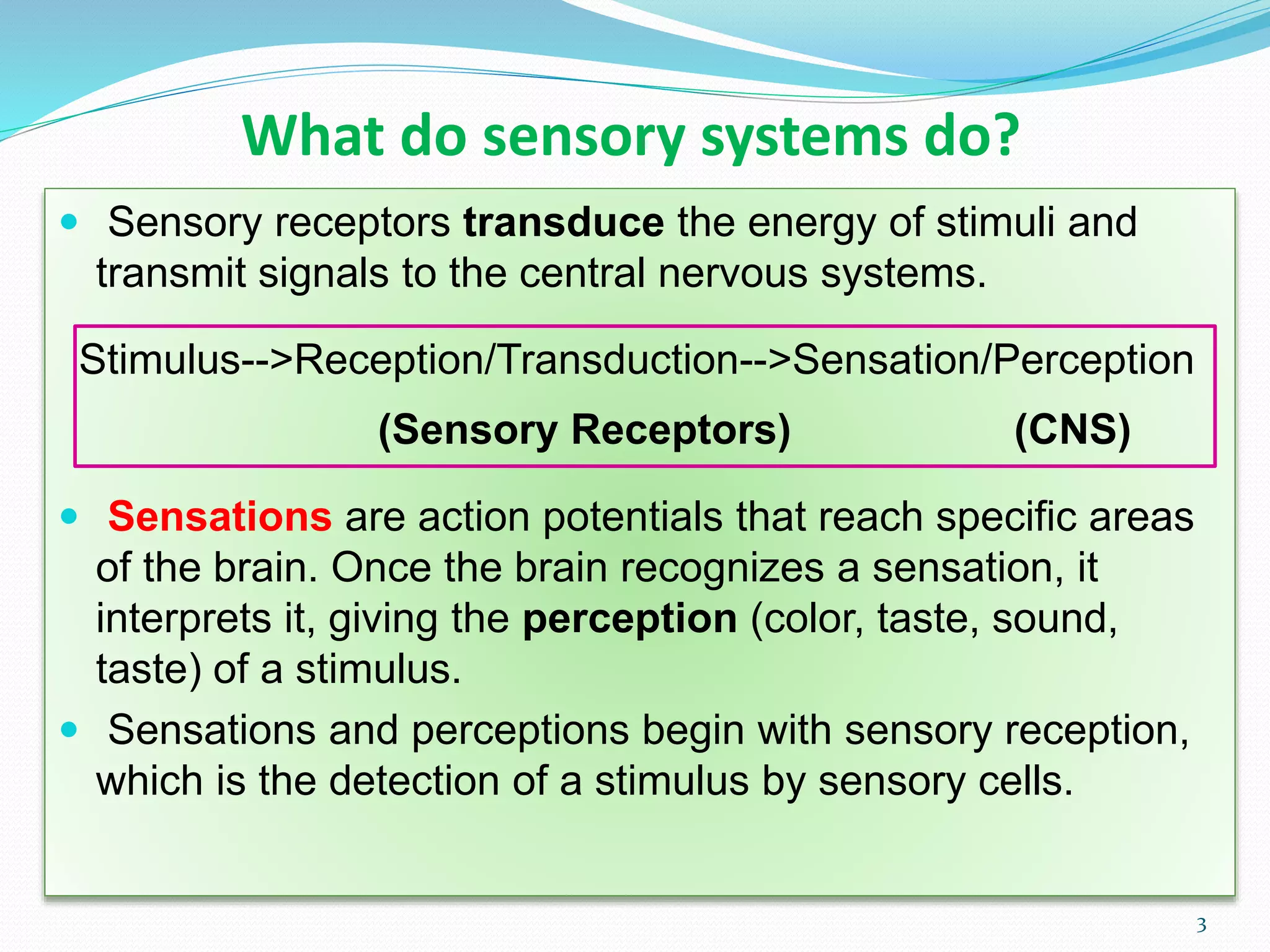
 Sensory receptors transduce the energy of stimuli and
transmit signals to the central nervous systems.
 Sensations are action potentials that reach specific areas
of the brain. Once the brain recognizes a sensation, it
interprets it, giving the perception (color, taste, sound,
taste) of a stimulus.
 Sensations and perceptions begin with sensory reception,
which is the detection of a stimulus by sensory cells.
Stimulus-->Reception/Transduction-->Sensation/Perception
(Sensory Receptors) (CNS)
3
 Sensory receptors are specialized neurons.
 They can occur singly or in groups as part of sensory
organs.
 Exteroreceptors are receptors that detect stimuli
coming from outside of the body (heat, light, chemicals,
pressure).
 Interoreceptors detect stimuli coming from within the
body (blood pressure, plasma osmolarity, blood pH).
4
 On the basis of functions, the sense organs of
insects, besides the eyes, are often classified as:-
 Mechanoreceptors
 Chemoreceptor
 Temperature and humidity receptor
 Photoreceptors or visual organs.
5
1. Mechanoreceptors:-
 Mechanoreceptors are the sense organs of insect, which
respond to the sense of touch due to contact with
external solid objects, current of air and water or even
because of internal body pressure.
 The principal mechanoreceptors are:-
1) Tactile organs
2) Campaniform sensilla
3) Chordotonal organs
4) Static organs
6
i. The tactile organs or trichoid sensilla :-
 Simple articulated sensory hairs
 Distributed on the entire body surface and commonly
called as the sensilla.
 They are made up of cuticle and articulated within the
socket with the body wall.
 The trichoid sensillum is formed by two cells; the hair by
the trichogen cell and the socket by the tormogen cell.
 Each sensillum is innervated by a bipolar sensory
neuron.
7
 The dendrite of the neuron is
enclosed at the base of the
hair by a cuticular tubular
sheath, called the scolopale.
 It is, in some case, provided
with a distal cap, called the
scolopale cap.
8
Location of tactile organs:-
 Trichoid sensilla present on the antennae, tarsi,
tibia and cerci.
Functions of tactile organs:-
 There are some trichoid hair plates at the joints of
various appendages and function as proprioceptors
during sliding of the segments over each other.
 The tactile hairs of the antennae and lower segments
of legs perceive earth-born vibrations in terrestrial
insects and water surface vibrations in aquatic insects.
9
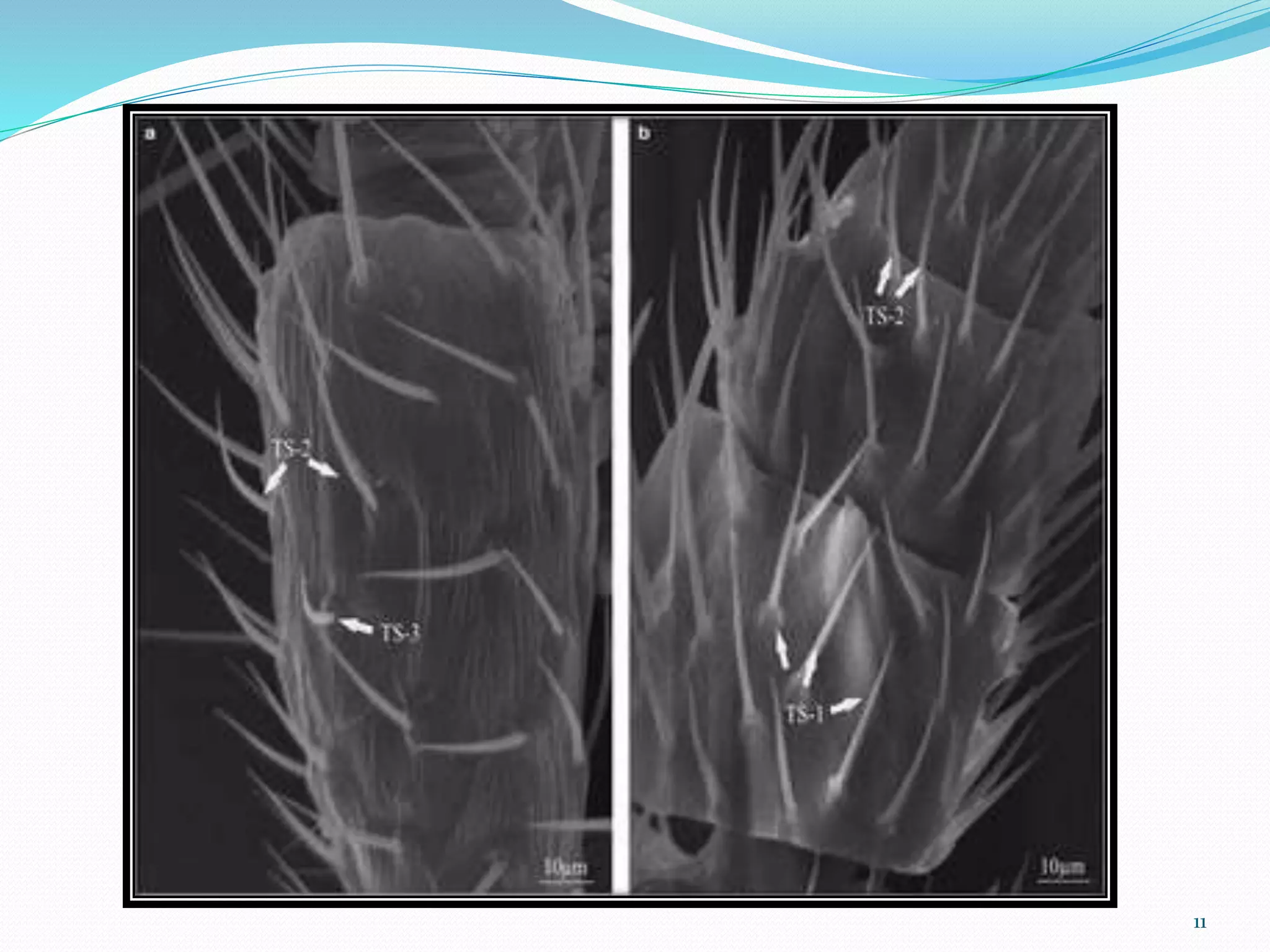
Electron microscopic structures of Trichoid sensillae
10
11
12
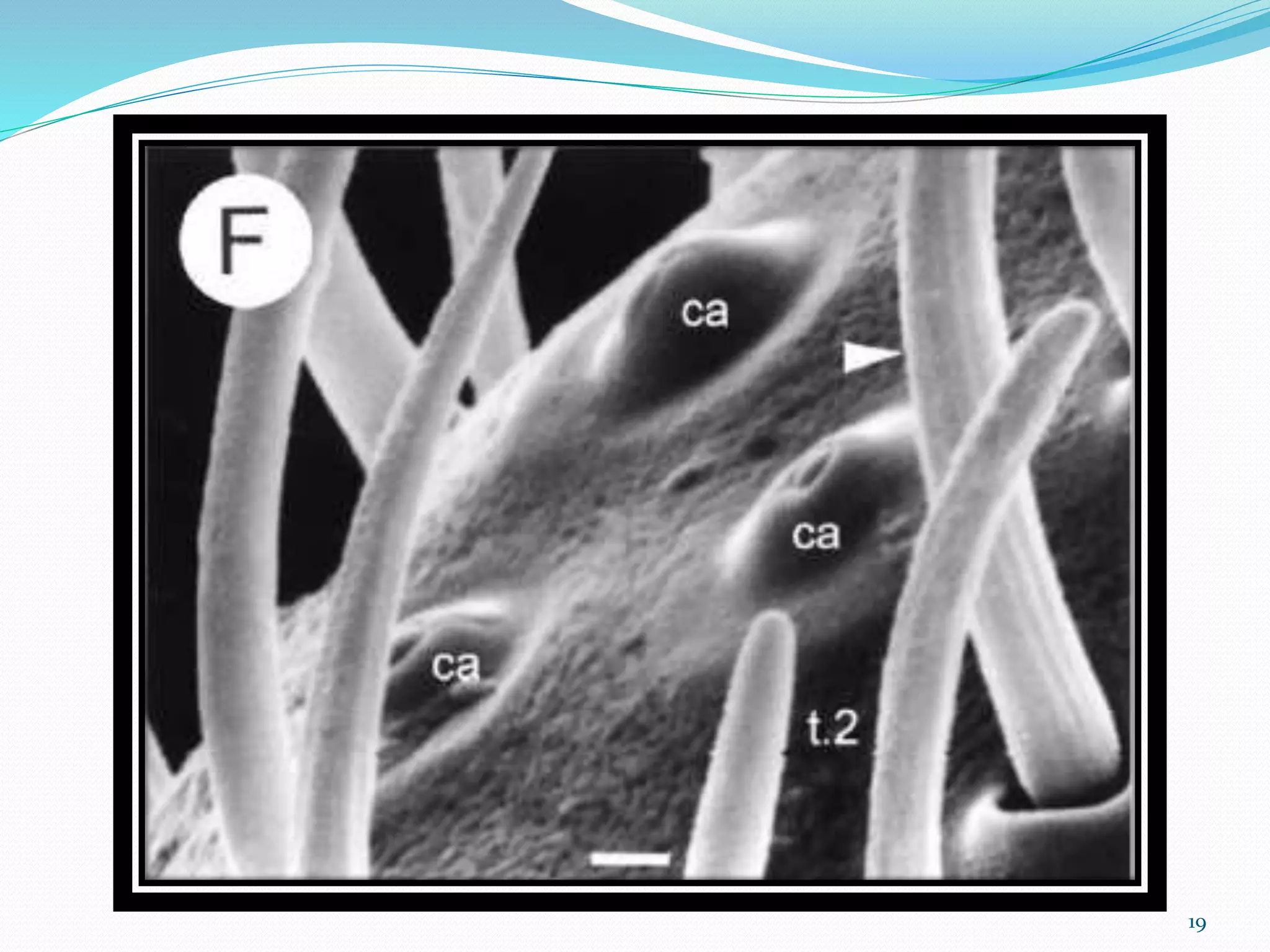
ii. The campaniform sensilla:
 The campaniform sensilla cannot be seen externally but
recognized from the dome-shaped cuticular areas.
 They elevated above or depressed below the general
body surface.
 Location:- wing-base, halteres, cerci and on the
base of trochanter, femora, tibia and tarsal
segments.
13
14
Mechanism of campaniform sensilla:-
 The cuticular stretches and the forces exerted on the cuticle
by muscles and gravitational forces stimulate the
campaniform sensilla.
 The campaniform sensilla function as the proprioceptors.
(connected with the position and movement of the body).
 They respond to the mechanical stimuli in terrestrial
insects, water pressure in aquatic insects & air pressure in
flying insects.
15
16
Electron microscopic structures of camponiform sensilla
17
18
19
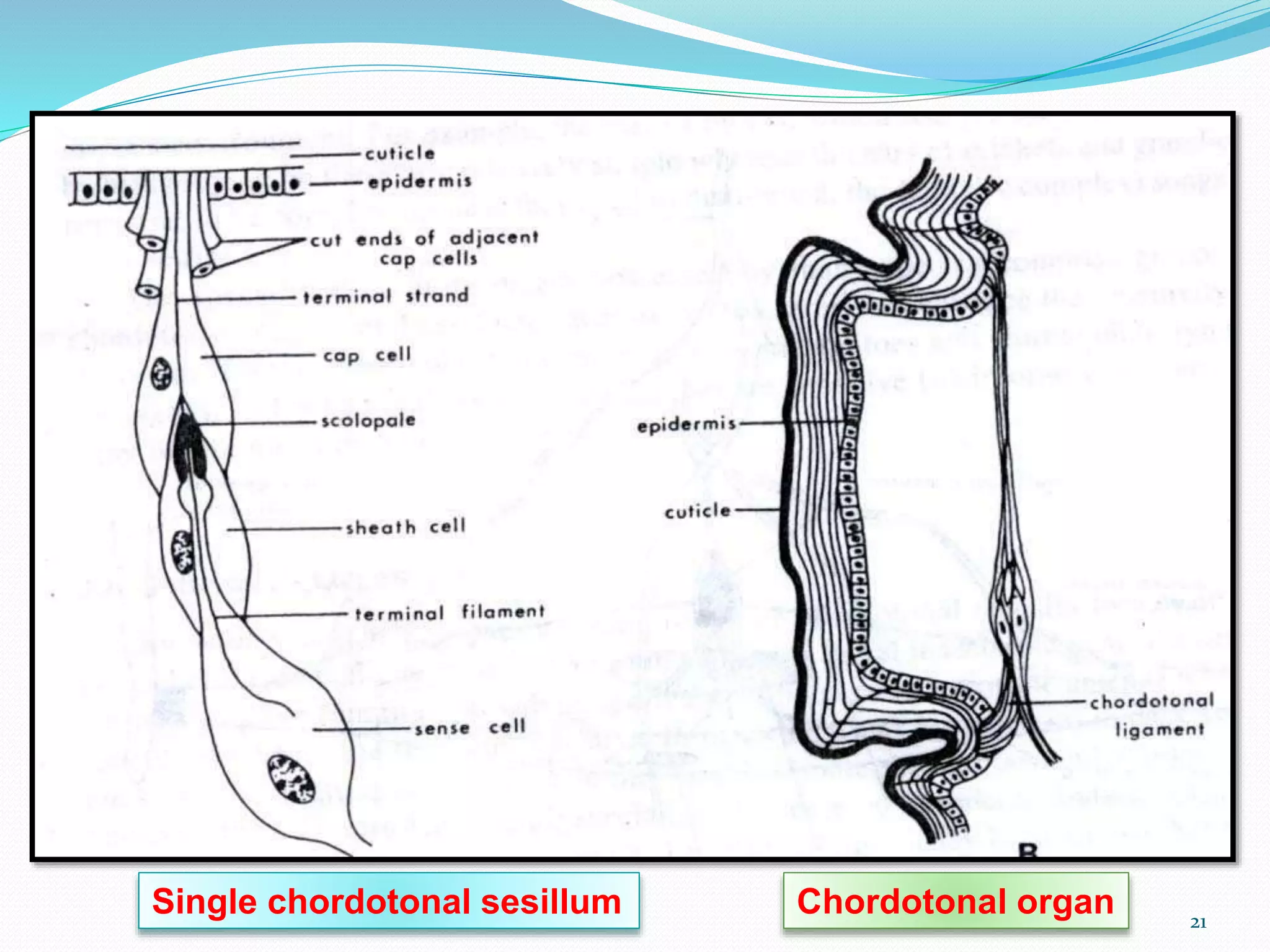
iii. Chordotonal organ:-
 Chordotonal organ consists of single unit or group of
similar unit is called scolopidia.
 They are sub-cuticular and are attached to the cuticle at
one or both end often no sign of their presence.
 Each scolopidia consists of three cells:
1. Neuron
2. Scolopale cell or enveloping cell
3. Cap cell
20
Single chordotonal sesillum Chordotonal organ 21
Location:-
 Occur in legs at femoral, distal tibial and tibio-tarsal
regions, in abdomen and wing base.
Mechanism of Chordotonal organ: stimulated by,
 Passive movement of segments,
 Tension of muscles
 Internal pressure changed due to blood and
tracheae.
22
Specialized chordotonal organ :-
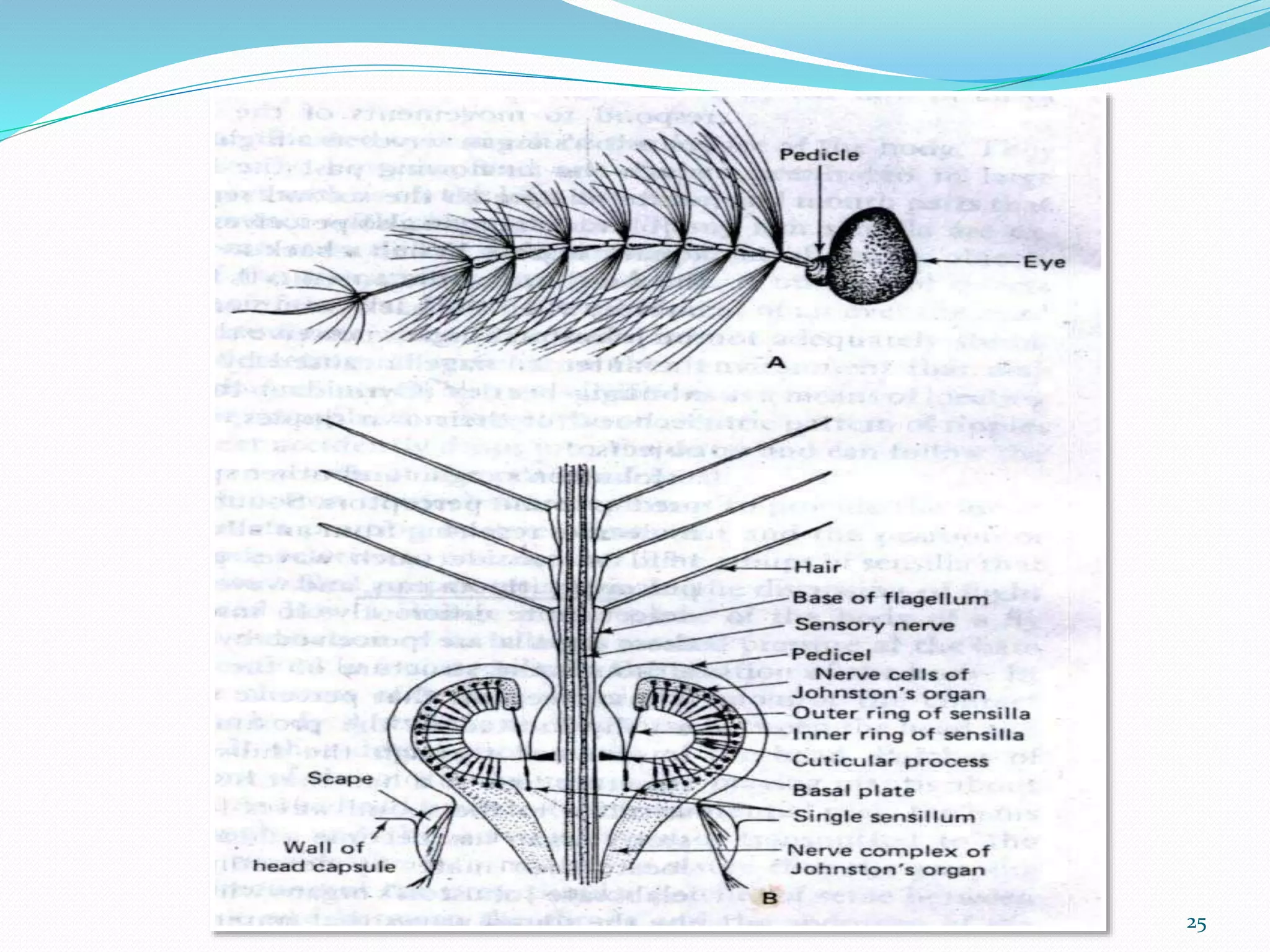
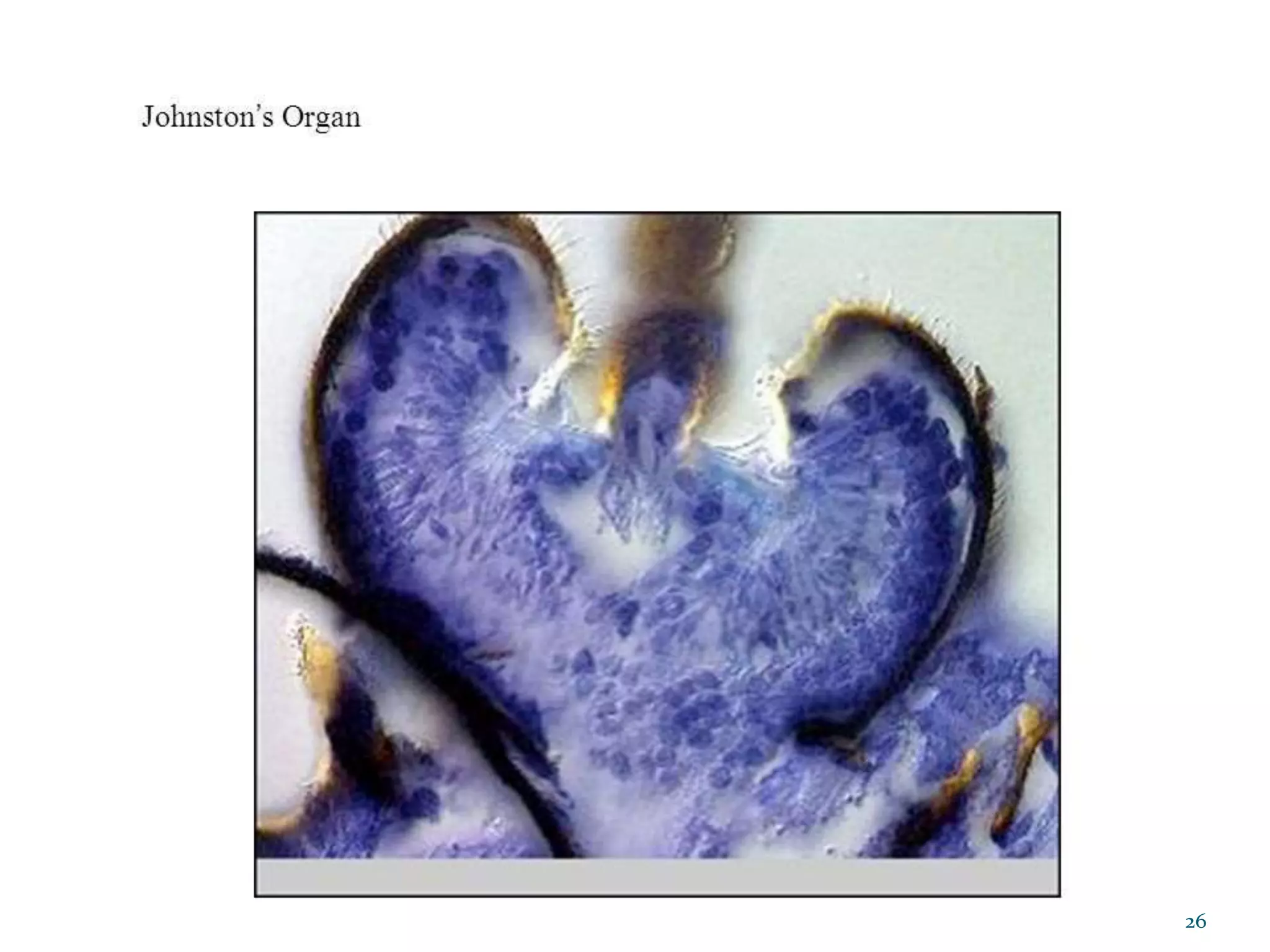
A. Johnstons organ:-
 Present in second antennal segment
 Except collembola and diplura.
 It consists of single mass or several groups of
scolopidia.
 Perceives movement of antennal flagellum and
flight speed indicator (Calliphora spp).
23
 Predominant organs of hearing in chironomids &
culicids males which have plumose antennae.
 In Notonecta spp & Coroxidae it acts as ORGANS
OF ORIENTATION during swimming.
24
25
26
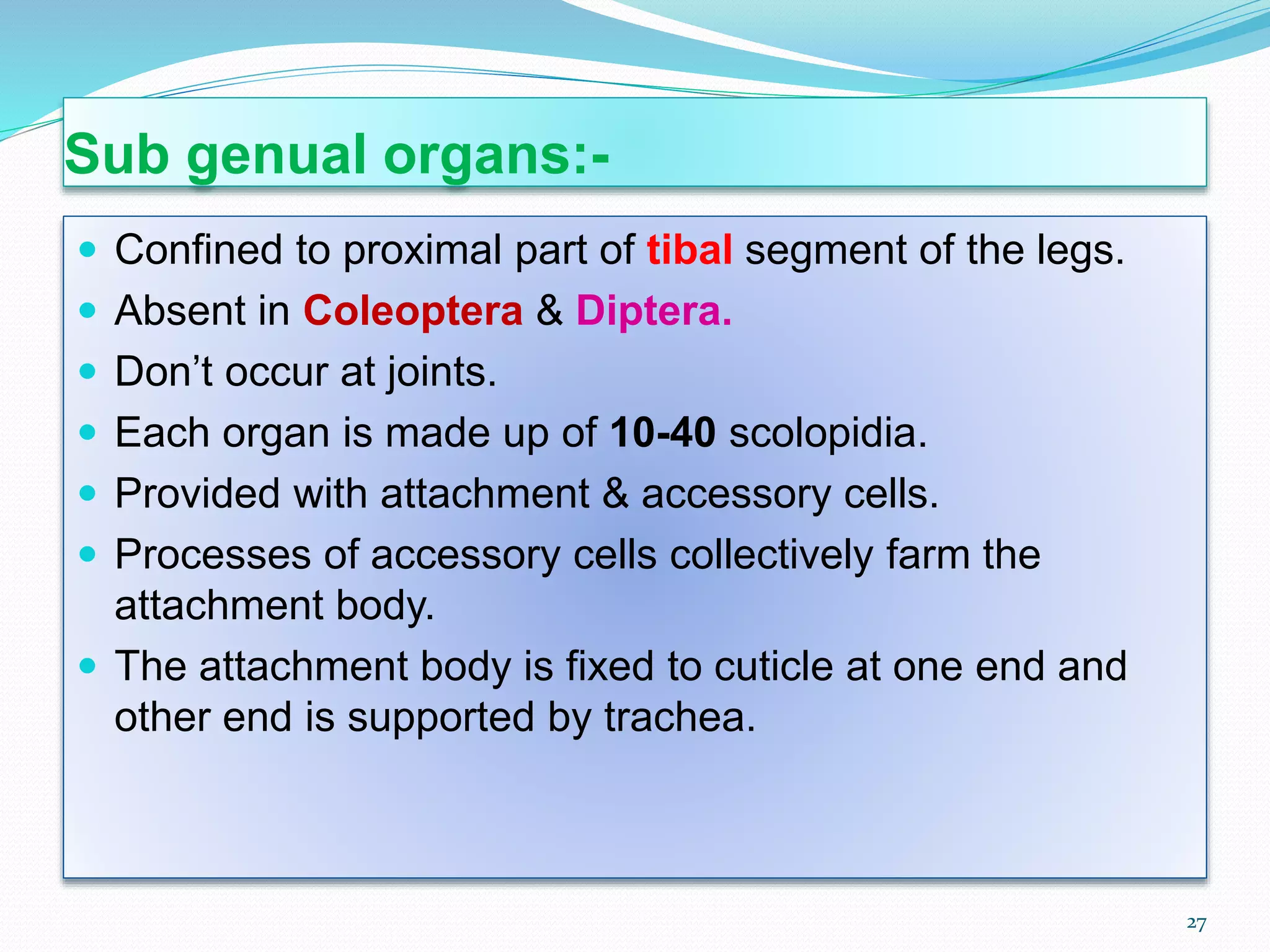
Sub genual organs:-
 Confined to proximal part of tibal segment of the legs.
 Absent in Coleoptera & Diptera.
 Don’t occur at joints.
 Each organ is made up of 10-40 scolopidia.
 Provided with attachment & accessory cells.
 Processes of accessory cells collectively farm the
attachment body.
 The attachment body is fixed to cuticle at one end and
other end is supported by trachea.
27
 Highly developed in Odonata, Dictyoptera & Orthoptera.
 Sensitive to vibrations of the substratum & airborne
sounds of high intensity.
 In Periplaneta spp. they respond to the vibrations at
frequencies up to 8 kc/sec.
28
Auditory or tympanal organ:-
 Present in the adults
 Consists of a thin layer of cuticular structure, called
tympanic membrane, air sac and a group of
chordotonal organ.
 Tympanic membrane and air sac form Drum,
 Sound waves that strike the drum cause it to vibrate
 Therefore, the sensilla to be stimulated.
29
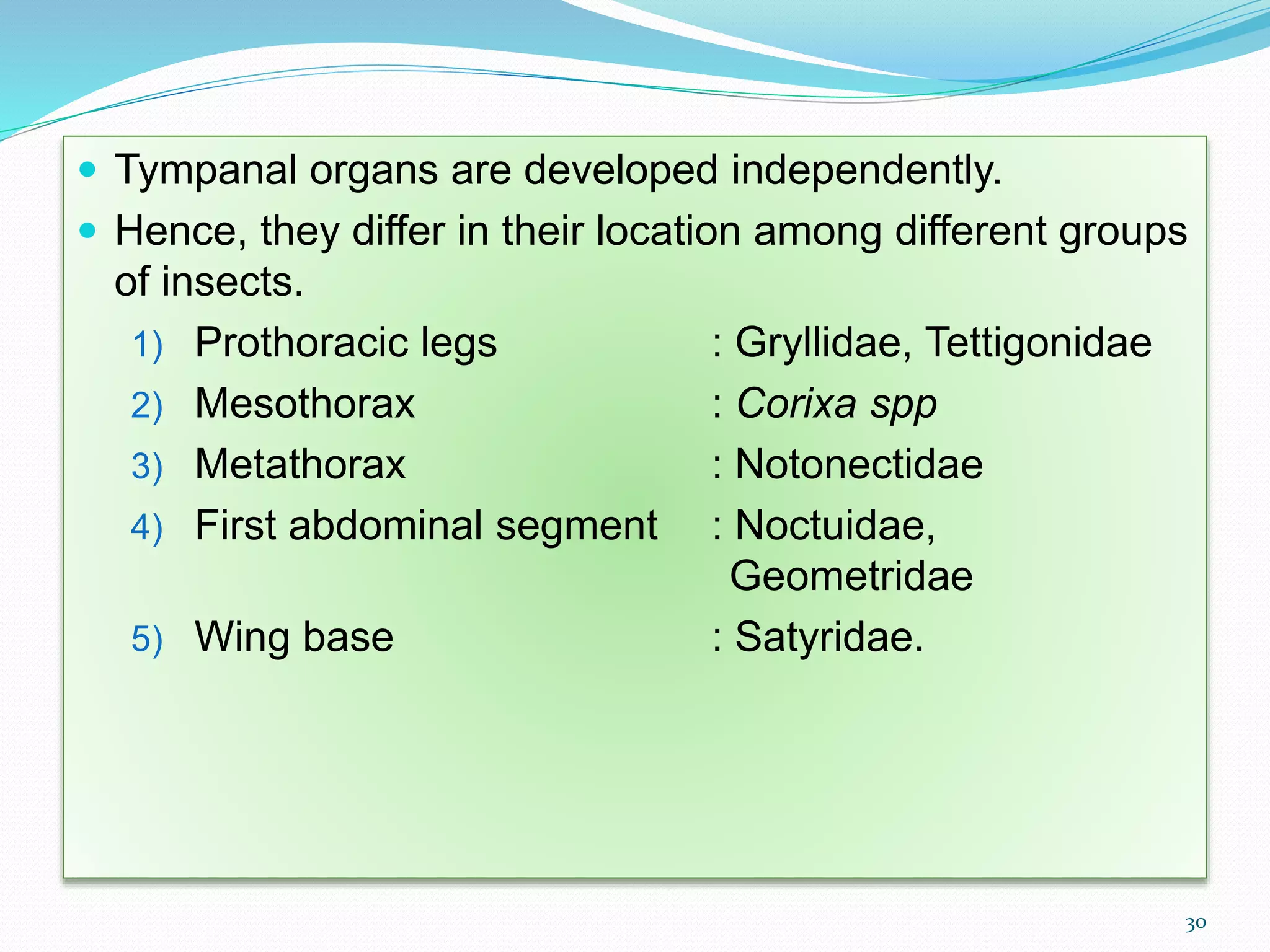
 Tympanal organs are developed independently.
 Hence, they differ in their location among different groups
of insects.
1) Prothoracic legs : Gryllidae, Tettigonidae
2) Mesothorax : Corixa spp
3) Metathorax : Notonectidae
4) First abdominal segment : Noctuidae,
Geometridae
5) Wing base : Satyridae.
30
Surface view of tibial tympanal organ of
Decticus (Tettigoniidae) 31
32
33
Static organs:-
 Proprioceptive organs.
 Maintaining equilibrium of the body
 Orienting insects with respect to gravity.
 The larva of Limnophilic fascipennis, bears a pair of sacs
in last abdominal segment.
 Each sac is provided with sensory hairs at its blind end &
granules or statoconia in the lumen.
34
 The sac is filled & emptied with water rhythmatically by
pumping action which causes the statocnia to fall upon
the sensory hair.
 Static organ is movable STATOLITH in the 10th and 11th
abdominal segments (Ptychoptera contaminate).
 Lethocerus spp. (Belostomatidae), bears a pair of pair of
static organs having the tactile hairs lodged abdominal
spiracles.
35
 In flying insects the static organs are located at the
bases of the coastal and sub coastal veins.
 Maintains equilibrium during flight.
 Halteres (Diptera) bears a variety of static organs.
 Serves as balancers.
 Ants and bees have hair cushions at neck petiole &
abdomen.
 Locusts have facial hair plates as the static organs.
36
References:-
 Insecta by D.S. Reddy and Raghumoorthy.
 Chapman RF 1998. Insect structure and function.
 Applied entomology by DS Reddy and Raghumoorthy.
 Wikipedia- the encyclopedia.
 Science direct web journals.
 Research gate journals and articles.
 Principles of insect physiology by Wigglesworth.
 Introductory Entomology: Sense Organs of Insect.
37
Submitted to,
Dr. T. Madumathi
Professor
Dept. of entomology
Agricultural college
ANGRAU
Bapatla.
Submitted by,
P. Vijay babu
BAM 18-41
Msc Ag 1st year
Dept. of entomology
ANGRAU
Agricultural college
Bapatla.
38
39

Insect sense organs

  • 1.
    ACHARYA N.G RANGAAGRICULTURALUNIVERSITY Agricultural college, Bapatla Course No : ENT 502 Course Title : Insect anatomy, physiology and nutrition Topic : Insect sense organs (Mechanoreceptors) Submitted to, Dr. T. Madhumati Professor Department of entomology Agricultural college Bapatla. Submitted by, P. Vijay babu BAM 18- 41.
  • 2.
  • 3.
    What do sensorysystems do?  Sensory receptors transduce the energy of stimuli and transmit signals to the central nervous systems.  Sensations are action potentials that reach specific areas of the brain. Once the brain recognizes a sensation, it interprets it, giving the perception (color, taste, sound, taste) of a stimulus.  Sensations and perceptions begin with sensory reception, which is the detection of a stimulus by sensory cells. Stimulus-->Reception/Transduction-->Sensation/Perception (Sensory Receptors) (CNS) 3
  • 4.
     Sensory receptorsare specialized neurons.  They can occur singly or in groups as part of sensory organs.  Exteroreceptors are receptors that detect stimuli coming from outside of the body (heat, light, chemicals, pressure).  Interoreceptors detect stimuli coming from within the body (blood pressure, plasma osmolarity, blood pH). 4
  • 5.
     On thebasis of functions, the sense organs of insects, besides the eyes, are often classified as:-  Mechanoreceptors  Chemoreceptor  Temperature and humidity receptor  Photoreceptors or visual organs. 5
  • 6.
    1. Mechanoreceptors:-  Mechanoreceptorsare the sense organs of insect, which respond to the sense of touch due to contact with external solid objects, current of air and water or even because of internal body pressure.  The principal mechanoreceptors are:- 1) Tactile organs 2) Campaniform sensilla 3) Chordotonal organs 4) Static organs 6
  • 7.
    i. The tactileorgans or trichoid sensilla :-  Simple articulated sensory hairs  Distributed on the entire body surface and commonly called as the sensilla.  They are made up of cuticle and articulated within the socket with the body wall.  The trichoid sensillum is formed by two cells; the hair by the trichogen cell and the socket by the tormogen cell.  Each sensillum is innervated by a bipolar sensory neuron. 7
  • 8.
     The dendriteof the neuron is enclosed at the base of the hair by a cuticular tubular sheath, called the scolopale.  It is, in some case, provided with a distal cap, called the scolopale cap. 8
  • 9.
    Location of tactileorgans:-  Trichoid sensilla present on the antennae, tarsi, tibia and cerci. Functions of tactile organs:-  There are some trichoid hair plates at the joints of various appendages and function as proprioceptors during sliding of the segments over each other.  The tactile hairs of the antennae and lower segments of legs perceive earth-born vibrations in terrestrial insects and water surface vibrations in aquatic insects. 9
  • 10.
    Electron microscopic structuresof Trichoid sensillae 10
  • 11.
  • 12.
  • 13.
    ii. The campaniformsensilla:  The campaniform sensilla cannot be seen externally but recognized from the dome-shaped cuticular areas.  They elevated above or depressed below the general body surface.  Location:- wing-base, halteres, cerci and on the base of trochanter, femora, tibia and tarsal segments. 13
  • 14.
  • 15.
    Mechanism of campaniformsensilla:-  The cuticular stretches and the forces exerted on the cuticle by muscles and gravitational forces stimulate the campaniform sensilla.  The campaniform sensilla function as the proprioceptors. (connected with the position and movement of the body).  They respond to the mechanical stimuli in terrestrial insects, water pressure in aquatic insects & air pressure in flying insects. 15
  • 16.
  • 17.
    Electron microscopic structuresof camponiform sensilla 17
  • 18.
  • 19.
  • 20.
    iii. Chordotonal organ:- Chordotonal organ consists of single unit or group of similar unit is called scolopidia.  They are sub-cuticular and are attached to the cuticle at one or both end often no sign of their presence.  Each scolopidia consists of three cells: 1. Neuron 2. Scolopale cell or enveloping cell 3. Cap cell 20
  • 21.
    Single chordotonal sesillumChordotonal organ 21
  • 22.
    Location:-  Occur inlegs at femoral, distal tibial and tibio-tarsal regions, in abdomen and wing base. Mechanism of Chordotonal organ: stimulated by,  Passive movement of segments,  Tension of muscles  Internal pressure changed due to blood and tracheae. 22
  • 23.
    Specialized chordotonal organ:- A. Johnstons organ:-  Present in second antennal segment  Except collembola and diplura.  It consists of single mass or several groups of scolopidia.  Perceives movement of antennal flagellum and flight speed indicator (Calliphora spp). 23
  • 24.
     Predominant organsof hearing in chironomids & culicids males which have plumose antennae.  In Notonecta spp & Coroxidae it acts as ORGANS OF ORIENTATION during swimming. 24
  • 25.
  • 26.
  • 27.
    Sub genual organs:- Confined to proximal part of tibal segment of the legs.  Absent in Coleoptera & Diptera.  Don’t occur at joints.  Each organ is made up of 10-40 scolopidia.  Provided with attachment & accessory cells.  Processes of accessory cells collectively farm the attachment body.  The attachment body is fixed to cuticle at one end and other end is supported by trachea. 27
  • 28.
     Highly developedin Odonata, Dictyoptera & Orthoptera.  Sensitive to vibrations of the substratum & airborne sounds of high intensity.  In Periplaneta spp. they respond to the vibrations at frequencies up to 8 kc/sec. 28
  • 29.
    Auditory or tympanalorgan:-  Present in the adults  Consists of a thin layer of cuticular structure, called tympanic membrane, air sac and a group of chordotonal organ.  Tympanic membrane and air sac form Drum,  Sound waves that strike the drum cause it to vibrate  Therefore, the sensilla to be stimulated. 29
  • 30.
     Tympanal organsare developed independently.  Hence, they differ in their location among different groups of insects. 1) Prothoracic legs : Gryllidae, Tettigonidae 2) Mesothorax : Corixa spp 3) Metathorax : Notonectidae 4) First abdominal segment : Noctuidae, Geometridae 5) Wing base : Satyridae. 30
  • 31.
    Surface view oftibial tympanal organ of Decticus (Tettigoniidae) 31
  • 32.
  • 33.
  • 34.
    Static organs:-  Proprioceptiveorgans.  Maintaining equilibrium of the body  Orienting insects with respect to gravity.  The larva of Limnophilic fascipennis, bears a pair of sacs in last abdominal segment.  Each sac is provided with sensory hairs at its blind end & granules or statoconia in the lumen. 34
  • 35.
     The sacis filled & emptied with water rhythmatically by pumping action which causes the statocnia to fall upon the sensory hair.  Static organ is movable STATOLITH in the 10th and 11th abdominal segments (Ptychoptera contaminate).  Lethocerus spp. (Belostomatidae), bears a pair of pair of static organs having the tactile hairs lodged abdominal spiracles. 35
  • 36.
     In flyinginsects the static organs are located at the bases of the coastal and sub coastal veins.  Maintains equilibrium during flight.  Halteres (Diptera) bears a variety of static organs.  Serves as balancers.  Ants and bees have hair cushions at neck petiole & abdomen.  Locusts have facial hair plates as the static organs. 36
  • 37.
    References:-  Insecta byD.S. Reddy and Raghumoorthy.  Chapman RF 1998. Insect structure and function.  Applied entomology by DS Reddy and Raghumoorthy.  Wikipedia- the encyclopedia.  Science direct web journals.  Research gate journals and articles.  Principles of insect physiology by Wigglesworth.  Introductory Entomology: Sense Organs of Insect. 37
  • 38.
    Submitted to, Dr. T.Madumathi Professor Dept. of entomology Agricultural college ANGRAU Bapatla. Submitted by, P. Vijay babu BAM 18-41 Msc Ag 1st year Dept. of entomology ANGRAU Agricultural college Bapatla. 38
  • 39.