Insect Integument
Snehal Arun Mane
Dept. of Entomology
Integument or Body Wall
• Insect body wall is
called as
Integument or
Exoskeleton.
• It is the external
covering of the
body which is
ectodermal in
origin.
• It is rigid, flexible, lighter,
stronger and variously modified
in different body parts to suit
different modes of life.
• Serves as a protective covering
over the body, also know
integument
• The insect integument consisting of
1.The cuticle
2.The epidermis or hypodermis
3.The basement membrane
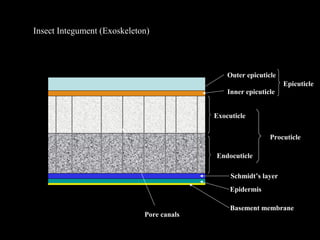
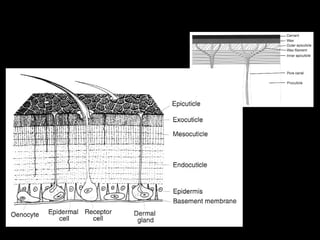
Insect Integument (Exoskeleton)
Outer epicuticle
Inner epicuticle
Epicuticle
Exocuticle
Endocuticle
Schmidt’s layer
Epidermis
Basement membrane
Pore canals
Procuticle
• It is complex non cellular layer .
• It is outermost thick layer of
integument
• Secreted by epidermis .
• When newly formed it is flexible
and elastic .
• When undergoes sclerotization it
becomes hardened and darkened .
1.The cuticle
A.The Epicuticle ( Upper )
B. The Procuticle ( Inner )
It is divided in to two regions
• It is very thin outer most layer
• Thickness : 0.03 – 4.00
micron.
• Chitin is absent in epicuticle
A.The Epicuticle
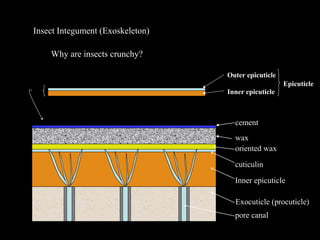
• Cement layer
• Wax layer
• Polyphenol layer
• Cuticulin layer
It consists of following 4 layers
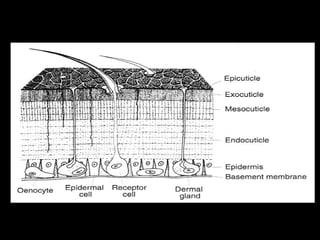
Insect Integument (Exoskeleton)
Why are insects crunchy?
Outer epicuticle
Inner epicuticle
Epicuticle
cement
wax
oriented wax
cuticulin
Inner epicuticle
Exocuticle (procuticle)
pore canal
• Secreted by dermal gland
• Composed of lipoprotein
• It protects the body from external
damage.
1. Cement layer
• Prominent layer
• Thickness - 0.25 micron
• Consisting long chain hydrocarbons
fatty acids and alcohols
• It serves as water proof layer
• Preventing water loss from the body
2.Wax layer
• Consisting phenols which are
mainly used in the formation of
proteins.
• Resistant to acids and organic
solvents.
3.Polyphenol layer
• It is amber colure thin layer
• Act as growth barrier.
4.Cuticulin layer
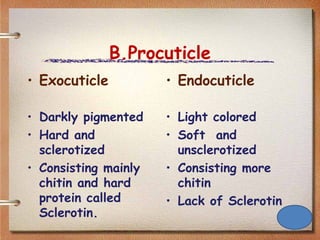
B.Procuticle
• Exocuticle
• Darkly pigmented
• Hard and
sclerotized
• Consisting mainly
chitin and hard
protein called
Sclerotin.
• Endocuticle
• Light colored
• Soft and
unsclerotized
• Consisting more
chitin
• Lack of Sclerotin
• It is single layer of cells lying
below the cuticle.
• Secretes greater part of cuticle
and moulting fluid
2.Epidermis
• Epidermis resting on basement
membrane with the following
function.
 Cuticle secretion
 Digestion and absorption of old
cuticle
 Wound repairing
 Gives surface look
3.Basement membrane
• Protection to the organs
• Gives shape to insect
• Provides surface for attachment of muscles
• Conserve moisture and prevent desiccation
• Prevent entry of pathogens and insecticides
• It forms sense organ
• Contains pigment to make insect attractive
Functions of body wall
Oklahoma State University Oklahoma Master Gardeners
Some days you’re the bug,
some days you’re the windshield.
- Mark Knopfler

Insect integument

  • 1.
    Insect Integument Snehal ArunMane Dept. of Entomology
  • 2.
    Integument or BodyWall • Insect body wall is called as Integument or Exoskeleton. • It is the external covering of the body which is ectodermal in origin.
  • 3.
    • It isrigid, flexible, lighter, stronger and variously modified in different body parts to suit different modes of life. • Serves as a protective covering over the body, also know integument
  • 4.
    • The insectintegument consisting of 1.The cuticle 2.The epidermis or hypodermis 3.The basement membrane
  • 5.
    Insect Integument (Exoskeleton) Outerepicuticle Inner epicuticle Epicuticle Exocuticle Endocuticle Schmidt’s layer Epidermis Basement membrane Pore canals Procuticle
  • 7.
    • It iscomplex non cellular layer . • It is outermost thick layer of integument • Secreted by epidermis . • When newly formed it is flexible and elastic . • When undergoes sclerotization it becomes hardened and darkened . 1.The cuticle
  • 8.
    A.The Epicuticle (Upper ) B. The Procuticle ( Inner ) It is divided in to two regions
  • 9.
    • It isvery thin outer most layer • Thickness : 0.03 – 4.00 micron. • Chitin is absent in epicuticle A.The Epicuticle
  • 10.
    • Cement layer •Wax layer • Polyphenol layer • Cuticulin layer It consists of following 4 layers
  • 11.
    Insect Integument (Exoskeleton) Whyare insects crunchy? Outer epicuticle Inner epicuticle Epicuticle cement wax oriented wax cuticulin Inner epicuticle Exocuticle (procuticle) pore canal
  • 13.
    • Secreted bydermal gland • Composed of lipoprotein • It protects the body from external damage. 1. Cement layer
  • 14.
    • Prominent layer •Thickness - 0.25 micron • Consisting long chain hydrocarbons fatty acids and alcohols • It serves as water proof layer • Preventing water loss from the body 2.Wax layer
  • 15.
    • Consisting phenolswhich are mainly used in the formation of proteins. • Resistant to acids and organic solvents. 3.Polyphenol layer
  • 16.
    • It isamber colure thin layer • Act as growth barrier. 4.Cuticulin layer
  • 17.
    B.Procuticle • Exocuticle • Darklypigmented • Hard and sclerotized • Consisting mainly chitin and hard protein called Sclerotin. • Endocuticle • Light colored • Soft and unsclerotized • Consisting more chitin • Lack of Sclerotin
  • 18.
    • It issingle layer of cells lying below the cuticle. • Secretes greater part of cuticle and moulting fluid 2.Epidermis
  • 19.
    • Epidermis restingon basement membrane with the following function.  Cuticle secretion  Digestion and absorption of old cuticle  Wound repairing  Gives surface look 3.Basement membrane
  • 20.
    • Protection tothe organs • Gives shape to insect • Provides surface for attachment of muscles • Conserve moisture and prevent desiccation • Prevent entry of pathogens and insecticides • It forms sense organ • Contains pigment to make insect attractive Functions of body wall
  • 21.
    Oklahoma State UniversityOklahoma Master Gardeners
  • 22.
    Some days you’rethe bug, some days you’re the windshield. - Mark Knopfler