TRAFFIC ENGINEERING COURSE
(PWE 8322)
SIGNALIZED INTERSECTIONS
Instructor: Usama Elrawy Shahdah, PhDLecture # 06
2
Types of Traffic Signals
 Pre-timed: Repeat a pre-set constant cycle.
 Actuated:
Respond to the presence of vehicles and pedestrians
 Semi-actuated
 Detectors placed only on the minor approach
 Major approach is interrupted only if vehicle present at the minor
approach
 Fully actuated
 Detectors are installed at all approaches
 Green time are allocated based on the incoming traffic on each
approach
3
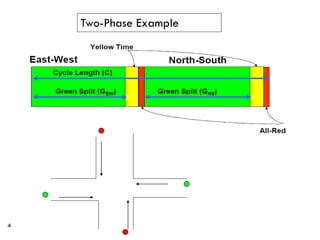
Cycle length & Signal Phase
 Cycle (cycle length or cycle time): time needed
for a complete sequence of signal indications
 Phase (signal phase):
 the part of a cycle allocated to any combination of
traffic movements receiving right-of-way
simultaneously during one or more time intervals,
 consisting green, yellow (amber), and/or all-red
 Split: a percentage of a cycle length allocated to each of the
various phases in a signal cycle
4
Two-Phase Example
5
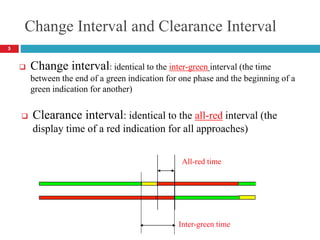
Inter-green time
Change Interval and Clearance Interval
 Change interval: identical to the inter-green interval (the time
between the end of a green indication for one phase and the beginning of a
green indication for another)
 Clearance interval: identical to the all-red interval (the
display time of a red indication for all approaches)
All-red time
6
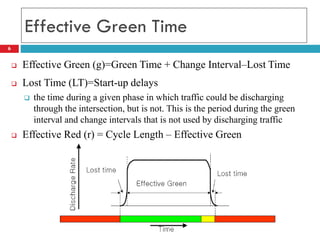
Effective Green Time
 Effective Green (g)=Green Time + Change Interval–Lost Time
 Lost Time (LT)=Start-up delays
 the time during a given phase in which traffic could be discharging
through the intersection, but is not. This is the period during the green
interval and change intervals that is not used by discharging traffic
 Effective Red (r) = Cycle Length – Effective Green
7
Capacity and Saturation Flow
 Capacity: the maximum number of vehicles that can
reasonably be expected to pass over a given roadway or
section of roadway, in one direction, during a given time
period and under the prevailing roadway, traffic, and
signalization conditions.
 Saturation flow: The maximum number of vehicles from a
lane group that would pass through the intersection in one
hour under the prevailing traffic and roadway conditions if the
lane group was given a continuous green signal for that hour.
8
Traffic Signal Timing Procedure
1. Develop a phase plan
2. Convert volumes to through-vehicle equivalents
3. Determine critical-lane volumes
4. Determine yellow and all-red intervals
5. Determine lost times
6. Determine the cycle length
7. Allocate effective green to each phase
8. Check pedestrian requirements
9
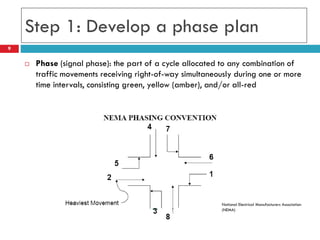
Step 1: Develop a phase plan
 Phase (signal phase): the part of a cycle allocated to any combination of
traffic movements receiving right-of-way simultaneously during one or more
time intervals, consisting green, yellow (amber), and/or all-red
National Electrical Manufacturers Association
(NEMA)
10
Treatment of Left Turns
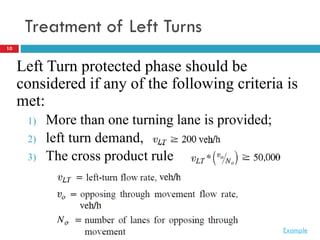
Left Turn protected phase should be
considered if any of the following criteria is
met:
1) More than one turning lane is provided;
2) left turn demand,
3) The cross product rule
Example
11
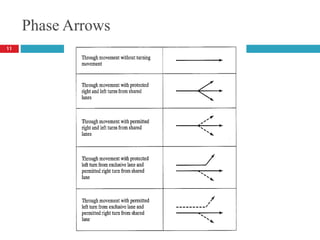
Phase Arrows
12
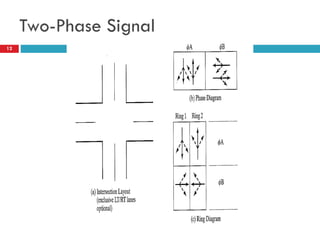
Two-Phase Signal
13
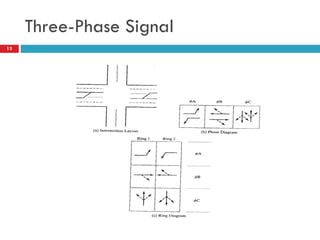
Three-Phase Signal
14
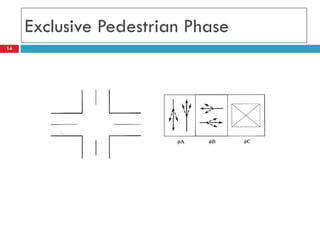
Exclusive Pedestrian Phase
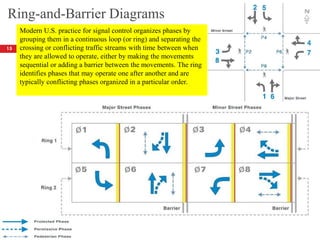
Ring-and-Barrier Diagrams
15
Modern U.S. practice for signal control organizes phases by
grouping them in a continuous loop (or ring) and separating the
crossing or conflicting traffic streams with time between when
they are allowed to operate, either by making the movements
sequential or adding a barrier between the movements. The ring
identifies phases that may operate one after another and are
typically conflicting phases organized in a particular order.
16
Step 2: Convert volumes to through vehicle
equivalents
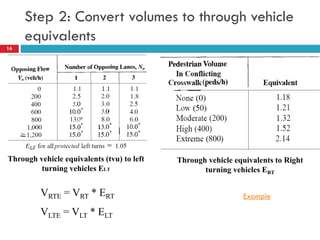
Through vehicle equivalents (tvu) to left
turning vehicles ELT
Through vehicle equivalents to Right
turning vehicles ERT
VRTE = VRT * ERT
VLTE = VLT * ELT
Example
17
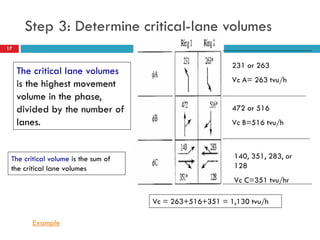
Step 3: Determine critical-lane volumes
The critical lane volumes
is the highest movement
volume in the phase,
divided by the number of
lanes.
The critical volume is the sum of
the critical lane volumes
231 or 263
Vc A= 263 tvu/h
472 or 516
Vc B=516 tvu/h
140, 351, 283, or
128
Vc C=351 tvu/hr
Vc = 263+516+351 = 1,130 tvu/h
Example
18
Step 4: Determine yellow and all
red intervals
19
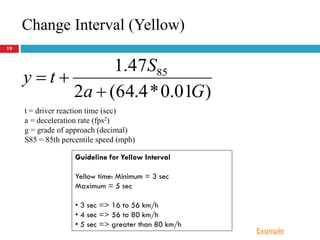
)01.0*4.64(2
47.1 85
Ga
S
ty


Change Interval (Yellow)
t = driver reaction time (sec)
a = deceleration rate (fps2)
g = grade of approach (decimal)
S85 = 85th percentile speed (mph)
Guideline for Yellow Interval
Yellow time: Minimum = 3 sec
Maximum = 5 sec
• 3 sec => 16 to 56 km/h
• 4 sec => 56 to 80 km/h
• 5 sec => greater than 80 km/h
Example
20
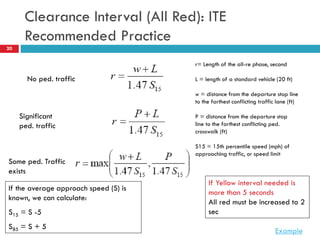
Clearance Interval (All Red): ITE
Recommended Practice
No ped. traffic
Significant
ped. traffic
r= Length of the all-re phase, second
L = length of a standard vehicle (20 ft)
w = distance from the departure stop line
to the farthest conflicting traffic lane (ft)
P = distance from the departure stop
line to the farthest conflicting ped.
crosswalk (ft)
S15 = 15th percentile speed (mph) of
approaching traffic, or speed limit
Some ped. Traffic
exists
If Yellow interval needed is
more than 5 seconds
All red must be increased to 2
sec
Example
If the average approach speed (S) is
known, we can calculate:
S15 = S -5
S85 = S + 5
21
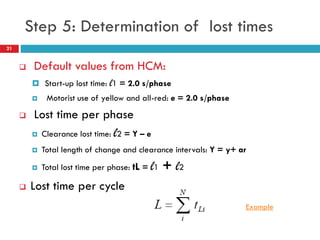
Step 5: Determination of lost times
 Default values from HCM:
 Start-up lost time: l1 = 2.0 s/phase
 Motorist use of yellow and all-red: e = 2.0 s/phase
 Lost time per phase
 Clearance lost time: l2 = Y – e
 Total length of change and clearance intervals: Y = y+ ar
 Total lost time per phase: tL = l1 + l2
 Lost time per cycle
Example
22
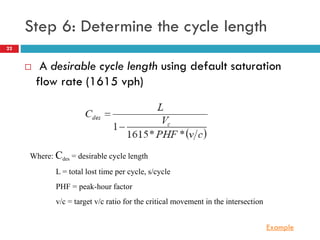
Step 6: Determine the cycle length
 A desirable cycle length using default saturation
flow rate (1615 vph)
Where: Cdes = desirable cycle length
L = total lost time per cycle, s/cycle
PHF = peak-hour factor
v/c = target v/c ratio for the critical movement in the intersection
Example
23
Step 7: Allocate effective green to
each phase
 Splitting the Green
 Available effective green time in the cycle
 Effective green time for phase i
Where:
gi = effective green time for phase I, second
gTOT= total effective green time in cycle, second
Vci=critical lane volume for phase or sub-phase i, veh/h
VC= sum of critical –lane volumes, veh/h
Example
24
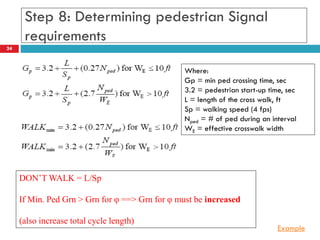
Step 8: Determining pedestrian Signal
requirements
Where:
Gp = min ped crossing time, sec
3.2 = pedestrian start-up time, sec
L = length of the cross walk, ft
Sp = walking speed (4 fps)
Nped = # of ped during an interval
WE = effective crosswalk width
DON’T WALK = L/Sp
If Min. Ped Grn > Grn for φ ==> Grn for φ must be increased
(also increase total cycle length)
Example
25
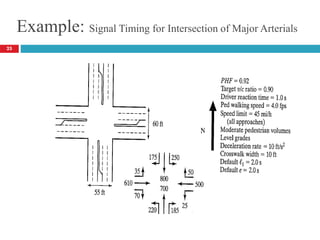
Example: Signal Timing for Intersection of Major Arterials
1
26
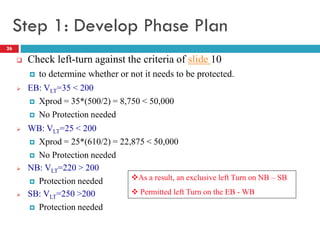
Step 1: Develop Phase Plan
 Check left-turn against the criteria of slide 10
 to determine whether or not it needs to be protected.
 EB: VLT=35 < 200
 Xprod = 35*(500/2) = 8,750 < 50,000
 No Protection needed
 WB: VLT=25 < 200
 Xprod = 25*(610/2) = 22,875 < 50,000
 No Protection needed
 NB: VLT=220 > 200
 Protection needed
 SB: VLT=250 >200
 Protection needed
As a result, an exclusive left Turn on NB – SB
 Permitted left Turn on the EB - WB
27
1
1
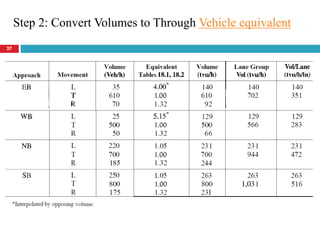
Step 2: Convert Volumes to Through Vehicle equivalent
28
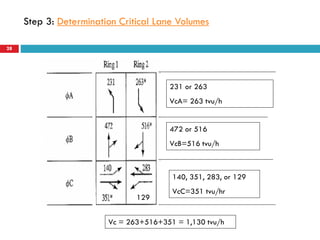
231 or 263
VcA= 263 tvu/h
472 or 516
VcB=516 tvu/h
140, 351, 283, or 129
VcC=351 tvu/hr
Vc = 263+516+351 = 1,130 tvu/h
Step 3: Determination Critical Lane Volumes
129
29
Step 4: Determine Yellow and All-Red intervals
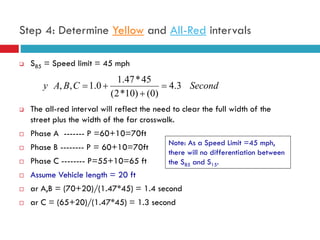
 S85 = Speed limit = 45 mph
 The all-red interval will reflect the need to clear the full width of the
street plus the width of the far crosswalk.
 Phase A ------- P =60+10=70ft
 Phase B -------- P = 60+10=70ft
 Phase C -------- P=55+10=65 ft
 Assume Vehicle length = 20 ft
 ar A,B = (70+20)/(1.47*45) = 1.4 second
 ar C = (65+20)/(1.47*45) = 1.3 second
SecondCBAy 3.4
)0()10*2(
45*47.1
0.1,, 


Note: As a Speed Limit =45 mph,
there will no differentiation between
the S85 and S15.
30
Step 5: Determination Of Lost Times
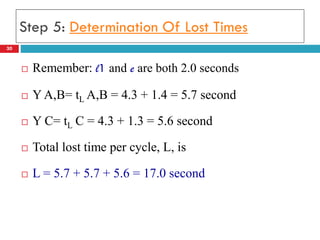
 Remember: l1 and e are both 2.0 seconds
 Y A,B= tL A,B = 4.3 + 1.4 = 5.7 second
 Y C= tL C = 4.3 + 1.3 = 5.6 second
 Total lost time per cycle, L, is
 L = 5.7 + 5.7 + 5.6 = 17.0 second
31
Step 6: Determine the Desirable Cycle Length
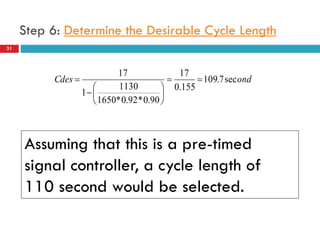
ondCdes sec7.109
155.0
17
90.0*92.0*1650
1130
1
17









Assuming that this is a pre-timed
signal controller, a cycle length of
110 second would be selected.
32
Step 7: Allocate Effective Green to Each Phase
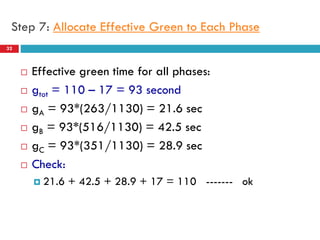
 Effective green time for all phases:
 gtot = 110 – 17 = 93 second
 gA = 93*(263/1130) = 21.6 sec
 gB = 93*(516/1130) = 42.5 sec
 gC = 93*(351/1130) = 28.9 sec
 Check:
 21.6 + 42.5 + 28.9 + 17 = 110 ------- ok
33
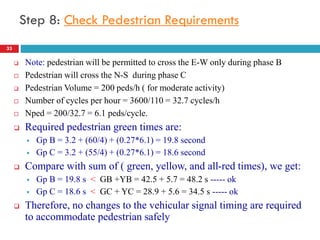
Step 8: Check Pedestrian Requirements
 Note: pedestrian will be permitted to cross the E-W only during phase B
 Pedestrian will cross the N-S during phase C
 Pedestrian Volume = 200 peds/h ( for moderate activity)
 Number of cycles per hour = 3600/110 = 32.7 cycles/h
 Nped = 200/32.7 = 6.1 peds/cycle.
 Required pedestrian green times are:
 Gp B = 3.2 + (60/4) + (0.27*6.1) = 19.8 second
 Gp C = 3.2 + (55/4) + (0.27*6.1) = 18.6 second
 Compare with sum of ( green, yellow, and all-red times), we get:
 Gp B = 19.8 s < GB +YB = 42.5 + 5.7 = 48.2 s ----- ok
 Gp C = 18.6 s < GC + YC = 28.9 + 5.6 = 34.5 s ----- ok
 Therefore, no changes to the vehicular signal timing are required
to accommodate pedestrian safely
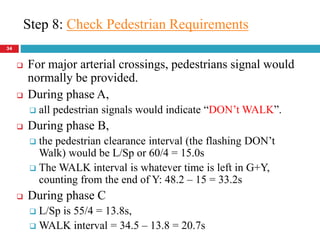
34
 For major arterial crossings, pedestrians signal would
normally be provided.
 During phase A,
 all pedestrian signals would indicate “DON’t WALK”.
 During phase B,
 the pedestrian clearance interval (the flashing DON’t
Walk) would be L/Sp or 60/4 = 15.0s
 The WALK interval is whatever time is left in G+Y,
counting from the end of Y: 48.2 – 15 = 33.2s
 During phase C
 L/Sp is 55/4 = 13.8s,
 WALK interval = 34.5 – 13.8 = 20.7s
Step 8: Check Pedestrian Requirements
Home Reading
35
"TRAFFIC SIGNAL TIMING MANUAL", FHWA,
Publication Number: FHWA-HOP-08-024
Available online at:
http://ops.fhwa.dot.gov/publications/fhwahop08024/
fhwa_hop_08_024.pdf
36
Thanks for your time

Lecture 06 Signalized Intersections (Traffic Engineering هندسة المرور & Dr. Usama Shahdah)

  • 1.
    TRAFFIC ENGINEERING COURSE (PWE8322) SIGNALIZED INTERSECTIONS Instructor: Usama Elrawy Shahdah, PhDLecture # 06
  • 2.
    2 Types of TrafficSignals  Pre-timed: Repeat a pre-set constant cycle.  Actuated: Respond to the presence of vehicles and pedestrians  Semi-actuated  Detectors placed only on the minor approach  Major approach is interrupted only if vehicle present at the minor approach  Fully actuated  Detectors are installed at all approaches  Green time are allocated based on the incoming traffic on each approach
  • 3.
    3 Cycle length &Signal Phase  Cycle (cycle length or cycle time): time needed for a complete sequence of signal indications  Phase (signal phase):  the part of a cycle allocated to any combination of traffic movements receiving right-of-way simultaneously during one or more time intervals,  consisting green, yellow (amber), and/or all-red  Split: a percentage of a cycle length allocated to each of the various phases in a signal cycle
  • 4.
  • 5.
    5 Inter-green time Change Intervaland Clearance Interval  Change interval: identical to the inter-green interval (the time between the end of a green indication for one phase and the beginning of a green indication for another)  Clearance interval: identical to the all-red interval (the display time of a red indication for all approaches) All-red time
  • 6.
    6 Effective Green Time Effective Green (g)=Green Time + Change Interval–Lost Time  Lost Time (LT)=Start-up delays  the time during a given phase in which traffic could be discharging through the intersection, but is not. This is the period during the green interval and change intervals that is not used by discharging traffic  Effective Red (r) = Cycle Length – Effective Green
  • 7.
    7 Capacity and SaturationFlow  Capacity: the maximum number of vehicles that can reasonably be expected to pass over a given roadway or section of roadway, in one direction, during a given time period and under the prevailing roadway, traffic, and signalization conditions.  Saturation flow: The maximum number of vehicles from a lane group that would pass through the intersection in one hour under the prevailing traffic and roadway conditions if the lane group was given a continuous green signal for that hour.
  • 8.
    8 Traffic Signal TimingProcedure 1. Develop a phase plan 2. Convert volumes to through-vehicle equivalents 3. Determine critical-lane volumes 4. Determine yellow and all-red intervals 5. Determine lost times 6. Determine the cycle length 7. Allocate effective green to each phase 8. Check pedestrian requirements
  • 9.
    9 Step 1: Developa phase plan  Phase (signal phase): the part of a cycle allocated to any combination of traffic movements receiving right-of-way simultaneously during one or more time intervals, consisting green, yellow (amber), and/or all-red National Electrical Manufacturers Association (NEMA)
  • 10.
    10 Treatment of LeftTurns Left Turn protected phase should be considered if any of the following criteria is met: 1) More than one turning lane is provided; 2) left turn demand, 3) The cross product rule Example
  • 11.
  • 12.
  • 13.
  • 14.
  • 15.
    Ring-and-Barrier Diagrams 15 Modern U.S.practice for signal control organizes phases by grouping them in a continuous loop (or ring) and separating the crossing or conflicting traffic streams with time between when they are allowed to operate, either by making the movements sequential or adding a barrier between the movements. The ring identifies phases that may operate one after another and are typically conflicting phases organized in a particular order.
  • 16.
    16 Step 2: Convertvolumes to through vehicle equivalents Through vehicle equivalents (tvu) to left turning vehicles ELT Through vehicle equivalents to Right turning vehicles ERT VRTE = VRT * ERT VLTE = VLT * ELT Example
  • 17.
    17 Step 3: Determinecritical-lane volumes The critical lane volumes is the highest movement volume in the phase, divided by the number of lanes. The critical volume is the sum of the critical lane volumes 231 or 263 Vc A= 263 tvu/h 472 or 516 Vc B=516 tvu/h 140, 351, 283, or 128 Vc C=351 tvu/hr Vc = 263+516+351 = 1,130 tvu/h Example
  • 18.
    18 Step 4: Determineyellow and all red intervals
  • 19.
    19 )01.0*4.64(2 47.1 85 Ga S ty   Change Interval(Yellow) t = driver reaction time (sec) a = deceleration rate (fps2) g = grade of approach (decimal) S85 = 85th percentile speed (mph) Guideline for Yellow Interval Yellow time: Minimum = 3 sec Maximum = 5 sec • 3 sec => 16 to 56 km/h • 4 sec => 56 to 80 km/h • 5 sec => greater than 80 km/h Example
  • 20.
    20 Clearance Interval (AllRed): ITE Recommended Practice No ped. traffic Significant ped. traffic r= Length of the all-re phase, second L = length of a standard vehicle (20 ft) w = distance from the departure stop line to the farthest conflicting traffic lane (ft) P = distance from the departure stop line to the farthest conflicting ped. crosswalk (ft) S15 = 15th percentile speed (mph) of approaching traffic, or speed limit Some ped. Traffic exists If Yellow interval needed is more than 5 seconds All red must be increased to 2 sec Example If the average approach speed (S) is known, we can calculate: S15 = S -5 S85 = S + 5
  • 21.
    21 Step 5: Determinationof lost times  Default values from HCM:  Start-up lost time: l1 = 2.0 s/phase  Motorist use of yellow and all-red: e = 2.0 s/phase  Lost time per phase  Clearance lost time: l2 = Y – e  Total length of change and clearance intervals: Y = y+ ar  Total lost time per phase: tL = l1 + l2  Lost time per cycle Example
  • 22.
    22 Step 6: Determinethe cycle length  A desirable cycle length using default saturation flow rate (1615 vph) Where: Cdes = desirable cycle length L = total lost time per cycle, s/cycle PHF = peak-hour factor v/c = target v/c ratio for the critical movement in the intersection Example
  • 23.
    23 Step 7: Allocateeffective green to each phase  Splitting the Green  Available effective green time in the cycle  Effective green time for phase i Where: gi = effective green time for phase I, second gTOT= total effective green time in cycle, second Vci=critical lane volume for phase or sub-phase i, veh/h VC= sum of critical –lane volumes, veh/h Example
  • 24.
    24 Step 8: Determiningpedestrian Signal requirements Where: Gp = min ped crossing time, sec 3.2 = pedestrian start-up time, sec L = length of the cross walk, ft Sp = walking speed (4 fps) Nped = # of ped during an interval WE = effective crosswalk width DON’T WALK = L/Sp If Min. Ped Grn > Grn for φ ==> Grn for φ must be increased (also increase total cycle length) Example
  • 25.
    25 Example: Signal Timingfor Intersection of Major Arterials 1
  • 26.
    26 Step 1: DevelopPhase Plan  Check left-turn against the criteria of slide 10  to determine whether or not it needs to be protected.  EB: VLT=35 < 200  Xprod = 35*(500/2) = 8,750 < 50,000  No Protection needed  WB: VLT=25 < 200  Xprod = 25*(610/2) = 22,875 < 50,000  No Protection needed  NB: VLT=220 > 200  Protection needed  SB: VLT=250 >200  Protection needed As a result, an exclusive left Turn on NB – SB  Permitted left Turn on the EB - WB
  • 27.
    27 1 1 Step 2: ConvertVolumes to Through Vehicle equivalent
  • 28.
    28 231 or 263 VcA=263 tvu/h 472 or 516 VcB=516 tvu/h 140, 351, 283, or 129 VcC=351 tvu/hr Vc = 263+516+351 = 1,130 tvu/h Step 3: Determination Critical Lane Volumes 129
  • 29.
    29 Step 4: DetermineYellow and All-Red intervals  S85 = Speed limit = 45 mph  The all-red interval will reflect the need to clear the full width of the street plus the width of the far crosswalk.  Phase A ------- P =60+10=70ft  Phase B -------- P = 60+10=70ft  Phase C -------- P=55+10=65 ft  Assume Vehicle length = 20 ft  ar A,B = (70+20)/(1.47*45) = 1.4 second  ar C = (65+20)/(1.47*45) = 1.3 second SecondCBAy 3.4 )0()10*2( 45*47.1 0.1,,    Note: As a Speed Limit =45 mph, there will no differentiation between the S85 and S15.
  • 30.
    30 Step 5: DeterminationOf Lost Times  Remember: l1 and e are both 2.0 seconds  Y A,B= tL A,B = 4.3 + 1.4 = 5.7 second  Y C= tL C = 4.3 + 1.3 = 5.6 second  Total lost time per cycle, L, is  L = 5.7 + 5.7 + 5.6 = 17.0 second
  • 31.
    31 Step 6: Determinethe Desirable Cycle Length ondCdes sec7.109 155.0 17 90.0*92.0*1650 1130 1 17          Assuming that this is a pre-timed signal controller, a cycle length of 110 second would be selected.
  • 32.
    32 Step 7: AllocateEffective Green to Each Phase  Effective green time for all phases:  gtot = 110 – 17 = 93 second  gA = 93*(263/1130) = 21.6 sec  gB = 93*(516/1130) = 42.5 sec  gC = 93*(351/1130) = 28.9 sec  Check:  21.6 + 42.5 + 28.9 + 17 = 110 ------- ok
  • 33.
    33 Step 8: CheckPedestrian Requirements  Note: pedestrian will be permitted to cross the E-W only during phase B  Pedestrian will cross the N-S during phase C  Pedestrian Volume = 200 peds/h ( for moderate activity)  Number of cycles per hour = 3600/110 = 32.7 cycles/h  Nped = 200/32.7 = 6.1 peds/cycle.  Required pedestrian green times are:  Gp B = 3.2 + (60/4) + (0.27*6.1) = 19.8 second  Gp C = 3.2 + (55/4) + (0.27*6.1) = 18.6 second  Compare with sum of ( green, yellow, and all-red times), we get:  Gp B = 19.8 s < GB +YB = 42.5 + 5.7 = 48.2 s ----- ok  Gp C = 18.6 s < GC + YC = 28.9 + 5.6 = 34.5 s ----- ok  Therefore, no changes to the vehicular signal timing are required to accommodate pedestrian safely
  • 34.
    34  For majorarterial crossings, pedestrians signal would normally be provided.  During phase A,  all pedestrian signals would indicate “DON’t WALK”.  During phase B,  the pedestrian clearance interval (the flashing DON’t Walk) would be L/Sp or 60/4 = 15.0s  The WALK interval is whatever time is left in G+Y, counting from the end of Y: 48.2 – 15 = 33.2s  During phase C  L/Sp is 55/4 = 13.8s,  WALK interval = 34.5 – 13.8 = 20.7s Step 8: Check Pedestrian Requirements
  • 35.
    Home Reading 35 "TRAFFIC SIGNALTIMING MANUAL", FHWA, Publication Number: FHWA-HOP-08-024 Available online at: http://ops.fhwa.dot.gov/publications/fhwahop08024/ fhwa_hop_08_024.pdf
  • 36.