Traffic control
Traffic signs


Traffic control devices, such as signs, pavement
markings, and traffic signals, are used to regulate, warn
and guide traffic movements on public roadways. Over
the years, the design and application of these devices
has become highly standardized throughout the world.



Traffic signs or road signs are signs erected at
the side of or above roads to give instructions or
provide information to road users. Many
countries have adopted pictorial signs or
otherwise simplified and standardized their signs
to overcome language barriers, and enhance
traffic safety. Such pictorial signs use symbols in
place of words and are usually based on
international protocols. Such signs were first
developed in Europe, and have been adopted by
most countries to varying degrees.
Situations needing extra care
1. Emergency vehicles : If an ambulance, fire engine, police or
other emergency vehicle approaches using flashing blue lights,
headlights and/or sirens, keep off the road.
2. Buses : Get on or off a bus only when it has stopped to allow
you to do so. Watch out for cyclists when you are getting off.
Never cross the road directly behind or in front of a bus; wait
until it has moved off and you can see clearly in both directions.
3. Railway level crossings : Do not cross if the red lights show,
an alarm is sounding or the barriers are being lowered. If there
are no lights, alarms or barriers, stop, look both ways and listen
before crossing.
. Street and pavement repairs : A pavement may be closed
temporarily because it is not safe to use. Take extra care if you
are directed to walk in or to cross the road.
Rules & Regulations









Rule no.1 Keep Left. the driver of a motor vehicle shall
drive the vehicle as close to the left hand side of the
road as may be expedient and shall allow all traffic
which is proceeding in the opposite direction to pass on
his right hand side.
Rule no.2 Overtaking prohibited in certain
cases.The driver of a motor vehicle shall not pass a
vehicle traveling in the same direction as himself;
(a) if his passing is likely to cause inconvenience or
danger to other traffic proceeding in any direction.
(b) if he is near a point, a bend or corner or a hill or
other obstruction of any kind that renders the road
ahead not clearly visible.
(c) if the driver ahead of him has not signaled that he
may be overtaken.
Rule no.3Caution at road junction. The driver of a motor
vehicle shall slow down when approaching a road intersection, a
road junction, pedestrian crossing or a road corner, and shall not
enter any such intersection, junction or crossing until he has
become aware that he may do so without endangering the safety
of persons there on.
 Rule no.4 Fire service vehicles and ambulances to be given
free passage. Every driver shall, on the approach of a fire
service vehicle or of an ambulance allow it free passage by
drawing to the side of the road.




Rule no.5 Right of way. The pedestrians have the right of
way at uncontrolled pedestrian crossing. When any road is
provided with footpath or cycle tracks specially for other
traffic, except with permission of a police officer in uniform, a
driver shall not drive on such footpath or track.



Rule no.6 Taking 'U' turn. No driver shall take a 'U'
turn where 'U' turn is specifically prohibited and on busy
traffic road. If a 'U' turn is allowed the driver shall show
signal by hand as for a right turn, watch in the rear view
mirror and turn when safe to do so.


Rule no.7 Signals to be given by drivers.



1.When about to slow down, a driver shall extend his right arm
with the palm downwards and to the right of the vehicle and
shall move the arm so extended up and down several times in
such a manner that the signal can beseen by the driver of any
vehicle which may be behind him.
2. When about to stop, a driver shall raise his right fore arm
vertically outside of and to the right of the vehicle, palm to the
right.
3. When about to turn to the right or to drive to the right hand
side of the road in order to pass another vehicle or for any
other purpose, a driver shall extend his right arm and in a
horizontal position outside of the hand turned to the front.
4. When about to turn to the left or to drive to the left hand side
of the road,a driver shall extend high right arm and rotate it in
an anticlockwise direction.
5. When a driver wishes to indicate to the driver of a vehicle
behind him that he desires that the driver to overtake him he
shall extend his right arm and hand horizontally outside of and
to the right of the vehicle and shall swing the arm backward
and forward in a semi-circular motion.








TRAFFIC CONTROL DEVICES






Traffic control devices are markers, signs and signal
devices used to inform, guide and control traffic, including
pedestrians, motor vehicle drivers and bicyclists. These
devices are usually placed adjacent, over or along the
highways, roads, traffic facilities and other public areas that
require traffic control.
Types
1. Traffic signs are signs which use symbols and/or words to
convey information to road users. These devices are made
with retroreflective materials that reflect light from headlights
back towards the driver's eyes. This is to achieve maximum
visibility especially at night.
Traffic signs






MANDATORY / REGULATORY - Mandatory signs are
generally indicated in a circular form. In accordance with the
Motor Vehicle Act, 1988, every driver of a motor vehicle shall
drive the vehicle in conformity with any indication given by the
mandatory signs and not obeying these signs is an offence.
CAUTIONARY / WARNING SIGNS:- Cautionary signs are
meant for cautioning the driver about the hazards lying ahead
on the road. Drivers must obey there signs for safety. These
signs are indicated in a triangular form.
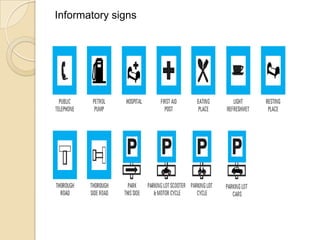
INFORMATORY SIGNS:- Informatory signs are erected on the
road to provide information on direction, destination, roadside
facilities etc. to the road users.
Mandatory signs
Warning signs
Informatory signs
•Channelling

devices are used to warn drivers and
pedestrians and to guide them through a work zone.
Common channelizing devices are traffic cones and
drums. This type of traffic control device are usually
placed between traffic and road construction sites, or
between opposing traffic streams.
Traffic cones are channelling devices shaped like
cones, thus the name. They are made from bright orange
flexible materials, not less than 18 inches (0.46 m) in
height. Cones used at night must have bands of reflective
material near the top. These are used to confine a
particular area or divide traffic lanes temporarily.
Tubular markers are cylindrical in shape. They are also
orange, with bands of reflective material near the top.
They must be at least 18 inches (0.46 m) in height and 2
inches (51 mm) in body diameter. Tubular markers are
made of flexible plastic and have a wider base that is
glued or screwed to the pavement. They are used in a
similar way as cones.








Vertical panels are reflective traffic control devices which
measure at least 8 inches (200 mm) wide and 24 inches
(610 mm) high. They are bright orange with diagonal white
stripes. These panels are used to guide vehicle traffic. They
can be more conspicuous than cones or tubular markers
when viewed head-on, but are very thin and hard to see from
the side.
Construction barrels or drums are cylindrical channelling
devices that are used when conspicuity is vital. These device
are made with industrial-grade orange plastic and covered
with alternating orange and white retroreflective stripes.
These drums are usually ballasted with a heavy rubber base
or a sandbag in the bottom for added stability.
Barricades are channelling devices used to redirect traffic on
high-speed roads and expressways. There are different types
of barricades depending on its size, design and applications.
Barricades may be a fixed or portable traffic control device.
Temporary raised islands are pavements that are usually 4
inches (100 mm) in height and 18 inches (460 mm) wide that
are used for temporary traffic control applications. This traffic
control device follow the standard design set by the AASHTO
Roadside Design Guide.
Road Marking




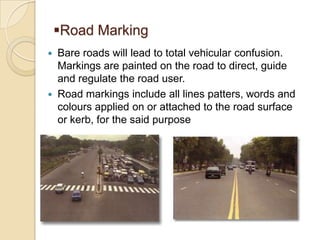
Bare roads will lead to total vehicular confusion.
Markings are painted on the road to direct, guide
and regulate the road user.
Road markings include all lines patters, words and
colours applied on or attached to the road surface
or kerb, for the said purpose




Traffic paints are commonly used for road
markings. Other materials such as, road
studs, cat's eyes and thermoplastic strips also find
their application in road markings. These markings
promote road safety and ensure smooth flow of
traffic. Sometimes, road markings are used to
supplement the message of road signs and other
devices.
White is generally used for carriageway (road)
markings except those indicating restrictions for
which yellow markings are used. White or yellow
together with black are used for kerb and object
marking.







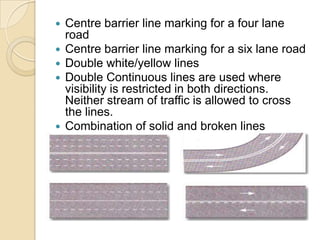
Centre barrier line marking for a four lane
road
Centre barrier line marking for a six lane road
Double white/yellow lines
Double Continuous lines are used where
visibility is restricted in both directions.
Neither stream of traffic is allowed to cross
the lines.
Combination of solid and broken lines





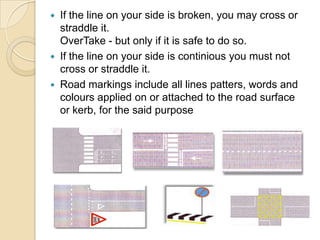
If the line on your side is broken, you may cross or
straddle it.
OverTake - but only if it is safe to do so.
If the line on your side is continious you must not
cross or straddle it.
Road markings include all lines patters, words and
colours applied on or attached to the road surface
or kerb, for the said purpose




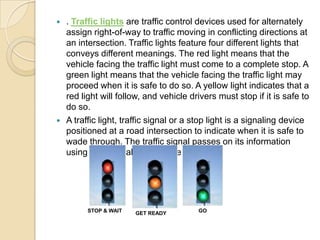
. Traffic lights are traffic control devices used for alternately
assign right-of-way to traffic moving in conflicting directions at
an intersection. Traffic lights feature four different lights that
conveys different meanings. The red light means that the
vehicle facing the traffic light must come to a complete stop. A
green light means that the vehicle facing the traffic light may
proceed when it is safe to do so. A yellow light indicates that a
red light will follow, and vehicle drivers must stop if it is safe to
do so.
A traffic light, traffic signal or a stop light is a signaling device
positioned at a road intersection to indicate when it is safe to
wade through. The traffic signal passes on its information
using a universal colour code

STOP & WAIT

GET READY

GO
THANK YOU

Traffic control

  • 1.
  • 2.
    Traffic signs  Traffic controldevices, such as signs, pavement markings, and traffic signals, are used to regulate, warn and guide traffic movements on public roadways. Over the years, the design and application of these devices has become highly standardized throughout the world.  Traffic signs or road signs are signs erected at the side of or above roads to give instructions or provide information to road users. Many countries have adopted pictorial signs or otherwise simplified and standardized their signs to overcome language barriers, and enhance traffic safety. Such pictorial signs use symbols in place of words and are usually based on international protocols. Such signs were first developed in Europe, and have been adopted by most countries to varying degrees.
  • 3.
    Situations needing extracare 1. Emergency vehicles : If an ambulance, fire engine, police or other emergency vehicle approaches using flashing blue lights, headlights and/or sirens, keep off the road. 2. Buses : Get on or off a bus only when it has stopped to allow you to do so. Watch out for cyclists when you are getting off. Never cross the road directly behind or in front of a bus; wait until it has moved off and you can see clearly in both directions. 3. Railway level crossings : Do not cross if the red lights show, an alarm is sounding or the barriers are being lowered. If there are no lights, alarms or barriers, stop, look both ways and listen before crossing. . Street and pavement repairs : A pavement may be closed temporarily because it is not safe to use. Take extra care if you are directed to walk in or to cross the road.
  • 4.
    Rules & Regulations      Ruleno.1 Keep Left. the driver of a motor vehicle shall drive the vehicle as close to the left hand side of the road as may be expedient and shall allow all traffic which is proceeding in the opposite direction to pass on his right hand side. Rule no.2 Overtaking prohibited in certain cases.The driver of a motor vehicle shall not pass a vehicle traveling in the same direction as himself; (a) if his passing is likely to cause inconvenience or danger to other traffic proceeding in any direction. (b) if he is near a point, a bend or corner or a hill or other obstruction of any kind that renders the road ahead not clearly visible. (c) if the driver ahead of him has not signaled that he may be overtaken.
  • 5.
    Rule no.3Caution atroad junction. The driver of a motor vehicle shall slow down when approaching a road intersection, a road junction, pedestrian crossing or a road corner, and shall not enter any such intersection, junction or crossing until he has become aware that he may do so without endangering the safety of persons there on.  Rule no.4 Fire service vehicles and ambulances to be given free passage. Every driver shall, on the approach of a fire service vehicle or of an ambulance allow it free passage by drawing to the side of the road.   Rule no.5 Right of way. The pedestrians have the right of way at uncontrolled pedestrian crossing. When any road is provided with footpath or cycle tracks specially for other traffic, except with permission of a police officer in uniform, a driver shall not drive on such footpath or track.  Rule no.6 Taking 'U' turn. No driver shall take a 'U' turn where 'U' turn is specifically prohibited and on busy traffic road. If a 'U' turn is allowed the driver shall show signal by hand as for a right turn, watch in the rear view mirror and turn when safe to do so.
  • 6.
     Rule no.7 Signalsto be given by drivers.  1.When about to slow down, a driver shall extend his right arm with the palm downwards and to the right of the vehicle and shall move the arm so extended up and down several times in such a manner that the signal can beseen by the driver of any vehicle which may be behind him. 2. When about to stop, a driver shall raise his right fore arm vertically outside of and to the right of the vehicle, palm to the right. 3. When about to turn to the right or to drive to the right hand side of the road in order to pass another vehicle or for any other purpose, a driver shall extend his right arm and in a horizontal position outside of the hand turned to the front. 4. When about to turn to the left or to drive to the left hand side of the road,a driver shall extend high right arm and rotate it in an anticlockwise direction. 5. When a driver wishes to indicate to the driver of a vehicle behind him that he desires that the driver to overtake him he shall extend his right arm and hand horizontally outside of and to the right of the vehicle and shall swing the arm backward and forward in a semi-circular motion.    
  • 7.
    TRAFFIC CONTROL DEVICES    Trafficcontrol devices are markers, signs and signal devices used to inform, guide and control traffic, including pedestrians, motor vehicle drivers and bicyclists. These devices are usually placed adjacent, over or along the highways, roads, traffic facilities and other public areas that require traffic control. Types 1. Traffic signs are signs which use symbols and/or words to convey information to road users. These devices are made with retroreflective materials that reflect light from headlights back towards the driver's eyes. This is to achieve maximum visibility especially at night.
  • 8.
    Traffic signs    MANDATORY /REGULATORY - Mandatory signs are generally indicated in a circular form. In accordance with the Motor Vehicle Act, 1988, every driver of a motor vehicle shall drive the vehicle in conformity with any indication given by the mandatory signs and not obeying these signs is an offence. CAUTIONARY / WARNING SIGNS:- Cautionary signs are meant for cautioning the driver about the hazards lying ahead on the road. Drivers must obey there signs for safety. These signs are indicated in a triangular form. INFORMATORY SIGNS:- Informatory signs are erected on the road to provide information on direction, destination, roadside facilities etc. to the road users.
  • 9.
  • 10.
  • 11.
  • 12.
    •Channelling devices are usedto warn drivers and pedestrians and to guide them through a work zone. Common channelizing devices are traffic cones and drums. This type of traffic control device are usually placed between traffic and road construction sites, or between opposing traffic streams. Traffic cones are channelling devices shaped like cones, thus the name. They are made from bright orange flexible materials, not less than 18 inches (0.46 m) in height. Cones used at night must have bands of reflective material near the top. These are used to confine a particular area or divide traffic lanes temporarily. Tubular markers are cylindrical in shape. They are also orange, with bands of reflective material near the top. They must be at least 18 inches (0.46 m) in height and 2 inches (51 mm) in body diameter. Tubular markers are made of flexible plastic and have a wider base that is glued or screwed to the pavement. They are used in a similar way as cones.
  • 13.
        Vertical panels arereflective traffic control devices which measure at least 8 inches (200 mm) wide and 24 inches (610 mm) high. They are bright orange with diagonal white stripes. These panels are used to guide vehicle traffic. They can be more conspicuous than cones or tubular markers when viewed head-on, but are very thin and hard to see from the side. Construction barrels or drums are cylindrical channelling devices that are used when conspicuity is vital. These device are made with industrial-grade orange plastic and covered with alternating orange and white retroreflective stripes. These drums are usually ballasted with a heavy rubber base or a sandbag in the bottom for added stability. Barricades are channelling devices used to redirect traffic on high-speed roads and expressways. There are different types of barricades depending on its size, design and applications. Barricades may be a fixed or portable traffic control device. Temporary raised islands are pavements that are usually 4 inches (100 mm) in height and 18 inches (460 mm) wide that are used for temporary traffic control applications. This traffic control device follow the standard design set by the AASHTO Roadside Design Guide.
  • 14.
    Road Marking   Bare roadswill lead to total vehicular confusion. Markings are painted on the road to direct, guide and regulate the road user. Road markings include all lines patters, words and colours applied on or attached to the road surface or kerb, for the said purpose
  • 15.
      Traffic paints arecommonly used for road markings. Other materials such as, road studs, cat's eyes and thermoplastic strips also find their application in road markings. These markings promote road safety and ensure smooth flow of traffic. Sometimes, road markings are used to supplement the message of road signs and other devices. White is generally used for carriageway (road) markings except those indicating restrictions for which yellow markings are used. White or yellow together with black are used for kerb and object marking.
  • 16.
         Centre barrier linemarking for a four lane road Centre barrier line marking for a six lane road Double white/yellow lines Double Continuous lines are used where visibility is restricted in both directions. Neither stream of traffic is allowed to cross the lines. Combination of solid and broken lines
  • 17.
       If the lineon your side is broken, you may cross or straddle it. OverTake - but only if it is safe to do so. If the line on your side is continious you must not cross or straddle it. Road markings include all lines patters, words and colours applied on or attached to the road surface or kerb, for the said purpose
  • 18.
      . Traffic lightsare traffic control devices used for alternately assign right-of-way to traffic moving in conflicting directions at an intersection. Traffic lights feature four different lights that conveys different meanings. The red light means that the vehicle facing the traffic light must come to a complete stop. A green light means that the vehicle facing the traffic light may proceed when it is safe to do so. A yellow light indicates that a red light will follow, and vehicle drivers must stop if it is safe to do so. A traffic light, traffic signal or a stop light is a signaling device positioned at a road intersection to indicate when it is safe to wade through. The traffic signal passes on its information using a universal colour code STOP & WAIT GET READY GO
  • 19.