Dr. Lina Shbeeb
Human component and vehicle in
transportation
Transportation Engineering
Dr. Lina Shbeeb
The Traffic System
3 Components
 Roadway/Transport Facilities
 Vehicle
 Humans (drivers, passengers,
pedestrians)
Dr. Lina Shbeeb
Road Users
Human as active component of traffic system,
Distinguishes it from virtually all other CE fields.
Component Highly variable and unpredictable in
capabilities and characteristics.
Physiological – Measurable and Usually Quantifiable
Psychological – Much more difficult to measure and
quantify
Dr. Lina Shbeeb
Driving task – monitoring and responding to a
continuous series of visual and audio cues
Driving task at three levels:
Operational (Control) – vehicle control through
second-to-second driver’s actions, speed
Tactical (Guidance)– vehicle guidance through
maintenance of a safe speed and proper path
Strategic (Navigation) – route planning
Driver
Dr. Lina Shbeeb
Road user types
Driver
Passenger
Cyclist
Pedestrian
Dr. Lina Shbeeb
Human Component
Driver decision process involves
 Sensing
 Perceiving
 Analysing
 Deciding
 Responding
Dr. Lina Shbeeb
Human Component
Sensing
 Feeling: forces on the vehicle
 Seeing: critically important means of
acquiring information
Ability to see fine details, depth perception,
peripheral vision, ‘night’ vision, glare
recovery
 Hearing: important for drivers, cyclists
and pedestrians
 Smelling: detecting emergencies e.g.
overheated engine, burning brakes, fire
Dr. Lina Shbeeb
Human Component/Perception and Reaction
Times
Perception time is delay between visibility and
determining there is a potential hazard
Perception and Reaction time consists of four stages
 Perception: Sees or hears situation (sees a stone)
 Identification: Identify situation (realizes deer is in road)
 Emotion: Decides on course of action (swerve, stop, change lanes,
etc)
 Reaction (volition) :Acts (time to start events in motion but not
actually do action)
 Foot begins to hit brake, not actual deceleration
Thus, the Total Reaction Time (PIEV) involves analytical and
decision-making as well as actual control response (e.g put foot on
brake)
Perception-reaction time (PIEV) often assumed to be 2.5 seconds
 At 100 kph a vehicle travels about 70 metres in that time
Dr. Lina Shbeeb
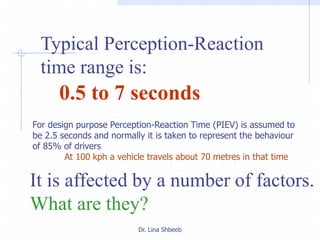
Typical Perception-Reaction
time range is:
0.5 to 7 seconds
It is affected by a number of factors.
What are they?
For design purpose Perception-Reaction Time (PIEV) is assumed to
be 2.5 seconds and normally it is taken to represent the behaviour
of 85% of drivers
At 100 kph a vehicle travels about 70 metres in that time
Dr. Lina Shbeeb
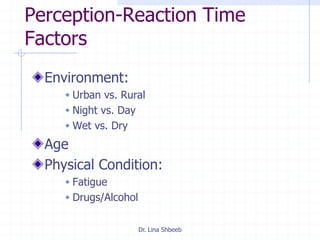
Perception-Reaction Time
Factors
Environment:
 Urban vs. Rural
 Night vs. Day
 Wet vs. Dry
Age
Physical Condition:
 Fatigue
 Drugs/Alcohol
Dr. Lina Shbeeb
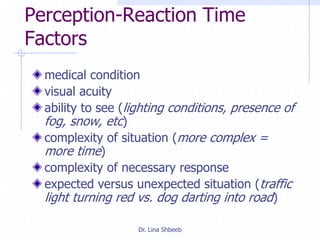
Perception-Reaction Time
Factors
medical condition
visual acuity
ability to see (lighting conditions, presence of
fog, snow, etc)
complexity of situation (more complex =
more time)
complexity of necessary response
expected versus unexpected situation (traffic
light turning red vs. dog darting into road)
Dr. Lina Shbeeb
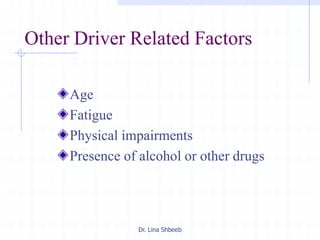
Other Driver Related Factors
Age
Fatigue
Physical impairments
Presence of alcohol or other drugs
Dr. Lina Shbeeb
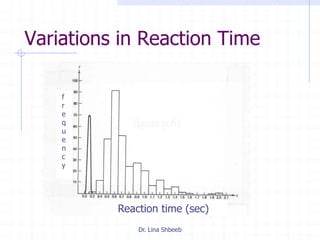
Variations in Reaction Time
f
r
e
q
u
e
n
c
y
Reaction time (sec)
Dr. Lina Shbeeb
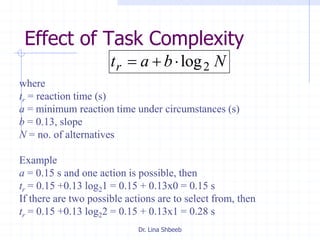
Effect of Task Complexity
where
tr = reaction time (s)
a = minimum reaction time under circumstances (s)
b = 0.13, slope
N = no. of alternatives
Example
a = 0.15 s and one action is possible, then
tr = 0.15 +0.13 log21 = 0.15 + 0.13x0 = 0.15 s
If there are two possible actions are to select from, then
tr = 0.15 +0.13 log22 = 0.15 + 0.13x1 = 0.28 s
Nbatr 2log
Dr. Lina Shbeeb
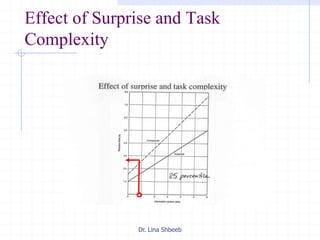
Effect of Surprise and Task
Complexity
Dr. Lina Shbeeb
Visual Acuity
Visual acuity :It refers to the sharpness with
which a person can see on object.
One measurement of it is the recognition acuity
obtained using Snellen chart.
Visual acuity is either static : no motion involved
and dynamic : relative motion involved.
Dr. Lina Shbeeb
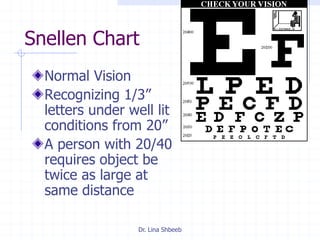
Snellen Chart
Normal Vision
Recognizing 1/3”
letters under well lit
conditions from 20”
A person with 20/40
requires object be
twice as large at
same distance
Dr. Lina Shbeeb
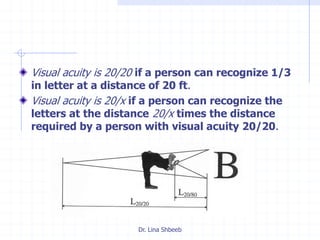
Visual acuity is 20/20 if a person can recognize 1/3
in letter at a distance of 20 ft.
Visual acuity is 20/x if a person can recognize the
letters at the distance 20/x times the distance
required by a person with visual acuity 20/20.
Dr. Lina Shbeeb
Example
A driver with 20/20 vision can see sign from
90’. How close must a driver with 20/50
vision be?
X=90*(Bad/Good)=90*(20/50)/(20/20)
 X=36’
If those letters were 2” high, how high should
they be for a driver with 20/60 visions (same
distance)
 6 ’
Dr. Lina Shbeeb
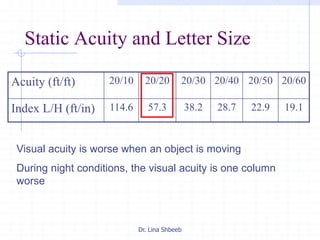
Static Acuity and Letter Size
Acuity (ft/ft) 20/10 20/20 20/30 20/40 20/50 20/60
Index L/H (ft/in) 114.6 57.3 38.2 28.7 22.9 19.1
Visual acuity is worse when an object is moving
During night conditions, the visual acuity is one column
worse
Dr. Lina Shbeeb
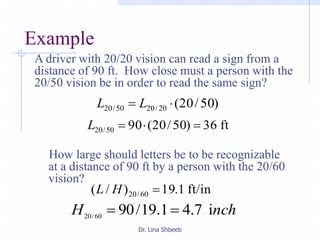
Example
How large should letters be to be recognizable
at a distance of 90 ft by a person with the 20/60
vision?
)50/20(20/2050/20  LL
ft36)50/20(9050/20 L
ft/in1.19)/( 60/20 HL
nchH i7.41.19/9060/20

A driver with 20/20 vision can read a sign from a
distance of 90 ft. How close must a person with the
20/50 vision be in order to read the same sign?
Dr. Lina Shbeeb
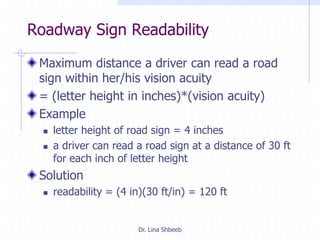
Roadway Sign Readability
Maximum distance a driver can read a road
sign within her/his vision acuity
= (letter height in inches)*(vision acuity)
Example
 letter height of road sign = 4 inches
 a driver can read a road sign at a distance of 30 ft
for each inch of letter height
Solution
 readability = (4 in)(30 ft/in) = 120 ft
Dr. Lina Shbeeb
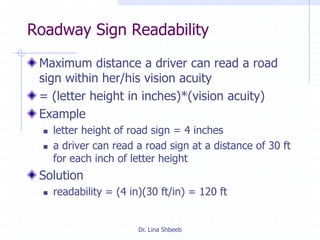
Roadway Sign Readability
Maximum distance a driver can read a road
sign within her/his vision acuity
= (letter height in inches)*(vision acuity)
Example
 letter height of road sign = 4 inches
 a driver can read a road sign at a distance of 30 ft
for each inch of letter height
Solution
 readability = (4 in)(30 ft/in) = 120 ft
Dr. Lina Shbeeb
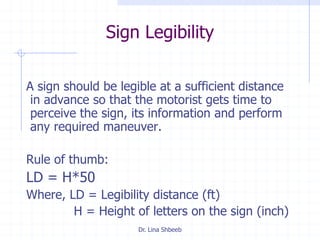
Sign Legibility
A sign should be legible at a sufficient distance
in advance so that the motorist gets time to
perceive the sign, its information and perform
any required maneuver.
Rule of thumb:
LD = H*50
Where, LD = Legibility distance (ft)
H = Height of letters on the sign (inch)
Dr. Lina Shbeeb
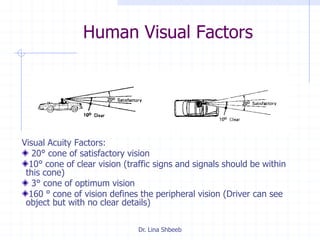
Human Visual Factors
Visual Acuity Factors:
20° cone of satisfactory vision
10° cone of clear vision (traffic signs and signals should be within
this cone)
3° cone of optimum vision
160 ° cone of vision defines the peripheral vision (Driver can see
object but with no clear details)
Dr. Lina Shbeeb
Aging’s impact of vision
Older persons experience low light
level
 Rules of thumb – after 50 the light you
can see halves with each 10 years
Glare – overloading eye with light
 Older drivers can take twice as long to
recover from glare
Poor discrimination of color
Poor contrast sensitivity
Dr. Lina Shbeeb
Pedestrian Characteristics
Walk Speed:
4.0 fps Safe or 15th
5.0 fps Median
6.0 fps 85th
Dr. Lina Shbeeb
Design Vehicle
Design Vehicle – largest (slowest,
loudest?) vehicle likely to use a facility
with considerable frequency
Three Characteristics
 Physical
 Operating
 Environmental
Dr. Lina Shbeeb
Physical Characteristics
Type Passenger Car
 Motorcycle
 Truck
Size (Several examples)
 Length
 Height
 Weight
 Width
 Minimum and Maximum Turning Radii
Dr. Lina Shbeeb
Operating Characteristics
Acceleration
Deceleration and braking
Power/weight ratios
Turning radius
Headlights
Dr. Lina Shbeeb
Environmental Characteristics
Noise
Exhaust
Fuel Efficiency
Dr. Lina Shbeeb
Vehicle Characteristics
Static: those characteristics that DO NOT
depend on the interaction with the
transportation facility
Dynamic: those characteristics that DO
depend on the interaction with the
transportation facility
Dr. Lina Shbeeb
Vehicle Performance
Impact of vehicle performance on
Road Design
Traffic operations
Truck Performance on Grades
Dr. Lina Shbeeb
Motion of vehicles
1. Rectilinear motion
Constant acceleration rate
Acceleration as function of speed
2. Motion on circular curves
Dr. Lina Shbeeb
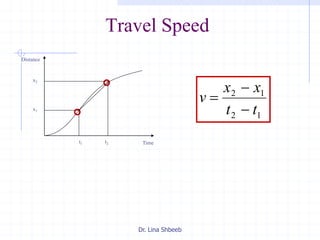
Travel Speed
12
12
tt
xx
v



Time
Distance
t2t1
x1
x2
Dr. Lina Shbeeb
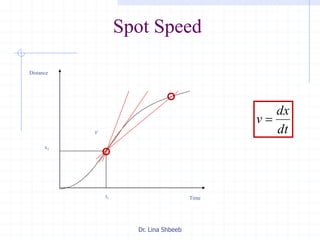
Spot Speed
dt
dx
v 
Time
Distance
t1
x1
V
Dr. Lina Shbeeb
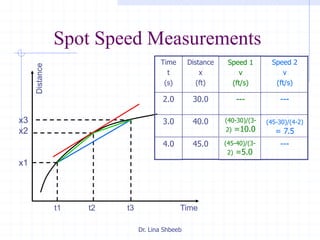
Spot Speed Measurements
t1 t2 t3 Time
x3
x2
x1
Distance
45.0
40.0
30.0
Distance
x
(ft)
4.0
3.0
2.0
Time
t
(s)
(40-30)/(3-
2) =10.0
---
Speed 1
v
(ft/s)
---
(45-30)/(4-2)
= 7.5
---
Speed 2
v
(ft/s)
(45-40)/(3-
2) =5.0
Dr. Lina Shbeeb
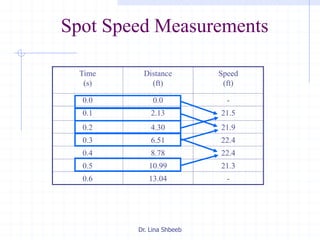
Spot Speed Measurements
Time
(s)
Distance
(ft)
Speed
(ft)
0.0 0.0 -
0.1 2.13 21.5
0.2 4.30 21.9
0.3 6.51 22.4
0.4 8.78 22.4
0.5 10.99 21.3
0.6 13.04 -
Dr. Lina Shbeeb
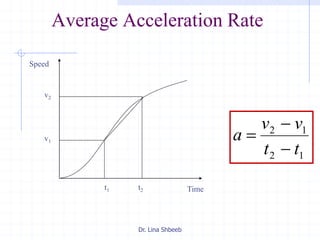
Average Acceleration Rate
12
12
tt
vv
a



Time
Speed
t2t1
v1
v2
Dr. Lina Shbeeb
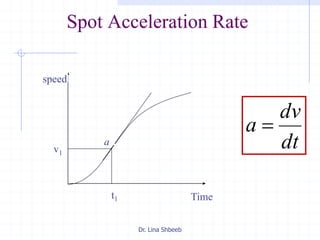
Spot Acceleration Rate
dt
dv
a 
Time
speed
t1
v1
a
Dr. Lina Shbeeb
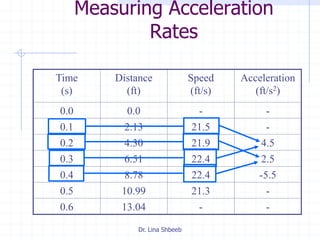
Measuring Acceleration
Rates
Time
(s)
Distance
(ft)
Speed
(ft/s)
Acceleration
(ft/s2)
0.0 0.0 - -
0.1 2.13 21.5 -
0.2 4.30 21.9 4.5
0.3 6.51 22.4 2.5
0.4 8.78 22.4 -5.5
0.5 10.99 21.3 -
0.6 13.04 - -
Dr. Lina Shbeeb
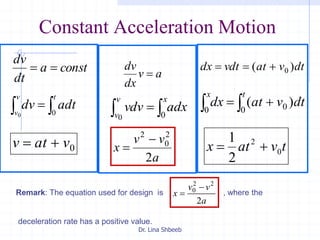
Constant Acceleration Motion
consta
dt
dv

 
tv
v
adtdv 00
0vatv 
av
dx
dv

 
xv
v
adxvdv 00
a
vv
x
2
2
0
2


dtvatvdtdx )( 0
  
x t
dtvatdx0 0 0 )(
tvatx 0
2
2
1

Remark: The equation used for design is , where the
deceleration rate has a positive value.
a
vv
x
2
22
0 

Dr. Lina Shbeeb
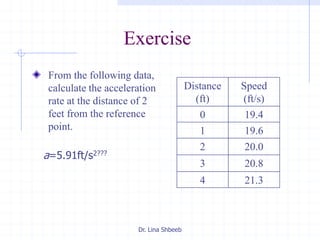
Exercise
From the following data,
calculate the acceleration
rate at the distance of 2
feet from the reference
point.
Distance
(ft)
Speed
(ft/s)
0 19.4
1 19.6
2 20.0
3 20.8
4 21.3
a=5.91ft/s2???
Dr. Lina Shbeeb
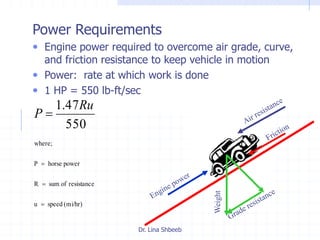
Grade Resistance = Rg = w x g = 4,500
lb x 0.03
Power Requirements
• Engine power required to overcome air grade, curve,
and friction resistance to keep vehicle in motion
• Power: rate at which work is done
• 1 HP = 550 lb-ft/sec
(mi/hr)speedu
resistanceofsumR
powerhorseP
where;
550
47.1




Ru
P
Weight
Dr. Lina Shbeeb
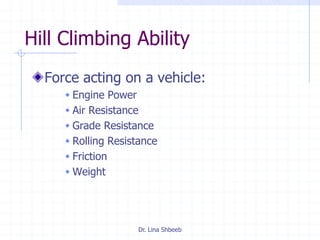
Hill Climbing Ability
Force acting on a vehicle:
 Engine Power
 Air Resistance
 Grade Resistance
 Rolling Resistance
 Friction
 Weight
Dr. Lina Shbeeb
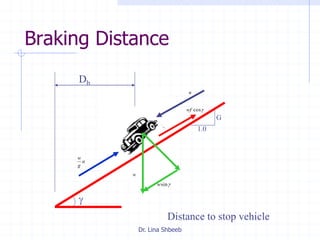
Braking Distance
a
g
w
g
w
gsinw
u
gcoswf
Db
G
1.0
Distance to stop vehicle
Dr. Lina Shbeeb
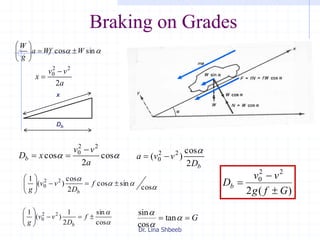
Braking on Grades
 sincos WWfa
g
W






a
vv
x
2
22
0 

x
Db
 cos
2
cos
22
0
a
vv
xDb


bD
vva
2
cos
)( 22
0




cos
sincos
2
cos
)(
1 22
0 





f
D
vv
g b


cos
sin
2
1
)(
1 22
0 





f
D
vv
g b
G 


tan
cos
sin
)(2
22
0
Gfg
vv
Db



Dr. Lina Shbeeb
Braking distance
Braking Distance (Db)
Db = distance from brakes enact to final speed
Db = f(velocity, grade, friction)
Db = (V0
2 – V2)/[30(f +/- G)]
or
Db = (V0
2 – V2)/[254(f +/- G)] metric
 Db = braking distance (feet or meters)
 V0 = initial velocity (mph or kph)
 V = final velocity (mph or kph)
 f = coefficient of friction
 G = Grade (decimal)
30 or 254 = conversion coefficient
Dr. Lina Shbeeb
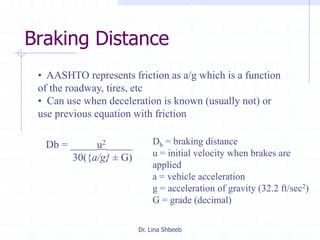
Braking Distance
Db = braking distance
u = initial velocity when brakes are
applied
a = vehicle acceleration
g = acceleration of gravity (32.2 ft/sec2)
G = grade (decimal)
• AASHTO represents friction as a/g which is a function
of the roadway, tires, etc
• Can use when deceleration is known (usually not) or
use previous equation with friction
Db = _____u2_____
30({a/g} ± G)
Dr. Lina Shbeeb
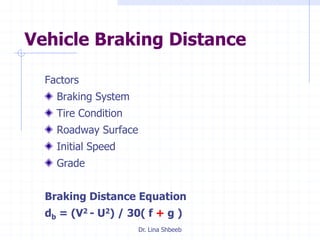
Vehicle Braking Distance
Factors
Braking System
Tire Condition
Roadway Surface
Initial Speed
Grade
Braking Distance Equation
db = (V2 - U2) / 30( f + g )
Dr. Lina Shbeeb
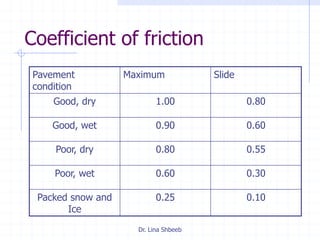
Coefficient of friction
Pavement
condition
Maximum Slide
Good, dry 1.00 0.80
Good, wet 0.90 0.60
Poor, dry 0.80 0.55
Poor, wet 0.60 0.30
Packed snow and
Ice
0.25 0.10
Dr. Lina Shbeeb
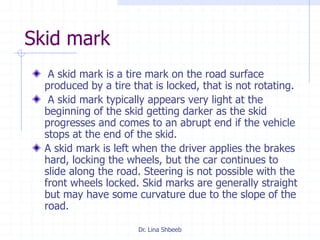
Skid mark
A skid mark is a tire mark on the road surface
produced by a tire that is locked, that is not rotating.
A skid mark typically appears very light at the
beginning of the skid getting darker as the skid
progresses and comes to an abrupt end if the vehicle
stops at the end of the skid.
A skid mark is left when the driver applies the brakes
hard, locking the wheels, but the car continues to
slide along the road. Steering is not possible with the
front wheels locked. Skid marks are generally straight
but may have some curvature due to the slope of the
road.
Dr. Lina Shbeeb
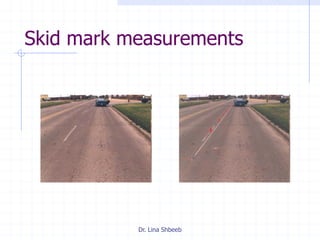
Skid mark measurements
Dr. Lina Shbeeb
Sight distance
Distance a driver can see ahead at any specific time
Must allow sufficient distance for a driver to
perceive/react and stop, swerve etc when necessary
Dr. Lina Shbeeb
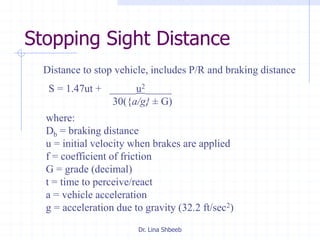
Stopping Sight Distance
where:
Db = braking distance
u = initial velocity when brakes are applied
f = coefficient of friction
G = grade (decimal)
t = time to perceive/react
a = vehicle acceleration
g = acceleration due to gravity (32.2 ft/sec2)
Distance to stop vehicle, includes P/R and braking distance
S = 1.47ut + _____u2_____
30({a/g} ± G)
Dr. Lina Shbeeb
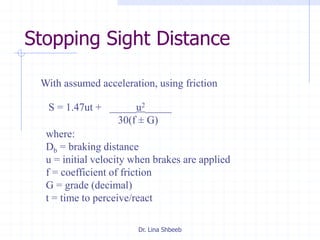
Stopping Sight Distance
where:
Db = braking distance
u = initial velocity when brakes are applied
f = coefficient of friction
G = grade (decimal)
t = time to perceive/react
With assumed acceleration, using friction
S = 1.47ut + _____u2_____
30(f ± G)
Dr. Lina Shbeeb
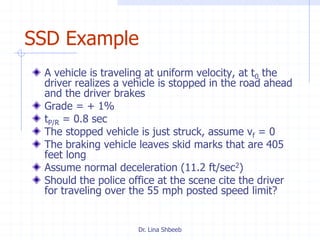
SSD Example
A vehicle is traveling at uniform velocity, at t0 the
driver realizes a vehicle is stopped in the road ahead
and the driver brakes
Grade = + 1%
tP/R = 0.8 sec
The stopped vehicle is just struck, assume vf = 0
The braking vehicle leaves skid marks that are 405
feet long
Assume normal deceleration (11.2 ft/sec2)
Should the police office at the scene cite the driver
for traveling over the 55 mph posted speed limit?
Dr. Lina Shbeeb
SSD Example
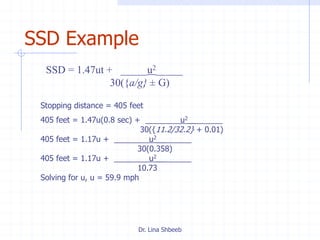
SSD = 1.47ut + _____u2_____
30({a/g} ± G)
Stopping distance = 405 feet
405 feet = 1.47u(0.8 sec) + ________u2________
30({11.2/32.2} + 0.01)
405 feet = 1.17u + ________u2________
30(0.358)
405 feet = 1.17u + ________u2________
10.73
Solving for u, u = 59.9 mph
Dr. Lina Shbeeb
Decision Sight Distance
When situation is unexpected or driver makes unusual
maneuvers or under difficult to perceive situations
Requires higher P/R time
Depends on type of maneuver made and roadway
setting (urban vs. rural)
Use table 3.5 from Text, page 75
Dr. Lina Shbeeb
Motion on Circular Curves
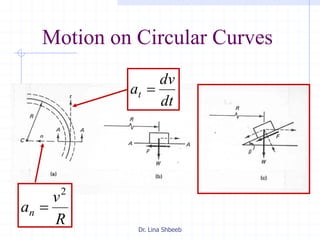
dt
dv
at 
R
v
an
2

Dr. Lina Shbeeb
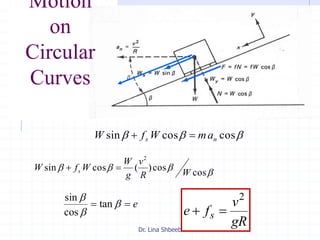
 coscossin ns amWfW 
 cos
cos)(cossin
2
WR
v
g
W
WfW s 
e 


tan
cos
sin
gR
v
fe s
2

Motion
on
Circular
Curves
Dr. Lina Shbeeb
Minimum Radius of a Circular Curve
where u = vehicle velocity (mph)
e = tan  (rate of superelevation)
fs = coefficient of side friction (depends on design speed)
Example
 design speed = 65 mph
 rate of superelevation = 0.05
 coefficient of side friction = 0.11
Solution
 minimum radius
 R = (65)2/[15(0.05+0.11)] = 1760 ft
)(15
2
sfe
u
R


Dr. Lina Shbeeb
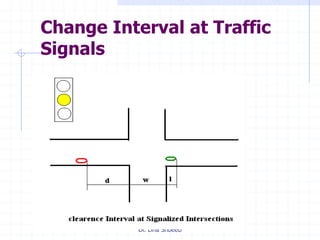
Change Interval at Traffic
Signals
Dr. Lina Shbeeb
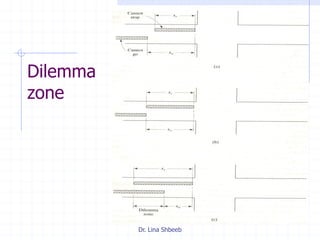
Dilemma
zone
Dr. Lina Shbeeb
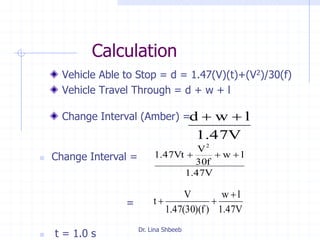
Calculation
Vehicle Able to Stop = d = 1.47(V)(t)+(V2)/30(f)
Vehicle Travel Through = d + w + l
Change Interval (Amber) =
V47.1
lwd 
 Change Interval =
=
 t = 1.0 s
V47.1
lw
f30
V
Vt47.1
2

V47.1
lw
)f)(30(47.1
V
t


Dr. Lina Shbeeb
Roadway Component
Roads serve four functions since they cater
for
 moving vehicles
 parked vehicles
 pedestrians and non-motorised vehicles
 allow development and access to
abutting property
Functions are inherently conflicting and
inconsistent
Dr. Lina Shbeeb
Roadway Component
Important design considerations:
 Capacity
 Safety
Design includes:
 Horizontal alignment
 Vertical alignment
 Linemarking and signage
 Pavement design

Driver Vehicle (Transportation Engineering Dr.Lina Shbeeb)

  • 1.
    Dr. Lina Shbeeb Humancomponent and vehicle in transportation Transportation Engineering
  • 2.
    Dr. Lina Shbeeb TheTraffic System 3 Components  Roadway/Transport Facilities  Vehicle  Humans (drivers, passengers, pedestrians)
  • 3.
    Dr. Lina Shbeeb RoadUsers Human as active component of traffic system, Distinguishes it from virtually all other CE fields. Component Highly variable and unpredictable in capabilities and characteristics. Physiological – Measurable and Usually Quantifiable Psychological – Much more difficult to measure and quantify
  • 4.
    Dr. Lina Shbeeb Drivingtask – monitoring and responding to a continuous series of visual and audio cues Driving task at three levels: Operational (Control) – vehicle control through second-to-second driver’s actions, speed Tactical (Guidance)– vehicle guidance through maintenance of a safe speed and proper path Strategic (Navigation) – route planning Driver
  • 5.
    Dr. Lina Shbeeb Roaduser types Driver Passenger Cyclist Pedestrian
  • 6.
    Dr. Lina Shbeeb HumanComponent Driver decision process involves  Sensing  Perceiving  Analysing  Deciding  Responding
  • 7.
    Dr. Lina Shbeeb HumanComponent Sensing  Feeling: forces on the vehicle  Seeing: critically important means of acquiring information Ability to see fine details, depth perception, peripheral vision, ‘night’ vision, glare recovery  Hearing: important for drivers, cyclists and pedestrians  Smelling: detecting emergencies e.g. overheated engine, burning brakes, fire
  • 8.
    Dr. Lina Shbeeb HumanComponent/Perception and Reaction Times Perception time is delay between visibility and determining there is a potential hazard Perception and Reaction time consists of four stages  Perception: Sees or hears situation (sees a stone)  Identification: Identify situation (realizes deer is in road)  Emotion: Decides on course of action (swerve, stop, change lanes, etc)  Reaction (volition) :Acts (time to start events in motion but not actually do action)  Foot begins to hit brake, not actual deceleration Thus, the Total Reaction Time (PIEV) involves analytical and decision-making as well as actual control response (e.g put foot on brake) Perception-reaction time (PIEV) often assumed to be 2.5 seconds  At 100 kph a vehicle travels about 70 metres in that time
  • 9.
    Dr. Lina Shbeeb TypicalPerception-Reaction time range is: 0.5 to 7 seconds It is affected by a number of factors. What are they? For design purpose Perception-Reaction Time (PIEV) is assumed to be 2.5 seconds and normally it is taken to represent the behaviour of 85% of drivers At 100 kph a vehicle travels about 70 metres in that time
  • 10.
    Dr. Lina Shbeeb Perception-ReactionTime Factors Environment:  Urban vs. Rural  Night vs. Day  Wet vs. Dry Age Physical Condition:  Fatigue  Drugs/Alcohol
  • 11.
    Dr. Lina Shbeeb Perception-ReactionTime Factors medical condition visual acuity ability to see (lighting conditions, presence of fog, snow, etc) complexity of situation (more complex = more time) complexity of necessary response expected versus unexpected situation (traffic light turning red vs. dog darting into road)
  • 12.
    Dr. Lina Shbeeb OtherDriver Related Factors Age Fatigue Physical impairments Presence of alcohol or other drugs
  • 13.
    Dr. Lina Shbeeb Variationsin Reaction Time f r e q u e n c y Reaction time (sec)
  • 14.
    Dr. Lina Shbeeb Effectof Task Complexity where tr = reaction time (s) a = minimum reaction time under circumstances (s) b = 0.13, slope N = no. of alternatives Example a = 0.15 s and one action is possible, then tr = 0.15 +0.13 log21 = 0.15 + 0.13x0 = 0.15 s If there are two possible actions are to select from, then tr = 0.15 +0.13 log22 = 0.15 + 0.13x1 = 0.28 s Nbatr 2log
  • 15.
    Dr. Lina Shbeeb Effectof Surprise and Task Complexity
  • 16.
    Dr. Lina Shbeeb VisualAcuity Visual acuity :It refers to the sharpness with which a person can see on object. One measurement of it is the recognition acuity obtained using Snellen chart. Visual acuity is either static : no motion involved and dynamic : relative motion involved.
  • 17.
    Dr. Lina Shbeeb SnellenChart Normal Vision Recognizing 1/3” letters under well lit conditions from 20” A person with 20/40 requires object be twice as large at same distance
  • 18.
    Dr. Lina Shbeeb Visualacuity is 20/20 if a person can recognize 1/3 in letter at a distance of 20 ft. Visual acuity is 20/x if a person can recognize the letters at the distance 20/x times the distance required by a person with visual acuity 20/20.
  • 19.
    Dr. Lina Shbeeb Example Adriver with 20/20 vision can see sign from 90’. How close must a driver with 20/50 vision be? X=90*(Bad/Good)=90*(20/50)/(20/20)  X=36’ If those letters were 2” high, how high should they be for a driver with 20/60 visions (same distance)  6 ’
  • 20.
    Dr. Lina Shbeeb StaticAcuity and Letter Size Acuity (ft/ft) 20/10 20/20 20/30 20/40 20/50 20/60 Index L/H (ft/in) 114.6 57.3 38.2 28.7 22.9 19.1 Visual acuity is worse when an object is moving During night conditions, the visual acuity is one column worse
  • 21.
    Dr. Lina Shbeeb Example Howlarge should letters be to be recognizable at a distance of 90 ft by a person with the 20/60 vision? )50/20(20/2050/20  LL ft36)50/20(9050/20 L ft/in1.19)/( 60/20 HL nchH i7.41.19/9060/20  A driver with 20/20 vision can read a sign from a distance of 90 ft. How close must a person with the 20/50 vision be in order to read the same sign?
  • 22.
    Dr. Lina Shbeeb RoadwaySign Readability Maximum distance a driver can read a road sign within her/his vision acuity = (letter height in inches)*(vision acuity) Example  letter height of road sign = 4 inches  a driver can read a road sign at a distance of 30 ft for each inch of letter height Solution  readability = (4 in)(30 ft/in) = 120 ft
  • 23.
    Dr. Lina Shbeeb RoadwaySign Readability Maximum distance a driver can read a road sign within her/his vision acuity = (letter height in inches)*(vision acuity) Example  letter height of road sign = 4 inches  a driver can read a road sign at a distance of 30 ft for each inch of letter height Solution  readability = (4 in)(30 ft/in) = 120 ft
  • 24.
    Dr. Lina Shbeeb SignLegibility A sign should be legible at a sufficient distance in advance so that the motorist gets time to perceive the sign, its information and perform any required maneuver. Rule of thumb: LD = H*50 Where, LD = Legibility distance (ft) H = Height of letters on the sign (inch)
  • 25.
    Dr. Lina Shbeeb HumanVisual Factors Visual Acuity Factors: 20° cone of satisfactory vision 10° cone of clear vision (traffic signs and signals should be within this cone) 3° cone of optimum vision 160 ° cone of vision defines the peripheral vision (Driver can see object but with no clear details)
  • 26.
    Dr. Lina Shbeeb Aging’simpact of vision Older persons experience low light level  Rules of thumb – after 50 the light you can see halves with each 10 years Glare – overloading eye with light  Older drivers can take twice as long to recover from glare Poor discrimination of color Poor contrast sensitivity
  • 27.
    Dr. Lina Shbeeb PedestrianCharacteristics Walk Speed: 4.0 fps Safe or 15th 5.0 fps Median 6.0 fps 85th
  • 28.
    Dr. Lina Shbeeb DesignVehicle Design Vehicle – largest (slowest, loudest?) vehicle likely to use a facility with considerable frequency Three Characteristics  Physical  Operating  Environmental
  • 29.
    Dr. Lina Shbeeb PhysicalCharacteristics Type Passenger Car  Motorcycle  Truck Size (Several examples)  Length  Height  Weight  Width  Minimum and Maximum Turning Radii
  • 30.
    Dr. Lina Shbeeb OperatingCharacteristics Acceleration Deceleration and braking Power/weight ratios Turning radius Headlights
  • 31.
    Dr. Lina Shbeeb EnvironmentalCharacteristics Noise Exhaust Fuel Efficiency
  • 32.
    Dr. Lina Shbeeb VehicleCharacteristics Static: those characteristics that DO NOT depend on the interaction with the transportation facility Dynamic: those characteristics that DO depend on the interaction with the transportation facility
  • 33.
    Dr. Lina Shbeeb VehiclePerformance Impact of vehicle performance on Road Design Traffic operations Truck Performance on Grades
  • 34.
    Dr. Lina Shbeeb Motionof vehicles 1. Rectilinear motion Constant acceleration rate Acceleration as function of speed 2. Motion on circular curves
  • 35.
    Dr. Lina Shbeeb TravelSpeed 12 12 tt xx v    Time Distance t2t1 x1 x2
  • 36.
    Dr. Lina Shbeeb SpotSpeed dt dx v  Time Distance t1 x1 V
  • 37.
    Dr. Lina Shbeeb SpotSpeed Measurements t1 t2 t3 Time x3 x2 x1 Distance 45.0 40.0 30.0 Distance x (ft) 4.0 3.0 2.0 Time t (s) (40-30)/(3- 2) =10.0 --- Speed 1 v (ft/s) --- (45-30)/(4-2) = 7.5 --- Speed 2 v (ft/s) (45-40)/(3- 2) =5.0
  • 38.
    Dr. Lina Shbeeb SpotSpeed Measurements Time (s) Distance (ft) Speed (ft) 0.0 0.0 - 0.1 2.13 21.5 0.2 4.30 21.9 0.3 6.51 22.4 0.4 8.78 22.4 0.5 10.99 21.3 0.6 13.04 -
  • 39.
    Dr. Lina Shbeeb AverageAcceleration Rate 12 12 tt vv a    Time Speed t2t1 v1 v2
  • 40.
    Dr. Lina Shbeeb SpotAcceleration Rate dt dv a  Time speed t1 v1 a
  • 41.
    Dr. Lina Shbeeb MeasuringAcceleration Rates Time (s) Distance (ft) Speed (ft/s) Acceleration (ft/s2) 0.0 0.0 - - 0.1 2.13 21.5 - 0.2 4.30 21.9 4.5 0.3 6.51 22.4 2.5 0.4 8.78 22.4 -5.5 0.5 10.99 21.3 - 0.6 13.04 - -
  • 42.
    Dr. Lina Shbeeb ConstantAcceleration Motion consta dt dv    tv v adtdv 00 0vatv  av dx dv    xv v adxvdv 00 a vv x 2 2 0 2   dtvatvdtdx )( 0    x t dtvatdx0 0 0 )( tvatx 0 2 2 1  Remark: The equation used for design is , where the deceleration rate has a positive value. a vv x 2 22 0  
  • 43.
    Dr. Lina Shbeeb Exercise Fromthe following data, calculate the acceleration rate at the distance of 2 feet from the reference point. Distance (ft) Speed (ft/s) 0 19.4 1 19.6 2 20.0 3 20.8 4 21.3 a=5.91ft/s2???
  • 44.
    Dr. Lina Shbeeb GradeResistance = Rg = w x g = 4,500 lb x 0.03 Power Requirements • Engine power required to overcome air grade, curve, and friction resistance to keep vehicle in motion • Power: rate at which work is done • 1 HP = 550 lb-ft/sec (mi/hr)speedu resistanceofsumR powerhorseP where; 550 47.1     Ru P Weight
  • 45.
    Dr. Lina Shbeeb HillClimbing Ability Force acting on a vehicle:  Engine Power  Air Resistance  Grade Resistance  Rolling Resistance  Friction  Weight
  • 46.
    Dr. Lina Shbeeb BrakingDistance a g w g w gsinw u gcoswf Db G 1.0 Distance to stop vehicle
  • 47.
    Dr. Lina Shbeeb Brakingon Grades  sincos WWfa g W       a vv x 2 22 0   x Db  cos 2 cos 22 0 a vv xDb   bD vva 2 cos )( 22 0     cos sincos 2 cos )( 1 22 0       f D vv g b   cos sin 2 1 )( 1 22 0       f D vv g b G    tan cos sin )(2 22 0 Gfg vv Db   
  • 48.
    Dr. Lina Shbeeb Brakingdistance Braking Distance (Db) Db = distance from brakes enact to final speed Db = f(velocity, grade, friction) Db = (V0 2 – V2)/[30(f +/- G)] or Db = (V0 2 – V2)/[254(f +/- G)] metric  Db = braking distance (feet or meters)  V0 = initial velocity (mph or kph)  V = final velocity (mph or kph)  f = coefficient of friction  G = Grade (decimal) 30 or 254 = conversion coefficient
  • 49.
    Dr. Lina Shbeeb BrakingDistance Db = braking distance u = initial velocity when brakes are applied a = vehicle acceleration g = acceleration of gravity (32.2 ft/sec2) G = grade (decimal) • AASHTO represents friction as a/g which is a function of the roadway, tires, etc • Can use when deceleration is known (usually not) or use previous equation with friction Db = _____u2_____ 30({a/g} ± G)
  • 50.
    Dr. Lina Shbeeb VehicleBraking Distance Factors Braking System Tire Condition Roadway Surface Initial Speed Grade Braking Distance Equation db = (V2 - U2) / 30( f + g )
  • 51.
    Dr. Lina Shbeeb Coefficientof friction Pavement condition Maximum Slide Good, dry 1.00 0.80 Good, wet 0.90 0.60 Poor, dry 0.80 0.55 Poor, wet 0.60 0.30 Packed snow and Ice 0.25 0.10
  • 52.
    Dr. Lina Shbeeb Skidmark A skid mark is a tire mark on the road surface produced by a tire that is locked, that is not rotating. A skid mark typically appears very light at the beginning of the skid getting darker as the skid progresses and comes to an abrupt end if the vehicle stops at the end of the skid. A skid mark is left when the driver applies the brakes hard, locking the wheels, but the car continues to slide along the road. Steering is not possible with the front wheels locked. Skid marks are generally straight but may have some curvature due to the slope of the road.
  • 53.
    Dr. Lina Shbeeb Skidmark measurements
  • 54.
    Dr. Lina Shbeeb Sightdistance Distance a driver can see ahead at any specific time Must allow sufficient distance for a driver to perceive/react and stop, swerve etc when necessary
  • 55.
    Dr. Lina Shbeeb StoppingSight Distance where: Db = braking distance u = initial velocity when brakes are applied f = coefficient of friction G = grade (decimal) t = time to perceive/react a = vehicle acceleration g = acceleration due to gravity (32.2 ft/sec2) Distance to stop vehicle, includes P/R and braking distance S = 1.47ut + _____u2_____ 30({a/g} ± G)
  • 56.
    Dr. Lina Shbeeb StoppingSight Distance where: Db = braking distance u = initial velocity when brakes are applied f = coefficient of friction G = grade (decimal) t = time to perceive/react With assumed acceleration, using friction S = 1.47ut + _____u2_____ 30(f ± G)
  • 57.
    Dr. Lina Shbeeb SSDExample A vehicle is traveling at uniform velocity, at t0 the driver realizes a vehicle is stopped in the road ahead and the driver brakes Grade = + 1% tP/R = 0.8 sec The stopped vehicle is just struck, assume vf = 0 The braking vehicle leaves skid marks that are 405 feet long Assume normal deceleration (11.2 ft/sec2) Should the police office at the scene cite the driver for traveling over the 55 mph posted speed limit?
  • 58.
    Dr. Lina Shbeeb SSDExample SSD = 1.47ut + _____u2_____ 30({a/g} ± G) Stopping distance = 405 feet 405 feet = 1.47u(0.8 sec) + ________u2________ 30({11.2/32.2} + 0.01) 405 feet = 1.17u + ________u2________ 30(0.358) 405 feet = 1.17u + ________u2________ 10.73 Solving for u, u = 59.9 mph
  • 59.
    Dr. Lina Shbeeb DecisionSight Distance When situation is unexpected or driver makes unusual maneuvers or under difficult to perceive situations Requires higher P/R time Depends on type of maneuver made and roadway setting (urban vs. rural) Use table 3.5 from Text, page 75
  • 60.
    Dr. Lina Shbeeb Motionon Circular Curves dt dv at  R v an 2 
  • 61.
    Dr. Lina Shbeeb coscossin ns amWfW   cos cos)(cossin 2 WR v g W WfW s  e    tan cos sin gR v fe s 2  Motion on Circular Curves
  • 62.
    Dr. Lina Shbeeb MinimumRadius of a Circular Curve where u = vehicle velocity (mph) e = tan  (rate of superelevation) fs = coefficient of side friction (depends on design speed) Example  design speed = 65 mph  rate of superelevation = 0.05  coefficient of side friction = 0.11 Solution  minimum radius  R = (65)2/[15(0.05+0.11)] = 1760 ft )(15 2 sfe u R  
  • 63.
    Dr. Lina Shbeeb ChangeInterval at Traffic Signals
  • 64.
  • 65.
    Dr. Lina Shbeeb Calculation VehicleAble to Stop = d = 1.47(V)(t)+(V2)/30(f) Vehicle Travel Through = d + w + l Change Interval (Amber) = V47.1 lwd   Change Interval = =  t = 1.0 s V47.1 lw f30 V Vt47.1 2  V47.1 lw )f)(30(47.1 V t  
  • 66.
    Dr. Lina Shbeeb RoadwayComponent Roads serve four functions since they cater for  moving vehicles  parked vehicles  pedestrians and non-motorised vehicles  allow development and access to abutting property Functions are inherently conflicting and inconsistent
  • 67.
    Dr. Lina Shbeeb RoadwayComponent Important design considerations:  Capacity  Safety Design includes:  Horizontal alignment  Vertical alignment  Linemarking and signage  Pavement design