Geometric Design
University of Jordan
2
Static Characteristics
• Size:
• Design of lane widths, parking bays, etc…
• Vertical clearance
• Weight:
• Pavement design, bridge design, axle loads
• Maximum grade
• Radius of Curvature:
• Intersection design
• Interchange ramps
3
Kinematic (Dynamic) Characteristics
• Acceleration (Constant or variable):
• Passing maneuvers
• Gap acceptance
• Dimensions of freeway ramps and passing lanes
• Motion elements (Distance and Velocity)
4
Functional classification of highways
• Highways are classified either by
– The function they serve (functional classification)
– The entity responsible for their construction and
maintenance (jurisdictional classification)
• Two concepts are used when classifying highway by
their function
– Mobility: continuous travel
– Accessibility: direct access to abutting (next to or adjacent)
property
• Some roads serve one of these two function while
few can satisfy both
5
Mobility
Accessibility
Function
classification
6
Mobility vs. Accessibility
7
Mobility versus accessibility
8
Three Major Roadway Classes and their
functions:
• Arterial (high mobility, low access, long trips,
fast speeds)
• Collector (moderate, moderate, moderate,
moderate)
• Local (low, high, short, slow)
9
Roadway Functional Classes
• Determined by characteristics:
– Function
– access density
– traffic demands
– trip length
– expected speed
10
11
Freeway versus expressway
• The distinction between freeways and expressway is
based on the accessibility control
– Freeways have a full control of access [access or exit are
permitted only at controlled locations (exit ramp)]
– Expressways have a partial access control. (access or exit
are maybe permitted directly from or adjacent land or via
a limited number of at grade intersections)
12
Rural road classification
Principal Arterials
• Function: Long disance Travel and Connect
urbanized areas
• Characteristics: Long trips, no stubs, high
speed, widely spaced, full/partial access
control
• Subclasses: Freeways, Other non-Freeways
with access control
13
Minor Arterials
• Function: connect small urban areas with
major trip generators
• Characteristics: Moderate everything
(routes, speed, spacing, mostly mobility)
14
Rural Collectors
• Major Collectors: Connect small twon to large towns not
served by arterials, link entities with nearby arterials, urban
areas
• Minor Collectors: Serve remaining small towns, link local
traffic generators with rural areas
• Characteristics: Shorter, Moderate Speeds (in rural areas),
Intermediate spacing
15
Rural Local Roads
• Function: Provide access to land on collector
network, serve short distance travel
• Characteristics: Short routes that terminate at higher
classes, relatively low speeds, intermediate spacing
16
Urban Functional System
Principal Arterials
• Functions: carry most trips entering/leaving urban
area, serve intra-urban trips, carry intra-urban and
intercity bus routes, provide continuity to rural
arterials
• Characteristics: longest distance routes and
highest volume, high speed, spacing is less than 1
km in CBD and greater than 8 km in urban fringe,
full/partial access control
• Subclasses: interstates, other freeways and
expressways, other principal arterials with partial
access control
17
Urban Minor Arterials
• Functions: interconnect with and augment
principle arterials, accommodate moderate
length trips, distribute traffic, carry local buses,
provide intra-community continuity, connect to
urban collectors
• Characteristics: moderate trip length high
volumes, moderate speeds, spacing 0.2 to1.0 km
in CBD and 3 to 5 km in suburbs
18
Urban Collectors
• Functions: Provide traffic circulation within
residential neighborhoods and industrial/commercial
areas, Collect traffic from locals and channel to
arterials, Carry local buses, Provide some direct land
access
• Characteristics: Shorter than minor arterials,
Moderate speeds, Spacing intermediate to arterials,
Penetrates residential neighborhoods
• Subclasses: major and minor
19
Urban Locals
• Functions: Provide direct access to land,
Connect properties to higher class streets (i.e.,
collectors)
• Characteristics: Short in length, Dead end –
terminate at collections, Low speeds, No bus
routes
20
21
Highway
Components
Cross-section
22
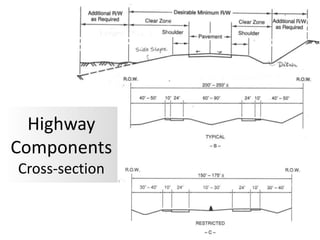
Cross section components
• Highways are categorized into
– Divided highways
– Undivided highways
• The distinction is based on the viability of median (Divided highways).
• The components of divided highways within the right of way are
– Carriageway or travelling lanes
– Median
– Shoulder
– Ditches
– Side-slopes
– Barrier
– Marking
– Cross section slope

Geometric Design 2.ppt

  • 1.
  • 2.
    2 Static Characteristics • Size: •Design of lane widths, parking bays, etc… • Vertical clearance • Weight: • Pavement design, bridge design, axle loads • Maximum grade • Radius of Curvature: • Intersection design • Interchange ramps
  • 3.
    3 Kinematic (Dynamic) Characteristics •Acceleration (Constant or variable): • Passing maneuvers • Gap acceptance • Dimensions of freeway ramps and passing lanes • Motion elements (Distance and Velocity)
  • 4.
    4 Functional classification ofhighways • Highways are classified either by – The function they serve (functional classification) – The entity responsible for their construction and maintenance (jurisdictional classification) • Two concepts are used when classifying highway by their function – Mobility: continuous travel – Accessibility: direct access to abutting (next to or adjacent) property • Some roads serve one of these two function while few can satisfy both
  • 5.
  • 6.
  • 7.
  • 8.
    8 Three Major RoadwayClasses and their functions: • Arterial (high mobility, low access, long trips, fast speeds) • Collector (moderate, moderate, moderate, moderate) • Local (low, high, short, slow)
  • 9.
    9 Roadway Functional Classes •Determined by characteristics: – Function – access density – traffic demands – trip length – expected speed
  • 10.
  • 11.
    11 Freeway versus expressway •The distinction between freeways and expressway is based on the accessibility control – Freeways have a full control of access [access or exit are permitted only at controlled locations (exit ramp)] – Expressways have a partial access control. (access or exit are maybe permitted directly from or adjacent land or via a limited number of at grade intersections)
  • 12.
    12 Rural road classification PrincipalArterials • Function: Long disance Travel and Connect urbanized areas • Characteristics: Long trips, no stubs, high speed, widely spaced, full/partial access control • Subclasses: Freeways, Other non-Freeways with access control
  • 13.
    13 Minor Arterials • Function:connect small urban areas with major trip generators • Characteristics: Moderate everything (routes, speed, spacing, mostly mobility)
  • 14.
    14 Rural Collectors • MajorCollectors: Connect small twon to large towns not served by arterials, link entities with nearby arterials, urban areas • Minor Collectors: Serve remaining small towns, link local traffic generators with rural areas • Characteristics: Shorter, Moderate Speeds (in rural areas), Intermediate spacing
  • 15.
    15 Rural Local Roads •Function: Provide access to land on collector network, serve short distance travel • Characteristics: Short routes that terminate at higher classes, relatively low speeds, intermediate spacing
  • 16.
    16 Urban Functional System PrincipalArterials • Functions: carry most trips entering/leaving urban area, serve intra-urban trips, carry intra-urban and intercity bus routes, provide continuity to rural arterials • Characteristics: longest distance routes and highest volume, high speed, spacing is less than 1 km in CBD and greater than 8 km in urban fringe, full/partial access control • Subclasses: interstates, other freeways and expressways, other principal arterials with partial access control
  • 17.
    17 Urban Minor Arterials •Functions: interconnect with and augment principle arterials, accommodate moderate length trips, distribute traffic, carry local buses, provide intra-community continuity, connect to urban collectors • Characteristics: moderate trip length high volumes, moderate speeds, spacing 0.2 to1.0 km in CBD and 3 to 5 km in suburbs
  • 18.
    18 Urban Collectors • Functions:Provide traffic circulation within residential neighborhoods and industrial/commercial areas, Collect traffic from locals and channel to arterials, Carry local buses, Provide some direct land access • Characteristics: Shorter than minor arterials, Moderate speeds, Spacing intermediate to arterials, Penetrates residential neighborhoods • Subclasses: major and minor
  • 19.
    19 Urban Locals • Functions:Provide direct access to land, Connect properties to higher class streets (i.e., collectors) • Characteristics: Short in length, Dead end – terminate at collections, Low speeds, No bus routes
  • 20.
  • 21.
  • 22.
    22 Cross section components •Highways are categorized into – Divided highways – Undivided highways • The distinction is based on the viability of median (Divided highways). • The components of divided highways within the right of way are – Carriageway or travelling lanes – Median – Shoulder – Ditches – Side-slopes – Barrier – Marking – Cross section slope