Geometri
c Design
Of
Highways
Chapter Three
Introduction
2
 Highway geometric design involves the design of
geometric elements of a highway and fixation of
standards with respect to various components
 Its dictated within economic limitations to satisfy the
requirements of traffic in designing elements such as
 Cross-section
 Horizontal alignment
 Vertical alignment
 Sight distances
 Lateral and vertical clearances
 Intersection,
 etc.
3
Cont.…
 The safety, efficiency, and economic operation of a highway
is governed to a large extent by the care with which the
geometric design is worked out
 The engineer has to consider the following points when
selecting design standards
 Volume and composition of traffic in the design year
 Faulty geometries are costly to rectify at a later date
 The design should be consistent with
 The design should embrace all aspects of design including signs,
markings, lighting, etc.
 The road should be considered as an element of the total environment
 The design should minimize the total transportation cost
 Safety should be built in the design
 The design should be enable all road users to use the facility
4
Design controls and criteria
The choice of design controls and criteria
is influenced by the following factors:
 Functional classification of the road
Nature of the terrain
Traffic volumes expected on the road
Design vehicle
Design speed
Sight distance
Density and character of the adjoining
land use and
Economic and environmental
considerations
5
Road Functional Classification
(or Road Hierarchy)
Roads generally serve a multitude of
purposes:
 As through route - for long distance traffic
 As local route – for local traffic
 In urban and rural areas –urban roads/rural roads
 For fast and slow vehicles – 2 wheels to 10+ wheels
 As servicing/access roads
 For use by pedestrians
 For parking areas
 For Street Vendors, etc
6
Rationale for a hierarchical system
Such a mix of uses Reduces SAFETY,
EFFICIENCY, and CAPACITY
Hence a hierarchical road system is necessary
Roads are therefore classified according to their
respective functions in terms of the character of the
services they are providing
7
Objectives in setting a hierarchy
 To obtain best use of an existing network
 To ensure that each type of traffic is using the
most appropriate route
 To minimize the risk to users and to the natural
built environment
 To ensure better management, maintenance
regimes and design policies
 To ensure funding for routes is targeted
appropriately
 To offer network users a choice for how to
travel
8
Road Hierarchy (The Ethiopian way)
Trunk roads
Access roads
Collector roads
Feeder roads
Link roads
Roads linking centers of national or international importance
and have over 400 - 1000 first year AADT, although values
can range between 50-10,000 AADT.
Roads linking centers of provincial importance and their first
year AADTs between 30-1,000 .
Roads linking locally important centers to each other, to a
more important center, or to higher class roads and their
first year AADTs between 25-400 .
Any road link to a minor center such as market and local
locations with first year AADT between 0-100.
Roads linking centers of international importance and roads
terminating at international boundaries and have a present
AADT 1000 and as low as 100.
9
Nature of Terrain
 The location and geometric design elements such as
gradients, sight distance, cross-sections, radius of
curvature, speeds, etc. of a highway are affected by
topography, physical features, and land use.
 Transverse terrain properties are categorized into four
classes as follows:
 FLAT: Flat or gently rolling country,
which offers few obstacles to the
construction of a road, having
continuously unrestricted horizontal
and vertical alignment (transverse terrain
slope up to 5 percent).
10
Cont.… Nature of Terrain
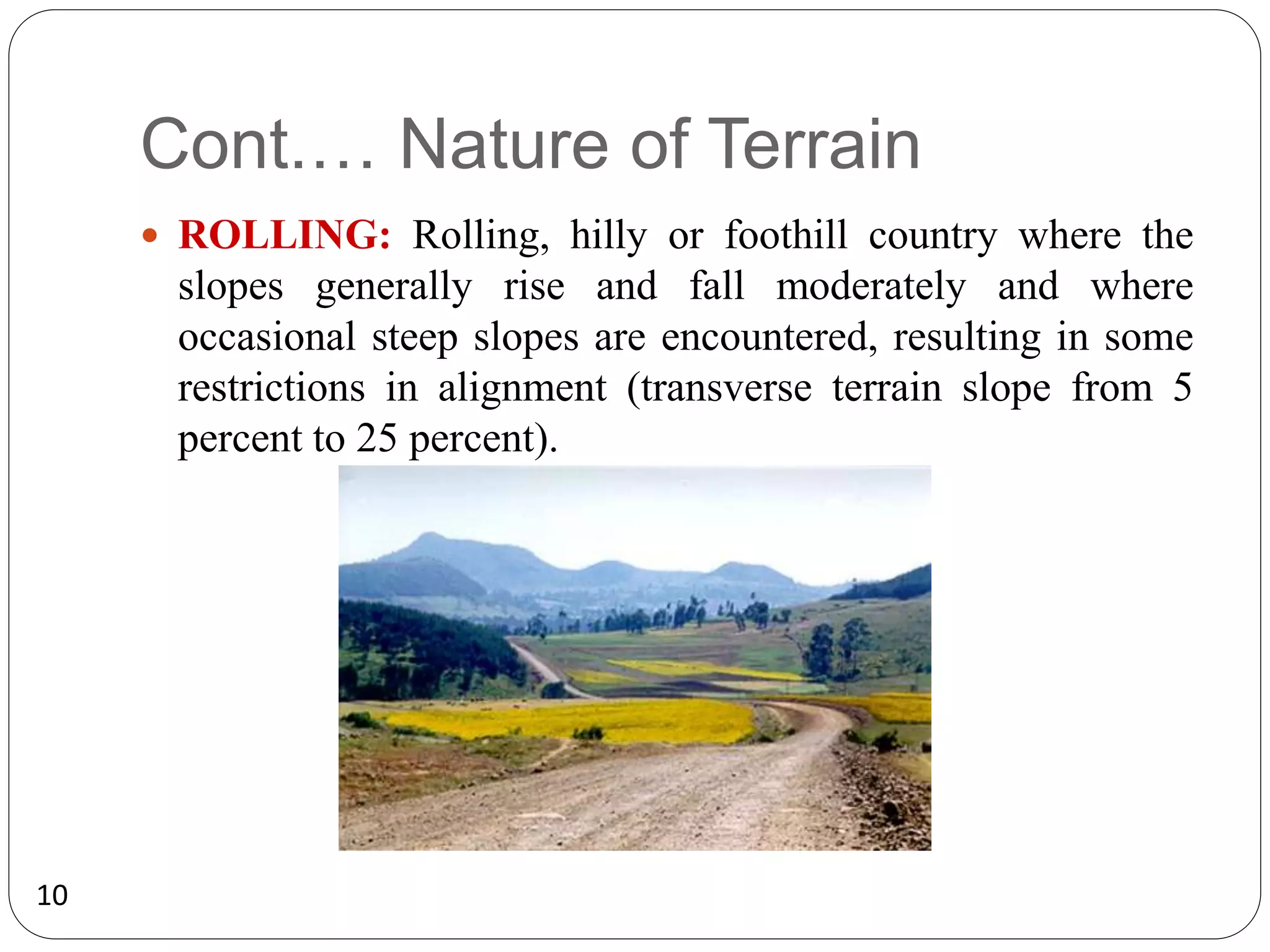
 ROLLING: Rolling, hilly or foothill country where the
slopes generally rise and fall moderately and where
occasional steep slopes are encountered, resulting in some
restrictions in alignment (transverse terrain slope from 5
percent to 25 percent).
11
Cont.… Nature of Terrain
 MOUNTAINOUS: Rugged, hilly and mountainous country and
river gorges. This class of terrain imposes definite restrictions on
the standard of alignment obtainable and often involves long
steep grades and limited sight distance (transverse terrain slope
from 25 percent to 50 percent).
12
Cont.… Nature of Terrain
 ESCARPMENT: Escarpment include situations where
switchback roadway sections are used or side hill transverse
sections which cause considerable earthwork quantities, with
transverse terrain slope in excess of 50 percent.
Traffic
 A further factor influencing the development of
road design standards, and in particular the
design speed, is the volume and composition of
traffic.
 The design of a road should be based in part on
factual traffic volumes.
 Traffic indicates the need for improvement and
directly affects features of design such as widths,
alignments, and gradients.
 Traffic data for a road or section of road, including
traffic trends, is generally available in terms of
annual average daily traffic (AADT).
Cont.….
Design Standards vs. Road Classification and AADT
Cont...
Shoulder Widths
* Shoulders included in the carriageway width given in Table 2-1
** Shoulders included in the carriageway width given in Table 2-1
*** To be provided where urbanization requires this facility
+ Where these classes of roads pass through urban areas, the road shall be designed
to Standard DS6
++ The actual shoulder width provided shall be determined from an assessment of the
total traffic flow and level of non-motorized traffic for each road section
+++ Depending on the development of the town & Includes a shoulder
Cont...
Geometric Design Parameters for Design Standard DS4
(Paved)
Design Vehicle
 Both the physical characteristics and turning capabilities of
vehicles are controls in geometric design.
 Vehicle characteristics and dimensions affecting design include
power to weight ratio, minimum turning radius and travel
path during a turn, and vehicle height and width.
 The road elements affected include the selection of maximum
gradient, lane width, horizontal curve widening, and junction
design.
18
Speed
 The speed that a driver adopts on a road depends on:
Physical characteristics of the road and its surroundings
Weather conditions in the area
Presence of other vehicles and the nature of these vehicles,
and
Speed limitations placed upon the vehicles either by law or
by mechanical devices fitted in vehicles
 Design speed is the max safe speed selected for designing
specific section of road considering the terrain, land use,
classification of the road, etc.
 Design elements such as lane and shoulder widths,
horizontal radius, Superelevation, sight distance and
gradient are directly related to, and vary, with design
speed
Density and Character of Adjoining
Land Use
 Traffic speeds are in fact influenced by the
presence of other vehicles traveling in and across
the through lanes, physical and right-of-way
constraints, together with pedestrian and safety
considerations
20
Sight Distance
 Sight Distance is the distance visible to the driver of a
vehicle ahead of him
 Stopping sight distance
 Passing sight distance
 For highway safety, the designer must provide sight distances of
sufficient length so that drivers can control the operation of their
vehicles. They must be able to avoid striking an unexpected object on
the traveled way.
 Two-lane highways should also have sufficient sight distance to enable
drivers to occupy the opposing traffic lane for passing maneuvers,
without risk of accident.
 Two-lane rural highways should generally provide such passing sight
distance at frequent intervals and for substantial portions of their length.
21
Stopping sight distance
• A distance that must be enable a vehicle traveling at the design speed to stop
before reaching a stationery object in its path
•Stopping sight distance is the total distance traveled by a given vehicle before
stopping during three time intervals
• the time to perceive the hazard
• the time to react
• the time to stop the vehicle
• during the first two intervals, the vehicle travels at full speed, during the third
interval, its speed is reduced to zero, and must happen before hitting an object
or vehicle ahead.
• As speed increases the reaction time increases ????
speed (km/h) Perception- reaction time (sec)
16 3.5
32 3.25
48 3.0
64 2.75
80 2.50
96 2.0
22
Cont.… Stopping sight distance
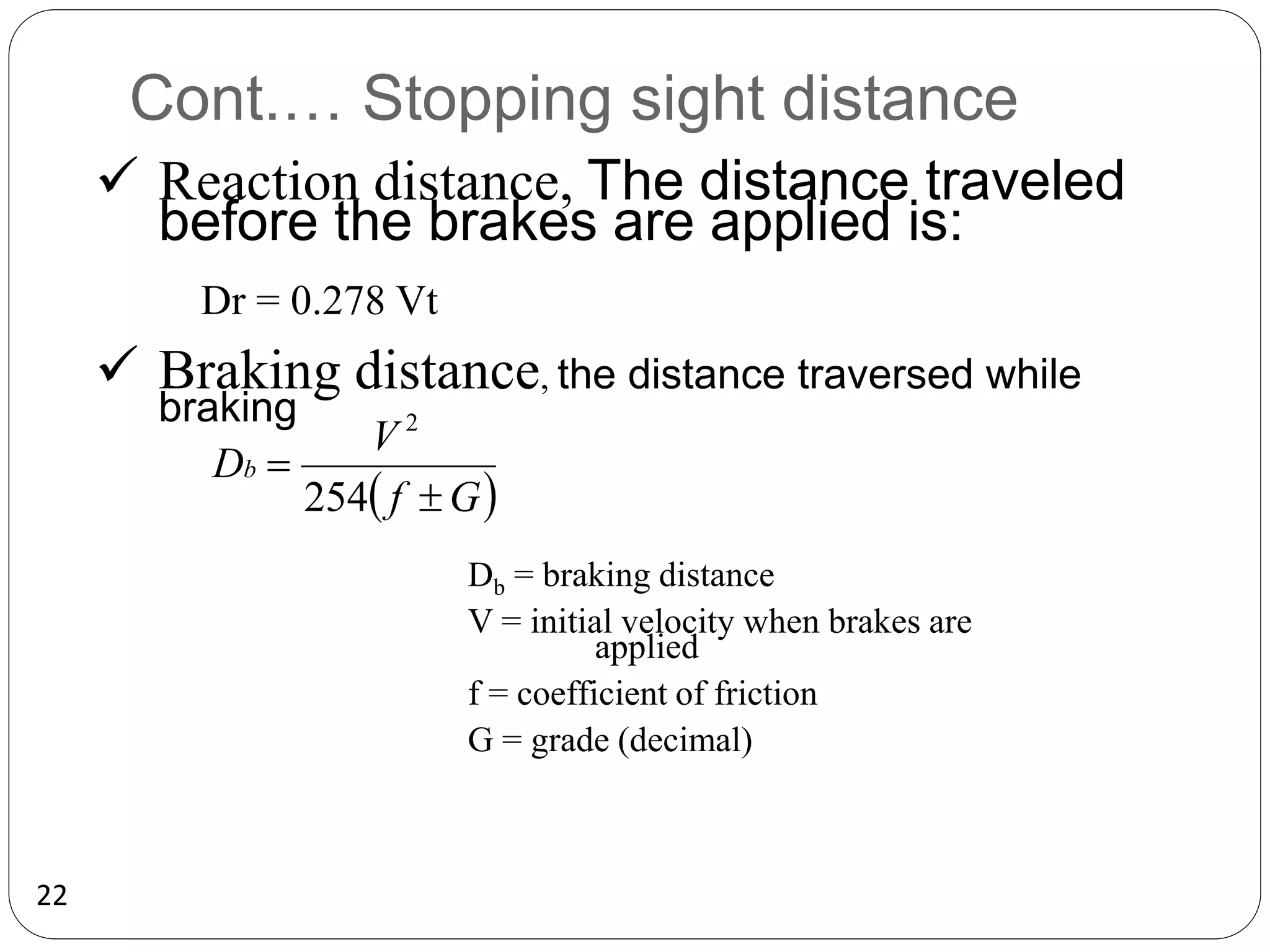
 Reaction distance, The distance traveled
before the brakes are applied is:
Dr = 0.278 Vt
 Braking distance, the distance traversed while
braking
 
G
f
V
Db


254
2
Db = braking distance
V = initial velocity when brakes are
applied
f = coefficient of friction
G = grade (decimal)
23
Stopping sight distance
 
G
f
V
V
t
SSD



254
)
)(
)(
278
.
0
(
2
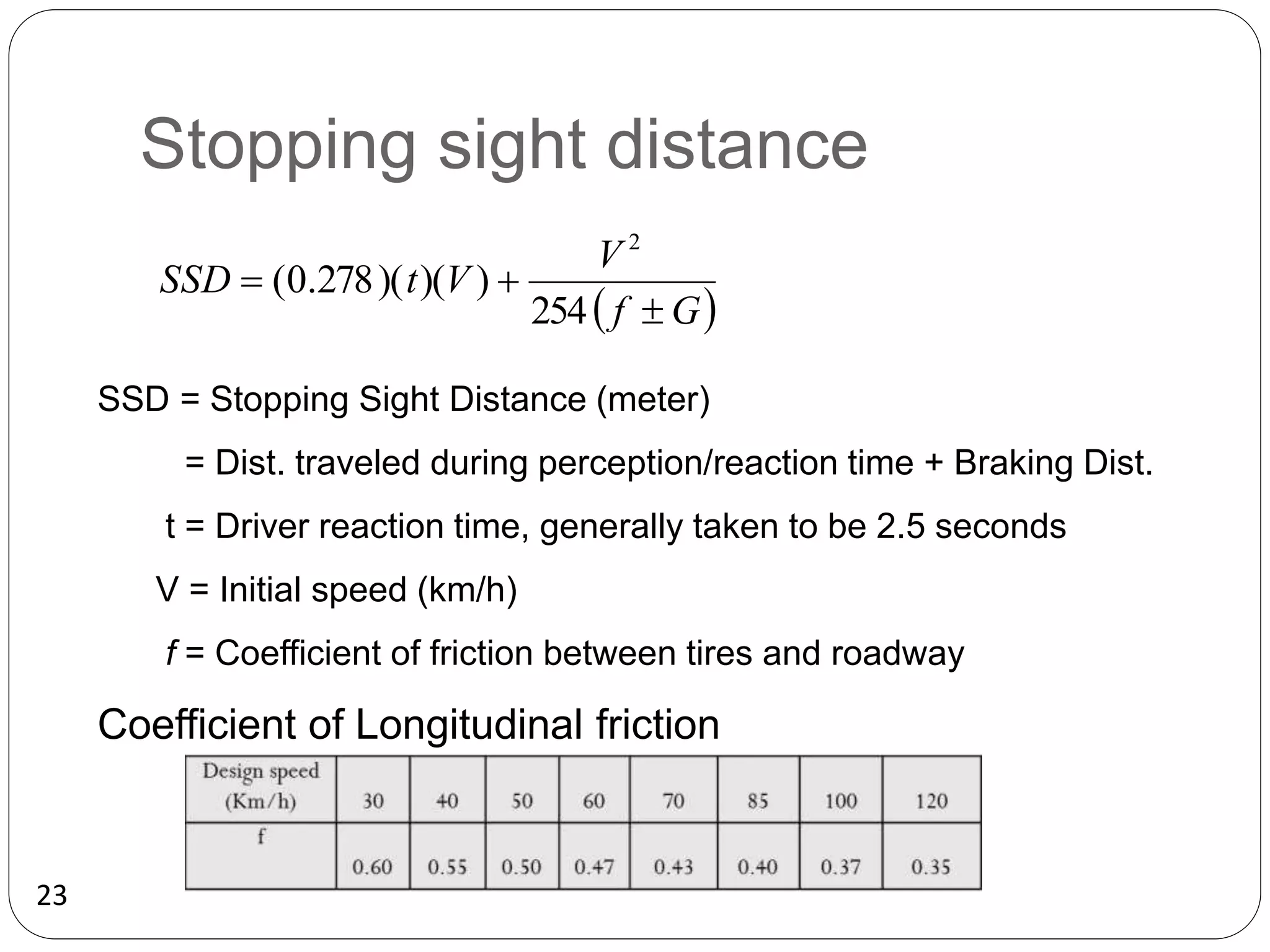
SSD = Stopping Sight Distance (meter)
= Dist. traveled during perception/reaction time + Braking Dist.
t = Driver reaction time, generally taken to be 2.5 seconds
V = Initial speed (km/h)
f = Coefficient of friction between tires and roadway
Coefficient of Longitudinal friction
24
Passing Sight Distance
• Minimum distance required to safely complete passing maneuver
on 2-lane two-way highway
• Allows time for driver to avoid collision with approaching vehicle
and not cut off passed vehicle when upon return to lane
• Assumes:
1. Vehicle that is passed travels at uniform speed
2. Speed of passing vehicle is reduced behind passed vehicle as it
reaches passing section
3. Time elapses as driver reaches decision to pass
4. Passing vehicle accelerates during the passing maneuver and
velocity of the passing vehicle is about 16km/hr greater than
that of the passed vehicle
5. Enough distance is allowed between passing and oncoming
vehicle when the passing vehicle returns to its lane
25
Cont.… Passing Sight Distance
d
26
Cont.… Passing Sight Distance
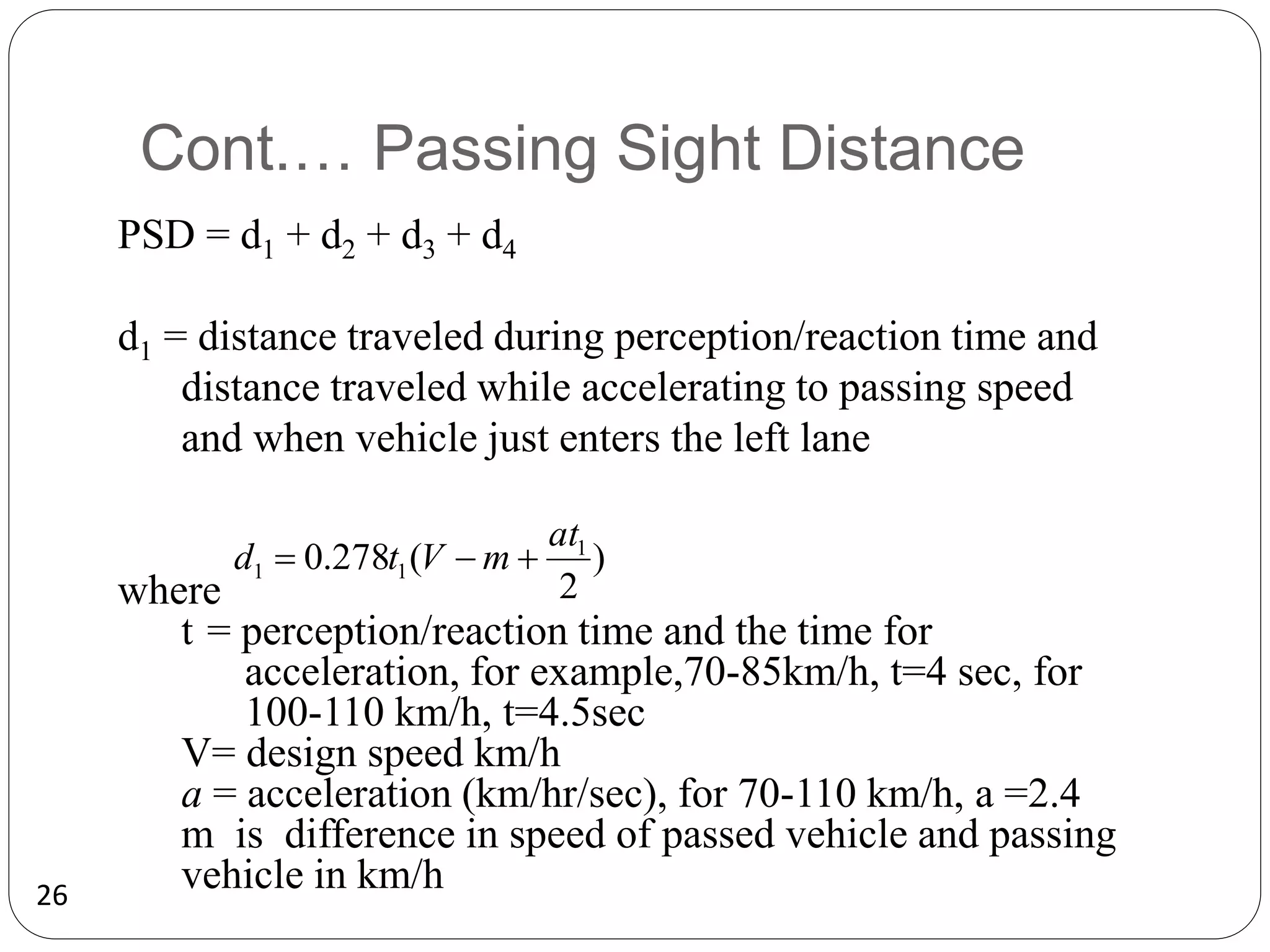
PSD = d1 + d2 + d3 + d4
d1 = distance traveled during perception/reaction time and
distance traveled while accelerating to passing speed
and when vehicle just enters the left lane
where
t = perception/reaction time and the time for
acceleration, for example,70-85km/h, t=4 sec, for
100-110 km/h, t=4.5sec
V= design speed km/h
a = acceleration (km/hr/sec), for 70-110 km/h, a =2.4
m is difference in speed of passed vehicle and passing
vehicle in km/h
)
2
(
278
.
0 1
1
1
at
m
V
t
d 


27
Cont.… Passing Sight Distance
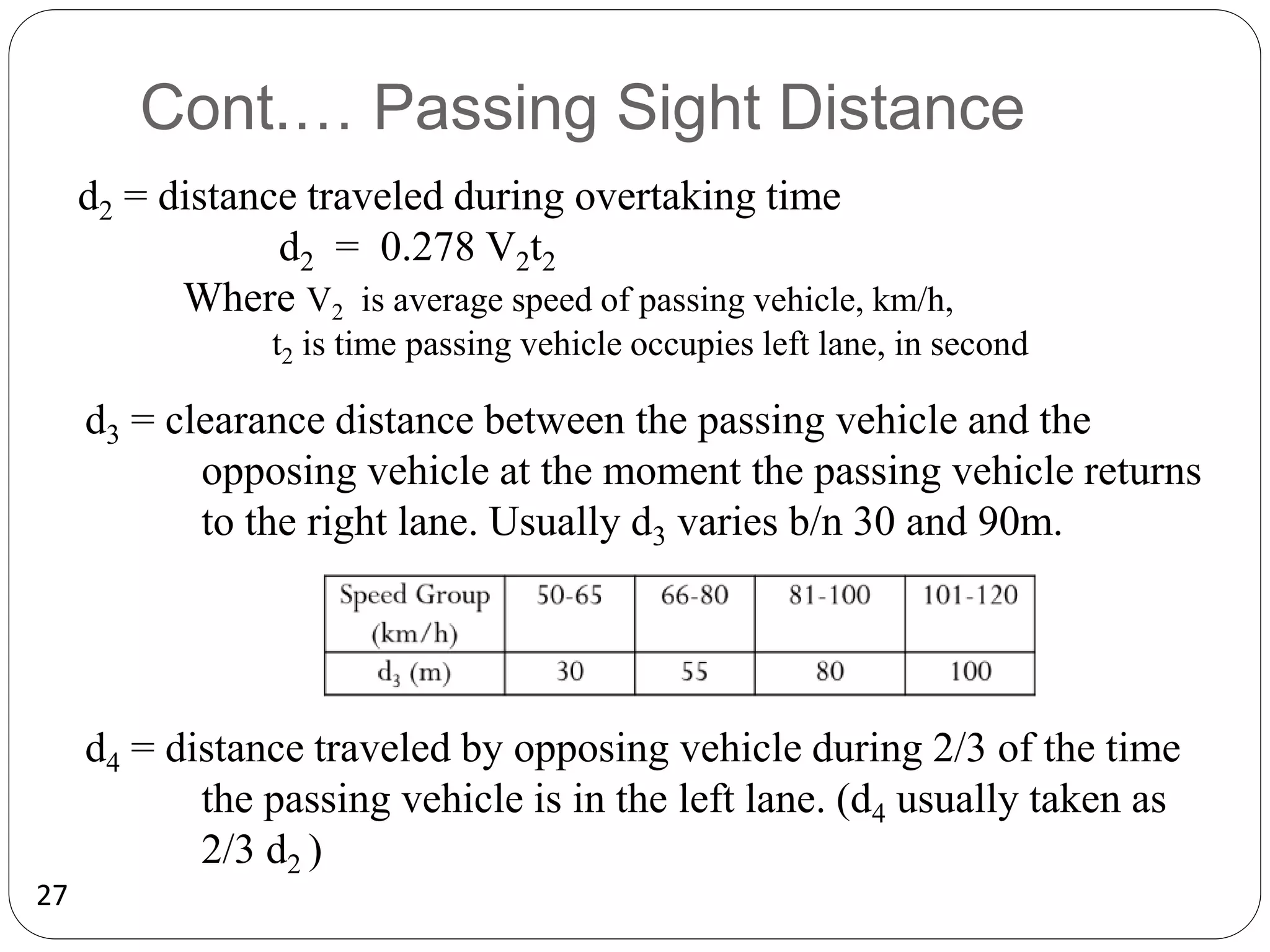
d2 = distance traveled during overtaking time
d2 = 0.278 V2t2
Where V2 is average speed of passing vehicle, km/h,
t2 is time passing vehicle occupies left lane, in second
d3 = clearance distance between the passing vehicle and the
opposing vehicle at the moment the passing vehicle returns
to the right lane. Usually d3 varies b/n 30 and 90m.
d4 = distance traveled by opposing vehicle during 2/3 of the time
the passing vehicle is in the left lane. (d4 usually taken as
2/3 d2 )
28
Elements of Road Cross-section
29
Elements of Road Cross-section
 Principal elements
 Traffic lanes
 Auxiliary lanes – climbing lanes, acceleration and deceleration
lanes, etc
 Shoulders
 Median (for divided roads)
 Marginal elements include
 Median and roadside barrier
 Curbs
 Gutters
 Guard rails
 sidewalks,
 Side slopes,
 Cross slopes
30
Elements of Road Cross-section
 Width of travel lanes
 Usually vary from 3 to 3.65 m, but occasionally 2.7 m lane width is used
in urban areas where the traffic volume is low and there is extreme right-
of-way constraints
 On two way two lane rural roads, accident rate for large trucks increases
as the traveled way decreases from 6.5 m
 The capacity decrease significantly as the lane width decrease from 3.0 m
31
Elements of Road Cross-section
 Shoulders
 Serves for an emergency stop of vehicles
 Used to laterally support the pavement structure
 Shoulder width
 Recommended shoulder width is in the range of 1.8 to 2.4 m
 for highways serving large number of trucks and on highways with high
traffic volumes and high speeds, shoulder width of 3.0 to 3.5 m is
preferable
 Minimum shoulder width 0.6 m on the lowest type of roads
 Shoulders should be flush with the edge of the traveled lane
and be sloped to facilitate drainage (2-4 % if paved, 4-6 % if
not paved)
32
Elements of Road Cross-section
 Median – section of divided road that separates lanes in the
opposite directions.
 Functions:
 Provide recovery area during emergency
 Provide stopping area for left and U-turning vehicles
 Provide refuge for pedestrians
 Reduce headlight glare
 Median can be either raised, flush or depressed
 Median width vary between 0.6 up to 24 m or more depending
on the availability of right-of-way
33
Elements of Road Cross-section
 Median barrier – a longitudinal structure used to prevent an errant vehicle from
crossing the portion of a divided highway separating the traveled way for
traffic in the opposite directions
 Roadside barrier – protect vehicles from causing hazards onto roadside and
shield pedestrians
 Curbs – raised structures used mainly on urban roads to delineate pavement
edge and pedestrian walkways. Curbs are also used:
 To control drainage
 Improve aesthetic
 Reduce right-of-way
 Are classified as
 Barrier curbs – relatively high designed for preventing vehicles from leaving the toad
 Mountable curbs – are designed so that vehicles can cross them
34
Elements of Road Cross-section
 Gutters – drainage ditches located on the pavement side of a curb
to provide the principal drainage facility for the highway
 Guard rails – longitudinal barriers on the outside of sharp curves
at sections with high fills (greater than 2.5 m)
 Side walks – provided on urban or rural roads
 When pedestrian traffic is high along main or high speed roads
 When shoulders are not provided on arterials even when pedestrian traffic is low
 In urban areas, sidewalks are provided along both sides of streets to serve
pedestrians access to schools, parks, shopping centers, and transit stops.
35
Elements of Road Cross-section
 Cross-slopes – to enhance the flow of surface water
 High type pavement – 1.5 –2 %
 Intermediate type of pavement – 1.5- 3%
 Side slopes – provided for stability of earthworks; the slope
varies depending on the material type
 Right-of-way – the total land area required for the construction of
the roadway
 To accommodate all the elements of the road cross-section
 Planned widening of the road
 Public utility facilities that will be installed along the highway
Horizontal Alignment
36
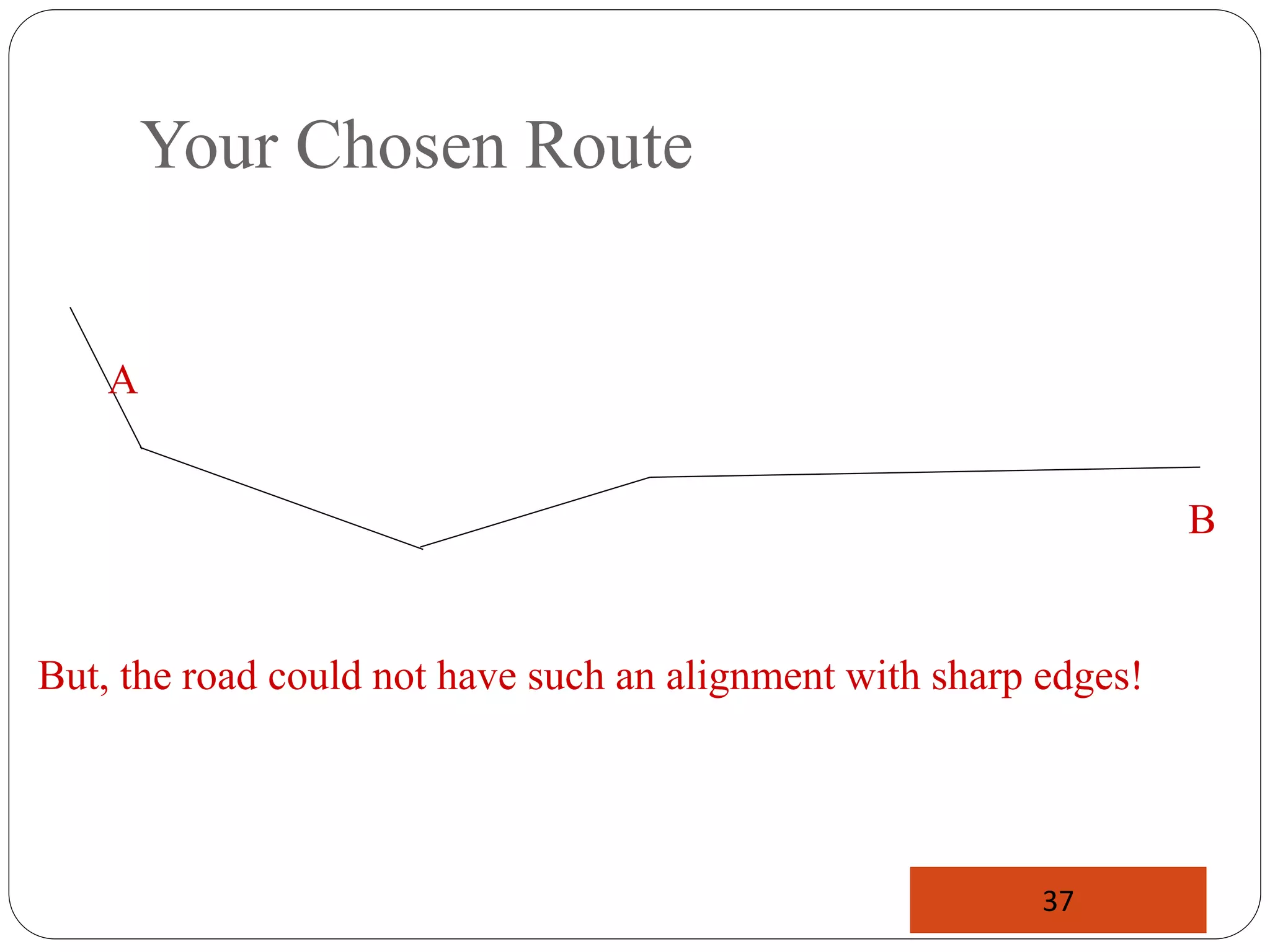
Your Chosen Route
But, the road could not have such an alignment with sharp edges!
A
B
37
Purpose of horizontal alignment
 To provide uniform speed
 To provide good drainage
 To provide minimum earth work quantity
 No sudden changes from easy to sharp
curvature.
38
Horizontal Alignment consists of
Straight lines
Circular Curves: a curve connecting two tangents in
different direction.
Types of Curves
 Simple circular curves: consists of tangent and a single
curve
 Compound Curves: .curve in the same direction but without
any intervening tangent section
 Reverse Curves: a curve followed by another curve in
opposite direction.
 Broken back curve: a curve followed by another curve in the
same direction with intervening tangent between two curves.
39
Considerations
A proper relation should be established between the design
speed and curvature and their joint relations with super
elevation and side friction. drainage
40
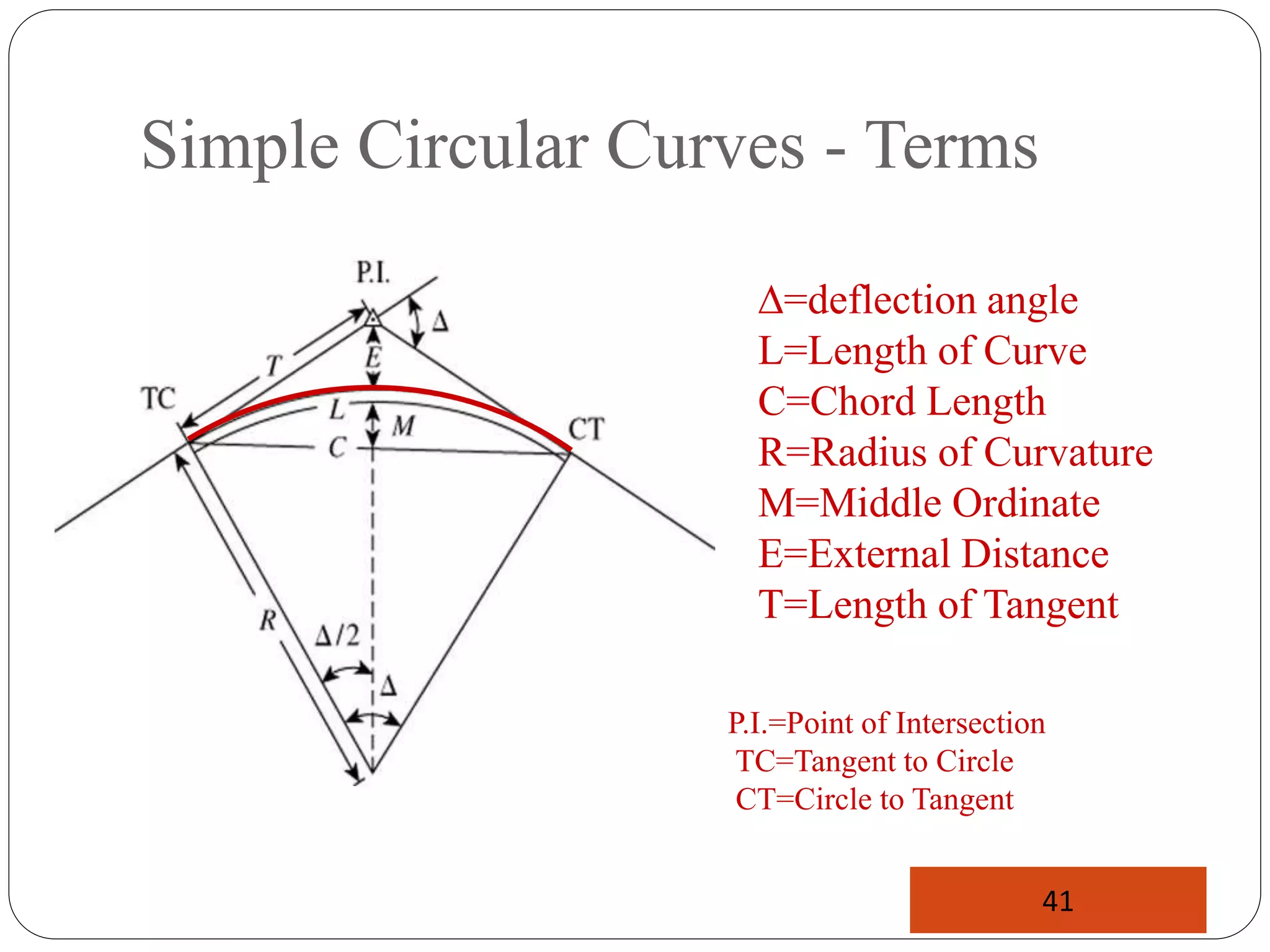
Simple Circular Curves - Terms
∆=deflection angle
L=Length of Curve
C=Chord Length
R=Radius of Curvature
M=Middle Ordinate
E=External Distance
T=Length of Tangent
P.I.=Point of Intersection
TC=Tangent to Circle
CT=Circle to Tangent
41
Degree of Curvature
Arc Definition
Chord Definition
R=10/ sin D/2
360
2
20 R
D


R
D
92
.
1145

R
20m
R
D
20m
D
42
Relations
 
 
)
2
/
cos(
1
1
)
2
/
sec(
)
2
/
sin(
2
)
2
/
tan(












R
M
R
E
R
L
R
C
R
T
43
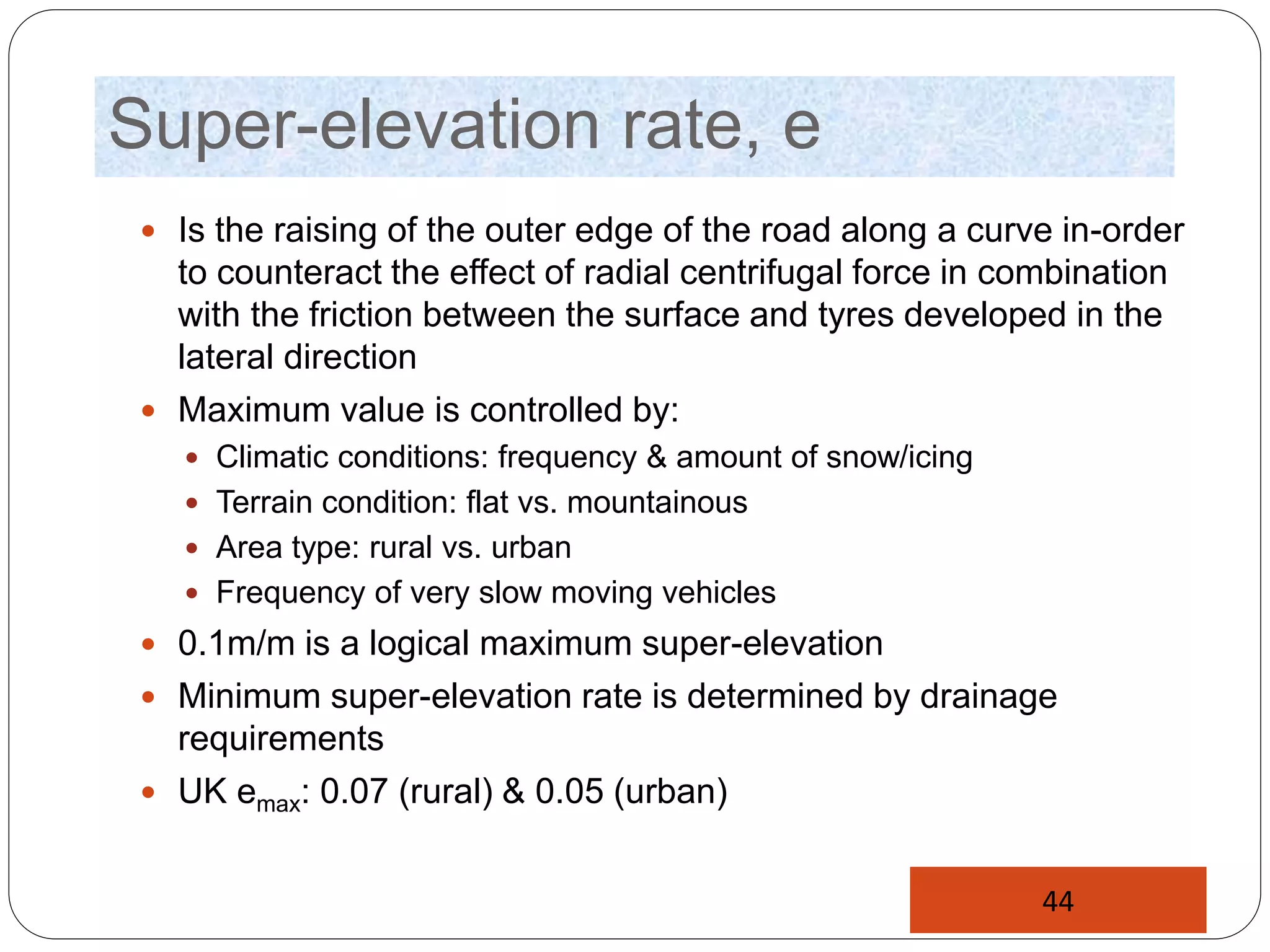
Super-elevation rate, e
 Is the raising of the outer edge of the road along a curve in-order
to counteract the effect of radial centrifugal force in combination
with the friction between the surface and tyres developed in the
lateral direction
 Maximum value is controlled by:
 Climatic conditions: frequency & amount of snow/icing
 Terrain condition: flat vs. mountainous
 Area type: rural vs. urban
 Frequency of very slow moving vehicles
 0.1m/m is a logical maximum super-elevation
 Minimum super-elevation rate is determined by drainage
requirements
 UK emax: 0.07 (rural) & 0.05 (urban)
44
Maximum Degree of Curvature
 minimum radius for safety (veh. stability)
 Limiting value for a given design speed (given
emax & mmax)
 The respective maximum Degree of Curvature
is:
 Sharper Curve might justify use of e>emax or a
higher dependence on tyre friction or both
 
m


e
V
R
127
2
min
 
 
2
2
min
143240
127
92
.
1145
92
.
1145
max
V
e
e
V
R
D
m
m





45
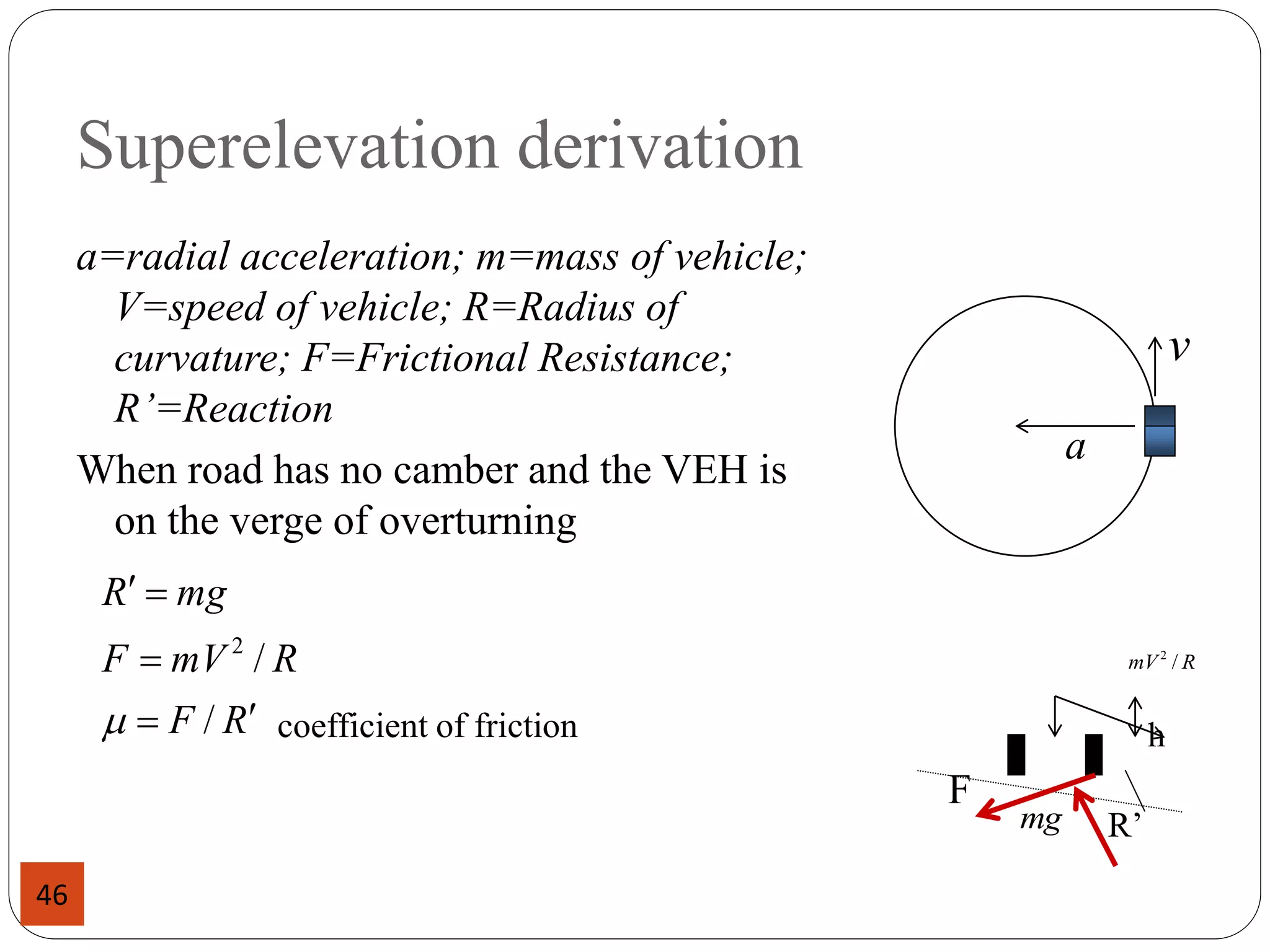
Superelevation derivation
a=radial acceleration; m=mass of vehicle;
V=speed of vehicle; R=Radius of
curvature; F=Frictional Resistance;
R’=Reaction
When road has no camber and the VEH is
on the verge of overturning
coefficient of friction
a
v
R
F
R
mV
F
mg
R





/
/
2
m
R
mV /
2
mg
F
R’
h
46
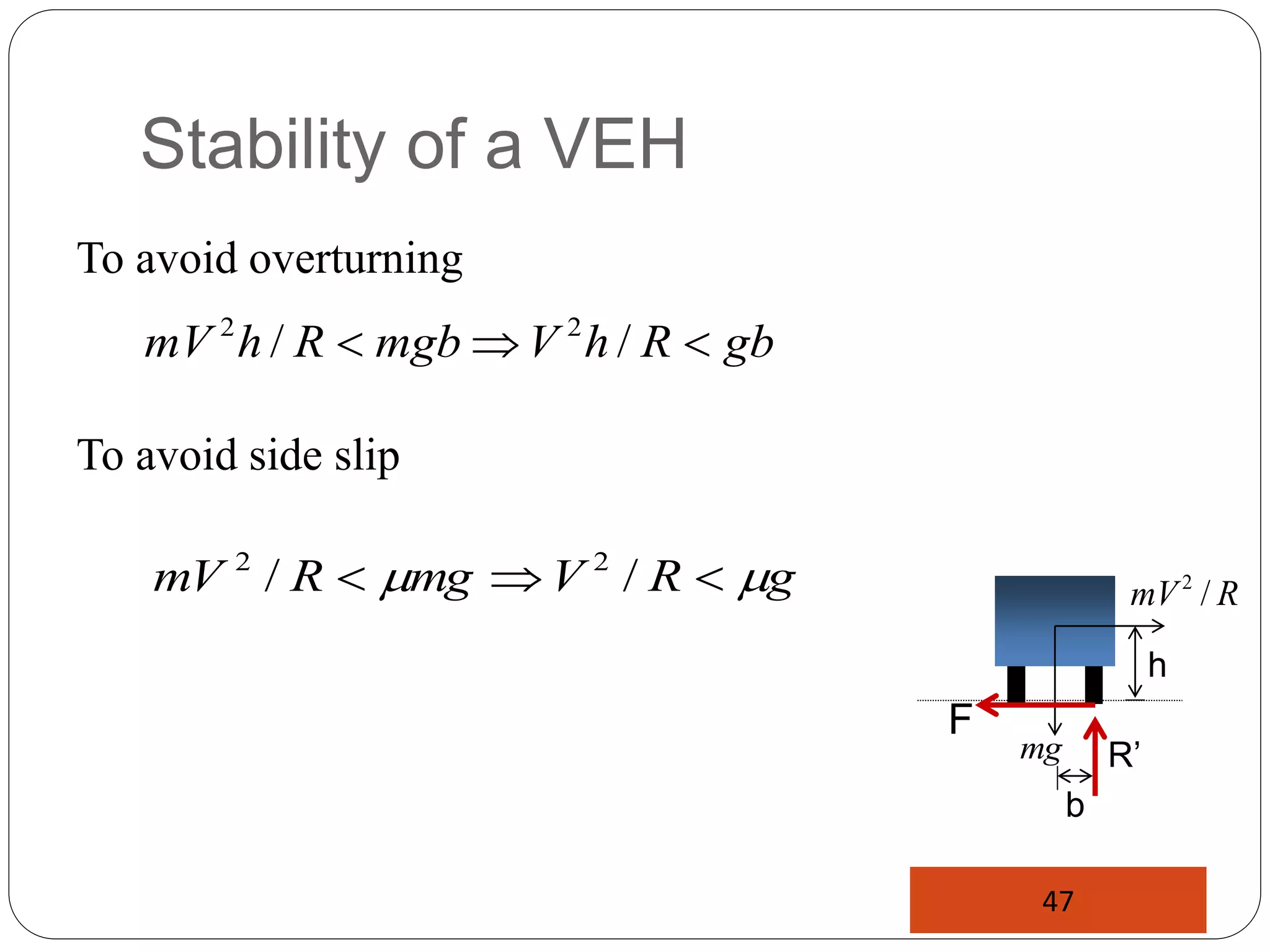
Stability of a VEH
To avoid overturning
To avoid side slip
R
mV /
2
mg
F
R’
h
gb
R
h
V
mgb
R
h
mV 

 /
/ 2
2
b
g
R
V
mg
R
mV m
m 

 /
/ 2
2
47
Resolving the Forces // and |to the road
(// to the road)
(| to the road)
Stability on Super-elevated Surface
Forces & Equilibrium

 Cos
gR
Wv
WSin
F
2


gR
Wv 2
N
F
W

Frictional force, F=mN
N
Sin
gR
Wv
WCos 
 

2
e
1
48
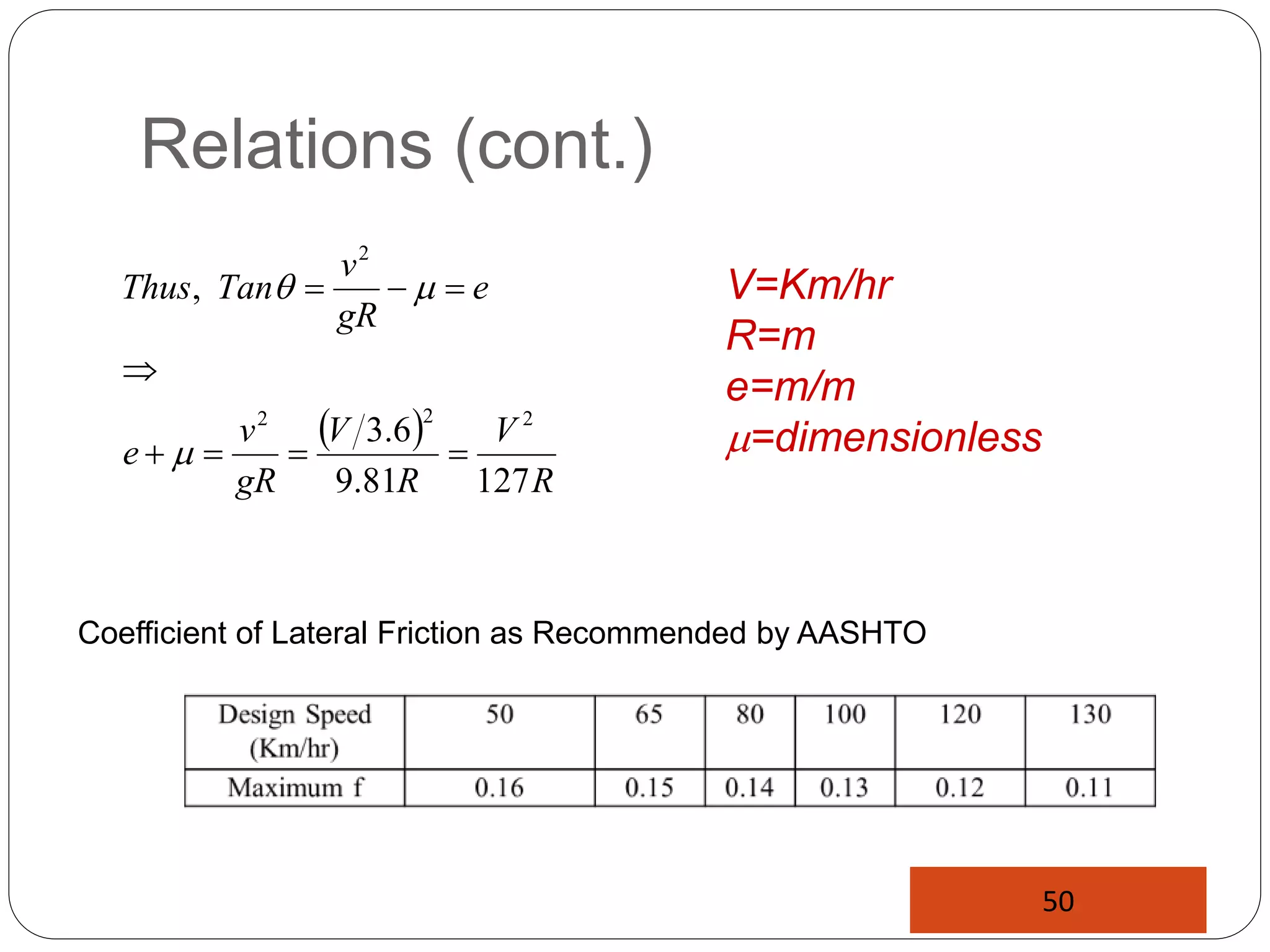
Relations (cont.)
1
1
2
2
2
2
2
2
2





























gR
v
gR
v
Tan
gR
v
Cos
gR
v
Sin
WSin
Cos
gR
Wv
WCos
Sin
gR
Wv
WSin
Cos
gR
Wv
N
m
m

m

m





m


m
gR
v2
m
But the term has a very small value and
could be ignored for all practical purposes.
Check using typical values like V=50km/hr;
m=0.16; and R=100m.
49
Relations (cont.)
 
R
V
R
V
gR
v
e
e
gR
v
Tan
Thus
127
81
.
9
6
.
3
,
2
2
2
2








m
m
 V=Km/hr
R=m
e=m/m
m=dimensionless
50
Coefficient of Lateral Friction as Recommended by AASHTO
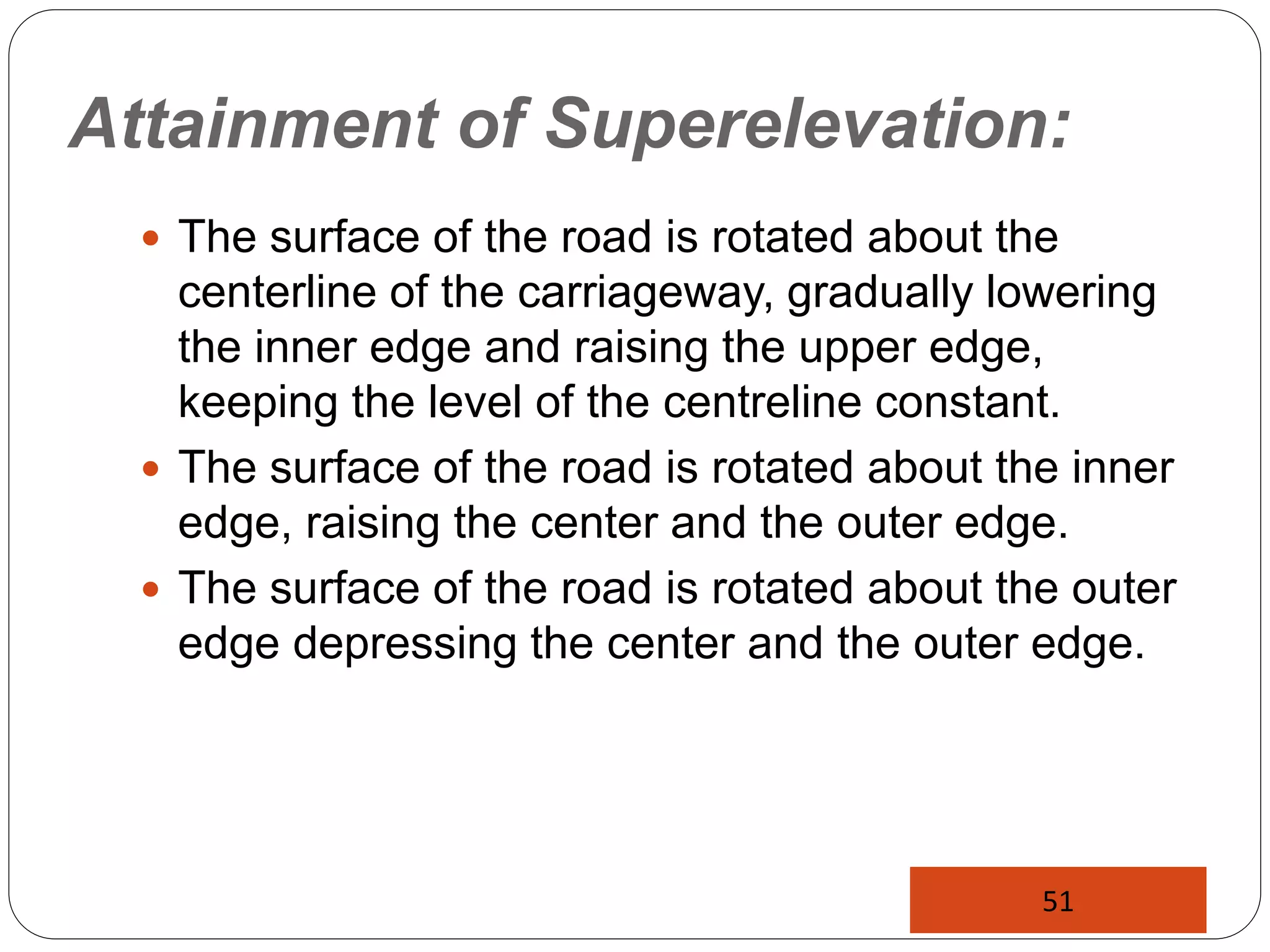
Attainment of Superelevation:
 The surface of the road is rotated about the
centerline of the carriageway, gradually lowering
the inner edge and raising the upper edge,
keeping the level of the centreline constant.
 The surface of the road is rotated about the inner
edge, raising the center and the outer edge.
 The surface of the road is rotated about the outer
edge depressing the center and the outer edge.
51
Cont…
Cont…
C
L
Normal Cross-section
Complete elimination of crown
X-section becomes a straight
fall from one side to another
Rotation about the crown
Rotation about the inner edge
C
L
h
H
h2
h
1
h
Where: H=ew
w=width of roadway
H
53
Cont…

Cont…
55
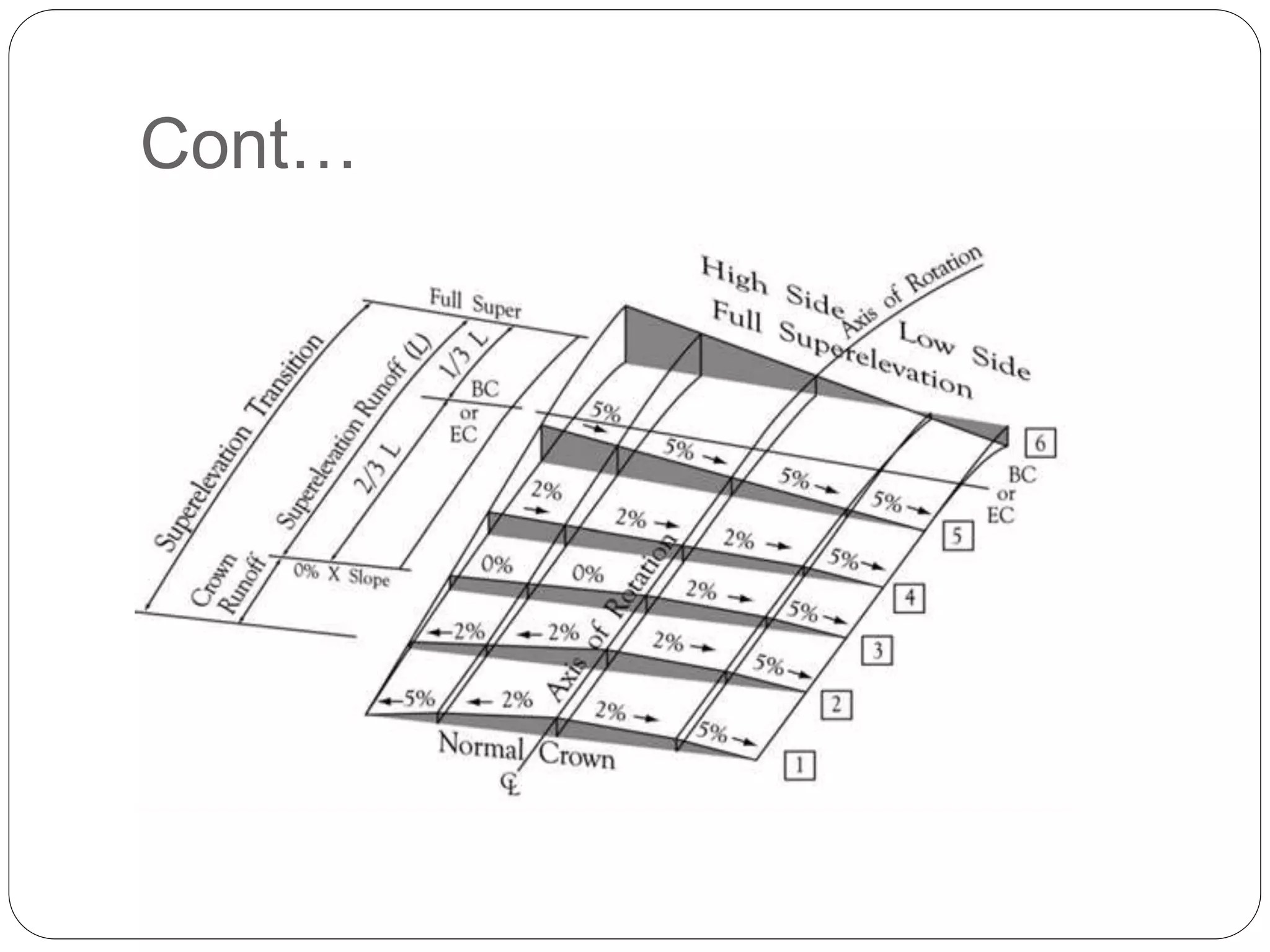
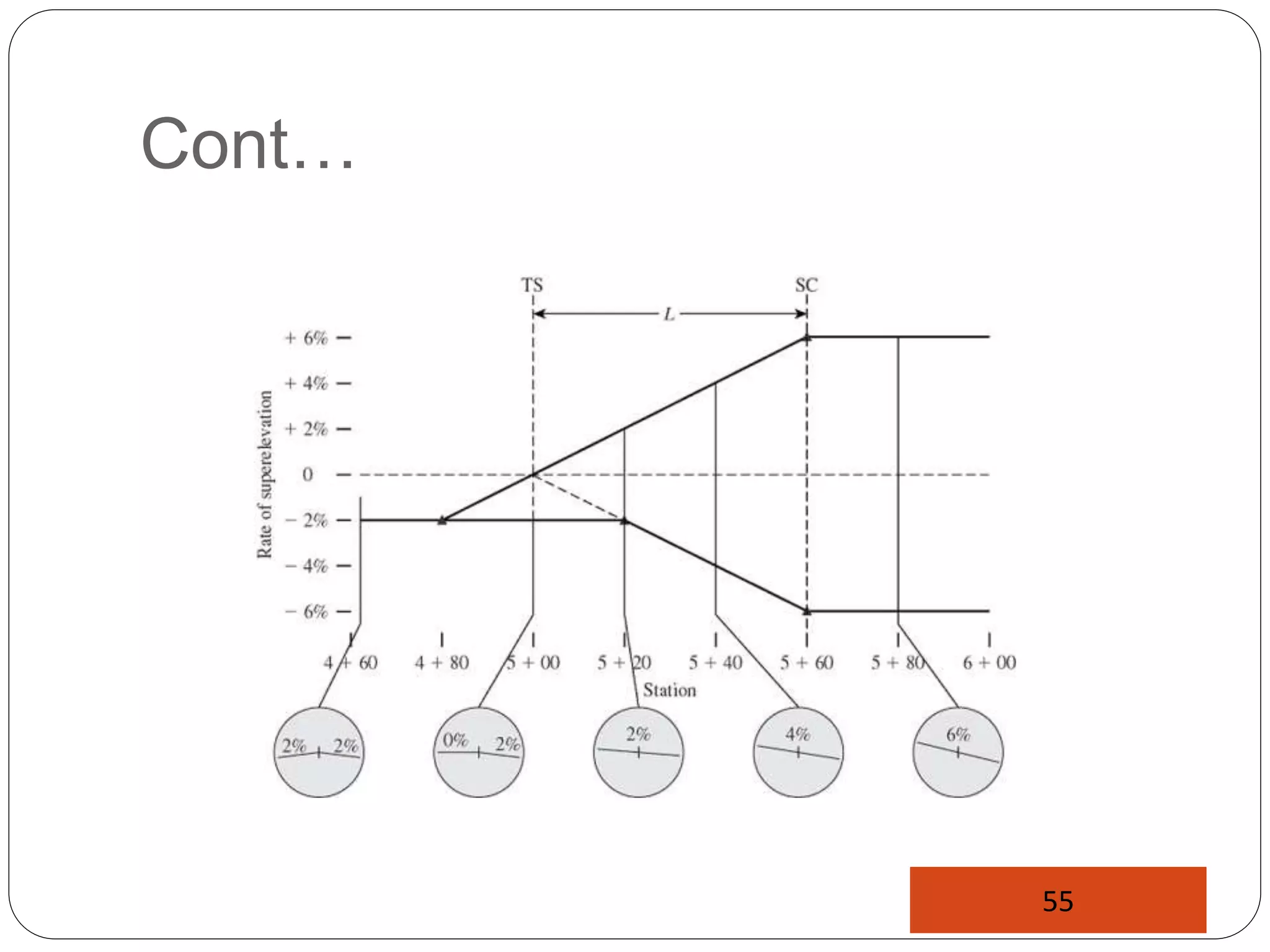
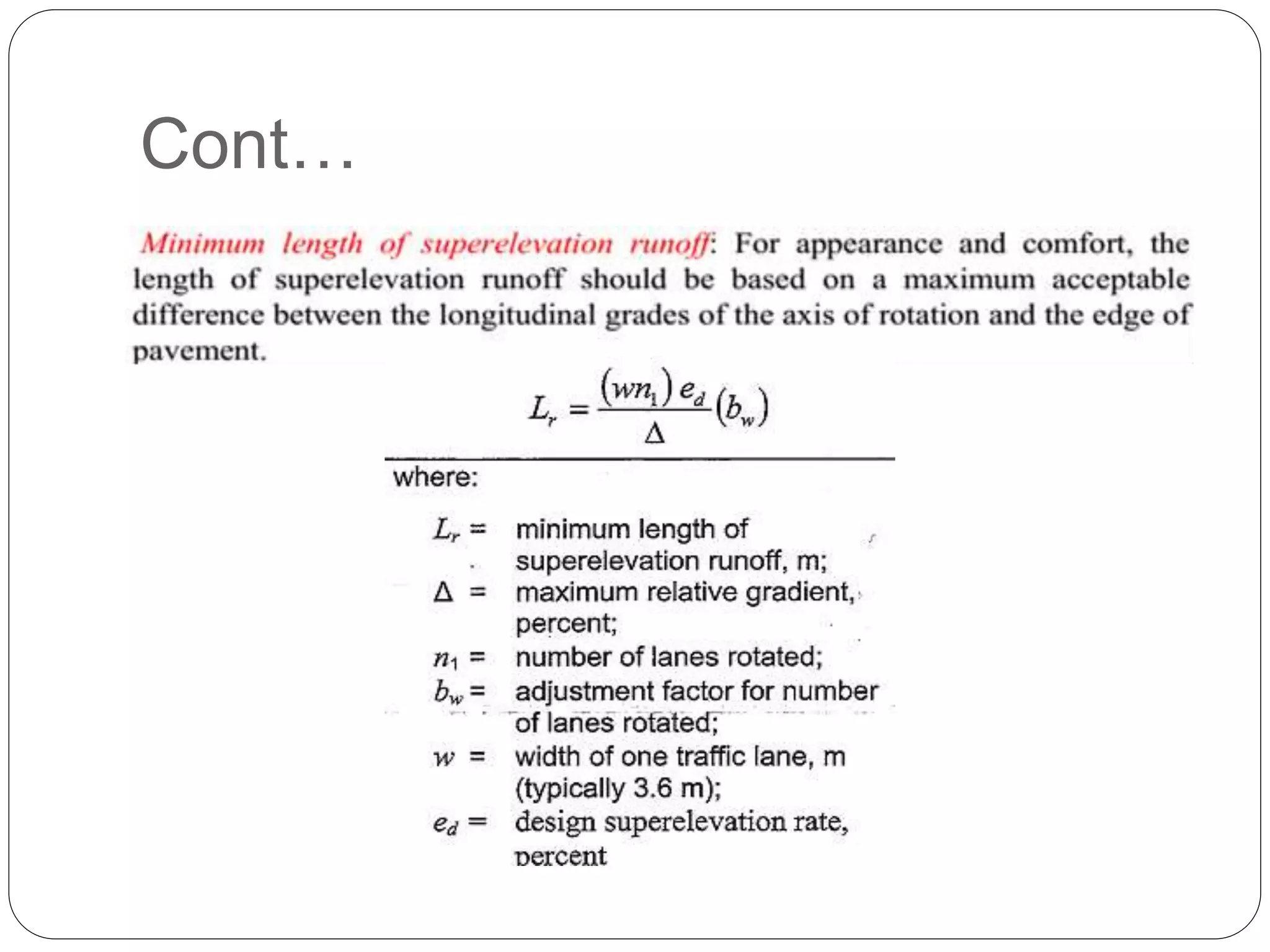
Superelevation transition section
consists:
 Superelevation runoff section: the roadway
length needed to accomplish a change in
outside-lane cross slope from zero (flat) to
full Superelevation, or vice versa.
 Tangent runout section: the roadway length
needed to accomplish a change in outside-lane
cross slope from normal cross slope rate to zero
(flat), or vice versa.
Cont…
Cont….
Cont…
Cont…
Super-elevation is started 1/2 to 1/3 into the tangent with the balance being
applied with in the curve
Shoulder Super-elevation
61
Transition Curves
Spirals are curves which provide a
gradual change in curvature from
tangent to a circular path
Advantages:
•Provides an easy-to-follow path
so that centrifugal force increases
and decreases gradually; lesser
danger of overturning/ side-
slipping
•Vehicle could keep to the middle
of lane while traversing a curve
•Is convenient for the application
of super-elevation
•Improved visual appearance 62
Transition Curves - Geometry
PI: Point of Intersection
TS: Tangent to spiral
SC: Spiral to Circle
CS: Circle to Spiral
ST: Spiral to tangent
Ls: Total length of spiral
Lc: Length of circular curve
qs: Central angle of spiral arc of
length Ls
∆=total deflection angle of the
curve
Ys=tangent offset at SC
Xs=
K=abscissa of shifted PC with
reference to TS
64
Cont…
 Some of the important properties of the spirals
are given below:
 L = 2Rθ
 θ = (L / Ls)2 * θs
 θs = Ls / 2Rc (in radians) = 28.65Ls / Rc (in
degrees)
 Ts = Ls /2 + (Rc + S)*tan(Δ/2)
 S = Ls
2 / 24Rc
 Es = (Rc + S)*sec(Δ/2) - Rc
Length of Transition:
The length of transition should be determined from
the following two conditions:
1. The rate of change of centrifugal acceleration
adopted in the design should not cause discomfort
to the drivers. If C is the rate of change of
acceleration,
 Ls = 0.0215V3 / (C*Rc)
 Where:
V = speed (Km/hr)
Rc = radius of the circular curve (m)
Cont…
2. The rate of change of Superelevation
(Superelevation application ratio) should be such
as not to cause higher gradients and unsightly
appearances. Since Superelevation can be given
by rotating about the centerline, inner edge or outer
edge, the length of the transition will be governed
accordingly.
Setting out of transition curve
from tangent
Cont…
Cont…

Widening of Highway Curves
Need
 Rear wheels don’t follow front wheels,
 Trailers fitted on trucks, don’t follow path of trucks
wheels
 To have adequate sight-distances
 Drivers tend to keep greater clearances with
vehicles coming from the opposite direction and
might thus move out of a lane when traversing a
curve
Extra width of pavement may be necessary on curves
71
Cont…
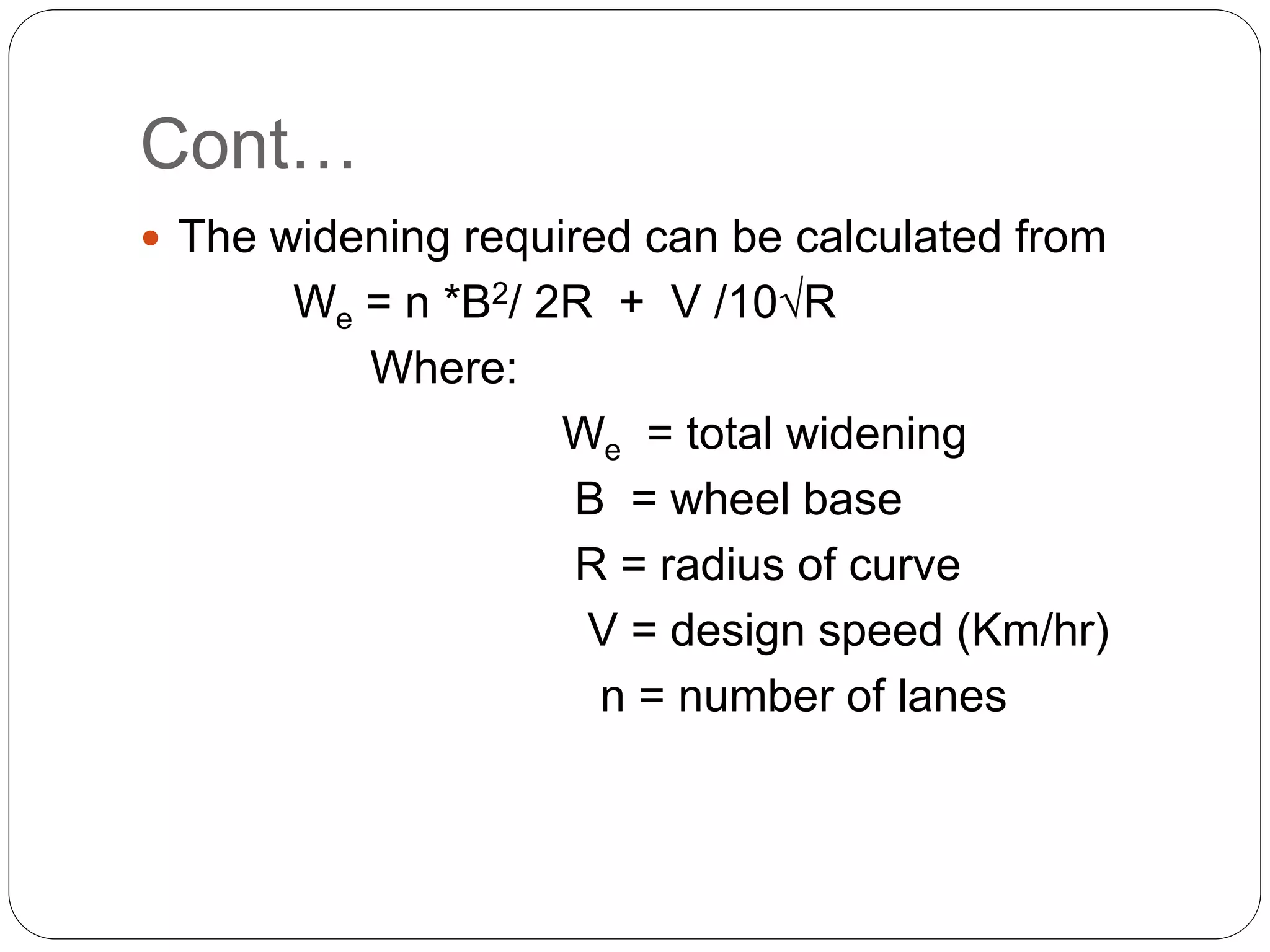
 The widening required can be calculated from
We = n *B2/ 2R + V /10√R
Where:
We = total widening
B = wheel base
R = radius of curve
V = design speed (Km/hr)
n = number of lanes
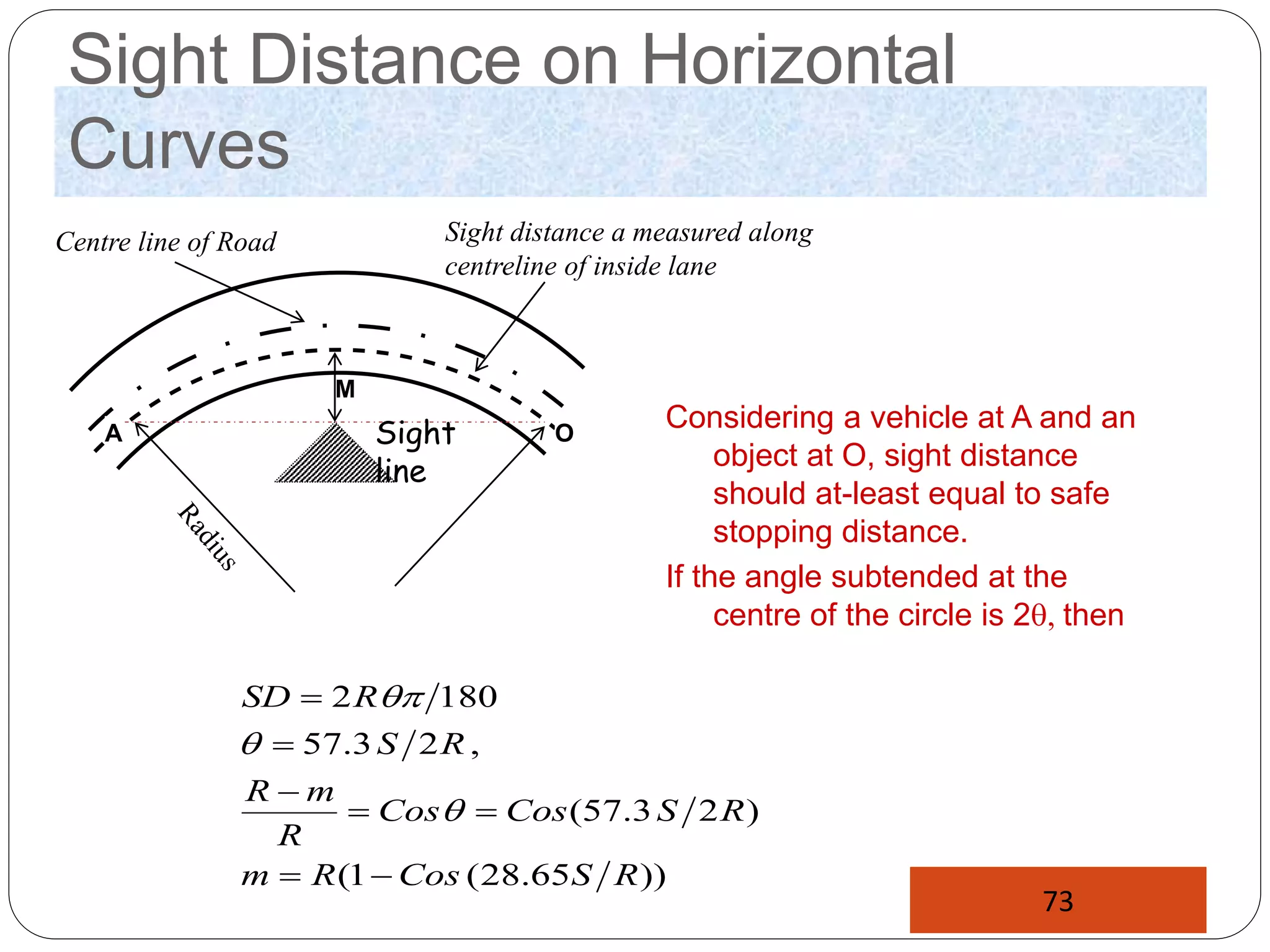
Sight Distance on Horizontal
Curves
Considering a vehicle at A and an
object at O, sight distance
should at-least equal to safe
stopping distance.
If the angle subtended at the
centre of the circle is 2, then
Centre line of Road
M
Sight distance a measured along
centreline of inside lane
Sight
line
A O
))
65
.
28
(
1
(
)
2
3
.
57
(
,
2
3
.
57
180
2
R
S
Cos
R
m
R
S
Cos
Cos
R
m
R
R
S
R
SD










73

Chapter 3 geometric design

  • 1.
  • 2.
    Introduction 2  Highway geometricdesign involves the design of geometric elements of a highway and fixation of standards with respect to various components  Its dictated within economic limitations to satisfy the requirements of traffic in designing elements such as  Cross-section  Horizontal alignment  Vertical alignment  Sight distances  Lateral and vertical clearances  Intersection,  etc.
  • 3.
    3 Cont.…  The safety,efficiency, and economic operation of a highway is governed to a large extent by the care with which the geometric design is worked out  The engineer has to consider the following points when selecting design standards  Volume and composition of traffic in the design year  Faulty geometries are costly to rectify at a later date  The design should be consistent with  The design should embrace all aspects of design including signs, markings, lighting, etc.  The road should be considered as an element of the total environment  The design should minimize the total transportation cost  Safety should be built in the design  The design should be enable all road users to use the facility
  • 4.
    4 Design controls andcriteria The choice of design controls and criteria is influenced by the following factors:  Functional classification of the road Nature of the terrain Traffic volumes expected on the road Design vehicle Design speed Sight distance Density and character of the adjoining land use and Economic and environmental considerations
  • 5.
    5 Road Functional Classification (orRoad Hierarchy) Roads generally serve a multitude of purposes:  As through route - for long distance traffic  As local route – for local traffic  In urban and rural areas –urban roads/rural roads  For fast and slow vehicles – 2 wheels to 10+ wheels  As servicing/access roads  For use by pedestrians  For parking areas  For Street Vendors, etc
  • 6.
    6 Rationale for ahierarchical system Such a mix of uses Reduces SAFETY, EFFICIENCY, and CAPACITY Hence a hierarchical road system is necessary Roads are therefore classified according to their respective functions in terms of the character of the services they are providing
  • 7.
    7 Objectives in settinga hierarchy  To obtain best use of an existing network  To ensure that each type of traffic is using the most appropriate route  To minimize the risk to users and to the natural built environment  To ensure better management, maintenance regimes and design policies  To ensure funding for routes is targeted appropriately  To offer network users a choice for how to travel
  • 8.
    8 Road Hierarchy (TheEthiopian way) Trunk roads Access roads Collector roads Feeder roads Link roads Roads linking centers of national or international importance and have over 400 - 1000 first year AADT, although values can range between 50-10,000 AADT. Roads linking centers of provincial importance and their first year AADTs between 30-1,000 . Roads linking locally important centers to each other, to a more important center, or to higher class roads and their first year AADTs between 25-400 . Any road link to a minor center such as market and local locations with first year AADT between 0-100. Roads linking centers of international importance and roads terminating at international boundaries and have a present AADT 1000 and as low as 100.
  • 9.
    9 Nature of Terrain The location and geometric design elements such as gradients, sight distance, cross-sections, radius of curvature, speeds, etc. of a highway are affected by topography, physical features, and land use.  Transverse terrain properties are categorized into four classes as follows:  FLAT: Flat or gently rolling country, which offers few obstacles to the construction of a road, having continuously unrestricted horizontal and vertical alignment (transverse terrain slope up to 5 percent).
  • 10.
    10 Cont.… Nature ofTerrain  ROLLING: Rolling, hilly or foothill country where the slopes generally rise and fall moderately and where occasional steep slopes are encountered, resulting in some restrictions in alignment (transverse terrain slope from 5 percent to 25 percent).
  • 11.
    11 Cont.… Nature ofTerrain  MOUNTAINOUS: Rugged, hilly and mountainous country and river gorges. This class of terrain imposes definite restrictions on the standard of alignment obtainable and often involves long steep grades and limited sight distance (transverse terrain slope from 25 percent to 50 percent).
  • 12.
    12 Cont.… Nature ofTerrain  ESCARPMENT: Escarpment include situations where switchback roadway sections are used or side hill transverse sections which cause considerable earthwork quantities, with transverse terrain slope in excess of 50 percent.
  • 13.
    Traffic  A furtherfactor influencing the development of road design standards, and in particular the design speed, is the volume and composition of traffic.  The design of a road should be based in part on factual traffic volumes.  Traffic indicates the need for improvement and directly affects features of design such as widths, alignments, and gradients.  Traffic data for a road or section of road, including traffic trends, is generally available in terms of annual average daily traffic (AADT).
  • 14.
    Cont.…. Design Standards vs.Road Classification and AADT
  • 15.
    Cont... Shoulder Widths * Shouldersincluded in the carriageway width given in Table 2-1 ** Shoulders included in the carriageway width given in Table 2-1 *** To be provided where urbanization requires this facility + Where these classes of roads pass through urban areas, the road shall be designed to Standard DS6 ++ The actual shoulder width provided shall be determined from an assessment of the total traffic flow and level of non-motorized traffic for each road section +++ Depending on the development of the town & Includes a shoulder
  • 16.
    Cont... Geometric Design Parametersfor Design Standard DS4 (Paved)
  • 17.
    Design Vehicle  Boththe physical characteristics and turning capabilities of vehicles are controls in geometric design.  Vehicle characteristics and dimensions affecting design include power to weight ratio, minimum turning radius and travel path during a turn, and vehicle height and width.  The road elements affected include the selection of maximum gradient, lane width, horizontal curve widening, and junction design.
  • 18.
    18 Speed  The speedthat a driver adopts on a road depends on: Physical characteristics of the road and its surroundings Weather conditions in the area Presence of other vehicles and the nature of these vehicles, and Speed limitations placed upon the vehicles either by law or by mechanical devices fitted in vehicles  Design speed is the max safe speed selected for designing specific section of road considering the terrain, land use, classification of the road, etc.  Design elements such as lane and shoulder widths, horizontal radius, Superelevation, sight distance and gradient are directly related to, and vary, with design speed
  • 19.
    Density and Characterof Adjoining Land Use  Traffic speeds are in fact influenced by the presence of other vehicles traveling in and across the through lanes, physical and right-of-way constraints, together with pedestrian and safety considerations
  • 20.
    20 Sight Distance  SightDistance is the distance visible to the driver of a vehicle ahead of him  Stopping sight distance  Passing sight distance  For highway safety, the designer must provide sight distances of sufficient length so that drivers can control the operation of their vehicles. They must be able to avoid striking an unexpected object on the traveled way.  Two-lane highways should also have sufficient sight distance to enable drivers to occupy the opposing traffic lane for passing maneuvers, without risk of accident.  Two-lane rural highways should generally provide such passing sight distance at frequent intervals and for substantial portions of their length.
  • 21.
    21 Stopping sight distance •A distance that must be enable a vehicle traveling at the design speed to stop before reaching a stationery object in its path •Stopping sight distance is the total distance traveled by a given vehicle before stopping during three time intervals • the time to perceive the hazard • the time to react • the time to stop the vehicle • during the first two intervals, the vehicle travels at full speed, during the third interval, its speed is reduced to zero, and must happen before hitting an object or vehicle ahead. • As speed increases the reaction time increases ???? speed (km/h) Perception- reaction time (sec) 16 3.5 32 3.25 48 3.0 64 2.75 80 2.50 96 2.0
  • 22.
    22 Cont.… Stopping sightdistance  Reaction distance, The distance traveled before the brakes are applied is: Dr = 0.278 Vt  Braking distance, the distance traversed while braking   G f V Db   254 2 Db = braking distance V = initial velocity when brakes are applied f = coefficient of friction G = grade (decimal)
  • 23.
    23 Stopping sight distance  G f V V t SSD    254 ) )( )( 278 . 0 ( 2 SSD = Stopping Sight Distance (meter) = Dist. traveled during perception/reaction time + Braking Dist. t = Driver reaction time, generally taken to be 2.5 seconds V = Initial speed (km/h) f = Coefficient of friction between tires and roadway Coefficient of Longitudinal friction
  • 24.
    24 Passing Sight Distance •Minimum distance required to safely complete passing maneuver on 2-lane two-way highway • Allows time for driver to avoid collision with approaching vehicle and not cut off passed vehicle when upon return to lane • Assumes: 1. Vehicle that is passed travels at uniform speed 2. Speed of passing vehicle is reduced behind passed vehicle as it reaches passing section 3. Time elapses as driver reaches decision to pass 4. Passing vehicle accelerates during the passing maneuver and velocity of the passing vehicle is about 16km/hr greater than that of the passed vehicle 5. Enough distance is allowed between passing and oncoming vehicle when the passing vehicle returns to its lane
  • 25.
  • 26.
    26 Cont.… Passing SightDistance PSD = d1 + d2 + d3 + d4 d1 = distance traveled during perception/reaction time and distance traveled while accelerating to passing speed and when vehicle just enters the left lane where t = perception/reaction time and the time for acceleration, for example,70-85km/h, t=4 sec, for 100-110 km/h, t=4.5sec V= design speed km/h a = acceleration (km/hr/sec), for 70-110 km/h, a =2.4 m is difference in speed of passed vehicle and passing vehicle in km/h ) 2 ( 278 . 0 1 1 1 at m V t d   
  • 27.
    27 Cont.… Passing SightDistance d2 = distance traveled during overtaking time d2 = 0.278 V2t2 Where V2 is average speed of passing vehicle, km/h, t2 is time passing vehicle occupies left lane, in second d3 = clearance distance between the passing vehicle and the opposing vehicle at the moment the passing vehicle returns to the right lane. Usually d3 varies b/n 30 and 90m. d4 = distance traveled by opposing vehicle during 2/3 of the time the passing vehicle is in the left lane. (d4 usually taken as 2/3 d2 )
  • 28.
    28 Elements of RoadCross-section
  • 29.
    29 Elements of RoadCross-section  Principal elements  Traffic lanes  Auxiliary lanes – climbing lanes, acceleration and deceleration lanes, etc  Shoulders  Median (for divided roads)  Marginal elements include  Median and roadside barrier  Curbs  Gutters  Guard rails  sidewalks,  Side slopes,  Cross slopes
  • 30.
    30 Elements of RoadCross-section  Width of travel lanes  Usually vary from 3 to 3.65 m, but occasionally 2.7 m lane width is used in urban areas where the traffic volume is low and there is extreme right- of-way constraints  On two way two lane rural roads, accident rate for large trucks increases as the traveled way decreases from 6.5 m  The capacity decrease significantly as the lane width decrease from 3.0 m
  • 31.
    31 Elements of RoadCross-section  Shoulders  Serves for an emergency stop of vehicles  Used to laterally support the pavement structure  Shoulder width  Recommended shoulder width is in the range of 1.8 to 2.4 m  for highways serving large number of trucks and on highways with high traffic volumes and high speeds, shoulder width of 3.0 to 3.5 m is preferable  Minimum shoulder width 0.6 m on the lowest type of roads  Shoulders should be flush with the edge of the traveled lane and be sloped to facilitate drainage (2-4 % if paved, 4-6 % if not paved)
  • 32.
    32 Elements of RoadCross-section  Median – section of divided road that separates lanes in the opposite directions.  Functions:  Provide recovery area during emergency  Provide stopping area for left and U-turning vehicles  Provide refuge for pedestrians  Reduce headlight glare  Median can be either raised, flush or depressed  Median width vary between 0.6 up to 24 m or more depending on the availability of right-of-way
  • 33.
    33 Elements of RoadCross-section  Median barrier – a longitudinal structure used to prevent an errant vehicle from crossing the portion of a divided highway separating the traveled way for traffic in the opposite directions  Roadside barrier – protect vehicles from causing hazards onto roadside and shield pedestrians  Curbs – raised structures used mainly on urban roads to delineate pavement edge and pedestrian walkways. Curbs are also used:  To control drainage  Improve aesthetic  Reduce right-of-way  Are classified as  Barrier curbs – relatively high designed for preventing vehicles from leaving the toad  Mountable curbs – are designed so that vehicles can cross them
  • 34.
    34 Elements of RoadCross-section  Gutters – drainage ditches located on the pavement side of a curb to provide the principal drainage facility for the highway  Guard rails – longitudinal barriers on the outside of sharp curves at sections with high fills (greater than 2.5 m)  Side walks – provided on urban or rural roads  When pedestrian traffic is high along main or high speed roads  When shoulders are not provided on arterials even when pedestrian traffic is low  In urban areas, sidewalks are provided along both sides of streets to serve pedestrians access to schools, parks, shopping centers, and transit stops.
  • 35.
    35 Elements of RoadCross-section  Cross-slopes – to enhance the flow of surface water  High type pavement – 1.5 –2 %  Intermediate type of pavement – 1.5- 3%  Side slopes – provided for stability of earthworks; the slope varies depending on the material type  Right-of-way – the total land area required for the construction of the roadway  To accommodate all the elements of the road cross-section  Planned widening of the road  Public utility facilities that will be installed along the highway
  • 36.
  • 37.
    Your Chosen Route But,the road could not have such an alignment with sharp edges! A B 37
  • 38.
    Purpose of horizontalalignment  To provide uniform speed  To provide good drainage  To provide minimum earth work quantity  No sudden changes from easy to sharp curvature. 38
  • 39.
    Horizontal Alignment consistsof Straight lines Circular Curves: a curve connecting two tangents in different direction. Types of Curves  Simple circular curves: consists of tangent and a single curve  Compound Curves: .curve in the same direction but without any intervening tangent section  Reverse Curves: a curve followed by another curve in opposite direction.  Broken back curve: a curve followed by another curve in the same direction with intervening tangent between two curves. 39
  • 40.
    Considerations A proper relationshould be established between the design speed and curvature and their joint relations with super elevation and side friction. drainage 40
  • 41.
    Simple Circular Curves- Terms ∆=deflection angle L=Length of Curve C=Chord Length R=Radius of Curvature M=Middle Ordinate E=External Distance T=Length of Tangent P.I.=Point of Intersection TC=Tangent to Circle CT=Circle to Tangent 41
  • 42.
    Degree of Curvature ArcDefinition Chord Definition R=10/ sin D/2 360 2 20 R D   R D 92 . 1145  R 20m R D 20m D 42
  • 43.
  • 44.
    Super-elevation rate, e Is the raising of the outer edge of the road along a curve in-order to counteract the effect of radial centrifugal force in combination with the friction between the surface and tyres developed in the lateral direction  Maximum value is controlled by:  Climatic conditions: frequency & amount of snow/icing  Terrain condition: flat vs. mountainous  Area type: rural vs. urban  Frequency of very slow moving vehicles  0.1m/m is a logical maximum super-elevation  Minimum super-elevation rate is determined by drainage requirements  UK emax: 0.07 (rural) & 0.05 (urban) 44
  • 45.
    Maximum Degree ofCurvature  minimum radius for safety (veh. stability)  Limiting value for a given design speed (given emax & mmax)  The respective maximum Degree of Curvature is:  Sharper Curve might justify use of e>emax or a higher dependence on tyre friction or both   m   e V R 127 2 min     2 2 min 143240 127 92 . 1145 92 . 1145 max V e e V R D m m      45
  • 46.
    Superelevation derivation a=radial acceleration;m=mass of vehicle; V=speed of vehicle; R=Radius of curvature; F=Frictional Resistance; R’=Reaction When road has no camber and the VEH is on the verge of overturning coefficient of friction a v R F R mV F mg R      / / 2 m R mV / 2 mg F R’ h 46
  • 47.
    Stability of aVEH To avoid overturning To avoid side slip R mV / 2 mg F R’ h gb R h V mgb R h mV    / / 2 2 b g R V mg R mV m m    / / 2 2 47
  • 48.
    Resolving the Forces// and |to the road (// to the road) (| to the road) Stability on Super-elevated Surface Forces & Equilibrium   Cos gR Wv WSin F 2   gR Wv 2 N F W  Frictional force, F=mN N Sin gR Wv WCos     2 e 1 48
  • 49.
  • 50.
    Relations (cont.)   R V R V gR v e e gR v Tan Thus 127 81 . 9 6 . 3 , 2 2 2 2         m m V=Km/hr R=m e=m/m m=dimensionless 50 Coefficient of Lateral Friction as Recommended by AASHTO
  • 51.
    Attainment of Superelevation: The surface of the road is rotated about the centerline of the carriageway, gradually lowering the inner edge and raising the upper edge, keeping the level of the centreline constant.  The surface of the road is rotated about the inner edge, raising the center and the outer edge.  The surface of the road is rotated about the outer edge depressing the center and the outer edge. 51
  • 52.
  • 53.
    Cont… C L Normal Cross-section Complete eliminationof crown X-section becomes a straight fall from one side to another Rotation about the crown Rotation about the inner edge C L h H h2 h 1 h Where: H=ew w=width of roadway H 53
  • 54.
  • 55.
  • 56.
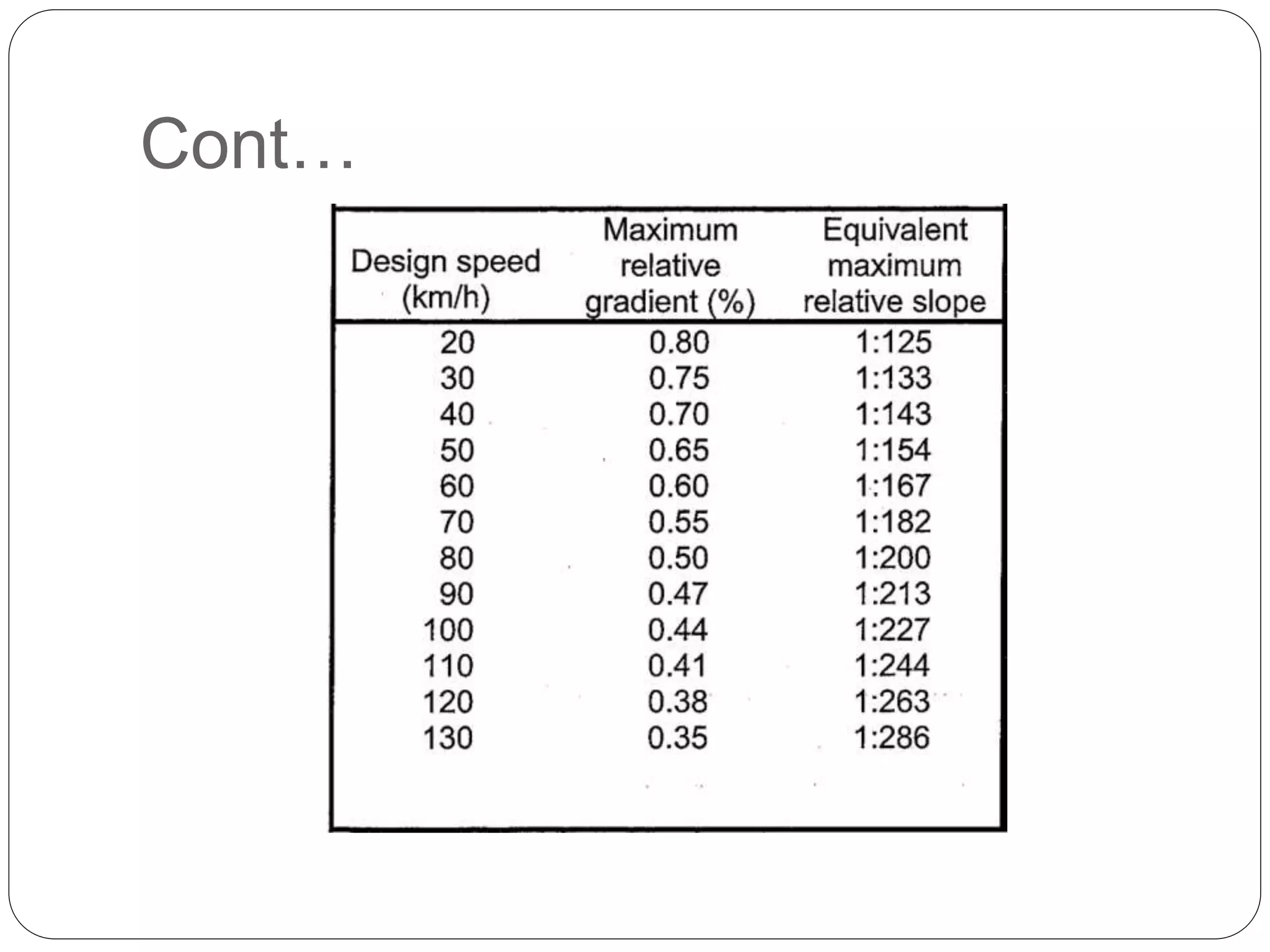
    Superelevation transition section consists: Superelevation runoff section: the roadway length needed to accomplish a change in outside-lane cross slope from zero (flat) to full Superelevation, or vice versa.  Tangent runout section: the roadway length needed to accomplish a change in outside-lane cross slope from normal cross slope rate to zero (flat), or vice versa.
  • 57.
  • 58.
  • 59.
  • 60.
    Cont… Super-elevation is started1/2 to 1/3 into the tangent with the balance being applied with in the curve
  • 61.
  • 62.
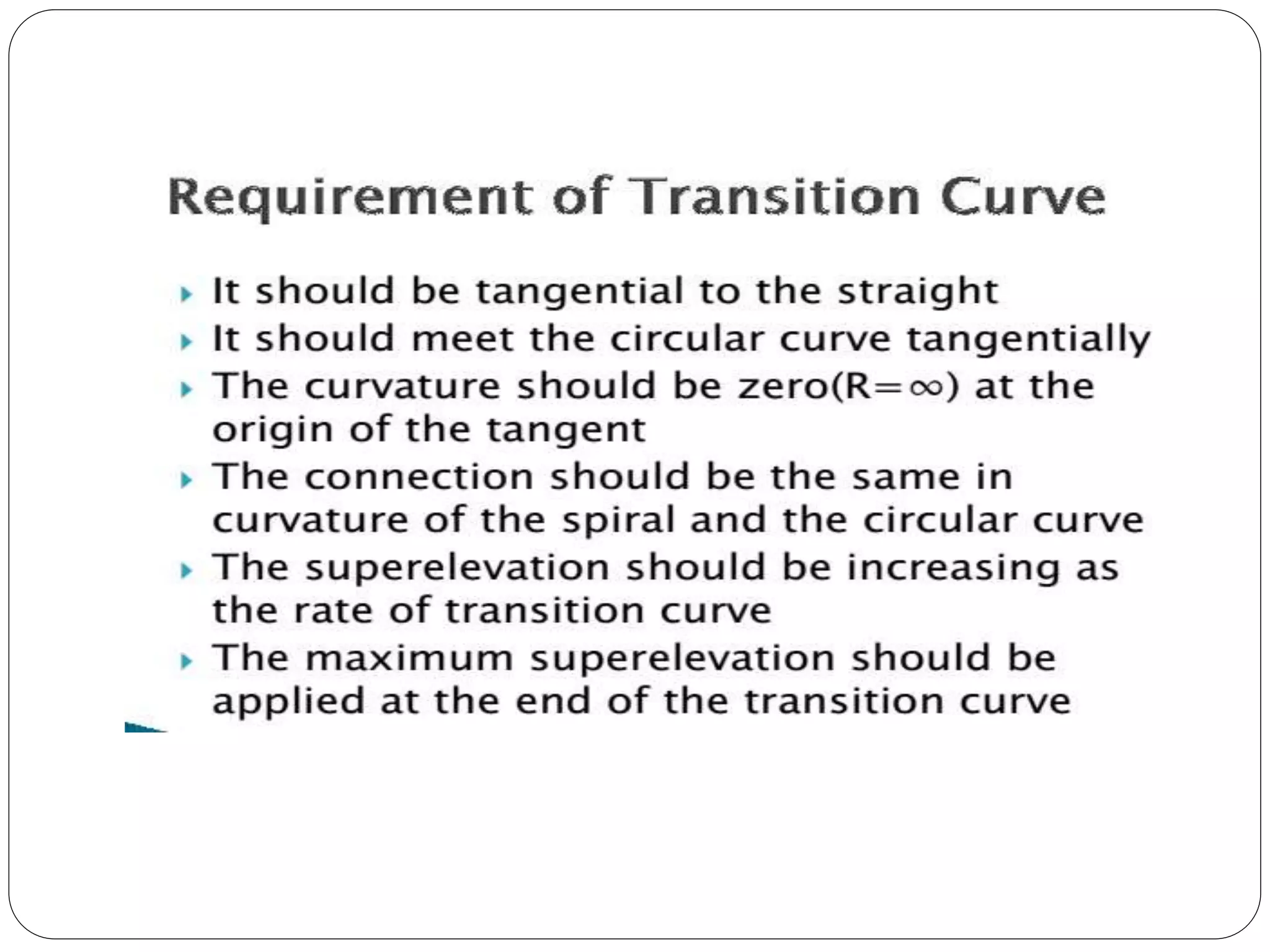
    Transition Curves Spirals arecurves which provide a gradual change in curvature from tangent to a circular path Advantages: •Provides an easy-to-follow path so that centrifugal force increases and decreases gradually; lesser danger of overturning/ side- slipping •Vehicle could keep to the middle of lane while traversing a curve •Is convenient for the application of super-elevation •Improved visual appearance 62
  • 64.
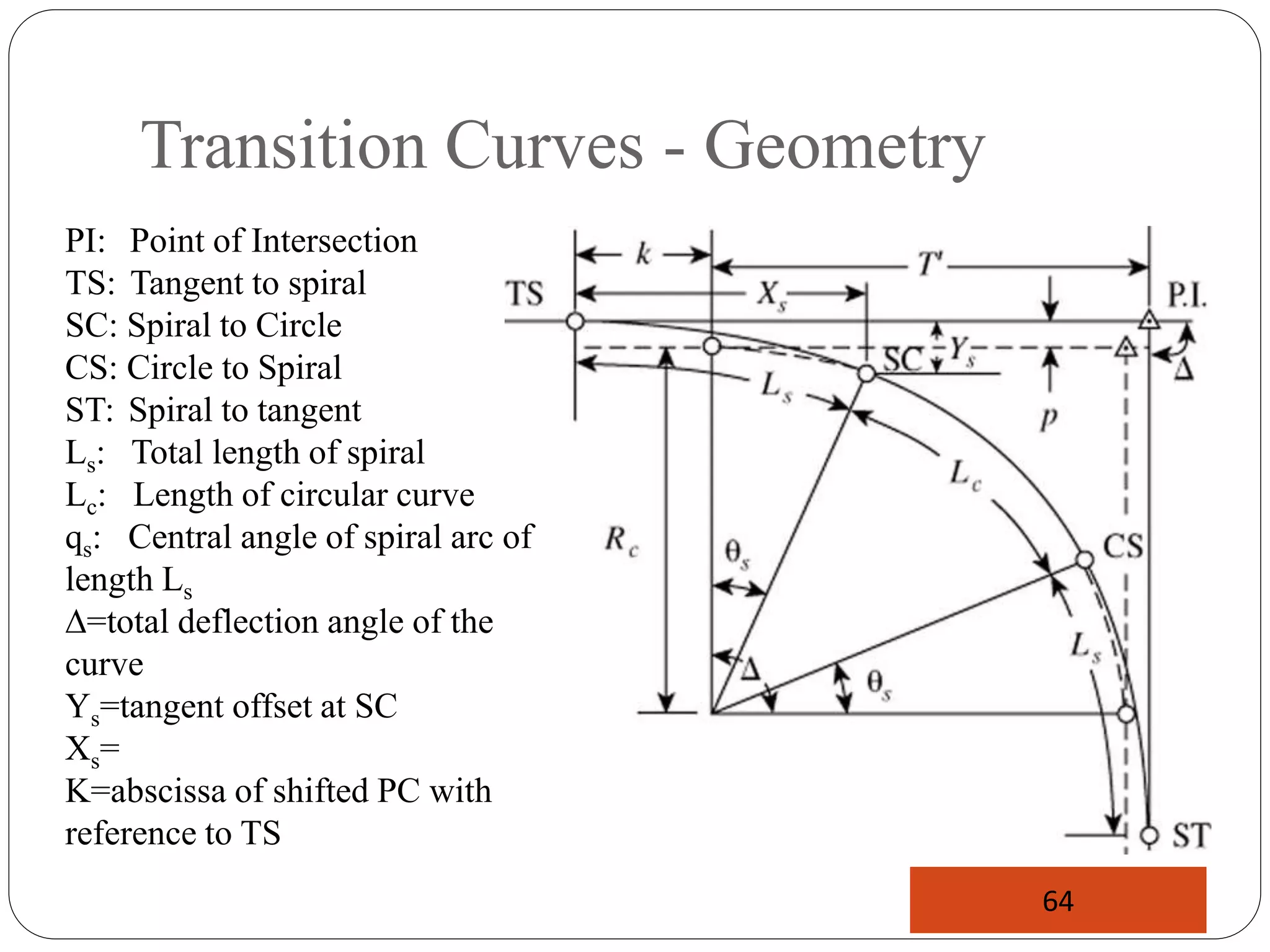
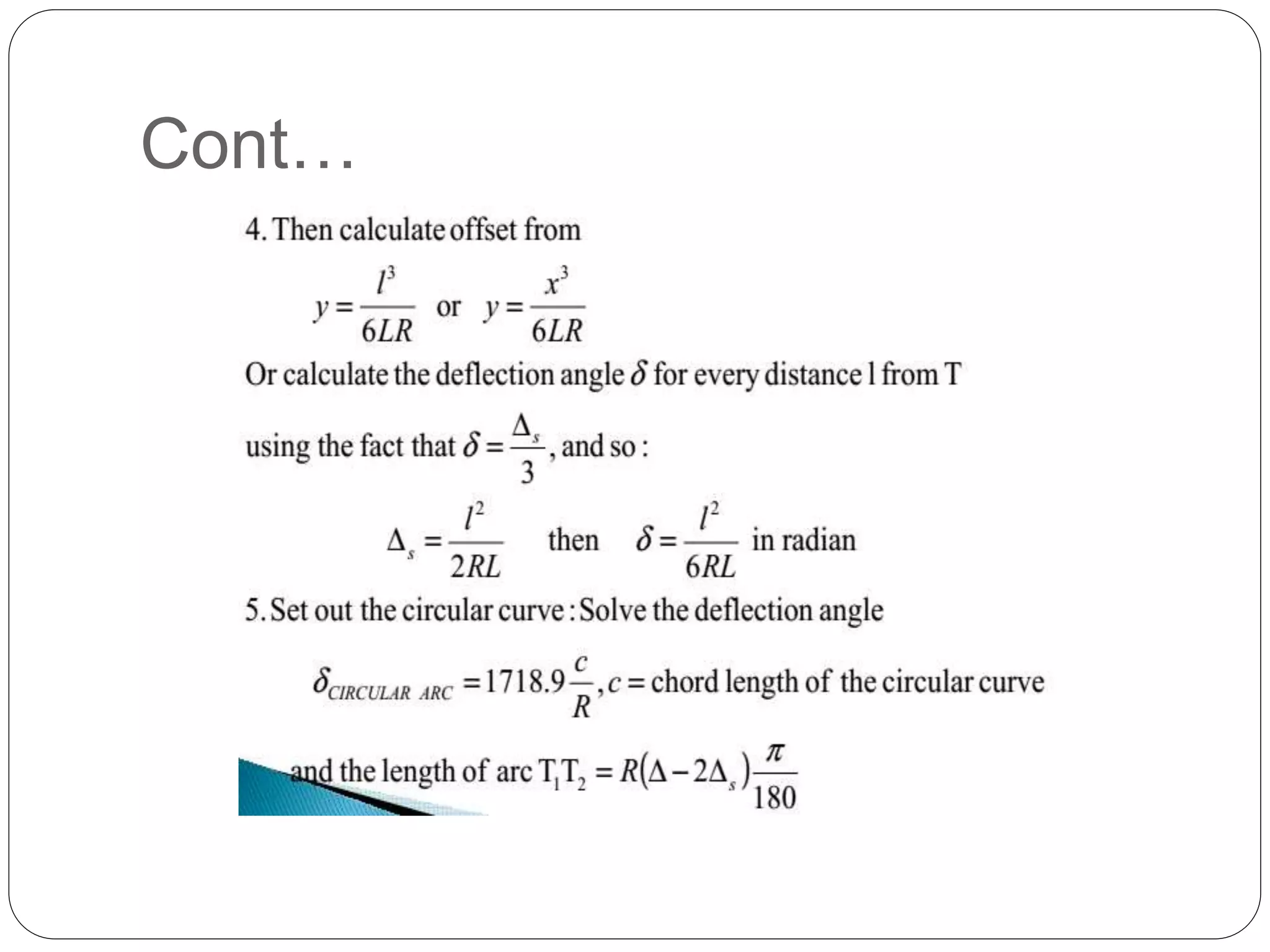
    Transition Curves -Geometry PI: Point of Intersection TS: Tangent to spiral SC: Spiral to Circle CS: Circle to Spiral ST: Spiral to tangent Ls: Total length of spiral Lc: Length of circular curve qs: Central angle of spiral arc of length Ls ∆=total deflection angle of the curve Ys=tangent offset at SC Xs= K=abscissa of shifted PC with reference to TS 64
  • 65.
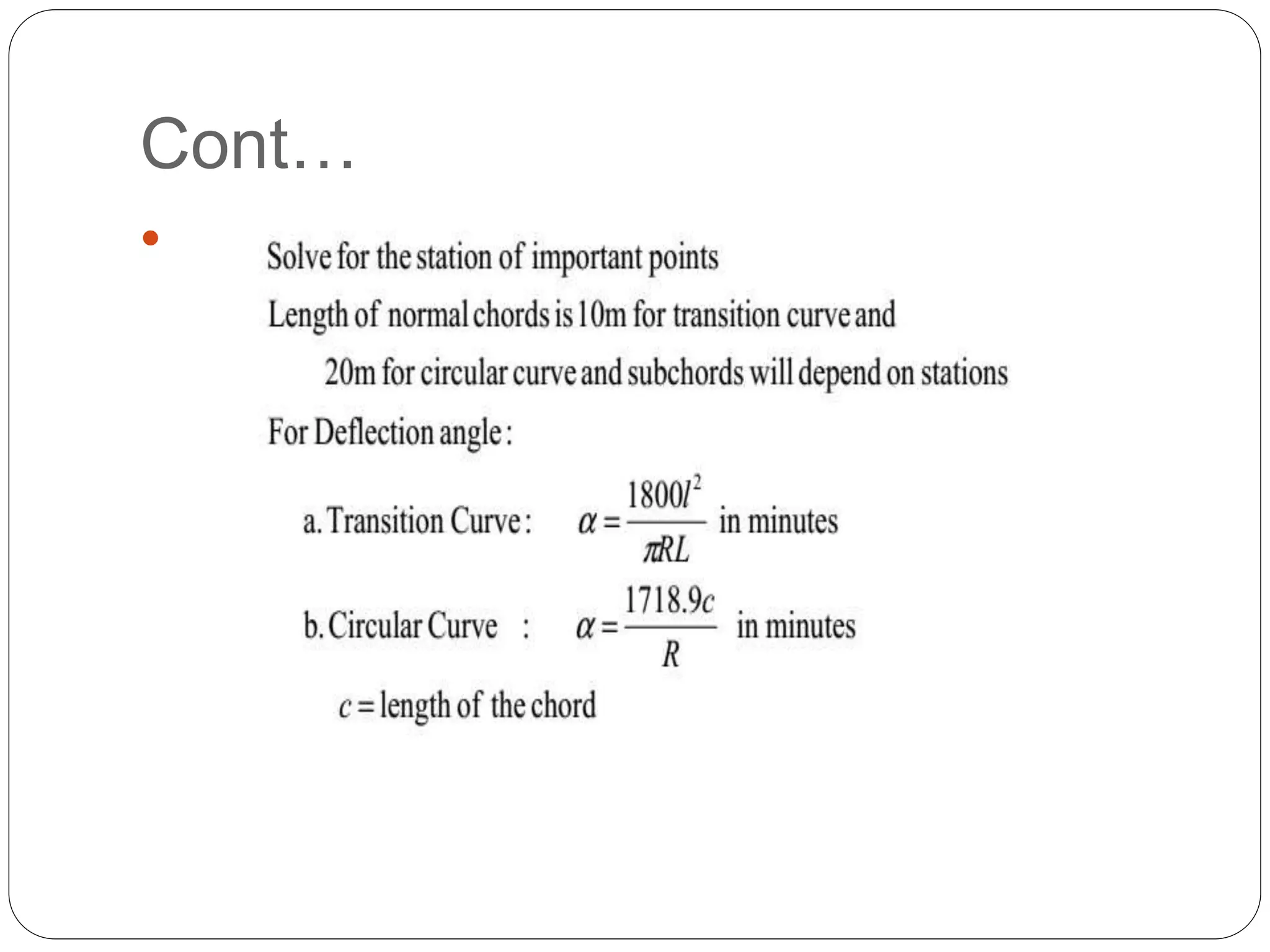
    Cont…  Some ofthe important properties of the spirals are given below:  L = 2Rθ  θ = (L / Ls)2 * θs  θs = Ls / 2Rc (in radians) = 28.65Ls / Rc (in degrees)  Ts = Ls /2 + (Rc + S)*tan(Δ/2)  S = Ls 2 / 24Rc  Es = (Rc + S)*sec(Δ/2) - Rc
  • 66.
    Length of Transition: Thelength of transition should be determined from the following two conditions: 1. The rate of change of centrifugal acceleration adopted in the design should not cause discomfort to the drivers. If C is the rate of change of acceleration,  Ls = 0.0215V3 / (C*Rc)  Where: V = speed (Km/hr) Rc = radius of the circular curve (m)
  • 67.
    Cont… 2. The rateof change of Superelevation (Superelevation application ratio) should be such as not to cause higher gradients and unsightly appearances. Since Superelevation can be given by rotating about the centerline, inner edge or outer edge, the length of the transition will be governed accordingly.
  • 68.
    Setting out oftransition curve from tangent
  • 69.
  • 70.
  • 71.
    Widening of HighwayCurves Need  Rear wheels don’t follow front wheels,  Trailers fitted on trucks, don’t follow path of trucks wheels  To have adequate sight-distances  Drivers tend to keep greater clearances with vehicles coming from the opposite direction and might thus move out of a lane when traversing a curve Extra width of pavement may be necessary on curves 71
  • 72.
    Cont…  The wideningrequired can be calculated from We = n *B2/ 2R + V /10√R Where: We = total widening B = wheel base R = radius of curve V = design speed (Km/hr) n = number of lanes
  • 73.
    Sight Distance onHorizontal Curves Considering a vehicle at A and an object at O, sight distance should at-least equal to safe stopping distance. If the angle subtended at the centre of the circle is 2, then Centre line of Road M Sight distance a measured along centreline of inside lane Sight line A O )) 65 . 28 ( 1 ( ) 2 3 . 57 ( , 2 3 . 57 180 2 R S Cos R m R S Cos Cos R m R R S R SD           73